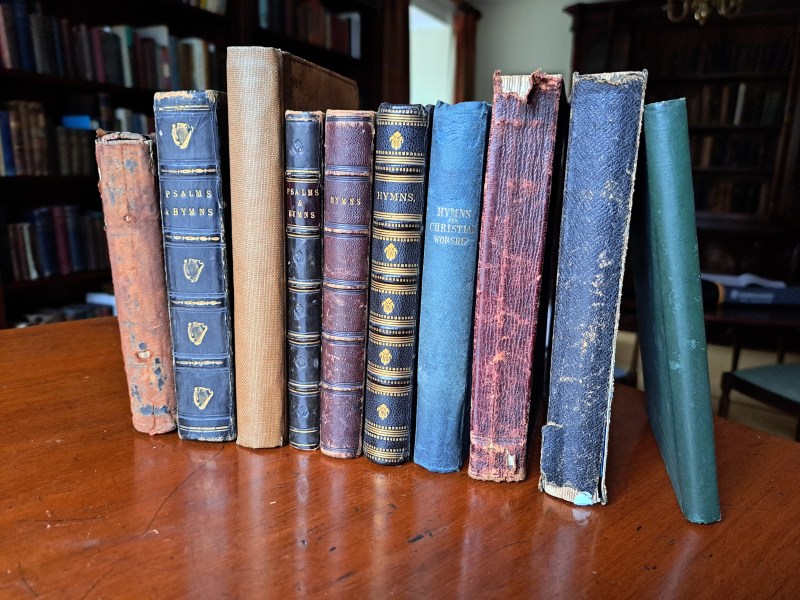
‘Let divine worship be observed, by all who would aspire after the happiness of heaven’. 19th-century Non-Subscribing Presbyterian Hymnbooks

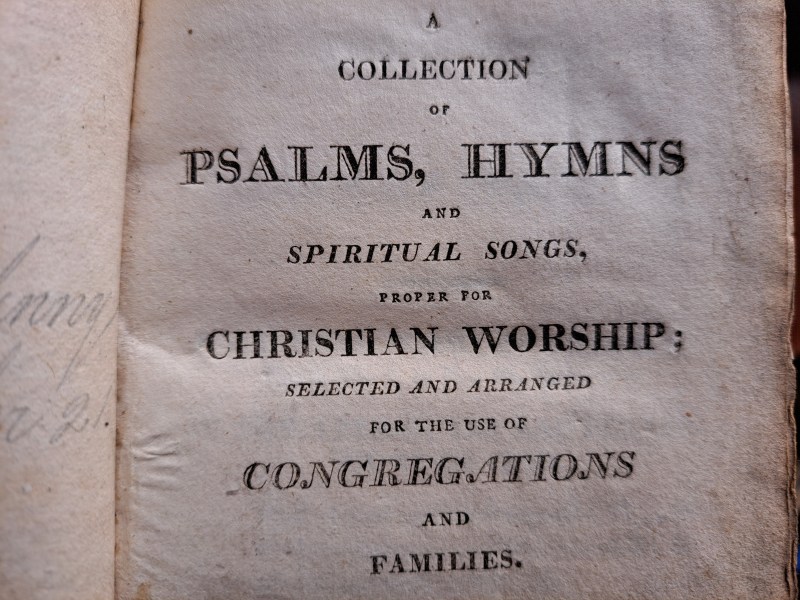
The title of this post comes from the Preface to A Collection of Psalms, Hymns and Spiritual Songs written by the Rev A.G. Malcolm for his hymnbook published in Newry in 1811.

Click on the video to explore Irish Non-Subscribing Presbyterian hymnbooks

Prior to about 1800 Non-Subscribing or New Light Presbyterian churches, in common with other Presbyterians, would have worshipped with a Psalter or Psalm book. The first distinctly Non-Subscribing hymnbook appeared in First Church in 1801. What is surprising about this publication is that in the same year Edward Bunting offered to supply an organ to the church. This offer wasn’t taken up although in just a few years the Second Congregation were to become the first church with an organ, First Church not acquiring one until 1853. The Rev William Bruce edited this collection and 1,200 copies were published. A choir seems to have led the singing which initially contained boys but was later expanded to include adults.
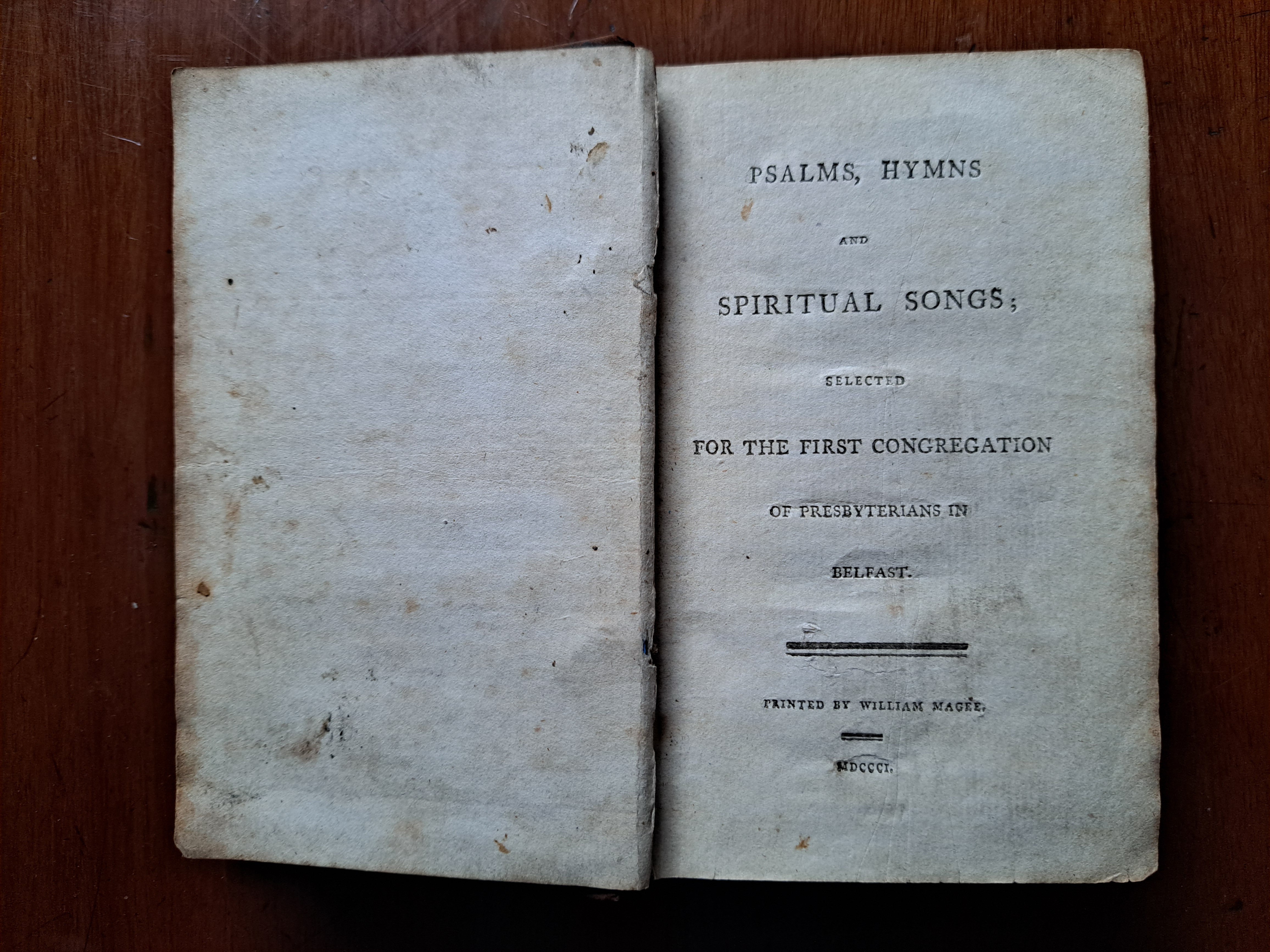
First Church’s Collection of 1801

William Bruce’s book contained 246 hymns, with an index of first lines and a brief one page table of subjects. The next hymnbook, the Newry edition of A.G. Malcolm, contained 405 hymns with a more substantial table of subjects running over eight pages. Plus it had an index of first lines with the names of authors (for example Barbauld, Watts, Doddridge, Kippis, Merrick, Wesley, Addison, Enfield) which showed the eclectic sources the book drew on from within Dissenting circles and beyond.

An interesting preface also explained their intentions:

…care has been taken, to select psalms and hymns, which treat of of the leading points both of faith and practice; and it is hoped, that the compilation will be found to contain a sufficient variety of the best compositions, in sacred poetry, adapted to all the principal subjects of Christian devotion.

A.G. Malcolm went on:

Correctness, both in sentiment and style, has also been made an object of considerable attention. Hence, many verses have been altered; and such psalms and hymns as seemed, in any degree, unsuitable to the simplicity and solemnity of divine worship have been omitted.

As the work is intended for general use, and must be expected to fall into the hands of persons, who unavaoidably differ from one another, in their opinions, on religious subjects, all expressions, which appeared likely to give offence to any sincere Christian, have been studiously avoided.

Interestingly the next hymnbook, dated Belfast, July 1818 and edited by Rev W.D.H. McEwen, made a similar point in a slightly more forceful way in its Preface:

Some doctrines are so offensive to the societies, for whose use this compilation is principally intended, that they are carefully avoided. As to others, the same scrupulosity is not observed; for, with respect to them, there may exist a diversity of sentiment. This selection may, therefore, be thought defective, but it will not disgust by a pertinacious obtrusion of doctrine.

So certain doctrines weren’t allowed to get in the way! Some were left out all together – the Trinity, the theory of the atonement based on penal substitution – and on some doctrines Non-Subscribers were able to agree to differ.
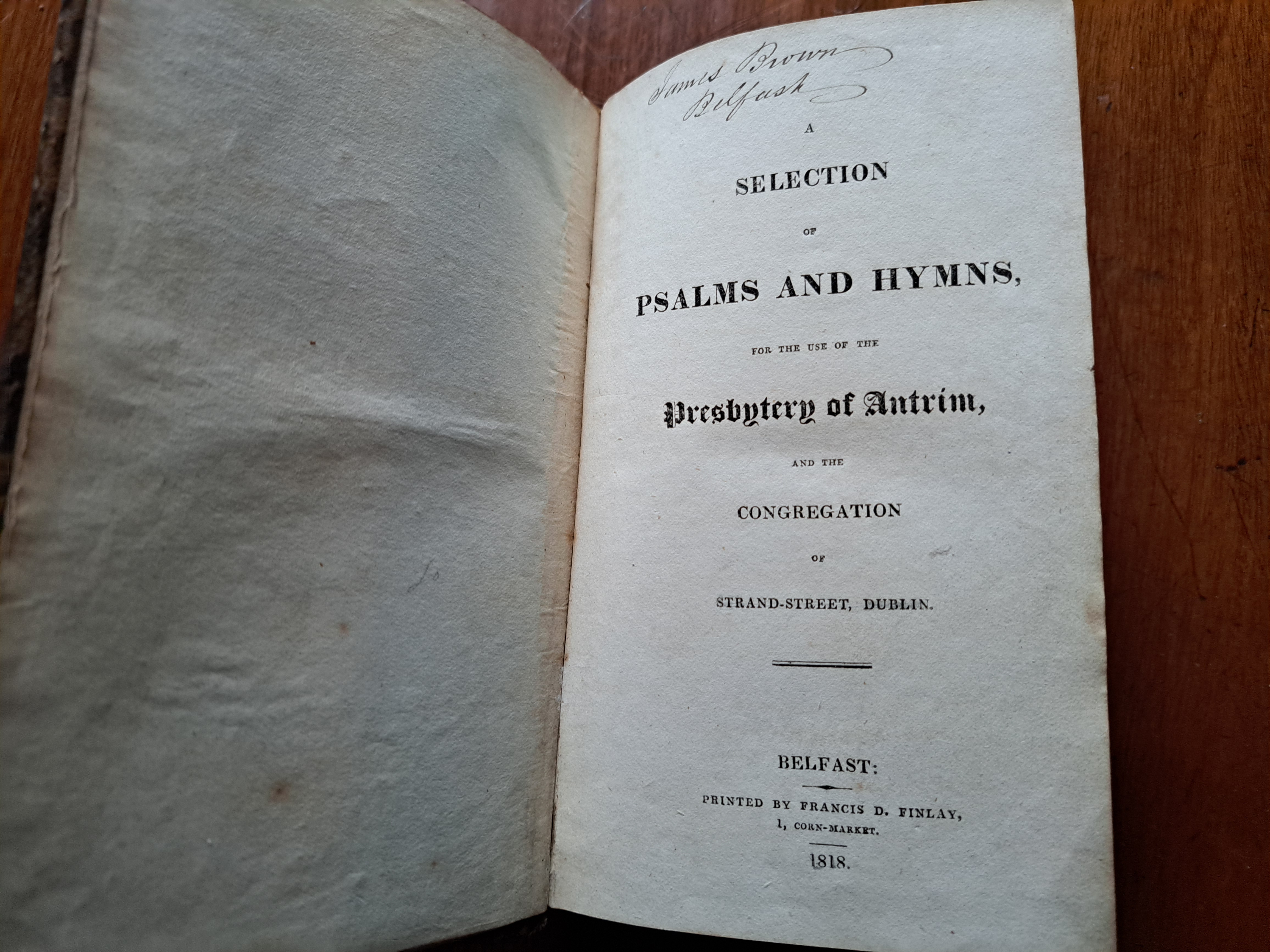
W.D.H. McEwen,s hymnbook

The book was published for the Presbytery of Antrim and the congregation of Strand Street, Dublin but it came from the minister of the Second Congregation. Curiously they had installed an organ in 1806 and had Edward Bunting as their organist from then until 1817. So they don’t appear to have had a hymnbook of their own for the first dozen years after installing the organ.

Following the establishment of the Remonstrant Synod of Ulster in 1830 Non-Subscribers moved towards the development of a hymnbook for all churches. This is Psalms, Paraphrases, and Hymns, for Christian Worship published in Belfast in 1841:
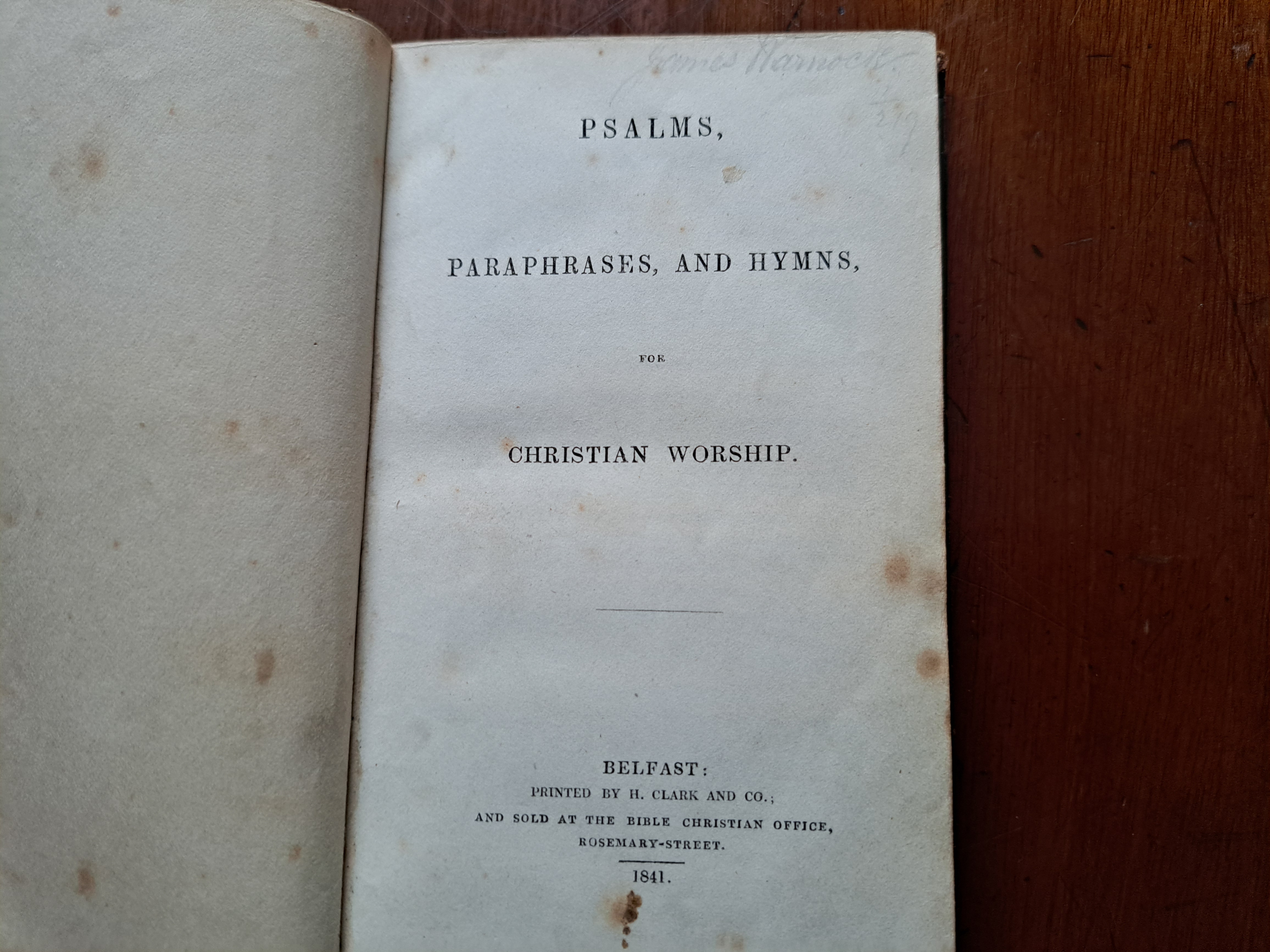
Psalms, Paraphrases, and Hymns, for Christian Worship 1841

This is the first edition of what became Hymns for Christian Worship, a book which went into at least four further editions before the end of the century and was followed by a supplement in 1899. Throughout this time this was the main series of hymnbooks in use in the churches in Ireland. More detail can be seen in the video above.

Transactions of the Unitarian Historical Society April 2025

The latest issue – Volume 28 Number 4 – is on its way to members of the Society, new members are always welcome and details of how to join can be found below.

As ever there is a great wealth of material in the journal, including:

Essex Street Chapel in the later eighteenth century: members, adherents and sympathisers

G. M. Ditchfield

Centenary Service at Essex Church 1874

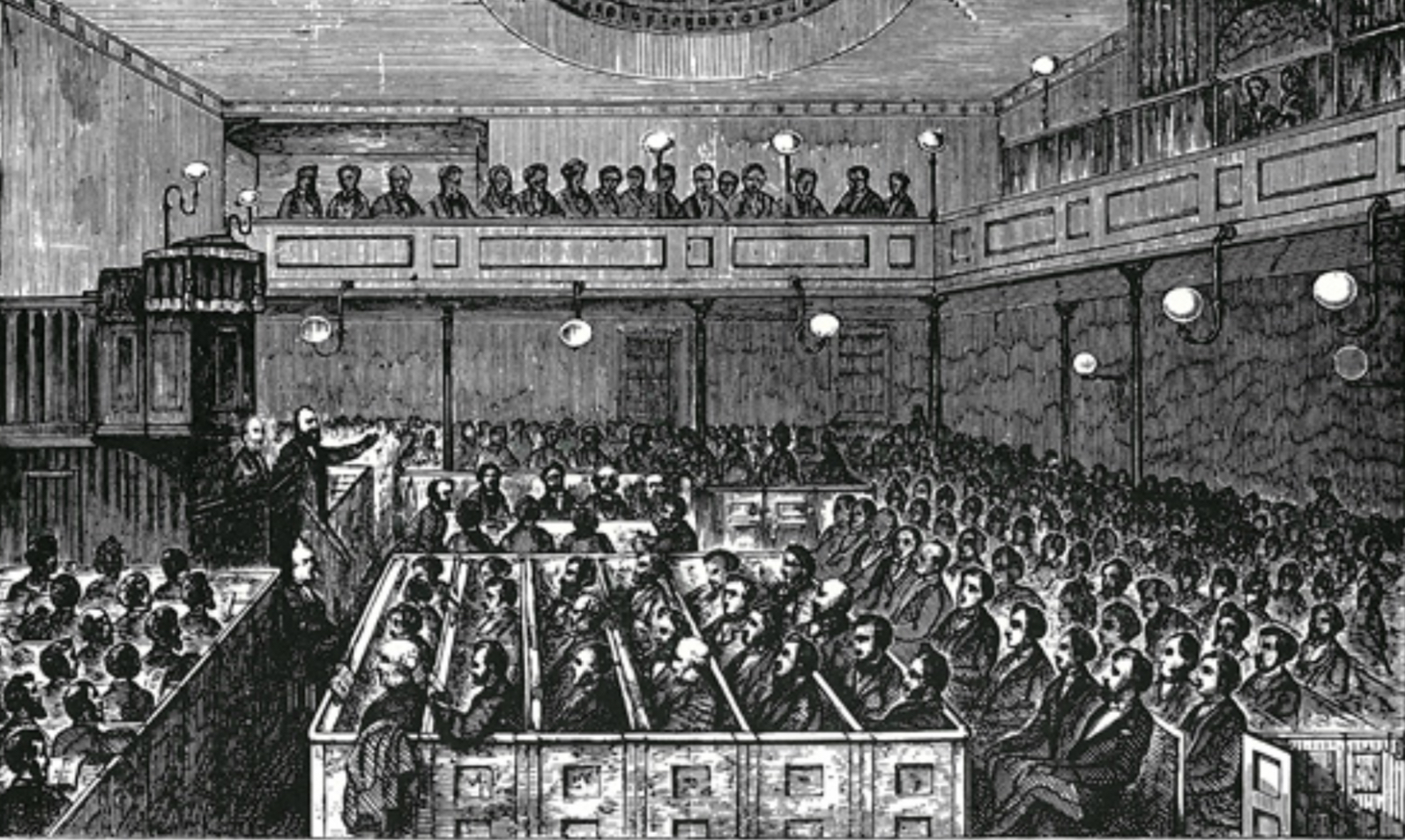
In this article Professor Grayson Ditchfield provides an analysis of the ‘associates, friends, visitors and even some critics of a congregation which has been, and remains, widely and deservedly regarded as a foundational pillar of the Unitarian movement in this country’.  In his paper Professor Ditchfield goes a long way to uncover the stories of the people who sat in the pews at Essex Street Chapel and looks especially at the role of women there. The Chapel was situated in a very impoverished area and Hannah Lindsey, the wife of the minister, organised poor relief for the local inhabitants. The congregation could not have survived without its female supporters in the early years in particular, and one member, Elizabeth Rayner, made an annual donation of £2,000. Essex Street Chapel included a number of MPs, including one described as `my fidgeting pew neighbour’ by another member. Some of the MPs made the free franking of letters in the House of Commons available to members! Was it a Dissenting Chapel or a reformed Church of England? Was it a congregation or an audience? All this and much more is examined in this fascinating article which breaks so much new ground.

After 1825 – celebrating the foundation of organised Unitarianism in Britain and America

Alan Ruston

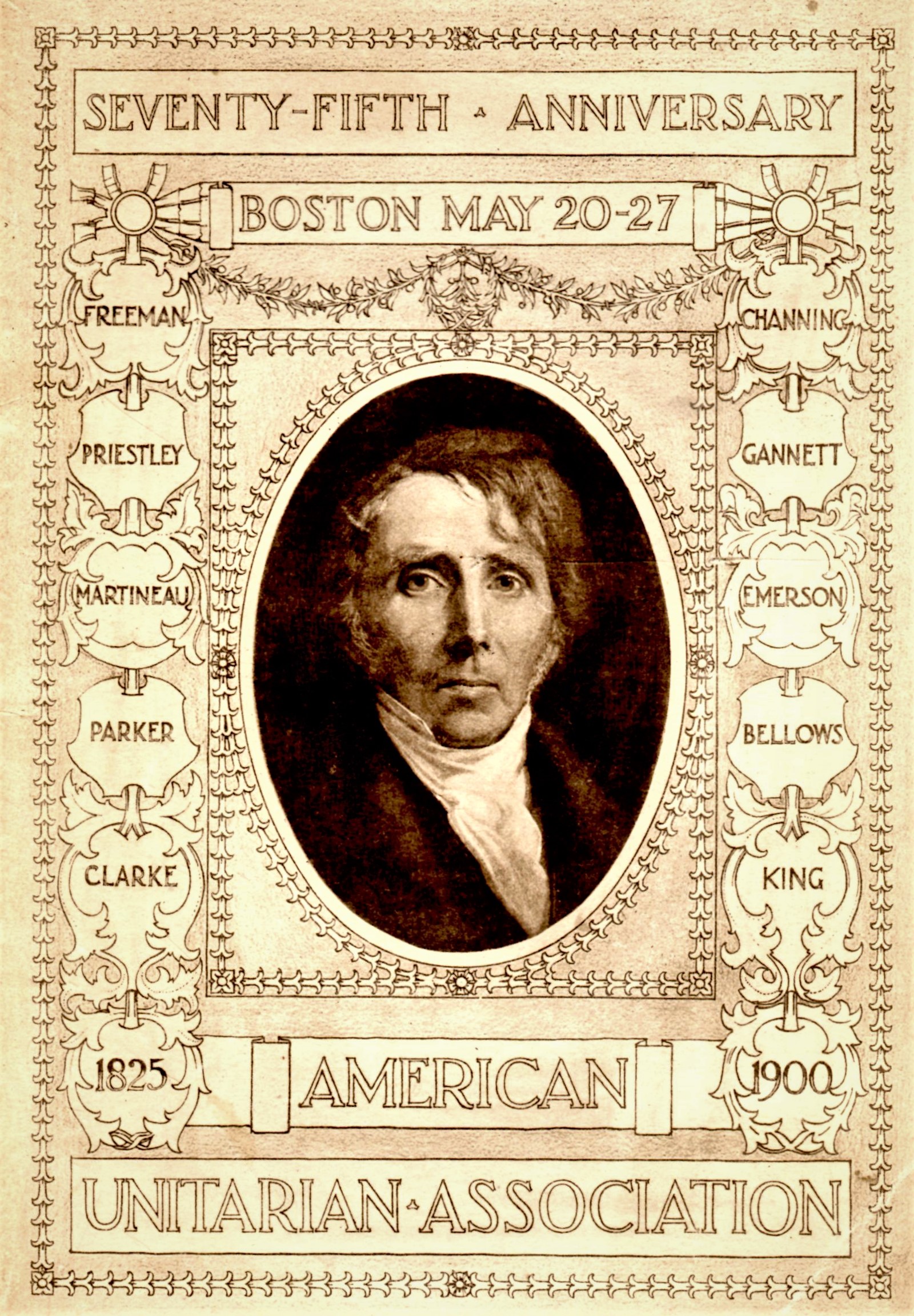
AUA 75th anniversary brochure cover

This year marks the 200th anniversary of the foundation of both the British and Foreign Unitarian Association (B&FUA) and the American Unitarian Association (AUA), both founded within a day of each other in May 1825. Alan Ruston investigates the way each anniversary has been celebrated in Britain and the USA. Both the B&FUA and the AUA have evolved over this time, the B&FUA really being superseded by the General Assembly in 1928 and the AUA being absorbed into the Unitarian Universalist Association in 1961 but the development of both bodies over two centuries tells us a lot about the development of Unitarianism in both countries and the interaction between British and American Unitarianism.

Notes

Alexander Gordon on James Martineau: An Evaluation

Alan Ruston

Very Rev William McMillan Library

David Steers

Very Rev William McMillan Library, Dunmurry

Dr Williams’s Trust.Announcing a New Partnership 

The University of Manchester Library and The Dr Williams’s Library 

REVIEWS

Daisy Hay,Dinner with Joseph Johnson: Books and Friendship in a Revolutionary Age, (Chatto & Windus, London, 2023) ISBN 9781784740184. 528 pages. Price £20.

Reviewed by Derek McAuley

Ben Stables, From Pigeon Flying to Intellectual Liberty. The History of Pepper Hill Unitarian Chapel in Shelf, West Yorkshire. With an Introduction by Rev John Midgley. Published by Pepper Hill Unitarian Chapel, 2024. 100 pages. Price £6. Copies are available directly from the author (benstables@hotmail.co.uk).

Reviewed by David Steers

Kazimierz Bem and Bruce Gordon (eds), Antitrinitarianism and Unitarianism in the Early Modern World, Palgrave Macmillan, 2024, 397 pages. ISBN 9783031696572, price £119.99; eBook ISBN 9783031696589, price £99.99.

Reviewed by Alan Ruston

Back to Life, The People on the Plaques in Brighton Unitarian Church, 2023, 95 pages. Price £8 including postage; copies can be obtained from Christine Clark-Lowes (cjclarklowes@yahoo.co.uk).

Reviewed by Alan Ruston

OBITUARY

John Jeremy Goring, MA, PhD (1930-2023)

by David L. Wykes

An individual annual subscription costs just £10.

Visit the Unitarian Historical Society website to join: https://unitarianhistory.org.uk/

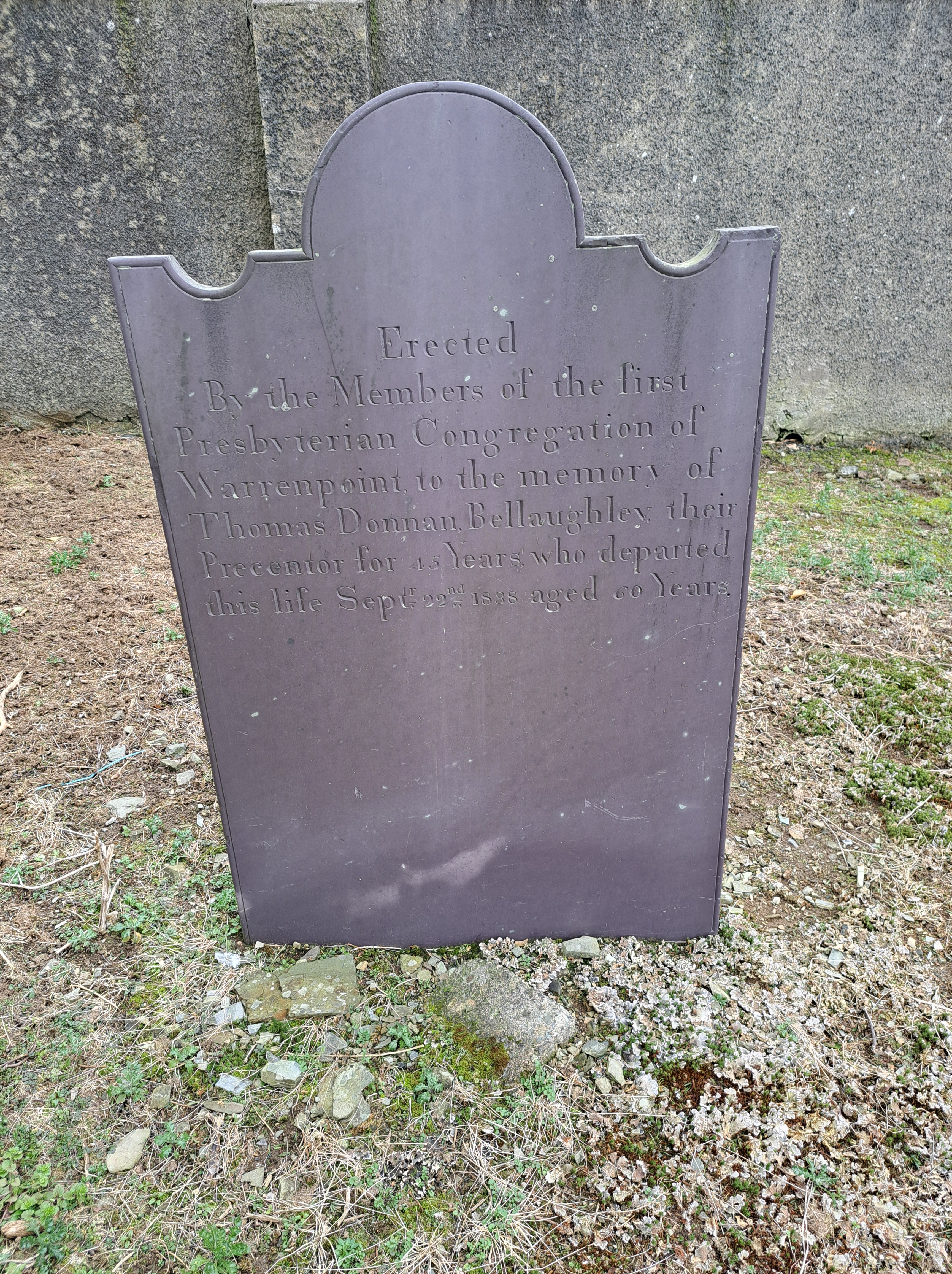
The Precentor’s Grave at Warrenpoint

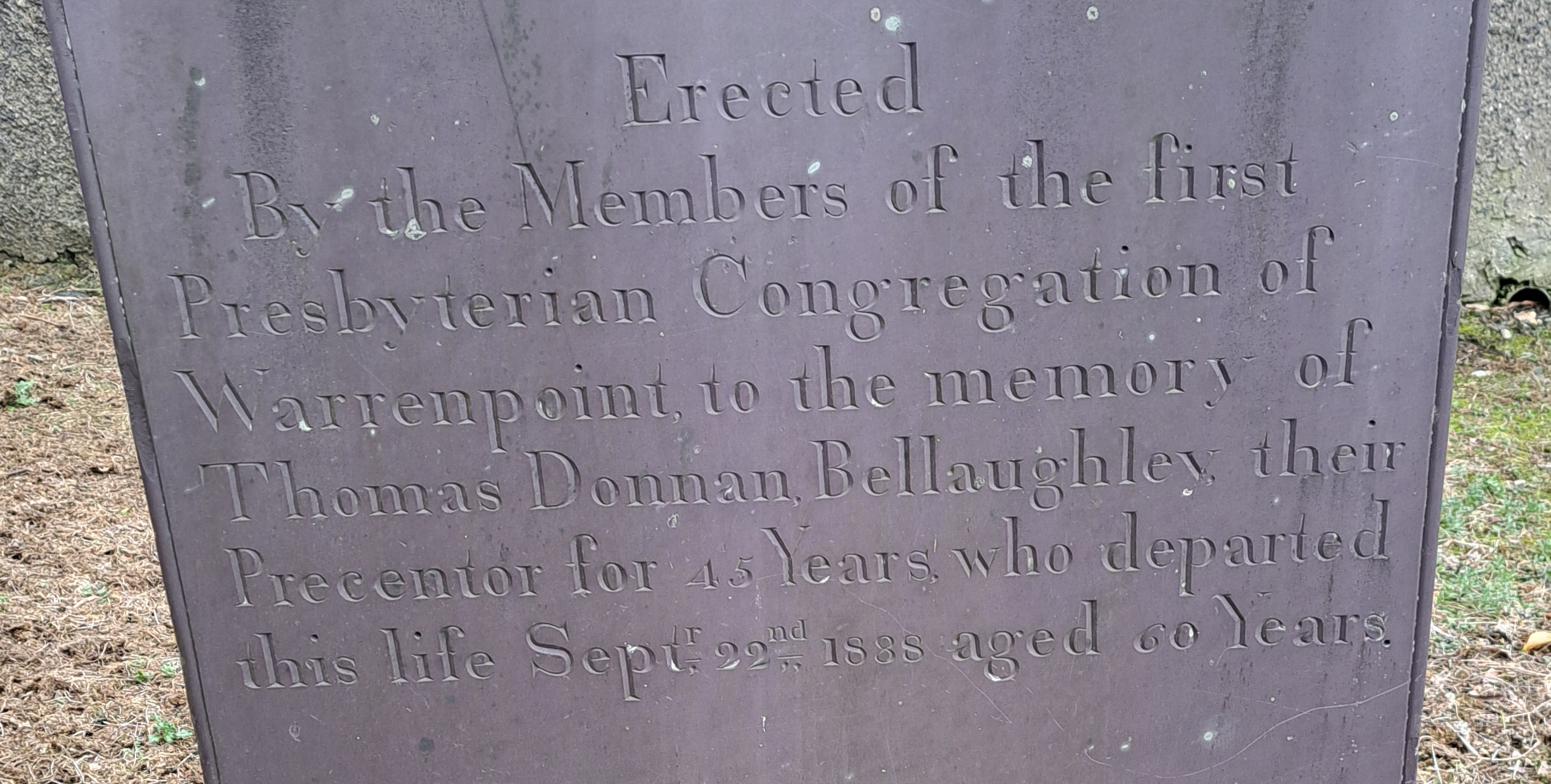
On a recent visit to Warrenpoint I noticed this gravestone and took a picture. Carved, it would appear, on a sheet of slate, the inscription is sharp and clear and I initially assumed it would be older than the date actually indicated. I didn’t have much time to study it but I am glad I took a picture, it is a fascinating artefact, a tribute to a key member of this congregation for almost half a century.

Thomas Donnan, of Bellaughley, was the Precentor of the Warrenpoint Non-Subscribing Presbyterian congregation for 45 years up to his death in 1888. He was 60 when he died so he must have been just 15 when he commenced this work in 1843.

It’s an intriguing gravestone because while it clearly tells of the high esteem in which Thomas Donnan was held and the long period of time he faithfully led the congregation in their singing it opens up so many more questions. Who was he? Did he have a family? Did he have any formal training in music? Did he have any other responsibilities or source of income?

Although a Non-Subscribing Presbyterian congregation the First Presbyterian congregation of Warrenpoint must have hung on to their traditional worship forms in singing by being led by the Precentor for a long time, perhaps because Thomas Donnan provided such acceptable leadership to them in their music.

It’s interesting that close by in Newry the New Light minister the Rev A.G. Malcolm produced one of the first hymnbooks in use in any Presbyterian church in Ireland in 1811 with his Collection of Psalms, Hymns and Spiritual Songs proper for Christian Worship; selected and arranged for the use of Congregations and Families. But this doesn’t seem to have been used in Warrenpoint.

In her tercentenary booklet of 2007 Across the Narrow Water (the congregation of Warrenpoint was originally known as Narrow Water) Elaine Crozier records that in 1841 the committee appointed ‘a teacher to teach the choir’ at a salary of £3 per year. Was this the prelude to the appointment of Thomas Donnan? Undoubtedly connected with his eventual appointment was a decision in 1842 that ‘the new collection of psalms compiled by the Remonstrant Ministry be put into the hands of the families belonging to the church.’ This would be the 1841 publication Psalms, Paraphrases, and Hymns, for Christian Worship published in Belfast by the Bible Christian (the main Non-Subscribing Presbyterian journal), Rosemary Street. It must have been this book that provided the basis for congregational singing in Warrenpoint led by Thomas Donnan although the book was gradually expanded as the century wore on with hymns from other sources. All this took place during the long and effective ministry at Warrenpoint from 1836 to 1867 of the Rev Samuel Moore. Born in Rademon and educated at Glasgow University he enjoyed some success as minister of Warrenpoint although the congregation faced the heavy difficulties of the Famine during his ministry.

From 1843 onwards, though, Thomas Donnan was leading the praise. If they were using Psalms, Paraphrases, and Hymns, for Christian Worship they had already taken a step away from using a traditional Psalter and this does, perhaps, suggest that the Precentor was also leading a choir. But there at the centre of their congregational life was this young man appointed at the age of just 15 and leading the congregation’s worship for the next 45 years to their evident satisfaction