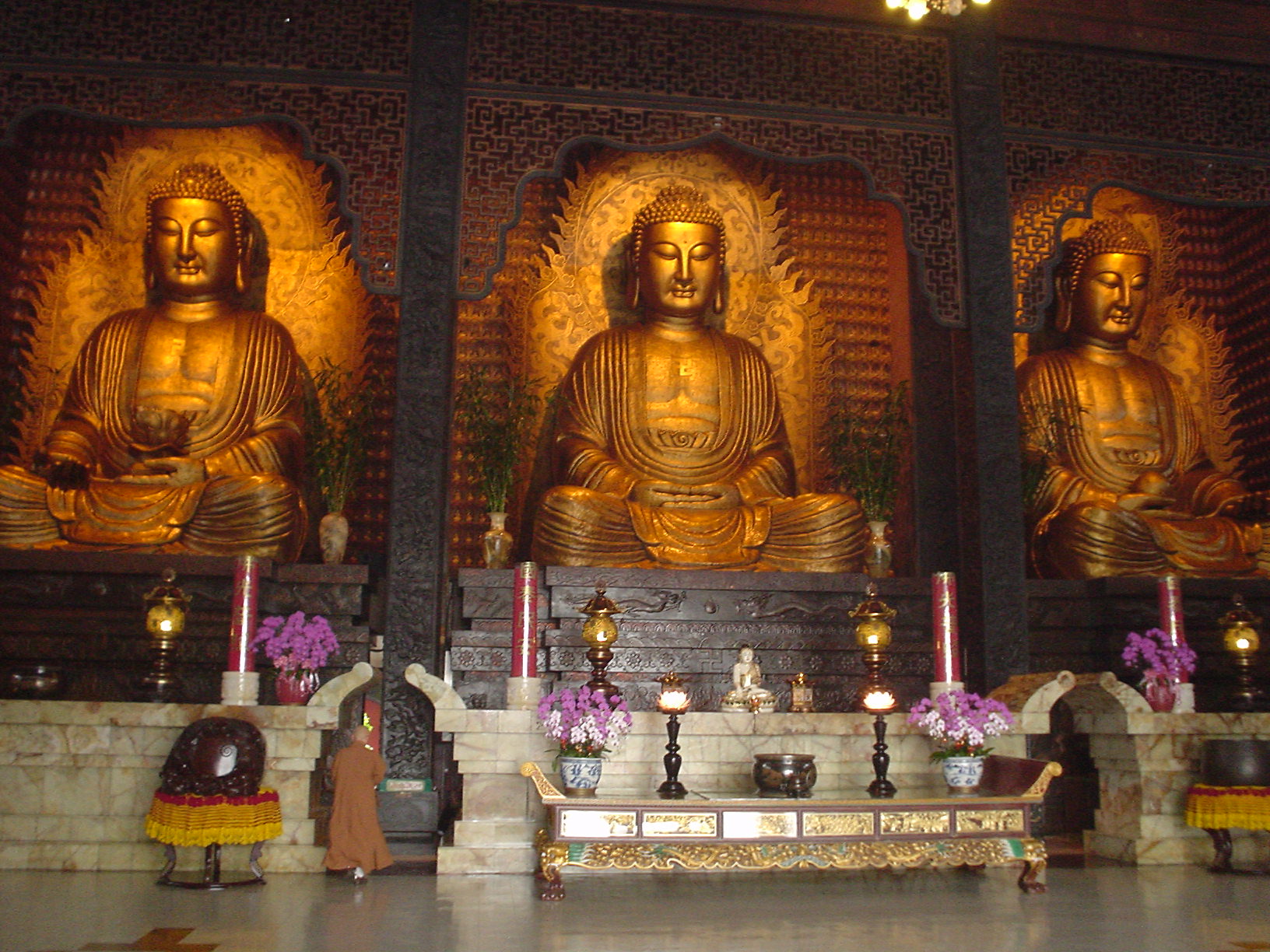
If you saw a copy of last year’s Faith and Freedom Calendar then you will recognise the three images on this page as from that publication. Last year’s Faith and Freedom Calendar was well received and helped to raise a good sum for the charity Send a Child to Hucklow Fund (SACH). The journal is planning to publish another Calendar for 2016 the proceeds from which will again go to the SACH.
Princes Road Synagogue Liverpool (January 2015)
Next year’s theme will be: Faith in the World
The publishers invite anyone to submit photographs for consideration for inclusion in next year’s Calendar in accordance with this theme. Please interpret the theme as broadly as you like – an act of worship, a faithful community or individual at work, a symbol of faith, a place of worship, it is up to you. However, the photograph should be your own work and you must be happy to give permission for it to be used in the Calendar should it be selected for inclusion. Photographs can be in colour or black and white, they should be landscape in orientation, of high resolution and sent, by email, to n.clarke884@btinternet.com
Pet service at St Andrew’s United Church, Kirton Lindsey, North Lincolnshire (March 2015)
All successful entrants will be sent a free copy of the Calendar and have the satisfaction of being part of an interesting project that shares the diversity and vibrancy of faith and which will also help to raise money for SACH. We may be able to include a broader number of pictures submitted in the journal’s website.
If there is a seasonal element to your entry please state it in your accompanying email as well as when and where it was taken. Please remember also that parental permission is usually required if your picture includes children under the age of 18. The deadline for submissions will be 18th September 2015.
Buddhist Temple, Fo Guang Shan Monastery, Kaohsiung, Taiwan (August 2015)
I have sometimes been tempted to write a blog or a column entitled ‘The things I buy on eBay’. I have picked up lots of pieces of ephemera at very low cost on eBay which while certainly bearing very little intrinsic value and generally falling into the category of junk nevertheless have some historical interest.
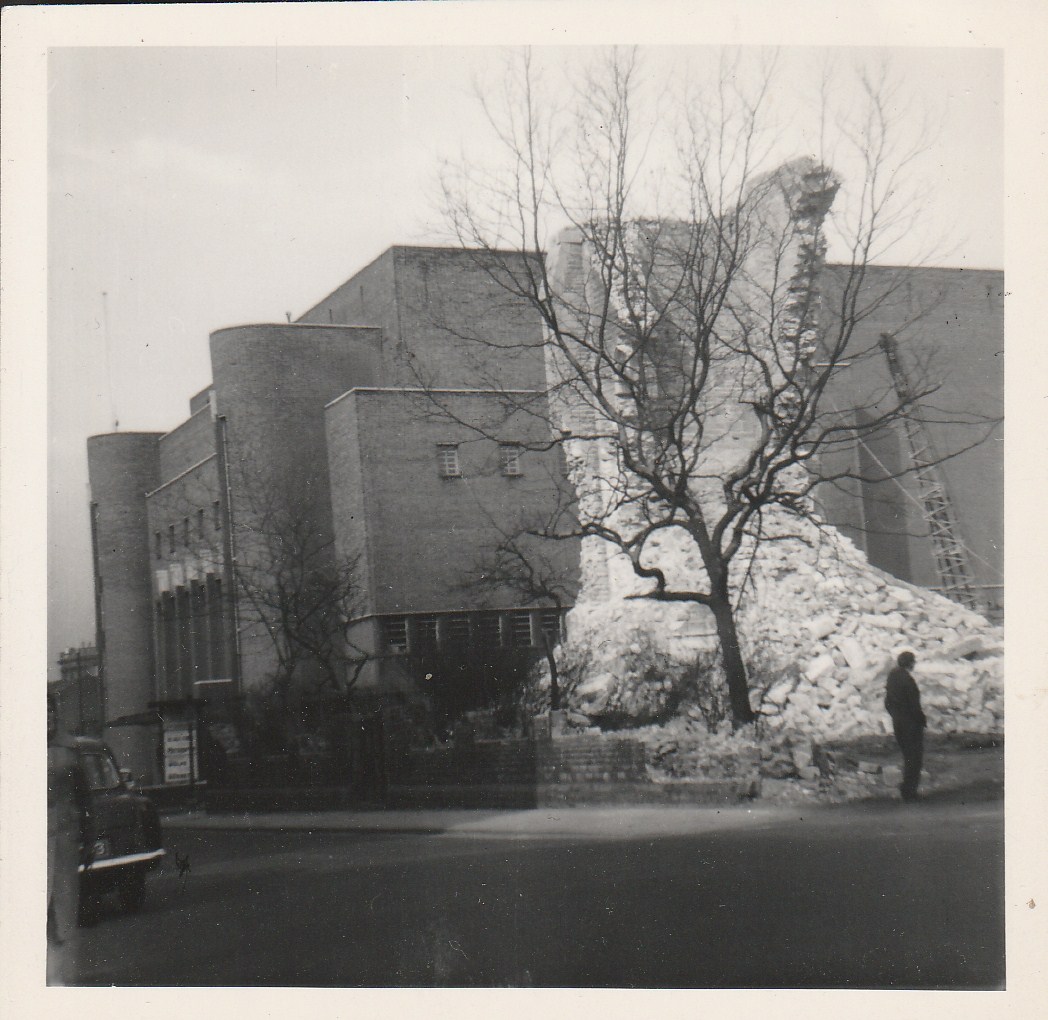
Hope Street Church, demolition 1962
The photograph above is a good example of this. It cost just 99p (which I suppose is actually quite a lot for a single, slightly blurry print) but it shows the very end of Hope Street Unitarian Church in Liverpool. Taken in 1962, probably by someone who habitually recorded views of buildings which he thought might one day be interesting, it catches the tower in the final stage of demolition. Somewhere under the rubble was a brass plate and a “hermetically sealed vase” containing a list of members, ground plans of the old and new chapels, a report of the congregation’s school, a plan of Liverpool, a print of the Dissenters’ Chapels Act, an engraved portrait of the minister and all the local papers from the week before the laying of the foundation stone on 9th May 1848. It was a sad end to a building that was opened for worship in 1849 and which occupied a prominent place in the city. Indeed it seems a shame that such a site, midway between the two cathedrals, could not have been saved for future use. It would be a great site today with enormous potential. But it is easy to be wise after the event, the world must have looked quite different to what was presumably a small and discouraged congregation by the early 1960s.
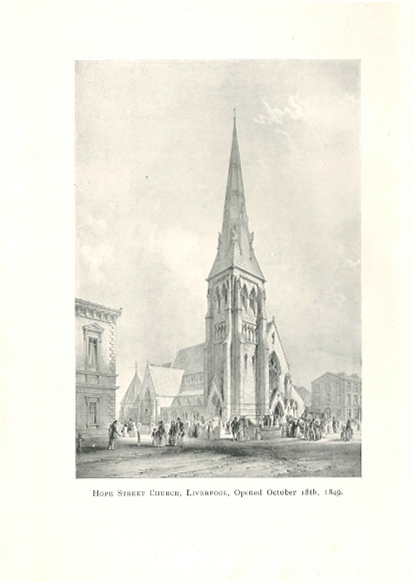
Hope Street had certainly known rather more glorious days. Built by James Martineau’s congregation to provide a place of worship that suited his style and popularity it was a thorough-going gothic construction that reflected his devotional approach. The classic image of it is this one:
Hope Street Church
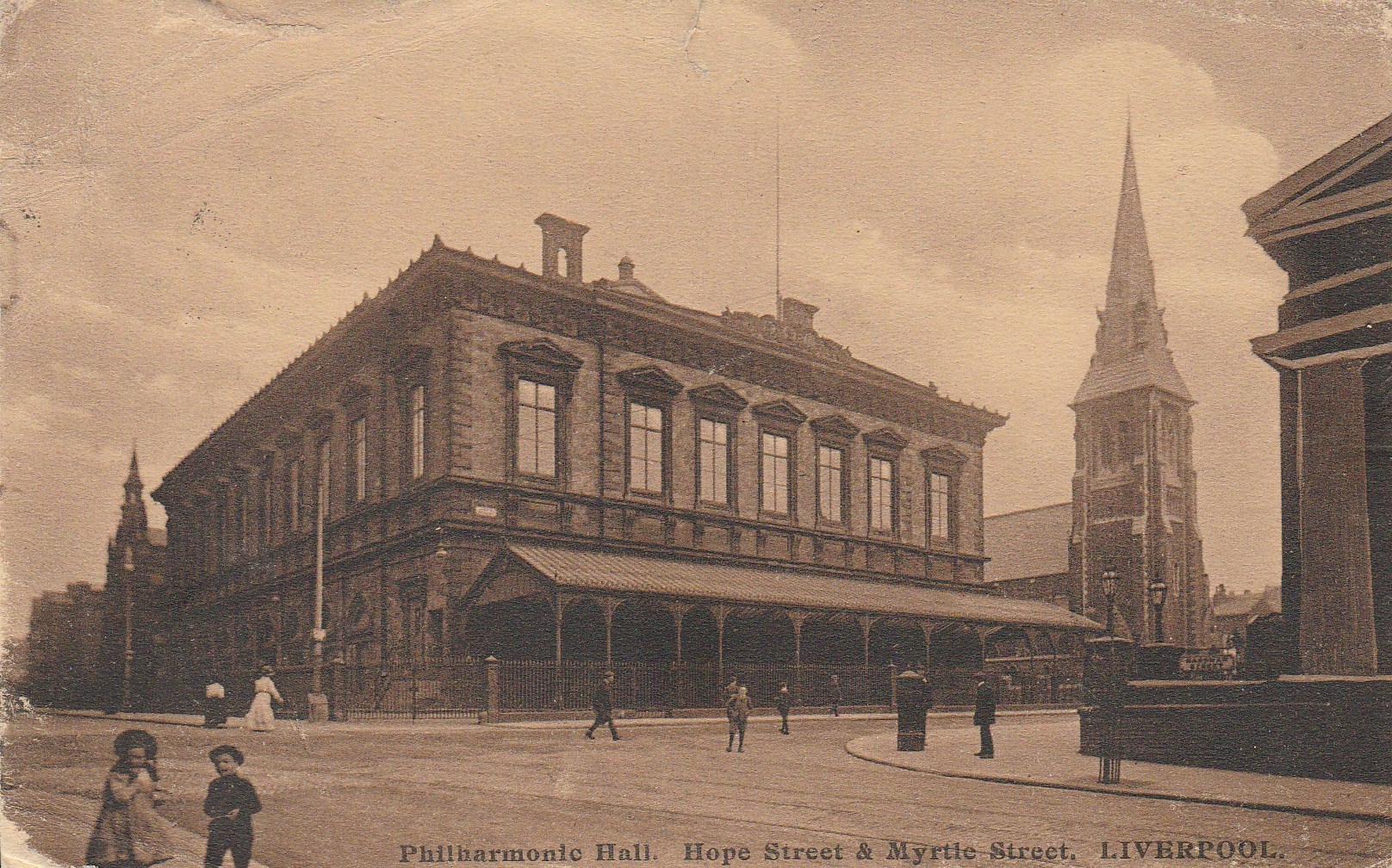
Its relationship to the next-door Philharmonic Hall can be seen from this Edwardian postcard. The original Philharmonic burnt down in the 1930s and was replaced by the present building in 1939. In the picture the classical church opposite, the corner of which can just be seen on the right of the postcard, was the Church for the Blind, attached to the Liverpool School for the Blind which was situated on Hardman Street.
Next door to the Philharmonic
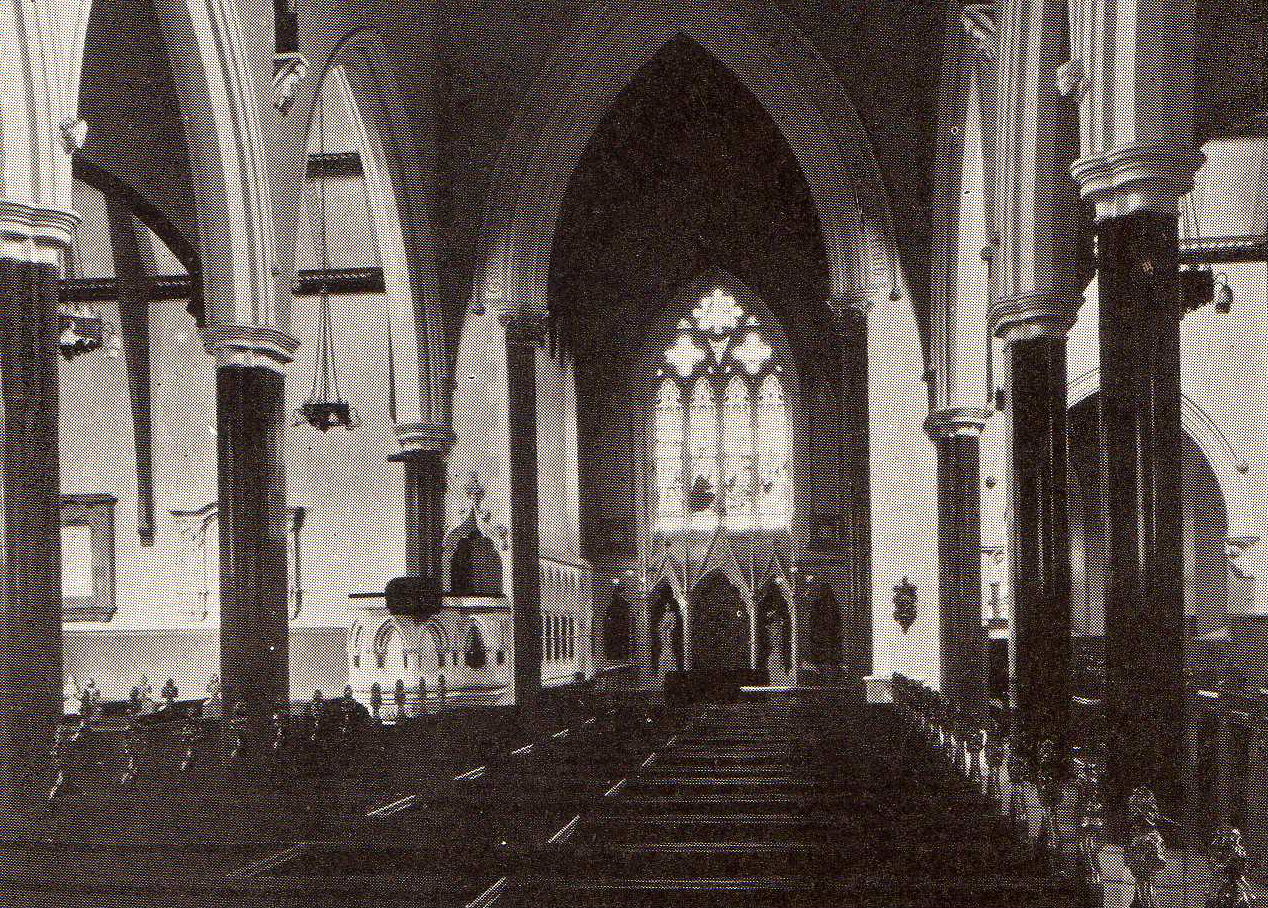
Nothing really remains of Hope Street Church today. Photographs of the interior are intriguing. This scan isn’t great but it shows the view looking towards the pulpit, the chancel and the font.
Church interior
After James Martineau and before the First World War the congregation had some high profile ministers including Charles Wicksteed, Alexander Gordon and Richard Acland Armstrong. The 1920s saw a revival of fortunes under the radical ministry of Stanley A. Mellor who mixed an advanced theology with Socialist ideas. But the crowds that came out to hear him did not last and by the time of the eccentric ministry of the highly scholarly Sidney Spencer the numbers were starting to reduce.
In the Winter 2008/9 of the Merseyside District Unitarian Newsletter The Honourable Dr Frank Paterson, a former member of Hope Street and a very distinguished circuit judge who died in 2014, wrote his reminiscences of the Church. They are a fascinating and rare account of the congregation in the twentieth century. I place them here with due acknowledgment to the MDMA Newsletter:
I reflect with pleasure on my childhood and early manhood, when I frequently accompanied my father to the morning and evening services. He had a wide interest in almost every religious creed. In latter years he reminded me of a character in Shaw’s Major Barbara who declared that he had studied several religions and found that he would be perfectly at home in any one of them. Having been born into a Scots Presbyterian household, he was attracted by the preaching of Dr Charles Aked, the charismatic minister of the then Pembroke Baptist Chapel in Liverpool, where he met my mother, whom he married in 1911. After the departure of Dr Aked for the United States (to what was known as ‘The Millionaires’ Church’ on 5th Avenue), my parents transferred their allegiance to Hope Street Unitarian Church to enjoy the benefits of the preaching of the Reverend Stanley Mellor. Following his death, they continued to attend Hope Street church throughout the ministry of the Reverend Sidney Spencer, I do not think my mother took any interest in the details of religious faiths, but was content to fulfil what she regarded as a spiritual duty by attendance at a church on a Sunday. It is perhaps not surprising that the idea of a free religious faith always appealed to me. It gave me great pleasure to follow in my father’s footsteps as chairman of the Hope Street Committee, which awakened in me the desire to enter a calling where I could participate in the cut and thrust of debate, and to promote harmony where there has been discord.
It has therefore been a source of satisfaction to me to find that Hope Street had its origins on the site of what is now The Queen Elizabeth II Law Courts, where I have spent the greater part of my professional life. When the buildings were opened by Queen Elizabeth II, I happened to be one of the longest standing circuit judges of the court and had the honour of being presented to Her Majesty. Whilst waiting for the ceremony I was placed in a line of those about to be presented immediately between the Anglican Bishop of Liverpool on one side and the Catholic Archbishop of Liverpool on the other. I regret I didn’t have the courage or the time to remind these prelates that I felt like the wonderful white church that once stood half way between the Anglican and Catholic cathedrals in Hope Street.
When I was a child services at Hope Street were almost as well attended as the Hope Hall Cinema (now the Everyman Theatre) down the road, and in order to secure two seats together my father was obliged to apply to the Church Secretary, Mr William Letcher. There was an interval of several weeks before a reply was received notifying my father that two places had been reserved for himself and my mother, and on the following Sunday they were met in the vestibule by Mr Letcher to be escorted past the queue waiting to be seated and down the aisle to a pew four rows from the front, on the back of which was a card bearing their names. This remained what we regarded as our family pew until the church was demolished several decades later. William Letcher remains in my memory as a formidable figure, well-suited to the task of controlling the crowds at Hope Street. He was, I believe, employed by one of Liverpool’s principle banks, in charge of the Stationary Department. As a small boy he appeared to me as a person of enormous power and influence. Whatever it meant for the Trinity to be present in one person, it seemed to me that person might as well be Mr William Letcher. He was highly thought of, and in due course enjoyed the distinction of becoming the subject of a light-hearted song, composed by my father and another member of the congregation, which recommended a variety of facetious changes to forms of worship, each one punctuated by the refrain: “But Will `e Letch `ya?” The authors sang it at a Christmas party.
Another innovation of my father’s as Chairman was the collection of “bun pennies`”. These were coins dating from the early days of the reign of Queen Victoria on which the monarch’s head appeared with hair drawn back in a bun, still current in the inter-war years but invariably worn very smooth. My father encouraged members of the congregation to deposit any they found in their possession in a wooden casket he had placed on the window-ledge of the church vestibule, similar to those designed for holding ashes with an incision made in the top and inscribed with the words: “The Hope Street Church Ancient Victorian Secret Society”. To what objects the fund accumulated therein was applied remains uncertain to this day.
The only photograph of the church I recall seeing was taken by a photographer from the Liverpool Daily Post and showed the spire wrapped in smoke. It dated from an evening on which my father had had to move a Committee Meeting from the Library to the Church Hall, and eventually – very reluctantly – to adjourn with business unfinished, because the premises had become unbearably hot. The neighbouring Philharmonic Hall was on fire. My father had a print framed and hung in the church to illustrate the perils to which the members of the Committee were prepared to subject themselves in pursuance of their duties.
Hope Street Church also survived the blitz a few years later. It may be that the enemy found the white spire of that Unitarian stronghold a useful pointer to the Liverpool docks and to the Cammell Laird shipyards and it took care to spare it. Be that as it may, incendiary bombs were such a menace that the government required all males over a certain age to register for fire-watching duties. The minister of Hope Street, the Reverend Sidney Spencer, an ardent pacifist, had no hesitation in fire-watching at his own church or anywhere else, but objected to doing so under compulsion of the State. He refused to register. The magistrates fined him £10 which he steadfastly refused to pay. In due course, he was sent to prison for a term of 14 days. The minister (an admirer of Mahatma Gandhi) was adamant that he did not wish the fine to be paid, but after a few days the Committee felt that he had made his point, and that somehow the fine should be paid anonymously. It was decided that, as a law student with access via the Magistrates’ Entrance to the courts on Dale Street, the Chairman’s son was best able to make the payment without drawing attention to himself. This I did. The first clerk I approached hesitated: “But Mr Spencer has said he doesn’t want this fine paid. I don’t think I can take it.” “If anyone offers us money – we take it!” declared his senior. A few hours later, the Reverend Sidney Spencer was a free man.
My father reimbursed me, from what source I do not know. Possibly he unlocked the coffer of the Hope Street Church Ancient Victorian Secret Society!
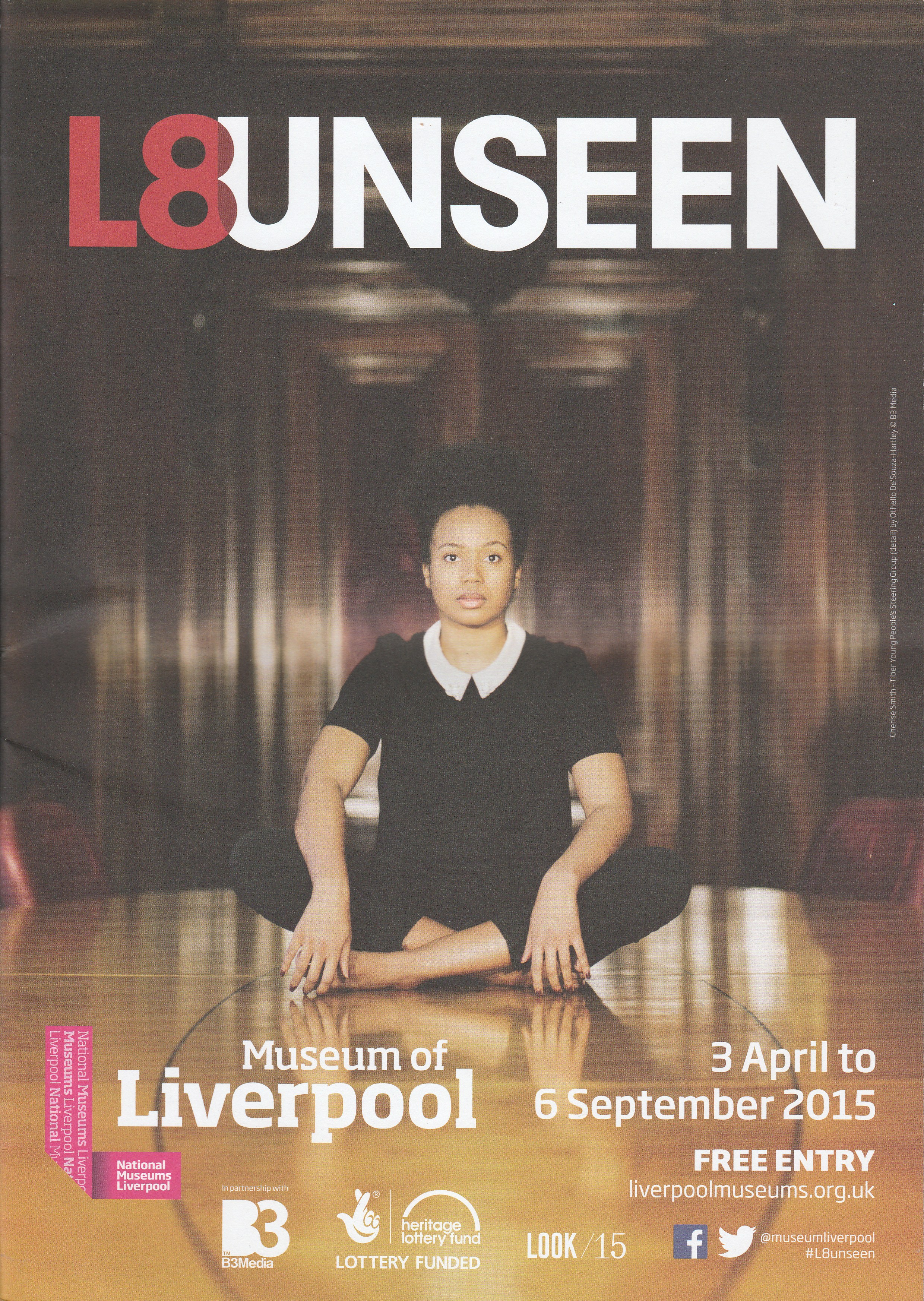
L8 Unseen runs at the Museum of Liverpool from 3 April to 6 September. It is a collection of striking images taken by photographer Othello de’Souza-Hartley. The pictures are all blown up to a large scale and rich in detail. Each one features someone or some group of people who live in Liverpool 8 pictured inside a building that reflects the history of Liverpool. The poster used to advertise the exhibition, and reproduced above for instance, shows Cherise Smith of the Tiber Young People’s Steering Group in the boardroom of the Liver Building.
There are also interactive elements in the exhibition in which you can listen to personal stories and send in your own photographs to add to the story. This has been incredibly successful and over 2,500 people have sent in their own photographs in the first weeks of the exhibition.
The blurb for the exhibition declares that “Liverpool 8 is a state of mind, an idea, a culture, rather than just a geographical location”. This identity is based upon diversity, something that is rooted in Liverpool’s development from the eighteenth century onwards as a major seaport that brought so many peoples and cultures to its streets. But in this also lies the downside – Liverpool’s prosperity was based, from the opening of its first dock in the early eighteenth century until 1807, on the slave trade and so the exhibition notes that many of the places used “were founded on the proceeds of the city’s international trading links and the slave trade.” This is undoubtedly true – even for buildings like the Liver Building, built as late as the twentieth century – for without that era of massive expansion when Liverpool became the pre-eminent slave ship port the continued advancement of the Victorian era and later would not have happened. This reprehensible trade carried on by so many people in Liverpool for a hundred years brought tremendous riches and provided the backbone of the city’s prosperity. So the buildings used include the Town Hall, The Black-E arts centre (which was once Great George Street Congregational Church), the Liver Building, a house in Abercomby Square, dock buildings, the Athenaeum Club and other places. There is no getting away from the fact that virtually the whole city was effectively complicit in a vicious trade but I can’t help feeling that somewhere like the Athenaeum perhaps indicates a slightly different attitude, after all it included amongst its founding members William Roscoe and his circle, people who opposed the slave trade from the start and were eventually successful in getting it stopped. We shouldn’t overlook the courage of people like Roscoe who stood out against the prevailing orthodoxy at the time.
My favourite photograph shows four religious leaders from places of worship in Liverpool 8, generally from near the top of Princes Avenue. Seated around a table in the Town Hall are representatives of the Al Taiseer Mosque, Princes Road Synagogue. St Nicholas Greek Orthodox Church and St Margaret’s Church of England, all resplendent in liturgical garb. One hopes that this gathering represents some sort of on-going dialogue between the different faiths rather than just a gathering for a photo opportunity. At least two of the religious buildings that they represent are amongst the grandest and most impressive buildings in the city and Liverpool, of course, had the first mosque ever built in England. What a shame the nearby Welsh Presbyterian Church, itself something of a mini-cathedral, is now gone, then they could have had a sober Presbyterian in preaching bands and black cassock join the group too. But the building has been derelict for years and the original congregation left in the 1970s. That illustrates one aspect of diversity which has almost entirely disappeared in Liverpool. When I was young the city was dotted with Welsh speaking churches, now I think just one small chapel remains. Sad to note the disappearance of this group, although even in Wales the types of churches that they comprised are nowhere near as prevalent as they once were.
But it is an illuminating exhibition that reflects the resilience and the vitality of Toxteth/Liverpool 8. As Laurence Westgraph says in his notes accompanying the exhibition “what is the culture of L8? Maybe it is the culture of accepting, tolerating and welcoming people from other cultures.”
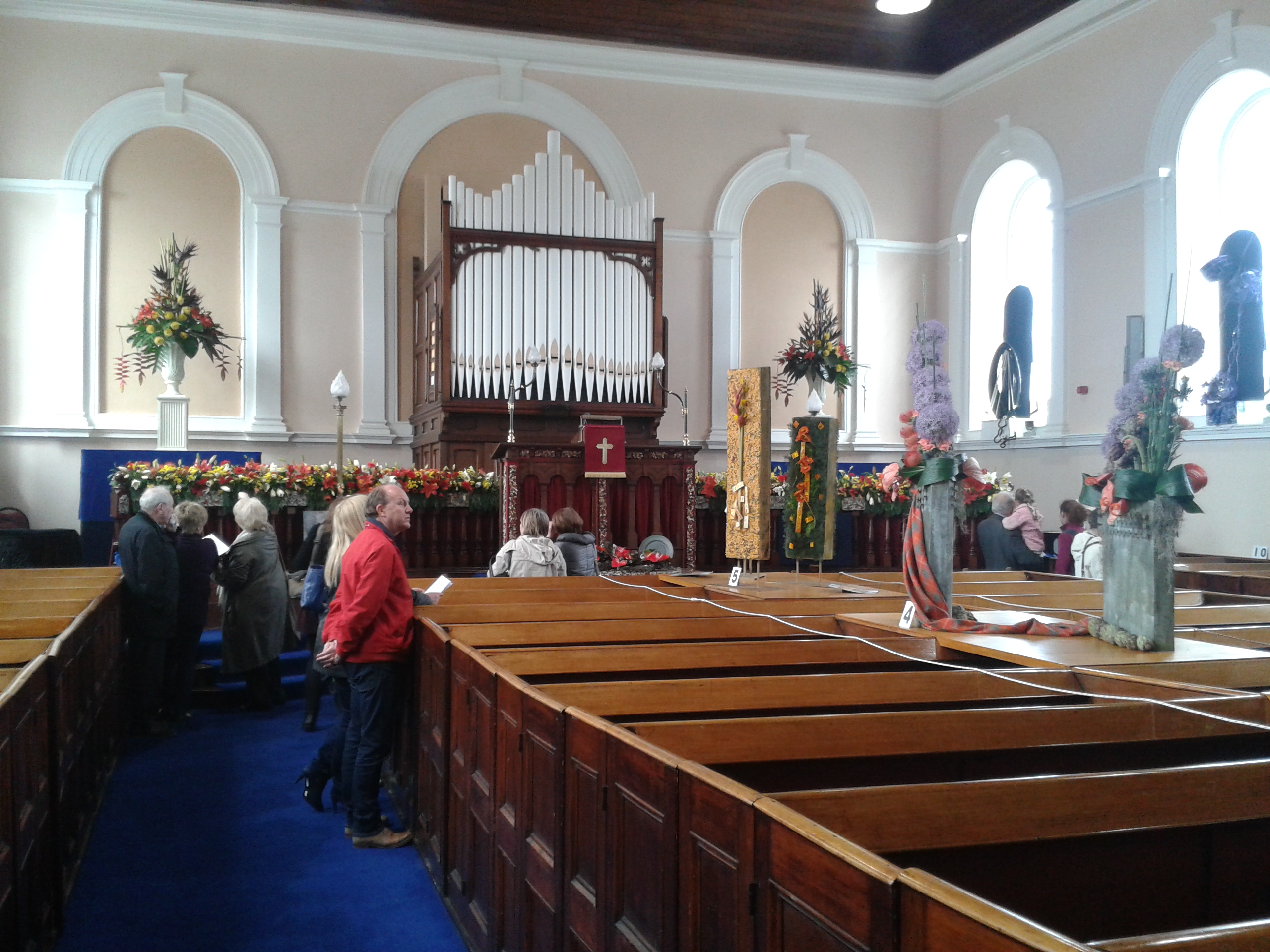
The Very Rev William McMillan has many strings to his bow. He is not just a distinguished and much loved pastoral minister, he is also a highly regarded historian who shares his knowledge readily with all enquirers. In both these areas – and others – he is highly respected but the area in which he is most pre-eminent is undoubtedly that of floral art. His fame in this role is world-wide and a few years ago he was appointed world champion no less. The Rev Mac regularly travels the world as a floral artist and over the decades must have helped to raise thousands of pounds for various charities through his artistic efforts. His latest exhibition is at Holywood Non-Subscribing Presbyterian church which not only utilises a wonderful space but also incorporates his historical knowledge and feel for the theological traditions that have contributed to the development of the church.
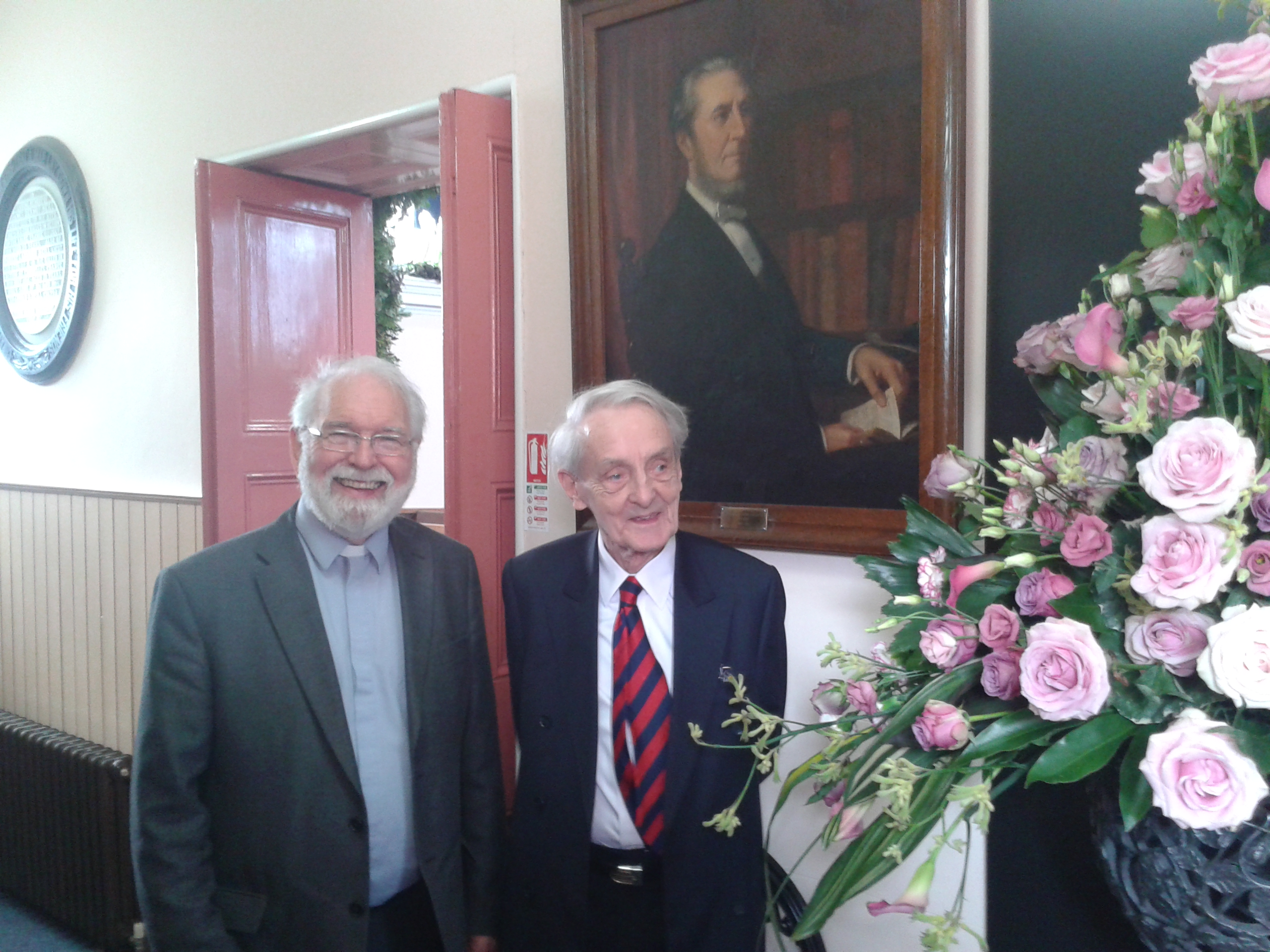
Rev Colin Campbell (left) and Rev Bill McMillan in front of the portrait of Rev C.J. McAlester, in the vestibule of the church
Holywood N.S. Presbyterian church is a substantial classical fronted church dating from the mid-nineteenth century (and designed by Sir Charles Lanyon) but the congregation dates back over 400 years and this exhibition is part of the celebration of the continuation of all branches of Presbyterian witness in the town over that long period. Mac uses the Benedicite, the Song of Creation, as the theme for the exhibition and incorporates references to the rich history of the congregation including the Praeger and Bruce families.
Sophia Rosamond Praeger was, in the words of the exhibition brochure, an “acclaimed sculptor, poet and artist” and as a member of the congregation there are numerous examples of her work housed in the church. Most notable of these is the First World War memorial which she designed to include two children carrying baskets of flowers representing hope; they kneel on either side of the names of those who were killed, including one of her own brothers. Her other brother, Robert Lloyd Praeger, was a world famous botanist who became librarian of the National Library of Ireland.
Rev Michael Bruce was one of the first members of the Presbytery of Antrim and introduced the principles of non-subscription to the congregation in the 1720s. Supposedly a direct descendant of Robert the Bruce his family produced generations of Presbyterian ministers in Ireland.
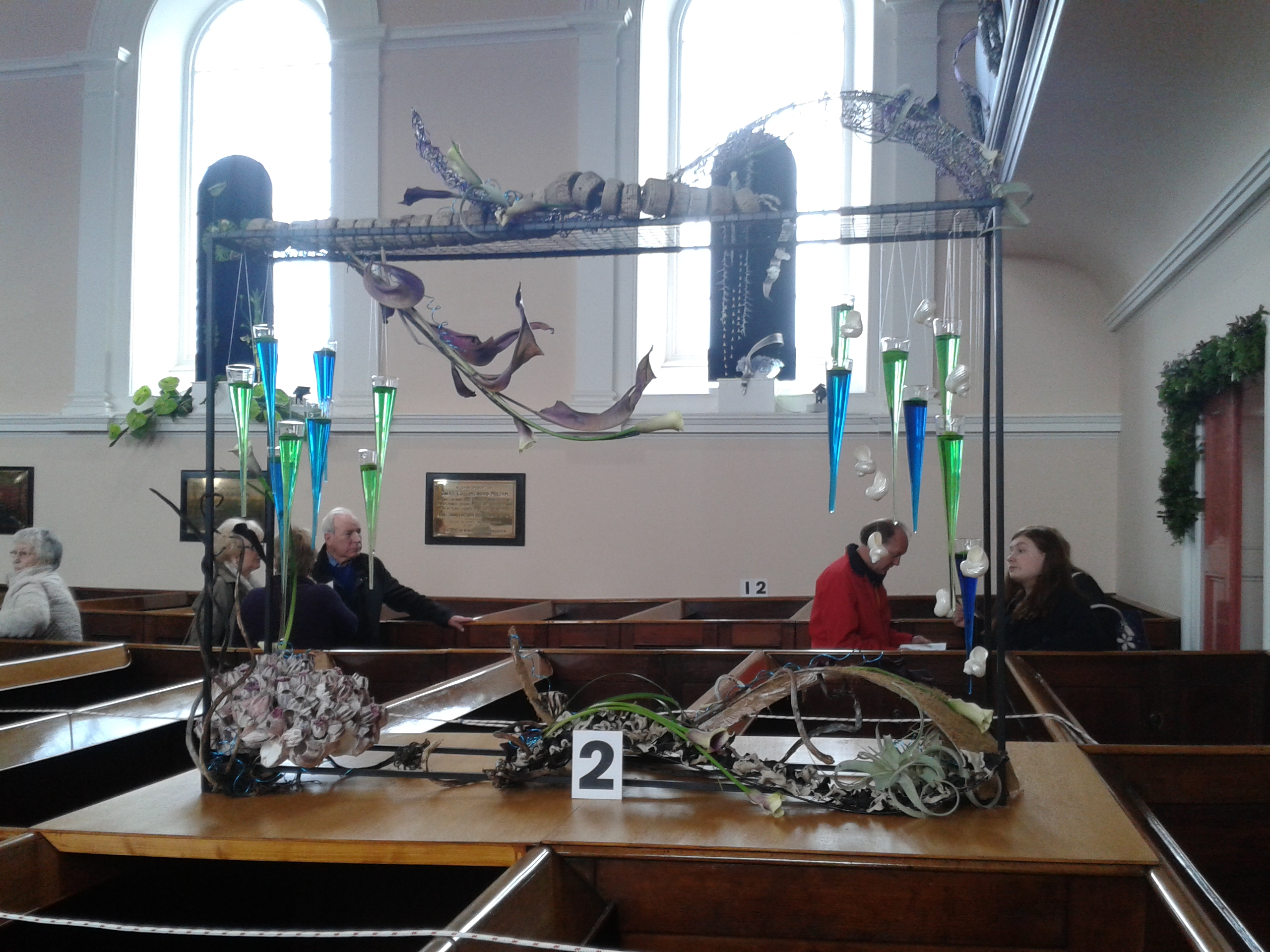
The exhibition contains material that is both traditional and strikingly modern. The line O ye Seas and Floods, bless ye the Lord takes as its cue the fact (quite new to me) that the first two buildings used by the congregation are now both submerged by the sea, and marine plants, shells and liquid are used in the design.
O ye Seas and Floods, bless ye the Lord
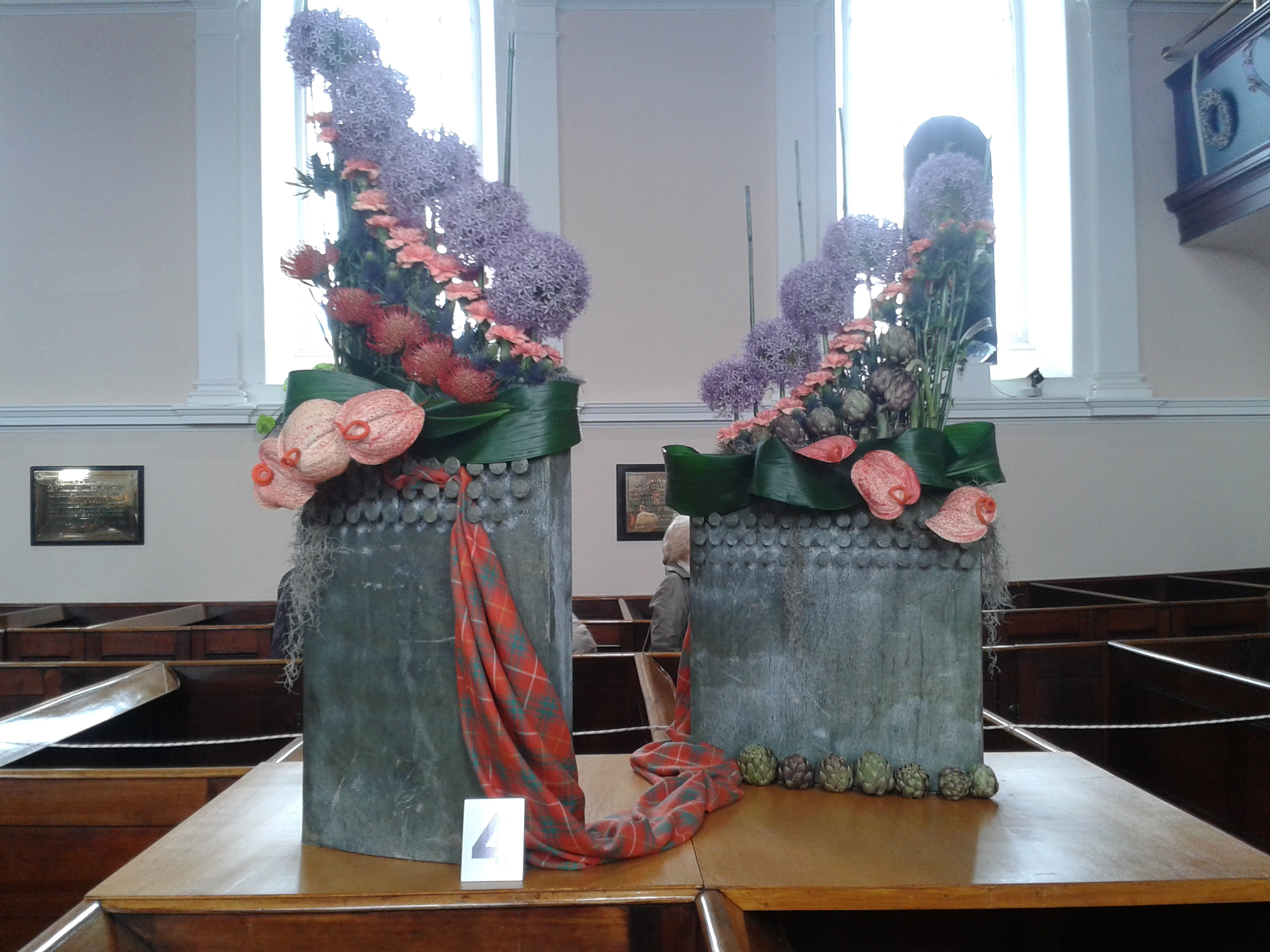
O ye Servants of the Lord, bless ye the Lord pays tributes to the Bruces and incorporates the colours of the Bruce tartan.
O ye Servants of the Lord, bless ye the Lord
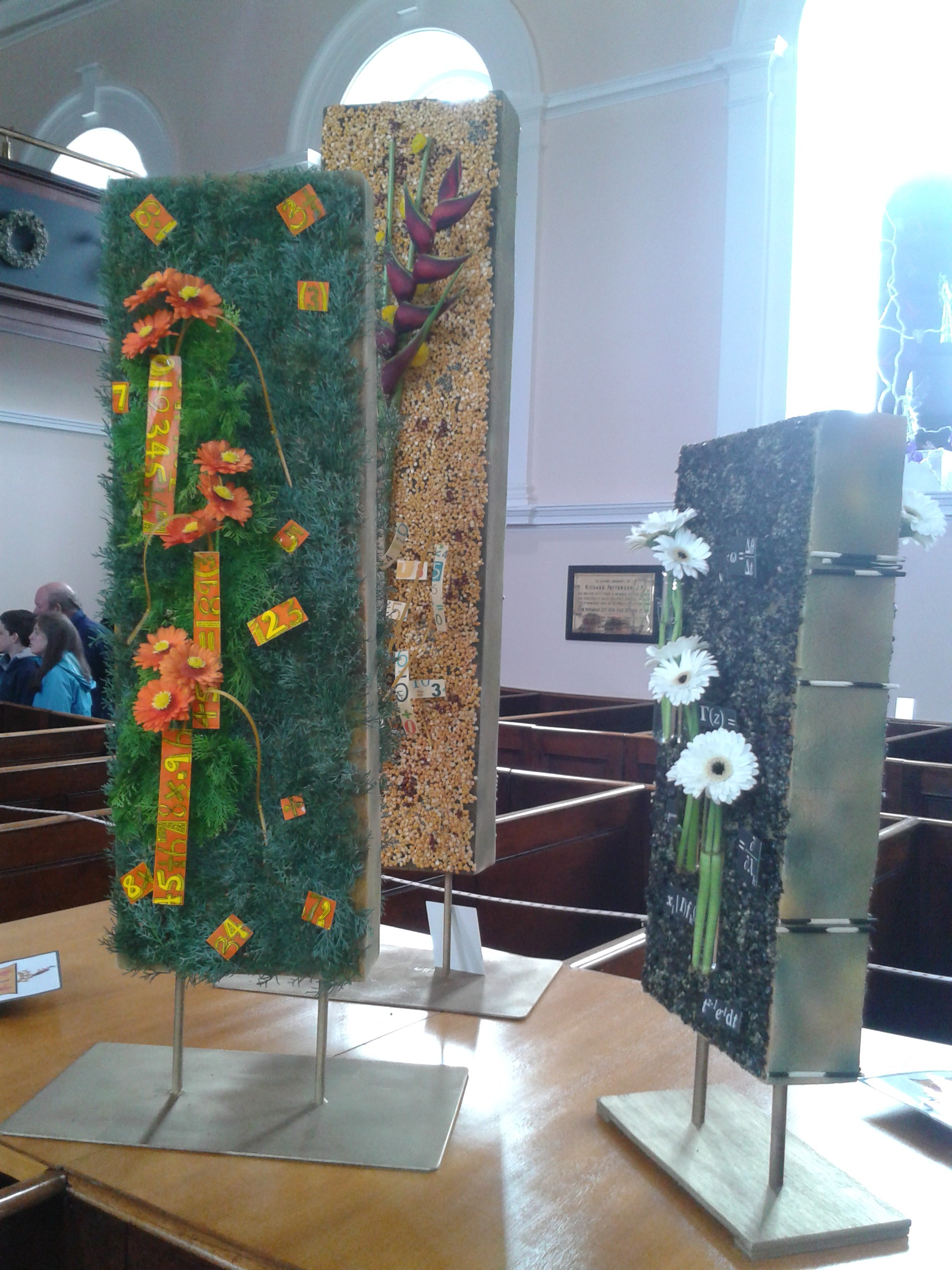
O ye Children of men, bless ye the Lord is inspired by the logo of Sullivan Upper School as a tribute to the Rev C.J. McAlester, nineteenth-century minister of the church and a scholar and a teacher. He was involved in the foundation of this school and also ran an “underground academy” in the basement of his church.
O ye Children of men, bless ye the Lord
Panels on the front of the gallery were inspired by a sketch by Rosamond Praeger entitled “County Donegal” as well as Robert Lloyd Praeger’s most famous book The Way that I Went.
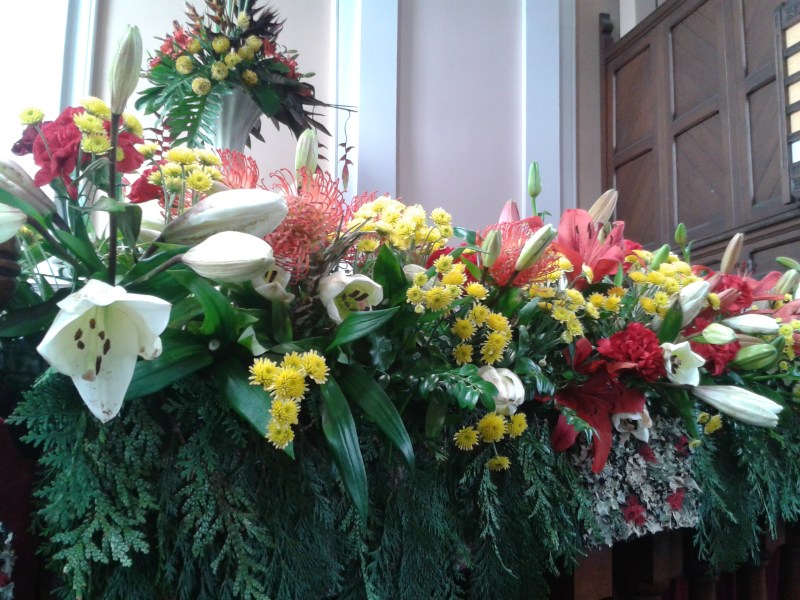
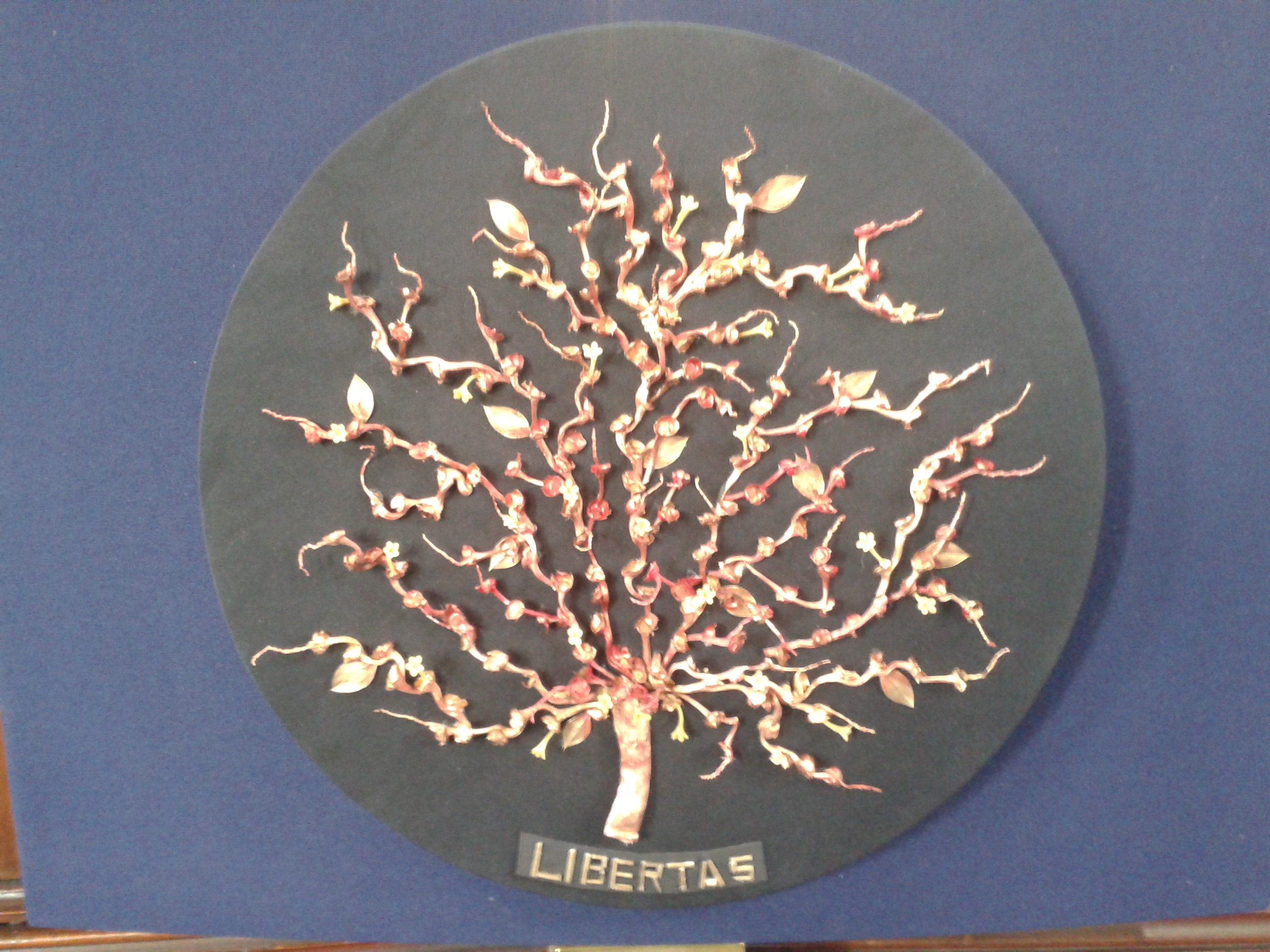
The Burning Bush symbol of the two varieties of Presbyterianism found in the town are both represented by sculptures in dried plant material and the communion table has a suitable decoration. My photographs probably don’t do the whole exhibition justice but it is nice to record at least some of what is on show in Holywood.
Festival of Floral Art, First Holywood (NS) Presbyterian Church 23-26 April 2015, to celebrate 400 years of Presbyterian witness in Holywood.
In September of 2014 we launched – in fine style, it must be said, in the impressive surroundings of the Liverpool Athenaeum, thanks to Philip Waldron – the book Liverpool Unitarians: Faith and Action. Essays exploring the lives and contributions to society of notable figures in Liverpool Unitarian history. Published by the Merseyside District Missionary Association it should also be added that the District took to the role of publisher with great aplomb – not necessarily the most usual role for any church administrative body. The book is available in many book shops and museums in Liverpool as well as online from the District and via Amazon.
Liverpool Unitarians was a long time in preparation but I think is a better book for the extra time spent on its production. All the contributors have some connection with Merseyside Unitarianism and all write about different aspects of the contribution made by members of this household of faith to wider society over the centuries.
The full list of contributors and subjects is as follows:
Introduction, David Steers; Memorials of the Ancient Chapel of Toxteth Park, Bernard Cliffe; Jeremiah Horrocks 1618 – 1641, Bernard Cliffe; William Roscoe 1753 – 1831, David Steers; A Short History of the Rathbone Family, Annette Butler; The Unitarian Family of George Holt, Bernard Cliffe; Noah Jones 1801 – 1861, Philip Waldron; James Martineau 1805 – 1900, Len W. Mooney; Joseph Blanco White 1775 – 1841, David Steers; Kitty Wilkinson 1786 – 1860, Daphne Roberts; John Johns 1801 – 1847, David Steers; William Henry Channing 1810 – 1884, Richard Merritt; Charles Pierre Melly 1829 – 1888, John Keggen; Sir Henry Tate 1819 – 1899, Richard Merritt; Sir John Brunner 1842 – 1919, Len W. Mooney; Lawrence Redfern 1888 – 1967, Elizabeth Alley; Sir Adrian Boult 1889 – 1983, Richard Merritt; The Visitors’ Book of the Ancient Chapel, Bernard Cliffe
It was particularly pleasing to see Len Mooney’s contributions published in the book in light of Len’s sad death just a few months later. Someone who had been a devoted member of Ullet Road Church for many decades Len was a thoughtful and wise person whose gifts shine through in his chapters published here.
The cover of the book
The book has a full colour cover designed by Alison Steers which incorporates ‘The Triumph of Truth’, the central detail from the library ceiling of Ullet Road Church, painted by Gerald Moira; the Good Samaritan Window at Gateacre Chapel, which was erected in memory of Sir Henry Tate; a bronze representation of the James, (the ship on which Richard Mather and the local puritans sailed to Massachusetts in 1635) made in 1934 for the hall door at the Ancient Chapel of Toxteth; the front elevation of Ullet Road Church built in 1899; and detail of the Liverpool Town Plan of 1725 by J. Chadwick.
The book also contains more than fifty illustrations, many of them never before published, and all of them helping to tell the story of Liverpool Unitarianism. Some of the stories told in the book are well known, others are not so familiar to the general reader, yet others break entirely new ground – Bernard Cliffe’s analysis of the memorials and graves in the Ancient Chapel is a first, as is his examination of the chapel’s visitors’ book.
In the Introduction I say:
This book is not intended to be hagiography but it does try to outline how one group of people – members of a particular faith community with deep historical roots but with an aversion to fixed creeds – were inspired to serve their fellows in different ways. Their legacy can be seen all over the city – in its parks, in its monuments, in the university, in hospitals, in education, in art galleries and museums – and it exists in the long and continuing struggle to create a society that gives equality and opportunity to all its citizens. It is not meant to be an exhaustive account of all the eminent members of the churches and chapels in the region. Readers will notice that the names mentioned are part of wider connections of family and business which includes many others who could be included. There are other figures who could be the subject of such biographical accounts. But this is a selection of some of those who have followed the call of faith to be of service to wider society.
It is pleasing also to report positive reviews in various publications.
In Faith and Freedom Peter Godfrey says: a splendid book… chapters that are full of interest and fill the reader with admiration and often wonder at the scope of the achievements of these Liverpool Unitarians
and in The Inquirer Alan Ruston says:
readers of this book will come to the conclusion that Unitarianism has not been just a faith of the mind but one of action as well.
The title and full publication and order details are as follows:
Liverpool Unitarians Faith and ActionEssays exploring the lives and contributions to society of notable figures in Liverpool Unitarian history
Edited by Daphne Roberts and David Steers
Published by the Merseyside and District Missionary Association 2014 ISBN 978-0-9929031-0-7 Price £12.99 plus £2.50 post and packing 128 pages, 52 illustrations, full colour cover
Available from: Philip Waldron, Ullet Road Church, 57 Ullet Road, Sefton Park, Liverpool L17 2AA or liverpoolunitarians@gmail.com also available for purchase on Amazon
As a long time admirer of the work of Martin Parr I was glad of the opportunity to see this exhibition at the Walker Art Gallery in Liverpool. I first came across his work in The Last Resort, his collection of photographs taken in New Brighton and first published, I now see, as long ago as 1985. These pictures, taken in colour, are bright and sharp, which serves only to highlight the sense of desperation about the place. Sunbathers sit on crowded beaches, their feet surrounded by litter, babies play amidst the debris, pensioners relax in semi-derelict shelters. They reminded me of childhood visits to the place and today seem to share more with that era than the present time: New Brighton is cleaner, smarter and less tawdry than it was then. But the seaside has been a continuous theme in Parr’s work and this exhibition shows not only some rarely seen examples of his early photography, but also pictures by a major influence on his own work.
Tony Ray-Jones died at a tragically young age in 1972. Martin Parr has curated a collection of his pictures from the 1960s. All in black and white many of them depict scenes taken at sea side locations – Broadstairs, Brighton, Southport, Blackpool and so on. Each picture conveys that sense of melancholy that only the English seaside seems to contain, both in and out of season. Tony Ray-Jones’s own injunction to himself was “don’t take boring pictures” and each contains a strange mixture of humour, ennui and sometimes even a vague sense of menace.
But Martin Parr’s own section of the exhibition is entitled The Non-Conformists, in this case a precise reference to religious dissenters of the traditional type. Taken in the 1970s this looks very much like a vanished age, the last days of an old order. Most of the subjects in the run down chapels are elderly, the ladies all wear impressive hats, the men Sunday-best suits. There is an air of melancholy about many of these pictures too. Chapel goers assemble for anniversary teas and resemble nothing so much as mourners at a wake. And yet the video that accompanies the exhibition shows some of the scenes as they are today and the remote Methodist Chapel looks pretty much like it is still in operation. Non-Conformists can be tenacious survivors.
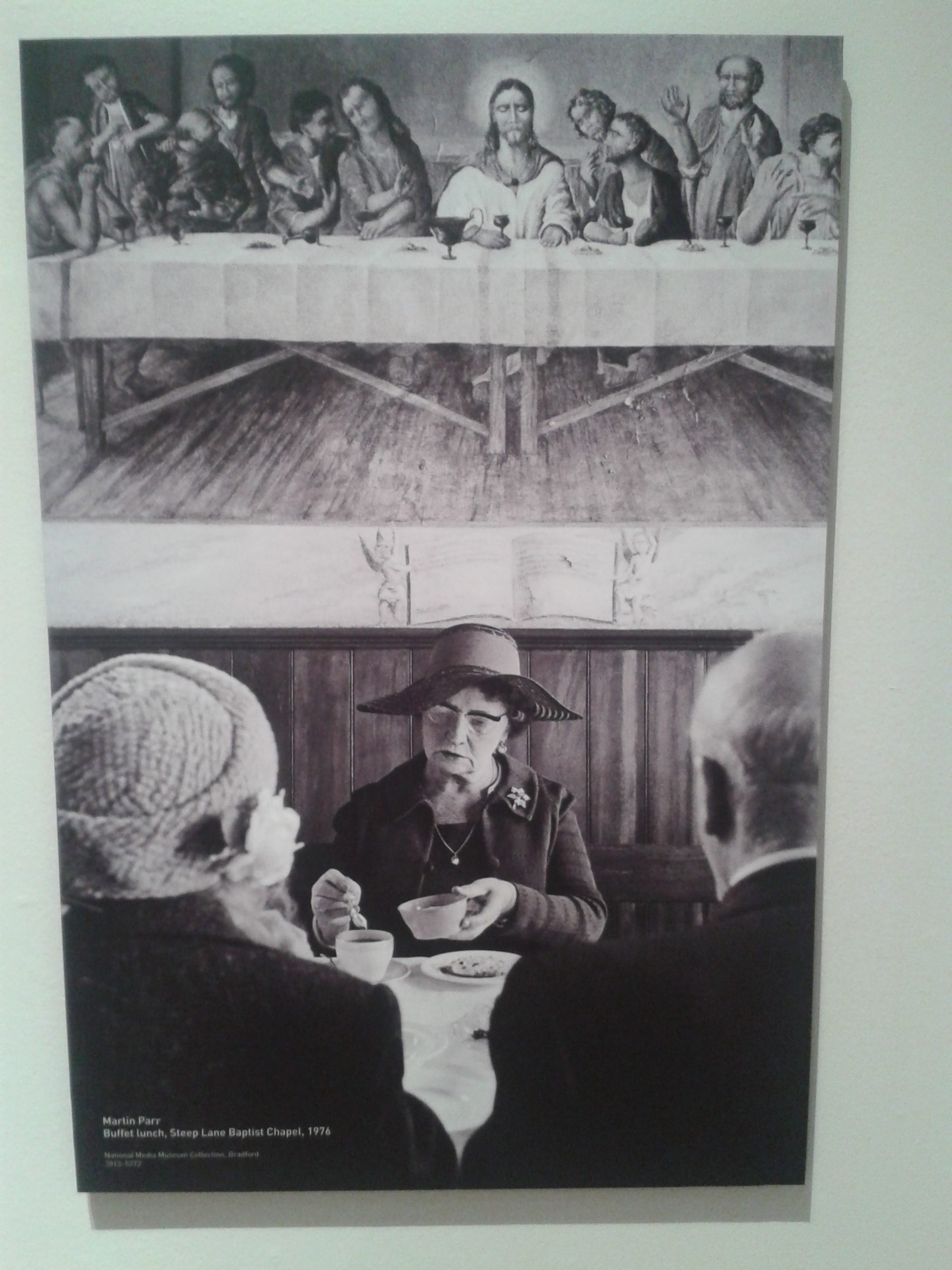
But if the same Methodist Chapel is still on the go, the congregation are unlikely to look as formal and as staid as they did in the 1970s. You have to go to Ulster, to Brethren and Free Presbyterian churches, to find such a collection of hats on a Sunday, it is generally shirt-sleeve order these days, casual informality is the style in most places now. There is a rigidity and a strictness in these photos of forty years ago that seems strange to modern eyes, as well as a sense of sadness; the chapels look run down, the paint is peeling, the congregations mostly elderly. But here we see chapel life as it was lived in a remote rural corner of England in the 1970s. Worshippers crouch in prayer, in the non-conformist style; sumptuous suppers are piled on to plates after worship; cabbages are auctioned after the harvest festival. Many of the compositions are very striking. A clever view of a service shows part of the congregation seated downstairs while others sit patiently in the gallery above them. Perhaps the most arresting is of a lady wearing a very large hat solemnly ladling sugar into a cup while seated at a table amongst others sharing in a post-service tea in a Baptist chapel. Her movements seem to mirror the illustration on the wall behind her – a curious and somewhat disquieting rendition of the Last Supper which must have been a permanent decoration in the church hall. A blown up version of this picture is used to advertise the show and I reproduce it below:
Martin Parr. Buffet Lunch, Steep Lane Baptist Chapel, 1976
But all this, plus Martin Parr’s pictures of home life and working life in the Calder Valley and Tony Ray-Jones’s depictions of English eccentricities like the Bacup Coconut Dancers, makes for a fascinating exhibition which is on show in the Walker Art Gallery until 7th June.




 velvethummingbee