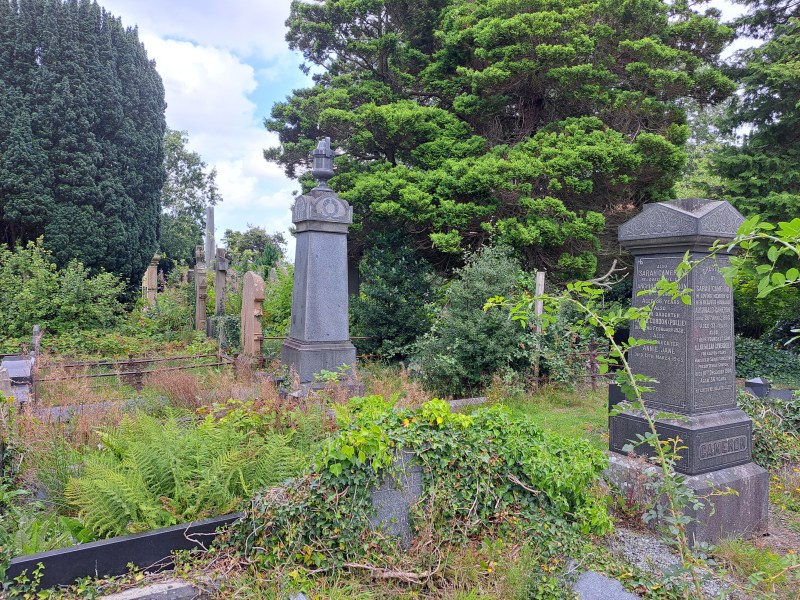
Belfast City Cemetery

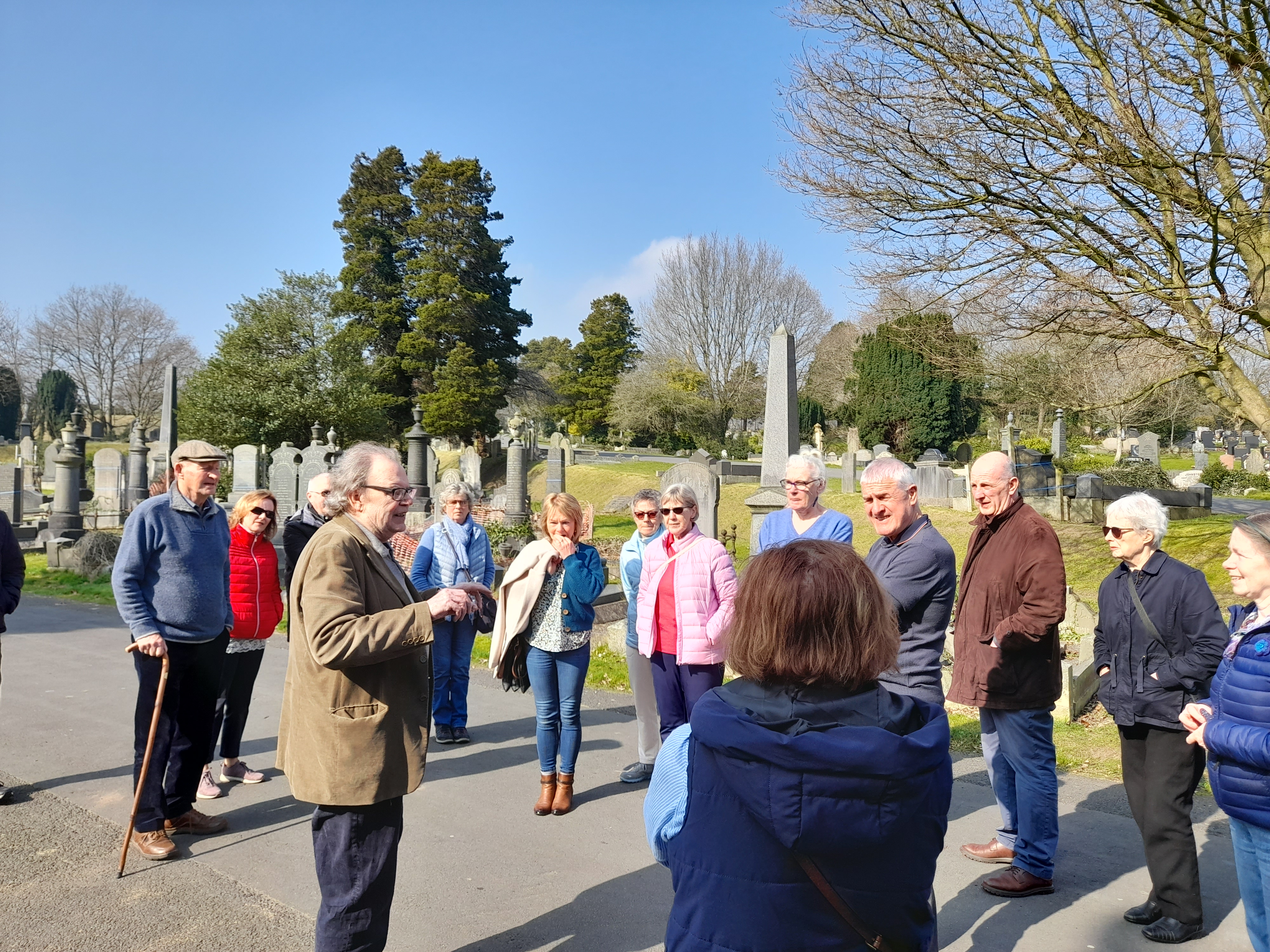
I was pleased to again take part in a tour of Belfast City Cemetery led by Tom Hartley. Tom is now the author of four books on the cemeteries of Belfast and I was pleased also to pick up a copy of his latest work, More Stories from the Belfast City Cemetery. This was his penultimate tour of the last series he would give as part of the Féile an Phobail and like all these tours there was a very large attendance.
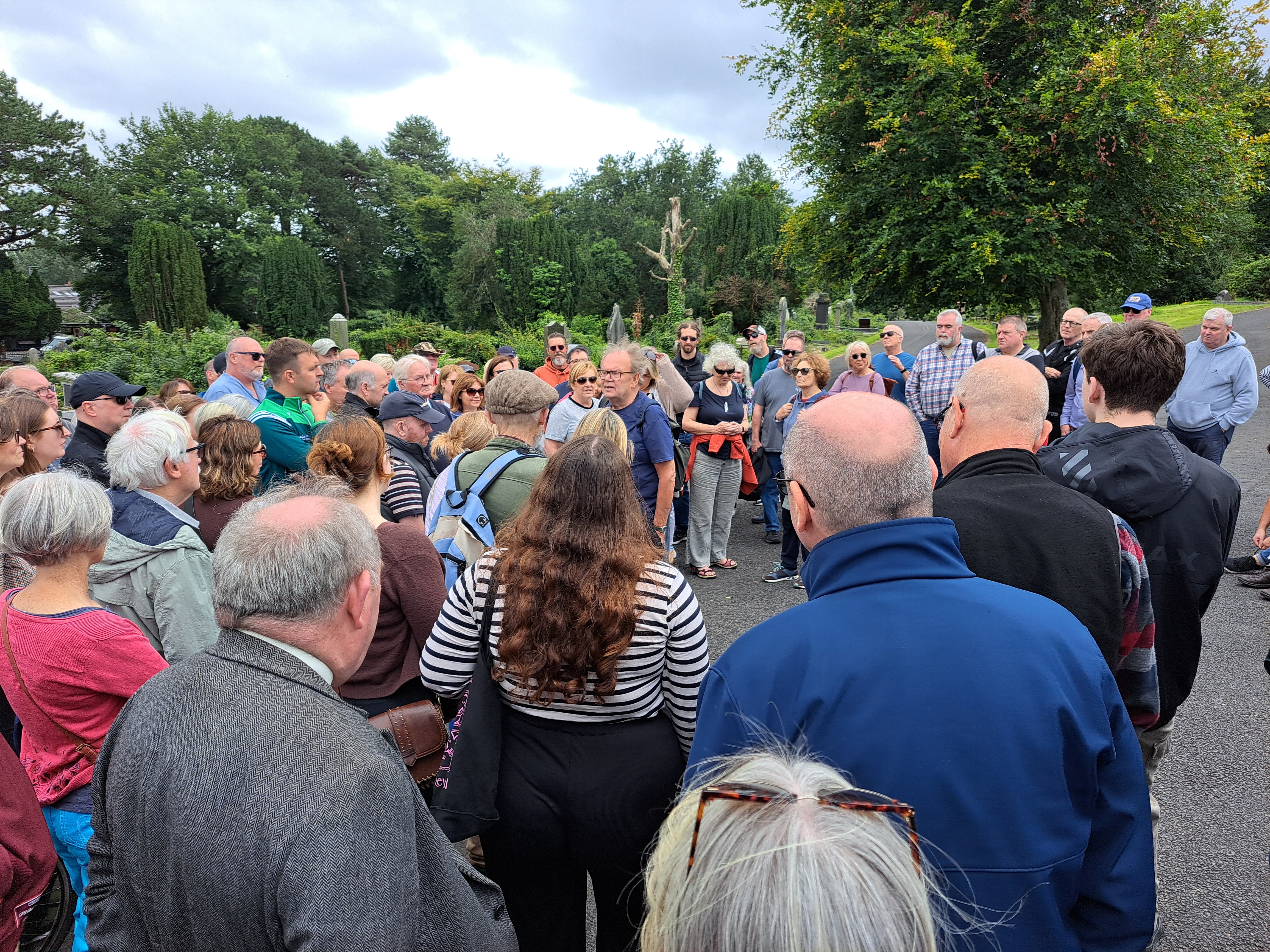
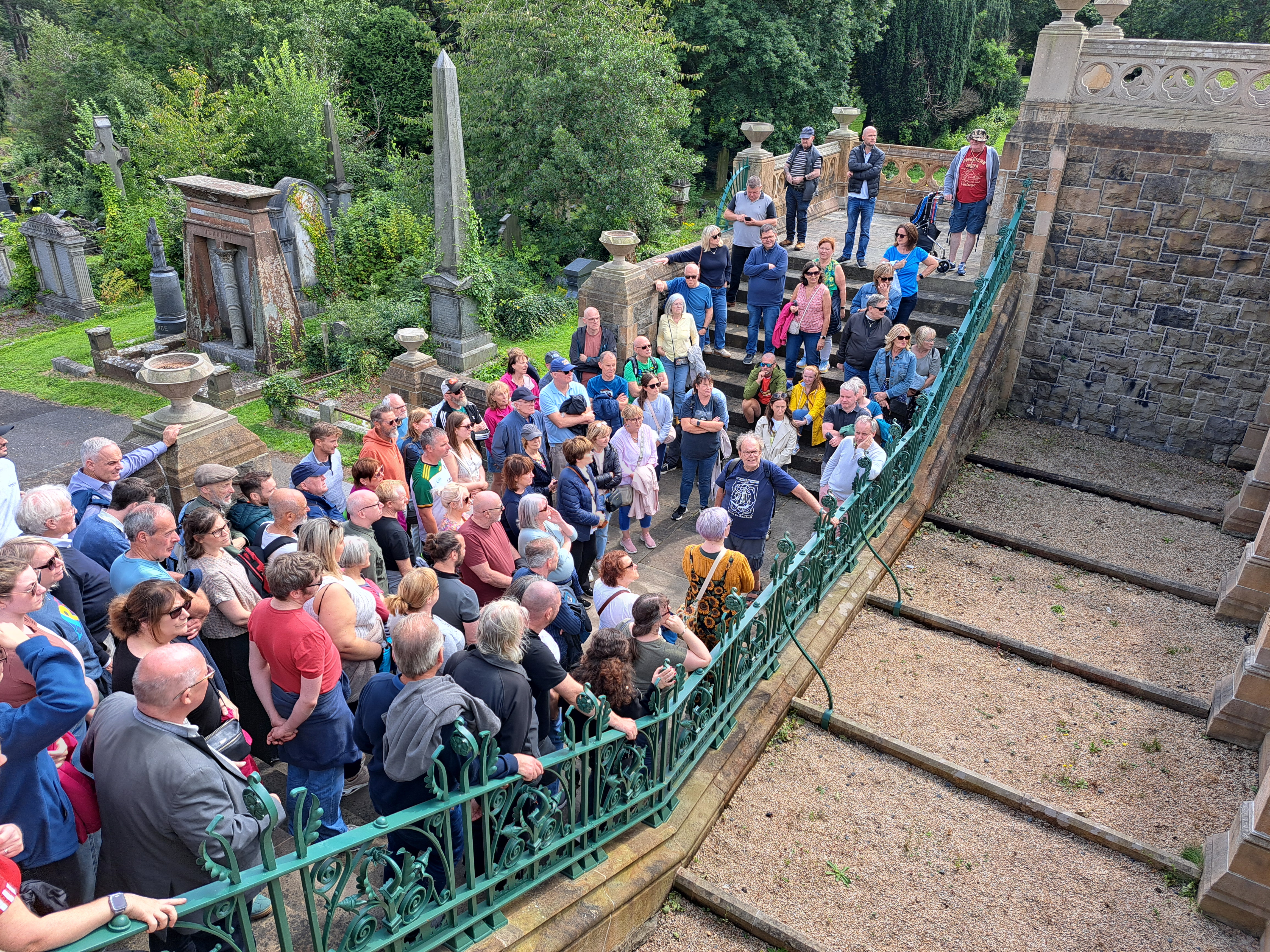
Start of the tour, showing some of those present

I see the first guided tour I attended was in March 2022. You can read that account here – Silent yet eloquent Memorials. There are a number of changes to the Cemetery made since that time, like the completion of the visitors’ centre, new signage all around the Cemetery, the restoration of the Vaults – which house the remains of such industrial luminaries as Sir Edward Harland and Thomas Gallaher – and a lot of new planting.

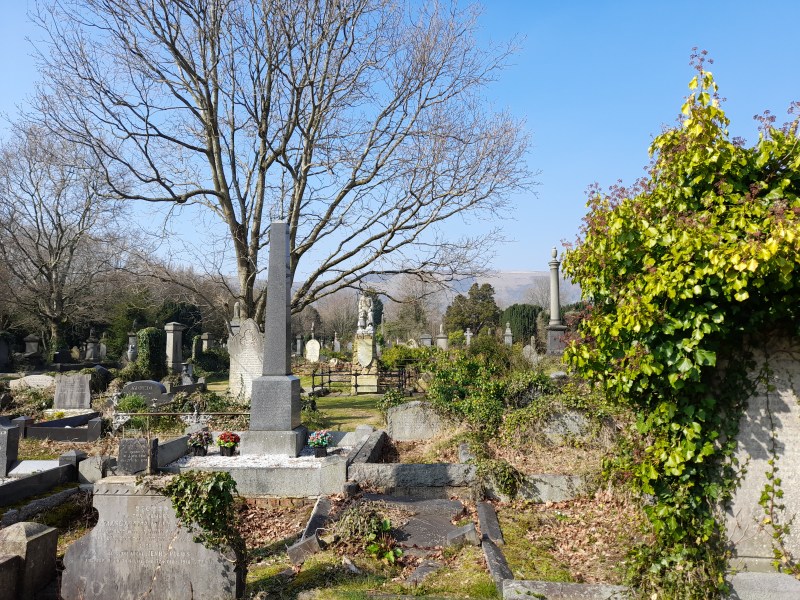
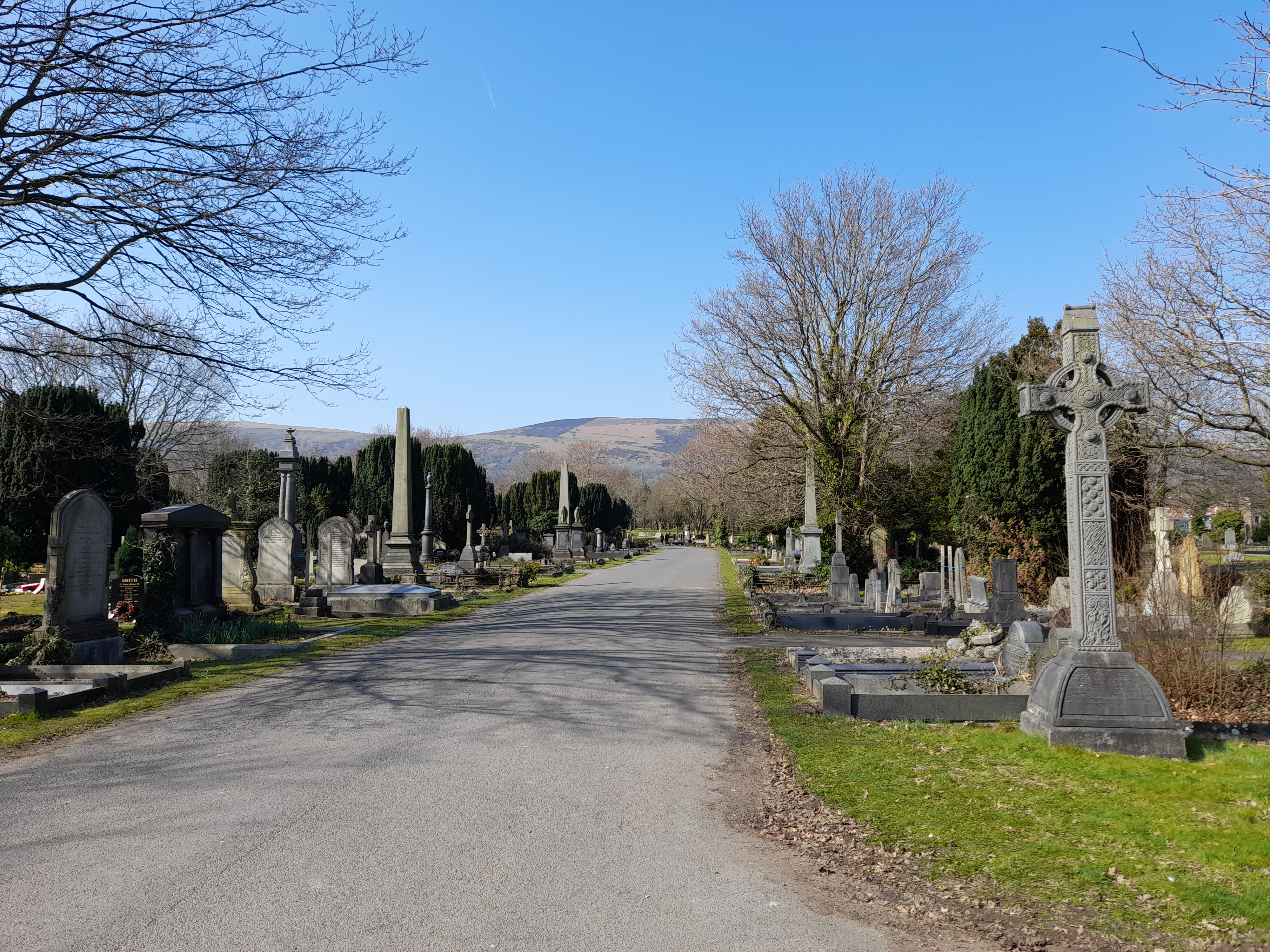
It is a very impressive cemetery, imaginatively laid out and designed by William Gay of Bradford in the shape of a bell (as in Belfast) and it contains some incredible Victorian, Edwardian and later memorials.
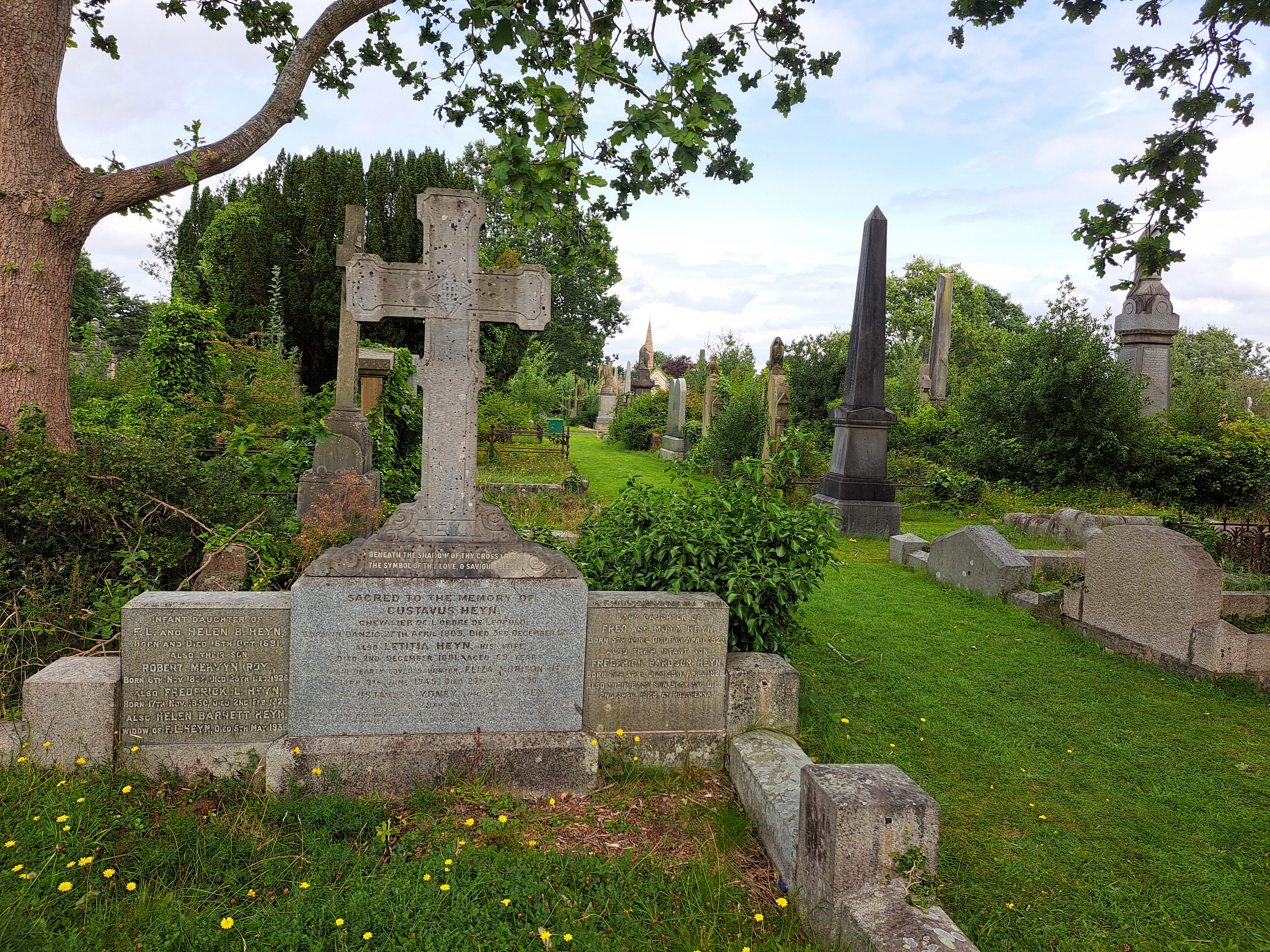
Gustavus Heyn, shipping magnate

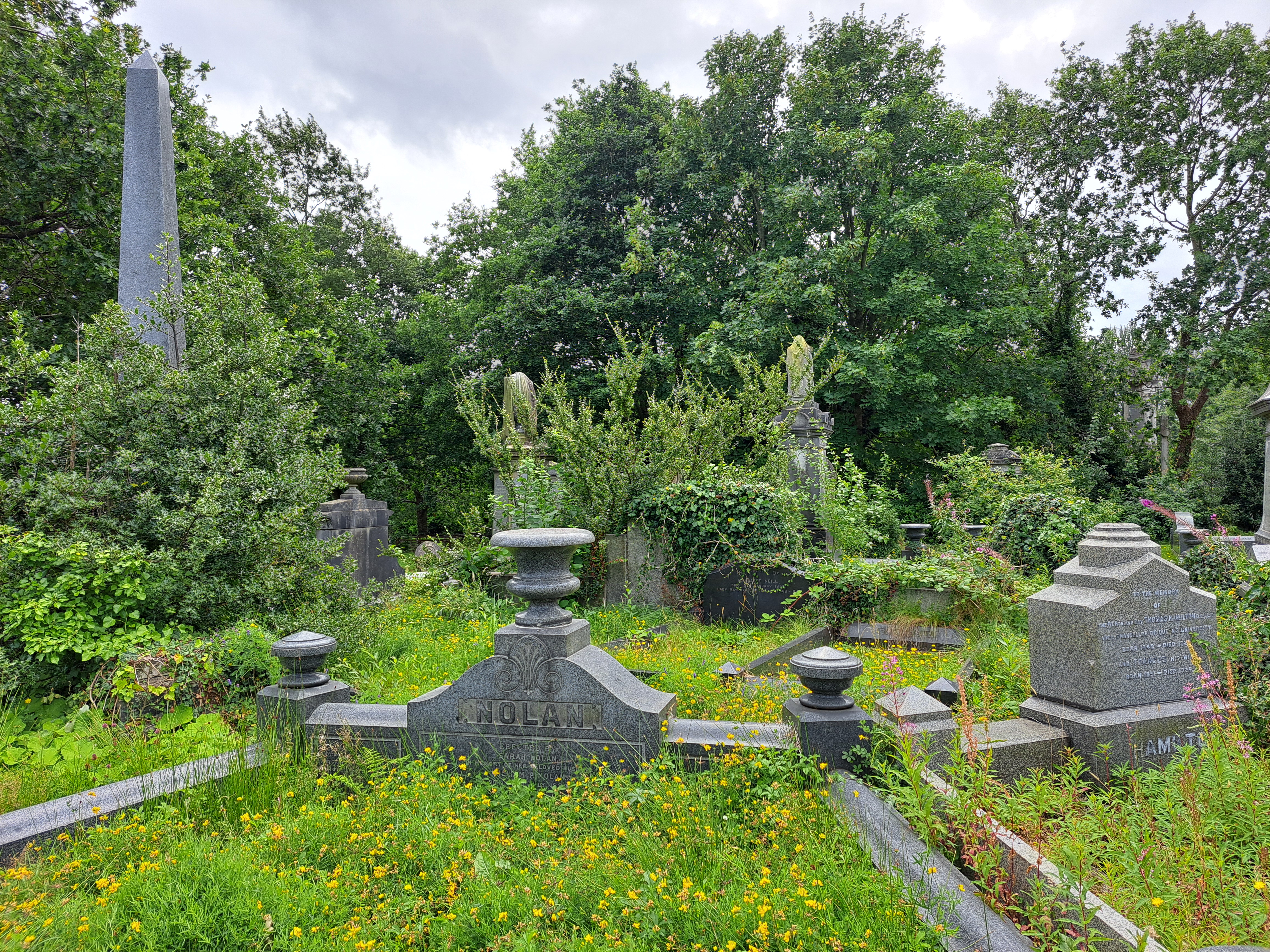
Some parts are still quite heavily overgrown and other parts have suffered badly from vandalism.
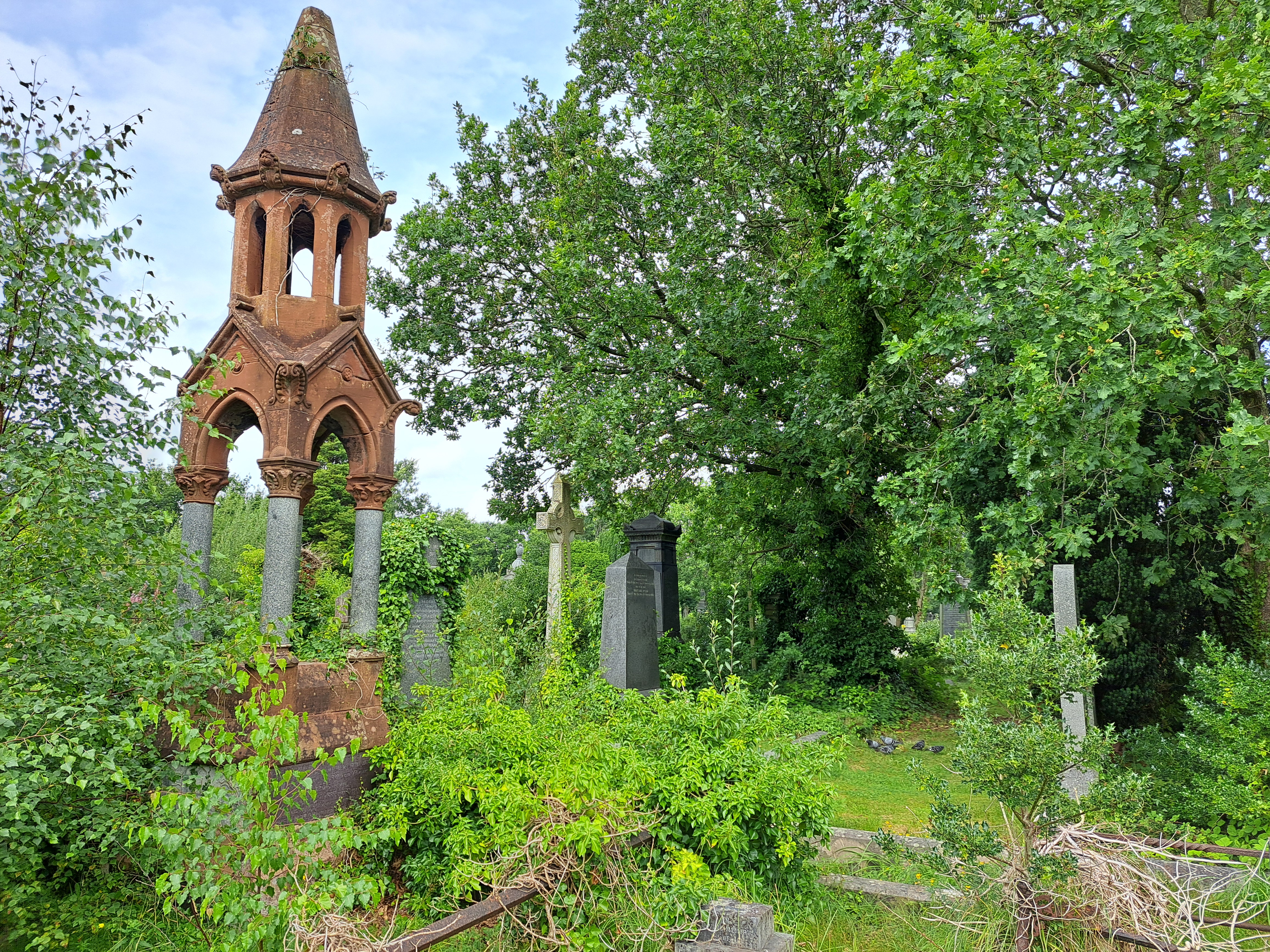
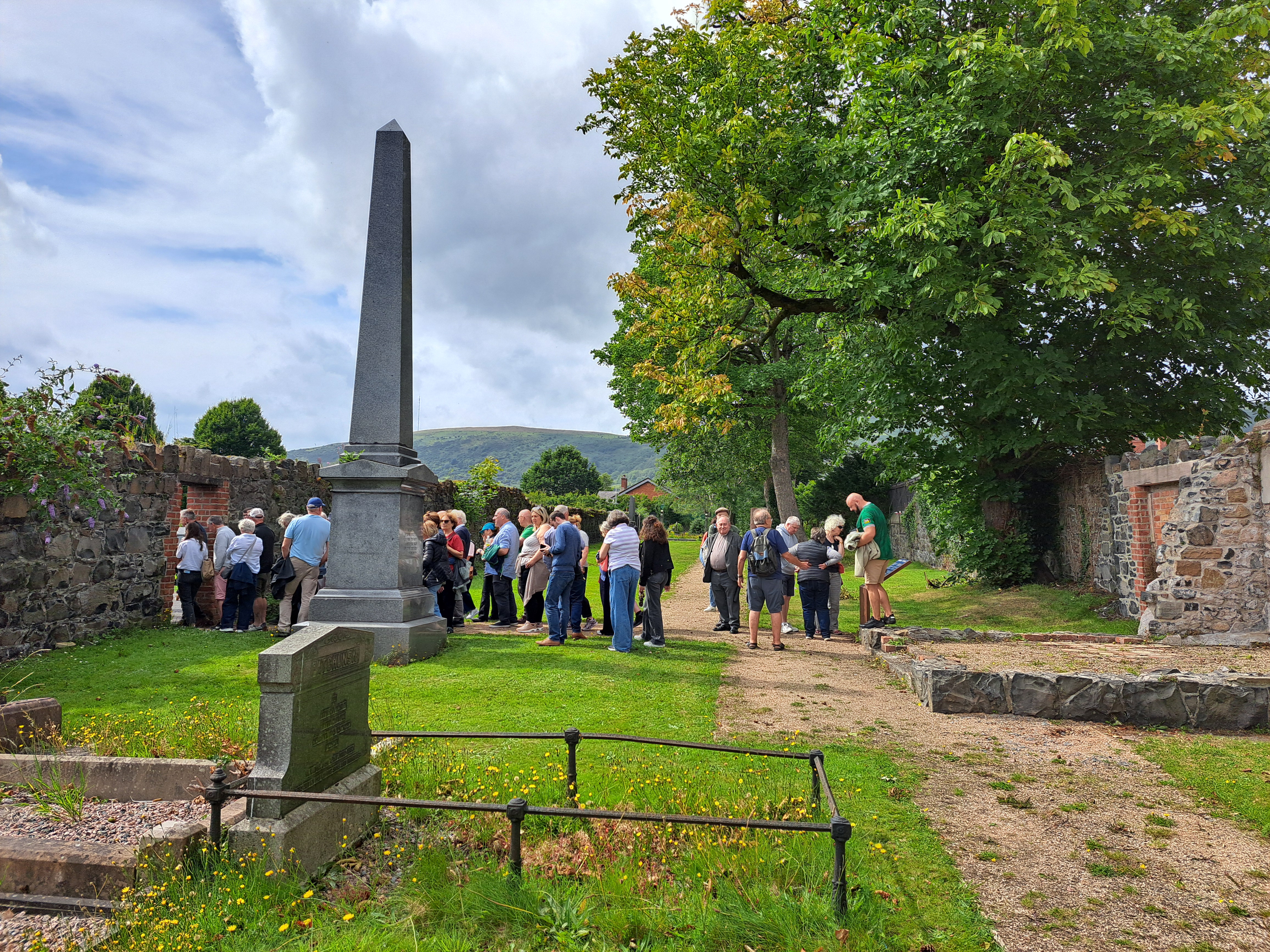
The Jewish section of the graveyard comprises a separate walled section although this has particularly suffered from vandalism and since 1964 Jewish burials now take place at Carnmoney Cemetery.
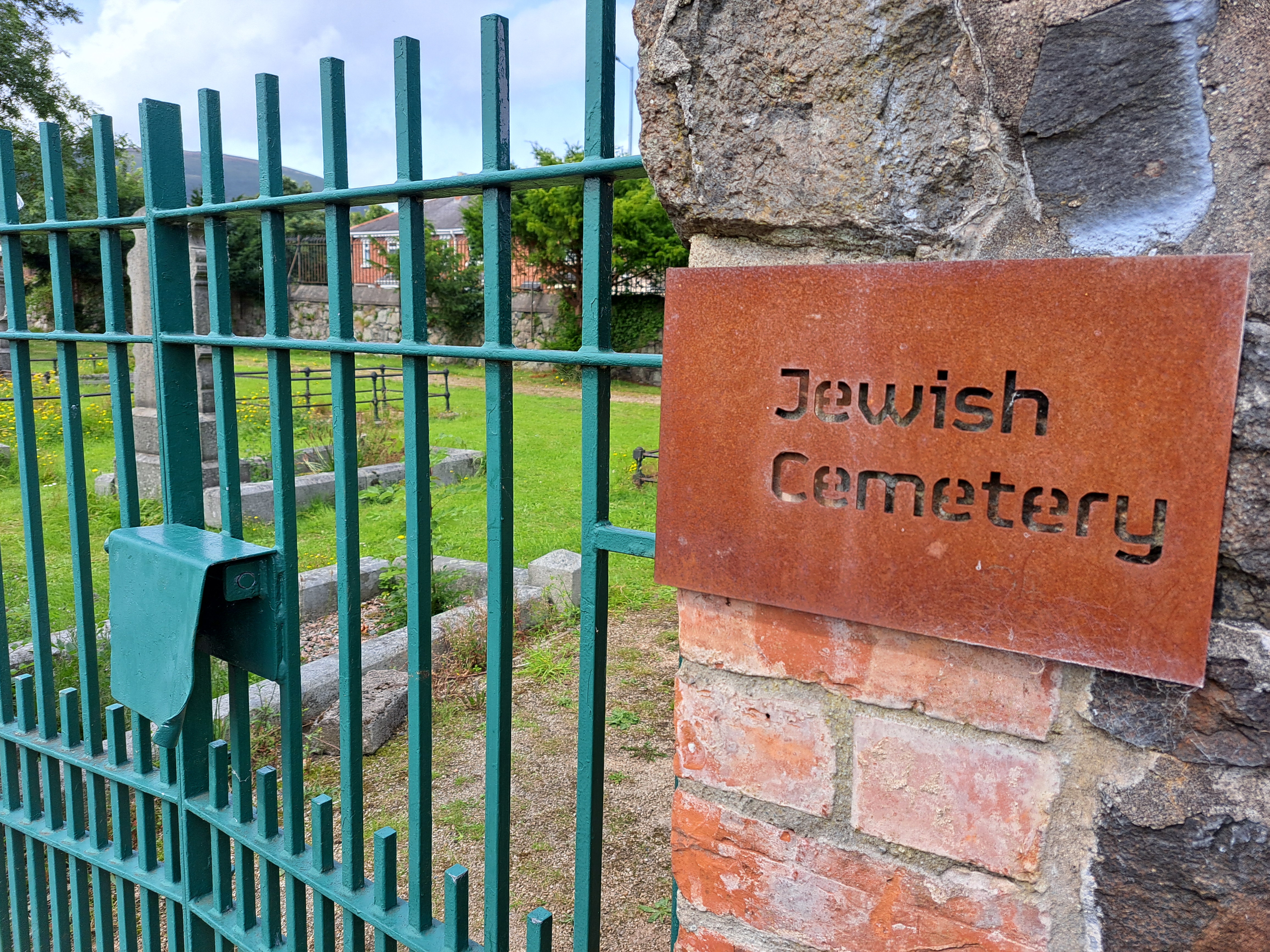
Entrance to the Jewish Cemetery
Inside the Jewish Cemetery. On the right is the remains of the Tahara, the mortuary chapel

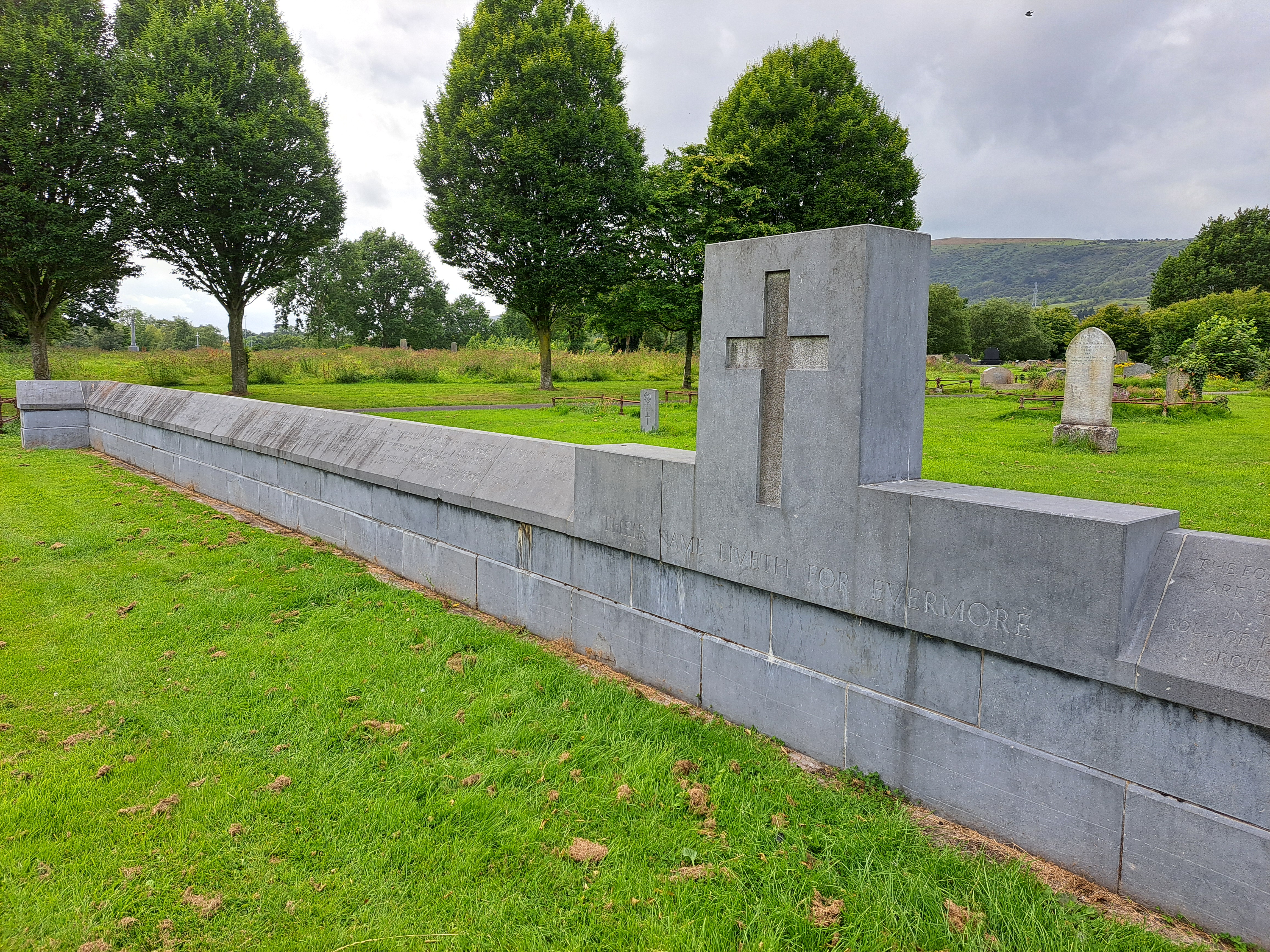
The Cemetery also includes a Commonwealth War Grave Cemetery with 296 burials from the First World War and 274 from the Second World War. There is also a Cross of Sacrifice (the same size as that in Botley Cemetery) and a First World War Screen Wall which carries the names of 74 soldiers who are buried in the First World War plot, 58 soldiers who are buried in unmarked graves and 8 soldiers who are buried elsewhere in the Cemetery.
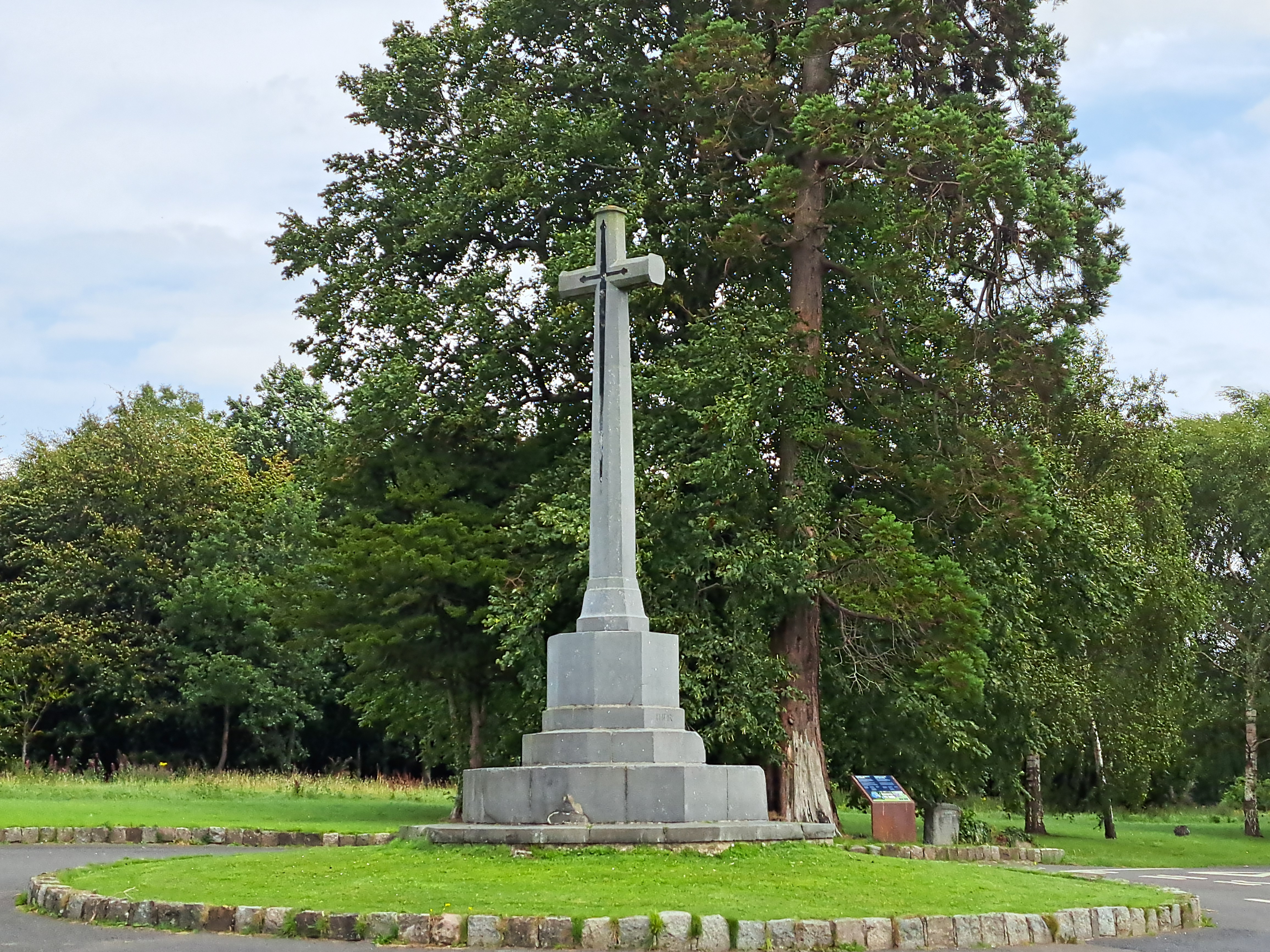
Cross of Sacrifice
Part of the First World War Screen Wall
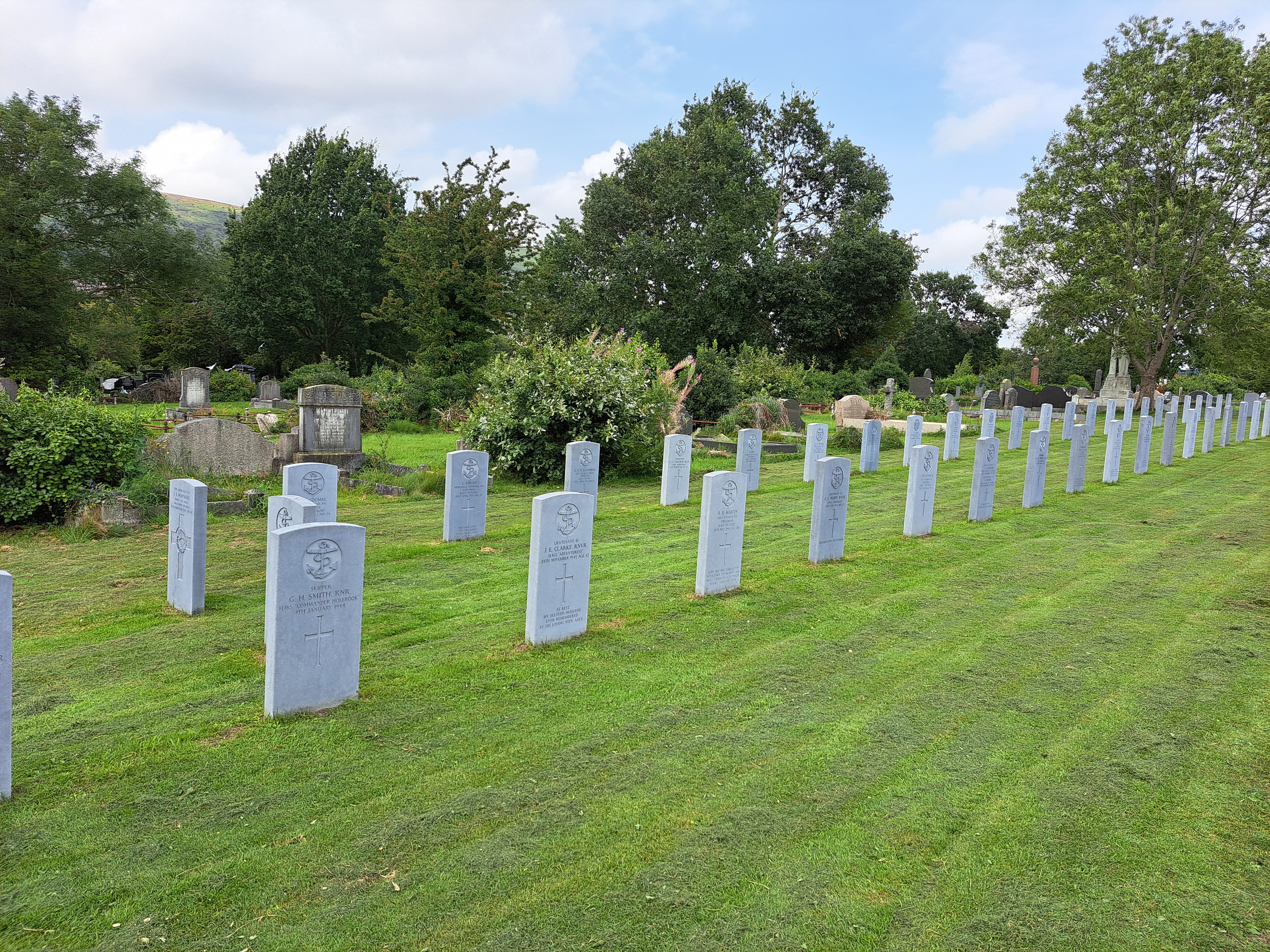
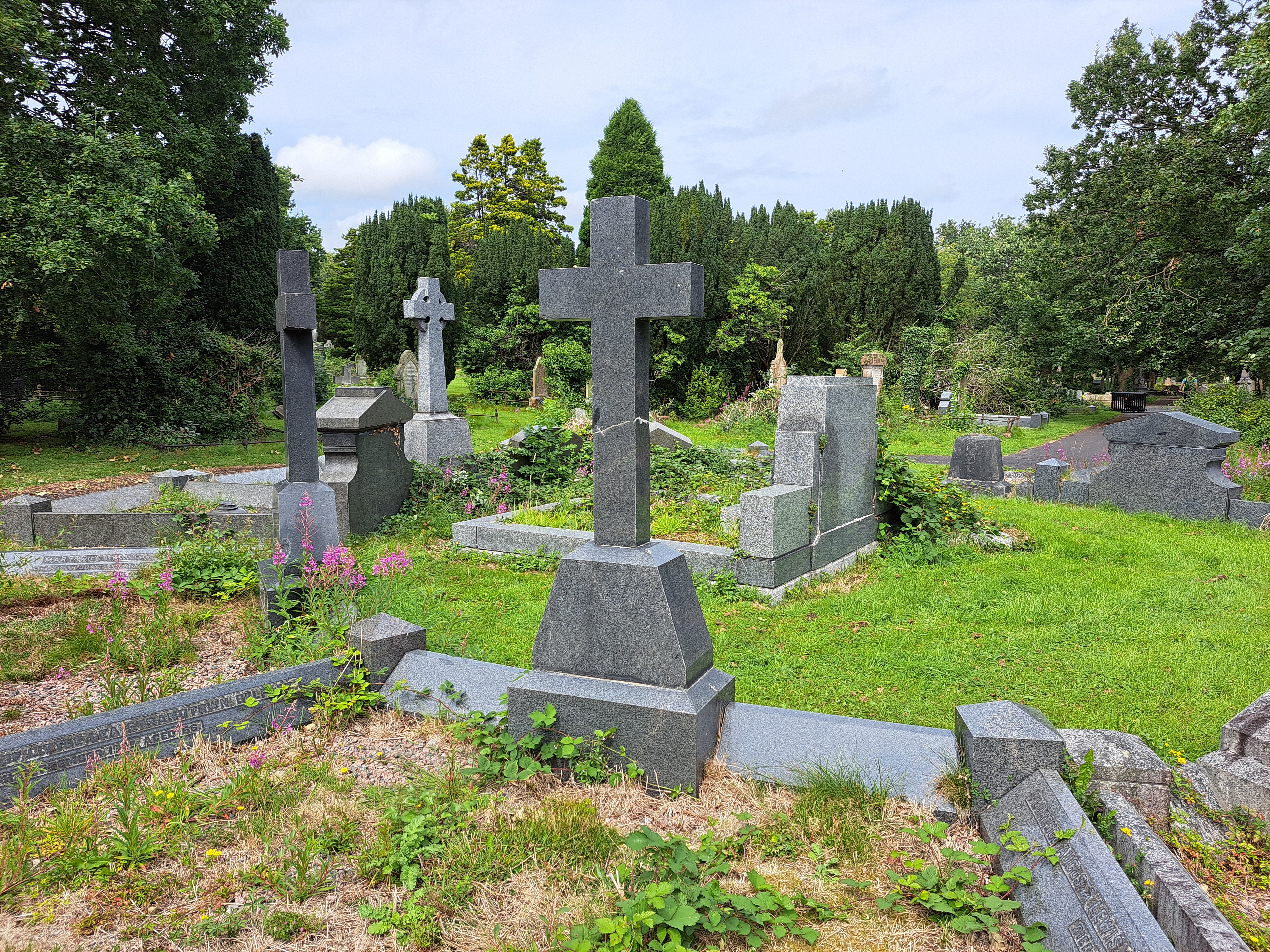
Second World War Royal Navy and Merchant Navy graves

There are a lot of significant people from Belfast’s past who were Non-Subscribing Presbyterians who are buried here, perhaps most notable are Lord and Lady Pirrie. Viscount Pirrie was the chairman of Harland and Wolff when the Titanic was built and was to have sailed with his nephew, the designer Thomas Andrews, on its maiden voyage, but was prevented from doing so by illness.
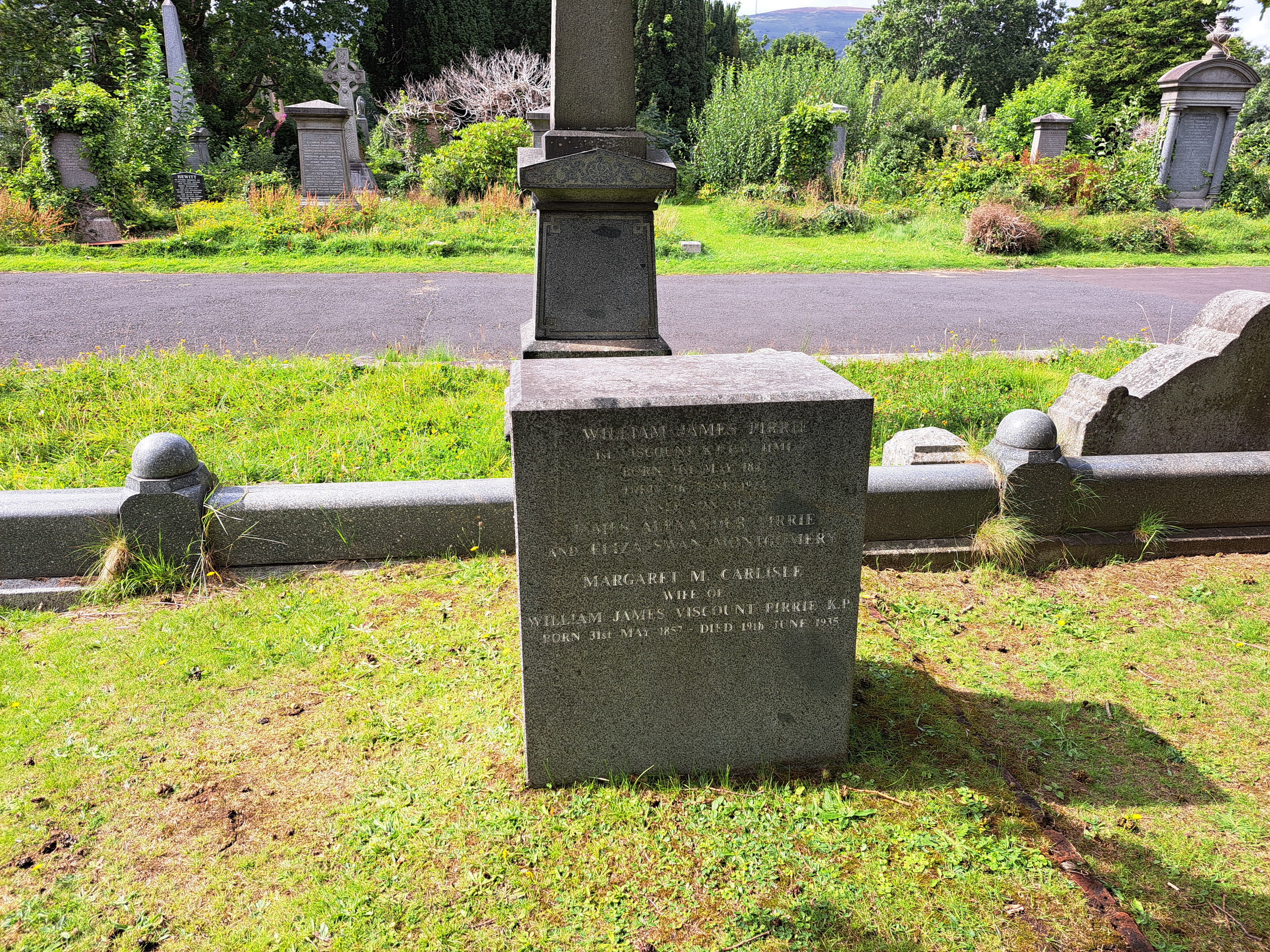
Grave of Lord and Lady Pirrie

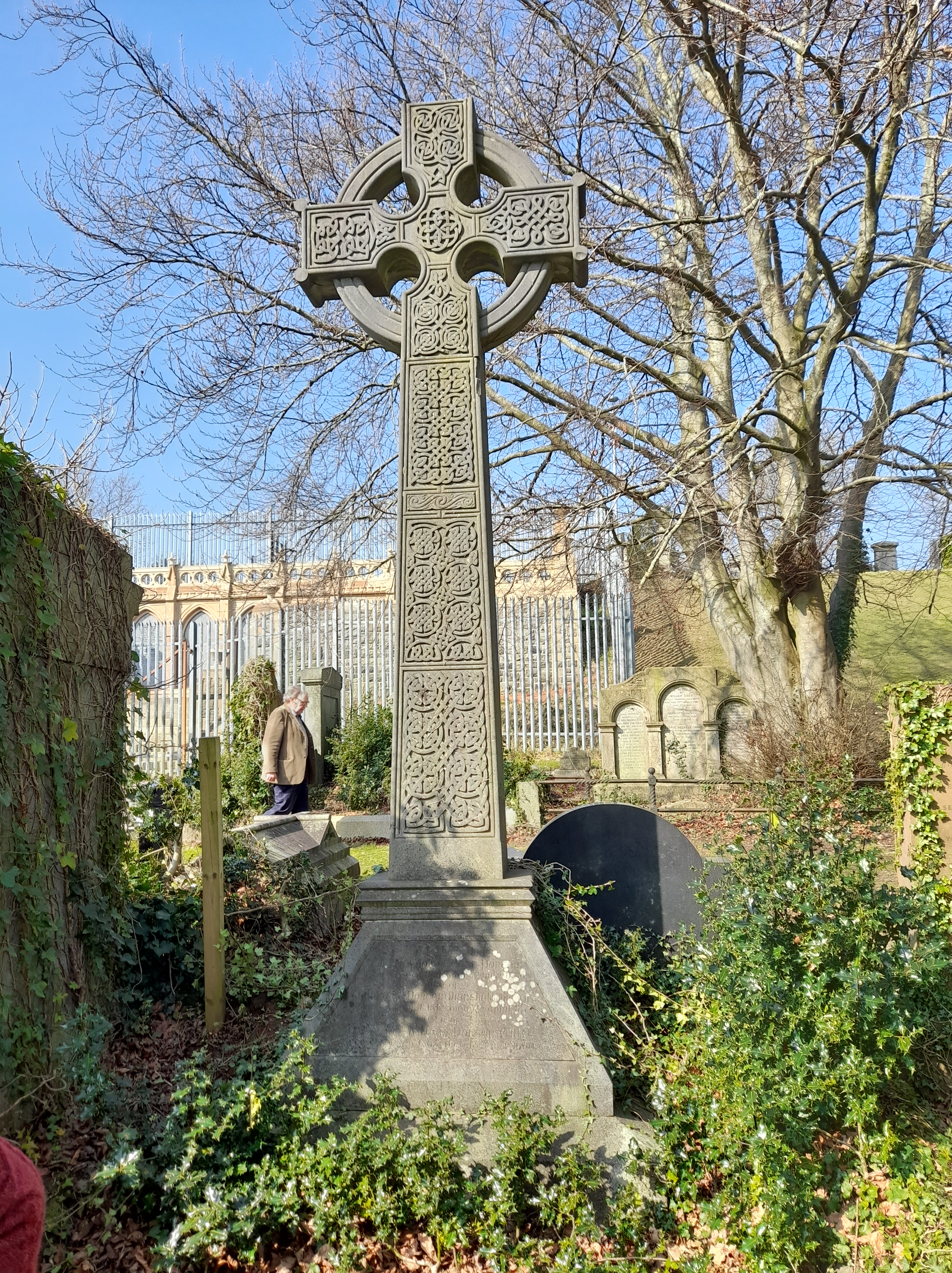
I have written before about one of the most notable Non-Subscribing Presbyterian ministers buried here, the Rev John Scott Porter, and was pleased to hear from his great great great granddaughter as a result. He is buried with his brother, William, who was once the attorney general at the Cape Colony, and actually introduced at that time a franchise that was inclusive of all races. The Celtic Cross that marks their grave is one of the most impressive in the cemetery:
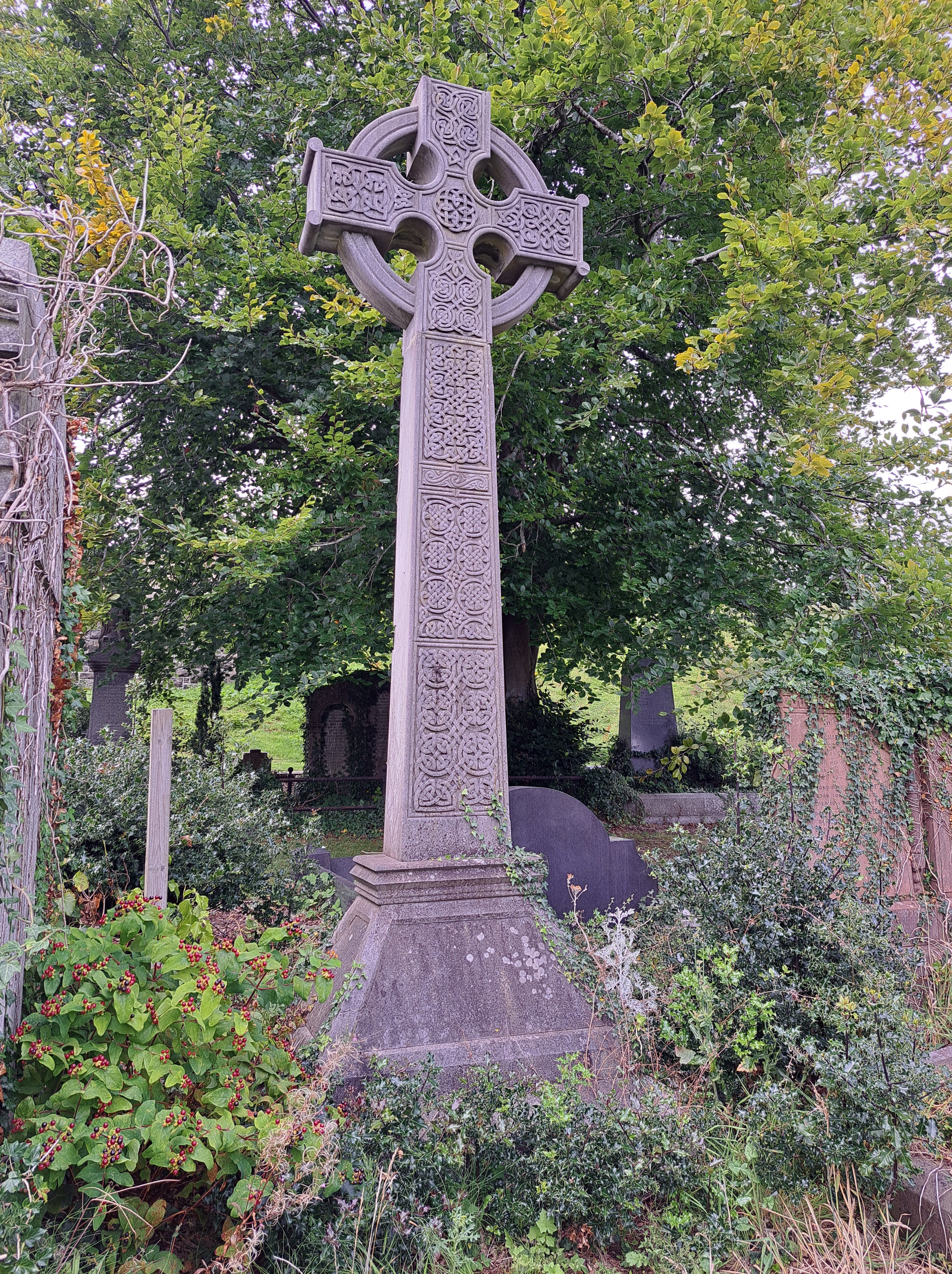
The grave of Rev John Scott Porter and William Porter

I also produced a short video about John Scott Porter at that time. This is available to view here:
Click above to see the video
The grave of Florence and Albert James Lewis, the parents of C.S. Lewis
The tour at the Vaults and Central Steps

Postcards from Finaghy – and the Moore family of Finaghy and Dunmurry

Following our postcard views of Dunmurry in the 1930s I thought I would post some postcards from a place a short distance away; pictures of Finaghy, which probably date from a few years before, and which we know were taken by Allen Daniel Coon of Letterkenny and Moira.

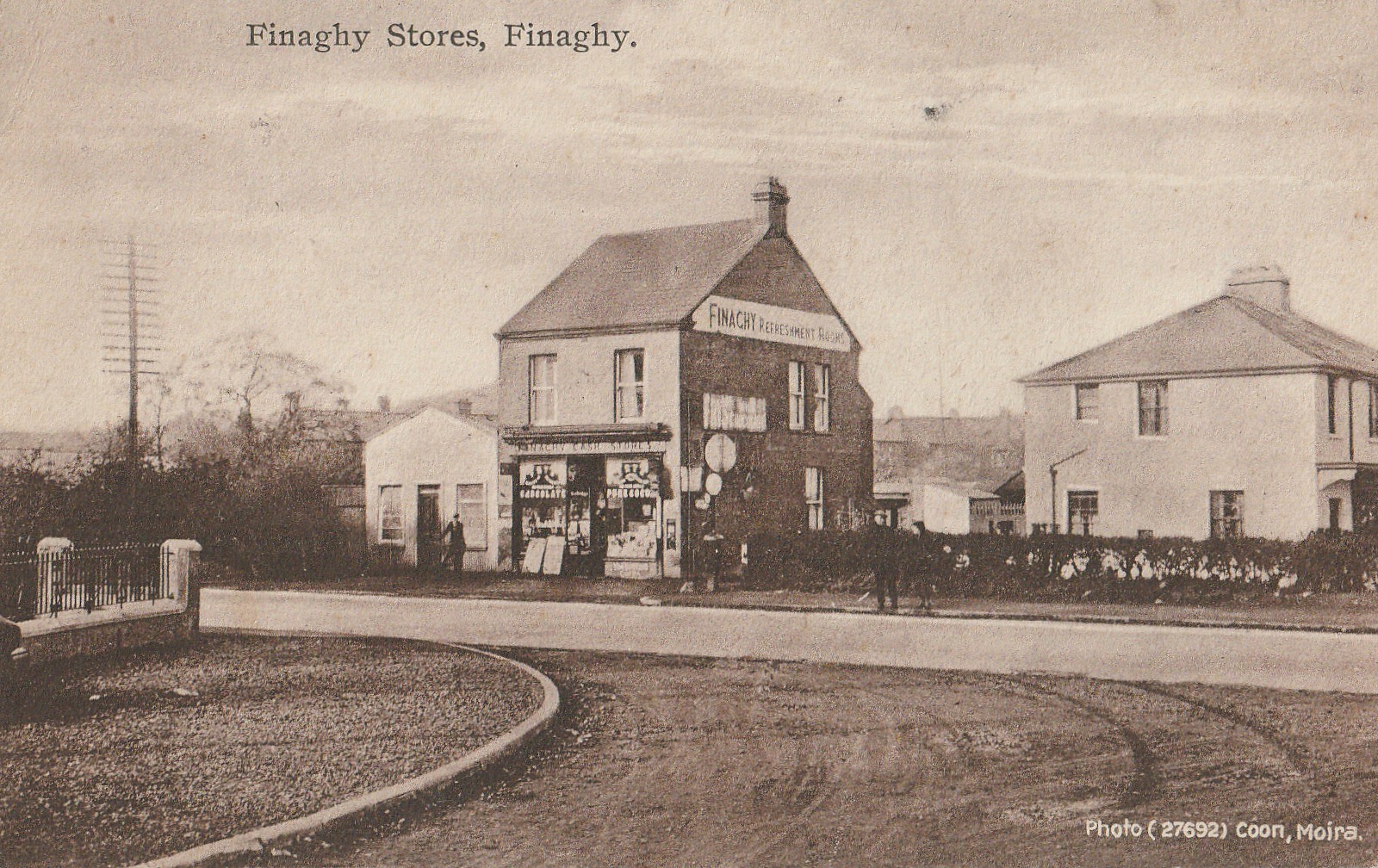
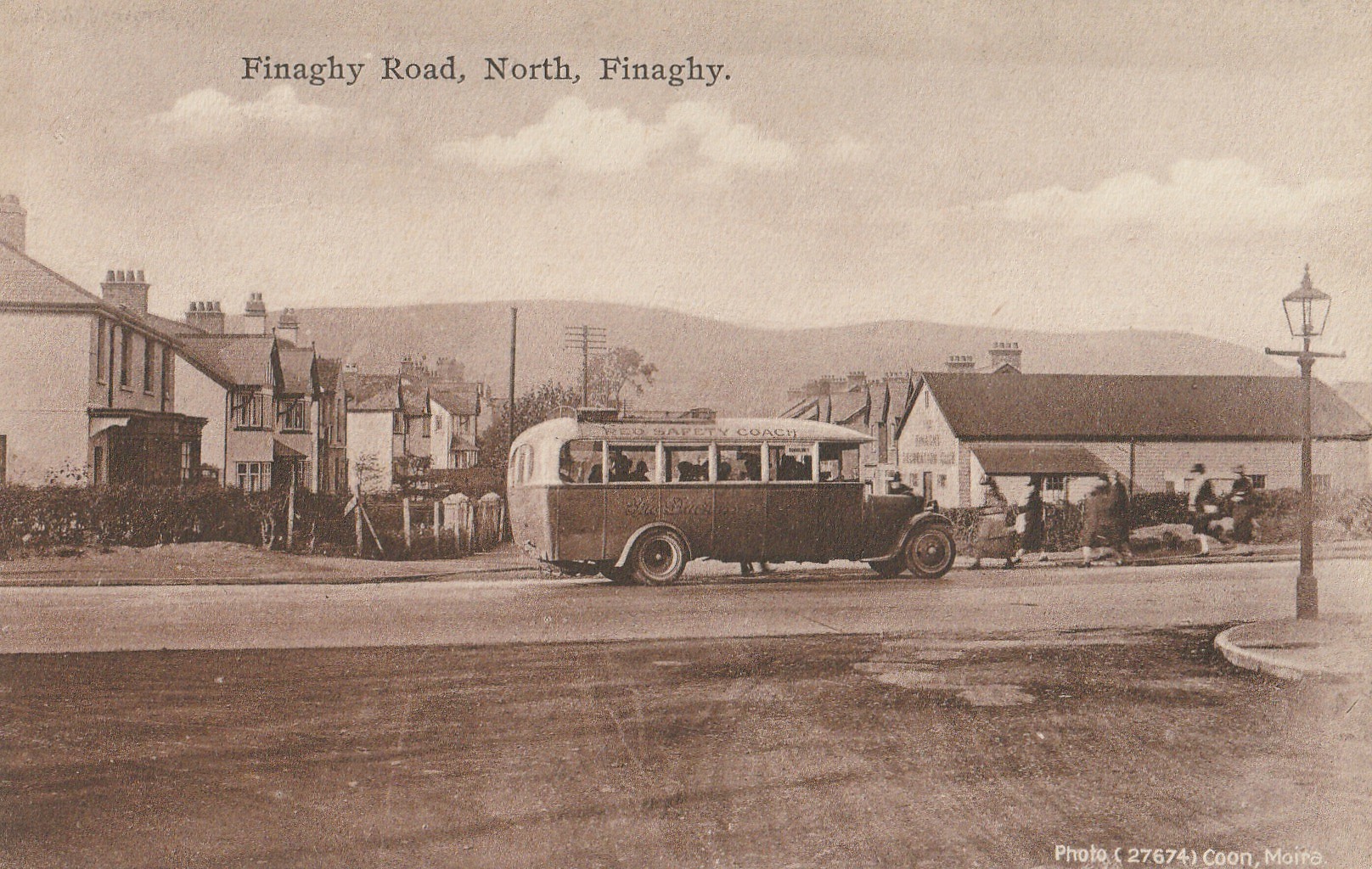
The numbering system on the four cards is believed to point to a date in 1927 for their production. According to the excellent catalogue of Allen Coon’s cards produced by Brian Hamilton in 2016 there were five cards published in this series for W.J. Ross of Finaghy Stores but I only have four of them. These four images are quite common but I have to admit that I have never seen an example of the fifth card which is named as ‘Finaghy Road South looking North’.

Finaghy Stores, Finaghy

The ‘Finaghy Stores’ postcard shows a solitary shop, that of W.J. Ross’s Cash Stores and Refreshment Rooms. It stands out very prominently in those days, but later had another shop joined to it and was surrounded by a number of other shops, including a couple of banks. The shop was well known to me in more recent times when it belonged to John Frazer, an active member of All Souls’ Church when I was minister there.

Finaghy Road, North, Finaghy

The postcard ‘Finaghy Road, North, Finaghy’ looks across the crossroads to Finaghy Road North and dates from a time when there was so little traffic that a bus could stop in the middle of the road to pick up passengers to be taken into town. This view has essentially not changed except for the addition of shops on one side and what was a bank on the other side of the road.

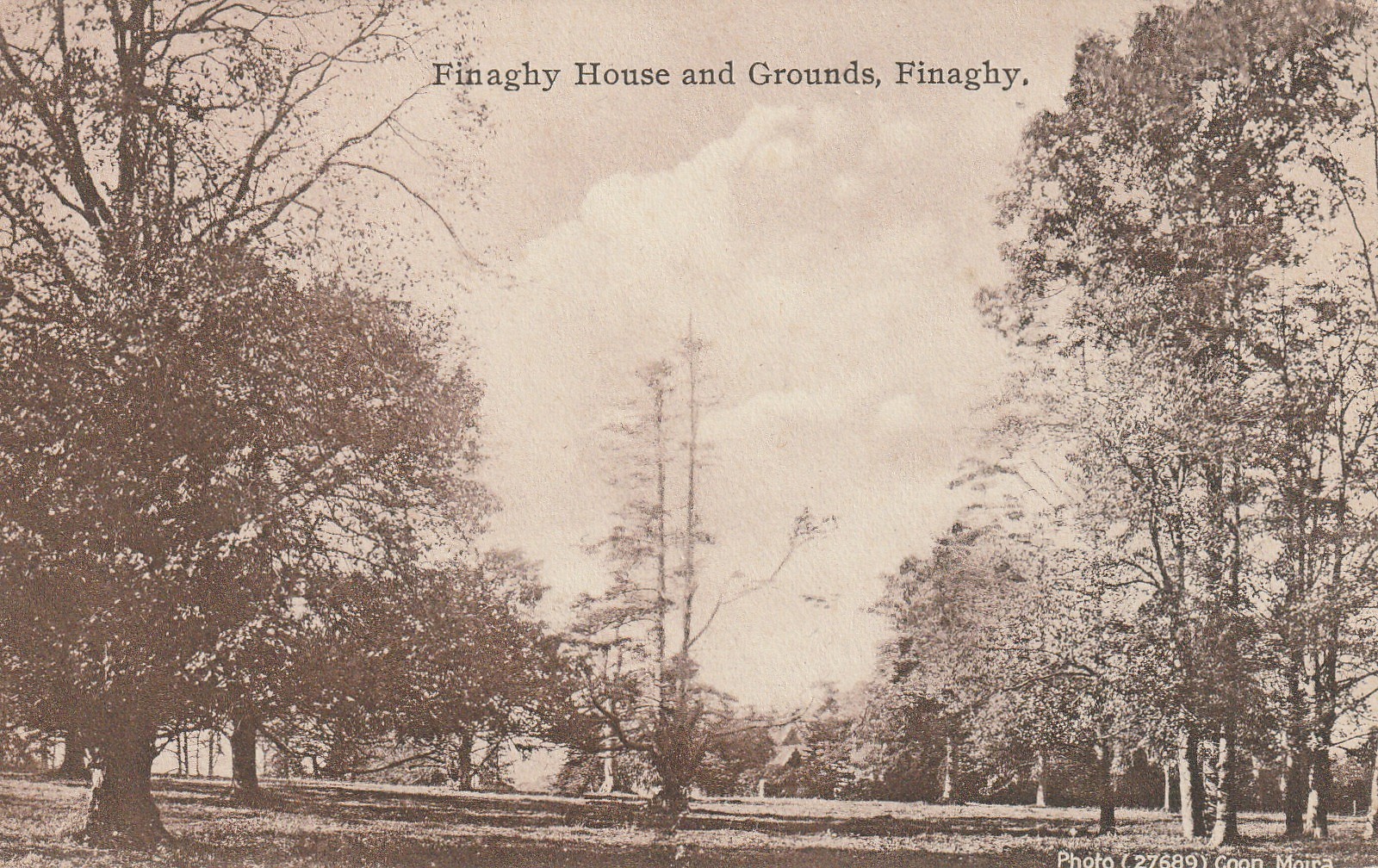
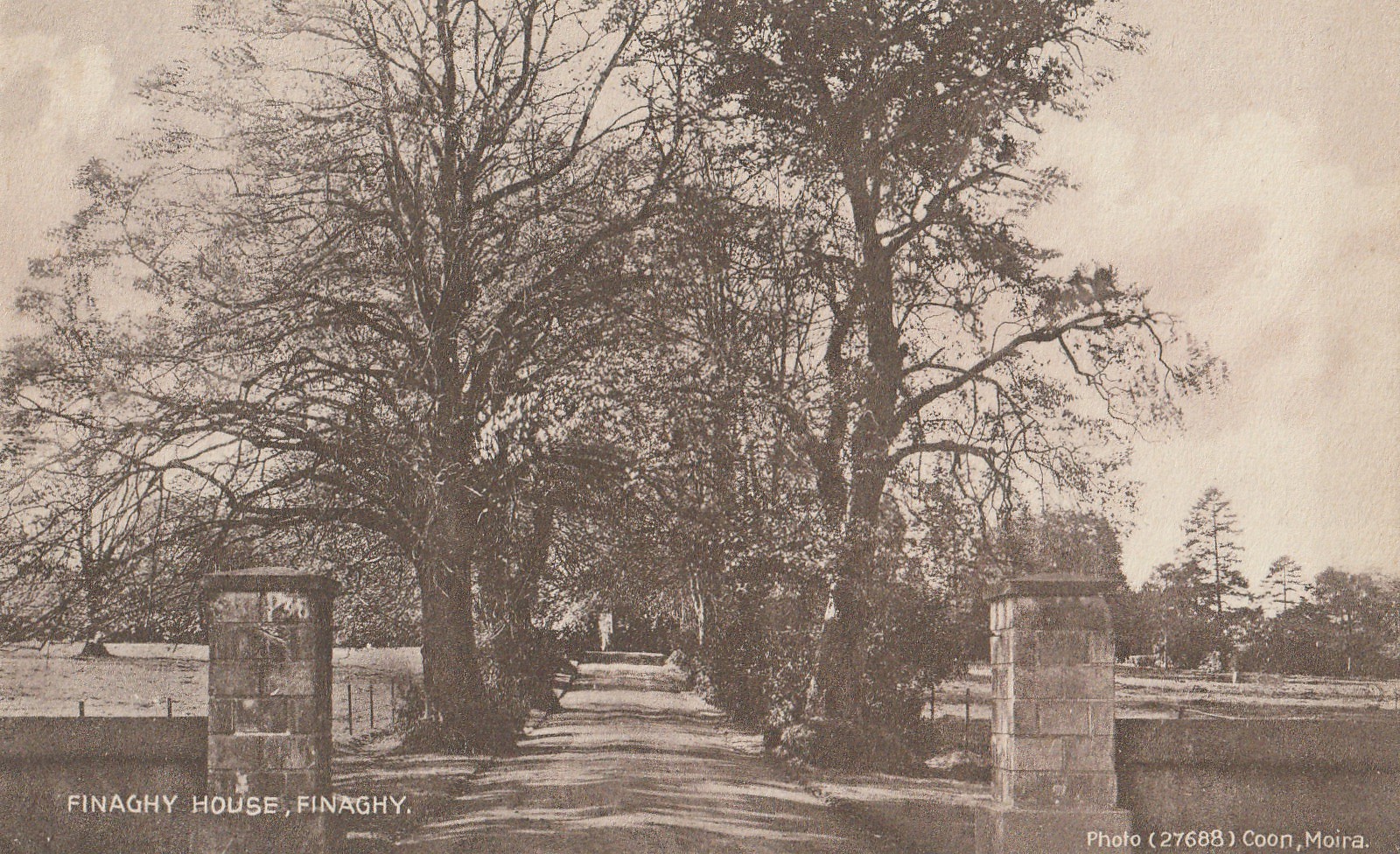
The other two postcards are a little more curious. Named as ‘Finaghy House’ and ‘Finaghy House and Grounds’, they could more accurately be titled ‘Finaghy House gateposts’ and ‘Finaghy House Grounds’ since neither card features any more than the merest suggestion of Finaghy House.

Finaghy House and Grounds

This is a pity really because Finaghy House will have been a major landmark at the time. Lord Belmont in Northern Ireland tells us all about Finaghy House in his excellent blog which you can read here. He tells us that the original house was built by Richard Woods at the end of the seventeenth century but was sold to the Charley family, a prominent linen family in 1727. Lord Belmont quotes the 1830 Ordnance Survey Memoirs as saying ‘the walls are nearly four feet thick and run together by grouted lime, similar to other ancient buildings.’ A descendant of the family said it was ‘an imposing mansion in a large park, with extensive outhouses and stables … a remarkable feature [of the interior] being a revolving fireplace between the drawing-room and the dining-room.’ The Charley family sold the house to a family named Brewis who, it is said, bred corgis, one of which had the distinction of being the first corgi owned by Queen Elizabeth, The Queen Mother.

In about 1890 Finaghy House was sold to James Moore and this is where a connection can be found with the Non-Subscribing Presbyterian Church of Ireland. James Moore was a direct descendant of Rev Henry Montgomery and the family were all members of our church at Dunmurry. In the 1901 Census he is listed as a Manufacturing Stationer living with his wife, Maria Lydia, who had been born in New Orleans. They and their three children (Harold Montgomery, Kenneth Montgomery and Sybil) all give their religion as Unitarian. As well as the five family members there are three servants listed as resident in the house. Harold and Kenneth are respectively stationer’s assistant and stationer’s apprentice to their father in 1901, Sybil is still at school. By the 1911 Census the three children are no longer living at home although there are still three (different) servants; a parlour maid, a cook and a housemaid.

Finaghy House by A.D. Coon

By 1911 James Moore was a JP in County Antrim. In the First World War Kenneth Montgomery Moore was commissioned into the 11th Battalion Royal Irish Rifles and was awarded the Military Cross. He returned home safely at the end of the war and his name is listed in the First World War Roll of Honour of the Non-Subscribing Presbyterian Church of Ireland  (published 2018).

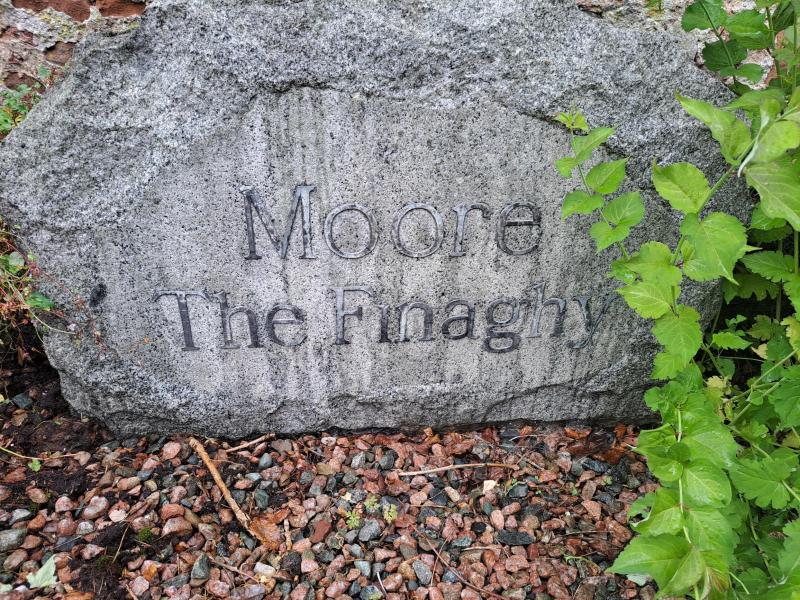
The Moore family burial ground can be found in their church, the First Presbyterian (NS) Church, Dunmurry. Marked simply as ‘Moore, The Finaghy’ it can be seen at the top of this page.

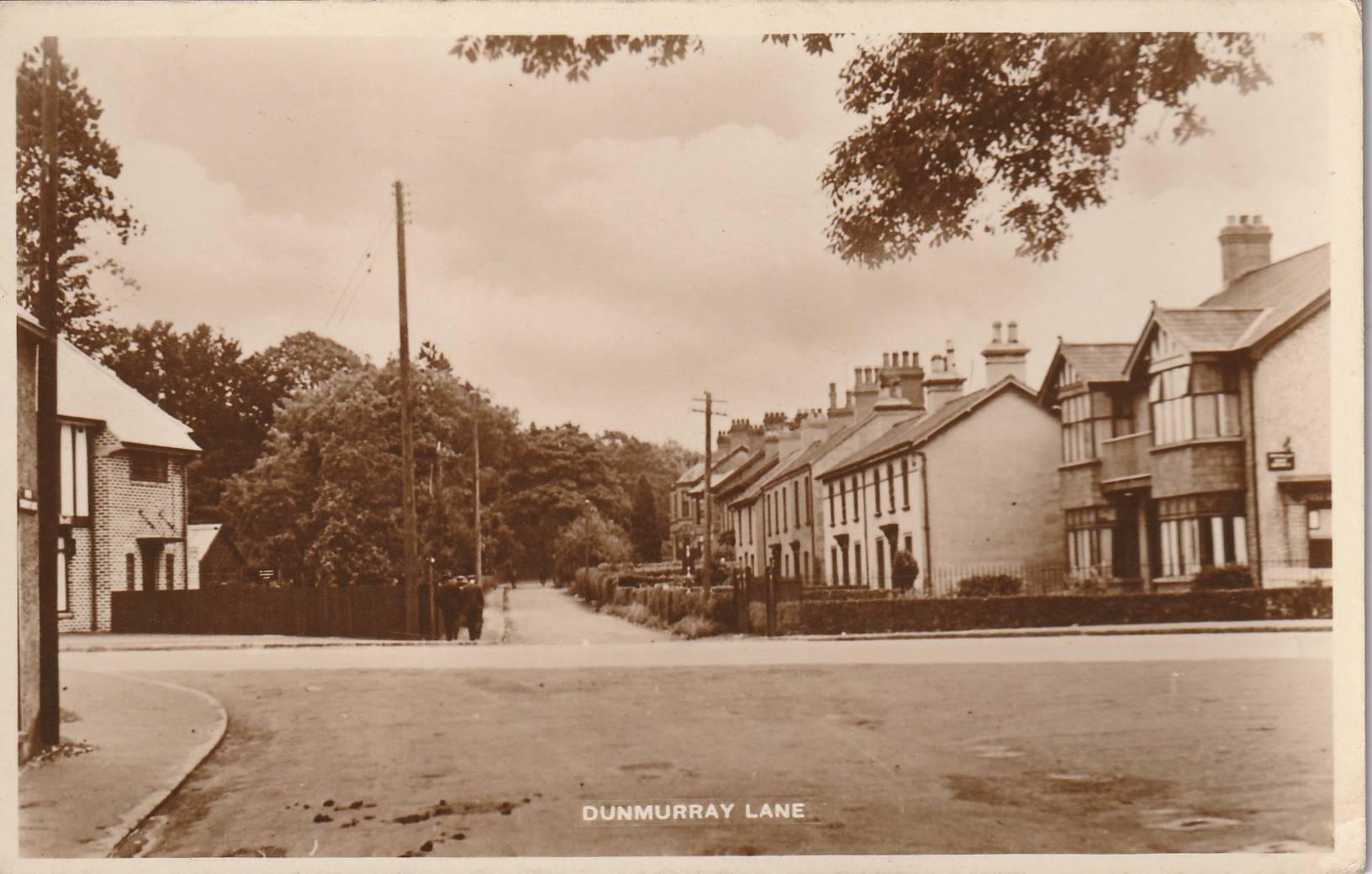
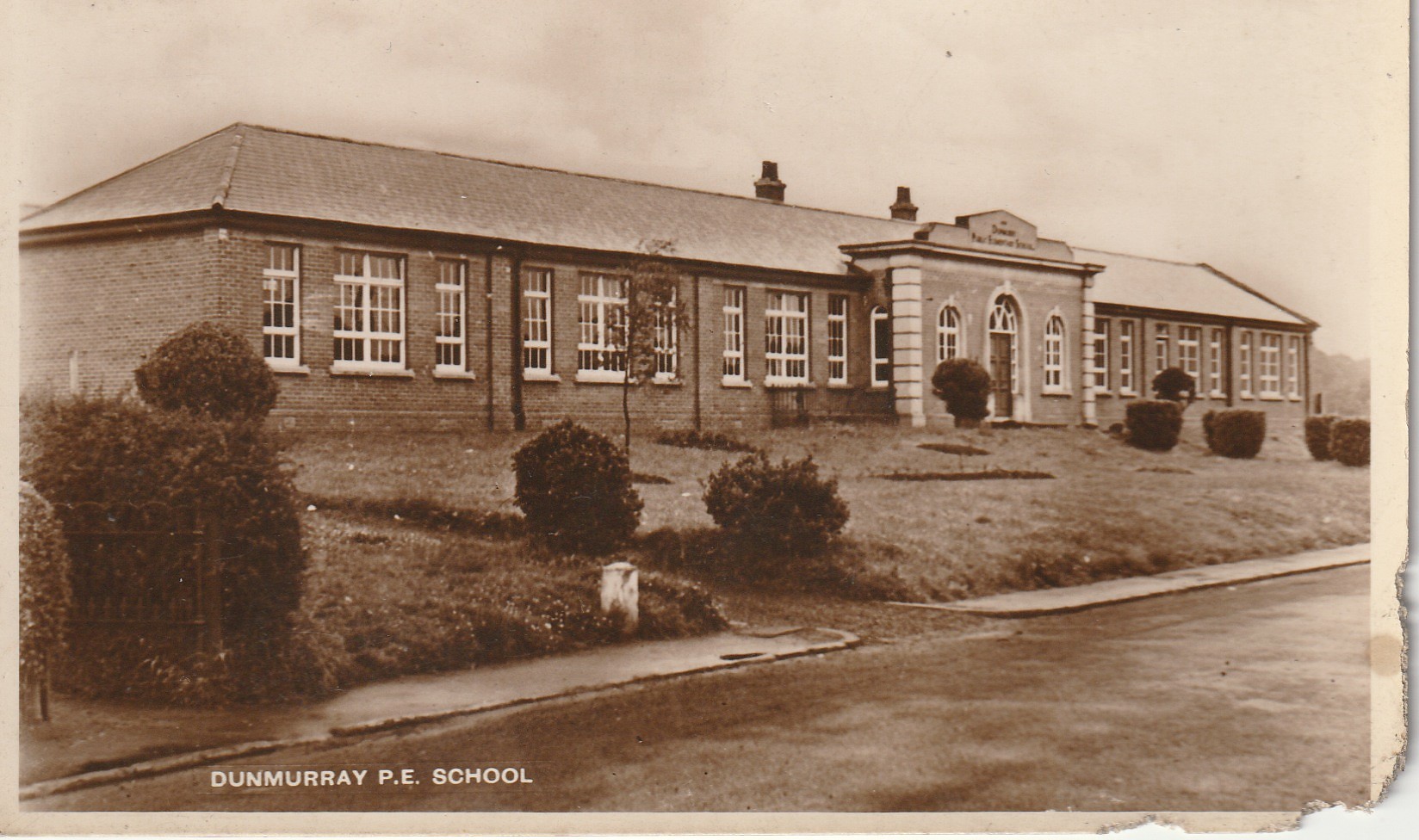
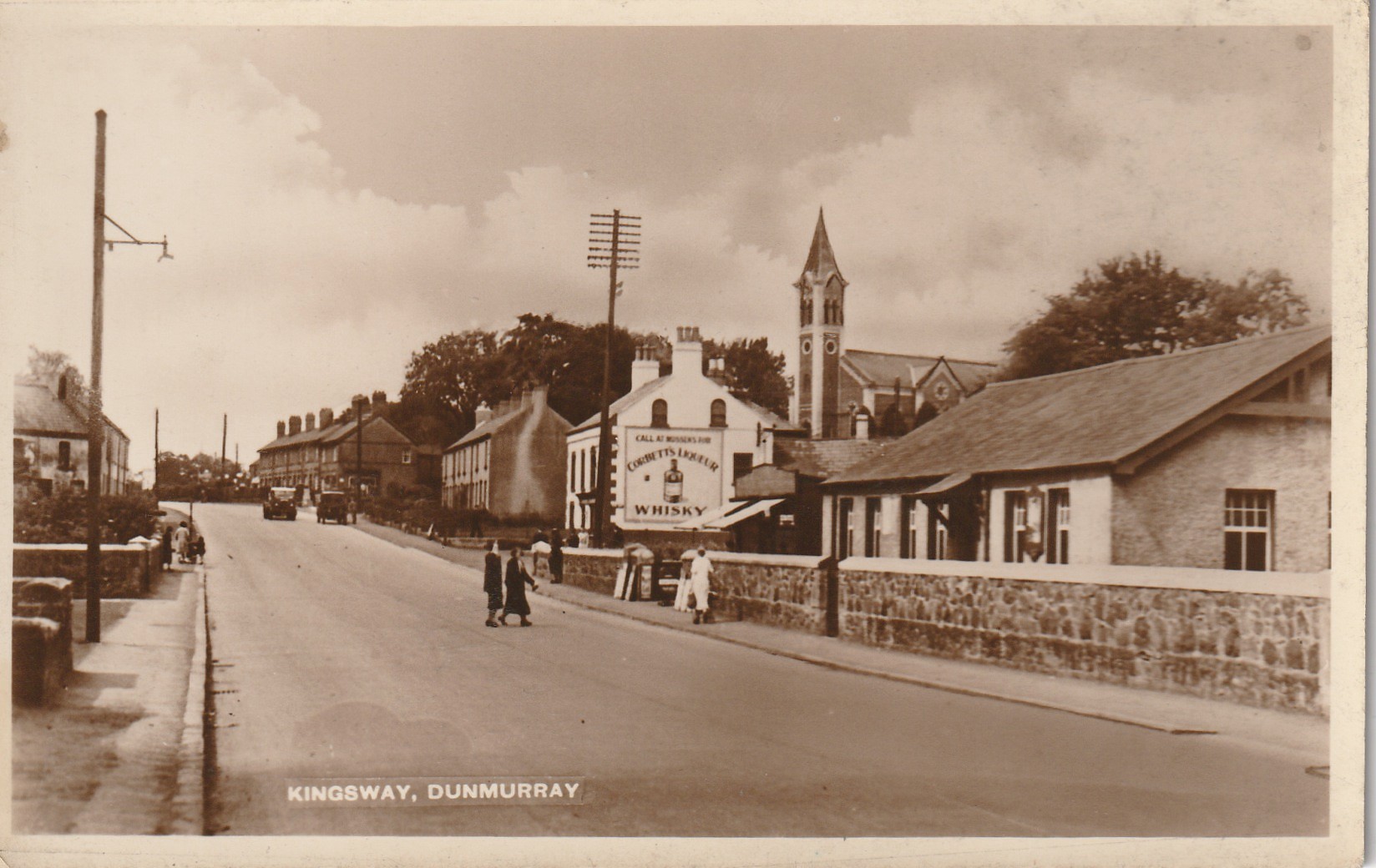
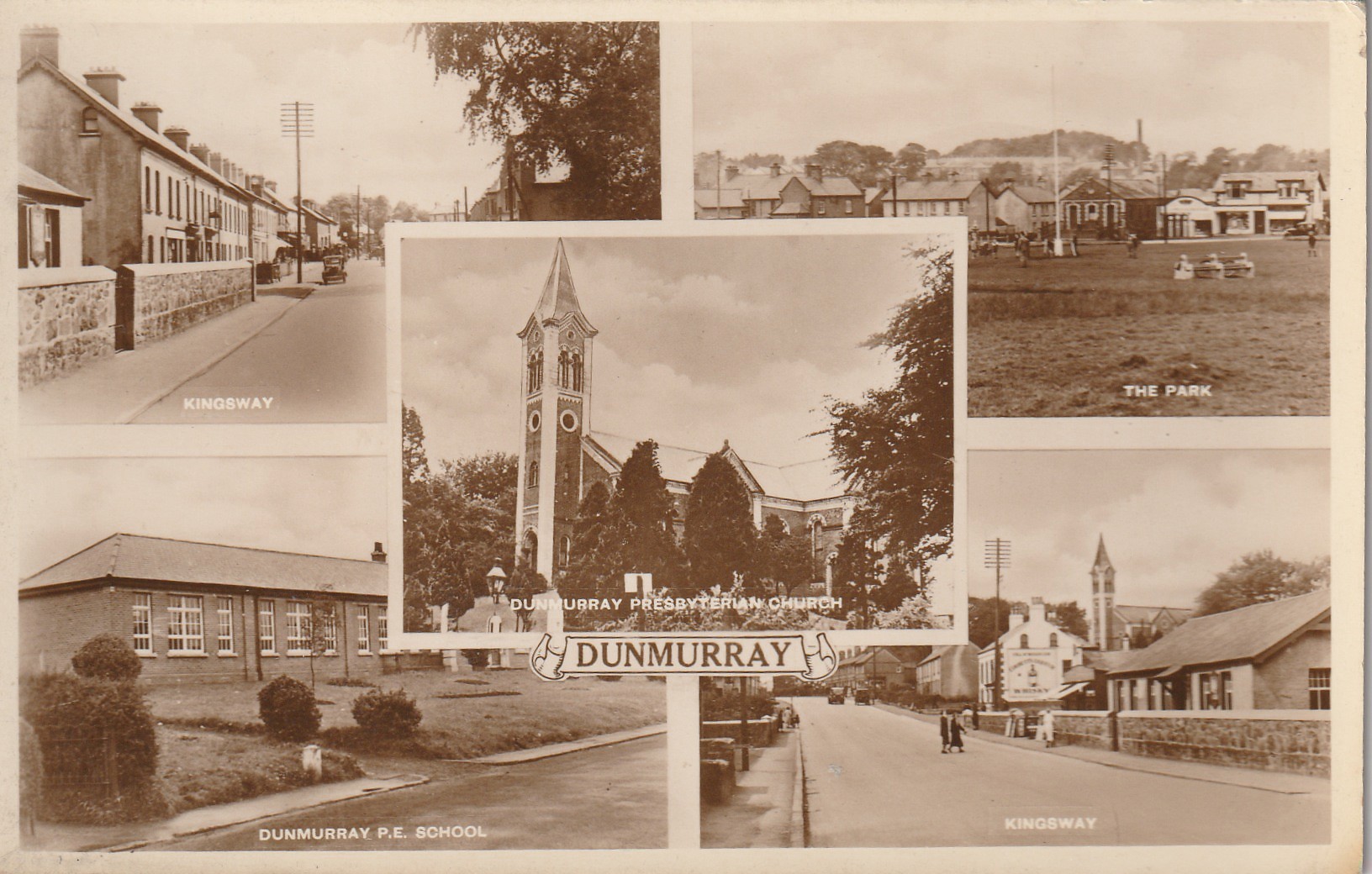
Dunmurry Postcards

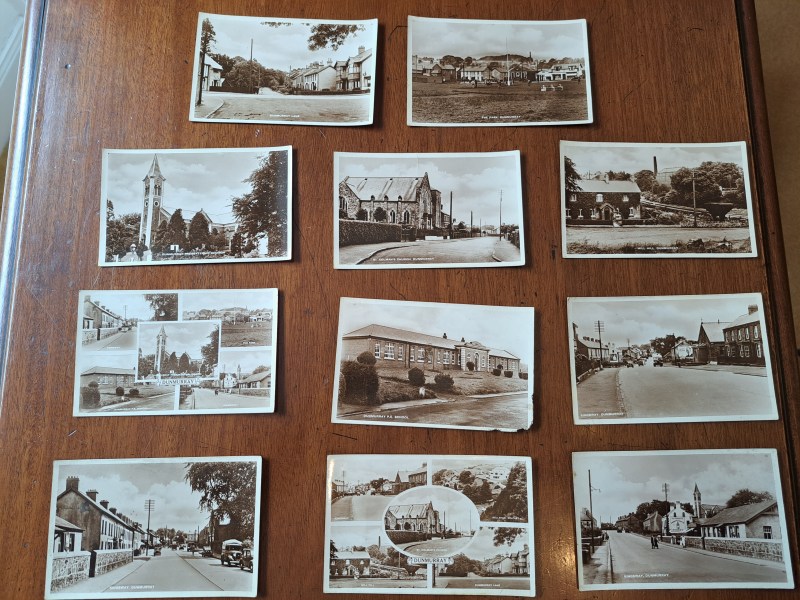
We have a good collection of postcards of Dunmurry in our Library at First Dunmurry (Non-Subscribing) Presbyterian Church. The following video tells their story:

Here are the postcards:

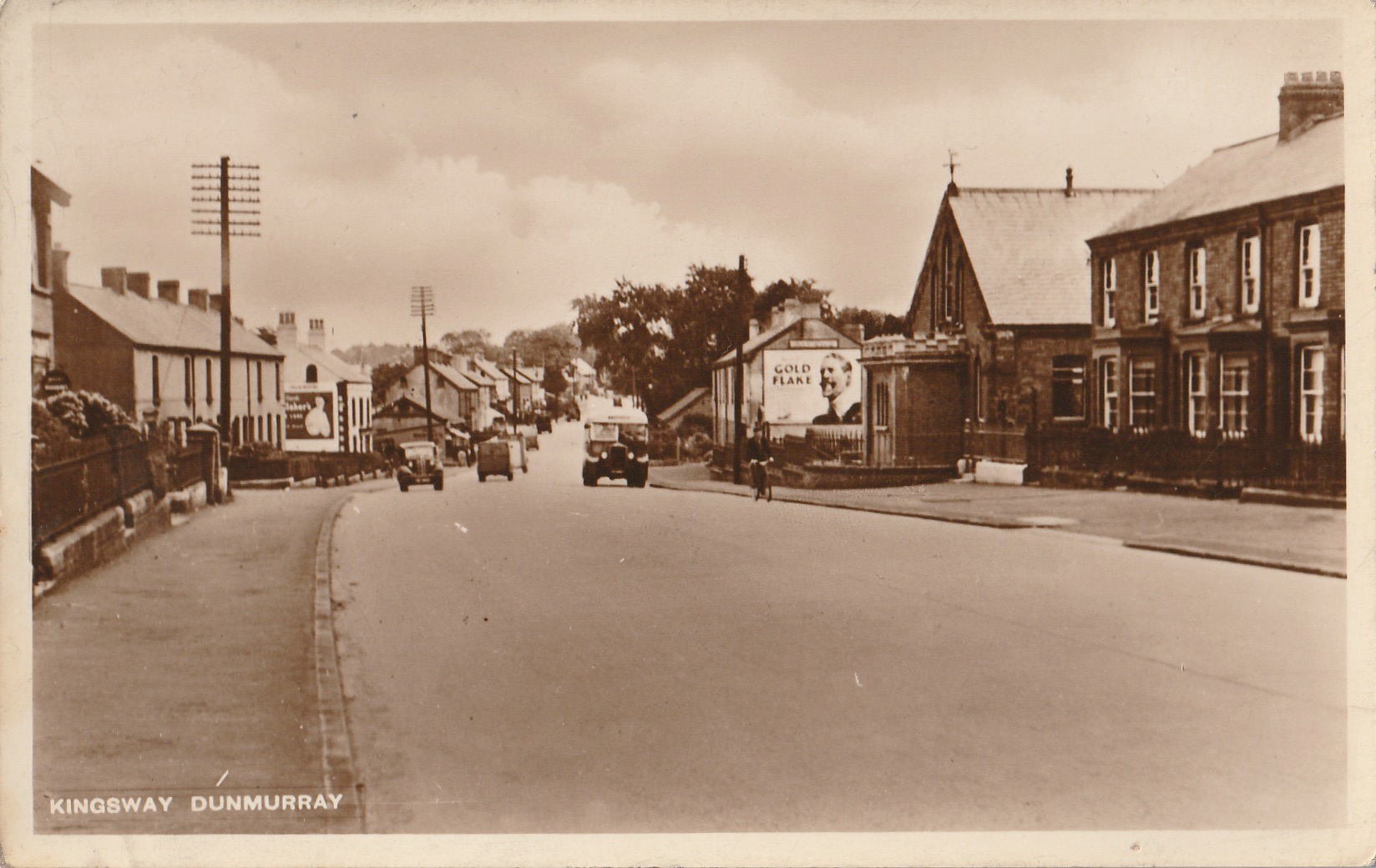
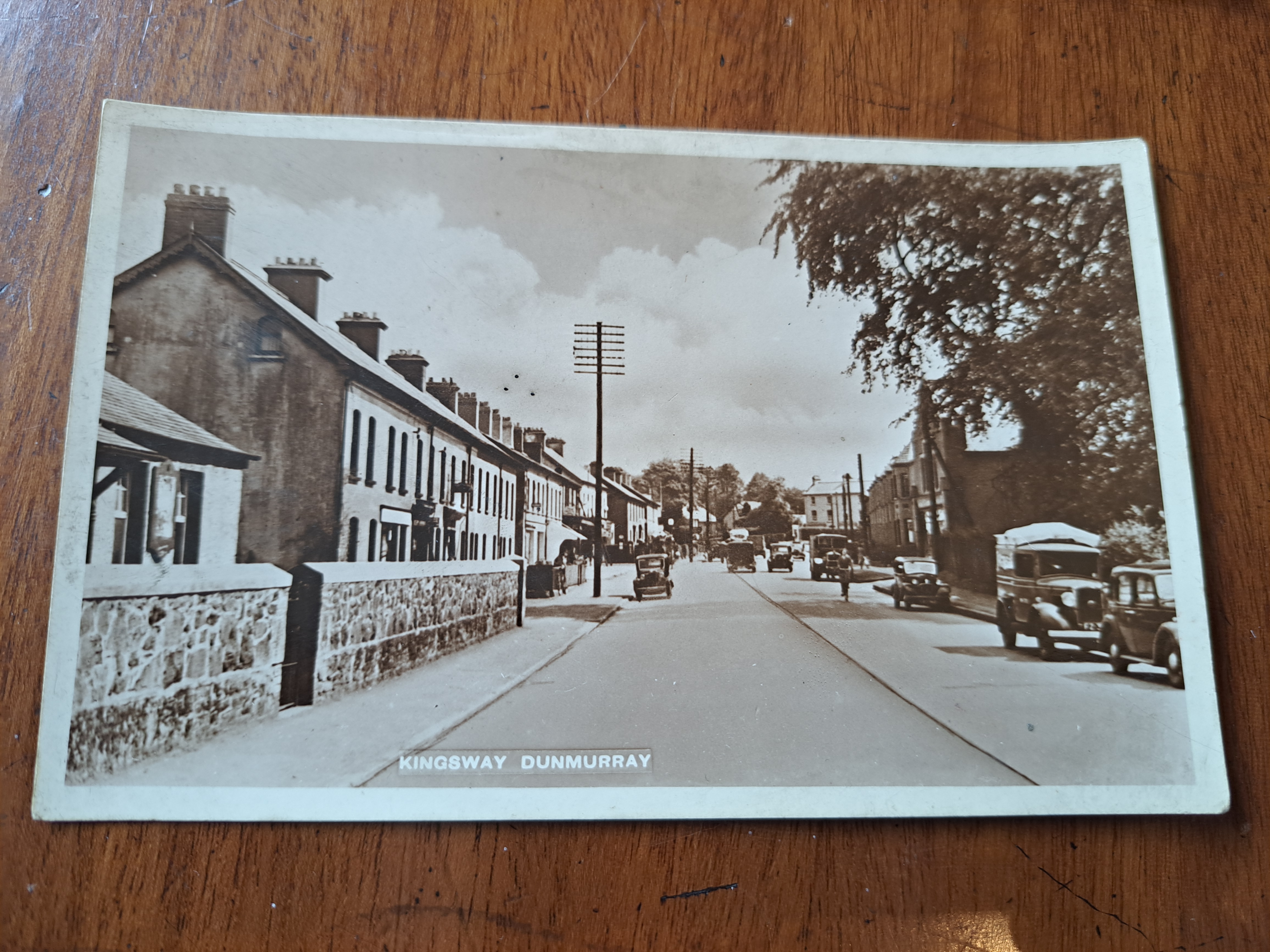
Kingsway 1
Dunmurry Lane
Dunmurry Primary School
Kingsway 2
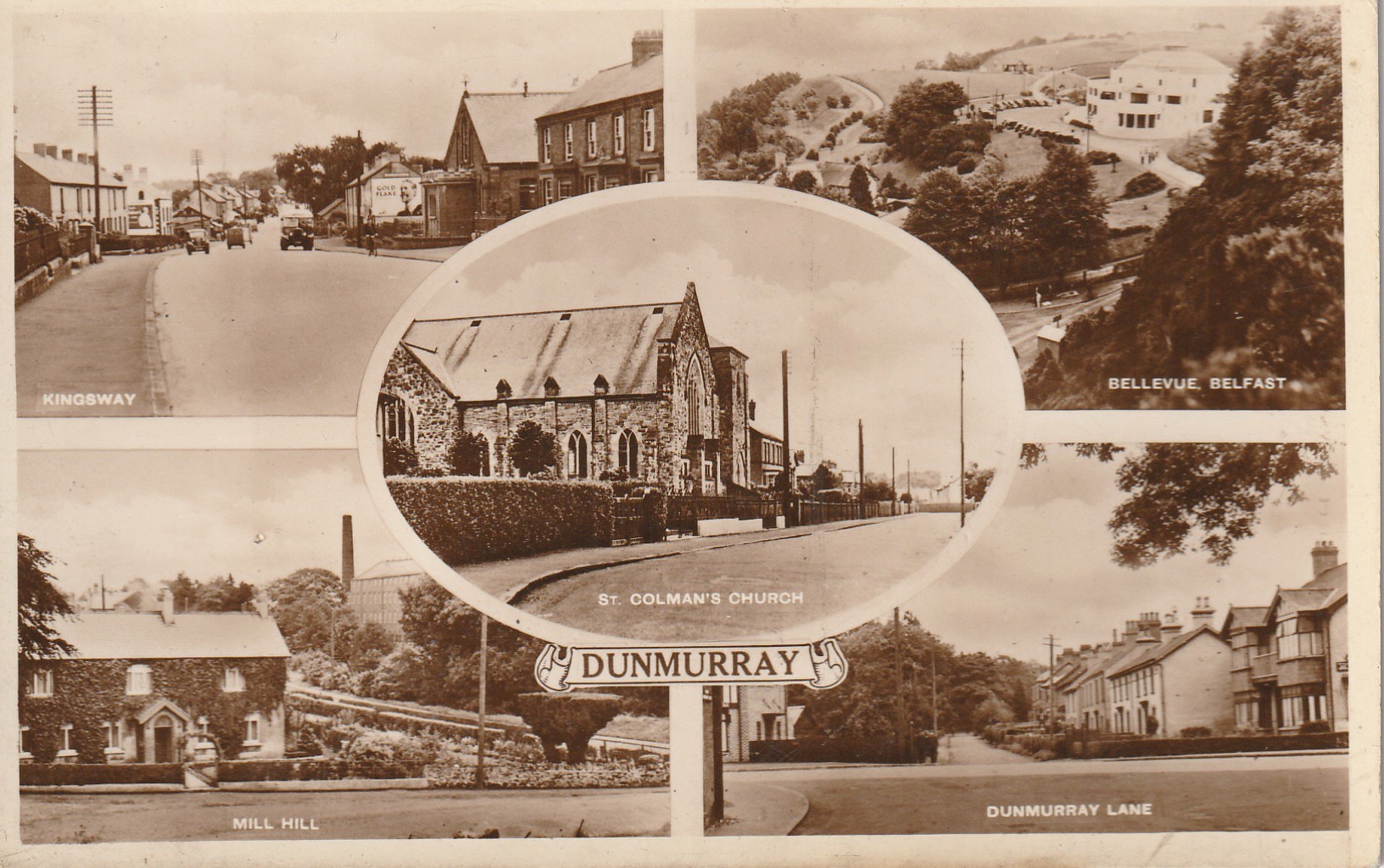
Multi-view 1
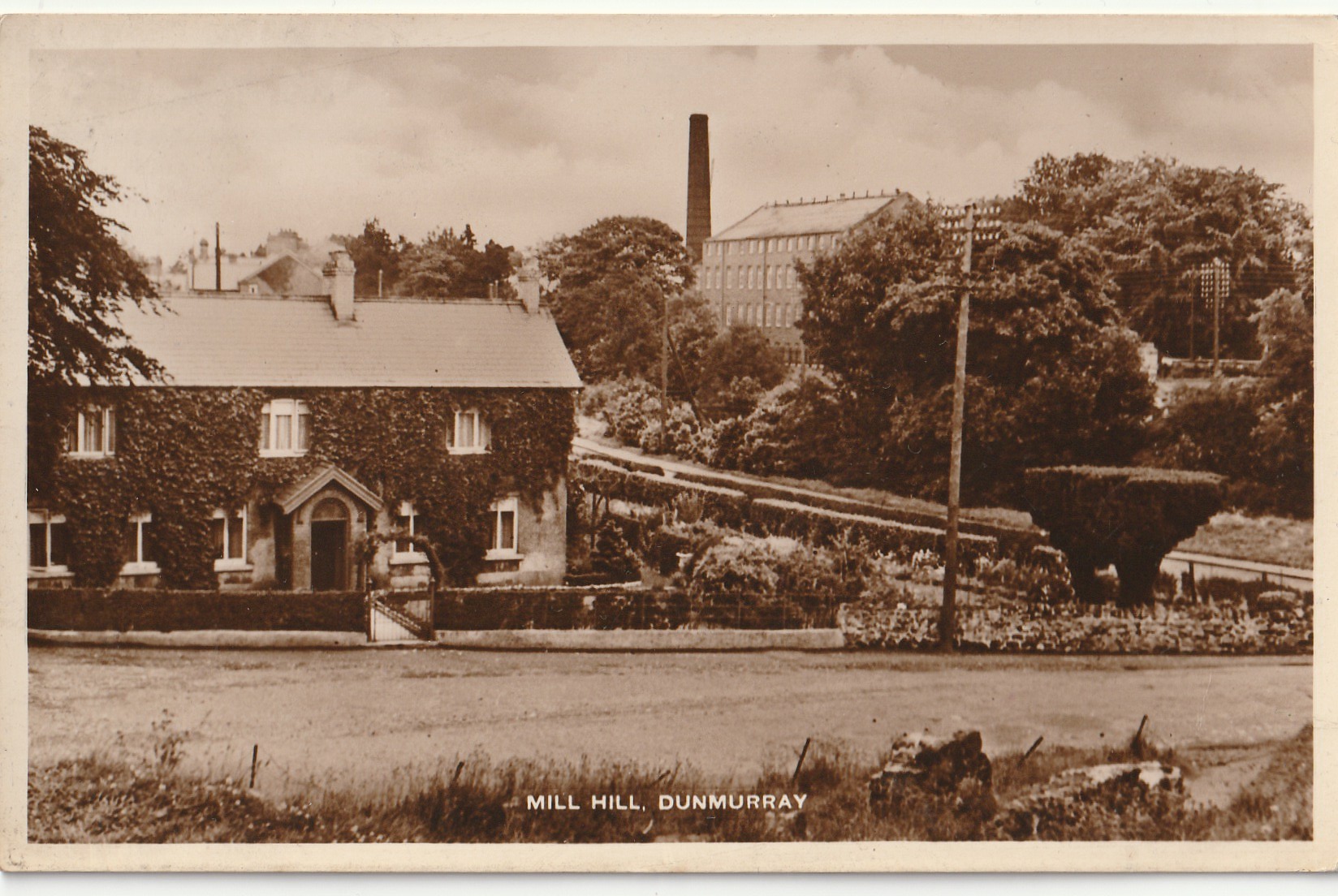
Mill Hill
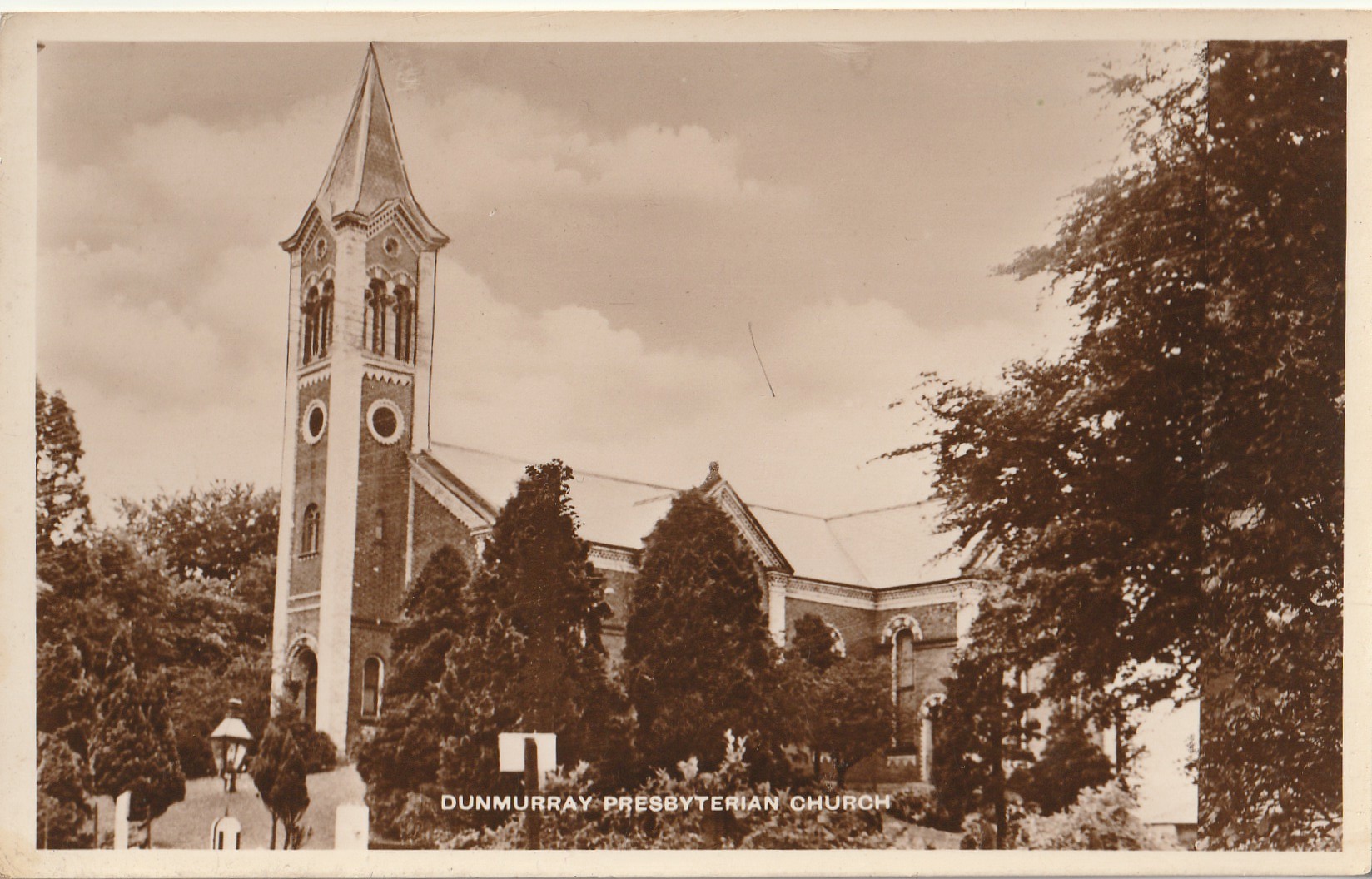
Presbyterian Church
Multi-view 2
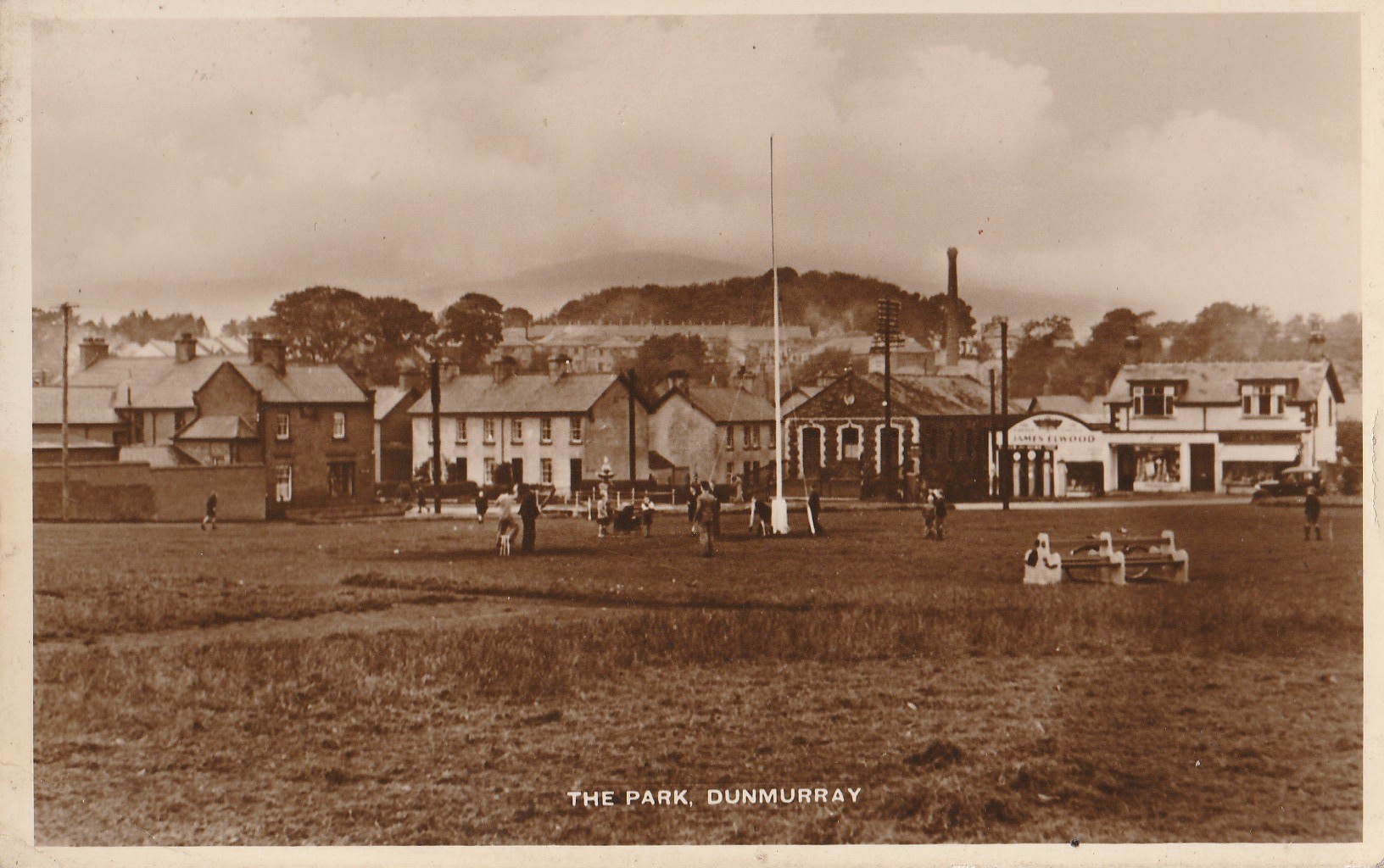
The Park
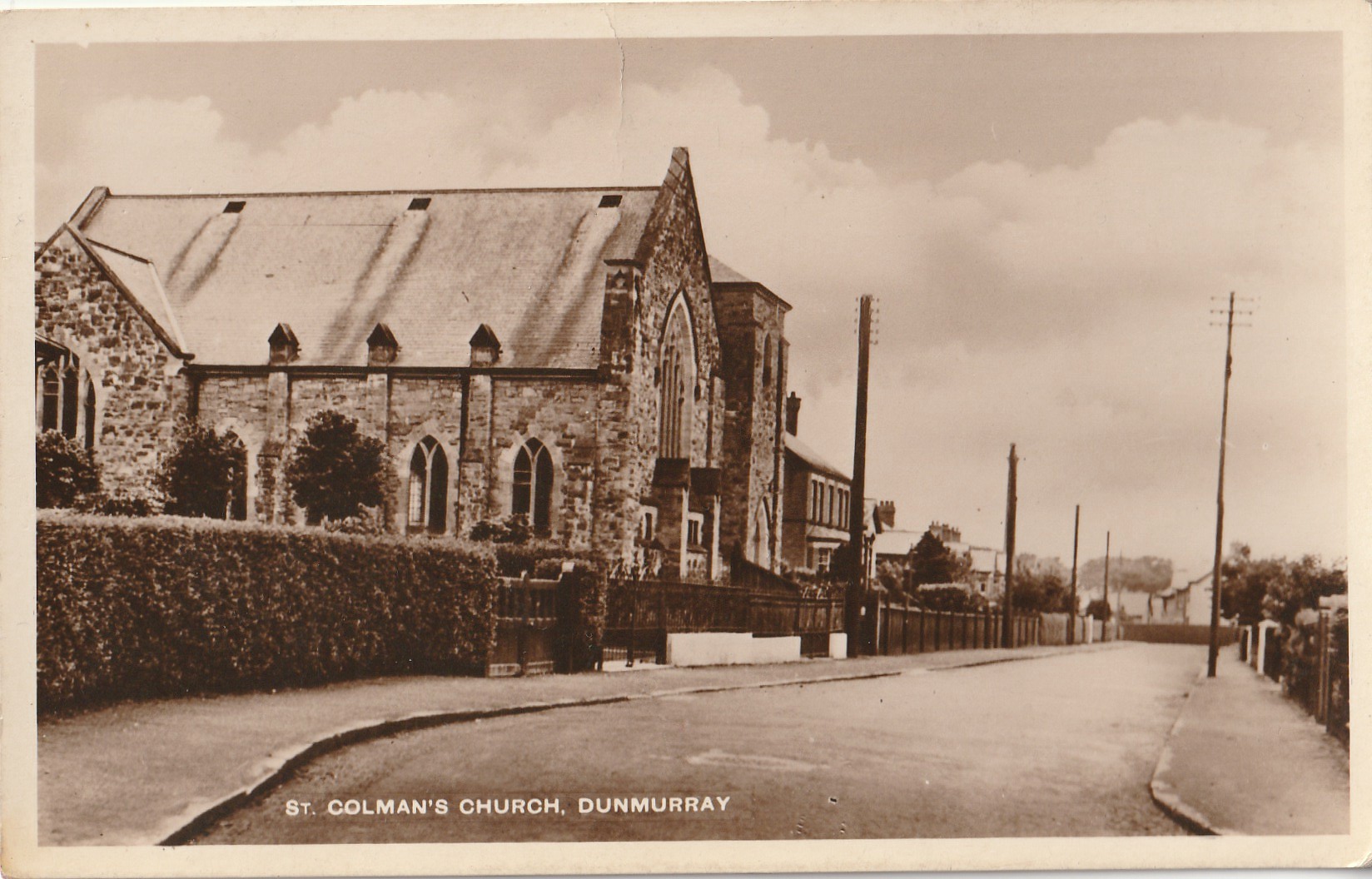
St Colman’s
Kingsway 3

All published by W. McCartney, Stationer, Newsagent & Tobacconist, Dunmurry. All with the unusual spelling of ‘Dunmurray’ on the front and back of each card!

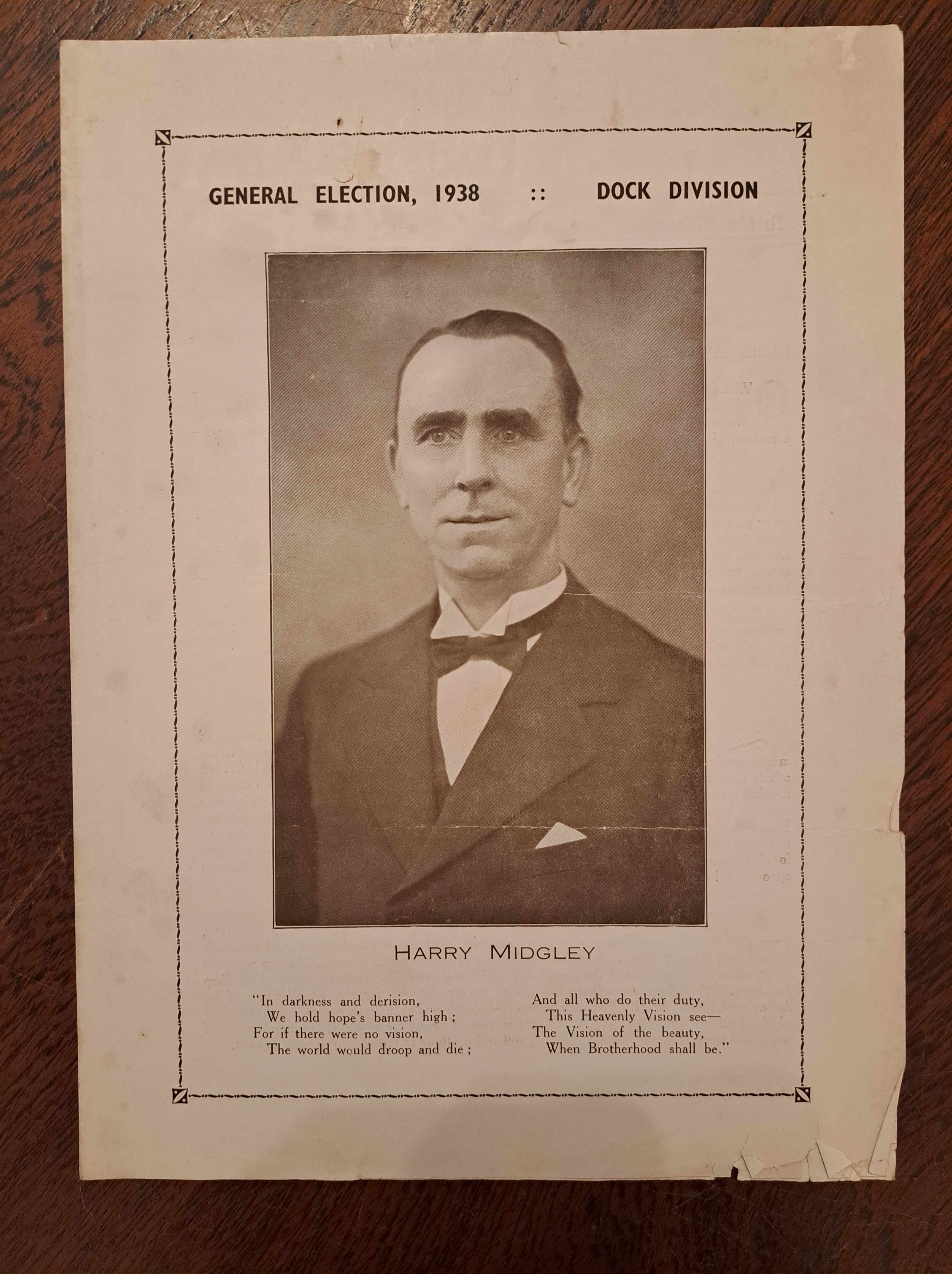
Harry Midgley: 1938 Election Address

One of the recently discovered items in the Very Rev William McMillan Library is the election address produced by Harry Midgley for the Dock Constituency in the 1938 Stormont Election. This is a fascinating piece of history, a very rare survival, that tells us about the career of a controversial figure in Belfast political history:

Click above to see the video

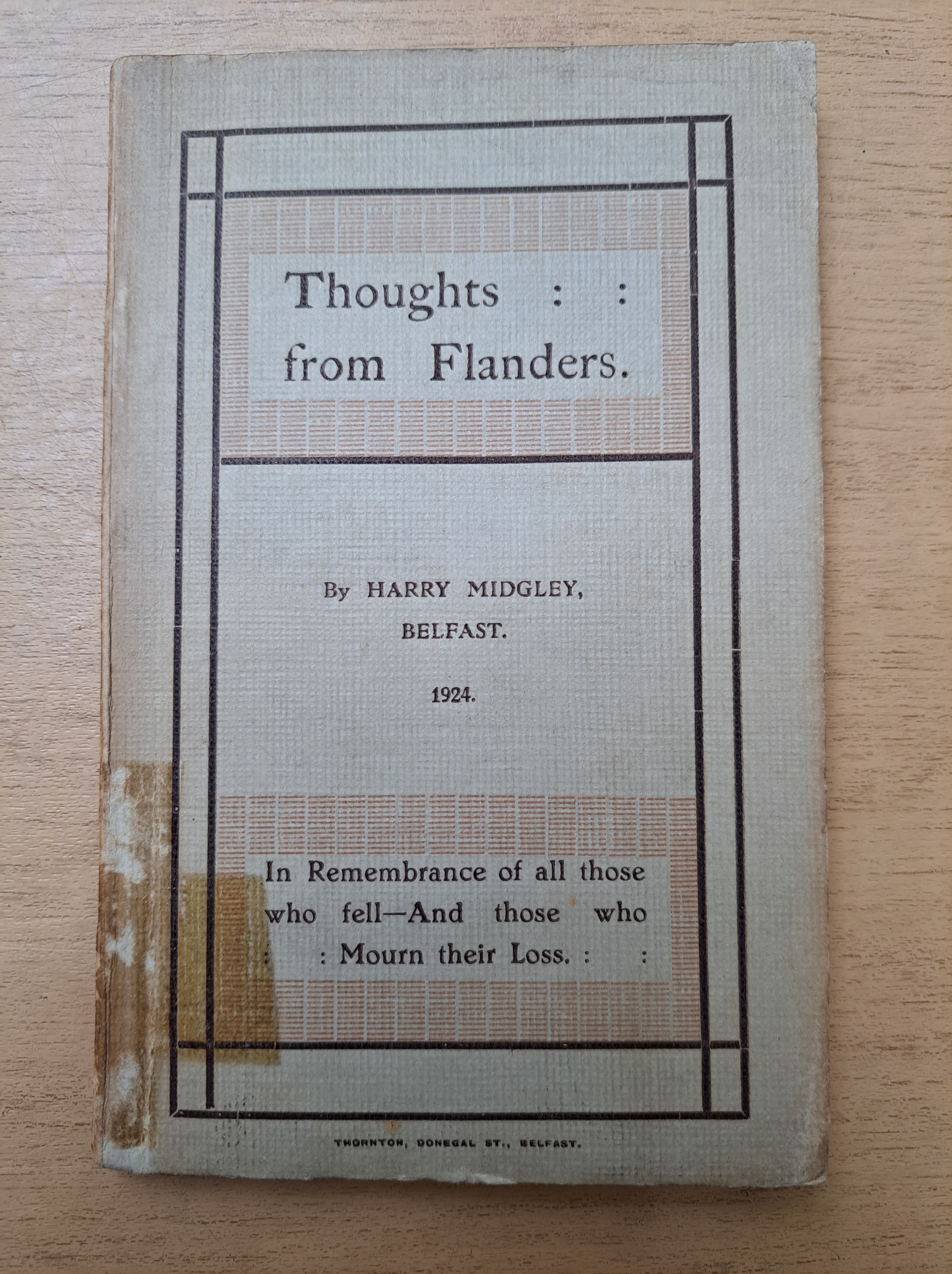
Harry Midgley was born in North Belfast, in Tiger’s Bay, and from his youth was involved in the nascent Labour movement in Northern Ireland. According to the ‘Dictionary of Irish Biography’ as a boy he attended a Sunday School connected with the Independent Labour Party in Belfast and he certainly met Keir Hardy in Befast as a youth and began speaking on behalf of the ILP on the Custom House steps while still a teenager. In his early days, right up to the early 1920s, Harry Midgley supported the all-Ireland Socialist ideals of James Connolly, nevertheless on the outbreak of war in 1914, along with his brothers, he joined up, enlisting in the Royal Inniskilling Fusiliers and served throughout the First World War. Later, in 1924, he published his reflections on his war-time experiences in poetic form. Much influenced by Kipling his verses also show the mixture of Christian values coupled with utopian socialist ideals which underpinned his politics throughout his career.

On his return from the war he immersed himself in politics, firstly getting a job as a shipyard joiner with Harland and Wolff, and soon after being appointed as organising secretary of the Irish Linenlappers’ and Warehouse Workers’ Union. This was his entry into the Labour movement and he became active in different organisations particularly the Belfast Labour Party.

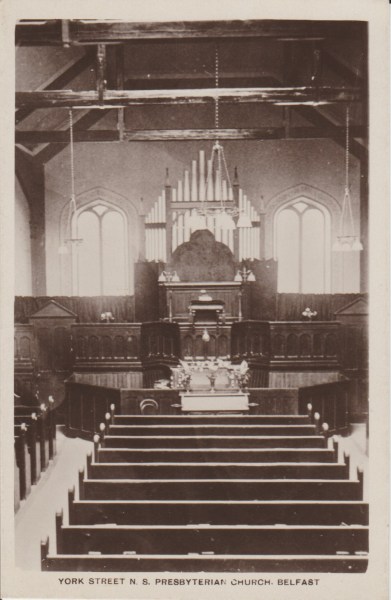
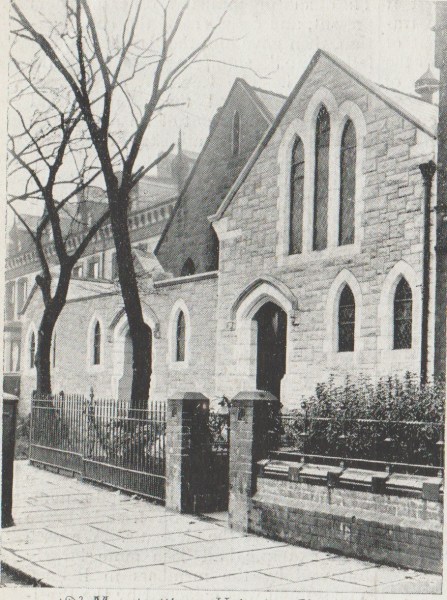
He also became a member of York Street Non-Subscribing Presbyterian Church (see picture at the top of this page) at a time when it was perceived as very left-orientated under the ministry of the Rev A.L. Agnew. Indeed when he fought the West Belfast Westminster constituency in 1924 (gaining over 21,000 votes, although not proving victorious) A.L. Agnew and the Rev E.I. Fripp, minister of All Souls’ NSP Church, were amongst his most prominent supporters. York Street Church was also characterised by very open political debate in the early 1920s, and welcomed speakers of all political backgrounds to its ‘mock parliaments’.

The Belfast Labour Party had proved very successful at its inception. In 1920 it won 10 out of the 60 seats in the municipal elections in Belfast. The Party gradually transformed to the Northern Ireland Labour Party and Harry Midgley became the first secretary.

In 1925 he was a elected to the council as a representative of the Dock Ward and a few years later, in 1933, he was successful in winning the Dock Constituency in the Stormont Parliament. However, in 1938 he lost this seat, partly due to the fall out from the Spanish Civil War. It is this from this election that the printed address in the Dunmurry Library comes. To see it and find out more about it click on the video above.

Gradually the Northern Ireland Labour Party adopted a pragmatic view of partition and Harry Midgley went along with this view. But for a party that tried to stand outside the sectarian divide the issue of the border was one that would not go away. The Northern Ireland Labour Party itself became divided over the position to take on the question of the border and eventually Harry Midgley was expelled, partly because of the strongly pro-Union position he ultimately adopted. He then formed his own Commonwealth Labour Party which enjoyed some success and as a Member of Parliament in Stormont he served in the war-time government, the first non-Unionist representative to be in government in Northern Ireland. Later he joined the Ulster Unionist Party, reconciled by the party’s willingness to follow the post-war social policies of the Westminster government. Having been elected as the MP for the Belfast Willowfield constituency at a by election in 1941 he continued to represent the same constituency up to the time of his death in 1957, first for the Northern Ireland Labour Party, then the Commonwealth Labour Party and ultimately for the Ulster Unionist Party, the only member of the Stormont Parliament to represent the same constituency for three different parties.

In later life he joined the Orange Order and the Royal Black Preceptory. A life-long supporter of Linfield FC he became a director of the club and ultimately the Chairman. At the time of his death he was Minister of Education.

Mountpottinger 150th Anniversary

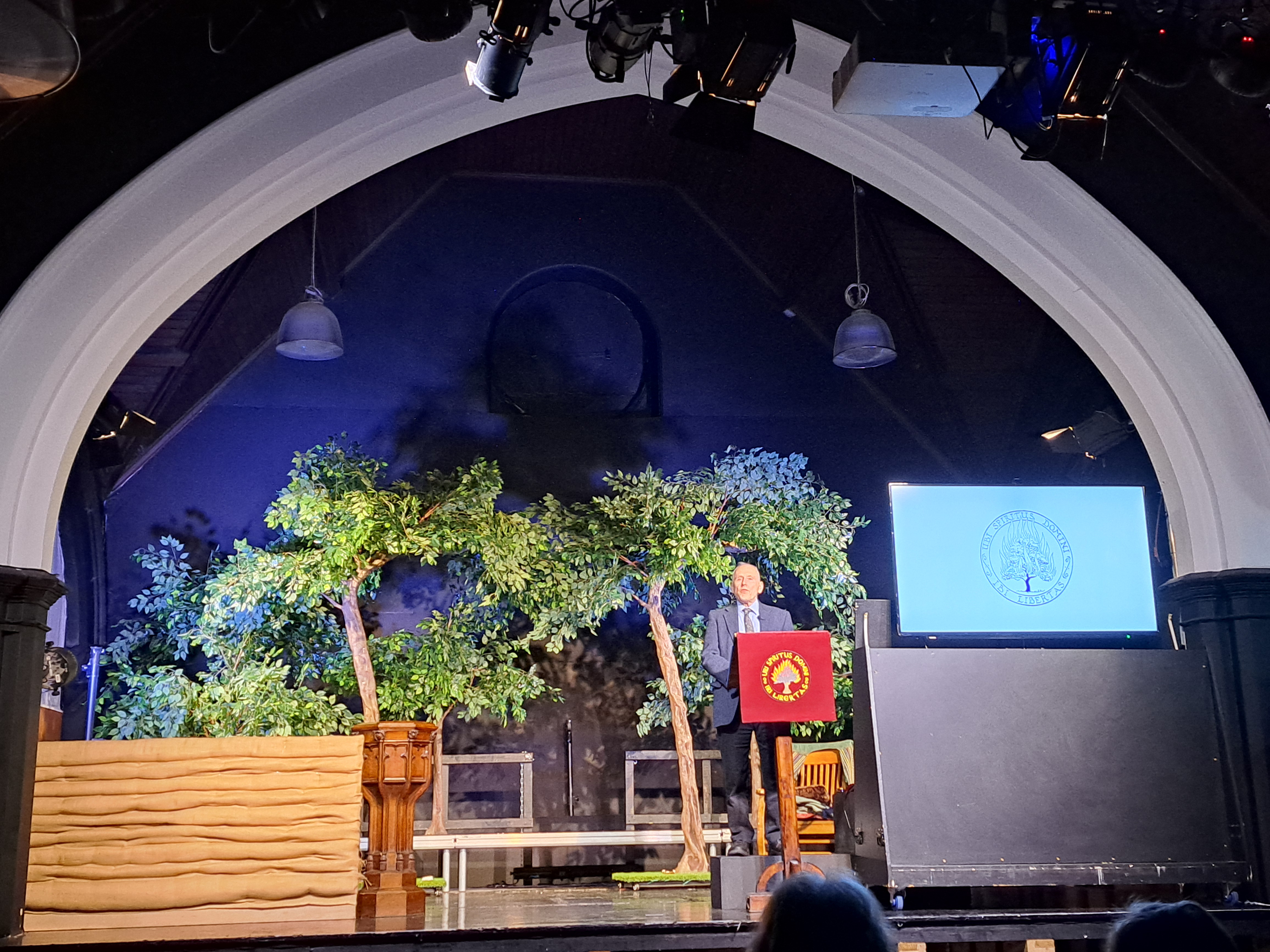
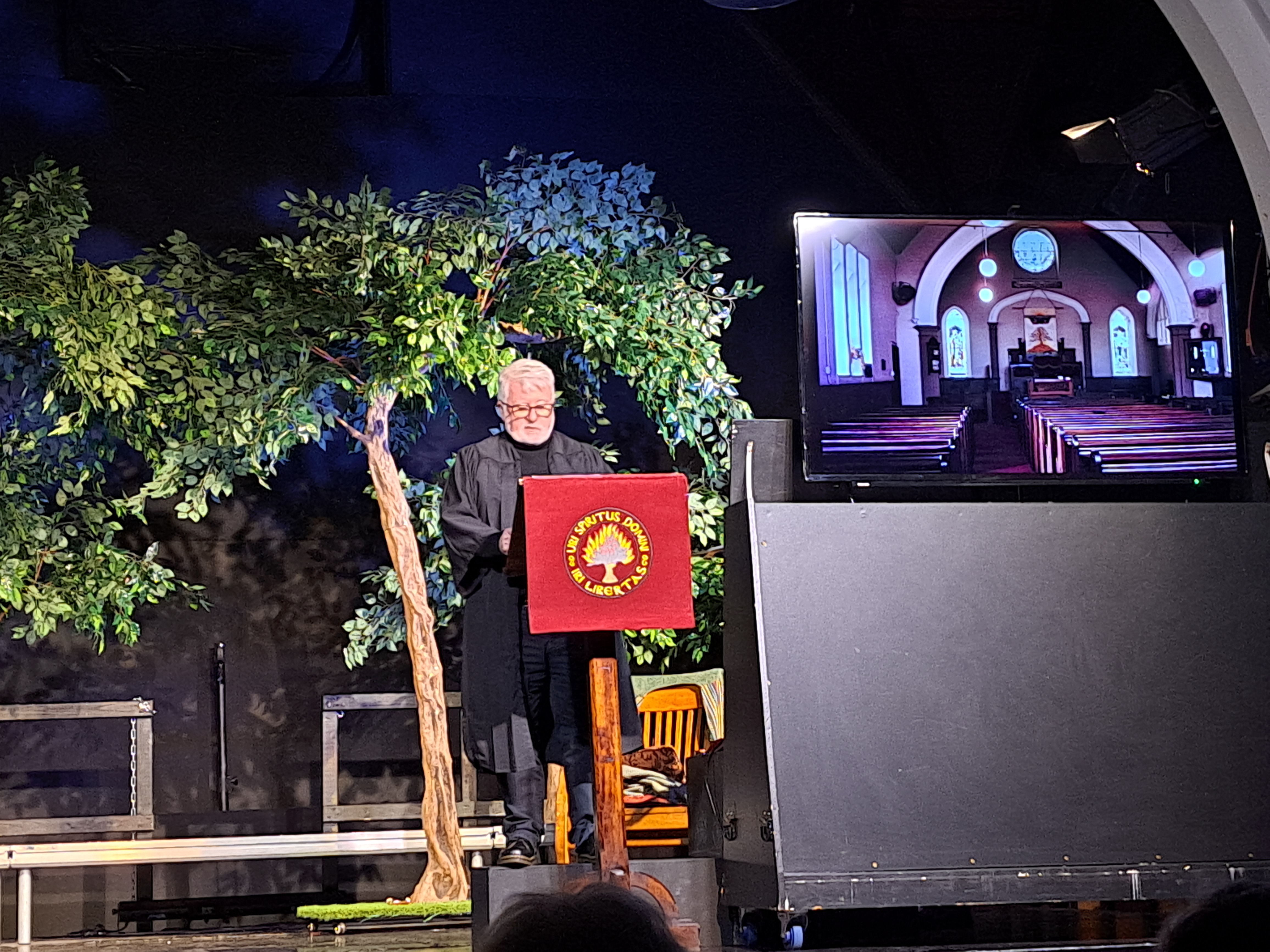
I’ve blogged before about Mountpottinger – most notably here and here where more details about its history can be seen – it is an interesting building on a prominent site in that part of Belfast and the congregation has a very distinctive history. Today the building is leased to the Bright Umbrella Drama Company who are turning the old school hall into the Studio Theatre and the church itself into the Sanctuary Theatre. But the congregation still has a place on the premises and the exact date of the anniversary of the opening of the building – 3rd January 2025 – was the occasion for this remarkable celebration of the 150 years of Mountpottinger.

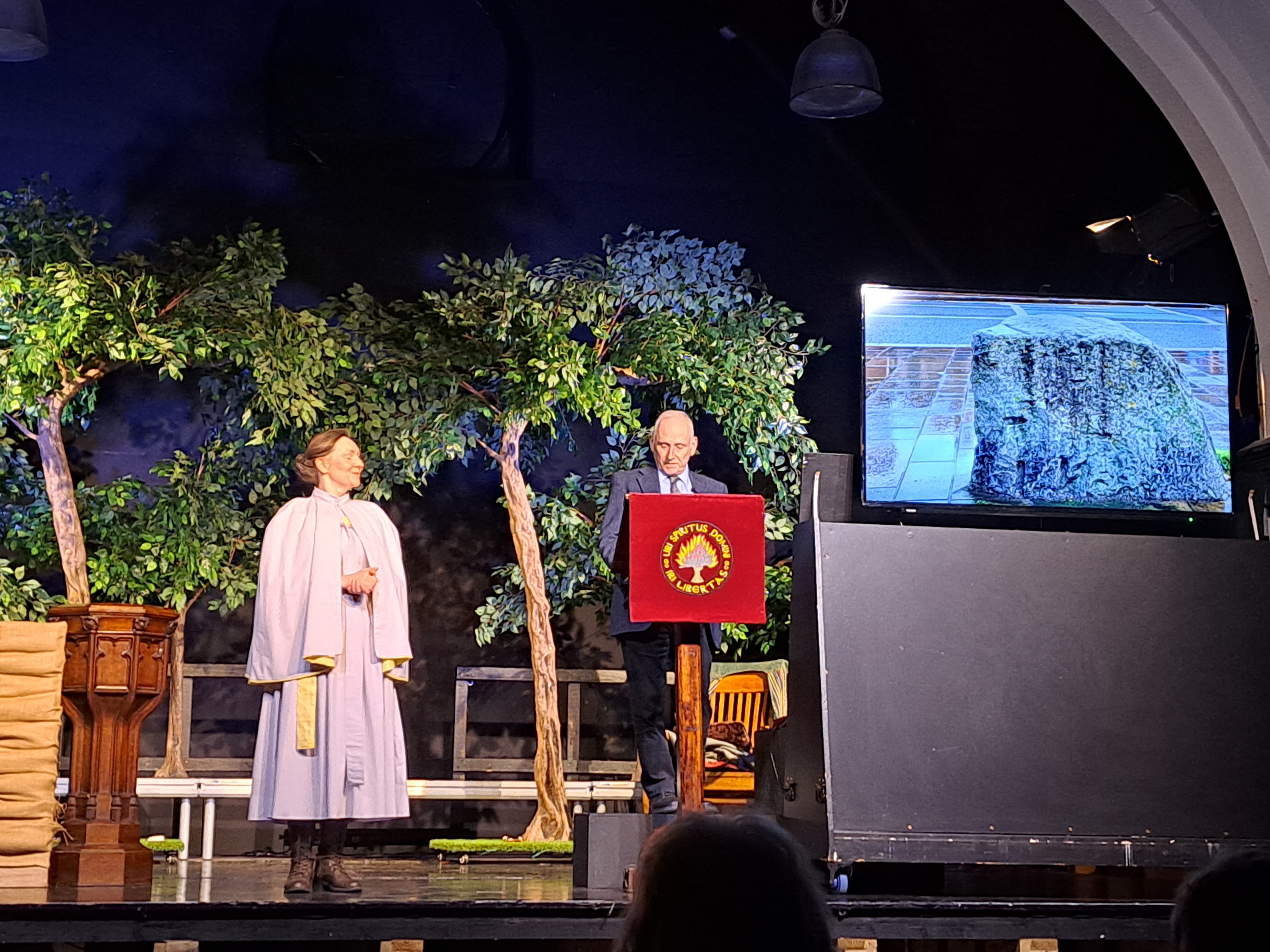
Adrian Moir introduces the evening

A lot of credit must go to Adrian Moir, the church secretary and former ‘Warden of the Fabrique’, as the Very Rev Charlie Kelly once termed him, who wrote and narrated this excellent celebration of the life of the congregation. It was a very positive collaboration between the church and the Drama Company which brought the history of the church to life covering three themes:

Foundation and Hope

Tragedy and Remembrance

Adapting to the times and a glimpse of the future

Trevor Gill delivers the Rev David Maginnis’s speech at the opening of the building in 1875. David Maginnis was a controversial but effective minister at York Street who came back to Belfast from Stourbridge to participate in the opening ceremony

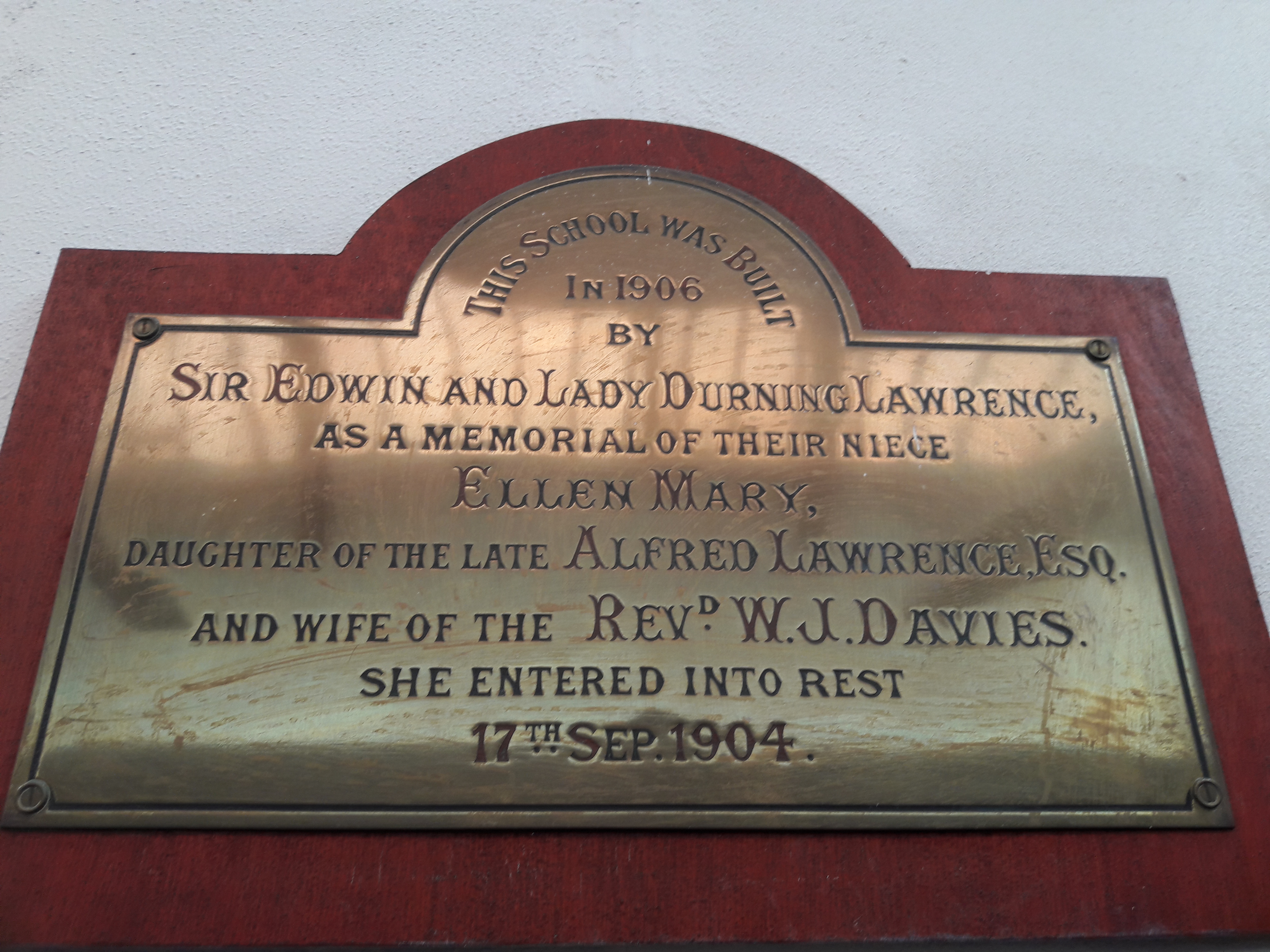
The evening was interesting, engaging and witty and also very moving as it looked at the story of Ellen Mary Davies, the wife of the Rev William Jenkin Davies, who died tragically young and in whose memory the school room was built.

Memorial in the School Room

Lindsay Charrington playing the role of Ellen Mary Davies

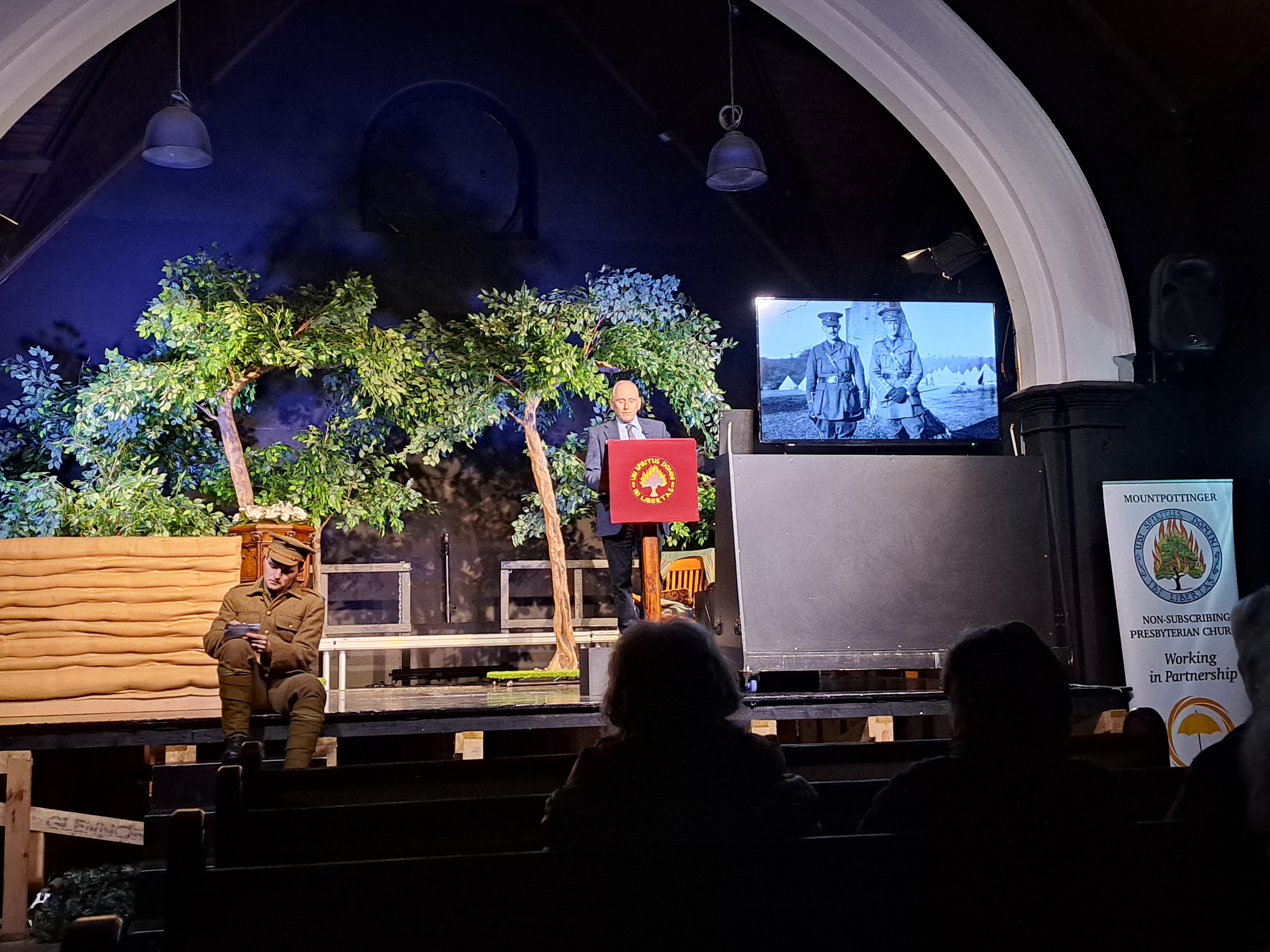
There was further tragedy with the loss of members of the church in the First World War, including Captain James Samuel Davidson in 1916, on the first day of the battle of the Somme. Also remembered on the evening was church member Sydney Agnew who was killed during the ‘Troubles’ in 1971 to prevent him giving evidence at a trial. It was both fitting and touching that members of Sydney’s family were there to lay a wreath in his memory.

Glenn McGivern writing home from the front as Captain J.S. Davidson

But the whole evening was very impressive, a fitting tribute to 150 years of work and witness which now has the opportunity to be part of a brave new venture as a community hub working in the arts and in drama in the Mountpottinger area.

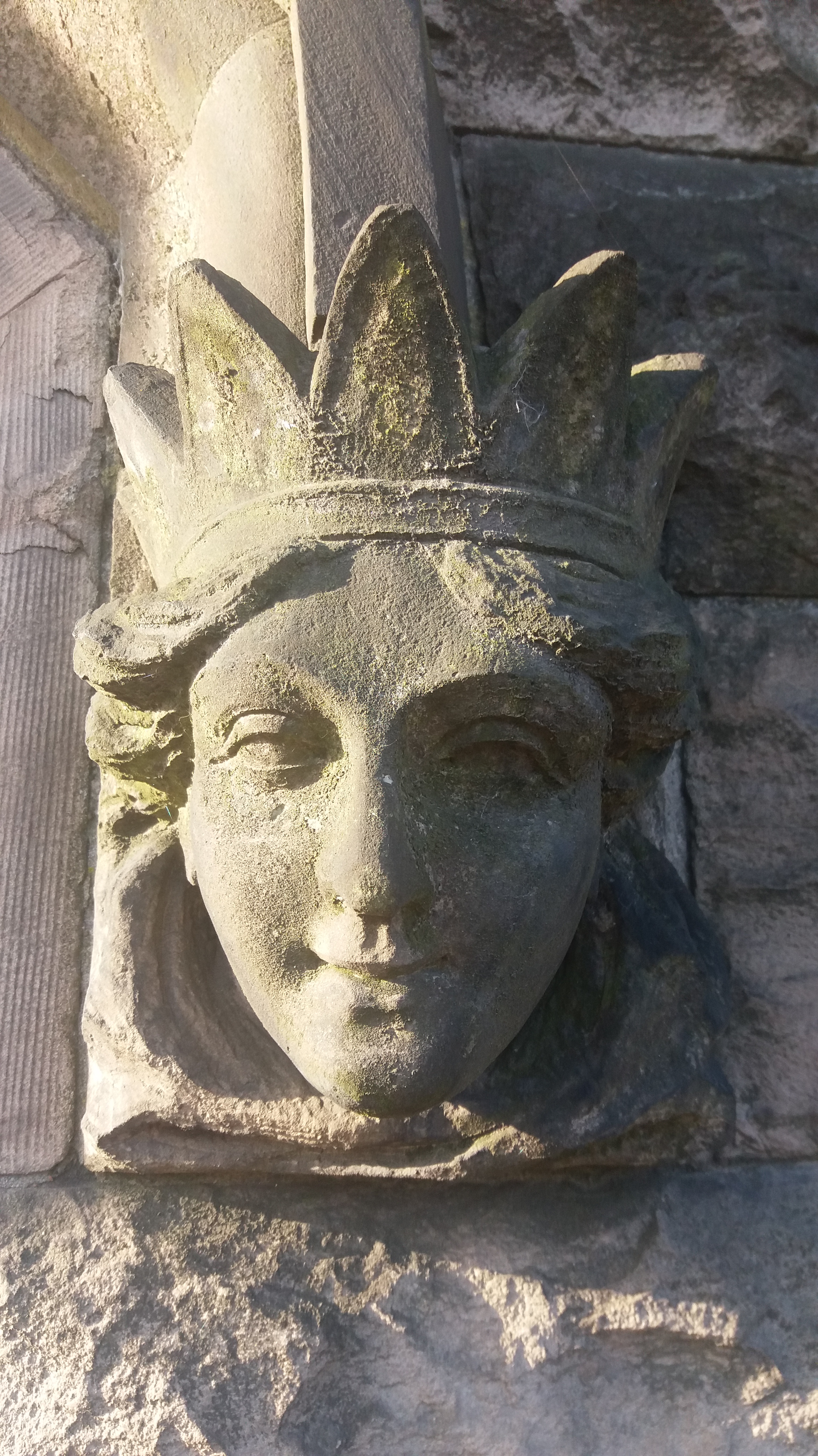
One of the ‘Regal Heads’ of Mountpottinger

Dunmurry Harvest 2024

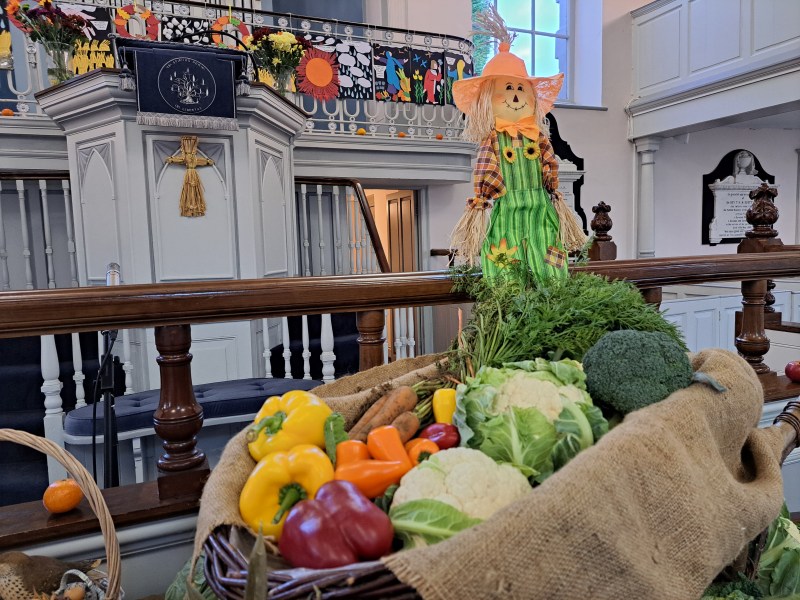
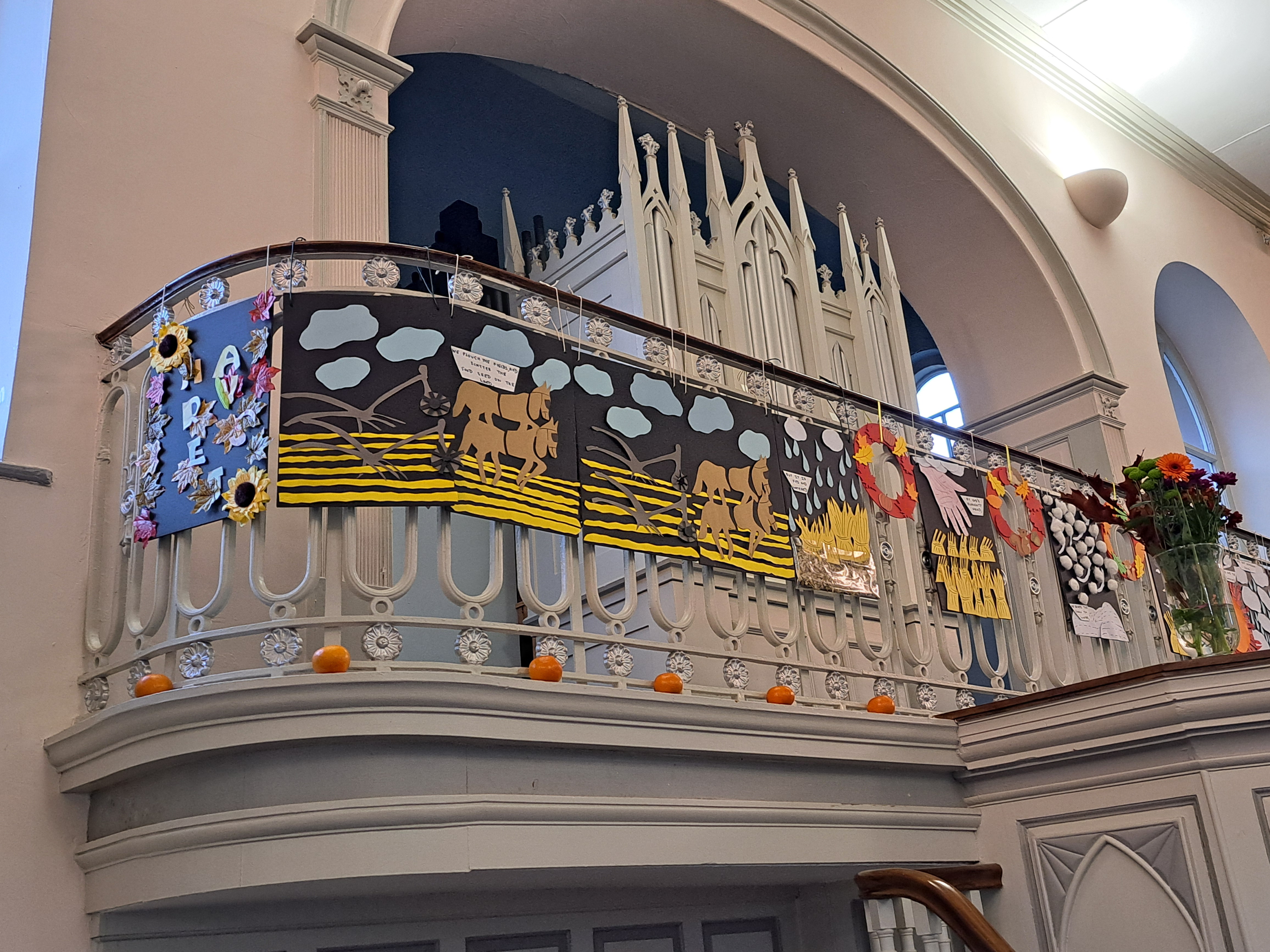
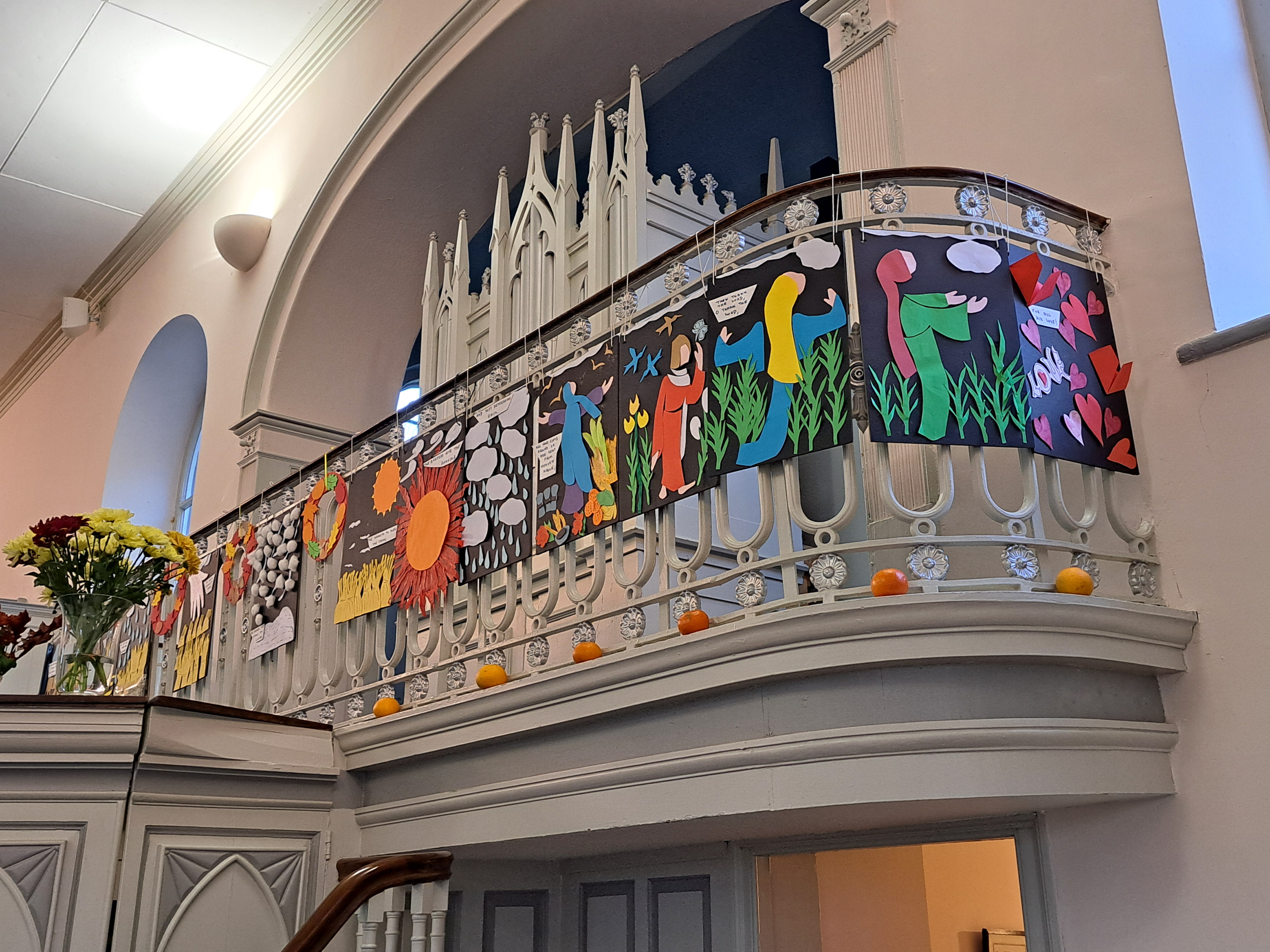
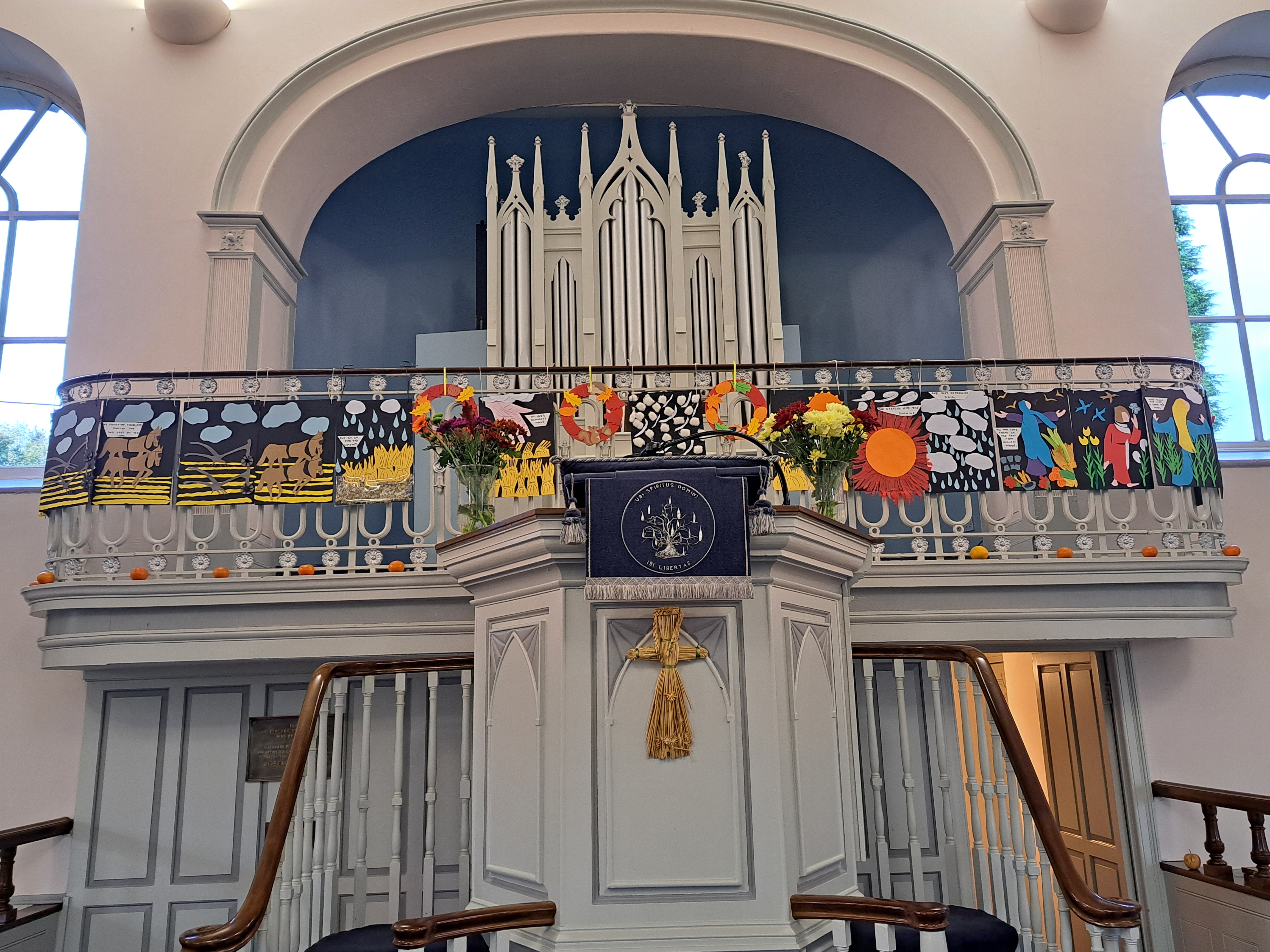
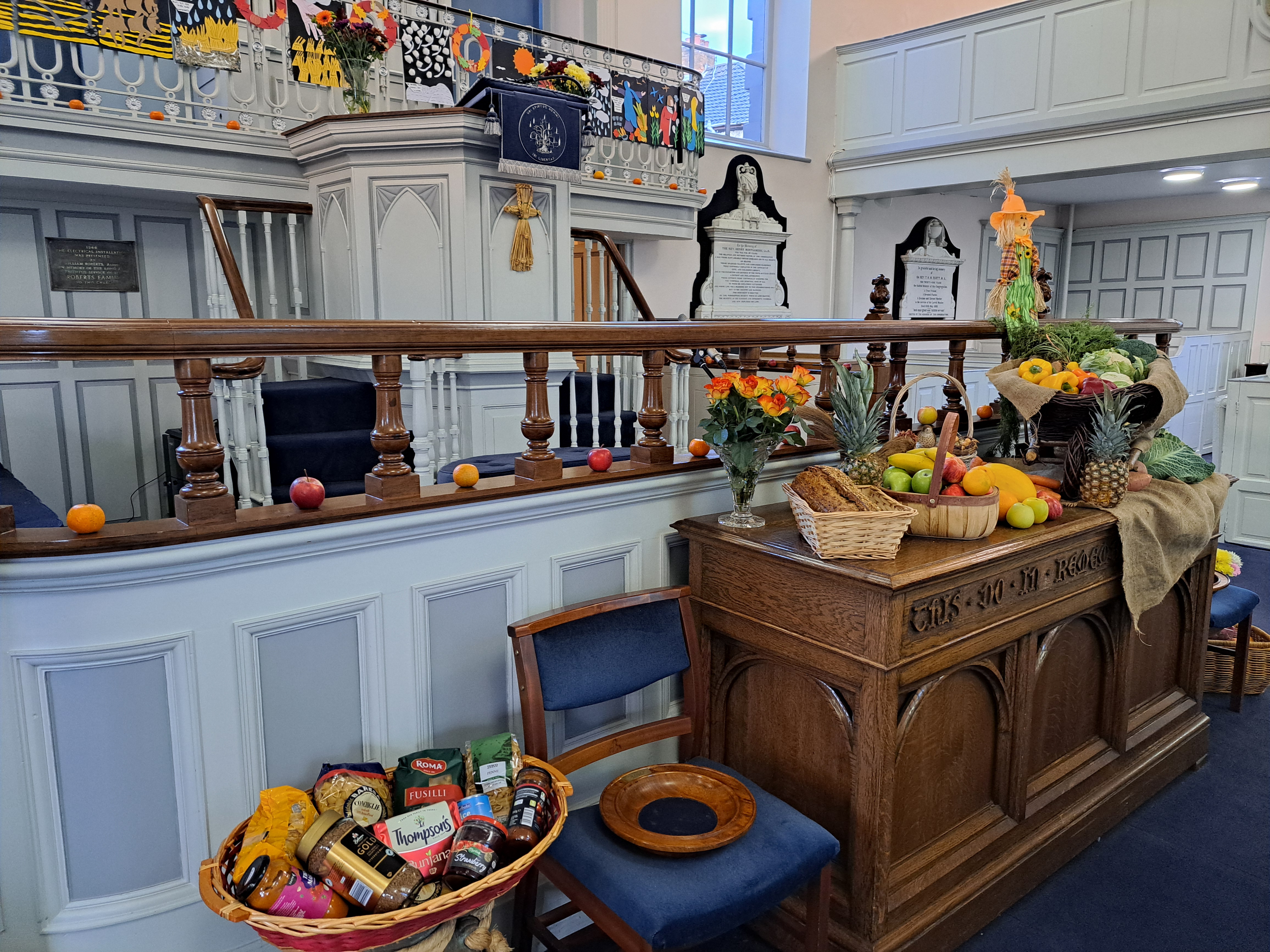
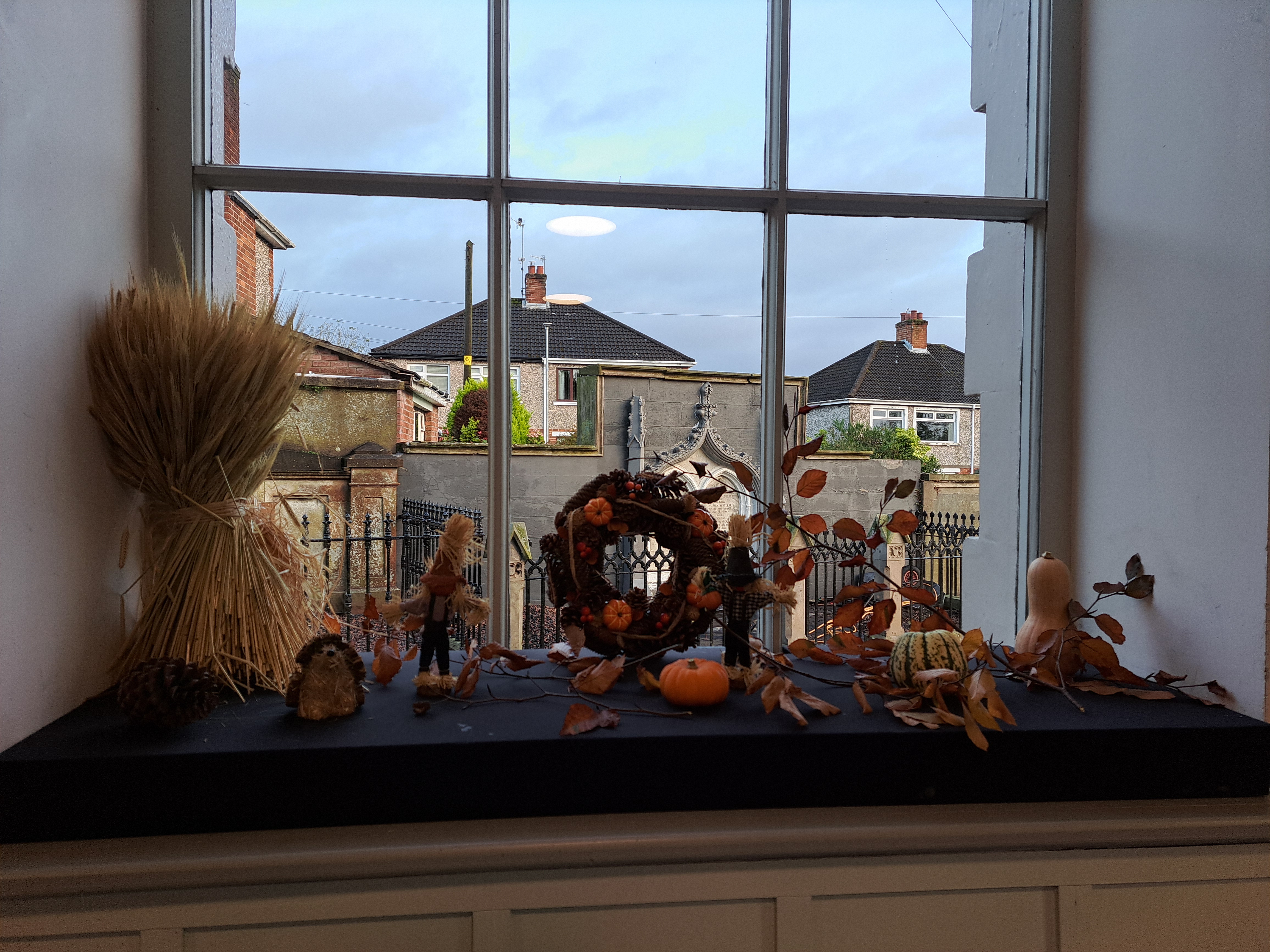
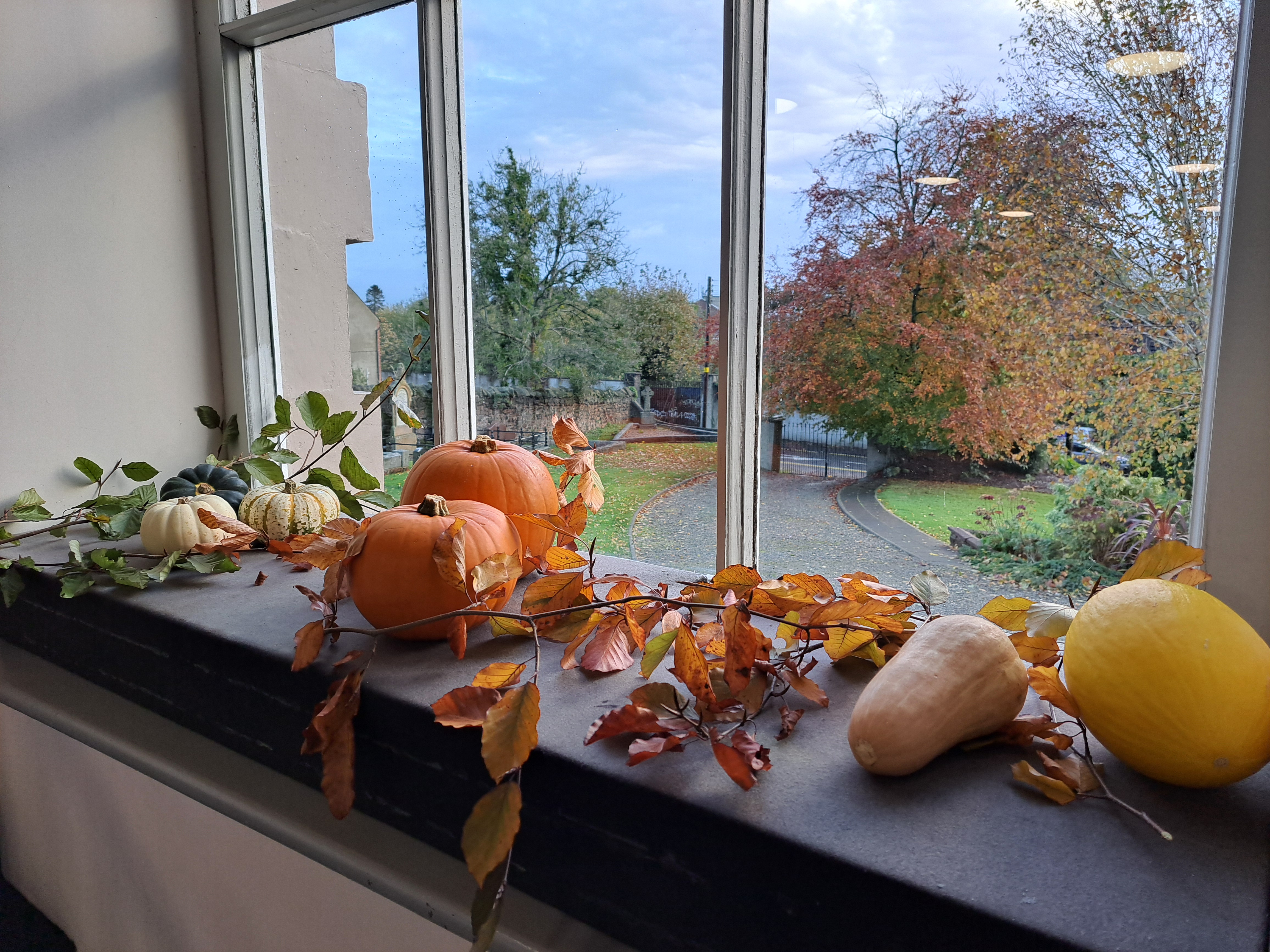
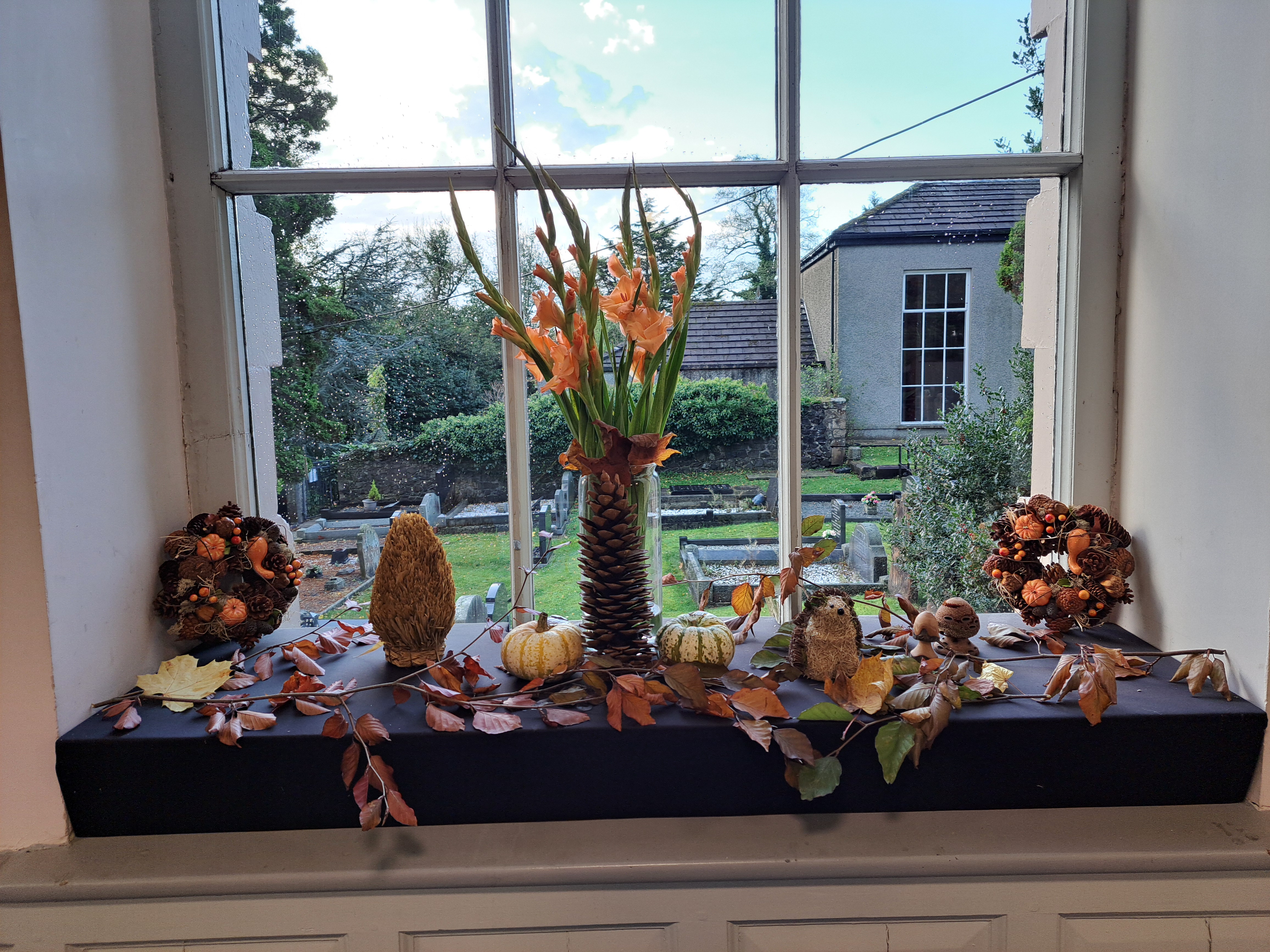
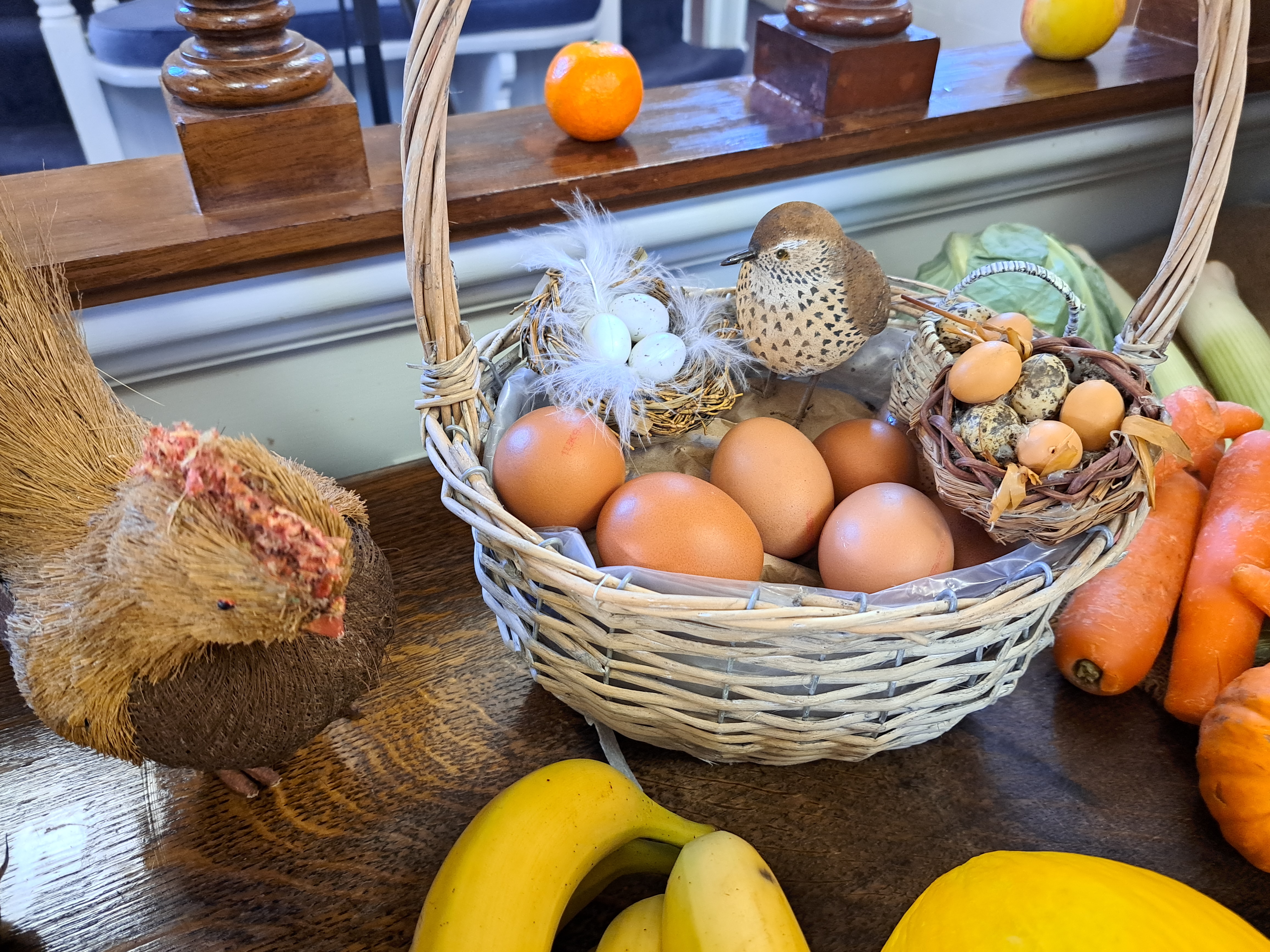
We had a wonderful Harvest Thanksgiving Service on Sunday, 20th October 2024. The service was conducted by Rev Dr David Steers, the organist was Allen Yarr and the readers were Lochlan Black and Erin Black. The Church was beautifully decorated throughout including the frieze depicting We Plough the Fields and Scatter made by the Sunday School and Youth Group. The service was live streamed and you can view it here on YouTube:
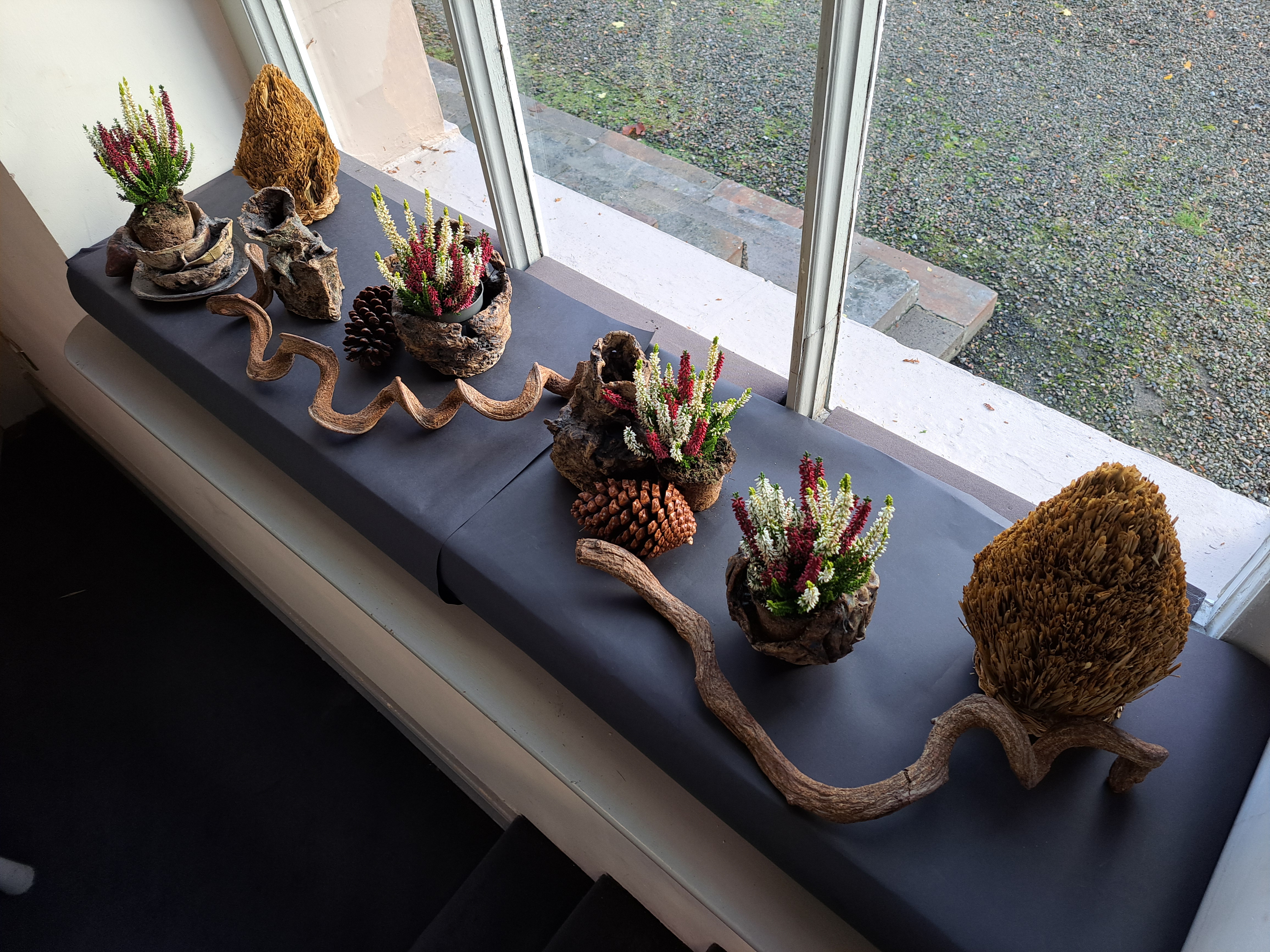
Here are some images from the day, beginning with We Plough the Fields and Scatter frieze created by the children and young people:

We were very pleased to welcome the Moderator, Rt Rev Alister Bell, who spoke warmly of the service and the work done by the children.

We also gathered a considerable amount of produce, both fresh vegteables and fruit, as well as tinned and dried foods, biscuits, pasta, sauces, tea, coffee etc. All of this has now been distributed to L’Arche Belfast.

What Is L’Arche?

“L’Arche (French for ‘The Ark’) is an international federation of 140 communities worldwide founded on faith and inspired by the gifts of people who have learning disabilities. By ‘community’ we mean a group of people of different ages, creeds, capacities and social and ethnic backgrounds connected to one another through a belief that everyone, irrespective of their circumstances, can have a positive impact on the lives of others. In our communities people with and without learning disabilities choose to live together in a spirit of friendship. We recognise the unique value of every person, the gifts we have to offer and our need for one another.” (From L’Arche website).

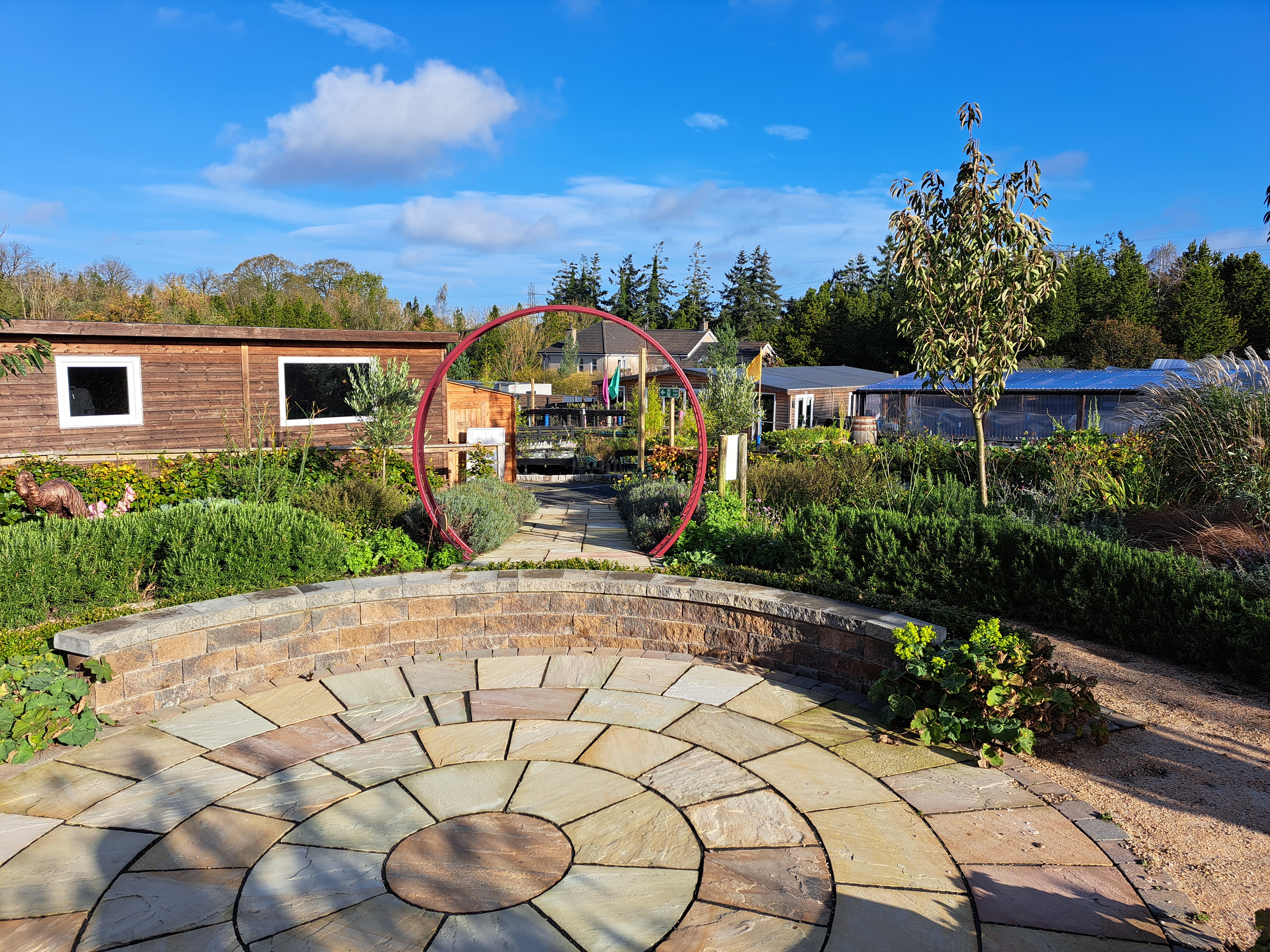
The newly created garden at the centre of the L’Arche community Belfast

You can find out more about L’Arche Belfast by clicking here.

John Wesley and Belfast

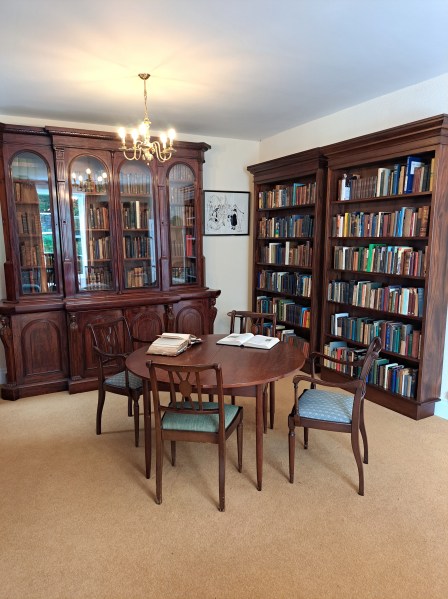
In the latest of our videos exploring the Very Rev William McMillan Library at Dunmurry we take a (brief) look at the eight volumes of the Journal of John Wesley. In particular we look at his visits to Belfast and his relationship with the Non-Subscribing Presbyterian churches in Belfast.

Exploring the Library at Dunmurry, episode 4. Click on the video above

John Wesley visited Belfast 11 times in the course of his career, always preaching in the town, sometimes in the market-house, sometimes in the open air. Often it seems he visited at times of cold, windy or wet weather. Only once did he preach in a church and the only church to ever be open to him was First Presbyterian Church, Rosemary Street. But this visit was mired in controversy and was not repeated. I am grateful to Des McKeown of First Church who recently gave me a copy of a letter to The Northern Whig dated 3 December 1873 written by the minister of First Church, the Rev John Scott Porter. This features in the video and it is interesting to see his opinion of Wesley’s visit almost one hundred years previously.

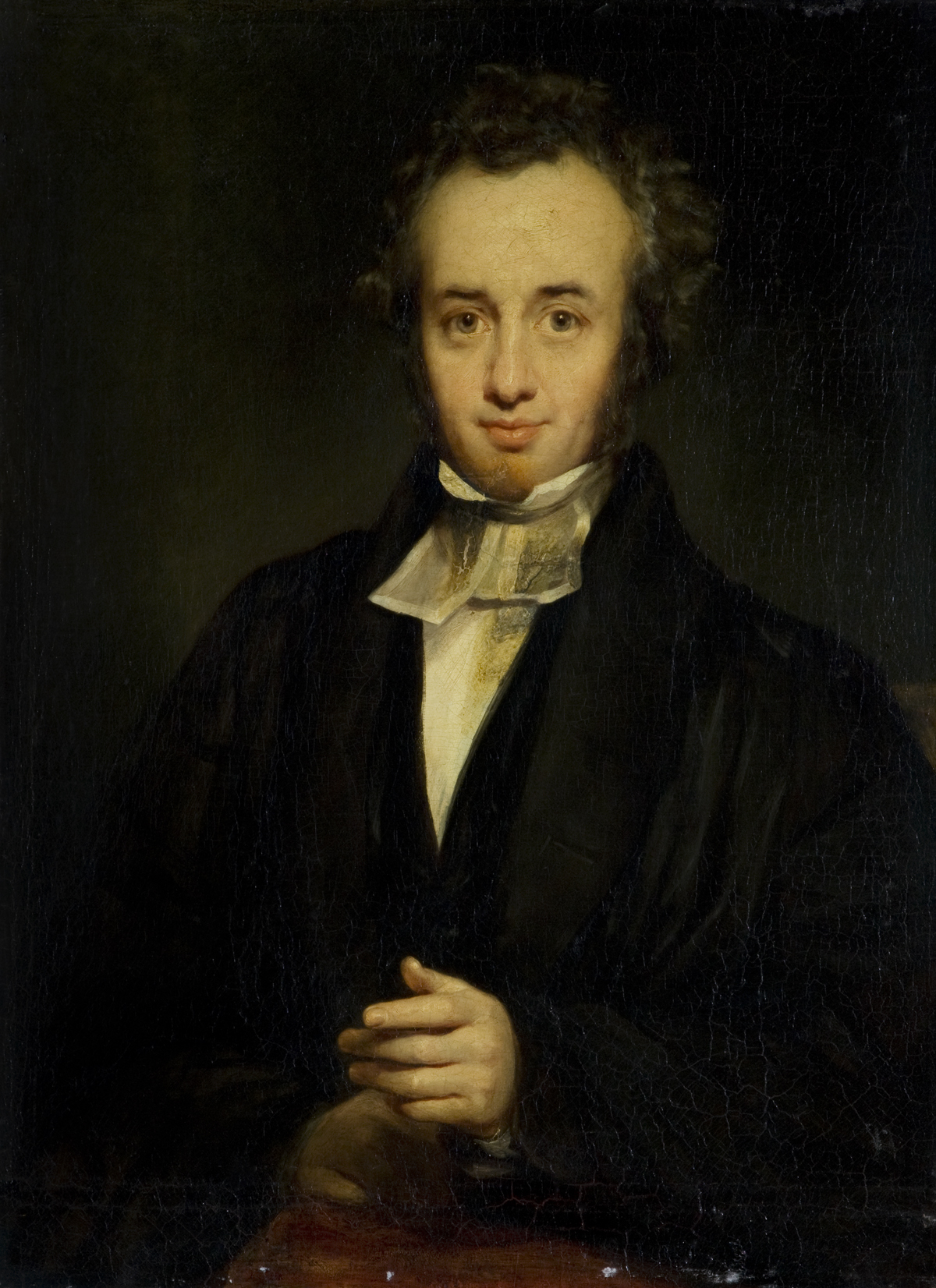
A youthful John Scott Porter

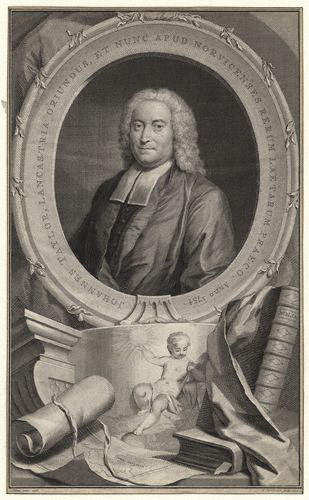
But another feature of Wesley’s Journal is his identification of followers of Dr John Taylor in the crowds that came to hear him in Belfast. John Taylor was minister of the Octagon Chapel in Norwich and the author of the The Scripture Doctrine of Original Sin. What are the implications of this in Belfast in the 1760s? We try to unpack the meaning of this for John Wesley’s reception in Belfast in the video.

John Taylor (Source: Wikipedia)

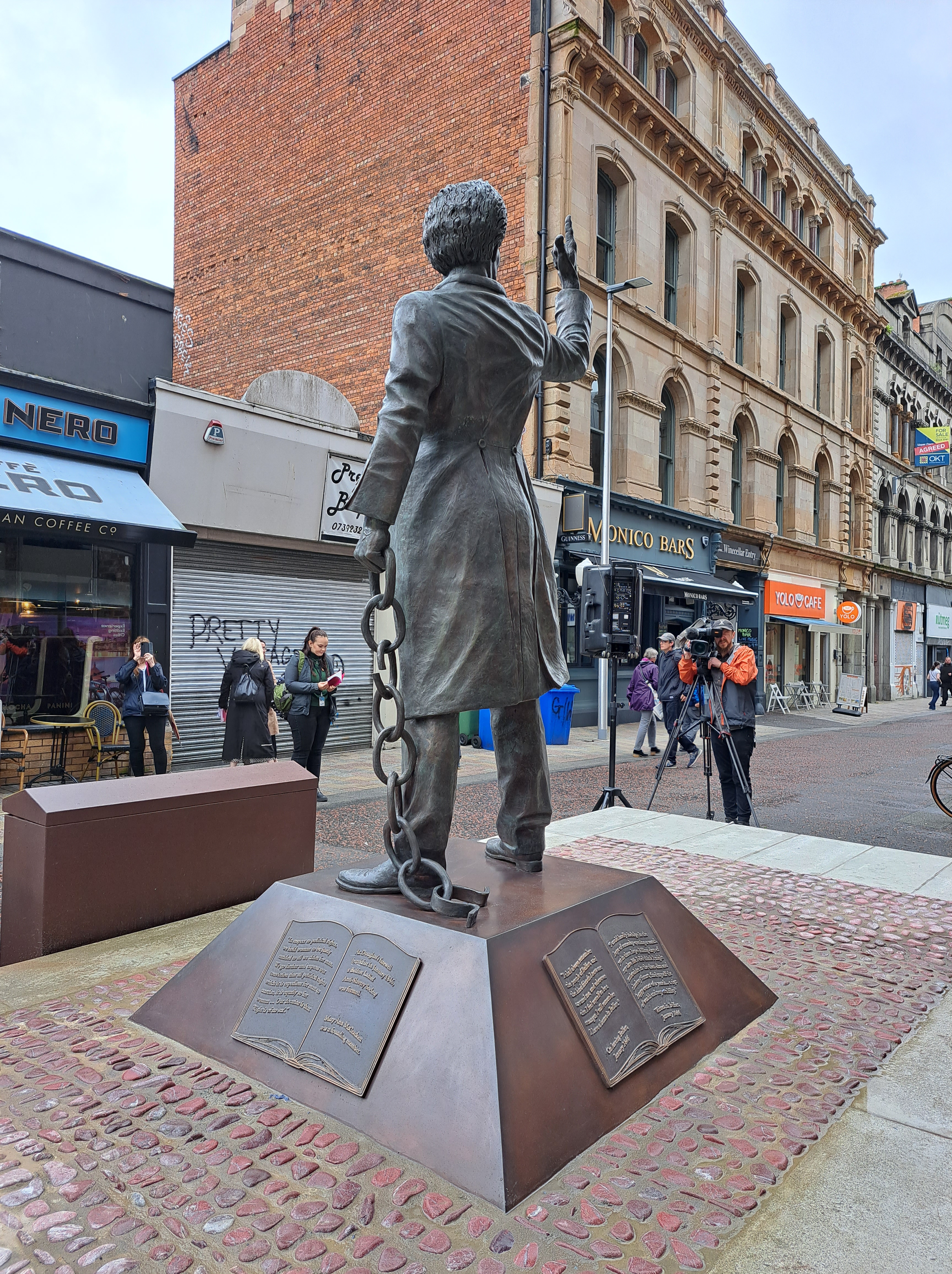
Frederick Douglass (1818-1895) Abolitionist and Human Rights Campaigner

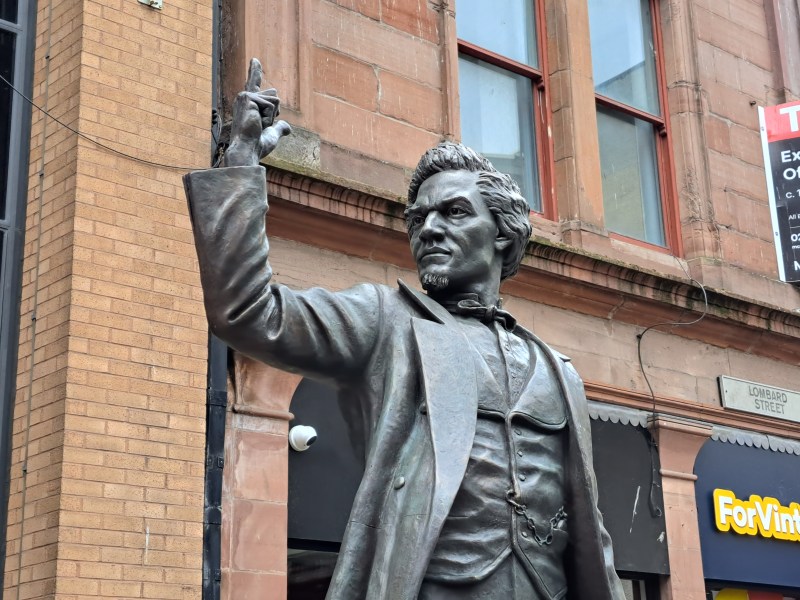
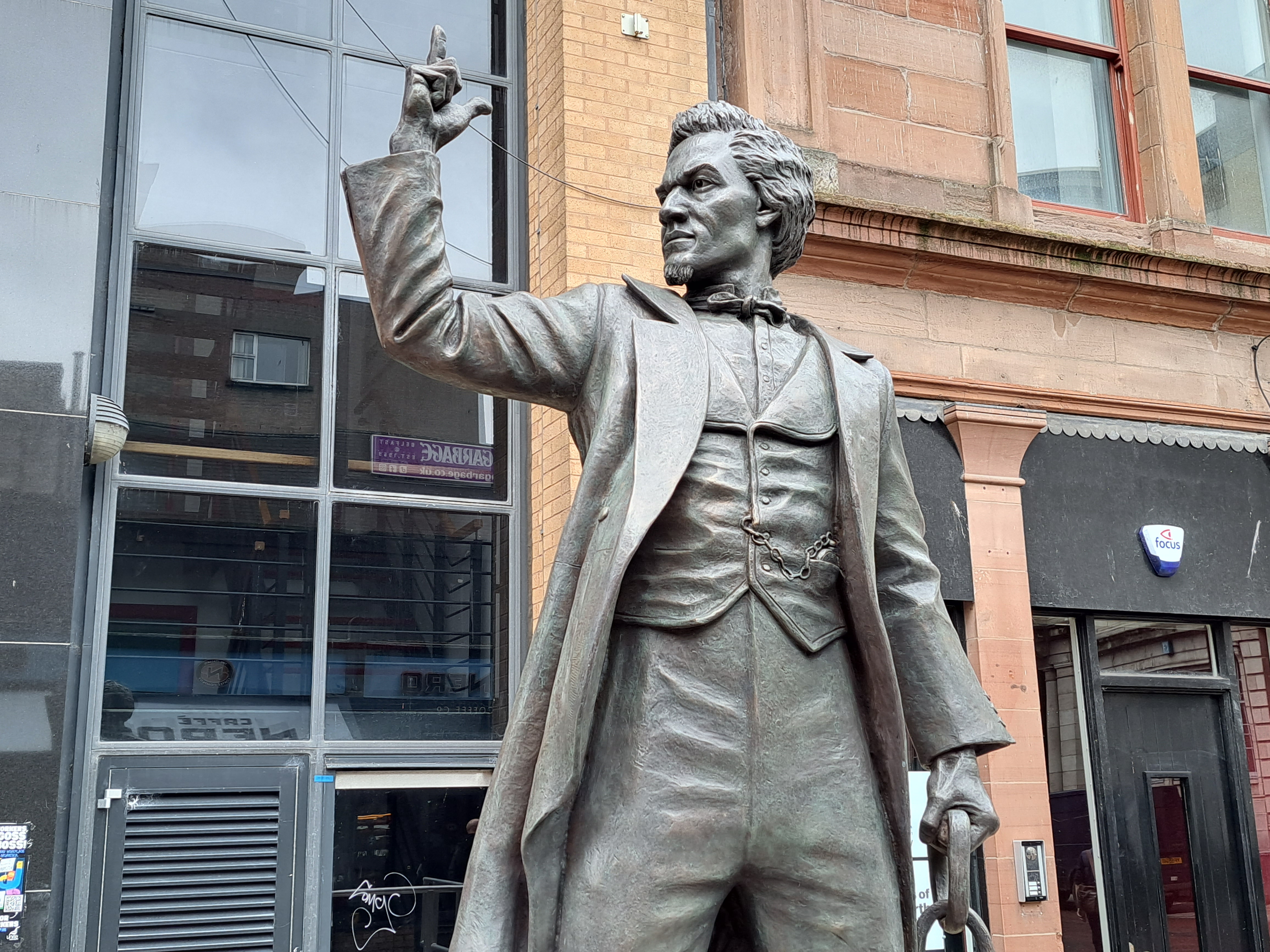
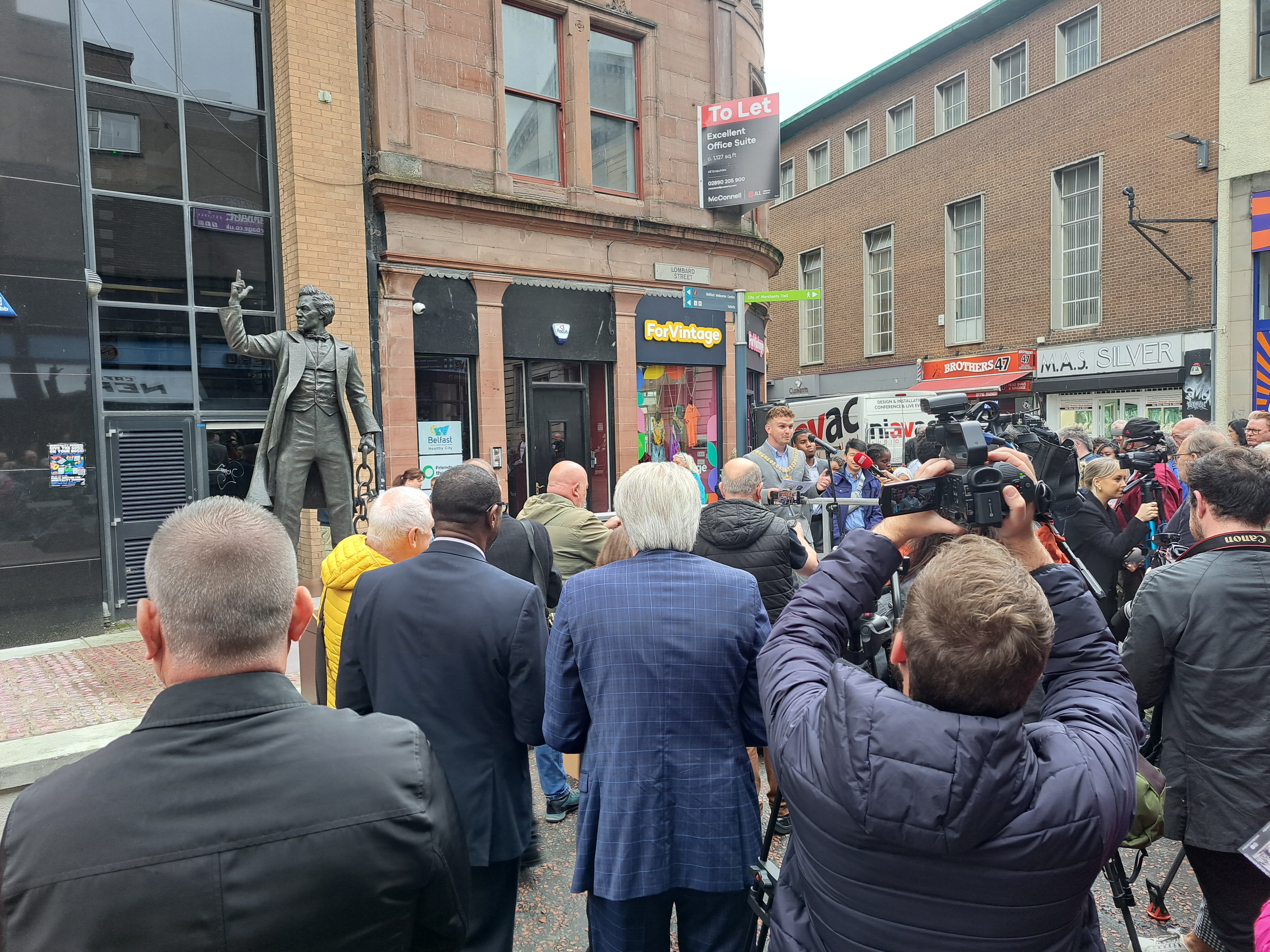
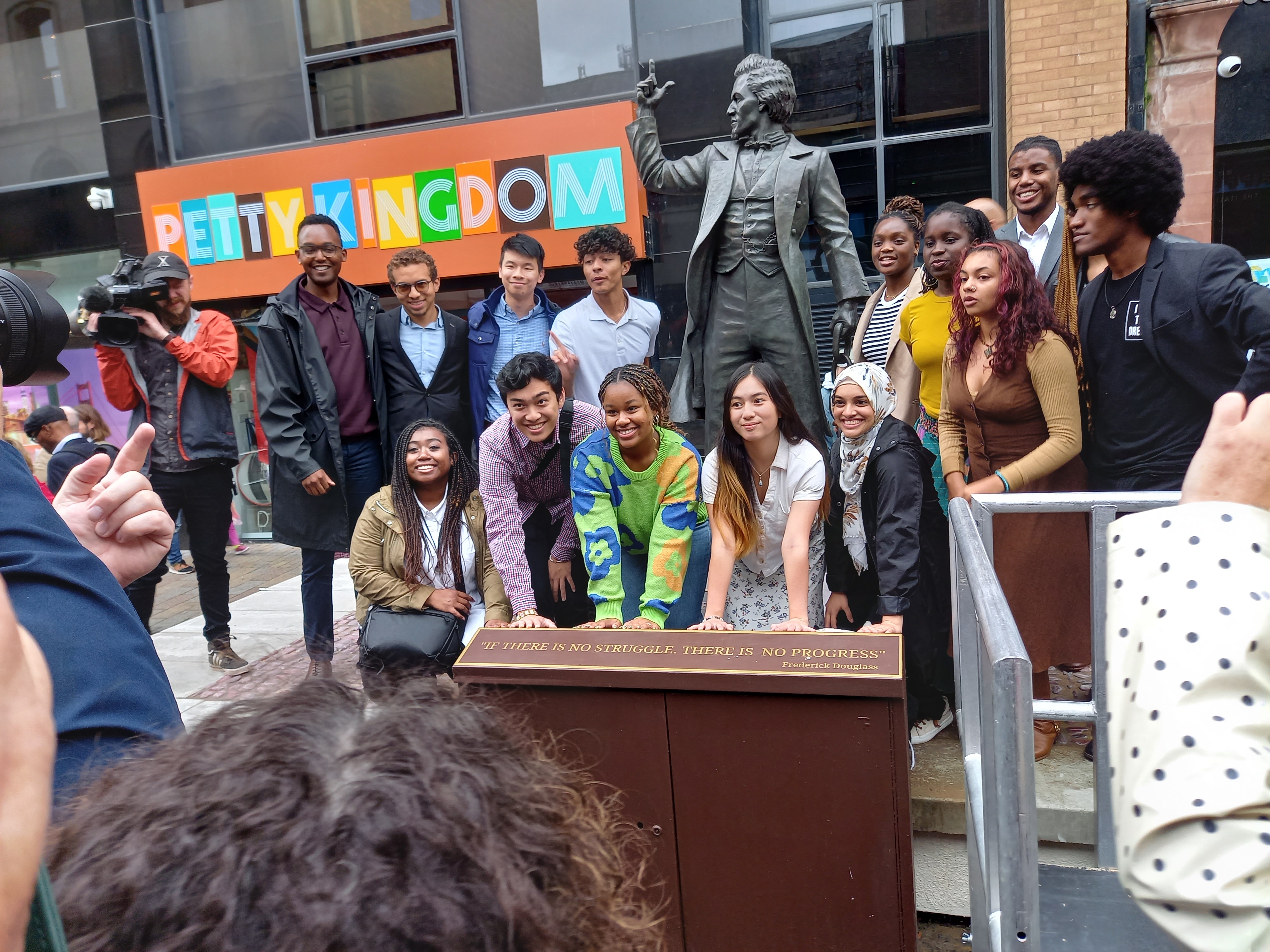
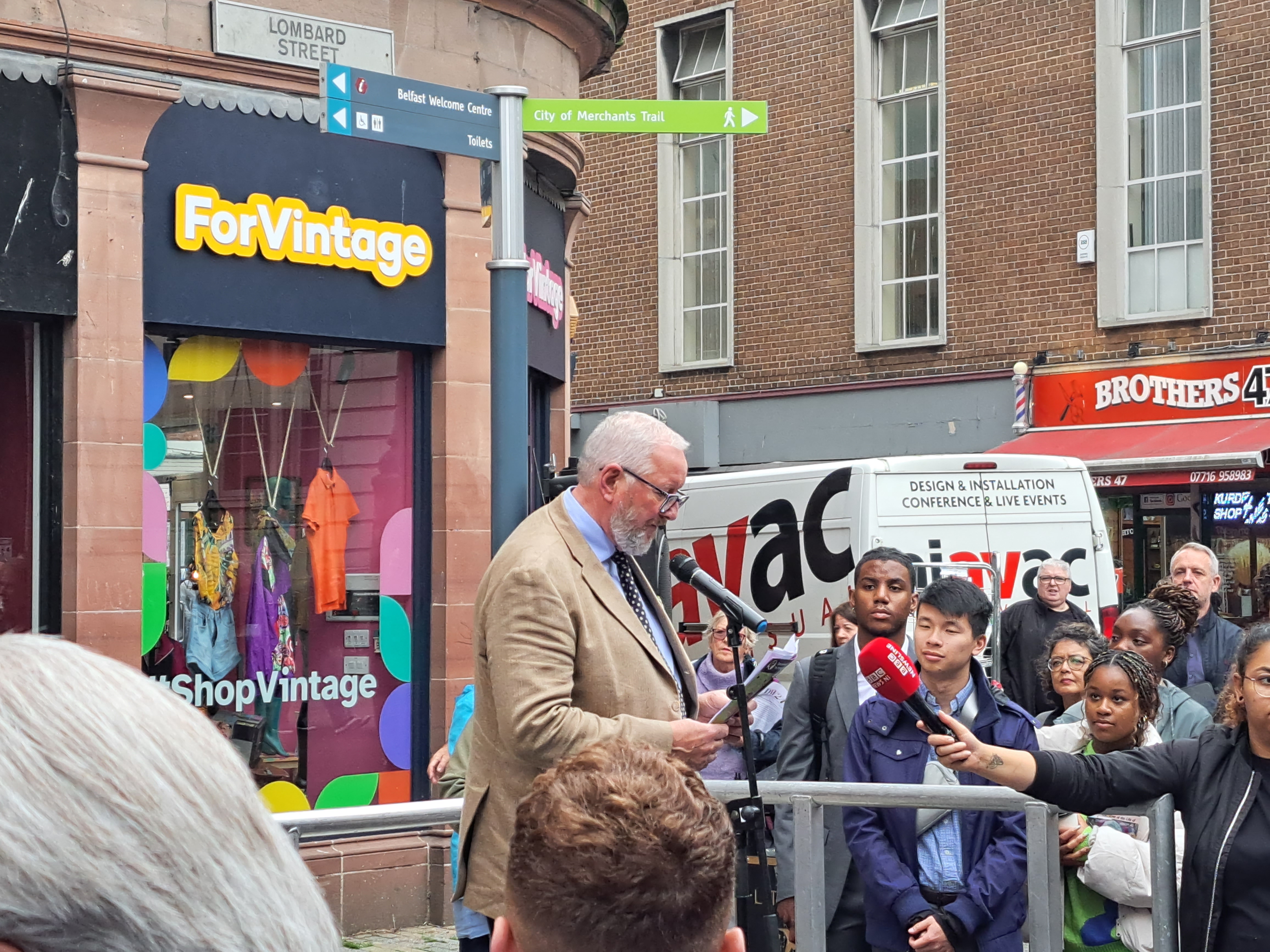
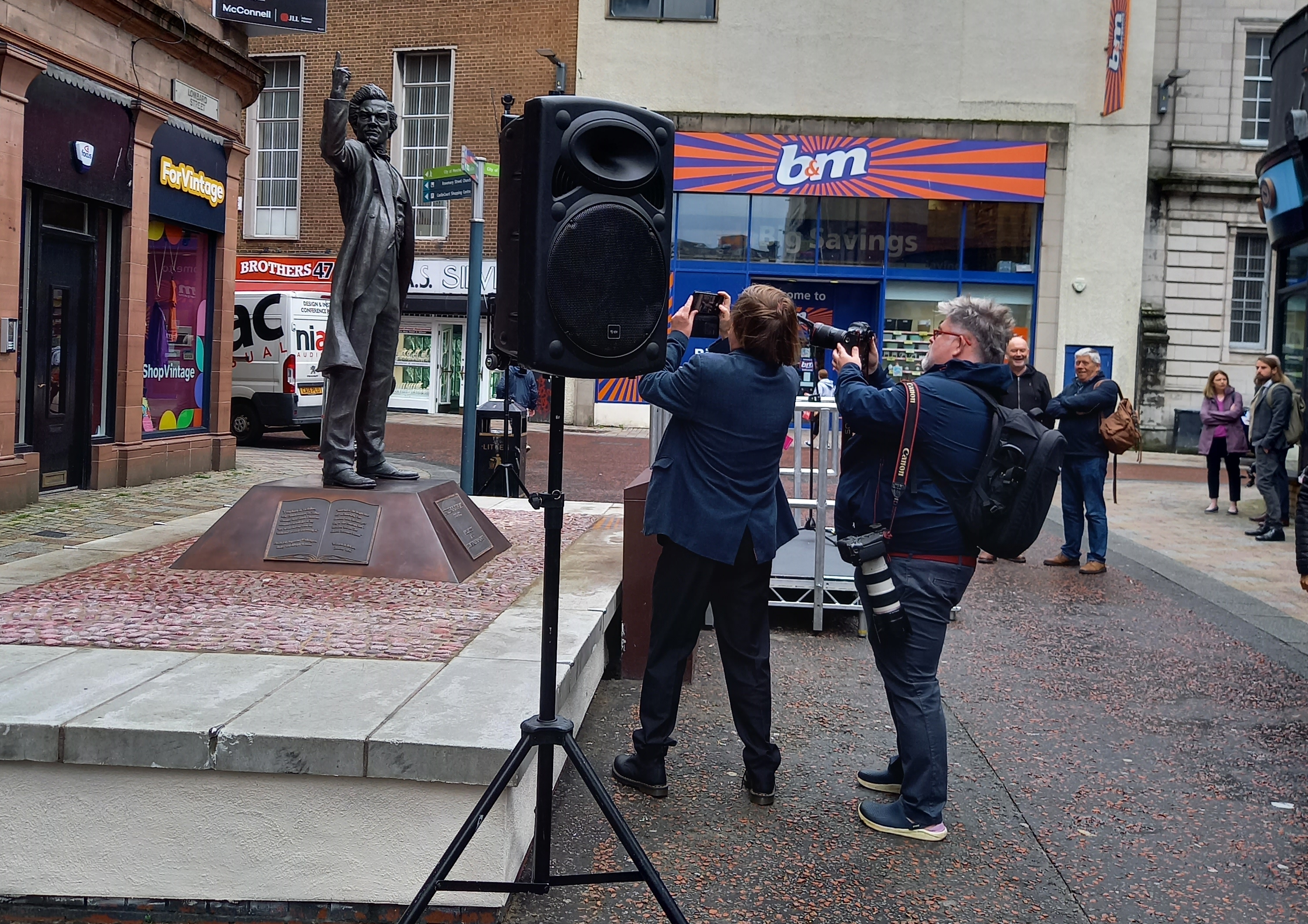
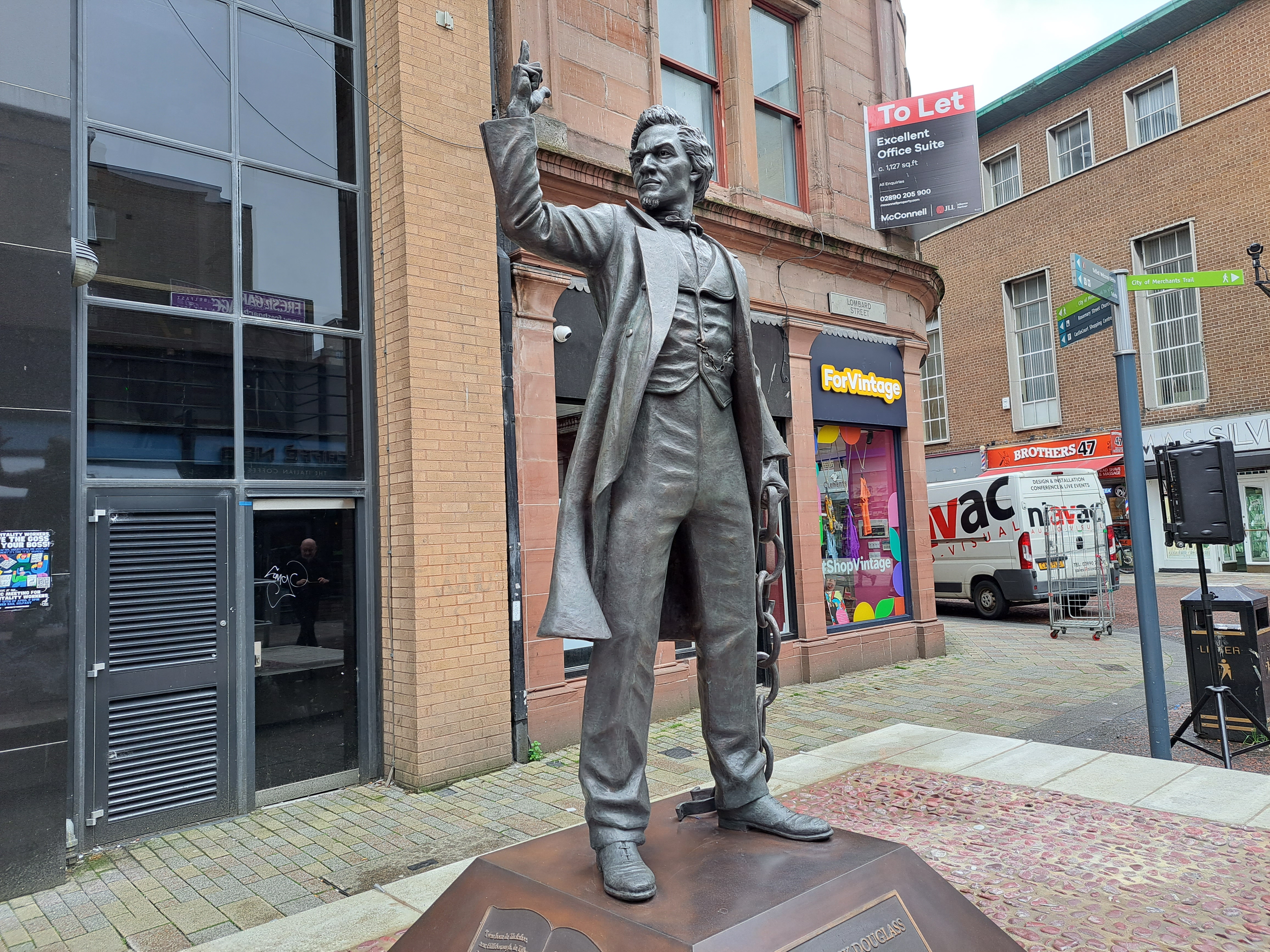
I was pleased to be present for the inauguration of the new statue of Frederick Douglass on Monday, 31st July 2023. I only found out about it by chance but it was good to be there for the formal recognition of Frederick Douglass as part of Belfast’s history.

Frederick Douglass was born a slave in February 1818, on Holme Hill Farm, near Easton, Talbot County, Maryland. Although slaves were not supposed to be taught to read he was taught the alphabet, taught himself to read and developed a life-long reading habit.

In 1838, at his third attempt, he successfully escaped from slavery and managed to get to New York where he married Anna Murray (1813–1882) of Baltimore. He became a preacher in the African Methodist Episcopal Zion Church and an associate of William Lloyd Garrison and an activist in the anti-slavery movement.

The Lord Mayor introduces the speakers

In 1845 he published the Narrative of the Life of Frederick Douglass, an American Slave, the first of three volumes of autobiography, and became so prominent in the anti-slavery movement that threats were made against him which led to him travelling to Britain and Ireland on a speaking tour. He spent two years speaking all over England, Scotland and Ireland. In Dublin he shared a platform with Daniel O’Connell and British supporters raised $700 to buy his freedom in the United States. This in itself was controversial as many thought it wrong to give any recognition to the idea that a human being could be bought or sold as someone’s property.

Some of those present

In the words of the Oxford Dictionary of National Biography, during his speaking tour:

He filled public halls, private homes, chapels, and churches, his audiences sometimes numbering thousands, and he often spoke on different subjects at more than one meeting a day. As well as making the abolitionist case, he spoke on women’s rights (he felt that he could not accept the vote as a black man if it was denied to women), temperance, land reform, education, and capital punishment, issues on which he never ceased to agitate. 

Alan Beattie Herriot, sculptor

Of his time in Belfast he wrote:

I shall always remember the people of Belfast, and the kind friends I now see around me, and wherever else I feel myself to be a stranger, I will remember I have a home in Belfast.

Words which are among those inscribed on the plinth of his statue.

At the opening of the statue Professor Christine Kinealy said that in Belfast he spoke in Rosemary Street Presbyterian Church. But this is ambiguous because there were then three churches on Rosemary Street, two non-subscribing and one orthodox. The booklet available at the opening also suggested that he spoke in First Church on Rosemary Street. In fact he spoke at the meeting-house of the Second (Non-Subscribing) Congregation which stood behind First Church and was finally demolished in the early 1960s. He was granted the use of the meeting-house of the Second Congregation on 7th December 1845 ‘to lecture on behalf of the Anti-Slavery Society’. But it is very fitting that he should have such a fine statue erected in his memory so close to Rosemary Street.

The view looking towards Rosemary Street
Looking down Lombard Street

Faith and Freedom – latest issue

Faith and Freedom

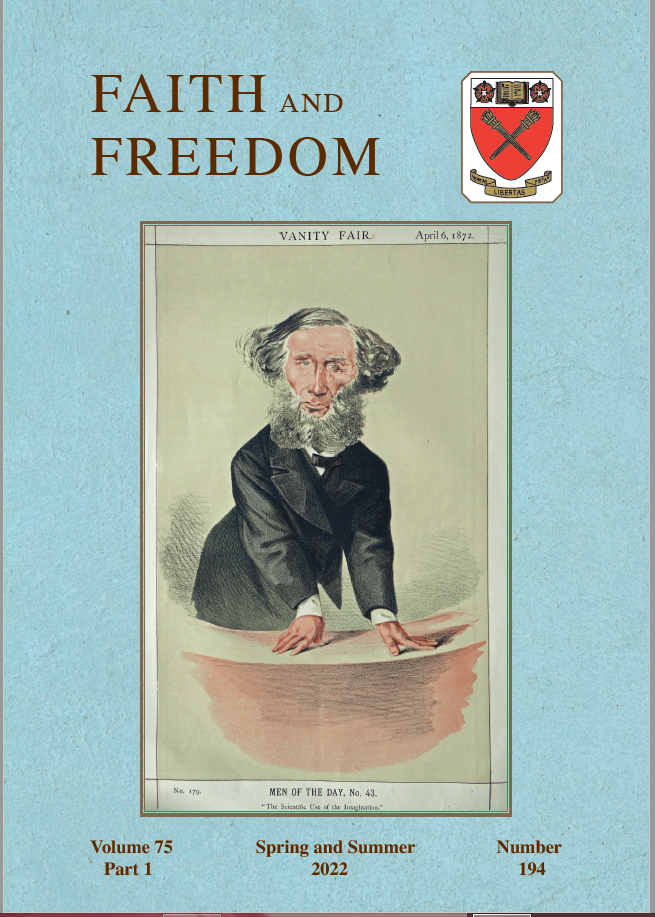
Volume 75, Part 1, Spring and Summer 2022, Number 194

The latest issue is now ready.

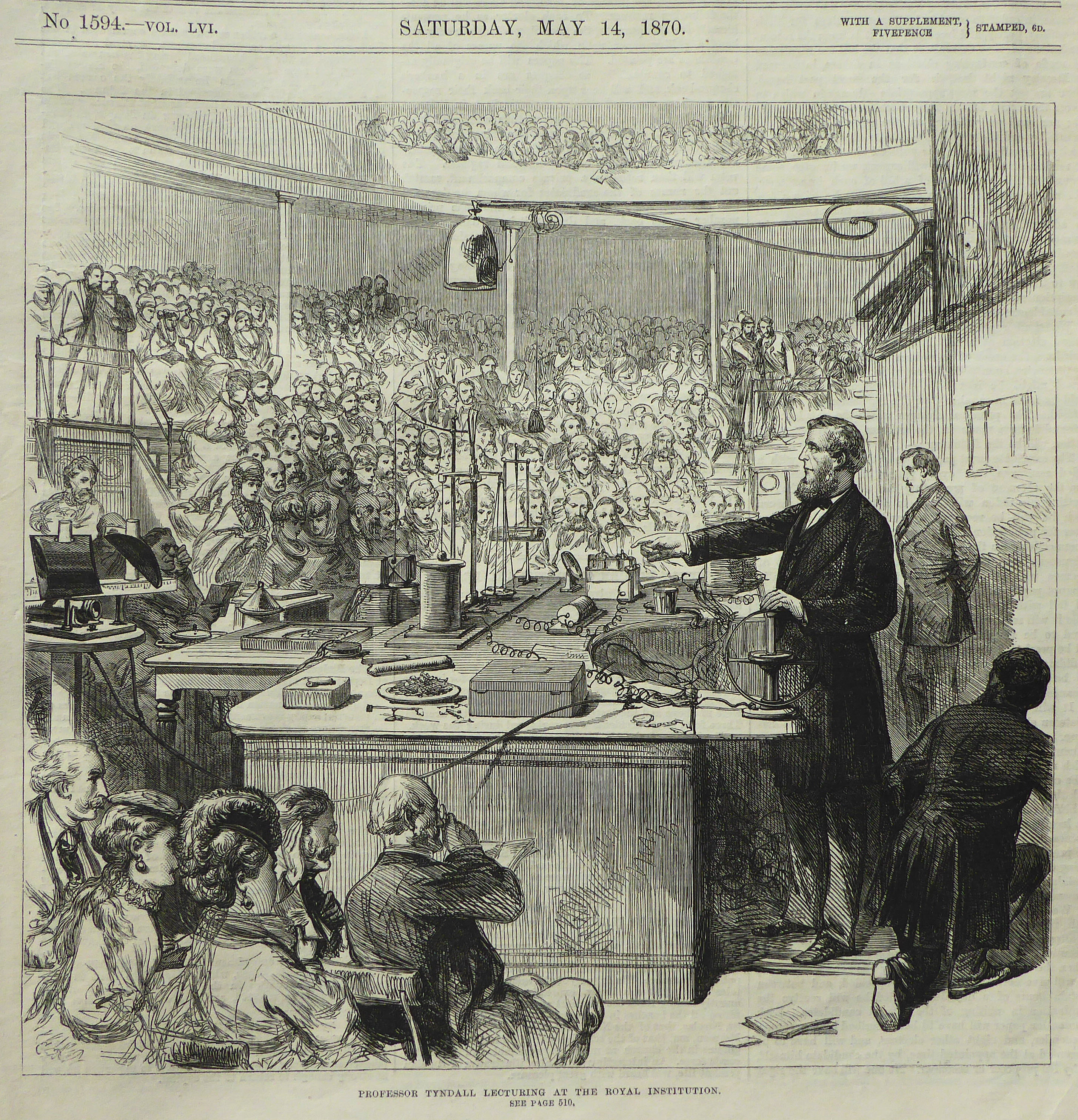
Professor John Tyndall lecturing at the Royal Institution, 1870

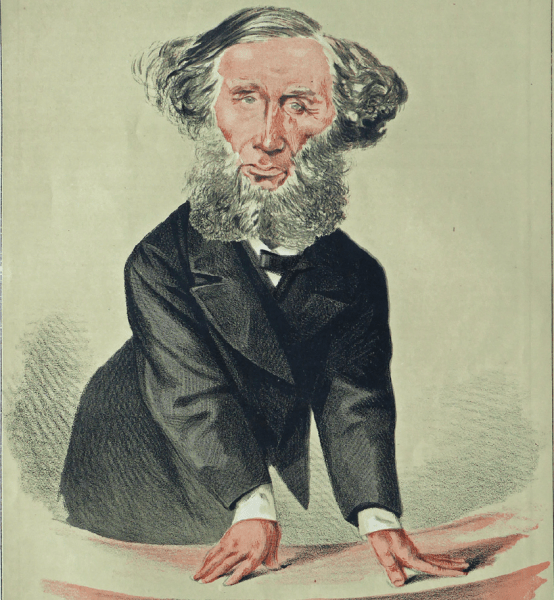
Our lead article is Howard Oliver’s examination of the remarkable career of John Tyndall and his influence on the relationship between science and religion. An outstanding physicist and an excellent lecturer he was also a glaciologist and an experienced mountaineer. Howard Oliver shows that by the 1840s he was a religious freethinker who had explored the role of faith in society in some depth. In 1847 his address in Belfast as President of the British Association for the Advancement of Science caused a furore and opened up the debate about the relationship between religion and science, especially in the light of Darwin’s theory of evolution. Our cover picture depicts his portrait from the cover of Vanity Fair in 1872.

We are delighted too to be able include articles by:

Paul Richards, on the spiritual dimension of the works of Richard Wagner which looks at Wagner and anti-Semitism, myth and religious symbolism, Tristran & Isolde, the Ring Cycle, and Parsifal.

Ann Peart, on the response of Unitarians to ministering during the pandemic, an examination of the imaginative and creative ways in which Unitarian ministers have developed new forms of worship and activity during the Covid-19 crisis.

Feargus O’Connor, on the Unitarian contribution to Animal Welfare, by a well-known advocate for human rights who leads the only annual interfaith celebration of animals in the UK.

And Robert Oulton, on the theology and works of Cynthia Bourgeault, an intriguing Episcopalian theologian and priest who is also an expert in mysticism.

We continue to carry some fine reviews including:

Religious Experience – its nature, validity, forms and problems by Principal J. Ernest Davey MA DD, with a Foreword by John, Lord Alderdice

Author and playwright Philip Orr on a new book of writings by Principal J. Ernest Davey (the leading Irish Presbyterian scholar of the twentieth century, Principal of the main Irish Presbyterian theological college, who was accused of heresy) edited by Lord Alderdice, now Senior Research Fellow at Harris Manchester College.

Mona Siddiqui, Human Struggle: Christian and Muslim Perspectives

Rev Dr Marcus Braybrooke, one of the leaders of the inter-faith movement in Britain, on Human Struggle: Christian and Muslim Perspectives, the 2016 Gifford Lectures by Mona Siddiqui published last year.

Steven Pinker, Rationality: what it is, why it seems scarce, why it matters

Professor David Williams on the place of rationality in human life according to Steven Pinker’s new book.

Daniel Costley, Life’s Journey Creating Unitarian Rites of Passage

The editor’s discussion of Daniel Costley’s Lindsey Press book on constructing special services.

Cover of the issue

Subscription Details

An annual subscription for each volume (two issues) costs £16.00 (postage included) in the United Kingdom. Single copies can be ordered at a cost of £8.00 each (postage included). Cheques should be made out to Faith and Freedom and sent to the business manager:

Nigel Clarke,
Business Manager, Faith and Freedom,
16 Fairfields,
Kirton in Lindsey,
Gainsborough,
Lincolnshire.
DN21 4GA.

It is also possible to pay online. For more details see our website: https://www.faithandfreedom.org.uk/subs.htm

Silent yet eloquent memorials

Starting off on the tour

On Wednesday, 23rd March a group from the four Belfast Non-Subscribing Presbyterian Churches enjoyed an excellent visit to the Belfast City Cemetery. We were blessed by good weather, almost like a summer’s day, which showed off the whole site to its fullest advantage. Designed in the shape of a bell and opened in 1869 it has been the burial place of approximately 225,153 people ranging from the some of the poorest members of society, buried in paupers’ graves, to some of the wealthiest merchants, industrialists and businessmen of Victorian Belfast. Years of neglect and vandalism obscured the importance of the cemetery in the city’s history for a long time, but the remarkable work done by Tom Hartley on the graves and history of the cemetery, not least reflected in his book Belfast City Cemetery, has opened up the cemetery to a wider and appreciative public. It is good too to see the construction of a visitors’ centre and the restoration of some of the larger memorials. Tom Hartley has an encyclopaedic knowledge of the history and significance of the site and was our informative guide as he showed us round a large proportion of the original Victorian graveyard, so attractively laid out with the Belfast hills providing a dramatic backdrop. Tom made special reference to some of the Presbyterian and Non-Subscribing Presbyterian graves in the cemetery and we encountered the last resting places of some familiar figures from our tradition. Among others we saw the grave of Margaret Byers, the founder of Victoria College, and Elisha Scott, legendary Liverpool goalkeeper. Cemeteries are such important repositories of history: funeral monuments, grave inscriptions, memorial artwork all tell us a great deal and in this case Belfast City Cemetery provides a fascinating window into the growth, development and history of Belfast as a city. After the tour we had lunch at Cultúrlann McAdam Ó Fiaich. Below are some images of what we saw:

The grave of Rev John Scott Porter (Biblical scholar, theologian and Belfast Non-Subscribing minister) and his brother William Porter, attorney general at the Cape Colony who introduced a franchise into the colony that extended the vote, at the time, to all people irrespective of race.
View across the cemetery showing the memorial to John Kirker (1891) on the right in the form of an ornamental Celtic Cross carved from a single piece of limestone.
.
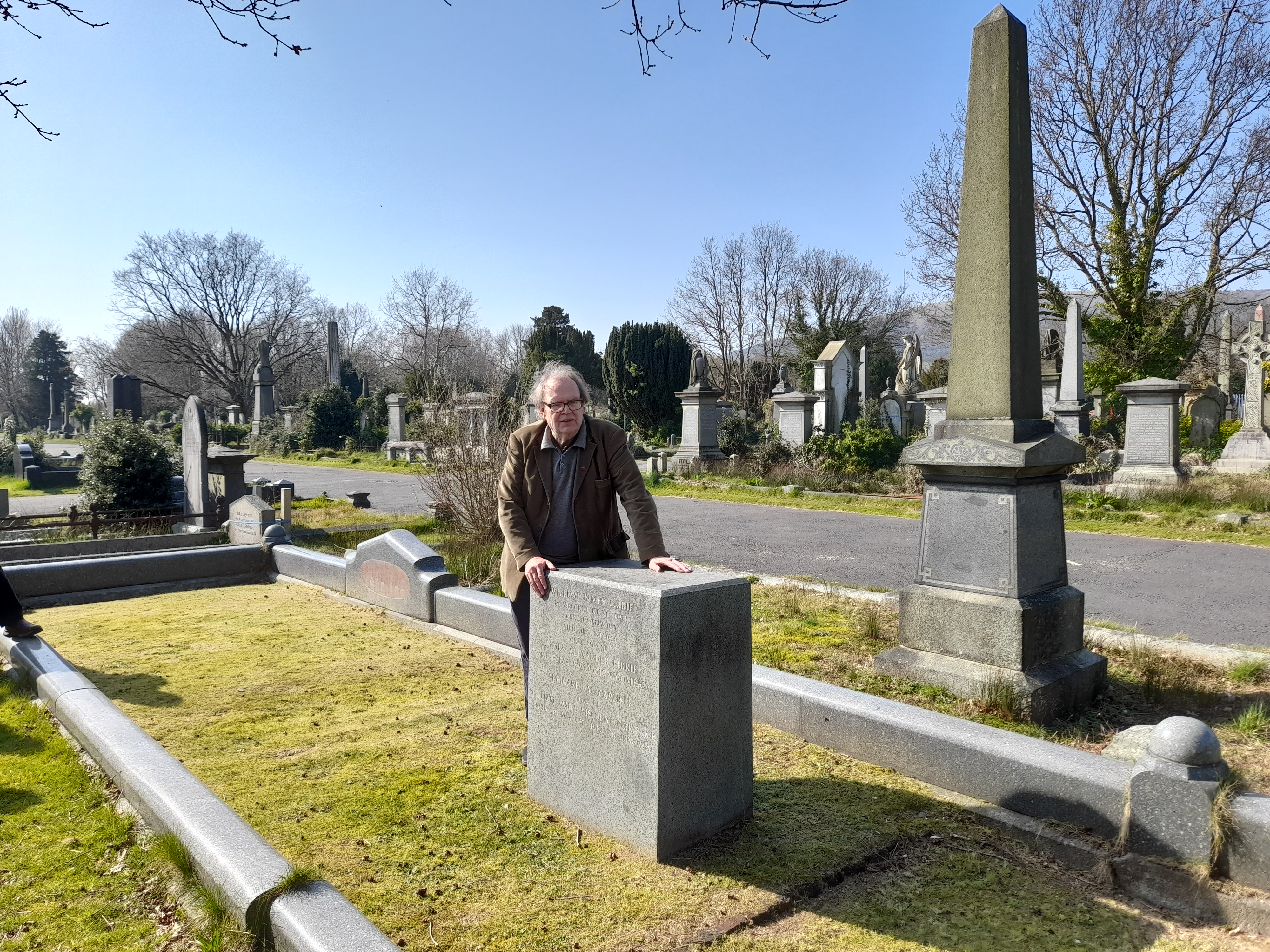
Tom Hartley at the grave of Lord and Lady Pirrie. William Pirrie was a leading Belfast politician and shipbuilder, chairman of Harland and Wolff and responsible for the building of the ‘Titanic’. His wife Margaret Montgomery Pirrie was a significant figure in her own right, closely involved in the establishment of the Royal Victoria Hospital and a granddaughter of the Rev Henry Montgomery of Dunmurry.
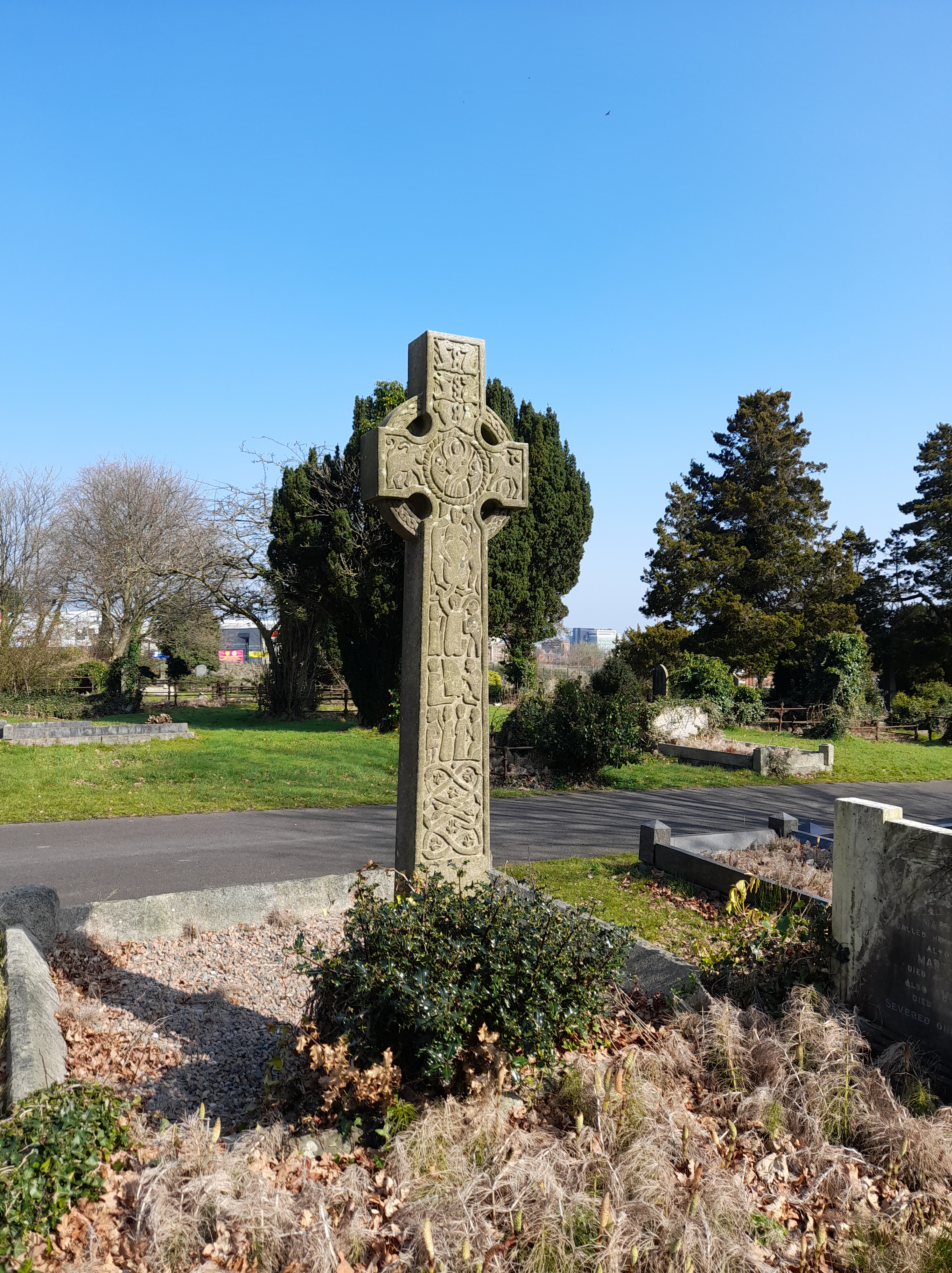
Another nineteenth-century Celtic Cross containing ancient religious imagery including, in this case, the Ouroboros (at the bottom of the Cross), the snake consuming its own tail.
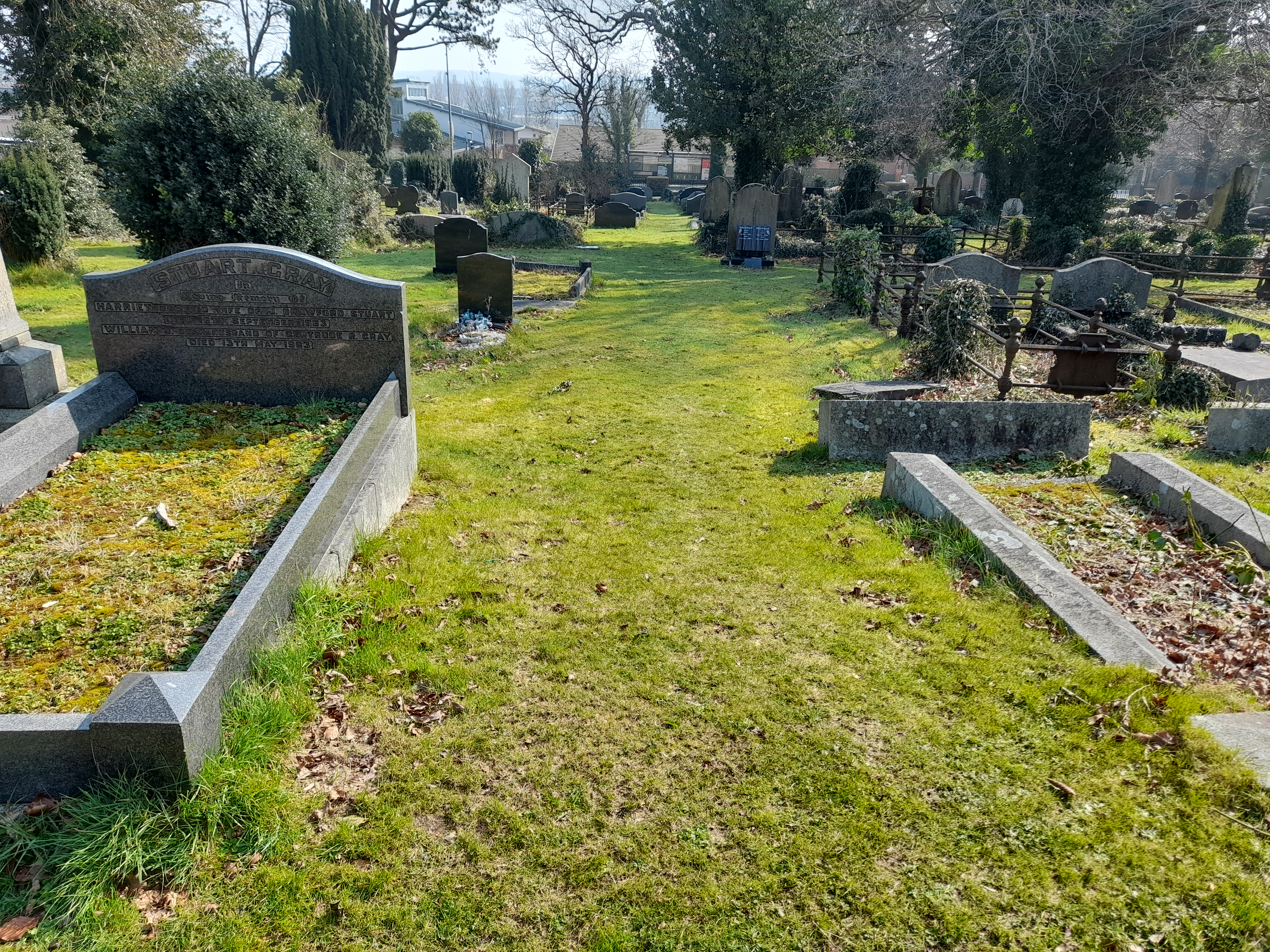
The infamous location in the cemetery where an underground wall, six feet tall, divided what were planned to be the Catholic and Protestant plots.
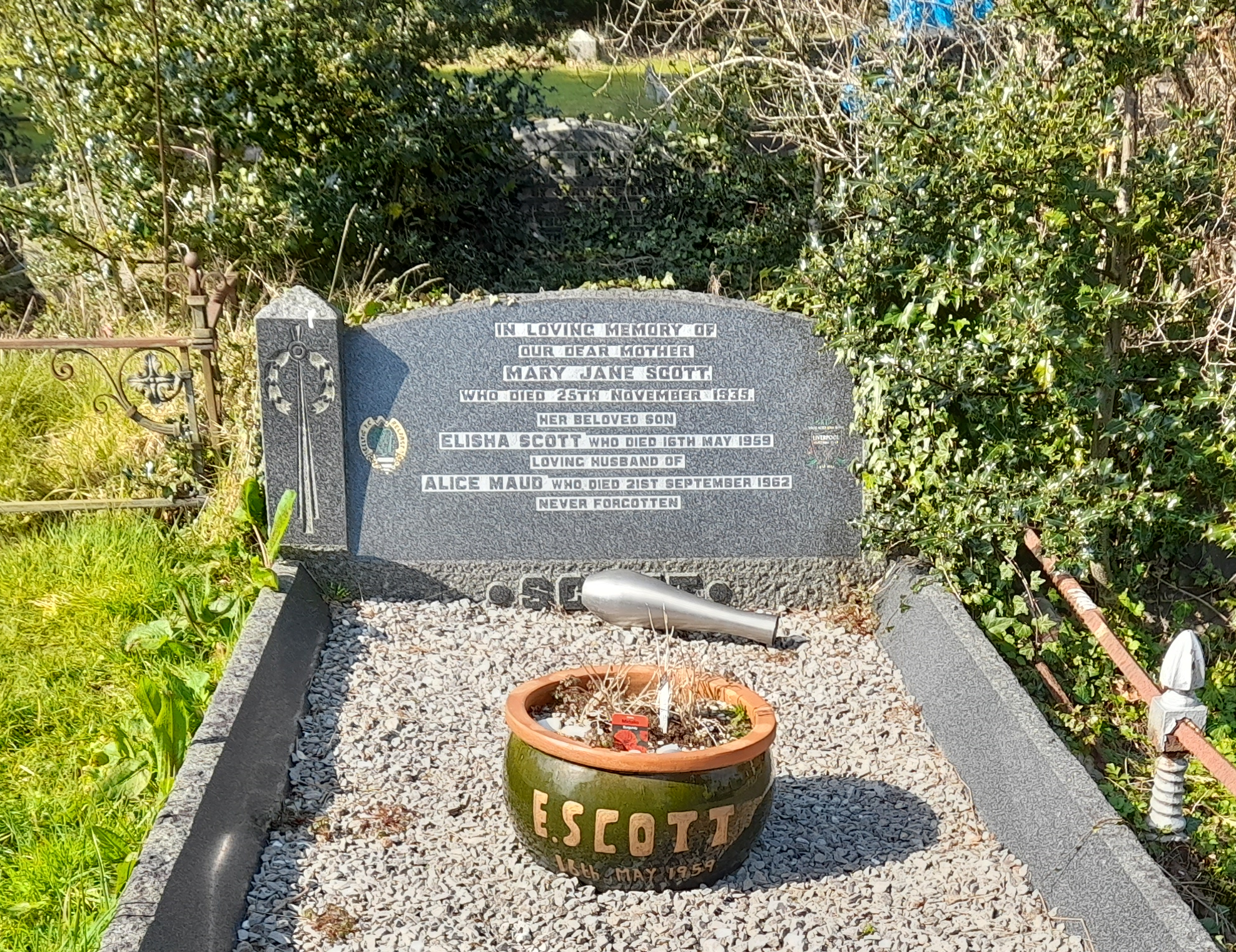
The grave of Elisha Scott, Belfast born Liverpool goalkeeper who played for the club for 22 years and made 468 appearances for Liverpool (which undoubtedly would have been more but for the First World War). He finished his career as a highly successful player-manager of Belfast Celtic until sectarian violence brought about the closure of that club.