The Rev Eric Price, the founding editor of Faith and Freedom, was recalled and honoured at Harris Manchester College on Tuesday, 23rd June during the annual meeting of Friends and Governors.
Eric had significant ministries in Bolton and Liverpool, among other places, and was lay secretary of Manchester College for a great many years. In addition he founded and edited Faith and Freedom from its inception in 1947 to the year 1983.
Portarit of Rev Eric Price
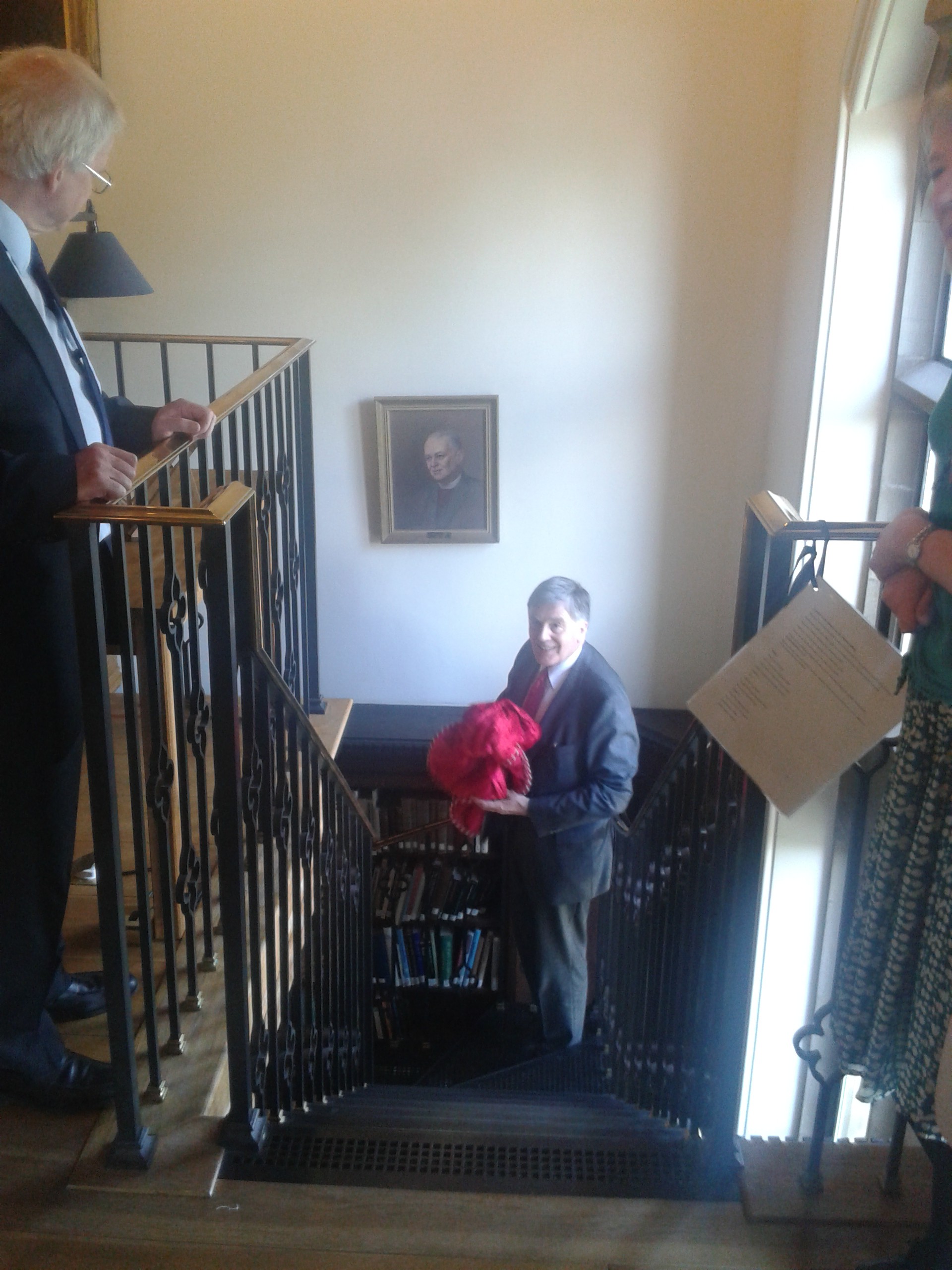
At the meeting Richard Price, Eric’s son presented a portrait to the College. This had originally been presented to his father by Bank Street Chapel, Bolton and was unveiled in its new location by the Principal, Rev Dr Ralph Waller.
The Principal unveils the portrait in its new location in the library
While making the presentation, in the course of an amusing speech, Richard Price recalled that he had been involved with Faith and Freedom from the very start, having been drafted in to stick erratum sheets in all 600 copies of the first issue printed! Later, he recalled his mother, when pregnant with his brother, threatening to give birth to twins and call them ‘Faith’ and ‘Freedom’, so all-consuming had the journal become for his father at the time!
Richard Price addresses those present in the library. Emeritus Editor Rev Peter and Sheila Godfrey can be seen in the corner of the shot
Happily both myself and Nigel Clarke were able to be there for the occasion and Nigel took the opportunity to present to Richard a bound copy of the very first issue which his father had signed.
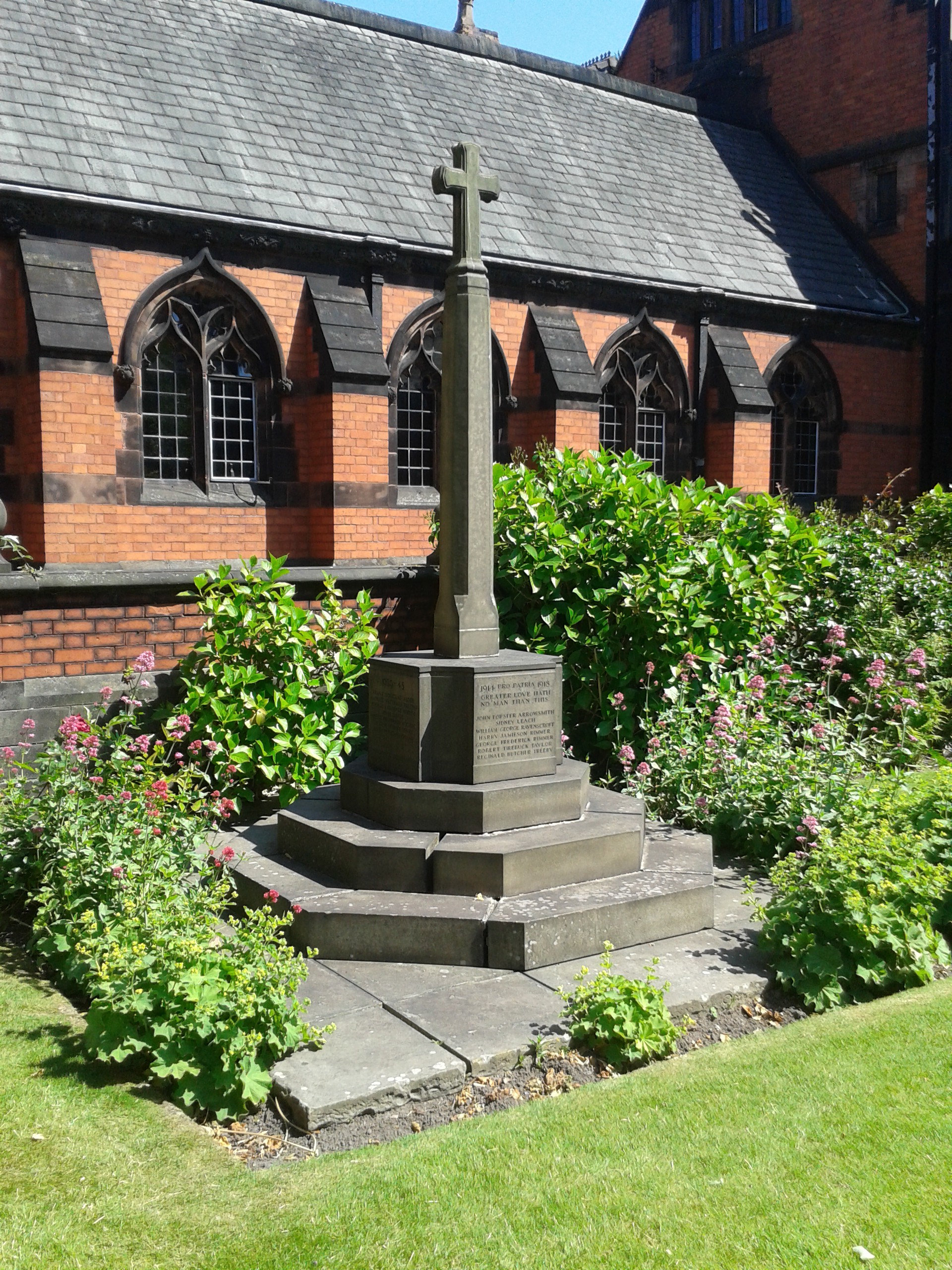
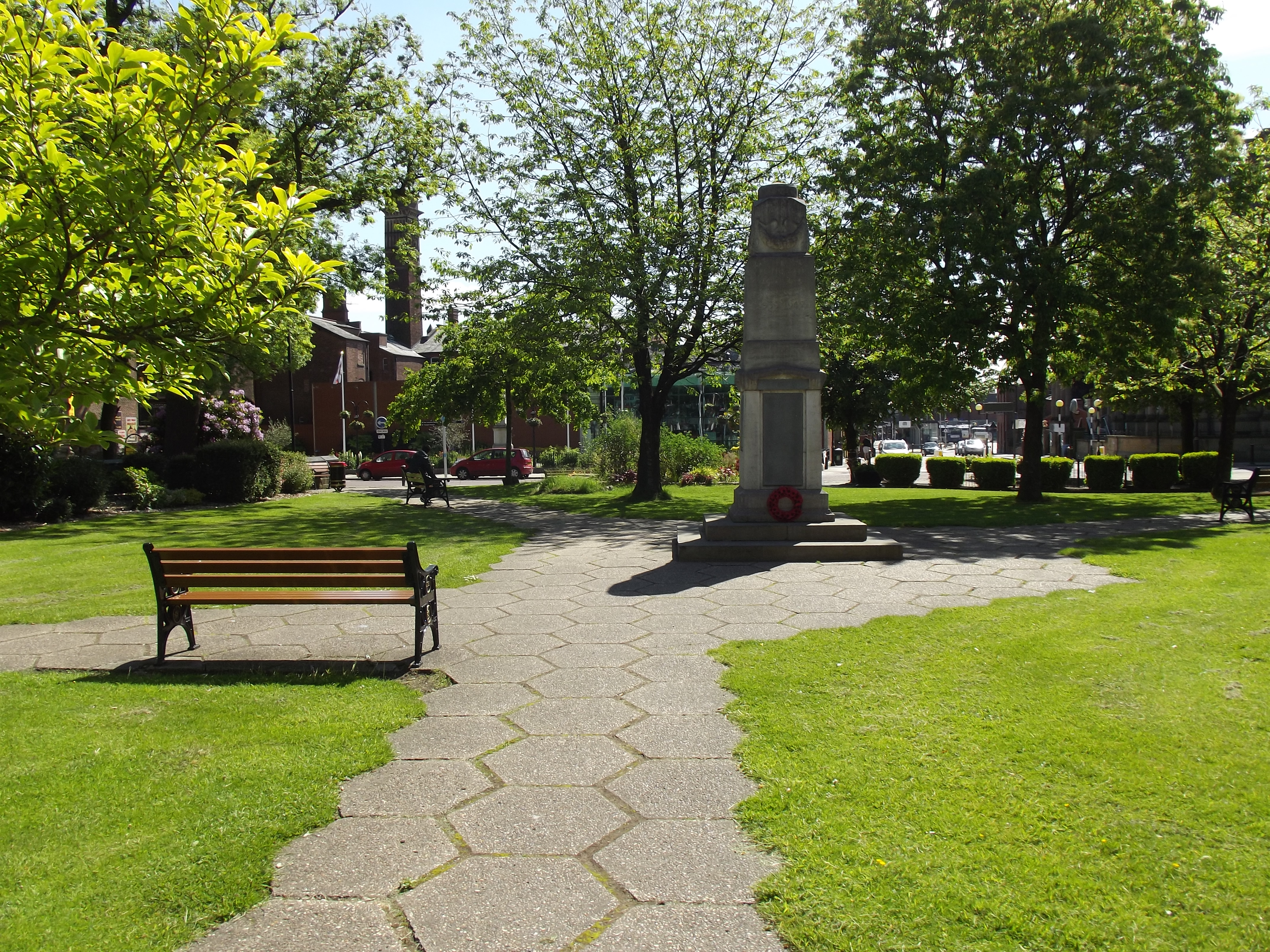
The Great War Project begun by Faith and Freedom is attracting a lot of positive interest and more material is being added, almost on a daily basis. Within the memorial section there soon will be added some pictures of the Cenotaph at Bury Unitarian Church which have been sent in by Neville Kenyon, many of which are reproduced here.
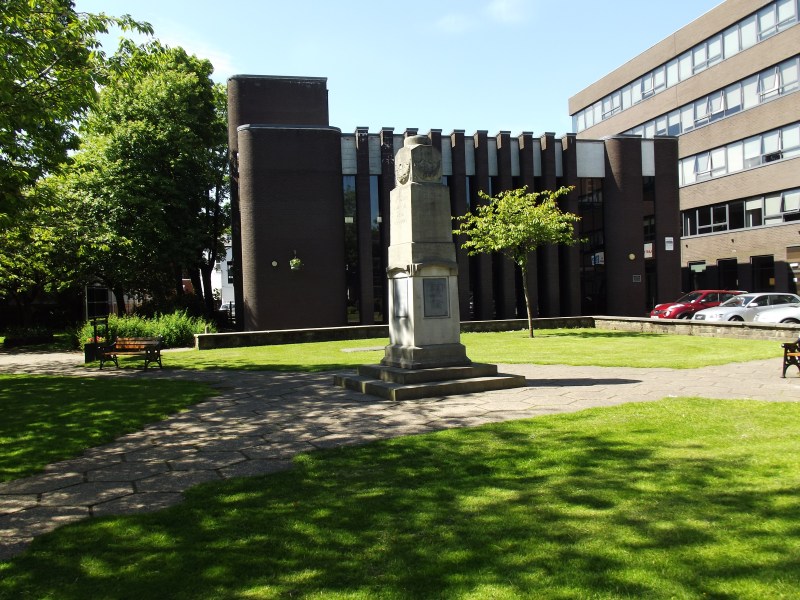
Cenotaph, Bury Unitarian Church
Neville suggests that this is the only Unitarian Cenotaph and I suspect that he must be right. Of course, Cenotaph means, literally, ‘empty tomb’ and in amongst the many old and quite extensive graveyards that exist around the country there must be a few tombs that fall into that category for one reason or another. But by Cenotaph we generally mean a freestanding public monument inspired by the Cenotaph in Whitehall, and repeated in many cities, towns and villages.
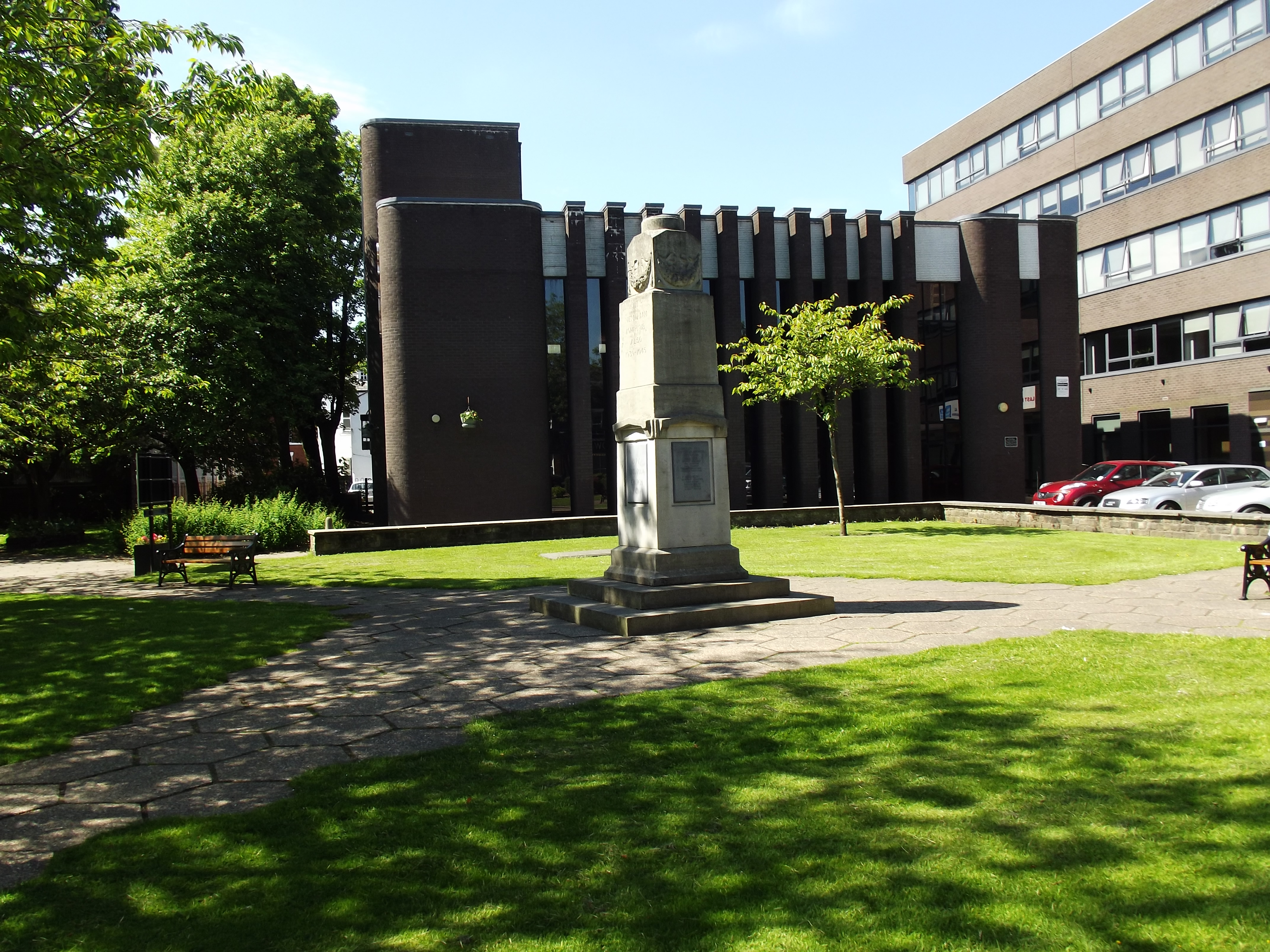
The Bury Cenotaph
The idea for Cenotaphs came from the experience of the First World War when so many soldiers had no known grave. In such a situation there was a need for a focus of remembrance, something that could symbolise the sacrifice and loss that was felt by so many people. To this end the Whitehall Cenotaph and all those that came after it fulfilled a very special role in national consciousness. And how different such monuments are when we compare them with other memorials that were erected following wars such as the Arc de Triomphe or the Brandenburg Gate, to name just two. Unlike them there is no overt military symbolism in the Cenotaph. It is much more restrained, much more dignified.
In 1924 the author H.V. Morton described his feelings as he stood near the Cenotaph on an ordinary morning:
I look up at the Cenotaph. A parcels delivery boy riding a tricycle van takes off his worn cap. An omnibus goes by. The men lift their hats. Men passing with papers and documents under their arms, attache and despatch cases in their hands – all the business of life – bare their heads as they hurry by. Six years have made no difference here. The Cenotaph – that mass of national emotion frozen in stone – is holy to this generation. Although I have seen it so many times on that day once a year when it comes alive to an accompaniment of pomp as simple and as beautiful as church ritual, I think that I like it best just standing here in a grey morning, with its feet in flowers and ordinary folk going by, remembering.
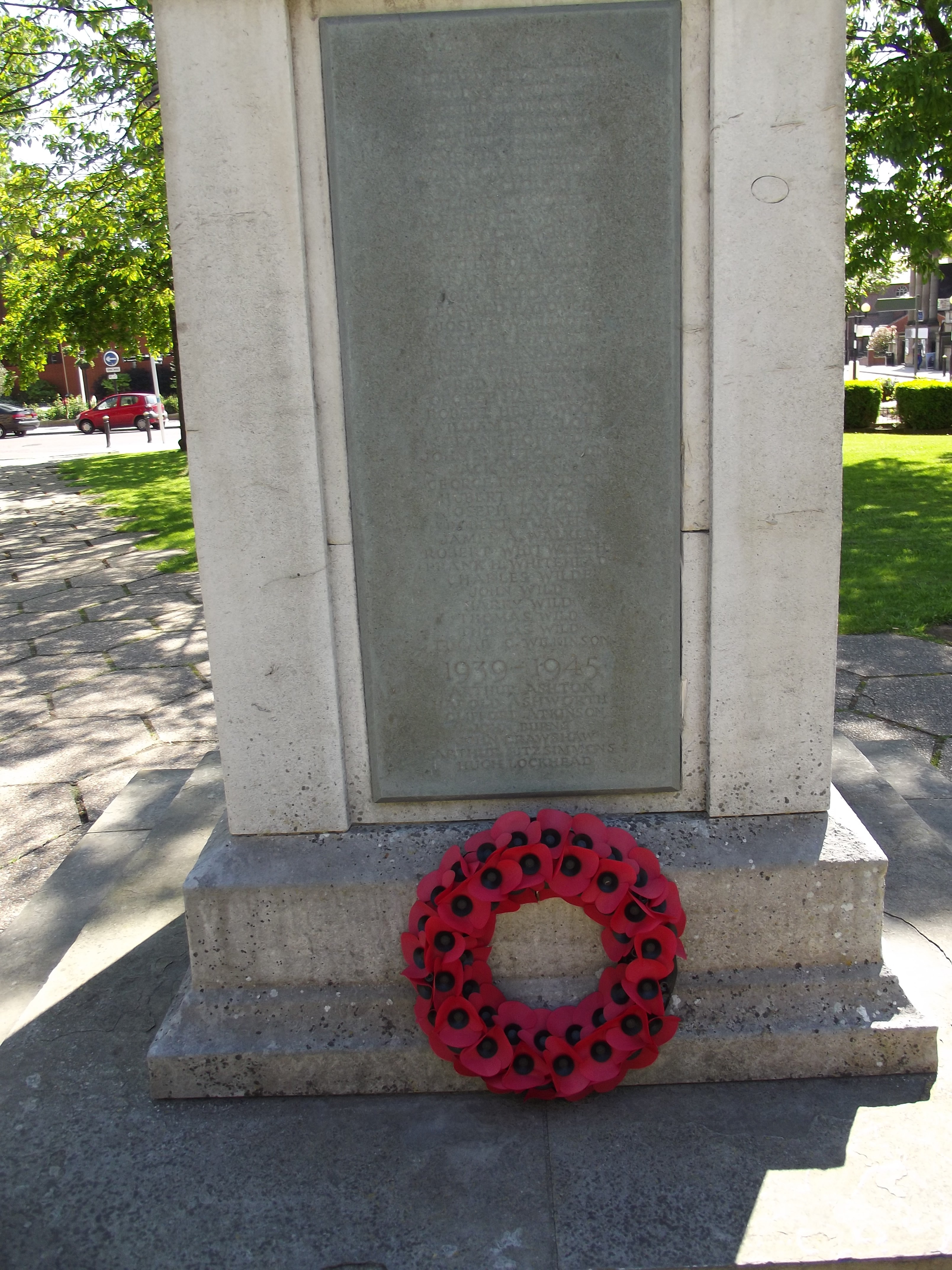
The Bury Cenotaph is very public and very similar to the memorials that are more often municipal, regimental or governmental in origin. It commemorates the members of three congregations who served in the First World War, with the names of those who served in the Second World War being added later. These were three long-established local congregations, who amalgamated into one with a bold new meeting house in 1974.
A view from the other side
The Cenotaph is situated in front of the church in the centre of what was the graveyard but which is now a public space. This space was originally called Library Gardens but has recently been renamed by the council with what seems a much more satisfying designation of Church Gardens. Neville tells me that on Remembrance Sunday the congregation meets at 11.00 am at the Cenotaph for the one minute silence, the Last Post is played, before the congregation goes into the church for a service of remembrance, the names of those inscribed on the memorial being read.
There is a plaque to commemorate each of the three congregations represented by the modern congregation – Chesham, Heywood and Bank Street, Bury. The Bank Street plaque – beneath the title ‘Bank Street Presbyterian Chapel Unitarian’ – has the longest list of names (I counted 40 names from the First World War) but it is by far the most weathered.
Bank Street Presbyterian Chapel Unitarian
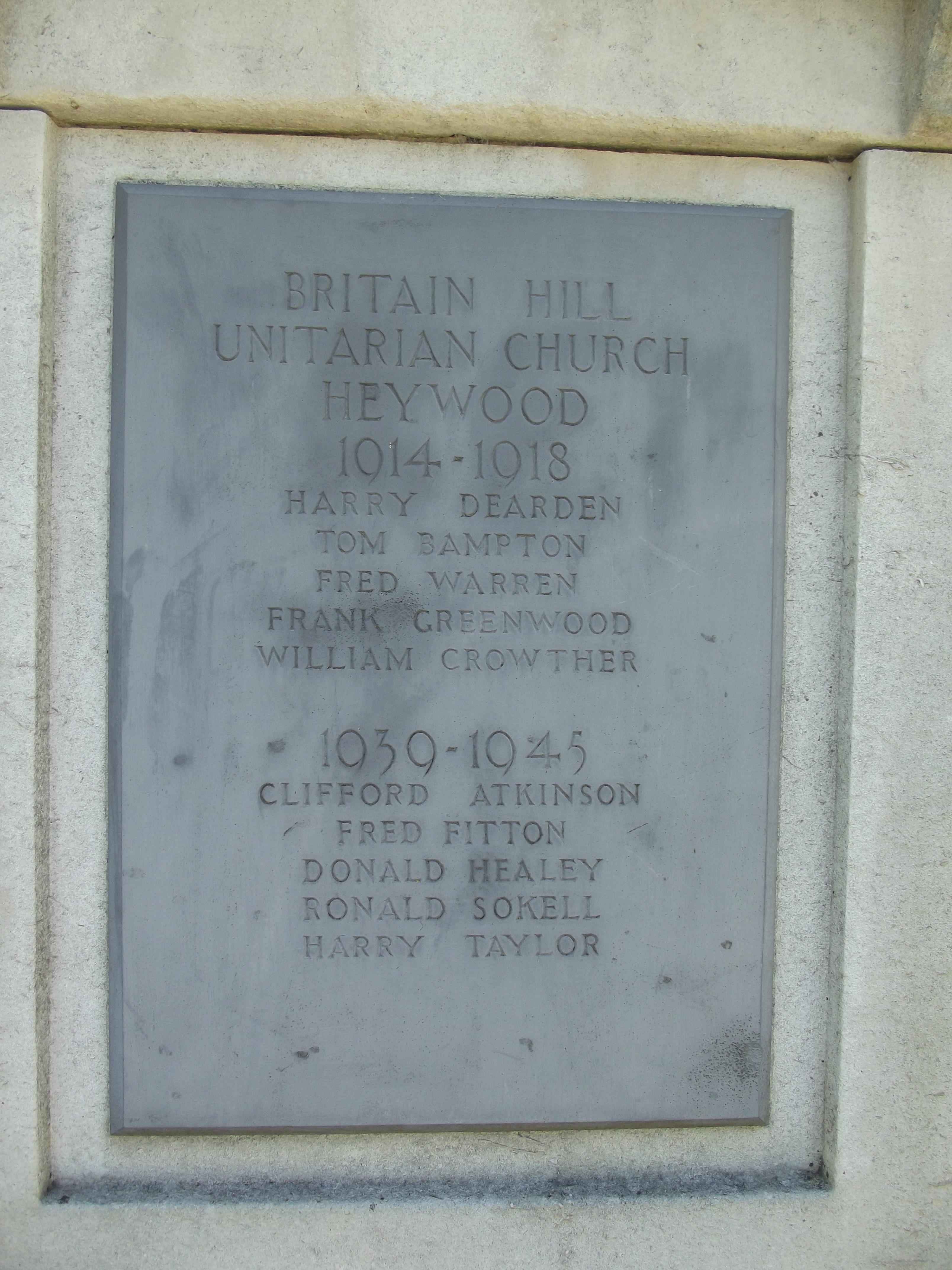
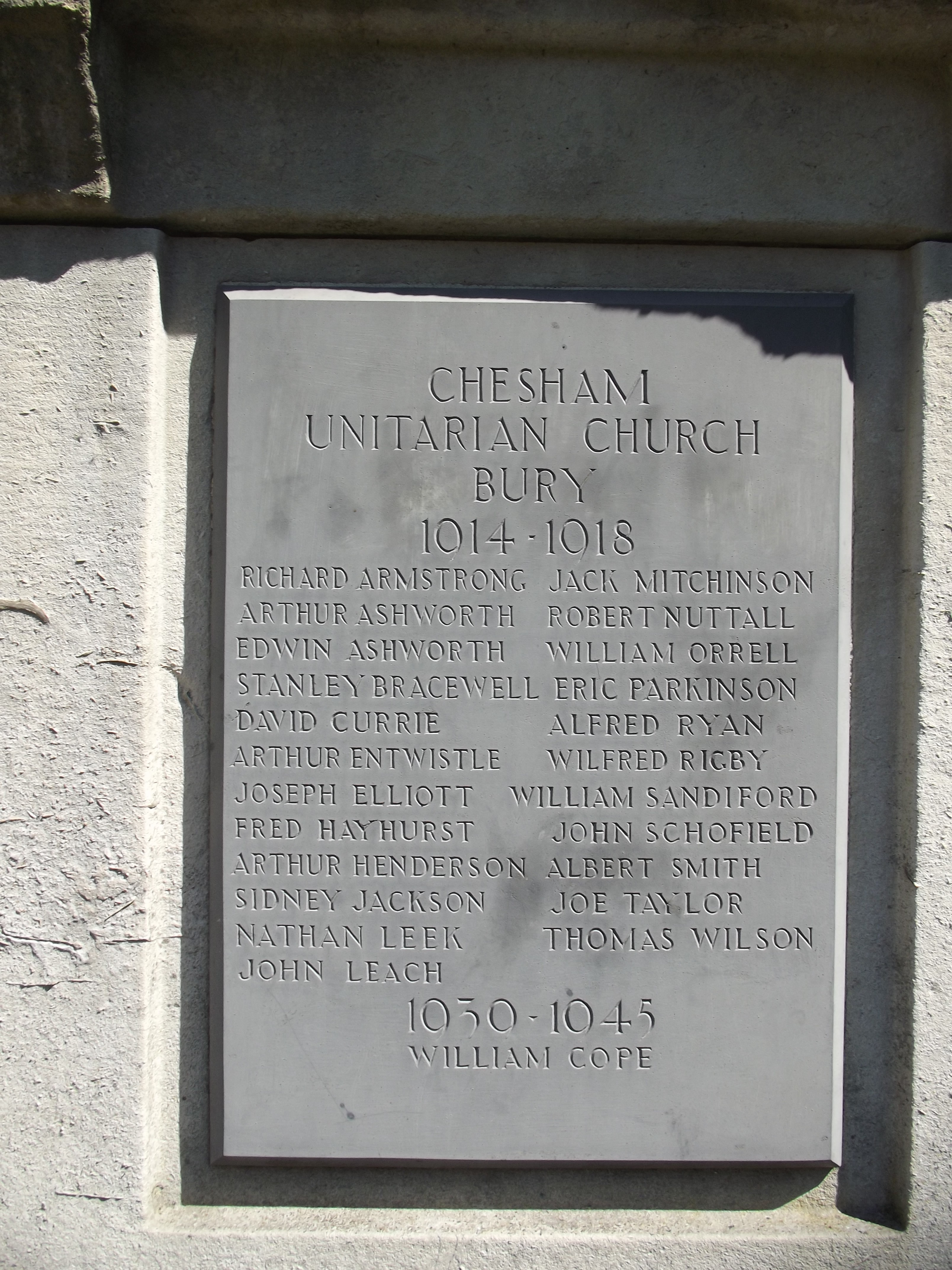
There are 23 names from the First World War on the Heywood memorial and five on the Chesham memorial.
Britain Hill Unitarian Church HeywoodChesham Unitarian Church Bury
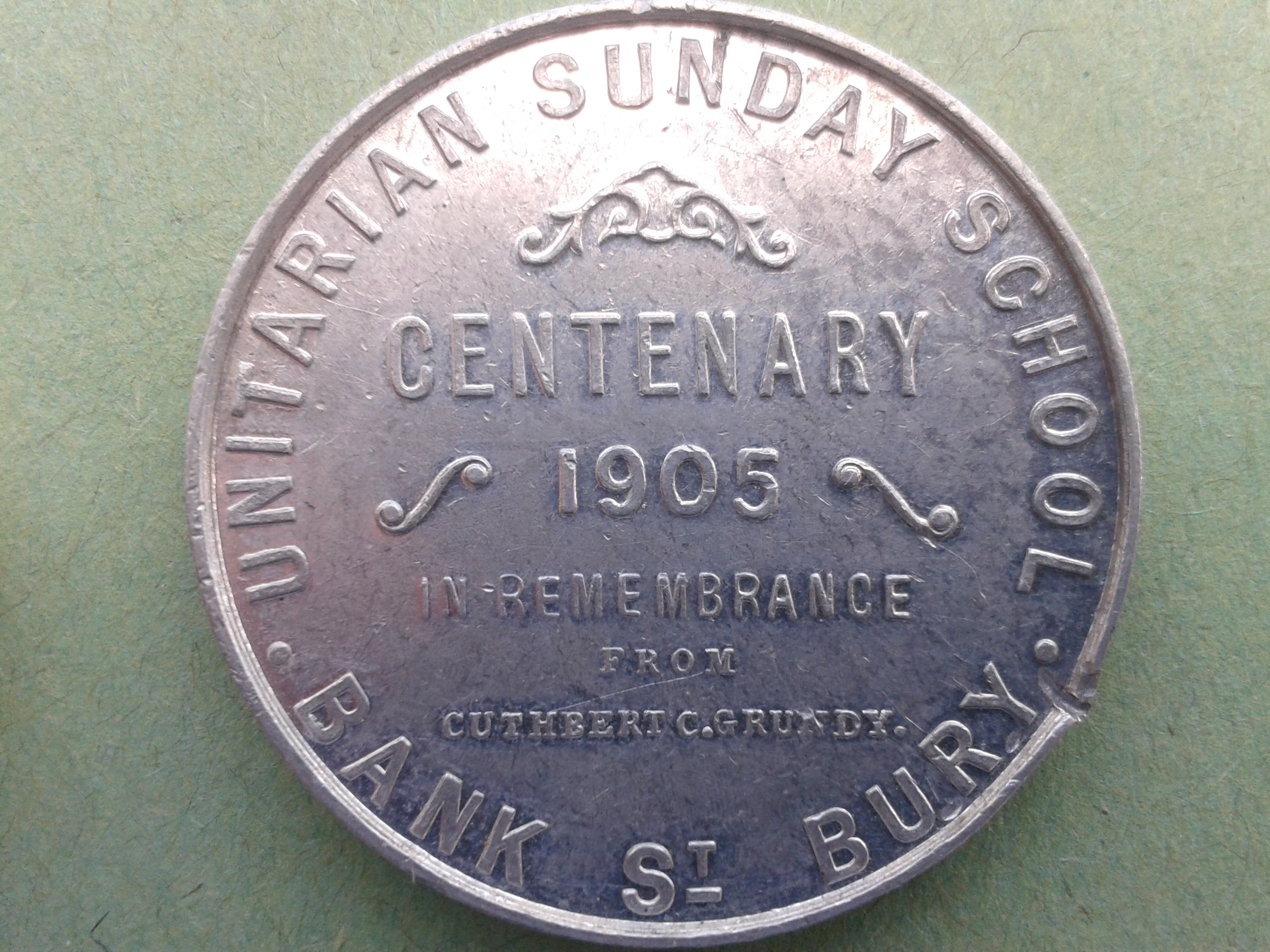
In my possession I have a medal struck to commemorate the centenary of the Bank Street Sunday School in 1905. The medal is inscribed ‘In Remembrance from Cuthbert C. Grundy’ and it must have been given to all the Sunday School scholars at the time. It is sad to think that so many of the children who received this medal in 1905 will be amongst the long list of volunteers whose names were inscribed on the Cenotaph just a few years later.
The Bury Sunday School medal
Is it the only Unitarian Cenotaph? If you know of any other please let me know and, best of all, send a picture. The only place that I know that comes near is Ullet Road Church in Liverpool which has a memorial set in its own large and well-kept grounds. But although it is a First World War Memorial that performs the same role as a Cenotaph the design is different to that of Bury, although not dissimilar to ones found in many places around the UK.
War Memorial Ullet Road Church Liverpool
But it would be nice to hear if anywhere else possesses a memorial in any way similar to that of Bury. Or maybe Bury is unique?
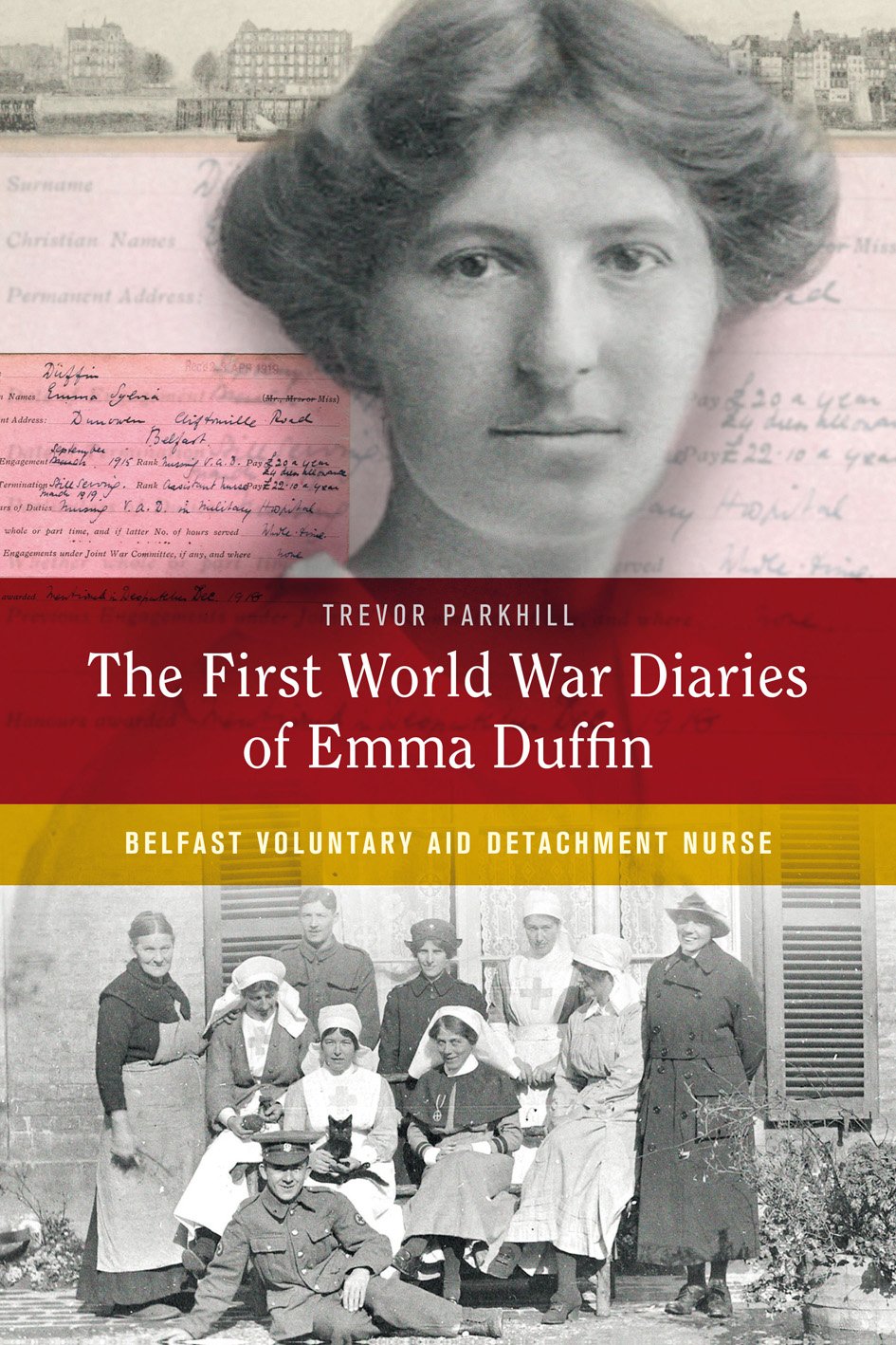
The First World War cast an enormous shadow over the past century. It had a cataclysmic effect on all aspects of society, no one was left untouched by it – homes, families, schools, factories, businesses, and, of course, churches. There are many ways in which the centenary of the Great War is being marked and most churches are spending some time over the current period reflecting on the conflict, its impact and its legacy. Faith and Freedom is establishing a special section of its website to reflect upon the conflict from the point of view of the churches and other faith groups. The website will be developed in a number of different ways. It will contain scholarly and thoughtful articles on the Great War, particularly in relation to churches and their participation in the War. The first three articles to go online are Unitarian Attitudes to the First World War, by Alan Ruston, The Centenary of the First World War and the Non-Subscribing Presbyterian Church of Ireland, by David Steers; and ‘Their sister in both senses’. The memoirs of Emma Duffin V.A.D. nurse in the First World War by Trevor Parkhill. Trevor is editor of The First World War Diaries of Emma Duffin, Belfast Voluntary Aid Detachment Nurse (Four Courts Press, Dublin, 2014) and his article gives an intensely moving account of the First World War experiences in hospitals at the front of Belfast-born Unitarian Emma Duffin (a direct descendant of William Drennan, the founder of the United Irishmen and a cousin of Thomas Andrews designer of the Titanic) who volunteered to serve as a nurse and spent three harrowing years tending the wounded.
The second section will contain accounts of commemorations and acts of remembrance made during the current centenary period and readers are very much encouraged to send in reports of their events. The first example is a thoughtful and intensely moving service held at Rosslyn Hill Chapel, Hampstead to mark the centenary of the outbreak of the War. We are also seeking to record the names and details of church members who served in the First World War and we begin with a very full account of the contribution and service, with pictures, of members of the Great Meeting, Hinckley.
Private Stanley Jennings of Hinckley, of the 15th Battalion Durham Light Infantry. Killed in France 3rd May 1917, aged 29
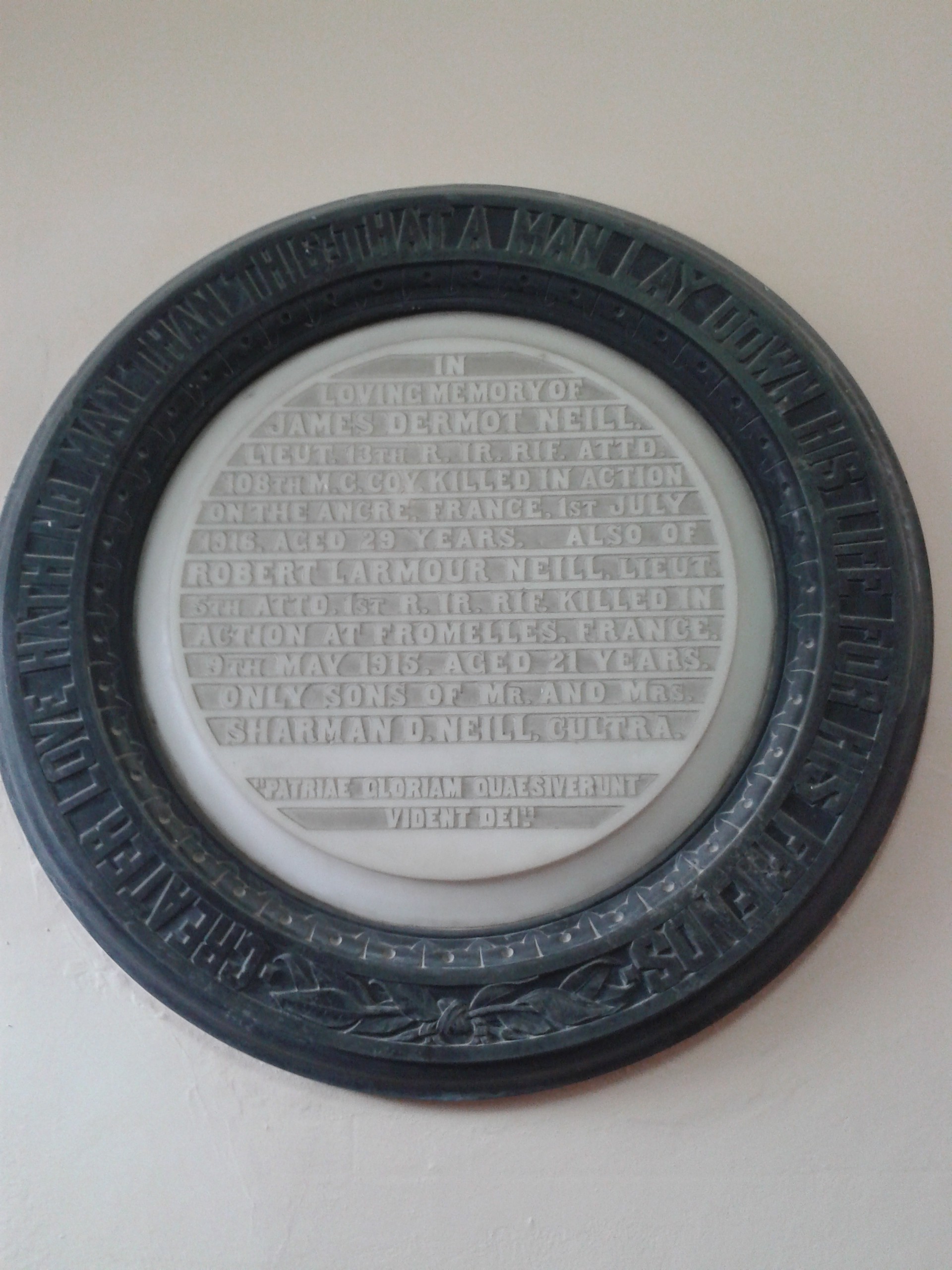
We also aim to build up a database of images of First World War memorials. Does your church have a memorial to its members who served in the First World War? If it does then please send a digital picture to go on the website. We are also actively seeking images and details of memorials that were placed in churches that are now closed, which may now be lost or which may have been put in a different location.
Memorial to Lieutenant R.L. Neill, Holywood co. Down. Killed at the battle fo the Somme
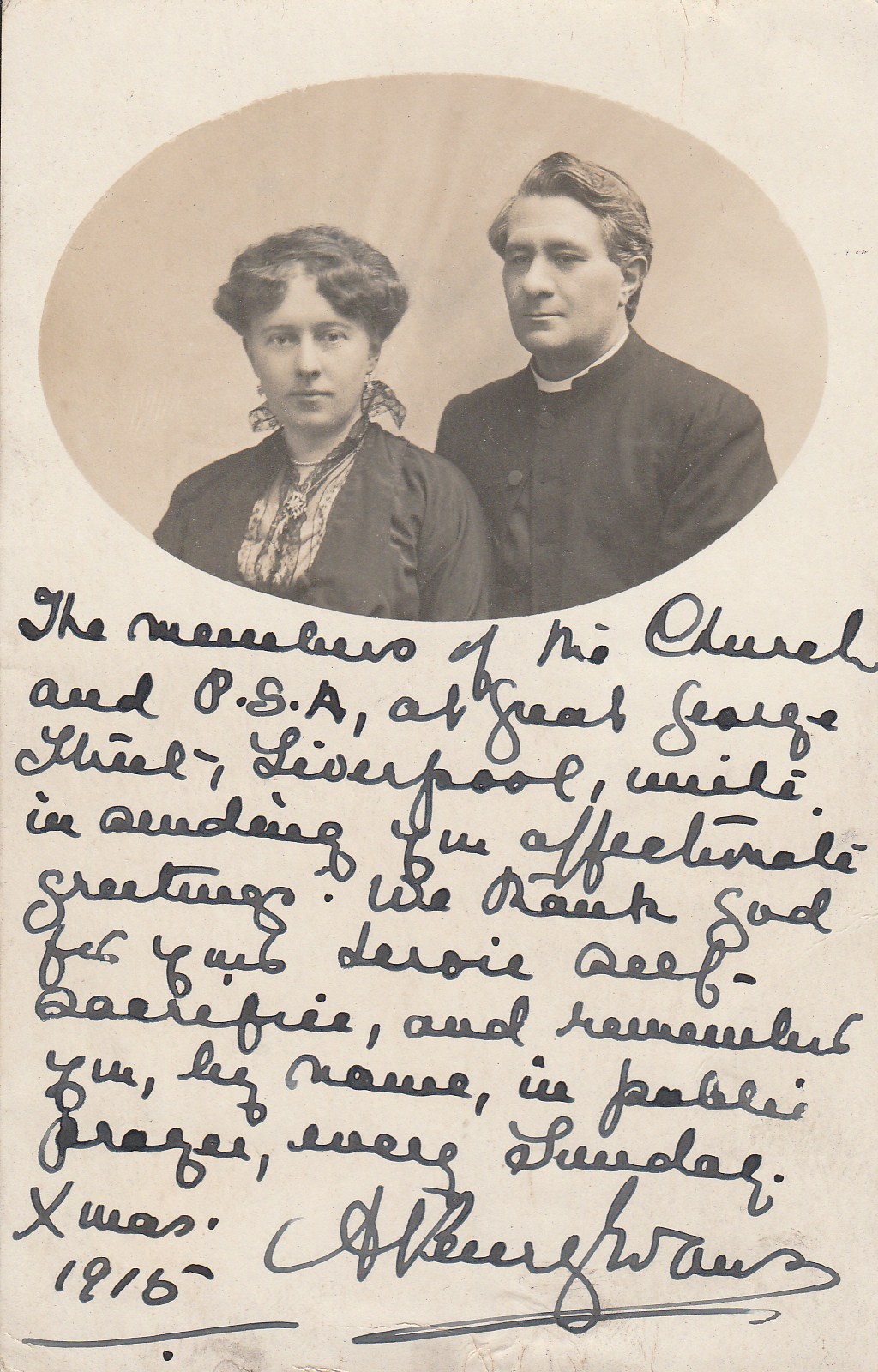
We also hope to include material – including photographs, sermons, writings, printed ephemera etc that date from the time of the War which can then be studied on our site.
A postcard sent to members of Great George Street Congregational Chapel, Liverpool serving at the front. Featuring a picture of the minister and his wife and a written message. P.S.A. stands for Pleasant Sunday Afternoon, a popular form of church entertainment at the time
We might also eventually include complete Rolls of Honour – for individual congregations and denominations. The whereabouts of the Roll of Honour relating to the churches that are now part of the General Assembly of Unitarian and Free Christian Churches has been a matter of some discussion recently. If we had the full list of names we could add it to the site. The Roll of Honour of the Non-Subscribing Presbyterian Church of Ireland also seems to have been begun but not completed. It would be good to see that completed and available online. With the co-operation of readers the site will be built up over time. If you would like to participate please contact the editor at editor@faithandfreedom.org.uk To view the website go to: http://www.faithandfreedom.org.uk/GWindex.htm
If you saw a copy of last year’s Faith and Freedom Calendar then you will recognise the three images on this page as from that publication. Last year’s Faith and Freedom Calendar was well received and helped to raise a good sum for the charity Send a Child to Hucklow Fund (SACH). The journal is planning to publish another Calendar for 2016 the proceeds from which will again go to the SACH.
Princes Road Synagogue Liverpool (January 2015)
Next year’s theme will be: Faith in the World
The publishers invite anyone to submit photographs for consideration for inclusion in next year’s Calendar in accordance with this theme. Please interpret the theme as broadly as you like – an act of worship, a faithful community or individual at work, a symbol of faith, a place of worship, it is up to you. However, the photograph should be your own work and you must be happy to give permission for it to be used in the Calendar should it be selected for inclusion. Photographs can be in colour or black and white, they should be landscape in orientation, of high resolution and sent, by email, to n.clarke884@btinternet.com
Pet service at St Andrew’s United Church, Kirton Lindsey, North Lincolnshire (March 2015)
All successful entrants will be sent a free copy of the Calendar and have the satisfaction of being part of an interesting project that shares the diversity and vibrancy of faith and which will also help to raise money for SACH. We may be able to include a broader number of pictures submitted in the journal’s website.
If there is a seasonal element to your entry please state it in your accompanying email as well as when and where it was taken. Please remember also that parental permission is usually required if your picture includes children under the age of 18. The deadline for submissions will be 18th September 2015.
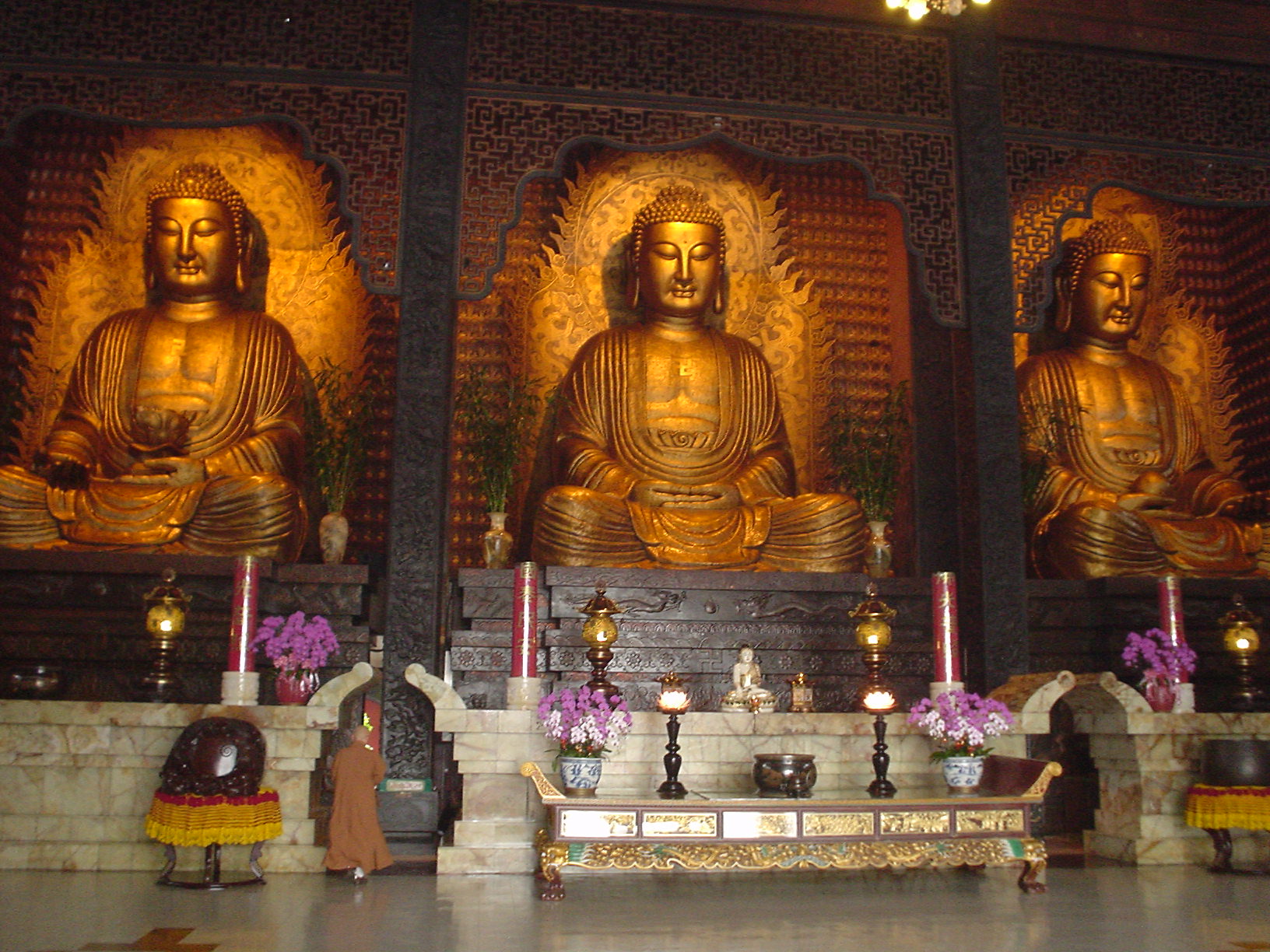
Buddhist Temple, Fo Guang Shan Monastery, Kaohsiung, Taiwan (August 2015)
These words of the Chinese philosopher Lau Tzu seem appropriate for the beginning of any new enterprise, they also tie in, for me personally, with the picture of the Ancient Chapel of Toxteth, a place which was very much a starting point for me. But the purpose of this blog will be to flag up things that interest me particularly in relation to the journals Faith and Freedom and the Transactions of the Unitarian Historical Society, both of which I edit. Not that I intend to confine myself to either of those publications – anything that catches my eye will go in here – the blog will have a special remit towards faith, religious history and associated matters but it will by no means confine itself to matters of religion.










 velvethummingbee