Our latest video (Number 7) exploring the collection of the Very Rev William McMillan Library at First Dunmurry looks at some Christmas readings. We also have O Come all ye faithful played by Jack Steers on the trumpet.
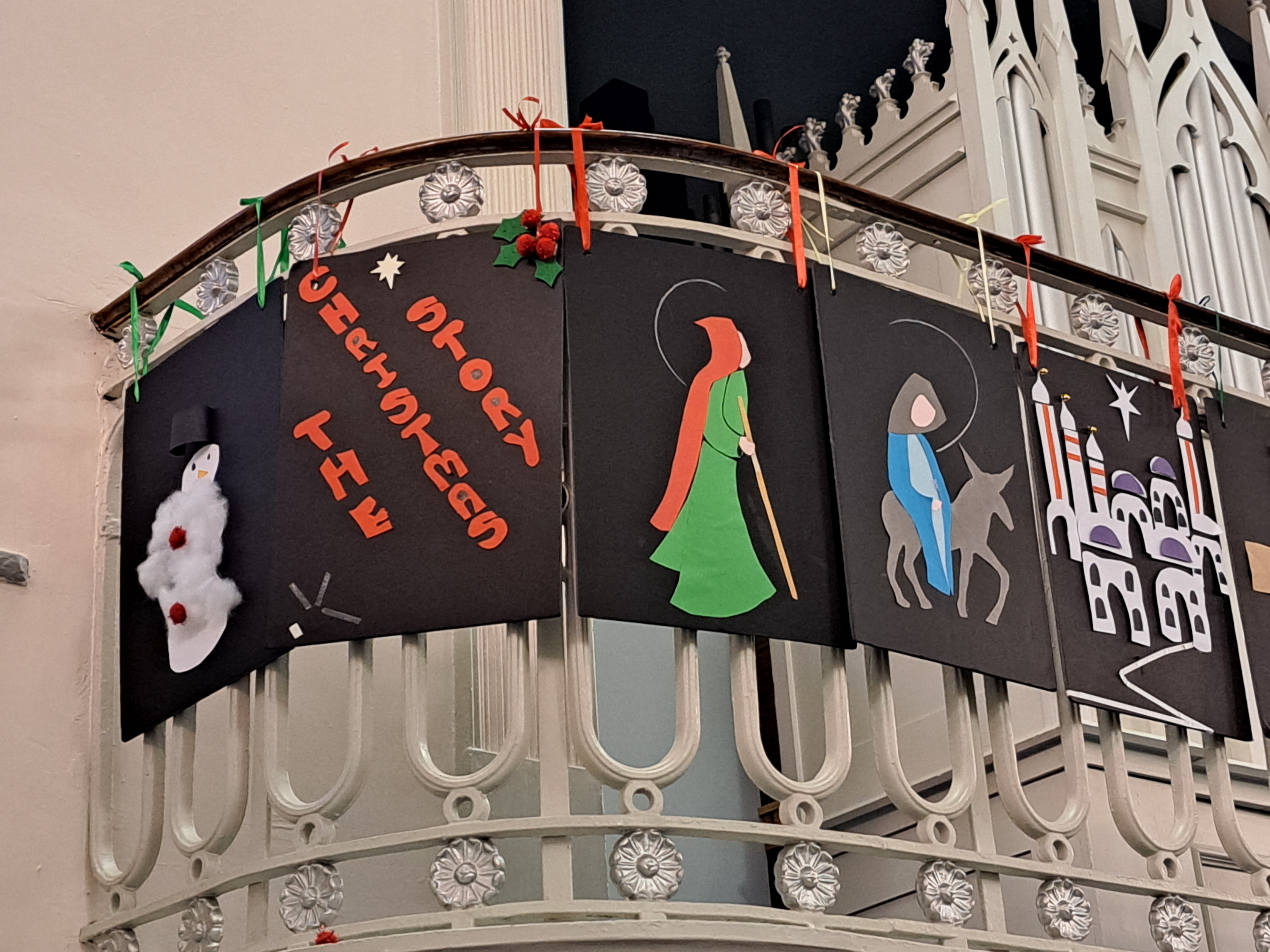
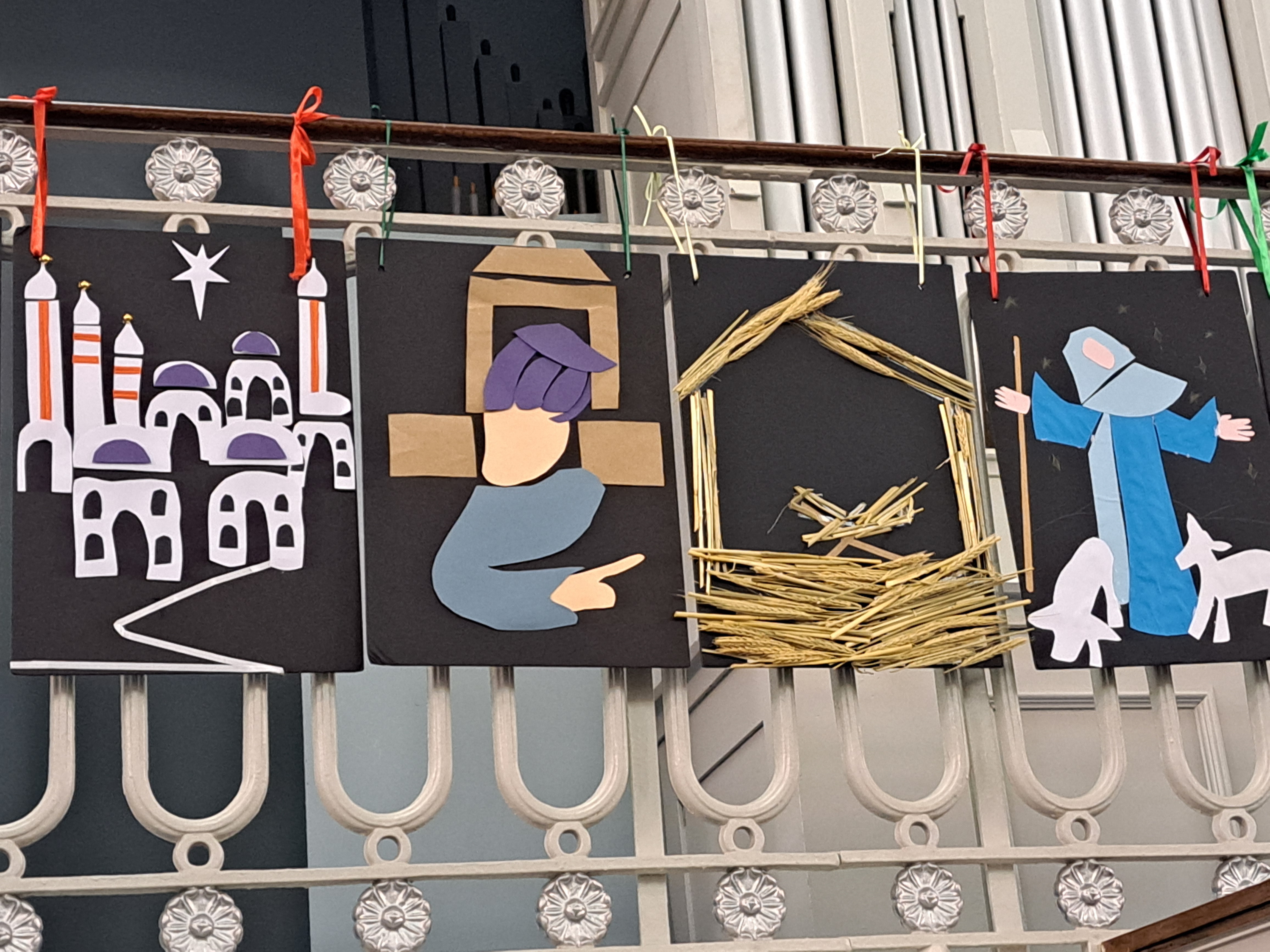
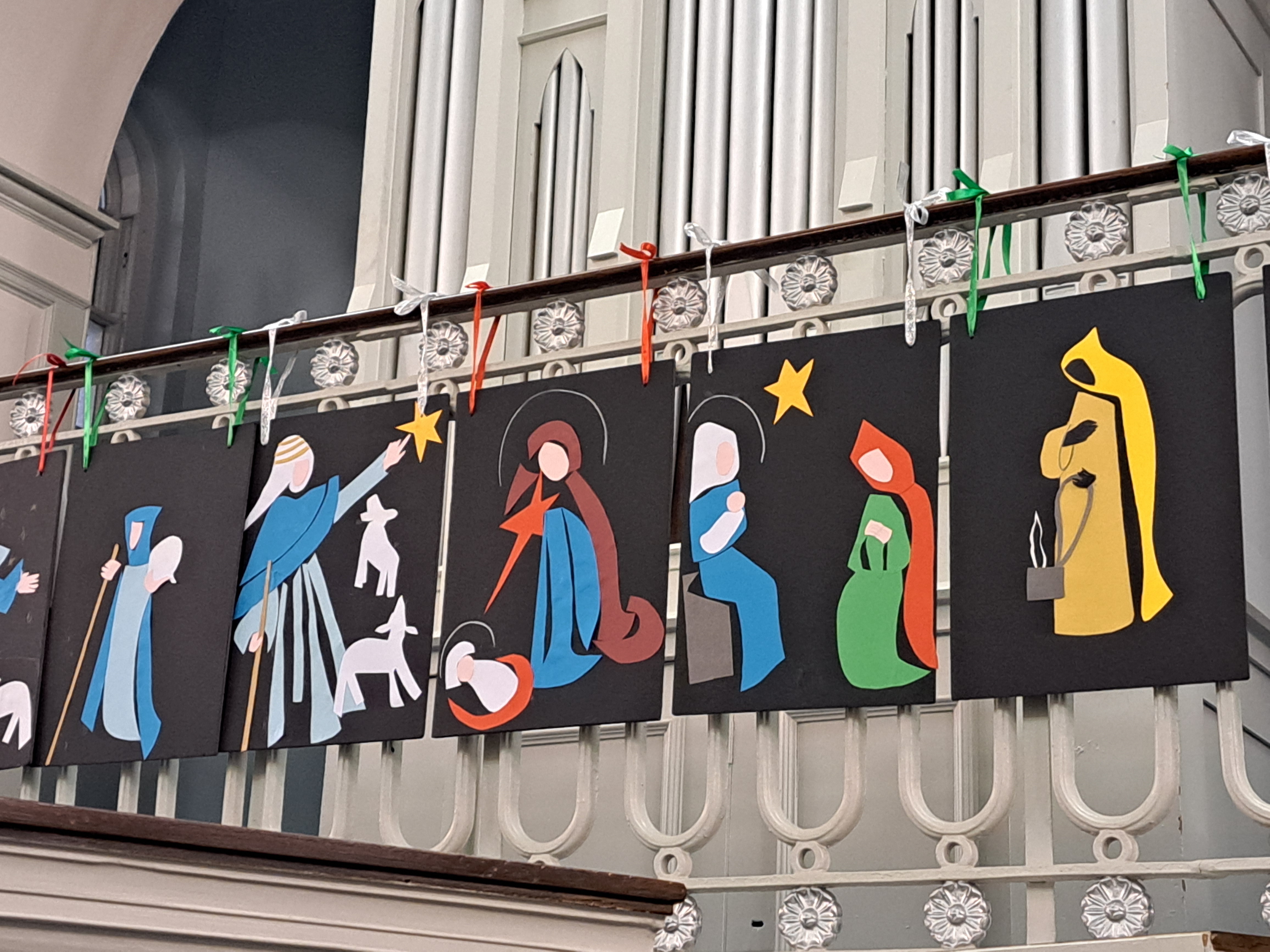
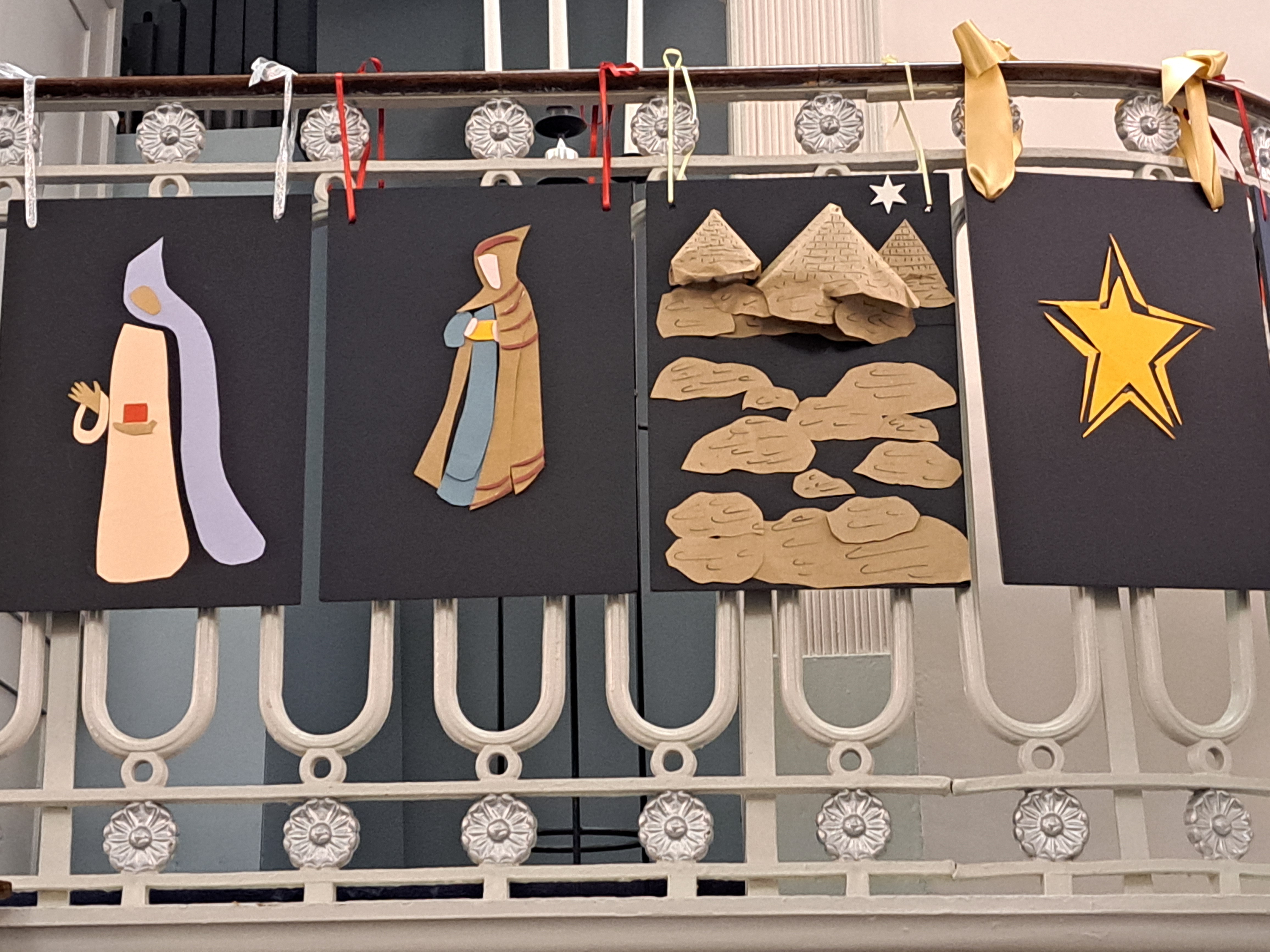
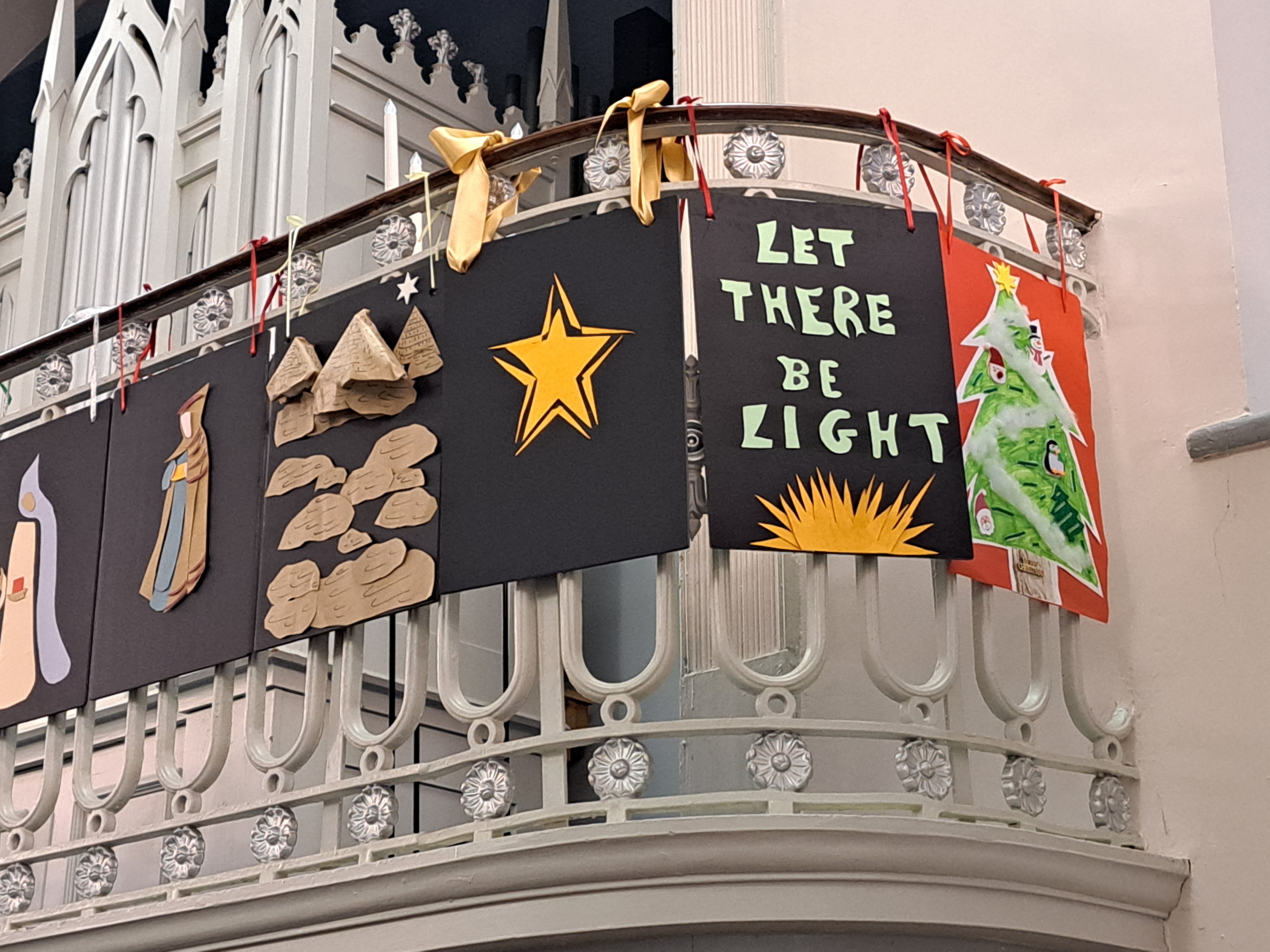
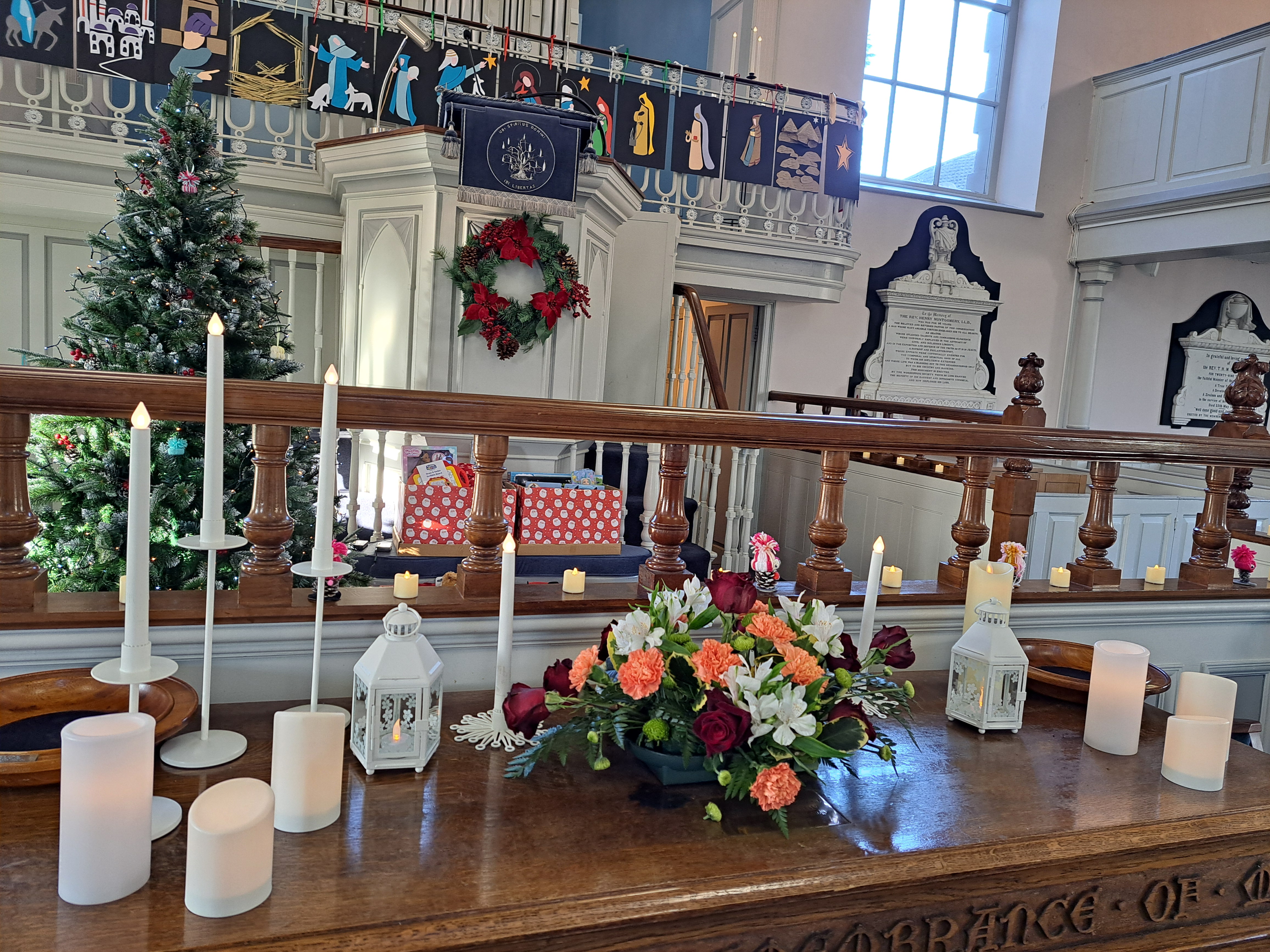
The video also includes some of the Christmas decoration in the Church including the excellent frieze created by the children of the Youth Group along the rail behind the pulpit, which can be seen in more detail below:
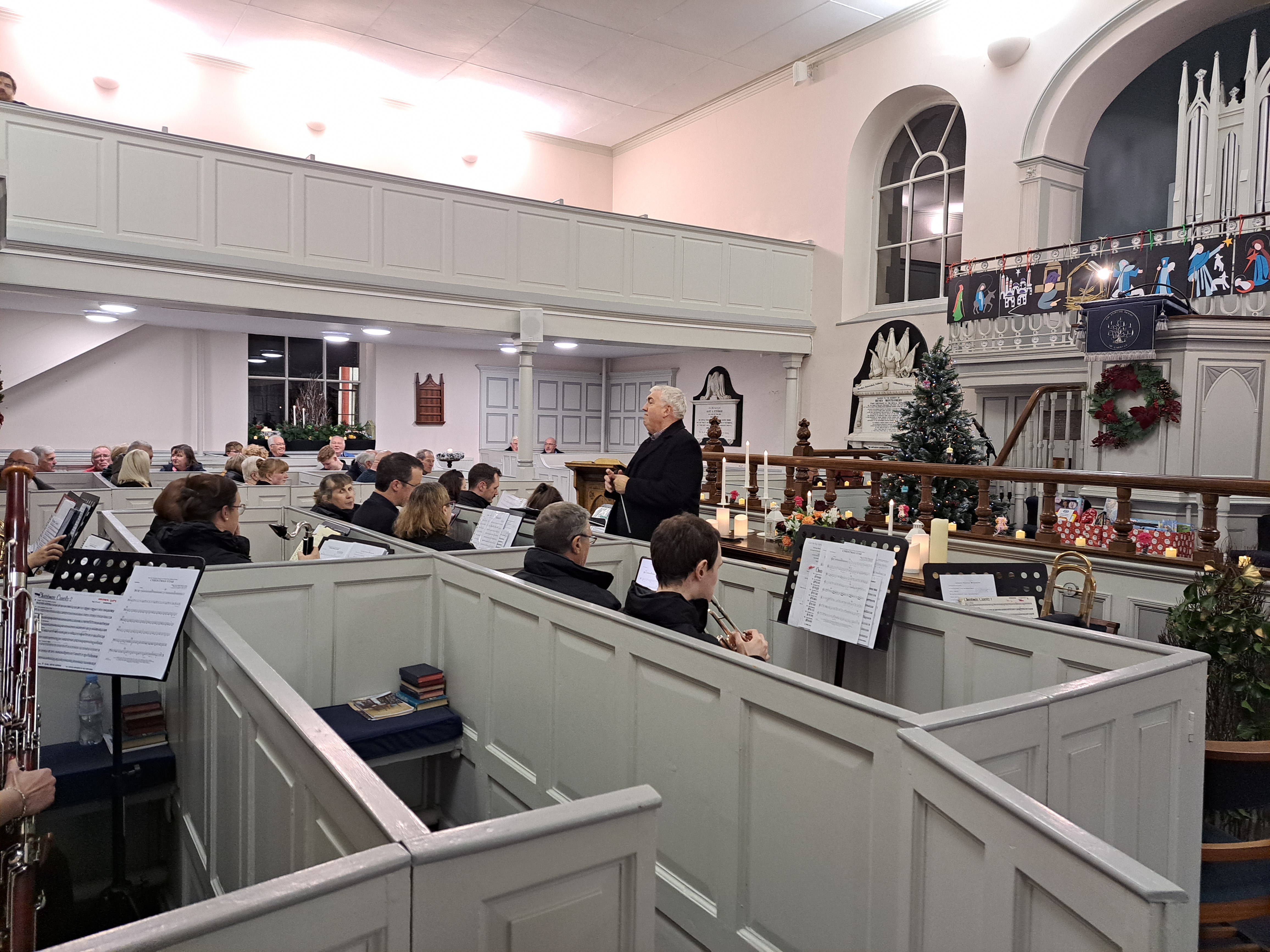
Despite the presence of Storm Darragh on Friday, 6th December we still were able to hold our well-attended service of Carols by Candlelight featuring Harmonic Sounds Concert Band under the direction of Paul Hamilton. It was a great evening and the whole service was livestreamed. You can watch the service here:
Click on the video
The service was conducted by the minister, Rev Dr David Steers, and our readers came from our own Church and our sister churches. They were David Kerr (First Church, Belfast), Kathy Yuille, Sylvia McBride, Adele Johnston, Diana Taggart, Erin Black, Rev Chris Hudson (All Souls’ Church, Belfast), Gilbert Cameron, Rev Chris Carson (Church of Ireland).
Band about to play
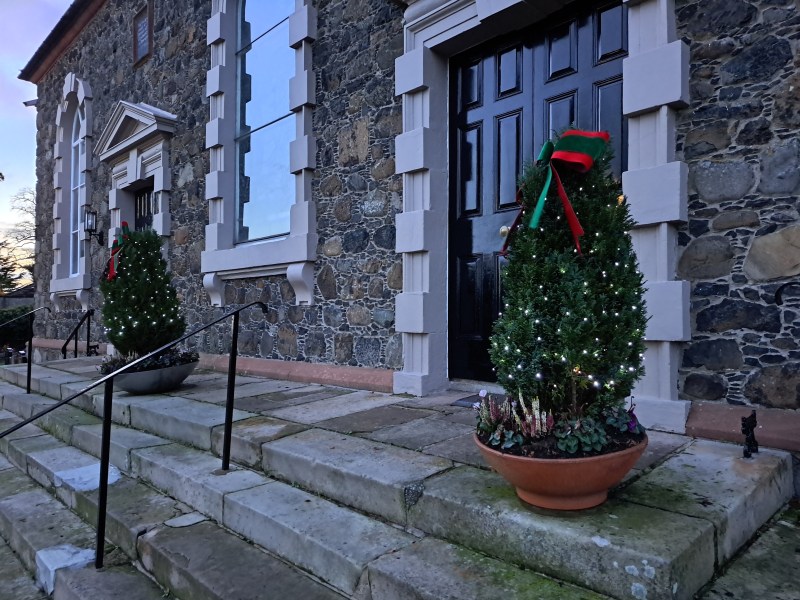
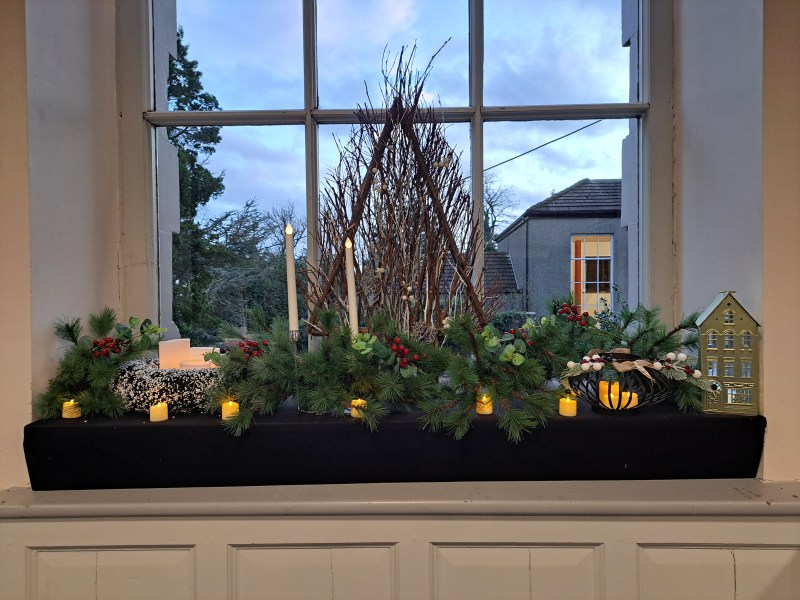
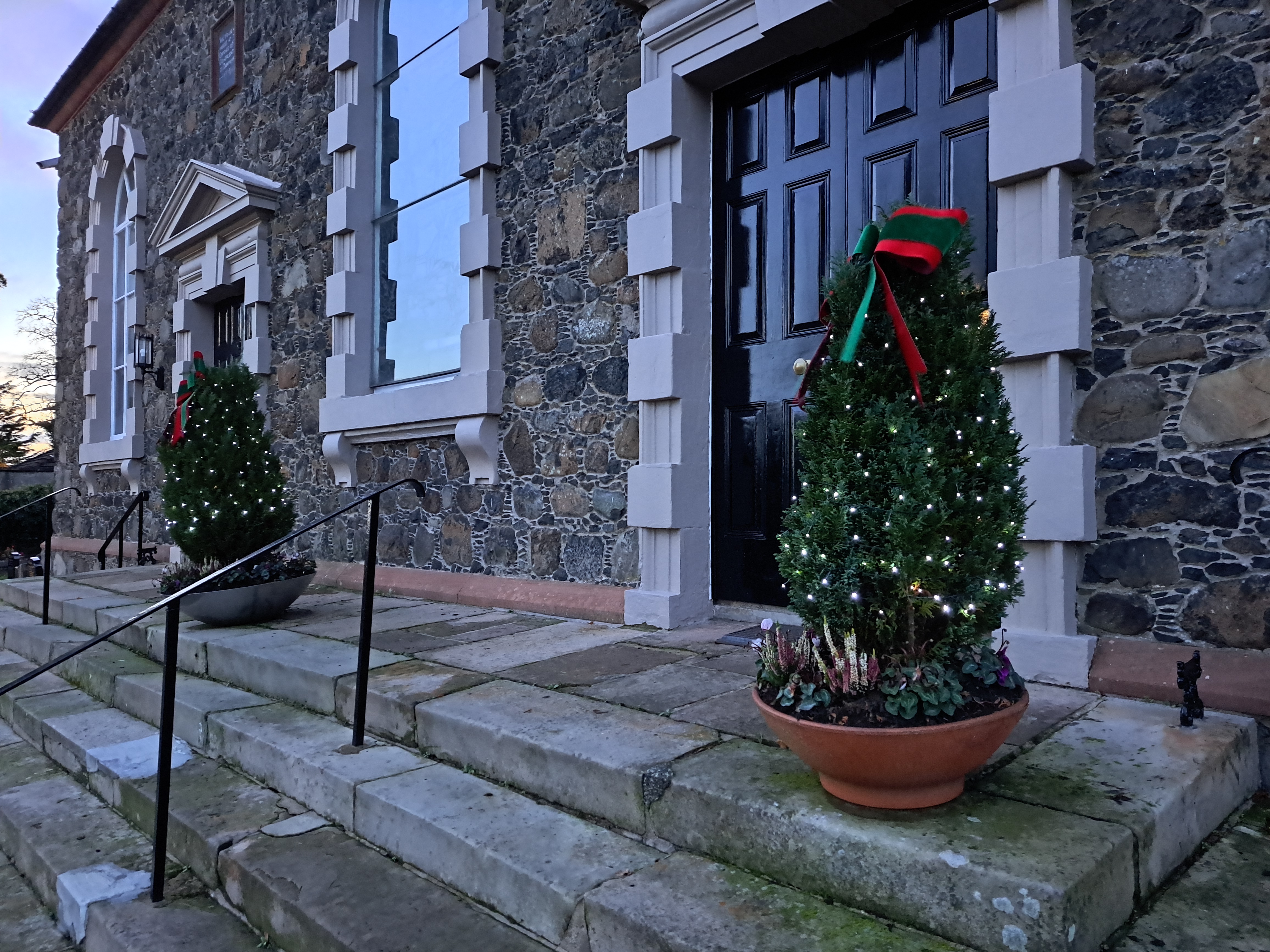
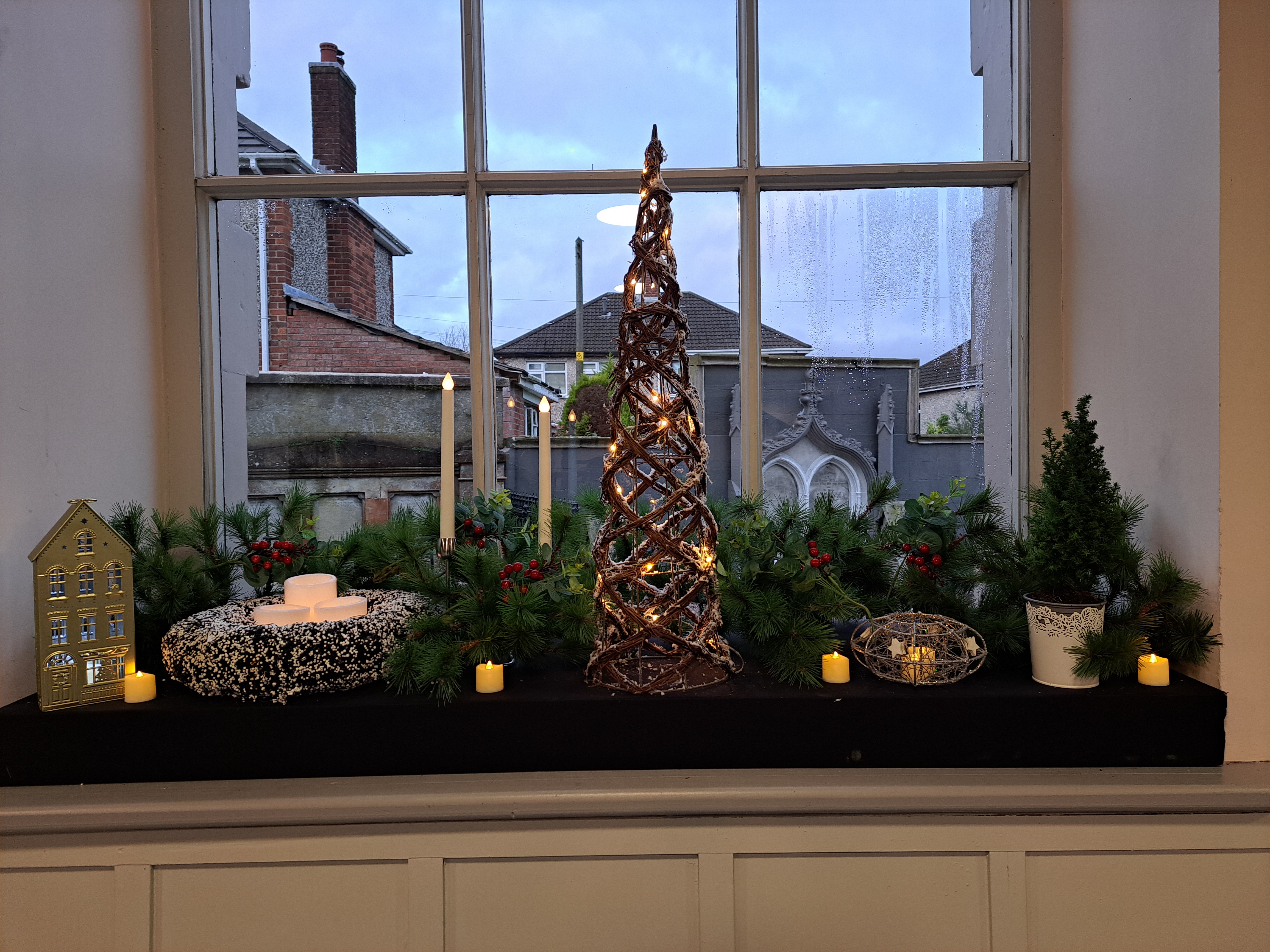
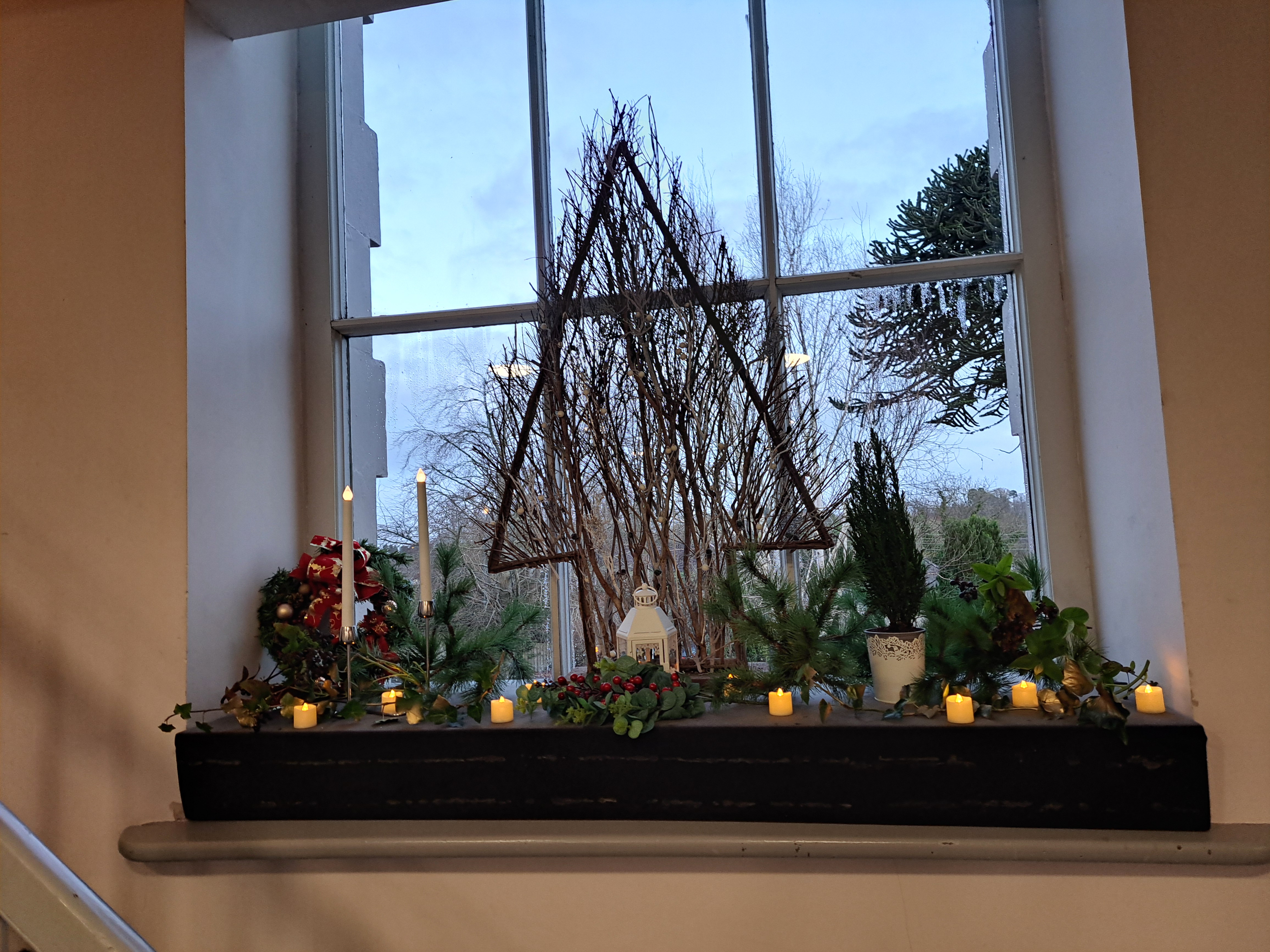
The Church was beatifully decorated both outside and in.
And many of those present were able to come over to the Hall for refreshments after the service.
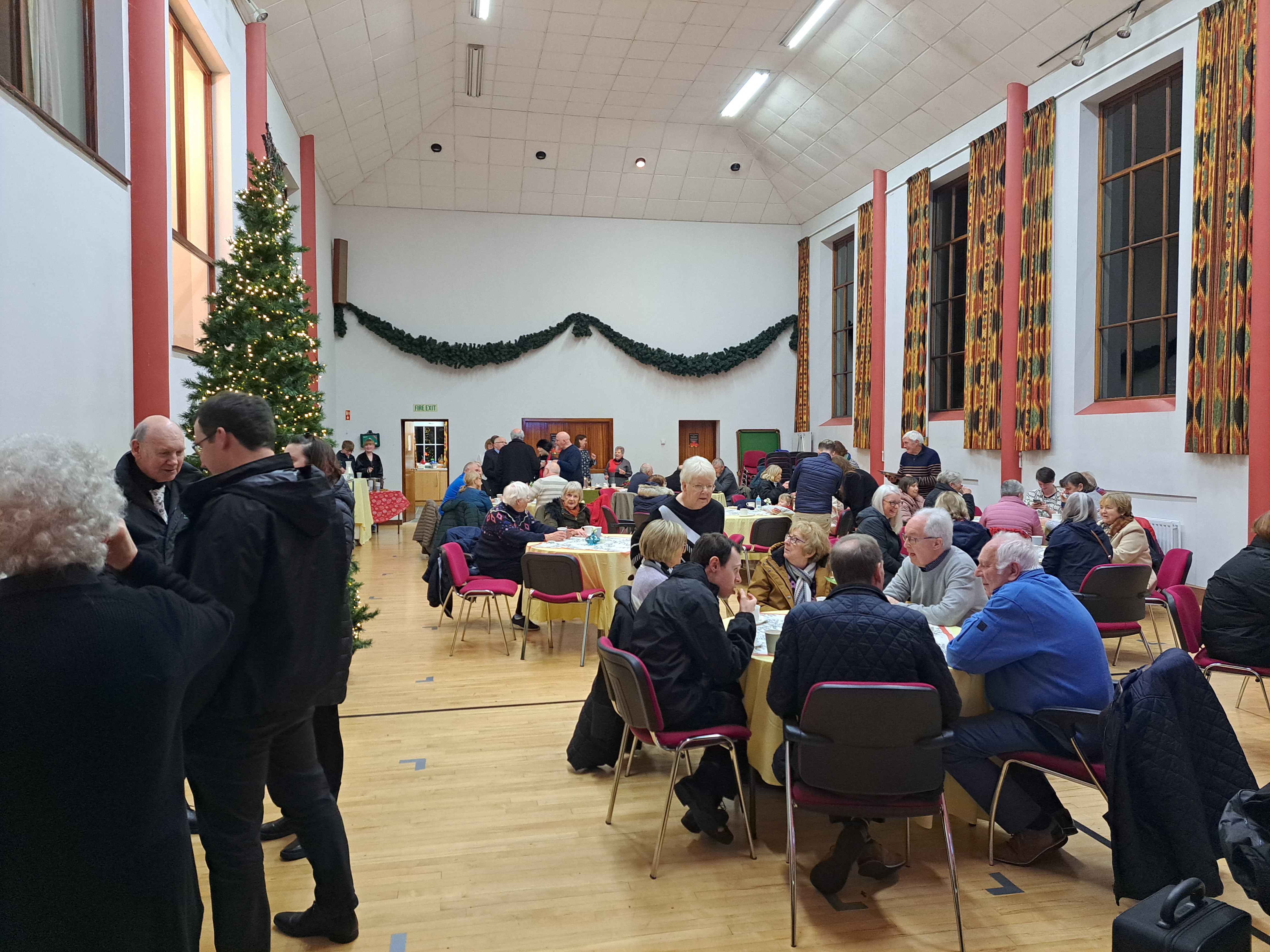
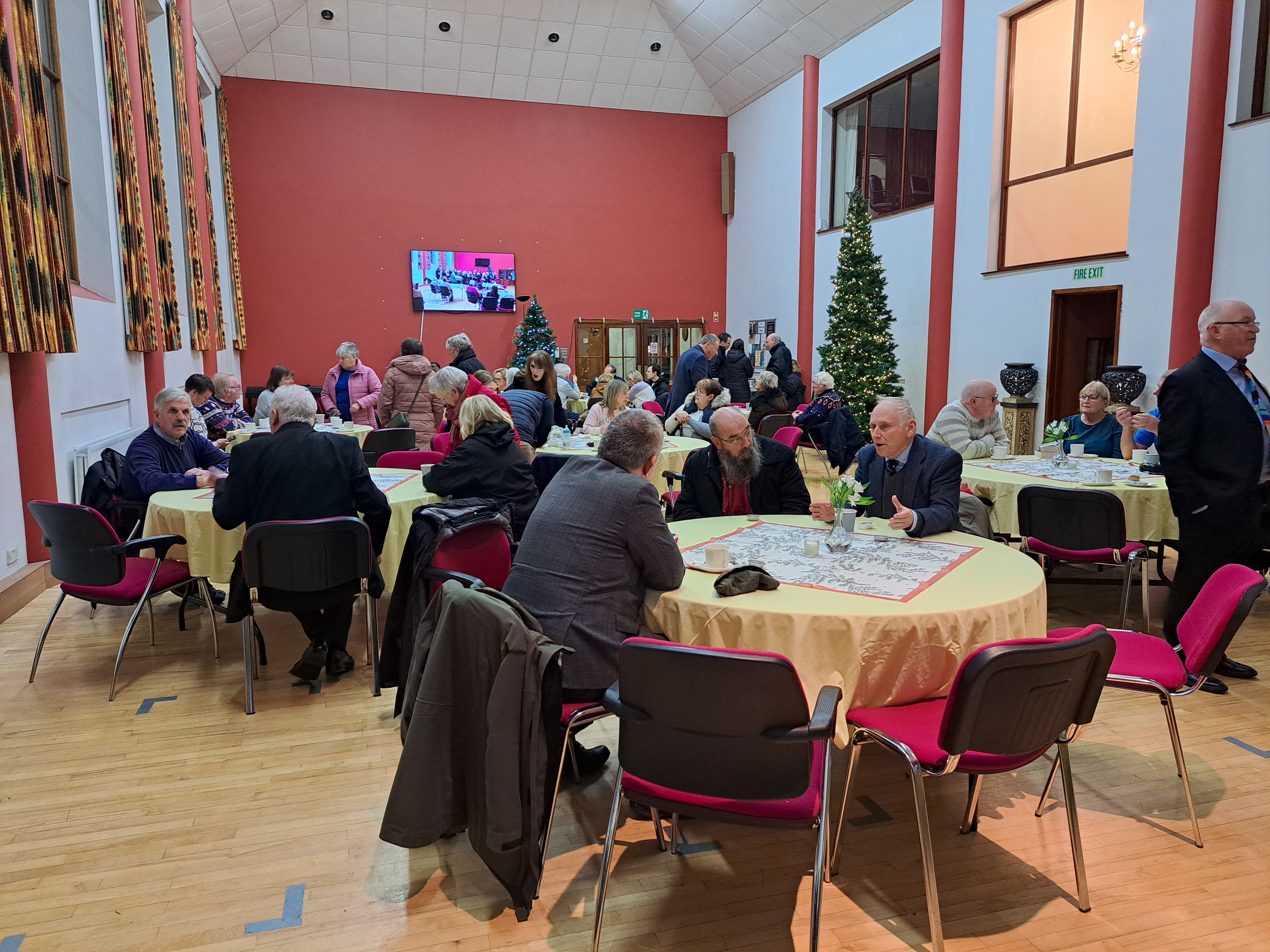
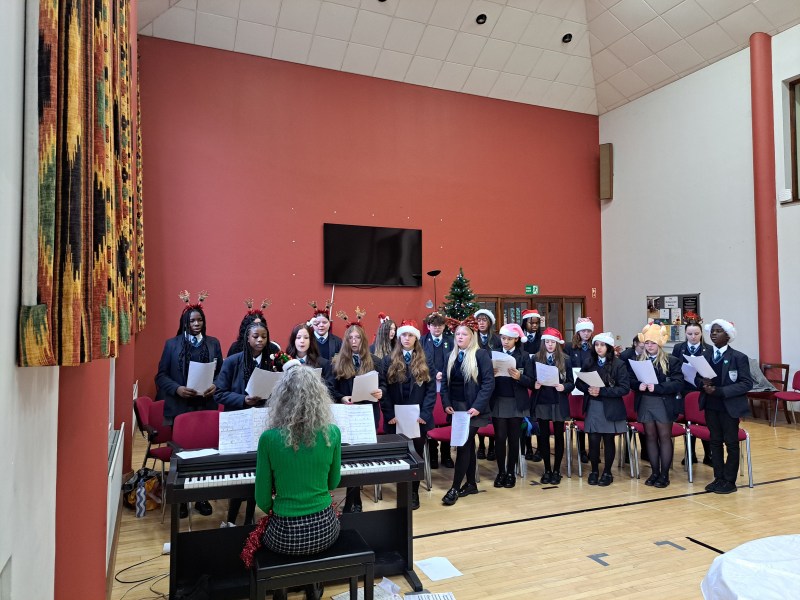
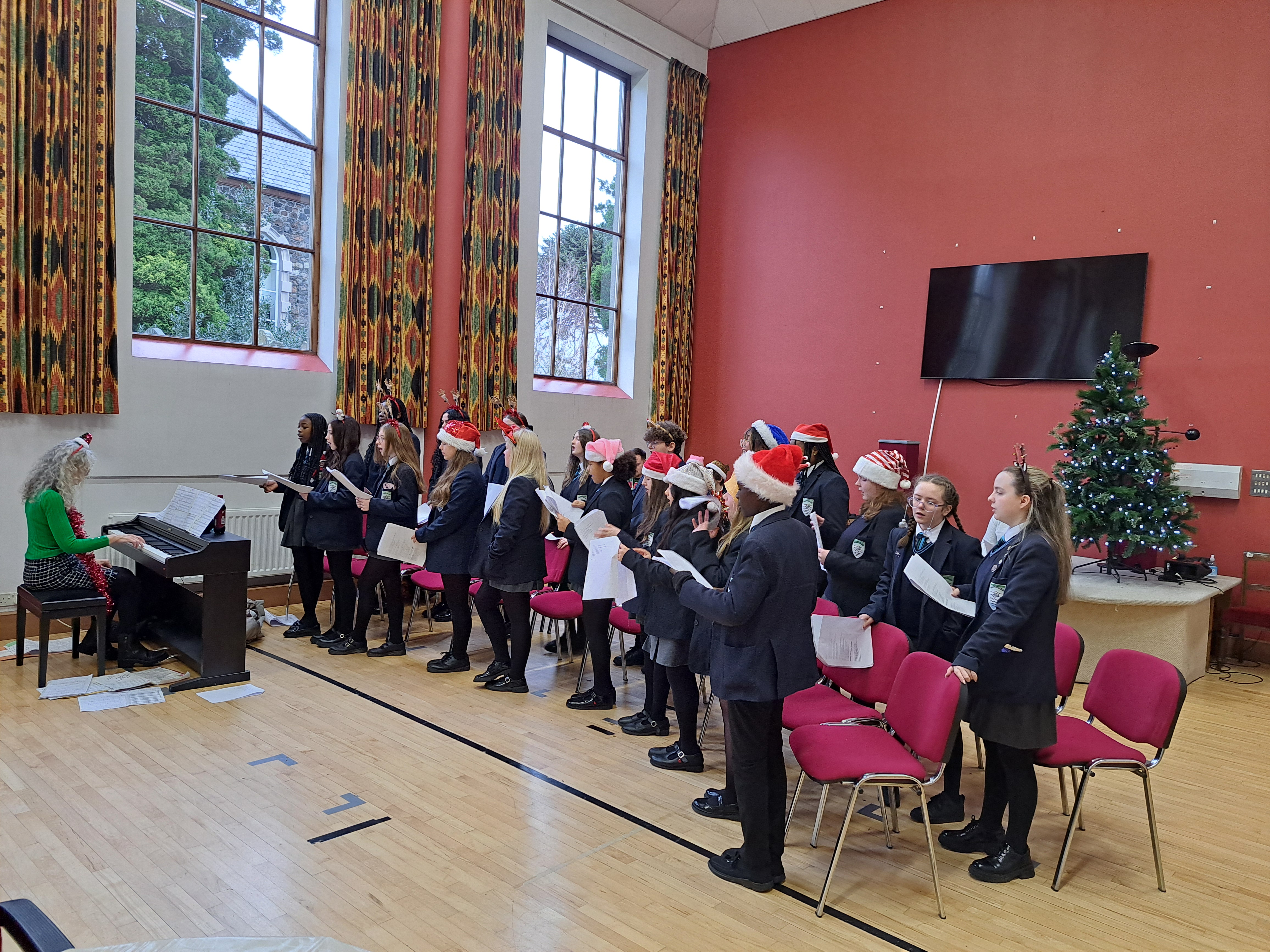
We were delighted to welcome the Choir of Malone College to our Warm Space Coffee Morning at Dunmurry on Thursday morning, 5th December under the direction of their musical director, Mrs Caroline Mitchell.
Click on the video to see Malone College Choir performing at First Dunmurry
The Choir sang a varied programme and were with us for two hours. The video above contains some of their repertoire. We are so glad that Mrs Mitchell, her staff and the Choir are able to take the time out to visit us at the start of the Christmas season, its an occasion that everyone looks forward to and fills us all with a strong sense of the Christmas spirit.
Malone Integrated College Choir at First Dunmurry (NS) Presbyterian Church
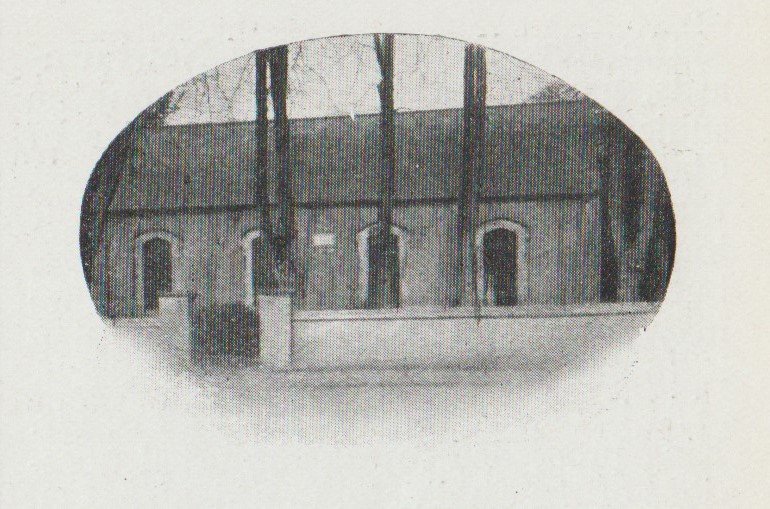
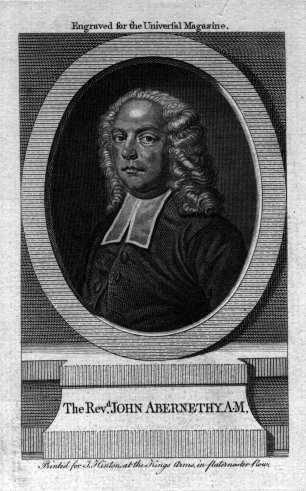
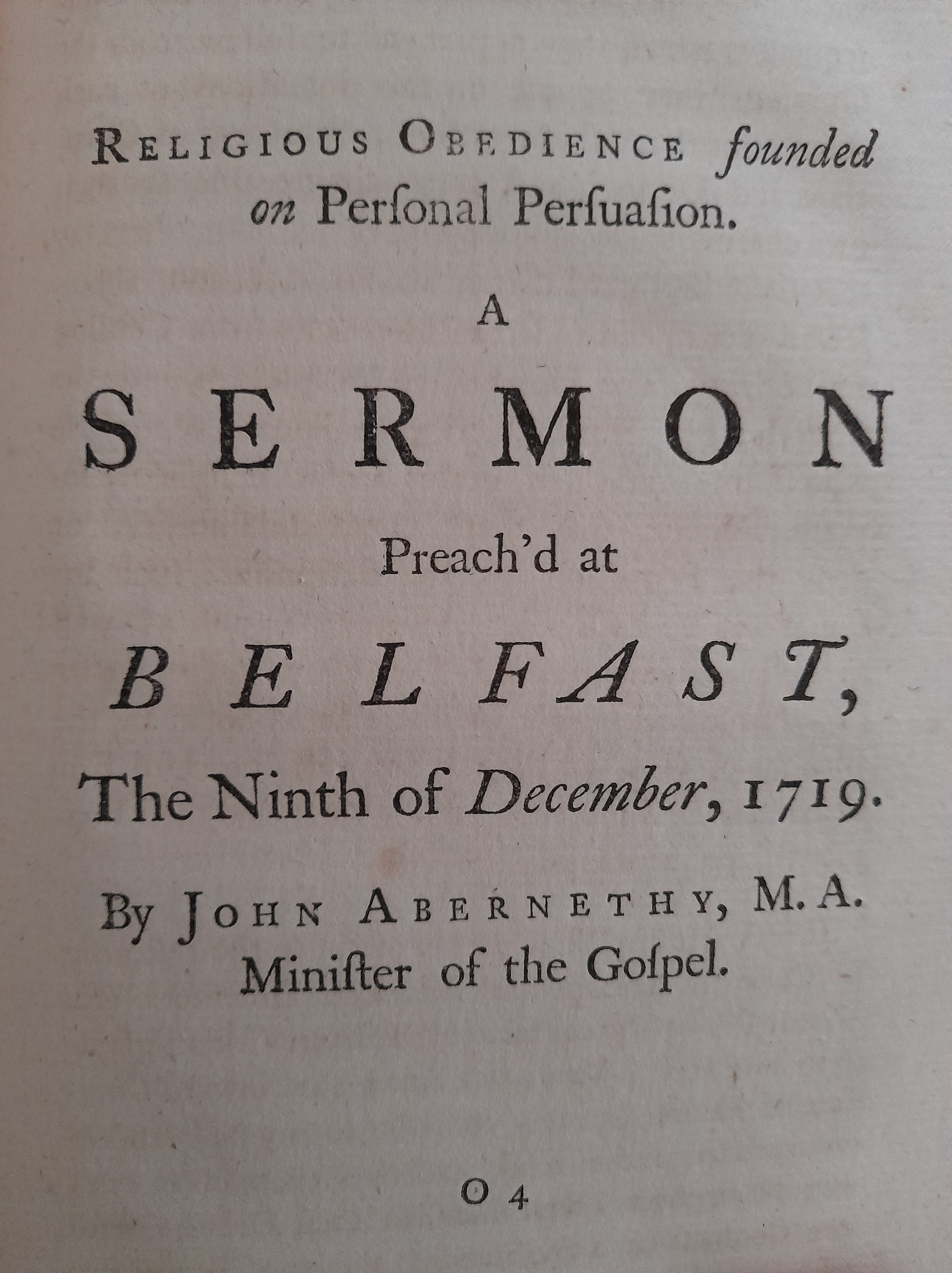
Episode 6 of our explorations of the Very Rev William McMillan Library at Dunmurry looks at the writings of the Rev John Abernethy (1680-1740). Without doubt the most prominent Presbyterian minister in Ireland in the early eighteenth century and the foremost exponent of Non-Subscription, he was minister at Antrim (see picture above) and later Wood Street, Dublin.
Click on the video to see John Abernethy’s books
Some of his books were the best sellers of their day and some of his publications were seen as either controversial theological statements or the key to opening up a new way to understand faith, depending on your point of view. Ironically at the time of the first subscription controversy the minister of Dunmurry, the Rev John Malcome, was a vocal opponent of the Non-Subscribers and was the first to use the term ‘New-Light’ about them. But Dunmurry Library has a good selection of his published works, most of them published after Abernethy’s death.
The founder of the Belfast Society in 1705, an outspoken advocate of the rights of the dissenting minority in Ireland and an established philosopher of some importance, John Abernethy’s books had considerable influence and this video looks at his publications held by our Library in Dunmurry.
From The Very Rev William McMillan Library of First Dunmurry (Non-Subscribing) Presbyterian Church.
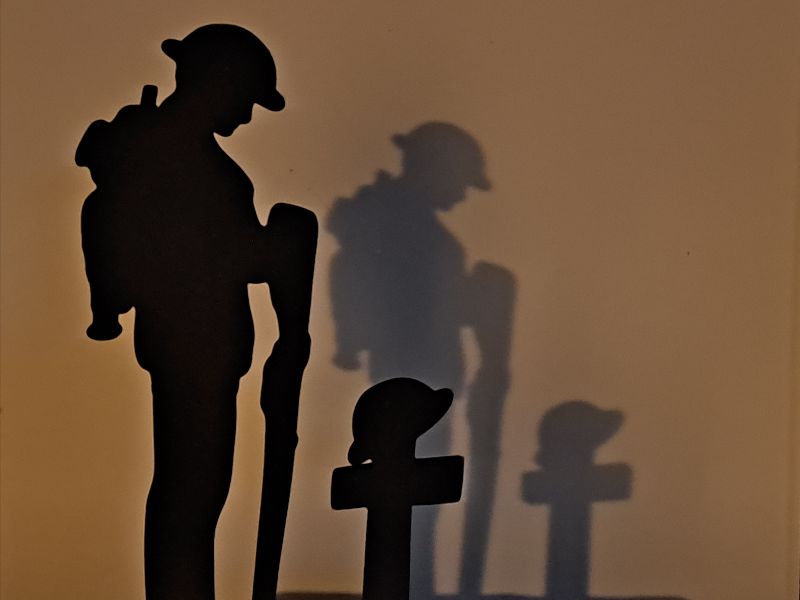
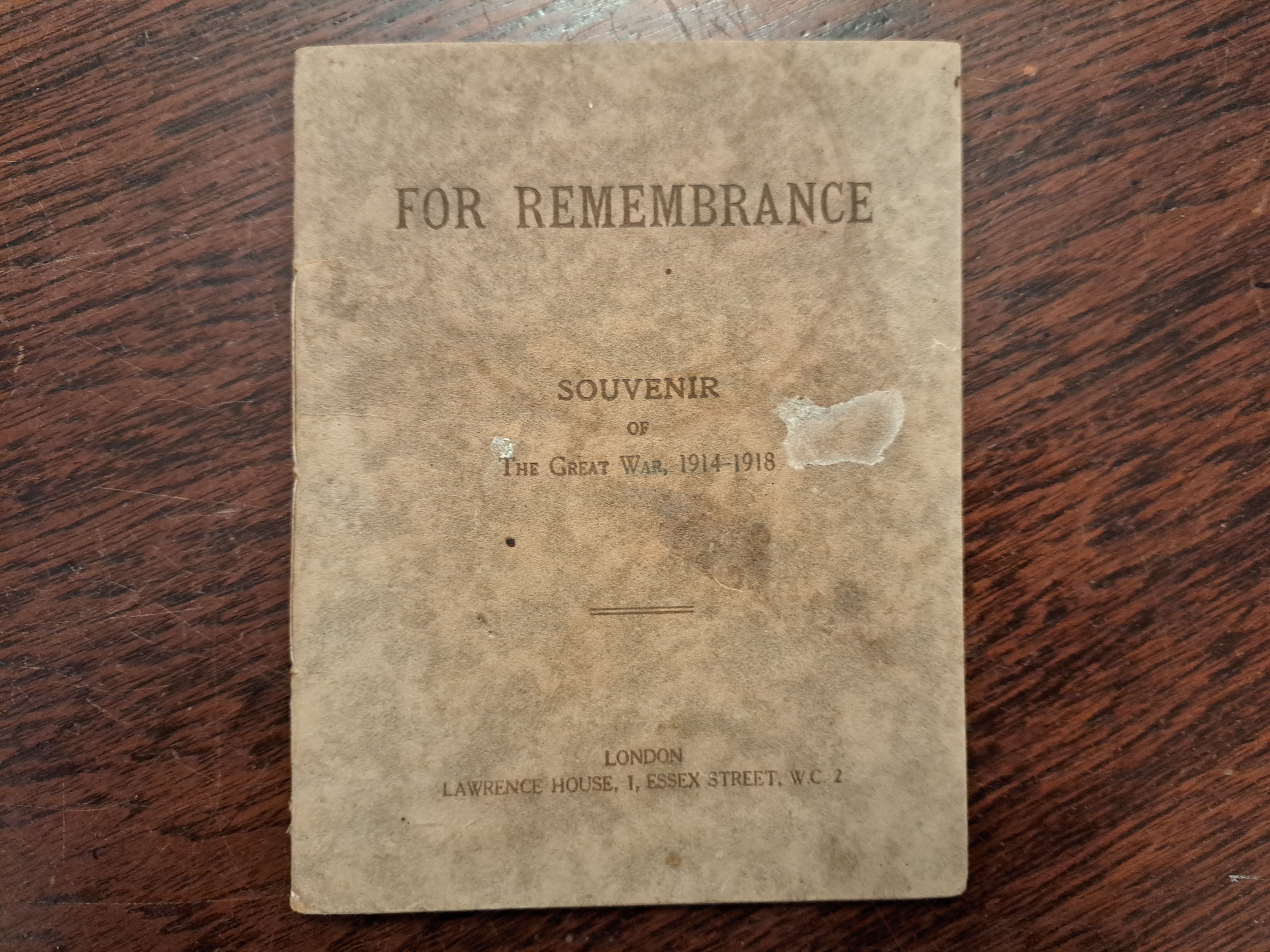
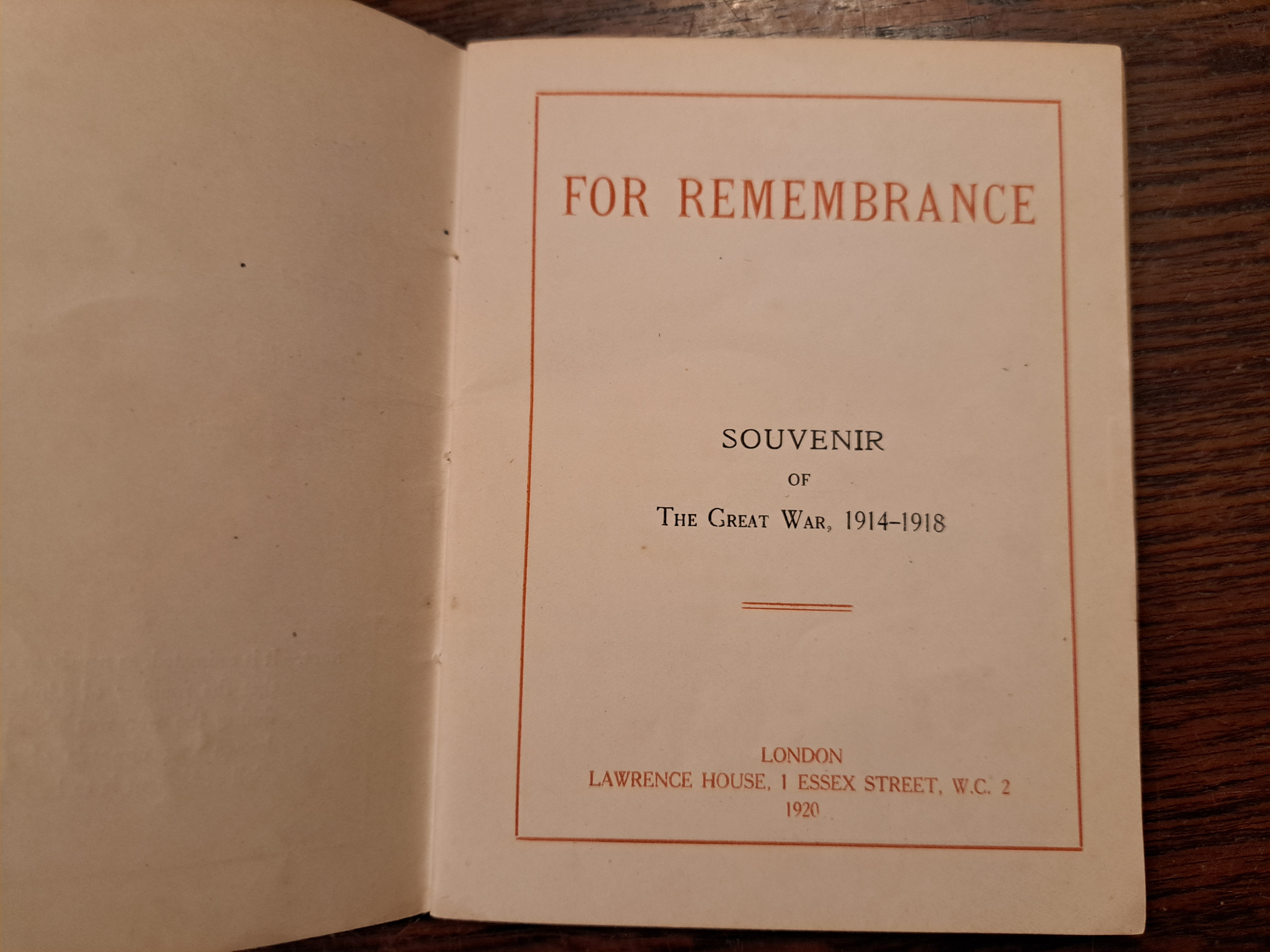
Exploring the Library: Episode 5 For Remembrance. A booklet given to returning servicemen after the First World War.
A short talk by the Rev Dr David Steers. With thanks to Jack Steers for playing the Last Post and Reveille on the trumpet.
This is rather a scruffy looking booklet but it is a very rare survival of which the editors said: ‘If it attains to anything like its aim it will be a real “keepsake,” an abiding record of the owner’s place and part in our nation’s mightiest struggle…’ A copy was given to every Unitarian and Non-Subscribing serviceman who returned from the First World War. It contains some poignant quotes and six short reflections by ministers who had served alongside the troops.
Possibly as many as 9,000 copies were issued but very few survive, at least in libraries, so we are fortunate to have a copy in the Very Rev William McMIllan Library. Click on the video to find out more about ‘For Remembrance’.
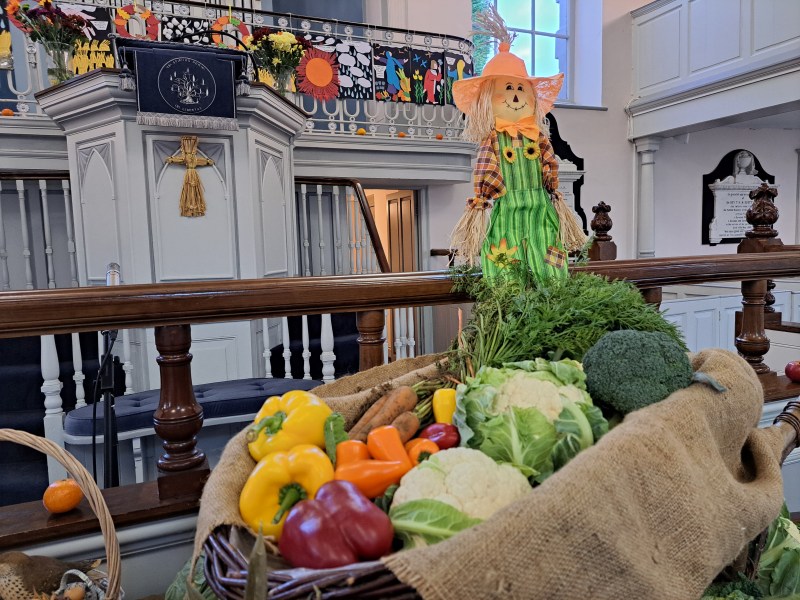
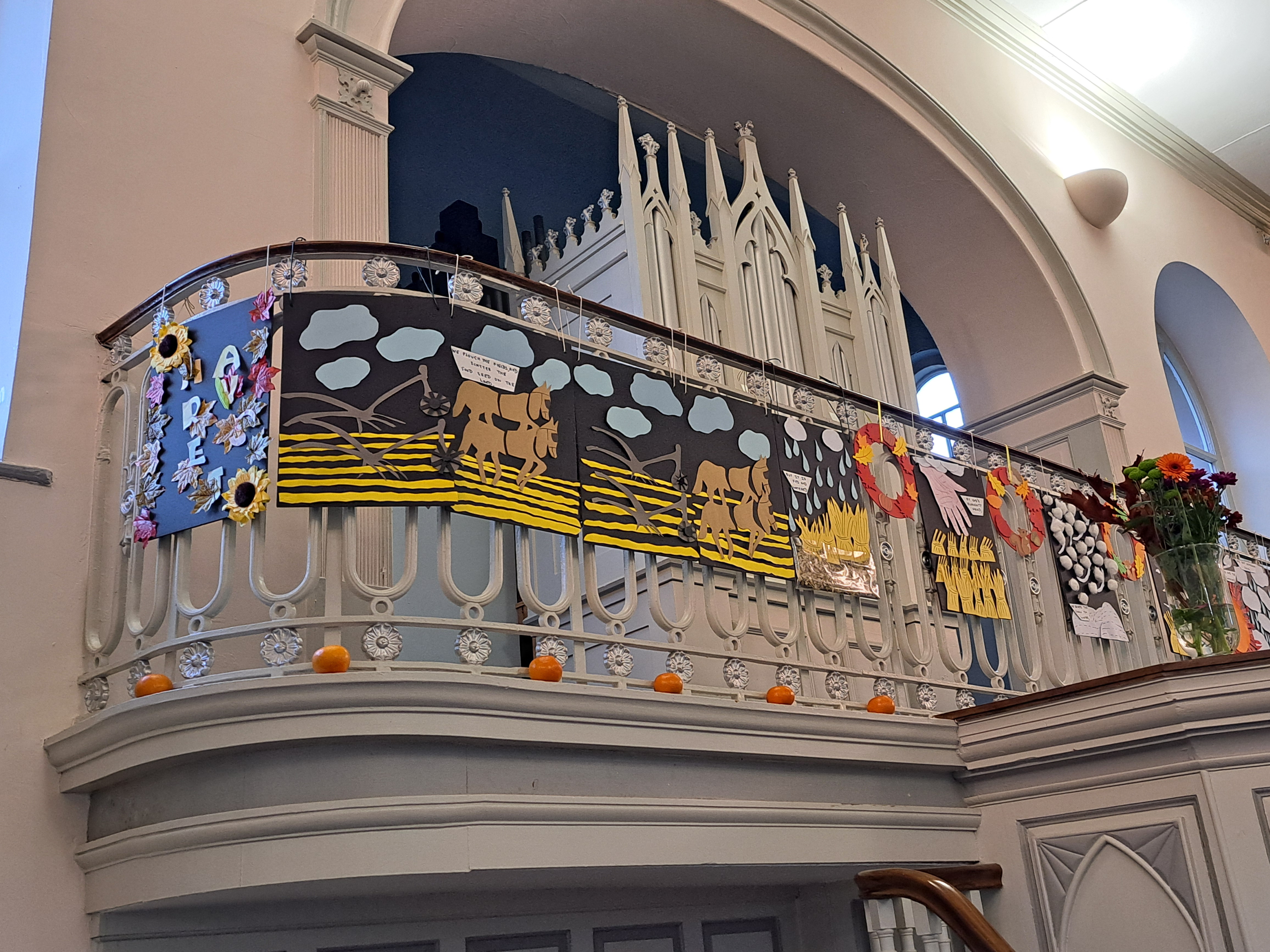
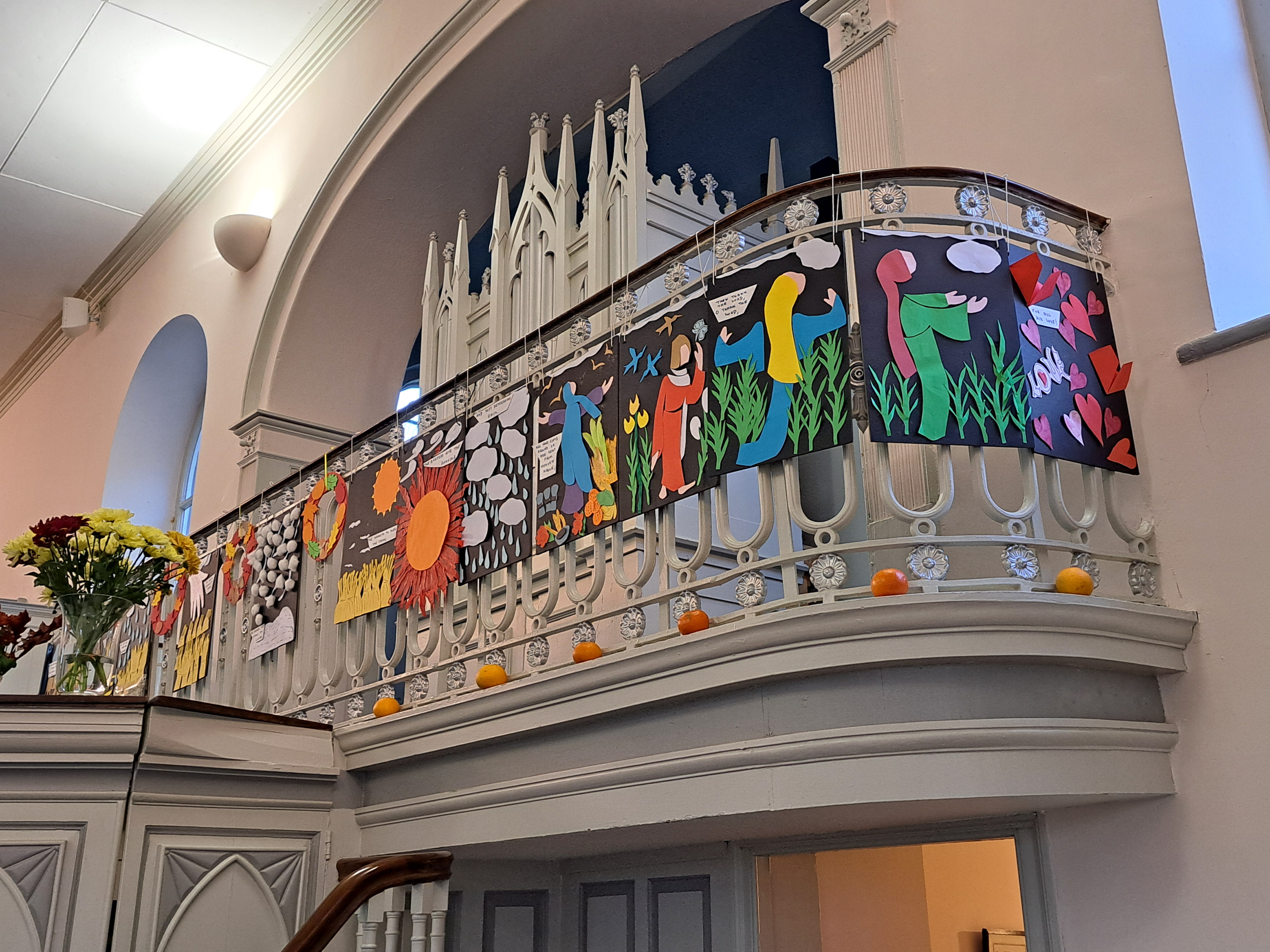
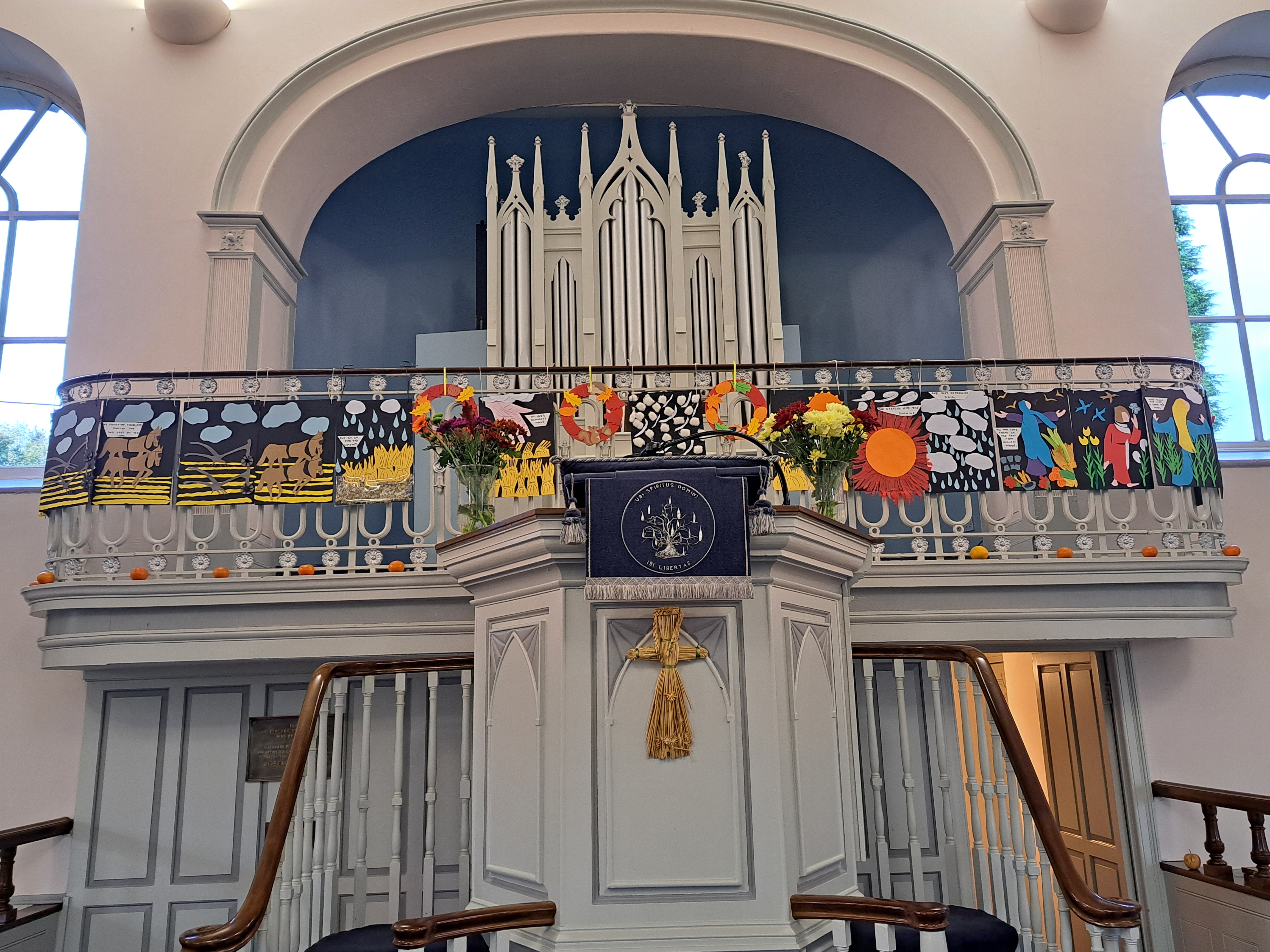
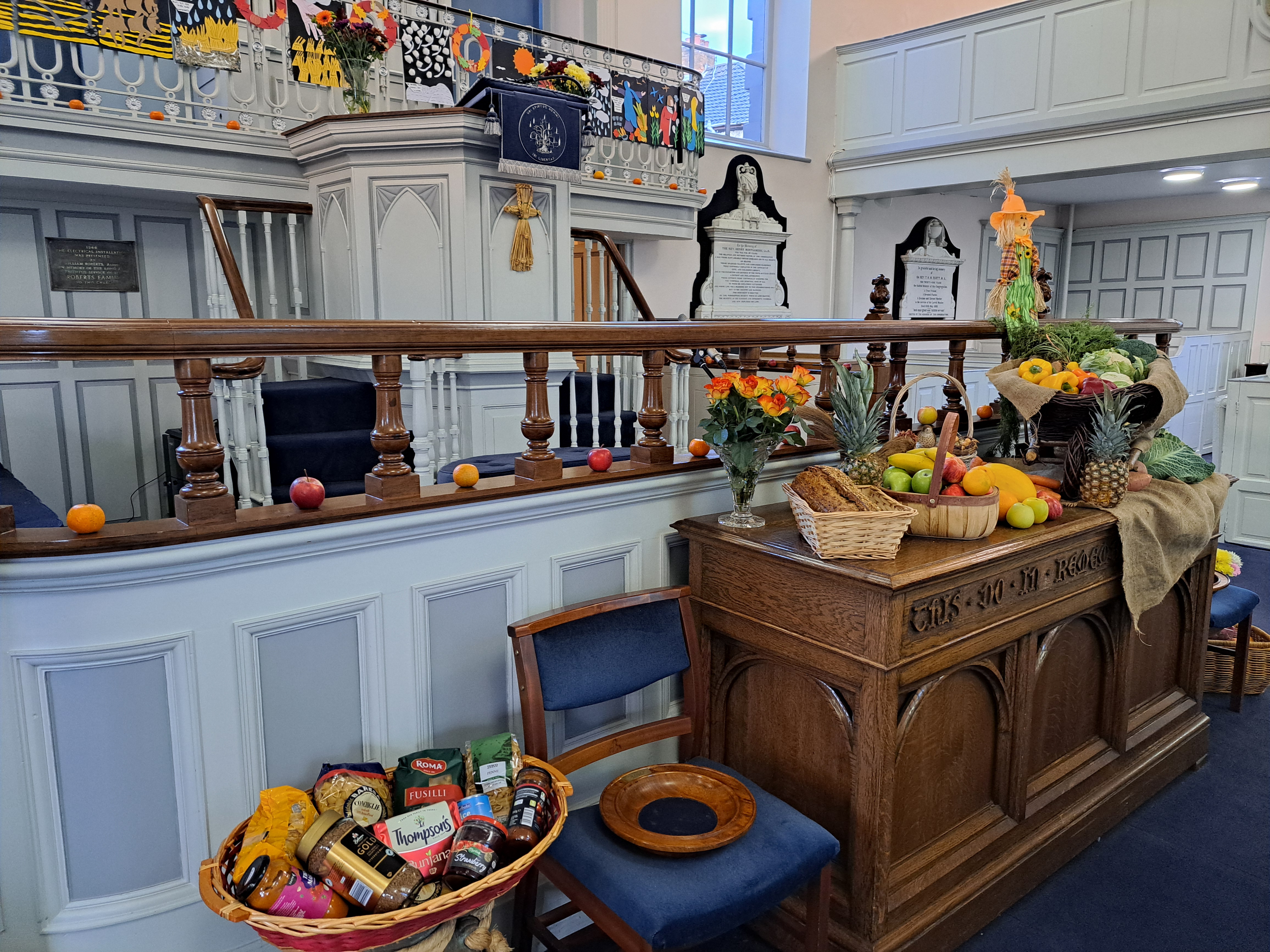
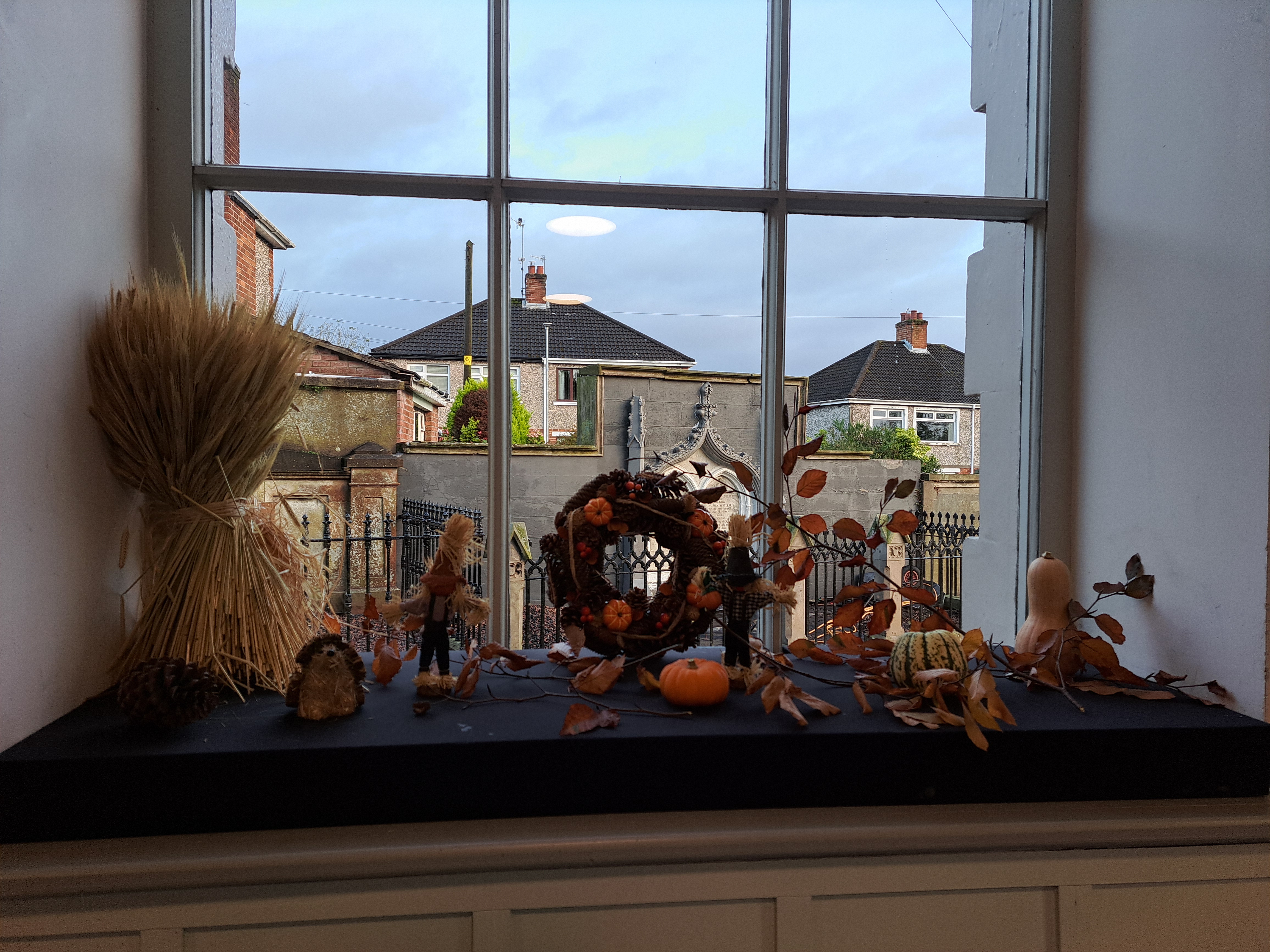
We had a wonderful Harvest Thanksgiving Service on Sunday, 20th October 2024. The service was conducted by Rev Dr David Steers, the organist was Allen Yarr and the readers were Lochlan Black and Erin Black. The Church was beautifully decorated throughout including the frieze depicting We Plough the Fields and Scatter made by the Sunday School and Youth Group. The service was live streamed and you can view it here on YouTube:
Here are some images from the day, beginning with We Plough the Fields and Scatter frieze created by the children and young people:
We were very pleased to welcome the Moderator, Rt Rev Alister Bell, who spoke warmly of the service and the work done by the children.
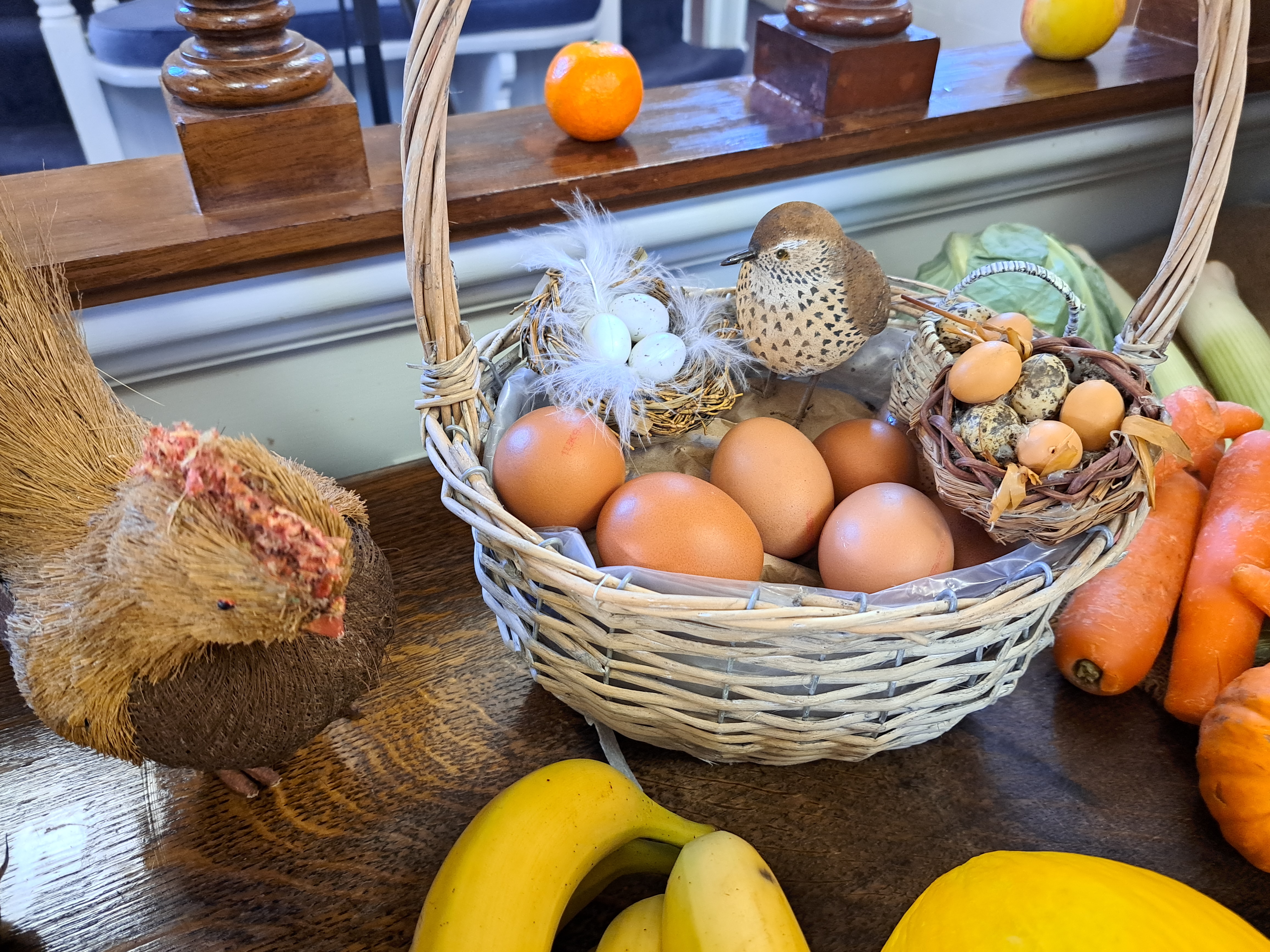
We also gathered a considerable amount of produce, both fresh vegteables and fruit, as well as tinned and dried foods, biscuits, pasta, sauces, tea, coffee etc. All of this has now been distributed to L’Arche Belfast.
What Is L’Arche?
“L’Arche (French for ‘The Ark’) is an international federation of 140 communities worldwide founded on faith and inspired by the gifts of people who have learning disabilities. By ‘community’ we mean a group of people of different ages, creeds, capacities and social and ethnic backgrounds connected to one another through a belief that everyone, irrespective of their circumstances, can have a positive impact on the lives of others. In our communities people with and without learning disabilities choose to live together in a spirit of friendship. We recognise the unique value of every person, the gifts we have to offer and our need for one another.” (From L’Arche website).
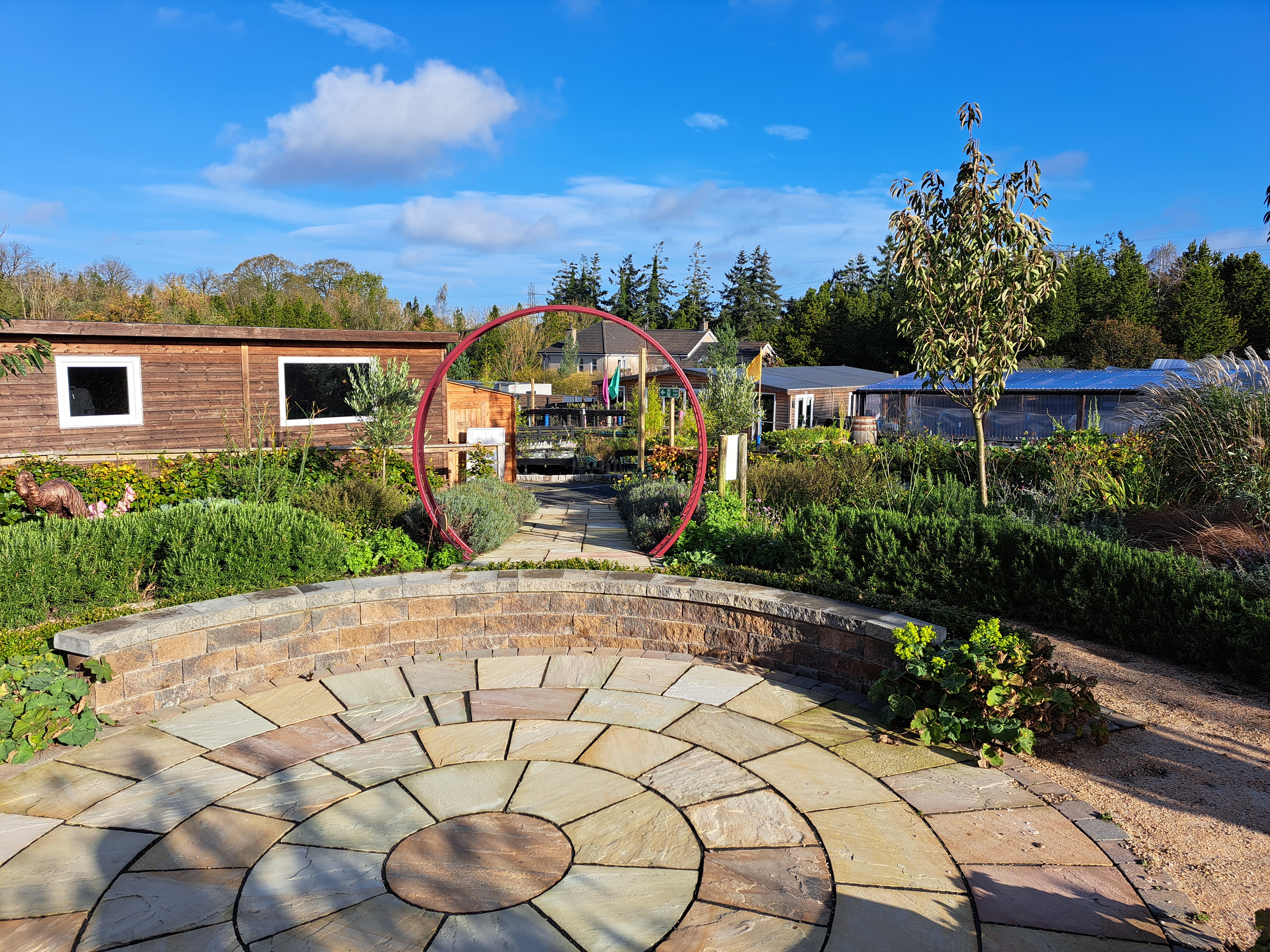
The newly created garden at the centre of the L’Arche community Belfast
You can find out more about L’Arche Belfast by clicking here.
Ephemera is the term given for items that weren’t usually expected to last. Usually printed items, they had only a limited shelf-life and were generally expected to be thrown away when they had been used. Inevitably such things tend to become interesting to collectors because they often illuminate some aspect of social history that might otherwise be lost. Our new Very Rev William McMillan Library is rich in ephemera and this latest video explores two items held by the Library:
Click above to see Episode 3 of the explorations of Dunmurry NSP Library
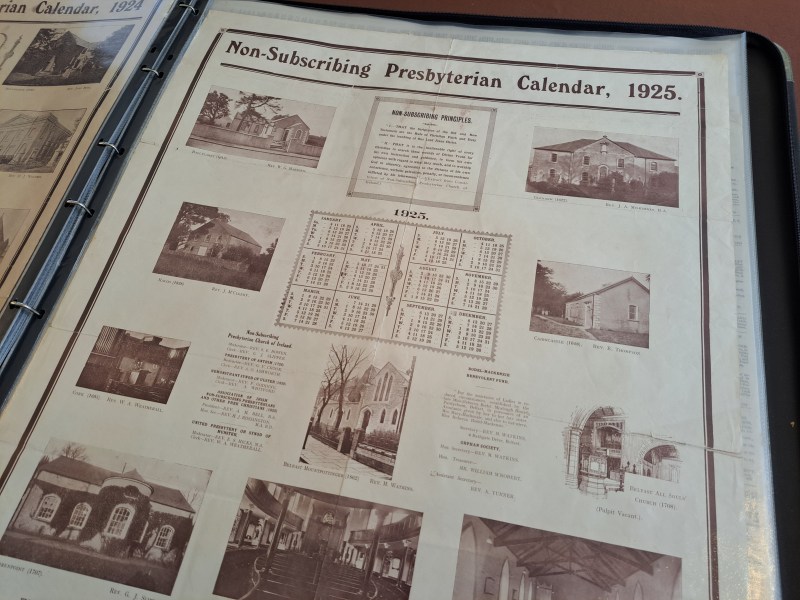
In 1924 and 1925 the congregation of York Street Church, Belfast, under the leadership of Rev Dr A.L. Agnew, produced a calendar to sell to the denomination. Over the two years they included a picture of all the churches in the denomination in Ireland and they make for interesting documents. Many of the pictures date from a bit before the mid-1920s but it makes for an interesting collection of early twentieth-century photographs. Some images are quite well-known and have often been published. Some are quite rare like this picture of Ballymoney:
There’s also a reminder of an attempt at outreach in Bangor which lasted for a few years, and seemed to be successful for these years at least:
But altogether they are interesting documents. They must have captured a lot of interest at the time but at the end of the year what do you do with an old calendar but throw it away? Which is why so few have survived. You can find out all about it by watching the video.
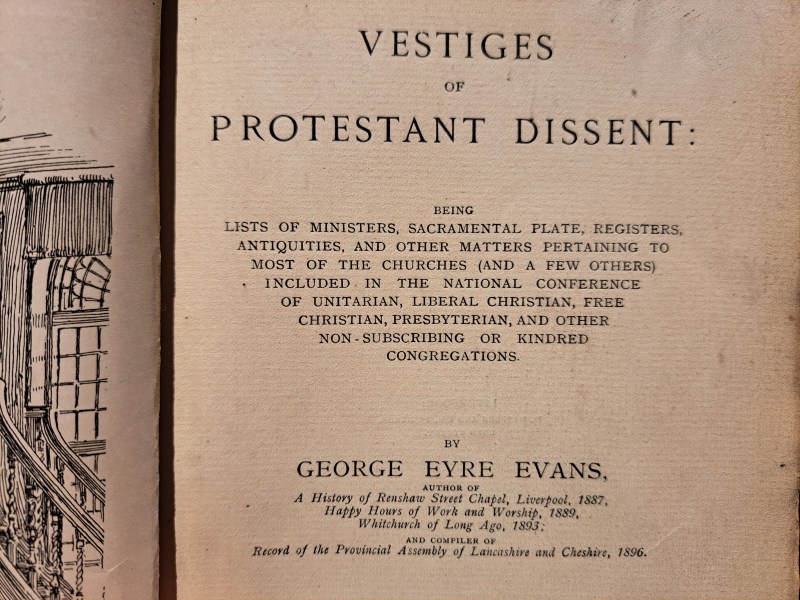
Everyone who has an interest in the study of Non-Subscribing Presbyterian/Unitarian history in the British Isles will know George Eyre Evans’s book the Vestiges of Protestant Dissent. Published in 1897 it was just one publication that came out of the extensive researches of G.E. Evans. His book is the subject of our latest video which is the second to explore the contents of the Very Rev William McMillan Library here at Dunmurry which will be opened and dedicated on Sunday, 22nd September 2024 at 3.00 pm:
Click on the video above for Vestiges of Protestant Dissent
The Library copy once belonged to a prominent lay member of the congregation who gave it to his minister before the end of the nineteenth century, but the full story can be seen on the video.
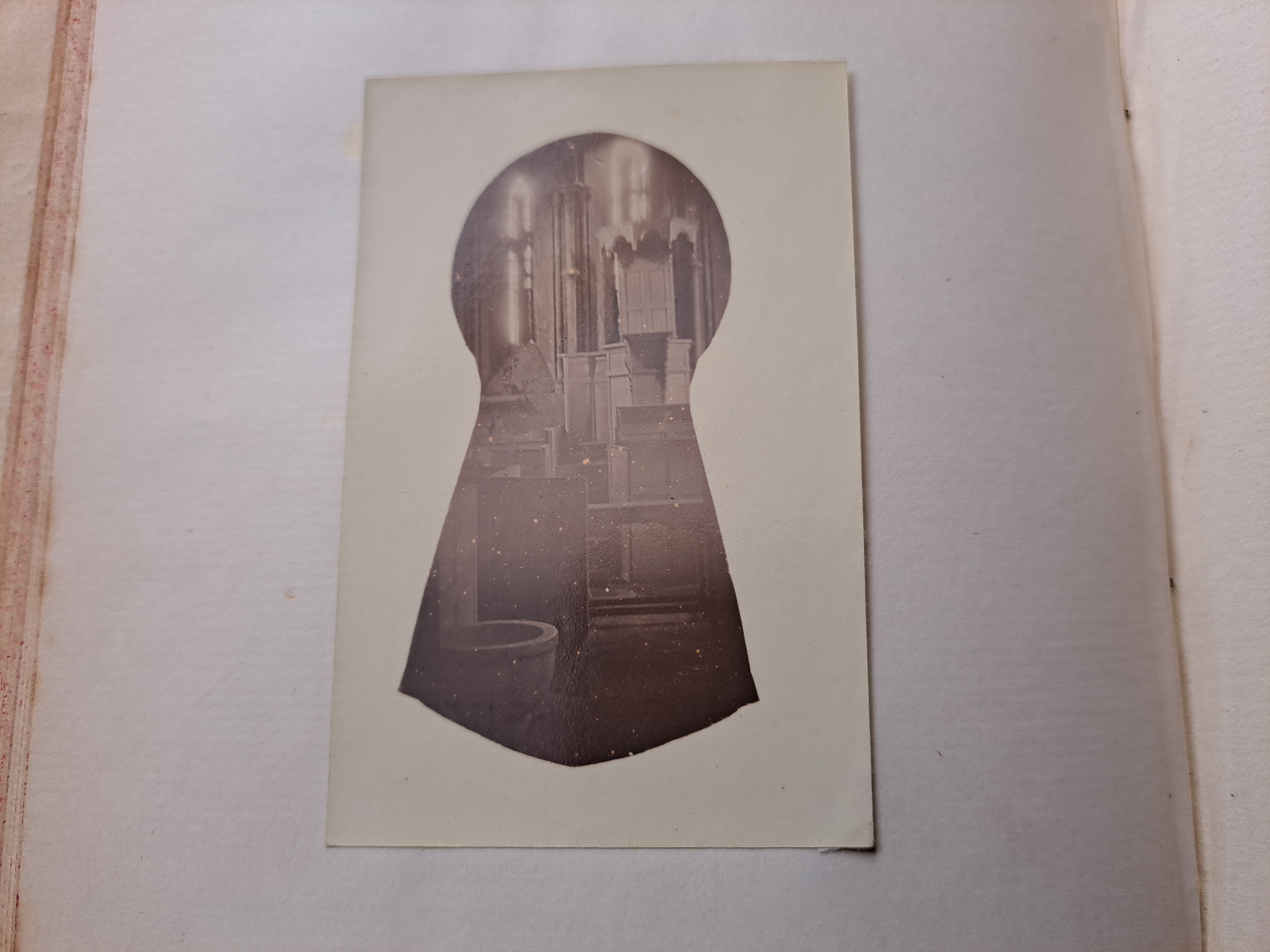
One of the things I try to draw attention to in the video is the occasional unusual detail G.E. Evans adds to the book, such as this picture, which exists in every copy as a real photograph pasted in to the book:
The picture from opposite page 123 of ‘Vestiges of Protestant Dissent’
The meaning of the photograph is explained in the video.
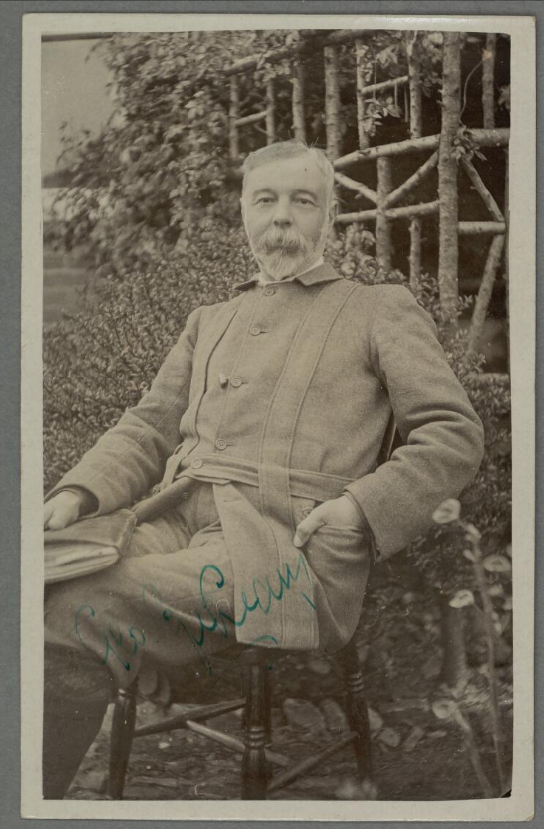
George Eyre Evans (photo: Dictionary of Welsh BiographY)
G.E. Evans was born in Colyton, Devon, the son of Welsh parents. His father was Rev David Lewis Evans, Unitarian minister at a number of places in Wales and England, including Colyton where his son was born, and ultimately being tutor in Hebrew, mathematics, and natural philosophy at the Presbyterian College, Carmarthen. He was also one of the founders of Yr Ymofynydd, although he wrote little in Welsh himself.
George E. Evans followed his father into the ministry and served at the Church of the Saviour at Whitchurch (1889-1897) as well as unpaid minister at Aberystwyth later in life. Primarily though he was an historian and antiquarian. Many of his publications relate to his interest in the history Unitarianism. Vestiges of Protestant Dissent is probably his best known work of this type although he also produced Record of the Provincial Assembly of Lancashire and Cheshire, a very useful detailed study of churches and their ministers in the north west of England, and Midland Churches: A History Of The Congregations On The Roll Of The Midland Christian Union. This all displays his wide geographical interests, also seen in publishing works about places such as Whitchurch, Colyton and Lampeter. He also wrote the first history of Renshaw Street Chapel in Liverpool, a city where he studied after being at the school of Gwilym Marles, the noted Unitarian minister and social reformer.
His main research interests increasingly centred on Wales, however. He was a founder member, secretary and editor of the journal of the Carmarthenshire Antiquarian Society. A member of the Cambrian Archaeological Society, he sat on its general committee and became a member of its editorial board, contributing to its journal Archaeologia Cambrensis. He was active in helping to establish two local museums in Wales and served on the Court of Governors of the University College of Wales, Aberystwyth, the Council of the National Museum of Wales, Cardiff, and the Council of the National Library of Wales, Aberystwyth. But this is by no means the full extent of his labours. He was made an Inspecting Officer of the Royal Commission on Ancient Monuments in Wales and Monmouthshire and in that capacity visited almost every monument or historic site in Wales. He joined the Boy Scouts in his 60s and became a County Scout Commissioner for Carmarthenshire and in 1928 became deputy Scout Commissioner for Wales. In 1937, two years before he died at the age of 82, he was made a Freeman of the Borough of Carmarthen where the Carmarthenshire Antiquarian Society has placed a blue plaque on one of the museums he founded and worked in.
He was a member of the Council of the Unitarian Historical Society and a frequent contributor to the Transactions, particularly writing about ‘Our communion plate and other treasures’. He visited Ireland in preparation for producing the Vestiges, mainly to inspect the communion plate, and from notes in his book we can follow his progress through Ireland in August 1892 when he went from Dublin (16th August), to Newry and Warrenpoint (17th), Clough, Downpatrick, and Rademon (19th), Moneyrea and Newtownards (20th), Ballycarry, Carrickfergus, and Larne, (22nd), and finishing up at Antrim, Templepatrick and Belfast (23rd). The only visit outside this sequence came on 14th October 1896, just a year before publication, when he visited Dunmurry and where he will have met the Rev J.A. Kelly who had been installed as minister on 23rd July of that year.
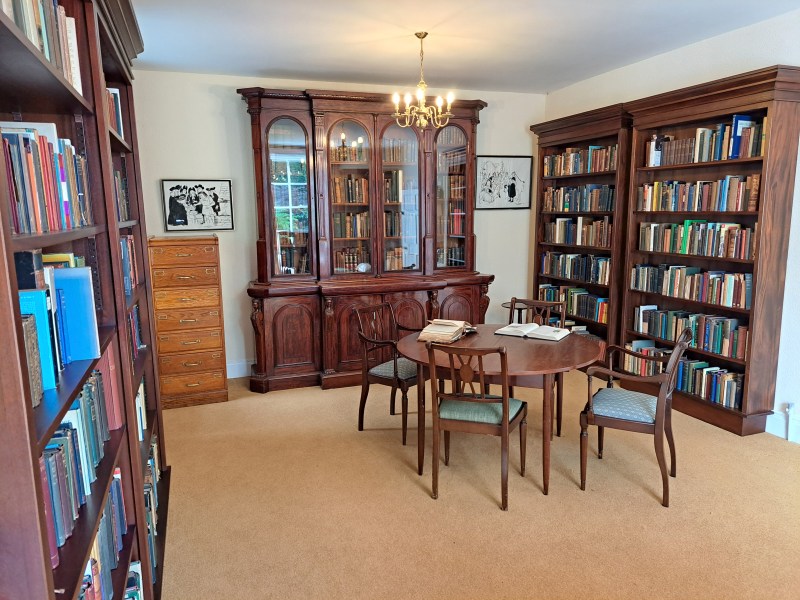
At Dunmurry we are particularly looking forward to the formal opening and dedication of the Very Rev William McMillan Library on Sunday, 22nd September at 3.00 pm. The Rev Mac bequethed his Library to the Church and over the last four years we have been working on creating a catalogue and getting everything ready to house the Library. We have had furniture made for the Library, we have also repurposed other furniture for use in the Library and restored some items to house the books.
It is an exciting project and a very fitting memorial for the Rev Mac who was an historian of some ability and renown. He assembled this collection as he worked on the history of Non-Subscription and the Library contains over 2,500 books, as many pamphlets and journals again, and many more manuscripts and other items. After the dedication the Library will be open for visitors (although we will not be able to lend items) but we want the Library to be known and appreciated by as wide a group as possible.
To help in this process I will be uploading short videos talking about the Collection, in which I will highlight different books which have an interesting story to tell. The first of these is this video;
Dunmurry NSP Library Episode 1. Click on the video to view.
This video looks at the Library’s copy of W.D. Killen’s History of Congregations of the Presbyterian Church in Ireland and Biographical Notices of Eminent Presbyterian Ministers and Laymen published in 1886 which was rebound and interleaved by Alexander Gordon in 1892. It’s a fascinating tale, the first in a series of short films about the unusual, interesting and informative books on the shelves.
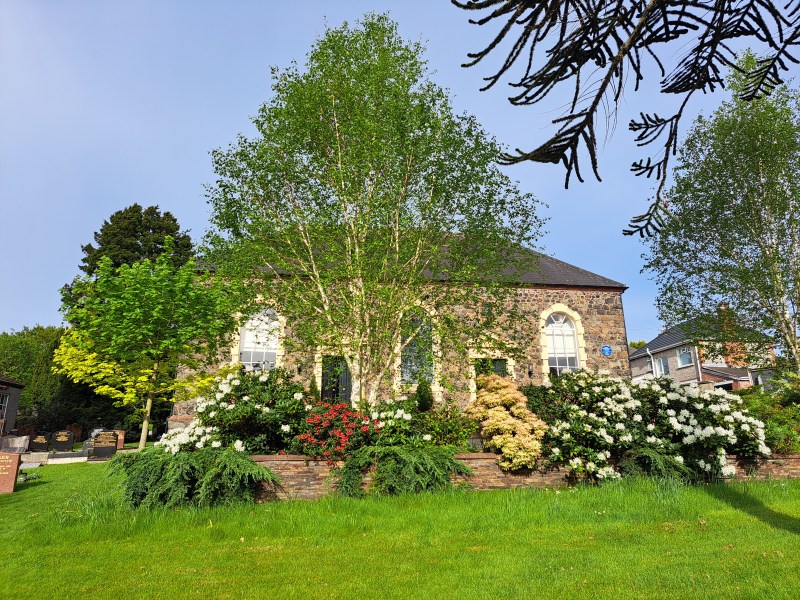
The congregation of First Dunmurry has existed since around 1676. The first meeting house was an old lime kiln, later a meeting house was built in 1714, and this was eventually replaced with the present remarkable building of 1779. So the congregation is almost 350 years old and the building itself is 245 years old. Since 1839 the church’s nearest neighbour has been the railway. That is a long time to be neighbours. The railway has run alongside the Church for all that time. Of course, it has been run by different operators over the years, steam trains have been supplanted by diesel, it has even changed gauge at one point, but the Belfast to Lisburn line was created back in 1839, the station at Dunmurry being added at the same time.
Because of this proximity the railway has inadvertently helped create for First Dunmurry a small footnote in film history. In June 1897 the cinematographer Alexandre Promio came to Ireland on behalf of the famous Lumière brothers to make the first moving film in Ireland. He filmed in Belfast, including street scenes in Castle Place and on Queen’s Bridge, fire-fighters practising, and a few seconds of the first football match ever to be filmed, which was Glentoran v Cliftonville at the Oval in East Belfast.
He also filmed short sections of the rail journey between Belfast and Dublin. Cameras were cumbersome and had to be hand cranked. To capture movement they had to be pointed at crowds or some human activity or placed on a moving platform like a train or a tram. So the train was an obvious place to go and filming the view as the train pulled out of a station was a good way to catch a local view.
As the steam train chugged out of Dunmurry station, sometime in the Summer of 1897, Promio filmed the view and the result was a 37 second burst of film called Départ de Dunmurry. The opening few seconds shows an intensely industrial scene based around the long demolished mill, not immediately recognisable as the modern Dunmurry. By the end of the film we are into open countryside.
This new video enables us to compare the trail blazing film of 1897 with a contemporary film of the same view in 2024. Départ de Dunmurry 2024 enables the viewer to make that comparison:
Click on the video to seeDépart de Dunmurry 2024
We can reflect on what has changed over those 127 years between 1897 and 2024. In one way we have to marvel at the technological progress that has taken place. In 1897 film was in its infancy, cameras were cumbersome, very expensive and required a lot of skill to use. Alexandre Promio was an expert who had filmed all over the world, one of only a handful of people who could do that. Today I am just one of literally millions of people who has a phone that is also a camera which can take digital films in colour with sound merely by pointing it in the right direction.
Imagine if you could show Alexandre Promio a modern phone or a digital camera. He would be more astonished than we could imagine. So we might ask what will technology be like 127 years from now? It is impossible to imagine.
But in the film what do we see today that is different? Today there are cars, lots of cars, there is a significant quantity of graffiti, but actually more trees and more houses. We can notice too that the old steam train takes a bit longer to get up speed than the modern diesel one. You wouldn’t know just looking at the videos though that the railways were much more extensive in 1897 than today. There were around 5,630 km of railway lines in those days, more than twice what there is today, and you could go virtually anywhere in Ireland by rail then. You are restricted to very limited routes today, particularly in Northern Ireland.
But when you compare the two films from 1897 and 2024 one thing has not changed and that is our church. Indeed it has not changed in any big way since 1779 when it was built. As the train curves to the right you can look up Glebe Road and see the church in its prominent position on top of the hill.
It represents our faith, our witness, and though the world changes around us in so many different ways, what we stand for and what we do is always equally important. As we look out of the window of the railway carriage we can see the changes and notice too our Church, the one constant in an ever changing world.
We also have another new video uploaded to YouTube. Non-Subscribing Presbyterian Reflections on Spring, Pentecost, and Psalm 104 from the newly refurbished Session Room and the grounds of First Dunmurry (NS) Presbyterian Church. With the Rev Dr David Steers, minister, and Allen Yarr, organist:



 velvethummingbee