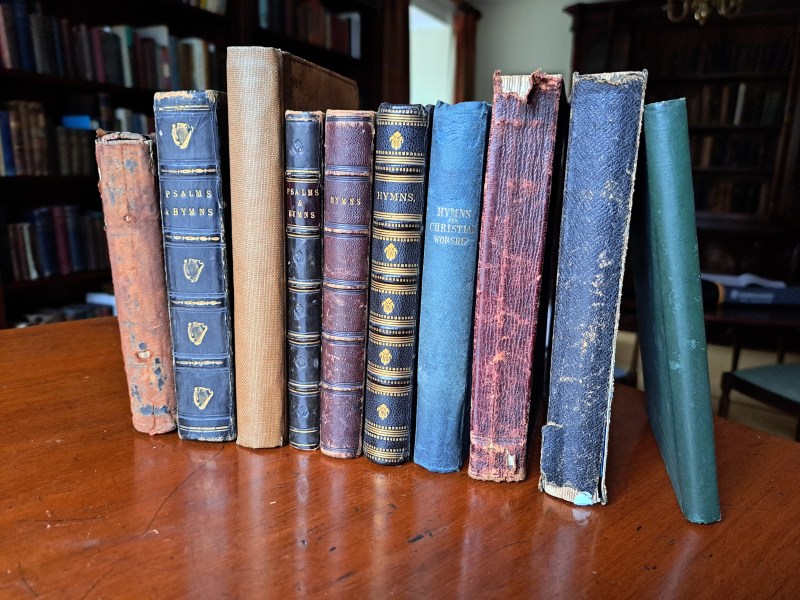
‘Let divine worship be observed, by all who would aspire after the happiness of heaven’. 19th-century Non-Subscribing Presbyterian Hymnbooks

The title of this post comes from the Preface to A Collection of Psalms, Hymns and Spiritual Songs written by the Rev A.G. Malcolm for his hymnbook published in Newry in 1811.

Click on the video to explore Irish Non-Subscribing Presbyterian hymnbooks

Prior to about 1800 Non-Subscribing or New Light Presbyterian churches, in common with other Presbyterians, would have worshipped with a Psalter or Psalm book. The first distinctly Non-Subscribing hymnbook appeared in First Church in 1801. What is surprising about this publication is that in the same year Edward Bunting offered to supply an organ to the church. This offer wasn’t taken up although in just a few years the Second Congregation were to become the first church with an organ, First Church not acquiring one until 1853. The Rev William Bruce edited this collection and 1,200 copies were published. A choir seems to have led the singing which initially contained boys but was later expanded to include adults.
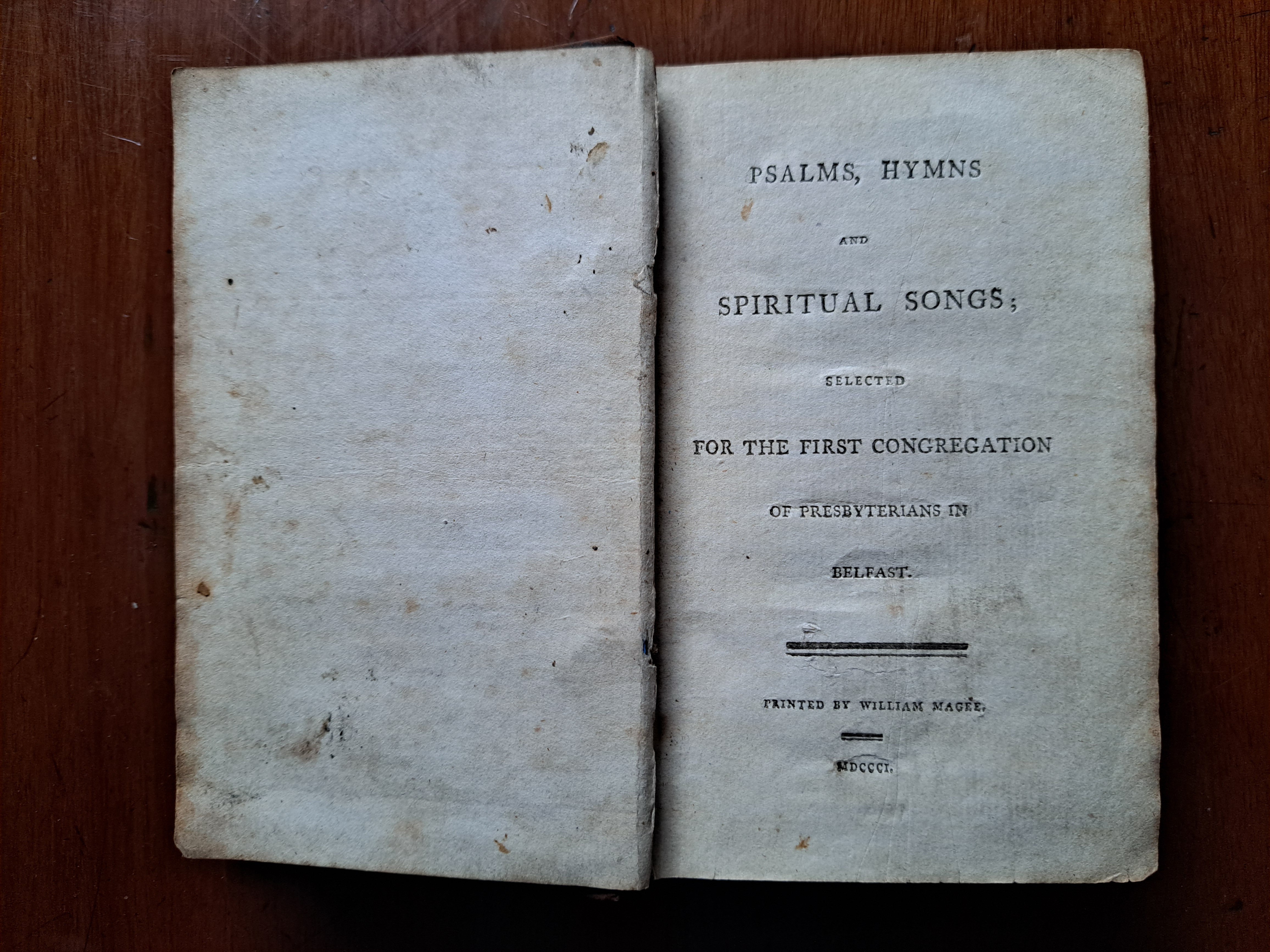
First Church’s Collection of 1801

William Bruce’s book contained 246 hymns, with an index of first lines and a brief one page table of subjects. The next hymnbook, the Newry edition of A.G. Malcolm, contained 405 hymns with a more substantial table of subjects running over eight pages. Plus it had an index of first lines with the names of authors (for example Barbauld, Watts, Doddridge, Kippis, Merrick, Wesley, Addison, Enfield) which showed the eclectic sources the book drew on from within Dissenting circles and beyond.

An interesting preface also explained their intentions:

…care has been taken, to select psalms and hymns, which treat of of the leading points both of faith and practice; and it is hoped, that the compilation will be found to contain a sufficient variety of the best compositions, in sacred poetry, adapted to all the principal subjects of Christian devotion.

A.G. Malcolm went on:

Correctness, both in sentiment and style, has also been made an object of considerable attention. Hence, many verses have been altered; and such psalms and hymns as seemed, in any degree, unsuitable to the simplicity and solemnity of divine worship have been omitted.

As the work is intended for general use, and must be expected to fall into the hands of persons, who unavaoidably differ from one another, in their opinions, on religious subjects, all expressions, which appeared likely to give offence to any sincere Christian, have been studiously avoided.

Interestingly the next hymnbook, dated Belfast, July 1818 and edited by Rev W.D.H. McEwen, made a similar point in a slightly more forceful way in its Preface:

Some doctrines are so offensive to the societies, for whose use this compilation is principally intended, that they are carefully avoided. As to others, the same scrupulosity is not observed; for, with respect to them, there may exist a diversity of sentiment. This selection may, therefore, be thought defective, but it will not disgust by a pertinacious obtrusion of doctrine.

So certain doctrines weren’t allowed to get in the way! Some were left out all together – the Trinity, the theory of the atonement based on penal substitution – and on some doctrines Non-Subscribers were able to agree to differ.
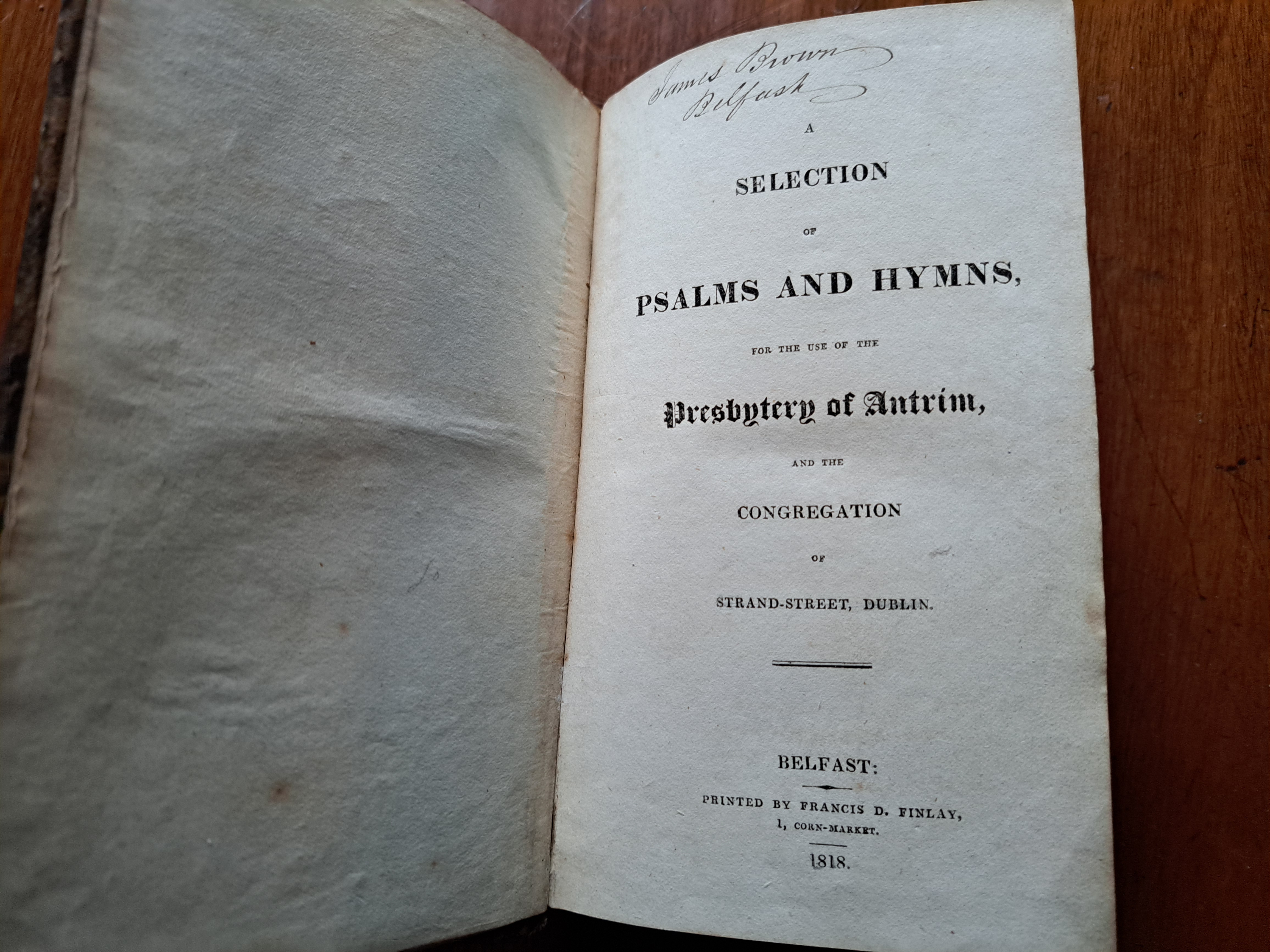
W.D.H. McEwen,s hymnbook

The book was published for the Presbytery of Antrim and the congregation of Strand Street, Dublin but it came from the minister of the Second Congregation. Curiously they had installed an organ in 1806 and had Edward Bunting as their organist from then until 1817. So they don’t appear to have had a hymnbook of their own for the first dozen years after installing the organ.

Following the establishment of the Remonstrant Synod of Ulster in 1830 Non-Subscribers moved towards the development of a hymnbook for all churches. This is Psalms, Paraphrases, and Hymns, for Christian Worship published in Belfast in 1841:
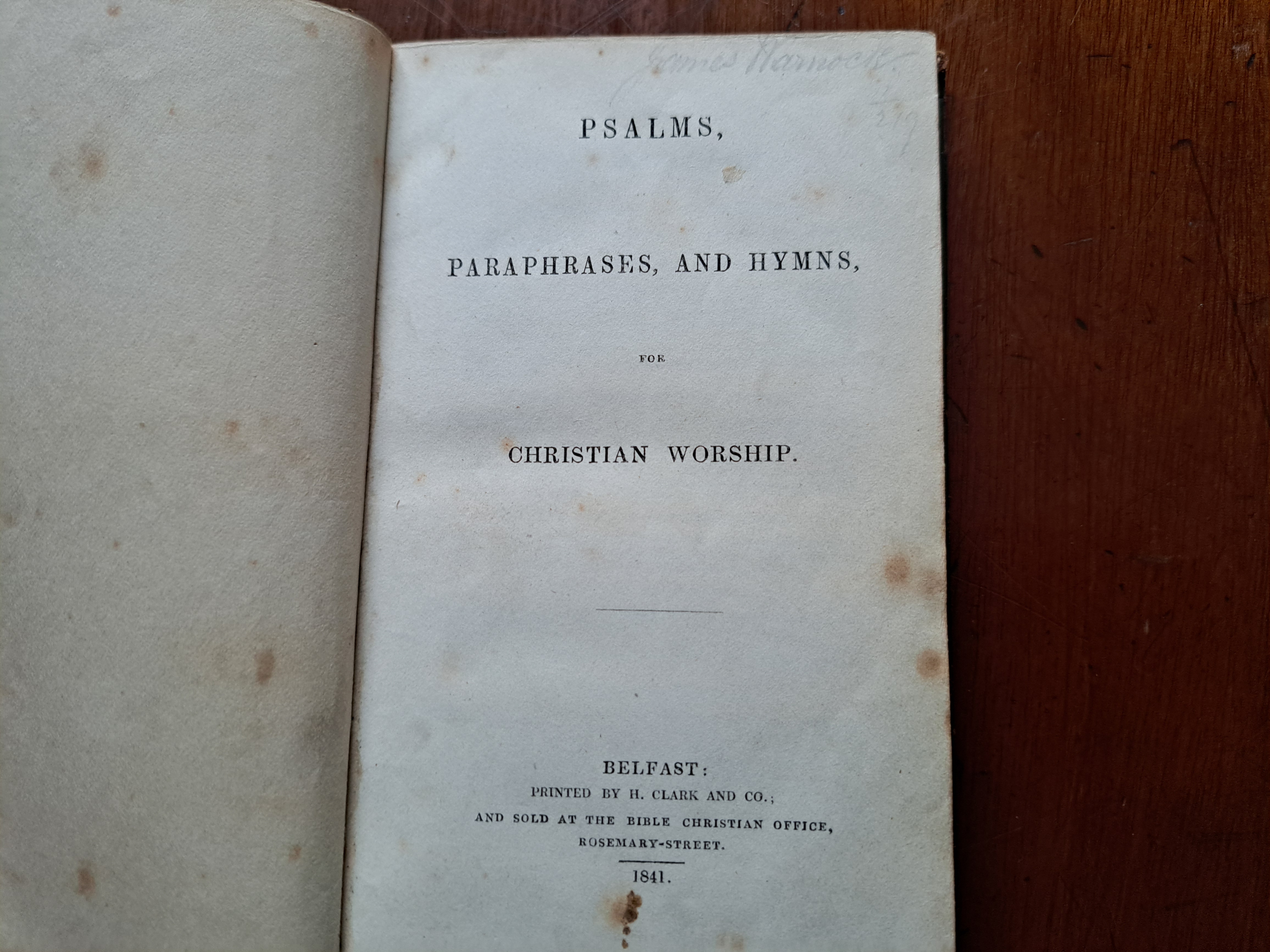
Psalms, Paraphrases, and Hymns, for Christian Worship 1841

This is the first edition of what became Hymns for Christian Worship, a book which went into at least four further editions before the end of the century and was followed by a supplement in 1899. Throughout this time this was the main series of hymnbooks in use in the churches in Ireland. More detail can be seen in the video above.
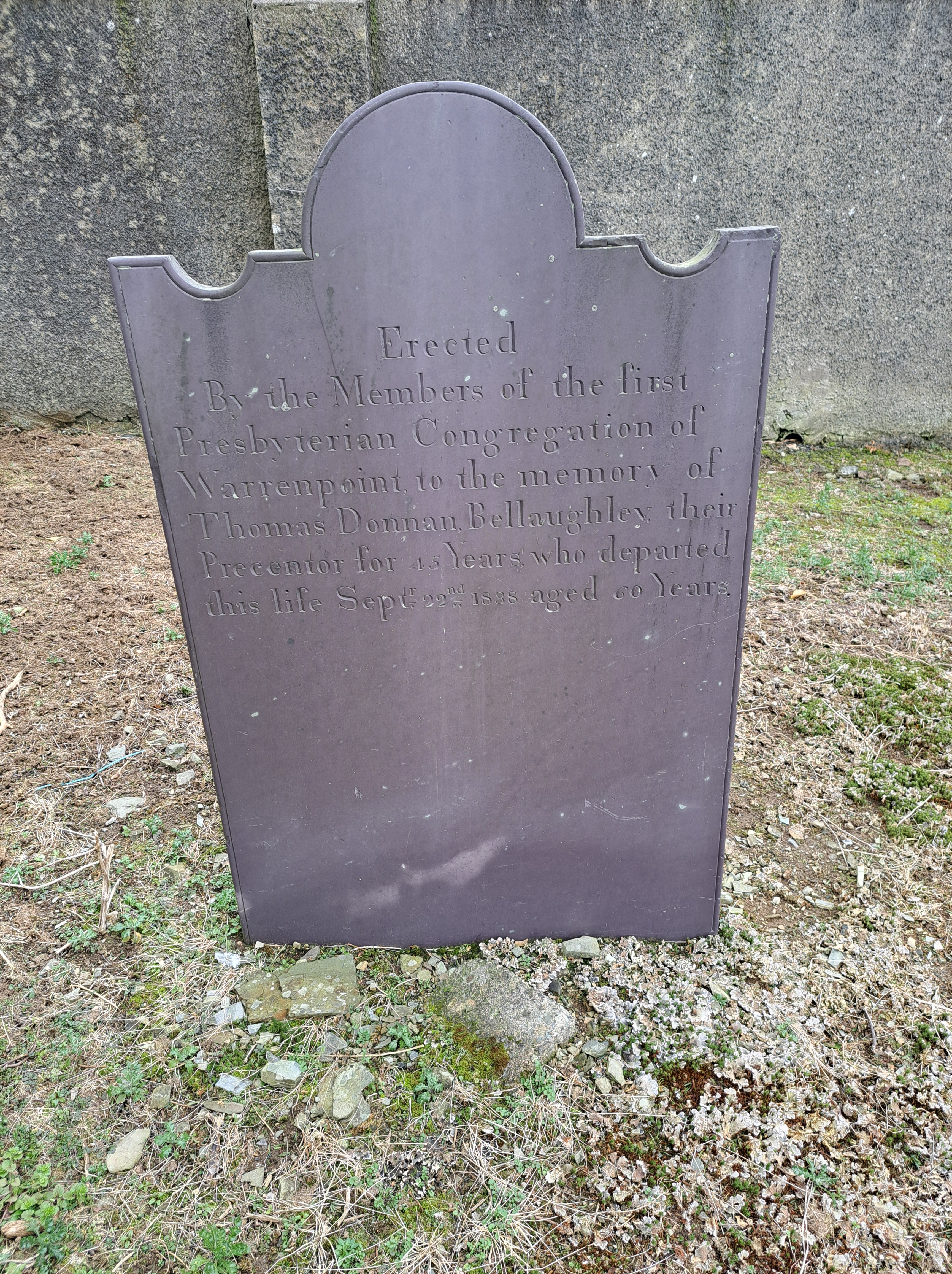
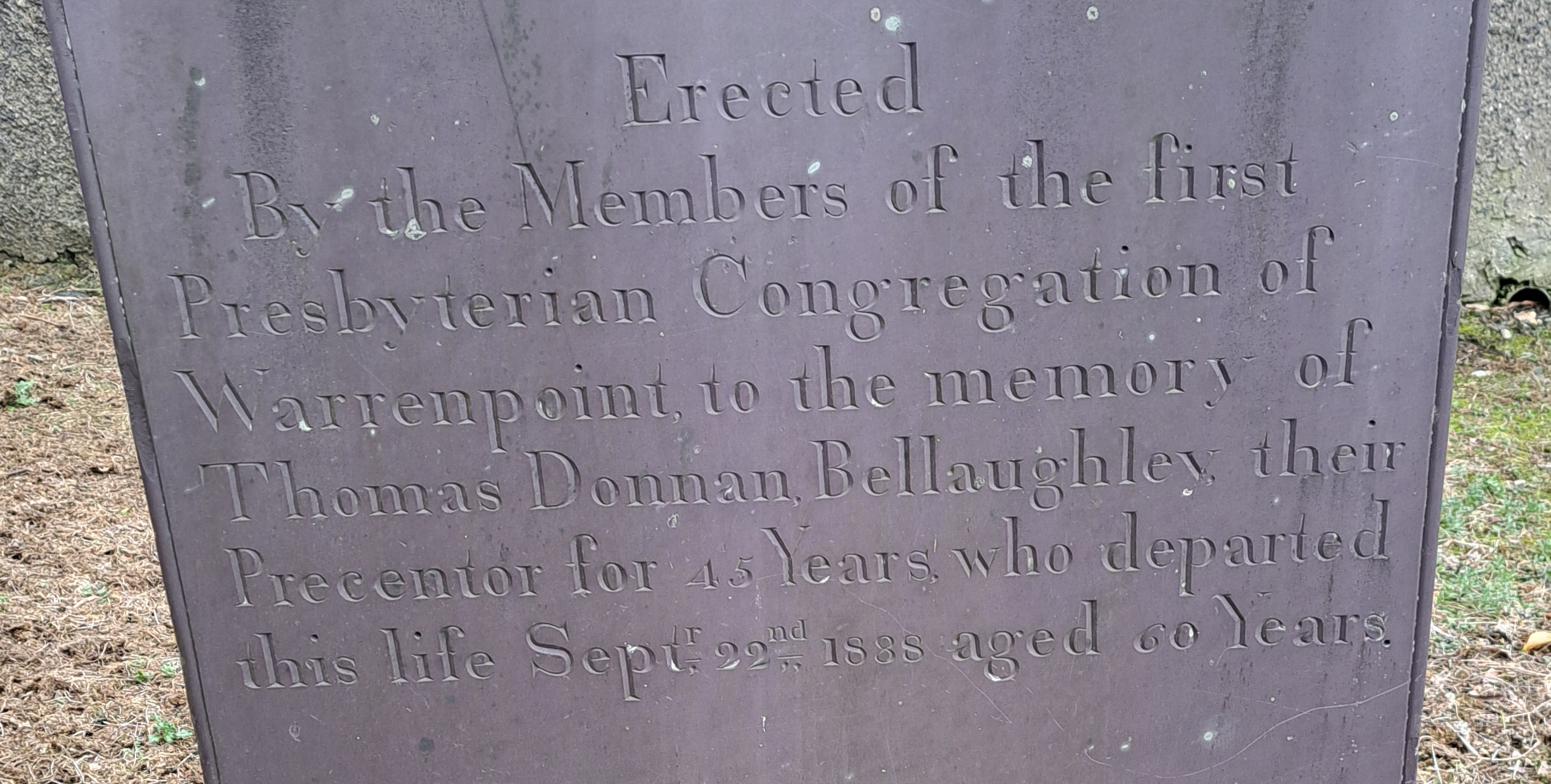
The Precentor’s Grave at Warrenpoint

On a recent visit to Warrenpoint I noticed this gravestone and took a picture. Carved, it would appear, on a sheet of slate, the inscription is sharp and clear and I initially assumed it would be older than the date actually indicated. I didn’t have much time to study it but I am glad I took a picture, it is a fascinating artefact, a tribute to a key member of this congregation for almost half a century.

Thomas Donnan, of Bellaughley, was the Precentor of the Warrenpoint Non-Subscribing Presbyterian congregation for 45 years up to his death in 1888. He was 60 when he died so he must have been just 15 when he commenced this work in 1843.

It’s an intriguing gravestone because while it clearly tells of the high esteem in which Thomas Donnan was held and the long period of time he faithfully led the congregation in their singing it opens up so many more questions. Who was he? Did he have a family? Did he have any formal training in music? Did he have any other responsibilities or source of income?

Although a Non-Subscribing Presbyterian congregation the First Presbyterian congregation of Warrenpoint must have hung on to their traditional worship forms in singing by being led by the Precentor for a long time, perhaps because Thomas Donnan provided such acceptable leadership to them in their music.

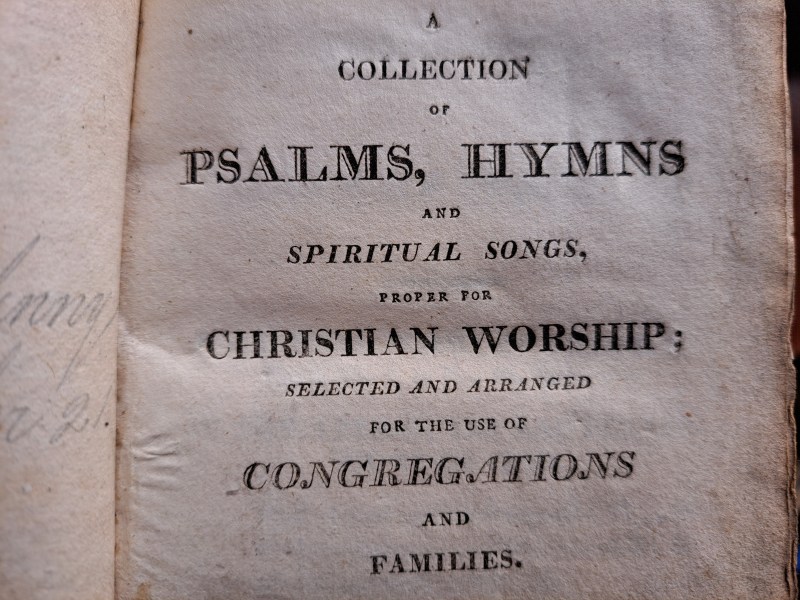
It’s interesting that close by in Newry the New Light minister the Rev A.G. Malcolm produced one of the first hymnbooks in use in any Presbyterian church in Ireland in 1811 with his Collection of Psalms, Hymns and Spiritual Songs proper for Christian Worship; selected and arranged for the use of Congregations and Families. But this doesn’t seem to have been used in Warrenpoint.

In her tercentenary booklet of 2007 Across the Narrow Water (the congregation of Warrenpoint was originally known as Narrow Water) Elaine Crozier records that in 1841 the committee appointed ‘a teacher to teach the choir’ at a salary of £3 per year. Was this the prelude to the appointment of Thomas Donnan? Undoubtedly connected with his eventual appointment was a decision in 1842 that ‘the new collection of psalms compiled by the Remonstrant Ministry be put into the hands of the families belonging to the church.’ This would be the 1841 publication Psalms, Paraphrases, and Hymns, for Christian Worship published in Belfast by the Bible Christian (the main Non-Subscribing Presbyterian journal), Rosemary Street. It must have been this book that provided the basis for congregational singing in Warrenpoint led by Thomas Donnan although the book was gradually expanded as the century wore on with hymns from other sources. All this took place during the long and effective ministry at Warrenpoint from 1836 to 1867 of the Rev Samuel Moore. Born in Rademon and educated at Glasgow University he enjoyed some success as minister of Warrenpoint although the congregation faced the heavy difficulties of the Famine during his ministry.

From 1843 onwards, though, Thomas Donnan was leading the praise. If they were using Psalms, Paraphrases, and Hymns, for Christian Worship they had already taken a step away from using a traditional Psalter and this does, perhaps, suggest that the Precentor was also leading a choir. But there at the centre of their congregational life was this young man appointed at the age of just 15 and leading the congregation’s worship for the next 45 years to their evident satisfaction

Reflections on Prayer

I added this short video to our YouTube channel featuring the church and some of the grounds at Dunmurry built around a short passage on prayer written by Valentine David Davis. V.D. Davis trained for the ministry at Manchester College when it was still in London and James Martineau was Principal. He was one of the last links between that generation of ministers and the mid-twentieth century. His little book The Lord’s Prayer An Interpretation. Together with an Address on The Offering of Prayer was published by the Lindsey Press in 1938.

Click on the video to see ‘Reflections on Prayer’ from Dunmurry

His book on prayer is full of insight. He is perhaps someone who is rather overlooked in our history. On leaving Manchester College he went to Christ Church, Nottingham as minister for a few years before moving on to the Ancient Chapel of Toxteth for eleven years. This was followed by a further ministry at Wallasey. In Merseyside he was greatly influenced by John Hamilton Thom whose devotional Services and Prayers he later edited along with a selection of J.H. Thom’s writings in a A Minister of God. Ministry in Liverpool and Wallasey was followed by eleven years as editor of The Inquirer before returning to the ministry in Bournemouth where he served for twenty years up to retirement. He made some more important contributions to devotional publishing and to history, producing A Book of Daily Strength as well as A History of Manchester College and a history of the London Domestic Mission Society. He was editor also of Hymns of Worship, first published in 1927, reprinted a number of times, then republished with a Supplement (1951), and later still republished in a revised format in 1962. Even Hymns of Faith and Freedom, published in 1991, described itself as a radical revision of Hymns of Worship. So as one of the first fruits of the collaboration that led to the new General Assembly and ‘offered, in the interest of unity and comprehension, with the prayer that it may be blessed in its ministry to the fellowship of our churches’ it proved remarkably successful.

We also uploaded to YouTube our full Easter Day service at Dunmurry recently. The full service, including hymns, prayers and readings can be seen here:

Easter Sunday Service, Dunmurry

Christmas Morning

On Christmas Eve, 2023, we held an excellent congregational Carol Service in Dunmurry. Below you can join the service via this video:

Excerpt from Hymn on the Morning of Christ’s Nativity by John Milton (1629):

No war or battle sound

Was heard the world around:

The idle spear and shield were high uphung;

The hooked chariot stood

Unstained with hostile blood;

The trumpet spake not to the armed throng,

And kings sat still with awful eye,

As if they surely knew their sovran Lord was by.

But peaceful was the night

Wherein the Prince of Light

His reign of peace upon the earth began:

The winds with wonder whist

Smoothly the waters kissed,

Whispering new joys to the mild ocean,

Who now hath quite forgot to rave,

While birds of calm sit brooding on the charmed wave.

And here is a short video of a heron in Derriaghy Glen, not far from Dunmurry. Filmed recently by Louise Steers:

Carols by Candlelight at Dunmurry

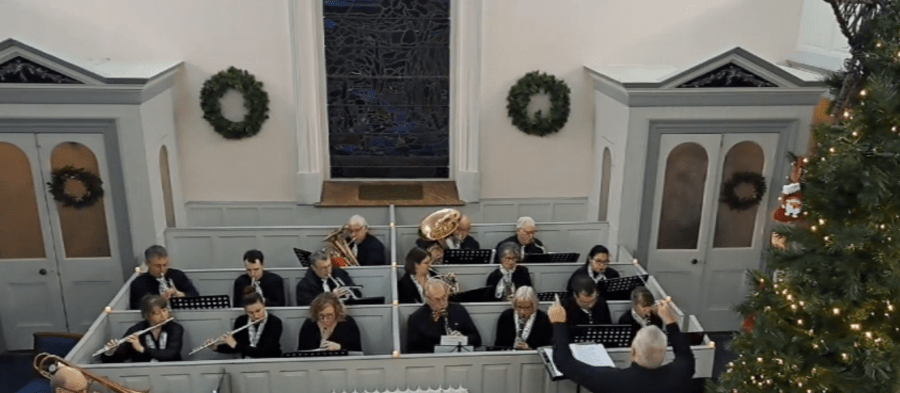
Harmonic Sounds Concert Band performing at Dunmurry

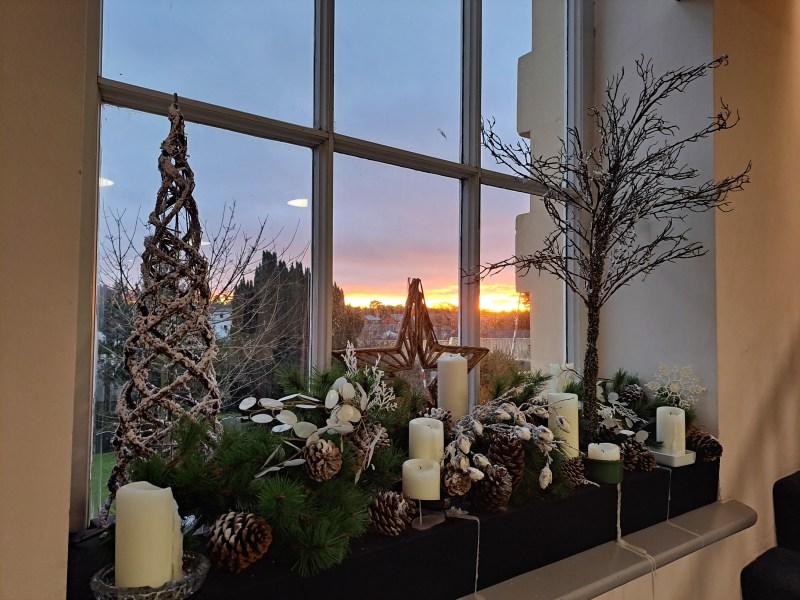
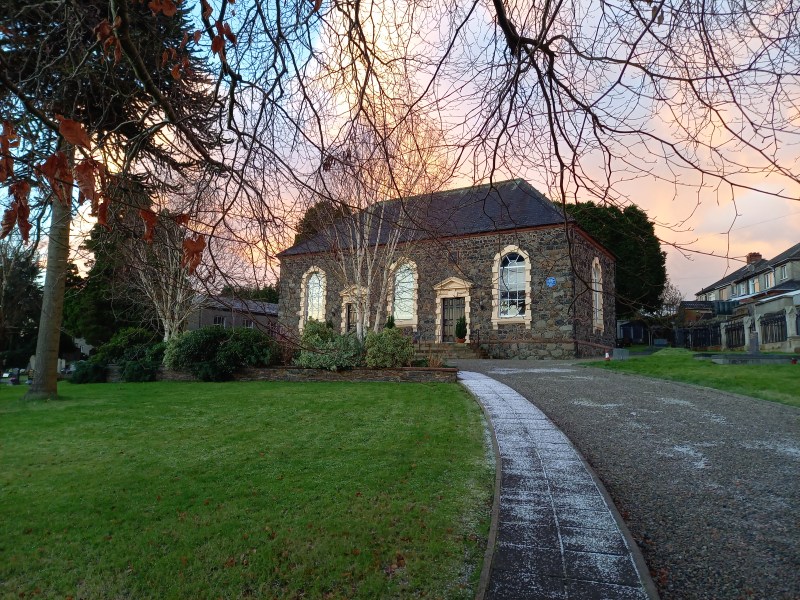
On Friday, 15th December we were delighted to welcome to Dunmurry Harmonic Sounds Concert Band under their Musical Director, Paul Hamilton to lead us in our service of Carols by Candlelight. The Church was beautifully decorated, there was a great attendance and readings were given by members and friends of the congregation.

Click on the video above to share in the service.

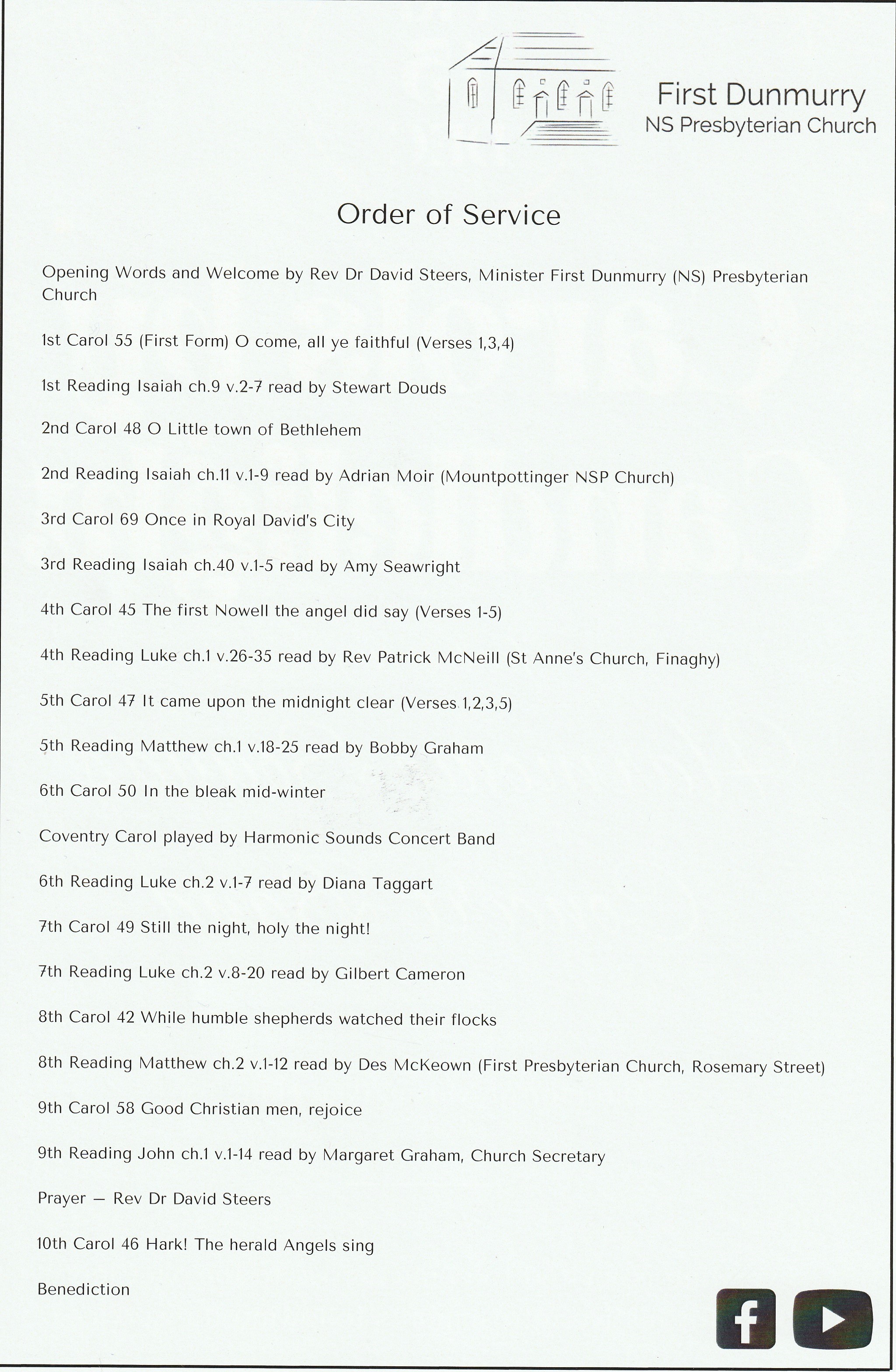
Order of Service

Another recent video which is available to view online is the sermon delivered in Church on Sunday, 10th December 2023, the second Sunday in Advent:

Carols at Dunmurry

Every Christmas Carol has its own backstory but there is none more intricate and unusual than O Come, all ye faithful, which is also one of the most universally popular of all Carols.

Adeste Fidelis

Click on the video above to see the Reflections on ‘O Come, all ye faithful

Carols by Candlelight

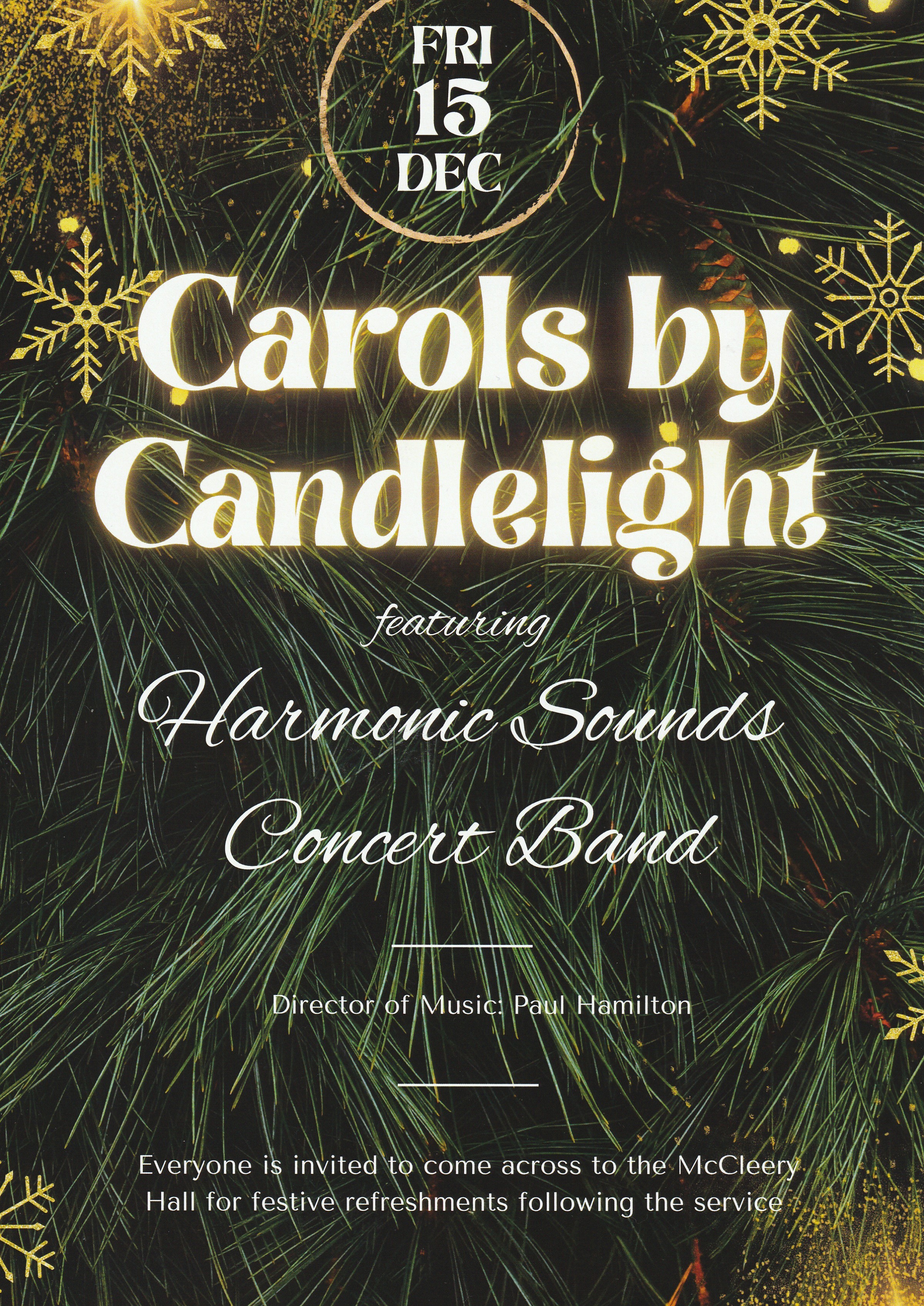
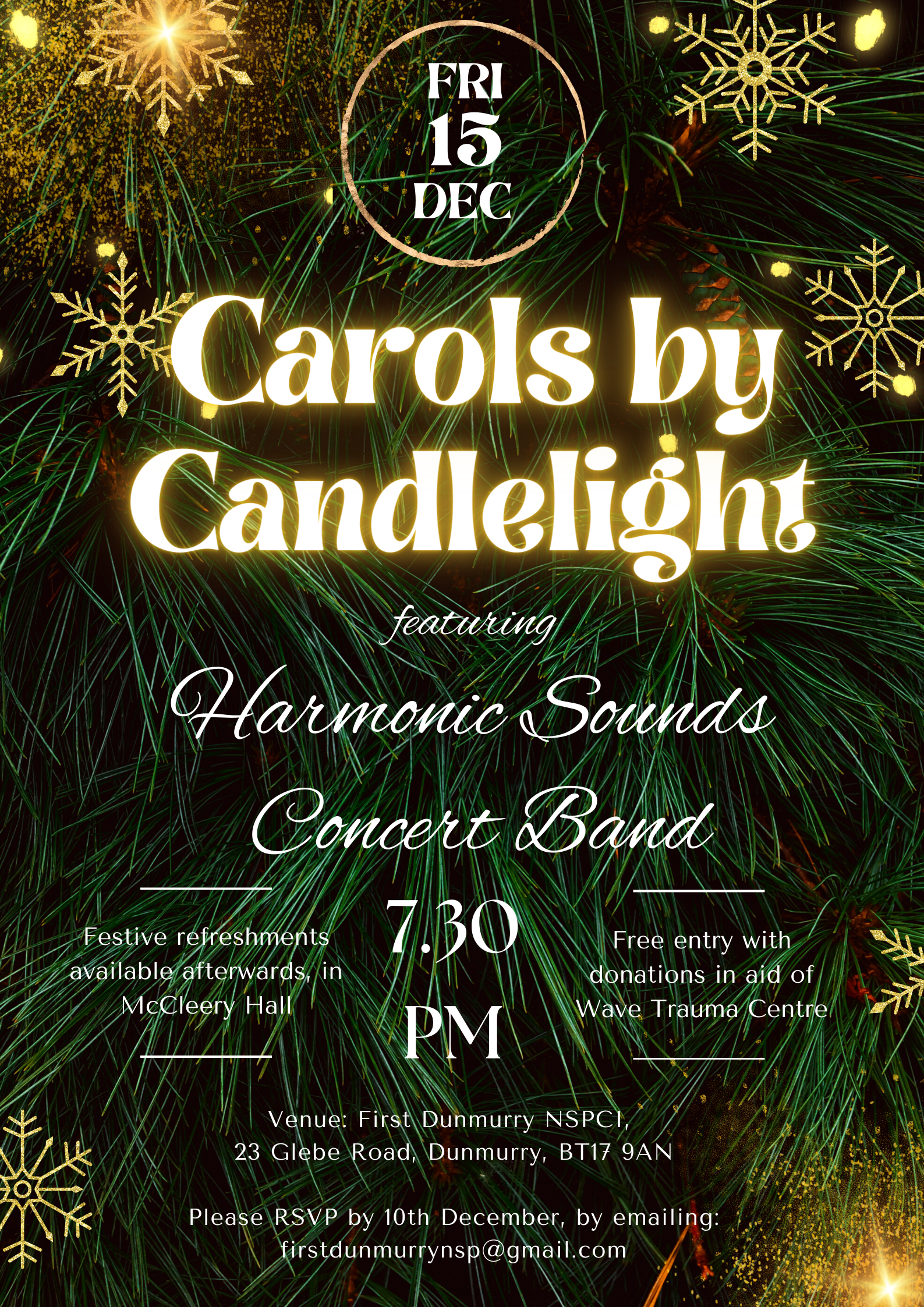
At Dunmurry we are really looking forward to our Carols by Candlelight service on Friday, 15th December at 7.30 pm when we will welcome Harmonic Sounds Concert Band with their Director of Music, Paul Hamilton. We will tell the story of Christmas through traditional carols and the traditional Christmas readings given by church members and friends from other churches. Everyone is welcome.

Dunmurry Harvest

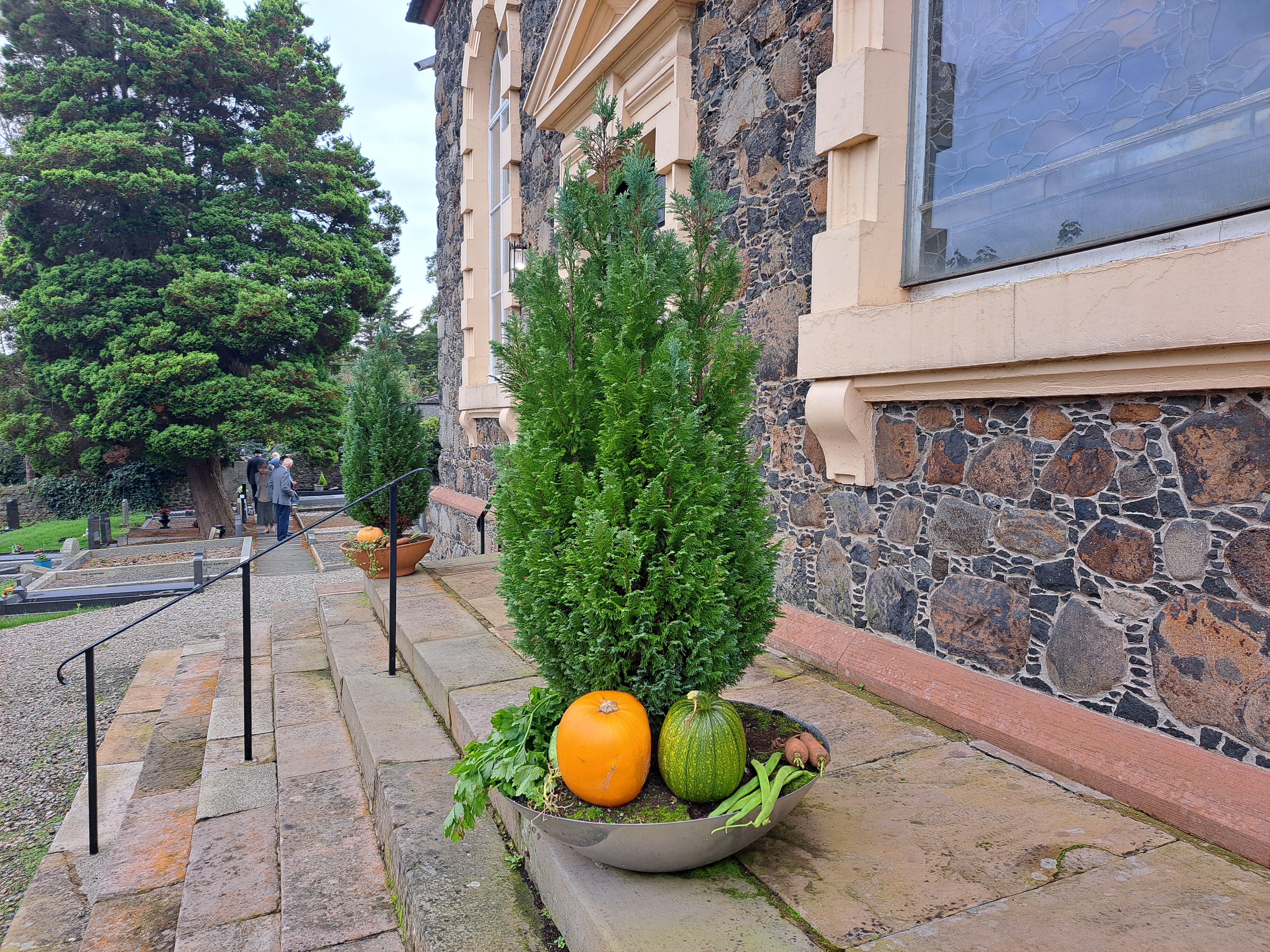
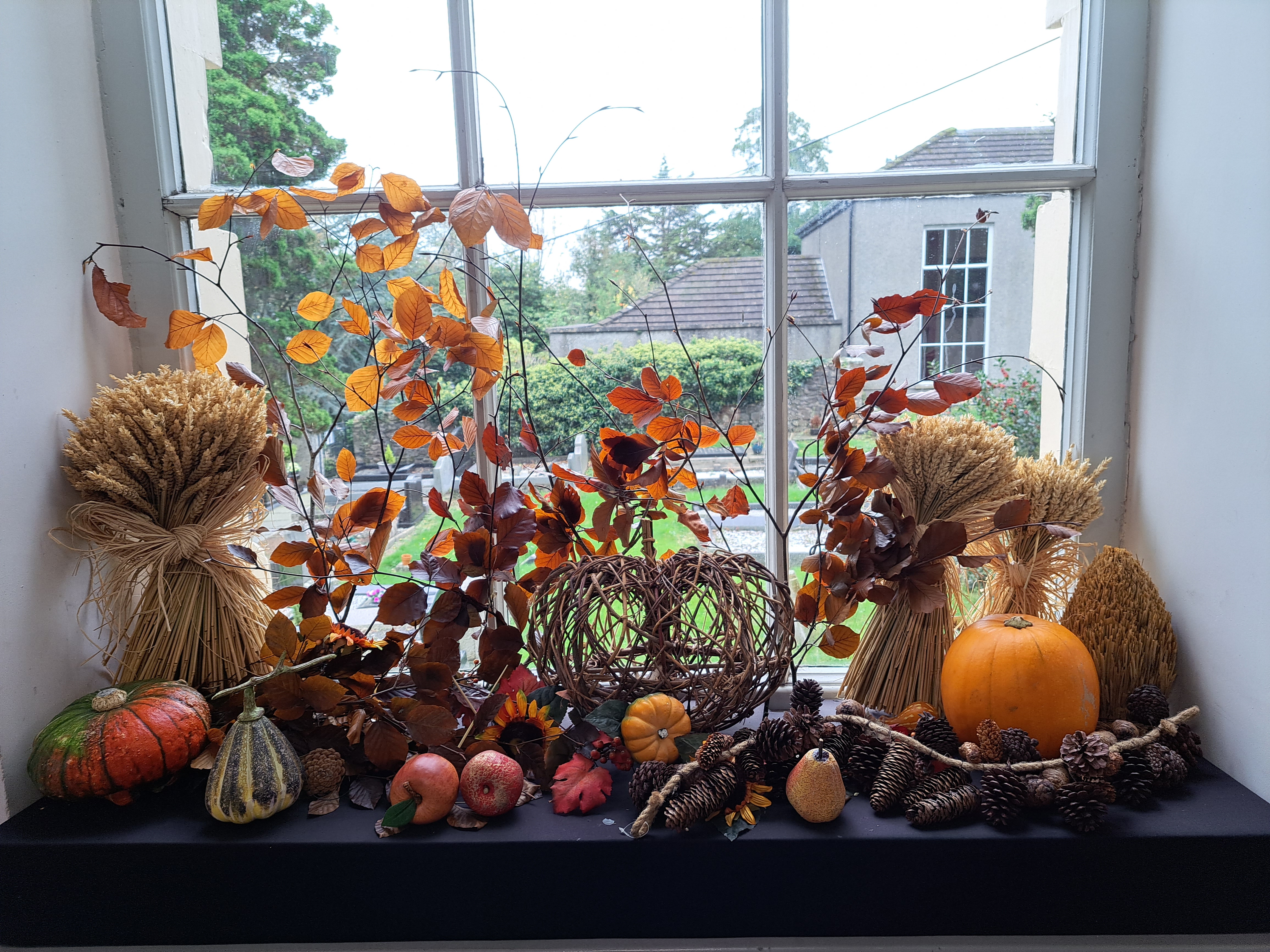
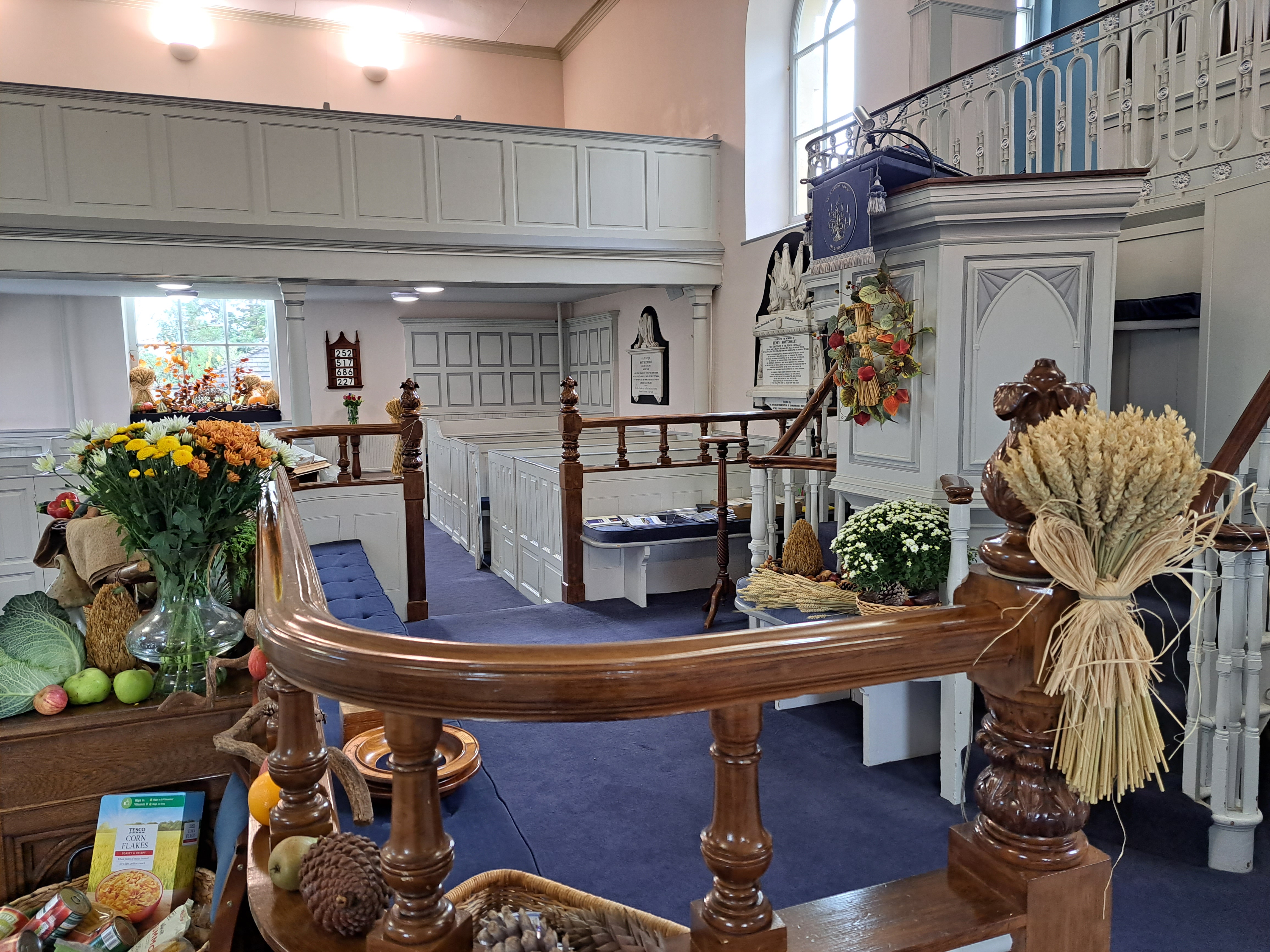
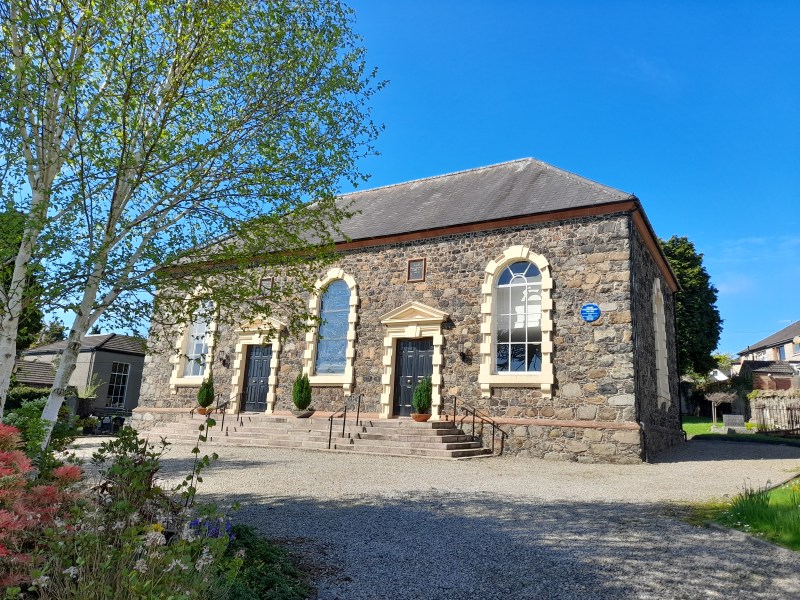
On Sunday, 8th October we celebrated our service of Harvest Thanksgiving at First Dunmurry. There was a good attendance and the church was beautifully decorated. The choir sang Great is thy faithfulness and the hymns included were Come, ye thankful people, come, All things bright and beautiful, Fountain of mercy, God of love and We plough the fields, and scatter.

The whole service can be viewed on the following video:

Click on the video to see the Harvest Service

The organist and choirmaster was Allen Yarr and the service was conducted by the minister, the Rev Dr David Steers.

All donations of tinned and dried food were given to the Foodbank and fruit and vegetables were donated to FareShare.

Christmas Reflections

Over the period of Advent in the run up to Christmas at Dunmurry we have uploaded three videos generally reflecting on Advent and Christmas carols, their origin and use, as well as the Christmas story itself. You can see them all by clicking on the videos below.

Christmas Reflections: The Christmas Story

Christmas Reflections
The Christmas Story

First Dunmurry (NS) Presbyterian Church

Told by Sue Steers FRSA
Organ: Allen Yarr
Trumpet: Jack Steers

Carols:
Hark! the herald angels sing
O Little town of Bethlehem
O Come, all ye faithful

It came upon the midnight clear

Click on the video above to see the Christmas Reflections

Two Christmas Carols: Deck the hall (1784) & Ding, dong merrily on high (1924)

Two Christmas Carols

Click on the link above to see this short exploration of two well-known carols:
Deck the hall with boughs of holly (first published 1784)
Ding, dong merrily on high (first published in 1924)

Filmed at First Dunmurry (NS) Presbyterian Church and at the Continental Market, Belfast

Trumpet played by Jack Steers

Advent Reflections: ‘Hark the glad sound!’ by Rev Philip Doddridge 1702-1751

A Short Reflection for Advent

Hark the glad sound! the Saviour comes
writtten by Rev Philip Doddridge DD (1702-1751)

Trumpet: Jack Steers

Click on the link above to see the video

Advent Reflections

First Dunmurry (NS) Presbyterian Church

Reflections for Advent

The Rev Philip Doddridge DD (1702-1751) was one of the most significant dissenting ministers in the first half of the eighteenth century. Among other things he was the author of the Advent carol ‘Hark the glad sound! The Saviour comes’. This short reflection by Rev Dr David Steers, minister of the First Presbyterian (Non-Subscribing) Church, Dunmurry, looks at Philip Doddridge and his hymn in the context of Advent. Jack Steers plays the hymn on the trumpet.

Illustration of Philip Doddridge, engraving by George Vertue after Andrea Soldi, National Portrait Gallery. Public Domain, Wikimedia Commons

Dunmurry Garden Wildlife

Your enjoyment of the world is never right, till every morning you awake in Heaven: see yourself in your Father’s palace; and look upon the skies, the earth, and the air as celestial joys: having such a reverend esteem of all, as if you were among the angels.

Thomas Traherne

One of the beauties of Dunmurry is not just the gardens and grounds that surround the church but the variety of animal and bird life that lives there. Louise Steers has been busy filming many of the birds, animals and insects that live there and we have two videos that consist of Louise’s films and photographs of them accompanied by music provided by John Strain on the organ at Ballee. Among the animals you can expect to see in Part One are robins, blue tits, blackbirds, a thrush, grey squirrels, a mouse, ladybirds, a speckled wood butterfly and a peacock butterfly.

Dunmurry Garden Wildlife Part One

Click on the video above to see some of the birds, animals and insects that live in the gardens round the First Presbyterian (NS) Church, Dunmurry. Medley played by John Strain on the organ at Ballee Non-Subscribing Presbyterian Church.

Dunmurry Garden Wildlife Part One

The second of two films featuring some of the birds, animals and insects that live in the gardens round the First Presbyterian (NS) Church, Dunmurry. All pictures are by Louise. In this case the accompaniment is by John Strain on the organ at Ballee playing God speaks to us in bird and song, For the beauty of the earth, and God who made the earth.

Click on the video above to see Part Two. The video includes forty-two images featuring: blue tit, female chaffinch, male chaffinch. starling, thrush, shieldbug, lacewing, bumblebee, carder bumblebee, hoverfly, ladybird, peacock butterfly, speckled wood butterfly, grey squirrel, hedgehog, wood pigeon, blackbird, magpie, fledgling blue tit, male bullfinch, great tit, robin.

Louise also has her own animation channel (InkLightning), which includes animation like this short video: