Only in England Photographs by Tony Ray-Jones and Martin Parr at the Walker Art Gallery, Liverpool

Only in England Photo

As a long time admirer of the work of Martin Parr I was glad of the opportunity to see this exhibition at the Walker Art Gallery in Liverpool. I first came across his work in The Last Resort, his collection of photographs taken in New Brighton and first published, I now see, as long ago as 1985. These pictures, taken in colour, are bright and sharp, which serves only to highlight the sense of desperation about the place. Sunbathers sit on crowded beaches, their feet surrounded by litter, babies play amidst the debris, pensioners relax in semi-derelict shelters. They reminded me of childhood visits to the place and today seem to share more with that era than the present time: New Brighton is cleaner, smarter and less tawdry than it was then. But the seaside has been a continuous theme in Parr’s work and this exhibition shows not only some rarely seen examples of his early photography, but also pictures by a major influence on his own work.

Tony Ray-Jones died at a tragically young age in 1972. Martin Parr has curated a collection of his pictures from the 1960s. All in black and white many of them depict scenes taken at sea side locations – Broadstairs, Brighton, Southport, Blackpool and so on. Each picture conveys that sense of melancholy that only the English seaside seems to contain, both in and out of season. Tony Ray-Jones’s own injunction to himself was “don’t take boring pictures” and each contains a strange mixture of humour, ennui and sometimes even a vague sense of menace.

But Martin Parr’s own section of the exhibition is entitled The Non-Conformists, in this case a precise reference to religious dissenters of the traditional type. Taken in the 1970s this looks very much like a vanished age, the last days of an old order. Most of the subjects in the run down chapels are elderly, the ladies all wear impressive hats, the men Sunday-best suits. There is an air of melancholy about many of these pictures too. Chapel goers assemble for anniversary teas and resemble nothing so much as mourners at a wake. And yet the video that accompanies the exhibition shows some of the scenes as they are today and the remote Methodist Chapel looks pretty much like it is still in operation. Non-Conformists can be tenacious survivors.

But if the same Methodist Chapel is still on the go, the congregation are unlikely to look as formal and as staid as they did in the 1970s. You have to go to Ulster, to Brethren and Free Presbyterian churches, to find such a collection of hats on a Sunday, it is generally shirt-sleeve order these days, casual informality is the style in most places now. There is a rigidity and a strictness in these photos of forty years ago that seems strange to modern eyes, as well as a sense of sadness; the chapels look run down, the paint is peeling, the congregations mostly elderly. But here we see chapel life as it was lived in a remote rural corner of England in the 1970s. Worshippers crouch in prayer, in the non-conformist style; sumptuous suppers are piled on to plates after worship; cabbages are auctioned after the harvest festival. Many of the compositions are very striking. A clever view of a service shows part of the congregation seated downstairs while others sit patiently in the gallery above them. Perhaps the most arresting is of a lady wearing a very large hat solemnly ladling sugar into a cup while seated at a table amongst others sharing in a post-service tea in a Baptist chapel. Her movements seem to mirror the illustration on the wall behind her – a curious and somewhat disquieting rendition of the Last Supper which must have been a permanent decoration in the church hall. A blown up version of this picture is used to advertise the show and I reproduce it below:
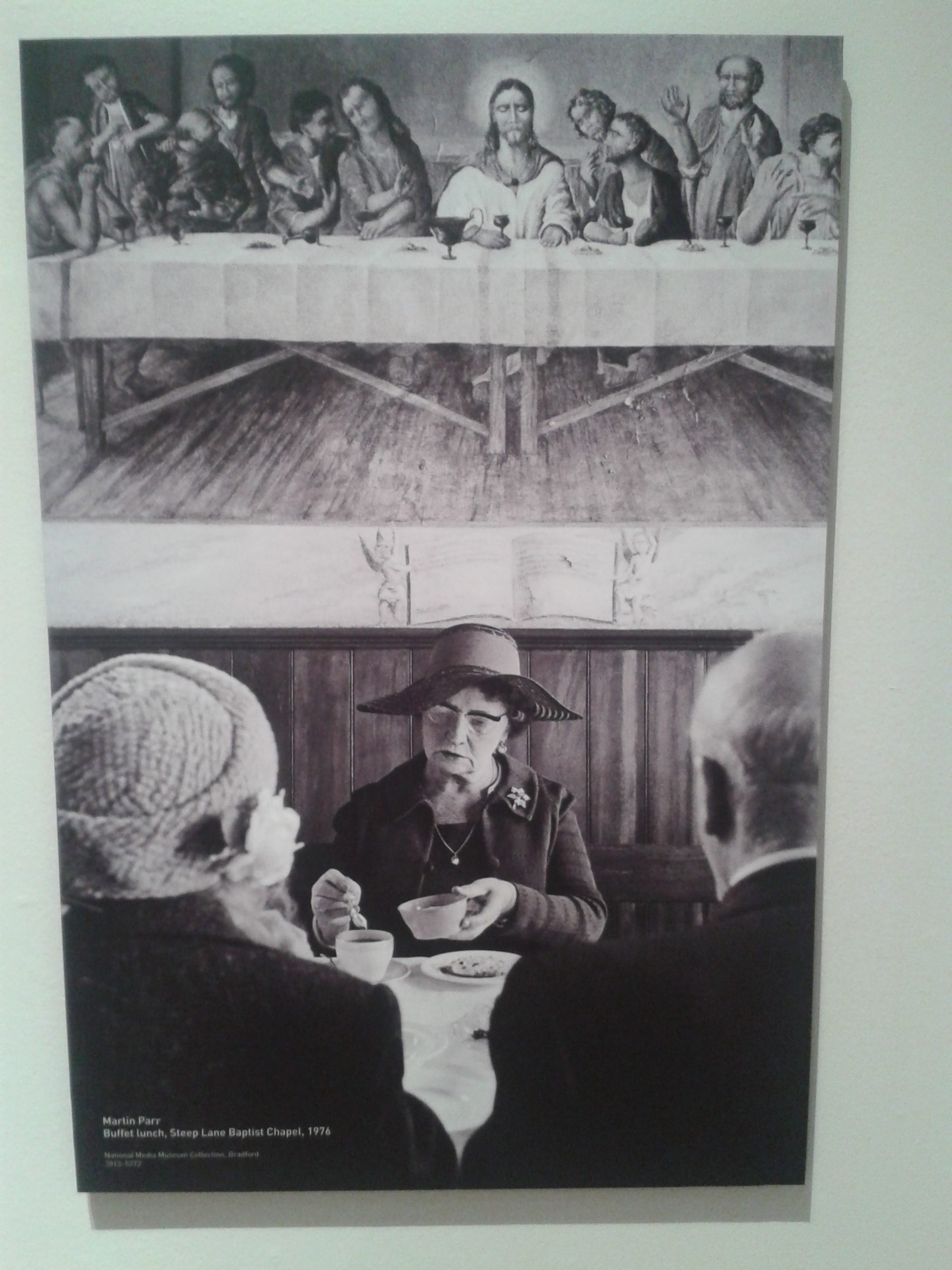
 

Martin Parr. Buffet Lunch, Steep Lane Baptist Chapel, 1976

But all this, plus Martin Parr’s pictures of home life and working life in the Calder Valley and Tony Ray-Jones’s depictions of English eccentricities like the Bacup Coconut Dancers, makes for a fascinating exhibition which is on show in the Walker Art Gallery until 7th June.

Rev John Watson: Ogden’s ‘Guinea Gold Cigarettes’

Some people like collecting things, other people discard anything that has no practical usefulness. For some collecting is a bug and whether it is stickers containing the likenesses of premiership footballers or paintings by Picasso costing millions of pounds or anything in between there is no shortage of those who, in the search for completeness or because of a desire to own something rare or unique, will buy things, sometimes at any price. While the artistic merit of a Picasso may (or may not) be appreciated by all and sundry the wonders of a sticker book containing all the footballers of the 1970 World Cup, for instance, will appeal only to the cognoscenti. But little things, small objects, printed ephemera and all the material that so many people would condemn as junk do tell a story, they can be interesting and open up another view of the world and who we are.

Rev John Watson
Rev John Watson

The picture above is a cigarette card. Starting before the end of the nineteenth century these became keenly collected, often by children and no doubt they helped to introduce new generations to smoking. They faded away in the 1950s and wouldn’t be allowed now, but old sets are still collected, early and rare examples attracting high prices of over £1,000 per card. Some of the early series are very informative, and others are very attractive in their design. But this card, once given away free and now worth a couple of pounds, is both a symbol of the early development of the modern cult of celebrity and an illustration of how important non-conformist churches were 100 years ago.

The card depicts Ian MacLaren an incredibly popular writer in about 1905 when the card was printed. He was one of the members of the kailyard school, writers of sentimental stories of Scottish rural life which enjoyed great popularity at the time. Their title came from a line of Burns quoted in MacLaren’s most popular book Beside the Bonnie Brier Bush:

There grows a bonnie brier bush in our kail-yard

And white are the blossoms on’t in our kail-yard.

J.M Barrie (the author of Peter Pan) was the most notable of this group but MacLaren’s books sold in Britain and America in their tens of thousands, indeed some are still in print today although read by a fairly specialised audience. But MacLaren’s fame as an author was closely bound up with his career as a Presbyterian minister. Ian MacLaren was a pseudonym and as John Watson he ministered to the Presbyterian Church in Sefton Park, Liverpool for 25 years with great success, from 1880 to 1905. He assembled an enormous congregation, those who held seats in his church had to be in place half an hour before the service began or else their seats would be given to visitors who queued up outside. Developing out of his ministry he became the most popular writer on theological topics of his day, certainly from within the non-conformist churches. His theology was quite liberal and at one point he was threatened with a charge of heresy from within his denomination (the Presbyterian Church of England). He was certainly liberal enough for the Rev John Hamilton Thom to complain about the removal of the Renshaw Street Unitarian congregation to Ullet Road – a location very close to Ian MacLaren’s church. He claimed that a number of Unitarians had already joined his church without changing their theology and that a move to the suburbs might result in further drift away to hear such a successful preacher.

But above everything else John Watson was the most prominent of all the Presbyterian Church of England ministers of his day. He assisted in the establishment of the University of Liverpool (which brought him into the orbit of many Unitarians) and his leadership and fundraising exertions resulted in the establishment of Westminster College, Cambridge in 1899, which became the main Presbyterian theological college. The following year he was moderator of his church. Invited to tour the United States and lecture in Yale University and other places his theological publications also became best sellers and his influence spread far and wide within the churches. And so famous was he that when Ogden’s produced a new series of ‘Famous People’ Cigarette Cards in about 1905, a set that possibly included actors, actresses, generals, politicians, sportsmen and writers they couldn’t leave out John Watson/Ian MacLaren. It was all part of the level of fame he had achieved in his day and age and so his portrait, in his clerical collar, was printed to go inside packs of Ogden’s Guinea Gold Cigarettes and no doubt eagerly sought by those anxious for the full set. It is hard to imagine what the exact equivalent would be in today’s celebrity terms but we can be pretty certain that no member of the clergy, not even the Archbishop of Canterbury, could expect to reach such a dizzy height.

A journey of a thousand miles begins with a single step

These words of the Chinese philosopher Lau Tzu seem appropriate for the beginning of any new enterprise, they also tie in, for me personally, with the picture of the Ancient Chapel of Toxteth, a place which was very much a starting point for me. But the purpose of this blog will be to flag up things that interest me particularly in relation to the journals Faith and Freedom and the Transactions of the Unitarian Historical Society, both of which I edit. Not that I intend to confine myself to either of those publications – anything that catches my eye will go in here – the blog will have a special remit towards faith, religious history and associated matters but it will by no means confine itself to matters of religion.