In this post we are looking at some more examples of the work of Allen Daniel Coon. The total output of postcards he produced between 1902 and his death in 1938 must have been enormous and they covered a very wide geographical area. I hadn’t noticed that one card I picked up a few years ago was by him:
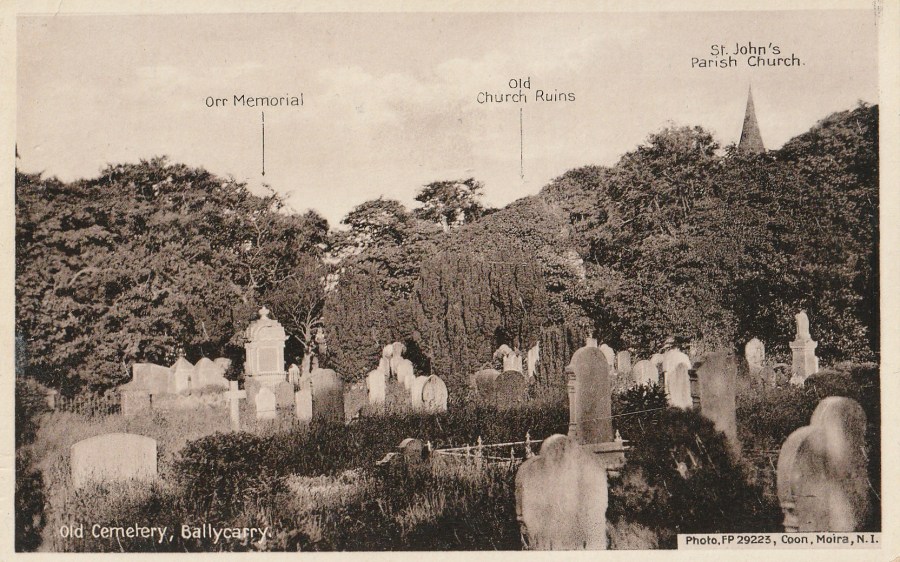
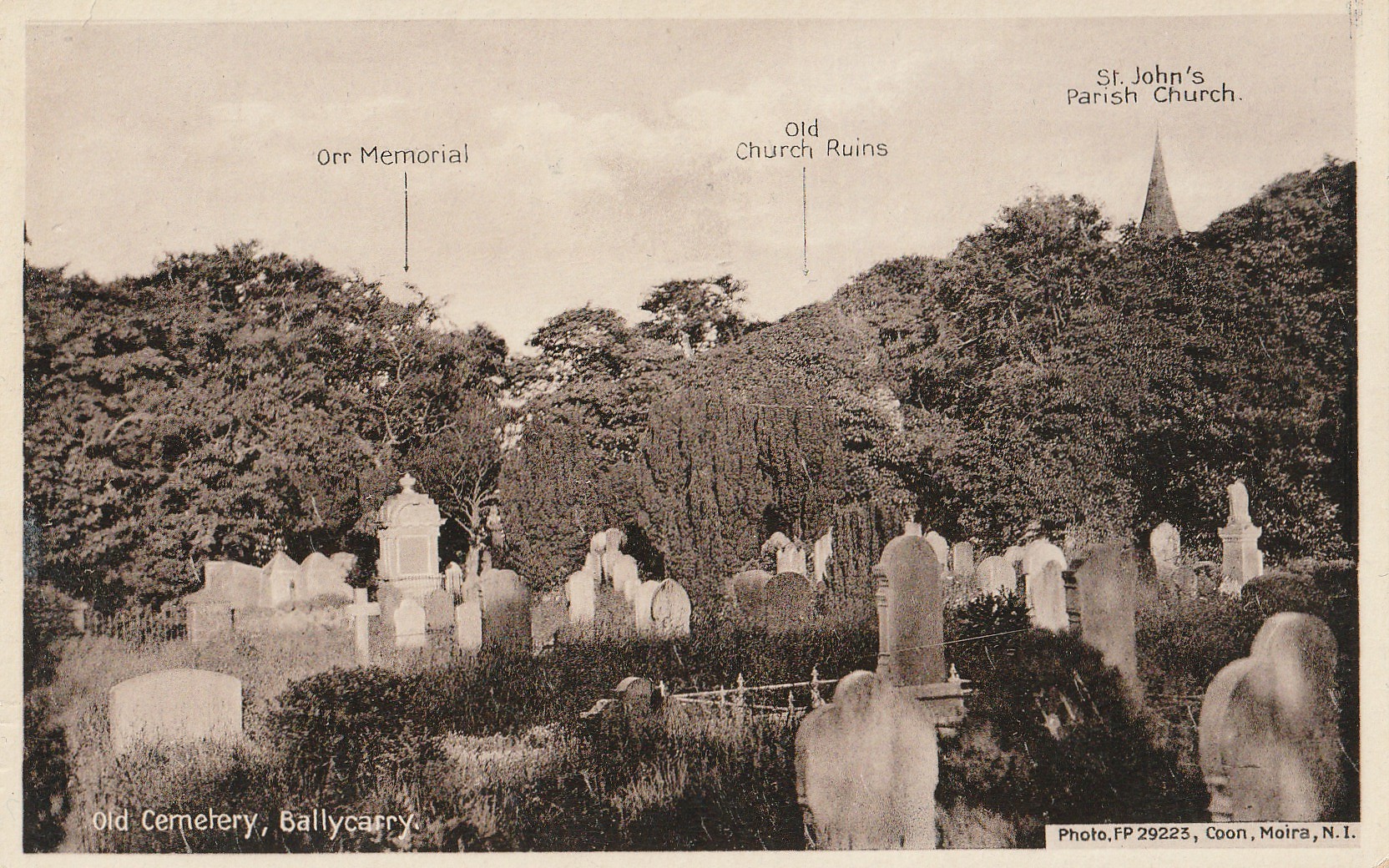
Old Cemetery, Ballycarry, 1929
This was produced for John McKee News Agent and Confectioner, Ballycarry, and is interesting because he has labelled different features of the graveyard, although you can only see the tip of the spire of St John’s Parish Church and can’t see the ruins of the old church at all as they are obscured by trees.
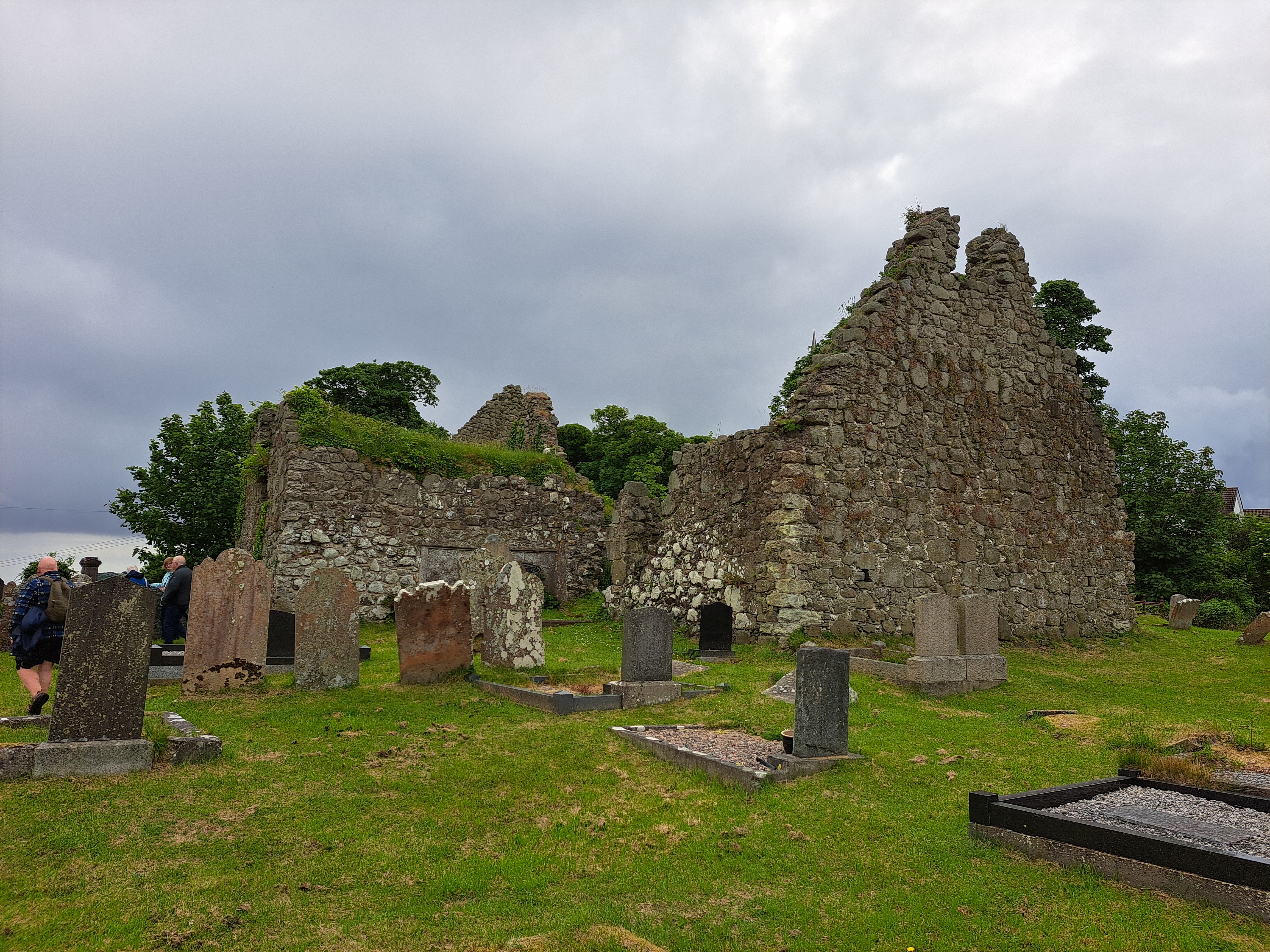
This is what the ruins look like today:
Ruins of Templecorran Church, Ballycarry
You can read about our recent visit to this graveyard here.
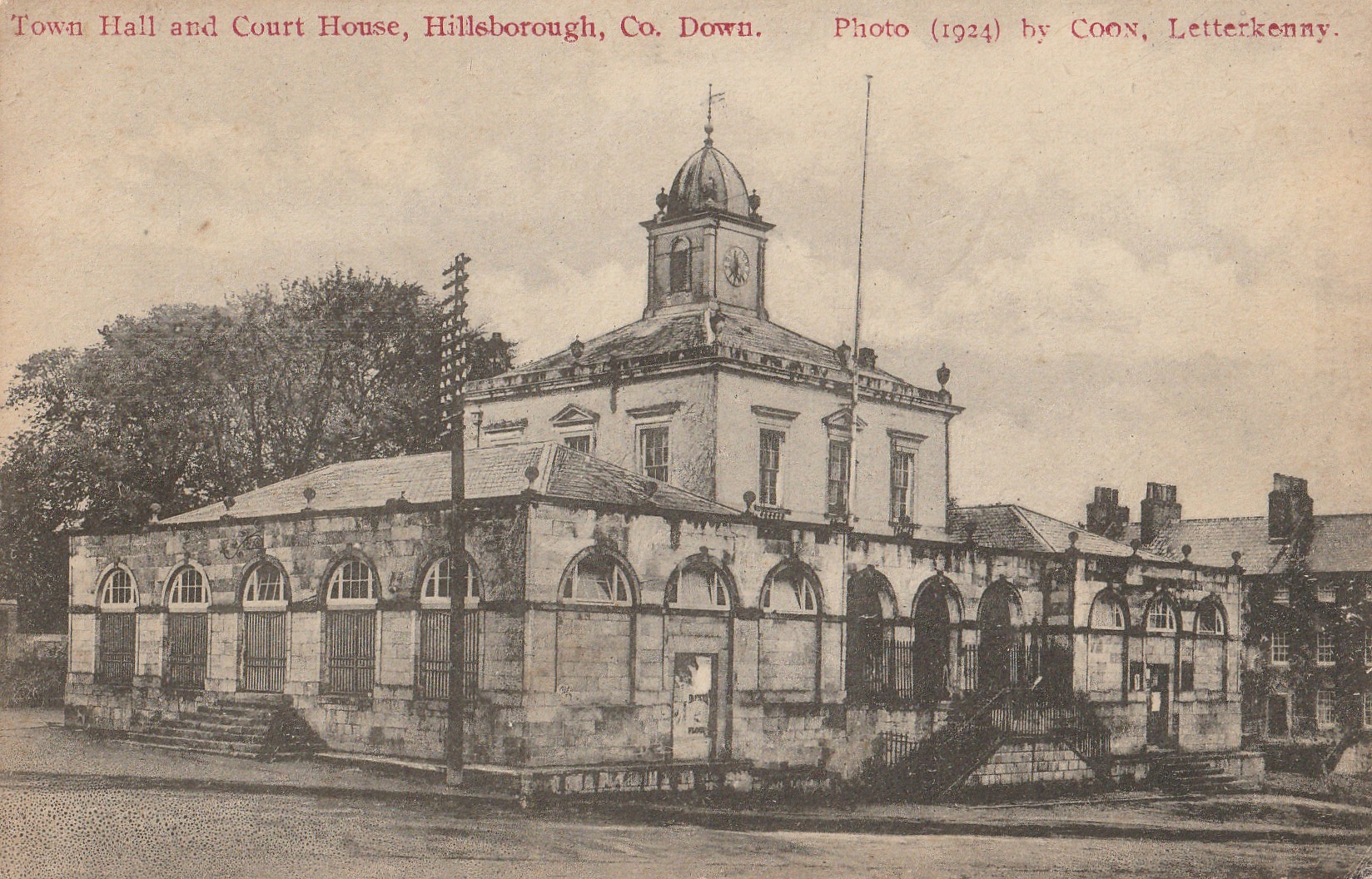
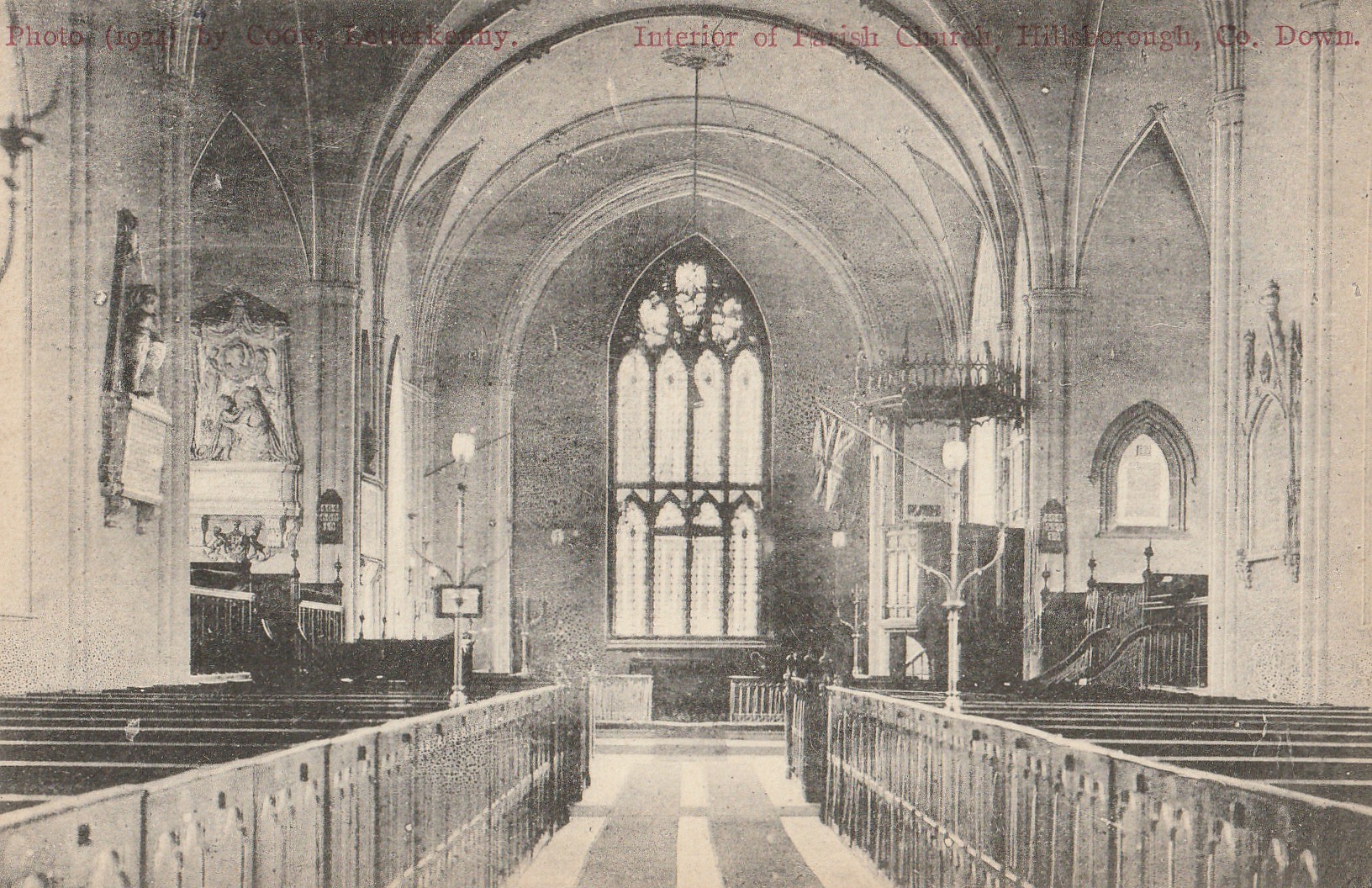
Allen Coon produced a lot of postcards for this part of County Antrim in the later 1920s, in this case giving his location as Moira, NI. Five years earlier his postcards produced for Mrs Johnston, Draper & Boot Merchant, Hillsborough still give his location as Letterkenny:
Town Hall and Court House, Hillsborough, 1924
Interior of Parish Church, Hillsborough, 1924
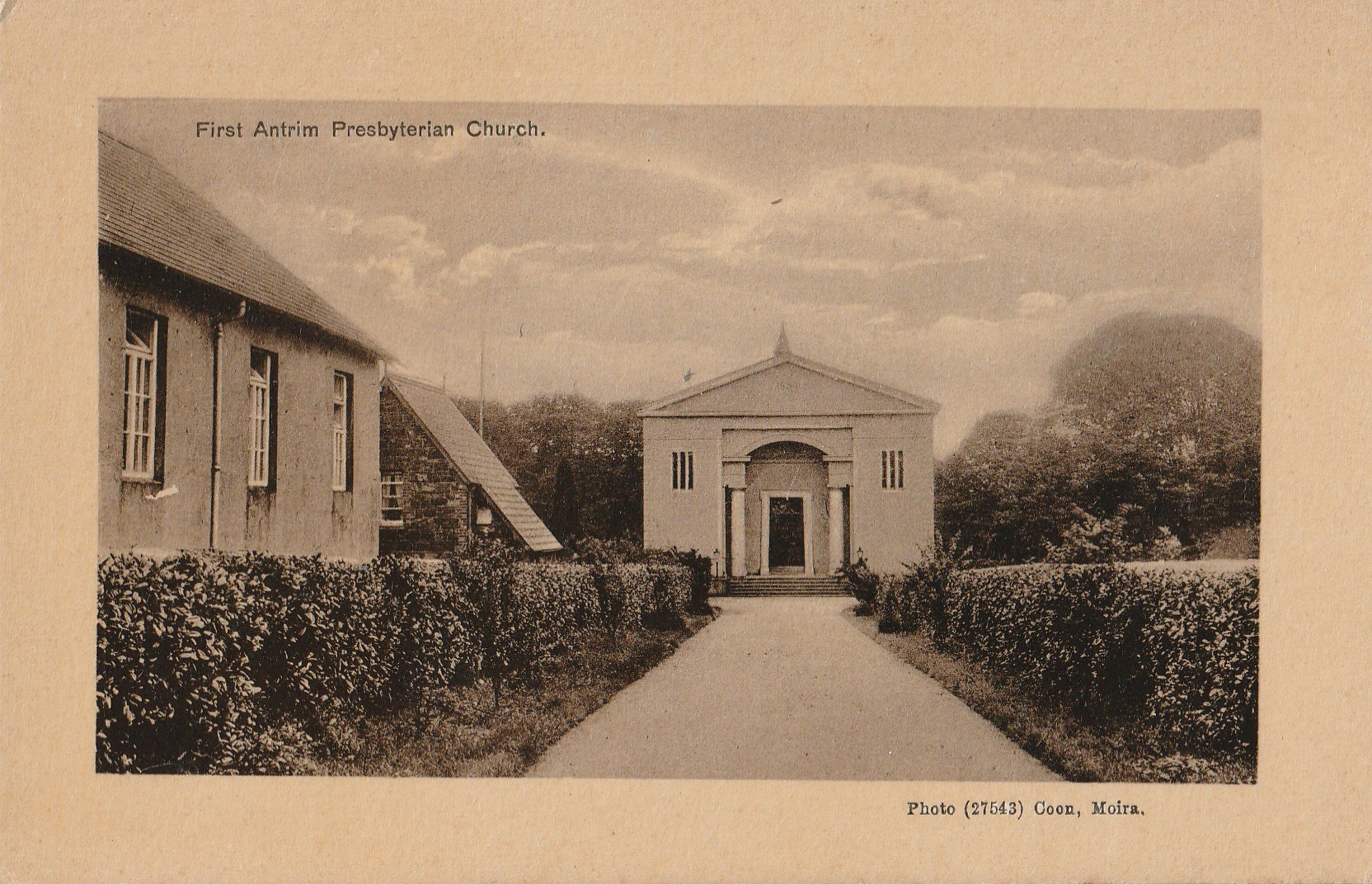
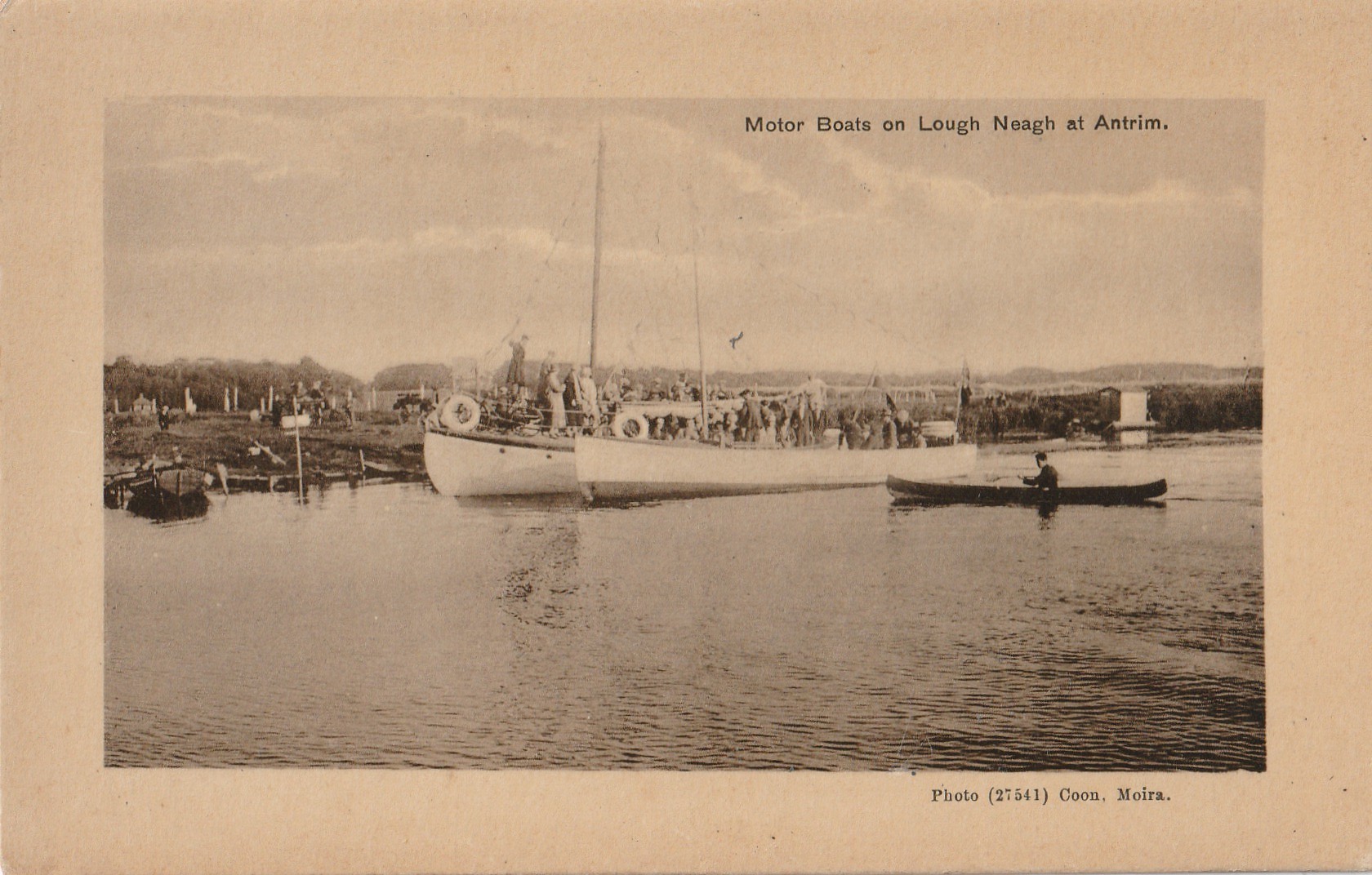
The cards produced in Antrim in 1927 stand out from the others having a large border and a glossy finish. This time they are published for Mrs Simpson, Newsagent and Stationer, Antrim, who must have wanted something different in terms of design. By this time he is well settled in Moira:
First Antrim Presbyterian Church, 1927
Motor Boats on Lough Neagh at Antrim, 1927
Presumably the motor boats were used as pleasure craft taking people on tours of the Lough.
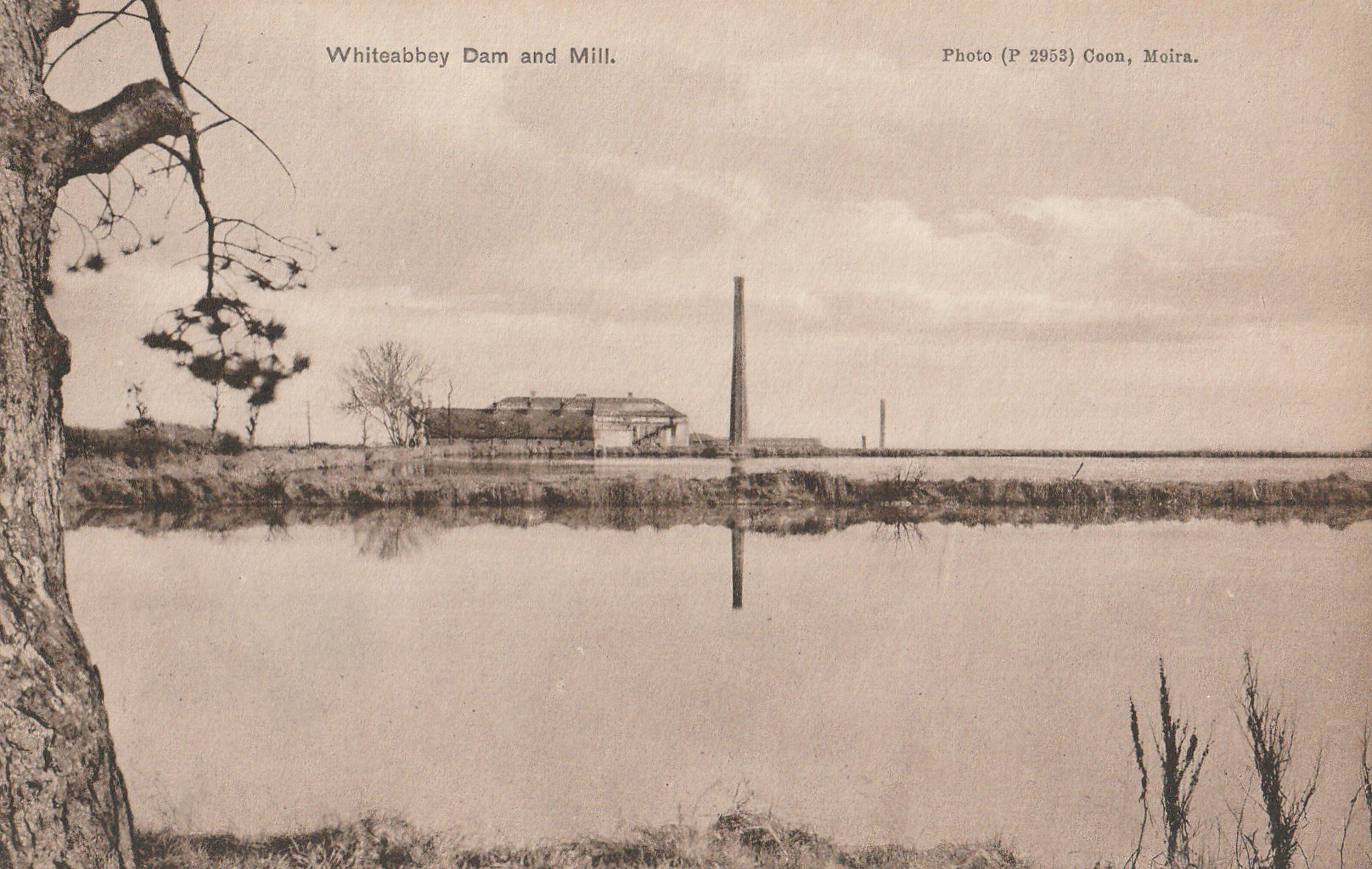
In Whiteabbey in 1929 he produced about 18 postcards for H. Quiery, Newsagent & Tobacconist. He must have exhausted all the possible views of the surroundings.
Whiteabbey Dam and Mill, 1929
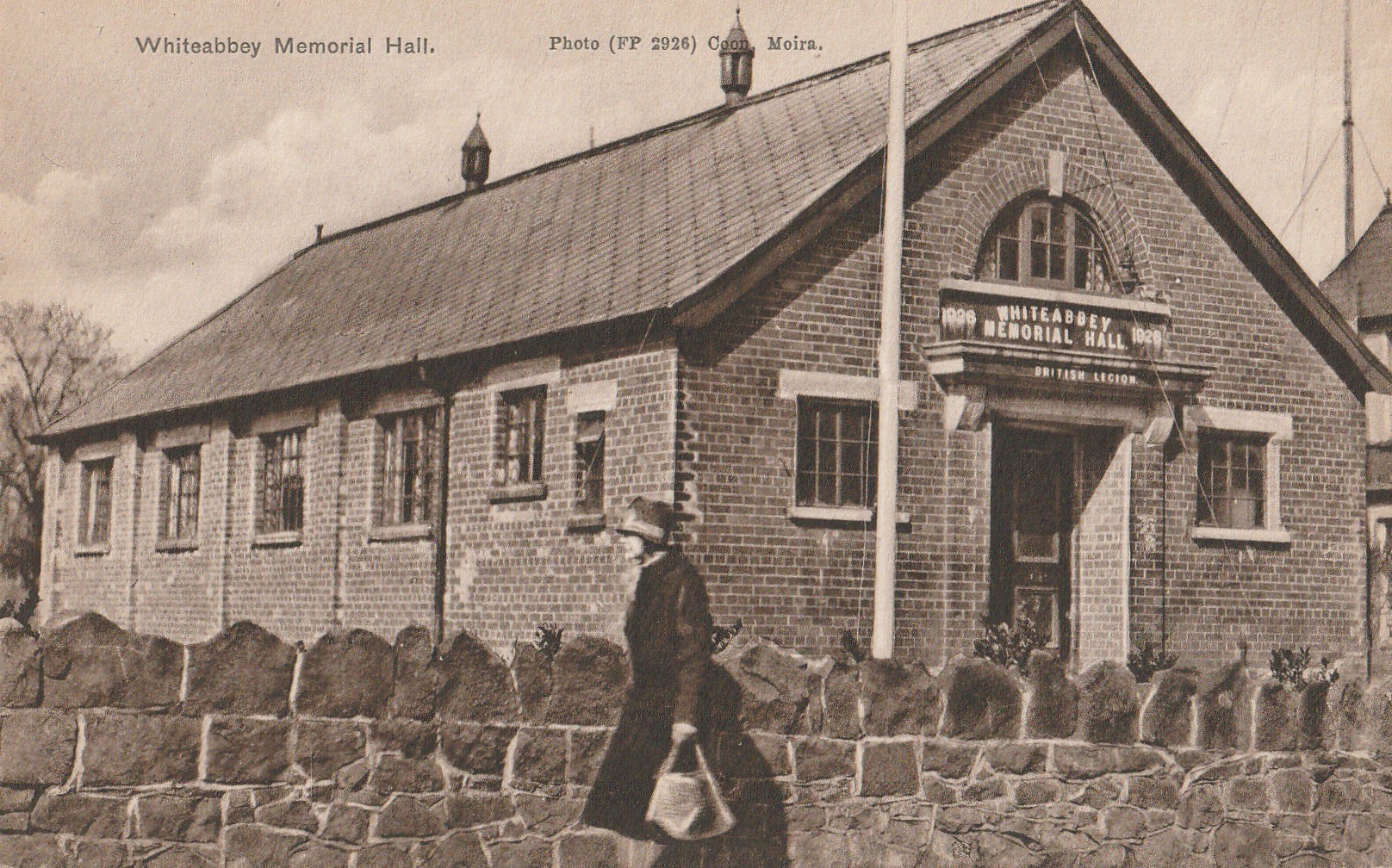
Whiteabbey Memorial Hall, 1929
A lot of Allen Coon’s pictures are straightforward architectural treatments of churches or halls. But this one is slightly different in that a passer-by boldly walks into shot in front of the Whiteabbey Memorial Hall (opened just two years earlier in 1927). Was this pre-arranged to add a bit of extra detail? Or did the lady accidently cross into the frame while he was standing there with his camera? If this was an unforeseen intrusion into his picture he must have liked the look of the finished article since he could easily have taken another one. But there she remains for posterity, out on her messages, captured on film.
The congregation of First Dunmurry has existed since around 1676. The first meeting house was an old lime kiln, later a meeting house was built in 1714, and this was eventually replaced with the present remarkable building of 1779. So the congregation is almost 350 years old and the building itself is 245 years old. Since 1839 the church’s nearest neighbour has been the railway. That is a long time to be neighbours. The railway has run alongside the Church for all that time. Of course, it has been run by different operators over the years, steam trains have been supplanted by diesel, it has even changed gauge at one point, but the Belfast to Lisburn line was created back in 1839, the station at Dunmurry being added at the same time.
Because of this proximity the railway has inadvertently helped create for First Dunmurry a small footnote in film history. In June 1897 the cinematographer Alexandre Promio came to Ireland on behalf of the famous Lumière brothers to make the first moving film in Ireland. He filmed in Belfast, including street scenes in Castle Place and on Queen’s Bridge, fire-fighters practising, and a few seconds of the first football match ever to be filmed, which was Glentoran v Cliftonville at the Oval in East Belfast.
He also filmed short sections of the rail journey between Belfast and Dublin. Cameras were cumbersome and had to be hand cranked. To capture movement they had to be pointed at crowds or some human activity or placed on a moving platform like a train or a tram. So the train was an obvious place to go and filming the view as the train pulled out of a station was a good way to catch a local view.
As the steam train chugged out of Dunmurry station, sometime in the Summer of 1897, Promio filmed the view and the result was a 37 second burst of film called Départ de Dunmurry. The opening few seconds shows an intensely industrial scene based around the long demolished mill, not immediately recognisable as the modern Dunmurry. By the end of the film we are into open countryside.
This new video enables us to compare the trail blazing film of 1897 with a contemporary film of the same view in 2024. Départ de Dunmurry 2024 enables the viewer to make that comparison:
Click on the video to seeDépart de Dunmurry 2024
We can reflect on what has changed over those 127 years between 1897 and 2024. In one way we have to marvel at the technological progress that has taken place. In 1897 film was in its infancy, cameras were cumbersome, very expensive and required a lot of skill to use. Alexandre Promio was an expert who had filmed all over the world, one of only a handful of people who could do that. Today I am just one of literally millions of people who has a phone that is also a camera which can take digital films in colour with sound merely by pointing it in the right direction.
Imagine if you could show Alexandre Promio a modern phone or a digital camera. He would be more astonished than we could imagine. So we might ask what will technology be like 127 years from now? It is impossible to imagine.
But in the film what do we see today that is different? Today there are cars, lots of cars, there is a significant quantity of graffiti, but actually more trees and more houses. We can notice too that the old steam train takes a bit longer to get up speed than the modern diesel one. You wouldn’t know just looking at the videos though that the railways were much more extensive in 1897 than today. There were around 5,630 km of railway lines in those days, more than twice what there is today, and you could go virtually anywhere in Ireland by rail then. You are restricted to very limited routes today, particularly in Northern Ireland.
But when you compare the two films from 1897 and 2024 one thing has not changed and that is our church. Indeed it has not changed in any big way since 1779 when it was built. As the train curves to the right you can look up Glebe Road and see the church in its prominent position on top of the hill.
It represents our faith, our witness, and though the world changes around us in so many different ways, what we stand for and what we do is always equally important. As we look out of the window of the railway carriage we can see the changes and notice too our Church, the one constant in an ever changing world.
We also have another new video uploaded to YouTube. Non-Subscribing Presbyterian Reflections on Spring, Pentecost, and Psalm 104 from the newly refurbished Session Room and the grounds of First Dunmurry (NS) Presbyterian Church. With the Rev Dr David Steers, minister, and Allen Yarr, organist:
Back in January 2023 I posted a piece about a postcard of Dunmurry which showed the classic view of the church built in 1779. It was published in Lisburn by F.W. Harding and posted in November 1906. This is the picture:
As I mention in that post, postcards of Non-Subscribing Presbyterian churches are not that common. I have seen the 1906 view before and there is also a much later one but I was pleased to discover another postcard featuring the church, this one new to me:
This dates from a little later and although it is taken from a less popular vantage point in many ways it gives a much clearer view of the building. This card was published locally by ‘W. McCartney, Stationer and Tobacconist, Dunmurry’ in the ‘Signal Series’. It has at the bottom left hand corner the title ‘Unitarian Church, Dunmurry’ and was never posted. On the back, however, it is dated May 19th 1919 and has a message to an unnamed recipient which reads ‘With best wishes for your welfare from the People of Dunmurry and district from W. Laursen’. The name is actually a bit hard to make out but that is my best guess.
In a way it is a clearer picture than the 1906 view, being a Real Photograph, if a little damaged. But the view is not obscured by trees and you can clearly see the large amount of ivy that was then being allowed to grow over the left hand door. This is actually also present on the 1906 view although it is hard to make out behind the tree.
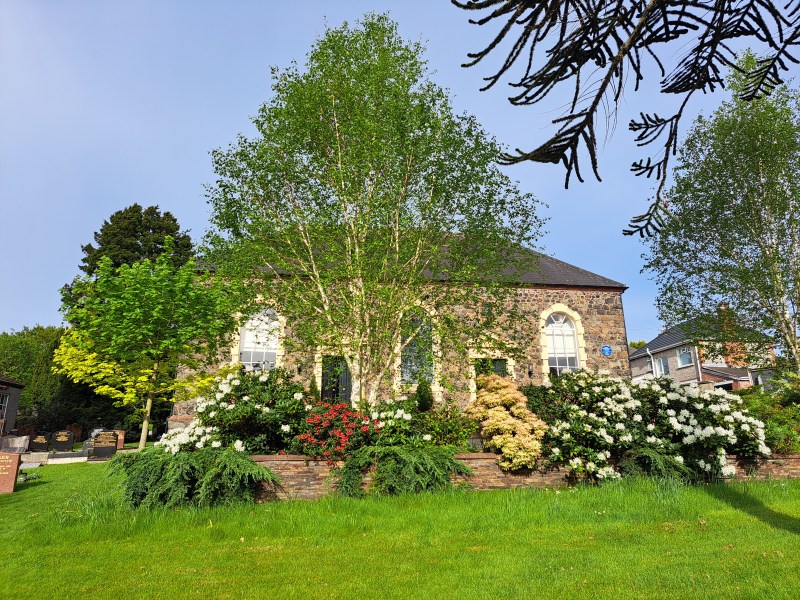
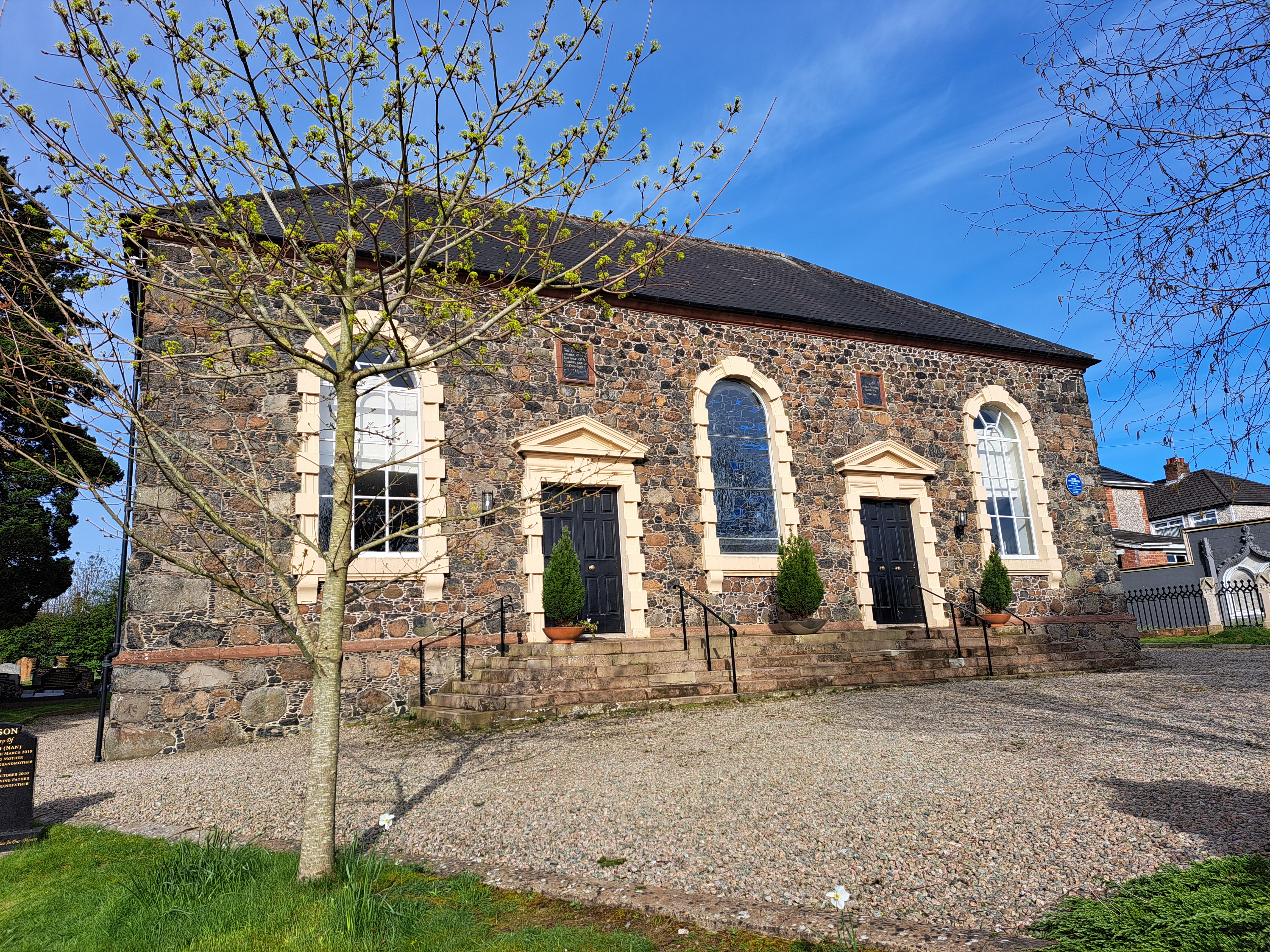
A modern image from more or less the same angle, taken a couple of weeks ago, shows the same view:
The view of the church hasn’t changed between 1919 and 2024. There are now houses along the side which weren’t there but the splendid building of 1779 is reassuringly the same.
I am not sure how many Non-Subscribing Presbyterian Churches had postcards produced featuring the meeting-house in Edwardian days. Not all of them I would guess but I have a good few examples and have blogged about a few of them including Downpatrick, Newry, Banbridge, All Souls’ Belfast (including one that quite clearly is not All Souls’), and Crumlin. There are others such as Clough and Dromore which I have seen but not acquired, but recently I was pleased to pick up a picture of Dunmurry.
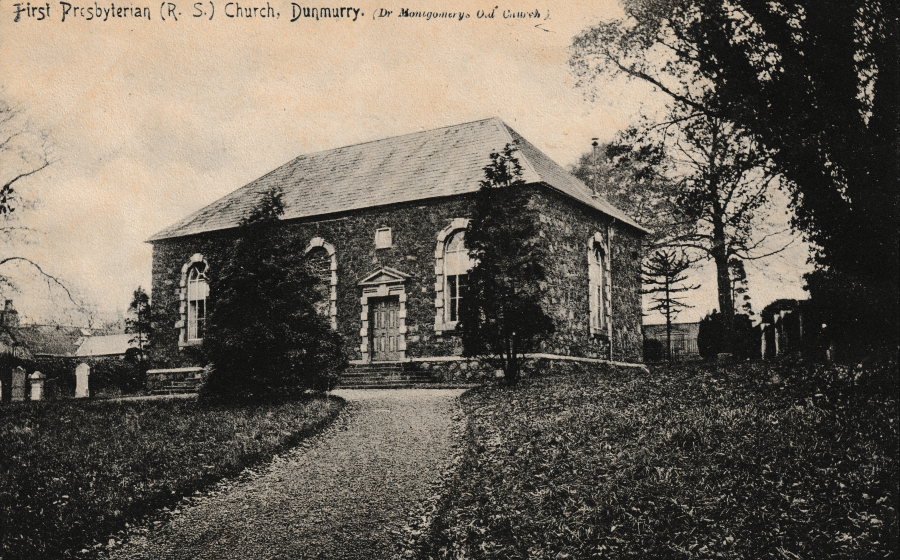
Dunmurry postcard
Labelled First Presbyterian (R[emonstrant] S[ynod]) Church, Dunmurry, (Dr Montgomery’s Old Church) I have seen this card offered for sale before but I am pleased to at last track one down. Published by F.W. Harding of Lisburn this card was posted on 12th November 1906 to Miss Browne in Aghalee, ‘M.B.’ writes to ‘Maggie’ telling they her they are still waiting for a letter from her but hope to see her soon.
We can compare it with a modern view, taken from more or less the same position last week and see that, of course, although some of the graves, the trees and planting around the church have changed the view is essentially unchanged.
Dunmurry January 2023
In January we filmed some short reflections in the church featuring Allen Yarr on the piano. The video can be seen here:
January Reflections
Reflections for the month of January with the Rev Dr David Steers, minister, and Allen Yarr, church organist. Music: ‘When I survey’, ‘Music for the Royal Fireworks’
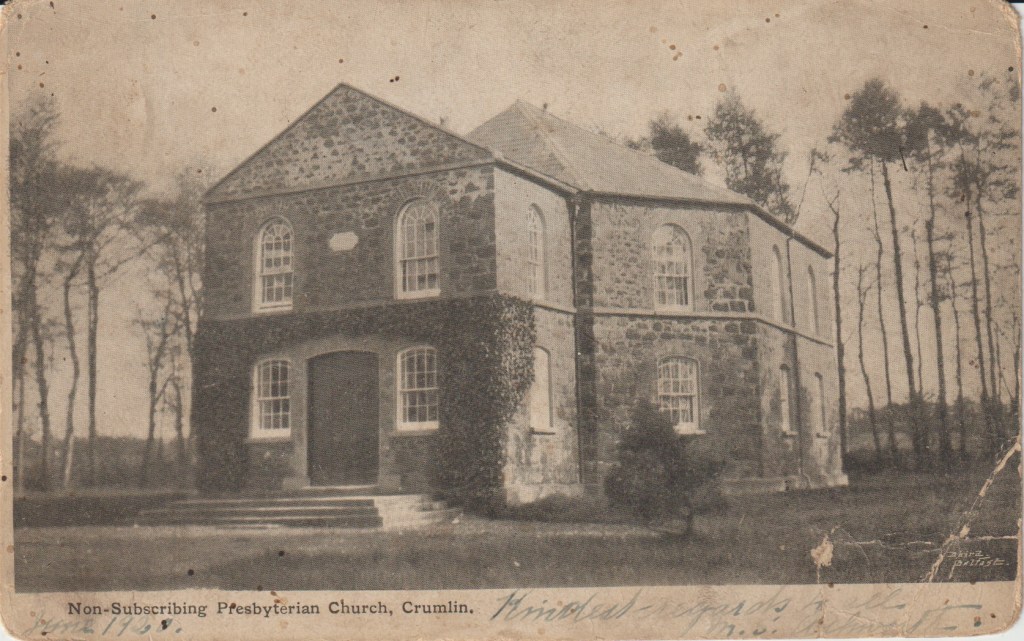
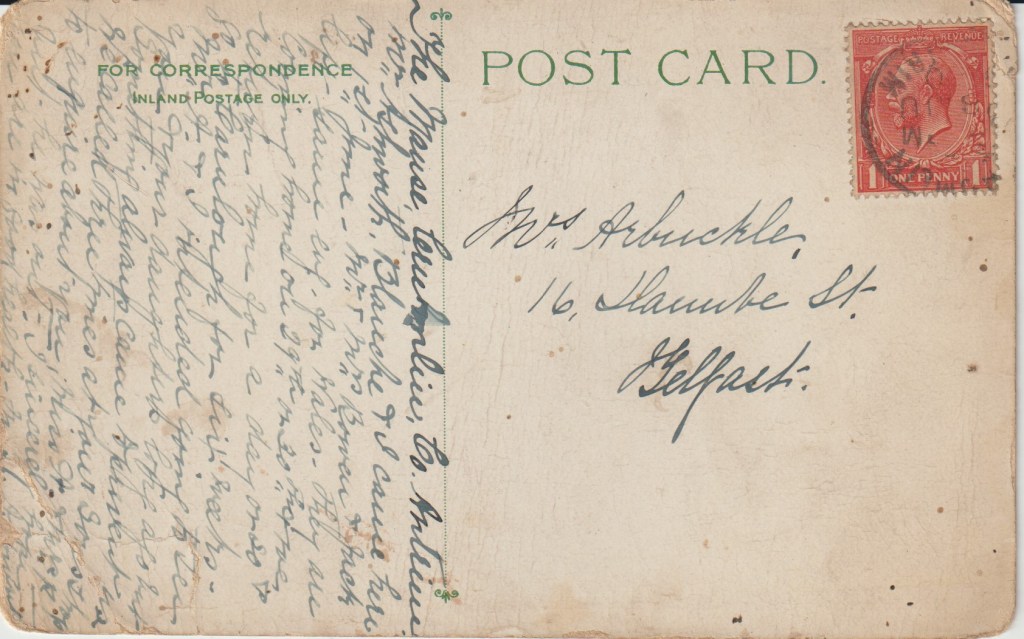
I purchased this postcard on eBay recently. It is not in great condition but it is a fairly rare example of a Baird of Belfast postcard of the Non-Subscribing Presbyterian Church at Crumlin. It came with added interest because it was sent by Mrs Ashworth to her friend Mrs Arbuckle of 16 Danube Street, Belfast in June 1908. The message gives us a little glimpse into Non-Subscribing Presbyterian church life in 1908.
Mrs Ashworth, the author, writes in friendly, yet also fairly formal tones to Mrs Arbuckle. Mrs Ashworth (as she describes herself) was the wife of the Rev Alexander Osborne Ashworth minister of York Street Non-Subscribing Presbyterian Church at the time. She refers to her husband only as Mr Ashworth in her short note although also mentions a person called Blanche who appears to be their daughter. They are also staying in the manse at Crumlin. ‘Mr Ashworth, Blanche and I’ came to the manse on 1st June, ‘Mr & Mrs Bowen & Jack’ left the same evening for Wales where they would remain for most of the month before returning for a six week stay at Carnlough. Prior to sending the card the Ashworths had made some unsuccessful attempts to meet up with Mrs Arbuckle and her family.
It’s not possible to identify the Mrs Arbuckle, but there is a good chance that she was a member of York Street Church, indeed there was a Mary Arbuckle living on York Street itself in the 1901 census and Danube Street is certainly within the catchment area of York Street Church.
Most of the contents reveal mundane domestic arrangements involving three Belfast families over 110 years ago. But knowing that two of those families were the families of NSP ministers and the fact that it was all written on a postcard depicting Crumlin Church enables us to put some flesh on the bones of this brief correspondence.
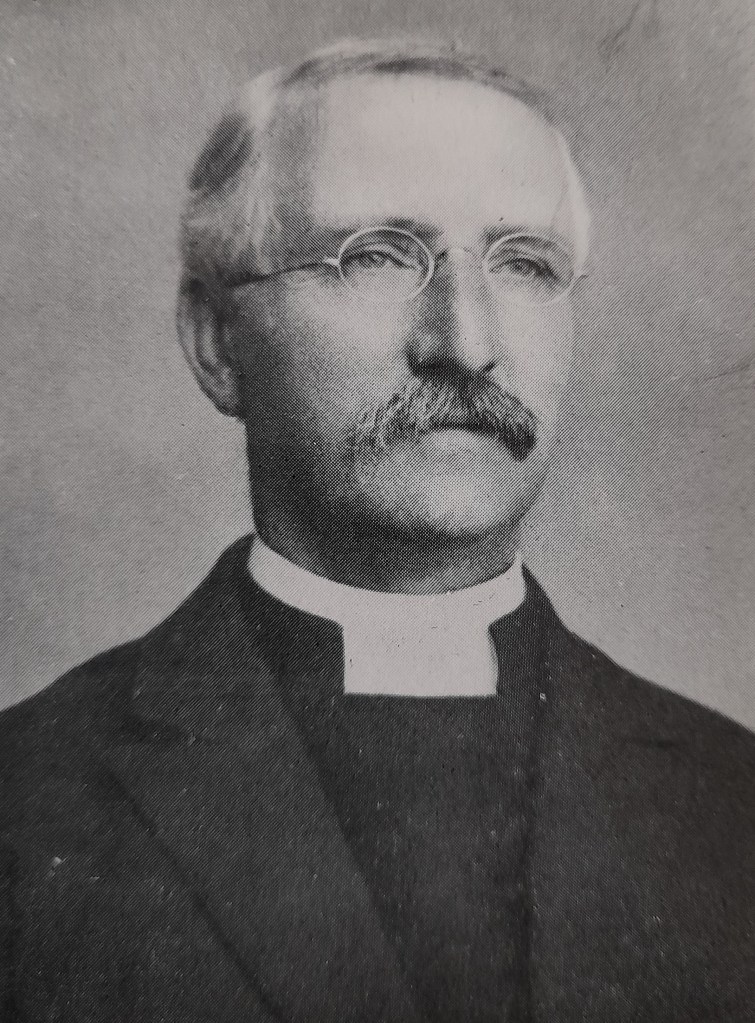
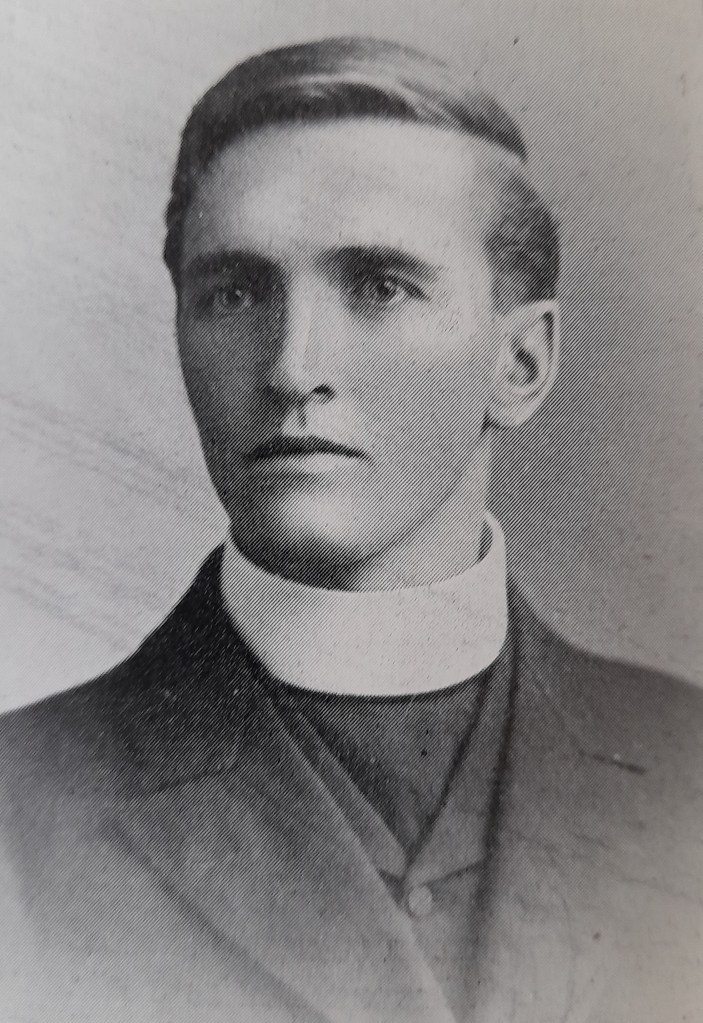
Mr and Mrs Bowen were the Rev Samuel Evans Bowen and his wife. S. E. Bowen was called to be minister of Crumlin in 1908, he was ordained later in the year on 3rd September by the Presbytery of Templepatrick. It may be that Alexander Ashworth and his wife were preparing the manse for their arrival, although he was clerk of the Presbytery of Antrim at that time and was still minister of York Street until 1909 when he retired, although he continued as a very active senior minister until 1913 and remained active in his denomination for many years afterwards until his death in 1935. Ashworth was born in the Rossendale valley in Lancashire in 1846 and trained at the Unitarian Home Missionary College. He came to York Street in 1893 after previous ministries in Chatham, Stalybridge, Doncaster and South Shields. For many years he was also the Sunday School Convenor for the Non-Subscribers. This job was no sinecure, in 1909, for instance, he organised the Annual Sunday School Conference at Downpatrick, an event which attracted 450 participants.
Rev A. O. Ashworth in 1909
The Rev Alexander Ashworth is probably hardly remembered today, for one thing the church where he had his longest and most significant ministry was destroyed in the blitz of 1941, but he gave devoted service in many different ways for decades.
Rev S. E. Bowen in 1908
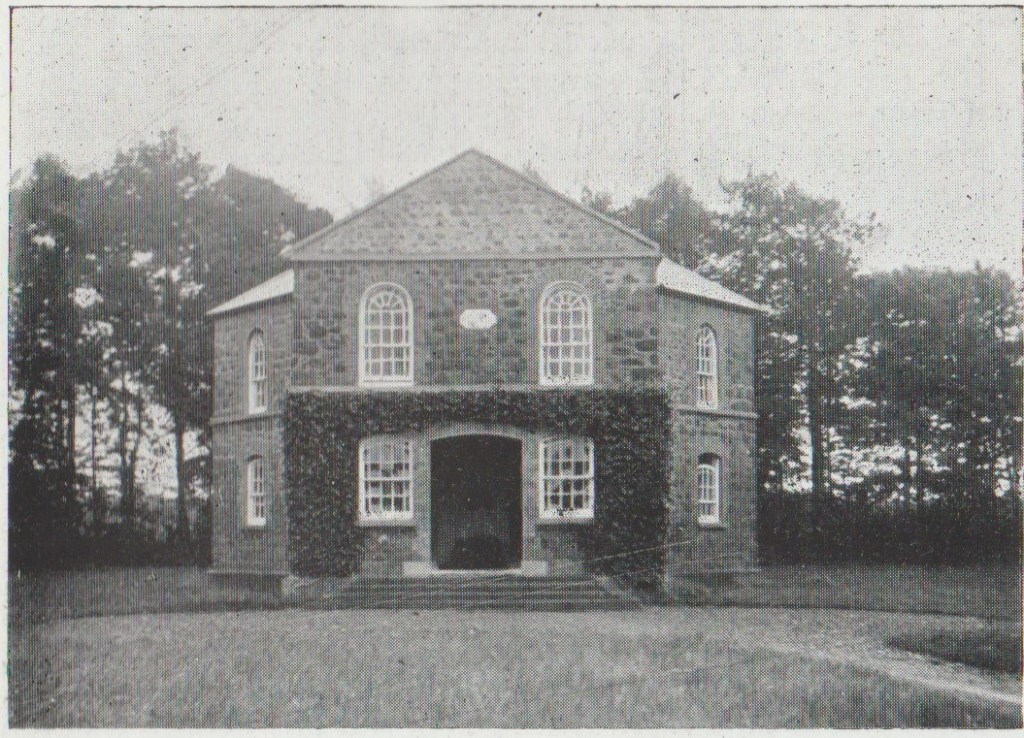
The same was true of S.E. Bowen. Another former student of the Unitarian College in Manchester he was minister in Crumlin for over twenty years (to 1929) before returning to his native Wales to minister at Allt-y-placa, Capel-y-bryn and Cwm Sychbant for 27 years. But with this postcard we get a view of the Crumlin meeting-house. Judging by the trees it is of a similar, although not identical, vintage to the photograph that appeared in the Non-Subscribing Presbyterian magazine in October 1908 to accompany the account of his ordination. In both pictures the ivy seems to be contained in identical positions but the postcard shows a small tree or bush to the right of the church which is not there in the magazine image. The postcard could be quite a few years older than the other photograph.
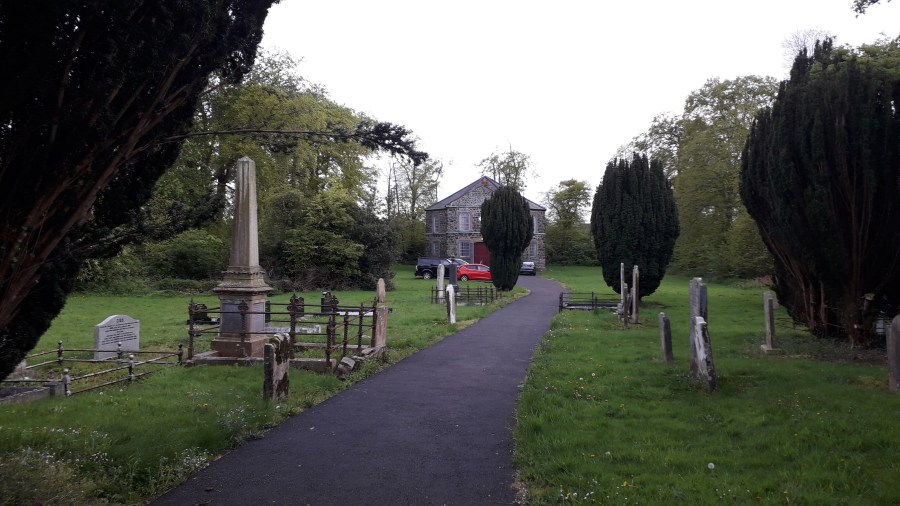
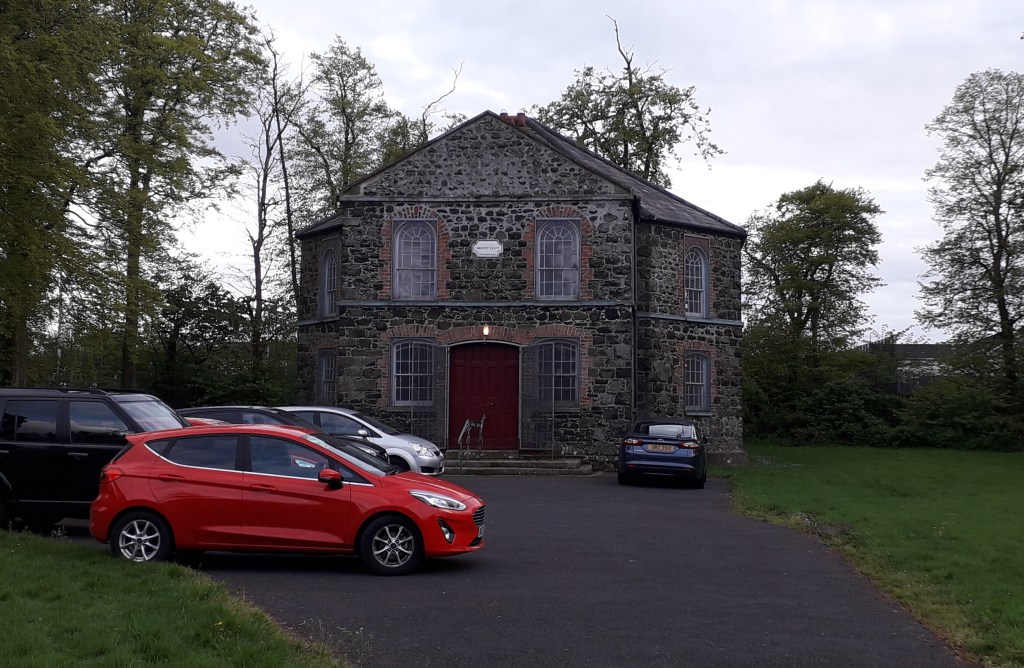
The Crumlin meeting-house is fairly secluded and can’t be seen from the main road. Built in 1835 it replaced an earlier church of 1715. It is a miniature replica of Belfast’s First Presbyterian Church designed by Roger Mulholland. It is interesting that the congregation of Crumlin took that building as a template for their new church over 60 years later.
Crumlin in 1908 (NSP Magazine)
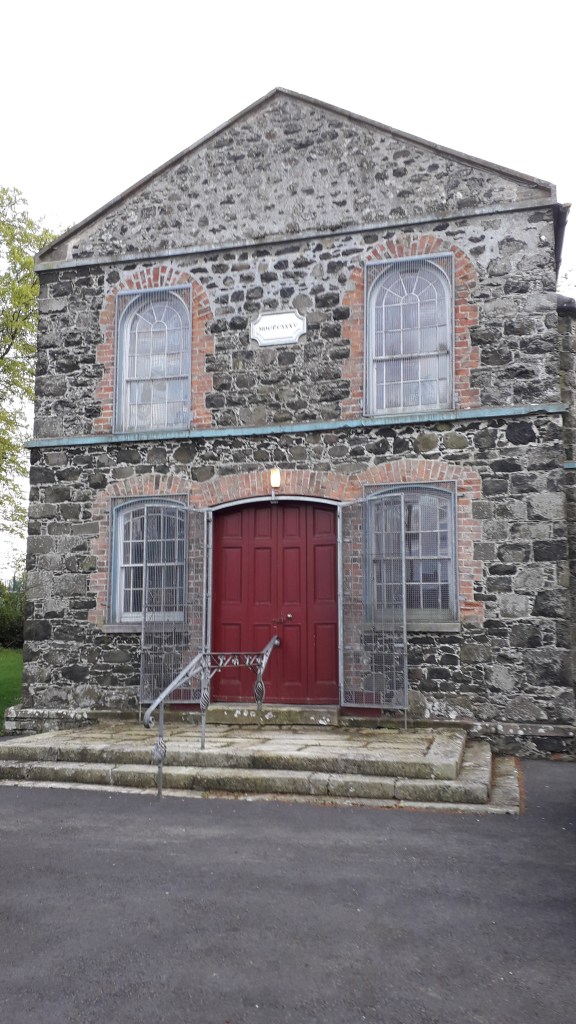
Crumlin in 2019
Whenever I try to take an architectural photograph I always aim to get a shot of the building without the distractions of either people or vehicles. I wasn’t able to do this with this picture of Crumlin taken in the autumn of 2019. The foreground is crowded with cars. But in the long term a photograph of something like a church which includes other details that date it actually makes it more interesting to the viewer. But if I was going to compose the cars for a photograph I wouldn’t park them like that!
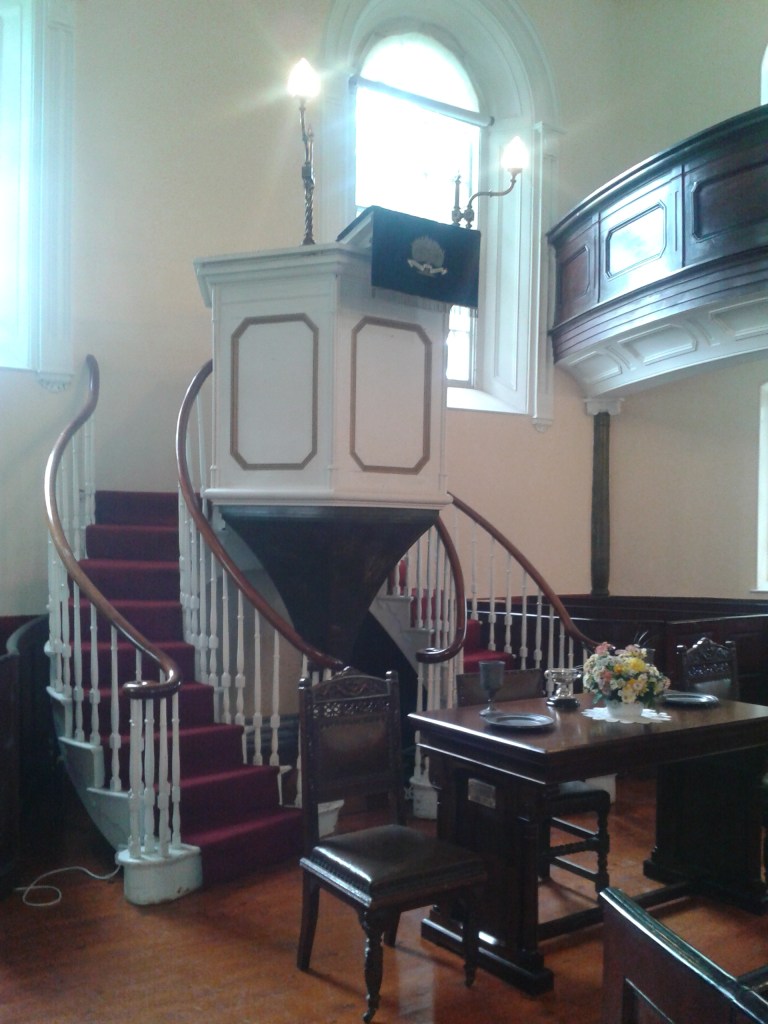
The interior of Crumlin has an elegant charm.
Pulpit
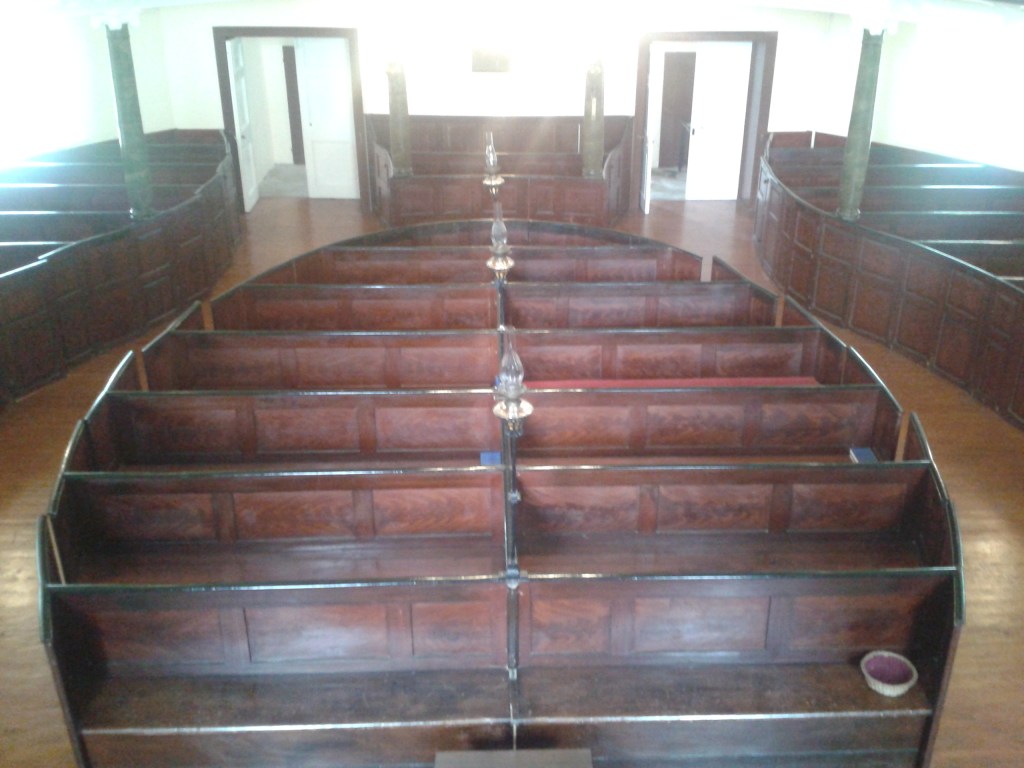
Pews
The account of S.E. Bowen’s ordination published in the Non-Subscribing Presbyterian magazine is quite full and interesting. In the service the Rev S.E. Bowen said that ‘Unitarians were a people who believed not so much in attempting a definition of religion as in working for truth and liberty, being bound together by a profound belief in the Fatherhood of God and the brotherhood of man.’ Later, over the welcome dinner there were a number of speeches given. Representing the Presbytery of Antrim the Rev W.S. Smith told the whole congregation to pick a day in October and arrive at the manse with a spade ready for three hours of work, leading the author of the report to note that the manse garden must ‘to say the least, be inferior in condition to the Garden of Eden when it was given to the father of all living to dress it and keep it’. The Rev Alexander Gordon was also there speaking highly of S.E. Bowen as a former student of his. He also related how he had recently been in the south of France and attended worship in a Protestant congregation there where the service was conducted by a young man in a congregation that only numbered sixteen, ‘yet he had been favourably impressed with the manifest consciousness of the congregation that they had come to worship, and with the energy and the earnestness of the preacher.’ It made me wonder what else Alexander Gordon did in the south of France in the summer of 1908, I can’t imagine that he just went there to sunbathe.
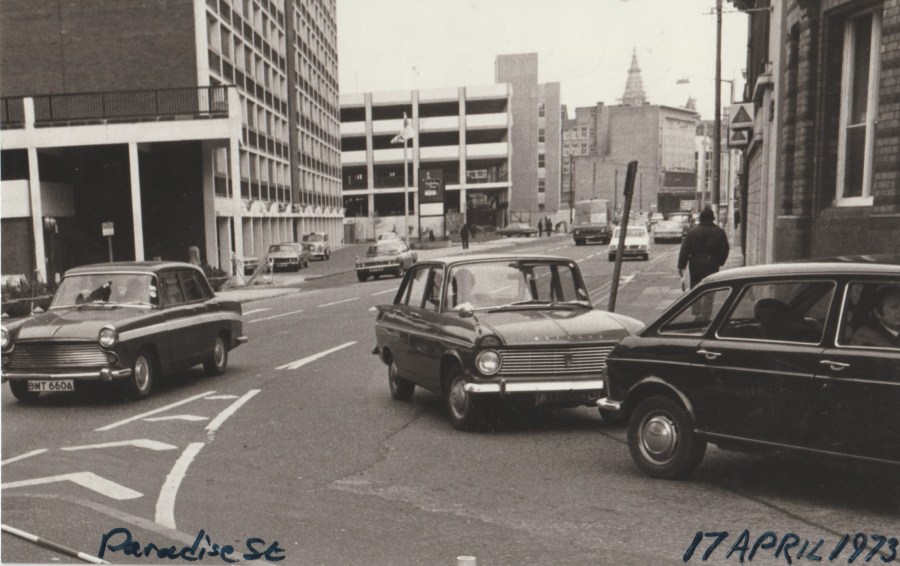
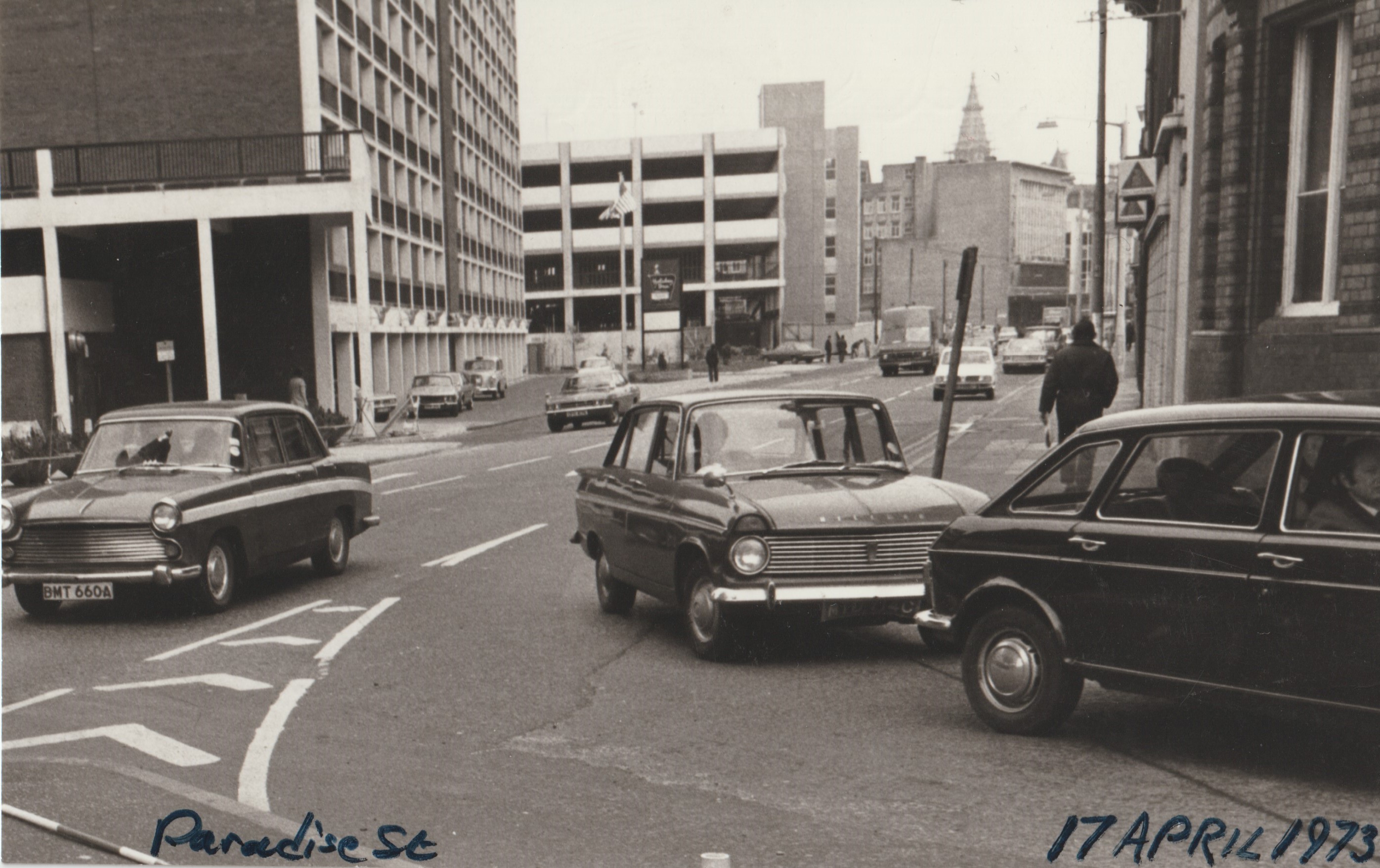
I bought this black and white print of a view of Paradise Street dated 17 April 1973 for a small amount on eBay recently. I was interested in seeing it because Paradise Street as it was before the building of the Liverpool 1 shopping development has been so completely obliterated. It is today forgotten and it takes some effort to recall it to mind. Not that Paradise Street in the 1970s deserves to loom large in anyone’s memory, even at the time it had the feeling of something like a backlot to the city centre, a place where there was nothing much to see, a place that existed as an adjunct to the streets and places that mattered.
A lot of it was car parks and this picture clearly shows the new multi-story car park which was then just being completed in 1973. A brutal and functional building, it wasn’t very pleasant although it was handy enough. Its contemporary neighbour the Holiday Inn, seen on the left of the photograph, was little better to look at. But the multi-story wasn’t the only car park on Paradise Street. On the opposite side of the road, not visible in the picture, was a street-level car park complete with parking meters. I can’t be the only person straining to remember this entirely forgettable piece of streetscape because another photograph of Paradise Street featuring the corner of the street-level car park sold just after this one on eBay for about £5. But that car park must have been somewhere near the site of the Paradise Street chapel of 1791.
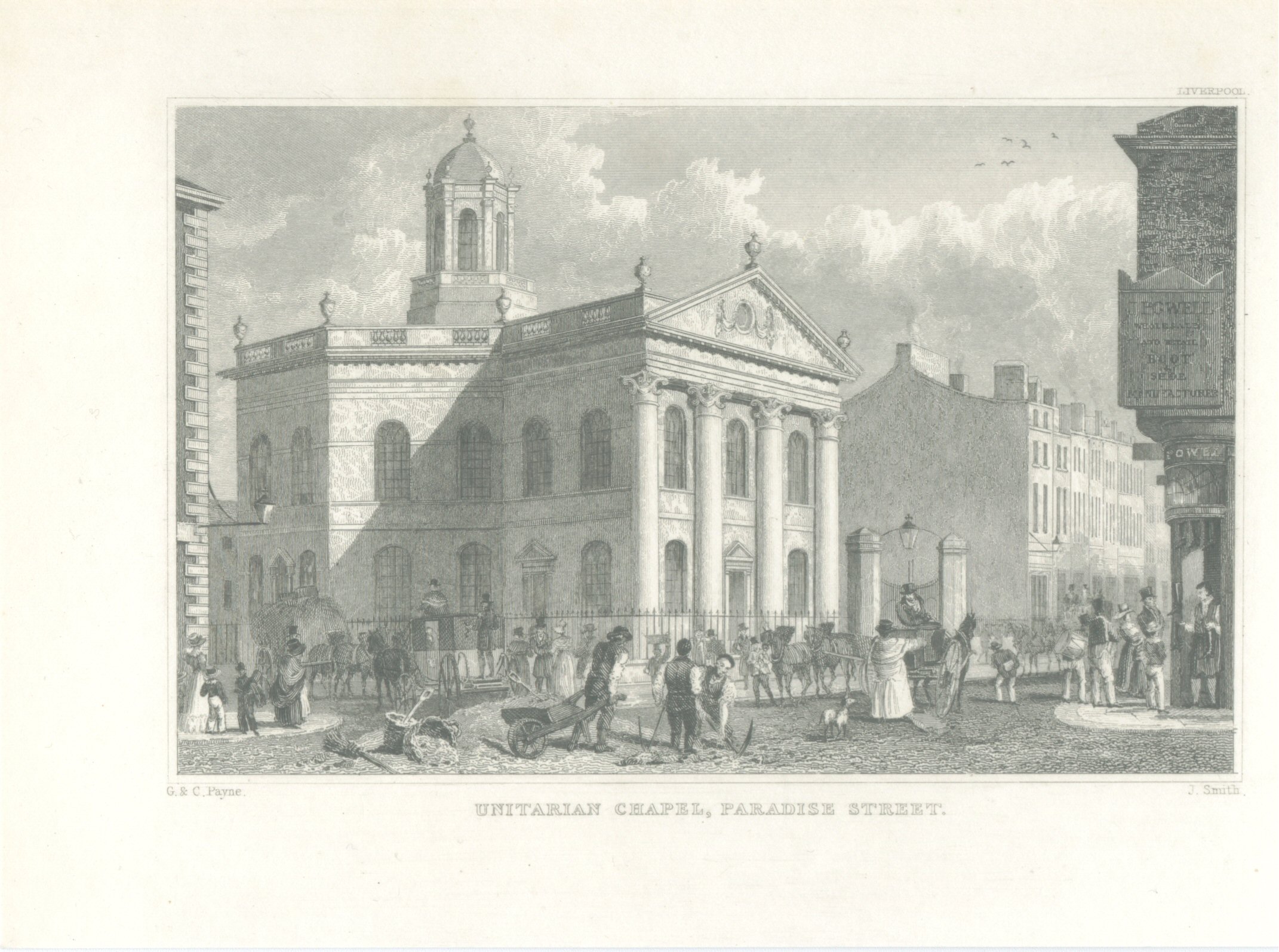
Paradise Street, Chapel
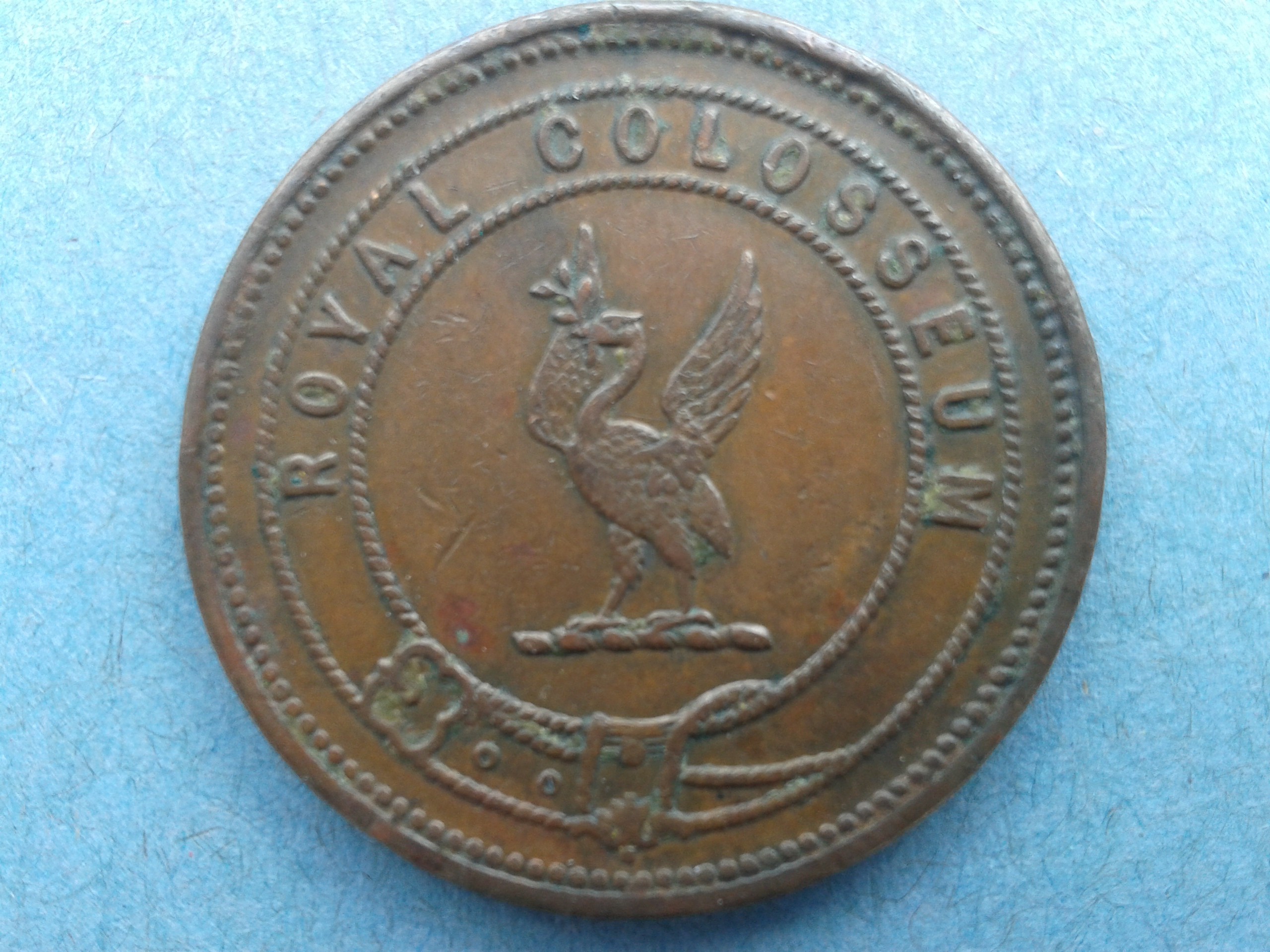
I have written before about this chapel which had an unusual history and ended up as a music hall. To some extent it enshrined the fortunes of this city centre street – from a well to do residential neighbourhood with its fashionable chapel and the home of the first US consul, to a seedy street with a licentious and dangerous reputation. Later still it became a commercial area (and the old chapel a warehouse) and later still Nazi bombs in 1941 finished off what was left and prepared the ground for the 1970s car parks and cheap hotels.
Click on the above image to read about the history of Paradise Street Chapel/Royal Colosseum
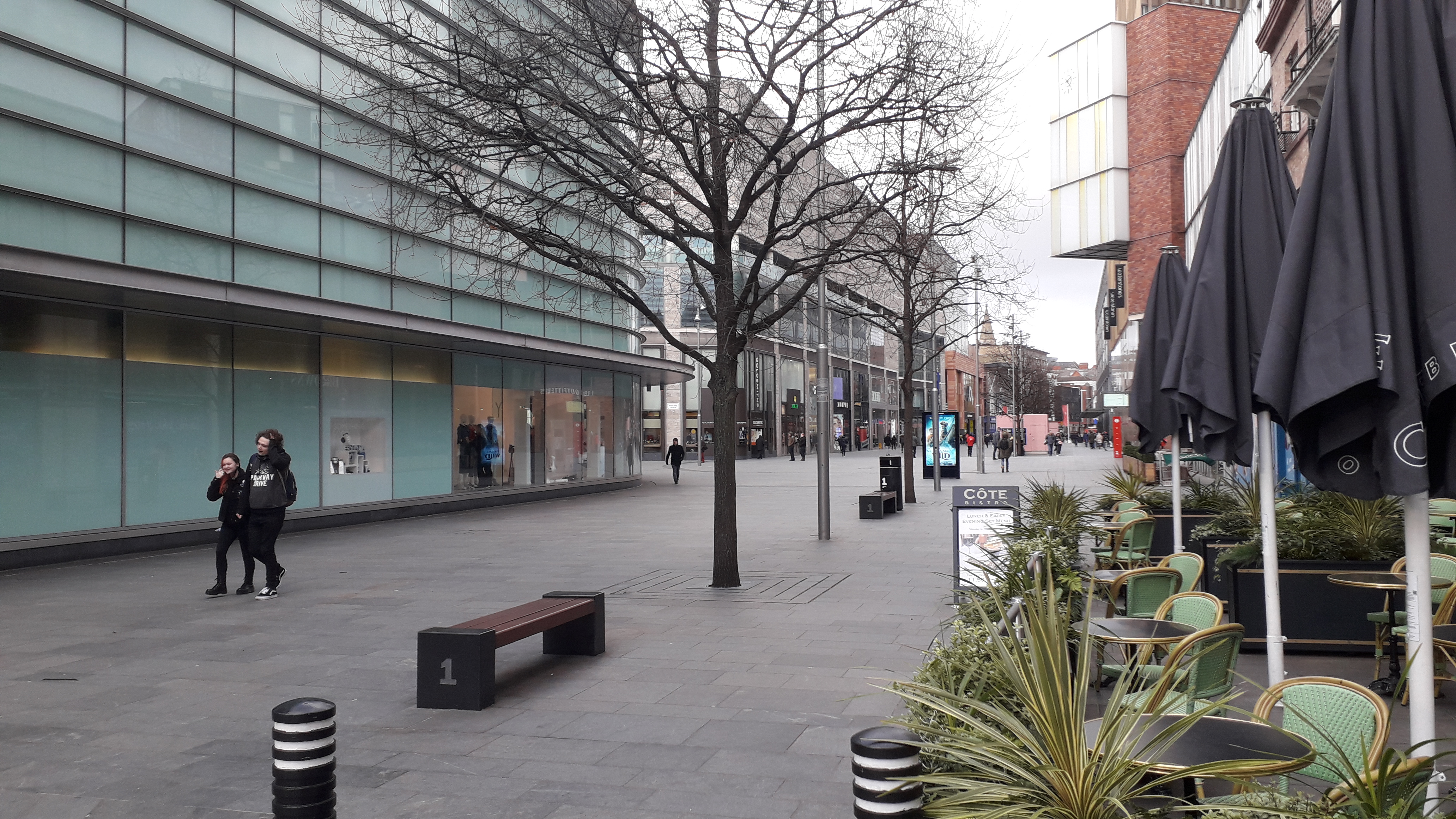
So let’s compare then and now views of Paradise Street.
Paradise Street April 1973
Paradise Street February 2020
The only buildings which remain are at opposite ends of the road. On the right in the 1973 picture is a red-brick building and the Eagle pub. The red-brick building is still there and is today a tapas bar, but you can’t take a picture from the same spot because there is so much furniture outside. Just visible next door is what was the Eagle pub, originally the US Consul’s house and which still carries an American eagle above the front door. Everything else has been redeveloped except for the post-war building at the far end of the street behind which the tower of the Municipal Buildings on Dale Street can still be seen. This was for many years Horne Brothers, the gentleman’s outfitters. In my youth I had to be a customer there because they had a monopoly on the provision of uniforms for my school. An at least annual visit there was inevitable. But I had another connection with Horne Brothers in that I was sent to the barbers shop in the basement to get my hair cut. This was done by Mr Cannon, one of the team of barbers who worked in the gloom of the basement. You had to make an appointment and my appointment was always with him. Unknown to me then it was Mr Cannon who first cut the hair of the Beatles. In volume one of Mark Lewisohn’s excellent book All These Years he tells how when Brian Epstein took over their management he sent them to Mr Cannon to get their first Beatles hair cut. Had I known anything of this back in the 1970s I would have asked him about it, but such things were of little general interest in the 70s. But although the building is still there Horne Bros has long gone, it was turned into a McDonalds years ago.
No pictures or text may be reproduced from this site without the express permission of the author.
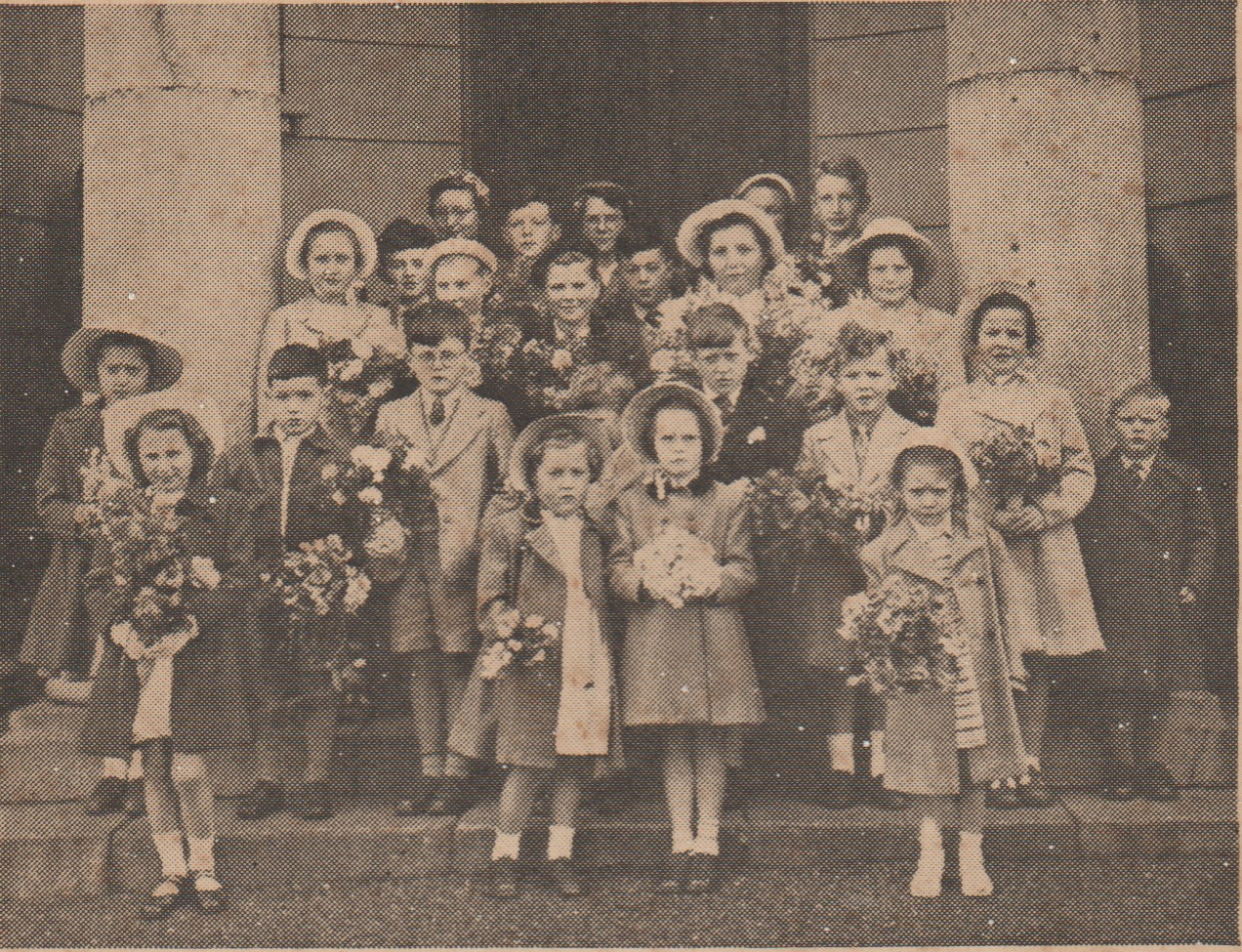
James Robinson lent me this Calendar from Clough dating to 1956. As the caption says it shows the Sunday School before the Flower Service in July 1954. I think the Rev George Buckley made a Calendar for each year he was minister of Ballee and Clough and I will search out any more of them that we can post online. But this one is particularly interesting because it shows the members of the Sunday School. The Flower Service was an important annual service in Clough in those days and many members remember it. Mr Buckley took the picture one year and used it in the Calendar eighteen months later. I am sure everyone in the photo can be identified and a great many of them are regular attenders in the church to this day. It would be nice to put a name to each of the children so that we can post those online too.
Downpatrick: Then and Now
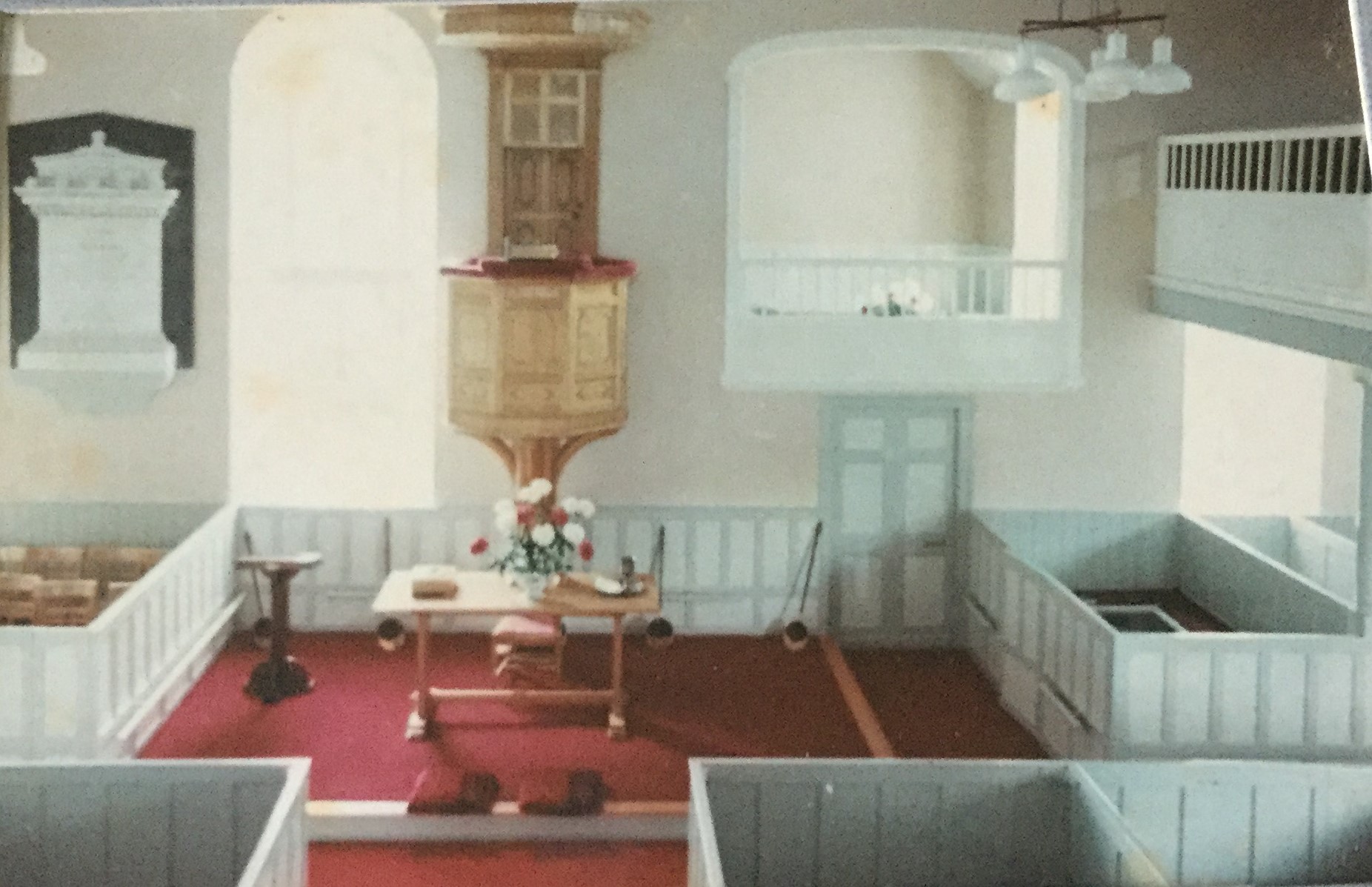
I am grateful to Mary Stewart and Thelma Lowry for the next image which is of the interior of Downpatrick in 1967 immediately following its previous renovation and redecoration in the 1960s. This picture was taken on the day of Thelma’s wedding in the church:
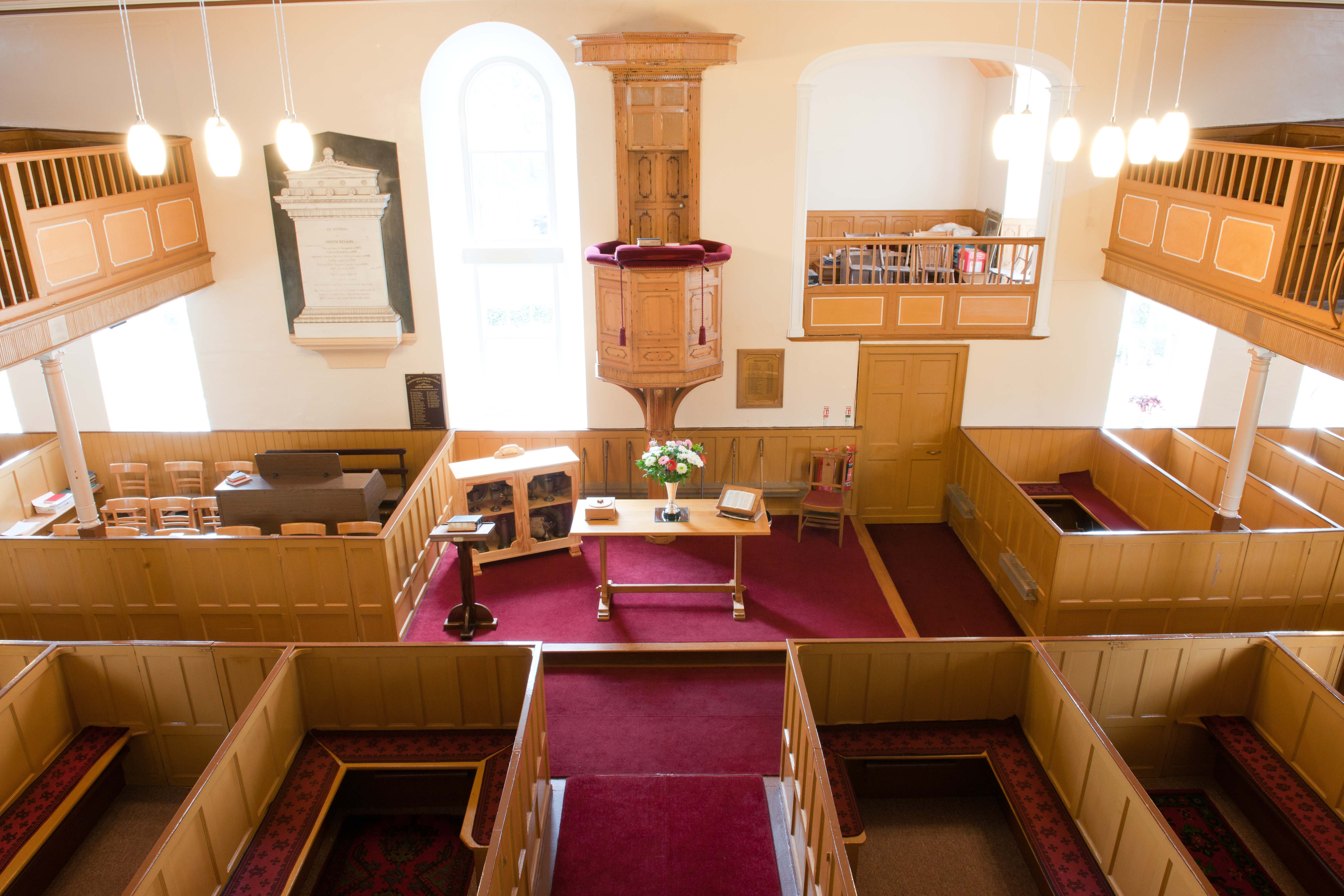
As can be seen the colour scheme is quite different to what we are used to today as this picture taken by Down County Museum in 2014 shows:
In the five years since this picture was taken a number of features have changed, including the addition of furniture and wall plaques. The ‘Squire’s Gallery’ is tidier too! But there is a different feel entirely to the interior, which is believed to be one much closer to the original interior of 1711.
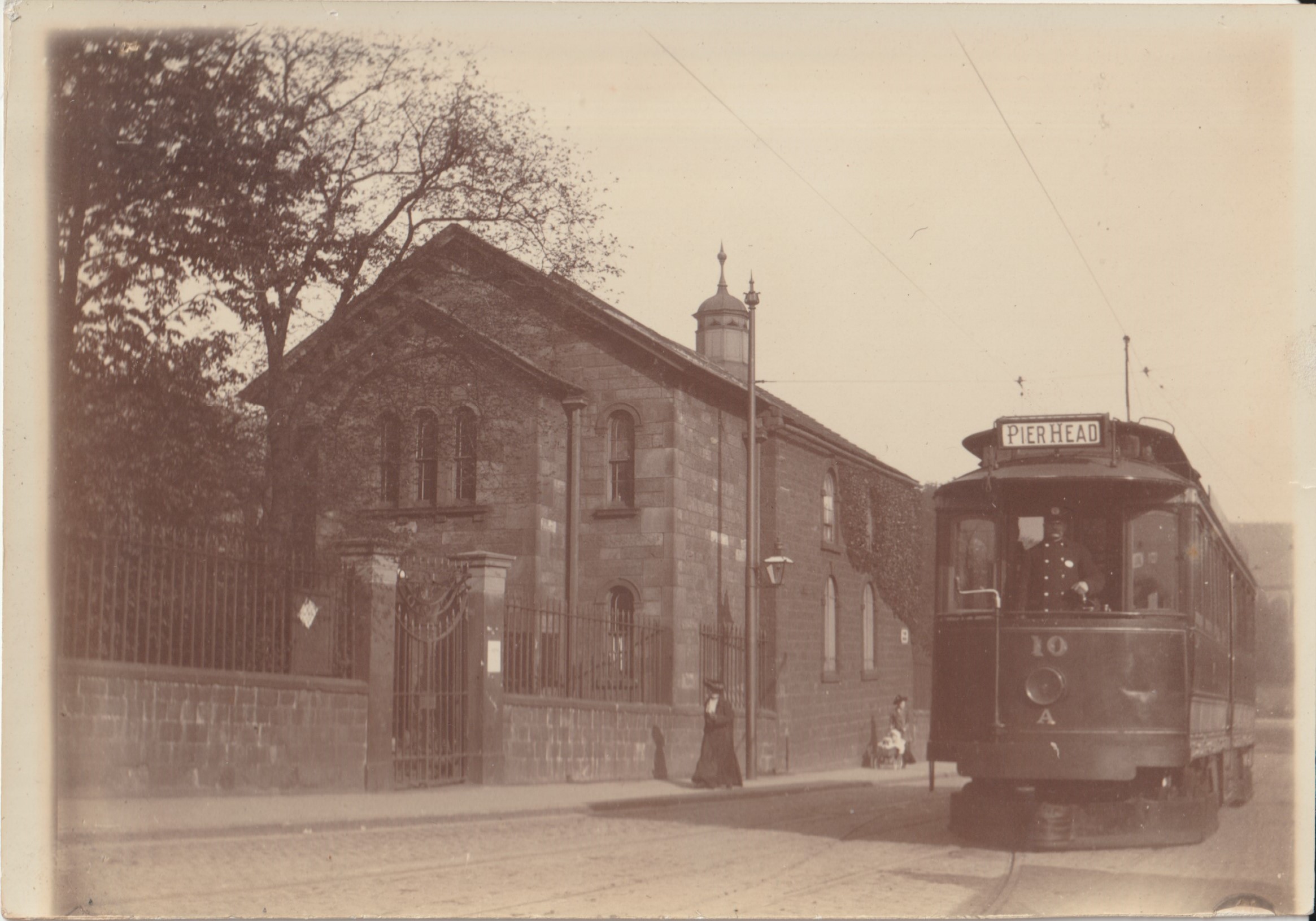
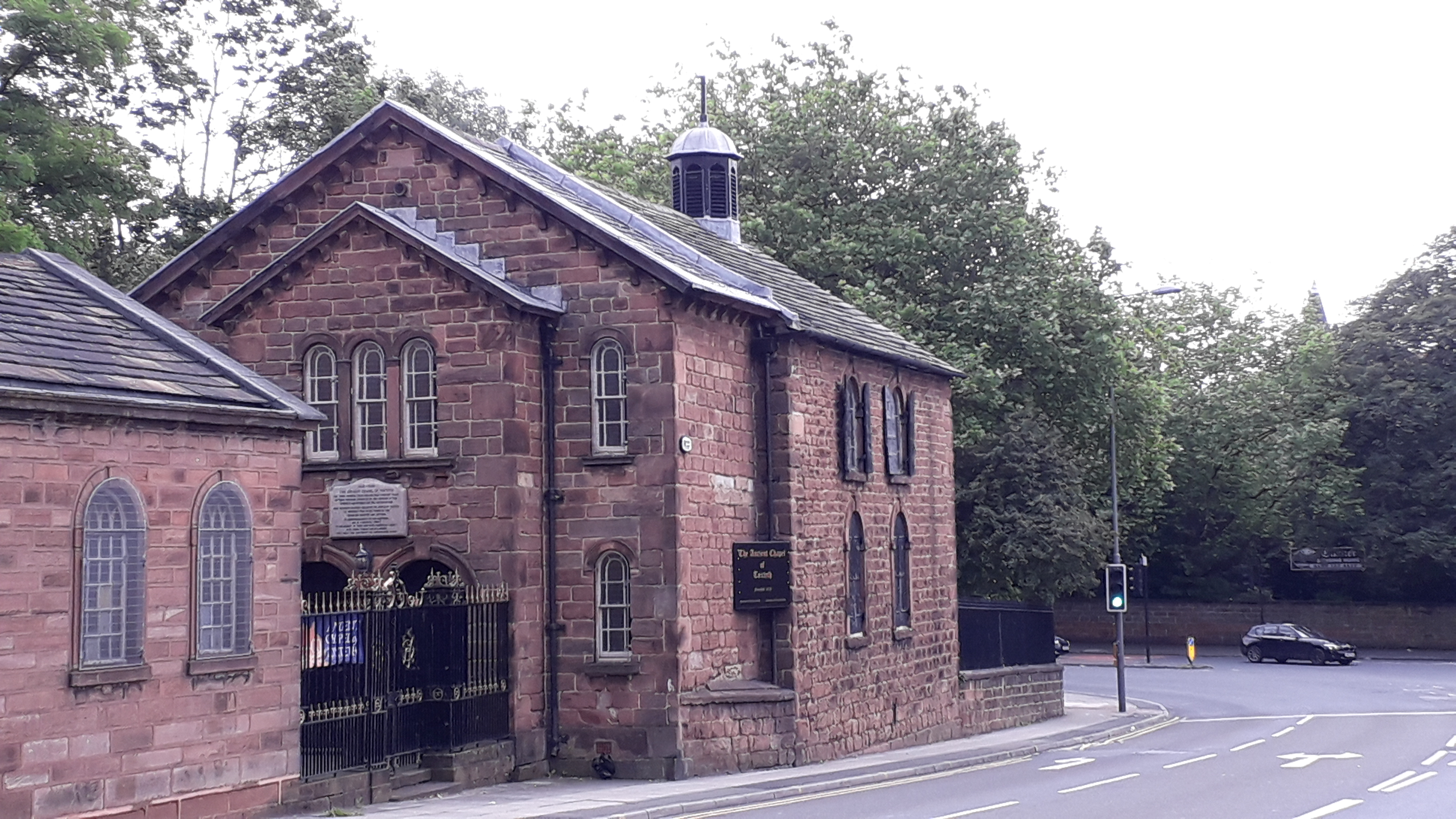
‘Then and now’ pictures can be interesting and informative. Standing outside the Ancient Chapel of Toxteth on 4 August 2019 I thought I would try and get a shot of the building from approximately the same position as the print that I have of the same view dating from about one hundred and fifteen years previously.
You can read about this photograph from between 1901 and 1904 and see some details from it here.
Whenever I take pictures of buildings I spend a lot of time trying to keep cars, buses, people, street furniture etc. out of shot. But, of course, for the historian it is the other details that often make the photograph useful and interesting. I picked this spot for the picture without referring to the old print and was half inclined to try and get a nice big Arriva bus coming up Park Road at the same time but there was a limit to how long I wanted to stand in the road! It’s a busy place and I suspect modern buses travel faster than old trams. So no buses in the picture but still a view that enables us to compare ‘then’ with ‘now’.
The picture at the top of the page is the wildflower meadow at St Agnes Field on the edge of Sefton Park.





 velvethummingbee