Faith and Freedom 200th Issue

Having been founded in 1947 we have now reached the significant milestone of our 200th issue. Still proudly flying the flag for a thoughtful, liberal approach to religion our journal goes all round the world and has readers on every continent.
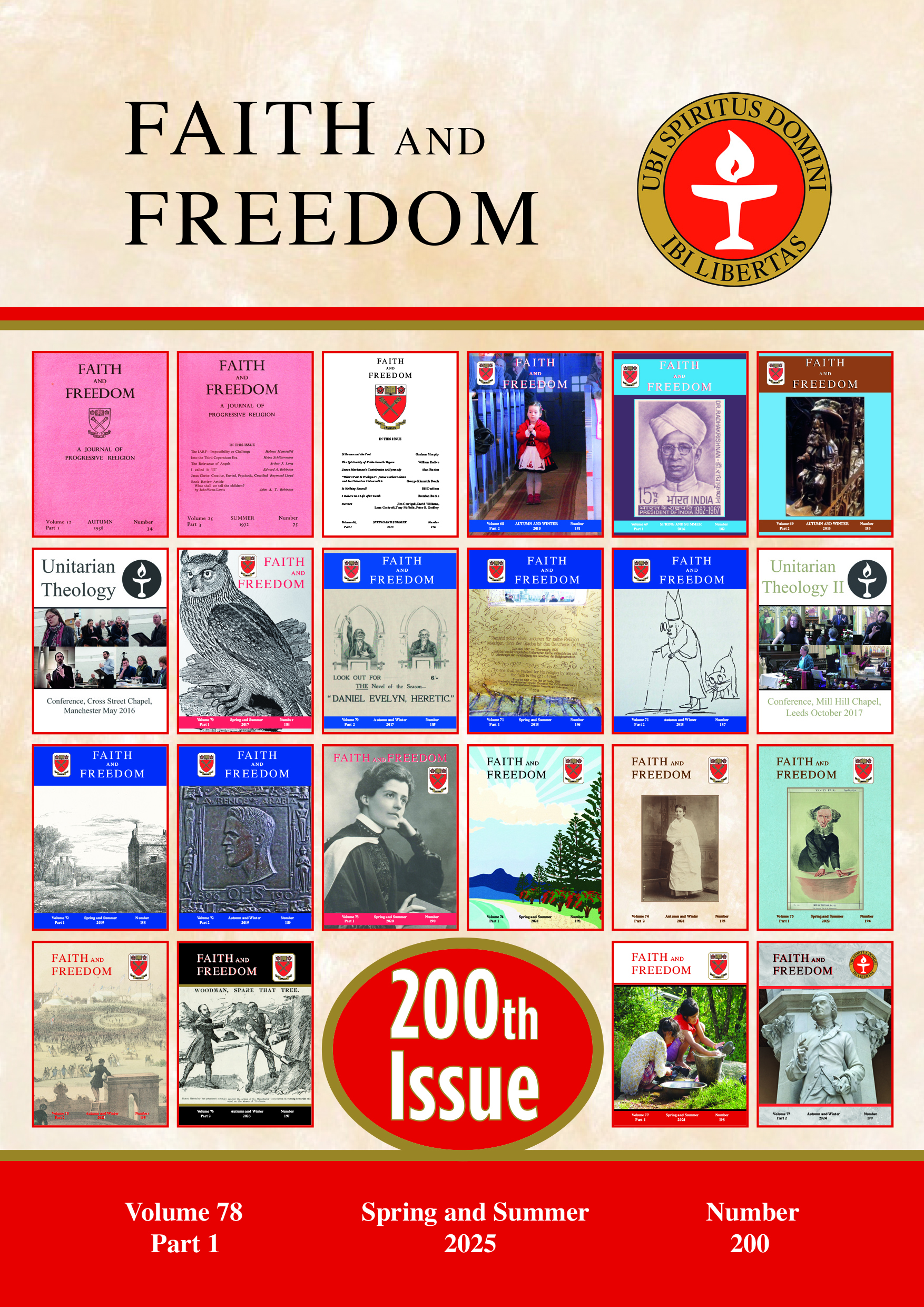
200th Issue Cover

Our Cover includes pictures of a selection of some of our 200 issues. We’ve had some splendid images in the last few years with photographs taken by some notable photographers as well some historic pictures or artworks that have really stood out.

With this being such a special issue we have selected three articles from our back catalogue that shed some light on our development over the last 78 years..

The first is from our very first issue. A Declaration of Faith by Dr Albert Schweitzer set the tone at the very genesis of this journal. It is hard to over estimate the importance of Albert Schweitzer within liberal circles at that time. A polymath thinker, theologian, humanitarian, philosopher, physician, he epitomised the cutting edge of a liberal, questioning approach to religion in the mid-twentieth century. Written for a meeting of the International Association for Religious Freedom, the world’s oldest interfaith organisation, a body which we have often had close interactions with, it was a considerable coup to have his contribution in the very first issue.

The second article is God is Necessary by H. Lismer Short published in Autumn 1958. At the time he was a future Principal of Manchester College, and his article displays the depth and breadth of his scholarship. Essentially an answer to the humanism of that age and the development of a scientific thinking that had unsettled the traditional Unitarian approach to the divine. The article declares that we ‘have been satisfied with cosmic explanations or enquiring agnosticisms, and have not sufficiently tackled religion from the end of human anxiety and dread.’ The traditional proofs of God no longer hold but ‘all the burden of living’ still required a place for faith in a personal God.
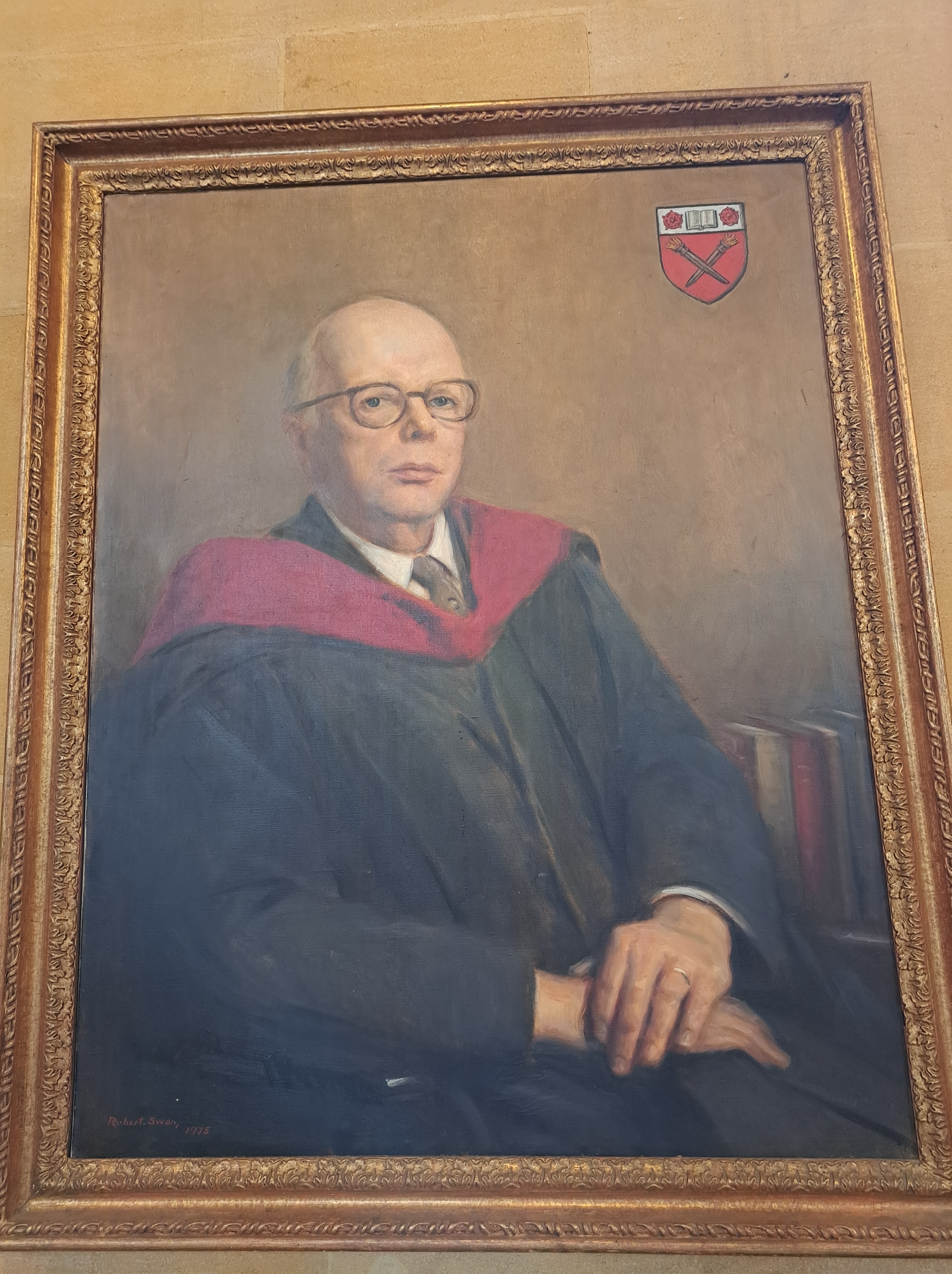
Harry Lismer Short. Portrait in Harris Manchester College

The final article from our back catalogue in this issue is A Rational Basis for Religious Belief by Arthur J. Long dating from Summer 1974. Another Unitarian Principal (this time of the Unitarian College, Manchester) this is another article which displays the writer’s considerable erudition as well, in Arthur’s case, of his irrepressible sense of humour. What is particularly interesting about this paper is that it was prepared for a long-forgotten meeting between Unitarian and Roman Catholic theologians which took place in 1973. The papers for this encounter still exist and it might be profitable at some stage to revisit them. The basis of this article is not to ask ‘Does God exist?’ but rather ‘What sort of God?’, he rejects the argument from revelation and the argument from experience and roots religious belief in a rational theism, ‘underpinned by a rational empirical theology’, and uses Peter Berger’s A Rumour of Angels to frame his apologia.
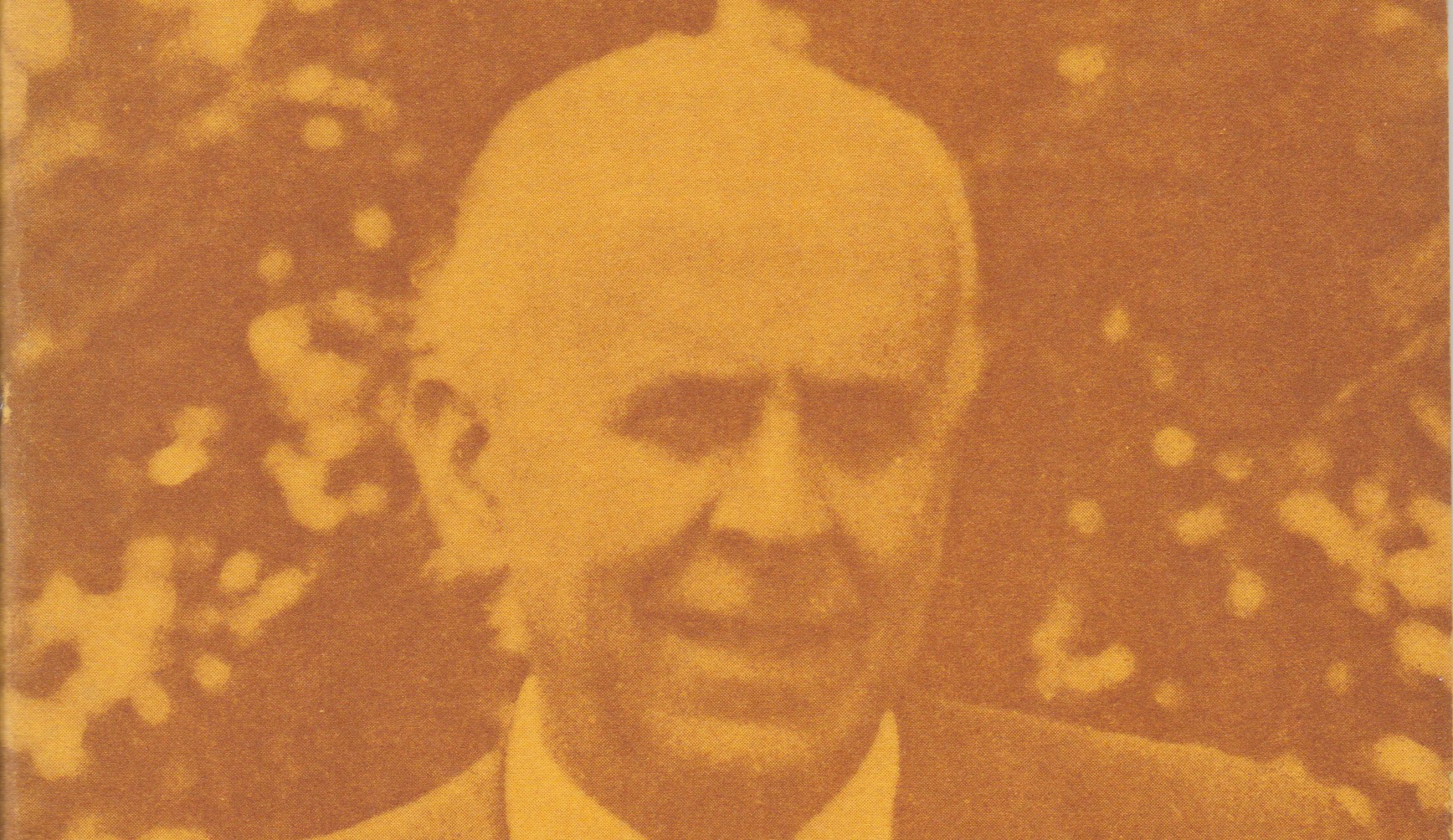
Rev Arthur Long (from the cover of his 1978 Essex Hall Lecture)

New pieces for this issue include On Reading the Koran by Barrie Needham, a timely, fair and objective assessment of this crucial text which is so frequently mentioned but very seldom examined. The other is Frank Walker’s The Sybil’s Request. Death and Our Human Imagination which explores how we understand death, Heaven and eternity and ranges over the thinking contained in the poetry and literature of such figures as T.S. Eliot, T.F. Powys and Julian Barnes, and ends, appropriately enough, with a quotation from Harry Lismer Short.

The articles are followed by a great selection of reviews:

Reviewed by Graham Murphy

Raja Shehadeh and Penny Johnson, ‘Forgotten, Searching for Palestine’s Hidden Places and Lost Memorials’, Profile Books, 2025 reviewed by Graham Murphy

Michael Allured and Kate Dean, ‘Soul Deep: Exploring Spirituality, Together’, Lindsey Press, 2024, reviewed by Laura Dobson

Jade C. Angelica, ‘Where two worlds touch’, Skinner House Books, 2024, reviewed by Peter Hewis

Patrick Riordan SJ, ‘Human Dignity and Liberal Politics: Catholic possibilities for the common good’, Georgetown University Press, Washington DC, 2023, reviewed by Helena Fyfe Thonemann.

Reviewed by Laura Dobson

An annual subscription to Faith and Freedom (two issues) costs £16.00 (postage included) in the United Kingdom. Single copies can be ordered at a cost of £8.00 each (postage included). Cheques should be made out to Faith and Freedom and sent to the business manager:

Nigel Clarke,
Business Manager, Faith and Freedom,
16 Fairfields,
Kirton in Lindsey,
Gainsborough,
Lincolnshire.
DN21 4GA.

Overseas subscriptions are also available.

It is also possible to pay online. For more details see our website:

https://www.faithandfreedom.org.uk/subs.htm

Transactions of the Unitarian Historical Society April 2025

The latest issue – Volume 28 Number 4 – is on its way to members of the Society, new members are always welcome and details of how to join can be found below.

As ever there is a great wealth of material in the journal, including:

Essex Street Chapel in the later eighteenth century: members, adherents and sympathisers

G. M. Ditchfield

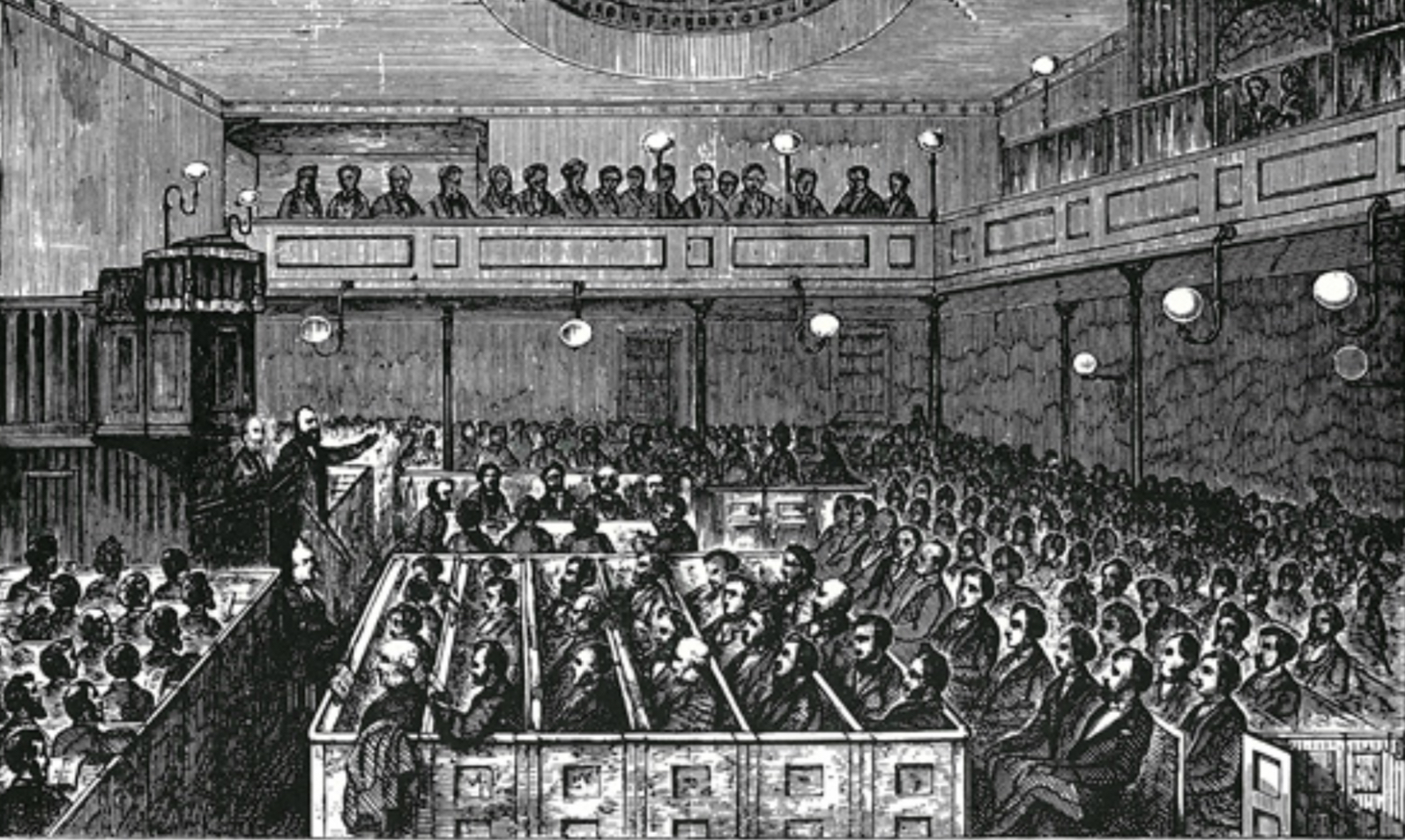
Centenary Service at Essex Church 1874

In this article Professor Grayson Ditchfield provides an analysis of the ‘associates, friends, visitors and even some critics of a congregation which has been, and remains, widely and deservedly regarded as a foundational pillar of the Unitarian movement in this country’.  In his paper Professor Ditchfield goes a long way to uncover the stories of the people who sat in the pews at Essex Street Chapel and looks especially at the role of women there. The Chapel was situated in a very impoverished area and Hannah Lindsey, the wife of the minister, organised poor relief for the local inhabitants. The congregation could not have survived without its female supporters in the early years in particular, and one member, Elizabeth Rayner, made an annual donation of £2,000. Essex Street Chapel included a number of MPs, including one described as `my fidgeting pew neighbour’ by another member. Some of the MPs made the free franking of letters in the House of Commons available to members! Was it a Dissenting Chapel or a reformed Church of England? Was it a congregation or an audience? All this and much more is examined in this fascinating article which breaks so much new ground.

After 1825 – celebrating the foundation of organised Unitarianism in Britain and America

Alan Ruston

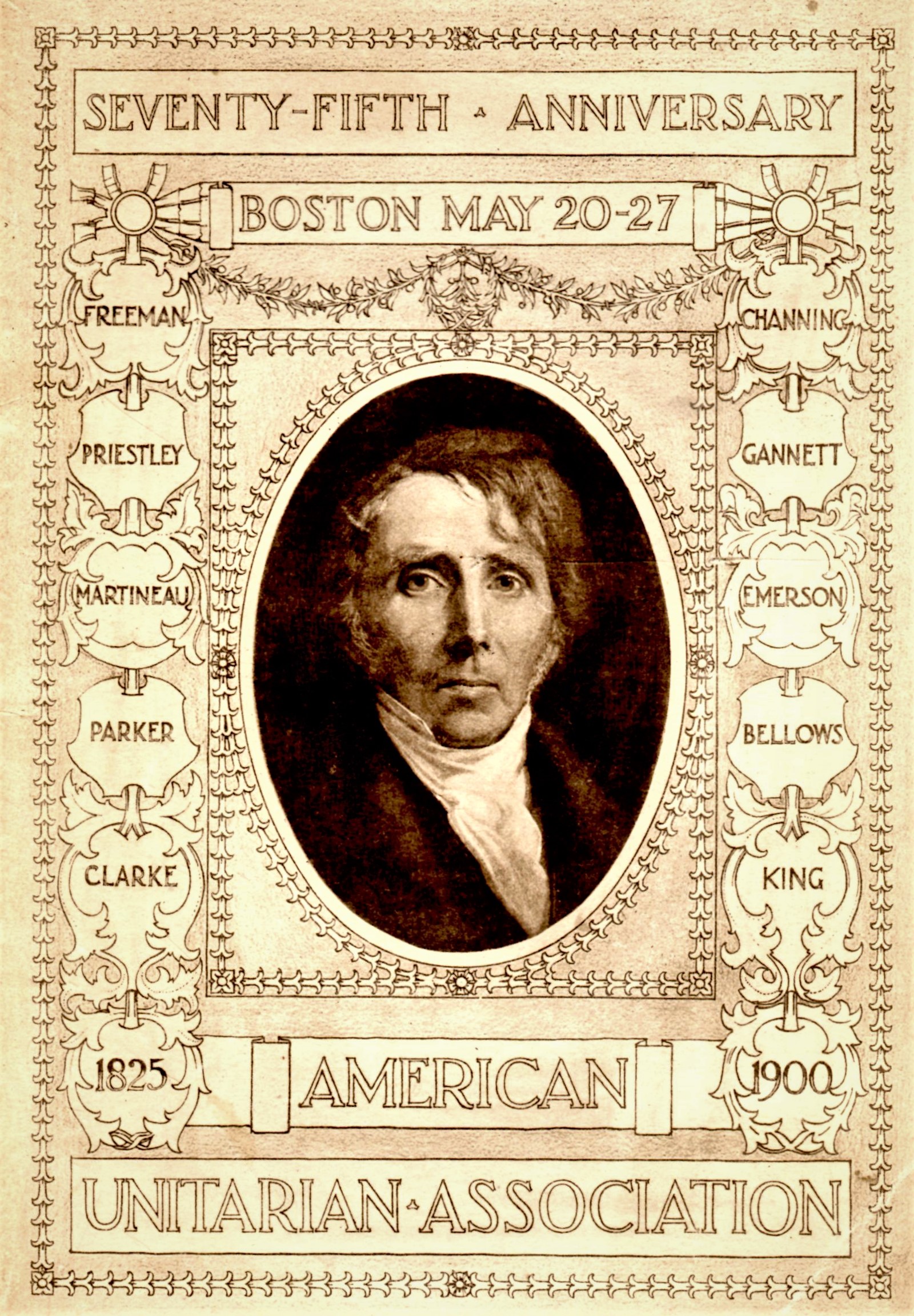
AUA 75th anniversary brochure cover

This year marks the 200th anniversary of the foundation of both the British and Foreign Unitarian Association (B&FUA) and the American Unitarian Association (AUA), both founded within a day of each other in May 1825. Alan Ruston investigates the way each anniversary has been celebrated in Britain and the USA. Both the B&FUA and the AUA have evolved over this time, the B&FUA really being superseded by the General Assembly in 1928 and the AUA being absorbed into the Unitarian Universalist Association in 1961 but the development of both bodies over two centuries tells us a lot about the development of Unitarianism in both countries and the interaction between British and American Unitarianism.

Notes

Alexander Gordon on James Martineau: An Evaluation

Alan Ruston

Very Rev William McMillan Library

David Steers

Very Rev William McMillan Library, Dunmurry

Dr Williams’s Trust.Announcing a New Partnership 

The University of Manchester Library and The Dr Williams’s Library 

REVIEWS

Daisy Hay,Dinner with Joseph Johnson: Books and Friendship in a Revolutionary Age, (Chatto & Windus, London, 2023) ISBN 9781784740184. 528 pages. Price £20.

Reviewed by Derek McAuley

Ben Stables, From Pigeon Flying to Intellectual Liberty. The History of Pepper Hill Unitarian Chapel in Shelf, West Yorkshire. With an Introduction by Rev John Midgley. Published by Pepper Hill Unitarian Chapel, 2024. 100 pages. Price £6. Copies are available directly from the author (benstables@hotmail.co.uk).

Reviewed by David Steers

Kazimierz Bem and Bruce Gordon (eds), Antitrinitarianism and Unitarianism in the Early Modern World, Palgrave Macmillan, 2024, 397 pages. ISBN 9783031696572, price £119.99; eBook ISBN 9783031696589, price £99.99.

Reviewed by Alan Ruston

Back to Life, The People on the Plaques in Brighton Unitarian Church, 2023, 95 pages. Price £8 including postage; copies can be obtained from Christine Clark-Lowes (cjclarklowes@yahoo.co.uk).

Reviewed by Alan Ruston

OBITUARY

John Jeremy Goring, MA, PhD (1930-2023)

by David L. Wykes

An individual annual subscription costs just £10.

Visit the Unitarian Historical Society website to join: https://unitarianhistory.org.uk/

The Latest issue of Faith and Freedom

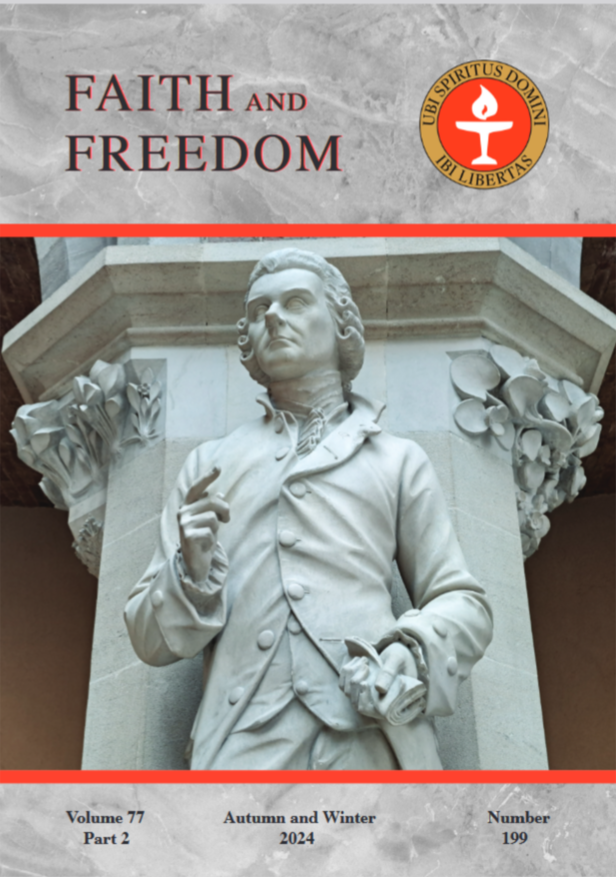
The latest issue – Volume 77, Part 2, Autumn and Winter 2024, Number 199 – is now available and will be with subscribers shortly. Details on how to subscribe (including a link to our website if you would like to pay via PayPal) can be found at the foot of this page.

This issue is special for a number of reasons. First of all we are pleased to announce the magnificent vote of approval given to us by the Merseyside and District Missionary Association who have given us very generous financial support. This is a tremendous help and together with the valued grant we already receive from the Daniel Jones Fund this means that Faith and Freedom can continue to serve our readers, maintaining the original vision set out by the Ministerial Old Students Association of Manchester College, Oxford for the promotion of liberal religious discussion and the free exchange of ideas.

Secondly we are also delighted to be able to launch our brand new Faith and Freedom Logo with this issue. Our Logo was previewed on this site a couple of weeks ago and it now takes its place atop our masthead. Specially designed for us, it is a striking representation of what we stand for as a journal and will let the world know who we are. We have already had requests for this to be produced as a badge which is something we are keen to look into.

It is very pleasing also that the journal continues to attract top quality articles from Unitarians and non-Unitarians alike from Britain and around the world. In this issue Elizabeth Kingston-Harrison, who is the Congregational Connections Lead for the General Assembly of Unitarian and Free Christians and has a PhD in Intellectual History, having studied the theology of Joseph Priestley and other eighteenth-century rational dissenters, contributes A Comet in the System: Joseph Priestley and the emergence of rational dissent in the eighteenth century. Elizabeth writes of Priestley’s role in the emergence of rational dissent and shows how, far from being a distant, dry historical study, this is something that is energising and alive today and helps us connect with our present-day religious identity. Joseph Priestley ‘was a courageous, “big picture” person’ whose scientific discoveries went hand in hand with his theological reflections. The discoverer of oxygen applied reason to scripture and developed a new way of understanding the universe.

Frank Walker considers Sir Lloyd Geering: Trinitarian-Unitarian, Humanistic Presbyterian, Centenarian and asks Can You Love the Human Race? Sir Lloyd Geering, a New Zealand Presbyterian Professor, who was once charged with heresy, may not be a name immediately familiar to most of our readers but I have no doubt that everyone will find Frank’s thoughtful examination of his theology and ideas incredibly life affirming and uplifting.

Peter Hewis addressed the Old Students Association at Harris Manchester College back in June and this paper is based on his sermon – Keep alive the dream in the heart – a quotation from Howard Thurman and an exploration of dreams in religious history and their continuing power to inspire us and drive us towards making a difference in the world,

As always we have a number of really interesting and informative reviews of a wide range of publications contributed by our readers. This issue includes:

Right Relationship in the Real World

Commissioning Editor: Jane Blackall, Right Relationship in the Real World, Learning to Live by our Unitarian Values, The Lindsey Press, London, 2024, pp 132, ISBN 978-0-8519-099-8, £7, pbk. The book can be ordered online at https://www.unitarian.org.uk/shop/

Reviewed by Peter B. Godfrey

Fideology

Richard F. Boeke, Fideology – Building Trust through the Shared Experience of Faith at the Root of the World’s Religions, 2024, pp 248, ISBN 97988844906686, £11.08 plus postage from Amazon.

Reviewed by Peter B. Godfrey

From the heights of politics via a spiritual journey to the ministry

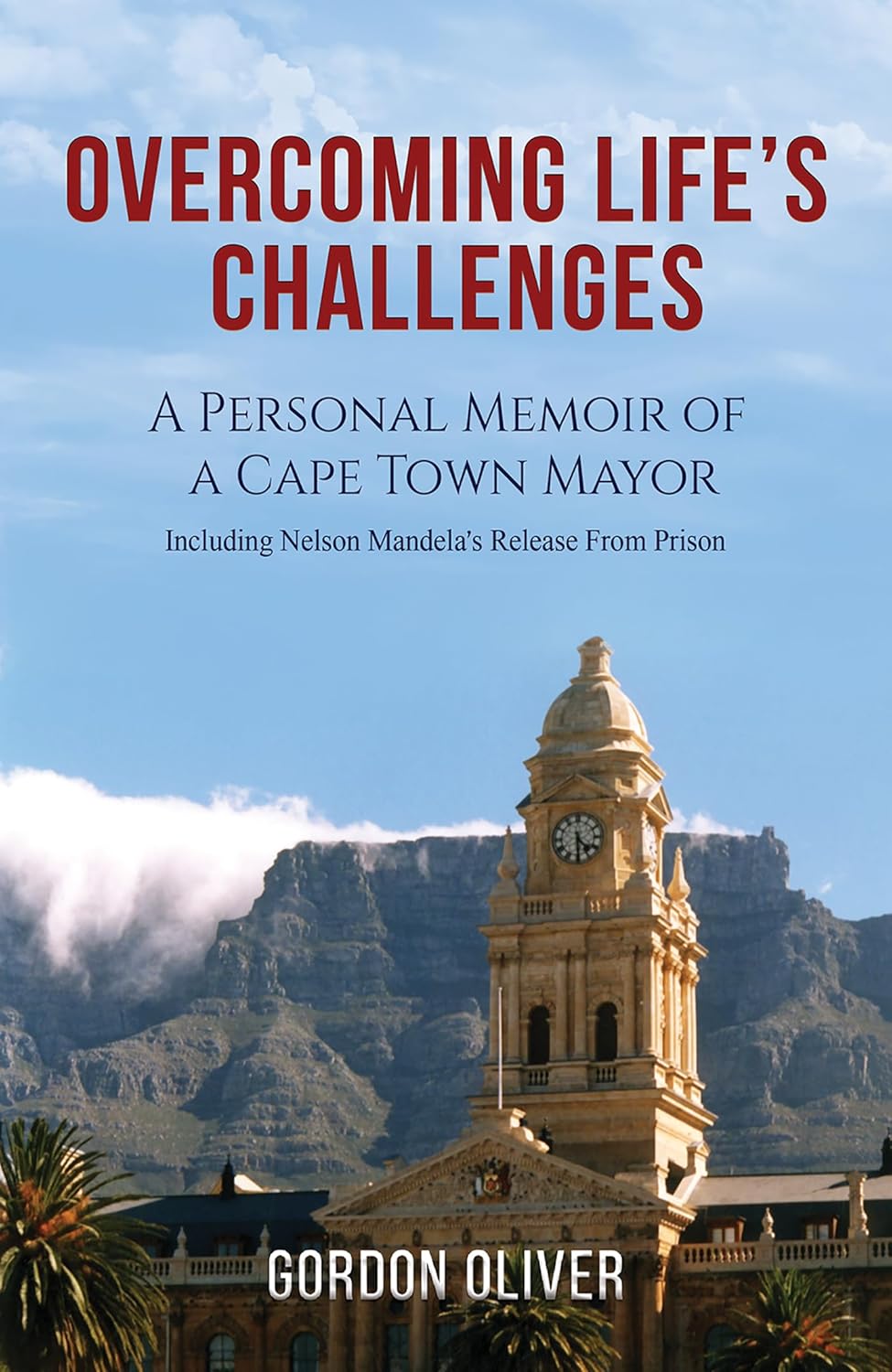
From the heights of politics via a spiritual journey to the ministry Gordon R. Oliver, Overcoming Life’s Challenges: A Personal Memoir of a Cape Town Mayor, Austin Macauley Publishers, 2024, pp.166, ISBN: 979-8891554146, £8.99, pbk.

Reviewed by John Midgley

An honest and liberal analysis of the Church

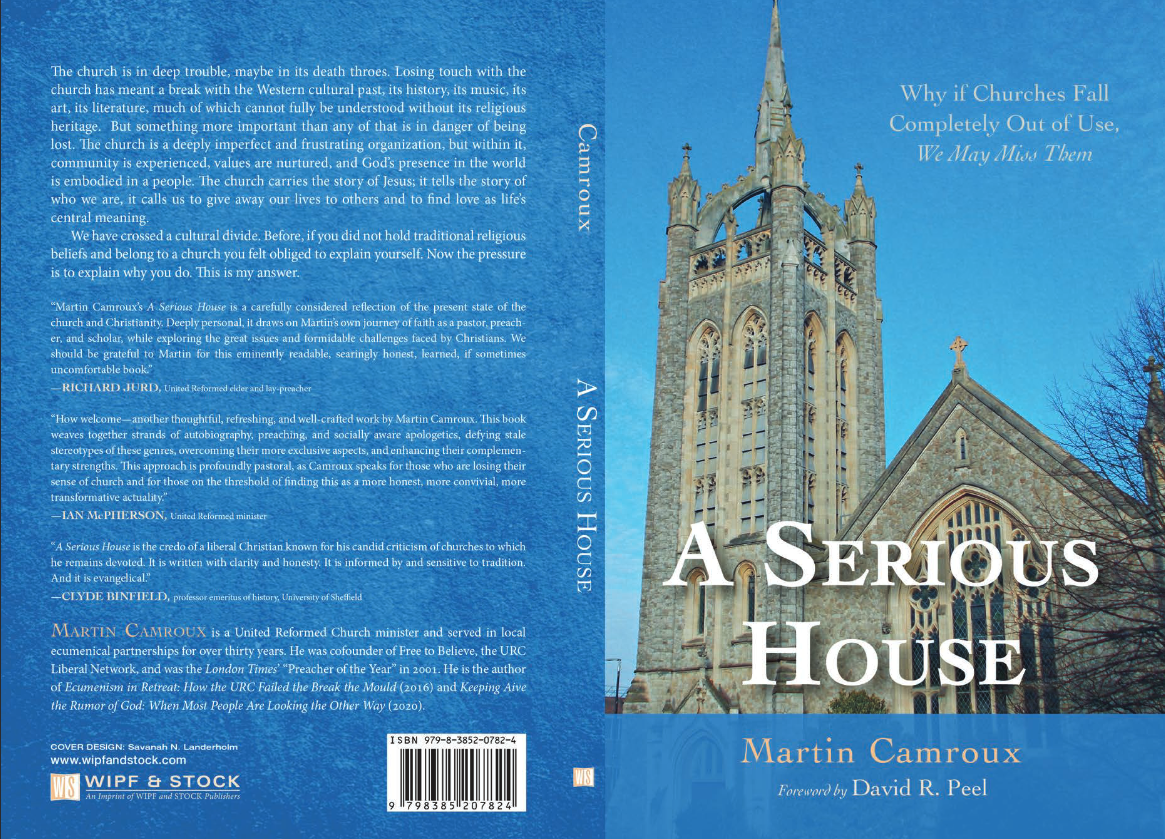
Martin Camroux, A Serious House, Why if Churches Fall Completely Out of Use We May Miss Them, Wipf and Stock, 2024, pp. 188, ISBN-13: 979-8385207824, £21 pbk, (also available direct fromthe author for £16, including postage, Martin Camroux, 4 Sorrel Close, Colchester, CO4 5UL).

Reviewed by Francis Elliot-Wright

Prayers of Many Faiths

Marcus Braybrooke, 1,000 Prayers from Around the World. Prayers of Many Faiths for Many Situations, independently published, 2024, pp.390, ISBN: 9798321565889, £39.99 hbk; ISBN: 97983439561609, £9.99 pbk black and white; ISBN: 798321565889, £19.99 pbk colour; also available on Kindle £4.99. Available to order on Amazon.

Reviewed by David Steers

An annual subscription to Faith and Freedom (two issues) costs £16.00 (postage included) in the United Kingdom. Single copies can be ordered at a cost of £8.00 each (postage included). Cheques should be made out to Faith and Freedom and sent to the business manager:

Nigel Clarke,
Business Manager, Faith and Freedom,
16 Fairfields,
Kirton in Lindsey,
Gainsborough,
Lincolnshire.
DN21 4GA.

Overseas subscriptions are also available.

It is also possible to pay online. For more details see our website:
https://www.faithandfreedom.org.uk/subs.htm

Visit to six churches in Belfast and county Down

Between 7th and 9th May, Dunmurry congregation was visited by four Unitarian ministers from Great Britain. These included Rev Laura Dobson, minister at Chorlton, Rev Mária Pap, minister at Mansfield, Francis Elliot-Wright, student minister at Knutsford, and Rev Jim Corrigall, the London District Minister. On the evening of Tuesday, 7th May Dunmurry congregation welcomed them, plus members of other congregations and a good number of local ministers, to a social evening in the McCleery Hall. I conducted an interview/dialogue with Jim who told us about his role as London District Minister, growing up in South Africa and his anti-apartheid activities, his decades as a journalist around the world which took him to Northern Ireland among other places, as well as the theological reflections which led him eventually to enter the ministry. As part of the evening Jim shared with us the reading that means most to him in his ministry – ‘God’s Grandeur’ by Gerard Manley Hopkins – and we listened to his favourite piece of music –  Nkosi Sikelel iAfrika, God Bless Africa. It was a great night enjoyed by everyone.

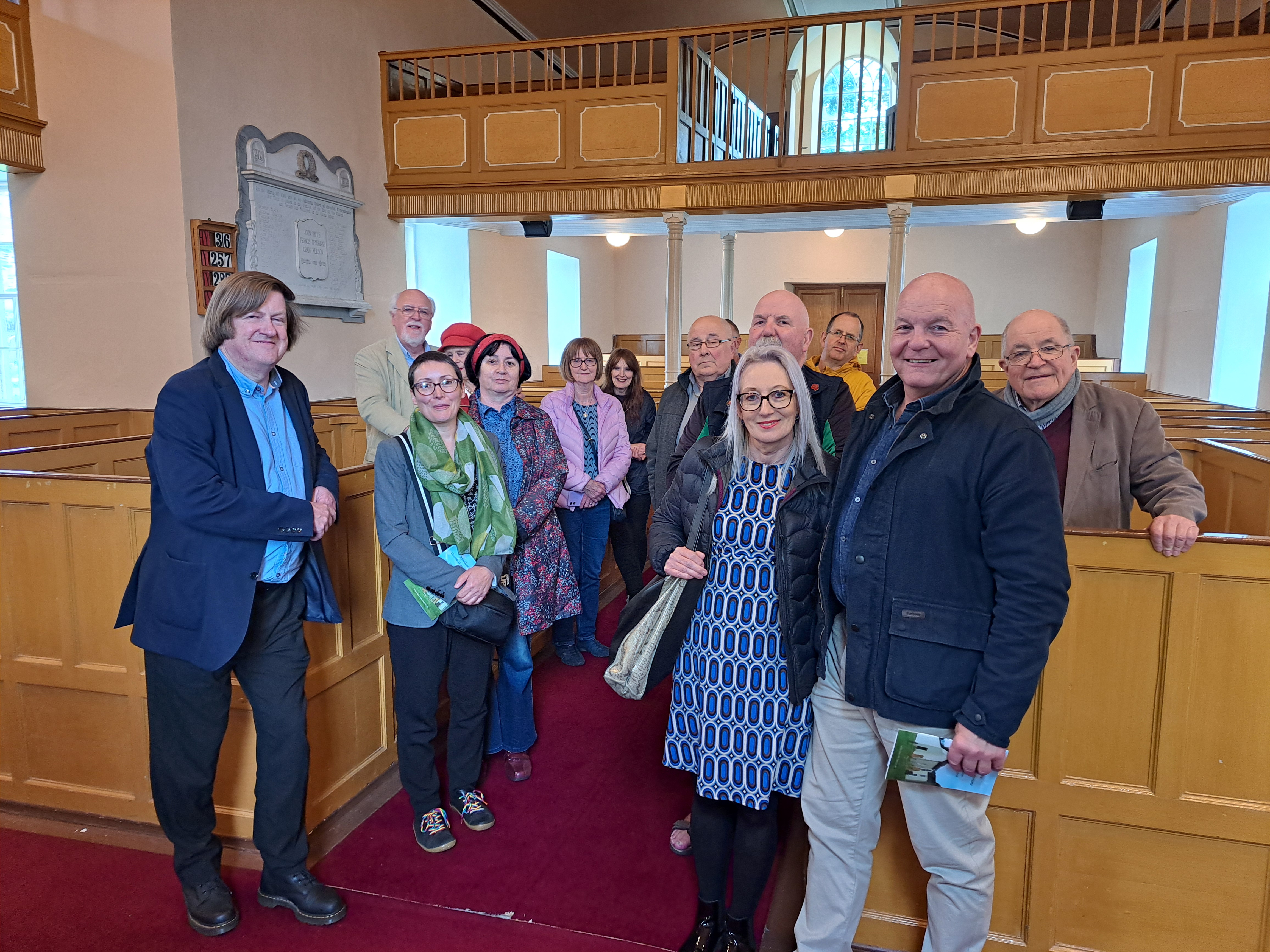
Left to right Rev Dr David Steers, Rev Mária Pap, Rev Lynda Kane, Rev Laura Dobson, Francis Elliot-Wright, Rev Jim Corrigall, Rev Stephen Reain Adair, Rev Brian Moodie in the McCleery Hall, Dunmurry.

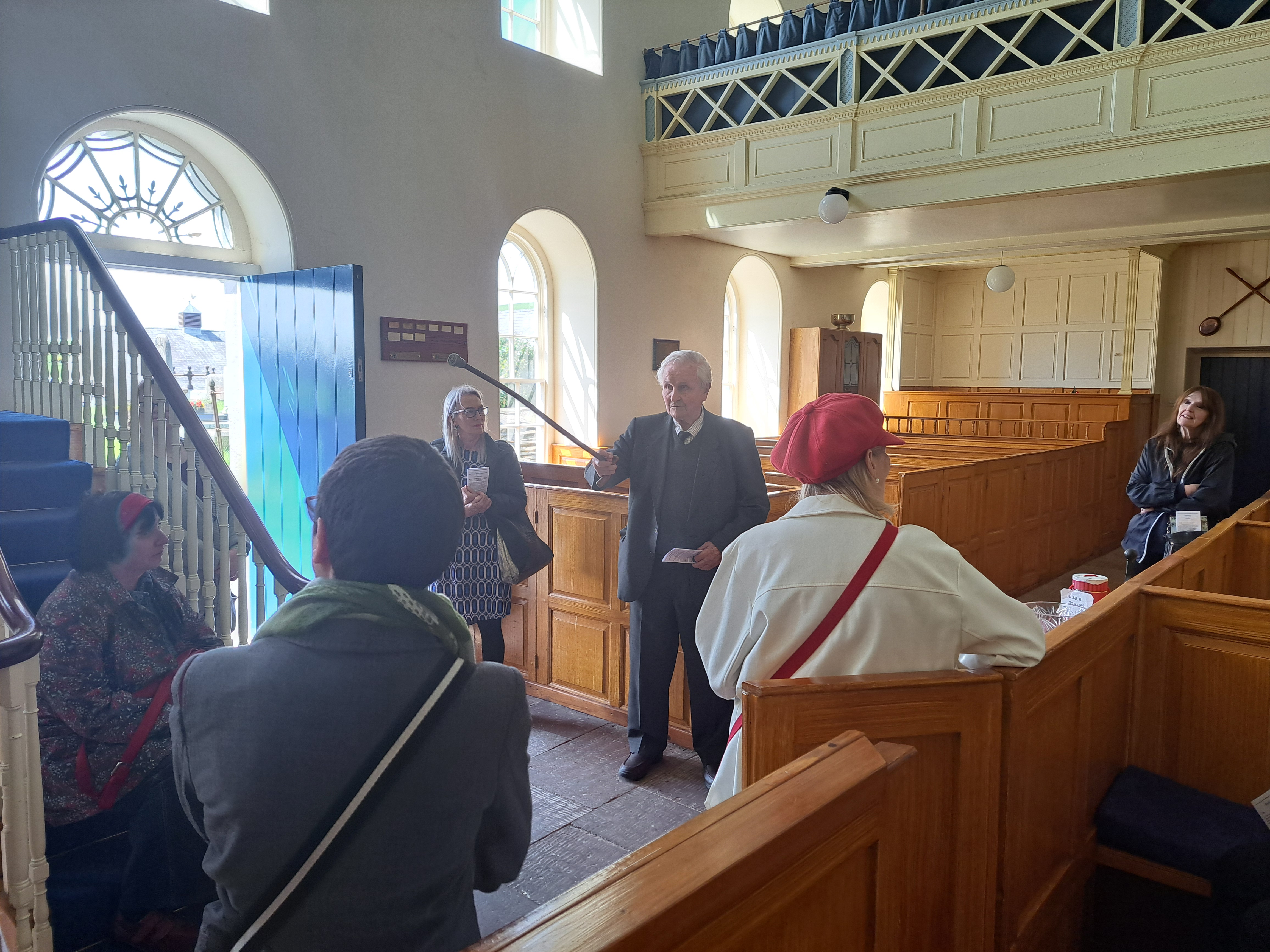
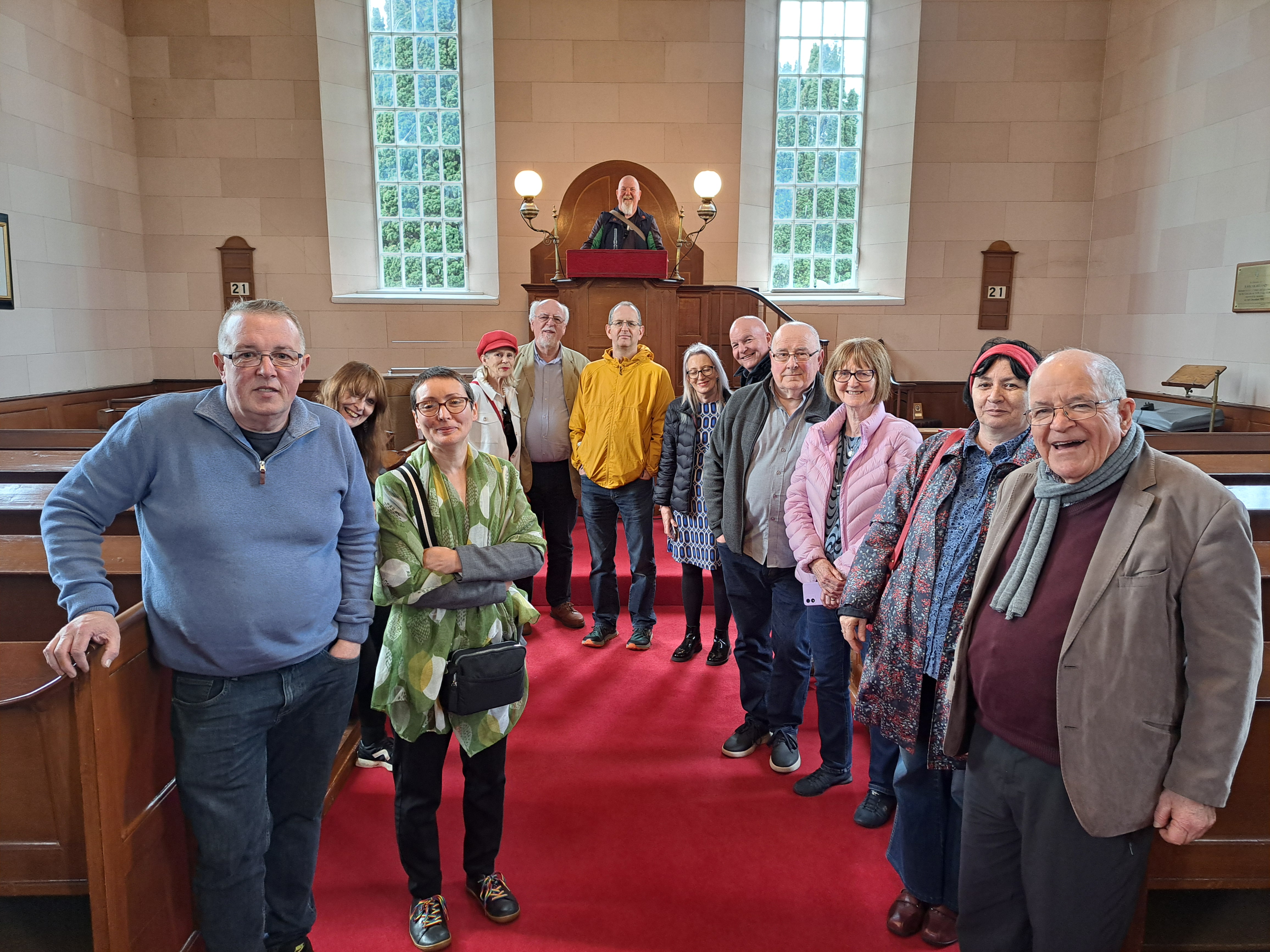
On Wednesday morning we made an early start in the company of a group of members of Dunmurry and First Church to visit six churches in Belfast and county Down and learn something about their history and witness. Thanks to Gary Douds we were taken around the churches in a minibus in great comfort and we were also blessed with fantastic weather.

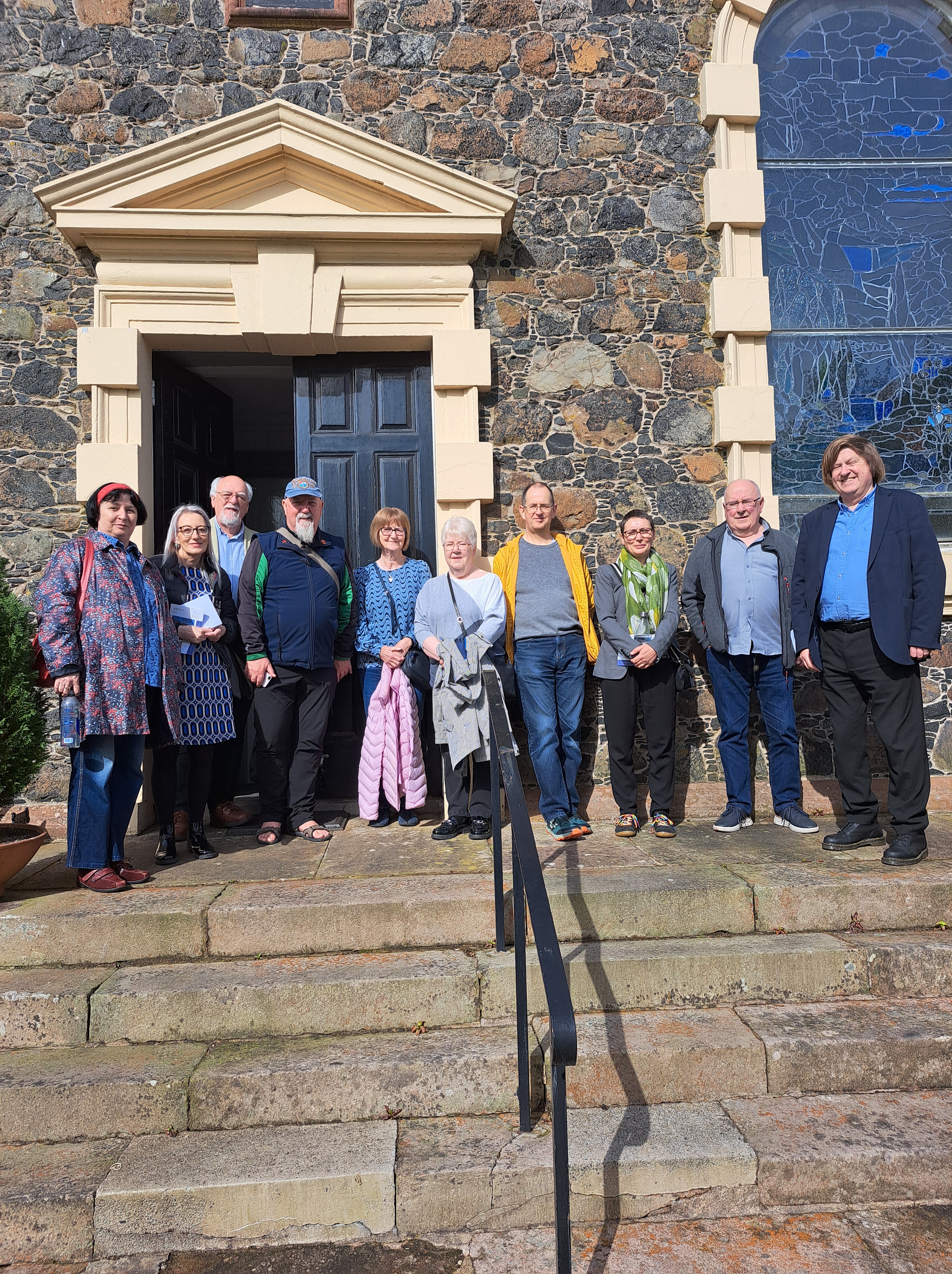
Some of the party at Dunmurry, ready to set off at 9.00 am.
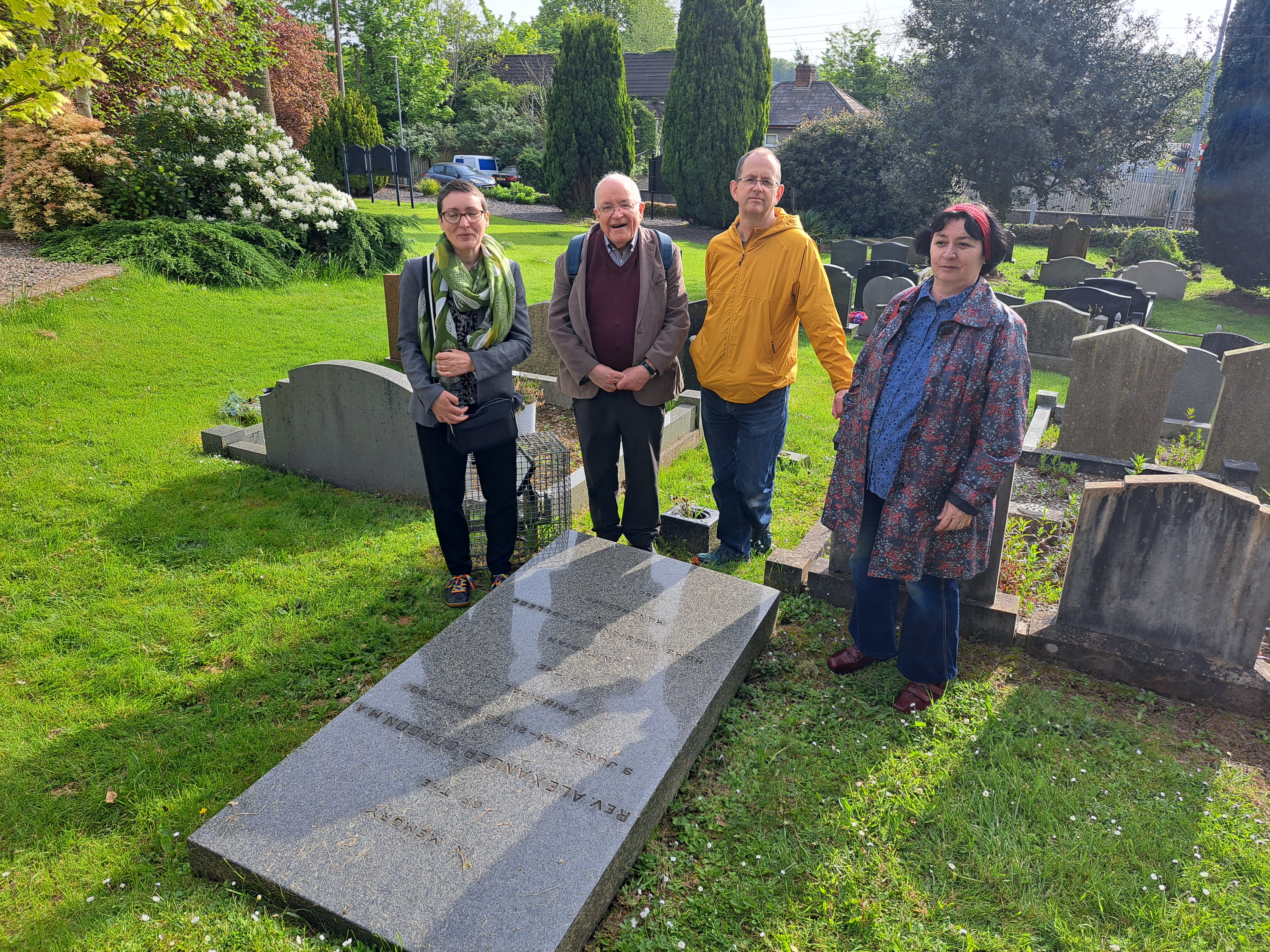
Laura, Jim, Francis and Mária visit the grave of Rev Alexander Gordon (Principal of the Unitarian Home Missionary College) at Dunmurry.
Outside Rademon later in the day.

In most of the churches I said something about the building and the history of the congregation and in Rademon Jim Ferris shared his historical expertise to give us a talk about his congregation. Our thanks go to all the ministers and members who welcomed us in our travels including Des McKeown, Rev Chris Hudson, Rev Dr Heather Walker, Mary Stewart and David Rooney, as well as Jim Ferris.

Des McKeown welcomes everyone to First Church, Rosemary Street.
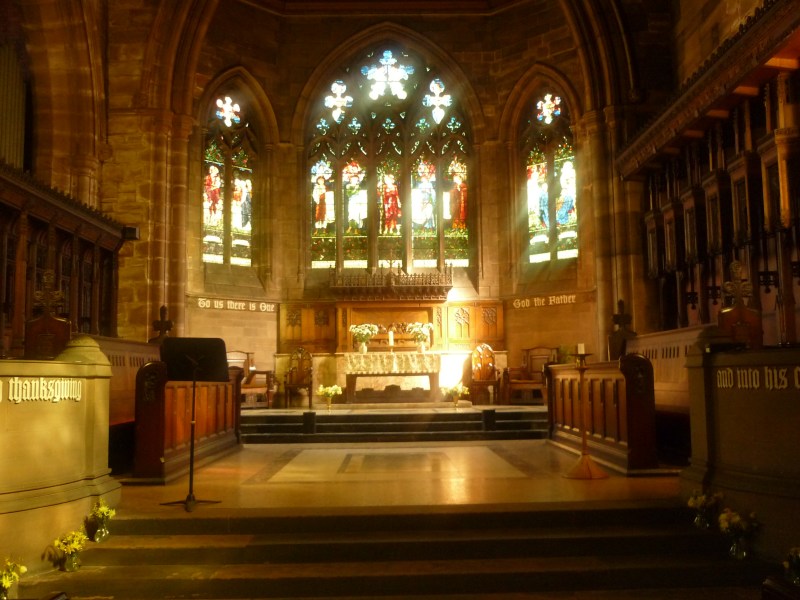
Rev Chris Hudson welcomes everyone in the chancel in All Souls’.

We had lunch in Denvir’s in Downpatrick and returned to Dunmurry just 15 minutes later than our planned schedule had anticipated, so all in all a great day out.

In Downpatrick.
Jim Ferris explains the history of Rademon.

We visited in turn Dunmurry (1779), First Belfast (1783), All Souls’ Belfast (1896), Rademon (1713), Downpatrick (1711) and Clough (1837), buildings of different styles and ages but all with their own story to tell as part of our distinctive tradition.

In Clough, the last visit of the day.

Reflections on Prayer

I added this short video to our YouTube channel featuring the church and some of the grounds at Dunmurry built around a short passage on prayer written by Valentine David Davis. V.D. Davis trained for the ministry at Manchester College when it was still in London and James Martineau was Principal. He was one of the last links between that generation of ministers and the mid-twentieth century. His little book The Lord’s Prayer An Interpretation. Together with an Address on The Offering of Prayer was published by the Lindsey Press in 1938.

Click on the video to see ‘Reflections on Prayer’ from Dunmurry

His book on prayer is full of insight. He is perhaps someone who is rather overlooked in our history. On leaving Manchester College he went to Christ Church, Nottingham as minister for a few years before moving on to the Ancient Chapel of Toxteth for eleven years. This was followed by a further ministry at Wallasey. In Merseyside he was greatly influenced by John Hamilton Thom whose devotional Services and Prayers he later edited along with a selection of J.H. Thom’s writings in a A Minister of God. Ministry in Liverpool and Wallasey was followed by eleven years as editor of The Inquirer before returning to the ministry in Bournemouth where he served for twenty years up to retirement. He made some more important contributions to devotional publishing and to history, producing A Book of Daily Strength as well as A History of Manchester College and a history of the London Domestic Mission Society. He was editor also of Hymns of Worship, first published in 1927, reprinted a number of times, then republished with a Supplement (1951), and later still republished in a revised format in 1962. Even Hymns of Faith and Freedom, published in 1991, described itself as a radical revision of Hymns of Worship. So as one of the first fruits of the collaboration that led to the new General Assembly and ‘offered, in the interest of unity and comprehension, with the prayer that it may be blessed in its ministry to the fellowship of our churches’ it proved remarkably successful.

We also uploaded to YouTube our full Easter Day service at Dunmurry recently. The full service, including hymns, prayers and readings can be seen here:

Easter Sunday Service, Dunmurry

General Assembly of Unitarian and Free Christian Churches 2024

I was very pleased to be able to attend this year’s General Assembly of Unitarian and Free Christian Churches held in Daventry. There were many stand out moments. One was the Unitarian Christian Association meeting at which Dr Lizzie Kingston Harrison gave an excellent talk entitled Joseph Priestley: radical roots and new beginnings. A wonderful presentation which showed how professional historical research can be alive with reflections for our present age in the hands of an expert. We look forward to publishing Lizzie’s paper in a future issue of Faith and Freedom.

The meetings were notable also for the large contingent of seven Non-Subscribing Presbyterians from Northern Ireland who were also able to be there for the welcoming onto the GA Roll of the Rev Lynda Kane. Now the minister of Ballyclare, Cairncastle and Ballymoney, Lynda was one of three new ministers recognised at the General Assembly Service.

Rev Lynda Kane with some of the ministers from Northern Ireland present at the GA (Photo: Sue Steers)
Rev Rory Castle Jones, Rev Lynda Kane, Rev Ant Howe, new ministers Rev Arek Malecki and Rev Jennifer Sanders, Liz Slade, Rev Melda Grantham and GA President Vince McCully, after the GA Service. (Photo: Sue Steers).

The Rev Ant Howe delivered a most inspiring sermon at the GA Service, and at the meetings Dot Hewerdine and the Rev John Midgley and the Rev Celia Midgely were all made honorary members of the GA.

We also held the annual meeting of the Unitarian Historical Society. There was a good turnout of people for the AGM and to hear Professor Grayson Ditchfield’s paper Essex Street Chapel in the Later Eighteenth Century. Unfortunately, because of disruption to the train services, Professor Ditchfield couldn’t be with us in person, and so his excellent paper was read for us by Rev Daniel Costley. There was a great deal of new information and new insight in the paper which will feature in next year’s Transactions of the Unitarian Historical Society.

Derek McAuley (President), Howard Hague (Secretary) with Rev Daniel Costley (left), who read Professor Ditchfield’s paper, at the meeting of the Unitarian Historical Society in Daventry. Saturday, 6th April.

Liverpool Unitarians: Faith and Action

This book (first published, I now realise, back in 2014!) has just been reprinted and, the original print run having sold out, is once again available. The publishers and printers have done an excellent job, it’s an attractive book, this time published in memory of Bernard Cliffe, Len Mooney and Rev Daphne Roberts, three contributors who have died since the original publication.

The full list of contributors and subjects is as follows:

Introduction, David Steers; Memorials of the Ancient Chapel of Toxteth Park, Bernard Cliffe; Jeremiah Horrocks 1618 – 1641, Bernard Cliffe; William Roscoe 1753 – 1831, David Steers; A Short History of the Rathbone Family, Annette Butler; The Unitarian Family of George Holt, Bernard Cliffe; Noah Jones 1801 – 1861, Philip Waldron; James Martineau 1805 – 1900, Len W. Mooney; Joseph Blanco White 1775 – 1841, David Steers; Kitty Wilkinson 1786 – 1860, Daphne Roberts; John Johns 1801 – 1847, David Steers; William Henry Channing 1810 – 1884, Richard Merritt; Charles Pierre Melly 1829 – 1888, John Keggen; Sir Henry Tate 1819 – 1899, Richard Merritt; Sir John Brunner 1842 – 1919, Len W. Mooney; Lawrence Redfern 1888 – 1967, Elizabeth Alley; Sir Adrian Boult 1889 – 1983, Richard Merritt; The Visitors’ Book of the Ancient Chapel, Bernard Cliffe.

Published by the Merseyside District Missionary Association the cover design is by Alison Steers and the book contains over 50 illustrations, many published here for the first time.

To accompany the republication we have produced a short video which incorporates a trip around Ullet Road Church which can be seen here:

Click on the video for a tour of Ullet Road Church and details of the book
The cover of the book

Liverpool Unitarians: Faith and Action Essays exploring the lives and contributions to society of notable figures in Liverpool Unitarian history

Edited by Daphne Roberts and David Steers

Published by Merseyside and District Missionary Association

ISBN: 978-0-9929031-0-7

Brand new edition for 2024

Price £10 (plus £2 post and packing). Available from Rev Phil Waldron, Ullet Road Church, 57 Ullet Road, Sefton Park, Liverpool. L17 2AA.

In the Introduction I say:

This book is not intended to be hagiography but it does try to outline how one group of people – members of a particular faith community with deep historical roots but with an aversion to fixed creeds – were inspired to serve their fellows in different ways. Their legacy can be seen all over the city – in its parks, in its monuments, in the university, in hospitals, in education, in art galleries and museums – and it exists in the long and continuing struggle to create a society that gives equality and opportunity to all its citizens. It is not meant to be an exhaustive account of all the eminent members of the churches and chapels in the region. Readers will notice that the names mentioned are part of wider connections of family and business which includes many others who could be included. There are other figures who could be the subject of such biographical accounts. But this is a selection of some of those who have followed the call of faith to be of service to wider society.

Faith and Freedom 197 (2023)

The latest issue of our journal is out now and will be with subscribers shortly. Anyone can subscribe and an annual subscription costs only £16 in the UK ($32 in the USA), details of how to subscribe can be found below.

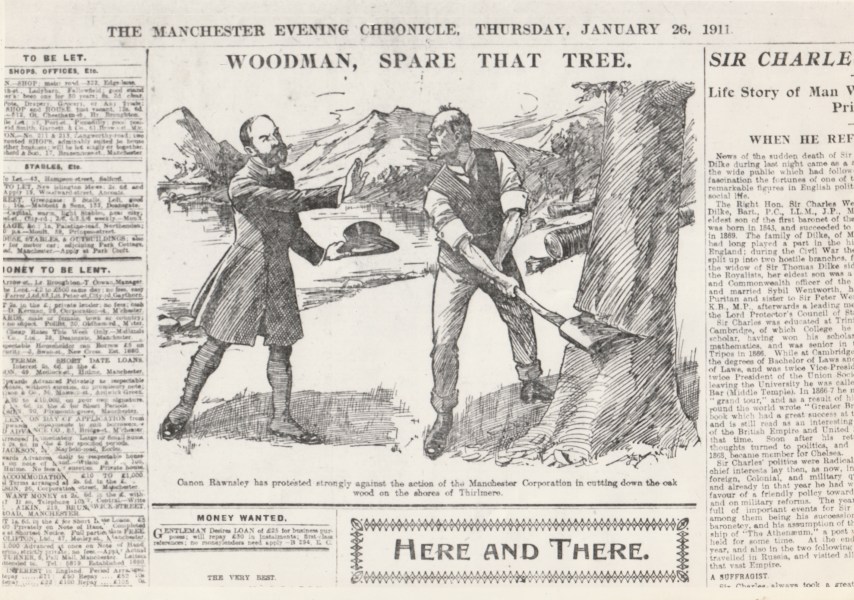
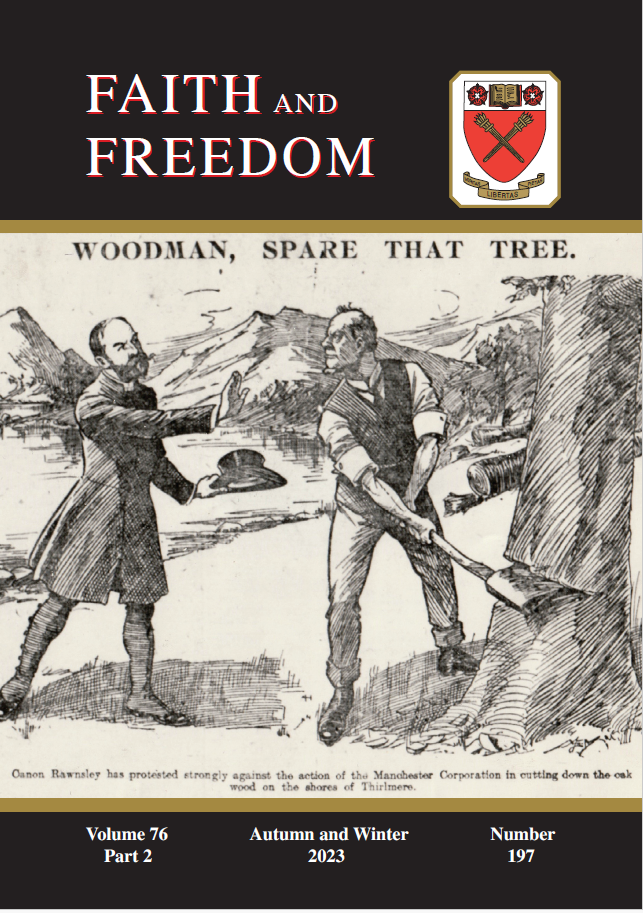
Our cover picture contains a cartoon from the Manchester Evening Chronicle of 26 January 1911 and features Canon Hardwicke Rawnsley, one of the founders of the National Trust, shown here trying to save some oaks on the bank of Thirlmere Reservoir in the Lake District. It links to Graham Murphy’s Review Article of a new biography by Michael Allen and Rosalind Rawnsley – Hardwicke Drummond Rawnsley, An Extraordinary Life, 1851-1920, (The New Beaver Press, 2023, pp 476. ISBN 978-1-7392194-1-3, £20 pbk.) The cartoon is strangely appropriate for today because it is also being used by campaigners trying to keep the public road along Thirlmere Reservoir open to walkers, cyclists and motorists. The Canon was not successful in his attempts in 1911 and the conifers which replaced the oaks now regularly blow down and block the road. You can read about the current campaign to keep the road open by clicking here.

Our journal opens with Sandra Gilpin’s pen portrait on the Rev William Hugh Doherty (c.1810-1890). His career began as the first minister of the Unitarian/Non-Subscribing Presbyterian Church in Comber county Down. He moved to the United States and embarked upon an unusual career firstly as a Unitarian minister in Rochester NY then moving to a denomination known as the ‘Christian Church’ where he became quite a prominent educator. But the suggestion of some scandal was never far away in his life and he managed to serve on both sides of the Civil War as well as hold views, at different times, that were both pro and anti slavery! His career ended with him becoming an assistant in the US Patent Office.

Other articles include Imran Usmani’s fascinating discussion of ‘The Crucifixion of Jesus in Islam’. Looking afresh at the traditional Muslim view of the Crucifixion the author presents ‘novel textual and contextual analysis of the Crucifixion Verse based on the Quran and traditional Muslim sources’ and concludes that the traditional view is actually a misunderstanding of the original intention. He concludes that the Quran does not deny the historical fact of the Crucifixion of Jesus, rather it denies that the Crucifixion was rightful. The author believes that ‘Crucifixion denial in the Muslim tradition created a chasm between Muslims and Christians because it made both parties sceptical of the other’s scriptures.’ His aim is to help bridge this chasm dividing the two religions.

Other articles include Dan C. West’s encouragement to Christians to turn from ‘preoccupation with the past to focus instead on the future is a courageous act of faith and hope’, in ‘With Courage and With Hope’; and a sermon by the editor, ‘Telling Our Stories’, which asks whether those of us in a liberal theological tradition fully understand and articulate our identities.

There is also a good number of reviews including:

Maria Curtis (ed.), Cherishing the Earth – Nourishing the Spirit, Lindsey Press, 2023, pp 264. ISBN: 978-0-85319-098-1, £12.00 pbk. Reviewed by Oscar Sinclair.

Stephen Hart, James Chuter Ede: Humane Reformer and Politician, Pen and Sword History, 2021, pp 352. ISBN 978-1-52678-372-1, £25.00, hbk. Reviewed by Derek McAuley.

George D. Chryssides and Dan Cohn-Sherbok (eds.), The Covid Pandemic and the World’s Religions. Bloomsbury Academic, 2023, pp 256. ISBN 978-1-3503-4963-6, £19.95 pbk, £65.00 hbk. Reviewed by Marcus Braybrooke.

Marcus Braybrooke, Interfaith Pioneers 1893-1939. The Legacy of the 1893 World Parliament of Religions, Braybrooke Press, 2023, pp 118. ISBN 9798392406180, £9.95 pbk.
Marcus Braybrooke, Jewish Friends and Neighbours. An Introduction for Christians, Braybrooke Press, 2023, pp 367. ISBN 979-8397750776, £19.95, pbk. Both reviewed by the Editor.

An annual subscription for each volume (two issues) costs £16.00 (postage included) in the United Kingdom. Single copies can be ordered at a cost of £8.00 each (postage included). Cheques should be made out to Faith and Freedom and sent to the business manager:

Nigel Clarke,
Business Manager, Faith and Freedom,
16 Fairfields,
Kirton in Lindsey,
Gainsborough,
Lincolnshire.
DN21 4GA.

It is also possible to pay online. For more details see our website: https://www.faithandfreedom.org.uk/subs.htm
Eustace Street meeting-house, Dublin

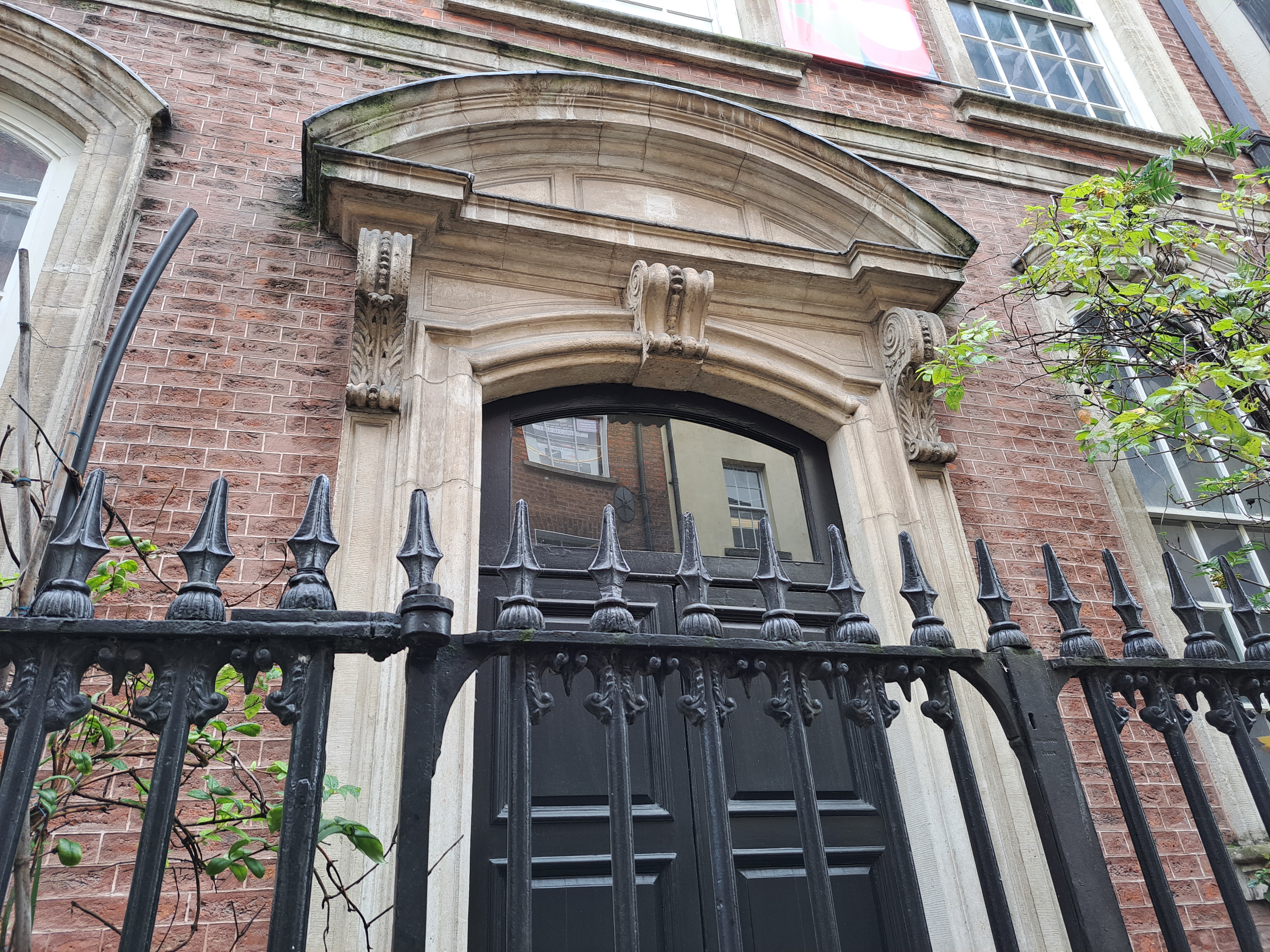
Until 1867 there were two Unitarian churches in Dublin. Both could trace their history back to at least the mid-seventeenth century and both had a succession of distinguished ministers and comprised congregations that had a significant role in Dublin life. After the restoration of 1660 the English Independent and Presbyterian clergy who had occupied the prime positions in religious life in Dublin during the Cromwellian interregnum were removed from their posts. This really was the start of the congregations of Wood Street, which later moved to Strand Street and ultimately to St Stephen’s Green, and New Row, which later built a new church on Eustace Street in 1728. In 1867 the congregations of Eustace Street and St Stephen’s Green amalgamated at St Stephen’s Green and have been a single congregation ever since. But the building on Eustace Street remained, for most of its history being used by Brindley’s the printers, and it is still there today, although today it is really little more than the façade.

The history of this building deserves to be better known and properly understood. I first went to see it in the early 1990s when it was empty but looked intact and was still recognisable as an old meeting-house. I took this picture which was published in the Inquirer at the time.

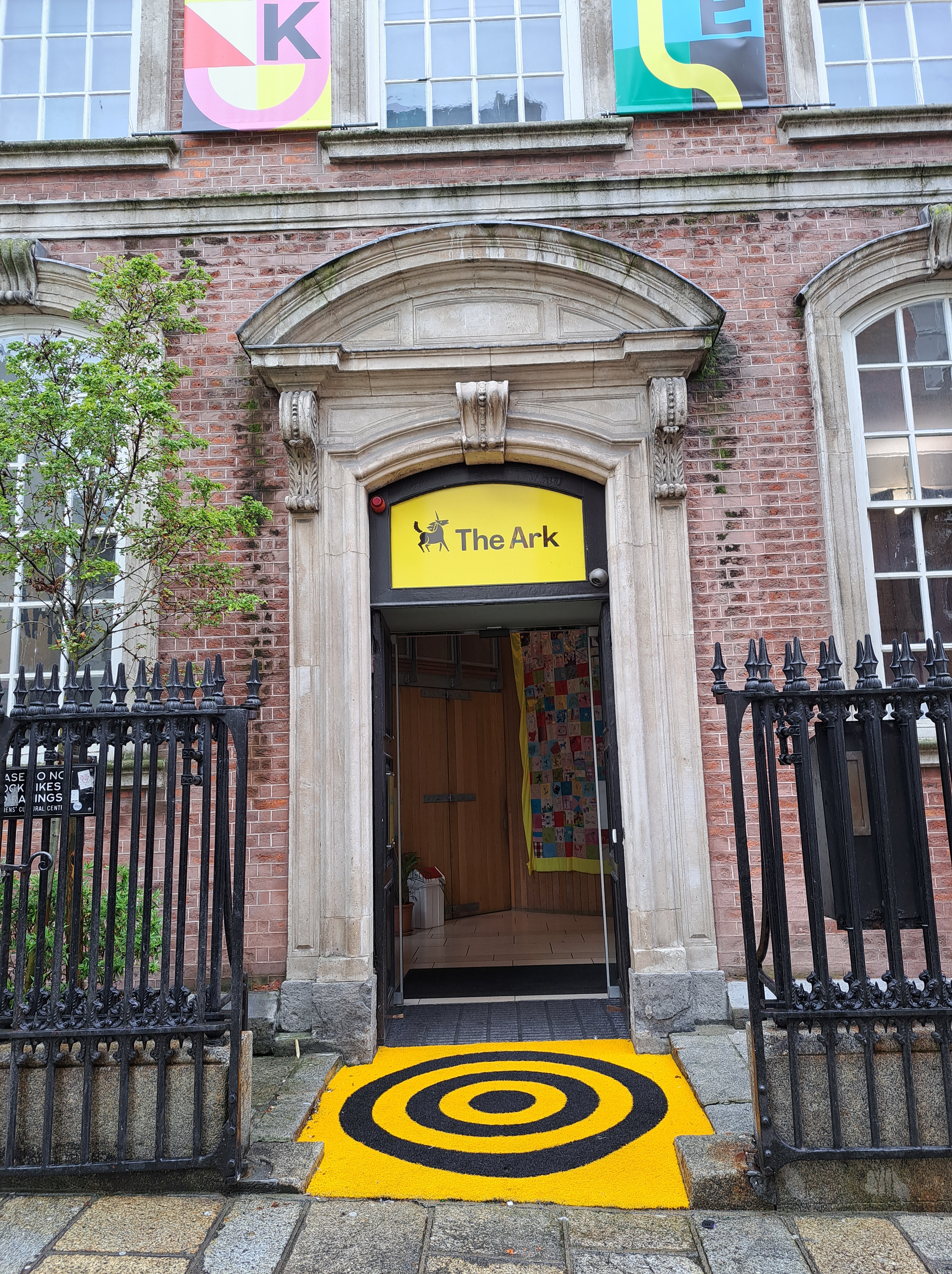
Within a few years, however, the whole area around it in Temple Bar underwent massive refurbishment and changed from a run down backwater to a busy cultural quarter. In about 1995 the building was turned into the Ark, a children’s theatre space.

The meeting-house today

Undoubtedly this is a good use for the building although it is a shame to think that so much of the original building had to be demolished to allow it to happen. Only the façade and the two side walls remain from the building of 1728. All the rendering from the old building has been removed to expose the brickwork both inside and out. But it is still a very impressive building.

One of the two entrances to the building

Christine Casey, in her book Dublin in the Buildings of Ireland series, says of the building: ‘The C18 facade is a handsome essay in retardataire Carolean classicism…A red-brick two-storey six-bay front with entrances in bays two and five and large segment-headed sash windows.’ It’s always good to see a bit of retardataire Carolean classicism. But it is a very fine frontage and even if the rest of the building is gone, it remains as an impressive testimony to the people who built the church.
Not everyone approved of it when it was built. According to Thomas Witherow a Quaker remarked (there was also a Quaker meeting-house on the same street) that ‘When there is so much vanity without, there cannot be much religion within’.

Visiting Eustace Street over the summer I took some pictures of the interior. We can see the bare brickwork which once echoed to the sound of the sermons of such luminaries as John Leland and James Martineau.

Upstairs window brickwork
Looking through one of the downstairs windows

Apart from the windows there is nothing remaining that tells us how the interior of Eustace Street looked. However, about 110 years ago the Non-Subscribing Presbyterian magazine published two engravings of the interior without giving any source for these interesting views. The first showed the position of the pulpit.

The Eustace Street pulpit as it may have looked
The foyer of the building today

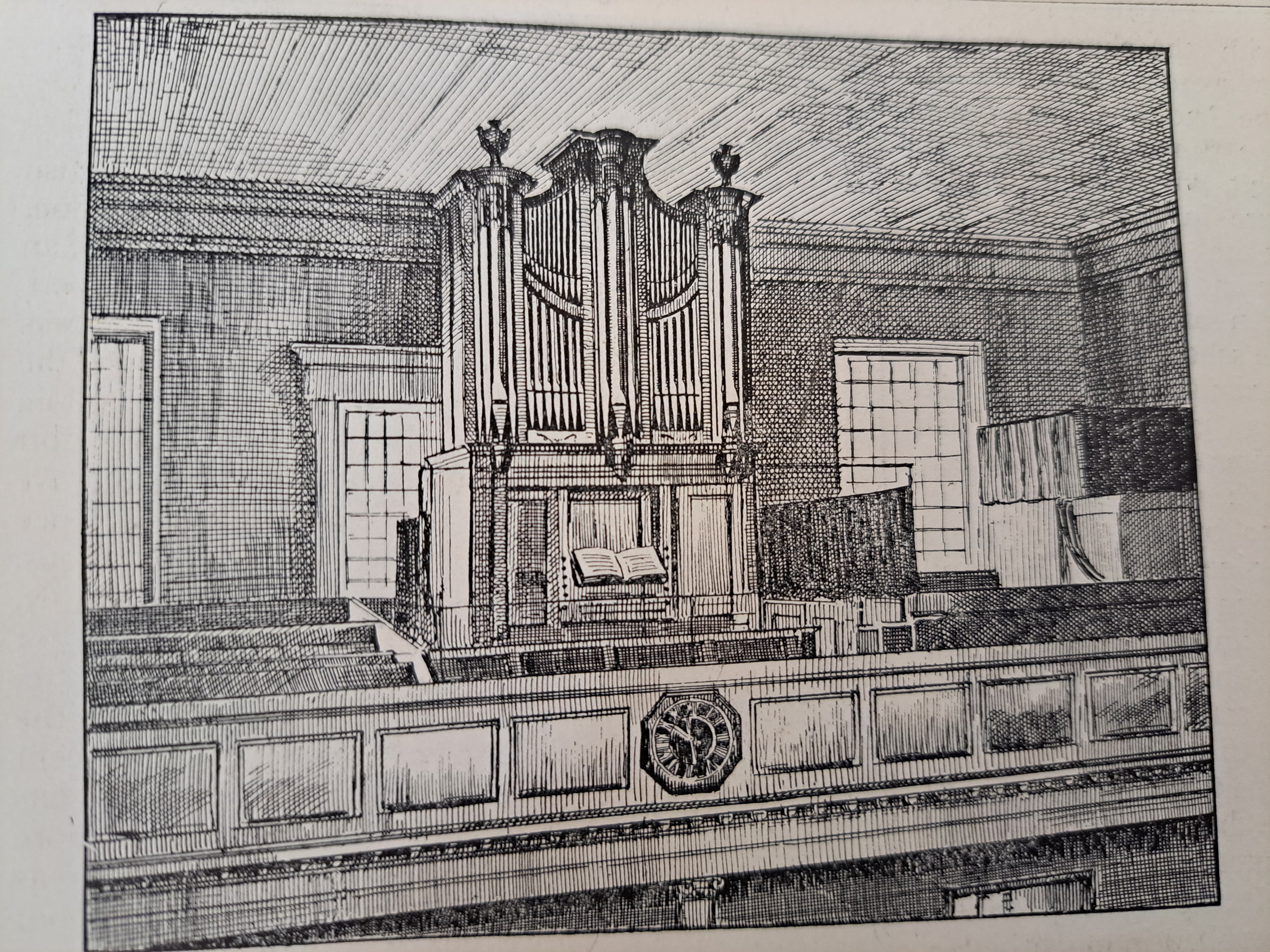
The windows that look on to Eustace Street are topped by a gentle arch but according to the Non-Subscribing Presbyterian images the now demolished windows at the back of the building were flat topped. At the back of the church there was a gallery which housed a clock and the organ.

The organ and gallery of Eustace Street as they looked before 1863

When Eustace Street was built times were difficult for Dissenters, they could frequently be the target of violent attacks, and from the earliest days there was a wall in front of the meeting-house. At some point before 1835 this was changed to the low wall and attractive railings which still stand there to this day. But neither the walls nor the railings were of much use when James Martineau added his name to a declaration in favour of Catholic emancipation which resulted in the windows being smashed by a mob.

The wall and railings today

It is good that this much has survived and that the space is obviously put to such good use. However, there has not always been such a clear understanding of the historical place of the meeting-house. Not long after the Ark was opened in 1995 members of Abbey Presbyterian Church were invited to hold a special service on the premises complete with baptisms of children as a way of connecting with the original history. This was a nice thing to do but rather misunderstood the nature of the history of the premises.

Inside the foyer today

James Martineau was ordained in this meeting-house on 26 October 1828. Back in 1992 I contributed an article to the Inquirer entitled ‘Martineau’s First Ministry’. If you would like to read it click on this link: Martineau’s First Ministry

Transactions of the Unitarian Historical Society April 2023

Volume 28 Number 2 (April 2023) of the Transactions of the Unitarian Historical Society is now ready and, as ever, it is full of interest. It contains:

To give ‘occasional contributions’ and ‘annual subscriptions’ to
promote ‘those great principles of religious truth’:
Unitarian Fellowship Funds in the early nineteenth century

by David L. Wykes

Dr David Wykes

Our first article is by Society Vice-President David Wykes who has researched in great detail the story of the Unitarian Fellowship Funds. Although these were not long-lasting they deserve attention as an early national initiative which expressed a Unitarian identity and which found outlets all over the country. The Funds have long been neglected by historians but they are a very important indication of lay involvement in Unitarianism. They embraced both the poorer strata of society for a denomination that was often seen as appealing only to the rich, as well as gave an opportunity for women to be more actively involved in church life. The article includes a check list of Fellowship Funds and richly illustrates a movement that was one of the earliest expressions of a Unitarian denominational identity.

Emily Ronalds (1795–1889) and her social reform work
by Beverley F. Ronalds

Emily Ronalds. Photograph by Edmund Wheeler, Brighton, 1880. Courtesy: Auckland Library, New Zealand, Sir George Grey Special Collections, NZMS 1235

Beverley Ronalds, a Fellow of the Australian Academy of Technology and Engineering, uncovers the life and contribution of Emily Ronalds, a much-neglected Unitarian figure who played an important part in the extension of infant schooling. In her youth she was, by nature, a retiring figure, she was later described by the American social activist Frances Wright as ‘clever’ with ‘energy of character’, while Henry Crabb Robinson spoke of her ‘vivacity & good spirits’. She had close links with many of the most advanced thinkers of her day and contributed to experiments in socialist co-operative communities, the abolition of slavery and the development of feminism.

William Sunderland Smith (1833 – 1912) and his family
by Ian Wood

William Sunderland Smith photographed by his son William Ivan Smith in 1902. Courtesy: the family of W.I. Smith

William Sunderland Smith was the twelfth student to enrol in the Unitarian Home Missionary Board (later College) and went on to have a succession of ministries in England, Scotland and Ireland. Ministering, in turn, at Aberdeen, Rawtenstall, Doncaster, Tavistock and Crediton, his final and longest ministry was at Antrim. Ian Wood, his great great grandson, traces his life and that of his family, along with his theological and political ideas. A writer and journalist he developed extensive scientific interests, contributing ‘Nature Notes’ to the Northern Whig newspaper, and made numerous contributions on natural history and Irish history to the Ulster Journal of Archaeology.

Review Article.
The Oxford History of Protestant Dissenting Traditions
by Alan Ruston

Alan Ruston contributes a Review Article on The Oxford History of Protestant Dissenting Traditions, a five volume investigation of the place of Protestant Dissent not only in England and Ireland but also the Empire and Commonwealth, the USA and ultimately all over the world. Alan reviews all five volumes but pays especial attention to volumes two and three which contain a great deal concerning Unitarianism.

In addition we have our review section.

Dr Williams’s Trust and Library: A History
by Alan Argent

A Short History of the
Non-Subscribing Presbyterian Church of Ireland.
Including Sketches of Individual Congregations
and a Fasti of Ministers who served in them

by J.W. Nelson

These Eighty Years. A Recollection
by Alan Ruston

All reviewed by David Steers,
Editor of the Transactions

plus

OBITUARY
Professor Sir Tony Wrigley, FBA (1931-2022):
a Unitarian appreciation
by David L. Wykes

An annual subscription costs £10

Visit the new Unitarian Historical Society website to join: https://unitarianhistory.org.uk/