I was really pleased to be invited to Knutsford to give a talk on Unitarian history earlier in January and so pleased to see such a good turnout and to find such a lot of interest in the topics discussed. I was delighted too to be asked to preach on the Sunday in the impressive meeting-house of 1689.
I have put together a short video that looks at one of the connections between Knutsford and Dunmurry, mainly that represented by Rev Alexander Gordon and his wife Clara Maria Gordon (née Boult). It can be viewed here:
Elizabeth Gaskell, Clara Boult & Alexander Gordon. Click above to see the video
Alexander Gordon himself was descended on his mother’s side from an ejected minister of 1662 and part of his enornous contribution to history was to produce Freedom after Ejection and the Minutes of the Cheshire Classis, both still important works of reference which have close connections to the story of the early dissenting community of Knutsford.
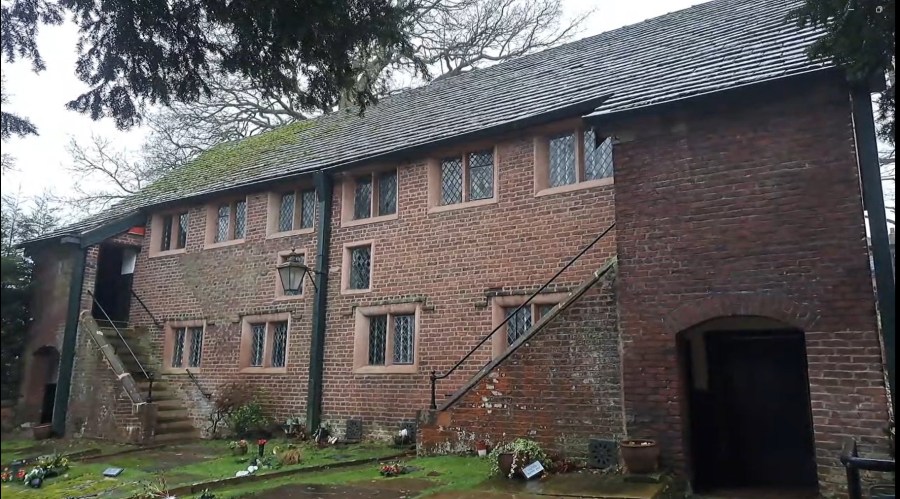
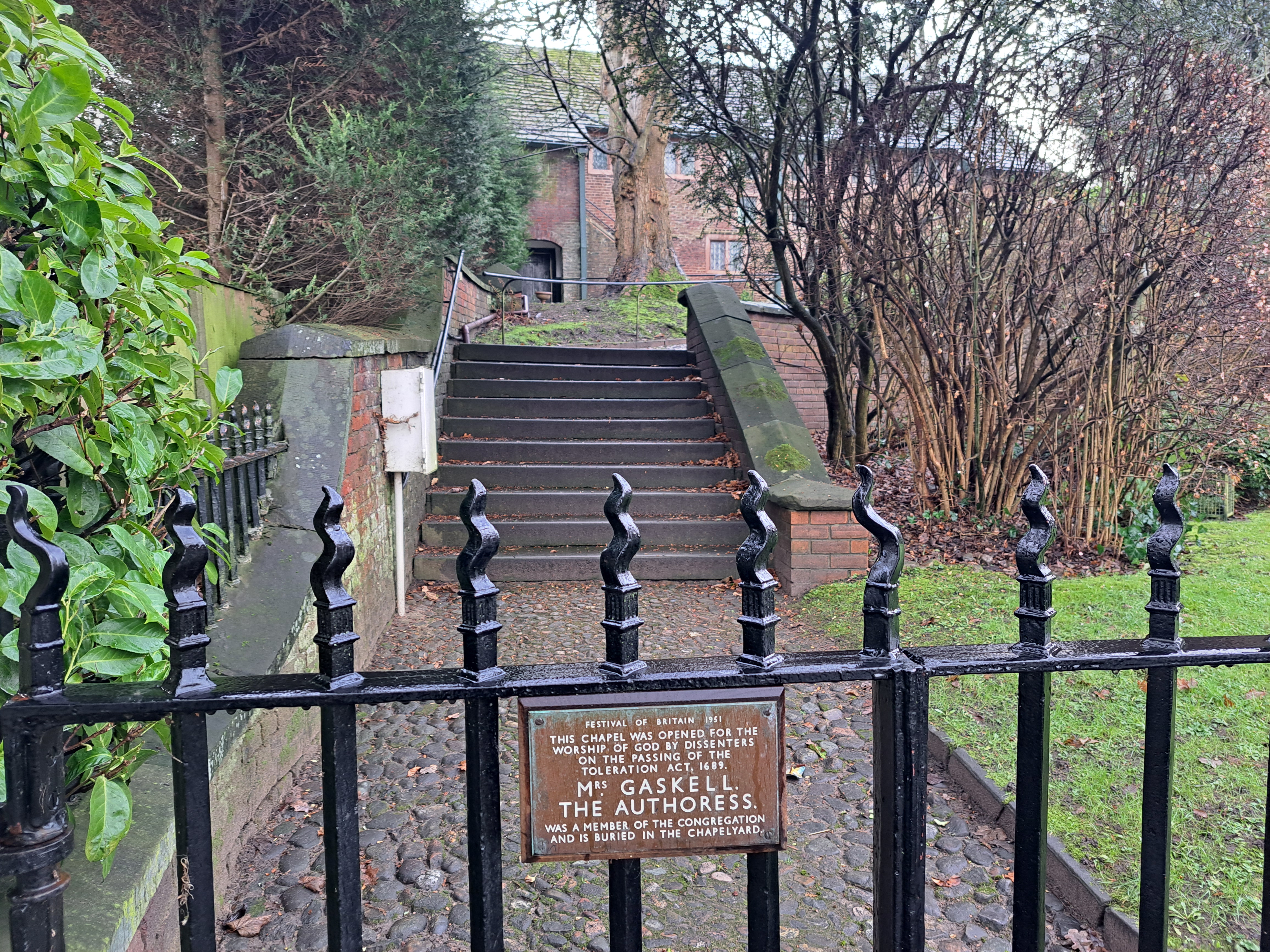
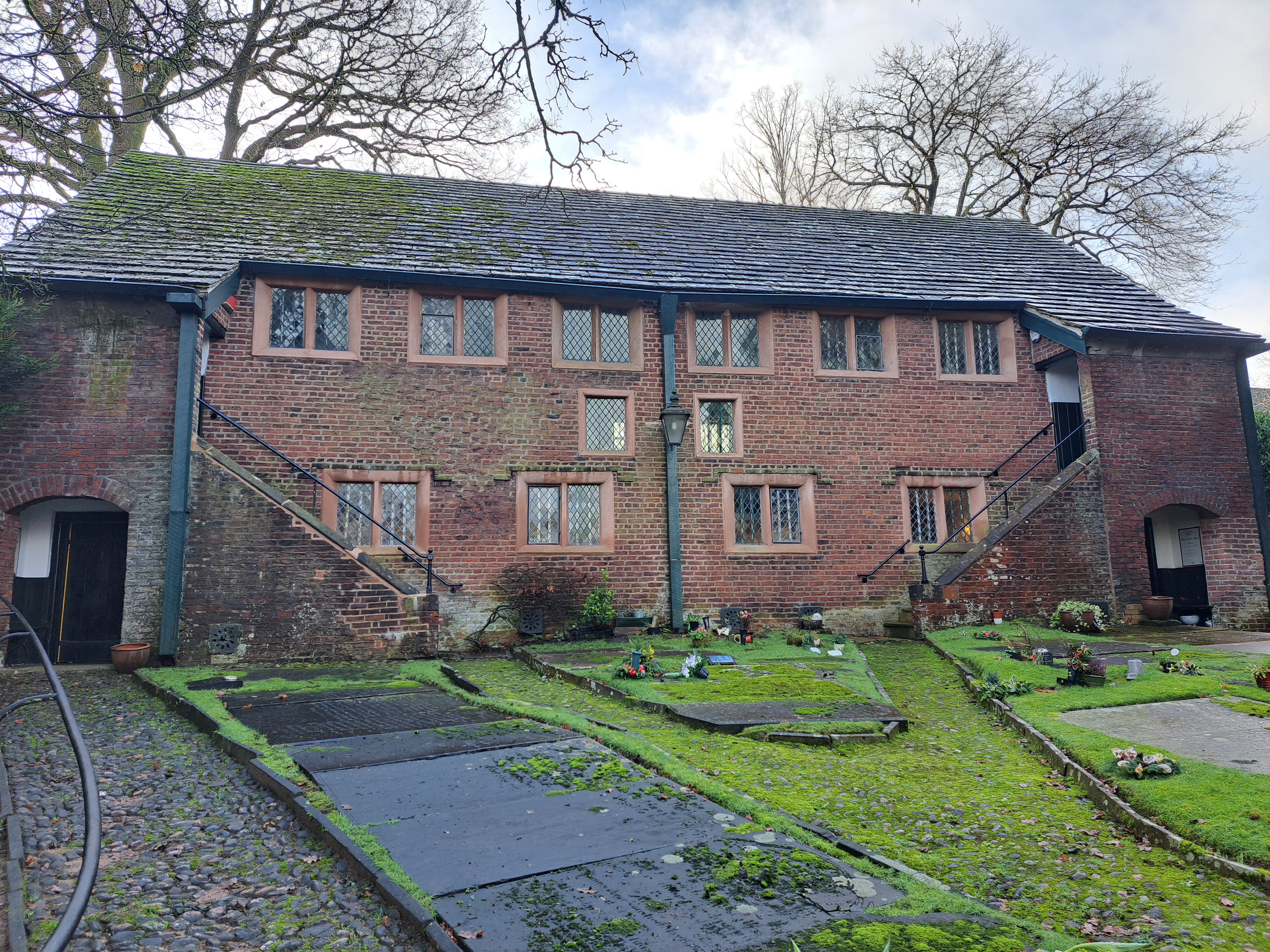
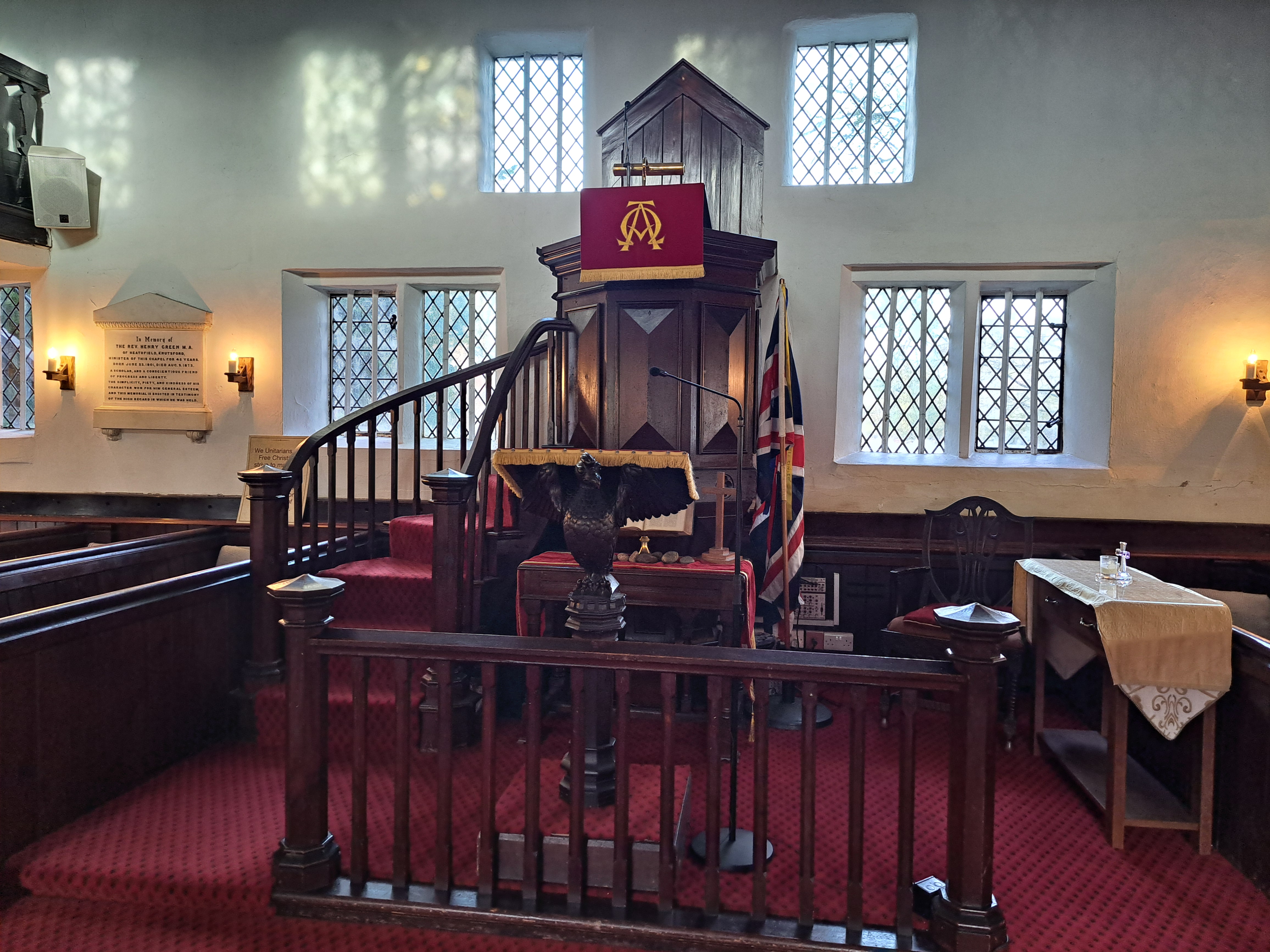
Of course, the most famous person connected with the chapel is undoubtedly Elizabeth Gaskell, who is buried in the chapel graveyard along with her husband Rev William Gaskell.
An old plaque commemorates ‘Mrs Gaskell, the Authoress’
Elizabeth Gaskell is possibly the most famous nineteenth-century Unitarian of all in terms of her continuing impact on modern culture and literature. She is also someone claimed as a Unitarian who really was exactly that; the daughter of a minister, raised in Knutsford Chapel, married to a prominent Unitarian minister and part of that extended community throughout the north west. Her religion was part of her, even to the extent of utlisiing some of the reports of the Manchester Domestic Mission for her descriptions of urban hardship in nineteenth-century Manchester in her novel North and South.
The exterior of the Chapel
Along with Elizabeth Gaskell, Knutsford is also the burial place of Clara Gordon and her gravestone is an invaluable aid in uncovering the tragedy of her and Alexander Gordon’s home life. Two children killed in war, a young daughter died in Rostrevor, county Down, and buried in Warrenpoint, a fact that can hardly be discovered anywhere else than from Clara’s gravestone.
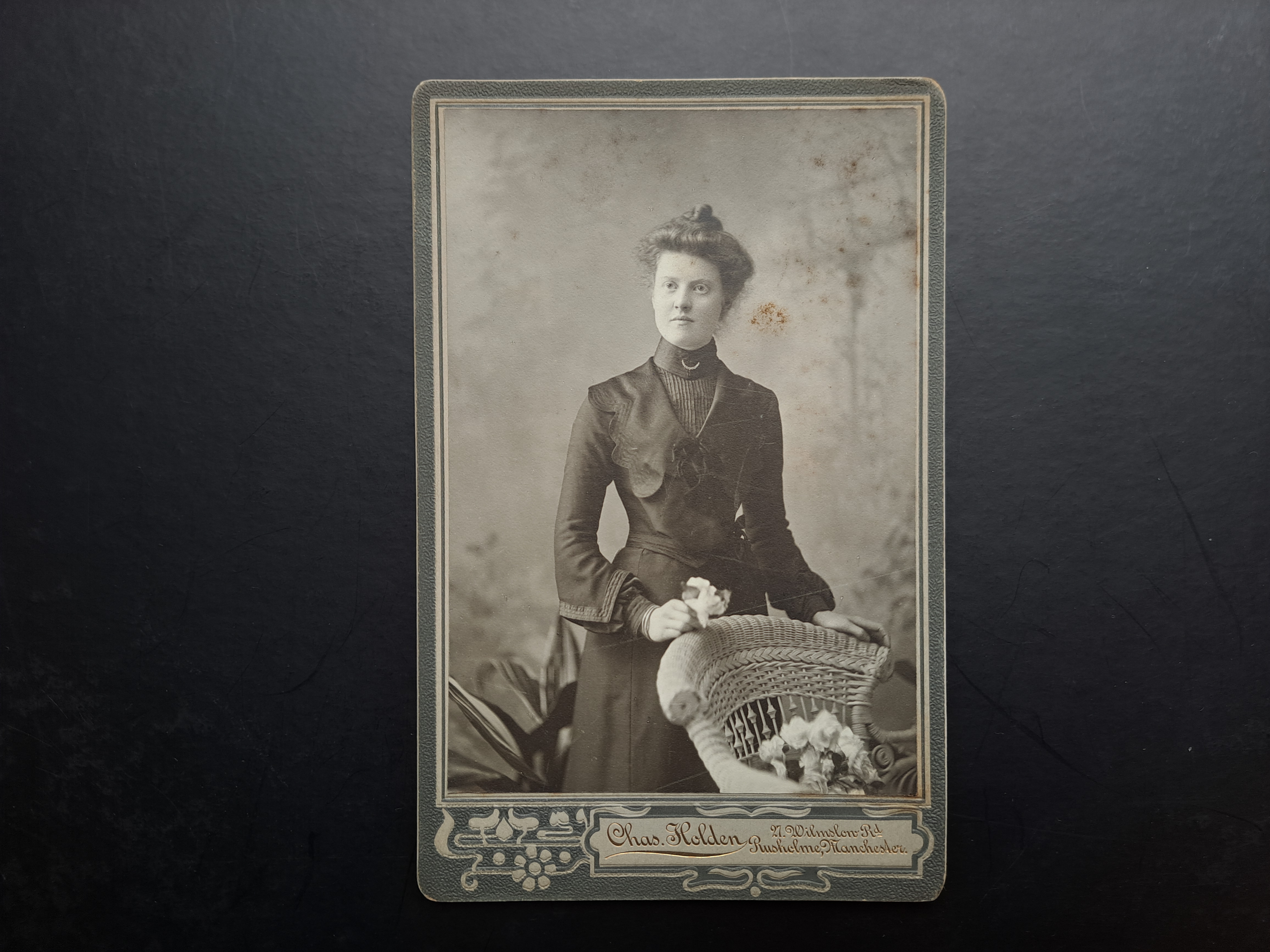
Mary (May) Gordon 1879-1904
The tragic story of the family is told in the video. May was born in Belfast, the above picture was taken in Manchester, in a studio in Rusholme.
The video also shows Alexander Gordon’s close allegiance to Dunmurry. A dedicated member there from 1889 to 1931 despite his commitments to the Unitarian Home Missionary College, the University of Manchester Faculty of Theology, and the churches in North West England.
The latest issue of Faith and Freedom (Volume 79 Part 1, Issue 201, Autumn and Winter 2025) is now on its way to subscribers. Having been in print since 1947 we have now reached issue 201.
Rev Sidney Spencer by John Stanton Ward, Harris Manchester College, Oxford.
Sidney Spencer is a much neglected figure in twentieth-century Unitarian history and Jo James gives a comprehensive examination of his theological ideas. A Unitarian minister noted for his strongly pacifist witness both before and during the Second World War, with only limited formal academic credentials to his name he nevertheless became Principal of Manchester College, Oxford as well as one of the acknowledged world experts on mysticism. His interest in this subject resulted in a number of publications culminating in the Pelican Mysticism in World Religion in 1963, an influential work and something of a best seller in its day. Jo illuminates Spencer’s theology, sets it in its context and seeks out its relevance to the present day.
This year is the 100th anniversary of the ‘Scopes Monkey Trial’, the famous trial which took place in Dayton, Tennessee when local teacher John Scopes was taken to court for teaching Darwin’s theories in his classes, contrary to the law of the state of Tennessee. John Midgley gives a timely account of this key event, forever made famous by the movie Inherit the Wind, starring Spencer Tracey.
One hundred years is a long time yet the whole case has many uncomfortable resonances in the present age and these perhaps feed into the current situation in the United States. Dan C. West, who has ‘lived through 15 presidents since the beginning of the Second World War’, gives a very insightful analysis of the current political, theological and cultural trends which mark America today.
How do we understand our place in the universe, how do we understand the universe itself in theological terms? Feargus O’Connor provides an excellent examination of Our Mysterious Universe: Accident or Design? looking at the philosophical notions that underpin the argument from design.
Following on from Barrie Needham’s article considering the Koran/Quran from Western, liberal Christian eyes in our last issue, we are pleased to include a response from Imran Usmani who brings considerable insight to the topic through his extensive researches on Christianity, Judaism and Islam.
We are delighted to once again include a number of reviews, including Peter B. Godfrey’s review of Diarmaid MacCulloch’s Lower than the Angels: A History of Sex and Christianity; Peter’s review of the late Rev Art Lester’s Thank God I’m an Agnostic: Trusting your Hunch about God, the Universe and All That and the editor’s review article on A Short History of the Non-Subscribing Presbyterian Church of Ireland. Including Sketches of Individual Congregations and a Fasti of Ministers who served in them by John Nelson.
You can take out a subscription via Nigel Clarke, our Business Manager, or online via PayPal. The details of how to subscribe can be found on our website here: https://www.faithandfreedom.org.uk/subs.htm
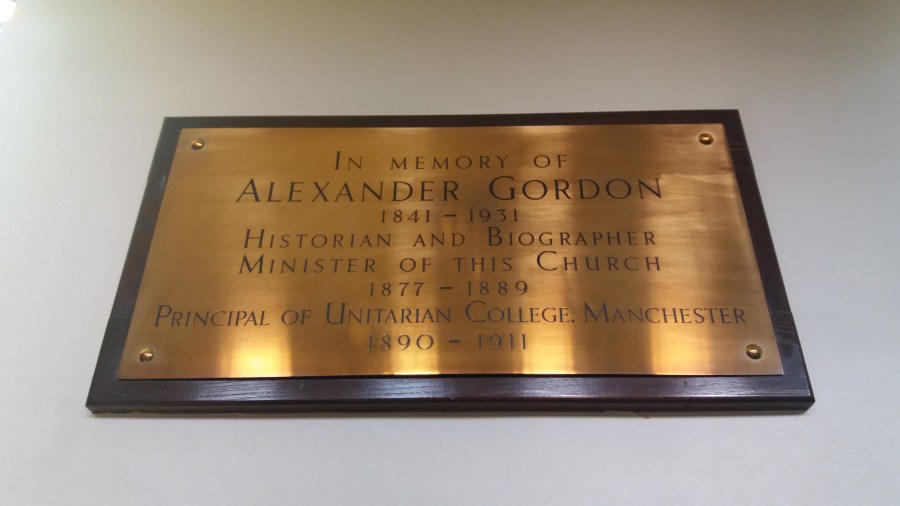
Historian, Biographer, Minister of First Church, Belfast. ‘An Englishman by birth, a Scotsman by education and an Irishman by inclination’.
On Thursday, 22nd May, 2025, we had an illustrated talk in First Dunmurry (NS) Presbyterian Church about the great historian Alexander Gordon.
Talk at Dunmurry by Rev Dr David Steers
A distinguished minister in England and Ireland, he served at Aberdeen; Hope Street, Liverpool; Norwich and at First Church, Belfast, before becoming Principal of the Unitarian Home Missionary College, Manchester and a lecturer in Ecclesiastical History in the first Free Faculty of Theology in the British Isles.
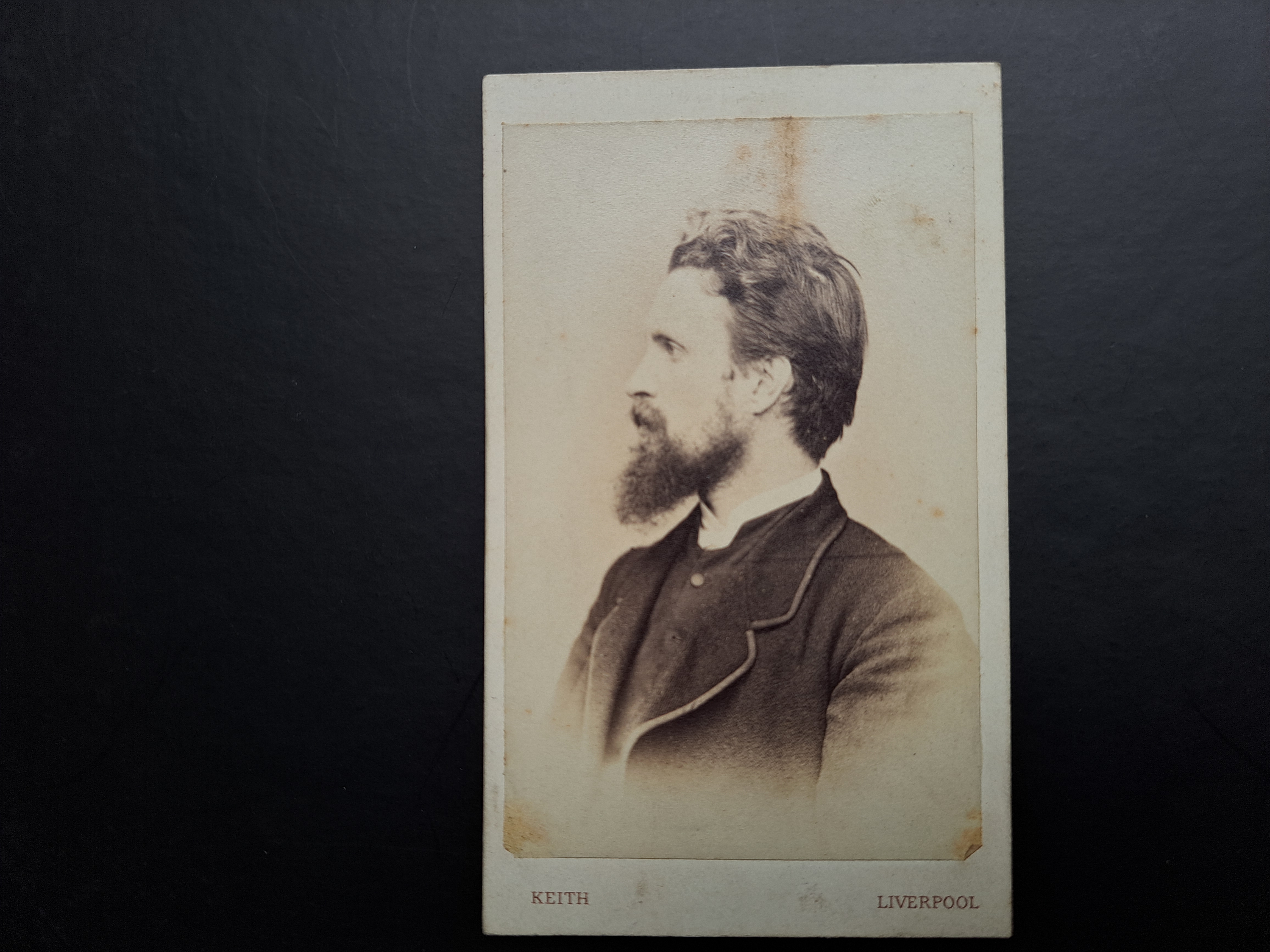
The earliest known photograph of Alexander Gordon, taken in Liverpool c.1872 at the time of his marriage to Clara Maria Boult
His scholarship was widely acknowledged all over the world, contributing 778 entries to the Dictionary of National Biography, 39 articles to the eleventh edition of the Encyclopaedia Britannica and much more. A superb linguist and experienced traveller his researches took him all over Europe. Among other things he was closely involved in the creation of the Non-Subscribing Presbyterian Church of Ireland in 1910.
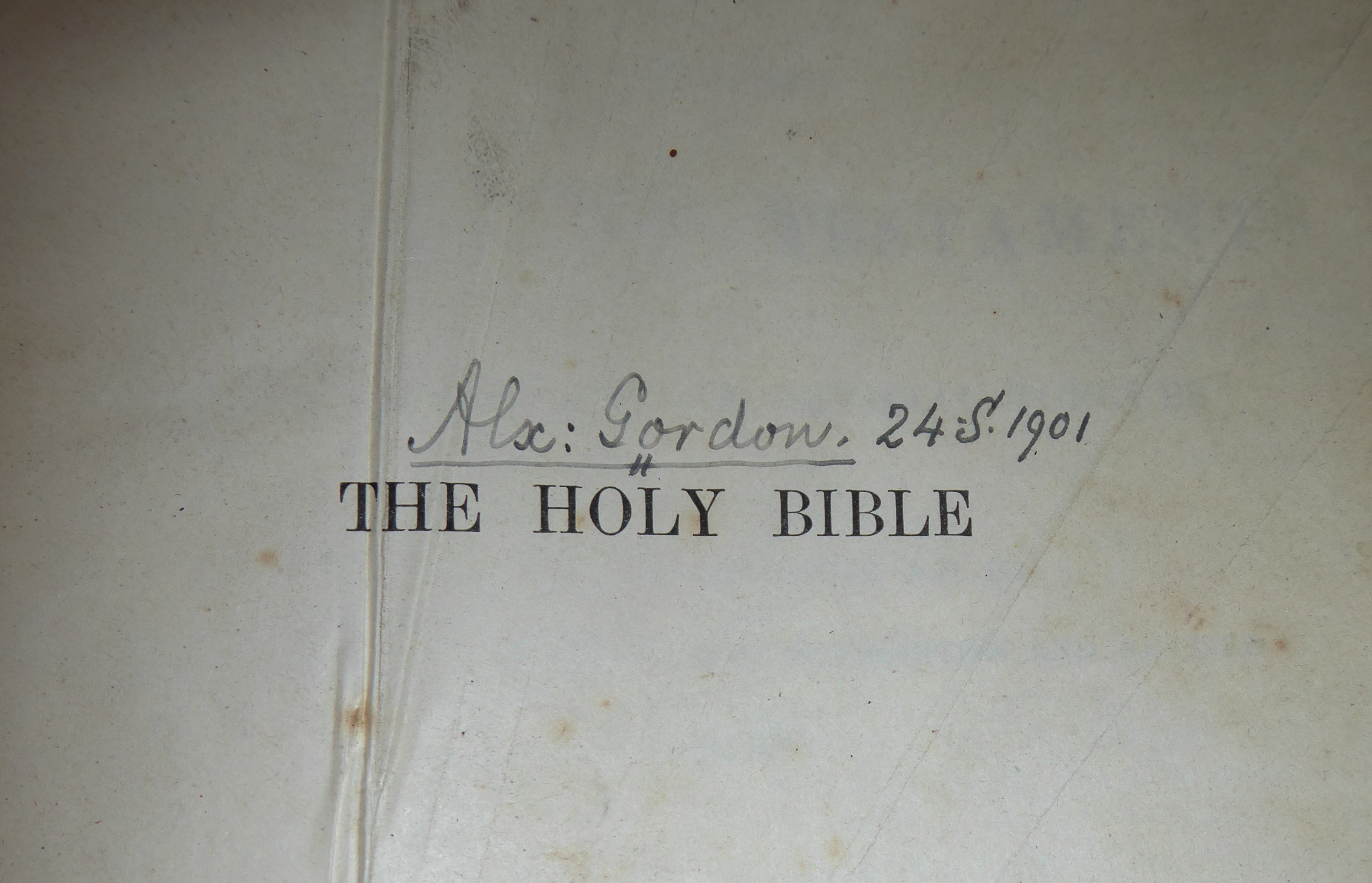
Gordon’s distinctive signature in a personal copy of his Bible (Revised Version)
The talk looks at his education, his work as a biographer and historian, and his commitment to the churches in Ireland which he served as secretary to the Association of Irish Non-Subscribing Presbyterians and later being closely involved in the setting up of the Non-Subscribing Presbyterian Church of Ireland itself.
He was a distinguished minister at First Church but even after leaving for Manchester kept a very close connection with the Irish churches, particularly through Dunmurry where he was regarded as the unpaid curate of his friend the Rev J.A. Kelly, despite the incredible heavy work load of his high profile work. From 1895 until the year of his death in 1931 he only missed one communion service at Dunmurry – and that was because of an unexpected train timetable change that left him stranded in Dublin one weekend during the First World War. For a very experienced traveller, particularly rail traveller, this must have been especially galling for Gordon. The lecture also looks at Alexander Gordon as a travel writer.
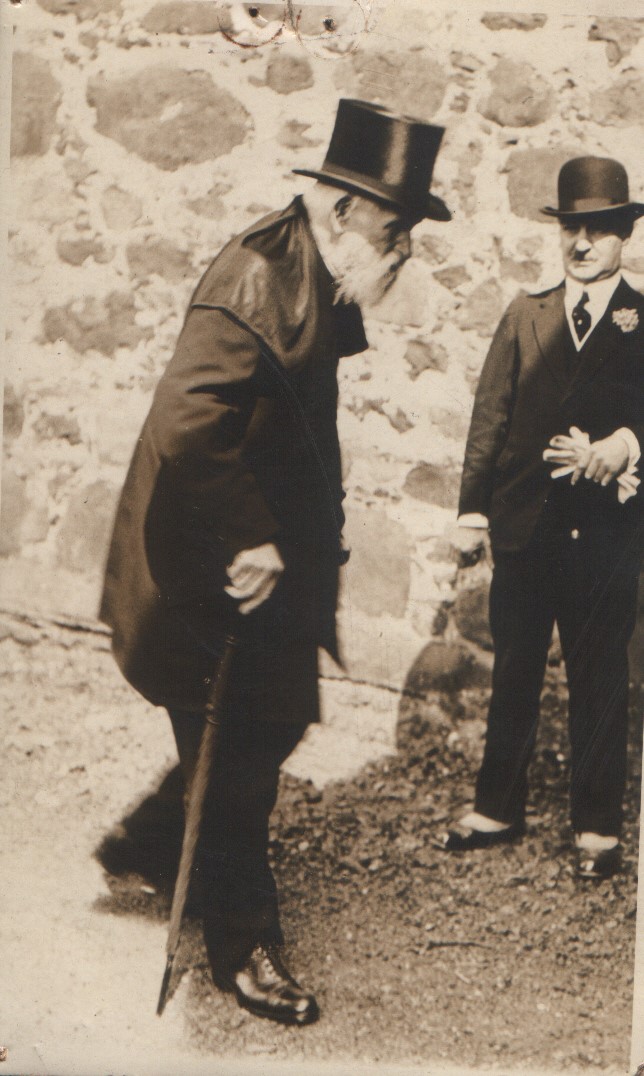
The last photograph of Alexander Gordon taken at Dunmurry on 18th January 1931
It examines too his family background, which was frequently touched by tragedy. But he inspired great loyalty and affection in the generations of students he trained for the ministry.
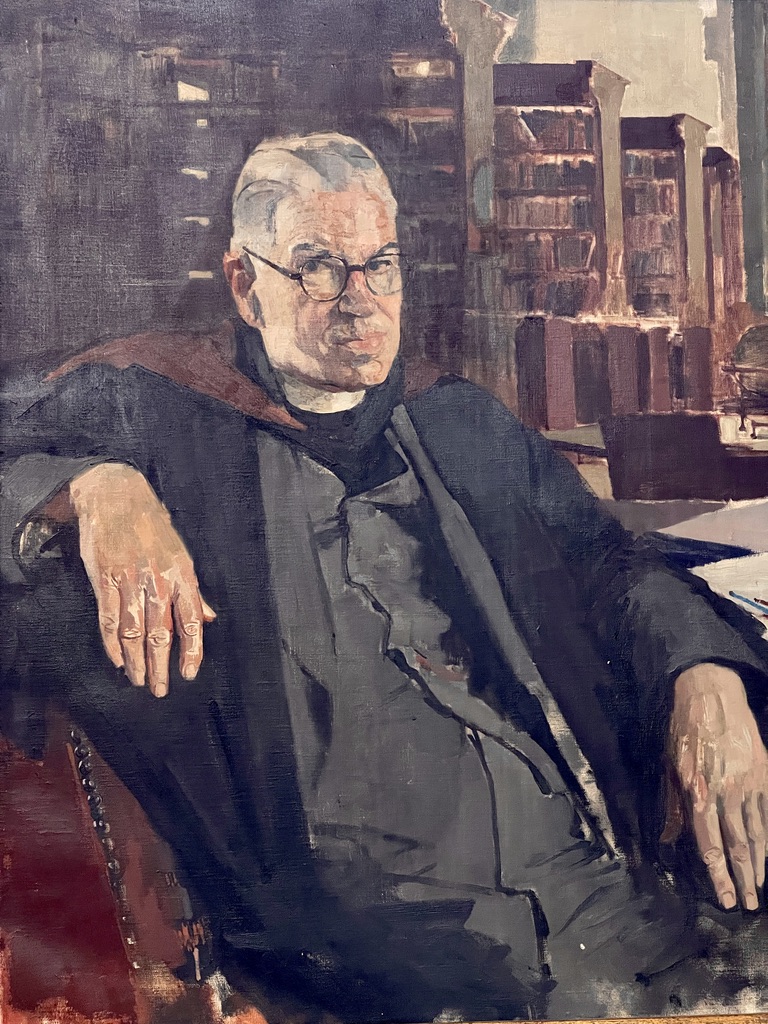
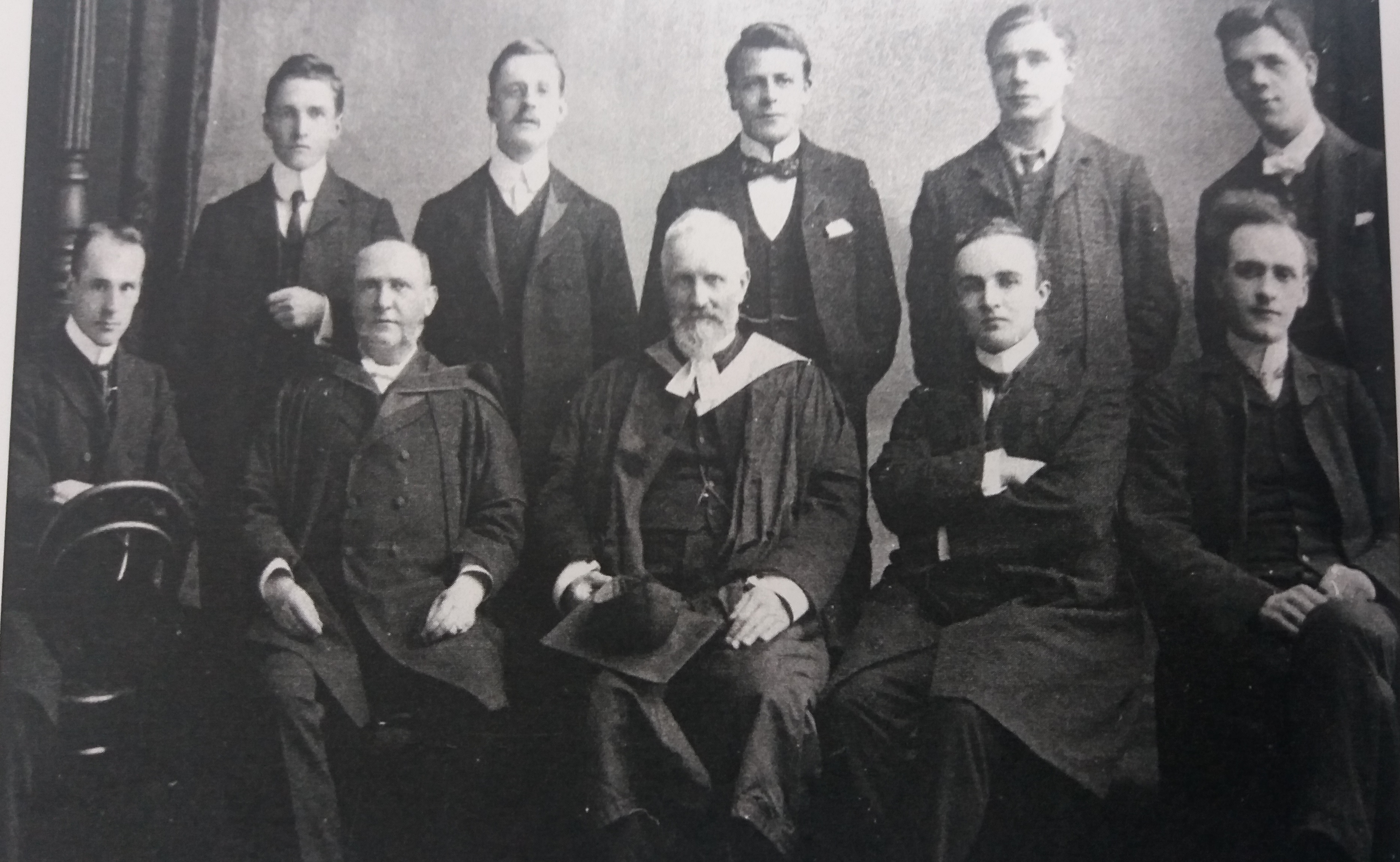
Principal of the Unitarian Home Missionary College, Manchester
He was buried in Dunmurry, just a short time after he conducted his final service there on 18th January 1931.
The latest issue – Volume 28 Number 4 – is on its way to members of the Society, new members are always welcome and details of how to join can be found below.
As ever there is a great wealth of material in the journal, including:
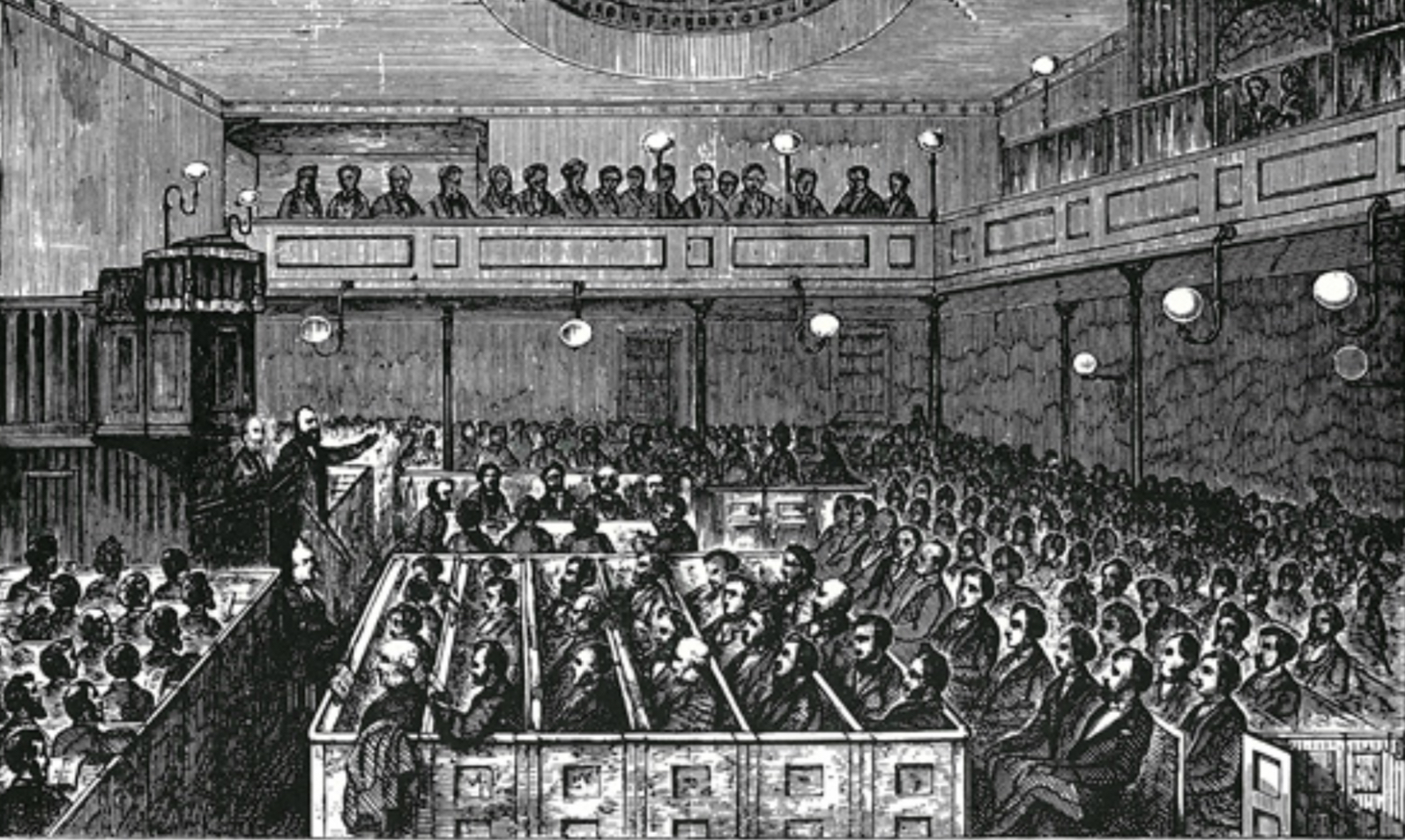
Essex Street Chapel in the later eighteenth century: members, adherents and sympathisers
G. M. Ditchfield
Centenary Service at Essex Church 1874
In this article Professor Grayson Ditchfield provides an analysis of the ‘associates, friends, visitors and even some critics of a congregation which has been, and remains, widely and deservedly regarded as a foundational pillar of the Unitarian movement in this country’. In his paper Professor Ditchfield goes a long way to uncover the stories of the people who sat in the pews at Essex Street Chapel and looks especially at the role of women there. The Chapel was situated in a very impoverished area and Hannah Lindsey, the wife of the minister, organised poor relief for the local inhabitants. The congregation could not have survived without its female supporters in the early years in particular, and one member, Elizabeth Rayner, made an annual donation of £2,000. Essex Street Chapel included a number of MPs, including one described as `my fidgeting pew neighbour’ by another member. Some of the MPs made the free franking of letters in the House of Commons available to members! Was it a Dissenting Chapel or a reformed Church of England? Was it a congregation or an audience? All this and much more is examined in this fascinating article which breaks so much new ground.
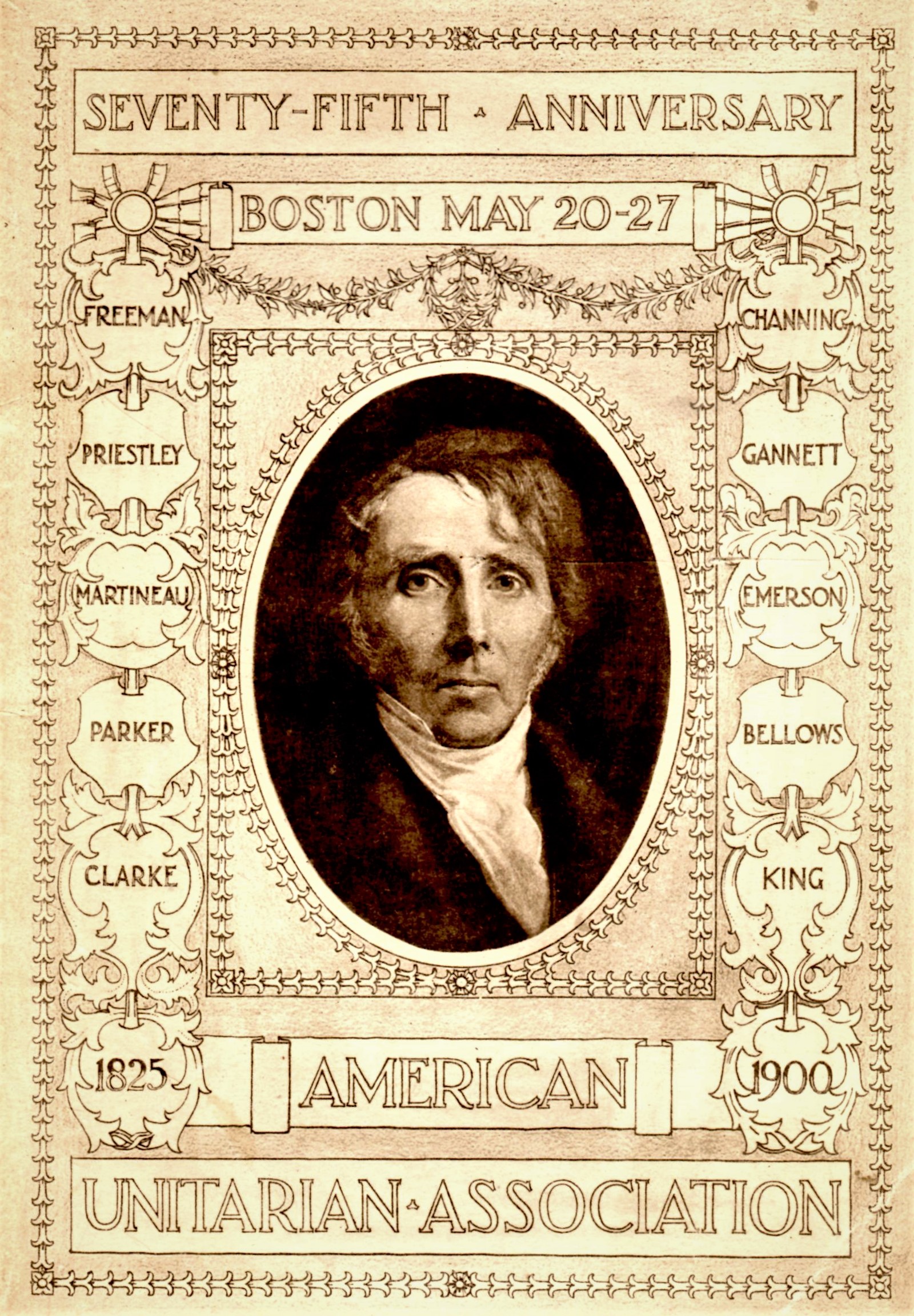
After 1825 – celebrating the foundation of organised Unitarianism in Britain and America
Alan Ruston
AUA 75th anniversary brochure cover
This year marks the 200th anniversary of the foundation of both the British and Foreign Unitarian Association (B&FUA) and the American Unitarian Association (AUA), both founded within a day of each other in May 1825. Alan Ruston investigates the way each anniversary has been celebrated in Britain and the USA. Both the B&FUA and the AUA have evolved over this time, the B&FUA really being superseded by the General Assembly in 1928 and the AUA being absorbed into the Unitarian Universalist Association in 1961 but the development of both bodies over two centuries tells us a lot about the development of Unitarianism in both countries and the interaction between British and American Unitarianism.
Notes
Alexander Gordon on James Martineau: An Evaluation
Alan Ruston
Very Rev William McMillan Library
David Steers
Very Rev William McMillan Library, Dunmurry
Dr Williams’s Trust.Announcing a New Partnership
The University of Manchester Library and The Dr Williams’s Library
REVIEWS
Daisy Hay,Dinner with Joseph Johnson: Books and Friendship in a Revolutionary Age, (Chatto & Windus, London, 2023) ISBN 9781784740184. 528 pages. Price £20.
Reviewed by Derek McAuley
Ben Stables, From Pigeon Flying to Intellectual Liberty. The History of Pepper Hill Unitarian Chapel in Shelf, West Yorkshire. With an Introduction by Rev John Midgley. Published by Pepper Hill Unitarian Chapel, 2024. 100 pages. Price £6. Copies are available directly from the author (benstables@hotmail.co.uk).
Reviewed by David Steers
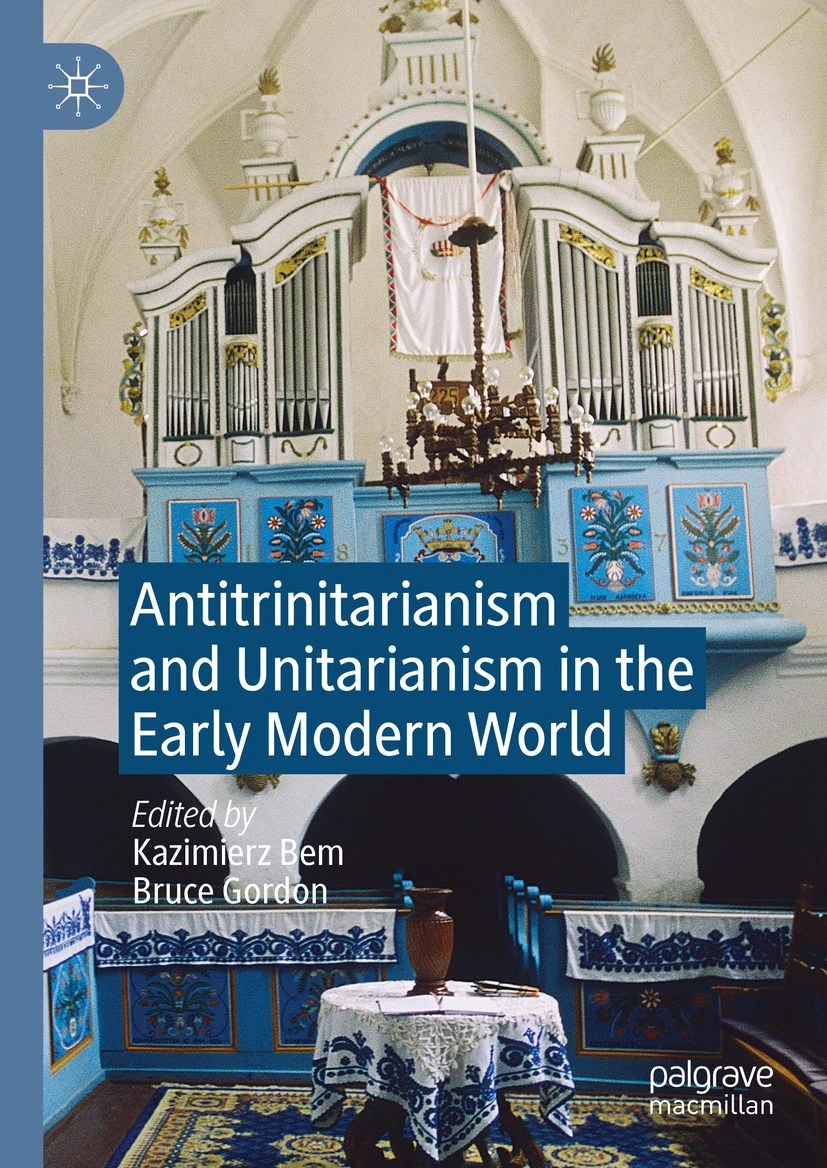
Kazimierz Bem and Bruce Gordon (eds), Antitrinitarianism and Unitarianism in the Early Modern World, Palgrave Macmillan, 2024, 397 pages. ISBN 9783031696572, price £119.99; eBook ISBN 9783031696589, price £99.99.
Reviewed by Alan Ruston
Back to Life, The People on the Plaques in Brighton Unitarian Church, 2023, 95 pages. Price £8 including postage; copies can be obtained from Christine Clark-Lowes (cjclarklowes@yahoo.co.uk).
I was very pleased to be asked to contribute to this book which has just been published by Palgrave Macmillan:
Antitrinitarianism and Unitarianism in the Early Modern World
The publishers describe the volume in these terms:
This collection offers an innovative and fresh interpretation of Antitrinitarian and rational dissent in the early modern world. The central themes focus on the fierce debates surrounding Antitrinitarianism and Unitarianism that emerged from the Reformation and the lived cultures of these dissenting movements. The chapters take an interdisciplinary approach addressing ideas in context, their reception and appropriation, and the diverse and often conflicting visions of Christianity. Drawing on previously unused sources, many from Eastern Europe and often in inaccessible languages, this book challenges our understanding of dissent as marginal and eccentric and places it at the center of contesting convictions about the nature of religious reform.
The contents are as follows:
Introduction
The Porous Boundaries of Dissent
Bruce Gordon
Antitrinitarianism and Its Influence in Italy and Poland
Italian Antitrinitarianism and the Legitimacy of Dissent
Odile Panetta
Scripture, Piety, and Christian Community in the Thought of the Polish Brethren
Sarah Mortimer
Religiosity in the Ethos of Polish Brethren in Light of Funeral and Wedding Speeches from the Seventeenth Century
Maria Barłowska
True Heirs of Jan Łaski: Polish Brethren Church Discipline in the Polish-Lithuanian Commonwealth and During Their Exile in Transylvania
Kazimierz Bem
Transylvanian Unitarianism
The Late Confessionalization of the Transylvanian Unitarian Church and the Polish Brethren
Gizella Keserű
Introduction to the Transylvanian Unitarian Disciplina Ecclesiastica
Lehel Molnár
De Disciplina Ecclesiastica: On Ecclesiastical Discipline (1626)
Alexander Batson
The Term, Development, Purpose, and Practice of Church or Canonical Visitation: Unitarians in Háromszék in the Seventeenth Century Between Conventional Rhetoric and Reality
Lehel Molnár
Some Aspects of the Hungarian Unitarian Liturgy in the Sixteenth to Eighteenth Centuries
Sándor Kovács
Engagement and Divorce Cases Before the Unitarian Consistory in Seventeenth-Century Transylvania. Frameworks in Church Law and the Doctrine of Marriage
David Szigeti Molnar
England, Ireland, and New England
The Historical Critique of Heresiology in the Seventeenth Century and the Origins of John Milton’s Arianism
R. Bradley Holden, Samuel J. Loncar
Authority, Reason, and Anti-trinitarianism: John Abernethy and the Competing Pressures Within Irish Presbyterianism in the Early Eighteenth Century
A. D. G. Steers
The 1662 Book of Common Prayer and Its Adaptation in Eighteenth-Century Rational Dissent
Bryan Spinks
New England Congregationalists and Unitarianism in Late Eighteenth Century/Early Nineteenth Century
Peter Field
The editors are:
Kazimierz Bem, Pastor of First Church in Marlborough (UCC), USA and a senior lecturer in Church History at the Evangelical School of Theology in Wrocław, Poland.
Bruce Gordon, Titus Street Professor of Ecclesiastical History at Yale Divinity School, USA.
Hardcover ISBN978-3-031-69657-2
Softcover ISBN978-3-031-69660-2
eBook ISBN978-3-031-69658-9
You can find out more about this book via this link.
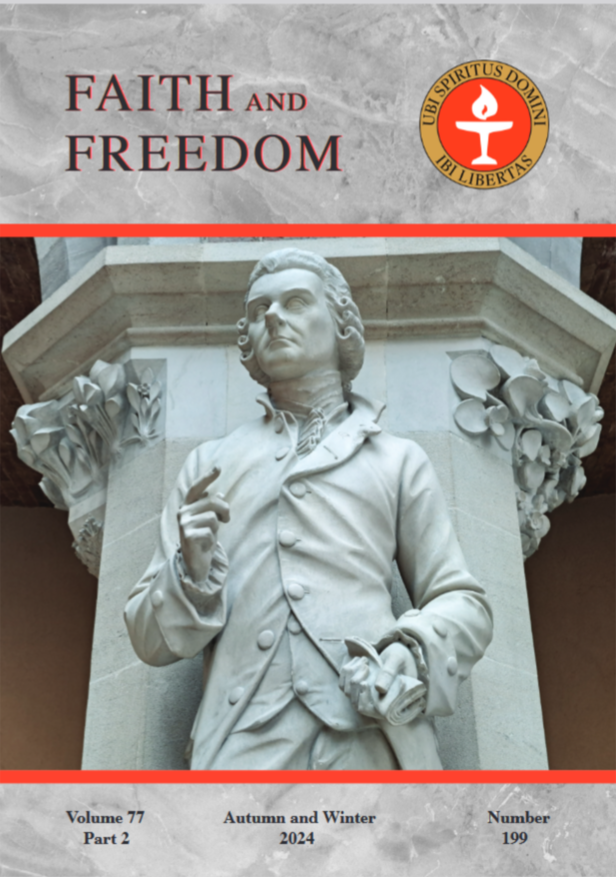
The latest issue – Volume 77, Part 2, Autumn and Winter 2024, Number 199 – is now available and will be with subscribers shortly. Details on how to subscribe (including a link to our website if you would like to pay via PayPal) can be found at the foot of this page.
This issue is special for a number of reasons. First of all we are pleased to announce the magnificent vote of approval given to us by the Merseyside and District Missionary Association who have given us very generous financial support. This is a tremendous help and together with the valued grant we already receive from the Daniel Jones Fund this means that Faith and Freedom can continue to serve our readers, maintaining the original vision set out by the Ministerial Old Students Association of Manchester College, Oxford for the promotion of liberal religious discussion and the free exchange of ideas.
Secondly we are also delighted to be able to launch our brand new Faith and Freedom Logo with this issue. Our Logo was previewed on this site a couple of weeks ago and it now takes its place atop our masthead. Specially designed for us, it is a striking representation of what we stand for as a journal and will let the world know who we are. We have already had requests for this to be produced as a badge which is something we are keen to look into.
It is very pleasing also that the journal continues to attract top quality articles from Unitarians and non-Unitarians alike from Britain and around the world. In this issue Elizabeth Kingston-Harrison, who is the Congregational Connections Lead for the General Assembly of Unitarian and Free Christians and has a PhD in Intellectual History, having studied the theology of Joseph Priestley and other eighteenth-century rational dissenters, contributes A Comet in the System: Joseph Priestley and the emergence of rational dissent in the eighteenth century. Elizabeth writes of Priestley’s role in the emergence of rational dissent and shows how, far from being a distant, dry historical study, this is something that is energising and alive today and helps us connect with our present-day religious identity. Joseph Priestley ‘was a courageous, “big picture” person’ whose scientific discoveries went hand in hand with his theological reflections. The discoverer of oxygen applied reason to scripture and developed a new way of understanding the universe.
Frank Walker considers Sir Lloyd Geering: Trinitarian-Unitarian, Humanistic Presbyterian, Centenarian and asks Can You Love the Human Race? Sir Lloyd Geering, a New Zealand Presbyterian Professor, who was once charged with heresy, may not be a name immediately familiar to most of our readers but I have no doubt that everyone will find Frank’s thoughtful examination of his theology and ideas incredibly life affirming and uplifting.
Peter Hewis addressed the Old Students Association at Harris Manchester College back in June and this paper is based on his sermon – Keep alive the dream in the heart – a quotation from Howard Thurman and an exploration of dreams in religious history and their continuing power to inspire us and drive us towards making a difference in the world,
As always we have a number of really interesting and informative reviews of a wide range of publications contributed by our readers. This issue includes:
Right Relationship in the Real World
Commissioning Editor: Jane Blackall, Right Relationship in the Real World, Learning to Live by our Unitarian Values, The Lindsey Press, London, 2024, pp 132, ISBN 978-0-8519-099-8, £7, pbk. The book can be ordered online at https://www.unitarian.org.uk/shop/
Reviewed by Peter B. Godfrey
Fideology
Richard F. Boeke, Fideology – Building Trust through the Shared Experience of Faith at the Root of the World’s Religions, 2024, pp 248, ISBN 97988844906686, £11.08 plus postage from Amazon.
Reviewed by Peter B. Godfrey
From the heights of politics via a spiritual journey to the ministry
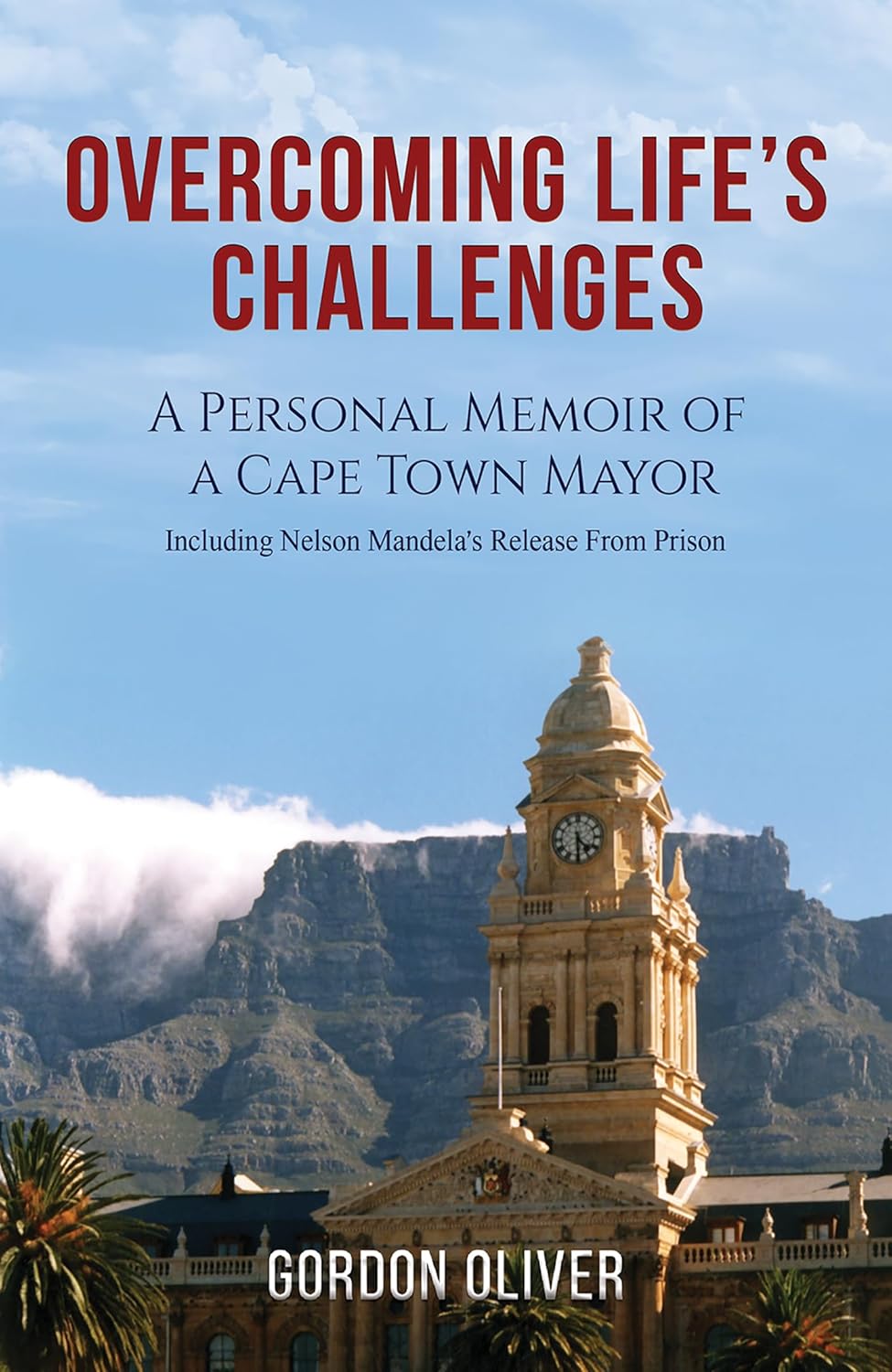
From the heights of politics via a spiritual journey to the ministry Gordon R. Oliver, Overcoming Life’s Challenges: A Personal Memoir of a Cape Town Mayor, Austin Macauley Publishers, 2024, pp.166, ISBN: 979-8891554146, £8.99, pbk.
Reviewed by John Midgley
An honest and liberal analysis of the Church
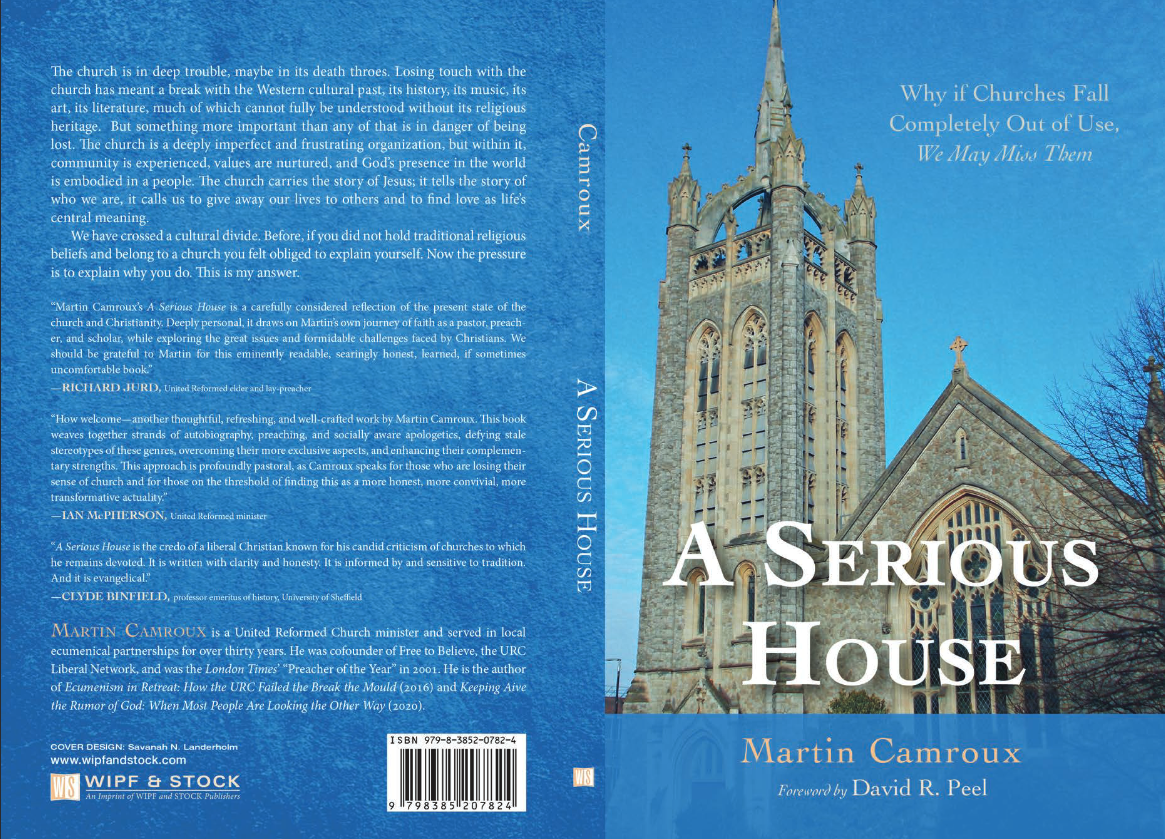
Martin Camroux, A Serious House, Why if Churches Fall Completely Out of Use We May Miss Them, Wipf and Stock, 2024, pp. 188, ISBN-13: 979-8385207824, £21 pbk, (also available direct fromthe author for £16, including postage, Martin Camroux, 4 Sorrel Close, Colchester, CO4 5UL).
Reviewed by Francis Elliot-Wright
Prayers of Many Faiths
Marcus Braybrooke, 1,000 Prayers from Around the World. Prayers of Many Faiths for Many Situations, independently published, 2024, pp.390, ISBN: 9798321565889, £39.99 hbk; ISBN: 97983439561609, £9.99 pbk black and white; ISBN: 798321565889, £19.99 pbk colour; also available on Kindle £4.99. Available to order on Amazon.
Reviewed by David Steers
An annual subscription to Faith and Freedom (two issues) costs £16.00 (postage included) in the United Kingdom. Single copies can be ordered at a cost of £8.00 each (postage included). Cheques should be made out to Faith and Freedom and sent to the business manager:
Nigel Clarke, Business Manager, Faith and Freedom, 16 Fairfields, Kirton in Lindsey, Gainsborough, Lincolnshire. DN21 4GA.
Overseas subscriptions are also available.
It is also possible to pay online. For more details see our website:
On Sunday, 10th November we held a well-attended Remembrance Service at Dunmurry and the video can be seen below. Special thanks go to John Neill for delivering Binyon’s Lines, to Jack Steers for playing the Last Post and Reveille, and to Allen Yarr for playing the organ.
Click above to see the Remembrance Service from First Dunmurry 10 November 2024
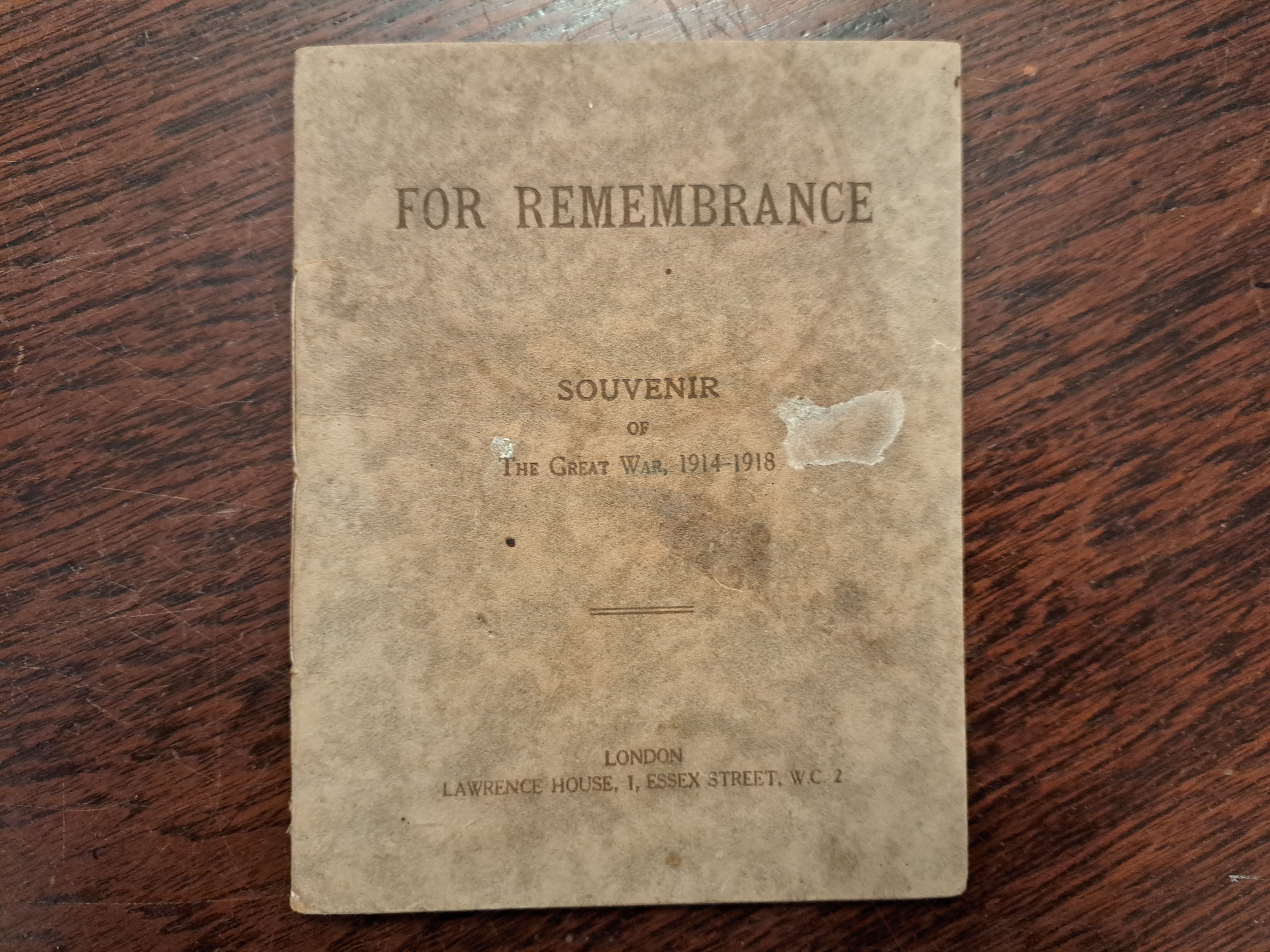
In the service I make full use of the booklet For Remembrance mentioned in the previous post. Indeed this little book, particularly the contribution by the Rev R. Nicol Cross, as it is mentioned in the previous video, has already sparked a lot of responses. Along with some of the other pieces it is a poignant and very honest reflection on the situation in 1919 for those returning from the front after the Armistice.
At the time he wrote his contribution Nicol Cross was minister of Mill Hill Chapel, Leeds, later he was minister of First Church, Belfast and later still Principal of Manchester College, Oxford. But from 1915 to 1919 he served as a private with the Royal Army Medical Corps. His perspective on the war was quite different from what you might otherwise have guessed.
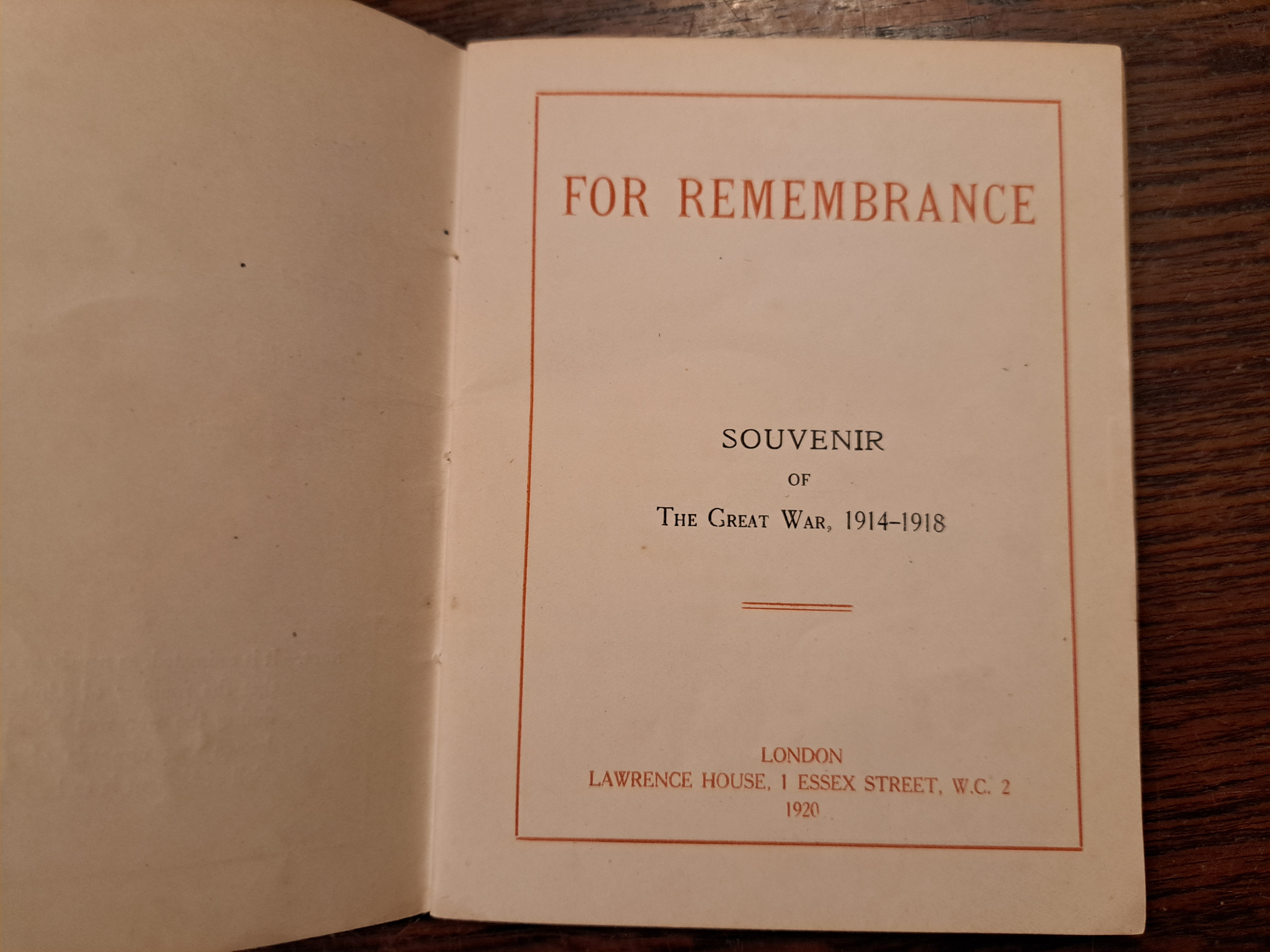
Title page of the booklet
It is a very rare book, very few copies have survived. In the 2019 issue of the Transactions of the Unitarian Historical Society Alan Ruston contributed an article entitled ‘1919 – a re-evaluation of the part played by Unitarians in the First World War’. In his article he reveals that he had not previously come across the book, the copy he was sent while writing the article was the only one known to him. It certainly has not made its way into library collections. So this copy, in the Very Rev William McMIllan Library, is one of only two known copies.
One feature of For Remembrance that I didn’t mention in the first video or in the service above is that there is also a short note from the American Unitarian Association (AUA) included in the booklet. It seems to have come from a message sent out by the AUA to reurning troops and reads:
OUR GREETING AND PLEDGE
You have successfully met the challenge of the most powerful armies the world ever saw. You have shared in the most significant victory in all history. By a devotion that has won the affectionate admiration of the civilized world, you have helped to make possible a new and nobler life for humanity, and a truer brotherhood of man.
We welcome you again to our homes and our homeland. We pledge ourselves anew to the ideals for which you went forth to suffer; and because of your example we will rise to meet the duties of the new day with unwavering faith. Through our church we will unite our powers with yours in defence of the principles for which so great a price has been paid.
Your courage, cheerfulness, and fortitude will strengthen the church of your fathers.
From the Message of the American Unitarian Association
It would be interesting to know if this was the whole message of the AUA or whether they produced a book similar to For Remembrance.
From The Very Rev William McMillan Library of First Dunmurry (Non-Subscribing) Presbyterian Church.
Exploring the Library: Episode 5 For Remembrance. A booklet given to returning servicemen after the First World War.
A short talk by the Rev Dr David Steers. With thanks to Jack Steers for playing the Last Post and Reveille on the trumpet.
This is rather a scruffy looking booklet but it is a very rare survival of which the editors said: ‘If it attains to anything like its aim it will be a real “keepsake,” an abiding record of the owner’s place and part in our nation’s mightiest struggle…’ A copy was given to every Unitarian and Non-Subscribing serviceman who returned from the First World War. It contains some poignant quotes and six short reflections by ministers who had served alongside the troops.
Possibly as many as 9,000 copies were issued but very few survive, at least in libraries, so we are fortunate to have a copy in the Very Rev William McMIllan Library. Click on the video to find out more about ‘For Remembrance’.
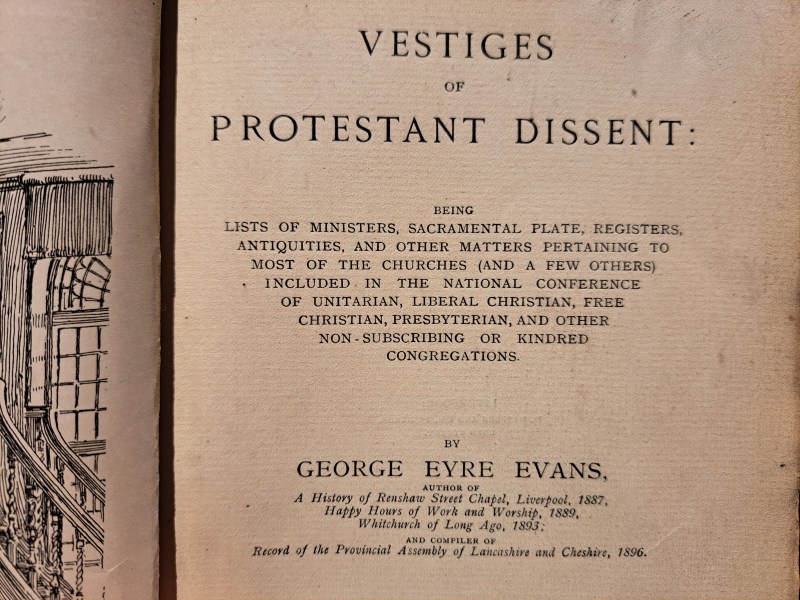
Everyone who has an interest in the study of Non-Subscribing Presbyterian/Unitarian history in the British Isles will know George Eyre Evans’s book the Vestiges of Protestant Dissent. Published in 1897 it was just one publication that came out of the extensive researches of G.E. Evans. His book is the subject of our latest video which is the second to explore the contents of the Very Rev William McMillan Library here at Dunmurry which will be opened and dedicated on Sunday, 22nd September 2024 at 3.00 pm:
Click on the video above for Vestiges of Protestant Dissent
The Library copy once belonged to a prominent lay member of the congregation who gave it to his minister before the end of the nineteenth century, but the full story can be seen on the video.
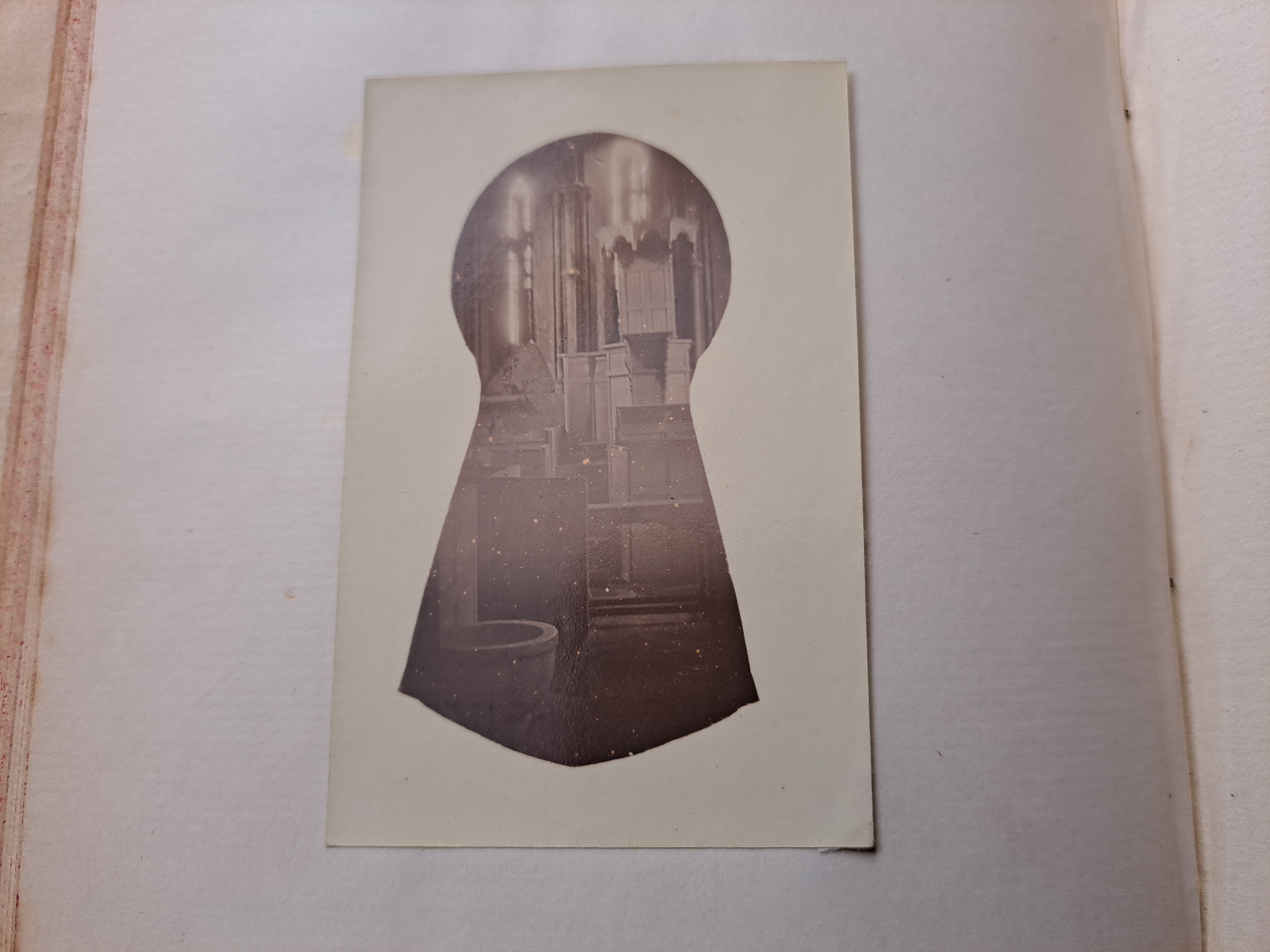
One of the things I try to draw attention to in the video is the occasional unusual detail G.E. Evans adds to the book, such as this picture, which exists in every copy as a real photograph pasted in to the book:
The picture from opposite page 123 of ‘Vestiges of Protestant Dissent’
The meaning of the photograph is explained in the video.
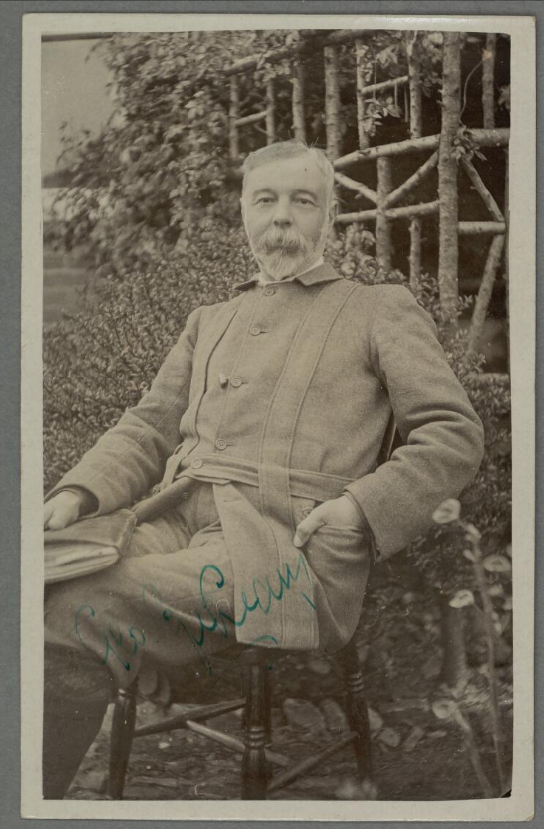
George Eyre Evans (photo: Dictionary of Welsh BiographY)
G.E. Evans was born in Colyton, Devon, the son of Welsh parents. His father was Rev David Lewis Evans, Unitarian minister at a number of places in Wales and England, including Colyton where his son was born, and ultimately being tutor in Hebrew, mathematics, and natural philosophy at the Presbyterian College, Carmarthen. He was also one of the founders of Yr Ymofynydd, although he wrote little in Welsh himself.
George E. Evans followed his father into the ministry and served at the Church of the Saviour at Whitchurch (1889-1897) as well as unpaid minister at Aberystwyth later in life. Primarily though he was an historian and antiquarian. Many of his publications relate to his interest in the history Unitarianism. Vestiges of Protestant Dissent is probably his best known work of this type although he also produced Record of the Provincial Assembly of Lancashire and Cheshire, a very useful detailed study of churches and their ministers in the north west of England, and Midland Churches: A History Of The Congregations On The Roll Of The Midland Christian Union. This all displays his wide geographical interests, also seen in publishing works about places such as Whitchurch, Colyton and Lampeter. He also wrote the first history of Renshaw Street Chapel in Liverpool, a city where he studied after being at the school of Gwilym Marles, the noted Unitarian minister and social reformer.
His main research interests increasingly centred on Wales, however. He was a founder member, secretary and editor of the journal of the Carmarthenshire Antiquarian Society. A member of the Cambrian Archaeological Society, he sat on its general committee and became a member of its editorial board, contributing to its journal Archaeologia Cambrensis. He was active in helping to establish two local museums in Wales and served on the Court of Governors of the University College of Wales, Aberystwyth, the Council of the National Museum of Wales, Cardiff, and the Council of the National Library of Wales, Aberystwyth. But this is by no means the full extent of his labours. He was made an Inspecting Officer of the Royal Commission on Ancient Monuments in Wales and Monmouthshire and in that capacity visited almost every monument or historic site in Wales. He joined the Boy Scouts in his 60s and became a County Scout Commissioner for Carmarthenshire and in 1928 became deputy Scout Commissioner for Wales. In 1937, two years before he died at the age of 82, he was made a Freeman of the Borough of Carmarthen where the Carmarthenshire Antiquarian Society has placed a blue plaque on one of the museums he founded and worked in.
He was a member of the Council of the Unitarian Historical Society and a frequent contributor to the Transactions, particularly writing about ‘Our communion plate and other treasures’. He visited Ireland in preparation for producing the Vestiges, mainly to inspect the communion plate, and from notes in his book we can follow his progress through Ireland in August 1892 when he went from Dublin (16th August), to Newry and Warrenpoint (17th), Clough, Downpatrick, and Rademon (19th), Moneyrea and Newtownards (20th), Ballycarry, Carrickfergus, and Larne, (22nd), and finishing up at Antrim, Templepatrick and Belfast (23rd). The only visit outside this sequence came on 14th October 1896, just a year before publication, when he visited Dunmurry and where he will have met the Rev J.A. Kelly who had been installed as minister on 23rd July of that year.
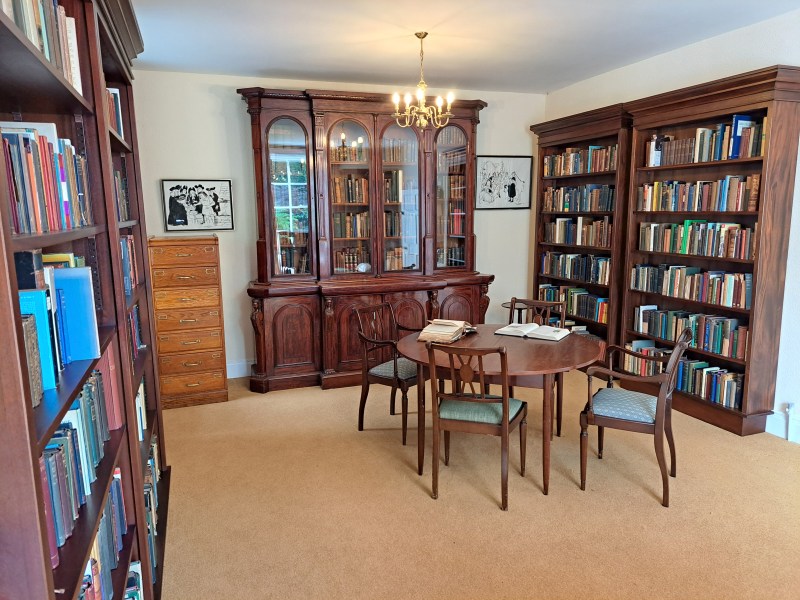
At Dunmurry we are particularly looking forward to the formal opening and dedication of the Very Rev William McMillan Library on Sunday, 22nd September at 3.00 pm. The Rev Mac bequethed his Library to the Church and over the last four years we have been working on creating a catalogue and getting everything ready to house the Library. We have had furniture made for the Library, we have also repurposed other furniture for use in the Library and restored some items to house the books.
It is an exciting project and a very fitting memorial for the Rev Mac who was an historian of some ability and renown. He assembled this collection as he worked on the history of Non-Subscription and the Library contains over 2,500 books, as many pamphlets and journals again, and many more manuscripts and other items. After the dedication the Library will be open for visitors (although we will not be able to lend items) but we want the Library to be known and appreciated by as wide a group as possible.
To help in this process I will be uploading short videos talking about the Collection, in which I will highlight different books which have an interesting story to tell. The first of these is this video;
Dunmurry NSP Library Episode 1. Click on the video to view.
This video looks at the Library’s copy of W.D. Killen’s History of Congregations of the Presbyterian Church in Ireland and Biographical Notices of Eminent Presbyterian Ministers and Laymen published in 1886 which was rebound and interleaved by Alexander Gordon in 1892. It’s a fascinating tale, the first in a series of short films about the unusual, interesting and informative books on the shelves.







 velvethummingbee