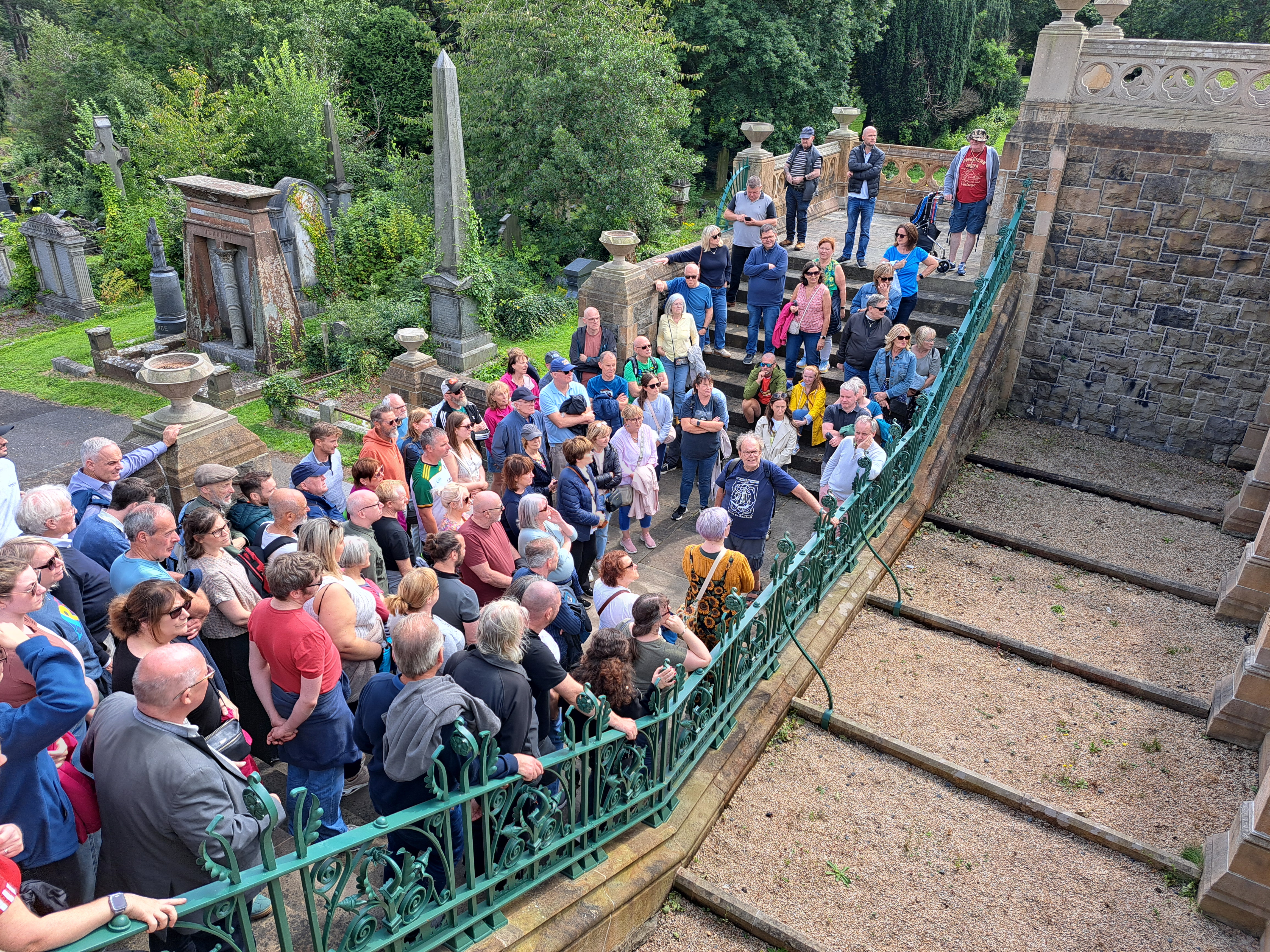
I was pleased to again take part in a tour of Belfast City Cemetery led by Tom Hartley. Tom is now the author of four books on the cemeteries of Belfast and I was pleased also to pick up a copy of his latest work, More Stories from the Belfast City Cemetery. This was his penultimate tour of the last series he would give as part of the Féile an Phobail and like all these tours there was a very large attendance.
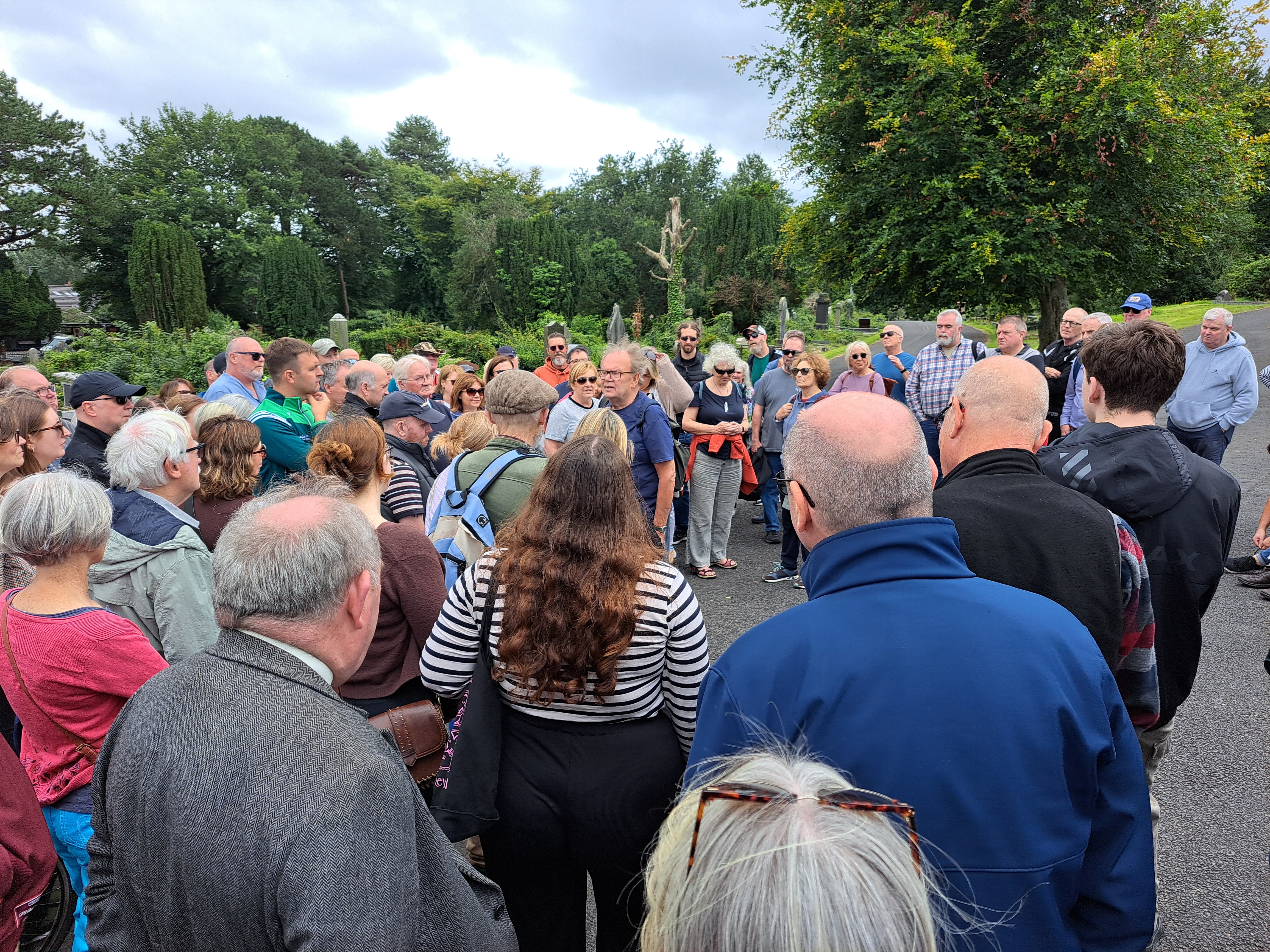
Start of the tour, showing some of those present
I see the first guided tour I attended was in March 2022. You can read that account here – Silent yet eloquent Memorials. There are a number of changes to the Cemetery made since that time, like the completion of the visitors’ centre, new signage all around the Cemetery, the restoration of the Vaults – which house the remains of such industrial luminaries as Sir Edward Harland and Thomas Gallaher – and a lot of new planting.
It is a very impressive cemetery, imaginatively laid out and designed by William Gay of Bradford in the shape of a bell (as in Belfast) and it contains some incredible Victorian, Edwardian and later memorials.
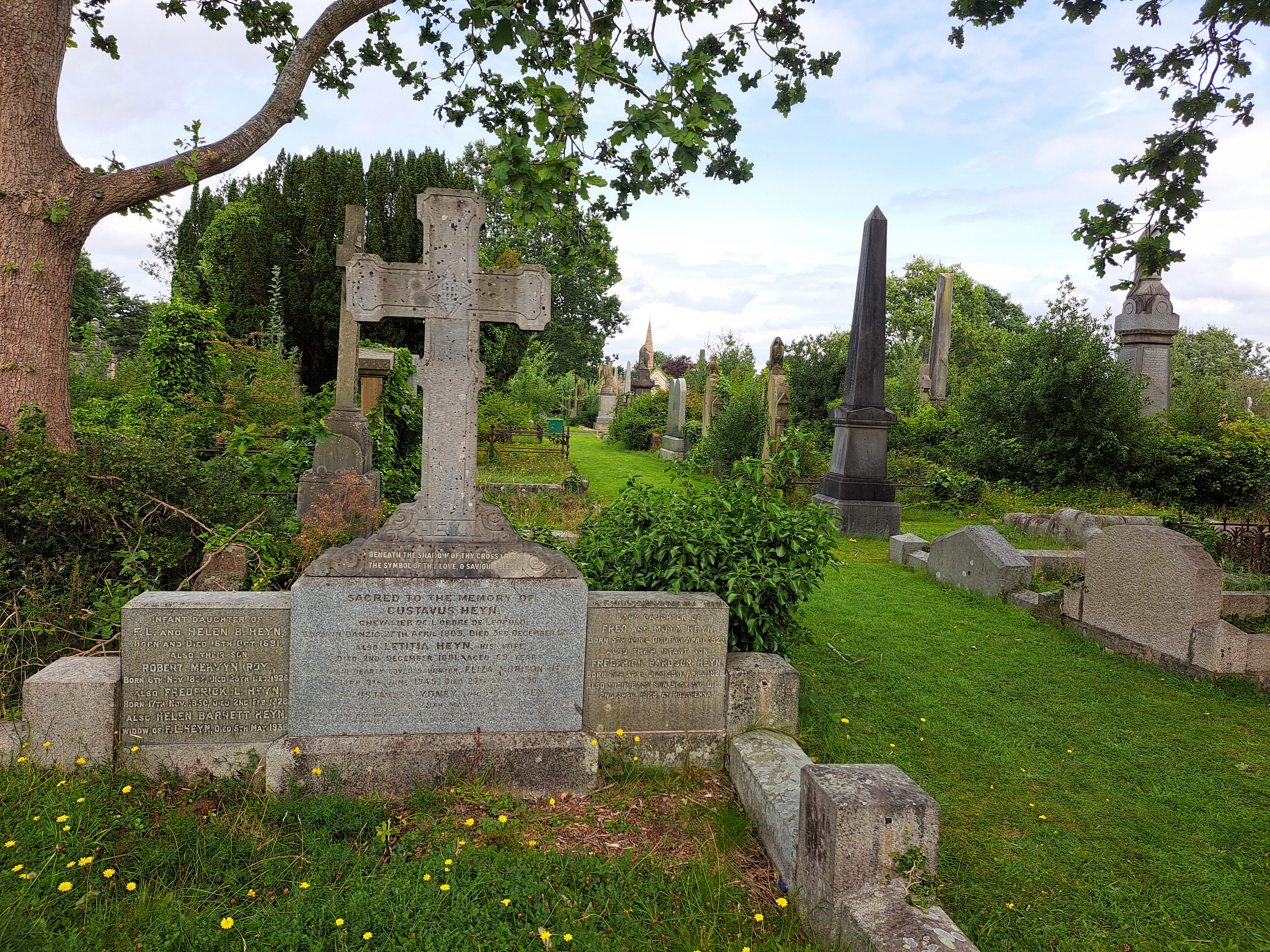
Gustavus Heyn, shipping magnate
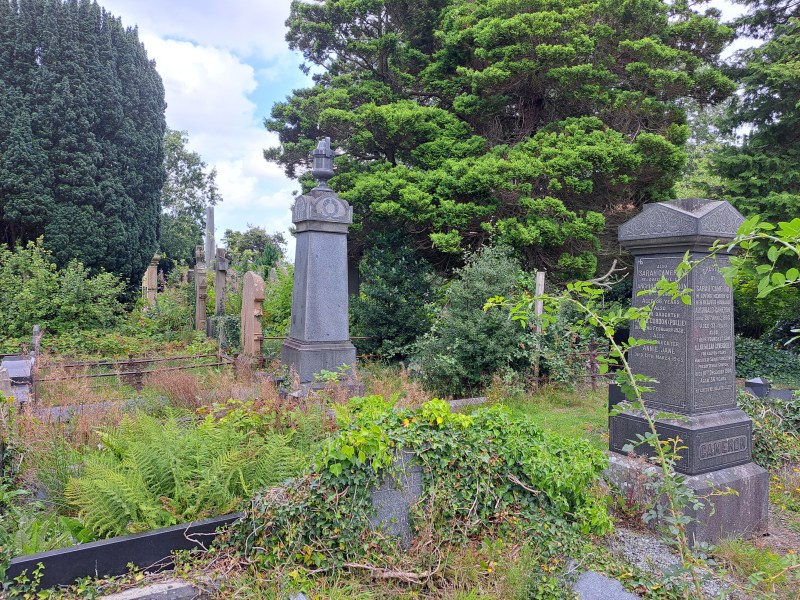
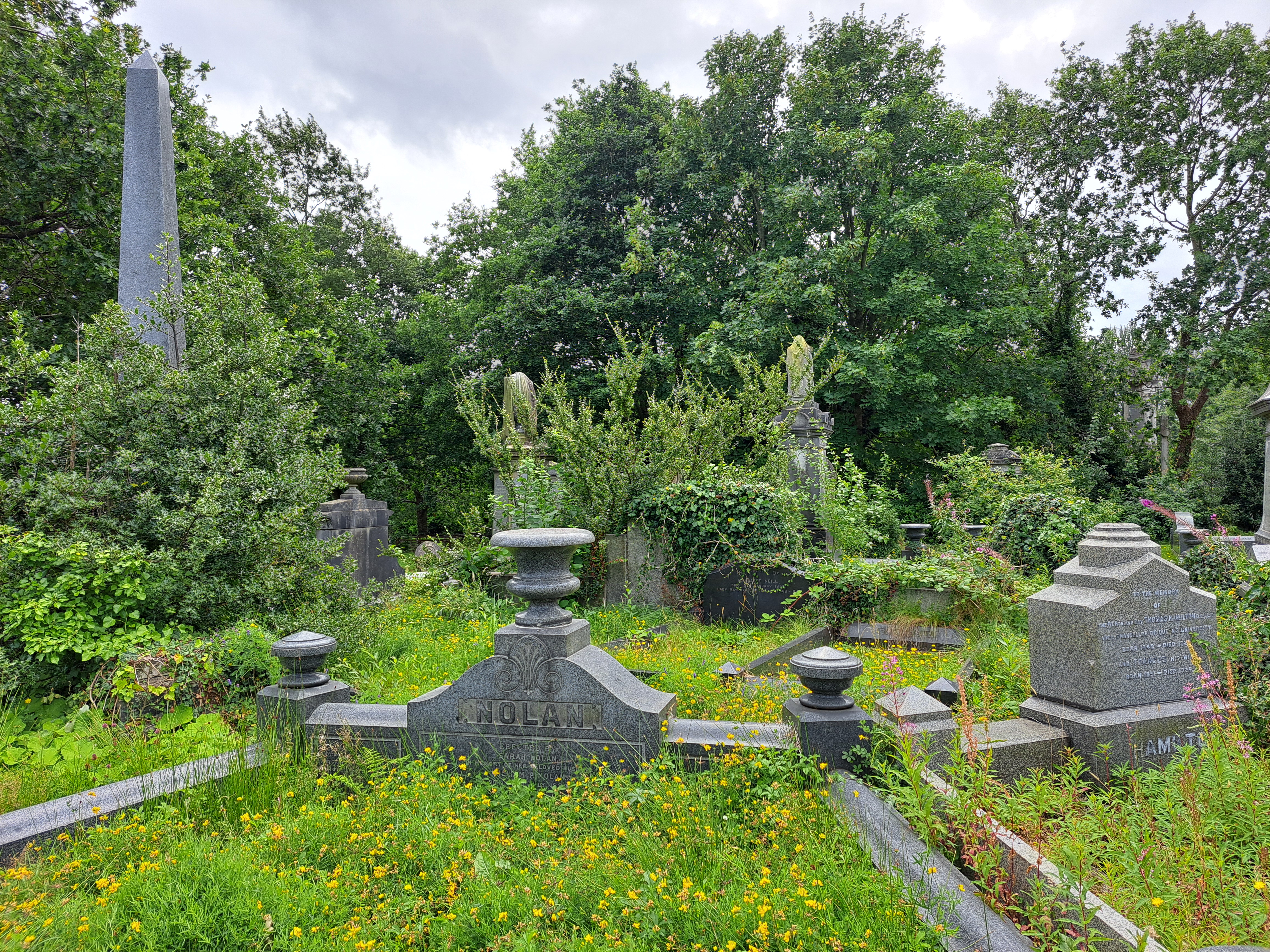
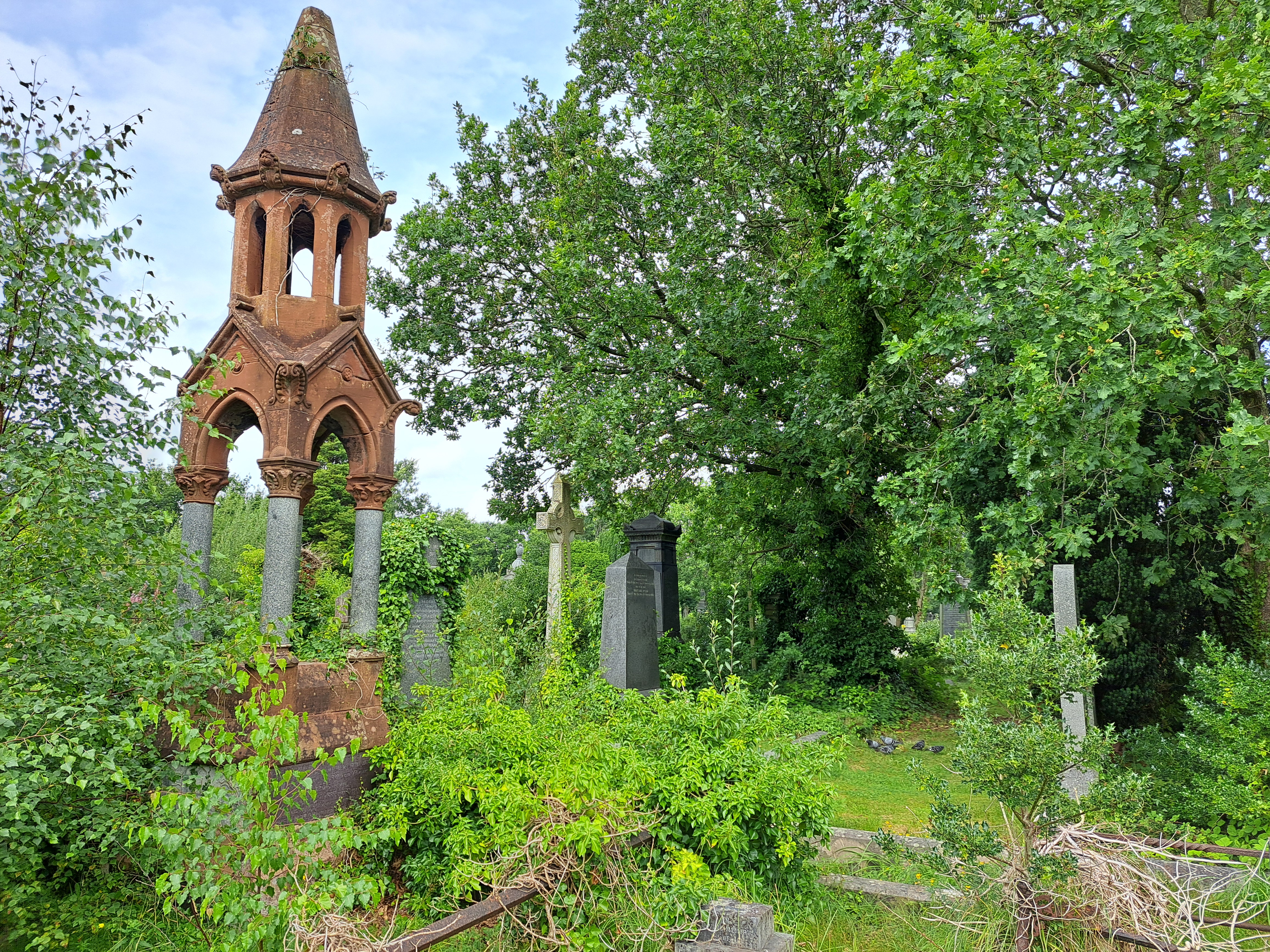
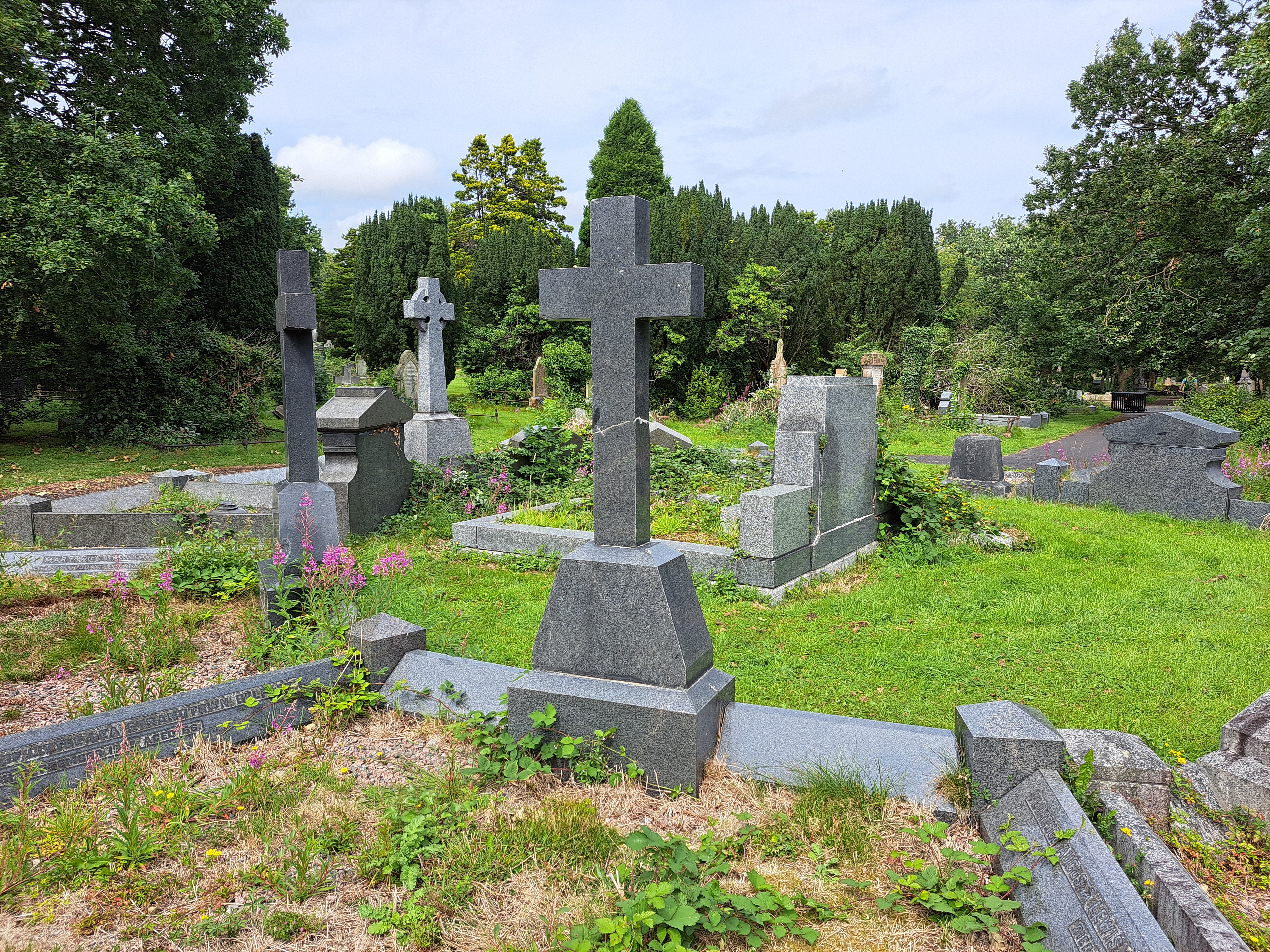
Some parts are still quite heavily overgrown and other parts have suffered badly from vandalism.
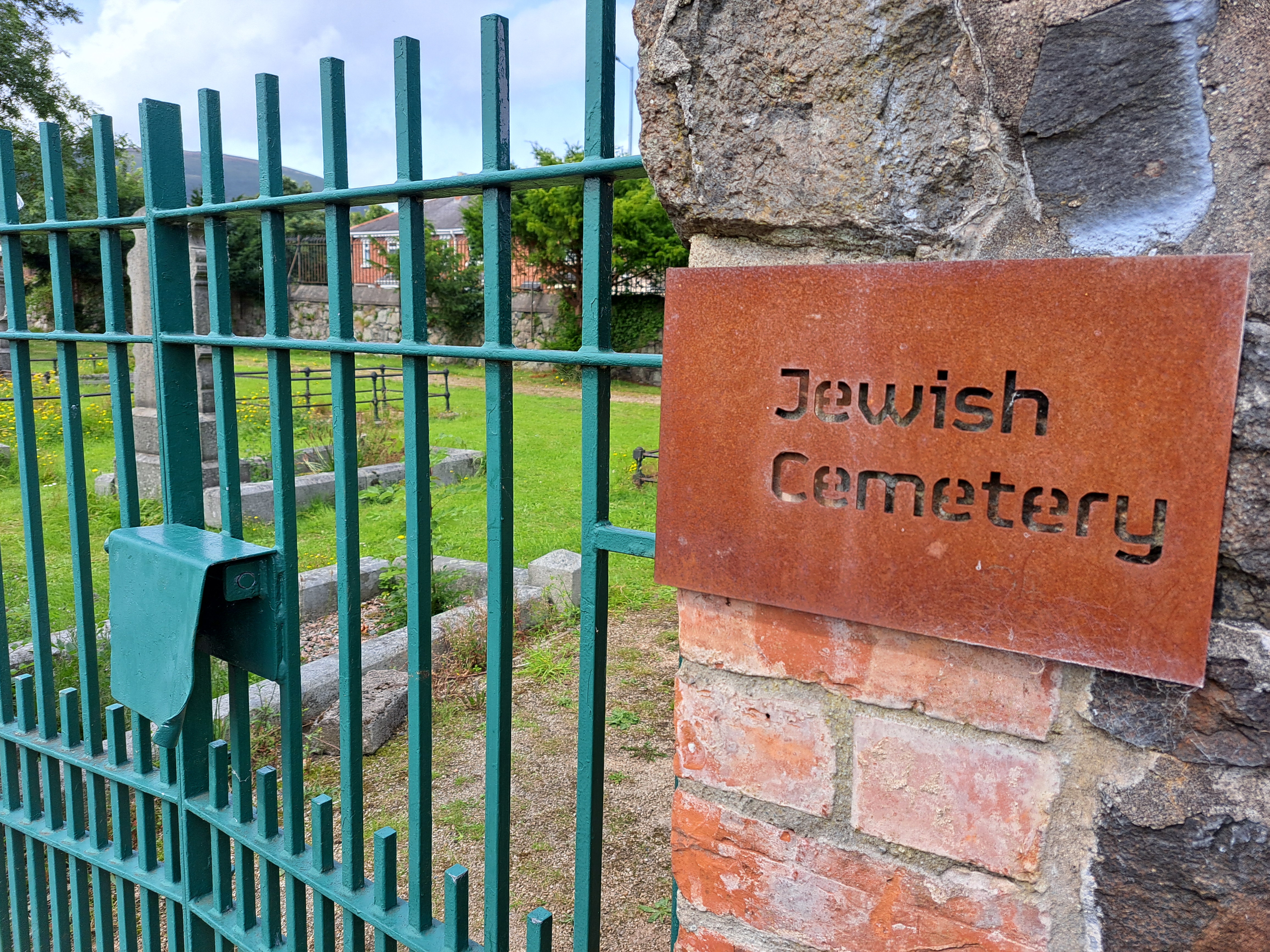
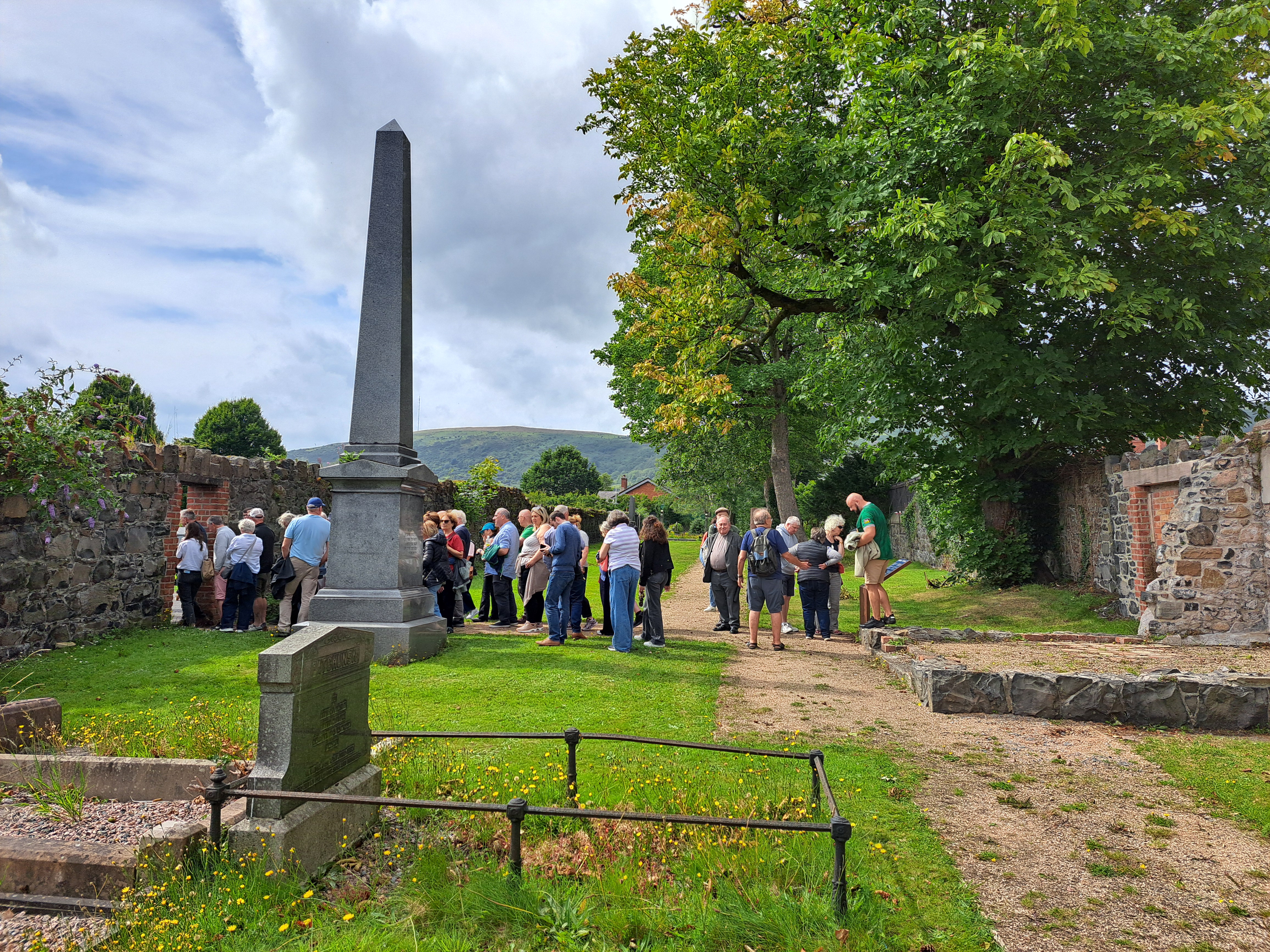
The Jewish section of the graveyard comprises a separate walled section although this has particularly suffered from vandalism and since 1964 Jewish burials now take place at Carnmoney Cemetery.
Entrance to the Jewish Cemetery
Inside the Jewish Cemetery. On the right is the remains of the Tahara, the mortuary chapel
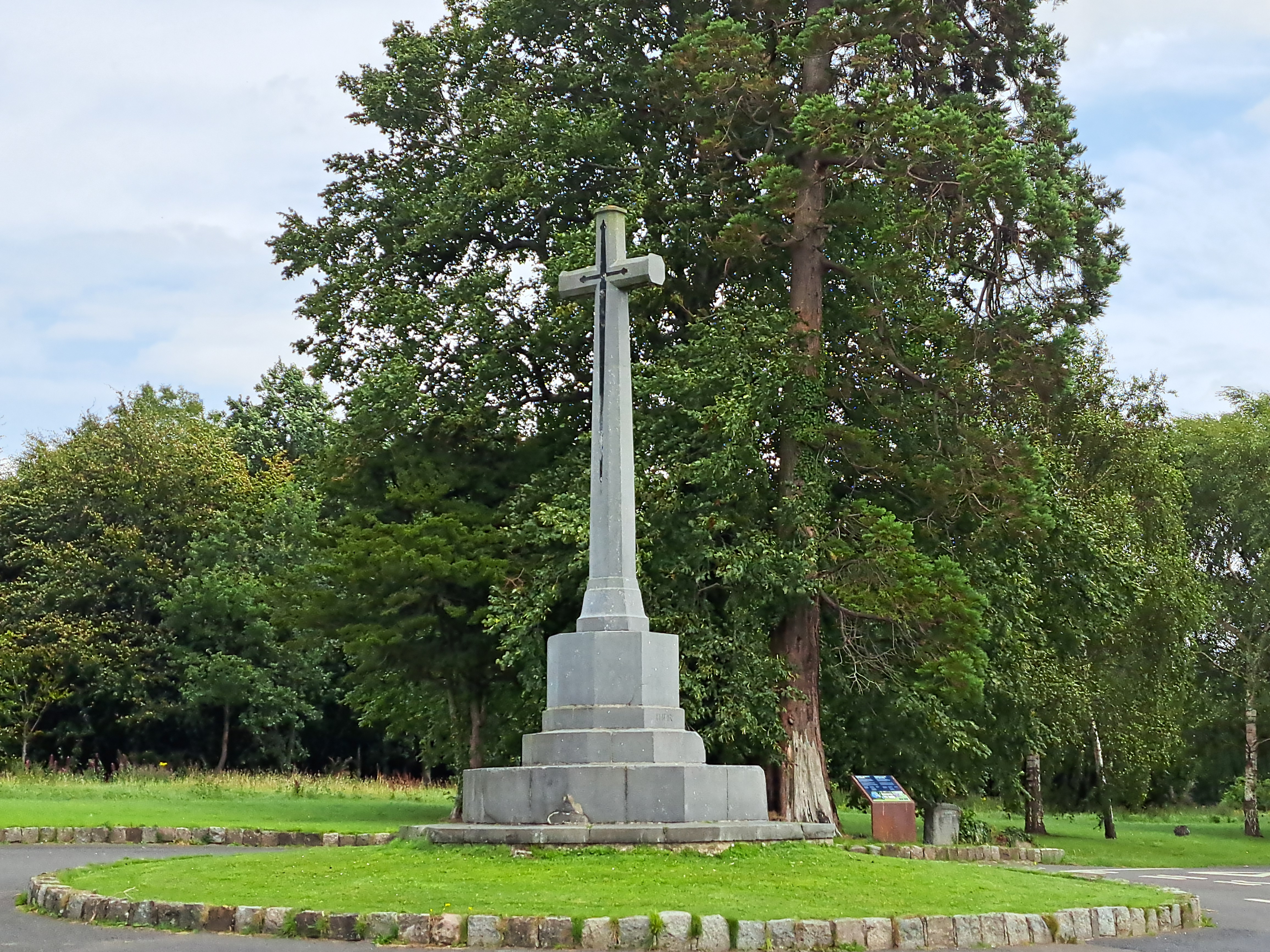
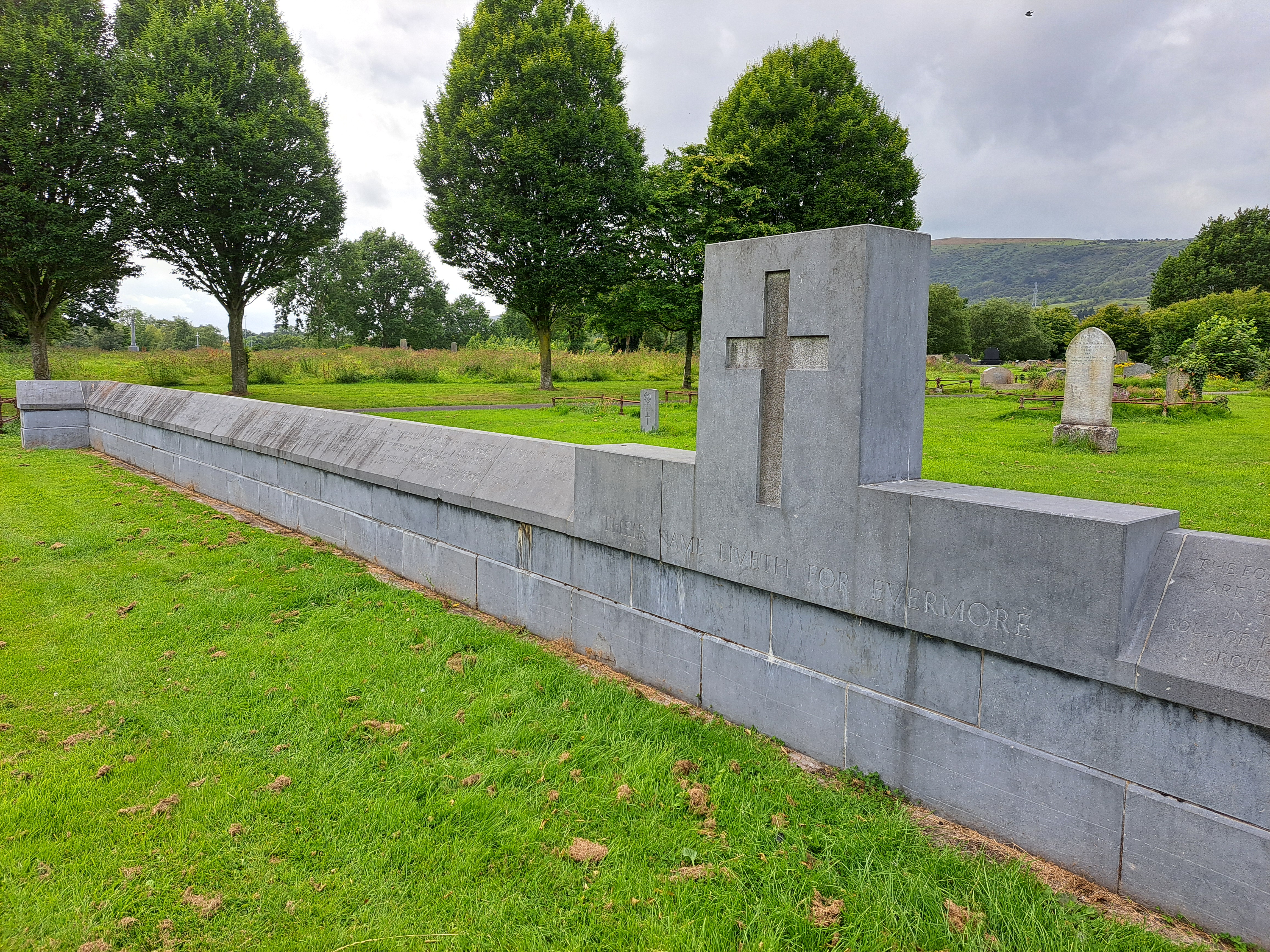
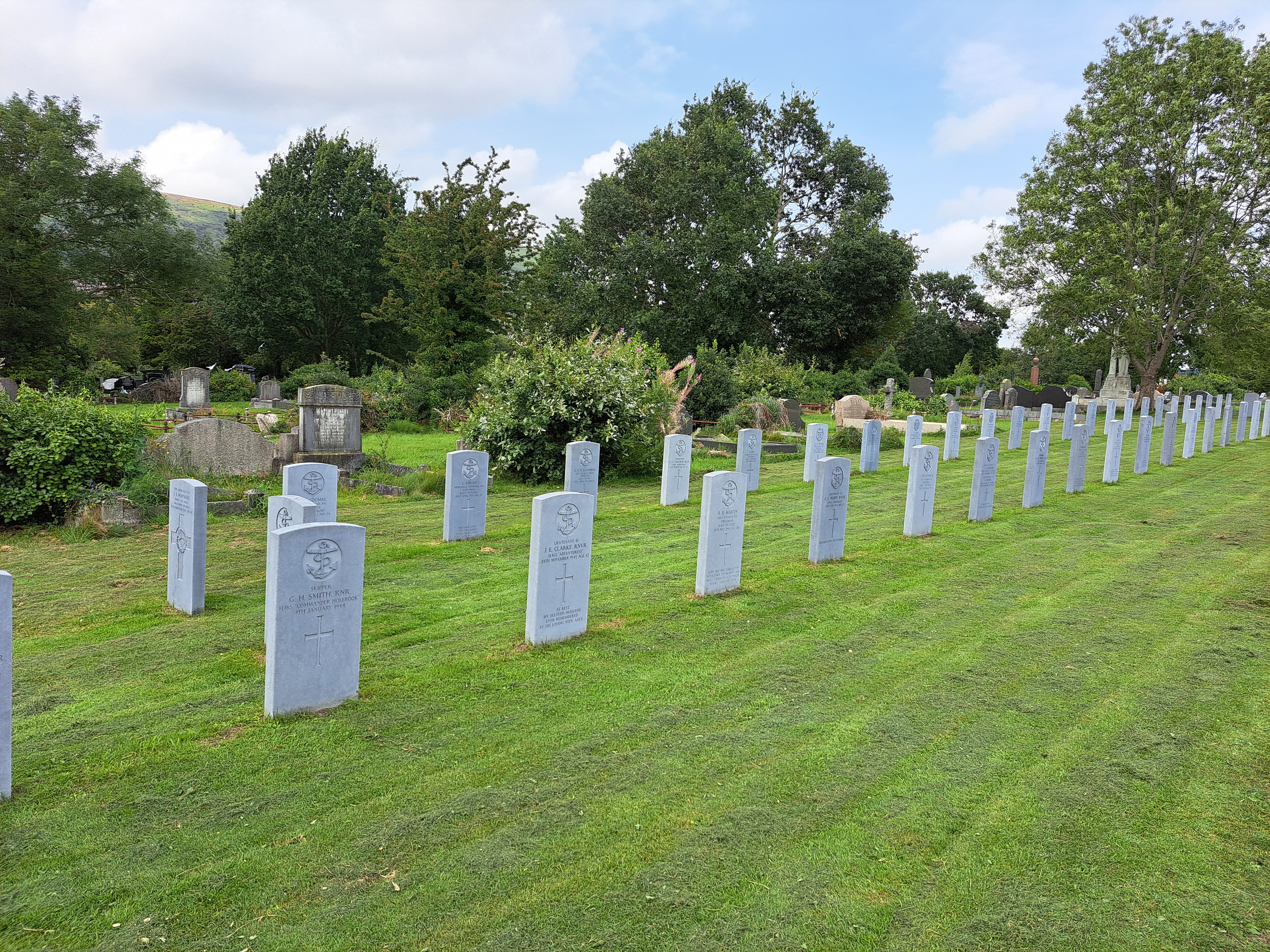
The Cemetery also includes a Commonwealth War Grave Cemetery with 296 burials from the First World War and 274 from the Second World War. There is also a Cross of Sacrifice (the same size as that in Botley Cemetery) and a First World War Screen Wall which carries the names of 74 soldiers who are buried in the First World War plot, 58 soldiers who are buried in unmarked graves and 8 soldiers who are buried elsewhere in the Cemetery.
Cross of Sacrifice
Part of the First World War Screen Wall
Second World War Royal Navy and Merchant Navy graves
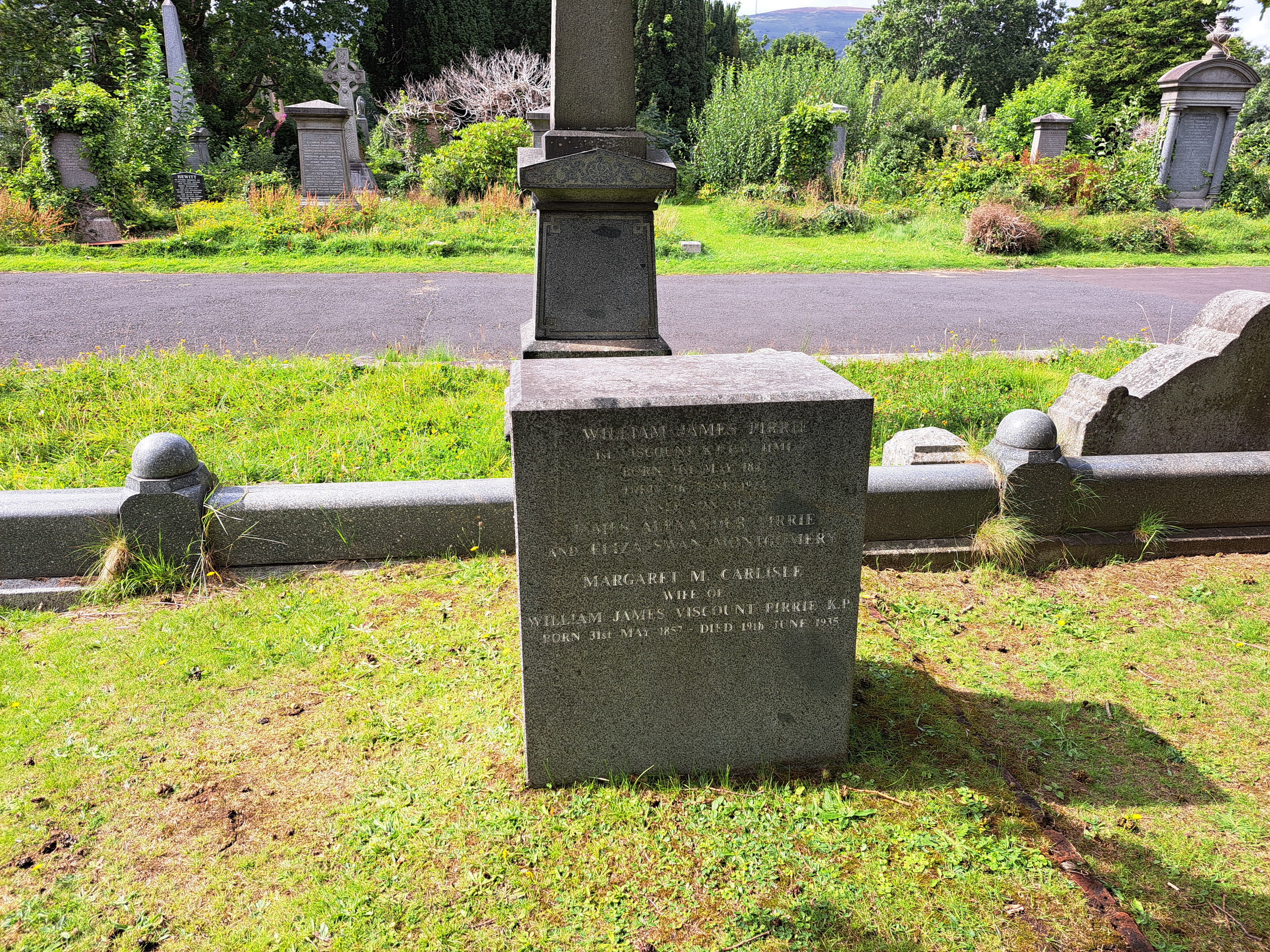
There are a lot of significant people from Belfast’s past who were Non-Subscribing Presbyterians who are buried here, perhaps most notable are Lord and Lady Pirrie. Viscount Pirrie was the chairman of Harland and Wolff when the Titanic was built and was to have sailed with his nephew, the designer Thomas Andrews, on its maiden voyage, but was prevented from doing so by illness.
Grave of Lord and Lady Pirrie
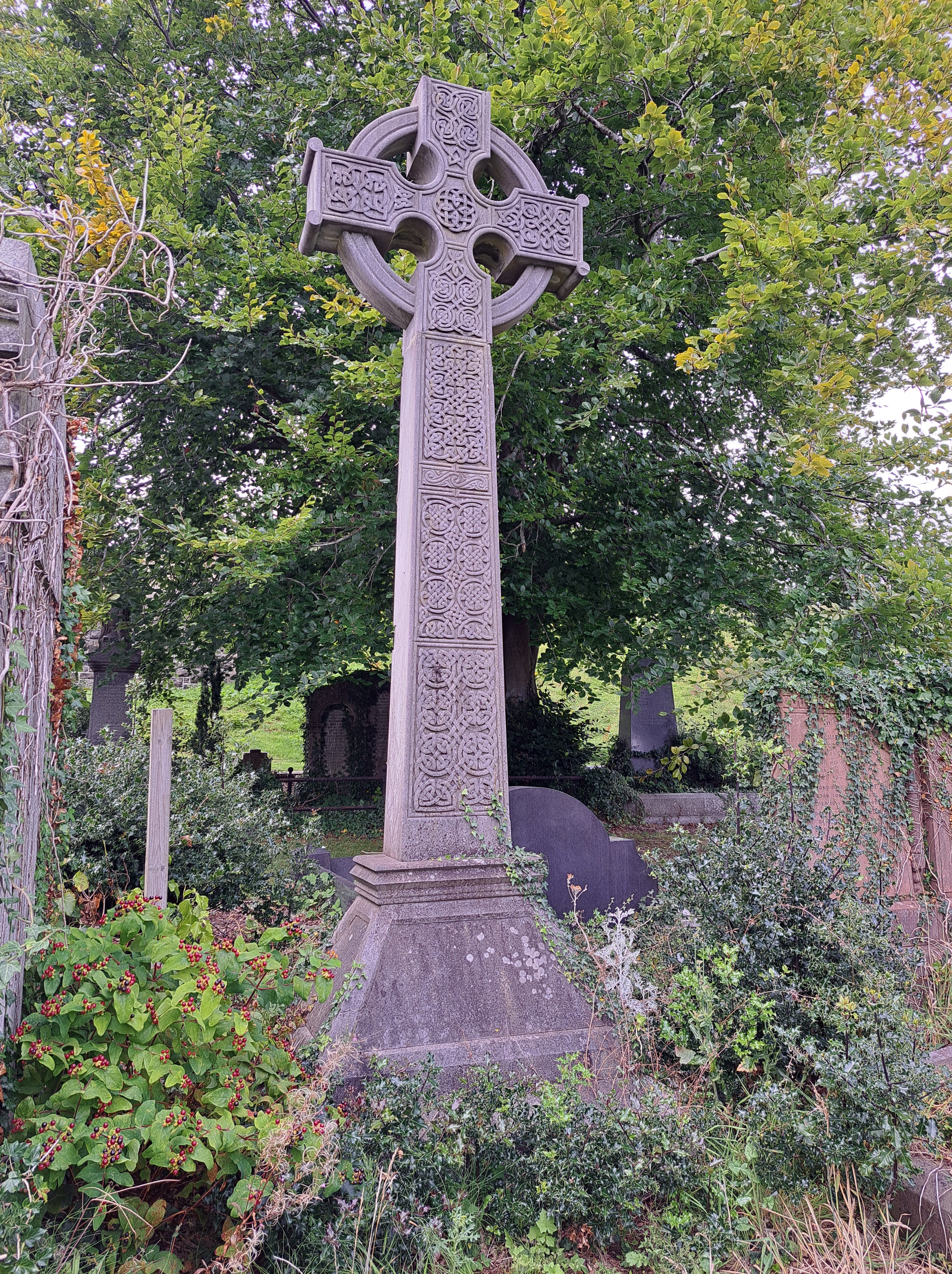
I have written before about one of the most notable Non-Subscribing Presbyterian ministers buried here, the Rev John Scott Porter, and was pleased to hear from his great great great granddaughter as a result. He is buried with his brother, William, who was once the attorney general at the Cape Colony, and actually introduced at that time a franchise that was inclusive of all races. The Celtic Cross that marks their grave is one of the most impressive in the cemetery:
The grave of Rev John Scott Porter and William Porter
I also produced a short video about John Scott Porter at that time. This is available to view here:
Click above to see the videoThe grave of Florence and Albert James Lewis, the parents of C.S. LewisThe tour at the Vaults and Central Steps
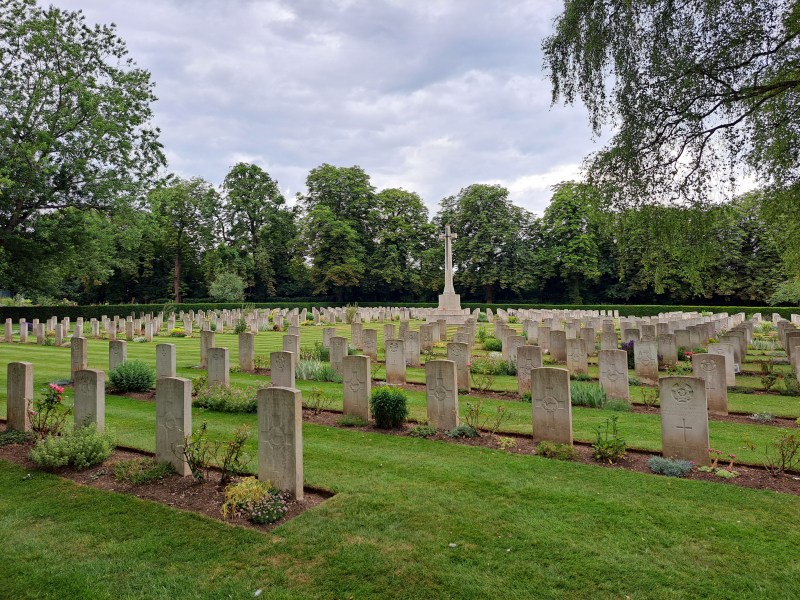
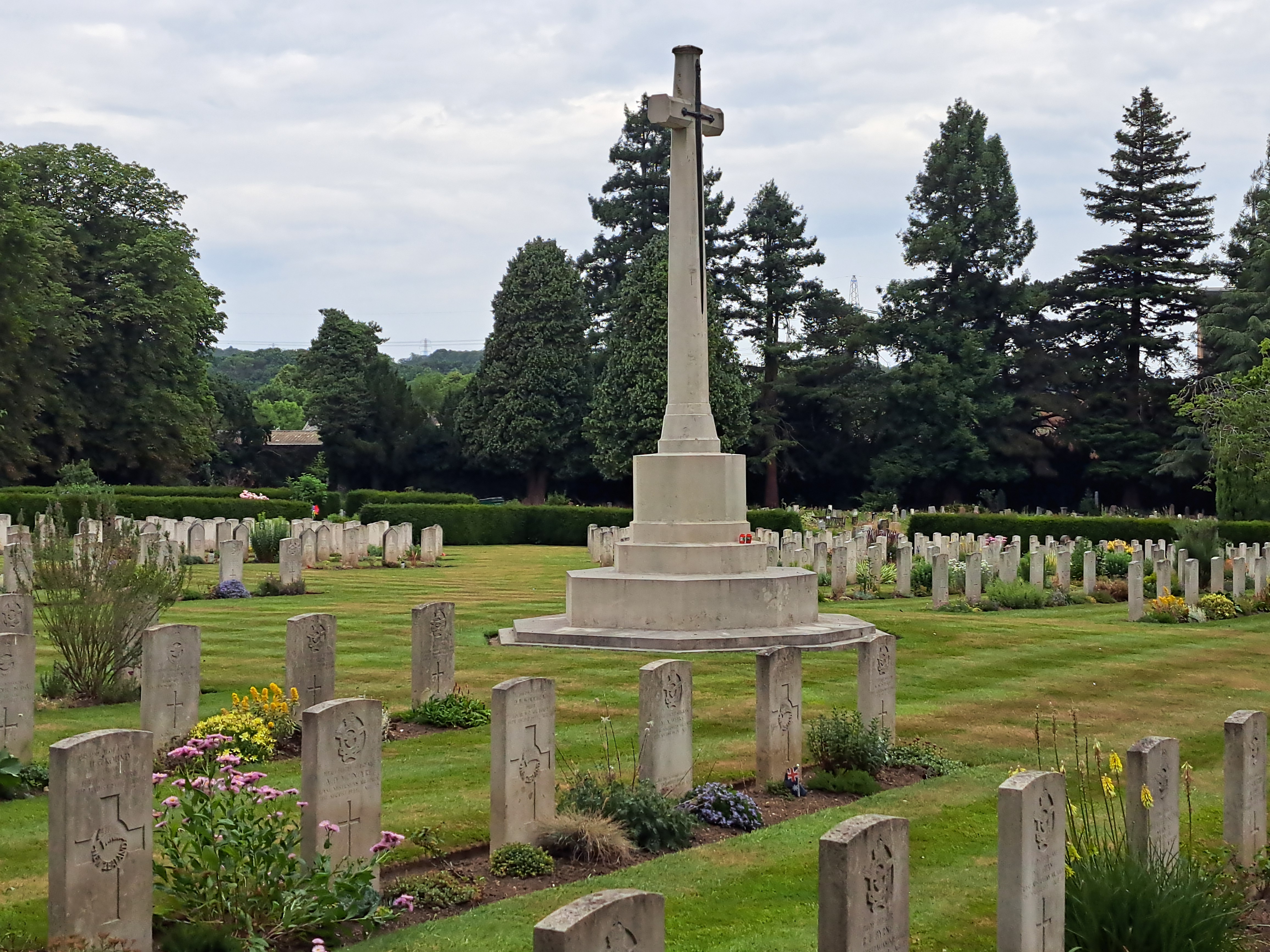
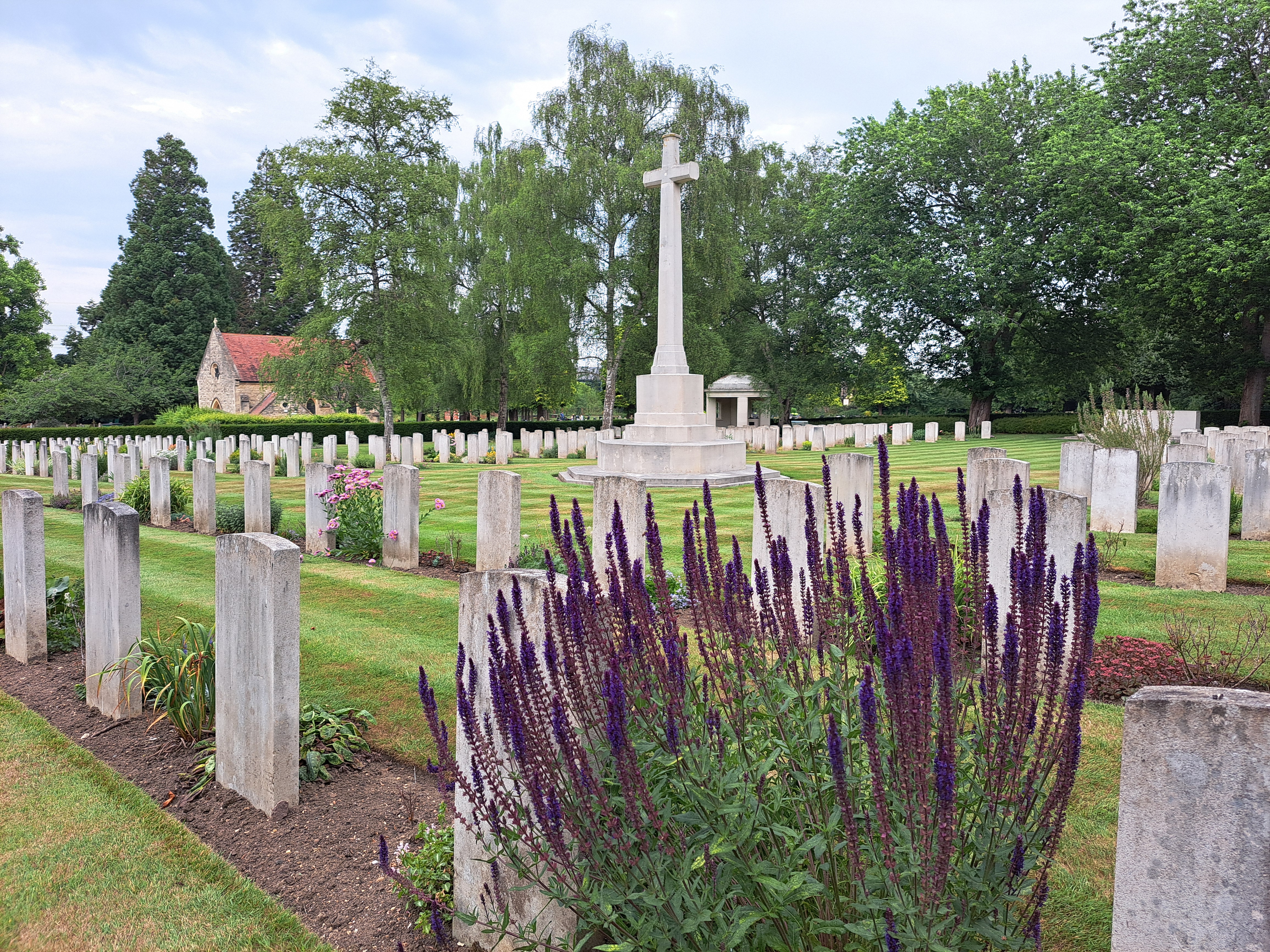
Visiting Botley Cemetery for the first time, despite seeing the signs for the Commonwealth War Graves, I didn’t expect to find such a large military cemetery of a size and with such features as you would expect to find in France or Flanders. Like all Commonwealth War Graves Commission cemeteries it is immaculately maintained, and a very moving place to visit.
I was surprised to find such a large graveyard of this sort in Oxfordshire, although it is inevitably true that many service men and women did die at home, either on home service, or were brought back because of wounds or found themselves in hospital because of accident or illness. Oxford provided a major regional hospital during the First World War, and again during the Second World War. Oxfordshire was also a major centre of RAF activity in the Second World War and Botley was then designated as a Royal Air Force Regional Cemetery. In the First World War the University Examination Schools housed the 3rd Southern General Hospital with room for 1,500 patients. The Schools weren’t the only venue for the war-time hospital, also put to use were Somerville College (for officers only), the Workhouse on Cowley Road, the Town Hall, University and New Colleges, and the Oxford Masonic Buildings on High Street. In the Second World War the Examination Schools were again used as a hospital.
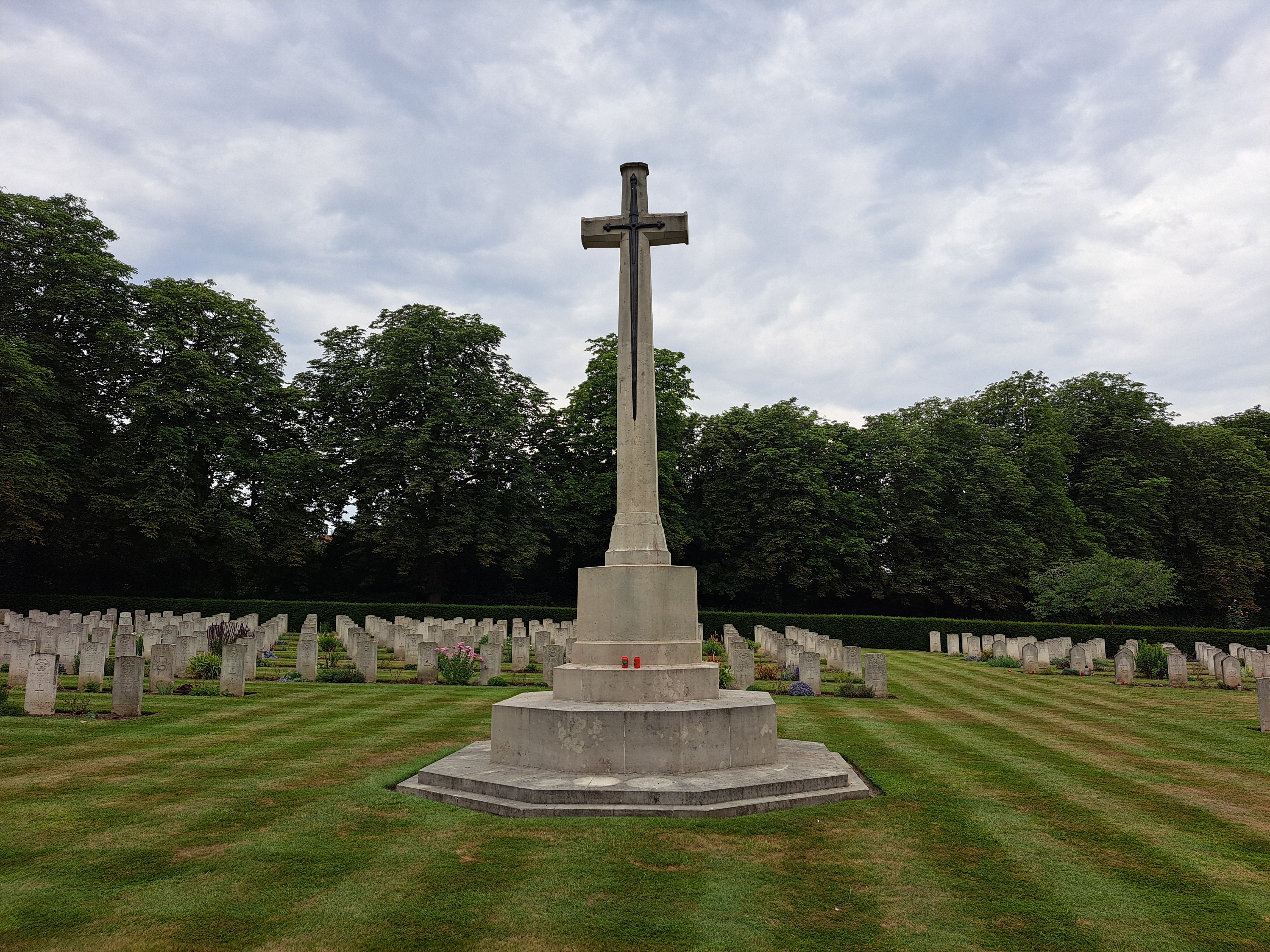
Botley Commonwealth War Graves Commission Cemetery has all the features that can be found in major cemeteries of this type. At the centre of the grave yard there is a Cross of Sacrifice, a large cross containing a bronze longsword, with its blade pointing down, it is said to be present in all graveyards containing 40 or more war graves. These were designed by Sir Reginald Blomfield and are a familiar symbol of sacrifice in so many places. By 1937 there were already over 1,000 of these crosses in Europe alone, more were to follow after the Second World War.
Cross of Sacrifice
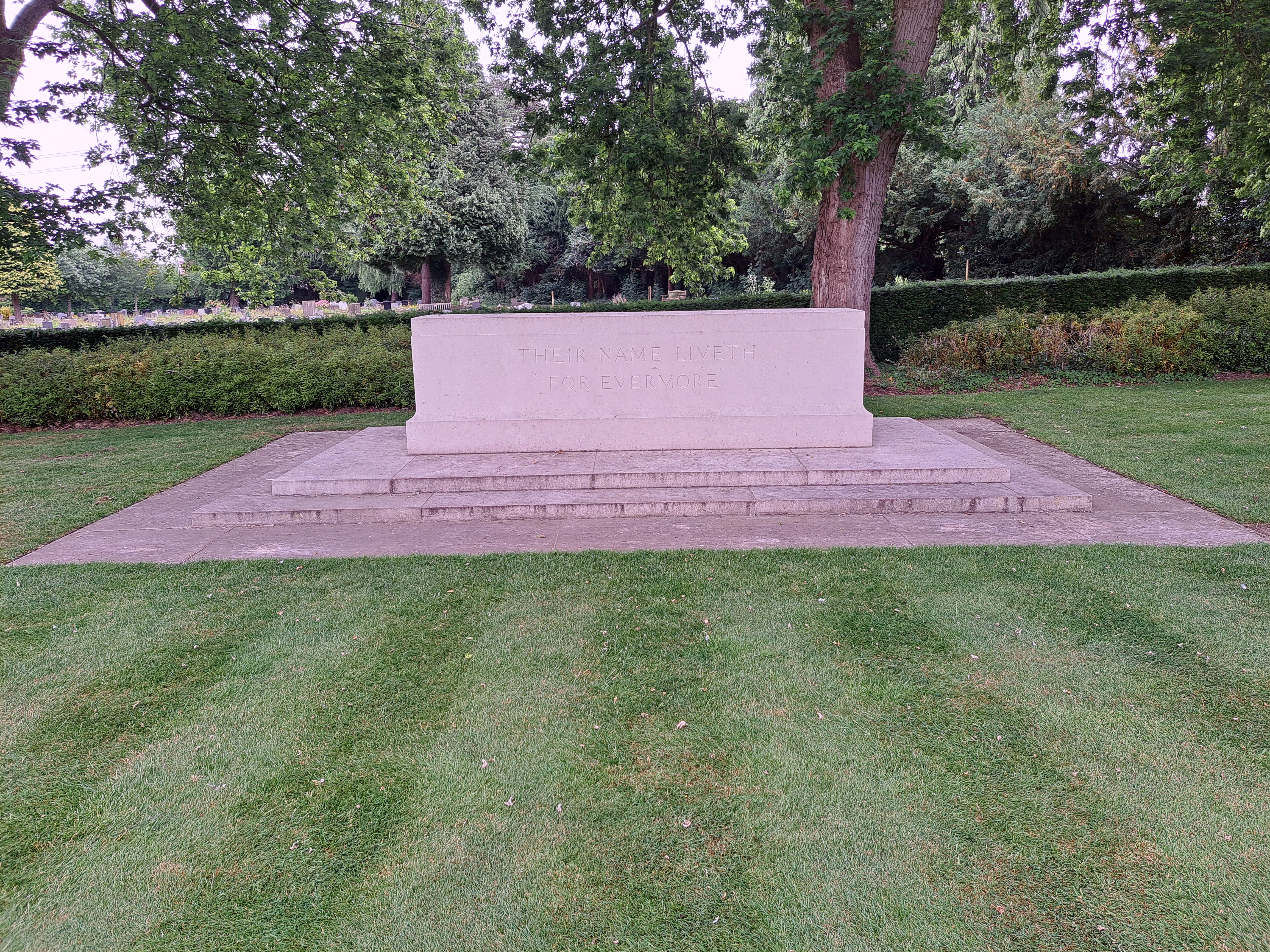
The Cemetery also has a Stone of Remembrance designed by Sir Edwin Lutyens for use in CWGC Cemeteries containing more than 1,000 graves. There are now hundreds of these all around the world but only 12 in the UK. With around 743 graves Botley was regarded as a special case, perhaps indicating that it is one of the dozen largest Commonwealth War Grave Cemeteries in the UK. Although not designed as such the Stone resembles an altar and carries a quotation from the book of Ecclesiasticus: Their Name Liveth for Evermore. Sir Edwin Lutyens was one of three principal architects of the Imperial War Graves Commission (as it was then called) and as well as his work in New Delhi and elsewhere is perhaps best remembered for his contribution to memorial architecture for the First World War, designing the Cenotaph in London and the Thiepval Memorial to the missing of the Somme.
Stone of Remembrance
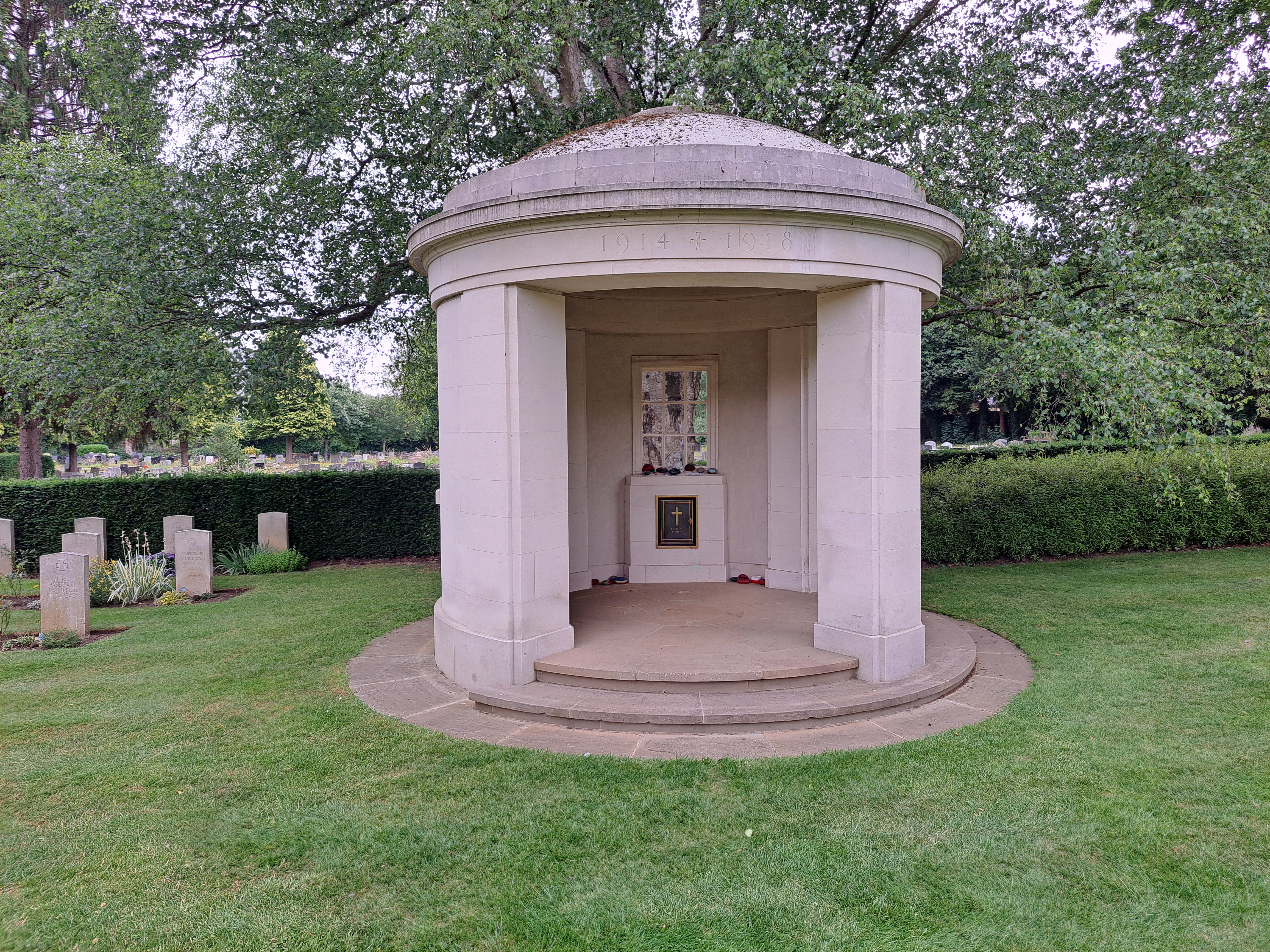
The third building found in the graveyard is the Shelter, designed by Sir Edward Maufe, the Principal architect of the Commonwealth War Grave Commission after the Second World War.
Domed Shelter
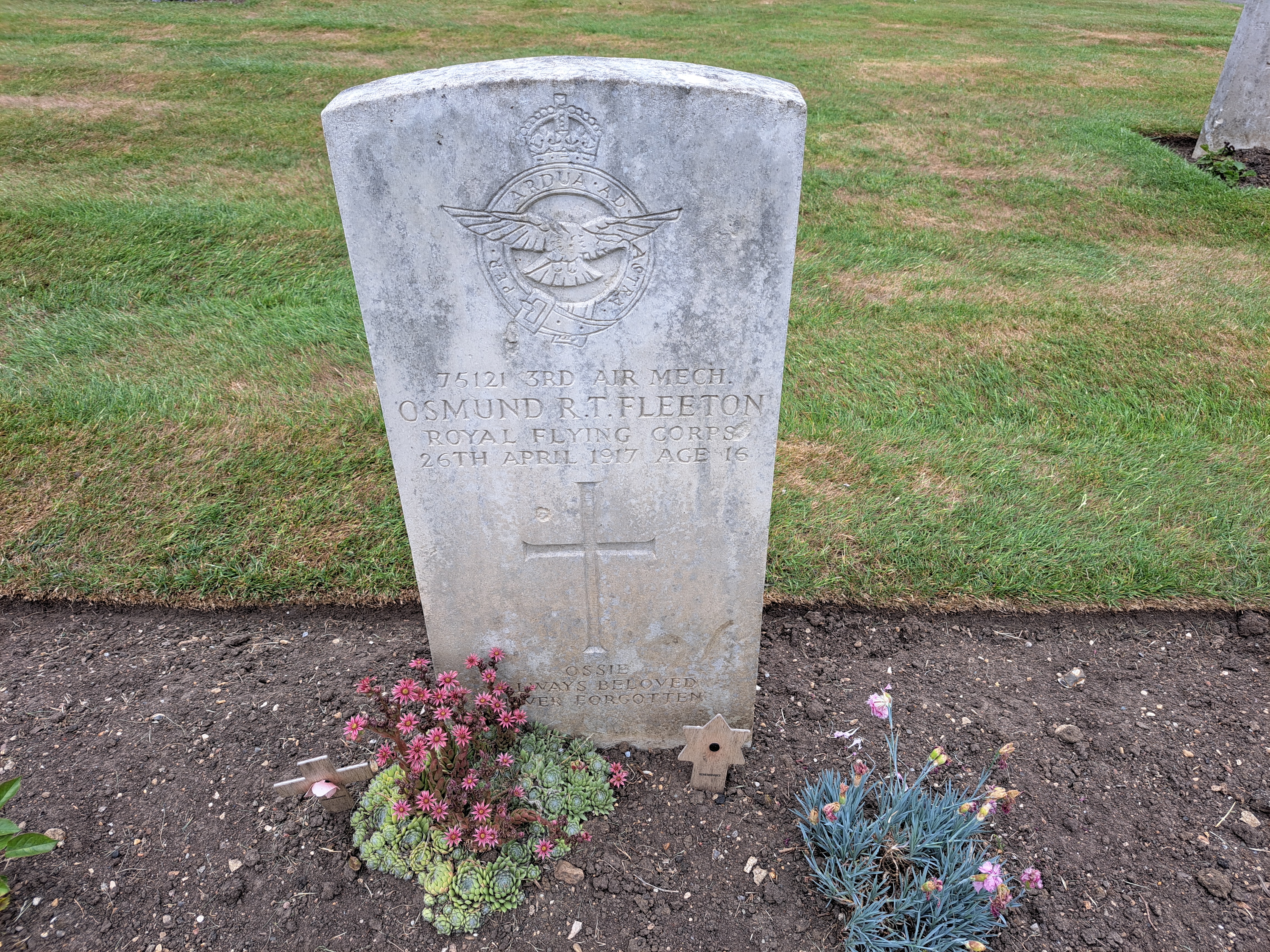
One of the first graves I noticed must be among the most poignant. It is that of Air Mechanic 3rd Class Osmund R.T. Fleeton of the Royal Flying Corps who was just 16 when he died. He came from Cork where his parents Robert and Jeanie Eloise Fleeton, lived at 1 Brookfield Villas, College Road. The official record says he ‘died of sickness 26th April, 1917’. ‘Ossie Always Beloved, Never Forgotten,’ his family inscribed on his grave.
Grave of Osmund Fleeton
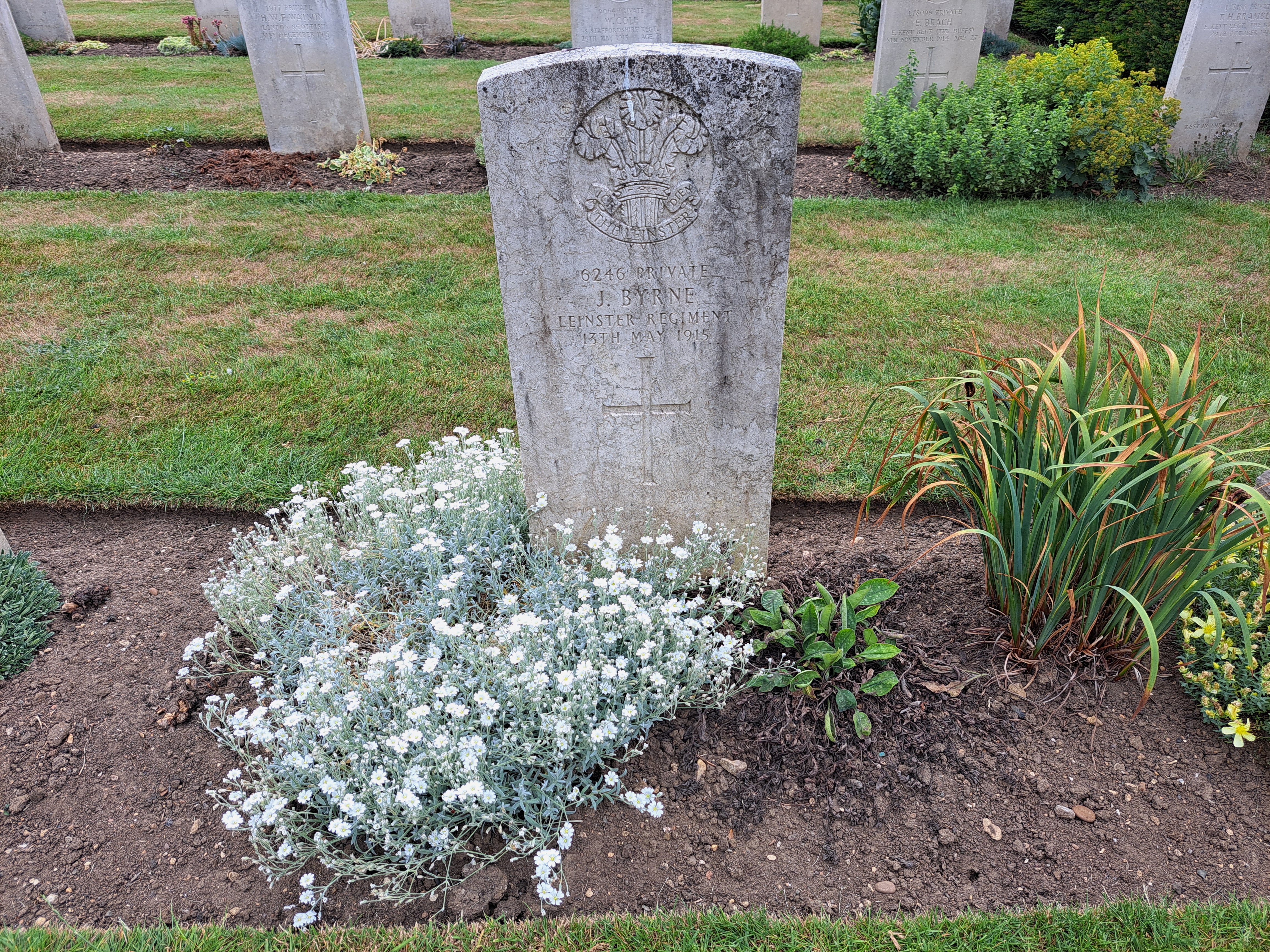
Another Irish grave is that of Private James Byrne from county Kilkenny of the 1st Battalion the Leinster Regiment who died on 13th May 1915.
Private James Byrne
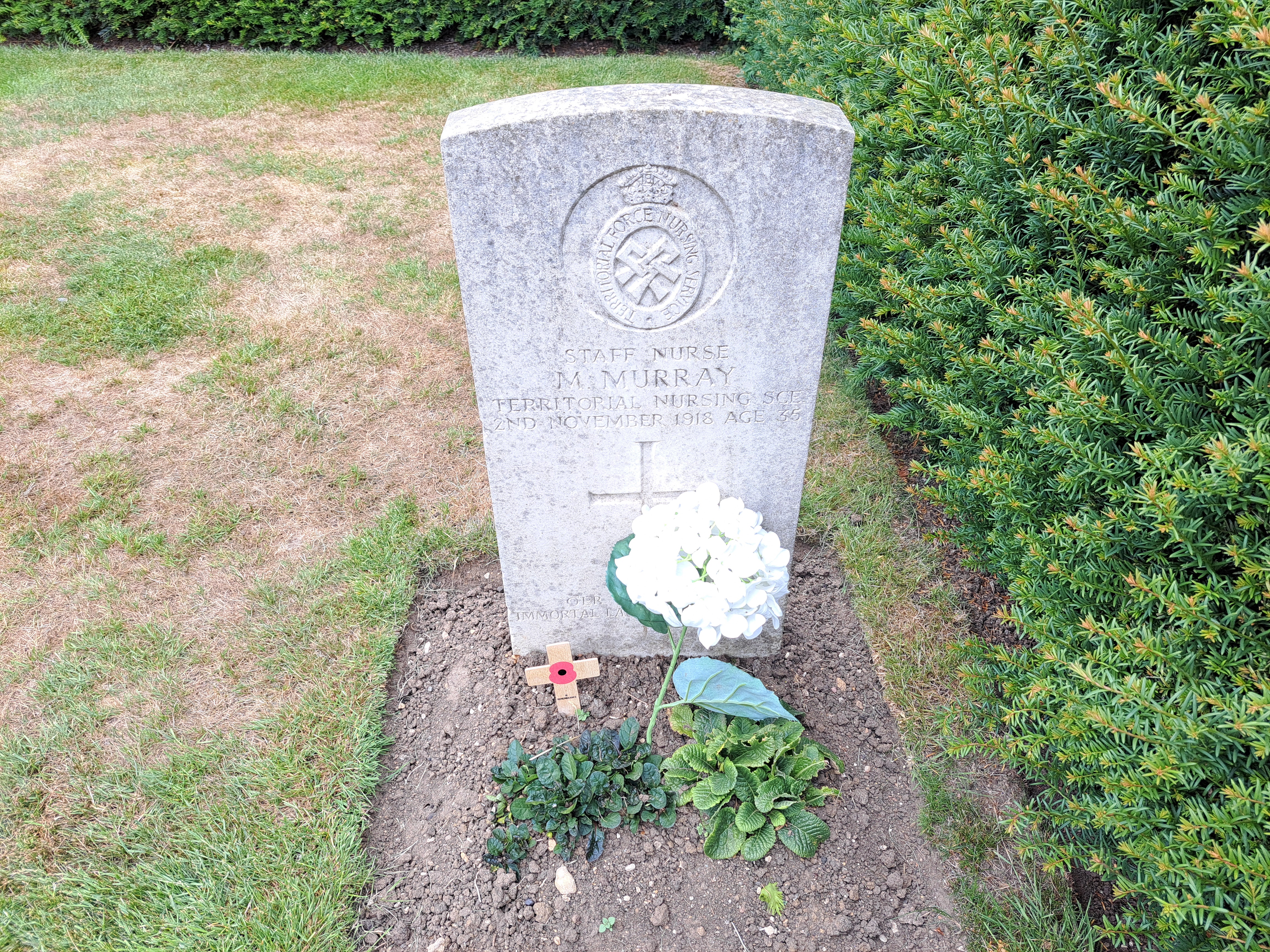
In one corner of the grave yard there is a solitary grave of a nurse – Staff Nurse Mabel Murray, of the Territorial Force Nursing Service, who worked at the 3rd Southern General Hospital and who died of influenza on 2nd November 1918 at the age of 35. She was one of the victims of the so-called ‘Spanish flu’ which swept over the nation at the end of the First World War, and it may be that the reason her grave is situated in a lonely corner is that they expected more of her colleagues to fall victim to influenza, but thankfully this did not transpire. She is not the only woman buried in the cemetery, however. Nineteen years old Aircraftwoman Glenys Doreen Harris is buried in the RAF section having been killed when an RAF Mosquito crashed in training at Upper Heyford on 24th September 1945.
Staff Nurse Mabel Murray
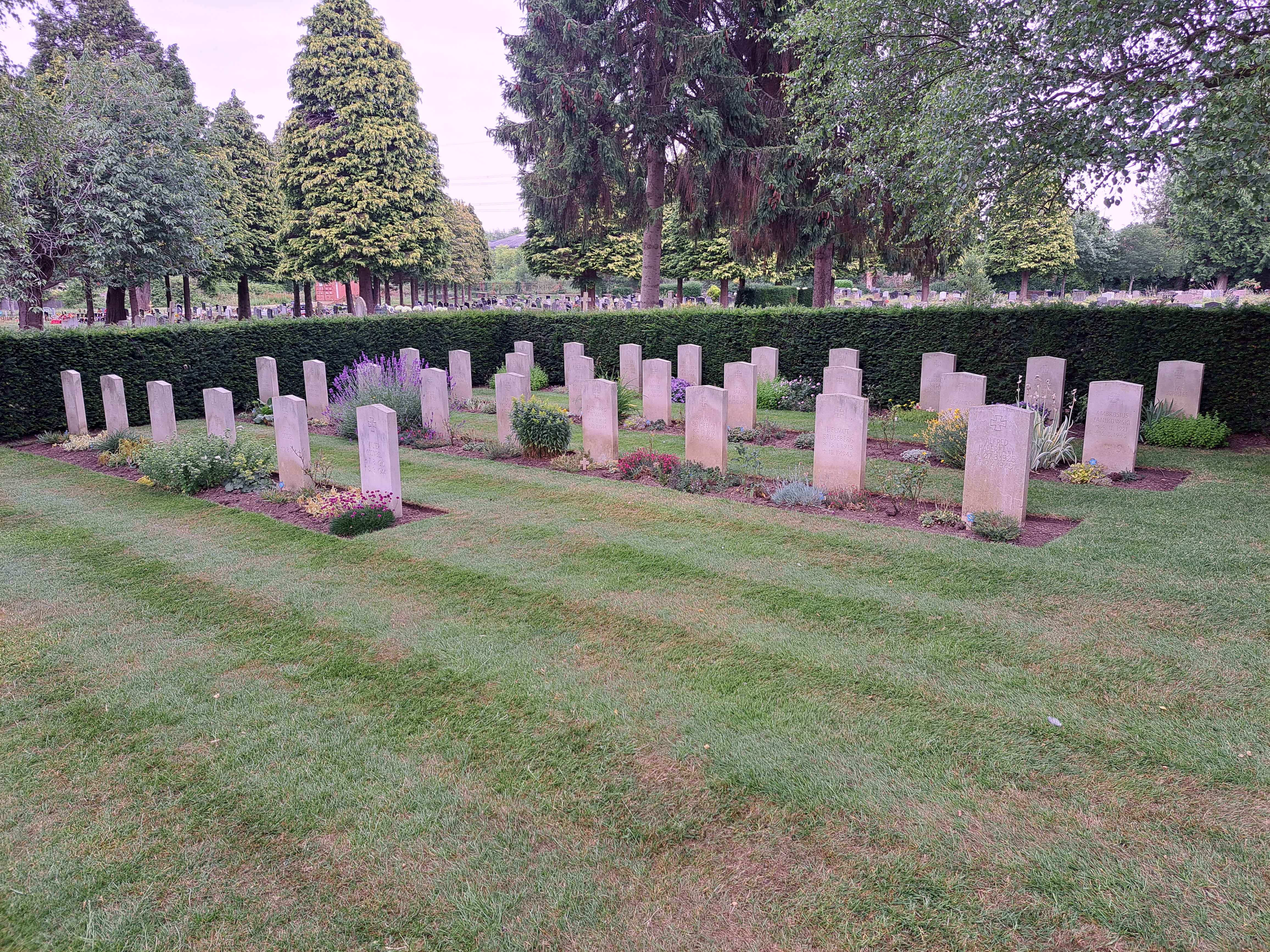
The graveyard contains the graves of many nationalities from both world wars including those who came from the then dominions of the British Empire (Australia, New Zealand, Canada, and South Africa) as well as other countries including Belgium, Czechoslovakia, Italy, The Netherlands, and Poland. Botley also contains the only grave of a Greek soldier in Britain – Private T. Lagos, who died in Oxford on 18th October 1944. His headstone is inscribed with a quotation from Pericles’ funeral oration as recorded by Thucydides: ‘The whole earth is the tomb of famous men’. There are also a number of German graves from the First World War as well as a large section of 33 graves of German soldiers all dated 1944 who presumably were prisoners of war. It was strange to see the German war graves although their presence is perhaps slightly reminiscent of the memorial in New College Chapel to former German students who had been killed in the Great War.
German war graves
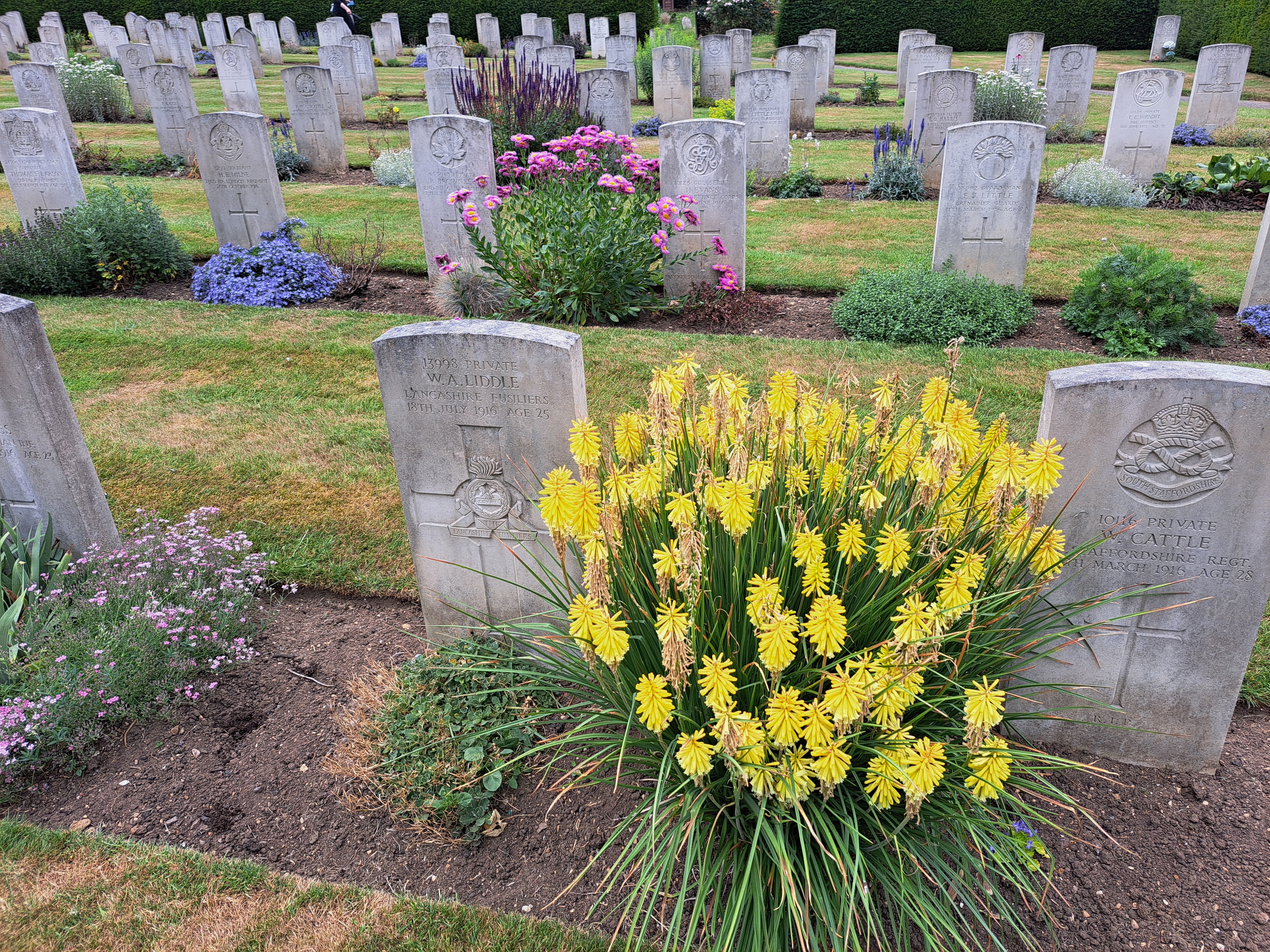
The precise number of graves in the CWGC cemetery at Botley varies according to which source you consult but I did notice a number of other military graves from the world wars located outside the Commonwealth War Graves area which might account for the variations. But it is certainly a very peaceful place, a well-cared-for corner of a municipal cemetery, a silent memorial to those who gave their lives.
 velvethummingbee