Faith and Freedom
Autumn and Winter issue 2017
Volume 70 Part 2. Number 185.
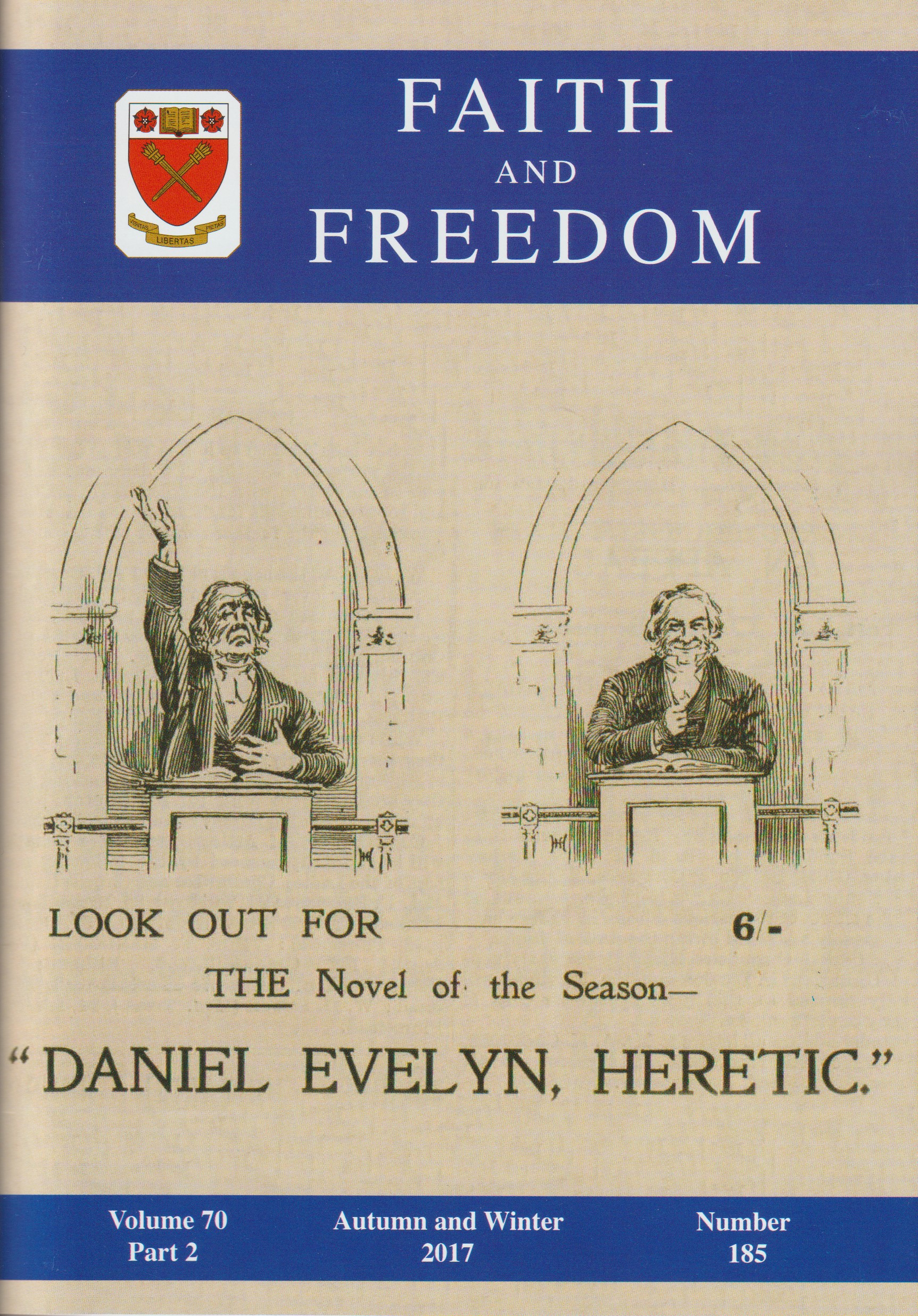
In the latest issue of Faith and Freedom Professor Emily Klenin breaks new ground with an exploration of the writings of David Delta Evans, the Flintshire-born son of a miner who went on to become a Unitarian minister, printer, editor of the Christian Life, novelist and poet in English and Welsh. Emily looks in detail at his 1913 novel Daniel Evelyn, Heretic, which is both a fictionalized account of his childhood and youth and a confession of faith. She draws out the importance of this long-forgotten novel in the religious and social landscape of England and Wales at the time. It’s a fascinating account of a remarkable man who has been long neglected.
Stephen Lingwood develops ‘A Unitarian Theology of Tradition’. He asks “in what sense do we claim religious continuity in a non-creedal tradition that allows the freedom of religious evolution? In what sense is the Unitarianism of the past the same thing as the Unitarianism of the present?” These are important questions for Unitarians to grapple with and drawing on sources such as James Luther Adams, Susan B. Anthony, George Lindbeck and Alasdair MacIntyre and taking scientific method as an analogy he gives a compelling explanation of the way Unitarians can understand their own tradition.
In ‘Manchester College Oxford Old Students Association – The Early Years’ Alan Ruston uncovers the early history of the OSA and describes its birth pangs and early development, concluding with its creation of Faith and Freedom and the encouraging observation: “F&F has proved to be a successful long-lasting journal of mainly intellectual content representing the Unitarian position, which is now in its seventieth year. Its creation can be considered the single most important initiative to have been undertaken by MOSA.”
Our review section is extensive and wide-ranging. Graham Murphy reviews Diarmaid MacCulloch’s All Things Made, New Writings on the Reformation (Allen Lane/Penguin). It’s an excellent review of a timely and important book, Graham writes: “MacCulloch guides us around rooms of the past, noting progress, noting dystopia, and here and there a glimmer of light: ‘a Declaration in the parish church of a town called Torda, a place which should be more of a centre of pilgrimage than it is’ – Toleration.”
Stephen Lingwood’s incisive review of Frederic Muir’s edited collection Turning Point: essays on a new Unitarian Universalism (Skinner House) draws out the ‘trinity of errors’ identified there, including exceptionalism, an aversion to authority and, especially, individualism. This latter tendency is the root of the philosophy of Samuel Smiles and in his fascinating review of John Hunter’s The Spirit of Self-Help. A Life of Samuel Smiles (Shepheard-Walwyn) Bob Janis-Dillon shows how the sometime attender at Mill Hill Chapel, Leeds adapted Emersonian individualism to his ‘Self-Help’ idea, “a mode of thinking we need to challenge if we are to advance as a species”.
Rev Dr Marcus Braybrooke, joint president of the World Congress of Faiths, looks at three books that inform on the place of Islam in modern Britain (James Ferguson, Al-Britainnia, My Country: A Journey Through Muslim Britain, Bantam Press; Richard Sudworth, Encountering Islam: Christian Muslim Relations in the Public Square, SCM Press; Rahim Snow, Remember Who You Are, 28 Spiritual Verses from the Holy Quran, Remembrance Studio), an essential starting point for those who wish to open up dialogue and debate in this area. Marcus also provides two reviews of works that deal with Jewish–Christian relations and pluralism – Tony Bayfield (ed.), Deep Calls to Deep: Transforming Conversations between Jews and Christians (SCM Press) and Hans Ucko (ed.), Thanking Together: On Pluralism, Violence, and the Other (Journal of Ecumenical Studies).
In his review of what may be Don Cupitt’s “last and most important book” (Ethics in the Last Days of Humanity, Polebridge Press) Frank Walker lifts about fifteen random insights from the book. These all bear careful reflection. One takes up the theme of Muslim relations (“Western scholars should publish fully critical studies of the origins and the developing theology of the Qur’an and of the hadith”). In another Don Cupitt asserts: “Ordinary people will need a religious discipline like that of the Buddhist sangha to help people to calm their violent passions and to think rationally about how best to live.” It’s difficult not reflect on the plight of Muslims in Myanmar on reading this. But it is an important book concerned, as Frank says, “in the most down-to-earth way” with the end-times.
Faith, hope and healing are the themes of three reviews. Pat Frankish reviews The Enduring Melody (Darton, Longman Todd) by Michael Mayne about one man’s struggle with cancer, “a powerful and painful book, with a thread of reality and hope”. Christian Wiman’s book My bright abyss: meditations of a modern believer (Farrar, Straus and Giroux) is similarly a tale of a struggle with cancer, in this case that of a poet who tries to make sense of religion and God through his suffering. It is reviewed by Barrie Needham who draws out many profound insights from it. Barrie writes: “Faith which is self-centred does not, according to Wiman, recognise God impinging on this world through love. ‘The only way to ascertain the truth of religious experience: it propels you back towards the world and other people, and not simply more deeply within yourself’.” Andrew Hill also reviews a new book of hymns: Hymns of Hope and Healing: words and music to refresh the church’s ministry of healing (Stainer & Bell), a modern, progressive collection of hymns which covers a subject index of more than 250 topics. Andrew mentions some of them but those listed alphabetically from A to D give an idea of the books radical emphases: “ageing, balance, birth, carers, dementia, DNA, drugs…”
So many of the reviews are about finding and connecting with the divine in one way or another and Jim Corrigall reviews Lorraine Cavanagh’s new book Waiting on the Word: Preaching Sermons that connect people with God (Darton, Longman and Todd). Jim quotes the author “Sermon preparation is a matter of waiting in the pain of others, rather than worrying what we are going to say.” Finally Peter Godfrey reviews Crocodiles do not swim here (Avian House) by John Smith Wilkinson who looks at doctrine, Biblical interpretation and religious understanding from fresh angles.
If you would like to take out an annual subscription to Faith and Freedom you can do so online at http://www.faithandfreedom.org.uk/subs.htm or by sending a cheque for £15 to the Business Manager, Nigel Clarke., 16 Fairfields, Kirton in Lindsey, Gainsborough, Lincs, DN21 4GA.

 velvethummingbee