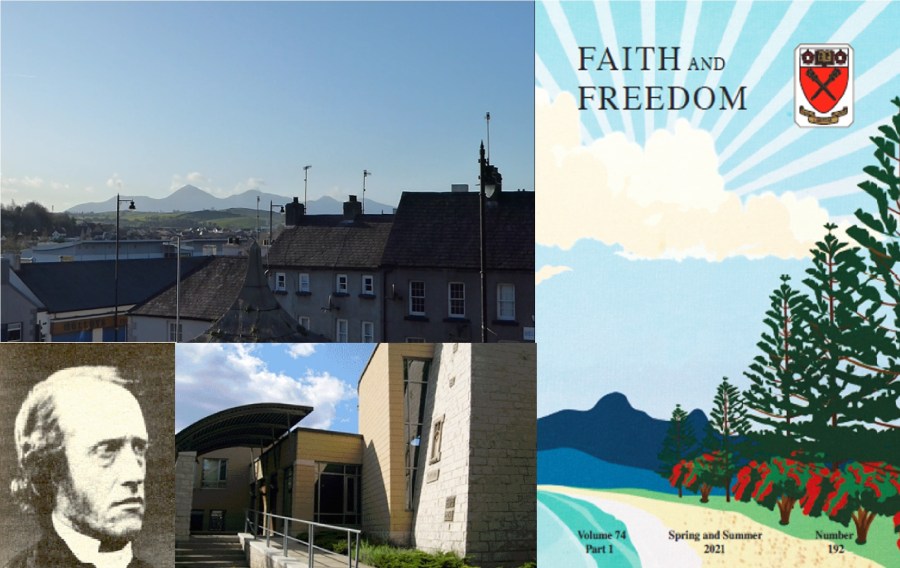
The A to Z of Non-Subscribing Presbyterianism V to Z

We have now completed the whole of our alphabetical survey having added the letters V to Z over the Christmas period. V stands for Verse, W looks at the role of Women in the church and ministry, X is represented by eXile, Y stands for Yahweh, and Z is for Zechariah. All the videos can be seen below.

Verse

V is for Verse

Where fishes play and bells do ring

Having reached the letter V in our study of Non-Subscribing Presbyterianism we look at poets and poetry in our tradition. Radicals, United Irishmen, literary giants, writers in Ulster Scots; the story of poets in our tradition is remarkably broad.

Who was the first person to refer to Ireland as the ‘Emerald Isle’? Which Ulster town was described as a place ‘where fishes play and bells do ring’? Which hymn penned by a Non-Subscriber has been in print for over 200 years? To which congregation did the ‘Shipyard Poet’ belong? Find out the answer to these and other questions in today’s service which looks at seven poets from the Non-Subscribing Presbyterian tradition. Conducted by the Rev Dr David Steers and filmed at First Presbyterian (NS) Church, Dunmurry the reading is from Isaiah ch.12 v.4-6. Church organist Allen Yarr plays the hymns: Just as I am, Thine own to be (Church Hymnary 497) and Thy Kingdom come, O God (Church Hymnary 152).

Women

The A to Z of Non-Subscribing Presbyterianism: Women

The twenty-third in a series of alphabetical explorations of the Non-Subscribing Presbyterian Church of Ireland. W – Women. Non-Subscribing Presbyterian Worship conducted by the Rev Dr David Steers. Filmed at Ballee and Dunmurry Non-Subscribing Presbyterian Churches. Reading: Acts ch.16 v.11-15. Organist: John Strain (Ballee) who plays the hymns: My spirit longs for thee (Hymns of Faith and Freedom 301) and Sent forth by God’s blessing (Hymns of Faith and Freedom 409). In today’s service we look at the role of women in our denomination and at the Rev Gertrude von Petzold who has the distinction of being the first women minister, commencing her ministry in Leicester in 1904.

X is for eXile

X is for eXile, the influence of Irish Non-Subscribers around the world

In this service we look at the considerable contribution made by Non-Subscribers who left their native shores to found churches and extend their faith all around the world, particularly in Canada, New Zealand and South Africa. Who knew that there was once a Presbytery of Canada or that the first electoral register in the Cape Colony in South Africa was introduced by a Non-Subscriber and paid no attention to race? The service is conducted by the Rev Dr David Steers and filmed at Downpatrick and Dunmurry Non-Subscribing Presbyterian Churches. The reader is Gilbert Cameron (Dunmurry) who reads Jeremiah ch.24  v.4-7 and the organist is Laura Patterson (Downpatrick) who plays the hymns: In the bleak midwinter and When he cometh. At the start of the service John Strain also plays ‘Hark a thrilling voice’ on the organ at Ballee.

Yahweh

The A to Z of Non-Subscribing Presbyterianism: Yahweh

The name of God

In the penultimate service in our alphabetical journey through our religious tradition we have reached the letter ‘Y’ and look at the Hebrew word for God, what we understand by it and how it influences our faith in the twenty-first century. Filmed at Ballee, Clough and Dunmurry Non-Subscribing Presbyterian Churches the reader is Elsie Nelson (Clough) who reads Exodus ch.3 v.1-6. John Strain plays the hymns: I heard the voice of Jesus say (Hymns of Faith and Freedom 199) and Go work in my vineyard (Hymns of Faith and Freedom 294). At the start of the service John also plays Lo he comes with clouds descending.

Zechariah

Z is for Zechariah

Having reached the letter Z in our journey through the alphabet of our denomination, Z stands for Zechariah. This service is filmed at Ballee and Dunmurry. The reader is Robert Neill (Downpatrick) who reads Luke ch.1 v.67-79. Laura Neill (Downpatrick) plays Auld Lang Syne on the bagpipes. John Strain plays the hymns: I heard the voice of Jesus say (Hymns of Faith and Freedom 199) and Go work in my vineyard (Hymns of Faith and Freedom 294).
Images of Gertrude von Petzold

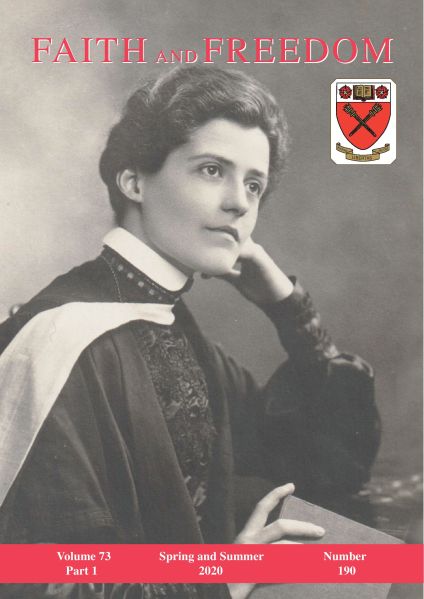
In this issue [of Faith and Freedom: Volume 73, Part 1, Number 190] we are pleased to include Mária Pap’s review of the Lindsey Press’s new book Unitarian Women. A Legacy of Dissent. One of the subjects rightly featured in the book, and also included within the book’s cover illustration, is Gertrude von Petzold. Although her career as a Unitarian minister was relatively short it was also quite effective and was remarkable because it was such a trailblazing achievement, the first woman minister of any organised denomination in Britain. Her achievement is perhaps all the more impressive because she was not born in Britain, English was not her first language, and she achieved all that she did in the teeth not only of prejudice because of her sex but also because of her nationality. In every sense she was an outsider in her chosen field and yet she established herself in her profession as a leader of considerable authority who inspired tremendous affection and loyalty from her congregations.

Gertrude von Petzold A 01

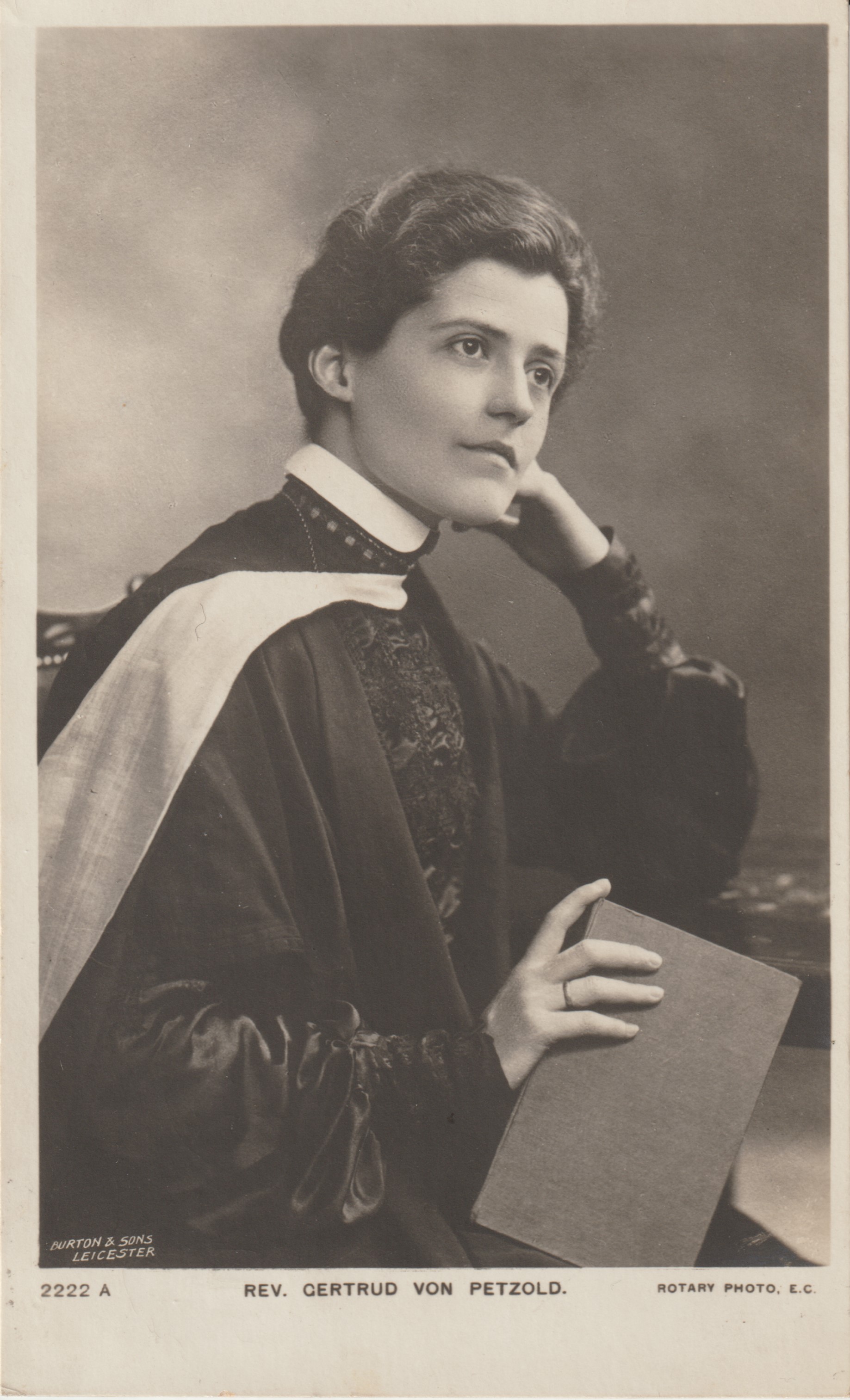
Postcard of Gertrude von Petzold, taken by Burton & Sons published by Rotary

She was also an undoubted celebrity in her own right. The image of her reproduced in the book and on the cover of this issue travelled far and wide and has retained a place in the public imagination, at least for those interested in this aspect of Unitarian or women’s history. In the last couple of years an enlargement of this same image has been framed and hung on the walls of Harris Manchester College, a fitting tribute from her old college, but a compliment too to the photographer.

When the picture was first taken in 1904 it was ubiquitous. It must have sold, as a postcard, in the thousands. Not only that, three weeks after being inducted as pastor of Narborough Road Free Church in Leicester the same image graced the cover of the Tatler magazine.

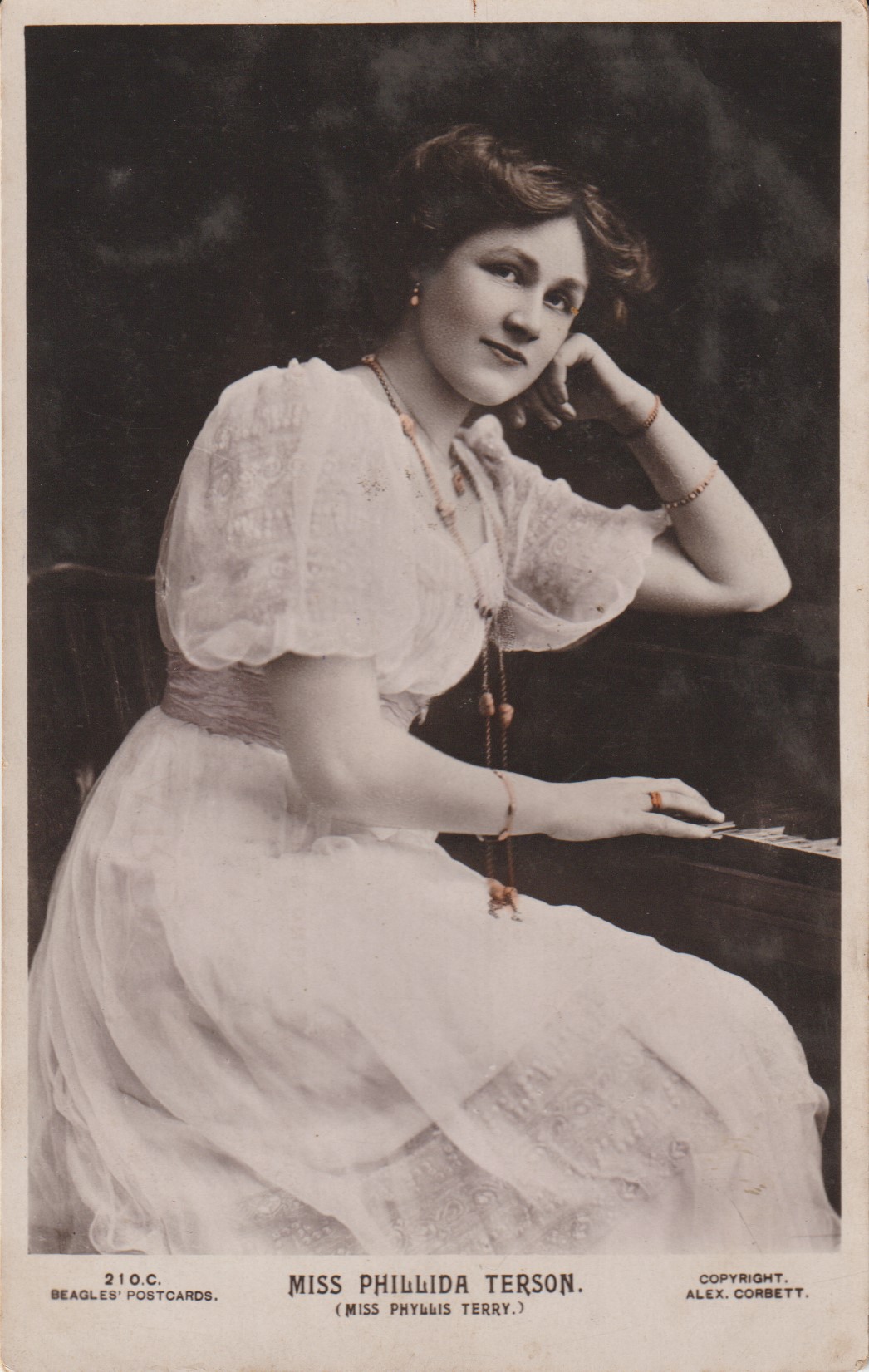
The picture was taken by Burton & Sons, a long-established photographer local to Leicester but with studios across the Midlands. They also had the task of creating something new – no one had ever photographed a woman minister before. How should such a subject be depicted? With what clothes, posture, style? How do you present someone doing an entirely new thing, the first of her kind? There is no precedent for this kind of illustration. So where do they go for inspiration? The answer is simple, it is a celebrity photograph. The model used by the photographer, and by market leader Rotary who subsequently produced and sold her image as a postcard, is that of the top celebrities and postcard favourites of their day – the stars of the stage. Although she is wearing her academic hood and holds a book as indicators of her academic status, Gertrude von Petzold is dressed very elegantly, she gazes off into the middle distance her head resting on her left hand. This is a classic pose of an actress or musical hall star in 1904, she was being packaged as a celebrity in the terms of her era.

MIss Phillida Terson

Postcard of Miss Phillida Terson/Miss Phyllis Terry published by J. Beagles & Co. 1912. As can be seen the pose is almost identical to that in Rotary photograph of Gertude von Petzold. (Described as ‘an actress of distinction’ in the ODNB she combined stage appearances with film roles in later life).

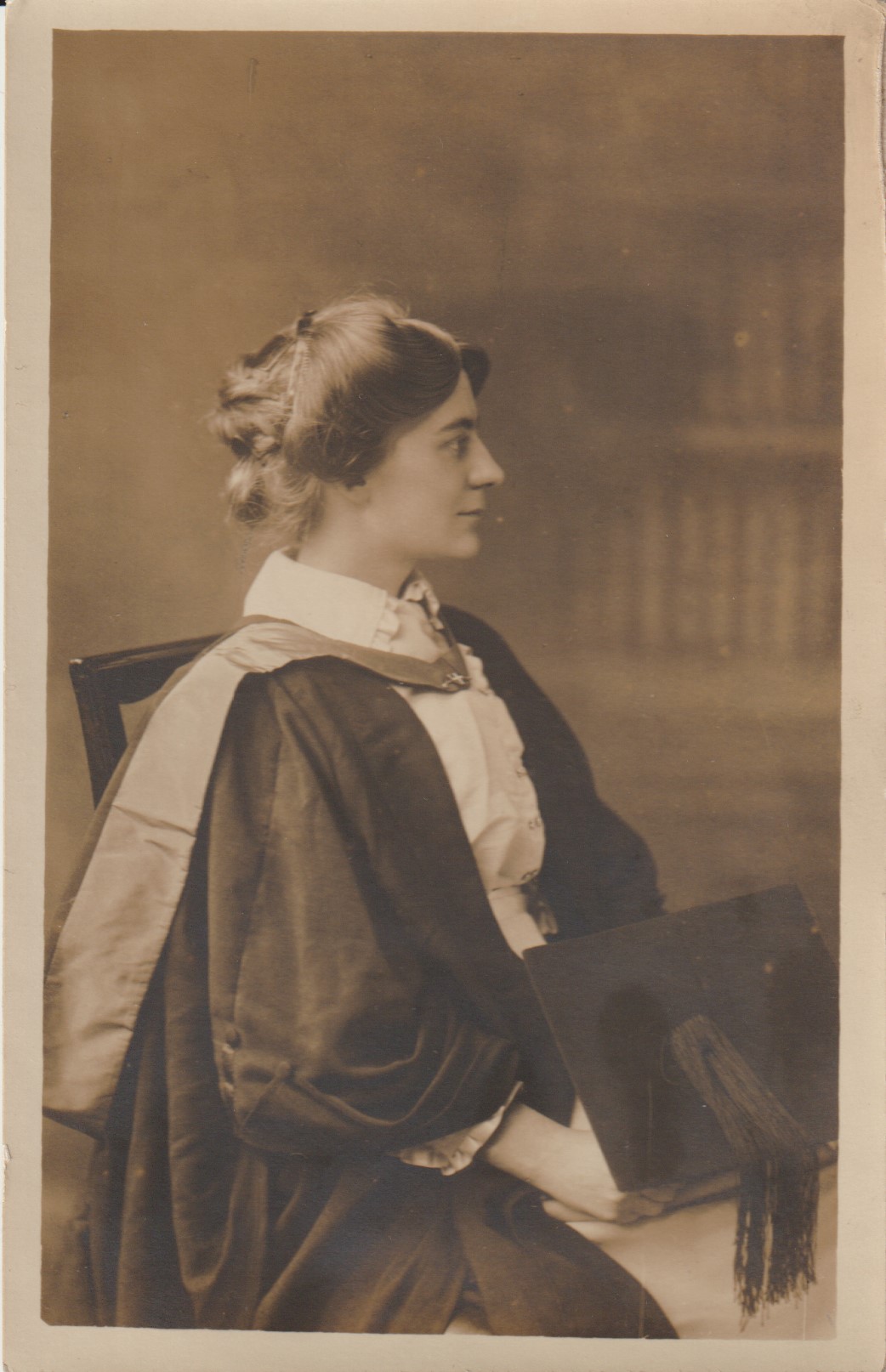
You have to acknowledge too that she also must have projected something of a star quality herself. You can find other examples of pictures of women graduates from this era and they lack that extra element that undoubtedly helped to make this postcard sell.

Unnamed Graduate Wickens Studios Bangor N.W.

Unnamed Pre-1914 female graduate. Wickens Studios, Bangor, North Wales

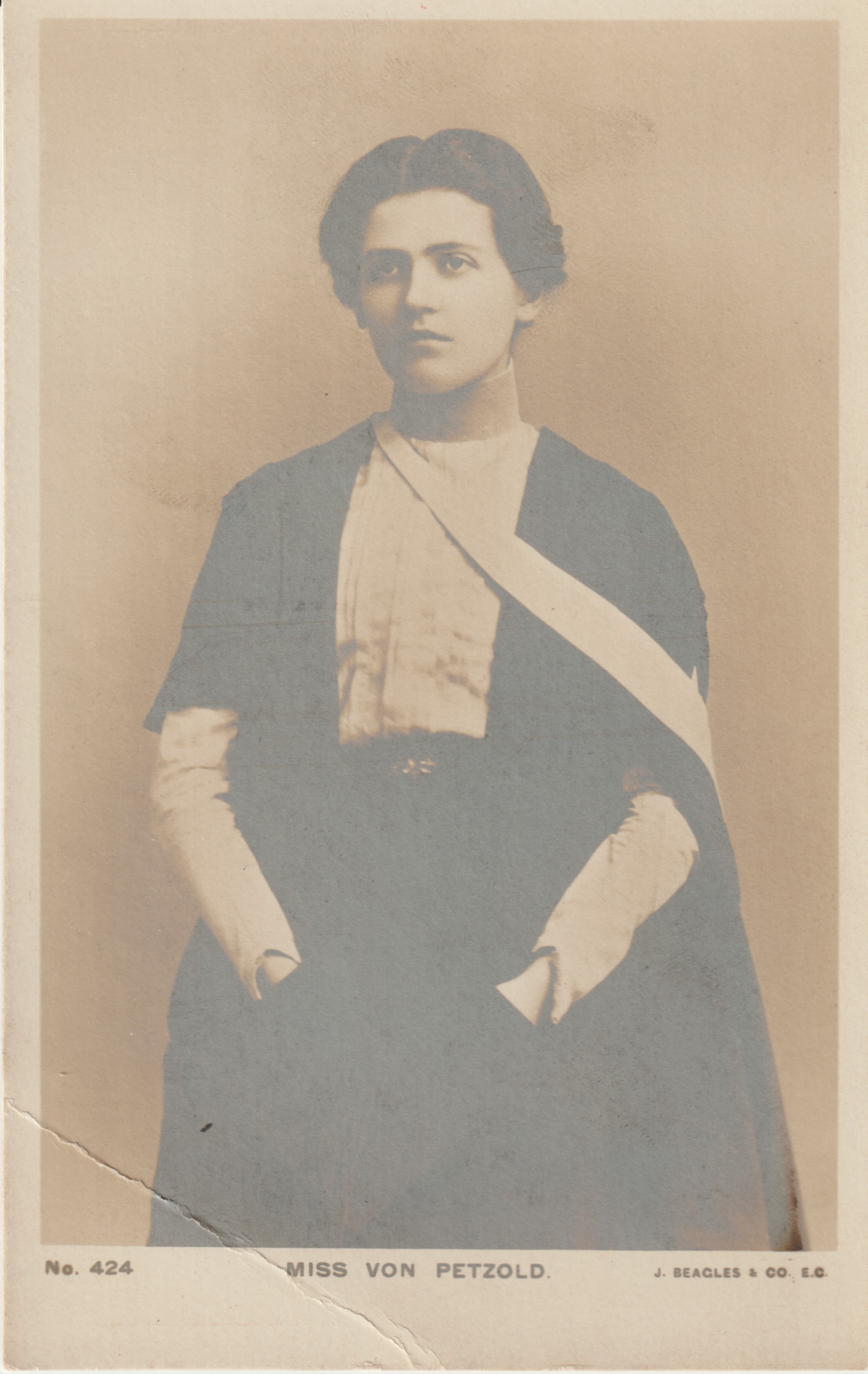
To many of us this [image of Gertrude von Petzold] is a familiar picture. But it was not an inevitable depiction of the first woman minister. How else might an Edwardian photographer think that a woman minister might be shown? Well the answer comes with the postcard that is reproduced alongside this article. This is a far rarer postcard than the one produced by Rotary and, it has to be said, is not as well produced although it was published by J. Beagles a long-established London photographic publisher. Like Rotary they specialised in royalty, musical hall artistes and actors and actresses but unlike them they had a different model in mind for the picture of the first female minister. What inspired them was the image of a woman as a nurse.

Gertrude von Petzold B 01

Postcard of Gertrude von Petzold by J. Beagles & Co. London 1904.

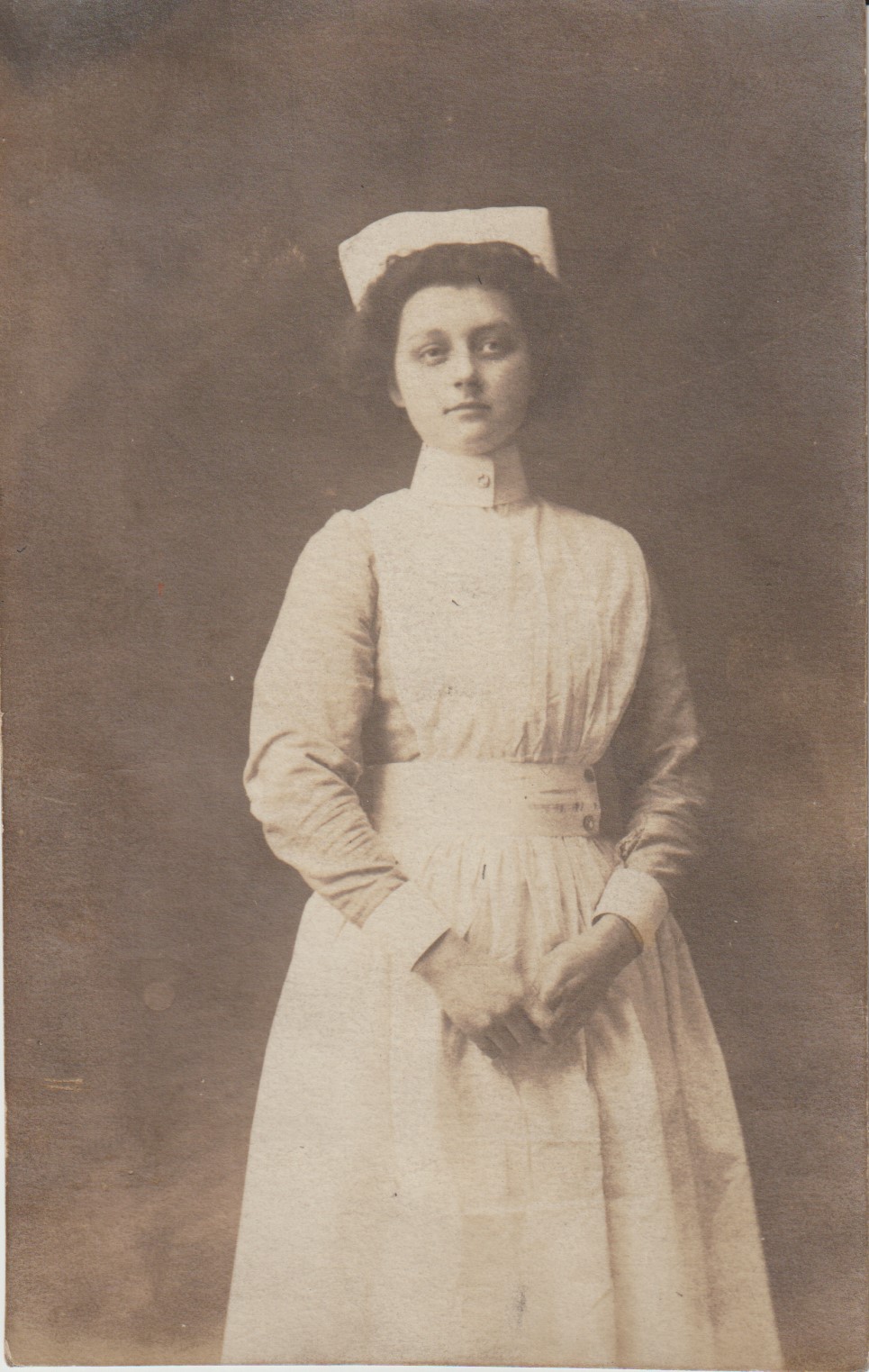
This was already a well established outlet for women’s work – a caring profession characterised by service, so it was not a surprising model to be chosen by the photographer. Although again there are academic accoutrements, this picture, with plainer clothes, a high collar, long sleeves and even the hands pushed into the pockets of the skirt or pinafore, is exactly reminiscent of contemporary photographs of nurses. With a fuller face, if not exactly gazing directly at the camera, this is one of the ways that members of the nursing profession were presented on postcards in the Edwardian era and right through the First World War. J. Beagles were not alone in this; Elliot and Fry, another firm of London photographers, also produced similar images of Gertrude von Petzold.

Edwardian Nurse Postcard

Postcard of an Edwardian nurse (‘With very best wishes for the future from Eunice to Molly’, no photographer or  publisher named). She doesn’t have her hands in her pockets as many similar photographs did but the similarities of pose and dress can be seen with J. Beagles’ photograph of Gertude.

But here we have two ideas of this pioneering woman minister. Was she a star, a glamorous personality, an elegant figure fit to grace the cover of magazines? Or was she a nurse, someone inspired by practical purpose, a worker, a servant? I wonder how she preferred to be seen herself? In the end, though, there is no doubt which card was the most popular. The ‘nurse’ picture is very rare indeed. The postcard image of this minister as a celebrity and star is very common and is frequently offered for sale on eBay right up to the present day.

This article appears in the SPRING AND SUMMER 2020 Volume 73, Part 1 Number 190 of Faith and Freedom. All the illustrations are from my own collection and may not be reproduced without my express permission.

An annual subscription to Faith and Freedom costs £15 (postage included). Contact the business manager:

Nigel Clarke,
Business Manager, Faith and Freedom,
16 Fairfields, Kirton in Lindsey,
Gainsborough, Lincolnshire.  DN21 4GA.

It’s also possible to pay via PayPal via clicking here.

Email: faithandfreedom@btinternet.com

The current situation with Covid-19 has delayed production and distribution of this issue but another article in the current issue can also be read online. To read Jim Corrigall’s review of Stephen Lingwood, SEEKING PARADISE: A UNITARIAN MISSION FOR OUR TIMES, Lindsey Press, London 2020, pp 142, ISBN 978-085319-094-3. £10.00 pbk. click here.