I was very pleased to be able to attend this year’s General Assembly of Unitarian and Free Christian Churches held in Daventry. There were many stand out moments. One was the Unitarian Christian Association meeting at which Dr Lizzie Kingston Harrison gave an excellent talk entitled Joseph Priestley: radical roots and new beginnings. A wonderful presentation which showed how professional historical research can be alive with reflections for our present age in the hands of an expert. We look forward to publishing Lizzie’s paper in a future issue of Faith and Freedom.
The meetings were notable also for the large contingent of seven Non-Subscribing Presbyterians from Northern Ireland who were also able to be there for the welcoming onto the GA Roll of the Rev Lynda Kane. Now the minister of Ballyclare, Cairncastle and Ballymoney, Lynda was one of three new ministers recognised at the General Assembly Service.
Rev Lynda Kane with some of the ministers from Northern Ireland present at the GA (Photo: Sue Steers)
Rev Rory Castle Jones, Rev Lynda Kane, Rev Ant Howe, new ministers Rev Arek Malecki and Rev Jennifer Sanders, Liz Slade, Rev Melda Grantham and GA President Vince McCully, after the GA Service. (Photo: Sue Steers).
The Rev Ant Howe delivered a most inspiring sermon at the GA Service, and at the meetings Dot Hewerdine and the Rev John Midgley and the Rev Celia Midgely were all made honorary members of the GA.
We also held the annual meeting of the Unitarian Historical Society. There was a good turnout of people for the AGM and to hear Professor Grayson Ditchfield’s paper Essex Street Chapel in the Later Eighteenth Century. Unfortunately, because of disruption to the train services, Professor Ditchfield couldn’t be with us in person, and so his excellent paper was read for us by Rev Daniel Costley. There was a great deal of new information and new insight in the paper which will feature in next year’s Transactions of the Unitarian Historical Society.
Derek McAuley (President), Howard Hague (Secretary) with Rev Daniel Costley (left), who read Professor Ditchfield’s paper, at the meeting of the Unitarian Historical Society in Daventry. Saturday, 6th April.
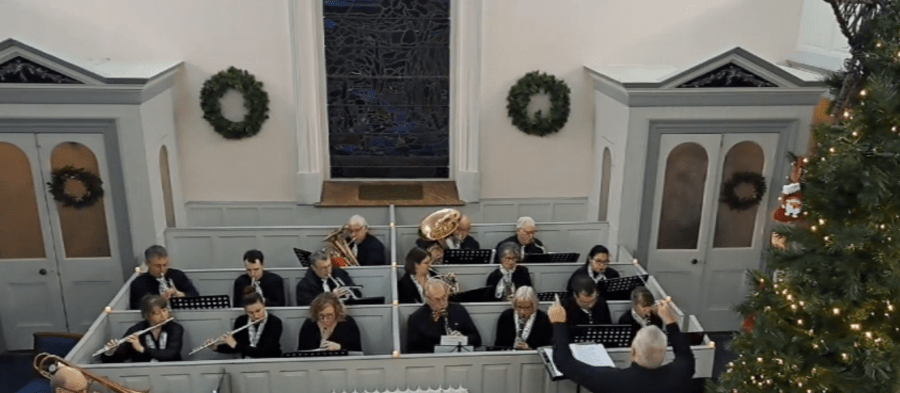
Harmonic Sounds Concert Band performing at Dunmurry
On Friday, 15th December we were delighted to welcome to Dunmurry Harmonic Sounds Concert Band under their Musical Director, Paul Hamilton to lead us in our service of Carols by Candlelight. The Church was beautifully decorated, there was a great attendance and readings were given by members and friends of the congregation.
Click on the video above to share in the service.
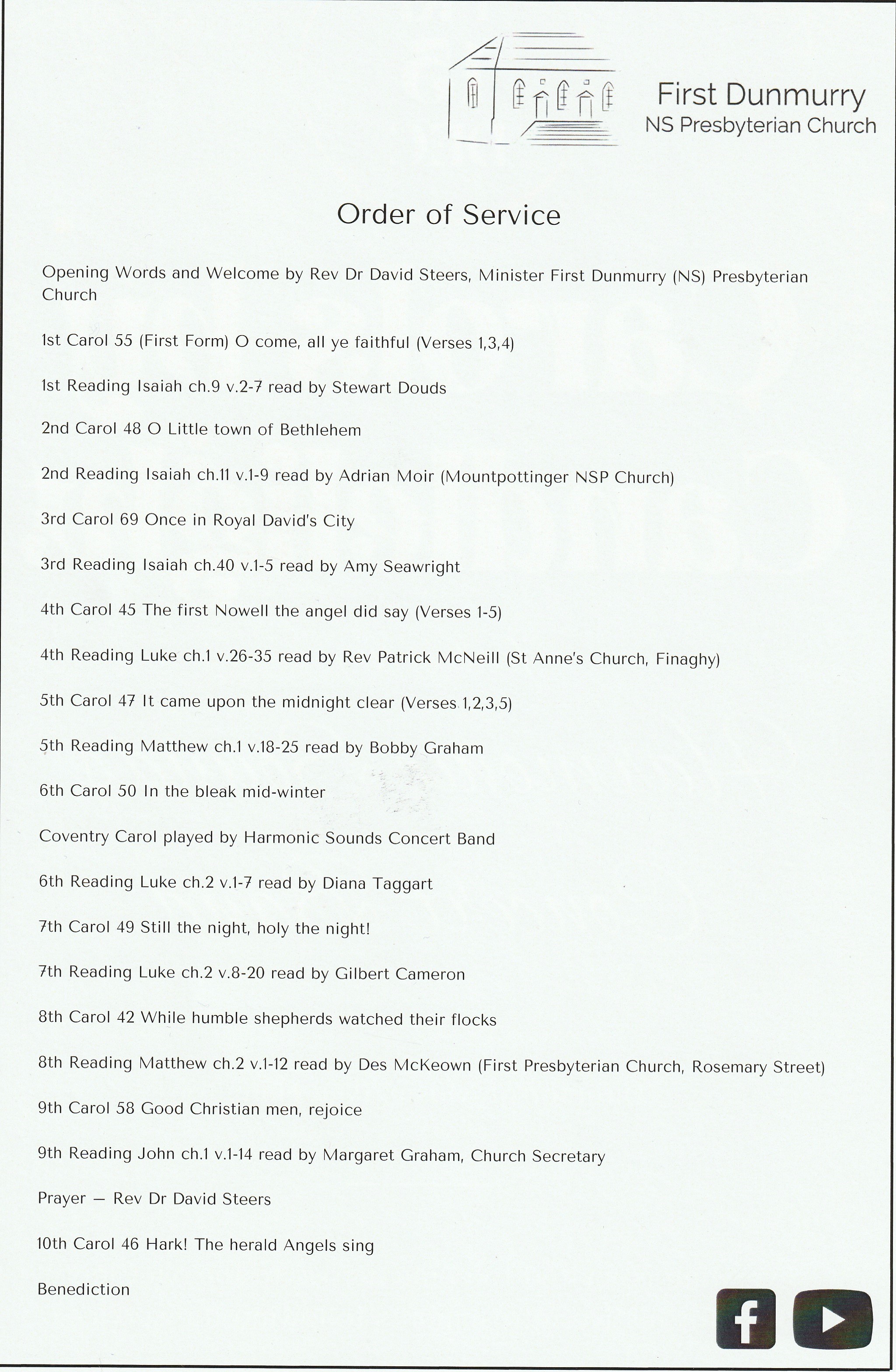
Order of Service
Another recent video which is available to view online is the sermon delivered in Church on Sunday, 10th December 2023, the second Sunday in Advent:
Every Christmas Carol has its own backstory but there is none more intricate and unusual than O Come, all ye faithful, which is also one of the most universally popular of all Carols.
Adeste Fidelis
Click on the video above to see the Reflections on ‘O Come, all ye faithful‘
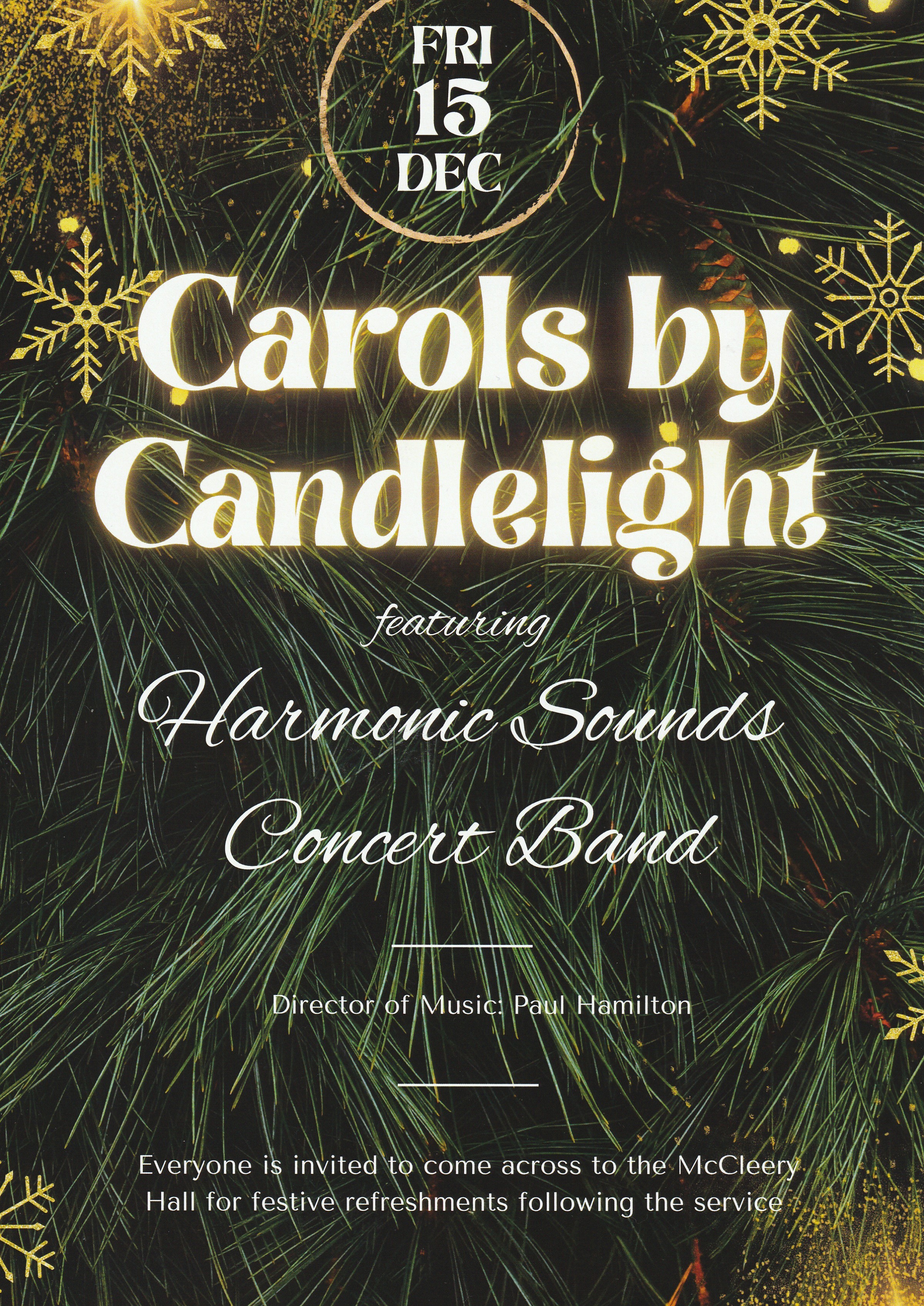
Carols by Candlelight
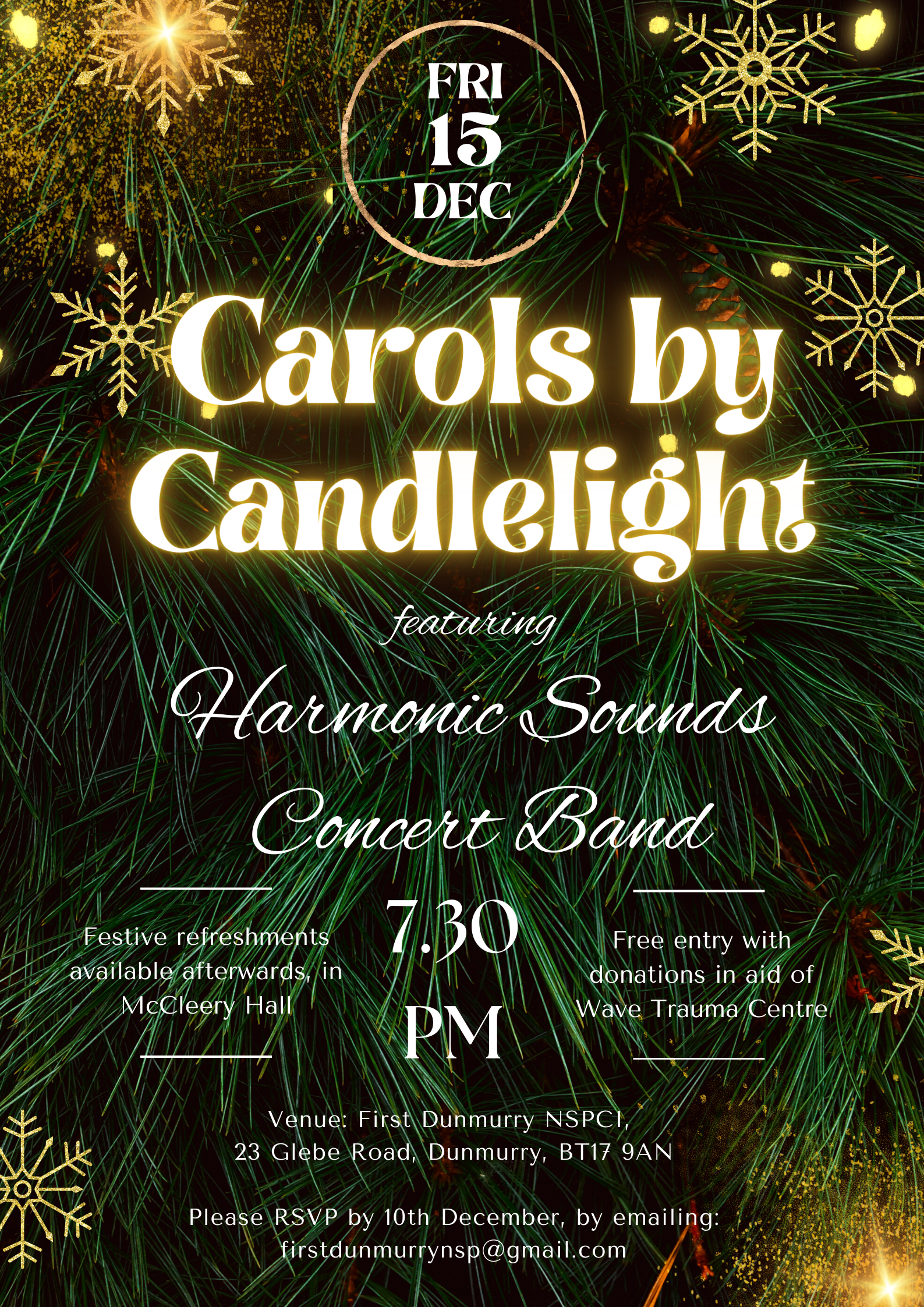
At Dunmurry we are really looking forward to our Carols by Candlelight service on Friday, 15th December at 7.30 pm when we will welcome Harmonic Sounds Concert Band with their Director of Music, Paul Hamilton. We will tell the story of Christmas through traditional carols and the traditional Christmas readings given by church members and friends from other churches. Everyone is welcome.
Just as we approach the start of Advent we were delighted to welcome to Dunmurry the Choir of Malone Integrated College who, guided by their Head of Music, Mrs Mitchell, and teacher, Mr Lennox, sang a wonderfully varied programme of pieces in the McCleery Hall for our regular Thursday Warm Space Coffee Morning on 30th November.
Malone College Choir singing at Dunmurry
It was great having the Choir with us, they had also walked all the way from their school to the church on a very cold day. But everyone was really impressed by their achievements as a Choir and the evident joy and enthusiasm they brought to their music. You can see some of their performance in the McCleery Hall on the following video:
Click on the video to see the Choir perform at Dunmurry
We wish the Choir every success in the future. It was a real pleasure to be able to start our Christmas celebrations in the company of the Choir.
Another video recorded at Dunmurry recently features a prayer from Orders of Worship. You can see this short video by clicking on the image below:
Which of the churches in our tradition do you think was the first to be filmed? Well, there is good evidence that this distinction belongs to Dunmurry. Indeed First Dunmurry (Non-Subscribing) Presbyterian Church must be among the first of all churches to appear on film in Ireland.
The original manse which appears in the film when viewed from the level crossing which itself can be seen slightly right of centre underneath the rainbow
In 1897 the famous Lumière brothers came to Ireland, or to be more precise their cinematographer Alexandre Promio did. Among other places, he filmed in Belfast and filmed segments of the rail journey from Belfast to Dublin. One day in 1897, sometime between June and October of that year, he filmed the view from the train as it pulled out of Dunmurry station. You can see this film – Départ de Dunmurry – in the video below.
The film lasts only 37 seconds and seems to have been made on a bright, sunny, probably summer’s day. As the train starts to pull out of the station the viewer sees the area around Upper Dunmurry Lane which is very hard to recognise, most of the buildings are quite different today compared to the complex of mills that were visible then. At about 22 seconds, though, you can quite clearly see Glebe Road from the vantage point of the level crossing. The wall of the Church is immediately identifiable as it curves round towards the gate, behind it you can see the grave yard and then you can see the Church through the trees as the train picks up speed. This is followed by the edge of the old manse before the view is taken up with more trees until the vista spreads out to an open field.
This film was first shown at Gatti’s Music Hall on Westminster Bridge Road, London on 21st October 1897.
It is a real piece of history and it does evoke a strange emotion to see a moving image of a place so familiar to us but as it looked 126 years ago. Yet, there we are, as we looked in the year of the Diamond Jubilee of Queen Victoria. Even then our Church was nearly 120 years old but caught in a fleeting glimpse as a steam train powers its way towards Lisburn. It is a reminder of the continuity of our witness and the unchanging core of our message set amidst an ever-changing world.
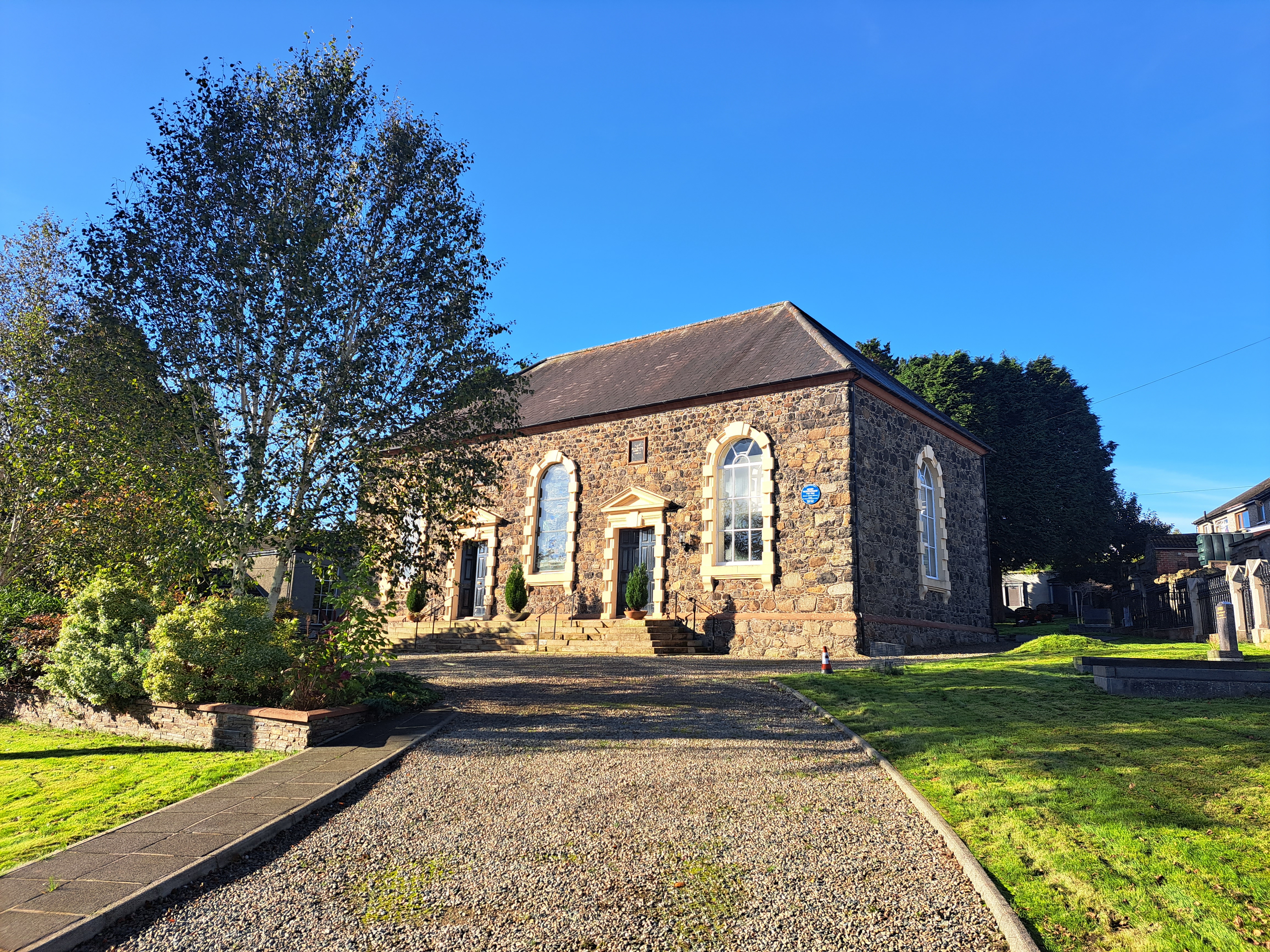
First Dunmurry, built in 1779, and possibly the first Church in Ireland to appear on film
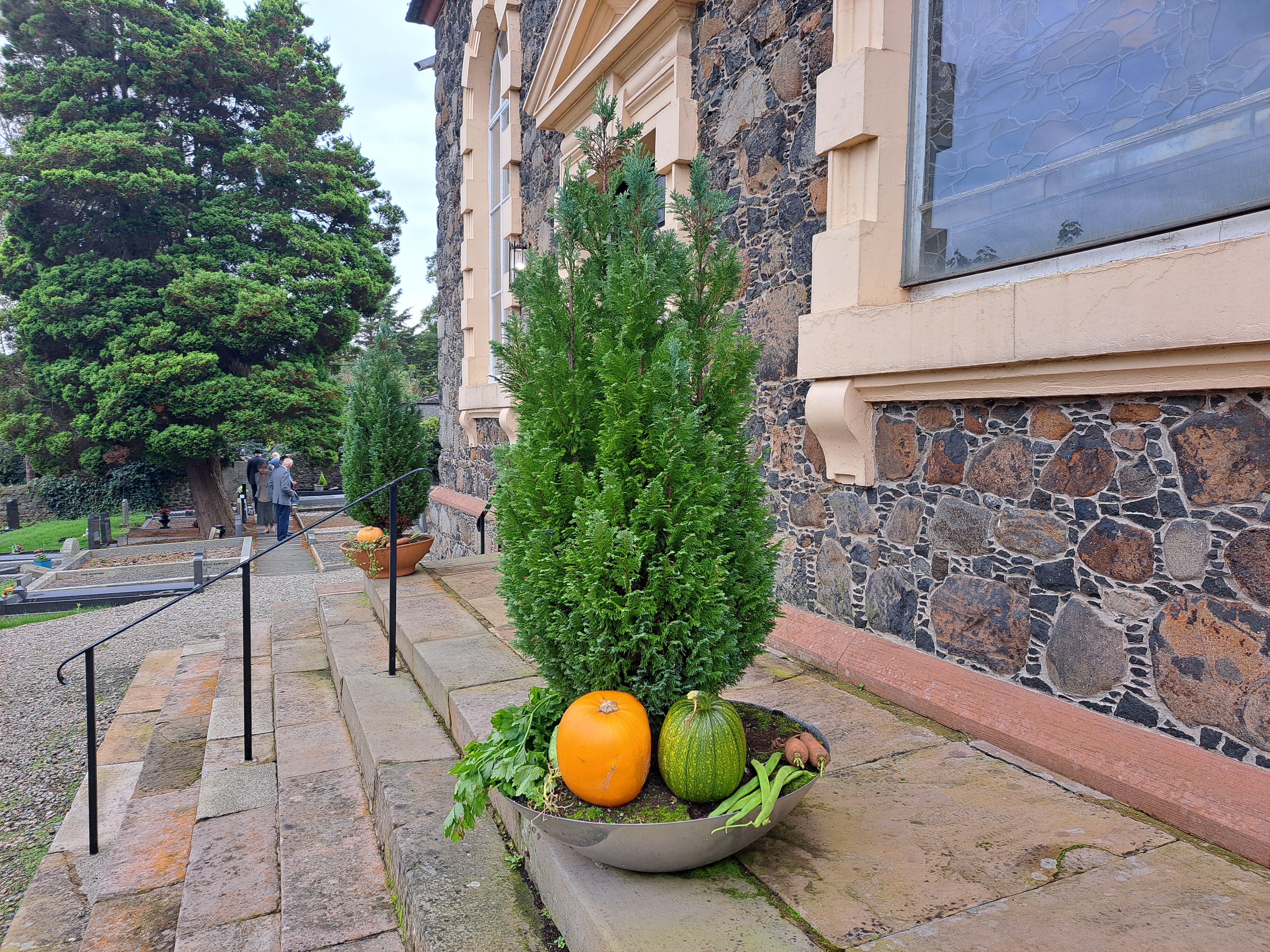
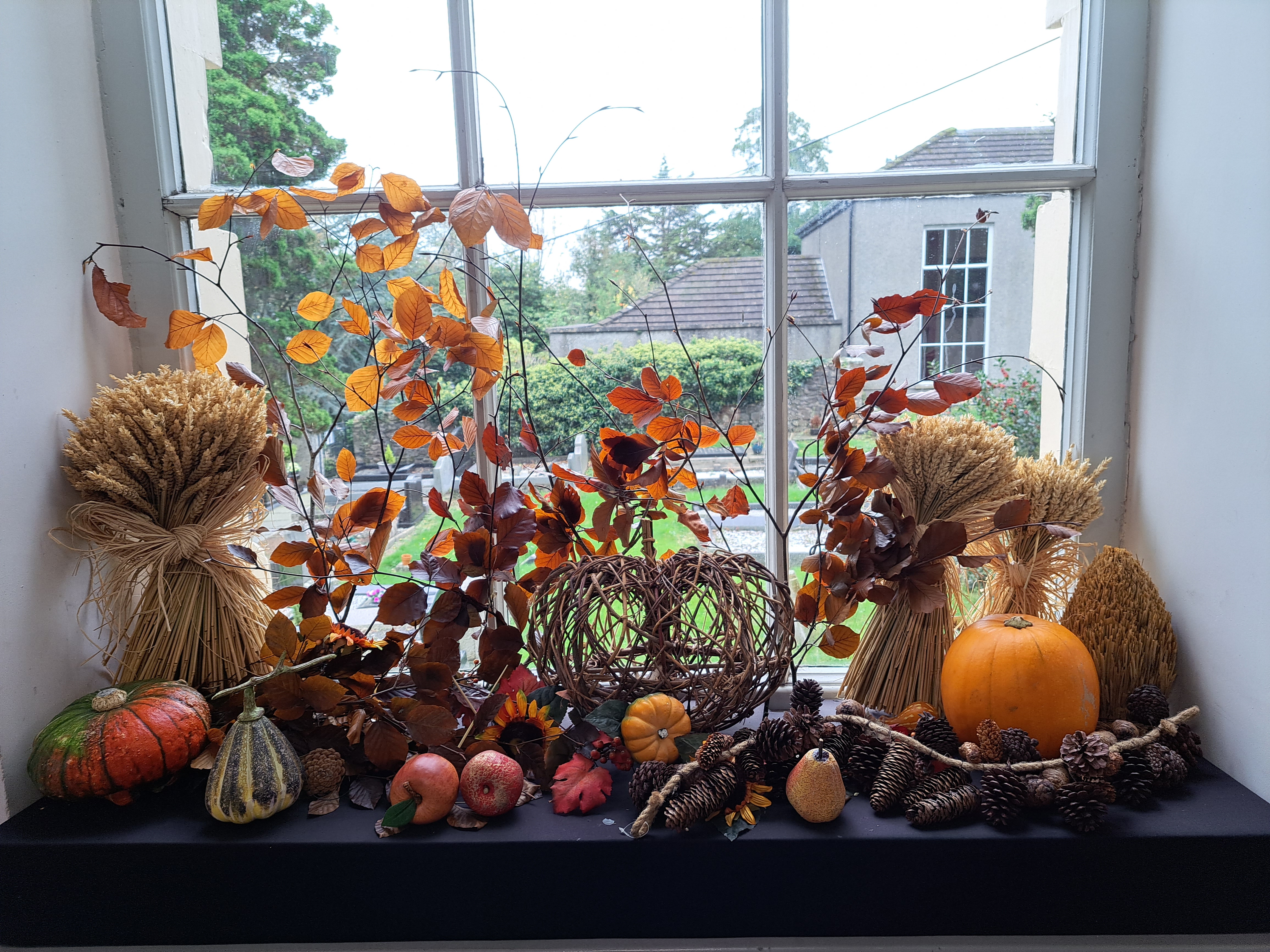
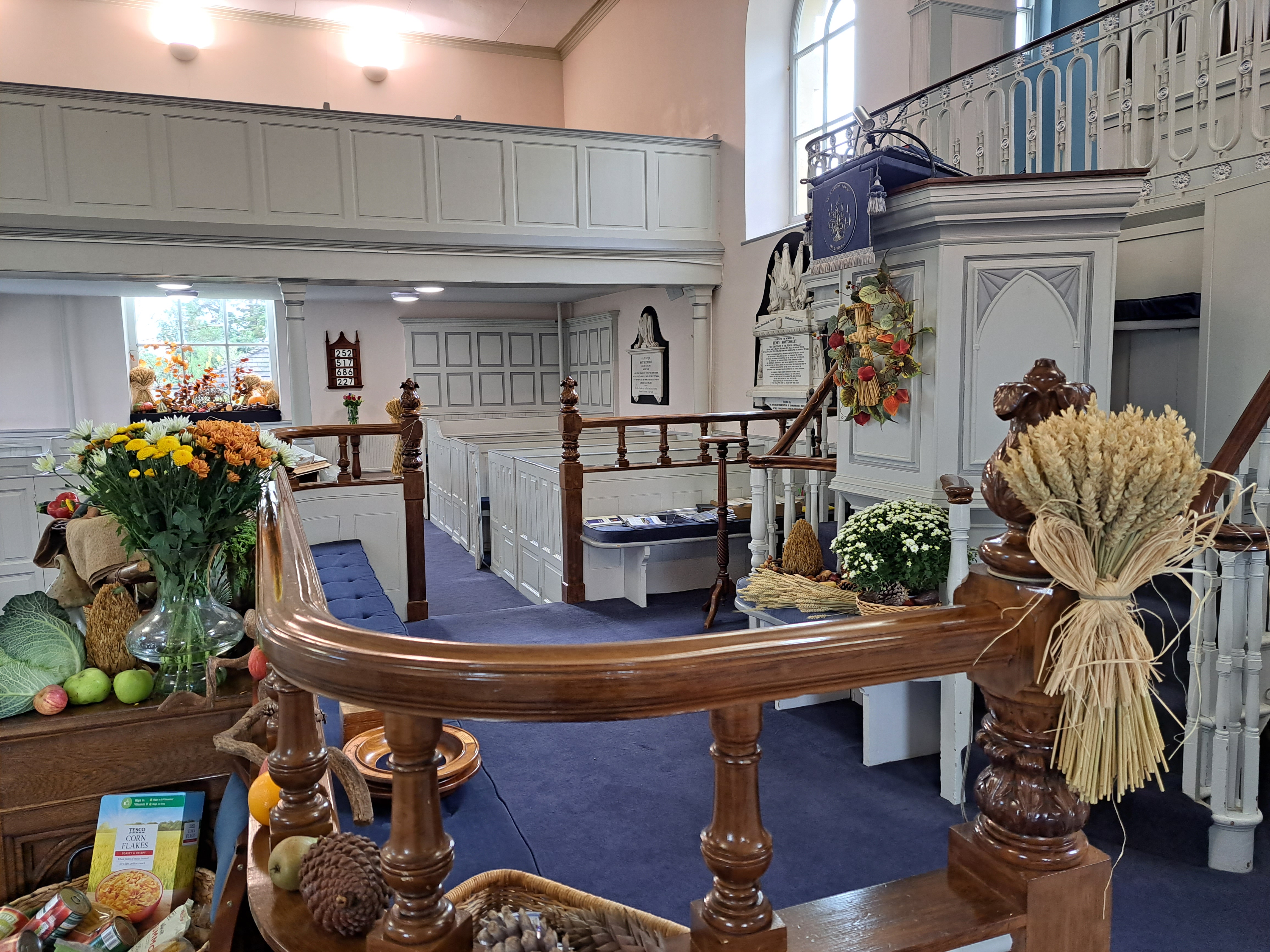
On Sunday, 8th October we celebrated our service of Harvest Thanksgiving at First Dunmurry. There was a good attendance and the church was beautifully decorated. The choir sang Great is thy faithfulness and the hymns included were Come, ye thankful people, come, All things bright and beautiful, Fountain of mercy, God of love and We plough the fields, and scatter.
The whole service can be viewed on the following video:
Click on the video to see the Harvest Service
The organist and choirmaster was Allen Yarr and the service was conducted by the minister, the Rev Dr David Steers.
All donations of tinned and dried food were given to the Foodbank and fruit and vegetables were donated to FareShare.
Until 1867 there were two Unitarian churches in Dublin. Both could trace their history back to at least the mid-seventeenth century and both had a succession of distinguished ministers and comprised congregations that had a significant role in Dublin life. After the restoration of 1660 the English Independent and Presbyterian clergy who had occupied the prime positions in religious life in Dublin during the Cromwellian interregnum were removed from their posts. This really was the start of the congregations of Wood Street, which later moved to Strand Street and ultimately to St Stephen’s Green, and New Row, which later built a new church on Eustace Street in 1728. In 1867 the congregations of Eustace Street and St Stephen’s Green amalgamated at St Stephen’s Green and have been a single congregation ever since. But the building on Eustace Street remained, for most of its history being used by Brindley’s the printers, and it is still there today, although today it is really little more than the façade.
The history of this building deserves to be better known and properly understood. I first went to see it in the early 1990s when it was empty but looked intact and was still recognisable as an old meeting-house. I took this picture which was published in the Inquirer at the time.
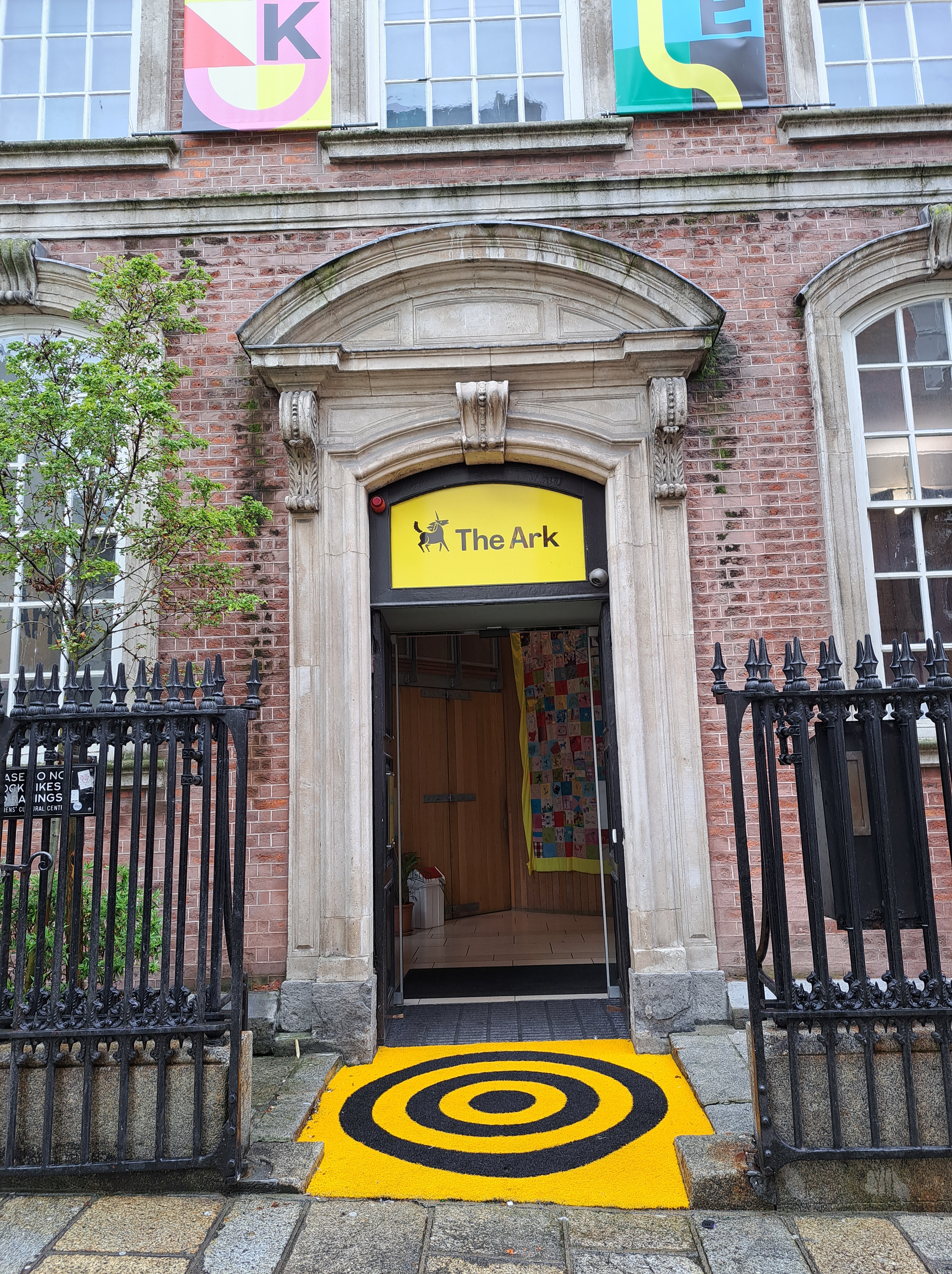
Within a few years, however, the whole area around it in Temple Bar underwent massive refurbishment and changed from a run down backwater to a busy cultural quarter. In about 1995 the building was turned into the Ark, a children’s theatre space.
The meeting-house today
Undoubtedly this is a good use for the building although it is a shame to think that so much of the original building had to be demolished to allow it to happen. Only the façade and the two side walls remain from the building of 1728. All the rendering from the old building has been removed to expose the brickwork both inside and out. But it is still a very impressive building.
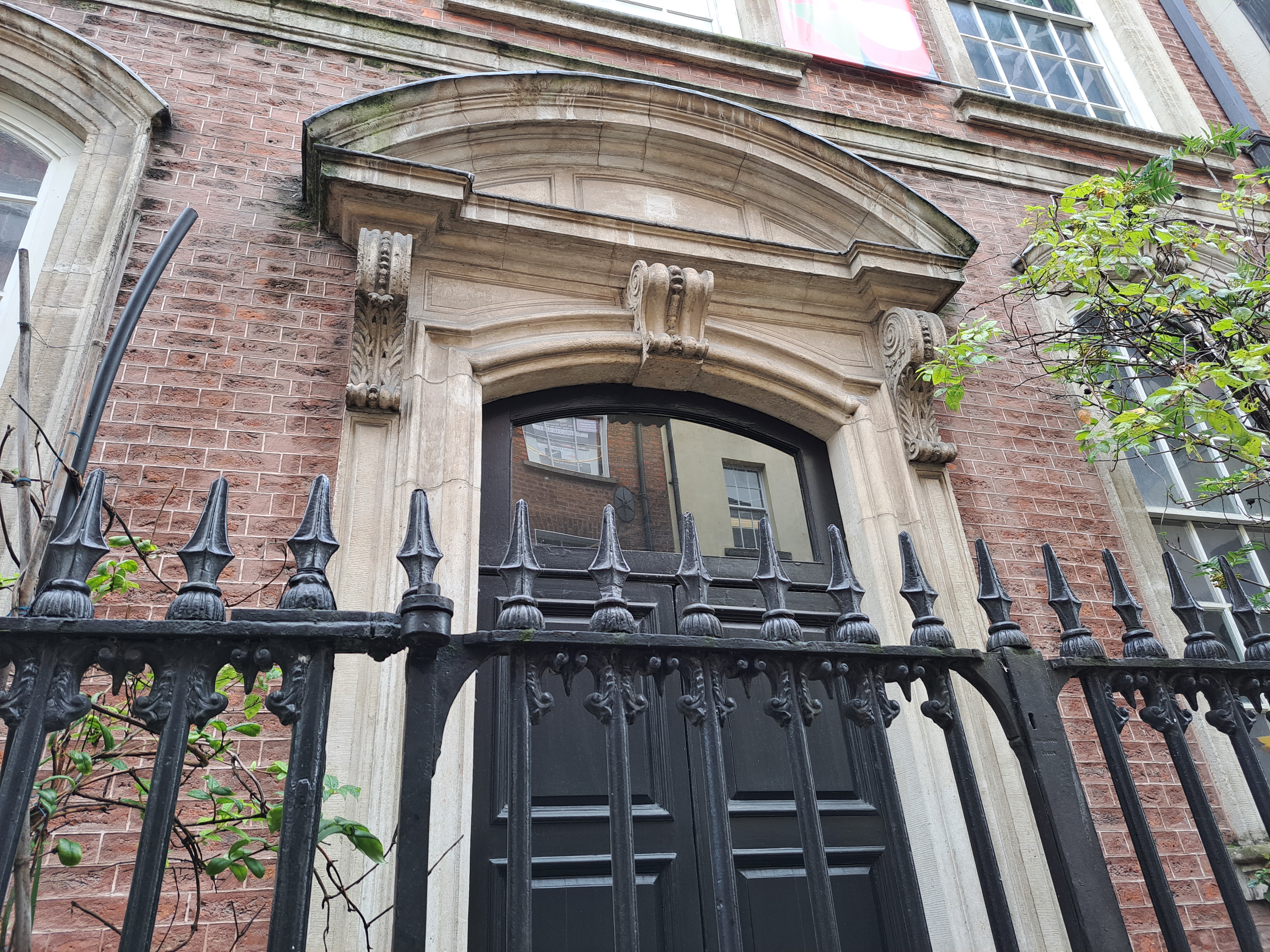
One of the two entrances to the building
Christine Casey, in her book Dublin in the Buildings of Ireland series, says of the building: ‘The C18 facade is a handsome essay in retardataire Carolean classicism…A red-brick two-storey six-bay front with entrances in bays two and five and large segment-headed sash windows.’ It’s always good to see a bit of retardataire Carolean classicism. But it is a very fine frontage and even if the rest of the building is gone, it remains as an impressive testimony to the people who built the church.
Not everyone approved of it when it was built. According to Thomas Witherow a Quaker remarked (there was also a Quaker meeting-house on the same street) that ‘When there is so much vanity without, there cannot be much religion within’.
Visiting Eustace Street over the summer I took some pictures of the interior. We can see the bare brickwork which once echoed to the sound of the sermons of such luminaries as John Leland and James Martineau.
Upstairs window brickwork
Looking through one of the downstairs windows
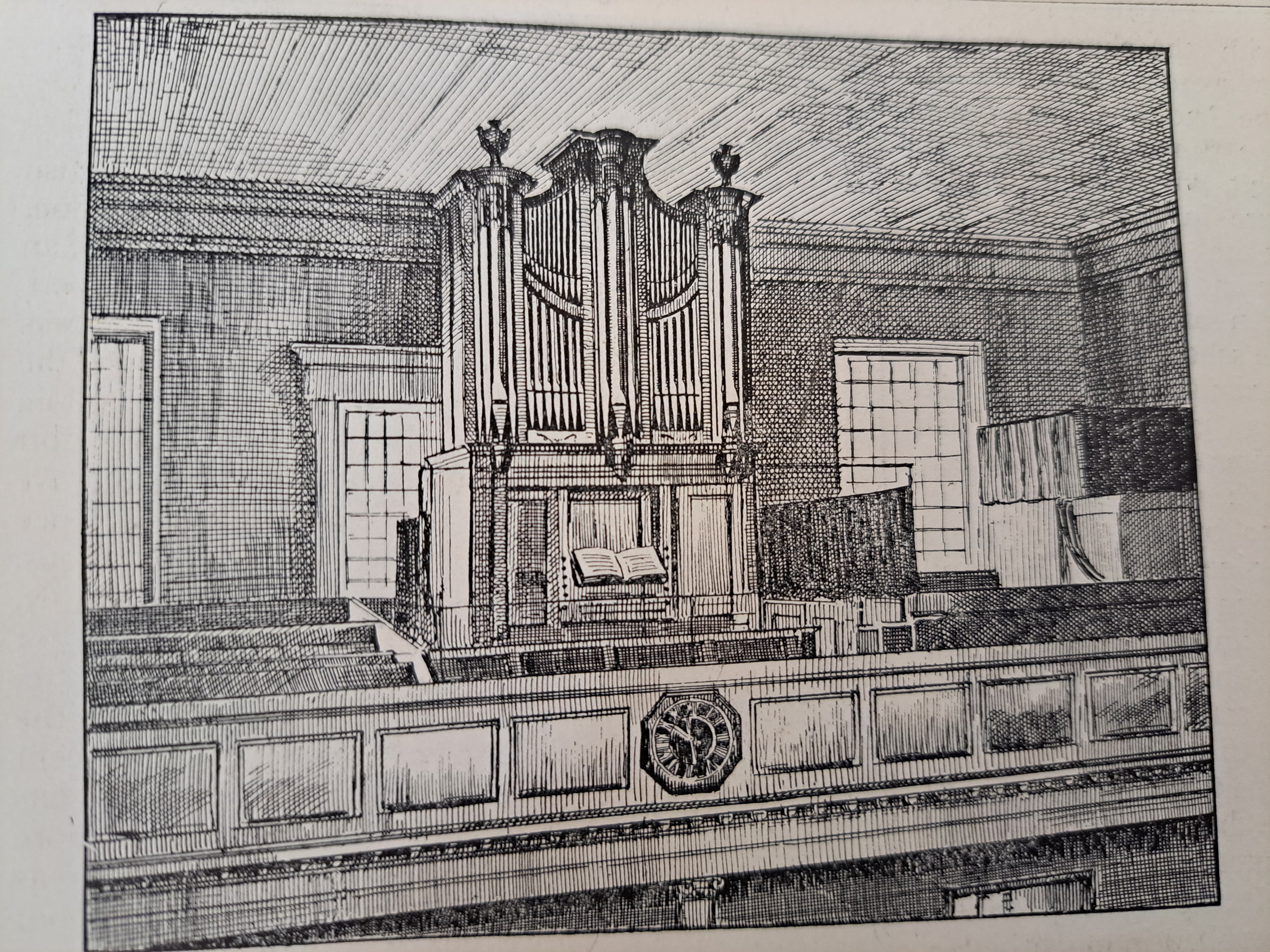
Apart from the windows there is nothing remaining that tells us how the interior of Eustace Street looked. However, about 110 years ago the Non-Subscribing Presbyterian magazine published two engravings of the interior without giving any source for these interesting views. The first showed the position of the pulpit.
The Eustace Street pulpit as it may have looked
The foyer of the building today
The windows that look on to Eustace Street are topped by a gentle arch but according to the Non-Subscribing Presbyterian images the now demolished windows at the back of the building were flat topped. At the back of the church there was a gallery which housed a clock and the organ.
The organ and gallery of Eustace Street as they looked before 1863
When Eustace Street was built times were difficult for Dissenters, they could frequently be the target of violent attacks, and from the earliest days there was a wall in front of the meeting-house. At some point before 1835 this was changed to the low wall and attractive railings which still stand there to this day. But neither the walls nor the railings were of much use when James Martineau added his name to a declaration in favour of Catholic emancipation which resulted in the windows being smashed by a mob.
The wall and railings today
It is good that this much has survived and that the space is obviously put to such good use. However, there has not always been such a clear understanding of the historical place of the meeting-house. Not long after the Ark was opened in 1995 members of Abbey Presbyterian Church were invited to hold a special service on the premises complete with baptisms of children as a way of connecting with the original history. This was a nice thing to do but rather misunderstood the nature of the history of the premises.
Inside the foyer today
James Martineau was ordained in this meeting-house on 26 October 1828. Back in 1992 I contributed an article to the Inquirer entitled ‘Martineau’s First Ministry’. If you would like to read it click on this link: Martineau’s First Ministry
On Saturday afternoon, 10th June 2023 a very large congregation assembled at Dunmurry to dedicate the special memorial to their late former minister the Very Rev William McMillan, MBE, MA.
The Rev Mac was minister at Dunmurry from 1970 to 2016 and continued as minister emeritus until his death in 2020. He was also a leading figure in the world of floral arrangements and horticulture and the congregation wished to create a lasting memorial that reflected this achievements.
The Garden was created and designed by Frances Gibson (centre left)
At its centre is a beautiful piece of art made for the Garden by Cork sculpture Tim Mulchinock
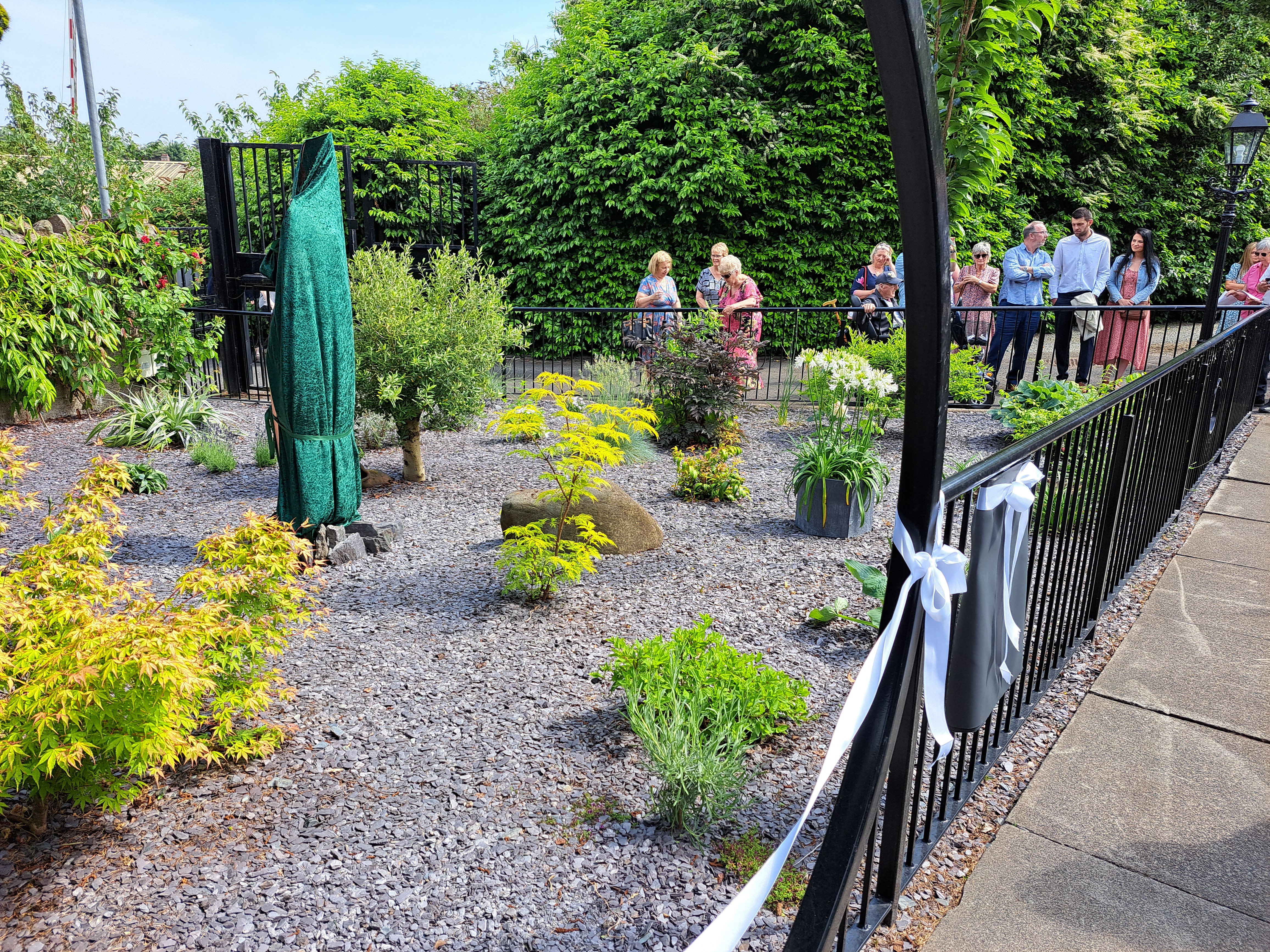
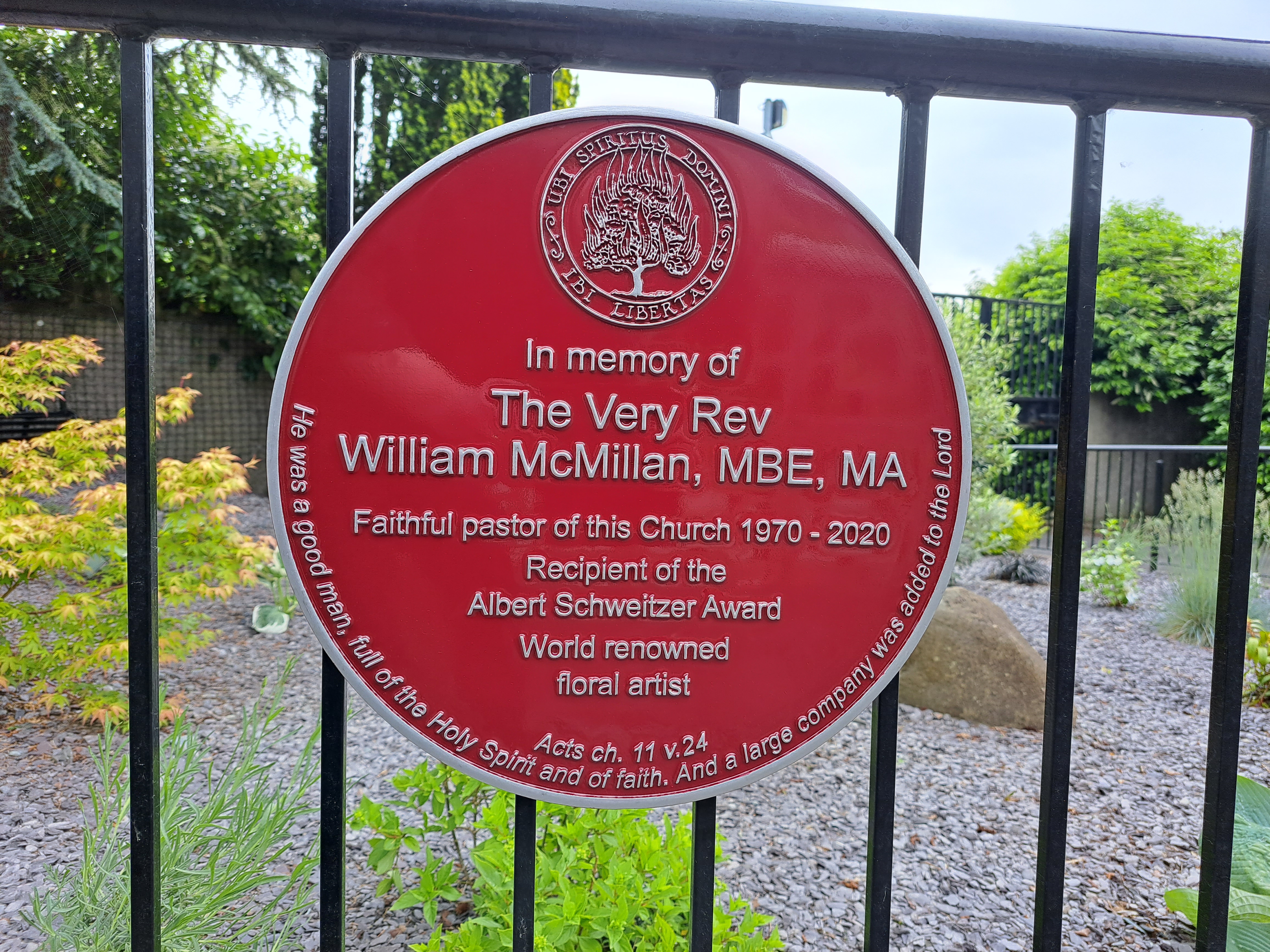
Members of the McMillan family unveiled the plaque at the entrance to the Garden, cut the ribbon to the entrance and unveiled the sculpture.
Click on the video below to see the short service in the Church followed by the opening of the Garden.
With thanks to Emma for filming and uploading the video
Below is the text of the address given in the Church by the Rev Dr David Steers:
We are to here to celebrate and commemorate a much-loved minister of this church whose work had such a positive and joyful impact not only here in his church – where he ministered for 50 years -, but in his denomination, and in churches of every conceivable denomination, and not only here in Northern Ireland, but across Ireland, across the British Isles and across the world. He was a minister, a pastor, a preacher, a writer, an expert on church history, all of which made for a most full, multi-faceted ministry that touched so many people.
That in itself would make a day like today such an important and right thing to do but beyond that he had another level of creative achievement that extended his ministry far and wide to so many people, so many groups, so many organisations in so many different countries.
Famously John Wesley, the great founder of the Methodist church, is said to have declared that ‘The World is my Parish’ by which he meant that wherever he was he felt compelled to promote the gospel. But the same thing could be said of the Rev Mac, I think the work which he did in the floral and horticultural worlds was an extension of his ministry, all his work was based on an appreciation of the glory of God’s creation and a desire to describe and explain it to everyone. His unique creativity was borne out of a deep recognition of the beauty of creation, as we heard from the reading before from the book of Genesis where at God’s command The earth brought forth grass, the herb yielding seed, and the fruit tree yielding fruit after his kind. Or as the RSV has it The earth brought forthvegetation, plants yielding seed according to their own kinds, and trees bearing fruit. It was this raw material of grass, plants, flowers, leaves, trees and all the wonders of the natural world which Mac took to express God’s love.
Something which he did with such sensitivity and understanding and, with a preacher’s skill, he was able to turn into such eloquent sermons of truth which went ‘beyond mere words’.
So when his church wanted to build some kind of memorial to the Rev Mac there were lots of ideas, lots of suggestions and lots of possibilities. But in the end the decision was taken to create a memorial that was living and vibrant, something natural and also lasting. So we will today dedicate to the glory of God the Very Rev William McMillan Memorial Garden. Created just yards from here and I want to thank all those many people who have had a hand in shaping it but say thank you particularly to Frances Gibson who has designed it. And thank you to Tim Mulchinock the sculptor who has created from beaten copper the centrepiece which is also entitled, like one of Mac’s books, ‘Beyond Mere Words’.
The garden, in the grounds of his church, rich in plant life, living as part of the natural environment with a wonderful piece of art at its centre, is truly a fitting memorial to the Rev William McMillan. Someone whose whole lifetime was devoted to communicating God’s word in all that he did. Someone who, as we heard before from the reading from Acts given to us by Jane: For he was a good man, full of the Holy Spirit and of faith. And a large company was added to the Lord.
The Garden before the unveiling
Sheila and Tim just before the unveiling
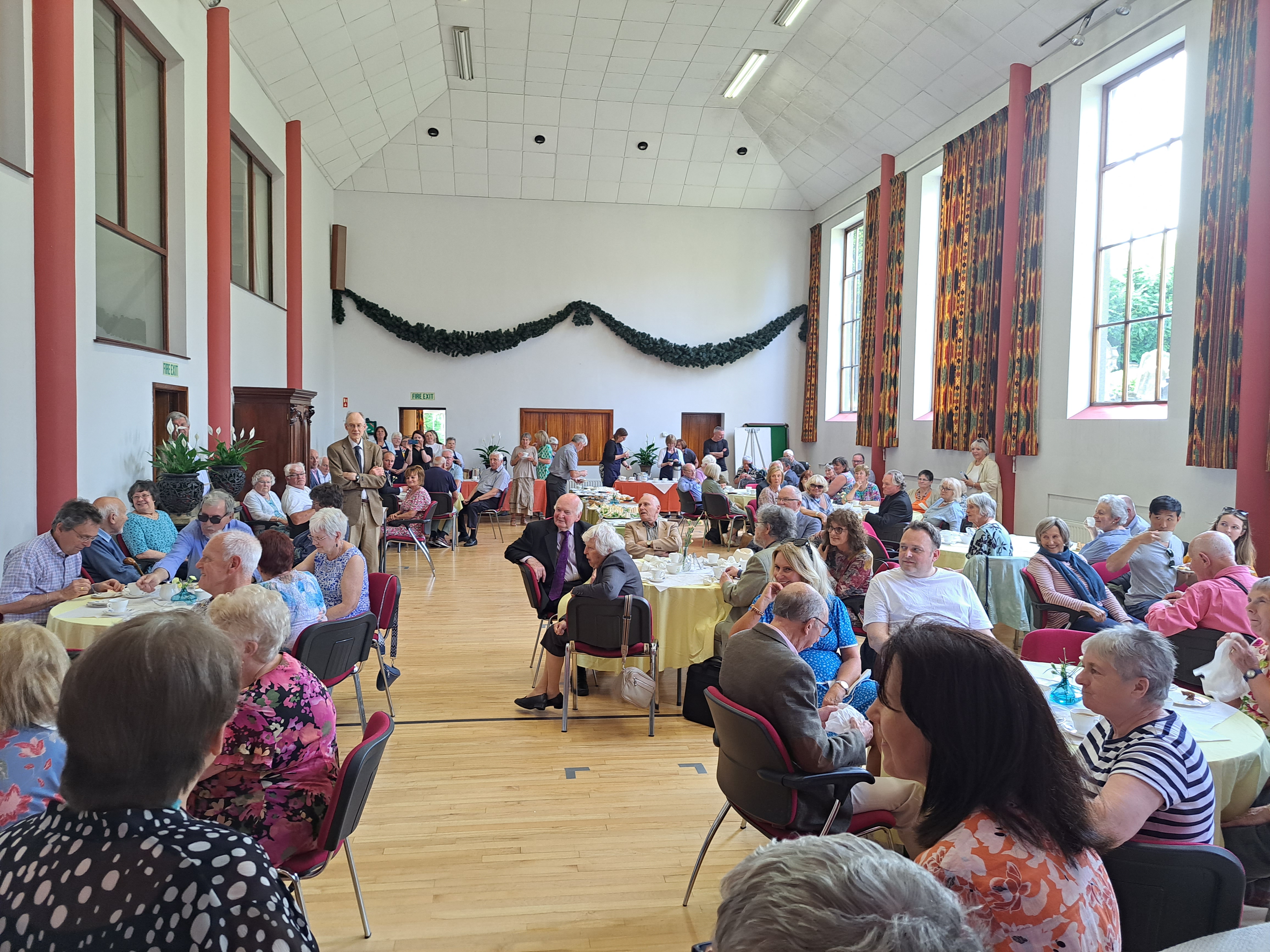
Refreshments in the McCleery Hall afterwards
Memorial plaque
Some of the floral decoration in the Hall created by Elma McDowell
The grounds of the First Presbyterian (NS) Church, Dunmurry look particularly impressive at this time of year as the various plants come into bloom. At the moment the azaleas look especially attractive, most notably the well established orange one flowering at the front of the church.
It struck me as something worth catching on video with perhaps an appropriate reading or two. So as well as some lines from Wordsworth I read part of the ‘Litany of Faith’ found in Orders of Worship.
Orders of Worship was published back in 1932 and is possibly mostly forgotten these days. But it has many virtues whether updated into contemporary language or read in the traditional form in which it was written, which still give it value today. ‘A Litany of Faith’ is part of the Fifth Service and can be found on pages 56-57.
Click on the video above
The music is provided by Allen Yarr, our church organist.
















 velvethummingbee