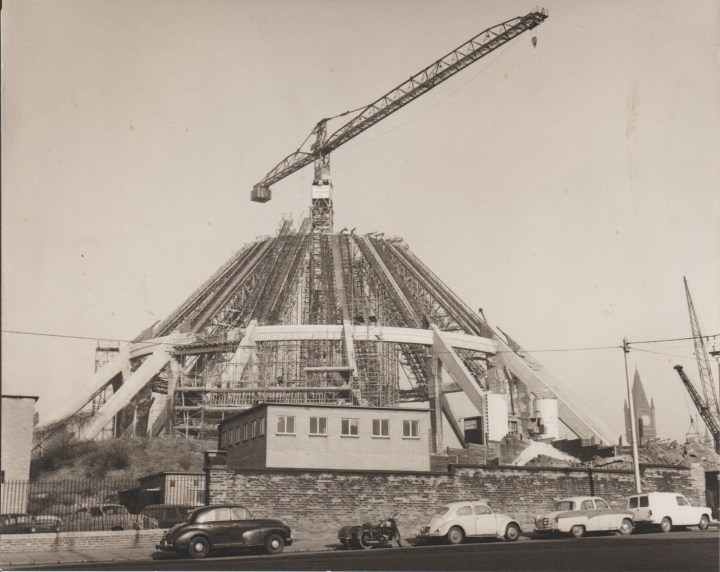
Liverpool Metropolitan Cathedral under construction

Writing in the mid-1960s in his examination of the place of art in Liverpool (Art in a City) John Willett observes:


“In 1967 the new Roman Catholic cathedral will be consecrated. With its novel circular plan, like a vast upturned funnel, its windows by John Piper and Patrick Reyntiens and its sculptures by William Mitchell, Frederick Gibberd’s great building quite possibly will take the breath away, and seems likely to provide for some years a religious-artistic sensation to rival Coventry.”


It was a striking addition to the cityscape and was described by Liverpool architect Quentin Hughes as “undoubtedly the major modern architectural attraction of the city”. At the time it was being built this maybe wasn’t so clear. In the 1960s Liverpool was undergoing a period of renewal that promised and threatened much in terms of architecture. City councillors had long been obsessed with constructing a ‘worthy’ civic centre and had identified the back of St George’s Hall for the location of this. By the 1960s this vision had taken on a grandiose form and encompassed an enormous series of buildings that would have snaked around the centre of the city. With a huge cross-shaped building impinging on St John’s Gardens behind St George’s Hall, Colin St John Wilson, the architect responsible, promised:


“…this is not an abstract building in space it is part of a whole texture – buildings, roads, Mersey Tunnel, Lime Street Station, with energy passing through a web of paths and creating points of focus. That’s the essence of it, to see this thing not isolated but as part of a whole traverse across the city.”


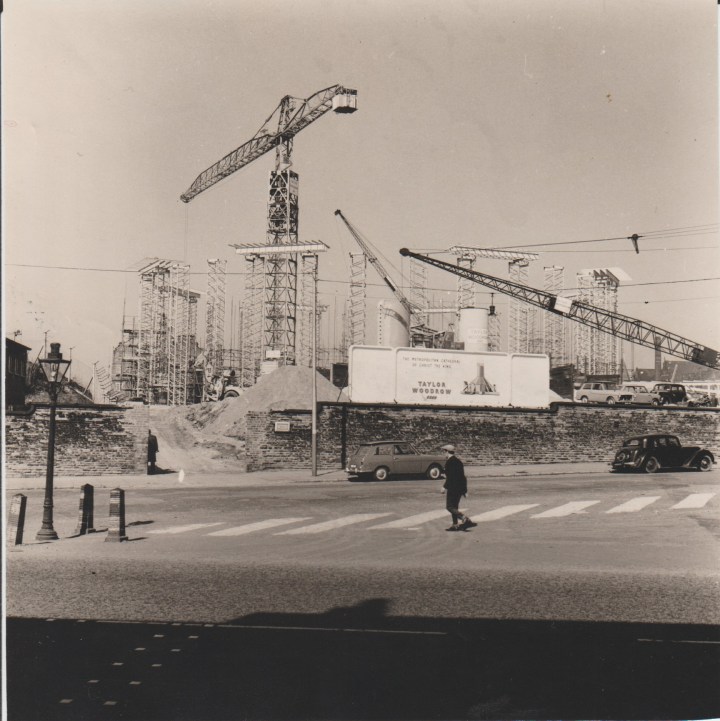
In the end most of this did not get built except for a ridiculous walkway at the back of the museums. But in the context of all this potential upheaval the new, defiantly modern Catholic Cathedral began to take shape. These two pictures by amateur photographers capture the process of building in the early 1960s:


liverpoolmcathedralconstruction02


As the “vast upturned funnel” began to take shape it must have been a challenging sight for passers-by. Certainly quite unlike anything else in Liverpool and a considerable contrast to every other church building in the city:


liverpoolmcathedralconstruction01


The building was completed and consecrated on 14th May 1967. In the Architectural Review of June 1967 Nicholas Taylor spoke of the new building’s “challenging relationship with Sir Giles Scott’s Catalan Gothic splendour for the Protestant ship-owners further along the ridge”. He also went on to draw a parallel with the other great post-war English cathedral of Coventry:


“The loosely defined image of the ‘big top’ or ‘wigwam’ will probably prove as big a success with the people in general as Spence’s Coventry, and there are already signs that it may acquire the same identity with Liverpool’s own civic image that Bertrand Goldberg’s Marina City towers have with Chicago’s.

The reason is that it expresses with uncommon force one particular historical emotion: at Coventry it was the War Memorial with its symbolism of Sacrifice in the ruins and of Resurrection in the new church; at Liverpool it is the ecclesia triumphans of the Foleys and O’Reillys, a symbol of Catholic kingship riding high above the former Protestant ascendancy of merchants in the quaysides below.”


In some ways this analysis seems both patronising and sectarian although it is entirely understandable in the context of the times. But, in my view at least, the building expresses something more positive and is a hugely impressive spiritual space, a place worthy of pilgrimage. A rather more worthwhile legacy of the 1960s than what the city planners envisaged elsewhere.


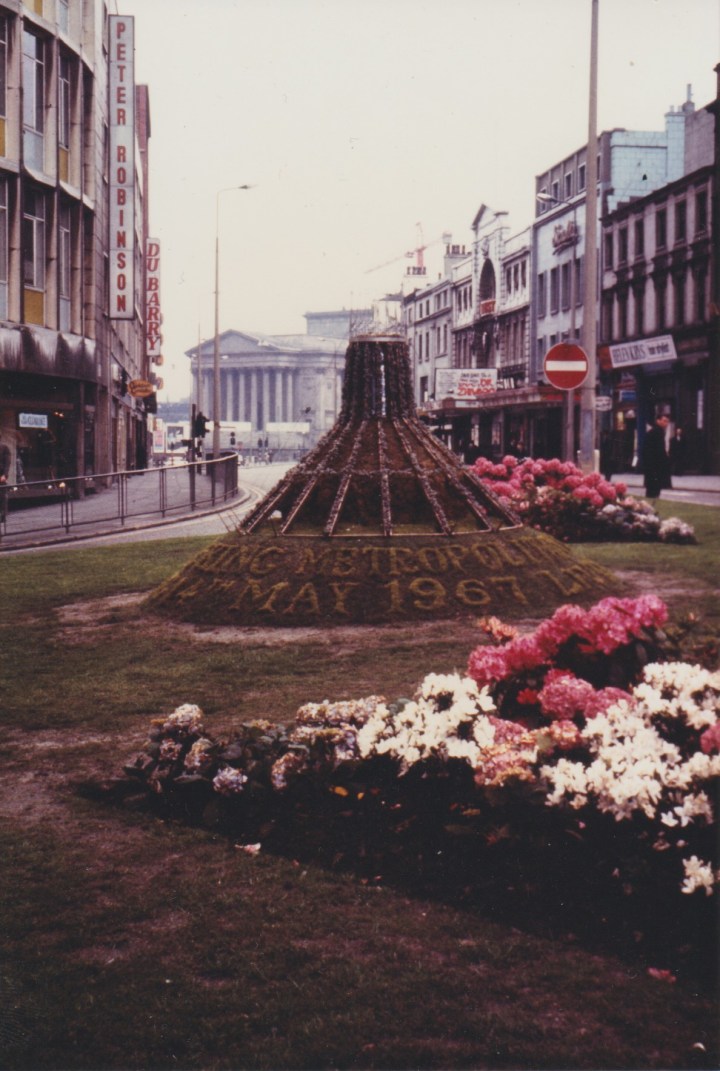
At the time of its opening the council arranged for this floral decoration to adorn the roundabout in front of the Adelphi Hotel at the end of Lime Street. In the distance you can see St George’s Hall and plenty of evidence of ongoing construction work. And at the now demolished Futurist cinema they were showing Dr Zhivago:

liverpoolmcathedralfloral

I’ve written before about the Metropolitan Cathedral:

https://velvethummingbee.wordpress.com/2015/06/21/liverpools-metropolitan-cathedral/

and also about Hope Street Unitarian Church which stood midway between where the two cathedrals have been built:

https://velvethummingbee.wordpress.com/2015/05/17/the-church-on-hope-street/

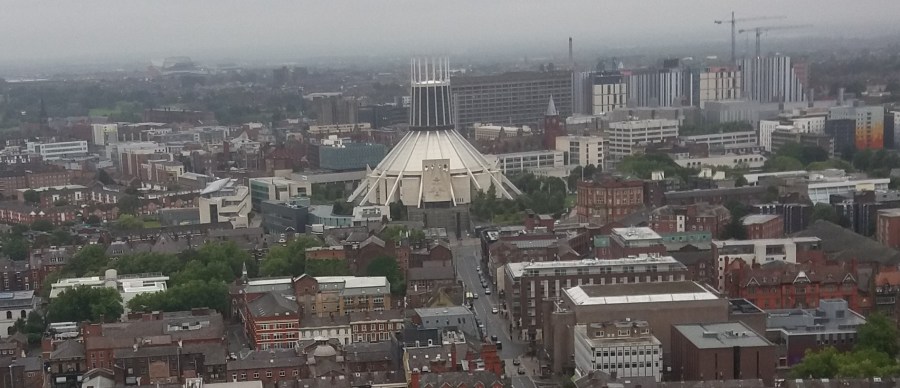
The three images above were all acquired on eBay for 99p. The photograph at the top of the page is one I took from the top of the Anglican Cathedral. Hope Street Church stood where the square-shaped white building stands at the bottom of the picture on the right hand side of the main road.

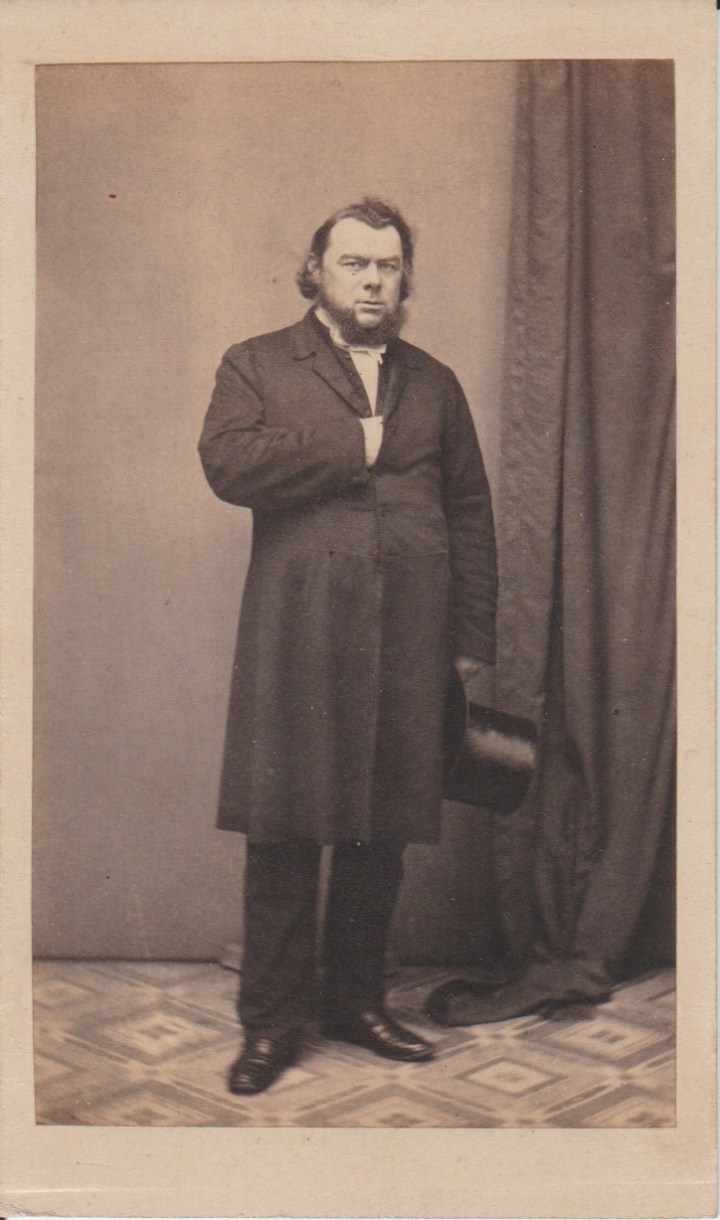
Hugh Stowell Brown’s carte de visite

Following on the previous post on Hugh Stowell Brown we can add this image featuring his carte de visite. These were enormously popular aspects of life for the middle classes in the 1860s and represented an extension of portrait photography used more for collecting as keepsakes rather than as part of the niceties of Victorian social encounters as the name might indicate. They were seldom named and were probably kept more by families and, in the case of celebrities, by fans who liked to amass collections. This was probably as true for clergy as for other minor celebrities and one suspects that many members of Myrtle Street Chapel will have been quite proud of the cdv of their minister that they were able to stick into their album or lean on the mantelpiece.


hsbrowncdv01


This is quite a characterful study of the Rev Hugh Stowell Brown. It shows what a good job was done by the creator of the statue that was set outside his chapel some years later. He could almost be wearing the same coat. The card was produced by E. Swift & Son of 126 Bold Street, Liverpool and is quite a minimalist picture. Almost certainly this will have reflected Mr Brown’s own taste. Most of E. Swift & Son’s cartes feature other objects dragged in to add variety to the picture. Sometimes the curtain was removed to reveal a trompe l’oeil painting of a window and some plants. It’s probably better covered up to honest. He also eschewed the selection of decorated urns and Corinthian pillars that many liked to lean on for their photo shoots in Swifts and also didn’t need the Abbotsford chairs that were wheeled out from time to time. Perhaps wisest of all he didn’t use the cut-out ballustrade that sometimes appears behind the subject. Only the distinctive and perhaps slightly gaudy carpet detracts from the sober no-nonsense image.

So Hugh Stowell Brown created a carte de visite that managed to express quite a lot about who he was. He looks every inch the respectable and respected Baptist pastor, without adornment, and with integrity and a seriousness of purpose that could not be doubted.

The Warrington Academy


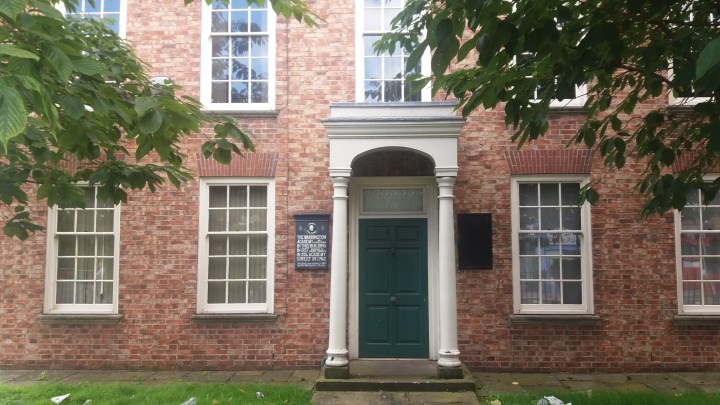
On a recent visit to Warrington I realised that I had been in the town many times but had never knowingly seen the famous Academy, or what remains of it. Famously the Academy was physically moved on rollers to preserve it after road widening in the early 1980s. I hadn’t realised, however, that this careful and no doubt expensive feat of engineering had not prevented it being demolished and rebuilt with hardly any original features in the 1990s.


20160812_144559

Two plaques still stand on either side of the entrance of what is left of the Academy. One commemorates the Academy, and another which is difficult, if not impossible, to read, was deciphered for me by Luke who tells me it recalls Arthur Bennett. The wording of the plaque is recorded on the Open Plaques site (http://openplaques.org/)  as being:

A poet who had dreams and to his dreams gave life. Arthur Bennett 1862-1931 Honorary Freeman and Alderman of the Borough of Warrington Mayor 1925-1927 A founder and president of the Warrington Society, the members of which erected this tablet in recognition of his services to the town he loved.

Clearly very proud of his Warrington heritage Arthur Bennett’s poem on eighteenth-century prison reformer, humanitarian and Warrington citizen ‘John Howard’ concludes with a stanza on his friendship with Dr John Aikin, son of one the founding tutors of the Academy and brother of Anna Laetitia Barbauld:

Then to “the Doctor’s, whom he loved so well,
Past the still halls with Memory’s laurels wreathed,
The sacred “seats where Science loved to dwell
Where liberty her ardent spirit breathed”.
The day’s work tested, he would journey home
To take his simple cup of tea and creep
Up the quaint old stairs in the familiar gloom,
Content to catch four fleeting hours of sleep.

I am sure Anna Laetitia’s poems relating to the Academy are better known today, one of her earliest poems discussed its educational role:


The Muses here have fixed their sacred seats.

Mark where its simple front yon mansion rears,

The nursery of men for future years!

Here callow chiefs and embryo statesmen lie,

And unfledged poets short excursions try….

Here Nature opens all her secret springs,

And heaven-born Science plumes her eagle-wings.


The Open Plaques site also tells me there is a plaque for Joseph Priestley in Warrington which I didn’t realise. He was perhaps the most eminent of all the staff of the Warrington Academy and another subject that inspired Anna Laetitia to poetry, writing to tease Priestley after she found a mouse caught in a trap which was destined to be a part of his experiments on air. She wrote:


O hear a pensive prisoner’s prayer,

For liberty that sighs;

And never let thine heart be shut

Against the wretch’s cries!


For here forlorn and sad I sit,

Within the wiry grate;

And tremble at the approaching morn,

Which brings impending fate.


If e’er thy breast with freedom glowed,

And spurned a tyrant’s chain,

Let not thy strong oppressive force

A free-born mouse detain!


The cheerful light, the vital air,

Are blessings widely given;

Let Nature’s commoners enjoy

The common gifts of Heaven.


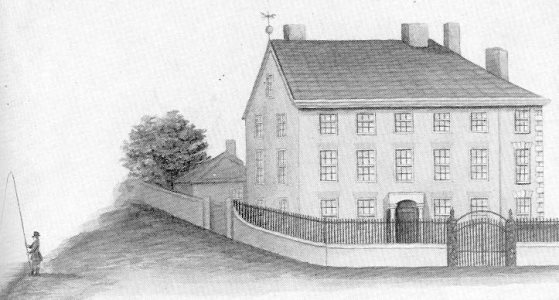
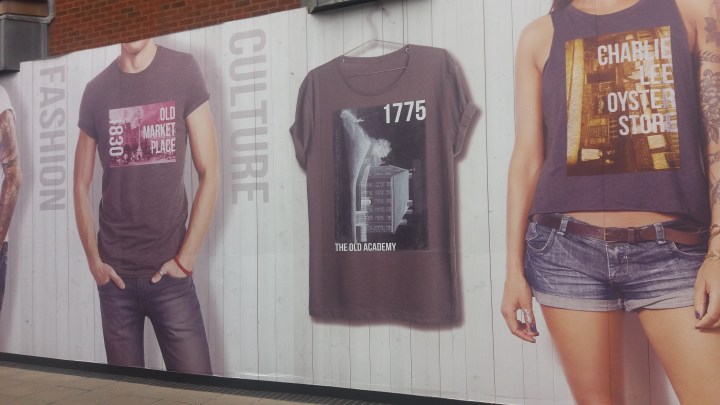
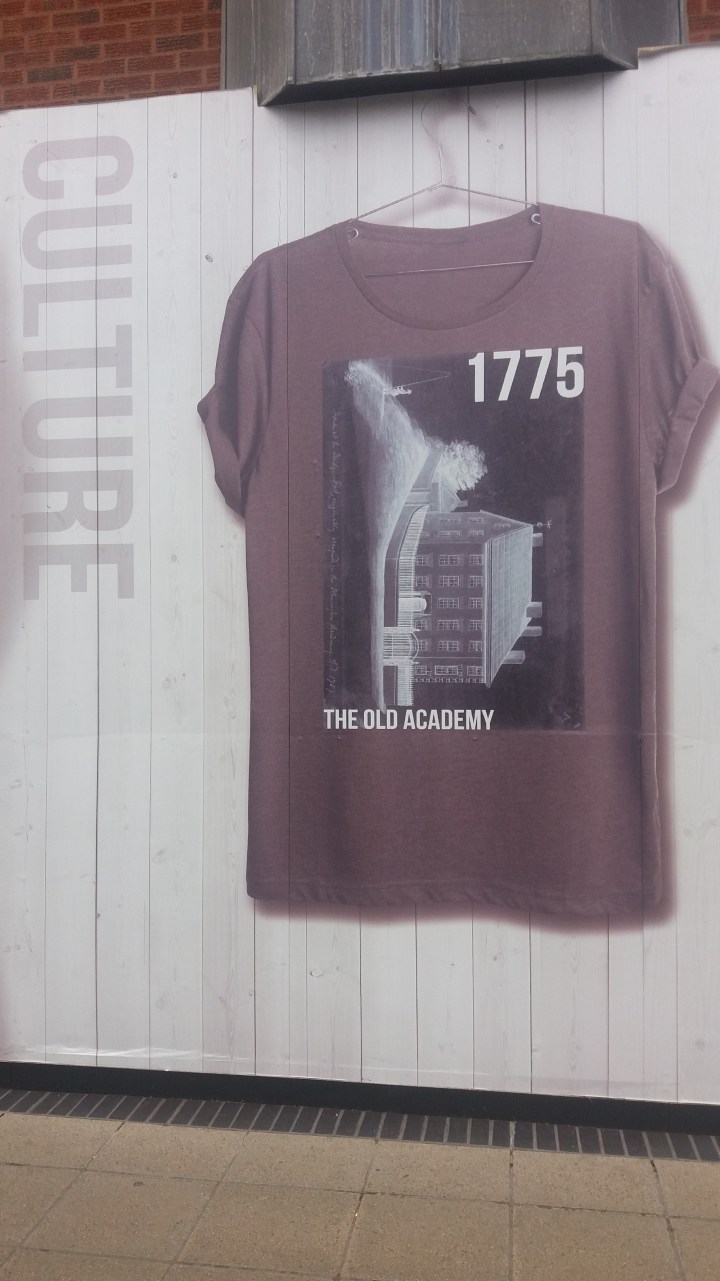
One of the things you notice when you visit Warrington is that even if the original building of the Academy has not been preserved its story is still valued in the town. An advertising hoarding promoting the town outside the Golden Square shopping centre makes use of the image of the first Academy:

20160812_151453

20160812_151500


I am not sure what the date 1775 is meant to commemorate. It may be an error for the date of foundation in 1757.

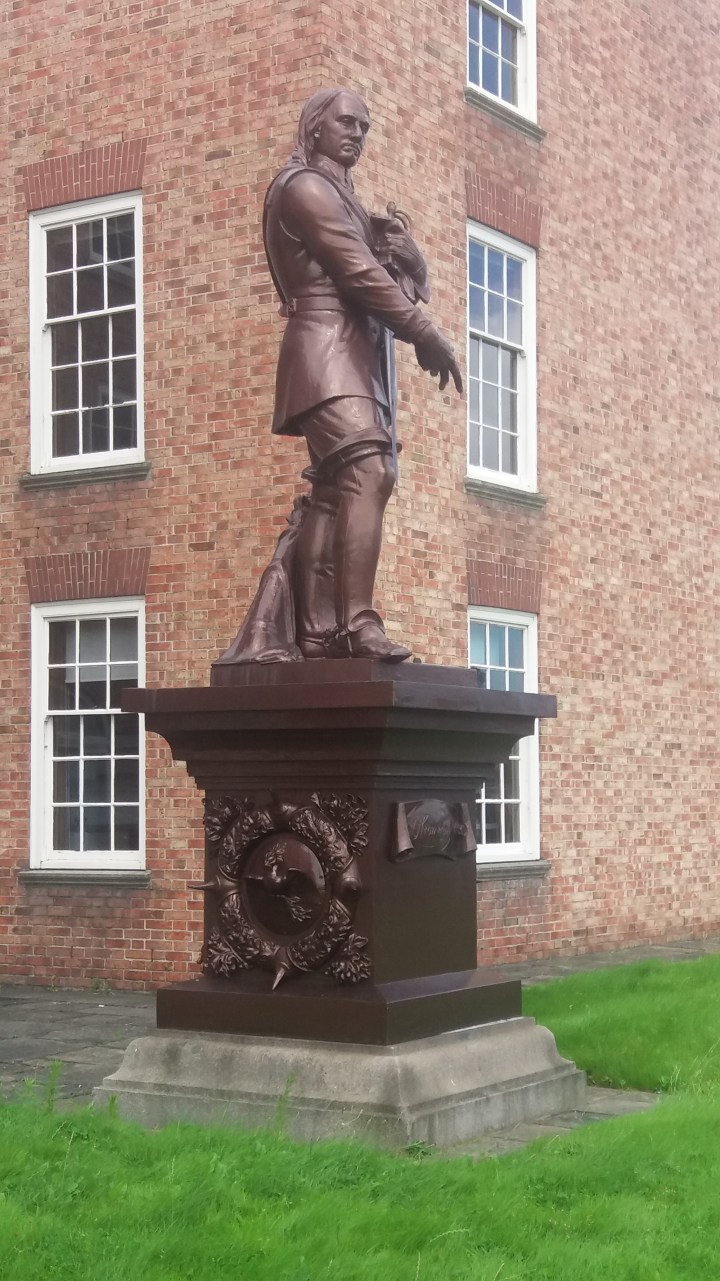
The most notable feature of the modern Academy building is a large statue of Oliver Cromwell. This was put up in 1899 although I am not sure if this was the original site.

20160812_144738

Presbyterian Church, Grosvenor Square

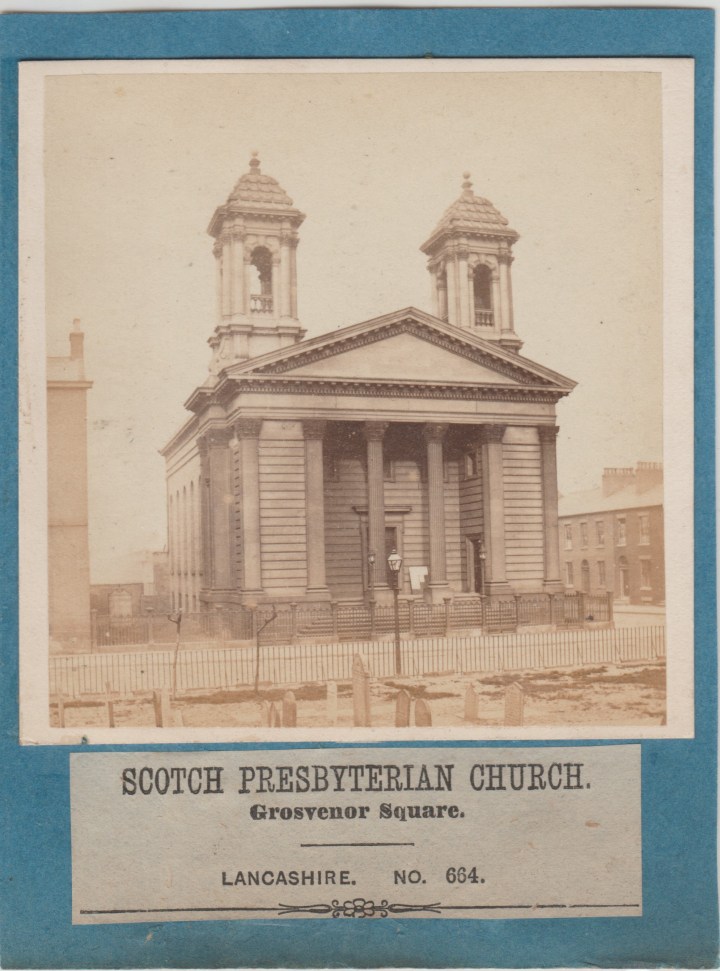
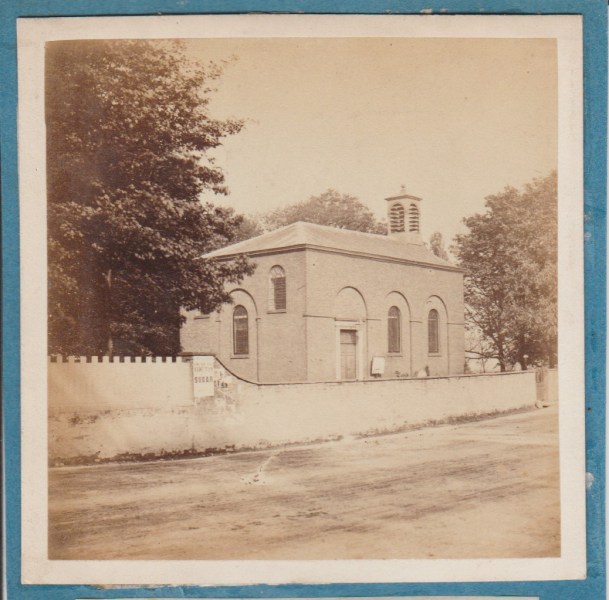
Like the photograph of Platt Chapel in the previous post this picture did not come cheap but it is a very rare, relatively early picture of a long vanished church. I can’t find any other picture of this church as good as this online.

The Scotch Presbyterian Church was situated on Grosvenor Square, near the top of Oxford Road in Manchester, an area that has long been colonised by academic buildings although the square still exists as a small green space. In the centre of the square stood All Saints’ Church and the Presbyterian Church was on the far side of the square, on Lower Ormond Street, the road parallel with Oxford Road. Both churches are long gone the Presbyterian Church ending its days in the 1950s as a wallpaper shop and later as a paint shop before demolition in the early 1970s. All Saints’ was damaged in the blitz.

In the foreground of the picture the graves seen there form part of the church yard of All Saints’ Church. It is an untidy looking area in the picture – there are two lifeless looking trees, denuded of leaves and branches, and the gravestones stand in the middle of a scruffy no-man’s land which is covered in either sand or bare earth amidst clumps of grass. Was it taken in the middle of some building work or renovation or did it always look a mess? Either way it is nothing to do with the Presbyterian Church other than it crops up in the foreground of the picture.

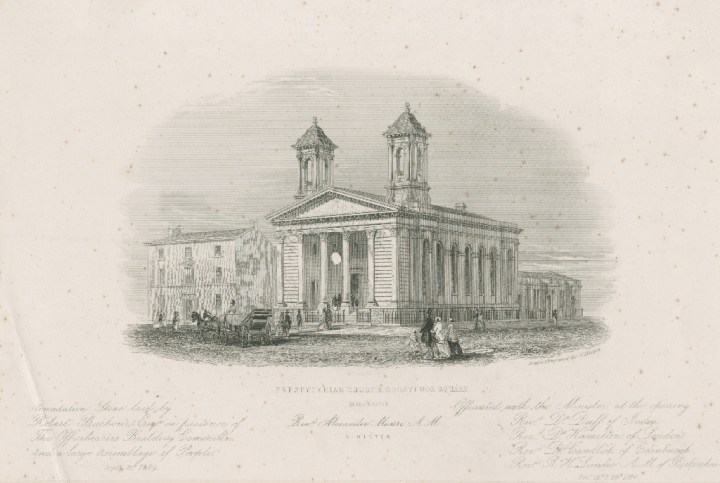
There is a very full set of records for the congregation deposited in Manchester Libraries, Information and Archives. Amongst these the Communicants’ roll books begin in 1832 which suggests a foundation of that date. The pew rents/seat lettings books begin in 1850 when the church was opened for worship, the foundation stone of the new building having been laid on 17th September 1849.

Grosvenor Presbyterian MLIA

An architectural drawing of the church at the time of its opening (Manchester Libraries, Information and Archives)


The church closed in 1940 and merged with Withington Presbyterian Church to form Withington Grosvenor Presbyterian Church further out of Manchester. This congregation closed in 1971 to form Grosvenor St Aidan’s Presbyterian (later URC) Church in Didsbury (now called simply Didsbury United Reformed Church).

The photograph is quite small, it only measures about 8 cm by 6 cm, but it is very sharp and very old. The sister photograph that shows Platt Chapel dates from before 1874 so there is no reason to date this one to any other period. But here it is, the oldest photograph of the Scotch Presbyterian Church, Grosvenor Square, Chorlton-on-Medlock. Long vanished but preserved in this little study, a very precise architectural photograph taken on a sunny day sometime in the middle of the reign of Queen Victoria.

Grosvenor Square 04

The original photograph attached to its card


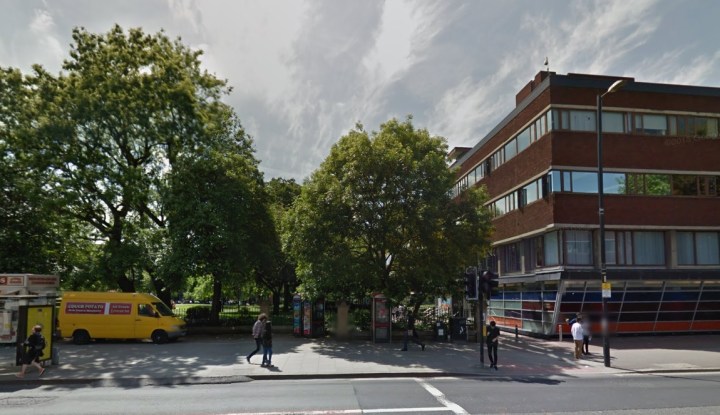
Google Street View, from a position along Oxford Road just past Manchester Metropolitan University, shows this view looking towards where the church once stood. It would have been visible beyond the trees on the other side of the square (now called ‘All Saints Park’).

Grosvenor Square Google Maps Streetview

Google Street View – Oxford Road


No pictures or text may be reproduced from this site without the express permission of the author.


Platt Chapel, Rusholme

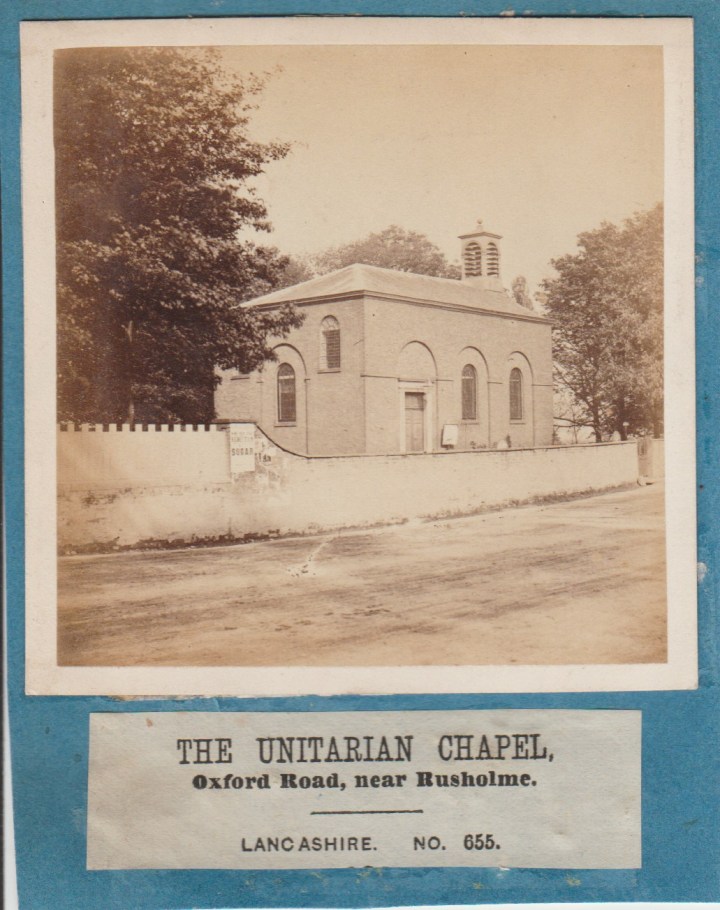
I bought this photograph on eBay a few years ago. I paid more for it than I like to do but it is quite a rare photograph of the old Platt Chapel in Rusholme, south Manchester. I bought it along with a picture of the ‘Scotch Presbyterian Church, Grosvenor Square’ also in Manchester to which I will return in the next post.

The photograph of Platt Chapel is interesting because it appears to have been taken by a professional. In a similar way to the Grosvenor Square photograph it is mounted on a card with its title printed below along with a reference number. It is probably some kind of photographer’s sample, perhaps one of a set of images available for use by purchasers for use on a cabinet card or carte de visite. Often these types of cards carried portraits of individuals or family groups, but other views, including views of churches, were also popular.

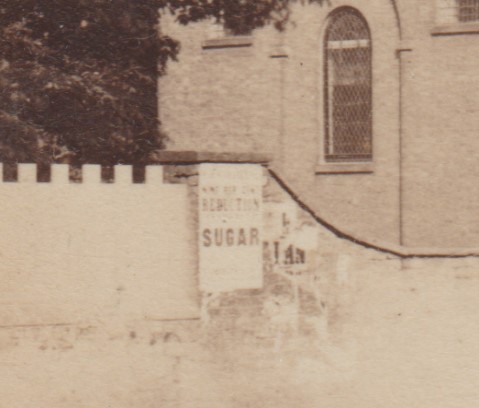
What is particularly interesting about this picture is that it shows the chapel of 1791 which was substantially rebuilt in 1874-76. This dates the photograph to before 1876, probably to before 1874 in fact. A big help towards an accurate dating might be the poster pasted up on the chapel wall. Victorians could be no respecters of property when it came to fly-posting and this one has been stuck up on a corner of the wall where the remnants of other posters can be detected. If it were an advertisement for a show or some other event then it might be very useful to us for dating the picture but, alas, it doesn’t give that much information. It appears to be a notice from a grocer or some other supplier. The largest word that can be made out is ‘sugar’, a bit above that is the word ‘reduction’ but nothing else is really visible.
Platt Chapel 03

The poster on the wall of the chapel


The congregation had its roots in a nearby chapel of ease which they managed to hold on to after 1662 under the patronage of the Birch family until 1697. Two years later they acquired the site at Platt and built a chapel in the same year. A second chapel was built in 1790-1 which is the building as shown in the photograph. The modern building is substantially the same but was extensively re-modelled over two years between 1874 and 1876. It was given a red brick exterior, the doors and windows were changed, an apse was added and a much steeper slate roof replaced the old one. Edwin Swindells in The History of Platt Chapel (1949) describes this period of rebuilding like this:

At the commencement of his long and faithful service, Mr. Poynting was faced with a trying difficulty. The Chapel building, although not very old, had got into a very bad state of repair, and it was found that considerable reconstruction would have to be carried out. This meant that for about two years the chapel was not available for services, and these had to be held in the newly erected school at Portland Grove, Fallowfield. The alterations which were completed in 1876, included the removal of the vestry from the north end to its present position, and the building of the small apse in its place. The chapel was re-roofed and the old oak straight backed pews replaced by the present pews, while a new pulpit was also provided. The original doors faced Wilmslow Road, and these were built up and the present South entrance substituted, with the provision of the vestibule screen as it is now. The heating arrangements were also brought up to date about this time. In spite of such an inconvenient disturbance, Mr. Poynting quickly settled down to a life devoted to the service of his congregation and the wider church, ably supported by his young wife whom he married in 1872, and who proved an ideal helpmeet in all respects. In those days Rusholme and Fallowfield still included large areas which were decidedly rural, and the work entailed in the mixed community presented its own peculiar problems. The project so dear to his heart of establishing a flourishing Sunday School, did not prove easy of attainment at first, and the first attempt was not a great success. However, Mr. Poynting was not the man to be easily discouraged, and a little later a fresh beginning was made and carried through to fruition. His interest in the young people was not confined to his own chapel, and he took a great interest always in the district Sunday school federation. Mr. Poynting was never a preacher of extreme views in theology, his knowledge of, and love for the New Testament was deep and sincere. On its teaching he founded the message he felt given to preach. It followed that his Unitarianism was neither negative nor aggressive, and the present writer well remembers how his name was respected among members of other denominations in Rusholme in the closing years of the nineteenth century.

A brick bell cote was constructed to house the bell which dated back to 1718. In the 2016 issue of the Transactions of the Unitarian Historical Society Len Smith traces the history of the Platt Chapel bell cast by Abraham Rudhall I of Gloucester and inscribed with ‘Come away make no delay’, the same phrase found on the bell in Gateacre Chapel which was made by his son Abraham Rudhall II. Len also records:

The clapper fell to the ground c.1959/60 while the bell was being rung for an evening service, narrowly missing worshippers approaching the chapel door.

The congregation was fortunate to be supported by the Worsley family in nearby Platt Hall who gave the land on which the chapel was built. Of puritan and Parliamentarian stock from the era of Cromwell they continued to support the chapel until 1830 when Thomas Carrill Worsley joined the Church of England and later built Holy Trinity, Platt.

All this can be read in Edwin Swindells’ excellent, although probably long-forgotten, little history of the chapel. He also details the contributions of a succession of ministers in the nineteenth century – Rev William Whitelegge, Rev Samuel Alfred Steinthal and Rev Charles Thomas Poynting – who created a very effective and flourishing ‘institutional church’ with day schools, Sunday schools, Dorcas society, Temperance Guild, social evenings, lantern lectures, debates etc., as well as a “Goose Club” which had a turnover of £100 per year in the late nineteenth century. Was this to enable members to buy a goose for Christmas I wonder?  S.A. Stenthal and the chapel also played a part in the extension of the franchise to women. In The History of Platt Chapel it says:

Anti-slavery found in him a warm advocate, and he was also one of the very early pioneers of Women’s Suffrage. It was during his years as minister at Platt Chapel that this truly remarkable man carried out some of his most valuable work, in these and other directions. In conjunction with John Stuart Mill, Cobden, Jacob Bright and others, what was probably the earliest society with the object of securing votes for women, was formed at a meeting held at Mr. Steinthal’s house. A story is told of the way in which he and Miss Becker were indirectly responsible for an amendment in the House of Commons, which secured the municipal franchise for women. In 1869, during the passage of a private bill through the House, Mr. Steinthal scribbled an amendment on the back of an envelope, and sent it in to Mr. Jacob Bright. The object was simply to raise a discussion on the disabilities of women ratepayers in corporate boroughs, but to the surprise of everybody the amendment was carried with very little opposition, in the small hours of the morning. A National Association for the Promotion of Social Science was launched in 1857, and for many years Mr. Steinthal sat on its Council. The cause of Temperance was yet another sphere which enlisted his very active sympathy, and he was for many years a member of the executive of the United Kingdom Alliance, and during his time at Platt Chapel he joined the board of management of the Manchester Children’s Hospital and served until 1898.

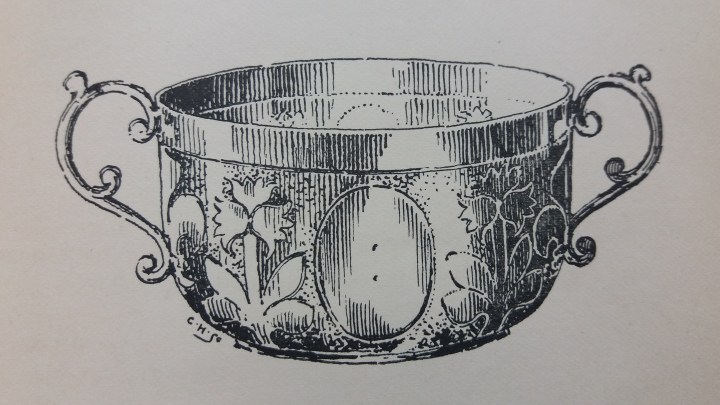
The twentieth century eventually brought social and demographic change which the chapel couldn’t keep up with and it closed in 1973. For many years it was the home of a photography club which was the case on the one occasion I was inside the building. By then there was nothing to identify the interior as that of a religious place of worship and no sign of the monuments listed in Christopher Stell’s Nonconformist Chapels and Meeting-houses in the North of England. I also can’t help but wonder what happened to the silver communion plate which included a two-handled chalice dating from as long ago as 1641. These were sold in 1874 but restored to the trustees in 1895:

on the one condition [wrote G.E. Evans]  that they are to remain the property of the Trustees, who receive them on the understanding that they are never to be again alienated by sale or otherwise.

George Eyre Evans was very impressed by this chalice and included an illustration in Vestiges of Protestant Dissent:
Platt Chapel chalice

Chalice, silver, porringer shape 2 3/8 inches tall, 4 1/2 inches diameter, bold ornamentation, G.E. Evans

More recently the chapel has been on the market as a potential dwelling house with an asking price of £350,000. Google Street View provides a sorry picture of how it looks today:
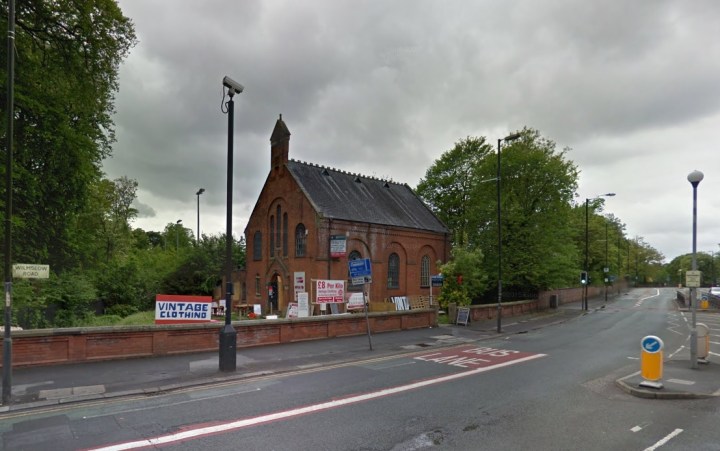
Platt Chapel Google Maps Streetview

Google Street View


Platt Chapel 02

The original photograph on its card


No pictures or text may be reproduced from this site without the express permission of the author.
Pictures of Harvest Festivals

Pictures of Harvest Festivals are amongst the most frequent early survivors of photographs of church or chapel interiors. The modern Harvest Festival, as it is known in churches today, was really invented by the Rev Robert Hawker, vicar of Morwenstow in Cornwall, in the 1840s. He was as colourful and eccentric as they come but devised the notion of a service in which the produce of the fields was brought into the church and used as decoration as an act of thanksgiving. The idea of the service quickly caught on and became a big part of the year for most churches, whether urban or rural. Harvest Festivals became and remain very popular with Unitarians, it would be interesting to study when and how they began to be incorporated into the cycle of services.


I don’t have any information to hand as to how harvest services spread and became popular but I see that in 1881, for instance, Alexander Gordon introduced the first Harvest Festival service to the First Presbyterian, Rosemary Street congregation in Belfast. This must be quite late, I would imagine. Was that something he had previously done over the preceding twenty years at Norwich, Hope Street, Liverpool, or Aberdeen? It would be an interesting avenue to pursue.


With the gradual development of photography as a medium, pictures were taken of churches and chapels. However, the difficulty – for all except the most skilled photographers – of taking good interior shots, and also, perhaps, a reluctance to take a picture of a scene that was so familiar as to be seen as hardly worth recording means that early shots of interiors of chapels and meetings houses are not that common. This seems to change when it comes to Harvest Festivals and a number of pictures that I have of now closed churches were taken to show off the harvest decoration that had been thoughtfully and faithfully put there by some parishioners.


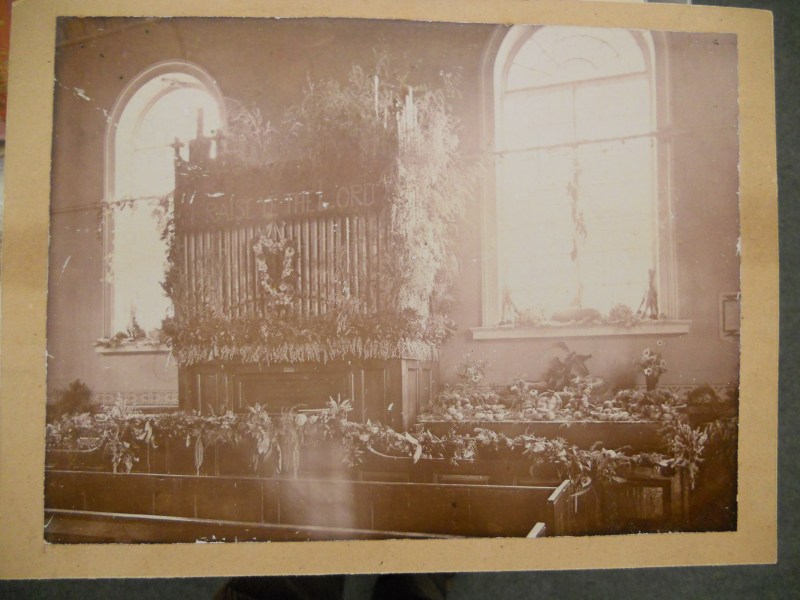
In the recent posts about Nantwich Unitarian Chapel I asked if anyone had any photographs of the interior. Andrew Lamberton has again found a fascinating image. He has sent me this picture of the area around the organ decorated for harvest. There is no date on the picture and it is very difficult to be at all precise although I would guess it was taken probably in the first decade of the twentieth century.


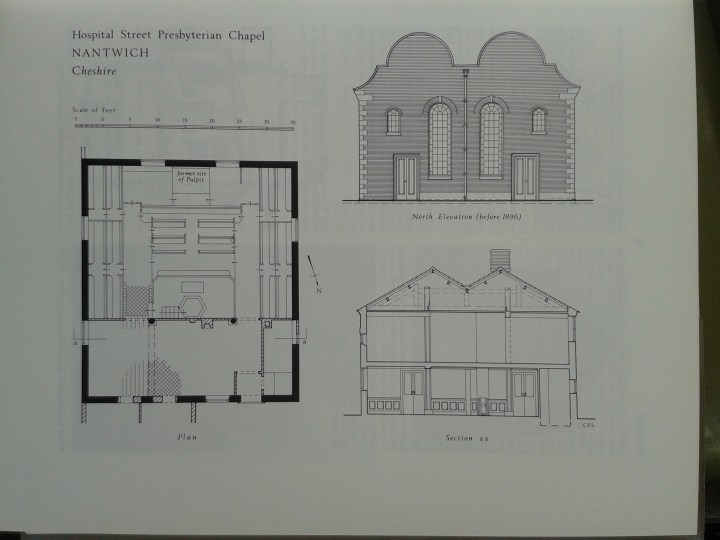
I gather the organ was installed in the 1870s so the picture shows a decorated scene around the organ sometime after that date. As I have mentioned in previous posts the chapel of 1725-26 was rebuilt and ‘turned’ in 1846-49 and this picture would appear to show the area on the plan between the windows and marked as ‘former site of Pulpit’ in Christopher Stell’s Nonconformist Chapels and Meeting-houses in the North of England:


Inventory Nantwich
Plan from Nonconformist Chapels and Meeting-houses in the North of England


It’s hard to make out too much detail in the photograph but it confirms the description also found in Nonconformist Chapels and Meeting-houses in the North of England (page 28) that the pews which incorporated original features from the 1720s were laid out in tiers:

“Seating: against E and W walls, two tiers of pews, partly reconstructed, include much early 18th-century fielded panelling, fronts renewed. The centre pews also incorporate original material.”

It is not an easy thing to take a picture of what is a dark wood-panelled interior while including the main source of light from two large windows. The light floods in through the window and the dark areas remain dark. But for all its limitations we have in this print a rare and useful image of a long forgotten building.

Organ Harvest Festival
(Photo: Andrew Lamberton and Nantwich Museum Archives)

Nantwich Unitarian Chapel

Willaston School Nantwich was created through the will of Philip Barker who lived at the Grove, a house originally built by his brother in 1837. It’s clear also that Philip Barker and his brothers were the main supporters of the Unitarian Chapel, their vision – and financial contribution – seems to have been what maintained what was otherwise quite a weak cause.


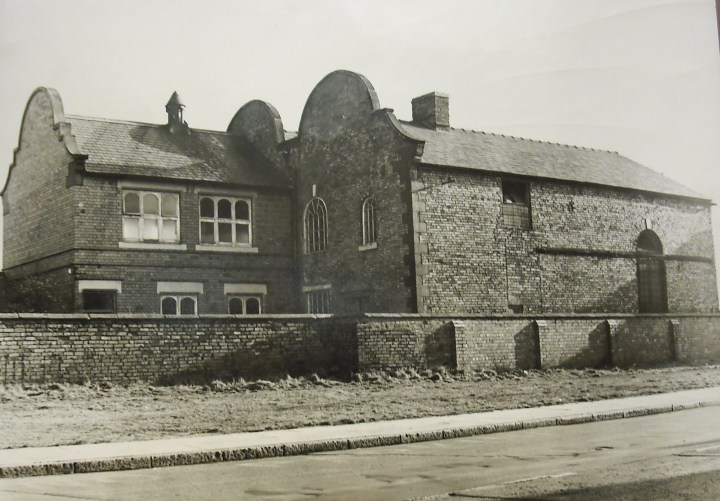
Nantwich 1950s

The chapel and associated buildings, probably dating from the 1950s. Photo courtesy of Andrew Lamberton


I found myself in Nantwich once, almost by accident, and carried out an ineffective and inevitably fruitless search for anything left of the Chapel. If I had checked The Unitarian Heritage book first I would have known that it was long demolished (in 1969), eventually meeting, it would appear, quite a sad end. However, the town of Nantwich is fortunate in having a very active History Group (which published Willaston School Nantwich – see the two previous posts) and through the kind help of Andrew Lamberton – who supplied me with a number of fascinating images and other information –  I’ve been able to piece together something of the history of the congregation that was once served by Joseph Priestley.


The congregation dated from the ejection and registered a former malt-kiln on Pepper Street as a meeting house in 1689. Between 1725 and 1726 they built the Chapel on Hospital Street.


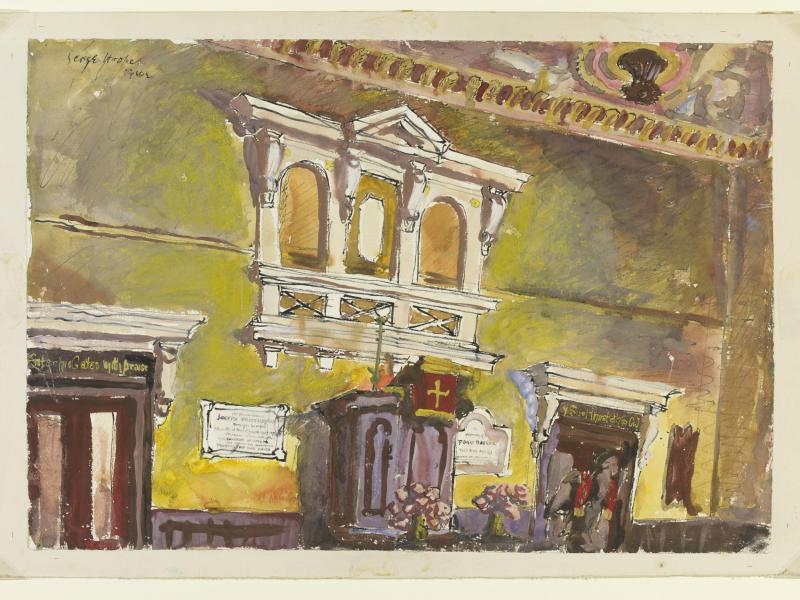
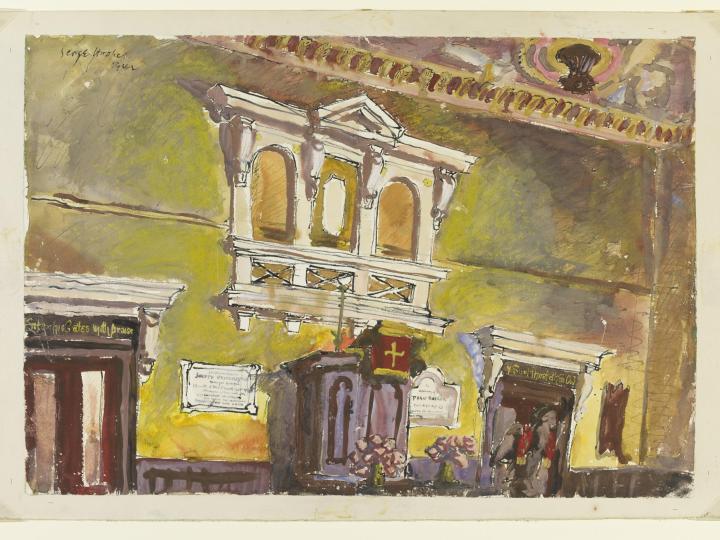
The lively painting of the interior on this page was painted in 1942 by George Hooper as part of the ‘Recording Britain’ series of images, held in the V & A which describes the scheme in the following way:

The ‘Recording Britain’ collection of topographical watercolours and drawings [was] made in the early 1940s during the Second World War. In 1940 the Committee for the Employment of Artists in Wartime, part of the Ministry of Labour and National Service, launched a scheme to employ artists to record the home front in Britain, funded by a grant from the Pilgrim Trust. It ran until 1943 and some of the country’s finest watercolour painters, such as John Piper, Sir William Russell Flint and Rowland Hilder, were commissioned to make paintings and drawings of buildings, scenes, and places which captured a sense of national identity. Their subjects were typically English: market towns and villages, churches and country estates, rural landscapes and industries, rivers and wild places, monuments and ruins. 


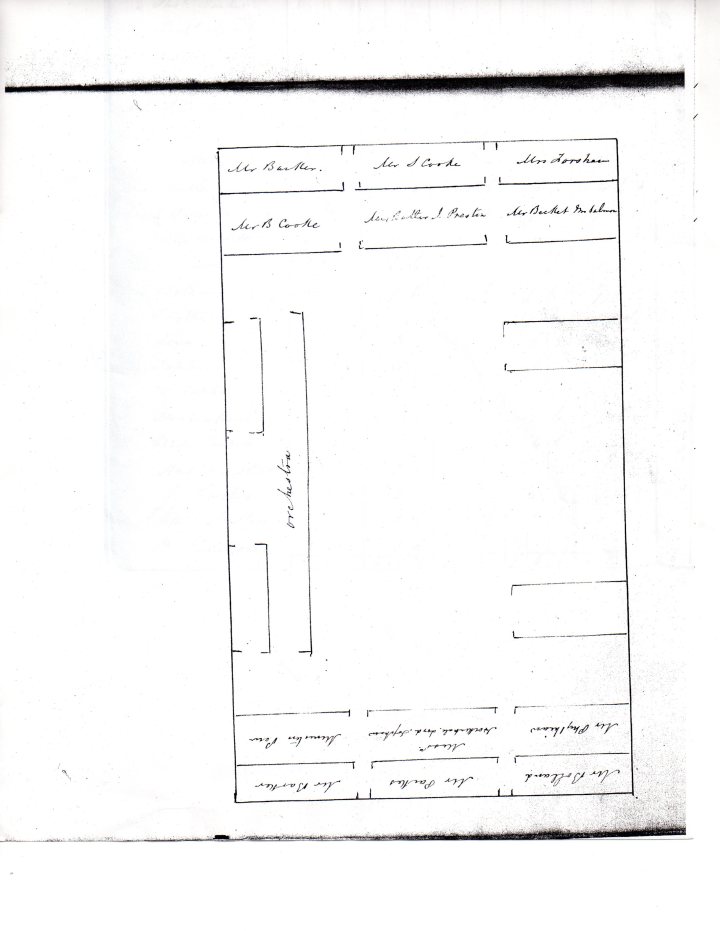
It’s an interesting choice of subject and shows the pulpit with memorials to Joseph Priestley and Philip Barker on either side. You probably wouldn’t guess from the painting but the interior had been completely re-ordered. The chapel had been turned through 180 degrees and the pulpit placed on a false wall with a vestibule and ancillary rooms located behind it. Andrew Lamberton has supplied me with this plan of the interior of the remodelled chapel (from the Cheshire Record Office):


Nantwich plan

Plan of the interior c.1850 (Cheshire Record Office)

Strangely this plan does not show the pulpit which would have been in the centre of the wall on the right hand side of the drawing as we look at it. Opposite it is an area described as ‘orchestra’ on the plan. Is this meant to imply some instrumental accompaniment for hymns or would it be the place for the choir? Philip Barker’s pew can be seen in the top left hand corner.


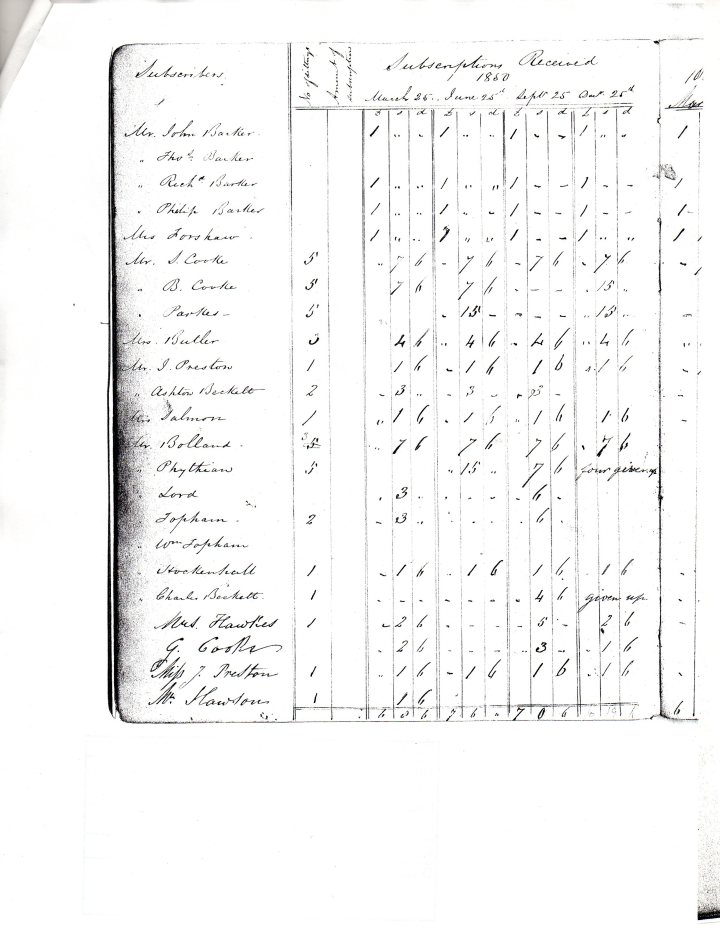
The major repairs that resulted in the re-ordering of the interior took place in 1846-49 according to Christoper Stell’s Nonconformist Chapels and Meeting-houses in the North of England (1994). His plan of the interior can be compared with the one above. By 1850, however, it was not a large congregation as this subscription list, also supplied by Andrew Lamberton from the Cheshire Record Office, shows


Nantwich subscribers

Subscribers List 1850 (Cheshire Record Office)

The chapel was clearly very dependent on the Barker family and the Rev J Morley Mills, minister at the end of the nineteenth and start of the twentieth centuries, recorded that it was known in those days as “Mr Barker’s Chapel”. By the time of the Second World War it was clearly at a very low ebb. Surviving photographs show the building in a very sorry state.

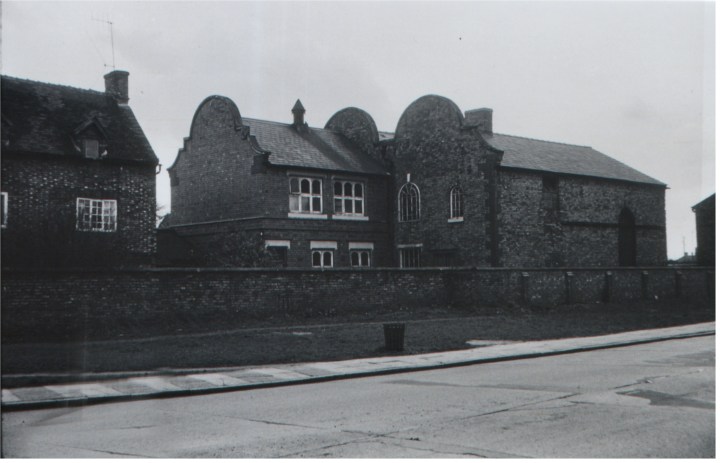
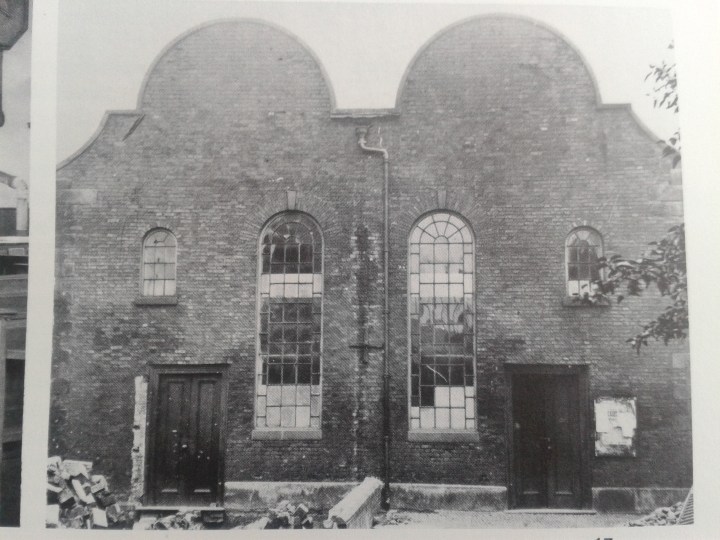
In 1896 a schoolroom had been built right in front of the chapel. This obscured the distinctive outline of the frontage with the Dutch style gables. However, Christopher Stell suggests this design may not have been original and could have been added in a rebuilding of 1870. Either way the Victorian schoolroom obscured the look of the chapel:

Nantwich 1960s

The chapel probably in the 1960s. Photo from Andrew Lamberton

Curiously The Unitarian Heritage carries a photograph of Nantwich chapel taken, presumably, after the school house had been demolished and showing the frontage as it had been built:

Nantwich UH

From The Unitarian Heritage

It seems a reasonable assumption to make that this photograph was taken at the start of the demolition process, after the Victorian school house had been taken down. However, if you compare this photograph and the previous one which dates from the 1960s it is clear that the two long windows are both intact and fully glazed and the stone work and frames around the window are no longer painted. Could this photograph actually date from a different period?


I’d be interested to hear from anyone who has any more information and any additional photographs of the chapel, especially of the interior.


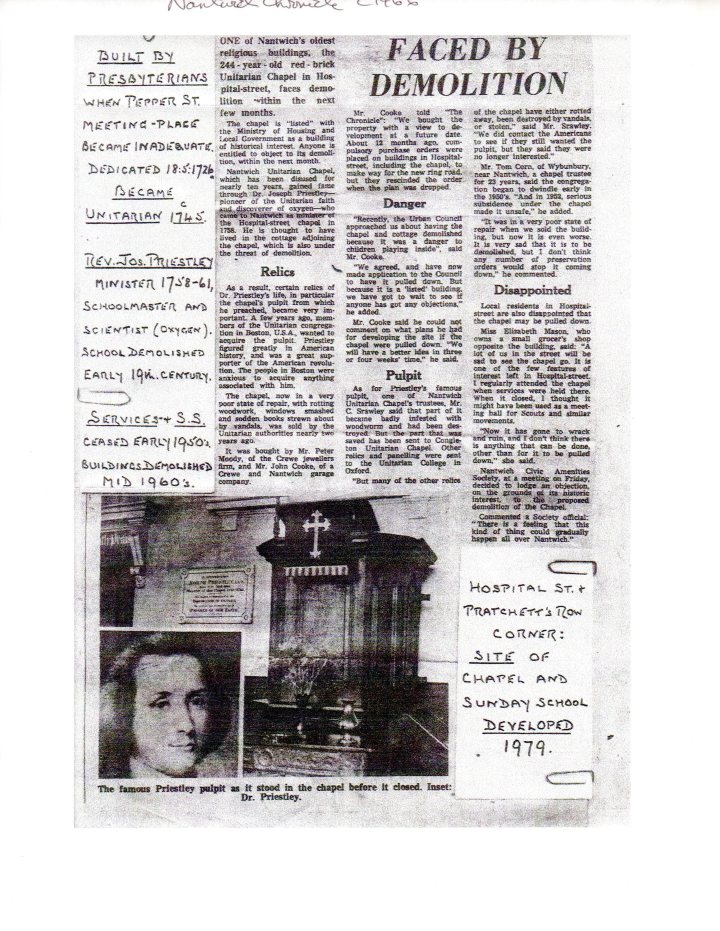
Andrew Lamberton has also sent me this newspaper cutting taken form the Nantwich Chronicle in about 1966 and indicating the sad end the chapel faced:

Nantwich Chronicle

From the Nantwich Chronicle c.1966

It is a shame that such a an unusual and interesting building was lost to the locality, one that had been thought significant enough to record for posterity during the  darkest years of the Second World War.

2012FG9670_2500

The Presbyterian Unitarian Chapel, Nantwich; Recording Britain; Chapel, Hospital Street, Nantwich. © Victoria and Albert Museum, London

Faith and Freedom, a journal of progressive religion

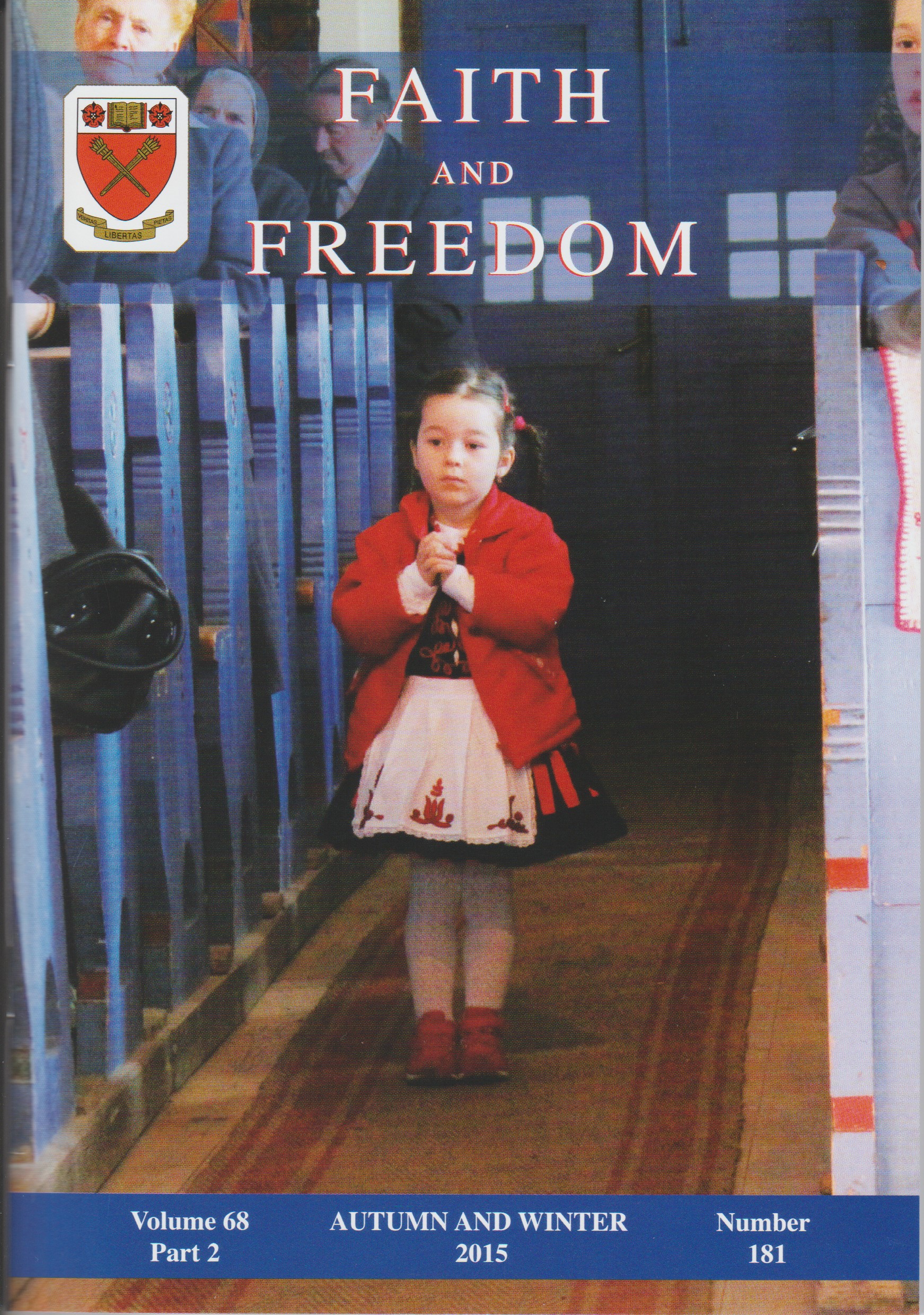
This latest issue of Faith and Freedom has a special cover. Taken from the above photograph by Márkó László it shows a scene from a Thanksgiving celebration at the Unitarian congregation in Oklánd, Hargita county, in Transylvania. This is a first for Faith and Freedom and ties in with a number of reviews in the Autumn and Winter 2015 issue which deal with the faith and practice of the Hungarian-speaking Unitarian churches in Romania. Márkó László’s photographs very effectively capture something of the cultural identity of the Unitarian folk there as well as their deeply held faith. There are more of his pictures in the 2016 Calendar.

The cover of the Autumn and Winter 2015 issue of 'Faith and Freedom', Vol. 68 Part 2, Number 181
The cover of the Autumn and Winter 2015 issue of ‘Faith and Freedom’, Vol. 68 Part 2, Number 181


Once again Faith and Freedom itself contains illustrations this time with a portrait of founding editor Eric Shirvell Price found inside and a photograph of the Rev Percival Godding, whose account of his time as a prisoner of war during the First World War also features.

An annual subscription costs £15 per annum (US $30 in the United States and Canada) and you can pay by post or online via PayPal. All details can be found on our website at:

http://www.faithandfreedom.org.uk/

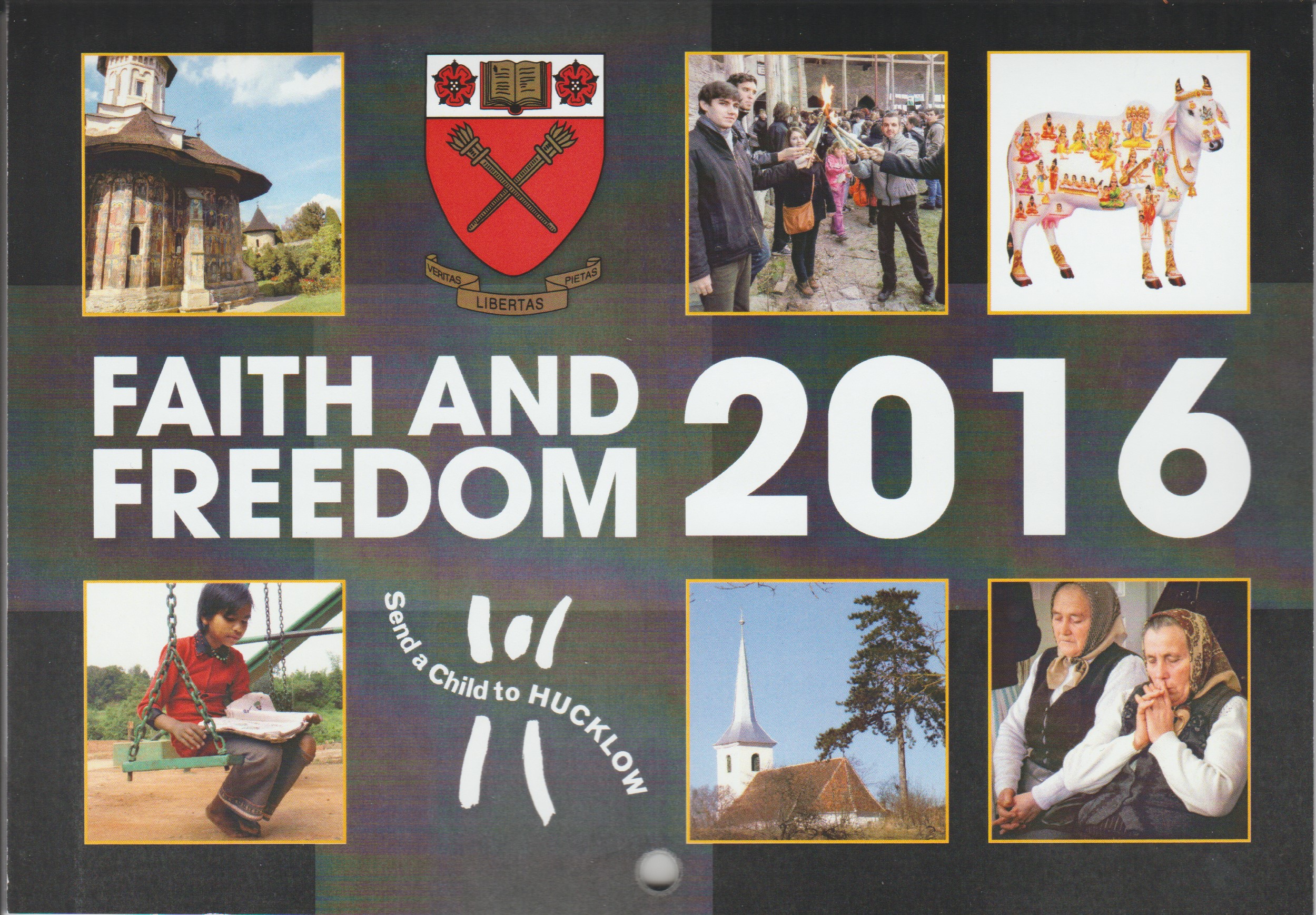
The cover of the 2016 'Faith and Freedom' Calendar - 'Faith in the World'
The cover of the 2016 ‘Faith and Freedom’ Calendar – ‘Faith in the World’


If you are an individual subscriber you will also receive a copy of our 2016 Calendar. These are also being sold in aid of the Send a Child to Hucklow Fund. A £5 donation will have one wing its way to you. Again information about the Calendar (and a preview) can be found on our website.


Service of Thanksgiving, Oklánd church, Transylvania (Photo: Márkó László)


Faith and Freedom latest issue and Calendar

FAITH AND FREEDOM, Autumn and Winter issue, (Volume 68, Part 2, Number 181) will be on its way to subscribers very soon. In it you will find:

Finding God in Strangers

John Navone

On Reading the Gospel of Mark with Two Eyes

George Kimmich Beach

Grace and Disgrace: a Social Pilgrimage

Yvonne Joan Craig

The Unitarians of the West and the Brahmo Samajees of the East

at Manchester College, Oxford 1896 –1948 Part II

Victor Lal

Six Months in a Prisoner of War Camp

David Steers

Manchester College, Oxford during the First World War

Evelyn Taylor

A Bible for Neo-Liberals

Barrie Needham

Bridging the Years in Marriage

Sue Norton

As well as reviews by Pat Frankish, Ernest Baker, Peter B. Godfrey, Lena Cockroft and the editor, and a review article by Graham Murphy on Sarah Shaw, The Spirit of Buddhist Meditation, The Sacred Literature Series, Yale University Press, New Haven & London, 2014.

Other books reviewed include

Charles Marsh, Strange Glory: a Life of Dietrich Bonhoeffer, SPCK, London, 2014.

Sam Harris, Waking Up: Searching for spirituality without religion, Bantam Press, London, 2014.

Mária Pap, Hungarian Unitarians in Transylvania, 2015.

Zoltán Fülöp, Emőd Farkas (eds.), Humble in Front of God, Words for Worship from Transylvanian Unitarians, International Council of Unitarians and Universalists/Hungarian Unitarian Ministers’ Association, Kolozsvár 2014

Emma Percy,”What Clergy Do”: especially when it looks like nothing, SPCK, London, 2014.

Marcus Braybrooke, Peace in Our Hearts Peace in Our World a meditation for everyday, Braybrooke Press, 2015.

John Pritchard, The Second Intercessions Handbook, SPCK, London, 2015.

Individual subscribers will also receive a copy of our Faith and Freedom 2016 Calendar. These are free to personal subscribers but extra copies can be ordered at a cost of £5 each, all of which goes to the charity the Send a Child to Hucklow Fund.

If you would like a sneak preview of the Calendar it can be downloaded on the Faith and Freedom website.

If you haven’t taken out a subscription and would like to do so you can also do that from the Faith and Freedom website:

http://www.faithandfreedom.org.uk/

The photograph at the top of this page is a picture by Transylvanian photographer Márkó László who has kindly contributed a number of pictures to the 2016 Calendar.


Faith in the World 2016 Calendar

For the second year running Faith and Freedom is producing a full-colour Calendar in aid of the charity, the Send a Child to Hucklow Fund.

After the success of last year’s Calendar we invited readers to send in their own images celebrating the theme of ‘Faith in the World’. This produced an excellent response with many more pictures being sent than we could use. The Calendar is now ready and will be sent out free to all subscribers to Faith and Freedom. An annual subscription costs only £15 and can be done online here: http://www.faithandfreedom.org.uk/subs.htm

With the Calendar you not only get the images covering people, places and religious celebrations from all around the world but an extensive record of dates and events covering all major religions and for all sorts of religious occasions and anniversaries in 2016.

A big thank you to everyone who sent in pictures. The volume and quality of images we received was overwhelming, making the final selection a very difficult task. We will try to include a range of images which didn’t appear in the Calendar on our website: www.faithandfreedom.org.uk.We also hope to upload the full Calendar for all to see on that site.

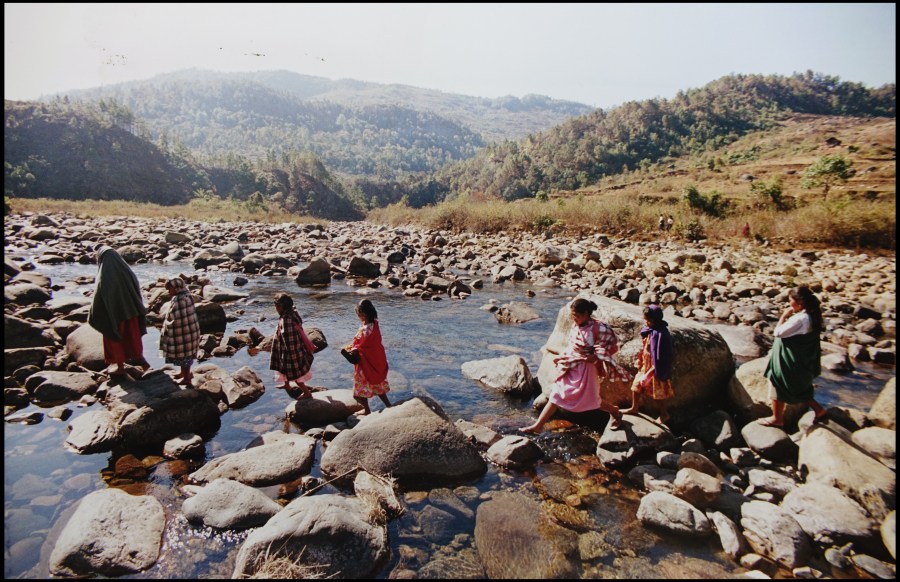
One of the images that we weren’t able to use in the Calendar is this picture, taken by John Hewerdine, of the five mile walk undertaken by Unitarian children each week to get to their Sunday School in the Khasi Hills, India.

Walking to Sunday School, Khasi Hills (Photo: John Hewerdine)


If you are not already a subscriber to Faith and Freedom you can purchase a copy of the Calendar for a suggested donation of £5, all of which will go to the Send a Child to Hucklow Fund to enable it to continue its invaluable work in giving disadvantaged children a much-needed holiday at the Nightingale Centre, Hucklow in the Peak District National Park.

If you would like to order a copy of the Calendar for yourself or for a friend email Nigel Clarke at faithandfreedom@btinternet.com