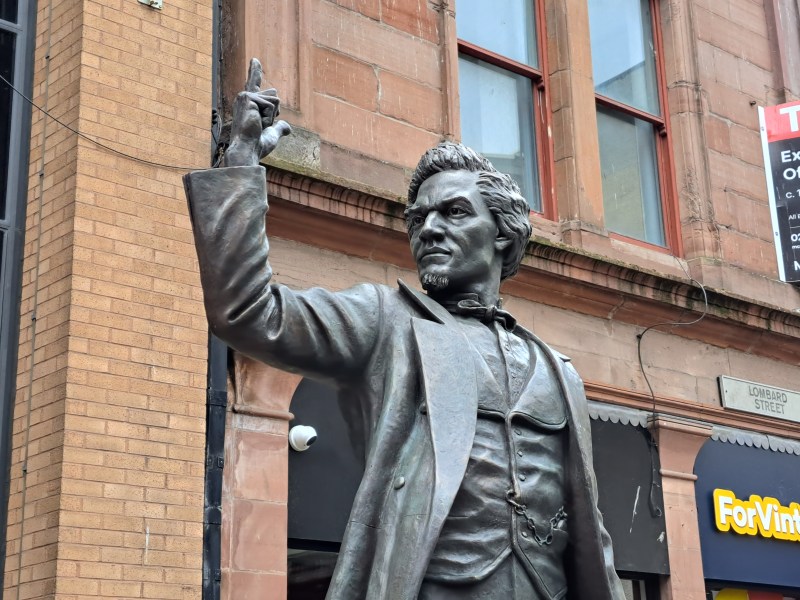
Frederick Douglass (1818-1895) Abolitionist and Human Rights Campaigner

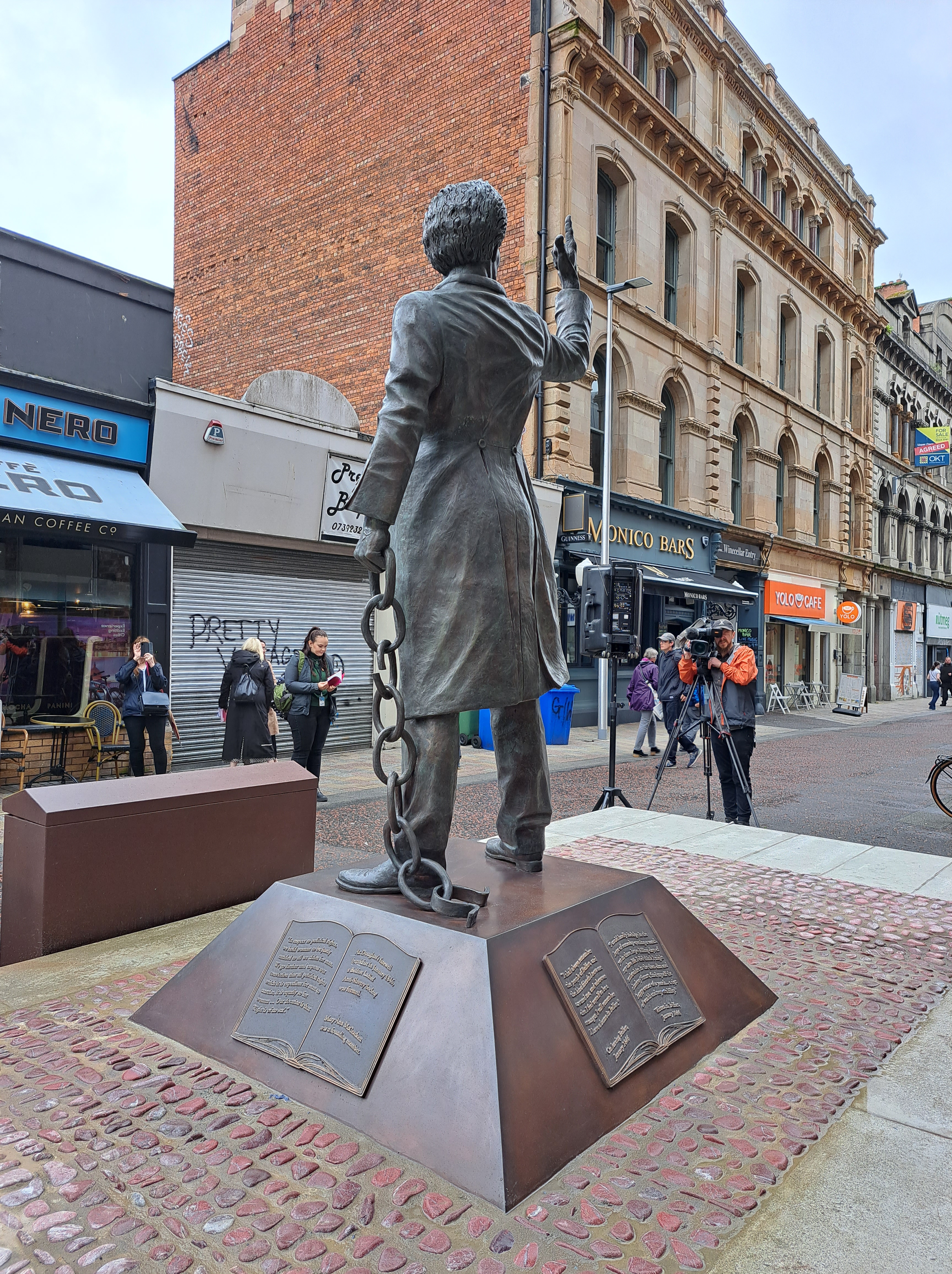
I was pleased to be present for the inauguration of the new statue of Frederick Douglass on Monday, 31st July 2023. I only found out about it by chance but it was good to be there for the formal recognition of Frederick Douglass as part of Belfast’s history.
Frederick Douglass was born a slave in February 1818, on Holme Hill Farm, near Easton, Talbot County, Maryland. Although slaves were not supposed to be taught to read he was taught the alphabet, taught himself to read and developed a life-long reading habit.

In 1838, at his third attempt, he successfully escaped from slavery and managed to get to New York where he married Anna Murray (1813–1882) of Baltimore. He became a preacher in the African Methodist Episcopal Zion Church and an associate of William Lloyd Garrison and an activist in the anti-slavery movement.
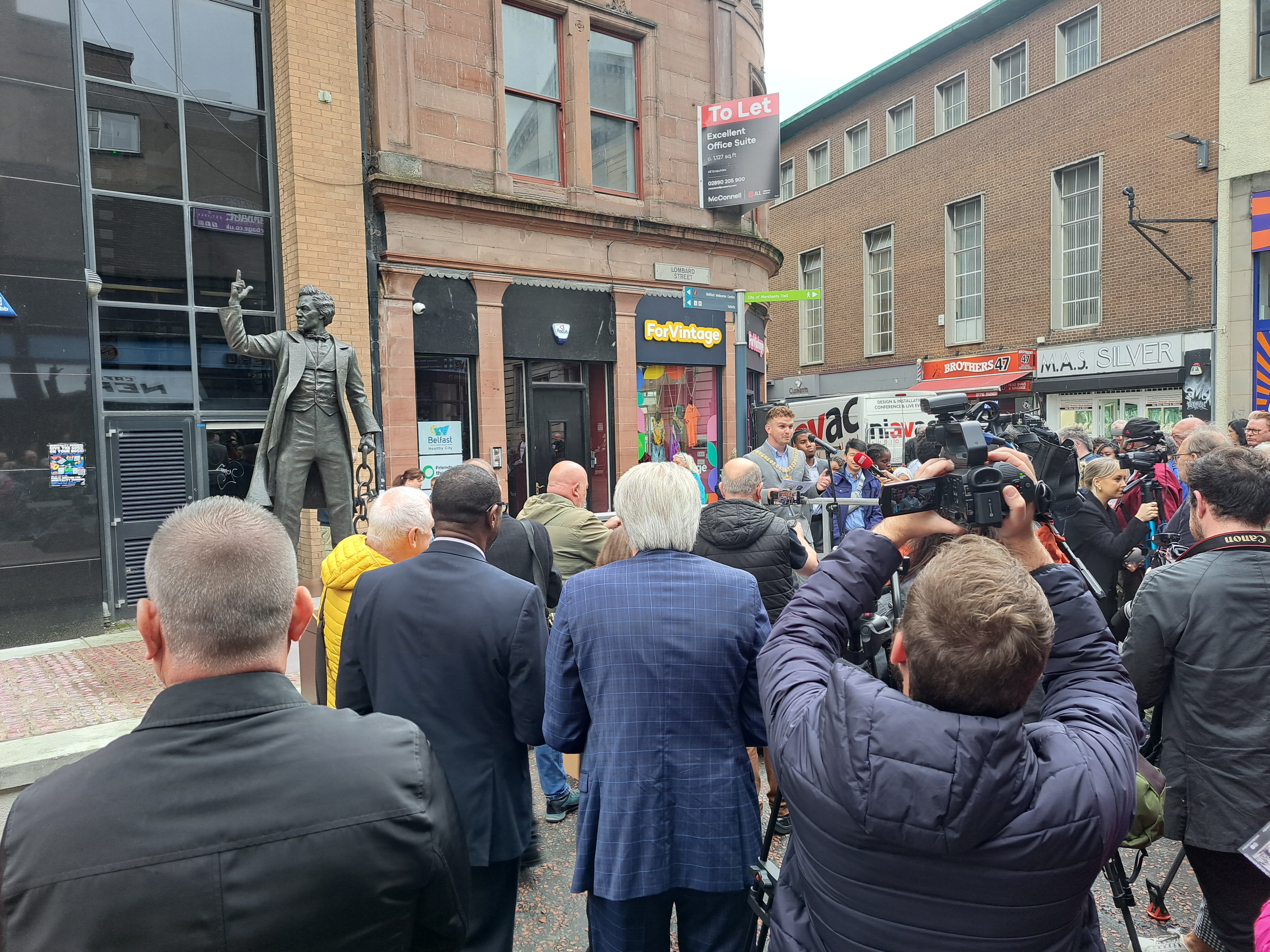
The Lord Mayor introduces the speakers

In 1845 he published the Narrative of the Life of Frederick Douglass, an American Slave, the first of three volumes of autobiography, and became so prominent in the anti-slavery movement that threats were made against him which led to him travelling to Britain and Ireland on a speaking tour. He spent two years speaking all over England, Scotland and Ireland. In Dublin he shared a platform with Daniel O’Connell and British supporters raised $700 to buy his freedom in the United States. This in itself was controversial as many thought it wrong to give any recognition to the idea that a human being could be bought or sold as someone’s property.
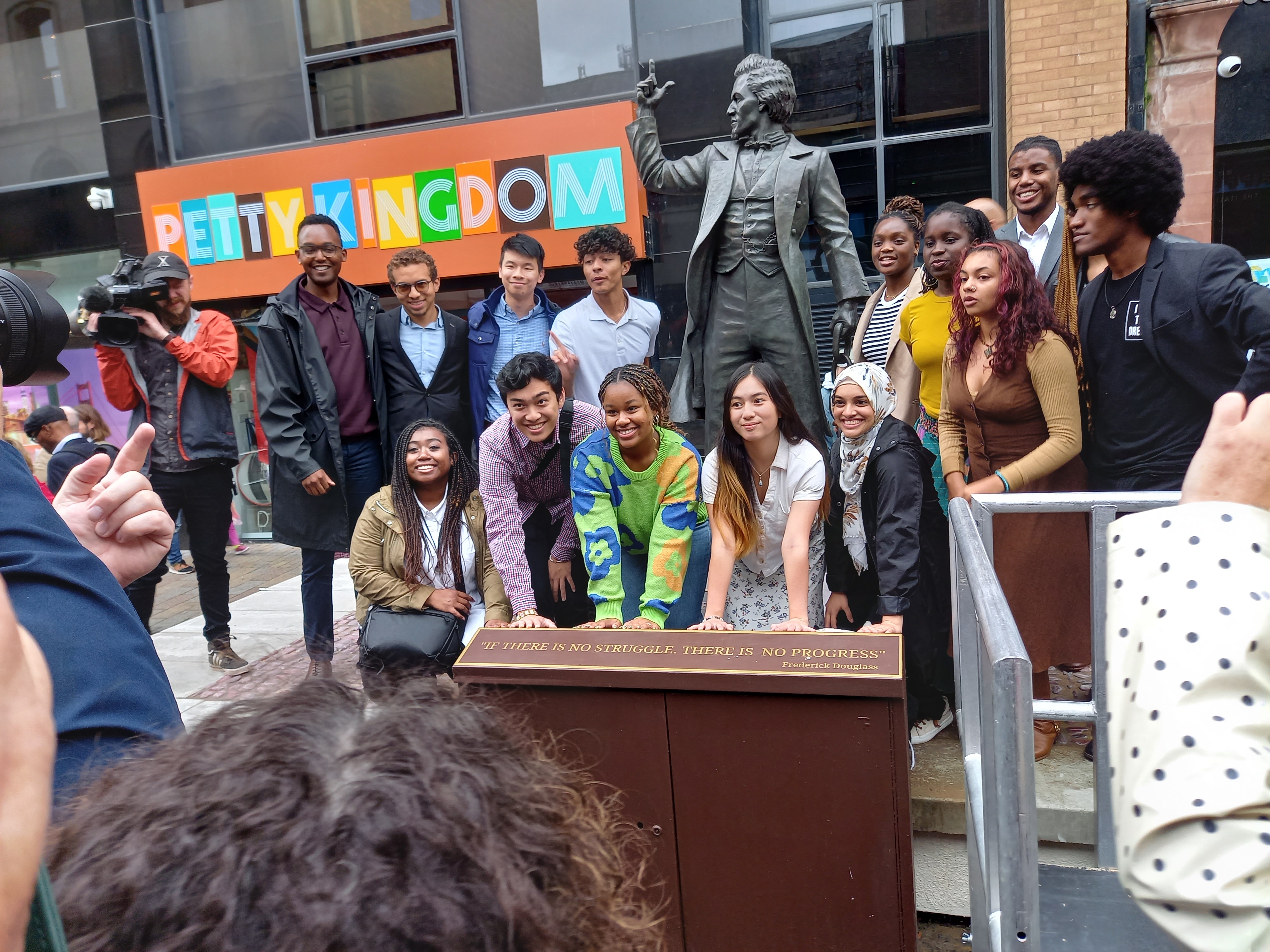
Some of those present

In the words of the Oxford Dictionary of National Biography, during his speaking tour:

He filled public halls, private homes, chapels, and churches, his audiences sometimes numbering thousands, and he often spoke on different subjects at more than one meeting a day. As well as making the abolitionist case, he spoke on women’s rights (he felt that he could not accept the vote as a black man if it was denied to women), temperance, land reform, education, and capital punishment, issues on which he never ceased to agitate. 
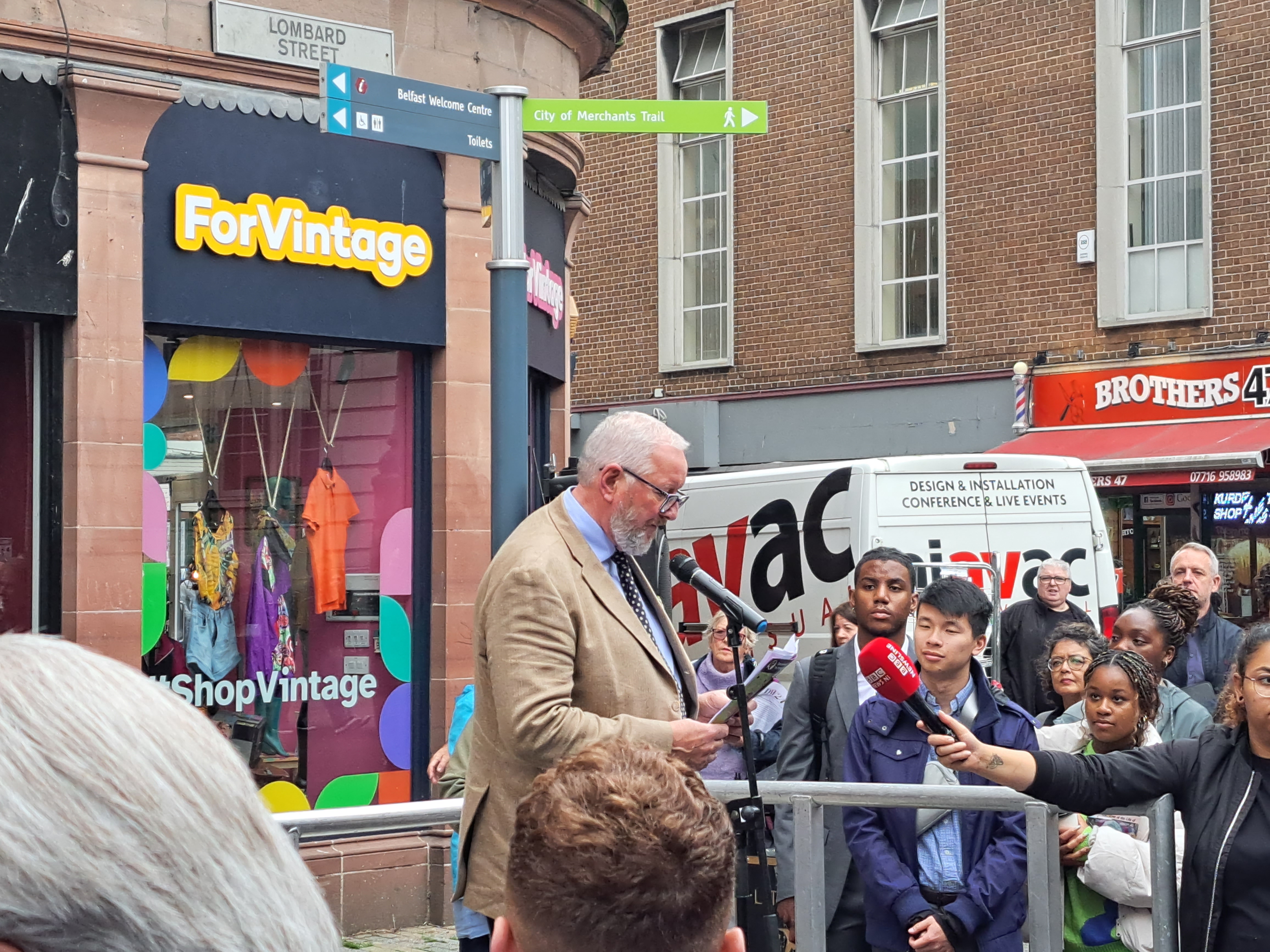
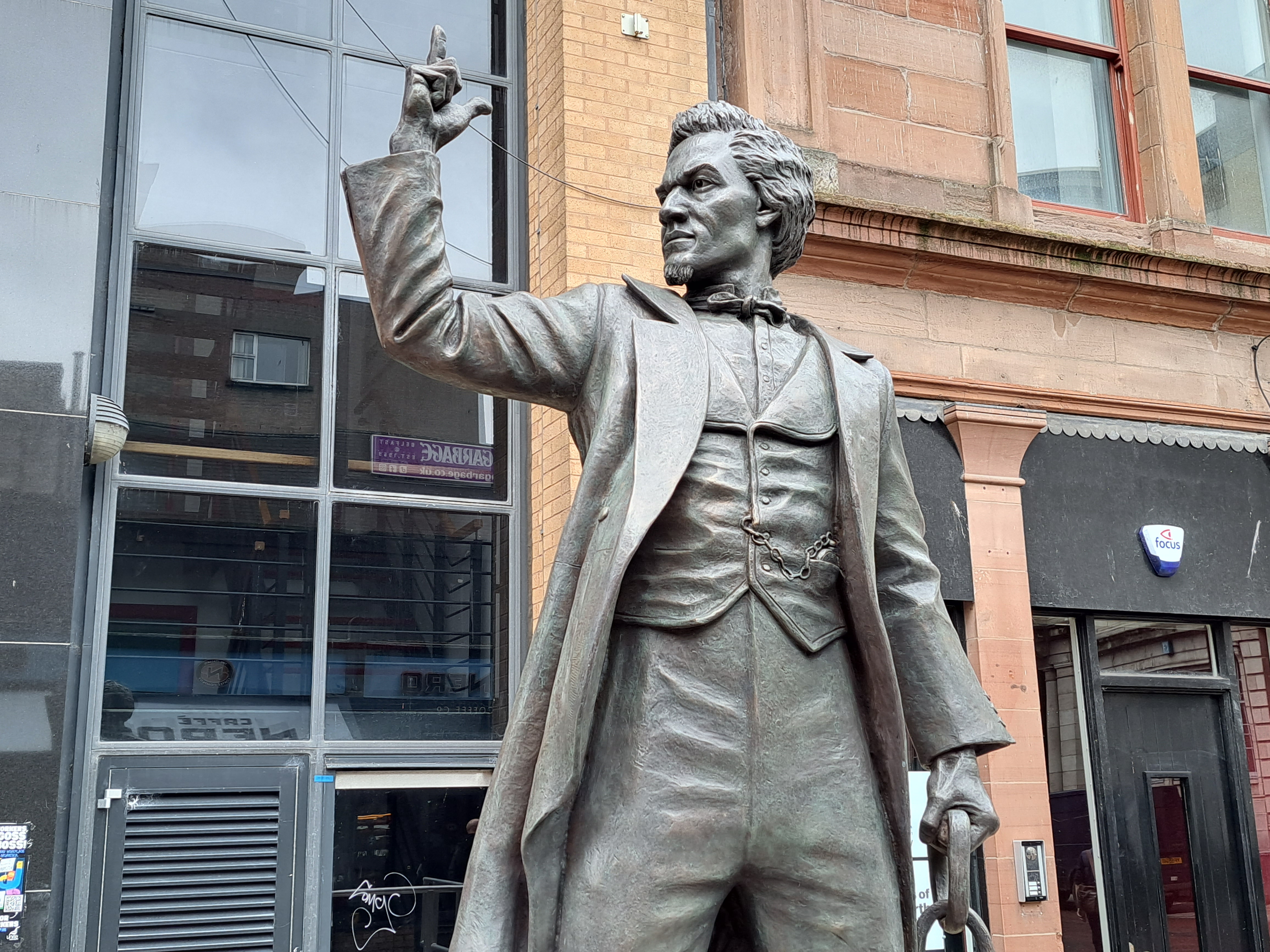
Alan Beattie Herriot, sculptor

Of his time in Belfast he wrote:

I shall always remember the people of Belfast, and the kind friends I now see around me, and wherever else I feel myself to be a stranger, I will remember I have a home in Belfast.

Words which are among those inscribed on the plinth of his statue.
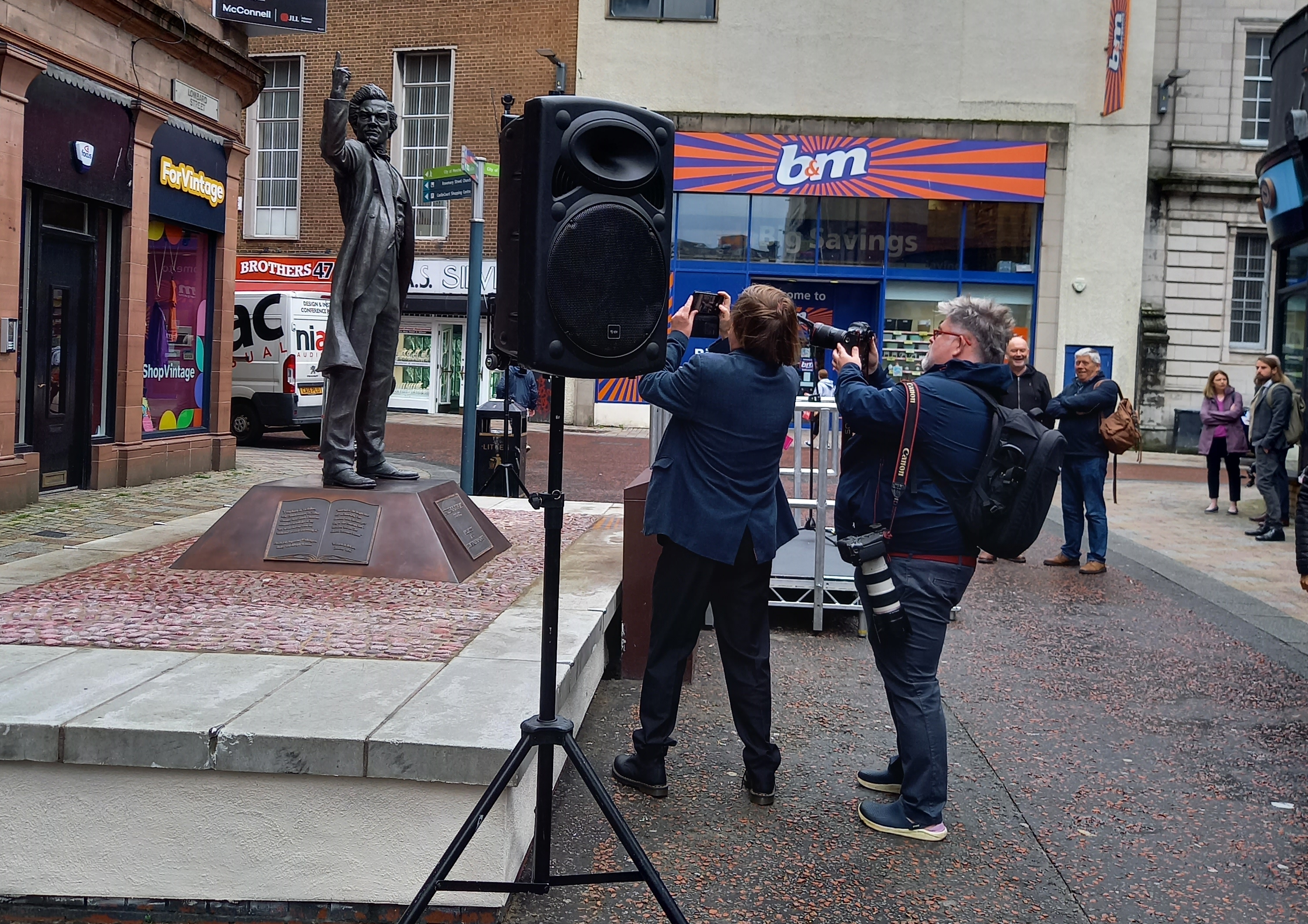
At the opening of the statue Professor Christine Kinealy said that in Belfast he spoke in Rosemary Street Presbyterian Church. But this is ambiguous because there were then three churches on Rosemary Street, two non-subscribing and one orthodox. The booklet available at the opening also suggested that he spoke in First Church on Rosemary Street. In fact he spoke at the meeting-house of the Second (Non-Subscribing) Congregation which stood behind First Church and was finally demolished in the early 1960s. He was granted the use of the meeting-house of the Second Congregation on 7th December 1845 ‘to lecture on behalf of the Anti-Slavery Society’. But it is very fitting that he should have such a fine statue erected in his memory so close to Rosemary Street.
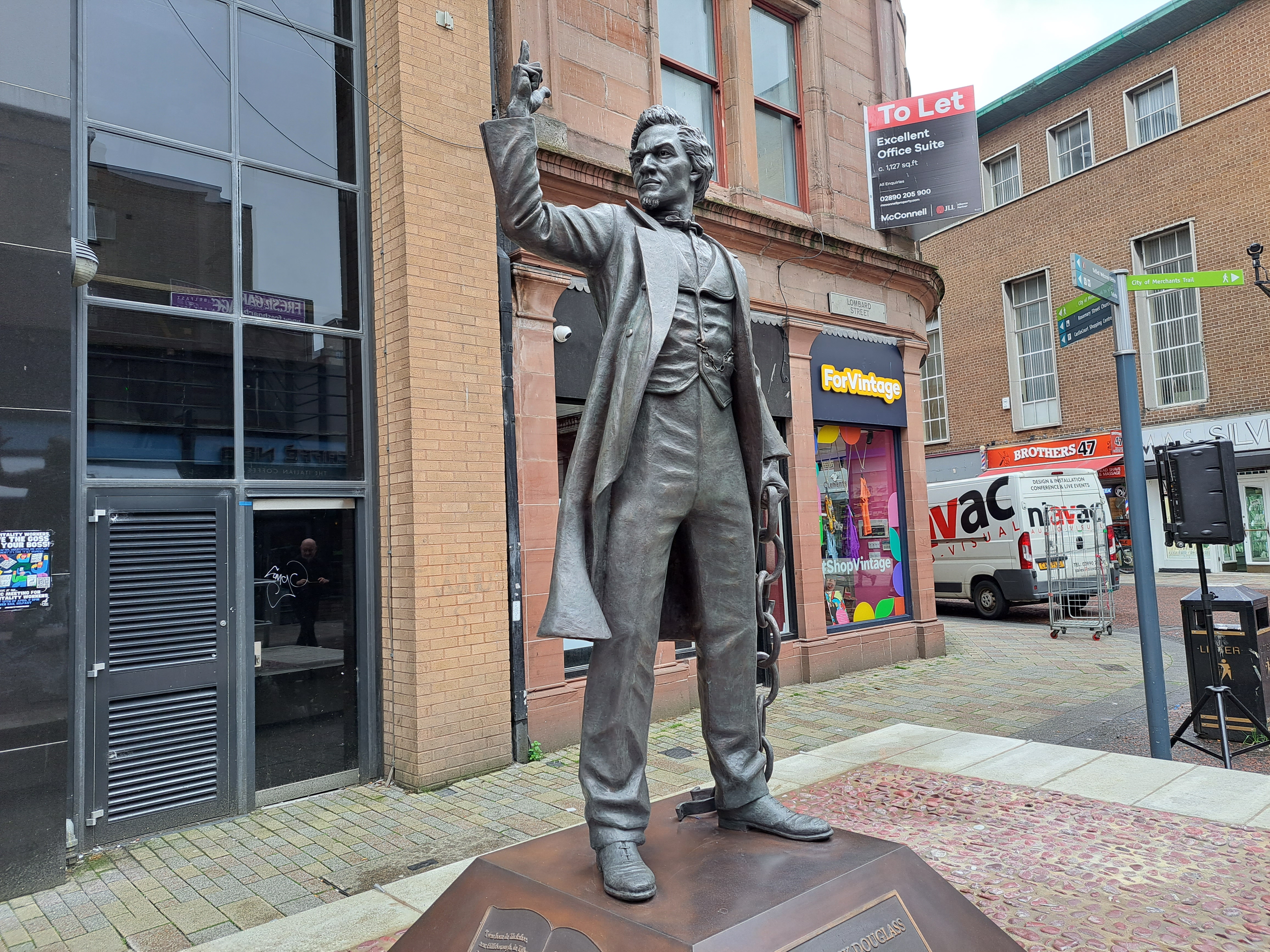
The view looking towards Rosemary Street
Looking down Lombard Street

The A to Z of Non-Subscribing Presbyterianism: N to Q

We have covered the letters N to Q in our alphabetical look at Non-Subscribing Presbyterianism. These letters cover, in turn; ‘New Light’, ‘Organs’, ‘Pews’ and ‘Quires and Places where they sing’.

New Light

The A to Z of Non-Subscribing Presbyterianism: New Light

Filmed at Clough Non-Subscribing Presbyterian Church and conducted by the minister, Rev Dr David Steers, the reading is from Matthew ch.5 v.13-16 and is given by Robert Neill. The organist is Alfie McClelland who plays the hymns Take my life and let it be (Hymns of Faith and Freedom 283) and The wise may bring their learning’ (Hymns of Faith and Freedom 247) as well as Lord of all hopefulness.

N stands for New Light and that is what we look at in the service, a term first coined by the Rev John Malcome in 1720 but indicative of the theological position of the Non-Subscribers ever since.

Organ

The A to Z of Non-Subscribing Presbyterianism: Organ

Non-Subscribing Presbyterians were pioneers in the use of organs and this video looks at their use in the denomination beginning with the building of the first organ in the Second Congregation of Belfast in 1806 and once played by the famous Edward Bunting. Our worship is filmed at Ballee Non-Subscribing Presbyterian Church and conducted by the minister. Our reader is Robert Neill who reads Psalm 150. John Strain plays the hymns: In Christ there is no East or West (Hymns of Faith and Freedom 235) and Go work in my vineyard (Hymns of Faith and Freedom 294) as well as Here O my Lord I see Thee face to face at the start of the service.

Edward Bunting

Edward Bunting

Perhaps the most famous historical organist in our denomination, the recorder of the music of the 1792 Harpers’ Festival in Belfast and organist at Belfast’s Second Congregation which installed the first organ in a dissenting church in Ulster in 1806.

Pews

The A to Z of Non-Subscribing Presbyterianism: Pews

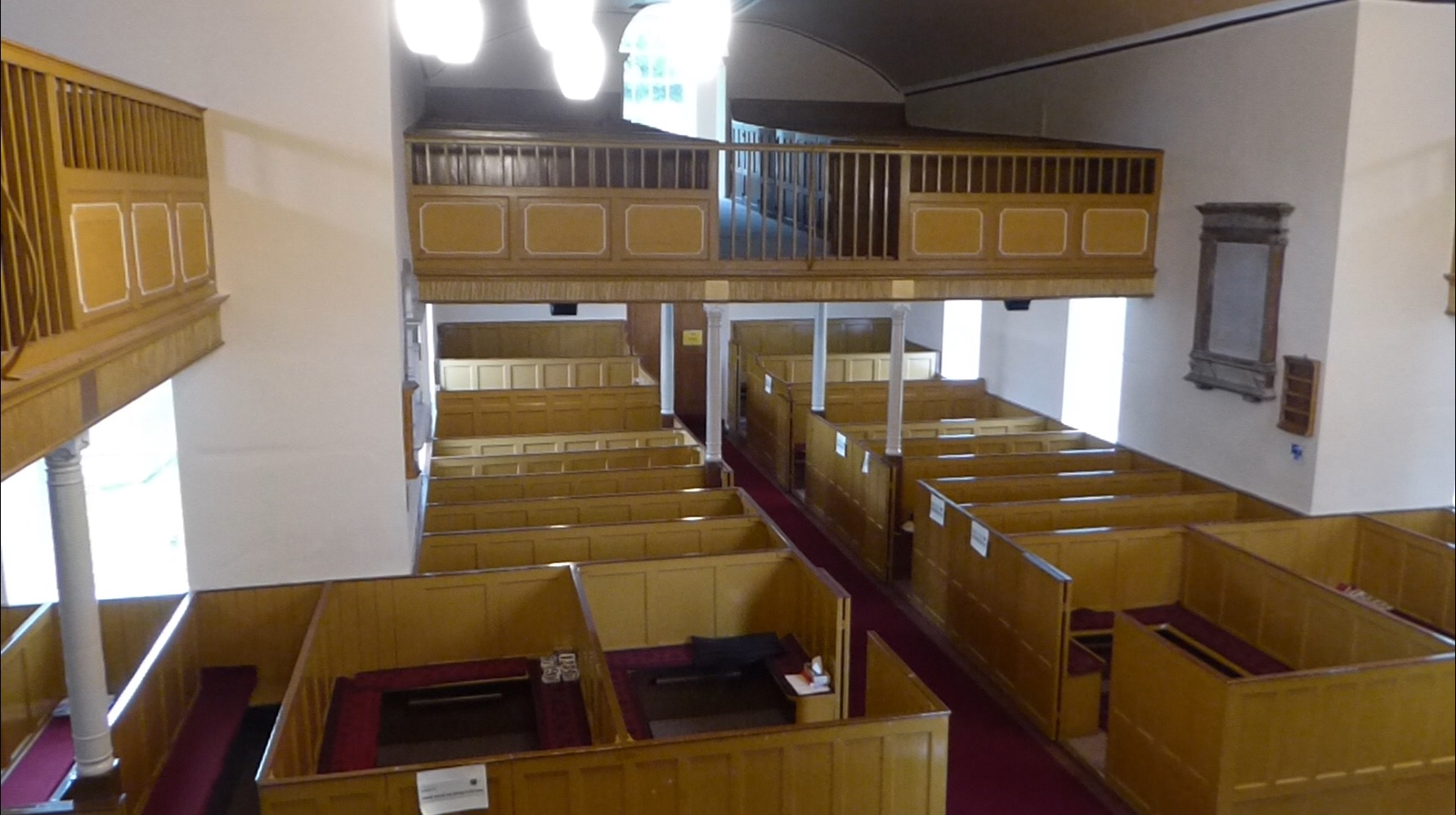
Filmed at the First Presbyterian (Non-Subscribing) Church, Downpatrick and conducted by the minister, Rev Dr David Steers, the reading is Psalm 122. The organist is Laura Patterson who plays the hymns: To God be the glory! Great things He hath done, I, the Lord of sea and sky, and Amazing Grace. Having reached the letter P, in the service we look at those essential items of church furniture: Pews.

Box pews at Downpatrick

Quires and Places where they sing

The A to Z of Non-Subscribing Presbyterianism: Quires and Places where they sing (available after 9.45 am on Sunday, 31st October 2021)

Filmed in Clough, Ballee and Dunmurry churches the reading comes from Psalm 92 v.1-5. Ballee organist: John Strain plays the hymns Immortal, invisible, God only wise (Hymns of Faith and Freedom 30), Make me a channel of your peace’(Hymns of Faith and Freedom 338) and also plays I am not worthy holy Lord.

Having reached the letter Q we look at Quires, an archaic spelling of Choirs which comes from an 1862 prayer book, partly edited by James Martineau, which re-used the original phrasing of the 1662 Book of Common Prayer. To find out more click on the video above.

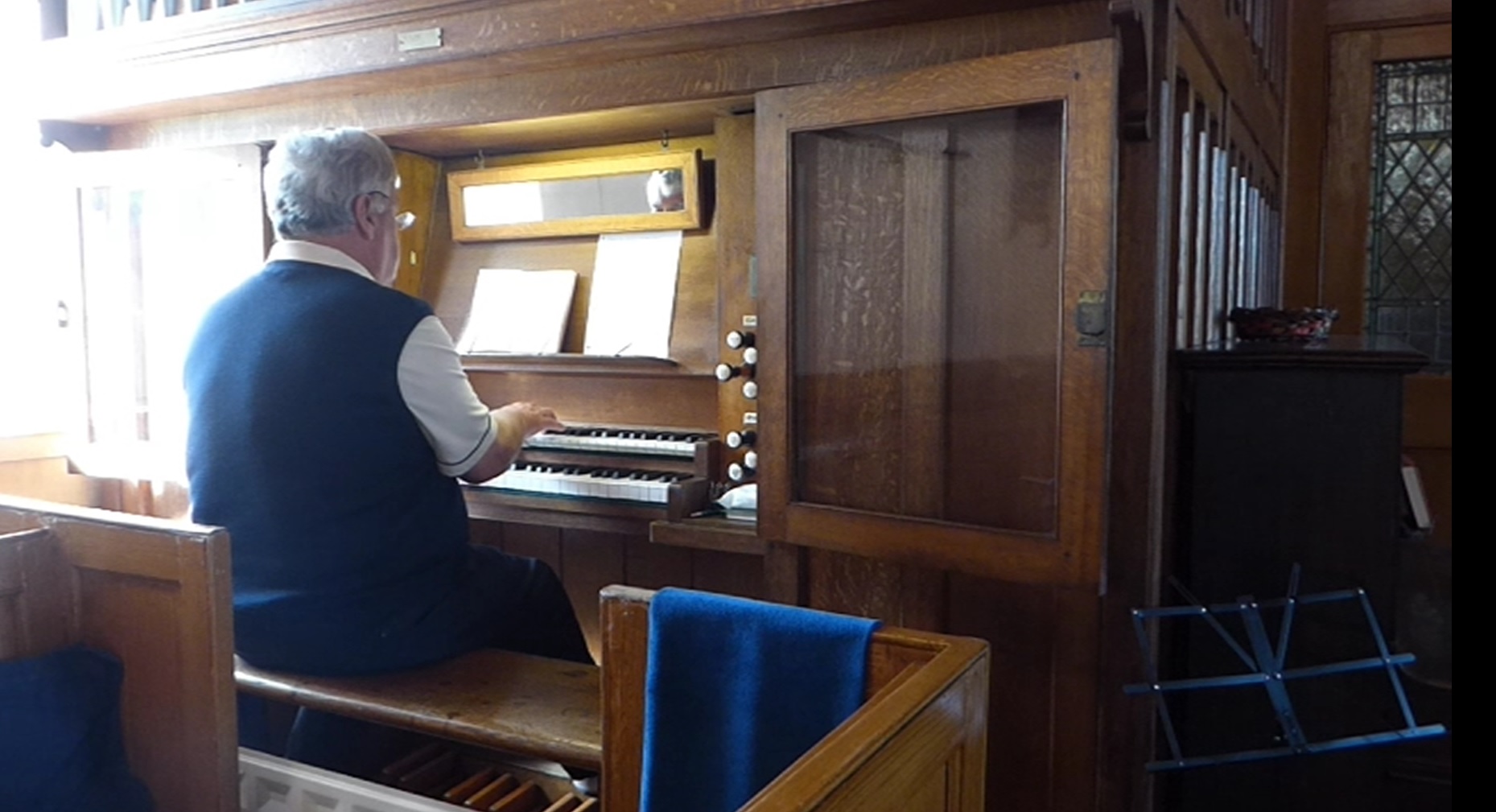
John Strain at the organ at Ballee

Very special thanks goes to John Strain, organist at Ballee Non-Subscribing Presbyterian Church, who has now recorded over 100 pieces for our online services during the period of the pandemic over the last 18 months. This is a significant contribution which has been a tremendous part of our online worship. Thank you John.

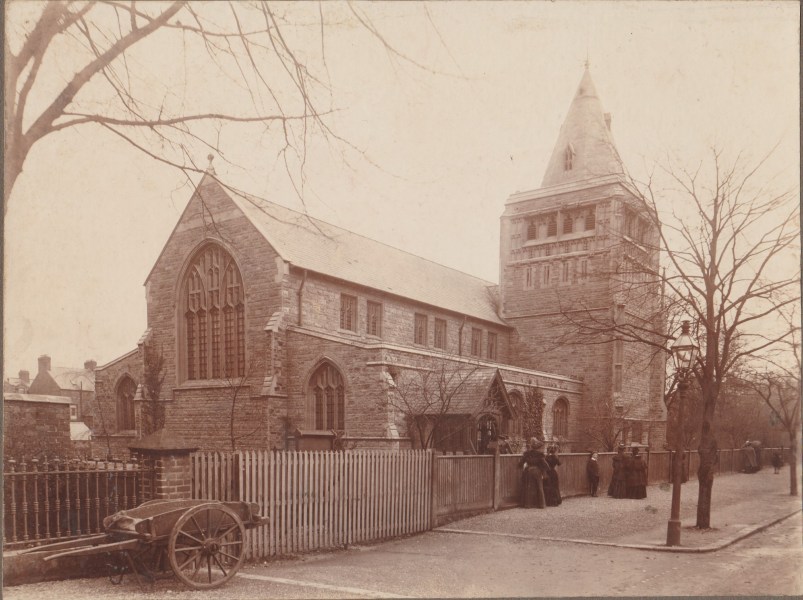
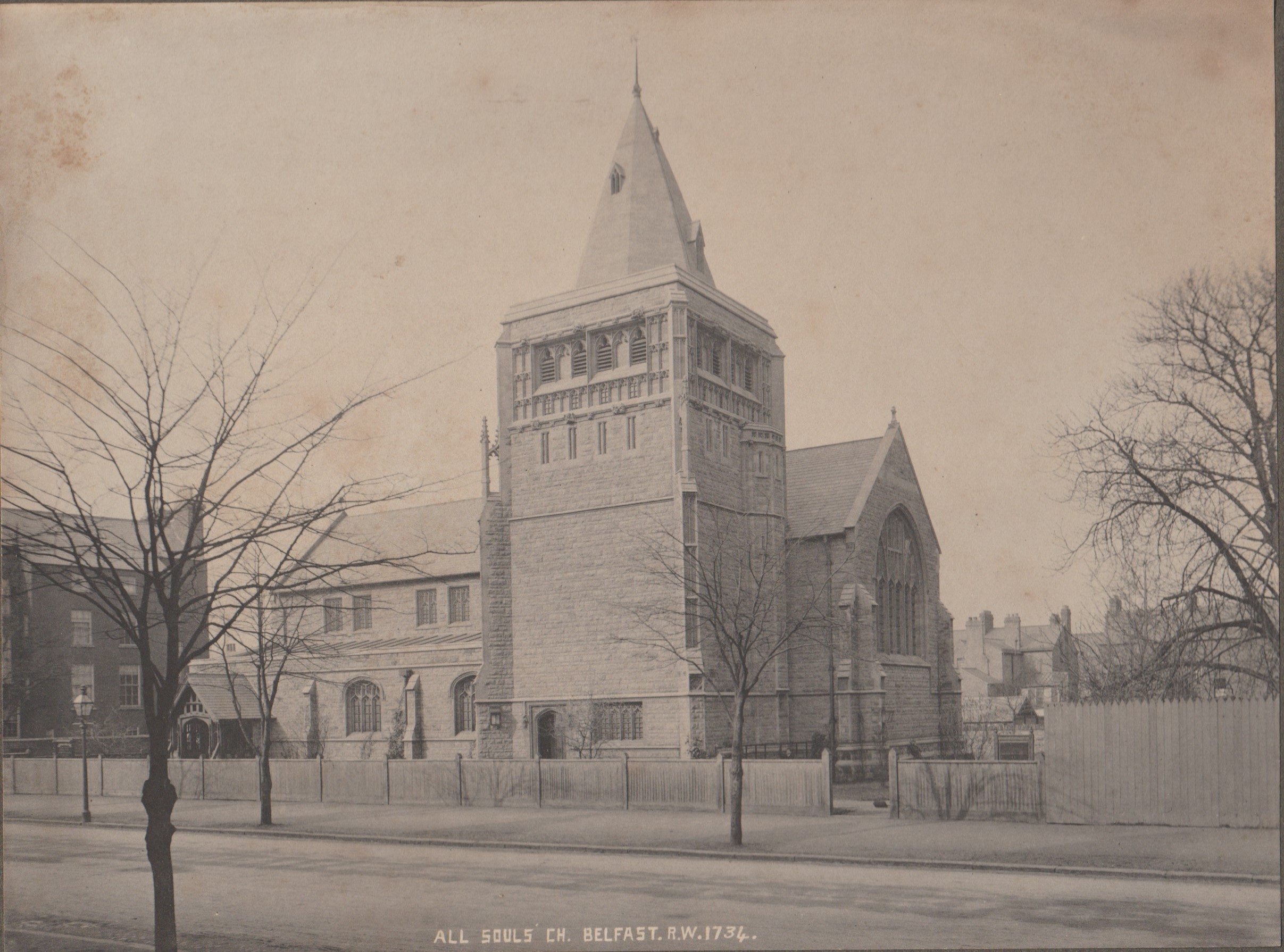
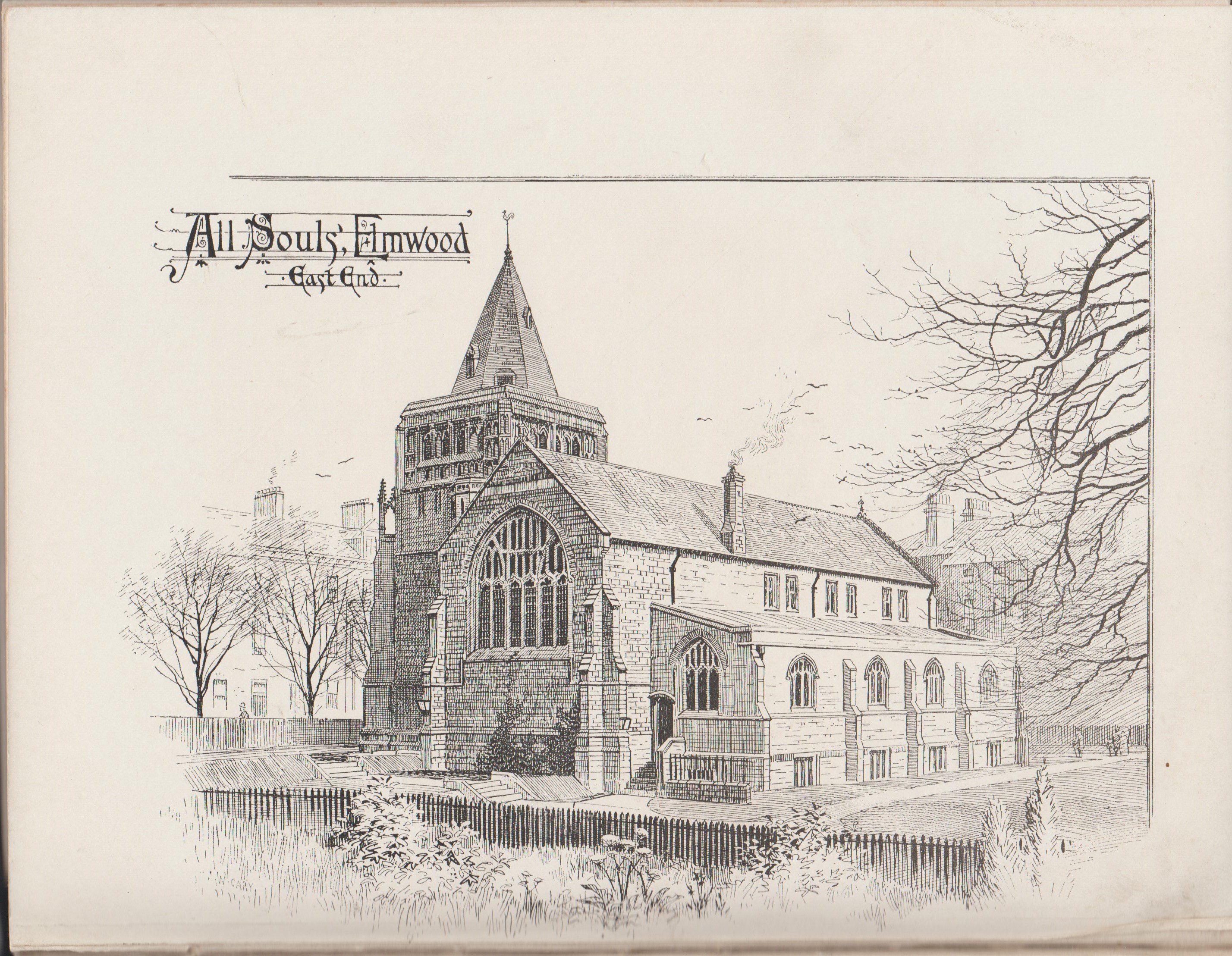
All Souls’ Church, Belfast built 1896

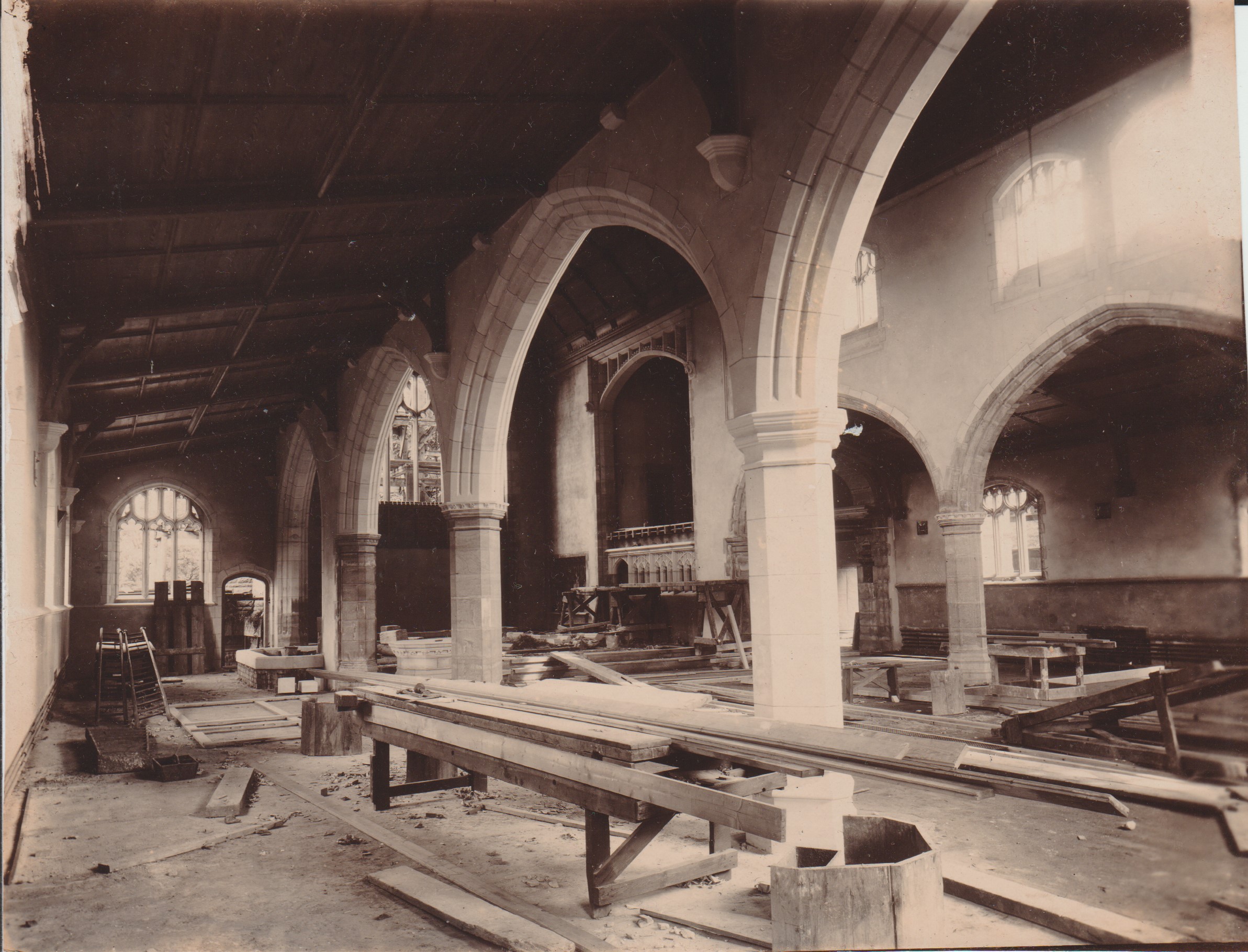
All Souls’ Church, Belfast exterior is modelled on Croyland Abbey in Lincolnshire. Built by the architect Walter Planck and opened for worship in 1896 it is the only church designed by that architect in Ireland. But it is interesting to note how closely the interior resembles the interiors of a number of fifteenth-century English parish churches. The arches, pillars, chancel, east window, clerestory windows all are reminiscent of a number of such places. I realised this when I saw a picture of the interior of the Church of St Mary in North Petherton. An Edwardian postcard of this interior  looks almost identical to All Souls’. Even the pews in All Souls’ underline this effect, the pews were brought in from the old meeting house on Rosemary Street when that church was vacated. These originally dated from the 1870s and a lot of Victorian parish churches would have installed new, modern pews at that time. The choice of this kind of architecture was quite deliberate by the minister, the Rev Edgar Innes Fripp in 1896. He was reaching back to medieval England to establish the kind of devotion he thought was most truly authentic. But architecturally it is a marvel. John McLachlan (in The Unitarian Heritage) says it is “unique in Irish Non-Subscribing church architecture”. But there is nothing like it in English Unitarian church architecture either which has a lot of remarkable gothic buildings.

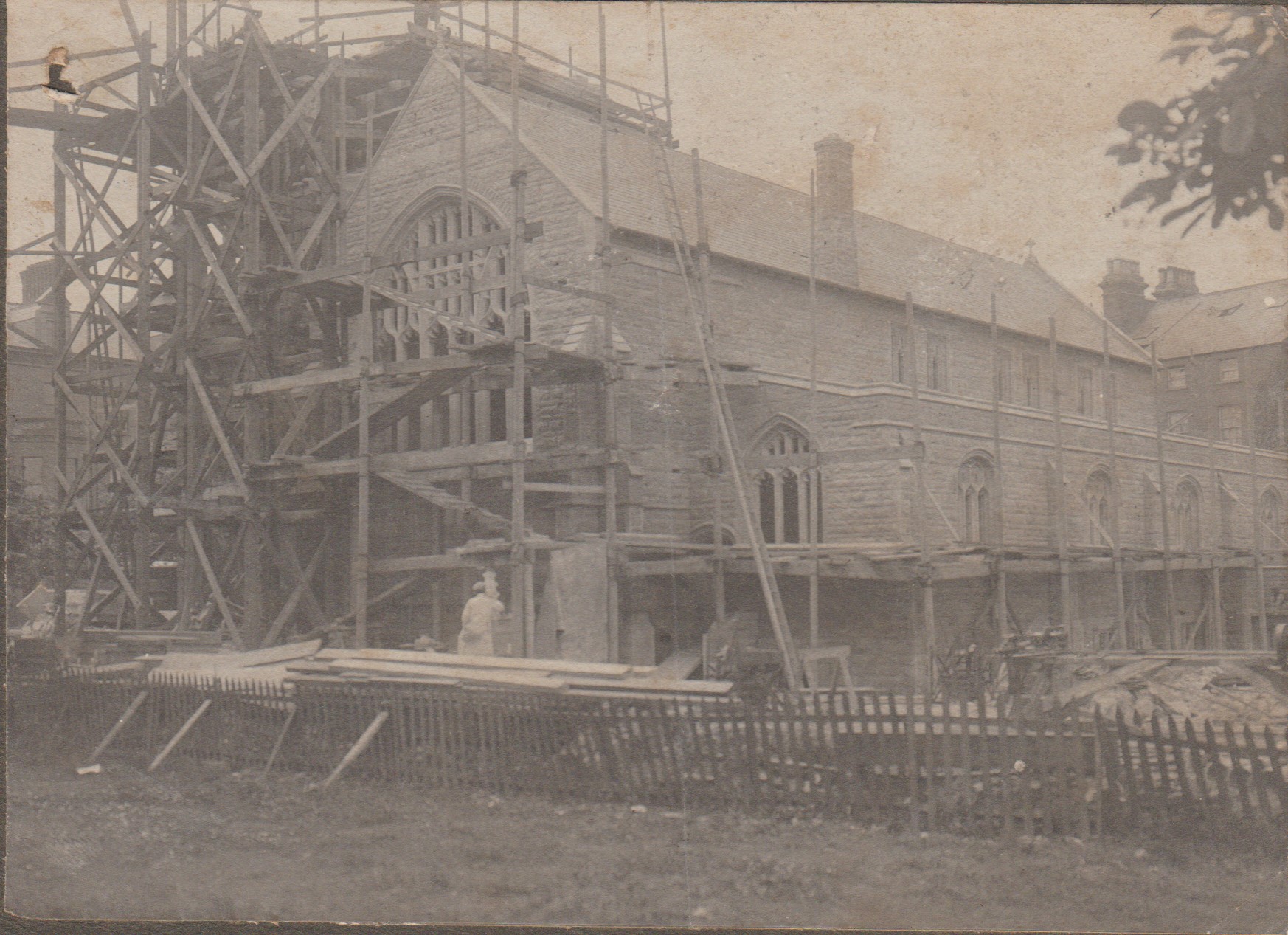
All Souls ext construction 02

Simon Walker (Historic Ulster Churches) says “it would be as fitting in a rural English setting as in Belfast’s busy University area”. Richard Oram (Expressions of Faith Ulster’s Church Heritage) notes that “It is a unique and beautiful, little building”. Paul Larmour (Belfast: an illustrated architectural guide) calls it “a gem of Victorian architecture”.

All Souls int construction 01

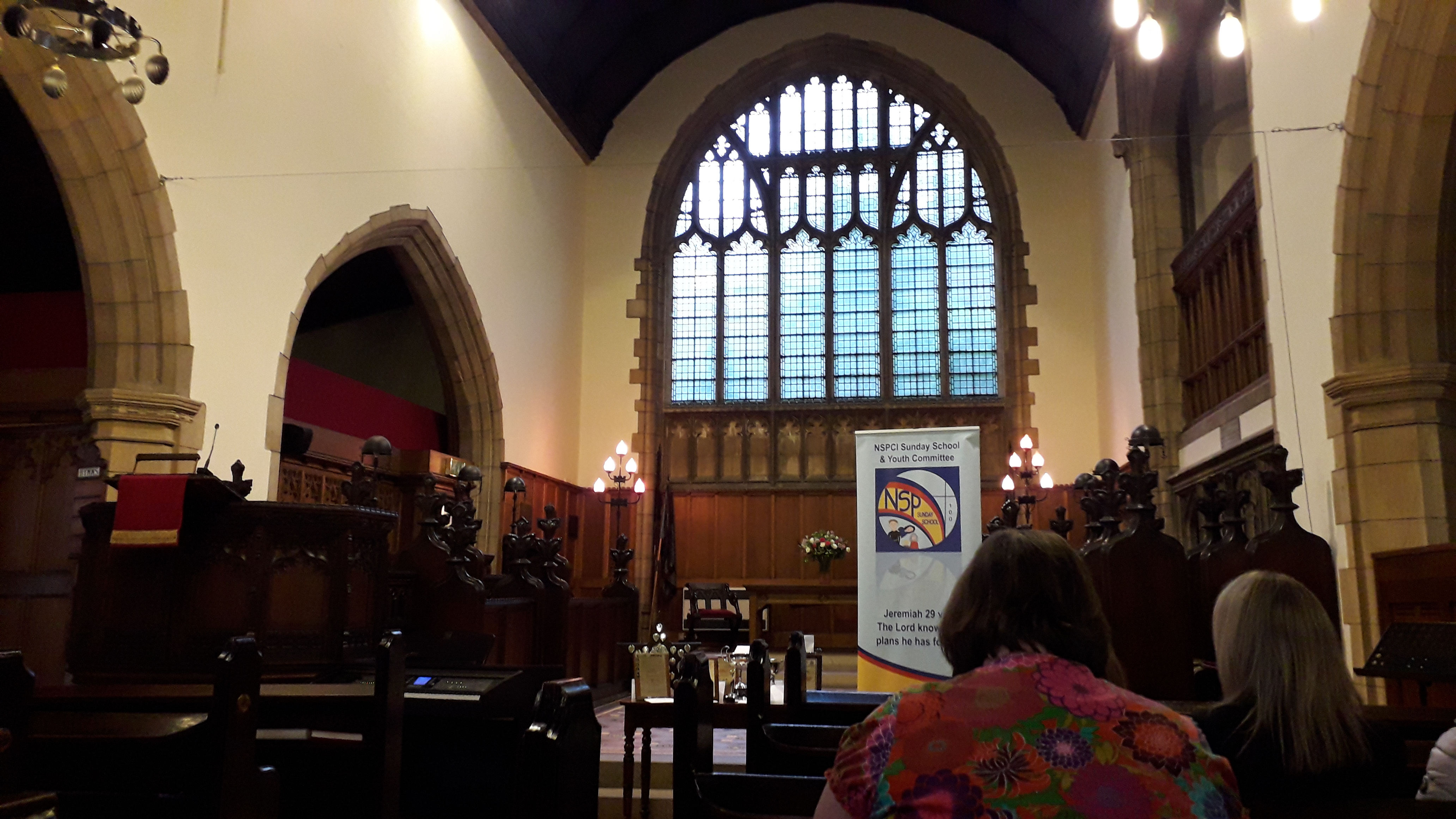
The pictures on this page show the church under construction and soon after it was built, plus a view of the chancel taken before the NSPCI Sunday School service held there on 7th June 2019.

All Souls ext completed 01

All Souls June 2019

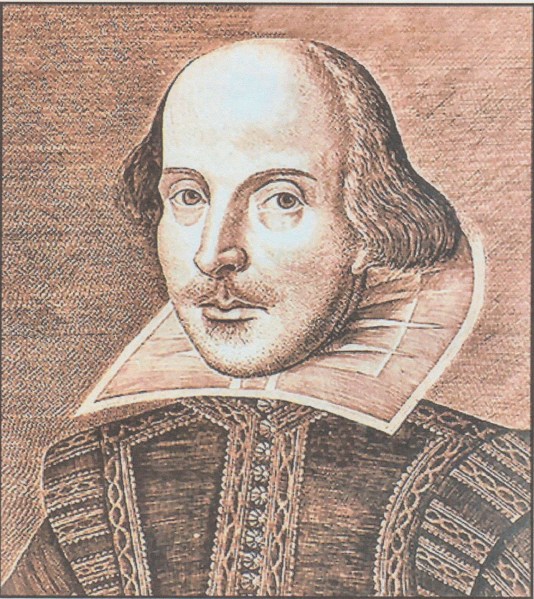
Edgar Innes Fripp and William Shakespeare

The current celebrations of the 400th anniversary of the death of William Shakespeare prompt me to think about the Rev Edgar Innes Fripp. His is not a name widely remembered today but I was very aware of him when I was minister of All Souls’ Church in Belfast as a very distinguished predecessor in that pulpit, indeed the minister under whose leadership that church was built in 1896.


E.I. Fripp didn’t really get the attention he deserved in the congregation, although I wrote and spoke about him on a number of occasions. If the congregation looked to anyone as an historical exemplar it was A.L. Agnew whose own particular heroic story in the course of a 54 year ministry was partly based on an undoing of the achievements of his predecessor Fripp. He did away with the ‘Fripperies’ that remained from early in the century even to the extent – or so I was told – of having a bonfire of old service books along with assorted hassocks, communion table cloths and pulpit hangings. Fripp had introduced an edited version of the prayer book to the church, a robed choir and a much more devotional style of worship than had been the case before. More than that he had built the church, a little medieval English parish church in suburban Belfast. It was his vision in achieving this that had enabled the church to survive. Without this move it would have been unlikely to have lasted in Rosemary Street, and although there may have been a falling off in attendances between the wars it suited the narrative of the later arrival of Dr Agnew and the York Street congregation following the blitz of 1941, to write off everything that had gone before. In fact the destruction of the York Street building made an eventual union of the two congregations inevitable but without the intervention of the German Luftwaffe even that probably would not have taken place.


AllSoulsexterior

All Souls’ in 1900


By the time I was minister at All Souls’ a large majority of the congregation had belonged to York Street or were descendants of that congregation. The Second Congregation families, the original All Souls’ people, were a minority yet there were a few who remembered Edgar Innes Fripp. This wasn’t because they were extraordinarily old, because although he had built the church in 1896 and left in 1900 he had returned at the start of the 1920s for a few years. In the 1990s there were some people who had childhood memories of Fripp and what they remembered in particular was his interest in Shakespeare. He was much given to quoting him and increasingly found inspiration in his writings for his sermons.


ShakespearesStratford

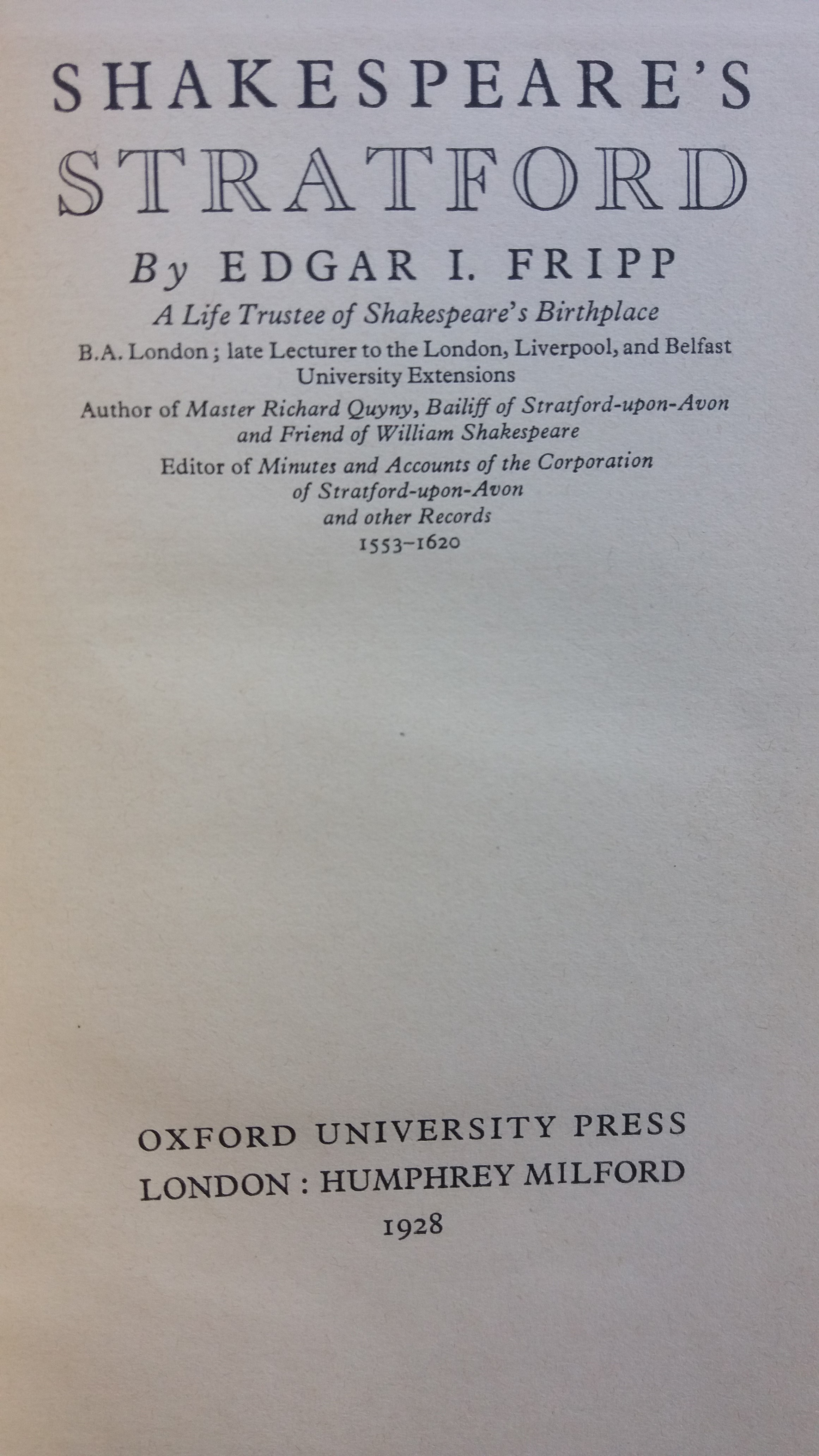
The title page of Shakespeare’s Stratford


In Belfast he had been innovative, imaginative and creative. He was a genuine scholar, he had been a Hibbert Scholar in Germany before entering the ministry, and was a caring and effective pastor. All this can be seen in his Kalendar, the first monthly magazine to be distributed within a church of the Non-Subscribing tradition in Ireland. Before he had arrived the Second Congregation had left the presbyterian structures to pursue their own course although they were rooted in the Free Christian theological traditions exemplified by James Martineau.


Early in his ministry he had produced an account of the composition of the book of Genesis, by the end of his ministry he was completely absorbed in Shakespearean studies. He published a number of works on Shakespeare, and his life and times, and became a trustee of Shakespeare’s birthplace. Indeed it is interesting to see that today the Shakespeare Birthplace Trust has a short video examining E.I. Fripp’s analysis of Iago:

http://findingshakespeare.co.uk/shakespeares-villains-iago


At the end of his life Fripp’s funeral took place in Shakespeare’s church and he was buried in Stratford on Avon. But he produced a large amount of work on Shakespeare and I have often been tempted to seek out a contemporary Shakespearean scholar to give an assessment of how these works are regarded today for Faith and Freedom. There is and has long been a vast industry around Shakespeare and each age finds a different set of interpretations that reflect its own circumstances. It would be nice to know from the point of view of an English literature specialist what endures from Fripp’s writings. But if nothing else he had an enduring impact on the topography of South Belfast, something that continues to this day.


AllSouls02

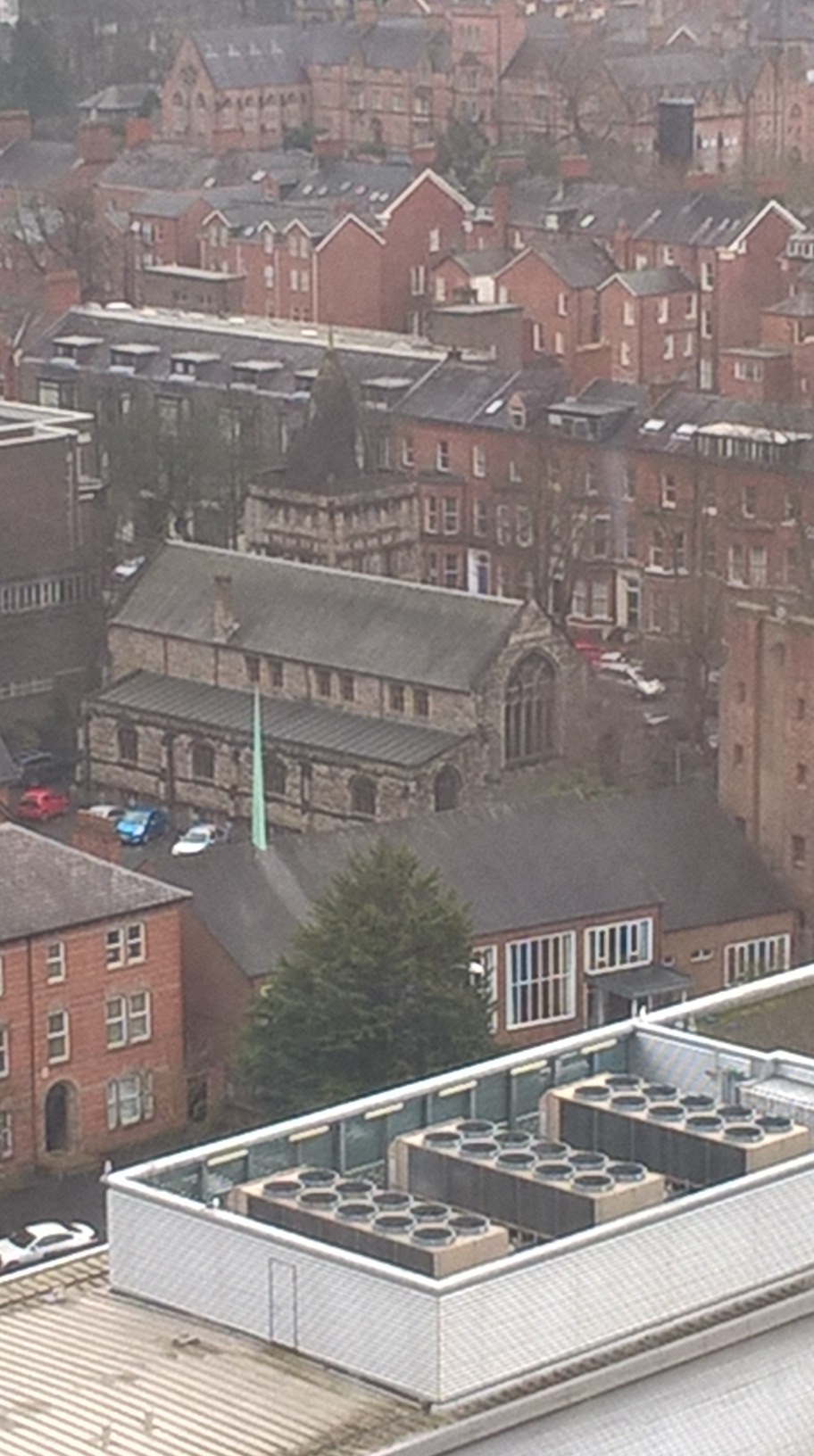
The view of All Souls’ today from the Belfast City Hospital