Faith and Freedom Issue 201

The latest issue of Faith and Freedom (Volume 79 Part 1, Issue 201, Autumn and Winter 2025) is now on its way to subscribers. Having been in print since 1947 we have now reached issue 201.
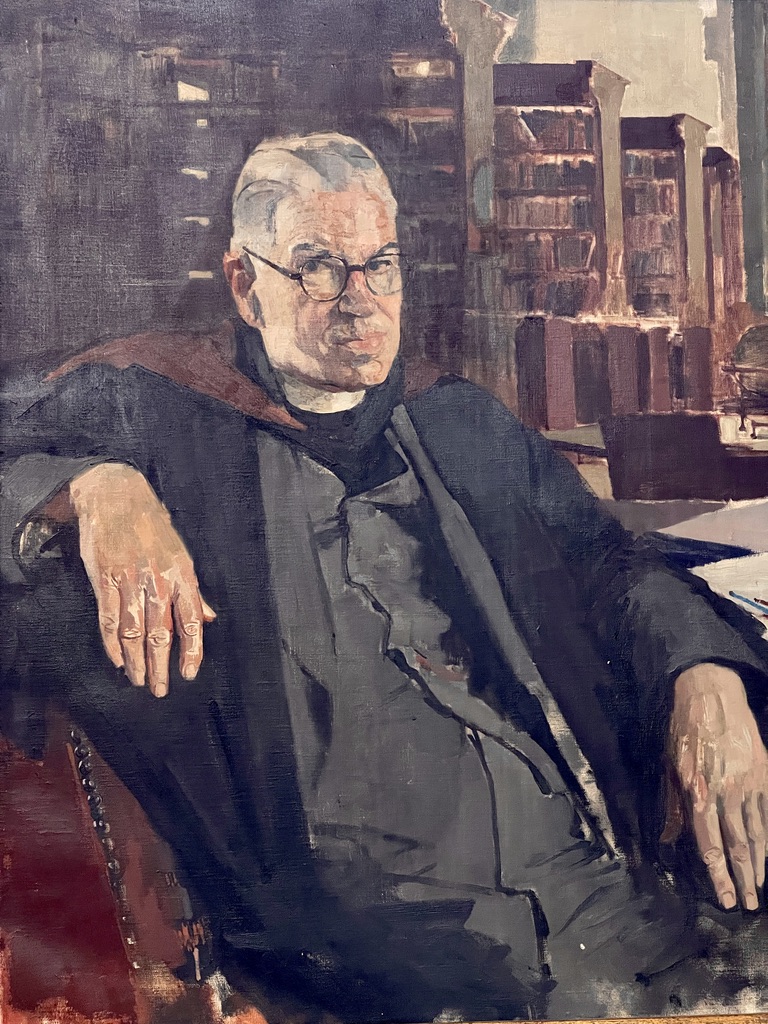
Rev Sidney Spencer by John Stanton Ward, Harris Manchester College, Oxford.

Sidney Spencer is a much neglected figure in twentieth-century Unitarian history and Jo James gives a comprehensive examination of his theological ideas. A Unitarian minister noted for his strongly pacifist witness both before and during the Second World War, with only limited formal academic credentials to his name he nevertheless became Principal of Manchester College, Oxford as well as one of the acknowledged world experts on mysticism. His interest in this subject resulted in a number of publications culminating in the Pelican Mysticism in World Religion in 1963, an influential work and something of a best seller in its day. Jo illuminates Spencer’s theology, sets it in its context and seeks out its relevance to the present day.

This year is the 100th anniversary of the ‘Scopes Monkey Trial’, the famous trial which took place in Dayton, Tennessee when local teacher John Scopes was taken to court for teaching Darwin’s theories in his classes, contrary to the law of the state of Tennessee. John Midgley gives a timely account of this key event, forever made famous by the movie Inherit the Wind, starring Spencer Tracey.

One hundred years is a long time yet the whole case has many uncomfortable resonances in the present age and these perhaps feed into the current situation in the United States. Dan C. West, who has ‘lived through 15 presidents since the beginning of the Second World War’, gives a very insightful analysis of the current political, theological and cultural trends which mark America today.

How do we understand our place in the universe, how do we understand the universe itself in theological terms? Feargus O’Connor provides an excellent examination of Our Mysterious Universe: Accident or Design? looking at the philosophical notions that underpin the argument from design.

Following on from Barrie Needham’s article considering the Koran/Quran from Western, liberal Christian eyes in our last issue, we are pleased to include a response from Imran Usmani who brings considerable insight to the topic through his extensive researches on Christianity, Judaism and Islam.

We are delighted to once again include a number of reviews, including Peter B. Godfrey’s review of Diarmaid MacCulloch’s Lower than the Angels: A History of Sex and Christianity; Peter’s review of the late Rev Art Lester’s  Thank God I’m an Agnostic: Trusting your Hunch about God, the Universe and All That and the editor’s review article on A Short History of the Non-Subscribing Presbyterian Church of Ireland. Including Sketches of Individual Congregations and a Fasti of Ministers who served in them by John Nelson.

You can take out a subscription via Nigel Clarke, our Business Manager, or online via PayPal. The details of how to subscribe can be found on our website here: https://www.faithandfreedom.org.uk/subs.htm
Faith and Freedom 200th Issue

Having been founded in 1947 we have now reached the significant milestone of our 200th issue. Still proudly flying the flag for a thoughtful, liberal approach to religion our journal goes all round the world and has readers on every continent.

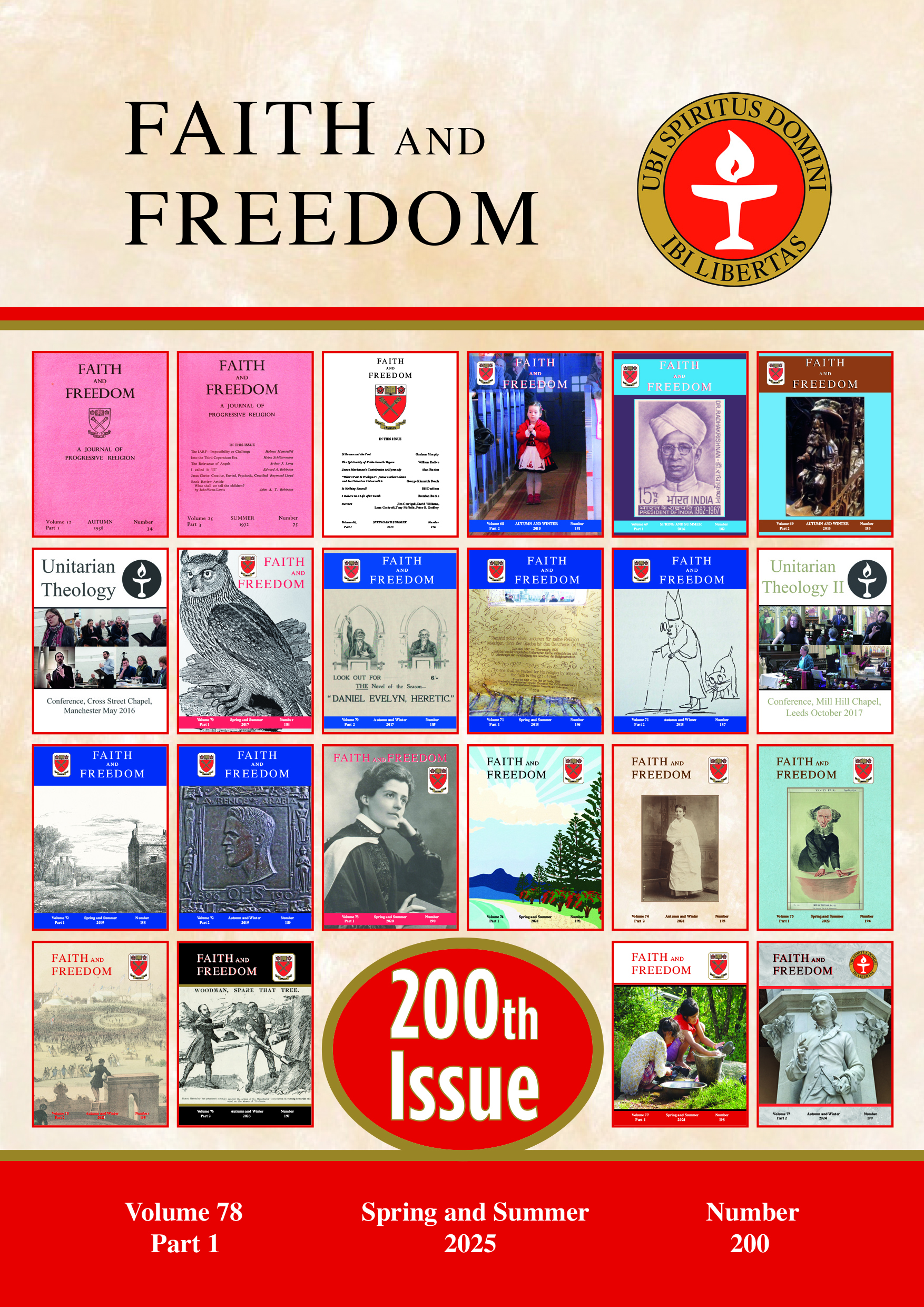
200th Issue Cover

Our Cover includes pictures of a selection of some of our 200 issues. We’ve had some splendid images in the last few years with photographs taken by some notable photographers as well some historic pictures or artworks that have really stood out.

With this being such a special issue we have selected three articles from our back catalogue that shed some light on our development over the last 78 years..

The first is from our very first issue. A Declaration of Faith by Dr Albert Schweitzer set the tone at the very genesis of this journal. It is hard to over estimate the importance of Albert Schweitzer within liberal circles at that time. A polymath thinker, theologian, humanitarian, philosopher, physician, he epitomised the cutting edge of a liberal, questioning approach to religion in the mid-twentieth century. Written for a meeting of the International Association for Religious Freedom, the world’s oldest interfaith organisation, a body which we have often had close interactions with, it was a considerable coup to have his contribution in the very first issue.

The second article is God is Necessary by H. Lismer Short published in Autumn 1958. At the time he was a future Principal of Manchester College, and his article displays the depth and breadth of his scholarship. Essentially an answer to the humanism of that age and the development of a scientific thinking that had unsettled the traditional Unitarian approach to the divine. The article declares that we ‘have been satisfied with cosmic explanations or enquiring agnosticisms, and have not sufficiently tackled religion from the end of human anxiety and dread.’ The traditional proofs of God no longer hold but ‘all the burden of living’ still required a place for faith in a personal God.

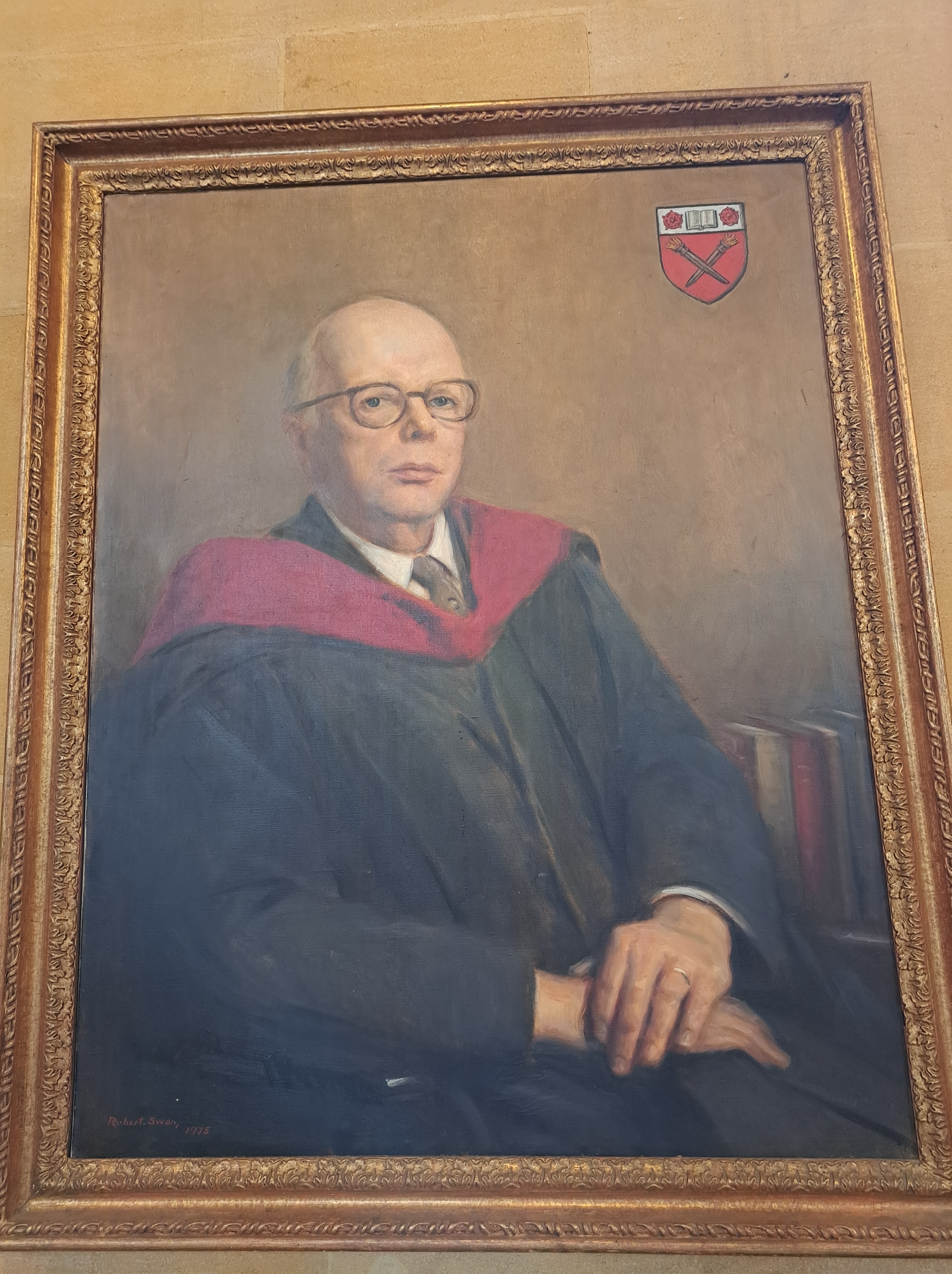
Harry Lismer Short. Portrait in Harris Manchester College

The final article from our back catalogue in this issue is A Rational Basis for Religious Belief by Arthur J. Long dating from Summer 1974. Another Unitarian Principal (this time of the Unitarian College, Manchester) this is another article which displays the writer’s considerable erudition as well, in Arthur’s case, of his irrepressible sense of humour. What is particularly interesting about this paper is that it was prepared for a long-forgotten meeting between Unitarian and Roman Catholic theologians which took place in 1973. The papers for this encounter still exist and it might be profitable at some stage to revisit them. The basis of this article is not to ask ‘Does God exist?’ but rather ‘What sort of God?’, he rejects the argument from revelation and the argument from experience and roots religious belief in a rational theism, ‘underpinned by a rational empirical theology’, and uses Peter Berger’s A Rumour of Angels to frame his apologia.

Rev Arthur Long (from the cover of his 1978 Essex Hall Lecture)

New pieces for this issue include On Reading the Koran by Barrie Needham, a timely, fair and objective assessment of this crucial text which is so frequently mentioned but very seldom examined. The other is Frank Walker’s The Sybil’s Request. Death and Our Human Imagination which explores how we understand death, Heaven and eternity and ranges over the thinking contained in the poetry and literature of such figures as T.S. Eliot, T.F. Powys and Julian Barnes, and ends, appropriately enough, with a quotation from Harry Lismer Short.

The articles are followed by a great selection of reviews:

Reviewed by Graham Murphy

Raja Shehadeh and Penny Johnson, ‘Forgotten, Searching for Palestine’s Hidden Places and Lost Memorials’, Profile Books, 2025 reviewed by Graham Murphy

Michael Allured and Kate Dean, ‘Soul Deep: Exploring Spirituality, Together’, Lindsey Press, 2024, reviewed by Laura Dobson

Jade C. Angelica, ‘Where two worlds touch’, Skinner House Books, 2024, reviewed by Peter Hewis

Patrick Riordan SJ, ‘Human Dignity and Liberal Politics: Catholic possibilities for the common good’, Georgetown University Press, Washington DC, 2023, reviewed by Helena Fyfe Thonemann.

Reviewed by Laura Dobson

An annual subscription to Faith and Freedom (two issues) costs £16.00 (postage included) in the United Kingdom. Single copies can be ordered at a cost of £8.00 each (postage included). Cheques should be made out to Faith and Freedom and sent to the business manager:

Nigel Clarke,
Business Manager, Faith and Freedom,
16 Fairfields,
Kirton in Lindsey,
Gainsborough,
Lincolnshire.
DN21 4GA.

Overseas subscriptions are also available.

It is also possible to pay online. For more details see our website:

https://www.faithandfreedom.org.uk/subs.htm

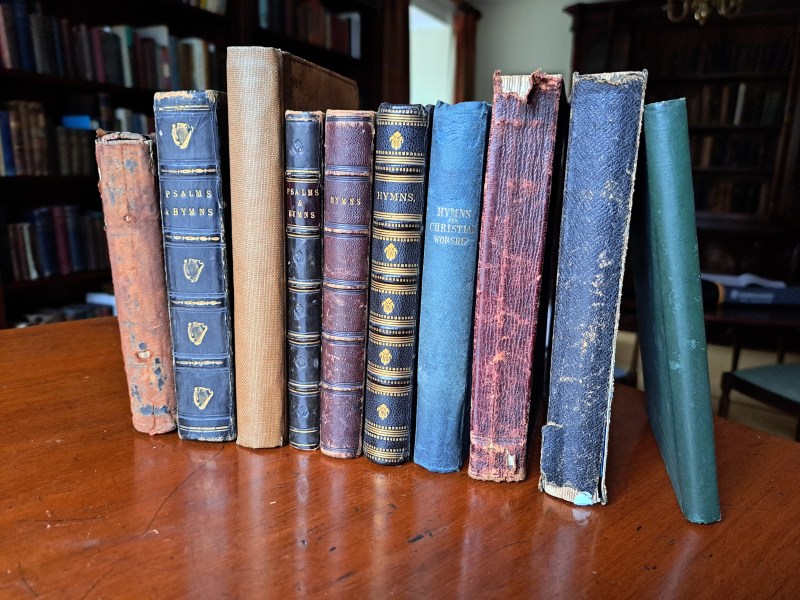
‘Let divine worship be observed, by all who would aspire after the happiness of heaven’. 19th-century Non-Subscribing Presbyterian Hymnbooks

The title of this post comes from the Preface to A Collection of Psalms, Hymns and Spiritual Songs written by the Rev A.G. Malcolm for his hymnbook published in Newry in 1811.

Click on the video to explore Irish Non-Subscribing Presbyterian hymnbooks

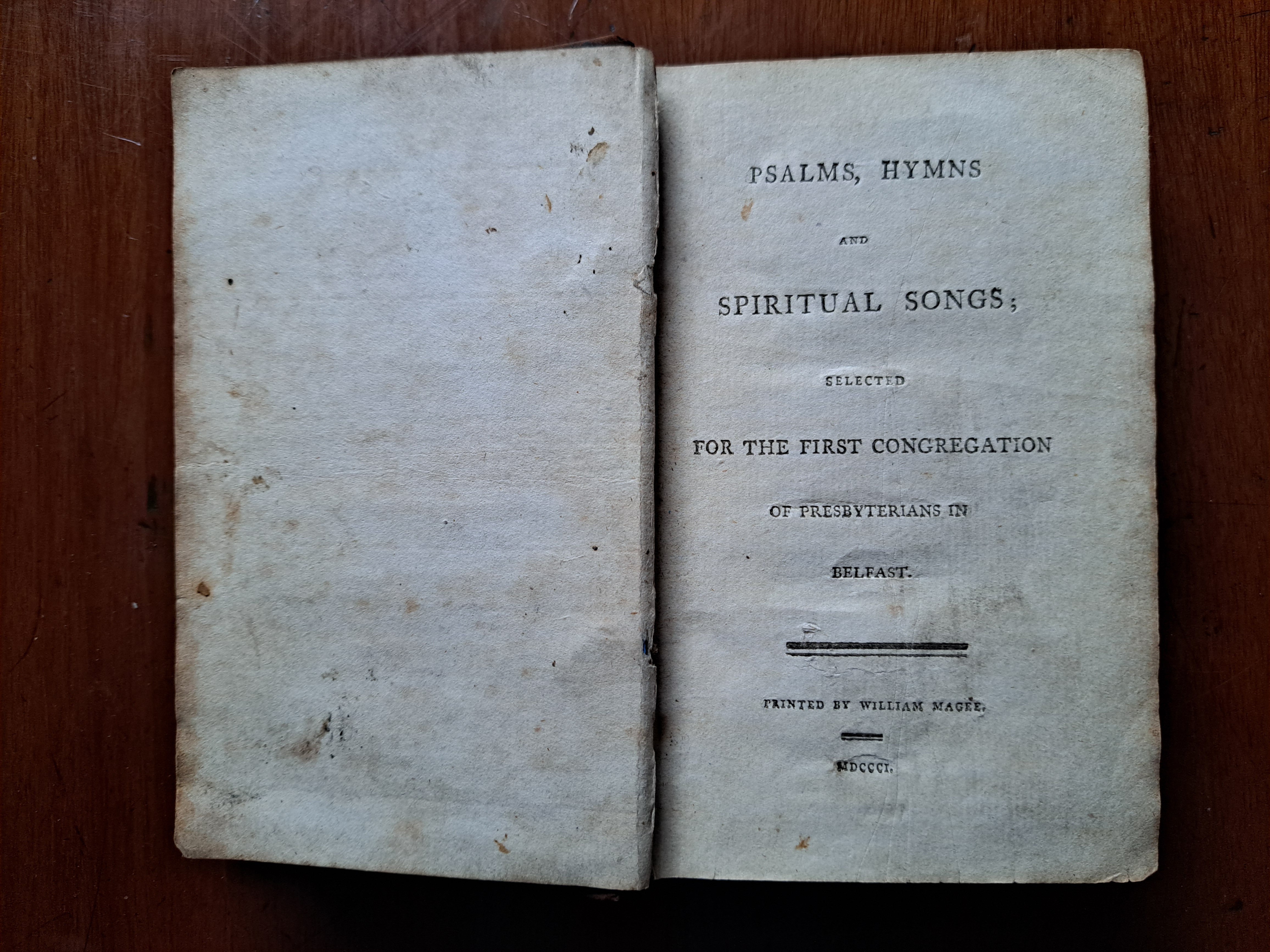
Prior to about 1800 Non-Subscribing or New Light Presbyterian churches, in common with other Presbyterians, would have worshipped with a Psalter or Psalm book. The first distinctly Non-Subscribing hymnbook appeared in First Church in 1801. What is surprising about this publication is that in the same year Edward Bunting offered to supply an organ to the church. This offer wasn’t taken up although in just a few years the Second Congregation were to become the first church with an organ, First Church not acquiring one until 1853. The Rev William Bruce edited this collection and 1,200 copies were published. A choir seems to have led the singing which initially contained boys but was later expanded to include adults.

First Church’s Collection of 1801

William Bruce’s book contained 246 hymns, with an index of first lines and a brief one page table of subjects. The next hymnbook, the Newry edition of A.G. Malcolm, contained 405 hymns with a more substantial table of subjects running over eight pages. Plus it had an index of first lines with the names of authors (for example Barbauld, Watts, Doddridge, Kippis, Merrick, Wesley, Addison, Enfield) which showed the eclectic sources the book drew on from within Dissenting circles and beyond.

An interesting preface also explained their intentions:

…care has been taken, to select psalms and hymns, which treat of of the leading points both of faith and practice; and it is hoped, that the compilation will be found to contain a sufficient variety of the best compositions, in sacred poetry, adapted to all the principal subjects of Christian devotion.

A.G. Malcolm went on:

Correctness, both in sentiment and style, has also been made an object of considerable attention. Hence, many verses have been altered; and such psalms and hymns as seemed, in any degree, unsuitable to the simplicity and solemnity of divine worship have been omitted.

As the work is intended for general use, and must be expected to fall into the hands of persons, who unavaoidably differ from one another, in their opinions, on religious subjects, all expressions, which appeared likely to give offence to any sincere Christian, have been studiously avoided.

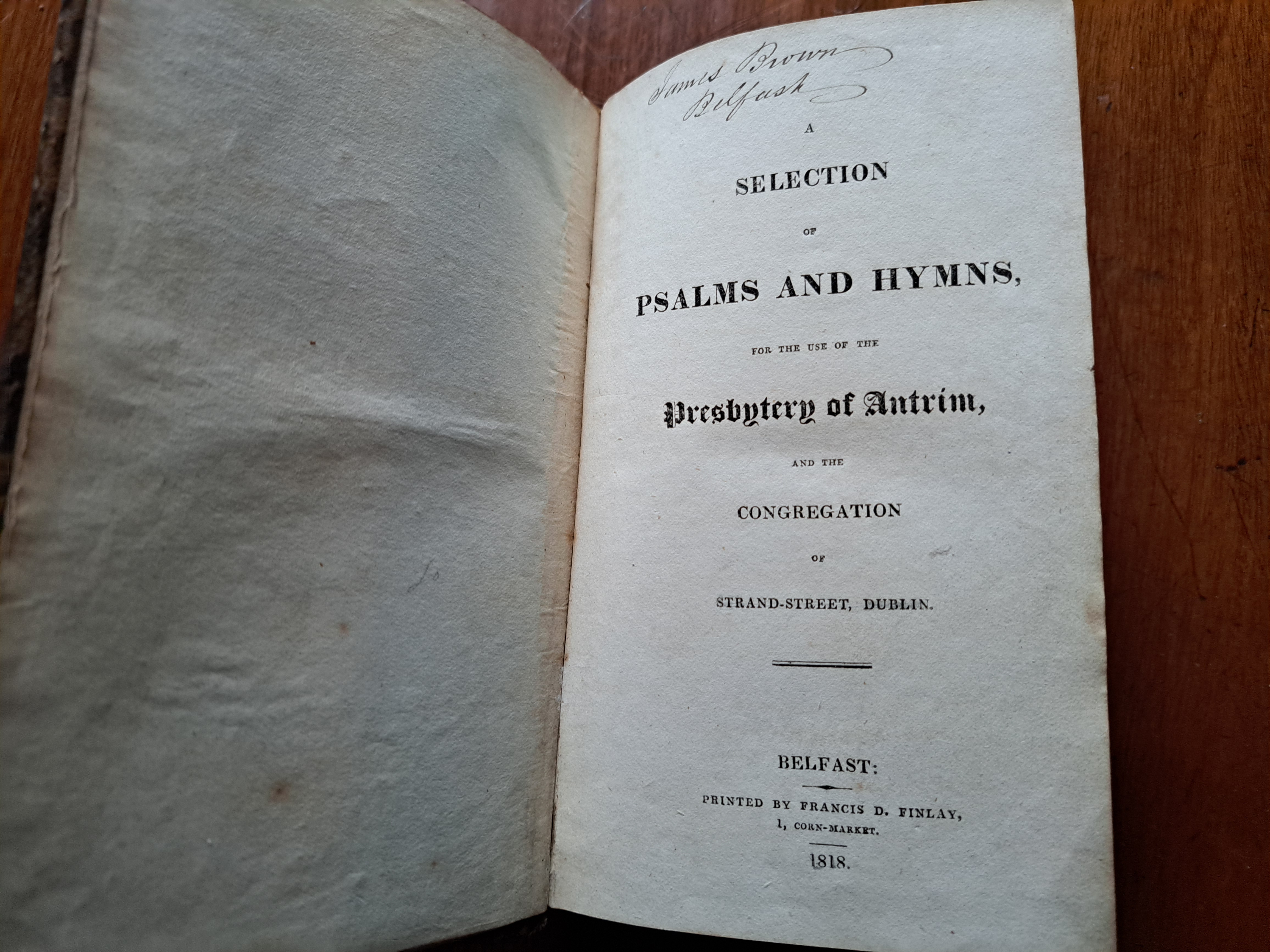
Interestingly the next hymnbook, dated Belfast, July 1818 and edited by Rev W.D.H. McEwen, made a similar point in a slightly more forceful way in its Preface:

Some doctrines are so offensive to the societies, for whose use this compilation is principally intended, that they are carefully avoided. As to others, the same scrupulosity is not observed; for, with respect to them, there may exist a diversity of sentiment. This selection may, therefore, be thought defective, but it will not disgust by a pertinacious obtrusion of doctrine.

So certain doctrines weren’t allowed to get in the way! Some were left out all together – the Trinity, the theory of the atonement based on penal substitution – and on some doctrines Non-Subscribers were able to agree to differ.

W.D.H. McEwen,s hymnbook

The book was published for the Presbytery of Antrim and the congregation of Strand Street, Dublin but it came from the minister of the Second Congregation. Curiously they had installed an organ in 1806 and had Edward Bunting as their organist from then until 1817. So they don’t appear to have had a hymnbook of their own for the first dozen years after installing the organ.

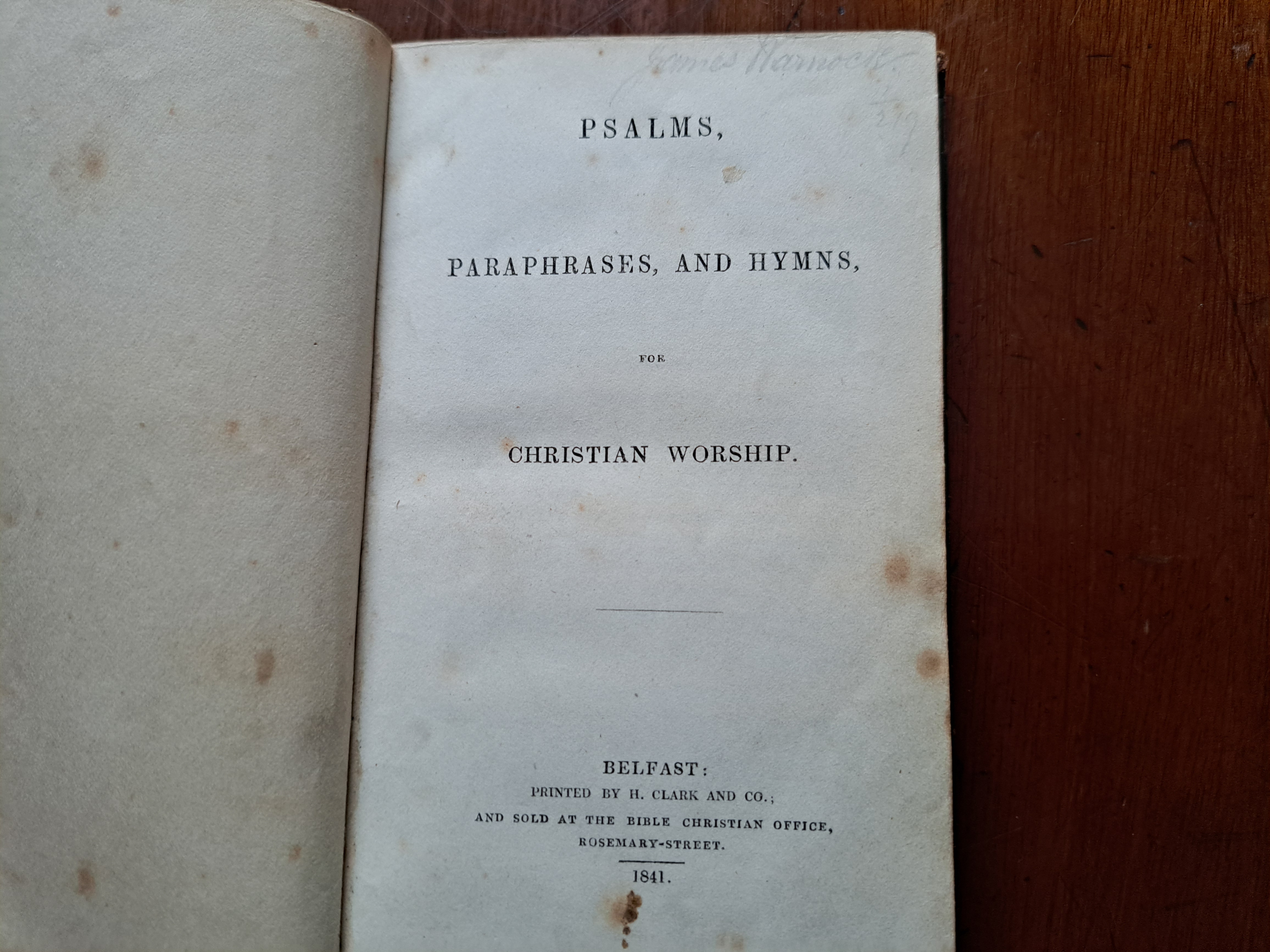
Following the establishment of the Remonstrant Synod of Ulster in 1830 Non-Subscribers moved towards the development of a hymnbook for all churches. This is Psalms, Paraphrases, and Hymns, for Christian Worship published in Belfast in 1841:

Psalms, Paraphrases, and Hymns, for Christian Worship 1841

This is the first edition of what became Hymns for Christian Worship, a book which went into at least four further editions before the end of the century and was followed by a supplement in 1899. Throughout this time this was the main series of hymnbooks in use in the churches in Ireland. More detail can be seen in the video above.

Antitrinitarianism and Unitarianism in the Early Modern World

I was very pleased to be asked to contribute to this book which has just been published by Palgrave Macmillan:

Antitrinitarianism and Unitarianism in the Early Modern World

The publishers describe the volume in these terms:

This collection offers an innovative and fresh interpretation of Antitrinitarian and rational dissent in the early modern world. The central themes focus on the fierce debates surrounding Antitrinitarianism and Unitarianism that emerged from the Reformation and the lived cultures of these dissenting movements. The chapters take an interdisciplinary approach addressing ideas in context, their reception and appropriation, and the diverse and often conflicting visions of Christianity. Drawing on previously unused sources, many from Eastern Europe and often in inaccessible languages, this book challenges our understanding of dissent as marginal and eccentric and places it at the center of contesting convictions about the nature of religious reform.

The contents are as follows:

Introduction

The Porous Boundaries of Dissent

Bruce Gordon

Antitrinitarianism and Its Influence in Italy and Poland

Italian Antitrinitarianism and the Legitimacy of Dissent

Odile Panetta

Scripture, Piety, and Christian Community in the Thought of the Polish Brethren

Sarah Mortimer

Religiosity in the Ethos of Polish Brethren in Light of Funeral and Wedding Speeches from the Seventeenth Century

Maria Barłowska

True Heirs of Jan Łaski: Polish Brethren Church Discipline in the Polish-Lithuanian Commonwealth and During Their Exile in Transylvania

Kazimierz Bem

Transylvanian Unitarianism

The Late Confessionalization of the Transylvanian Unitarian Church and the Polish Brethren

Gizella Keserű

Introduction to the Transylvanian Unitarian Disciplina Ecclesiastica

Lehel Molnár

De Disciplina Ecclesiastica: On Ecclesiastical Discipline (1626)

Alexander Batson

The Term, Development, Purpose, and Practice of Church or Canonical Visitation: Unitarians in Háromszék in the Seventeenth Century Between Conventional Rhetoric and Reality

Lehel Molnár

Some Aspects of the Hungarian Unitarian Liturgy in the Sixteenth to Eighteenth Centuries

Sándor Kovács

Engagement and Divorce Cases Before the Unitarian Consistory in Seventeenth-Century Transylvania. Frameworks in Church Law and the Doctrine of Marriage

David Szigeti Molnar

England, Ireland, and New England

The Historical Critique of Heresiology in the Seventeenth Century and the Origins of John Milton’s Arianism

R. Bradley Holden, Samuel J. Loncar

Authority, Reason, and Anti-trinitarianism: John Abernethy and the Competing Pressures Within Irish Presbyterianism in the Early Eighteenth Century

A. D. G. Steers

The 1662 Book of Common Prayer and Its Adaptation in Eighteenth-Century Rational Dissent

Bryan Spinks

New England Congregationalists and Unitarianism in Late Eighteenth Century/Early Nineteenth Century

Peter Field

The editors are:

Kazimierz Bem, Pastor of First Church in Marlborough (UCC), USA and a senior lecturer in Church History at the Evangelical School of Theology in Wrocław, Poland.

Bruce Gordon, Titus Street Professor of Ecclesiastical History at Yale Divinity School, USA.

  Hardcover ISBN978-3-031-69657-2

  Softcover ISBN978-3-031-69660-2

  eBook ISBN978-3-031-69658-9

You can find out more about this book via this link.

The most interesting place in Southport


Southport is always an interesting place. It has all the usual seaside details you would expect plus some features that mark it out as a little more dignified than the usual destination. Most notably these include the intricate nineteenth-century cast iron verandahs which adorn Lord Street.

But for me, for as long as I can remember, the one place that really stands out is the Shell Shop. You could easily miss it if you didn’t know it was there but it is a place I never walk past without going in.

Youthful visits to Southport with church and youth groups always included a trip to the Shell Shop. It was arranged as a museum around some rickety staircases and took the visitor on an eccentric journey to the South Sea Islands. A large and grubby looking plug from borstal hung near the end of the experience along with, I was recently reminded by Tony the current owner, a large model of a witch doctor placed there to discourage young visitors from shop lifting! Nowadays I don’t go so much for the shells as for the three floors of second hand books. I didn’t realise until a recent visit that the original Shell Shop and book shop were two separate businesses and indeed both were different to the current business, Parkinsons Books, but such was the demand from visitors for shells and other unusual items that the large stock of shells, fossils and curios from around the world remain very much a part of the display.

There is always a good selection of theology upstairs and it is always worth the hike to see what is there. But the shadowy passageway containing the 50p bargains never fails to yield some great finds. Not so long ago I purchased six random volumes of the original Dictionary of National Biography for 50p each. You might wonder why I wanted them since they are quite bulky and are, of course, available online these days, but you couldn’t leave them there for £3. Besides I only have to find 16 more and I will have the full set.

Southport shop front

A Lord Street shop front

Southport colonnade

Victorian cast iron and glass shop canopies

Southport shell entrance

The entrance to the Shell Shop

Southport shell 50p books

50p bargains

Southport shell passage

Getting nearer to the shop

Southport shell books

Ground floor

Southport shell shelves

Some shells

Southport diver

Don’t forget the diver. Southport statue

Fr John Navone’s ‘Theology of Failure’

In the Spring and Summer 2014 issue of Faith and Freedom we were very pleased to have something of a scoop with two articles by Fr John Navone SJ, the leading Italian American theologian whose theology has been acknowledged as a major influence on Pope Francis.


In that issue we were delighted to have John Navone write exclusively about the challenges and priorities of Francis’ papacy. In his first article on the subject for a British or European audience Professor Navone explained the Pope’s interest in his thinking and gave a resumé of his own ‘Theology of Failure’.


Professor John Navone SJ


Just prior to the Pope’s visit to the USA in September 2015 Fr Navone was interviewed by CNN and featured in a long and thoughtful online article on the CNN website by Daniel Burke, CNN Religion Editor. The author discusses Fr Navone’s theological influence on the Pope and carries part of the interview with him. In the piece he quotes Fr Navone as saying:

“There was a blessed juncture between my theology and his crisis…It was a kind of light in the darkness to him.”


And among other things himself says:

As it happened, Navone and I spoke on the day Francis made it easier for Catholics to annul their marriages, and about a week after he encouraged priests to forgive women who have had abortions.

Navone and I talked about mercy, and how it’s hard to forgive others if you aren’t intimately acquainted with your own failures. We talked about a Pope who travels to the peripheries because he himself was sent there. And we talked about Francis’ apparent internal freedom, his refusal to resign himself to others’ expectations.

The full article, ‘The Pope’s Dark Night of the Soul’, can be read here:

http://edition.cnn.com/interactive/2015/09/specials/pope-dark-night-of-the-soul/


Faith and Freedom is also delighted to announce that the Autumn and Winter 2015 issue, due out this week, also carries another timely article by John Navone entitled ‘Finding God in Strangers’.


Faith and Freedom is a print journal but it can be ordered online here:

http://www.faithandfreedom.org.uk/subs.htm



A journey of a thousand miles begins with a single step

These words of the Chinese philosopher Lau Tzu seem appropriate for the beginning of any new enterprise, they also tie in, for me personally, with the picture of the Ancient Chapel of Toxteth, a place which was very much a starting point for me. But the purpose of this blog will be to flag up things that interest me particularly in relation to the journals Faith and Freedom and the Transactions of the Unitarian Historical Society, both of which I edit. Not that I intend to confine myself to either of those publications – anything that catches my eye will go in here – the blog will have a special remit towards faith, religious history and associated matters but it will by no means confine itself to matters of religion.