From Rational Piety to Music Hall

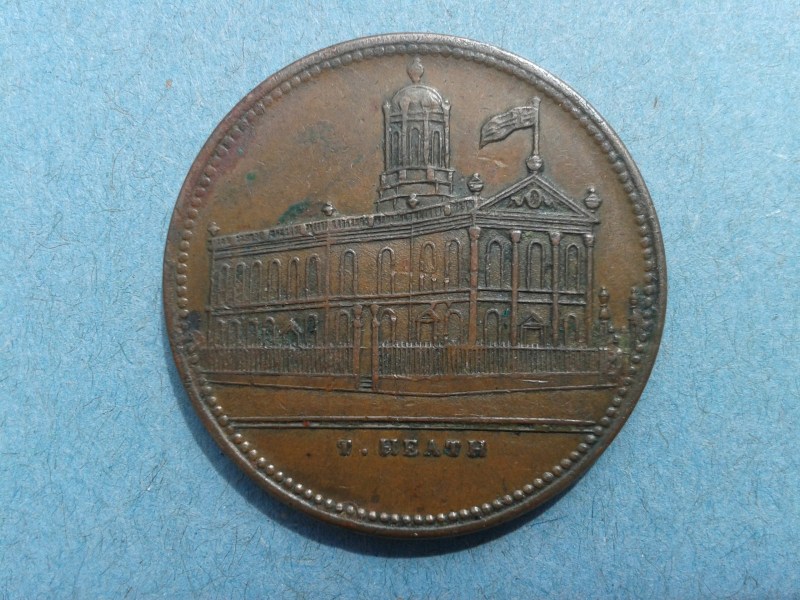
I wonder how many Unitarian churches have their images engraved on the reverse of a coin? I only know of one example, it is not a particularly beautiful example of the medallist’s art but it is very interesting and tells an unusual tale.

The reverse of the token

The church in question is Paradise Street Chapel in Liverpool, now long demolished, indeed the whole street has disappeared under the shopping development known today as Liverpool One. But Paradise Street was built in 1791 and was a dissenting church of some importance in Liverpool at the time. In the nineteenth century no less a person than James Martineau became the minister – a fitting appointment to a congregation that was cultured, wealthy and influential. They had built their meeting house on the grand scale, with a central cupola it was octagonal with a classical frontage and adorned with elegant stone urns along the balustrade. Martineau arrived in 1832 and established a name for himself as a preacher, teacher and philosopher linking up with other prominent figures in Liverpool and the north west including John Hamilton Thom, Charles Wicksteed, and John James Tayler.

Coinreverse01 detail
Close up of the Chapel

But partly through the changing environment around the old chapel, which had become more commercially orientated and less like an area the well-to-do might want to visit, and partly also because of the more devotional worship that Martineau introduced, the congregation felt a need to abandon their old church and build something new. Accordingly a grand gothic church was built on Hope Street and Martineau and his congregation departed to their new home, selling the old place off. (For Hope Street Church see my earlier post – the Church on Hope Street).
James Martineau and his congregation, perhaps out of financial necessity from building anew on an extravagant scale, showed little sentimentality in disposing of their old place of worship. Yet one can’t help suspecting that a man of such high-brow intellectual tastes as Martineau can hardly have approved of the new use to which the old chapel was now put. It was purchased by a man called Joseph Heath who intended to turn it into a music hall.
After the Unitarians left it in 1849 the spacious chapel, with its well-constructed gallery all built of the finest materials and to the highest standards, was converted into the Royal Colosseum Theatre and Music Hall. The pews were re-used for seating and one can see how a large chapel could easily be adapted for use as a theatre. However, Joseph Heath must have been an ingenious individual because he managed to turn Paradise Street into the first multiplex: there were twin auditoria for both a theatre and a music hall. According to The Liverpool Stage by Harold Ackroyd the theatre “presented what were described as full blooded dramatic plays for a patronage of mariners”, while the front part of the old chapel was converted into a music hall where variety performances were put on “well suited to the taste of those for whom Mr. Heath catered.”
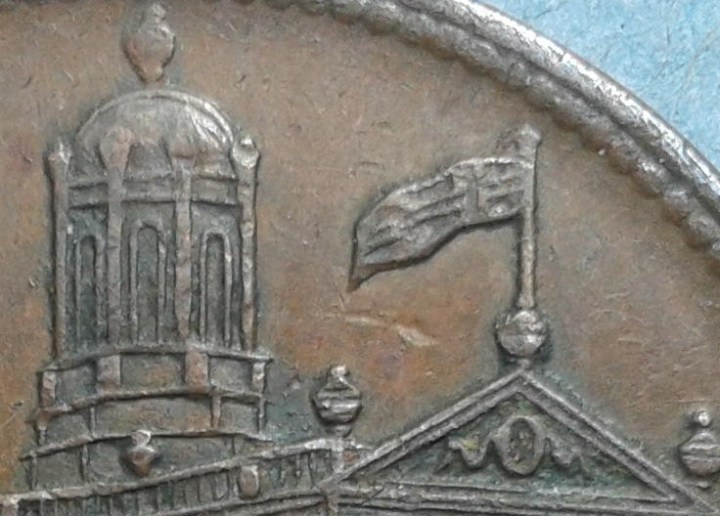
Coinreverse01 detail tower
Detail of the tower

One can’t imagine Martineau really approving of such an undignified end to his old church but there was greater indignity to come. The Colly, as it became known, was reputedly haunted, an association encouraged by the continuing presence of the chapel’s graveyard around the building. This also presented a practical advantage to the thespians. According to Harold Ackroyd again:
…there was never any shortage of a skull during a performance of Hamlet. These were easily obtained, the artists’ dressing room, below the stage, formerly having been a grave vault, the artist had only to put his hand through an opening in the thin dividing wall, to seize hold of the grisly relic, as did Hamlet.
So it was the music hall owners who had the coin engraved with the unmistakable likeness of the Paradise Street Chapel. The Heath family owned the former chapel until about 1895 although it went through a number of refurbishments and changes of name in that time. But it remained known as the Royal Colosseum Theatre until 1875 at which time it was being run by Thomas Theodore Heath, Joseph’s son. Presumably this is the ‘T. Heath’ whose name is inscribed on the coin as the owner of the theatre. This would date the coin to the early 1870s when it functioned as an admission token for those eager for Victorian melodrama or the bawdy delights of an evening at the music hall. On the other side of the coin is a Liver bird, a belt and the name of the theatre. Some examples of the coins have a large letter ‘H’ stamped on them. I don’t know precisely what this indicated, at first I thought it was a reference to a seat or a row or an entrance but ‘H’ seems to be the only letter used in this way and it rather spoils the look of the engraving. Whatever meaning it had to the person at the theatre door this is now long forgotten.

An example of the coin with the letter 'H' stamped on it
An example of the coin with the letter ‘H’ stamped on it

By the late 1870s the theatre was said to be able hold 3,000 people, and must have been returned to a single auditorium, but at this stage in its history it was struck by a terrible tragedy. On the night of 11th October 1878, during a performance before a full house, a portion of the ceiling fell onto the pit and caused panic amongst the audience. Thirty-seven people were killed in the crush to escape and many more injured. Pictures in the Illustrated London News at the time show a building that was already extensively remodelled from the one that appears on the back of the token but it had fallen victim to the sort of tragedy that was not unknown in Victorian Britain. Following this the theatre was rebuilt, frequently renamed and continued in use up to the First World War. By then known as Kelly’s Theatre, it finally closed its doors in October 1916 and was sold to Cooper’s Ltd who used it as a warehouse for their greengrocery and restaurant business.

Coinobverse02

The whole story of Paradise Street Chapel and the Royal Colosseum Theatre was brought to a close by a German bomb during the blitz of 1941. Precisely how much of the building of 1791 had survived within the much enlarged edifice is hard to know but by then the building’s origins as a place of worship were hardly remembered. The link is maintained though by these little tokens which record a small element of theatre history and, almost by accident, help to preserve the image of a building that had a quite different history and purpose.

(This is an amended version of an article that first appeared in the ‘Inquirer’ 4 July 2015)

Godshandiwork Puppets at Clough

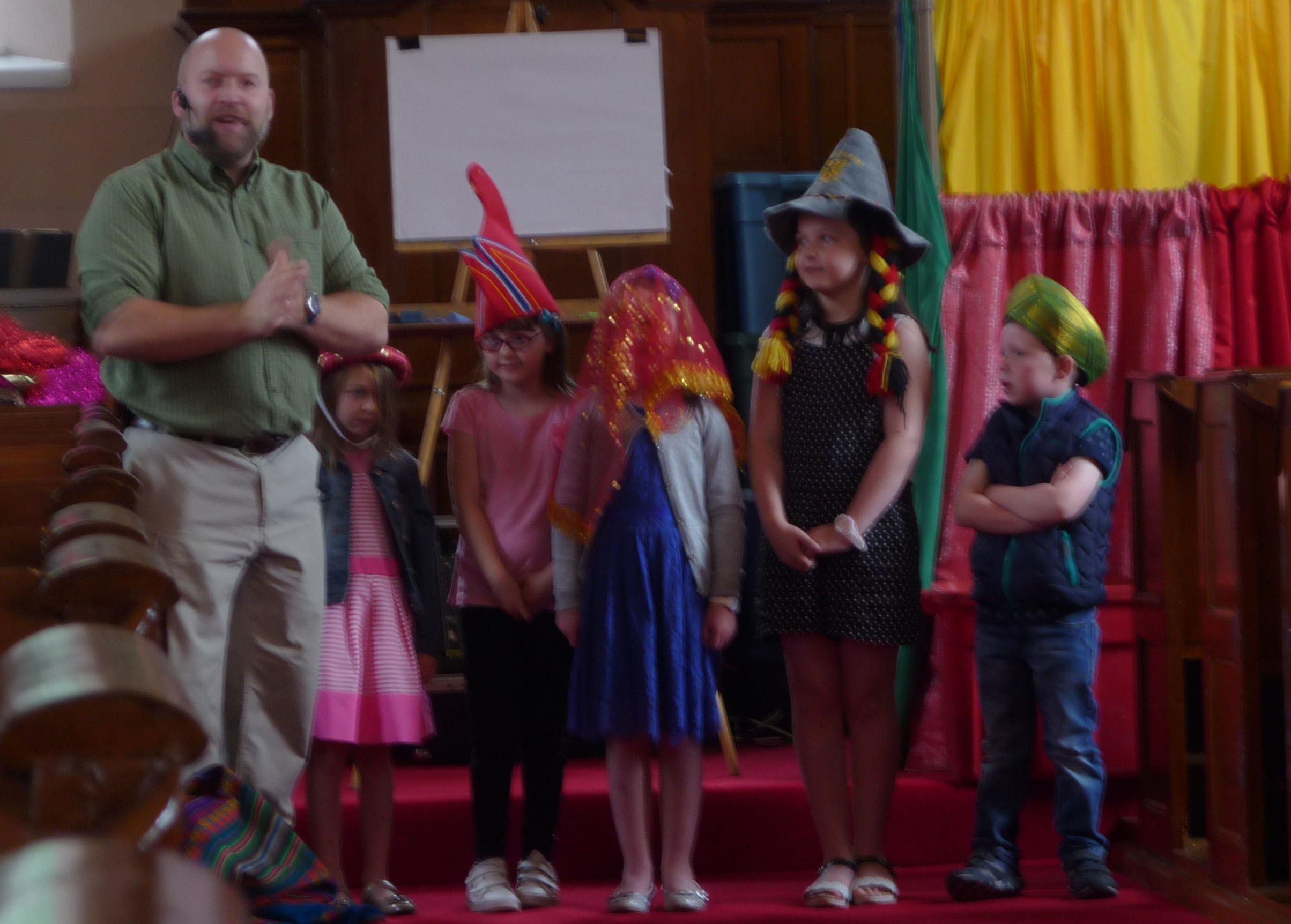
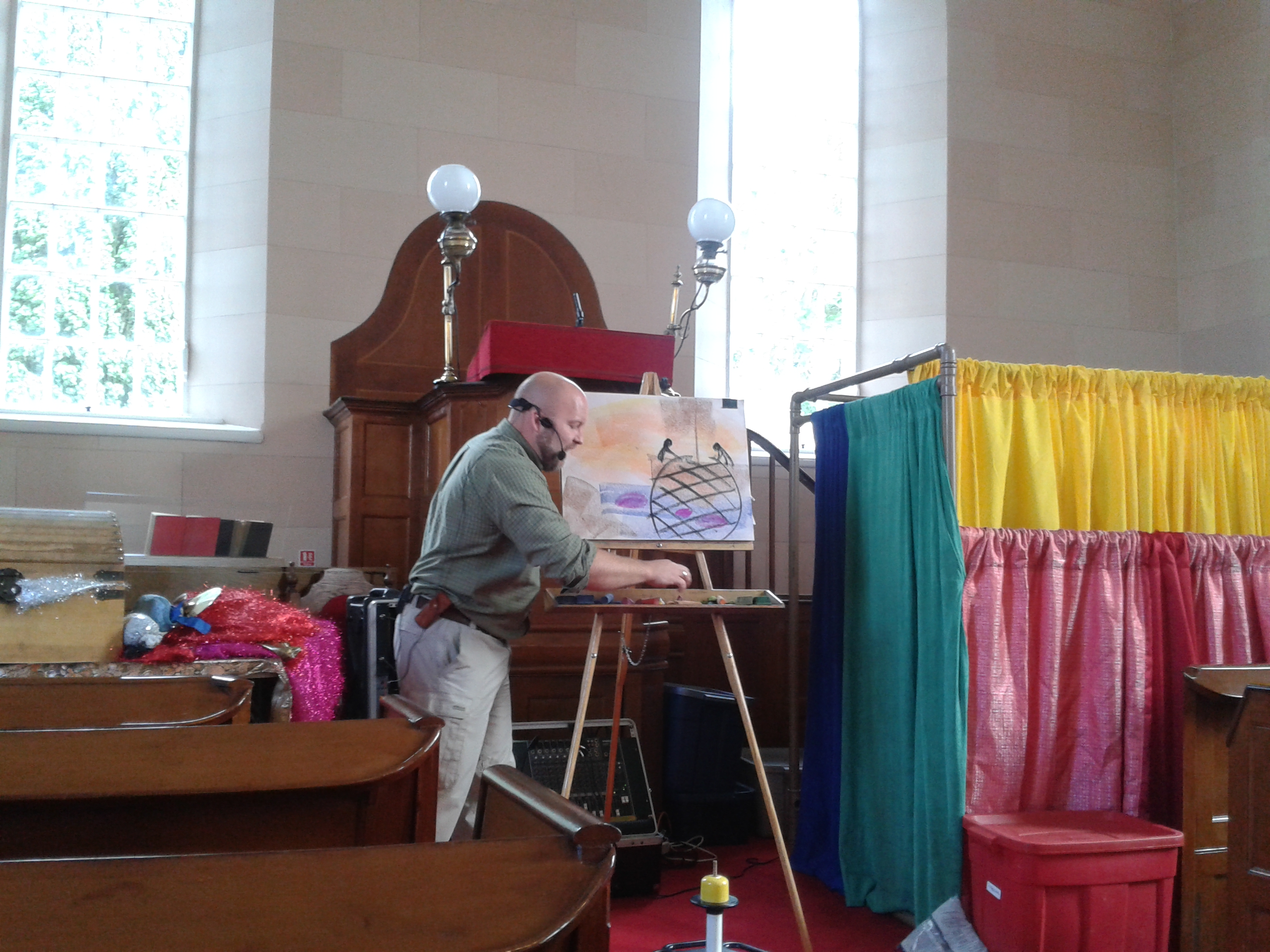
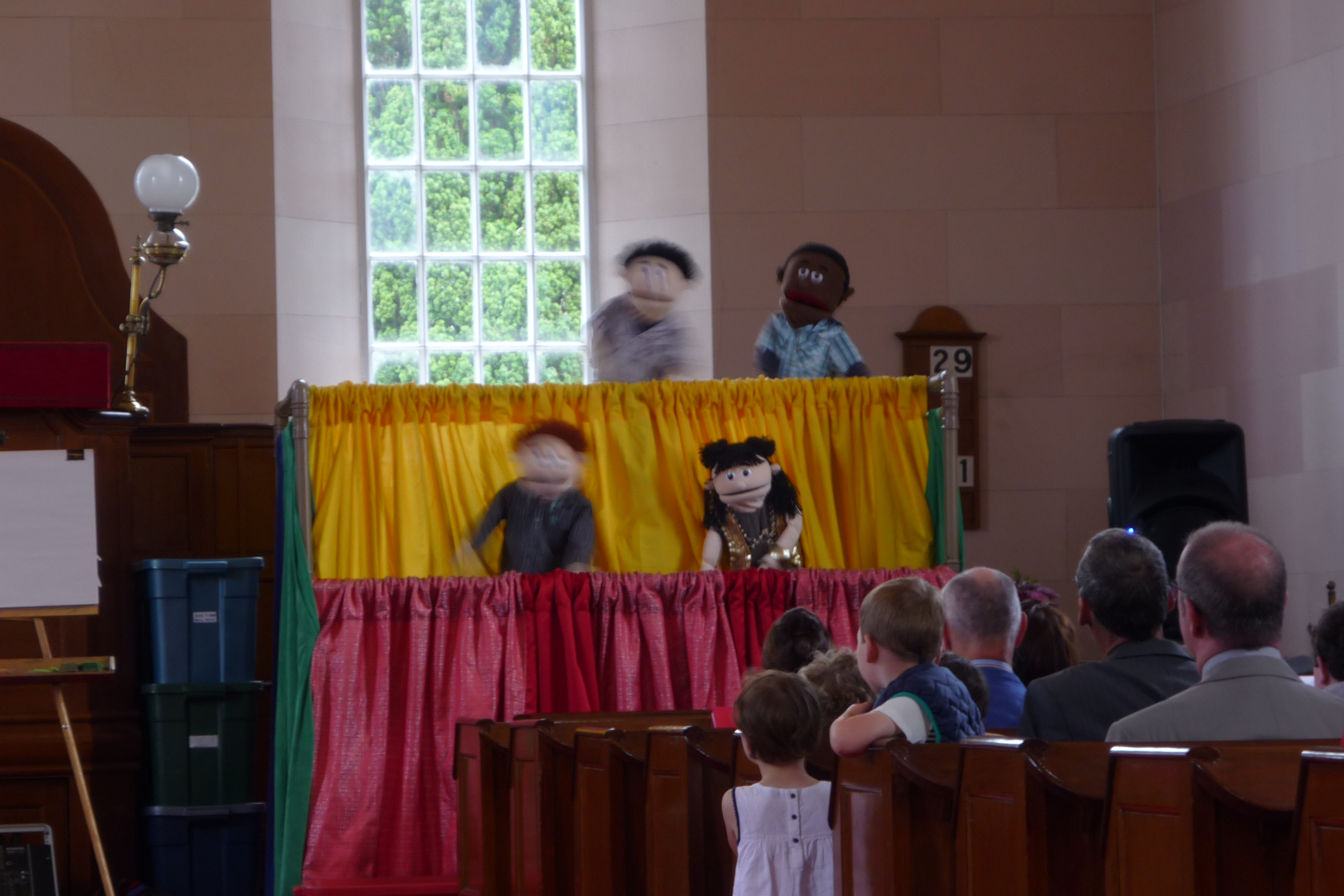
On Sunday, 19th July worship at Clough was led by Sam Shaw and Godshandiwork Puppets. There was a large congregation of members, both young and old, and from Ballee and Downpatrick as well as Clough and everyone was enthralled by the wonderful, varied presentation given by Sam and his team which included puppets, music, drawing and lots of fun.

Wearing hats from all around the world
Puppet quartet
Puppet quartet
Telling the story through art
Puppets in song
Puppets in song
Watching the puppets
Brown bear and polar bear

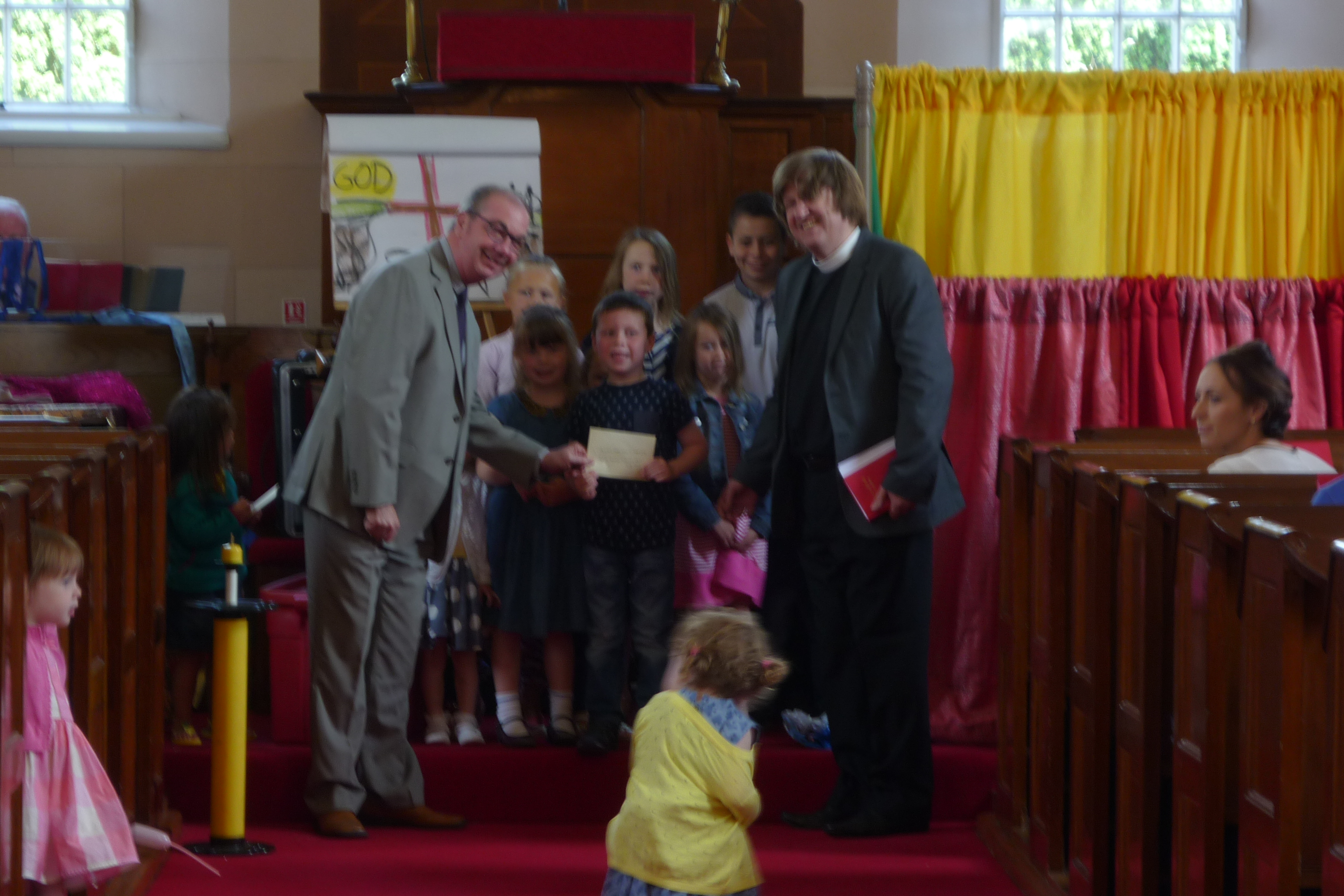
Over the last year Clough Sunday School have also been raising money for the Downpatrick and District Autism NI Parents Support Group and at the end of the service Sunday School member Thomas Rooney presented a cheque for £230 to Ashley McKinley on behalf of the Parents Support Group.

Thomas Rooney makes the presentation to Ashley McKinley
Some of the congregation

On the road with the Unitarian Van Mission

I probably first came across the Unitarian Van Mission in the late Professor R.K. Webb’s masterful survey of ‘The Unitarian Background’ in the 1986 volume Truth Liberty Religion. Essays celebrating Two Hundred Years of Manchester College (edited by Barbara Smith). However, the end of his chapter takes on a very negative tone where he describes “precipitous decline” being caused by the “attenuation and fragmentation of Unitarian doctrine”. In this context he mentions “the touching Van Mission that wended its slow way through the country in the years after 1906”.

This really is a slightly patronising view of the Van Mission and, of course, is not really fair. From the perspective of the late twentieth century anything that relied on horse drawn power could be regarded as touching and slow. But in 1906 people would not regard such a mission in any such way.

It is clear from the response to my previous post that there is a great deal of latent interest in the Unitarian Van Mission. It is also the case that there is the material for a serious research project on it. John Roberts’ useful investigation into the Van Mission in the 1978 Transactions of the Unitarian Historical Society is just about the only thing that has been written on it since the First World War. I don’t have much else to hand that can shed light on the Van Mission but the one thing I do have is the special centenary edition of the Christian Life from 1913 – a single issue of that magazine that never fails to provide something of interest.

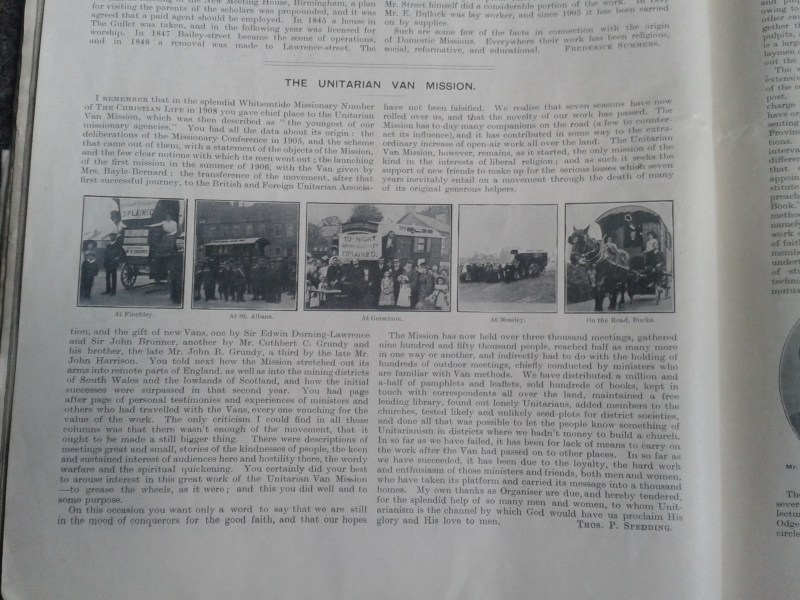
It was published to mark the centenary of the Trinity Act and includes a vast amount of material. One of the shorter sections – only about half a page – is that on the Unitarian Van Mission written by the Rev T.P. Spedding and accompanied by five fascinating, if frustratingly small, images. The article is, like almost everything in that issue, quite relentlessly positive and upbeat. In part this reflects the celebratory nature of that publication but it also reflects the underlying truth – they were positive, things were going well, they didn’t know the world stood on the brink of a brutal world war, and they had every reason to feel that in religious terms their ideas, if not all-conquering, were at least gaining a positive reception and winning ground.

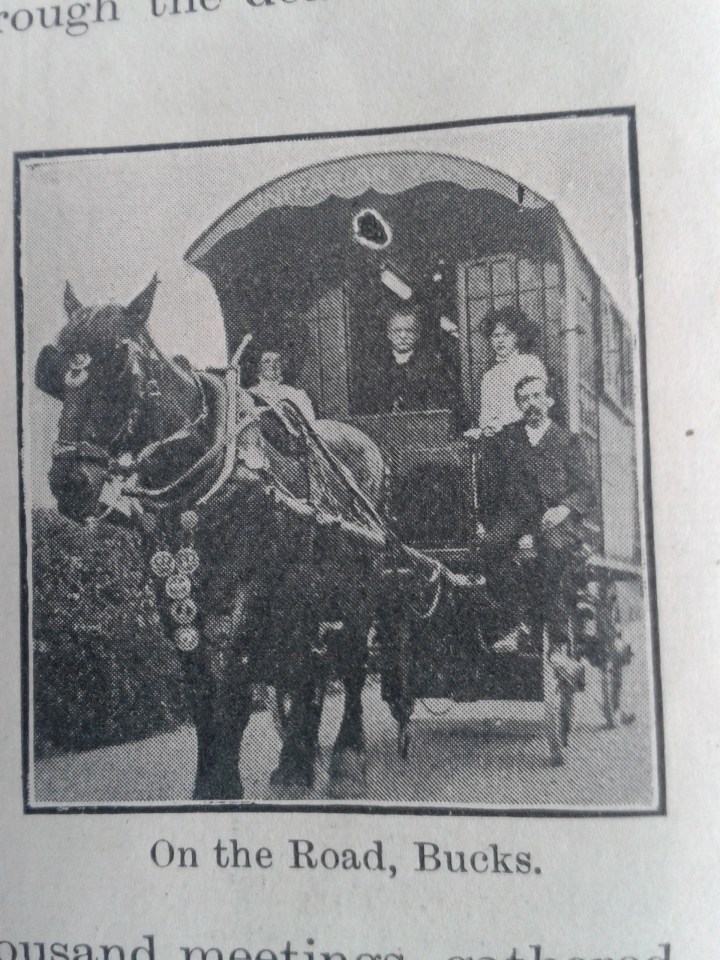
On teh Road Bucks
The Van on the move, the horse with its brasses and the Rev T.P. Spedding with three assistants on board

T.P. Spedding writes how the number of vans had increased to four thanks to donations by Sir Edwin Durning-Lawrence, Cuthbert C. and John R. Grundy, and John Harrison. (John Roberts suggests that in the end there were six vans on the road.) But if T.P. Spedding’s statistics are accurate it had been an extraordinarily active movement:

The mission has now held over three thousand meetings, gathered nine hundred and fifty thousand people, reached half as many more in one way or another, and indirectly had to do with the holding of hundreds of outdoor meetings, chiefly conducted by ministers who are familiar with Van methods. We have distributed a million and a-half of pamphlets and leaflets, sold hundreds of books, kept in touch with correspondents all over the land, maintained a free lending library, found out lonely Unitarians, added members to the churches, tested likely and unlikely seed-plots for district societies…

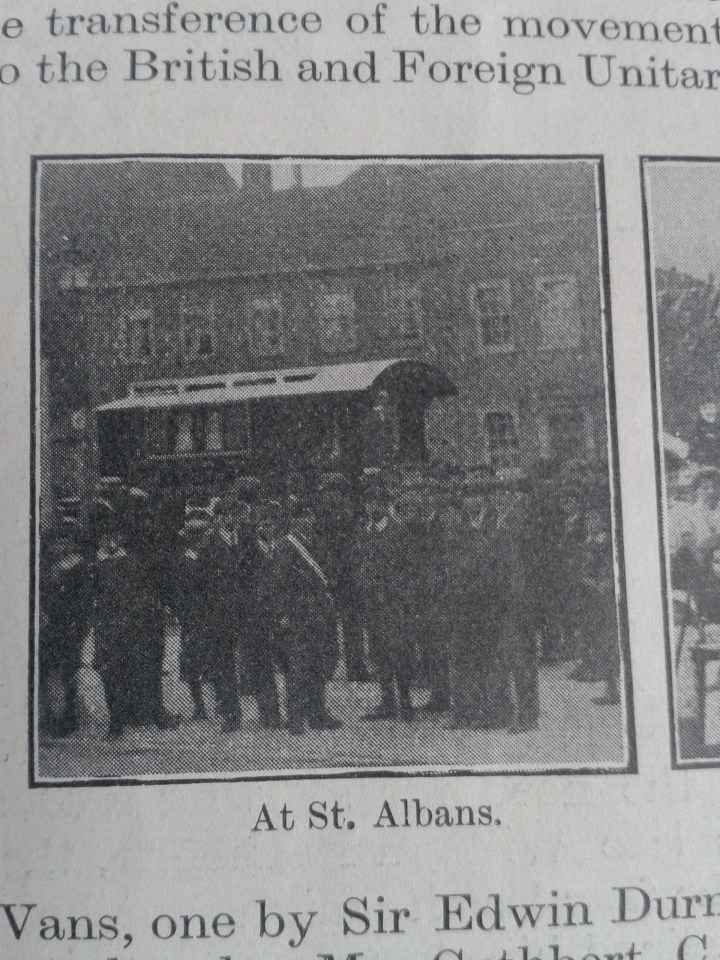
At St Albans
A meeting at St Albans

Three thousand outdoor meetings in about seven years! Even with modern media gathering 950,00 people online would be something that any church publicity movement would be very proud of.

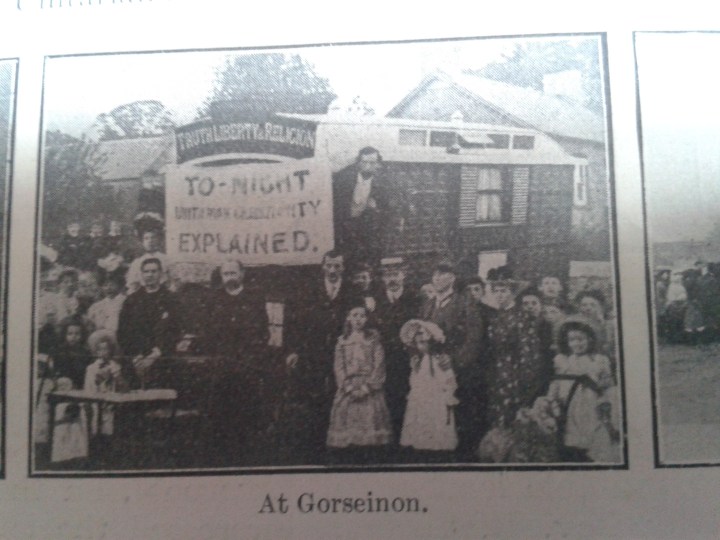
At Gorseinon
Gorseinon near Swansea

Its clear that the Mission didn’t just go into uncharted territory but also went to places where it supplemented an already established witness. It also faced competition from many other churches that were doing something similar and opposition from some who, T.P. Spedding seems to suggest, may have had this purpose in their design.

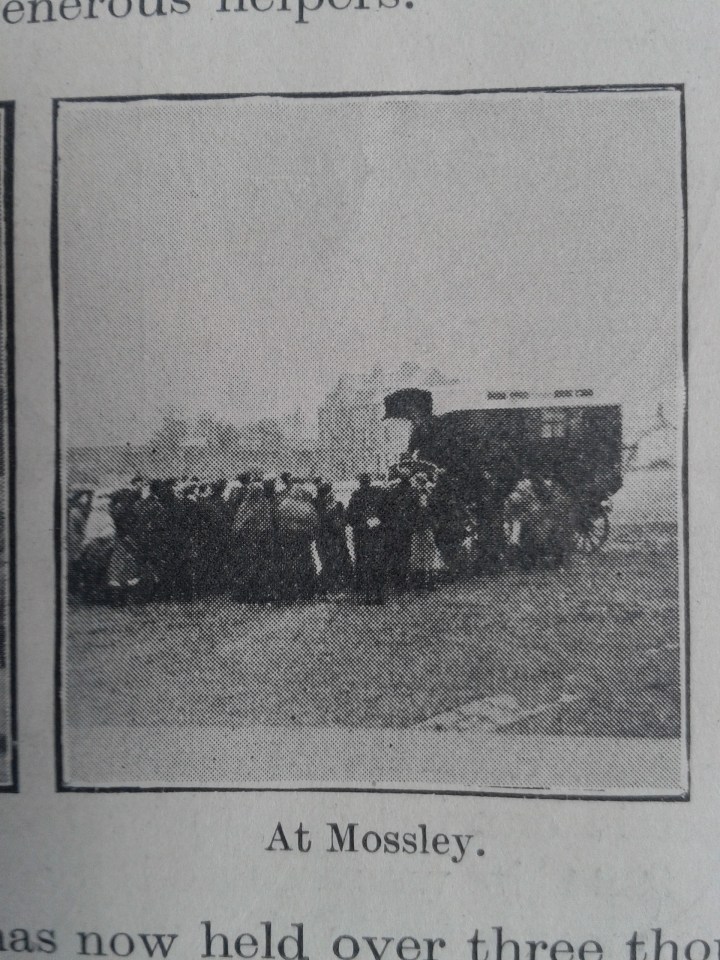
At Mossley
A busy meeting at Mossley where a church had existed since the 1840s

Nothing I have yet seen explains the logistics of operating the Mission – presumably horses were hired or loaned wherever they were needed by the local people. There must have been a lot of careful organisation behind its running. But there are records in various places that will repay careful examination and a fuller picture can be built up of the Mission’s operation.

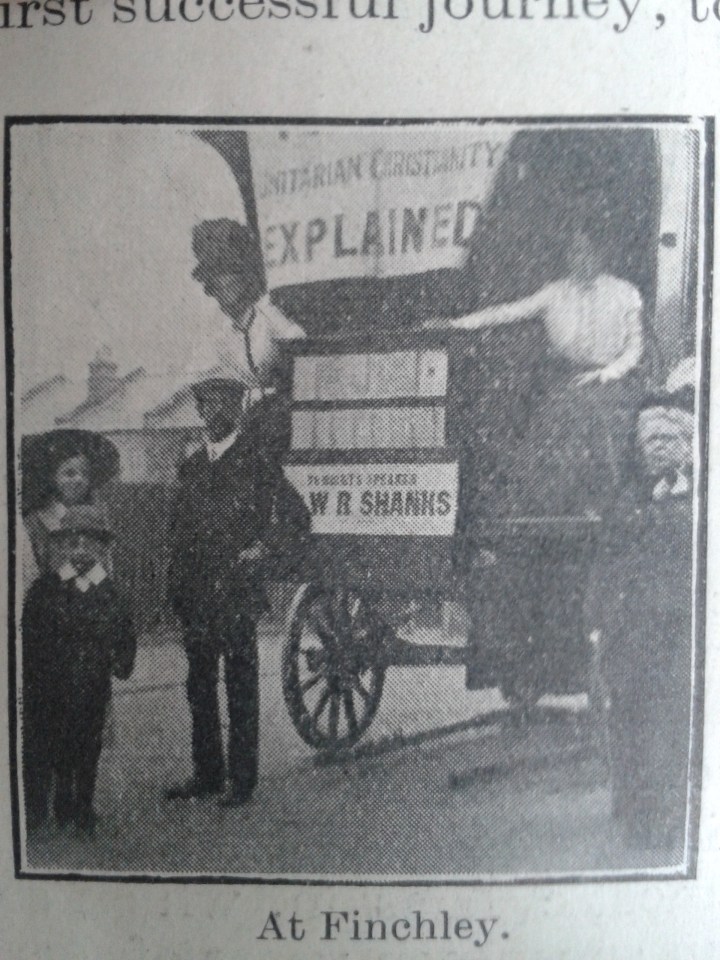
At Finchley
Finchley, “Unitarian Christianity Explained. Tonight’s Speaker [Rev] W R Shanks” – the Rev William Rose Shanks (1856-1928)
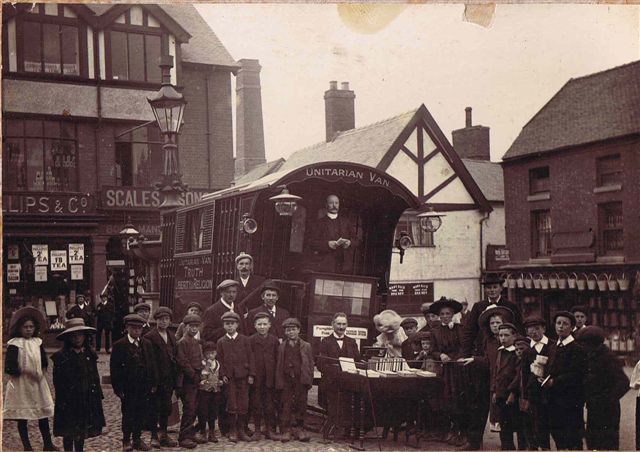
The pictures in Christian Life are small and are not terribly well reproduced. The best picture of the Mission in operation is still the one I reproduced on this blog a few weeks ago. A lot of people have looked at it but we are still not able to identify the location. Both Len Smith and Rachel Eckersley are working hard on finding the spot, the presence of a number of named shops should be a help. It appears not to be Chesterfield, Northwich or Burslem which all had a branch of Scales and Sons. The town of Malton, which seemed a good possibility, can now be discounted, Len has discovered. Wrexham may be a possibility. But we still need to find the place where this interesting photograph was taken. If you have any suggestions please do send them in.

Van Mission Square

The discoverer of Pluto

If you look up at the night sky on a clear night you will gradually see hundreds and hundreds of stars. In fact we know there are hundreds of thousands of millions of them, each one of them a star like our Sun. Around our Sun there orbit a number of planets and around all the other stars in the universe there must be planets of different shapes and sizes. Astronomers know of the existence of about 170 of these, light years away from us and discovered, so I read, by a process called microlensing.


If you were asked how many planets there were in our solar system you might say that there were eight or nine. Officially now there are eight although Pluto, the planet most recently discovered – as recently as 1930 – has now been demoted and is officially regarded only as a dwarf planet. It is also a very long way away – so far away that it takes 248 years for it to orbit around the Sun compared to the 365 days it takes our Earth. But because it is quite small and exists in an area where there are lots of other things floating around – the Kuiper Belt – it has been denied its planetary status by astronomers in the last ten years. However, this is still controversial and not everyone agrees with it.


But Pluto is in the news again this week as the US spaceship, New Horizons, which was launched nine years ago in 2006, will become the first space craft to visit Pluto.


Having journeyed through space for more than three billion miles, New Horizons will come within 7,800 miles of Pluto at 12.49pm Tuesday, 14th July UK time. As it hurtles past it will take photographs and make measurements of the distant planet which will tell us something about its composition and atmosphere.


But the story of Pluto’s discovery is not without interest. It was discovered in 1930 by Clyde Tombaugh. Although he was the first to discover it and he later helped to found the New Mexico State University’s astronomy department he didn’t start out as an astronomer. He grew up on a farm in Kansas and became interested in the stars and the planets as a boy. He built all his first telescopes out of farm machinery and the telescope he used to search for Pluto was made from things he found on the farm when he was 24. Other astronomers had predicted the existence of Pluto but Clyde Tombaugh, using a telescope made from a grain elevator, a cream separator and an old car axle together with lenses he had ground himself, was the first to see the planet. Clyde died in 1997 and, fittingly, when New Horizons was launched some of his ashes were sent into space onboard the ship.


I am always impressed by stories like this. It is a truly human trait to wonder at the stars and the majesty of creation, and to want to explore its vastness. This is something the Psalmist felt as he gazed at the night sky over Jerusalem maybe three thousand years ago:


When I look at thy heavens, the work of thy fingers,
the moon and the stars which thou hast established;
what is man that thou art mindful of him,
and the son of man that thou dost care for him?

(Psalm 8 v.3-4)


Isaac Watts expressed something similar in one of his hymns in the eighteenth century:

Eternal Power, whose high abode
Becomes the grandeur of a God:
Infinite length beyond the bounds
Where stars revolve their finite rounds.


But what particularly caught my eye with this story was that Clyde Tombaugh also helped to found a new church in Las Cruces, New Mexico. Not only that when he died they put in a very striking stained glass window in his memory in the Unitarian Universalist church there of which he was a member. It is a very large and attractive window, eight feet tall and eighteen feet wide and shows the figure of Clyde Tombaugh making one of his lenses and the solar system stretched out in the night sky including Pluto. Appropriately enough it also includes the church’s motto: “That all souls shall grow into harmony with creation”.

If you would like to see the window this link should take you there:

https://www.uuworld.org/articles/tombaugh-memorial-window

Picture credit at the top of the page is “ForestWander Nature Photography” Wikimedia Commons

Animals and Faith and Freedom

In the latest issue of Faith and Freedom Clair Linzey contributes ‘Animal theology: a view from the periphery’. Clair is the Deputy Director of the Oxford Centre for Animal Ethics and the article is based on a sermon she delivered in the Chapel of Harris Manchester College. In it she takes her lead from Jesus’s concern for the poor and Brazilian theologian Leonardo Boff’s theology of liberation which extends concern for the poor and marginalised to the planet itself and its non-human inhabitants. She makes a case for concern for animal welfare to be moved from the margins of our thought and discourse to a more central place in our consideration for the sake of our own spiritual and personal well-being. It is well worth reading.

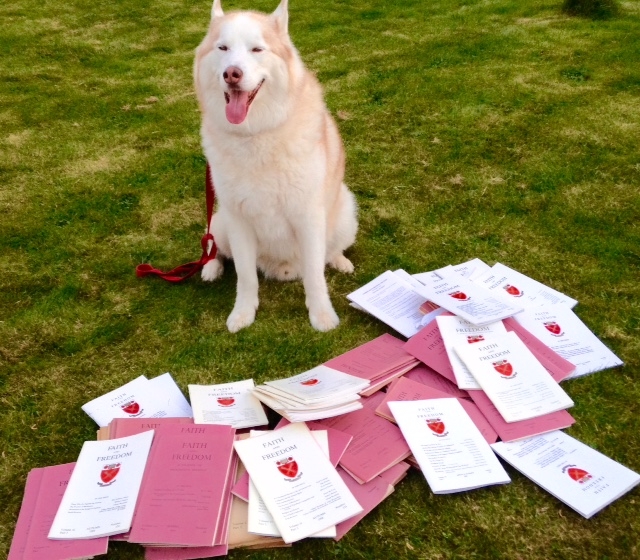
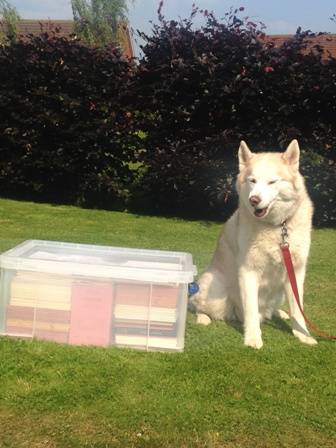
Those who attended the Old Students Association at Harris Manchester College in June will also have seen Nigel Clarke’s excellent presentation on the journal over the past twelve months. This included our own modest foray into animal matters with the appointment last year of Billy as the custodian of the Faith and Freedom archive.

Billy and the journals

Billy had initially done an excellent job in minding the archive and expressed evident delight at being appointed to such an illustrious role.

All safely gathered in

However, in more recent times he seems to have grown bored with this position and hints of dissatisfaction, indolence even, have crept into his demeanour as this candid picture illustrates: Billy02

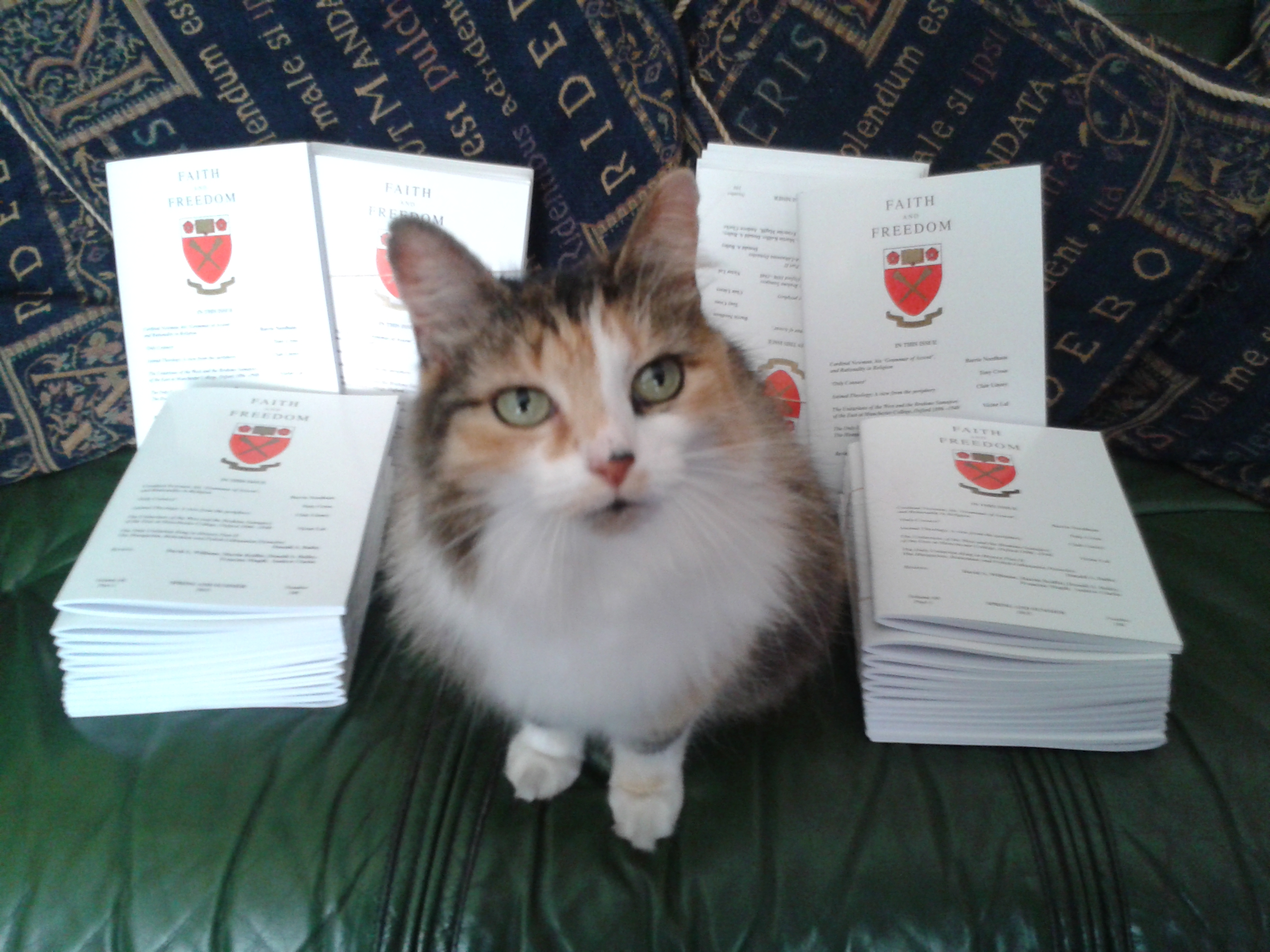
This has led to calls for the position to be offered to Caspian, the cat. Caspian, however, indicated that he had other things to consider and was not at all minded to be tied down to such a position. His friend Rosie, however, has given it consideration and seems at home in a bookish world.

Rosie01

Time will tell if Rosie will prove suitable for this job. Caspian, however, declined to be photographed for this report and appears only in silhouette. Caspian shadow 01

First editor of ‘Faith and Freedom’ honoured at Harris Manchester College

The Rev Eric Price, the founding editor of Faith and Freedom, was recalled and honoured at Harris Manchester College on Tuesday, 23rd June during the annual meeting of Friends and Governors.
Eric had significant ministries in Bolton and Liverpool, among other places, and was lay secretary of Manchester College for a great many years. In addition he founded and edited Faith and Freedom from its inception in 1947 to the year 1983.

Portarit of Rev Eric Price

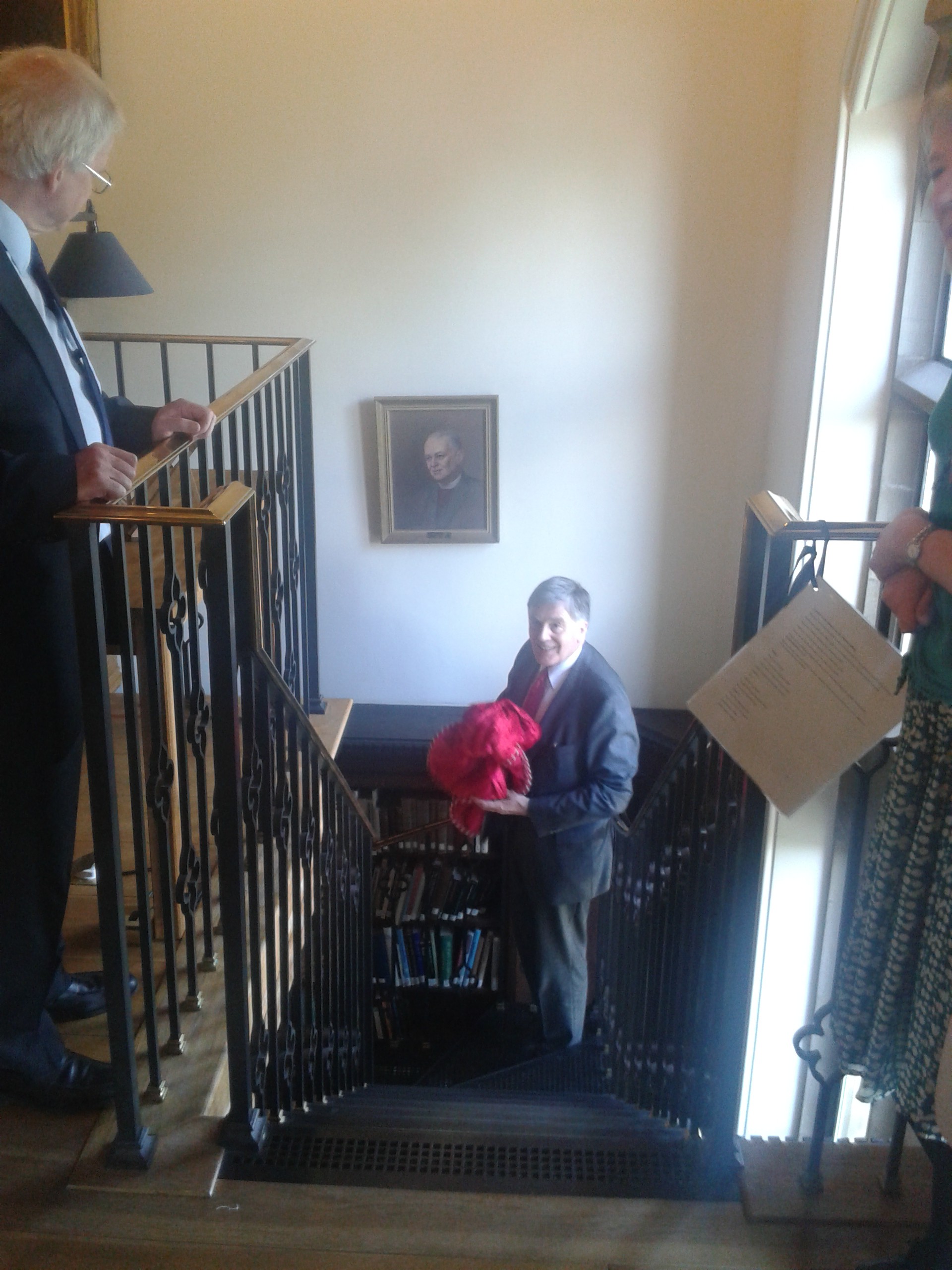
At the meeting Richard Price, Eric’s son presented a portrait to the College. This had originally been presented to his father by Bank Street Chapel, Bolton and was unveiled in its new location by the Principal, Rev Dr Ralph Waller.

The Principal unveils the portrait in its new location in the library

While making the presentation, in the course of an amusing speech, Richard Price recalled that he had been involved with Faith and Freedom from the very start, having been drafted in to stick erratum sheets in all 600 copies of the first issue printed! Later, he recalled his mother, when pregnant with his brother, threatening to give birth to twins and call them ‘Faith’ and ‘Freedom’, so all-consuming had the journal become for his father at the time!

Richard Price addresses those present in the library. Emeritus Editor Rev Peter and Sheila Godfrey can be seen in the corner of the shot

Happily both myself and Nigel Clarke were able to be there for the occasion and Nigel took the opportunity to present to Richard a bound copy of the very first issue which his father had signed.


Richard Price with Nigel Clarke and David Steers

Liverpool’s Metropolitan Cathedral

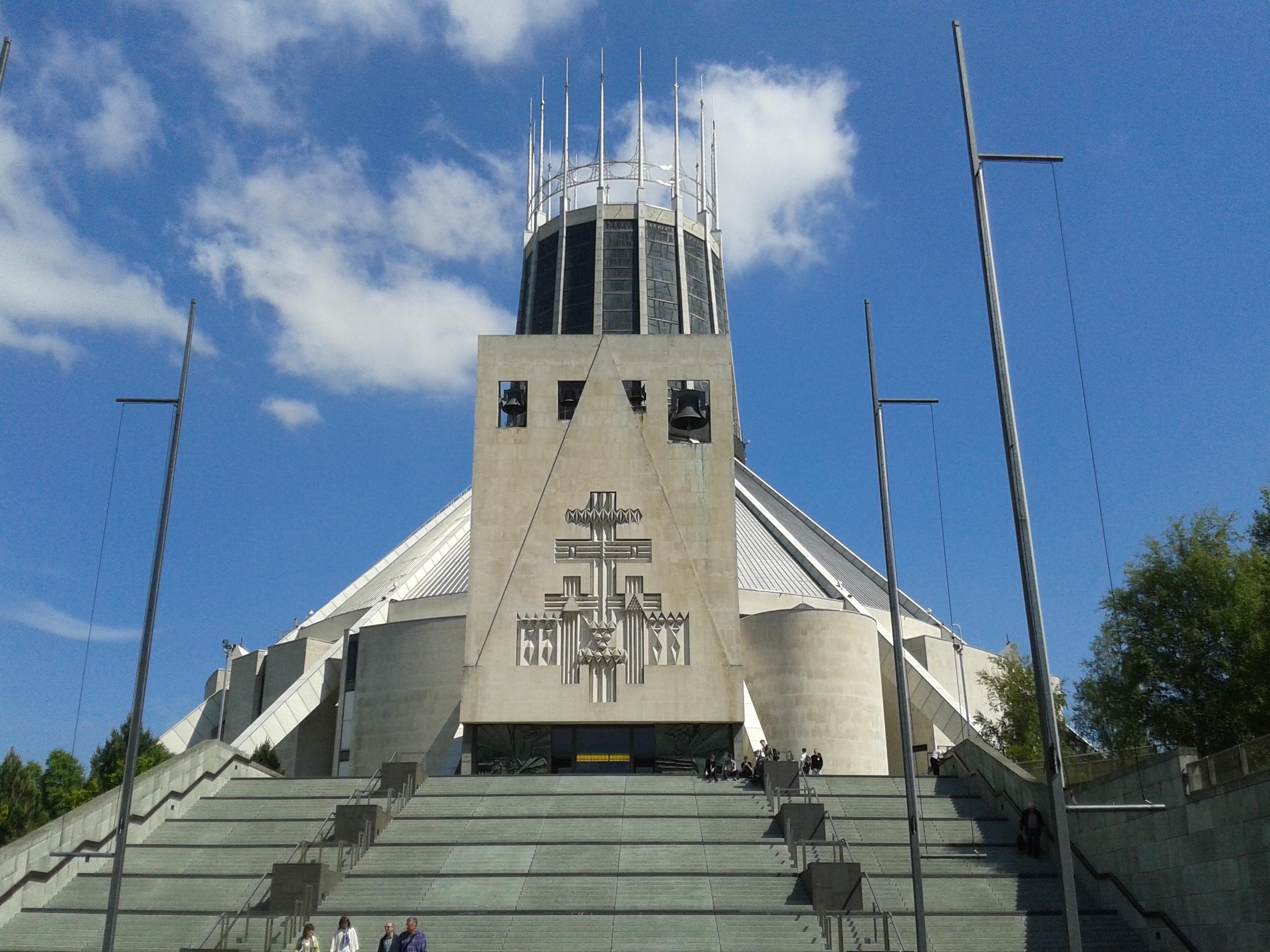
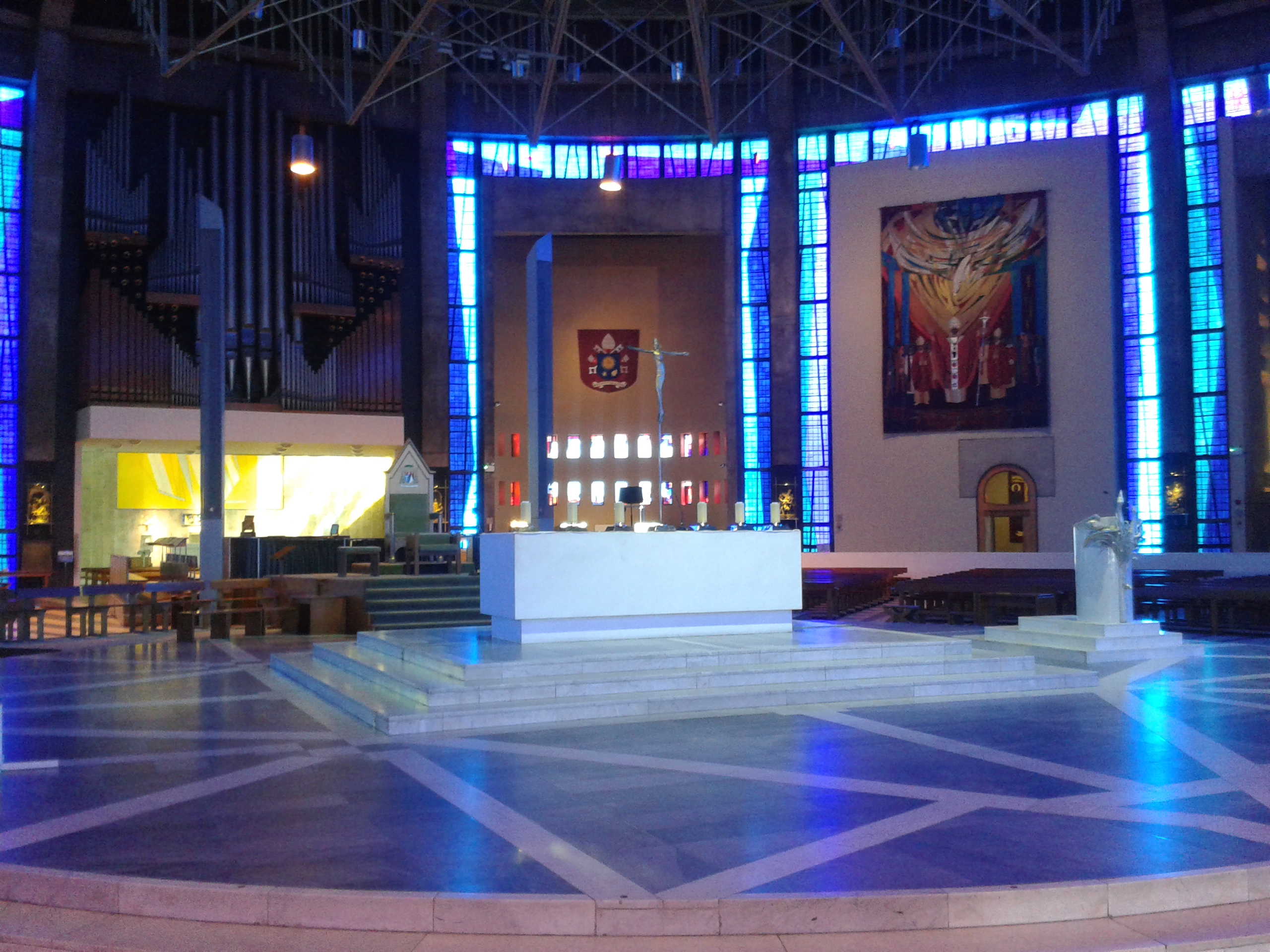
On a recent visit to Liverpool’s Metropolitan Cathedral I was struck by the beauty of the place – not quite for the first time – but on a profounder level than I had experienced before. It is a building of the 1960s in every way, with a lot of the problems that would be associated with such a building, especially one that was, in the end, built quickly and on a limited budget.


Cathedral exterior
Cathedral exterior


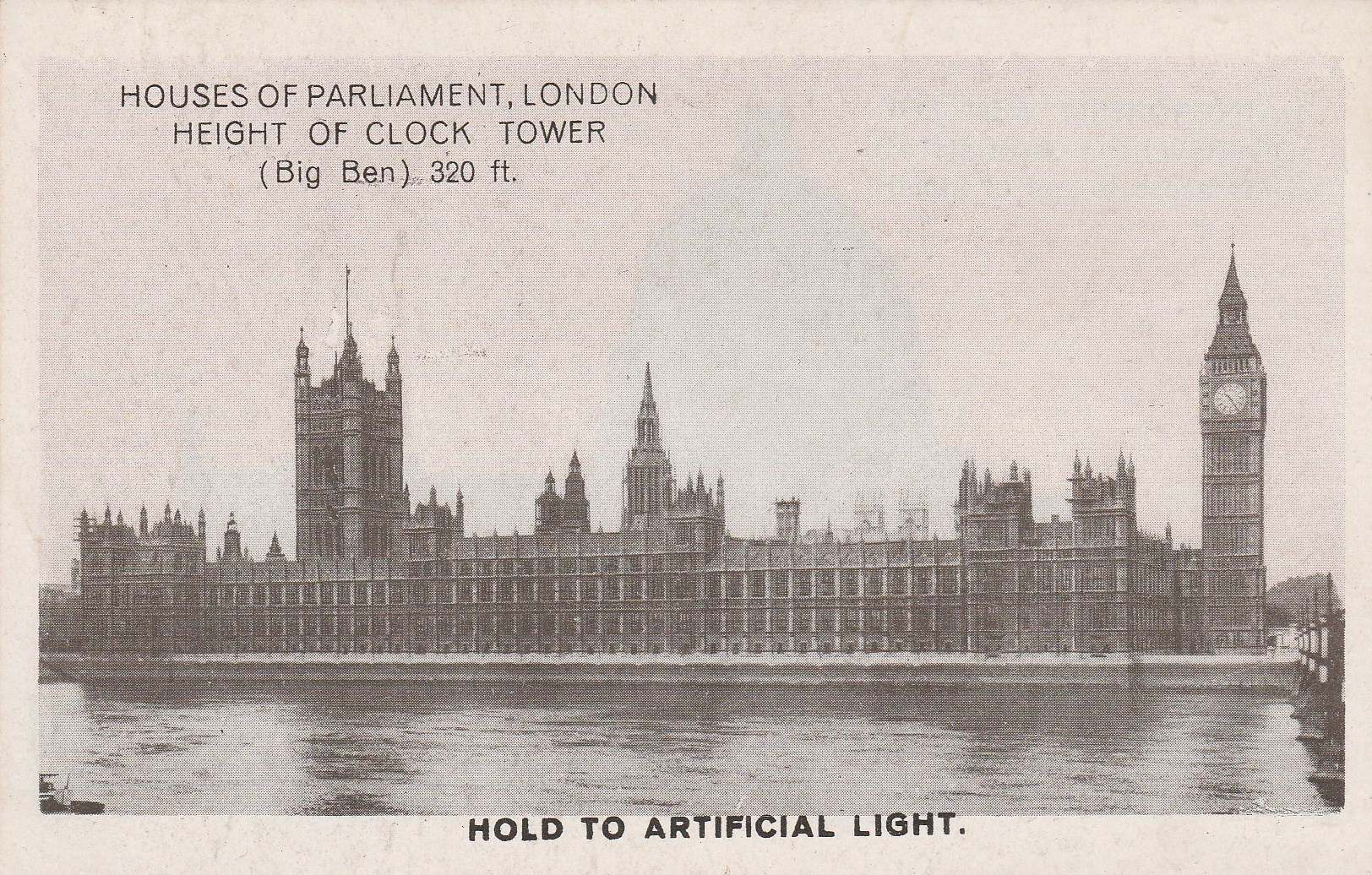
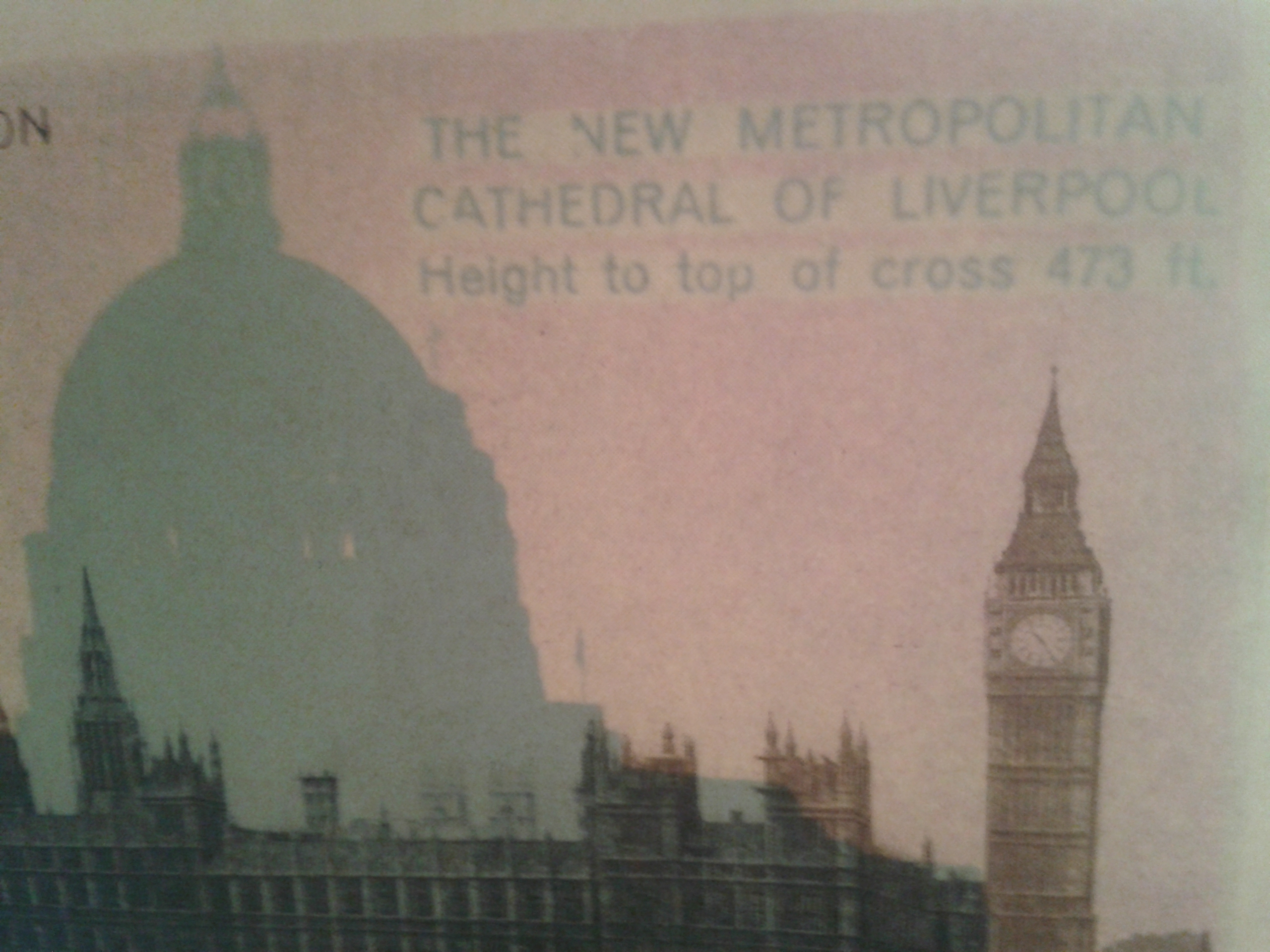
The original plan had been very extravagant indeed, a massive structure that would have dwarfed the large Anglican Cathedral nearby. Sir Edwin Lutyens was brought in to provide a plan for the second biggest cathedral in the world, the model for which can still be seen in the Museum of Liverpool. I have a promotional postcard from the 1930s that shows just how big they expected it to be:


Height of Big Ben 320 ft

Hold it up to electric light and all is revealed:


Height to top of cross 473 ft

But although the crypt was completed and remains part of the continuing cathedral the great romanesque building of Lutyens’ design could never be constructed after the war. Somewhere in the crypt there is a brick with my great grandmother’s name on, one of the thousands of faithful who made a contribution to build the northern cathedral in the 1920s and 1930s. But although I wasn’t an Anglican, in my youth it was the Church of England cathedral that played a bigger role in my life. We went there for school Founders’ Day, often a bit of a trial, especially when I was dragooned into the junior choir. I was also there for the Boys’ Brigade Liverpool battalion church parades. These I found much more enjoyable especially when I was a member of the colour party and got to process through the cathedral and sit in the choir stalls, learning along the way quite a bit about liturgy and the conduct of worship. But no visitor to the Anglican cathedral can fail to be impressed by its sheer grandeur, it is a breathtaking building.


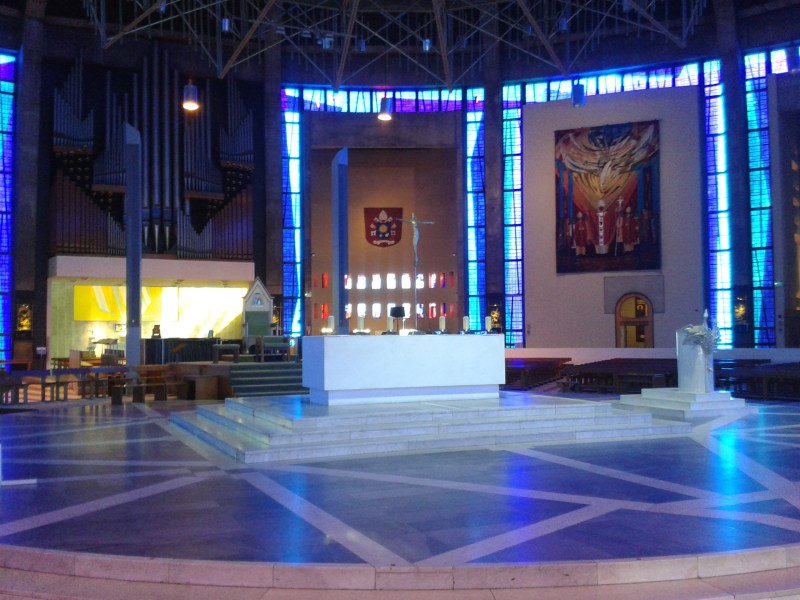
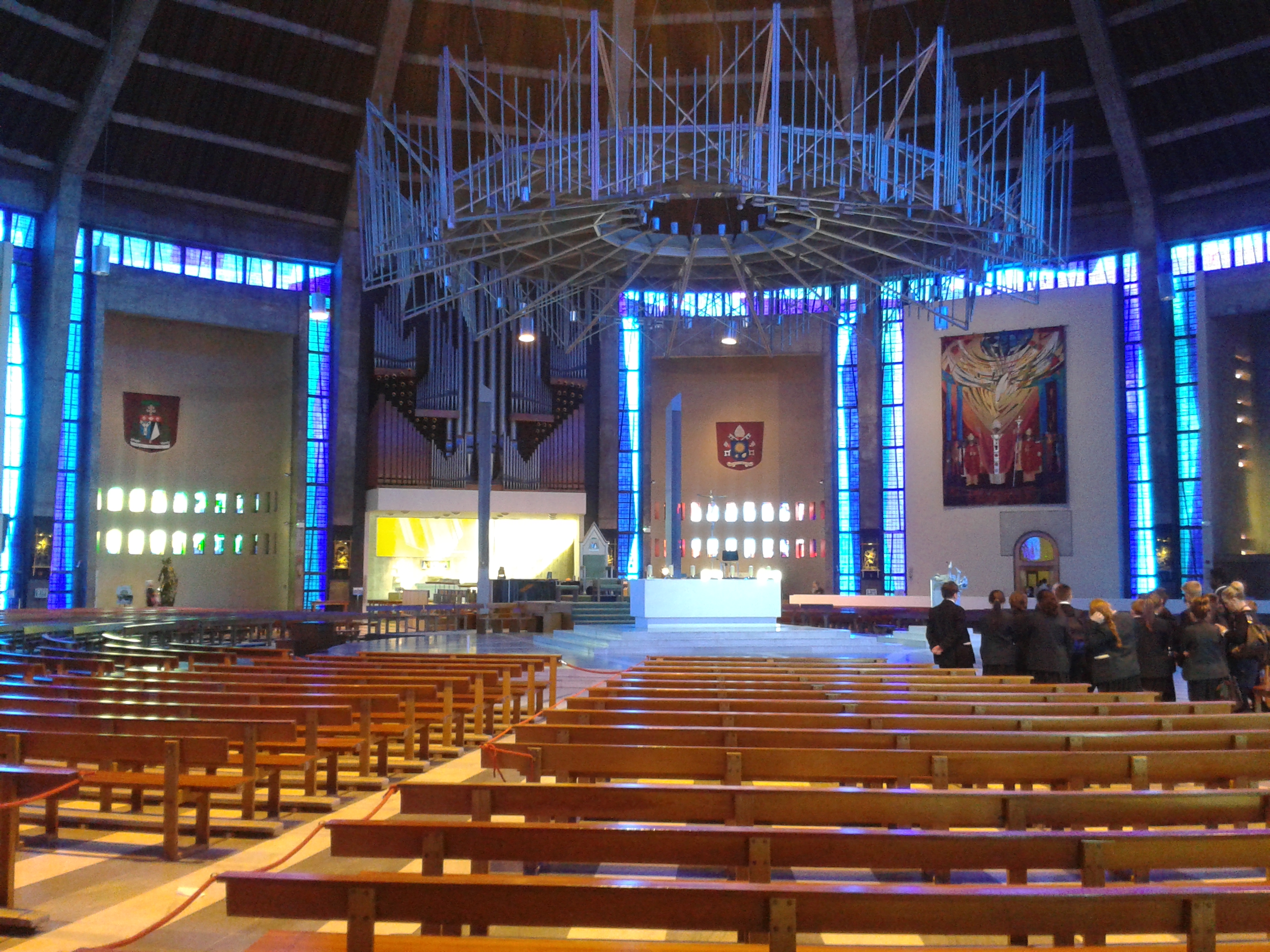
So I didn’t go to the Metropolitan Cathedral often and when I did it was reminiscent to me of the ‘space race’, of something very modern and a bit utilitarian. The bare concrete walls didn’t help in this regard. Coming straight after Vatican II its central altar and circular design is another typically sixties design which is fine if you like that sort of thing but I have never felt that worship in the round was necessarily the best way for any group of faithful people to gather.


Cathedral interior
Cathedral interior, a peaceful reflective space

But if you go in the cathedral today, as I did recently, you are struck by a quiet, luminous beauty. The blue of the stained glass windows seems to fill the space with a peaceful, reflective sense. The bare walls are frequently covered by tapestries and different hangings which create interest and warmth and although, when I visited, there were a number of school parties being shown round, the atmosphere of peace and worship was never interrupted. This I think is testimony to the skill of the guides and the attentiveness of the school pupils. The circular space has one great advantage in that if you walk around you discover a truly meditative experience. Indeed I felt so enthralled that I walked round twice and would happily have continued in my perambulations if other matters had not called upon my attention.


The view toward the altar


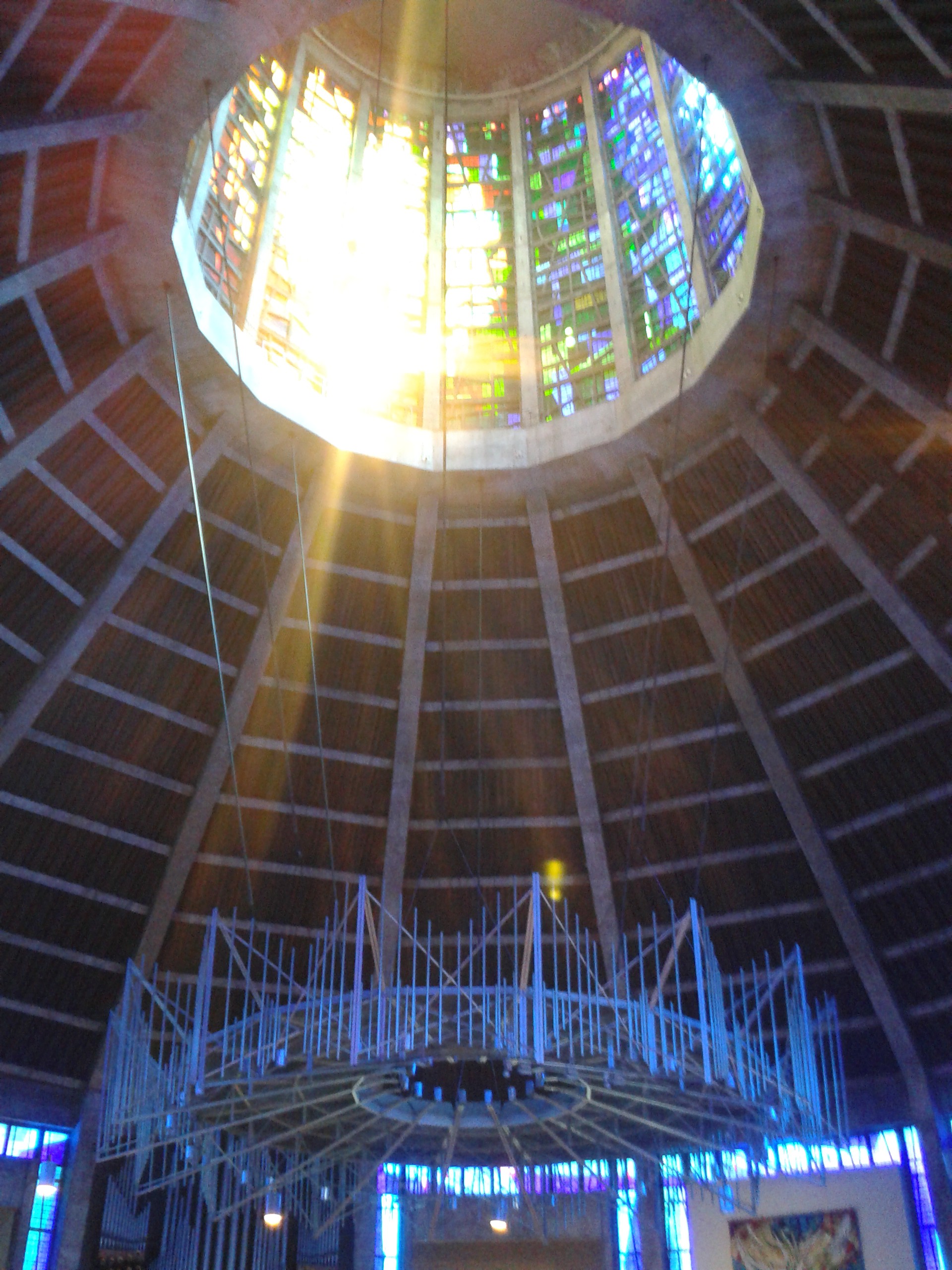
The light seemed to flood in from the lantern on this particular sunny day and infused the building with a sense of the numinous. It made me glad that I had gone in. There is a great deal of art to view. Again much of it very redolent of the 1960s but there’s nothing wrong with that. Not all of it can appeal to everyone but some of it struck me on that day as impressive, Robert Brumby’s terracotta statue of the Virgin and Child seems to fill the corner of the Lady Chapel very appropriately, for instance.


View of the lantern
View of the lantern


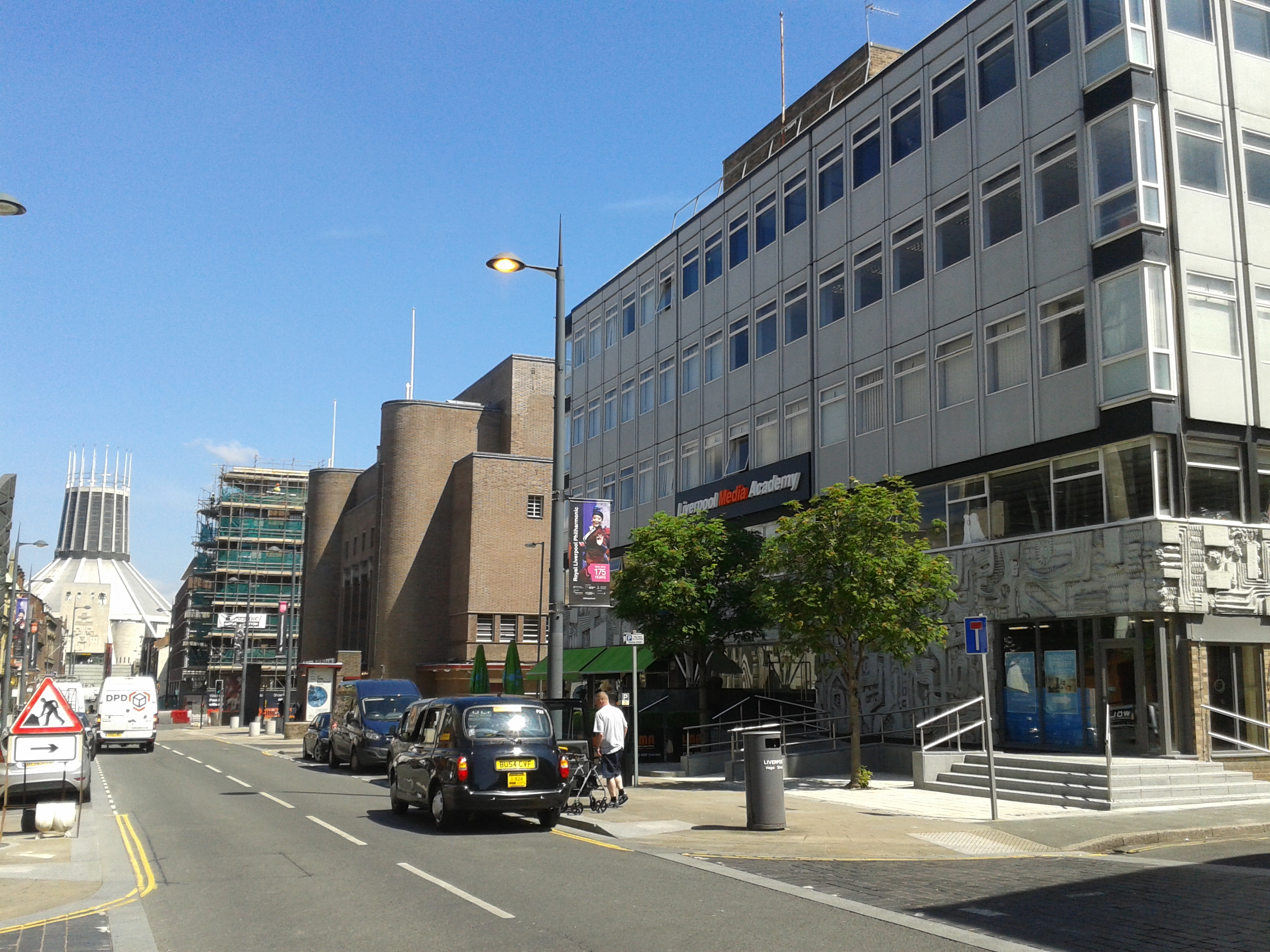
But leaving the cathedral on this sunny day I had to go and look again at the site of Hope Street Church. This building is now long gone, just one of a number of sometimes quite grand churches that once featured on these surrounding streets, it has to be said. You can read about Hope Street Church in a previous post. But the building on the right of the picture now called the Liverpool Media Academy, right next to the Philharmonic Hall, was once the site of James Martineau’s Church. The view from outside now looks along Hope Street to the modern cathedral opened in 1967.


The view along Hope Street

The only Unitarian Cenotaph?

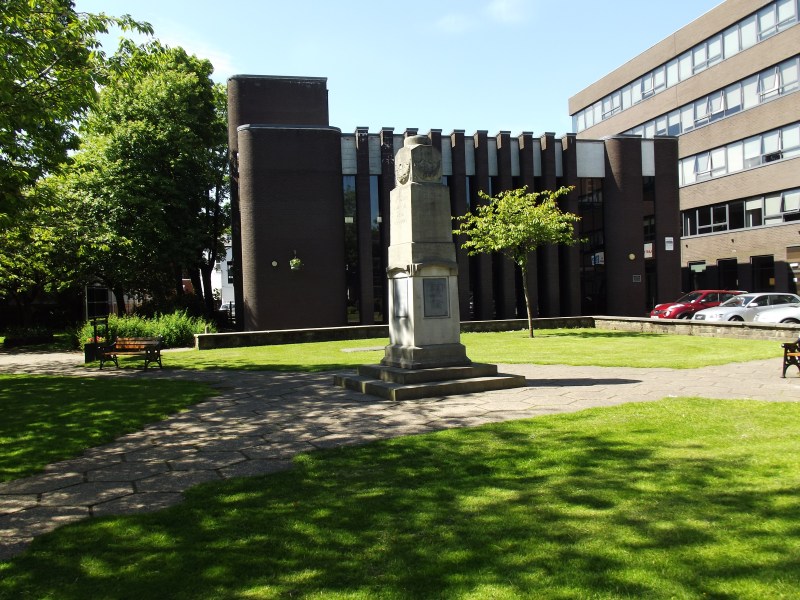
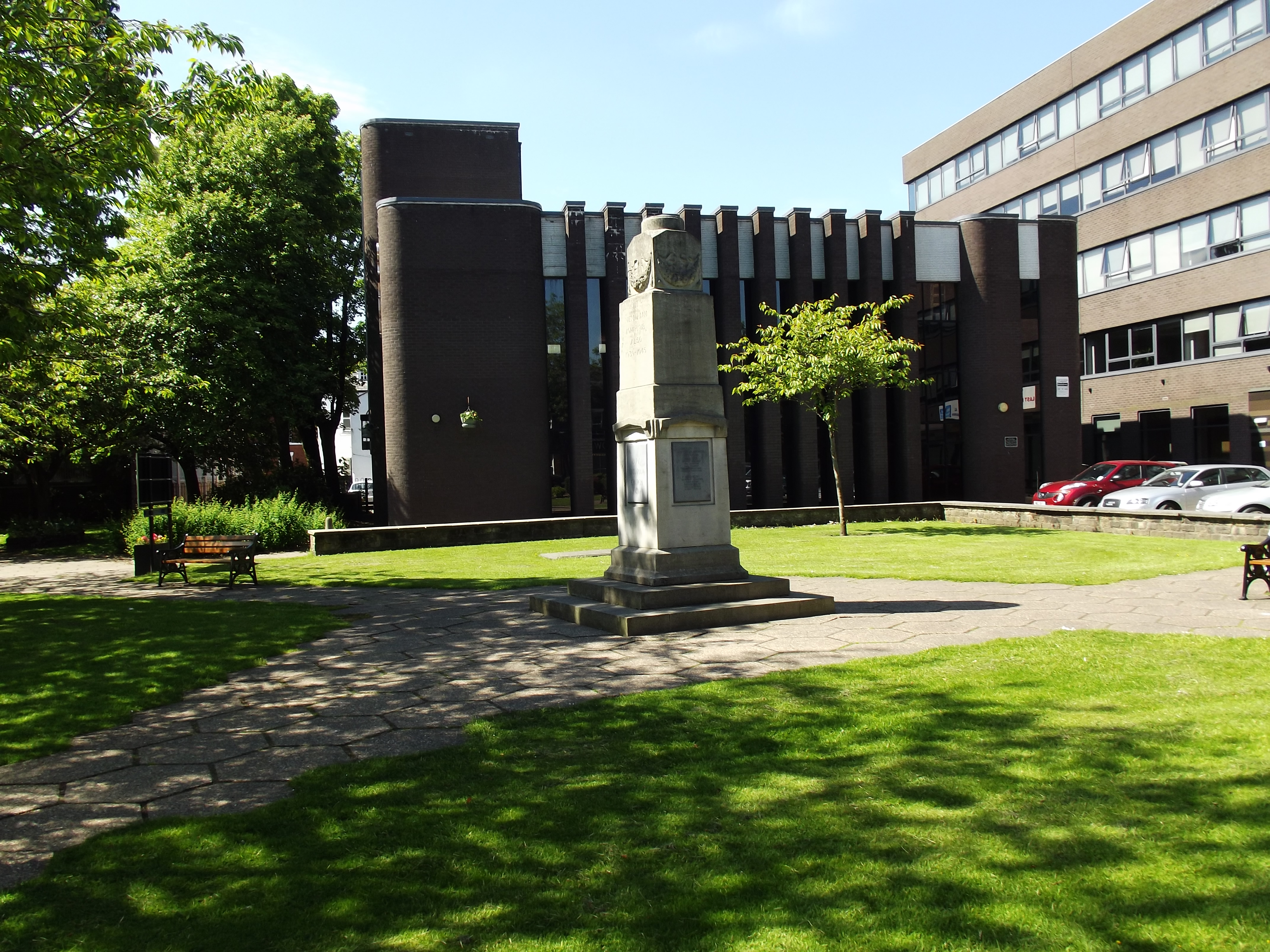
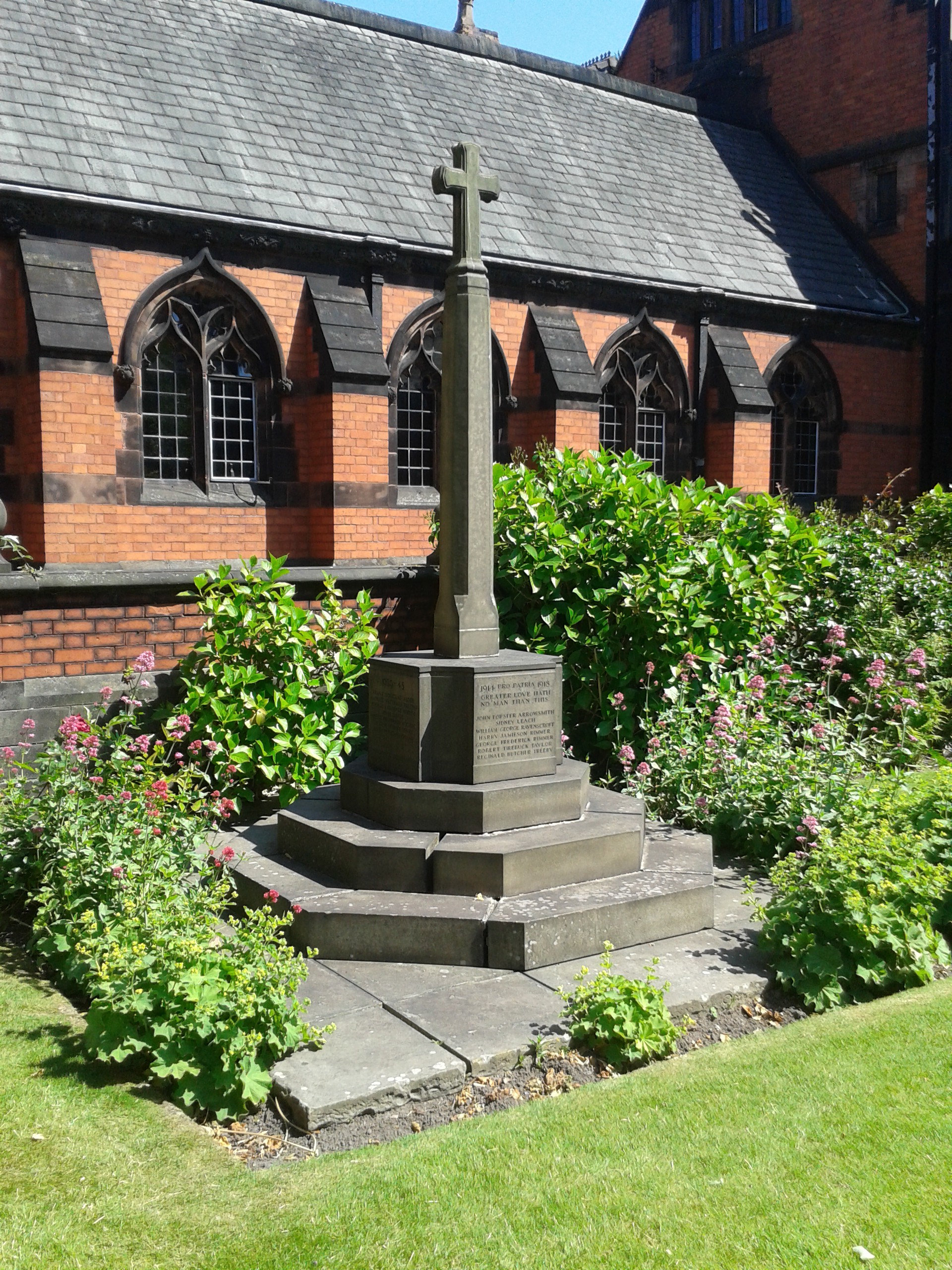
The Great War Project begun by Faith and Freedom is attracting a lot of positive interest and more material is being added, almost on a daily basis. Within the memorial section there soon will be added some pictures of the Cenotaph at Bury Unitarian Church which have been sent in by Neville Kenyon, many of which are reproduced here.

Cenotaph, Bury Unitarian Church

Neville suggests that this is the only Unitarian Cenotaph and I suspect that he must be right. Of course, Cenotaph means, literally, ‘empty tomb’ and in amongst the many old and quite extensive graveyards that exist around the country there must be a few tombs that fall into that category for one reason or another. But by Cenotaph we generally mean a freestanding public monument inspired by the Cenotaph in Whitehall, and repeated in many cities, towns and villages.

The Bury Cenotaph
The Bury Cenotaph

The idea for Cenotaphs came from the experience of the First World War when so many soldiers had no known grave. In such a situation there was a need for a focus of remembrance, something that could symbolise the sacrifice and loss that was felt by so many people. To this end the Whitehall Cenotaph and all those that came after it fulfilled a very special role in national consciousness. And how different such monuments are when we compare them with other memorials that were erected following wars such as the Arc de Triomphe or the Brandenburg Gate, to name just two. Unlike them there is no overt military symbolism in the Cenotaph. It is much more restrained, much more dignified.

In 1924 the author H.V. Morton described his feelings as he stood near the Cenotaph on an ordinary morning:

I look up at the Cenotaph. A parcels delivery boy riding a tricycle van takes off his worn cap. An omnibus goes by. The men lift their hats. Men passing with papers and documents under their arms, attache and despatch cases in their hands – all the business of life – bare their heads as they hurry by.
Six years have made no difference here. The Cenotaph – that mass of national emotion frozen in stone – is holy to this generation. Although I have seen it so many times on that day once a year when it comes alive to an accompaniment of pomp as simple and as beautiful as church ritual, I think that I like it best just standing here in a grey morning, with its feet in flowers and ordinary folk going by, remembering.

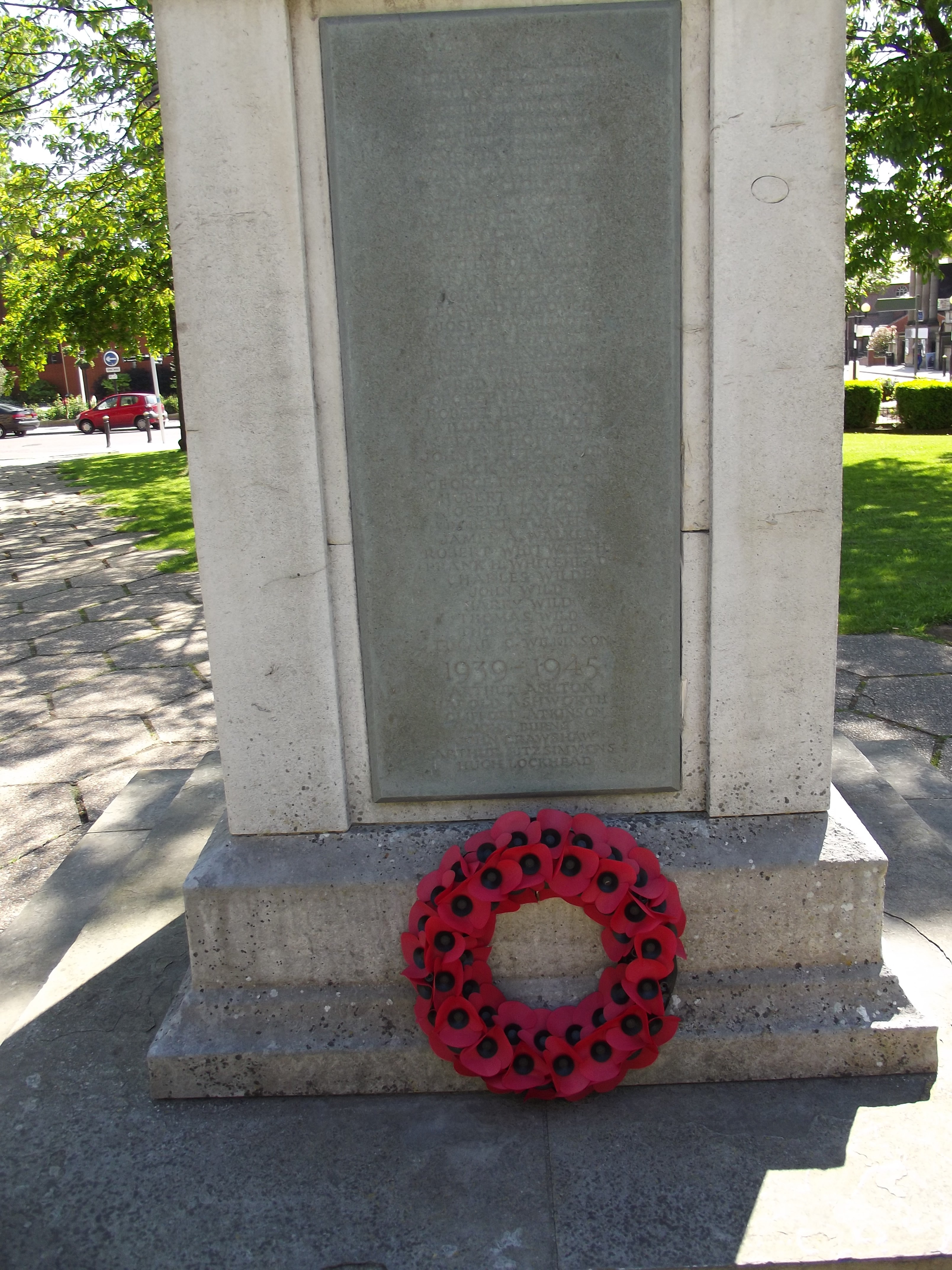
The Bury Cenotaph is very public and very similar to the memorials that are more often  municipal, regimental or governmental in origin. It commemorates the members of three congregations who served in the First World War, with the names of those who served in the Second World War being added later. These were three long-established local congregations, who amalgamated into one with a bold new meeting house in 1974.

A view from the other side

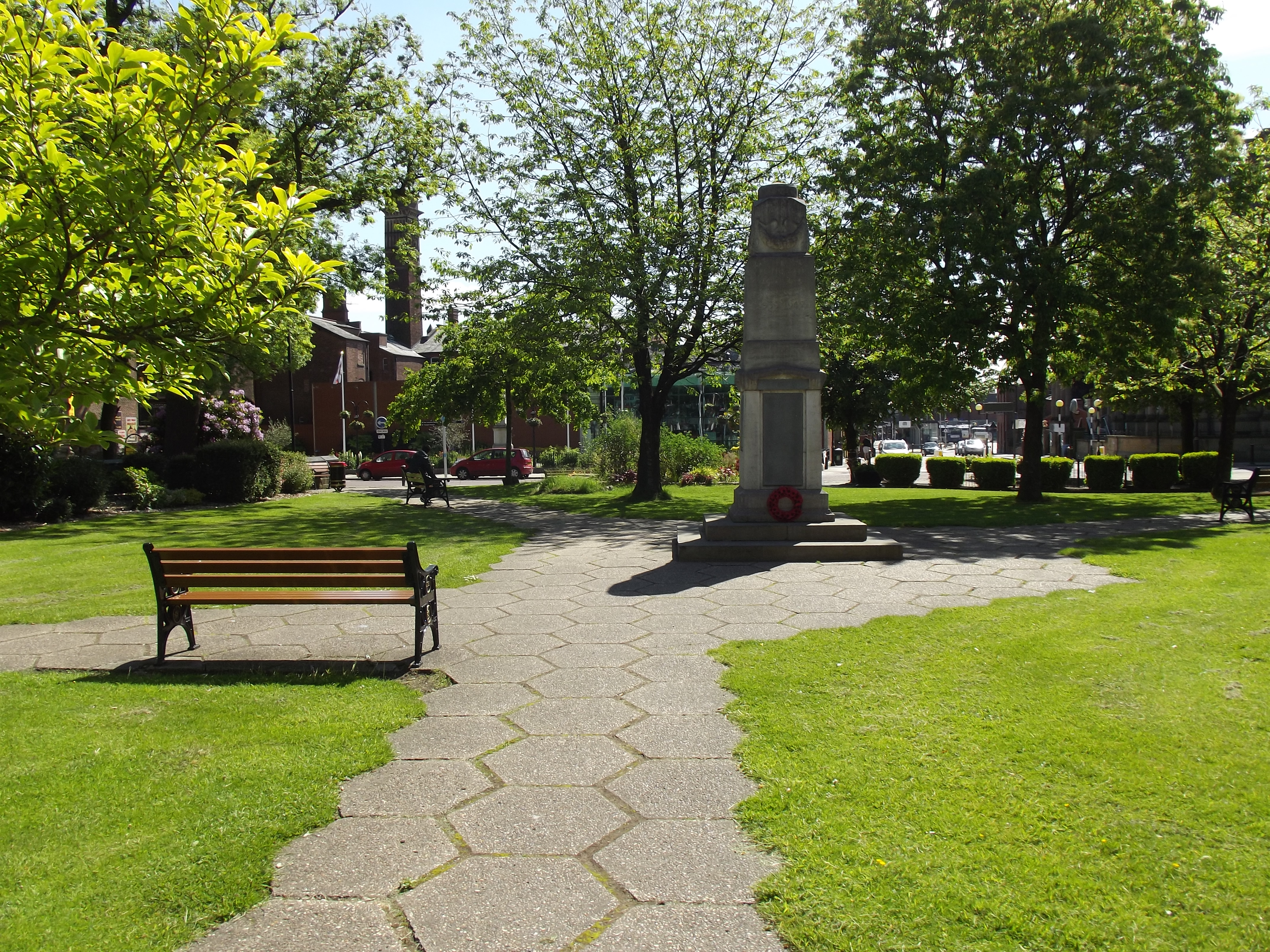
The Cenotaph is situated in front of the church in the centre of what was the graveyard but which is now a public space. This space was originally called Library Gardens but has recently been renamed by the council with what seems a much more satisfying designation of Church Gardens. Neville tells me that on Remembrance Sunday the congregation meets at 11.00 am at the Cenotaph for the one minute silence, the Last Post is played, before the congregation goes into the church for a service of remembrance, the names of those inscribed on the memorial being read.

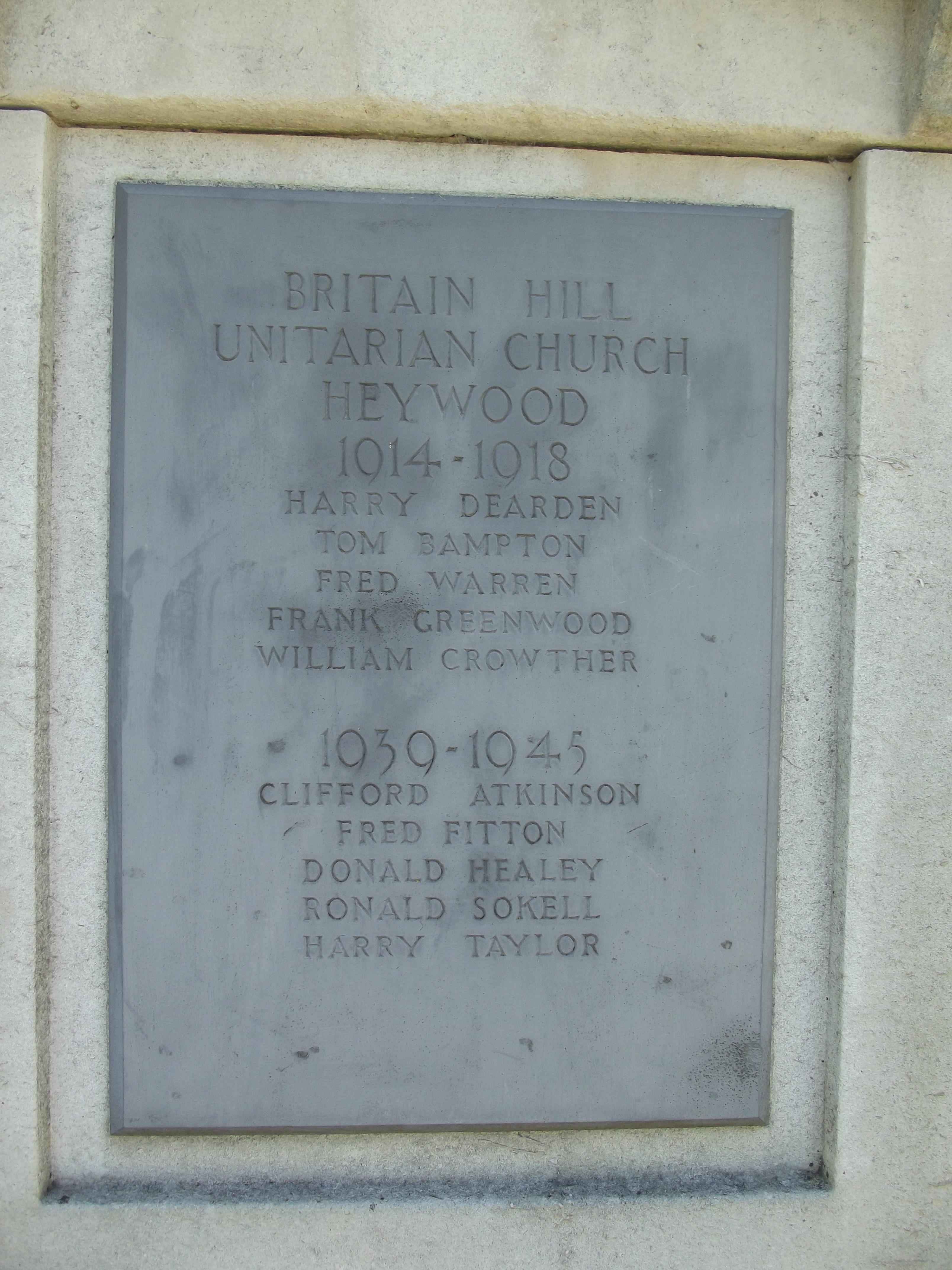
There is a plaque to commemorate each of the three congregations represented by the modern congregation – Chesham, Heywood and Bank Street, Bury. The Bank Street plaque – beneath the title ‘Bank Street Presbyterian Chapel Unitarian’ – has the longest list of names (I counted 40 names from the First World War) but it is by far the most weathered.

Bank Street Presbyterian Chapel Unitarian

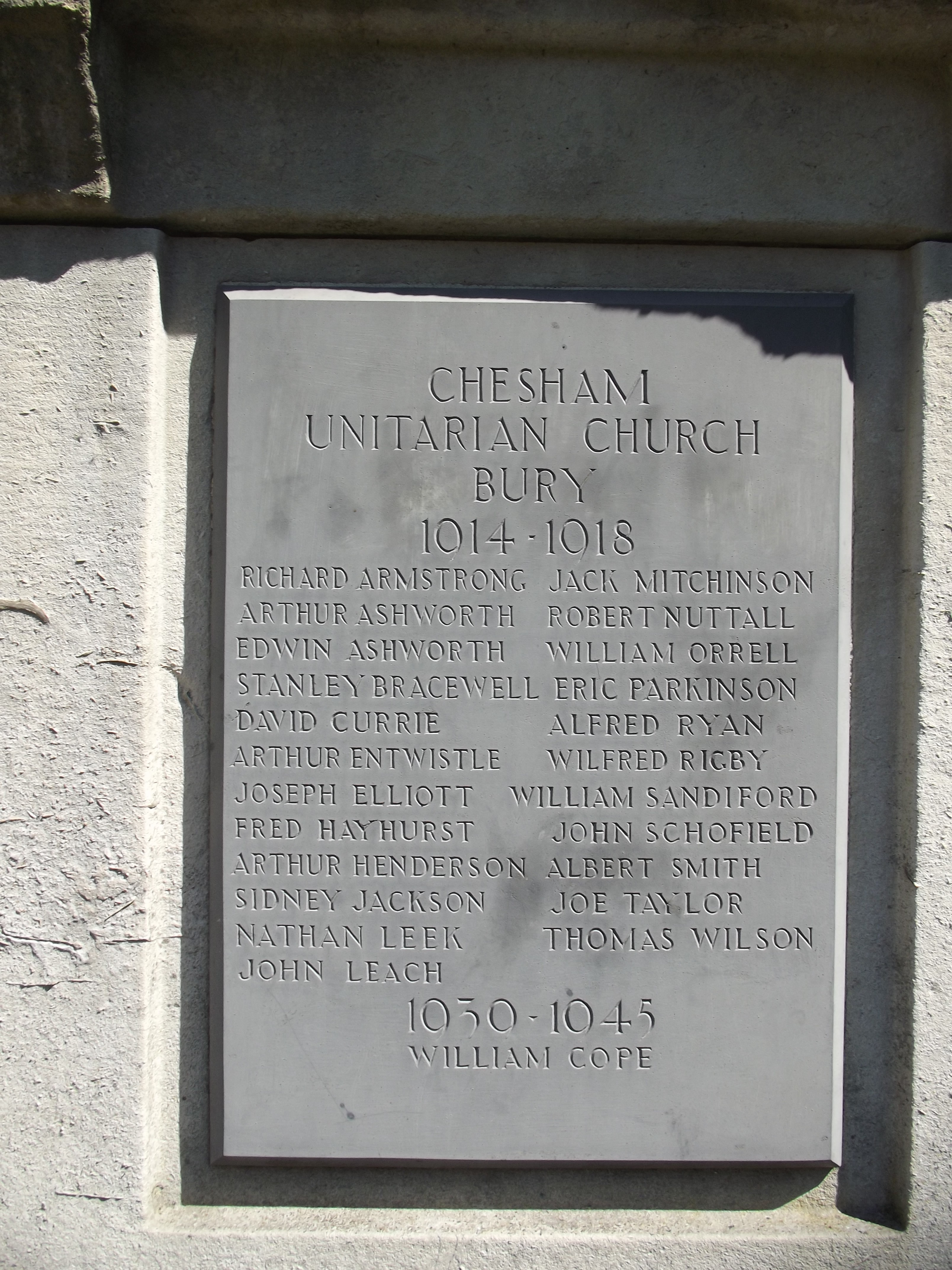
There are 23 names from the First World War on the Heywood memorial and five on the Chesham memorial.

Britain Hill Unitarian Church Heywood
Chesham Unitarian Church Bury

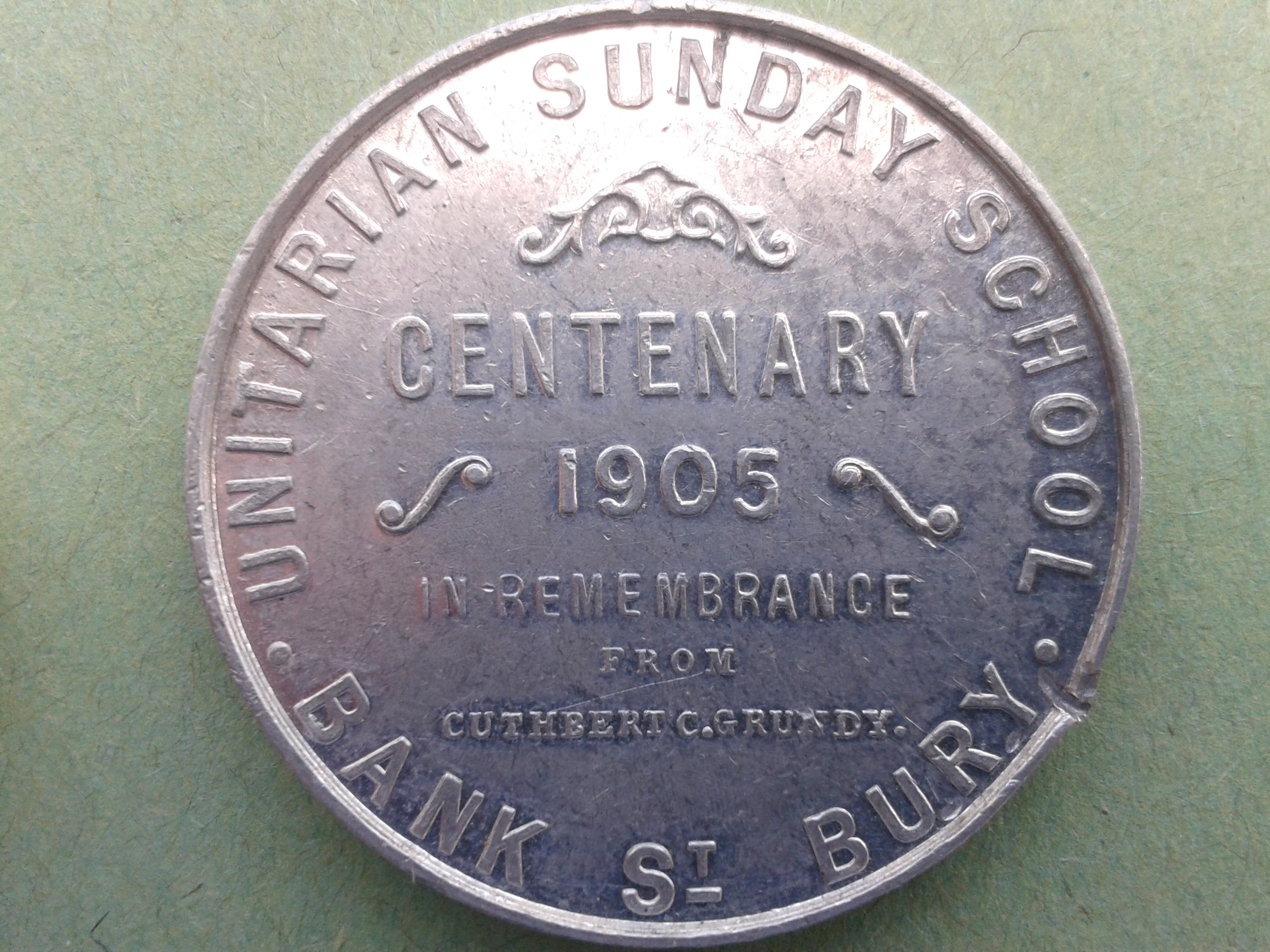
In my possession I have a medal struck to commemorate the centenary of the Bank Street Sunday School in 1905. The medal is inscribed ‘In Remembrance from Cuthbert C. Grundy’ and it must have been given to all the Sunday School scholars at the time. It is sad to think that so many of the children who received this medal in 1905 will be amongst the long list of volunteers whose names were inscribed on the Cenotaph just a few years later.

The Bury Sunday School medal

Is it the only Unitarian Cenotaph? If you know of any other please let me know and, best of all, send a picture. The only place that I know that comes near is Ullet Road Church in Liverpool which has a memorial set in its own large and well-kept grounds. But although it is a First World War Memorial that performs the same role as a Cenotaph the design is different to that of Bury, although not dissimilar to ones found in many places around the UK.

War Memorial Ullet Road Church Liverpool

But it would be nice to hear if anywhere else possesses a memorial in any way similar to that of Bury. Or maybe Bury is unique?

BuryCenotaph04

Faith and Freedom Great War Project

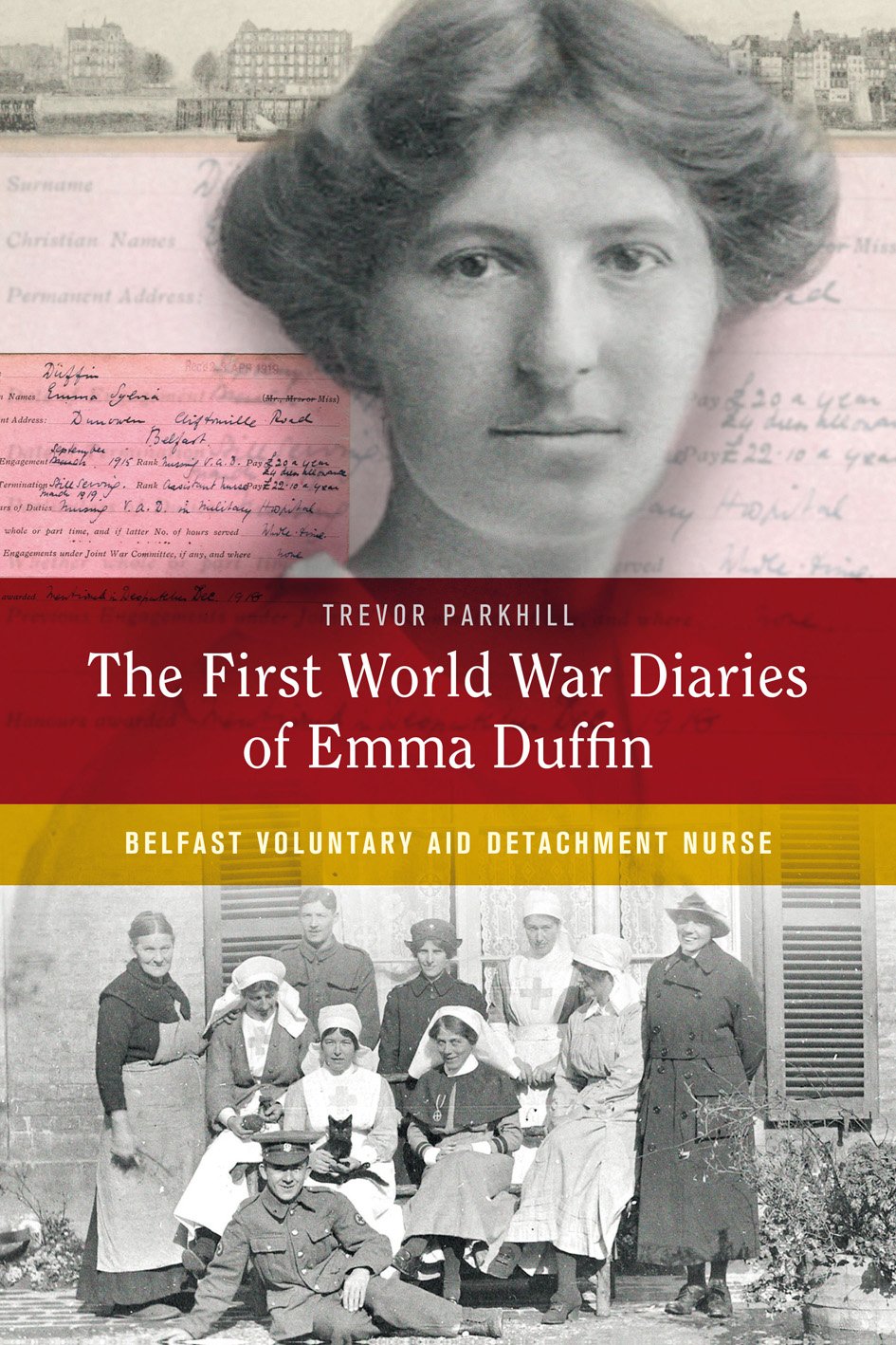
The First World War cast an enormous shadow over the past century. It had a cataclysmic effect on all aspects of society, no one was left untouched by it – homes, families, schools, factories, businesses, and, of course, churches. There are many ways in which the centenary of the Great War is being marked and most churches are spending some time over the current period reflecting on the conflict, its impact and its legacy. Faith and Freedom is establishing a special section of its website to reflect upon the conflict from the point of view of the churches and other faith groups. The website will be developed in a number of different ways. It will contain scholarly and thoughtful articles on the Great War, particularly in relation to churches and their participation in the War. The first three articles to go online are Unitarian Attitudes to the First World War, by Alan Ruston, The Centenary of the First World War and the Non-Subscribing Presbyterian Church of Ireland, by David Steers; and ‘Their sister in both senses’. The memoirs of Emma Duffin V.A.D. nurse in the First World War by Trevor Parkhill. Trevor is editor of The First World War Diaries of Emma Duffin, Belfast Voluntary Aid Detachment Nurse (Four Courts Press, Dublin, 2014) and his article gives an intensely moving account of the First World War experiences in hospitals at the front of Belfast-born Unitarian Emma Duffin (a direct descendant of William Drennan, the founder of the United Irishmen and a cousin of Thomas Andrews designer of the Titanic) who volunteered to serve as a nurse and spent three harrowing years tending the wounded.

Emma Duffin

The second section will contain accounts of commemorations and acts of remembrance made during the current centenary period and readers are very much encouraged to send in reports of their events. The first example is a thoughtful and intensely moving service held at Rosslyn Hill Chapel, Hampstead to mark the centenary of the outbreak of the War. We are also seeking to record the names and details of church members who served in the First World War and we begin with a very full account of the contribution and service, with pictures, of members of the Great Meeting, Hinckley.

Private Stanley Jennings of Hinckley, of the 15th Battalion Durham Light Infantry. Killed in France 3rd May 1917, aged 29

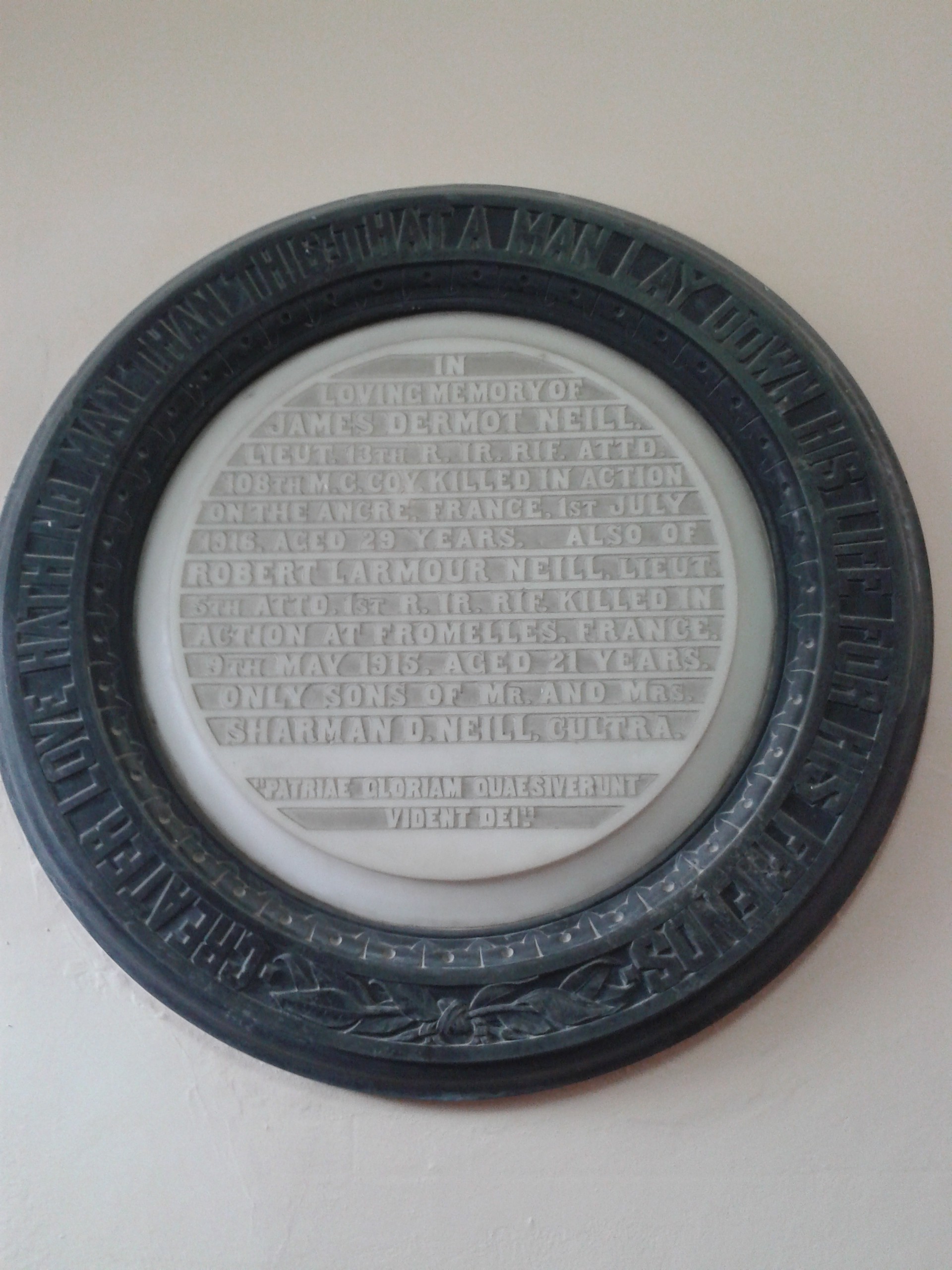
We also aim to build up a database of images of First World War memorials. Does your church have a memorial to its members who served in the First World War? If it does then please send a digital picture to go on the website. We are also actively seeking images and details of memorials that were placed in churches that are now closed, which may now be lost or which may have been put in a different location.

Memorial to Lieutenant R.L. Neill, Holywood co. Down.  Killed at the battle fo the Somme
Memorial to Lieutenant R.L. Neill, Holywood co. Down. Killed at the battle fo the Somme

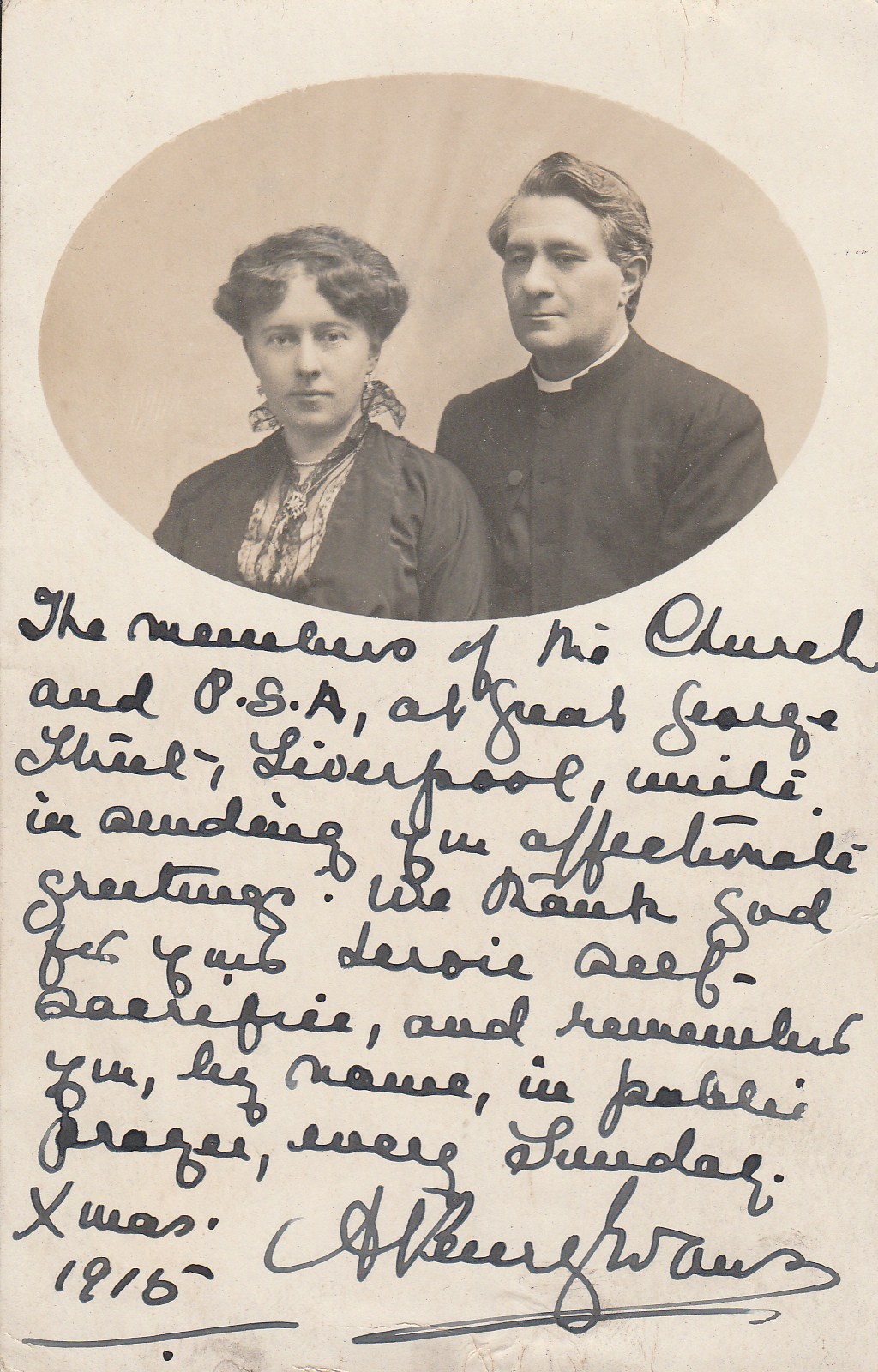
We also hope to include material – including photographs, sermons, writings, printed ephemera etc that date from the time of the War which can then be studied on our site.

A postcard sent to members of Great George Street Congregational Chapel, Liverpool,  serving at the front. Featuring a picture of the minister and his wife and a written message. P.S.A. stands for Pleasant Sunday Afternoon, a popular form of church entertainment at the time
A postcard sent to members of Great George Street Congregational Chapel, Liverpool serving at the front. Featuring a picture of the minister and his wife and a written message. P.S.A. stands for Pleasant Sunday Afternoon, a popular form of church entertainment at the time

We might also eventually include complete Rolls of Honour – for individual congregations and denominations. The whereabouts of the Roll of Honour relating to the churches that are now part of the General Assembly of Unitarian and Free Christian Churches has been a matter of some discussion recently. If we had the full list of names we could add it to the site. The Roll of Honour of the Non-Subscribing Presbyterian Church of Ireland also seems to have been begun but not completed. It would be good to see that completed and available online. With the co-operation of readers the site will be built up over time. If you would like to participate please contact the editor at editor@faithandfreedom.org.uk To view the website go to: http://www.faithandfreedom.org.uk/GWindex.htm

History of the First Presbyterian (Non-Subscribing) Church Downpatrick

The meeting house of the First Presbyterian (Non-Subscribing) Church in Downpatrick was opened in 1711 at the start of the ministry of the Rev Thomas Nevin. Recognised as one of the most significant architectural examples of the T-shaped meeting-house in Ireland the building celebrated 300 years of continuous worship and witness in 2011.

Central high pulpit originally built for Thomas Nevin (Down Museum photograph)

To mark the tercentenary of the church building the congregation published the History of the First Presbyterian (Non-Subscribing) Church Downpatrick. Written and compiled by Mary Stewart, the church secretary, the book is a remarkable record of three centuries of church life in the historic building. The book details the history of the congregation in the context of Downpatrick and Irish Presbyterianism, the conflict between subscribers and non-subscribers in the 18th century, the history of the building, the congregation’s engagement with education and much more. The book includes biographies of all the ministers of the congregation going back to the 17th century, extracts from the records of the Synod of Ulster, accounts of services, special events and financial matters, and contains details of committee and session members over the centuries, lists of members going back to the 1860s, and a complete record of all the graveyard inscriptions. It will be valued by all those with an interest in Non-Subscribing Presbyterian Church history, local history, and genealogy.

Celebrating the tercentenary

In the first of the two Forewords the Very Rev William McMillan says:

Miss Stewart is to be congratulated on a truly comprehensive publication. She not only presents us with a history of the Downpatrick congregation but has collated a remarkable number of newspaper accounts, together with other printed material which will be of considerable help to future historians.

 Her commitment to the congregation is evident from the immense research that she has done and I am delighted to recommend this valuable contribution to the Denomination’s Historical Record in which Downpatrick congregation has played such an important role.

and in the second Foreword the Rev Dr JohnNelson says:

The congregation of Downpatrick has a long and notable history, reflected in the lives of the ministers and lay people who have been part of that church. A congregation which has held a significant place both within Non-Subscribing Presbyterian circles and the wider Presbyterian community.

 Perhaps the most outstanding theme of that history is the fact that for the last 300 years the congregation have worshiped in the wonderful building that is Stream Street Meeting House. While that building has always been well maintained, the interior has never been substantially altered, leaving it to-day essentially as built and evoking a sense of history, of presence, and of worship in all who enter there. It is highly appropriate that this book is published as part of the celebrations to mark the 300th anniversary of that meeting house.

Mary Stewart is to be congratulated in producing such a thorough and detailed history of the congregation. Not only does she give the story of the church, but her painstaking researches have produced a wealth of source material which will be a delight to historians, church members, and everyone interested in the heritage of Downpatrick town and community.

This book both opens a door on the past and links it with the living present.

At the tercentenary service

The book contains 408 pages and over 150 illustrations. It is bound in a full colour hard-back cover the book and is excellent value at only £15.

The cover of the book

A sense of what it contains can be seen from the list of contents:

Chapter 1        Background History of Downpatrick

Chapter 2        Arrival and Settlement of Presbyterians

Chapter 3        Subscribers and Non-Subscribers, the Faith of the Non-Subscribers

Chapter 4        Presbytery Records from 1691 including Thomas Nevin’s Trial and Consequences

Chapter 5        List of Ministers of Downpatrick, Details of Ministers

Chapter 6        The Church Building

Chapter 7        Church Site and Schools

Chapter 8        Life and Times of Samuel Craig Nelson   

Chapter 9        Special Services

Chapter 10      Special Events and Reports

Chapter 11      Church Excursions from 1881

Chapter 12      Social Evenings and Gatherings

Chapter 13      Harvest Services from 1908

Chapter 14      Financial Matters (Inc. Committee Record from 1886)

Appendix I       Rules and Regulations of the Downpatrick Congregation

Appendix II    Church Elders, Committee and Sunday School Teachers (From 1861-2007)

Appendix III   The Church Graveyard and Inscriptions

Appendix IV   Sermon by Alexander Colvill A.M. M.D. on the Death of Thomas Nevin 24th March 1744

Congregation at the tercentenary service

The cost of the book is just £15. Postage within the UK is £5. If you are interested in having a copy posted abroad please enquire for postal rates. Details of how to purchase the book can be found on the Church’s website: http://www.downpatricknsp.org.uk/History.html