Balloo, Killinchy, A Hidden History

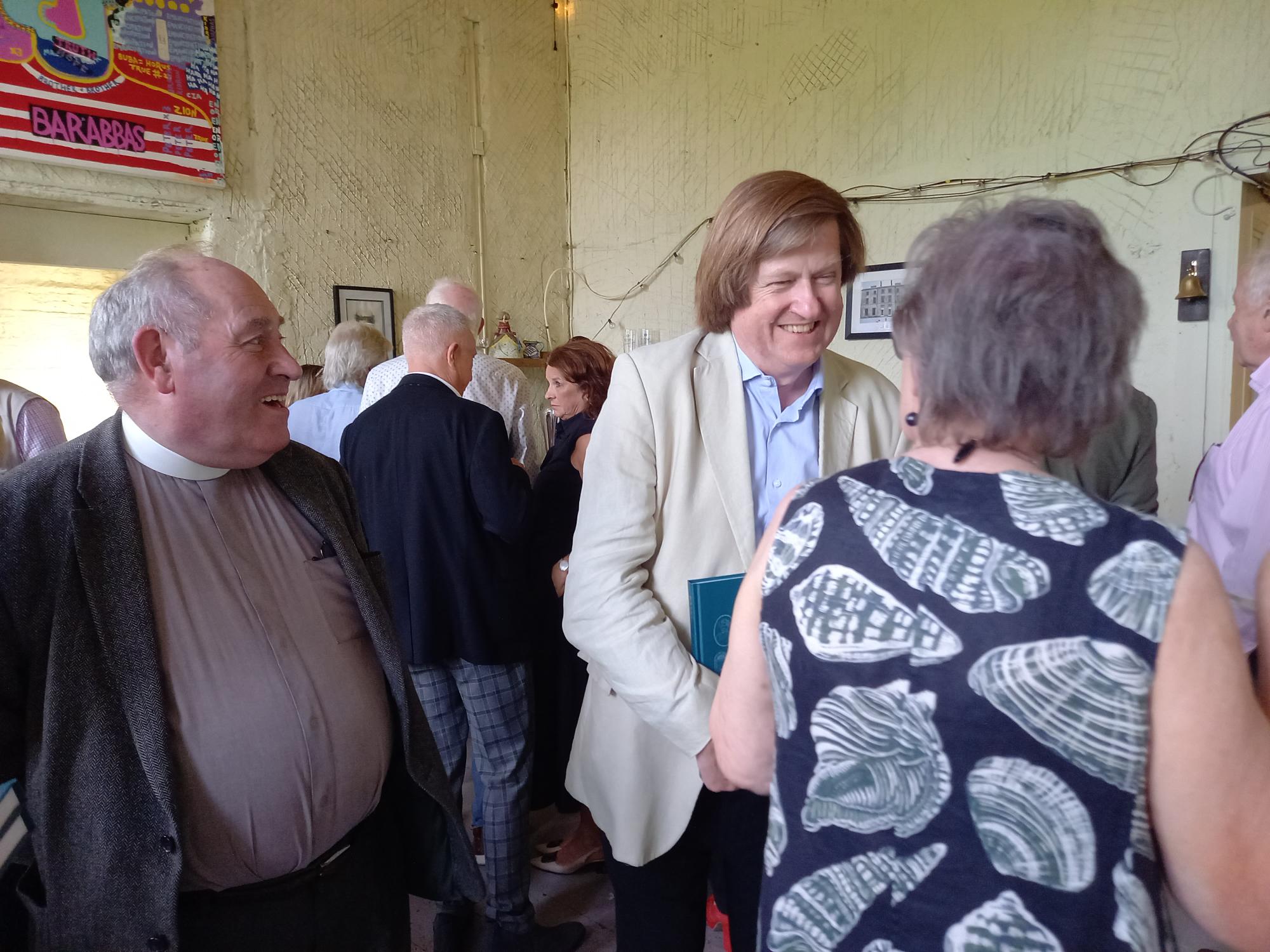
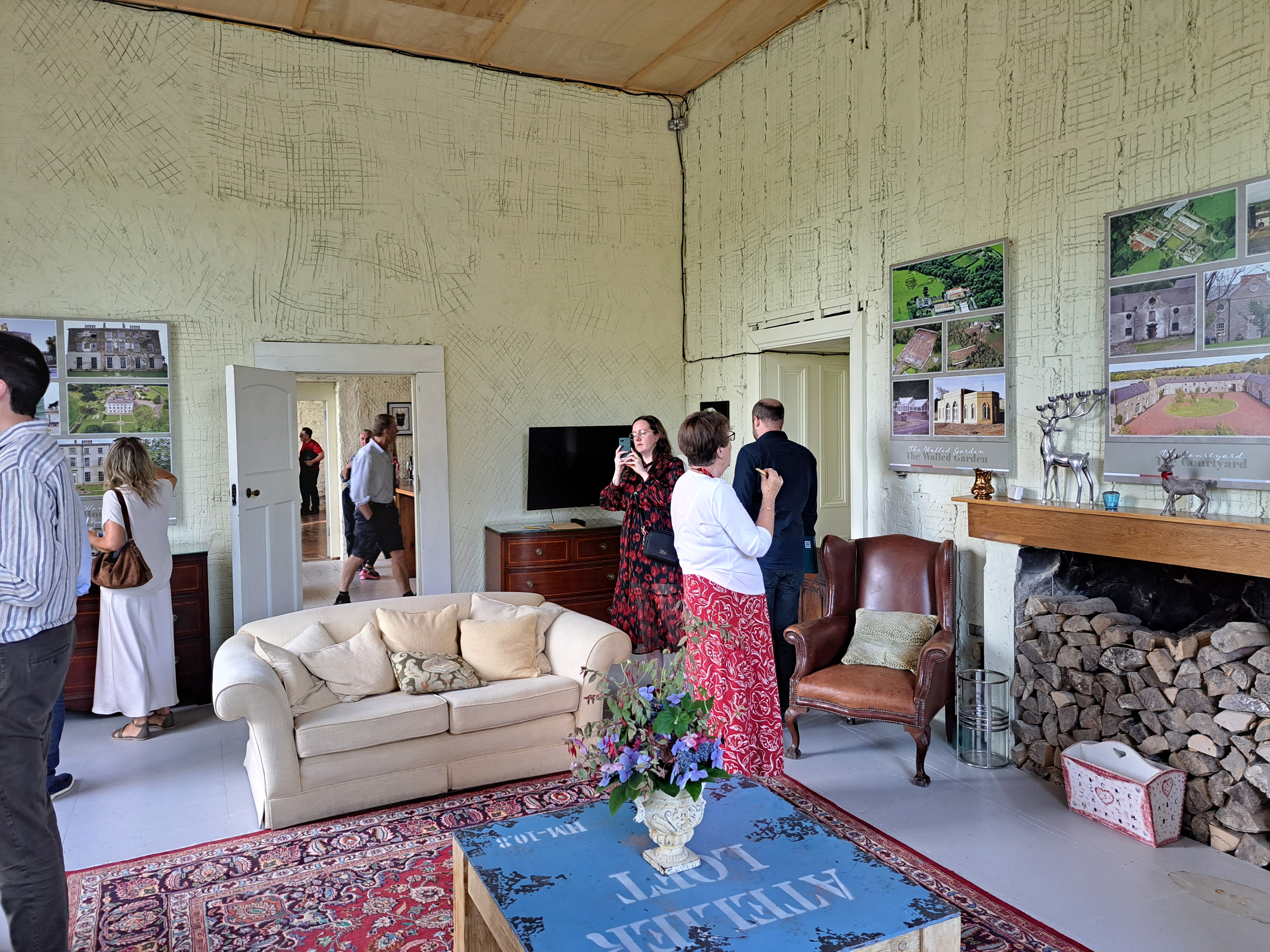
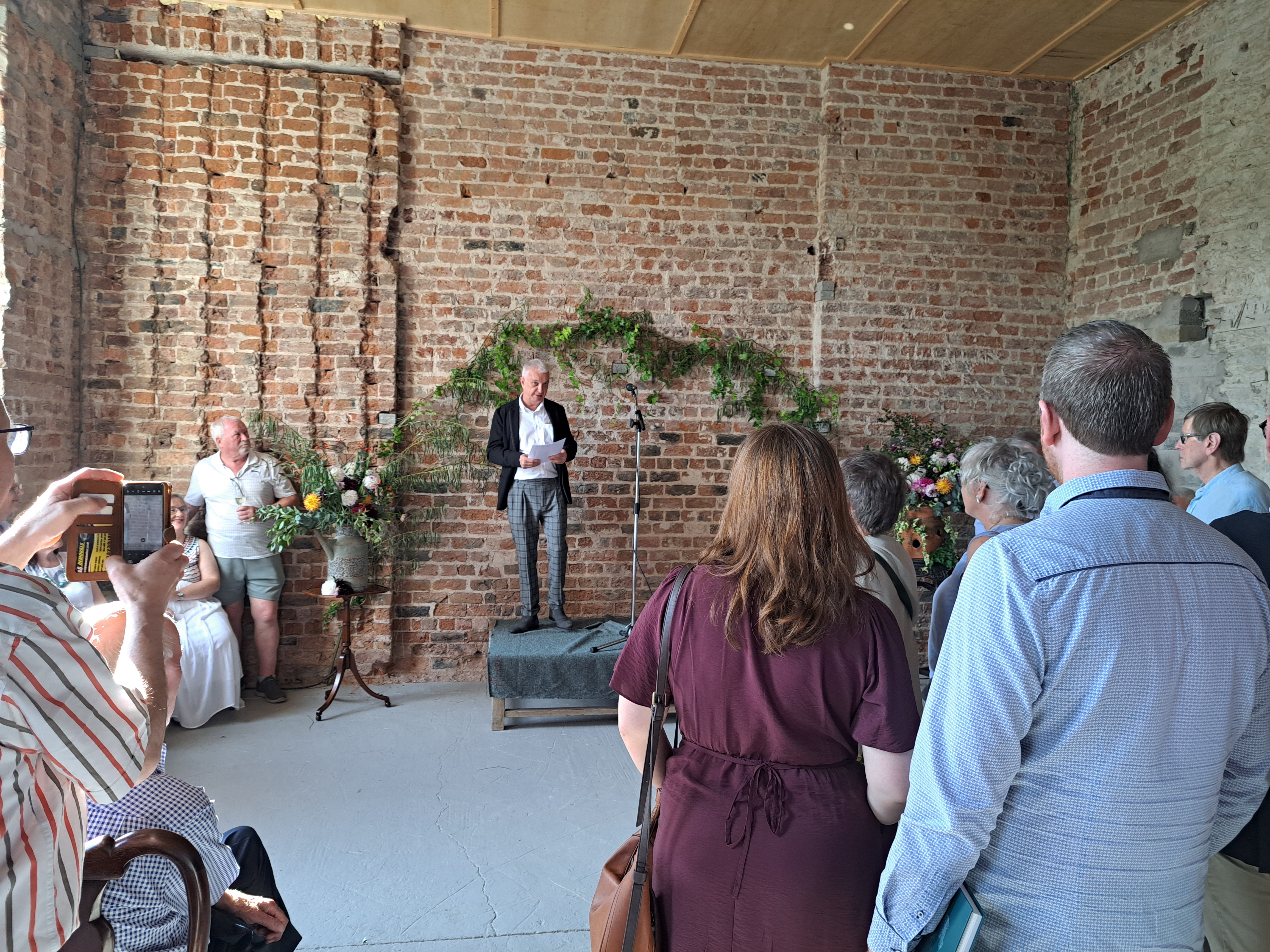
I was delighted to attend the launch of Balloo, Killinchy, A Hidden History by Lesley Simpson, Moira Concannon and Leanna Russell on Saturday, 15th August at Florida Manor, Killinchy. It was a wonderful occasion and a great start for a fascinating and beautifully produced book.
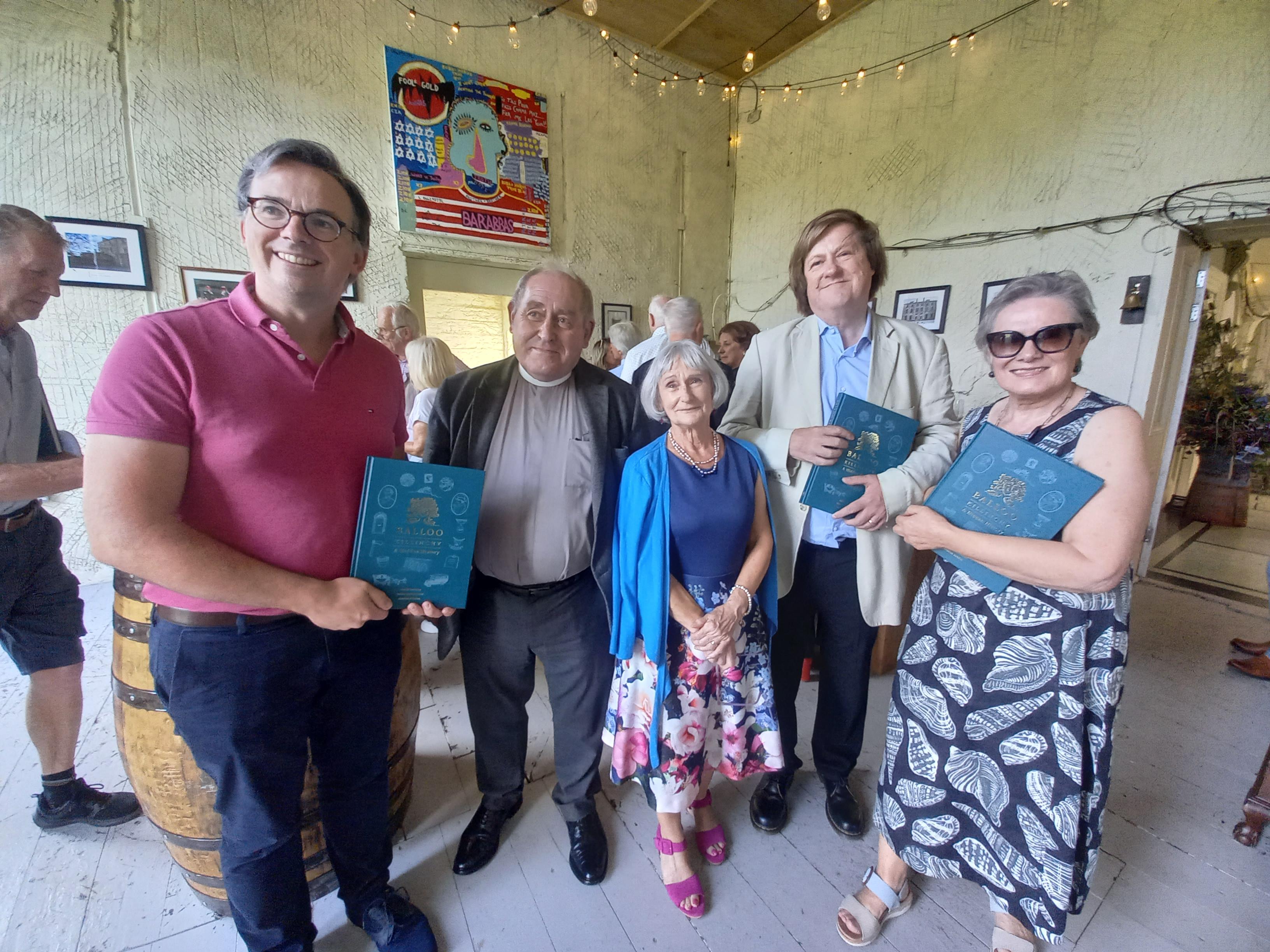
With Rev Dr Stanley Gamble, Rev Dr John Nelson, Lesley Simpson and Moira Concannon

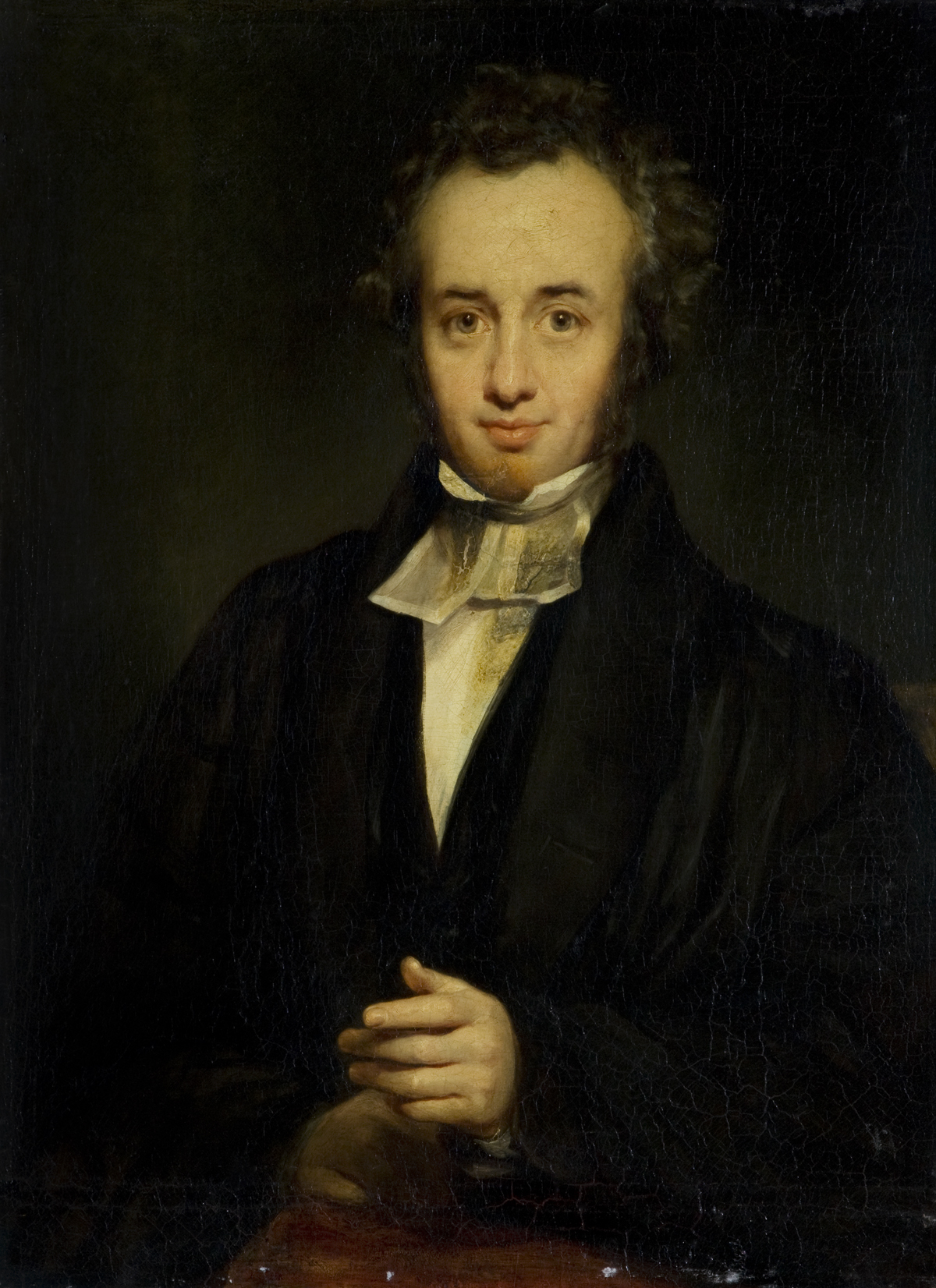
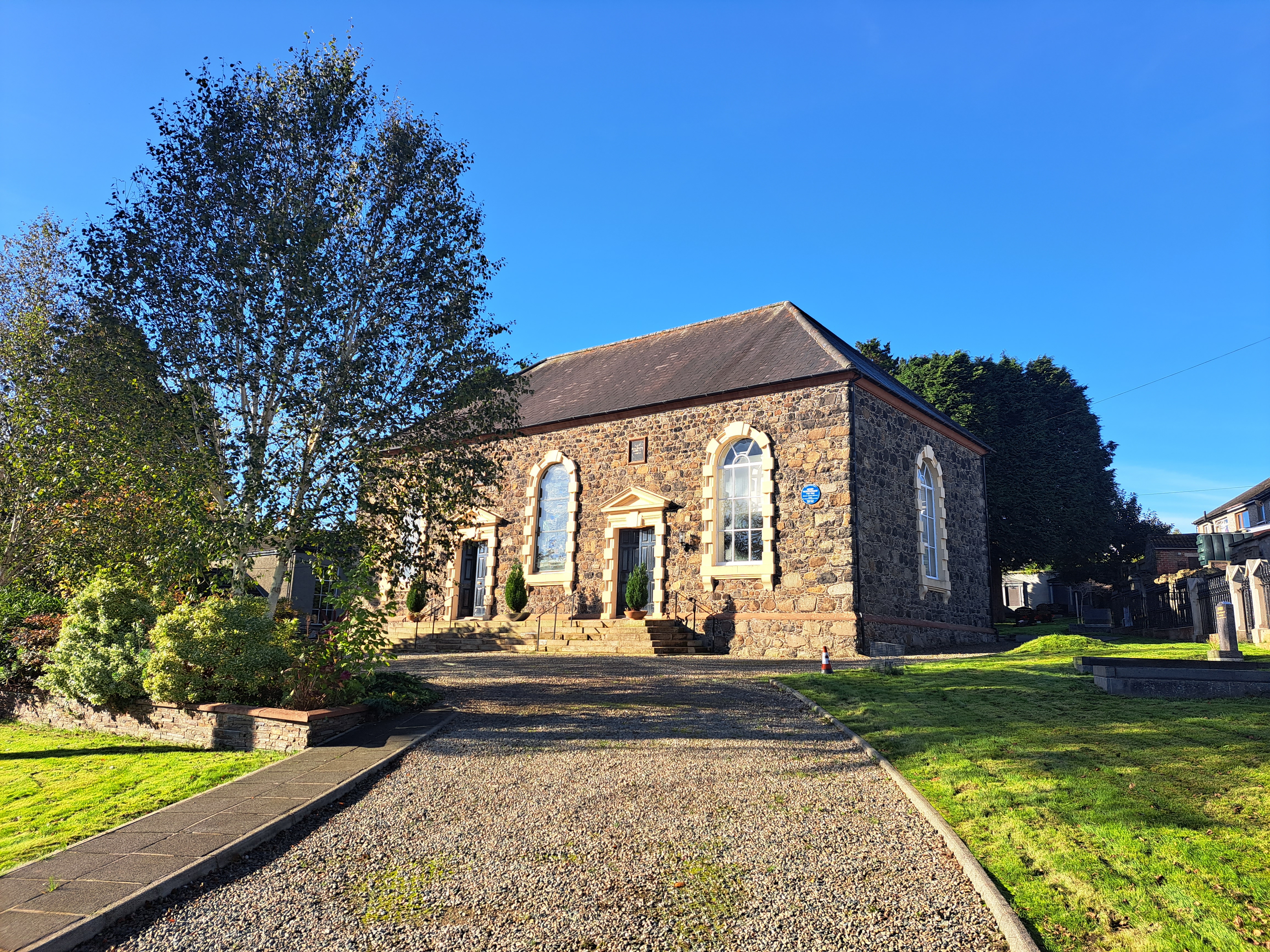
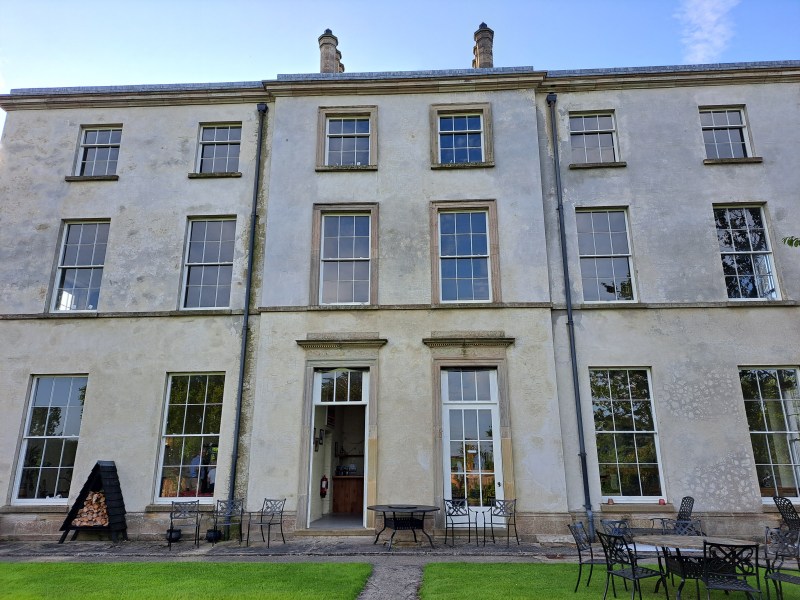
The authors tell the story of the locality through maps, family history, newspaper reports, churches, mills and stores and, most of all, the local houses. Of particular interest to me is the house known as Templebrook Valley which was the home of the Rev Samuel Watson minister in Killinchy from 1797 up to his death in 1856. He was at the centre of one of the major disputes between the Synod of Ulster and the Non-Subscribers in the 1830s and the new Remonstrant meeting house was built for him in Killinchy in 1846.
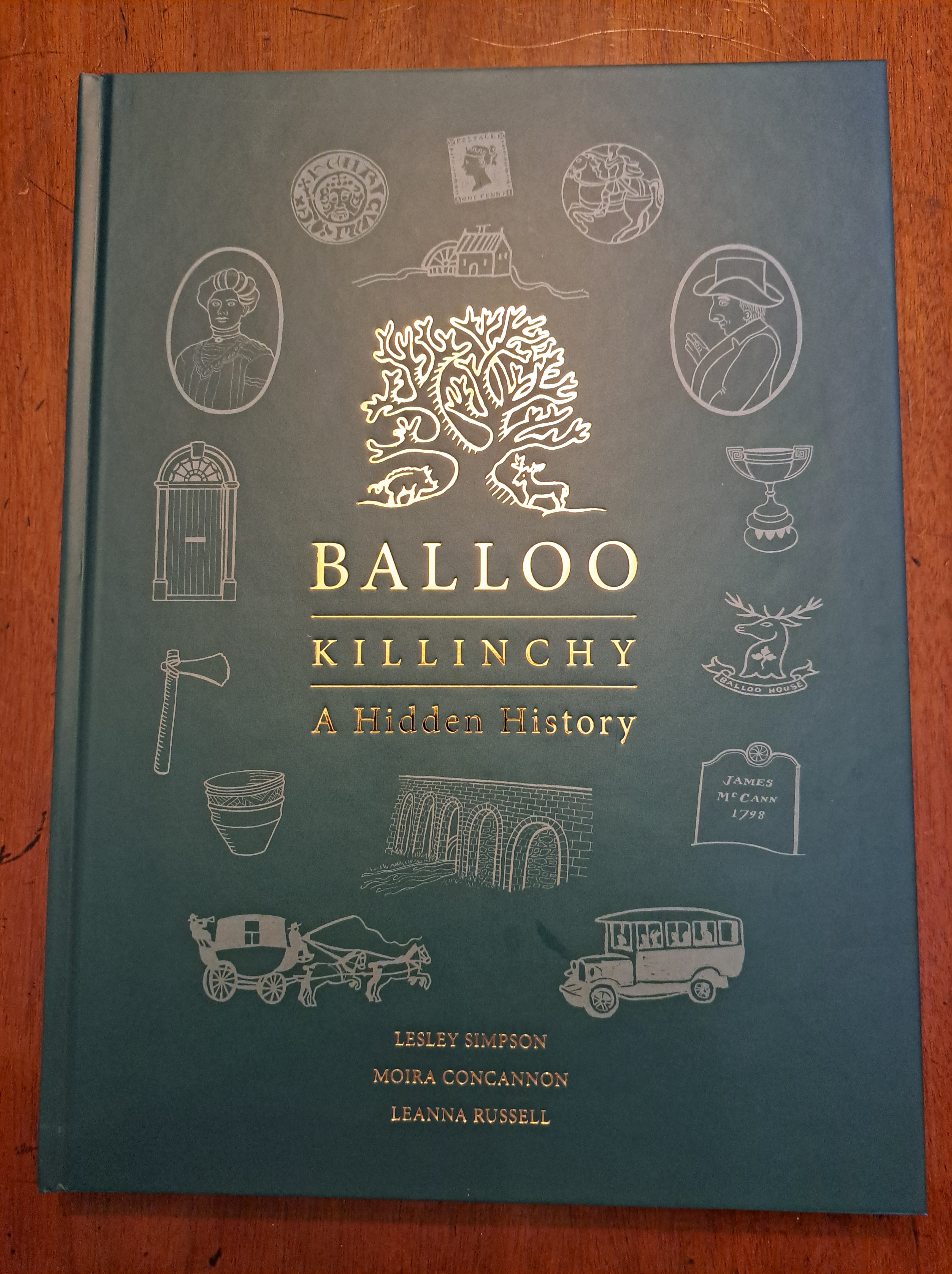
When the Non-Subscribers were ejected from their original meeting-house, for three years they held services in the grounds of his house. The book tells the story of the Rev Samuel Watson and his ‘long and interesting life from his suspected involvement with the United Irishmen to his move towards Unitarianism’. One of 13 children, three of them becoming Non-Subscribing Presbyterian ministers, Samuel Watson was also a significant farmer in the locality. Sadly his house was left to fall into dereliction in the twentieth century although a new house has now been restored on the site.
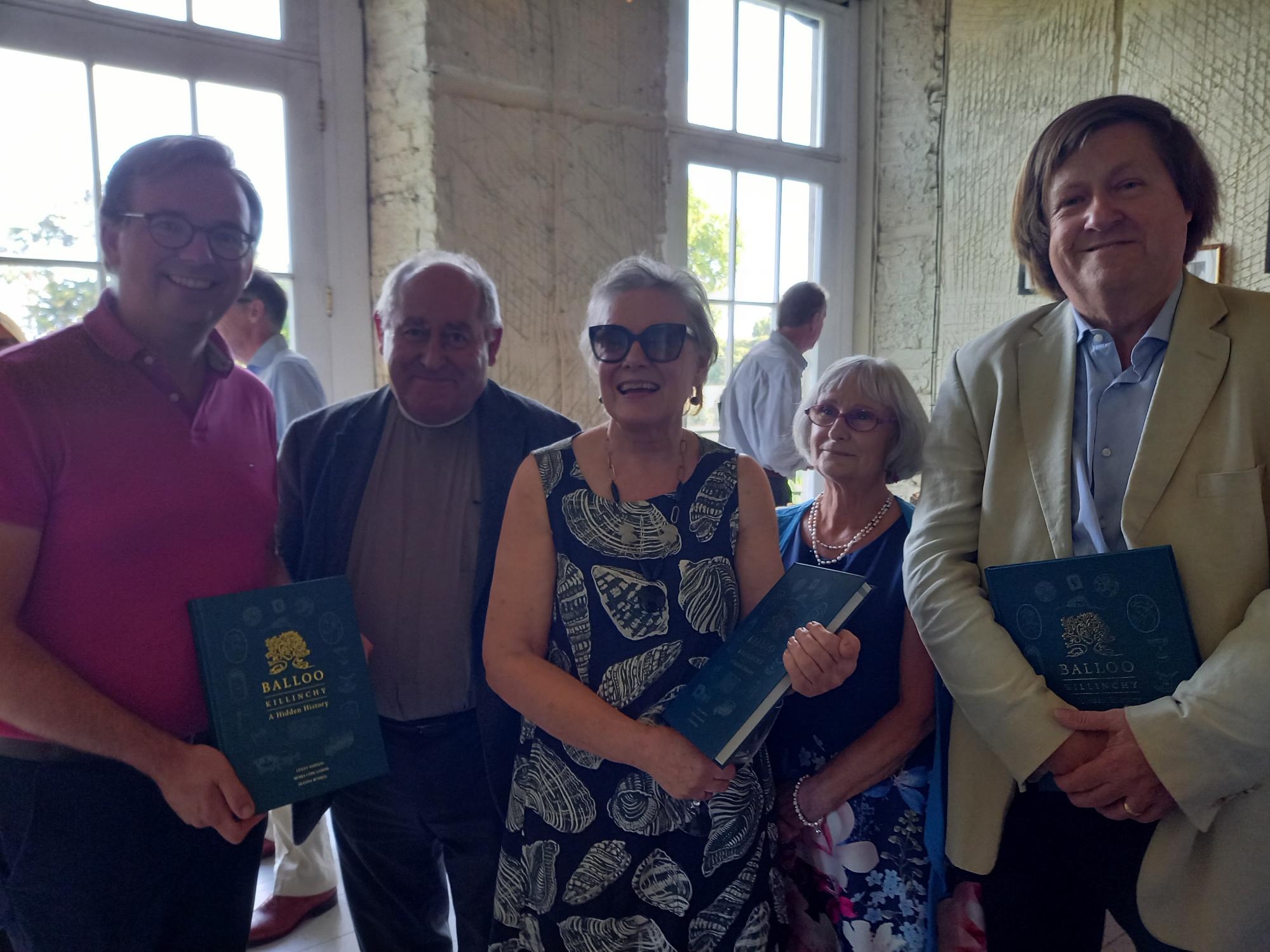
There is a great deal in the book about Samuel Watson. At the stone-laying ceremony for his new meeting-house it was reported that:

…seventy clergymen and strangers joined the congregation for a celebration which culminated in a substantial dinner, in a commodious wooden house that had been erected for the occasion with the Rev. Samuel Watson presiding.

I was particularly amused by one quotation taken from James Gourley in 1874, a perhaps not entirely unbiased commentator, who asked an old man who had sat under Samuel Watson’s feet:

What sort of doctrines did he preach? ‘Ohm’ said he ‘at that time there was no word about doctrine.’ ‘And what then did he preach about?’ ’Mainly about far away countries and wild beasts’.

Samuel Watson’s obituary in the Northern Whig described him as ‘…one of the oldest and ablest Ministers of the Church.’

The book is full of detail and uncovers such fascinating stories as the 1893 excavation of Templebrook Valley by the Belfast Natural History and Philosophical Society with the co-operation of Samuel Watson’s two youngest daughters – Anna and Sarah who were photographed at the excavation which uncovered Bronze Age vessels now in the Ulster Museum.
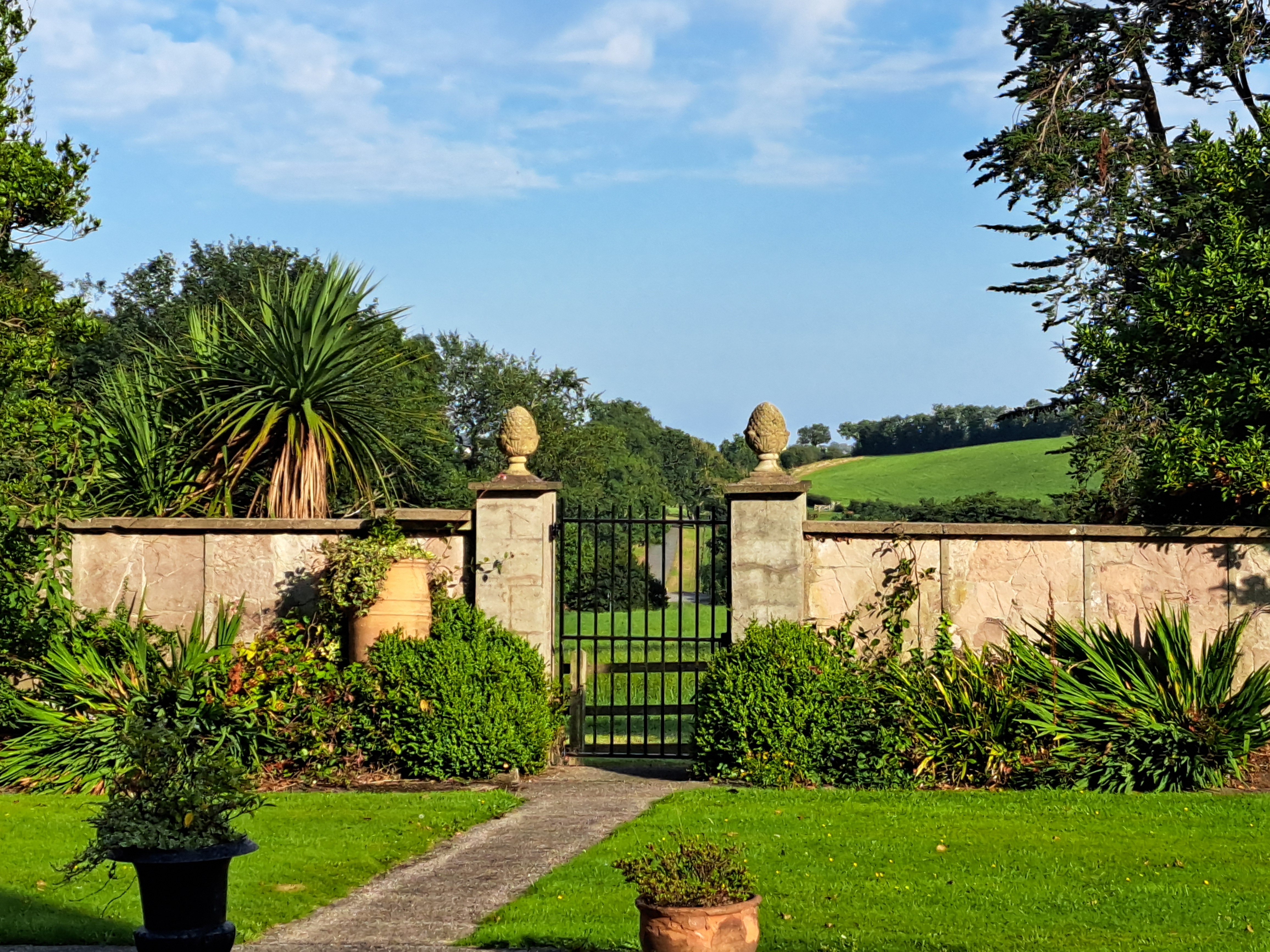
The view from the back of Florida Manor

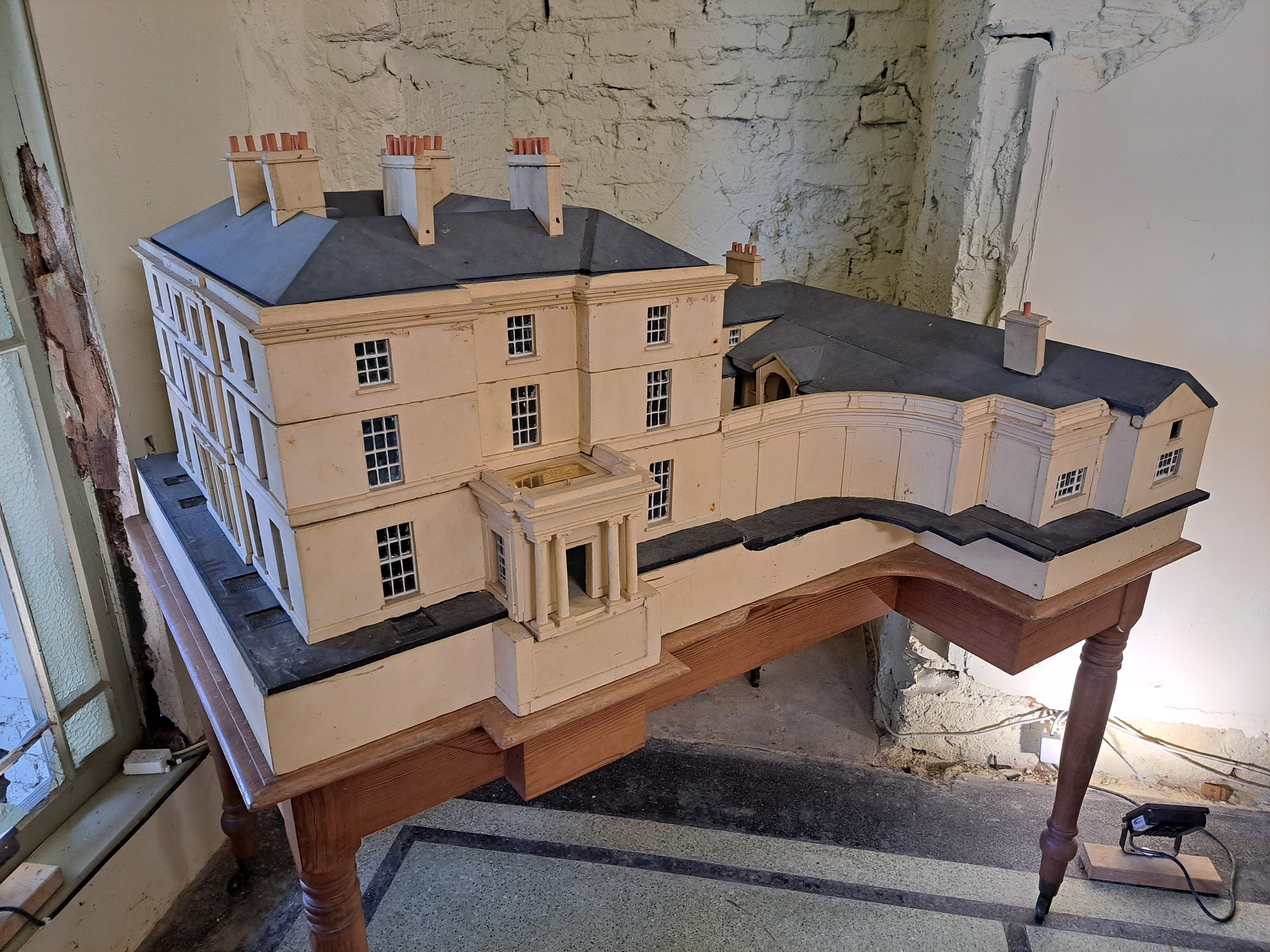
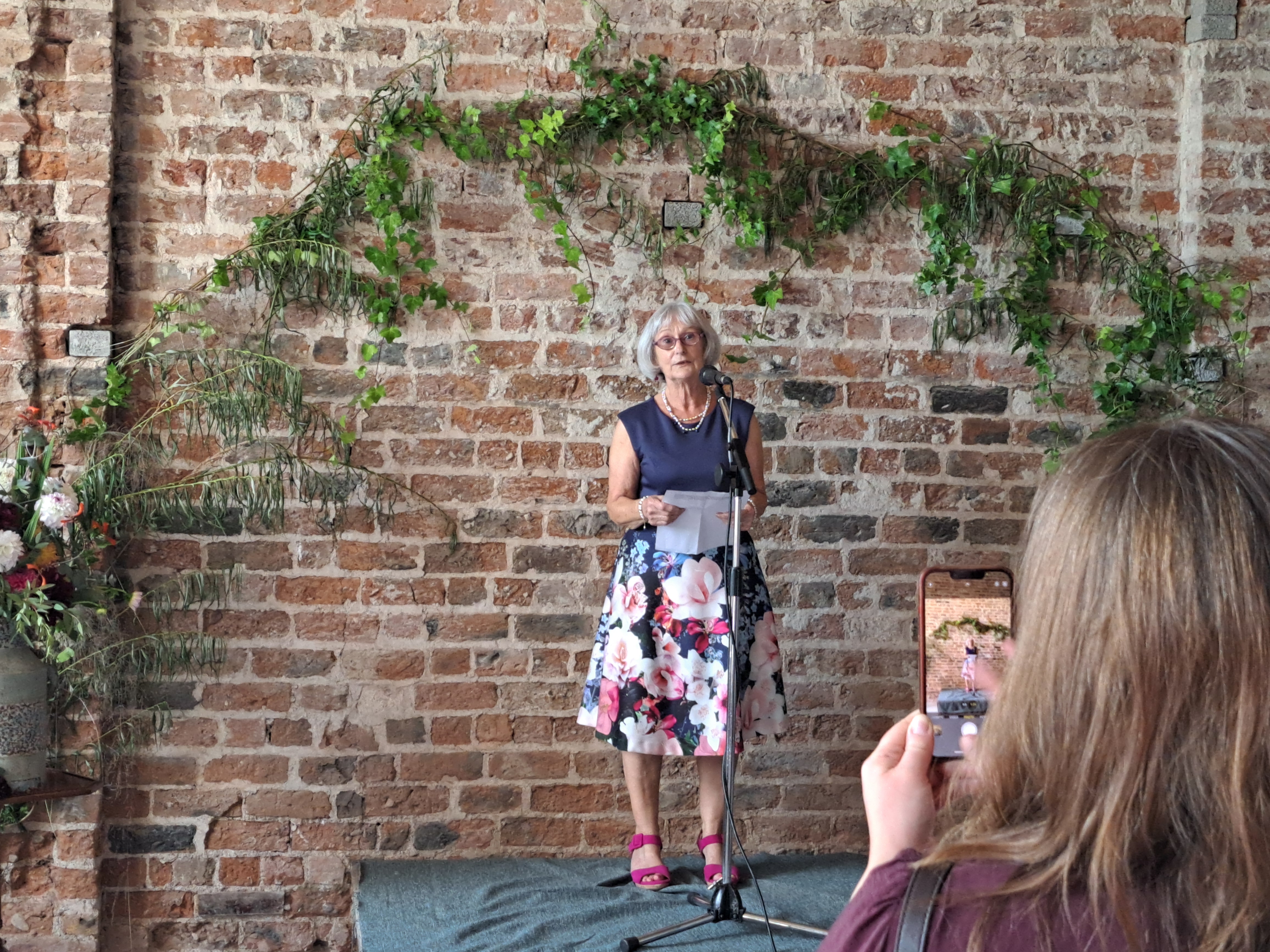
The book is richly illustrated throughout and is full of fascinating information. It is a credit to its authors and will be enjoyed by all with an interest in local history, the history of county Down and Irish Presbyterian history. The launch was a splendid occasion at Florida Manor, as the following photographs show.
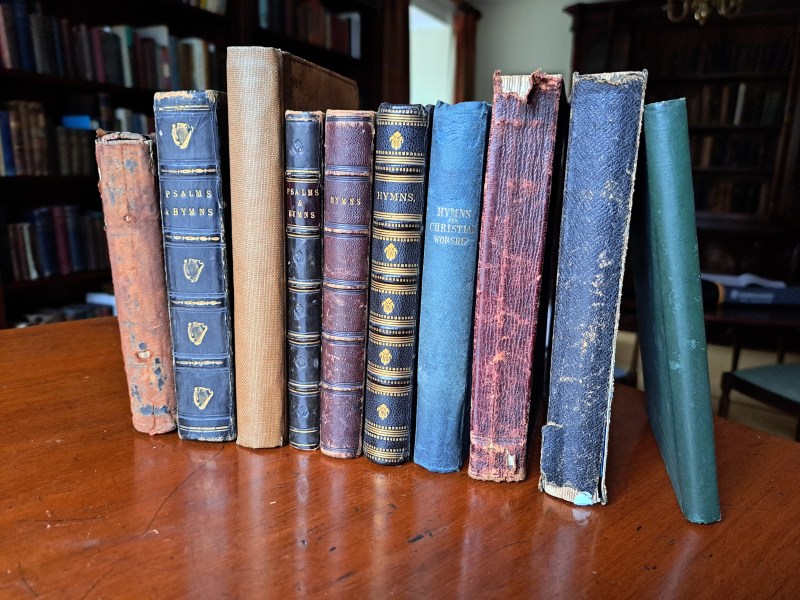
‘Let divine worship be observed, by all who would aspire after the happiness of heaven’. 19th-century Non-Subscribing Presbyterian Hymnbooks

The title of this post comes from the Preface to A Collection of Psalms, Hymns and Spiritual Songs written by the Rev A.G. Malcolm for his hymnbook published in Newry in 1811.

Click on the video to explore Irish Non-Subscribing Presbyterian hymnbooks

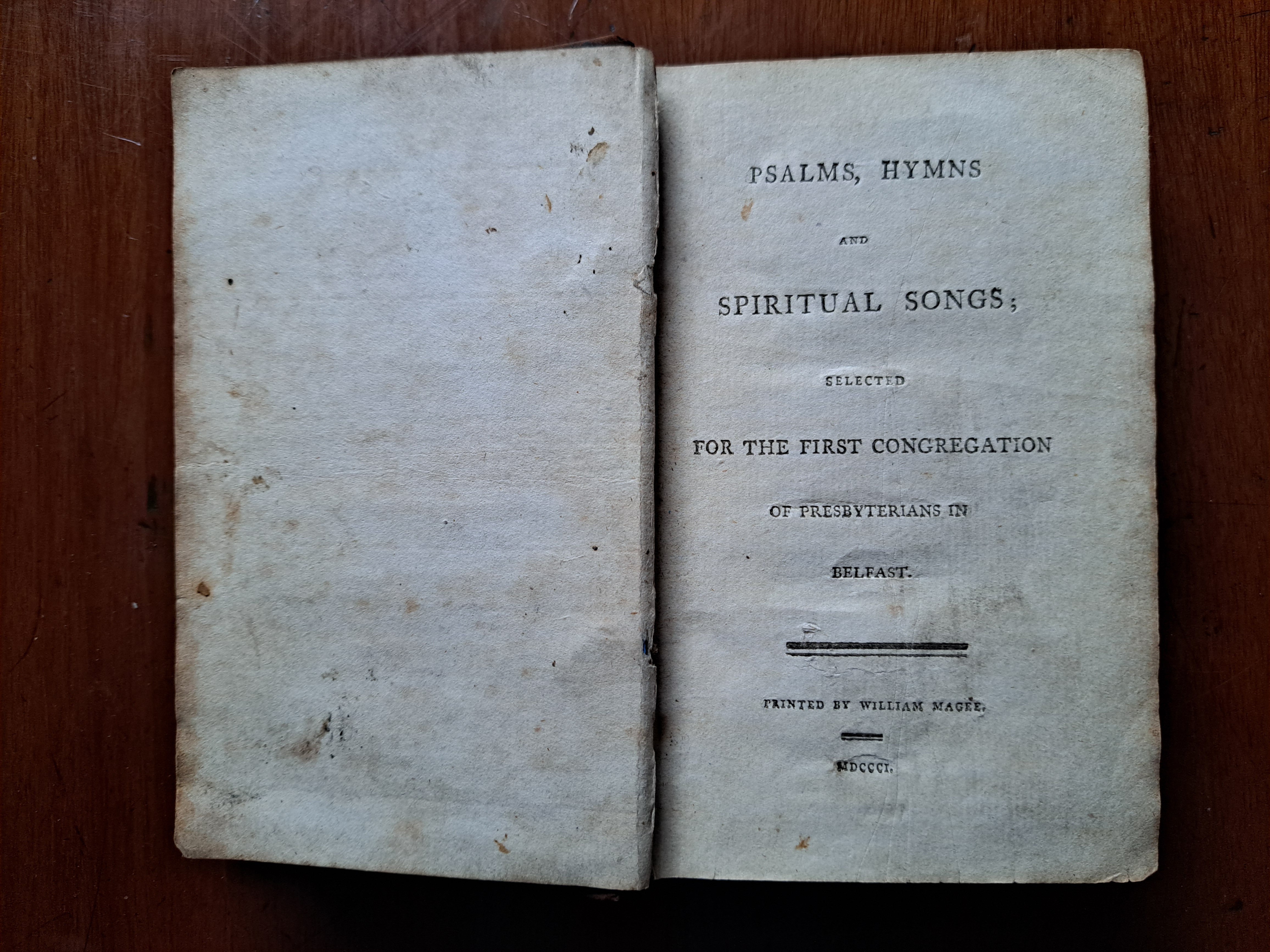
Prior to about 1800 Non-Subscribing or New Light Presbyterian churches, in common with other Presbyterians, would have worshipped with a Psalter or Psalm book. The first distinctly Non-Subscribing hymnbook appeared in First Church in 1801. What is surprising about this publication is that in the same year Edward Bunting offered to supply an organ to the church. This offer wasn’t taken up although in just a few years the Second Congregation were to become the first church with an organ, First Church not acquiring one until 1853. The Rev William Bruce edited this collection and 1,200 copies were published. A choir seems to have led the singing which initially contained boys but was later expanded to include adults.

First Church’s Collection of 1801

William Bruce’s book contained 246 hymns, with an index of first lines and a brief one page table of subjects. The next hymnbook, the Newry edition of A.G. Malcolm, contained 405 hymns with a more substantial table of subjects running over eight pages. Plus it had an index of first lines with the names of authors (for example Barbauld, Watts, Doddridge, Kippis, Merrick, Wesley, Addison, Enfield) which showed the eclectic sources the book drew on from within Dissenting circles and beyond.

An interesting preface also explained their intentions:

…care has been taken, to select psalms and hymns, which treat of of the leading points both of faith and practice; and it is hoped, that the compilation will be found to contain a sufficient variety of the best compositions, in sacred poetry, adapted to all the principal subjects of Christian devotion.

A.G. Malcolm went on:

Correctness, both in sentiment and style, has also been made an object of considerable attention. Hence, many verses have been altered; and such psalms and hymns as seemed, in any degree, unsuitable to the simplicity and solemnity of divine worship have been omitted.

As the work is intended for general use, and must be expected to fall into the hands of persons, who unavaoidably differ from one another, in their opinions, on religious subjects, all expressions, which appeared likely to give offence to any sincere Christian, have been studiously avoided.

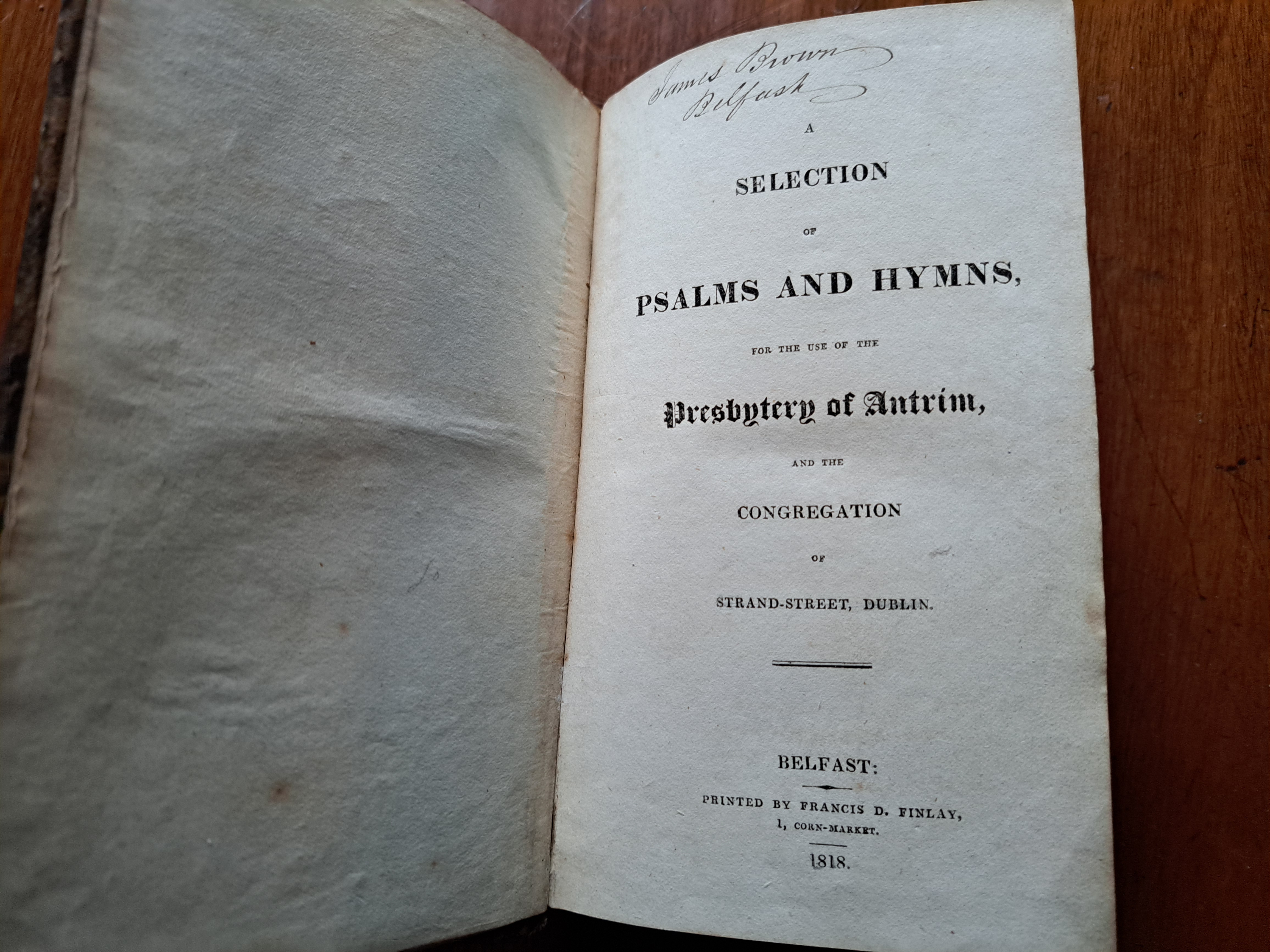
Interestingly the next hymnbook, dated Belfast, July 1818 and edited by Rev W.D.H. McEwen, made a similar point in a slightly more forceful way in its Preface:

Some doctrines are so offensive to the societies, for whose use this compilation is principally intended, that they are carefully avoided. As to others, the same scrupulosity is not observed; for, with respect to them, there may exist a diversity of sentiment. This selection may, therefore, be thought defective, but it will not disgust by a pertinacious obtrusion of doctrine.

So certain doctrines weren’t allowed to get in the way! Some were left out all together – the Trinity, the theory of the atonement based on penal substitution – and on some doctrines Non-Subscribers were able to agree to differ.

W.D.H. McEwen,s hymnbook

The book was published for the Presbytery of Antrim and the congregation of Strand Street, Dublin but it came from the minister of the Second Congregation. Curiously they had installed an organ in 1806 and had Edward Bunting as their organist from then until 1817. So they don’t appear to have had a hymnbook of their own for the first dozen years after installing the organ.

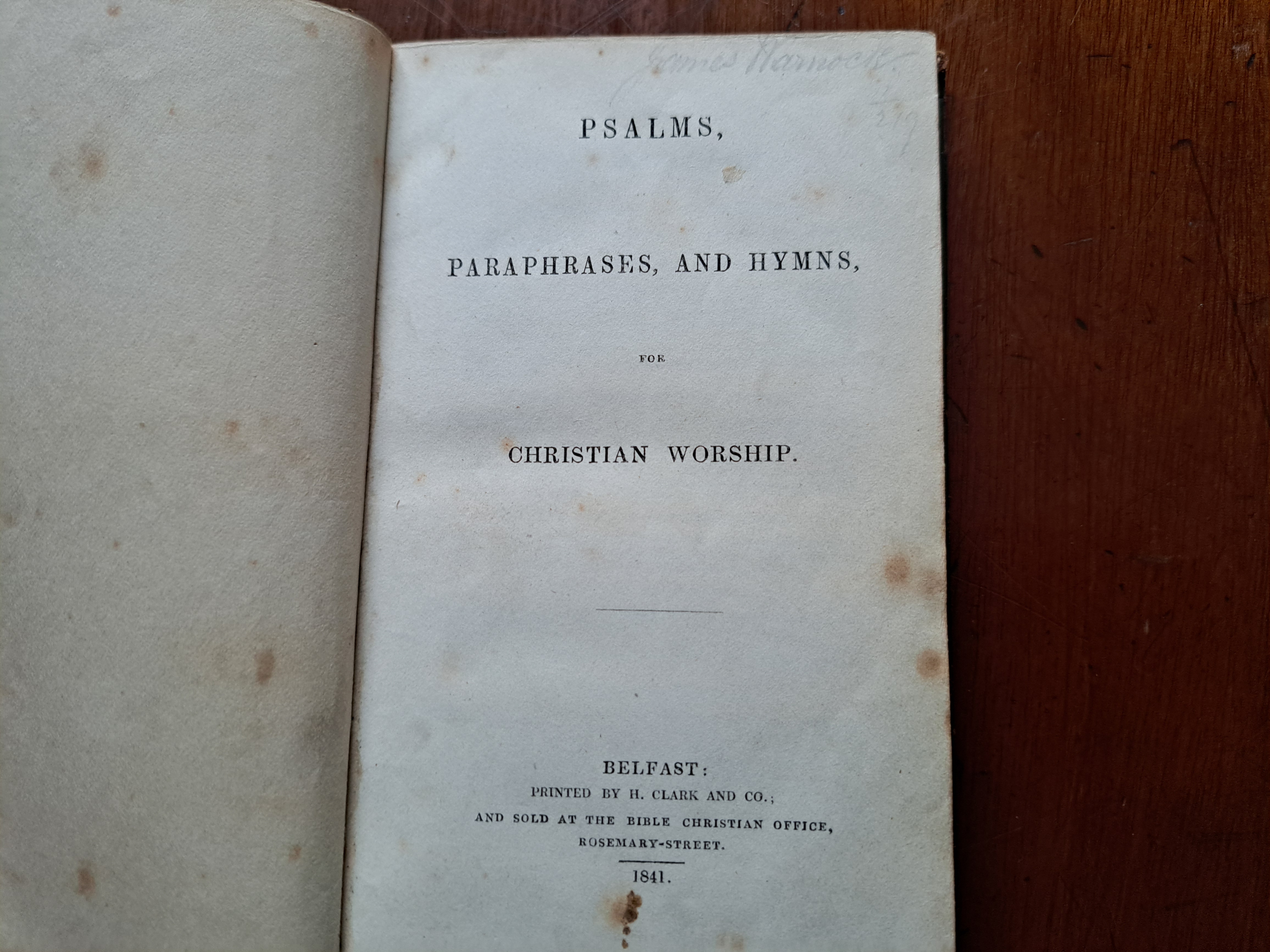
Following the establishment of the Remonstrant Synod of Ulster in 1830 Non-Subscribers moved towards the development of a hymnbook for all churches. This is Psalms, Paraphrases, and Hymns, for Christian Worship published in Belfast in 1841:

Psalms, Paraphrases, and Hymns, for Christian Worship 1841

This is the first edition of what became Hymns for Christian Worship, a book which went into at least four further editions before the end of the century and was followed by a supplement in 1899. Throughout this time this was the main series of hymnbooks in use in the churches in Ireland. More detail can be seen in the video above.

The Antrim Meeting of 1626 and Rowel Friers

A recent post looked at the two wonderful Rowel Friers cartoons which hang on the wall of the Library in Dunmurry, as well as the video which explains the story about them. As the post explains these pictures were commissioned by the Rev William McMillan for his impressive Exhibition illustrating the history of the Presbytery of Antrim held in January 1976.

It must have been an attractive display in the McCleery Hall, the Rev Mac sourced portraits, books, communion plate, swords and pikes from the ’98 Rebellion, sculptures by Rosamond Praegar, commmunion tokens, copper collecting pans and all sorts of material from all over Northern Ireland. There was even a mould for making eighteenth-century communion tokens from Ballycarry and – something I had not previously heard of – an eighteenth-century family token box, described as ‘a wooden box holding a small leadbox in which the token was taken to the meeting house.’

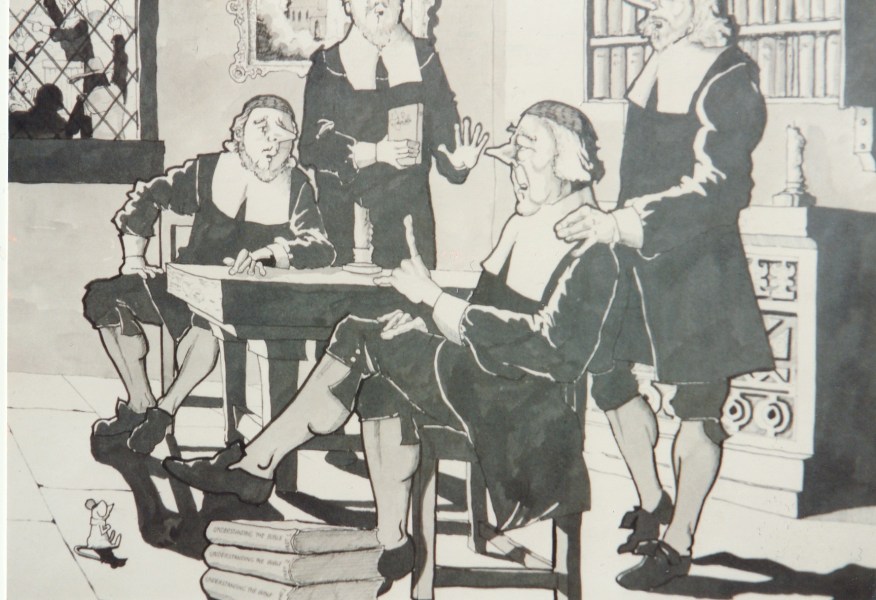
One feature of the Exhibition for the 250th anniversary of the Presbytery of Antrim is that there were in fact three, not two, Rowel Friers cartoons included. Unfortunately one of these has been missing for fifty years. However, we have now discovered a photograph of the lost picture and this features in our latest video:

Click on the video to see the video about the 1626 Antrim Meeting

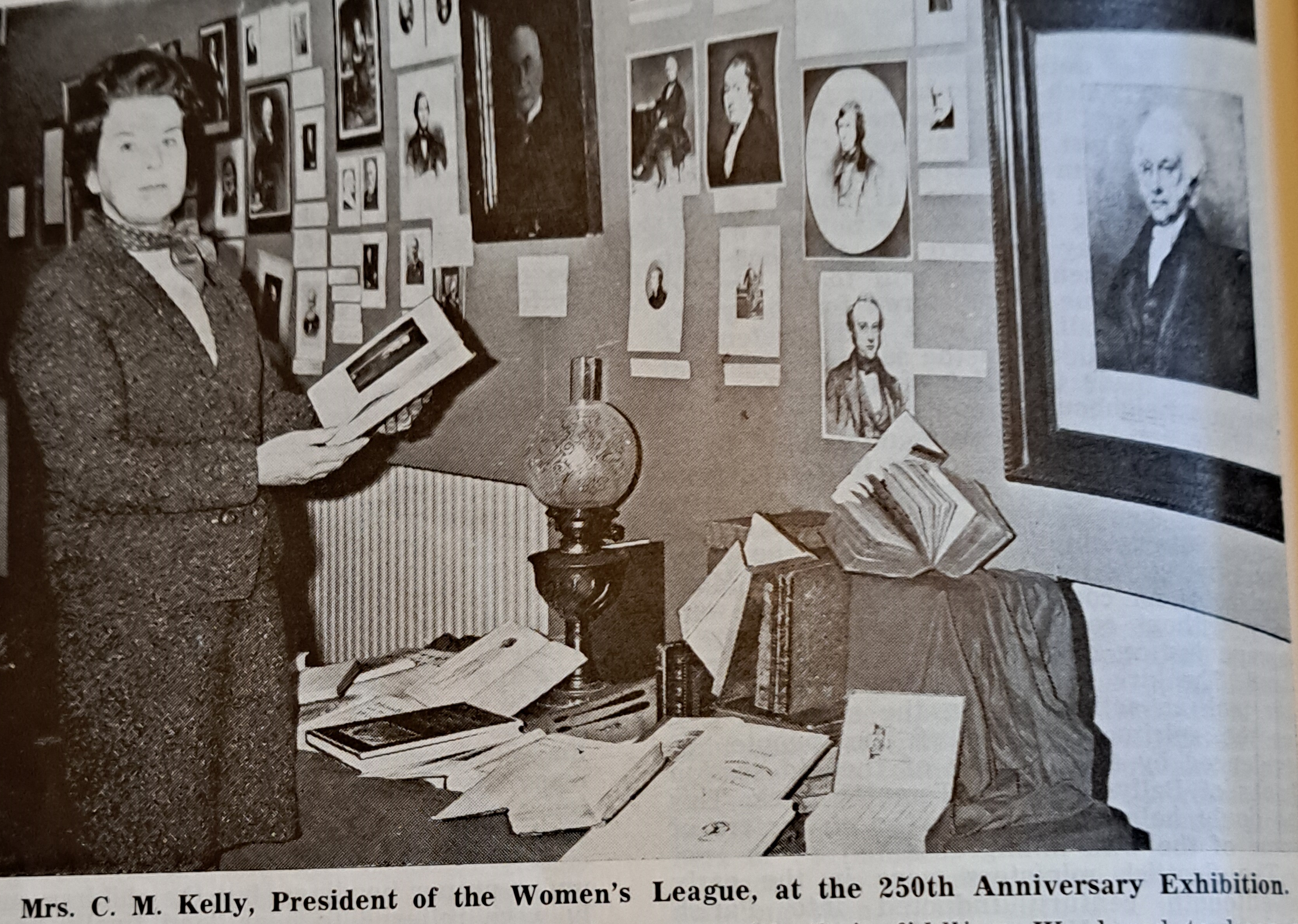
The Exhibition was held in January 1976 and covered both the creation of the Presbytery of Antrim in 1725 and its separation from the Synod of Ulster. It was also intended to cover the anniversary of the creation in 1626 of the original Antrim Meeting. The Exhibition must have been fascinating but unfortunately in that pre-digital age there were very few photographs taken. There is only one that shows the Exhibition in the Non-Subscribing Presbyterian magazine at the time:

Betty Kelly at the Exhibition in the McCleery Hall in 1976

There were a large number of dignitaries invited to the dinner that followed the Exhibition, representatives of all denominations, figures in public life, historians and international figures. Many of the speeches are recorded in the Non-Subscribing Presbyterian magazine and the Rev John Radcliffe, clerk of the Synod, made reference to the third Rowel Friers cartoon:

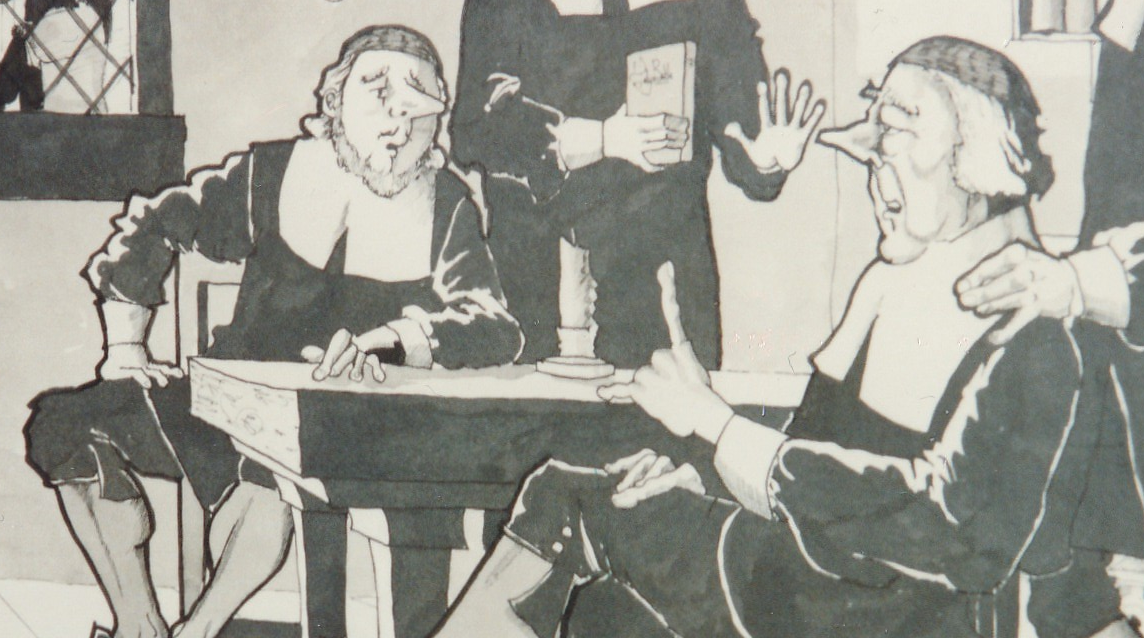
‘There are two extreme forms of the expression of religious sentiment. There is one that is very well expressed in the person here described: “His mind and voice had precisely the fluid quality of some clear, subtle liquid: one felt it could flow around anything and overcome nothing.” That is the extreme of presenting the Christian faith in such delightfully attractive style, with such a fluency of language, with such a vividness of imagery, that it will flow around anything and overcome nothing. At the other extreme there is another sort of Christianity, corybantic Christianity. There is a cartoon on the wall there, a drawing of four rather austere clerics, and the date is 1626. Outside you see somebody rousing a rabble – not unheard of in these days. The four rather serious looking clerics are trying to bring a bit of reason into it all; and the man outside is an exponent of corybantic Christianity, the Christianity that is the direct oppposite of that I have been describing tonight – and appeals all the time to the emotions in which people get carried away, and leads in the end to a very dangerous, in fact terrible, fanaticism – the very negation of the Christian spirit.’

Detail from the photograph

It is a fascinating footnote to our previous post and video about our Rowel Friers cartoons, another part of the story that takes us back even further in time, in this case to 1626.

The published works of John Abernethy

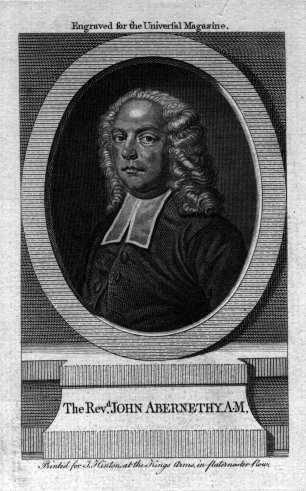
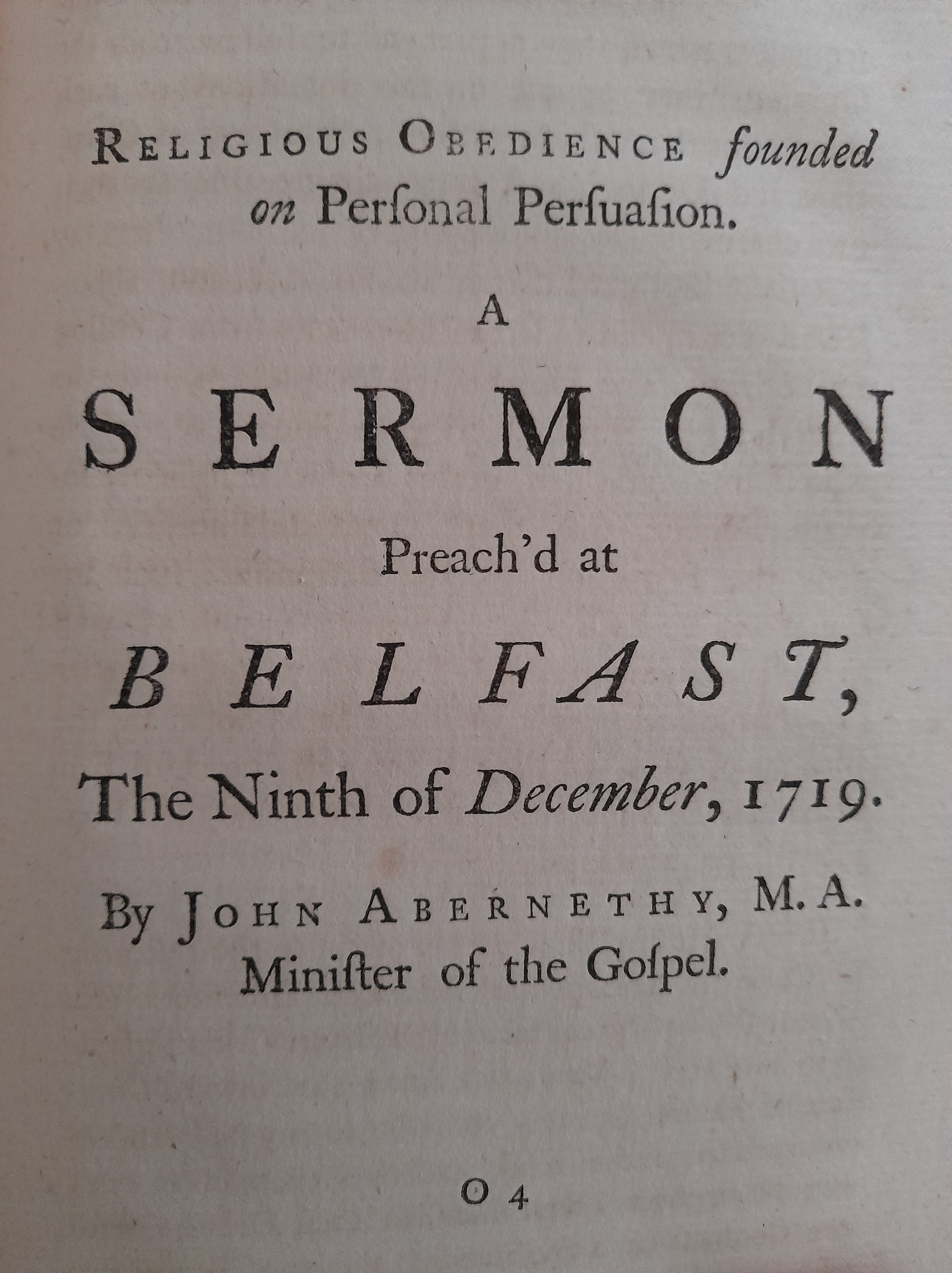
Episode 6 of our explorations of the Very Rev William McMillan Library at Dunmurry looks at the writings of the Rev John Abernethy (1680-1740). Without doubt the most prominent Presbyterian minister in Ireland in the early eighteenth century and the foremost exponent of Non-Subscription, he was minister at Antrim (see picture above) and later Wood Street, Dublin.

Click on the video to see John Abernethy’s books

Some of his books were the best sellers of their day and some of his publications were seen as either controversial theological statements or the key to opening up a new way to understand faith, depending on your point of view. Ironically at the time of the first subscription controversy the minister of Dunmurry, the Rev John Malcome, was a vocal opponent of the Non-Subscribers and was the first to use the term ‘New-Light’ about them. But Dunmurry Library has a good selection of his published works, most of them published after Abernethy’s death.

The founder of the Belfast Society in 1705, an outspoken advocate of the rights of the dissenting minority in Ireland and an established philosopher of some importance, John Abernethy’s books had considerable influence and this video looks at his publications held by our Library in Dunmurry.

John Wesley and Belfast

In the latest of our videos exploring the Very Rev William McMillan Library at Dunmurry we take a (brief) look at the eight volumes of the Journal of John Wesley. In particular we look at his visits to Belfast and his relationship with the Non-Subscribing Presbyterian churches in Belfast.

Exploring the Library at Dunmurry, episode 4. Click on the video above

John Wesley visited Belfast 11 times in the course of his career, always preaching in the town, sometimes in the market-house, sometimes in the open air. Often it seems he visited at times of cold, windy or wet weather. Only once did he preach in a church and the only church to ever be open to him was First Presbyterian Church, Rosemary Street. But this visit was mired in controversy and was not repeated. I am grateful to Des McKeown of First Church who recently gave me a copy of a letter to The Northern Whig dated 3 December 1873 written by the minister of First Church, the Rev John Scott Porter. This features in the video and it is interesting to see his opinion of Wesley’s visit almost one hundred years previously.

A youthful John Scott Porter

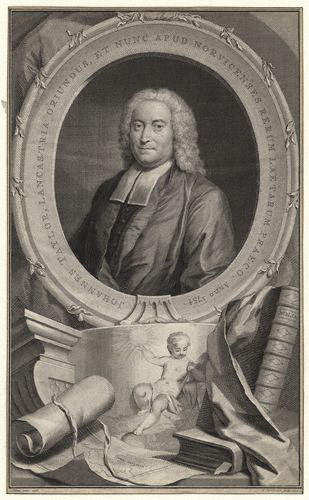
But another feature of Wesley’s Journal is his identification of followers of Dr John Taylor in the crowds that came to hear him in Belfast. John Taylor was minister of the Octagon Chapel in Norwich and the author of the The Scripture Doctrine of Original Sin. What are the implications of this in Belfast in the 1760s? We try to unpack the meaning of this for John Wesley’s reception in Belfast in the video.

John Taylor (Source: Wikipedia)

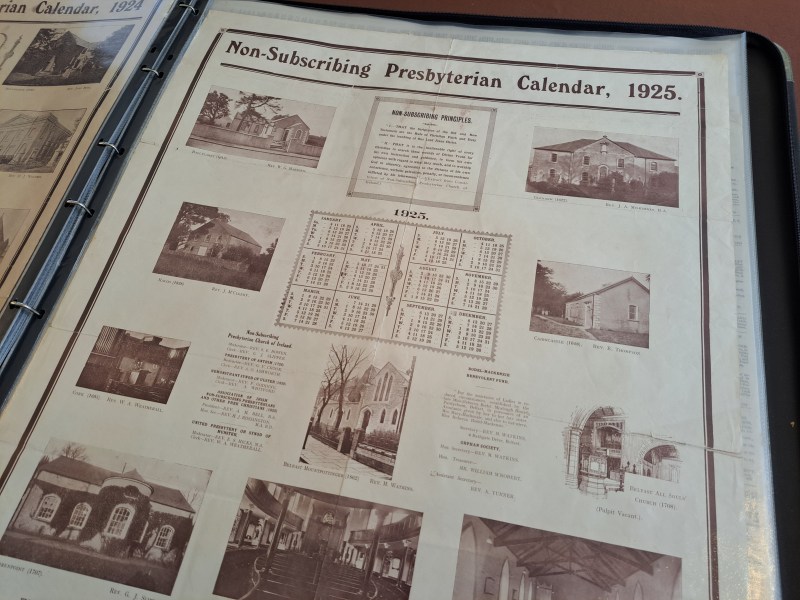
Ephemera – two Calendars from the 1920s

Ephemera is the term given for items that weren’t usually expected to last. Usually printed items, they had only a limited shelf-life and were generally expected to be thrown away when they had been used. Inevitably such things tend to become interesting to collectors because they often illuminate some aspect of social history that might otherwise be lost. Our new Very Rev William McMillan Library is rich in ephemera and this latest video explores two items held by the Library:

Click above to see Episode 3 of the explorations of Dunmurry NSP Library

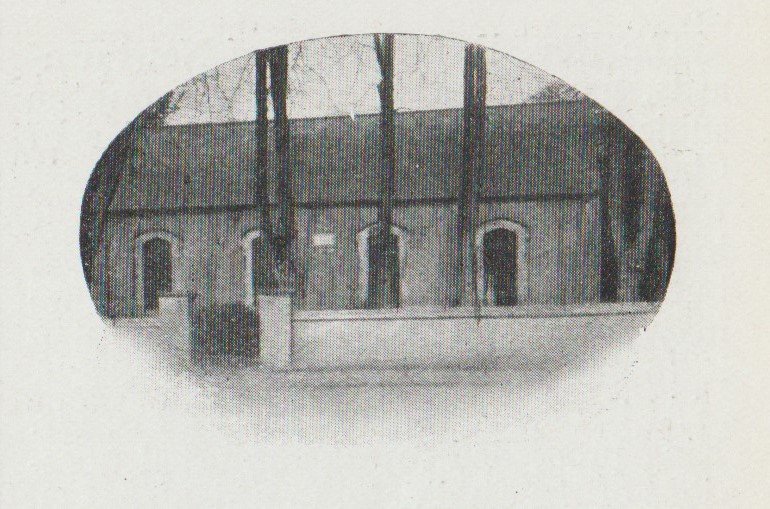
In 1924 and 1925 the congregation of York Street Church, Belfast, under the leadership of Rev Dr A.L. Agnew, produced a calendar to sell to the denomination. Over the two years they included a picture of all the churches in the denomination in Ireland and they make for interesting documents. Many of the pictures date from a bit before the mid-1920s but it makes for an interesting collection of early twentieth-century photographs. Some images are quite well-known and have often been published. Some are quite rare like this picture of Ballymoney:

There’s also a reminder of an attempt at outreach in Bangor which lasted for a few years, and seemed to be successful for these years at least:

But altogether they are interesting documents. They must have captured a lot of interest at the time but at the end of the year what do you do with an old calendar but throw it away? Which is why so few have survived. You can find out all about it by watching the video.

Very Rev William McMillan Library

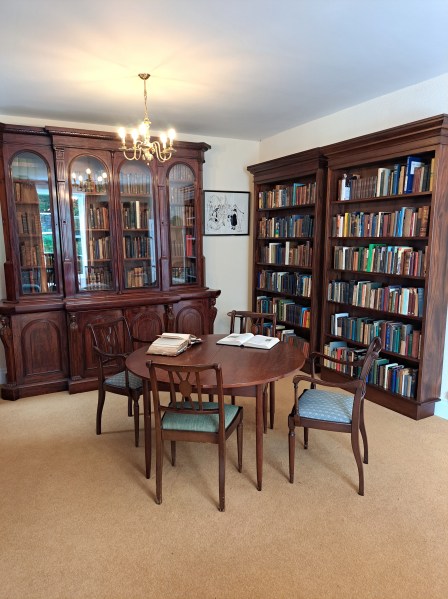
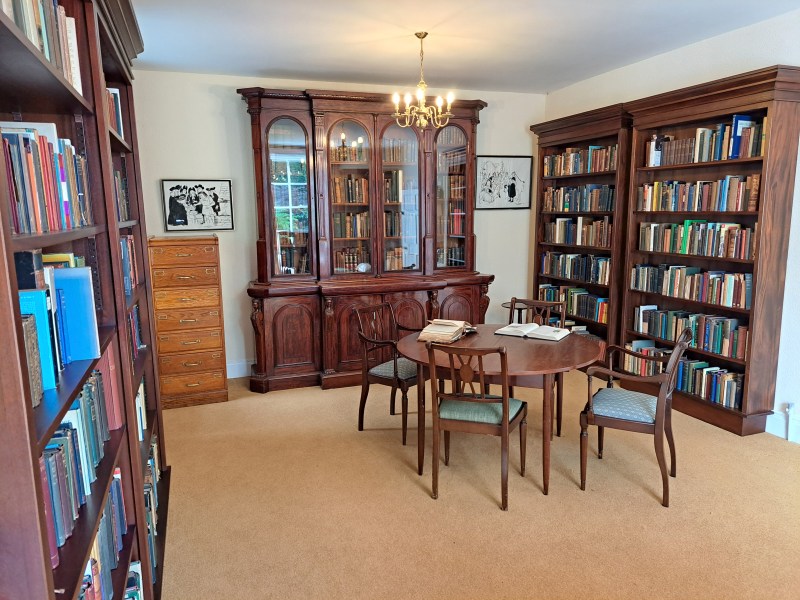
At Dunmurry we are particularly looking forward to the formal opening and dedication of the Very Rev William McMillan Library on Sunday, 22nd September at 3.00 pm. The Rev Mac bequethed his Library to the Church and over the last four years we have been working on creating a catalogue and getting everything ready to house the Library. We have had furniture made for the Library, we have also repurposed other furniture for use in the Library and restored some items to house the books.

It is an exciting project and a very fitting memorial for the Rev Mac who was an historian of some ability and renown. He assembled this collection as he worked on the history of Non-Subscription and the Library contains over 2,500 books, as many pamphlets and journals again, and many more manuscripts and other items. After the dedication the Library will be open for visitors (although we will not be able to lend items) but we want the Library to be known and appreciated by as wide a group as possible.

To help in this process I will be uploading short videos talking about the Collection, in which I will highlight different books which have an interesting story to tell. The first of these is this video;

Dunmurry NSP Library Episode 1. Click on the video to view.

This video looks at the Library’s copy of W.D. Killen’s History of Congregations of the Presbyterian Church in Ireland and Biographical Notices of Eminent Presbyterian Ministers and Laymen published in 1886 which was rebound and interleaved by Alexander Gordon in 1892. It’s a fascinating tale, the first in a series of short films about the unusual, interesting and informative books on the shelves.

Faith and Freedom 197 (2023)

The latest issue of our journal is out now and will be with subscribers shortly. Anyone can subscribe and an annual subscription costs only £16 in the UK ($32 in the USA), details of how to subscribe can be found below.

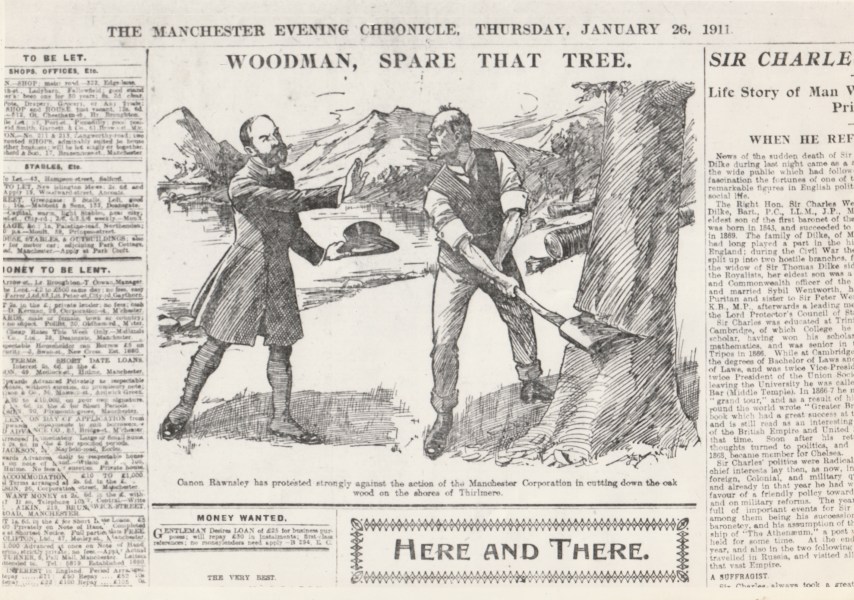
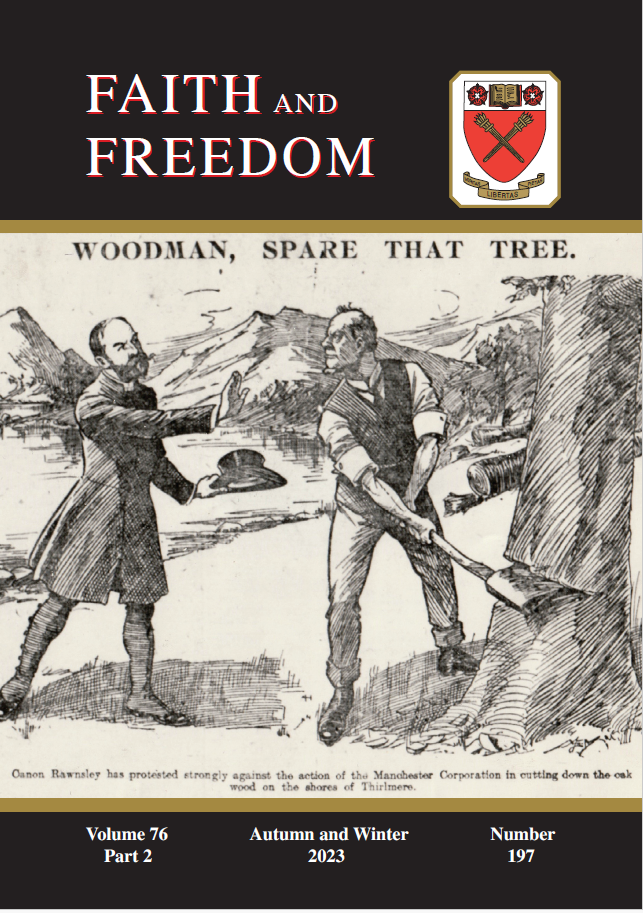
Our cover picture contains a cartoon from the Manchester Evening Chronicle of 26 January 1911 and features Canon Hardwicke Rawnsley, one of the founders of the National Trust, shown here trying to save some oaks on the bank of Thirlmere Reservoir in the Lake District. It links to Graham Murphy’s Review Article of a new biography by Michael Allen and Rosalind Rawnsley – Hardwicke Drummond Rawnsley, An Extraordinary Life, 1851-1920, (The New Beaver Press, 2023, pp 476. ISBN 978-1-7392194-1-3, £20 pbk.) The cartoon is strangely appropriate for today because it is also being used by campaigners trying to keep the public road along Thirlmere Reservoir open to walkers, cyclists and motorists. The Canon was not successful in his attempts in 1911 and the conifers which replaced the oaks now regularly blow down and block the road. You can read about the current campaign to keep the road open by clicking here.

Our journal opens with Sandra Gilpin’s pen portrait on the Rev William Hugh Doherty (c.1810-1890). His career began as the first minister of the Unitarian/Non-Subscribing Presbyterian Church in Comber county Down. He moved to the United States and embarked upon an unusual career firstly as a Unitarian minister in Rochester NY then moving to a denomination known as the ‘Christian Church’ where he became quite a prominent educator. But the suggestion of some scandal was never far away in his life and he managed to serve on both sides of the Civil War as well as hold views, at different times, that were both pro and anti slavery! His career ended with him becoming an assistant in the US Patent Office.

Other articles include Imran Usmani’s fascinating discussion of ‘The Crucifixion of Jesus in Islam’. Looking afresh at the traditional Muslim view of the Crucifixion the author presents ‘novel textual and contextual analysis of the Crucifixion Verse based on the Quran and traditional Muslim sources’ and concludes that the traditional view is actually a misunderstanding of the original intention. He concludes that the Quran does not deny the historical fact of the Crucifixion of Jesus, rather it denies that the Crucifixion was rightful. The author believes that ‘Crucifixion denial in the Muslim tradition created a chasm between Muslims and Christians because it made both parties sceptical of the other’s scriptures.’ His aim is to help bridge this chasm dividing the two religions.

Other articles include Dan C. West’s encouragement to Christians to turn from ‘preoccupation with the past to focus instead on the future is a courageous act of faith and hope’, in ‘With Courage and With Hope’; and a sermon by the editor, ‘Telling Our Stories’, which asks whether those of us in a liberal theological tradition fully understand and articulate our identities.

There is also a good number of reviews including:

Maria Curtis (ed.), Cherishing the Earth – Nourishing the Spirit, Lindsey Press, 2023, pp 264. ISBN: 978-0-85319-098-1, £12.00 pbk. Reviewed by Oscar Sinclair.

Stephen Hart, James Chuter Ede: Humane Reformer and Politician, Pen and Sword History, 2021, pp 352. ISBN 978-1-52678-372-1, £25.00, hbk. Reviewed by Derek McAuley.

George D. Chryssides and Dan Cohn-Sherbok (eds.), The Covid Pandemic and the World’s Religions. Bloomsbury Academic, 2023, pp 256. ISBN 978-1-3503-4963-6, £19.95 pbk, £65.00 hbk. Reviewed by Marcus Braybrooke.

Marcus Braybrooke, Interfaith Pioneers 1893-1939. The Legacy of the 1893 World Parliament of Religions, Braybrooke Press, 2023, pp 118. ISBN 9798392406180, £9.95 pbk.
Marcus Braybrooke, Jewish Friends and Neighbours. An Introduction for Christians, Braybrooke Press, 2023, pp 367. ISBN 979-8397750776, £19.95, pbk. Both reviewed by the Editor.

An annual subscription for each volume (two issues) costs £16.00 (postage included) in the United Kingdom. Single copies can be ordered at a cost of £8.00 each (postage included). Cheques should be made out to Faith and Freedom and sent to the business manager:

Nigel Clarke,
Business Manager, Faith and Freedom,
16 Fairfields,
Kirton in Lindsey,
Gainsborough,
Lincolnshire.
DN21 4GA.

It is also possible to pay online. For more details see our website: https://www.faithandfreedom.org.uk/subs.htm

Caught on Film in 1897

Which of the churches in our tradition do you think was the first to be filmed? Well, there is good evidence that this distinction belongs to Dunmurry. Indeed First Dunmurry (Non-Subscribing) Presbyterian Church must be among the first of all churches to appear on film in Ireland.

The original manse which appears in the film when viewed from the level crossing which itself can be seen slightly right of centre underneath the rainbow

In 1897 the famous Lumière brothers came to Ireland, or to be more precise their cinematographer Alexandre Promio did. Among other places, he filmed in Belfast and filmed segments of the rail journey from Belfast to Dublin. One day in 1897, sometime between June and October of that year, he filmed the view from the train as it pulled out of Dunmurry station. You can see this film – Départ de Dunmurry – in the video below.

The film lasts only 37 seconds and seems to have been made on a bright, sunny, probably summer’s day. As the train starts to pull out of the station the viewer sees the area around Upper Dunmurry Lane which is very hard to recognise, most of the buildings are quite different today compared to the complex of mills that were visible then. At about 22 seconds, though, you can quite clearly see Glebe Road from the vantage point of the level crossing. The wall of the Church is immediately identifiable as it curves round towards the gate, behind it you can see the grave yard and then you can see the Church through the trees as the train picks up speed. This is followed by the edge of the old manse before the view is taken up with more trees until the vista spreads out to an open field.

This film was first shown at Gatti’s Music Hall on Westminster Bridge Road, London on 21st October 1897.

It is a real piece of history and it does evoke a strange emotion to see a moving image of a place so familiar to us but as it looked 126 years ago. Yet, there we are, as we looked in the year of the Diamond Jubilee of Queen Victoria. Even then our Church was nearly 120 years old but caught in a fleeting glimpse as a steam train powers its way towards Lisburn. It is a reminder of the continuity of our witness and the unchanging core of our message set amidst an ever-changing world.

First Dunmurry, built in 1779, and possibly the first Church in Ireland to appear on film

Killyleagh and the Hincks family

Click on the video to follow the story

Killyleagh, county Down is a town remarkable for its history, much of this related to the Non-Subscribing tradition in Irish Presbyterianism. In this video we look at some of this history, including Sir Hans Sloane and local rector Rev Edward Hincks, Egyptologist and son of Rev Thomas Dix Hincks who is buried in the parsh graveyard.

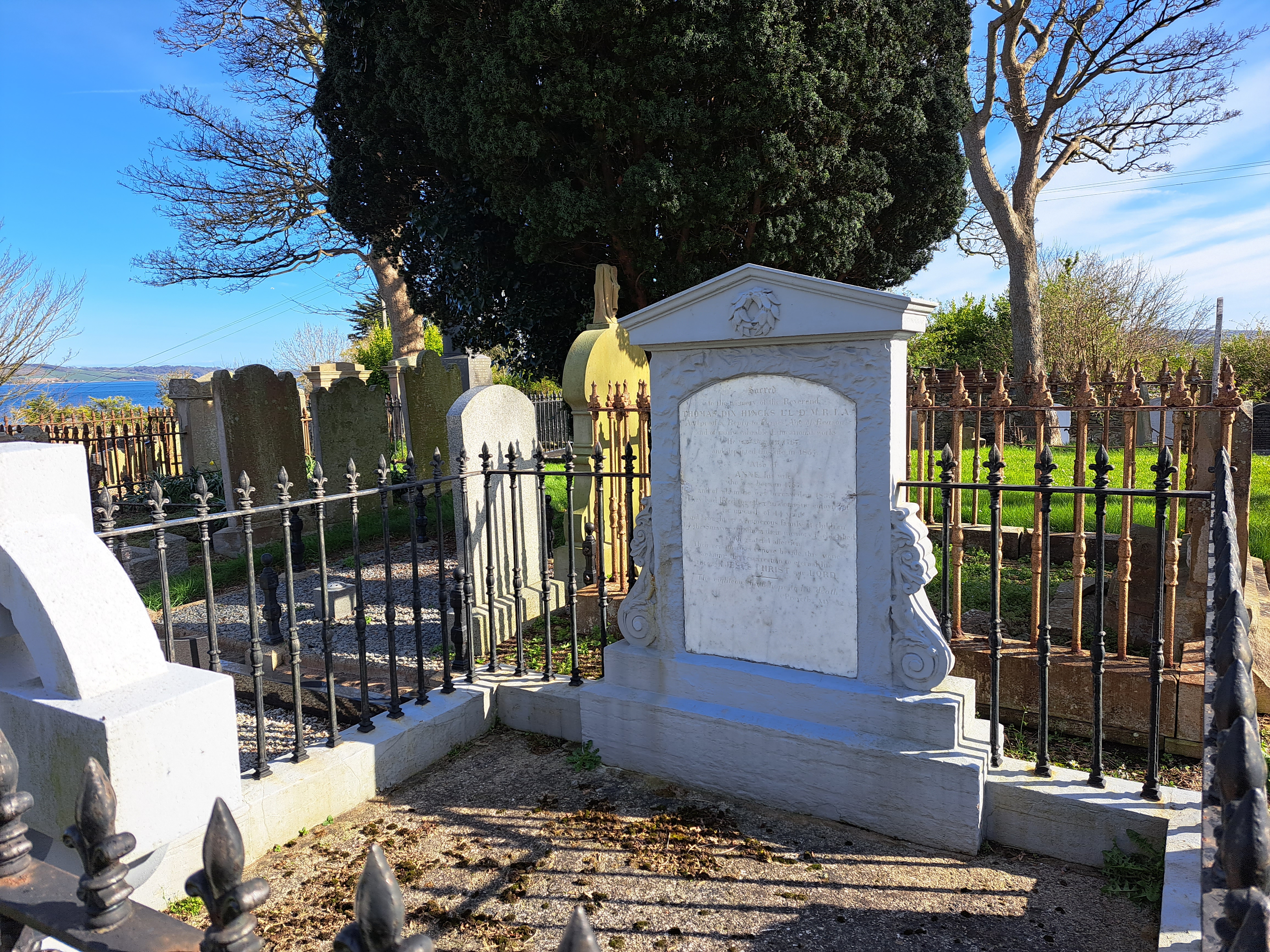
Thomas Dix Hincks was born in Dublin and educated at Trinity College, Dublin and the dissenting academy of Hackney New College, London. He became minister of the Old Presbyterian Church, Princes Street, Cork in 1790 and the following year married Anne Boult. In Cork he kept a school and helped to establish the Royal Cork Institution. He later moved to Fermoy where he ran the Fermoy Academy before coming to Belfast as Professor of Oriental Languages at the Royal Belfast Academical Institution which was then also a training college for ministers as well as a school. A pioneering educationalist and teacher he published widely over the years, he was awarded the degree of LLD in 1834 by Glasgow University and was a Member of the Royal Irish Academy.

He and his wife are buried in Killyleagh alongside their eldest son but together they established a significant Unitarian/Non-Subscribing dynasty which was influential in England, Ireland and Canada.

The grave of Thomas Dix Hincks and Anne Hincks in Killyleagh

They had seven children, two girls and five boys:

Hannah Hincks (d.c1873)

Anne Hincks (d.1877)

Rev Edward Hincks (1792-1866)

Rev William Hincks c.1793-1871

Rev Thomas Hincks (1796-1882)

Rev John Hincks (1804-1831)

Sir Francis Hincks (1807-1885)

Two of the brothers became ministers of Renshaw Street Chapel in Liverpool, amongst other things.

To hear the full story and hear more about Killyleagh click on the video at the top of the page.

Memorial window to Thomas Dix Hincks, Anne Hincks and Hannah Hincks in the First Presbyterian Church, Rosemary Street, Belfast.

A previous video explores something of the life of Rev Thoms Hincks (1818-1899) the son of Rev William Hincks (c.1793-1871). It can be seen here: