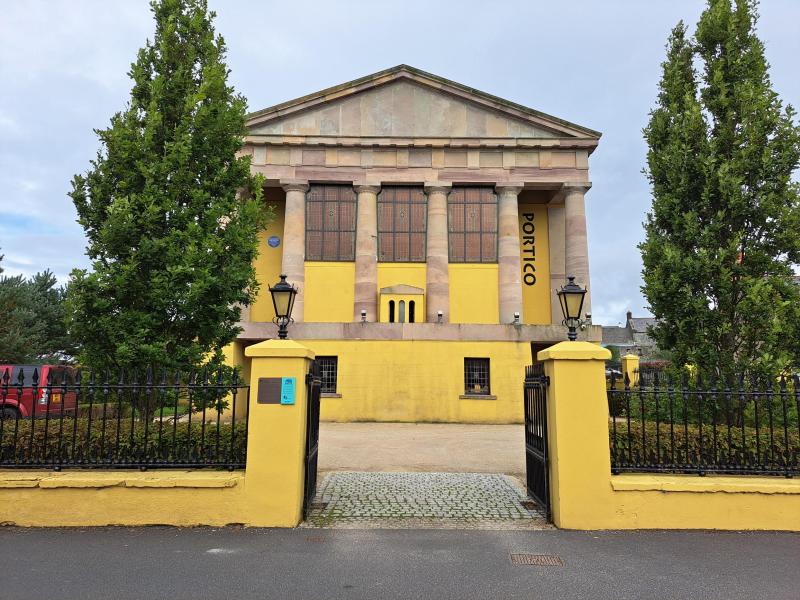
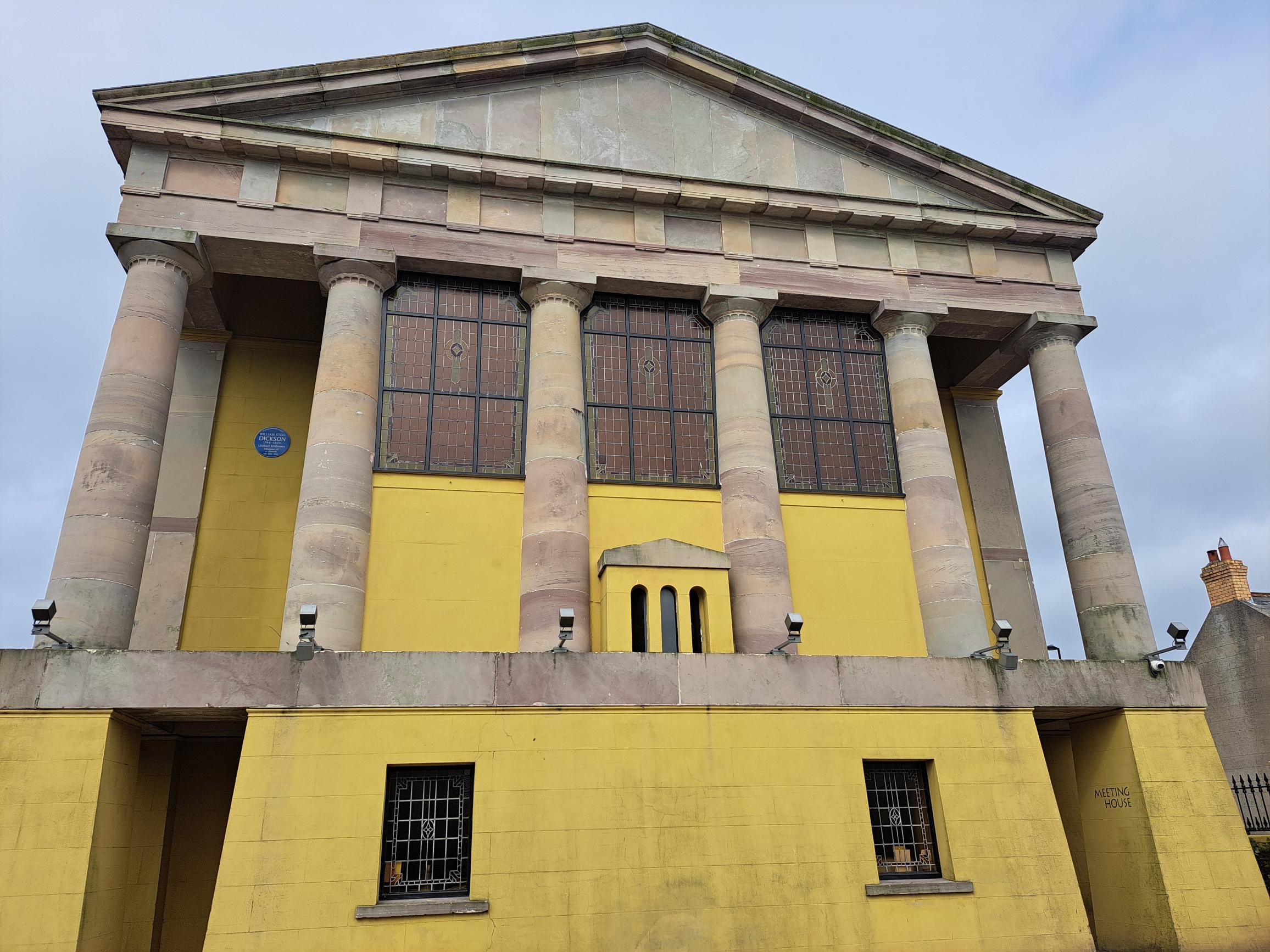
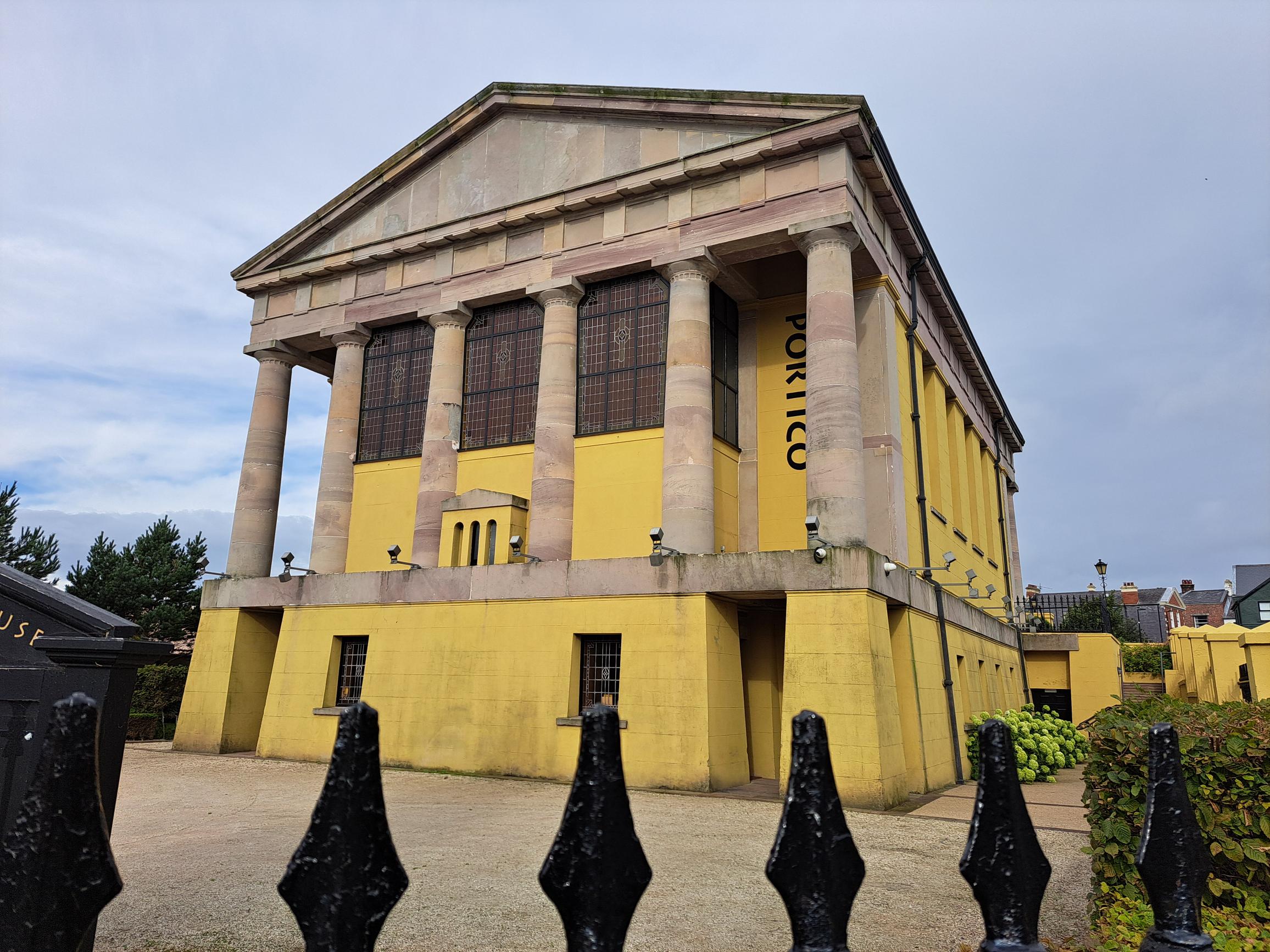
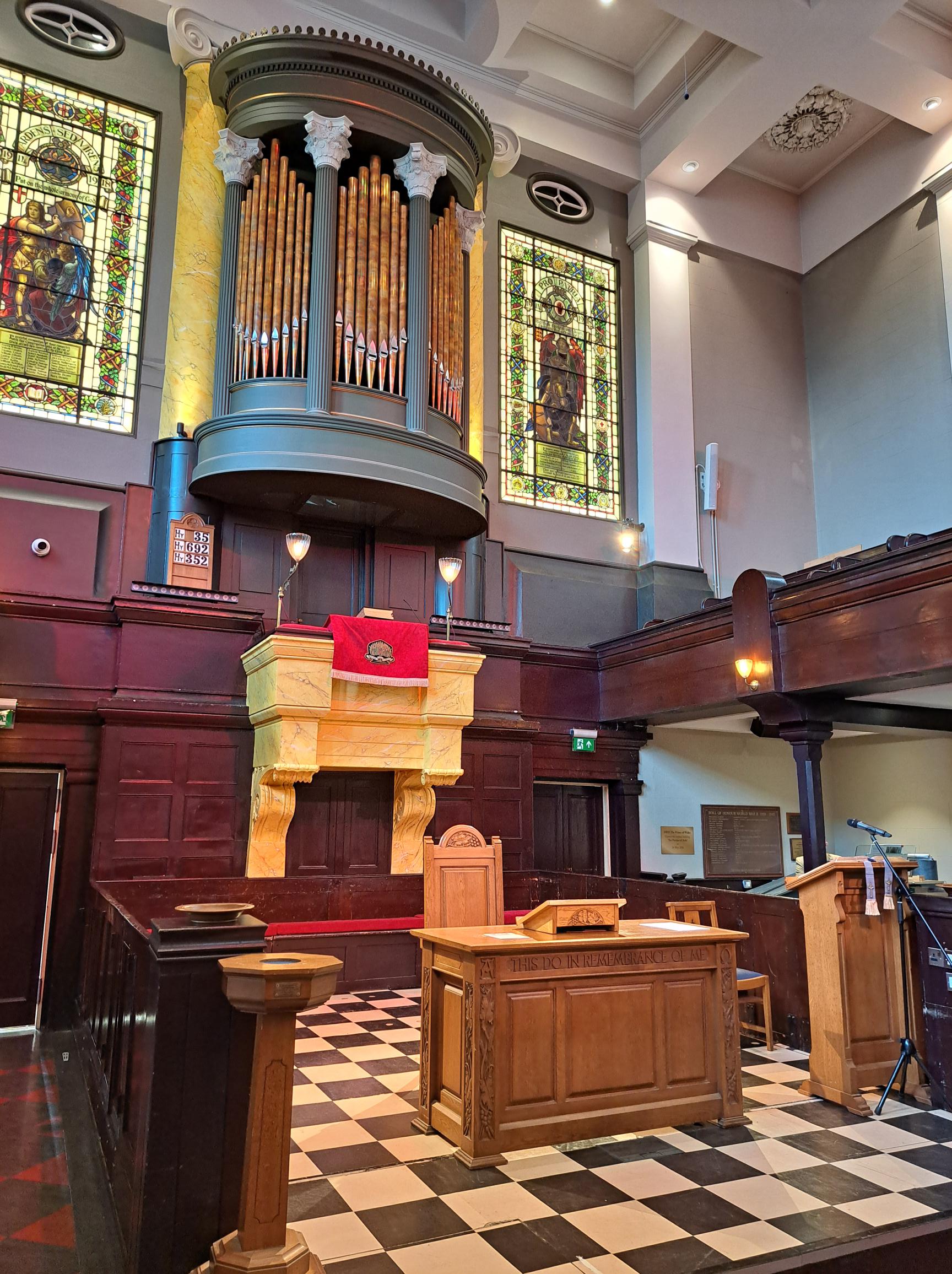
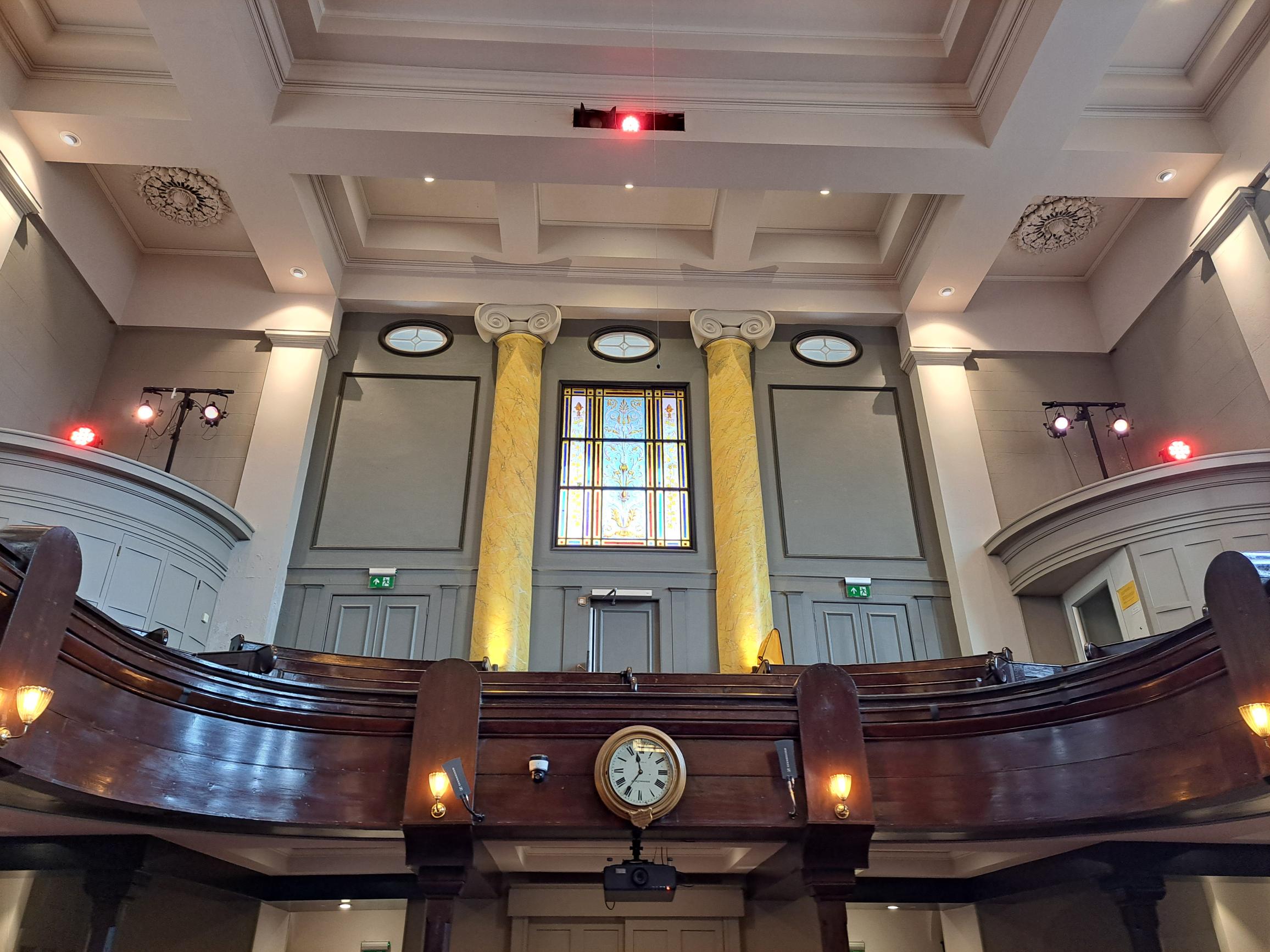
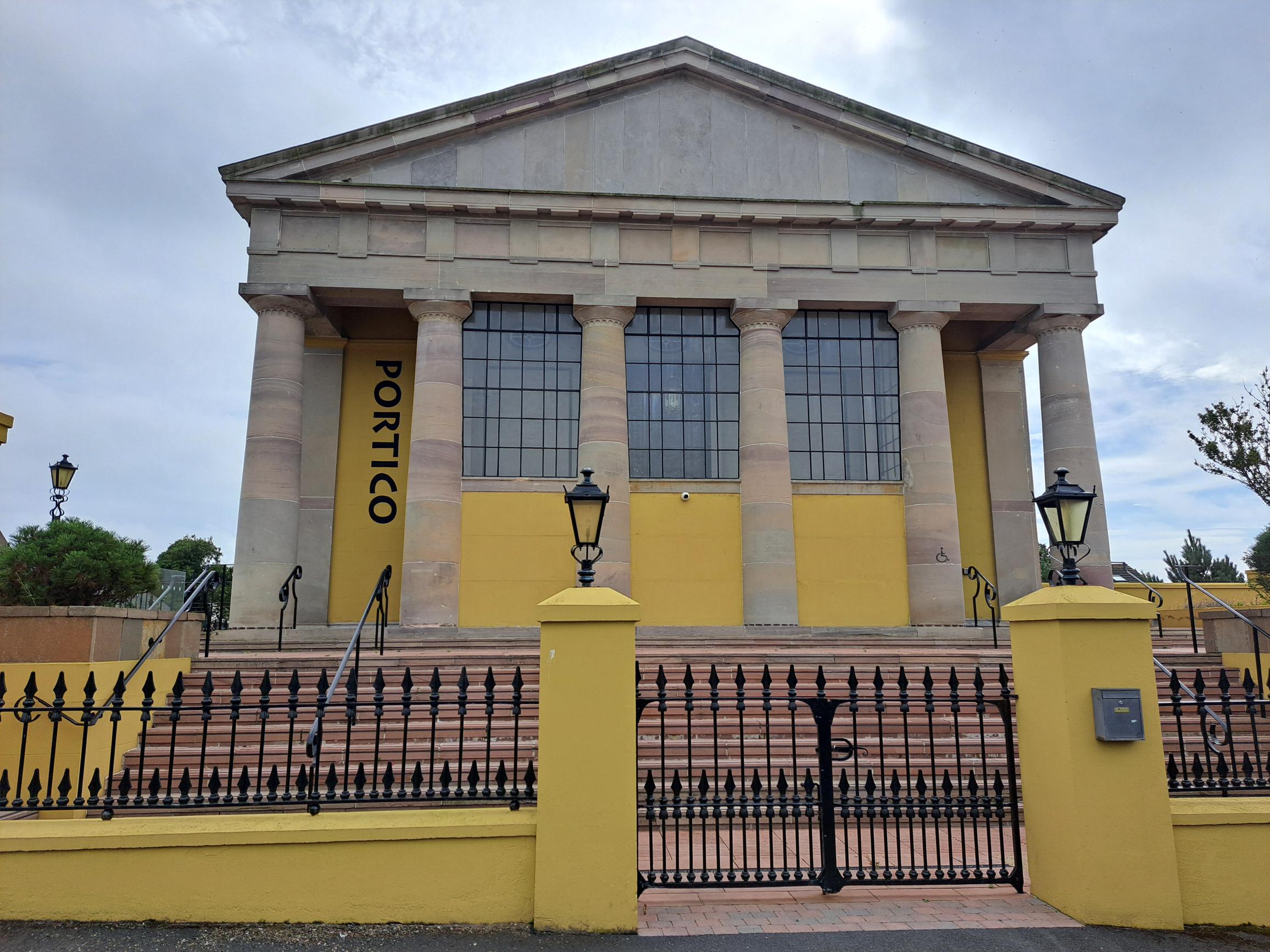
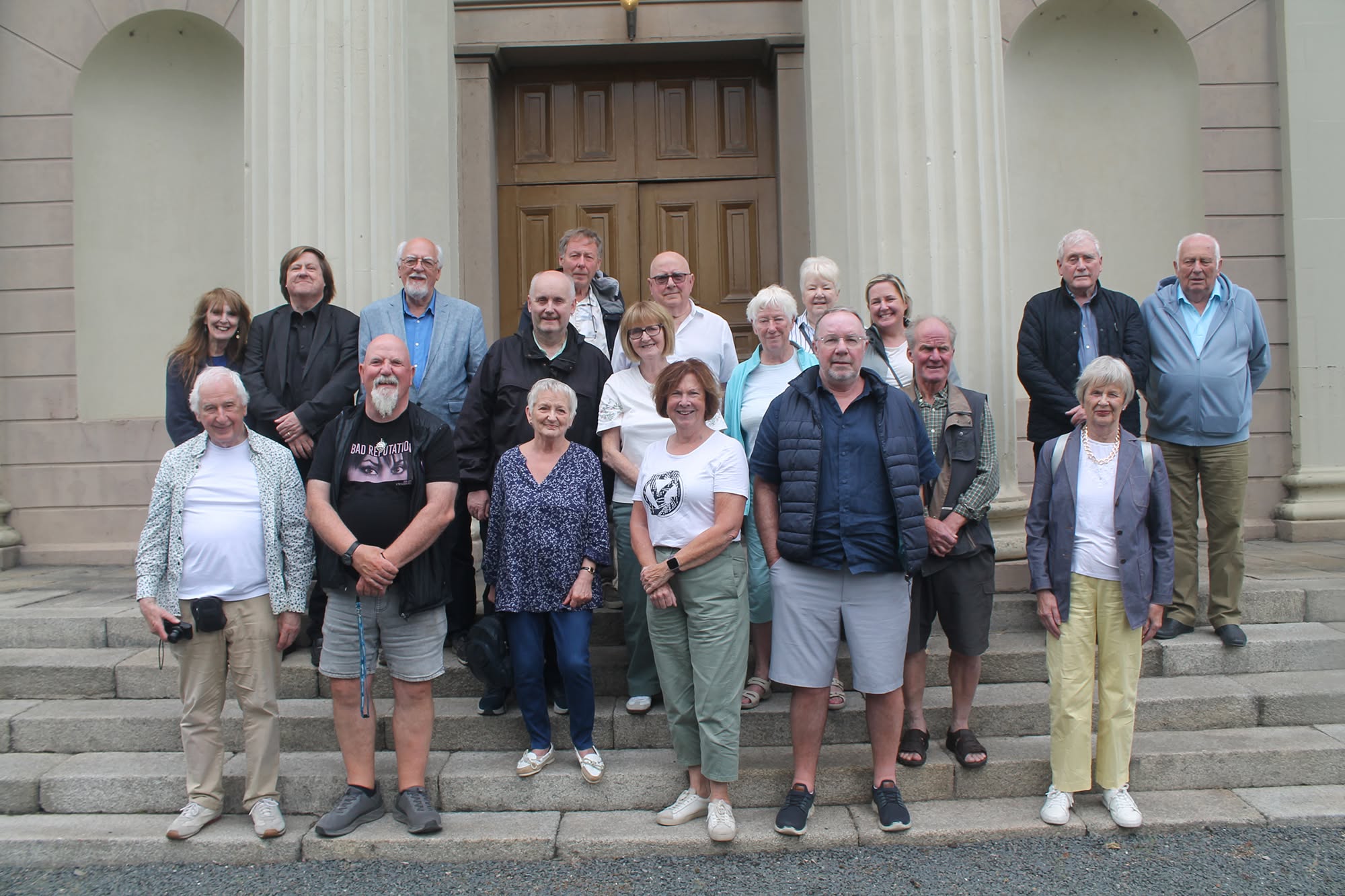
I was delighted to have visited Portaferry this morning and to get the chance to meet the wonderful congregation. The building is really impressive. Opened in 1841 by no less a person than Henry Cooke, it replaced a previous T-shaped building of 1751 which was damaged on the ‘Night of the Big Wind’ on 7th January 1839.
Portaferry Presbyterian Church
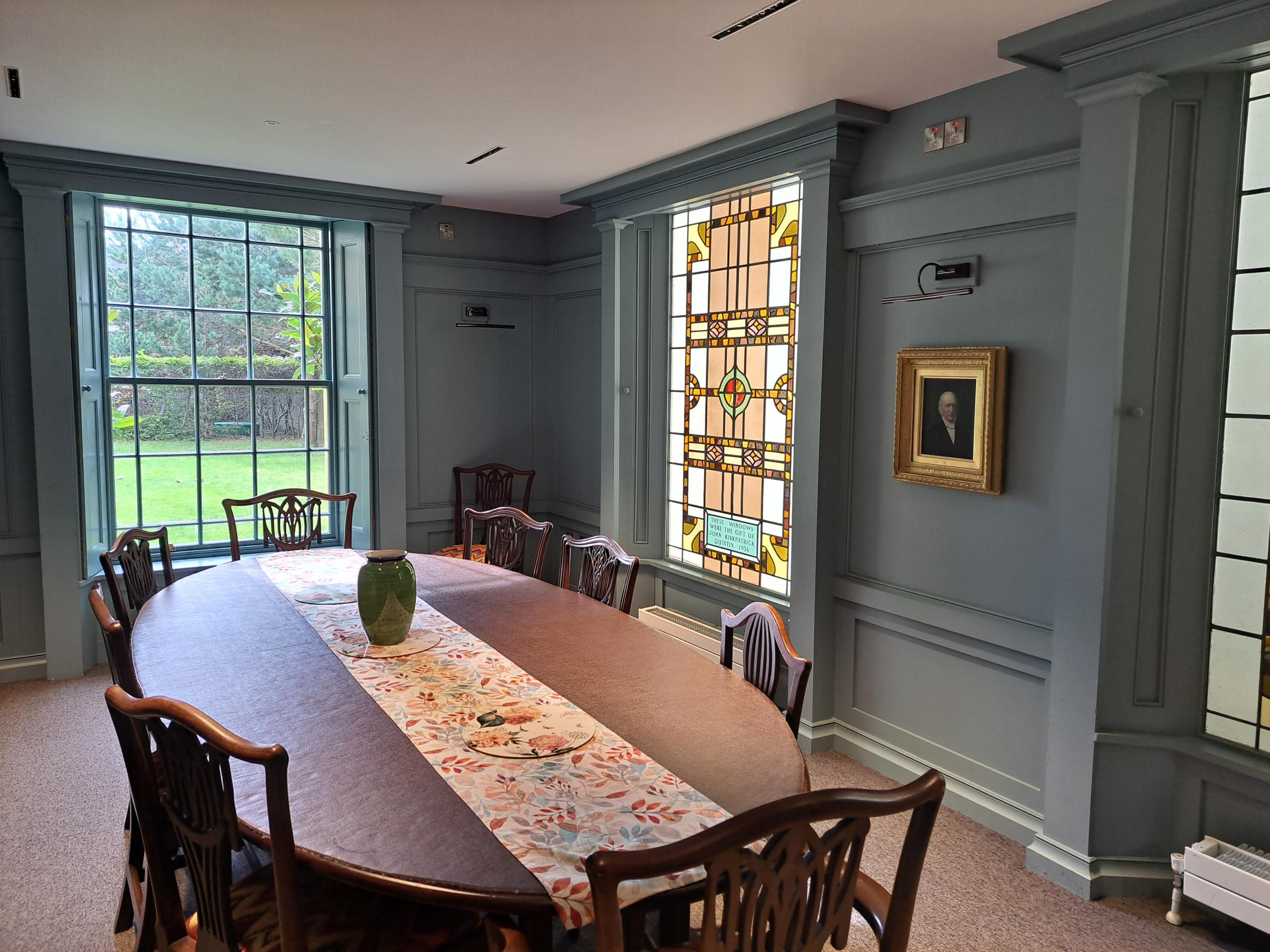
The new meeting house was built under the ministry of the Rev John Orr, who enjoyed a long and highly successful ministry from 1822 until his death in 1878. He is commemorated in a very tasteful room which was added to the building when it was restored in 2015.
Rev John Orr Room
Rev John Orr engaged the architect John Millar who produced a unique building. Simon Walker says of it: ‘In appearance this is an amazing neo-classical church, and is quite unlike any other of its kind. Millar used the ancient Temple of Nemesis at Rhammus as his influence and produced a very robust Greek Revival structure.’ (Historic Ulster Churches, p.85).
James Stevens Curl says in Classical Churches in Ulster: ‘Hexastyle Doric porticoes on a high podium distinguish John Millar’s nobly conceived Portaferry Presbyterian Church, Co. Down, of 1841, a building that would not look out of place in Helsinki or in Leningrad [St Petersburg]. Indeed, this marvellous Greek temple is one of the most distinguished Neoclassical buildings in Ulster, and is in the first rank of Neoclassical designs in the whole of the British Isles.’
The church was opened on 2nd September 1841 at a cost of £1,999 12s 6d. The building has a blue plaque in memory of its most famous minister, the United Irishman Rev William Steel Dickson. Ordained at Ballyhalbert in 1771, he was installed at Portaferry by the Presbytery of Killyleagh on 6th March 1780 and did not subscribe to the Westminster Confession of Faith on either occasion. Moderator of the Synod of Ulster in 1793 he was awarded the degree of DD by the University of Glasgow.
During the 1798 Rebellion he was imprisoned first in Belfast then in Fort George in Scotland, although prior to that he also conducted some services at Ballee on the other side of Strangford Lough. After three years in prison he became minister of Second Keady. He died on 27th December 1824, in much reduced circumstances, and was buried in a pauper’s grave in Clifton Street Cemetery in Belfast. Only eight or nine people attended his funeral, although they included the Rev Dr Henry Montgomery of Dunmurry. ‘An impressive and eloquent address’ was given at the graveside by the Rev W.D.H. McEwen, another Non-Subscriber.
The building underwent extensive restoration in 2014-15 and is now a Grade A listed building and serves as an Arts and Heritage Centre as well as the home to the historic congregation.
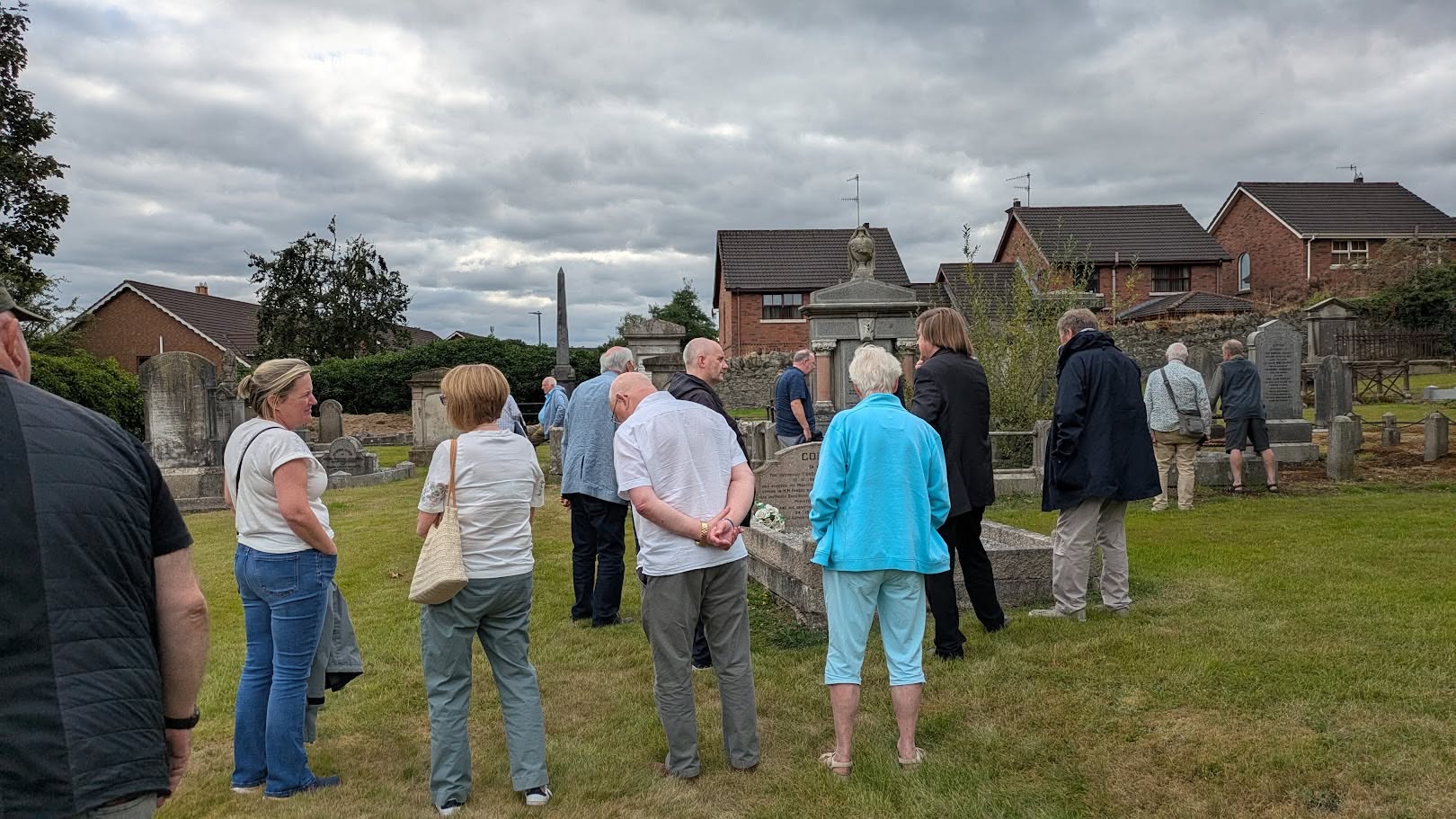
Saturday, 15th August was our long-awaited visit to churches and places of Non-Subscribing Presbyterian interest in Warrenpoint, Newry, and Banbridge. A group from Dunmurry and First Belfast made an early start from Dunmurry and kept brilliantly to the timetable all day. Our first stop was Warrenpoint where Anthony and Anne Holmes made us very welcome.
Warrenpoint
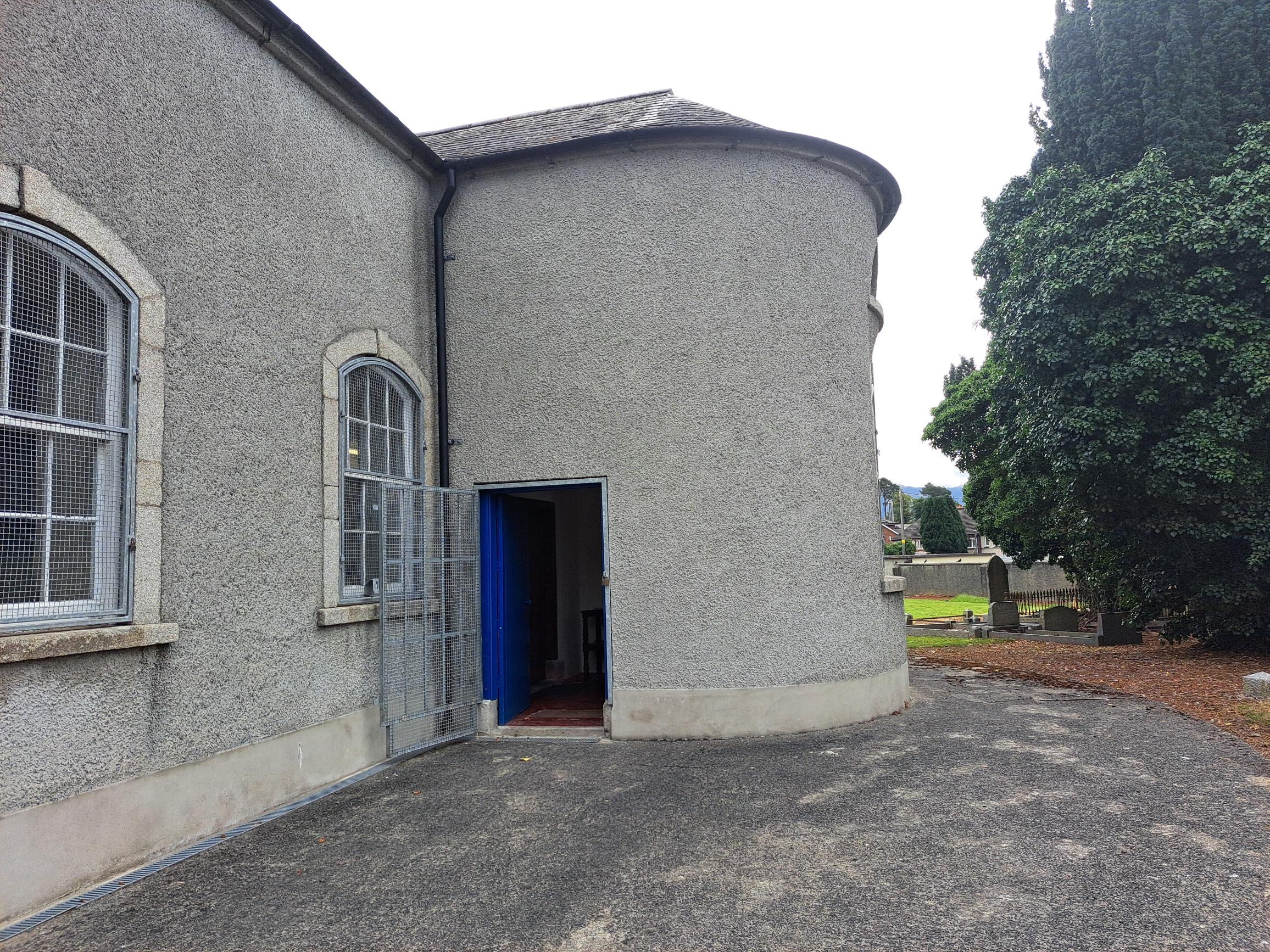
Warrenpoint is a unique church in our tradition, there is no other quite like it. When you approach it through the unusual curved porch you come into a building with a curved pulpit and three galleries supported by cast iron columns and leaving only a narrow rectangle not covered by the galleries. There is a date stone of 1707 and part of it must date from then but it was extensively rebuilt in about 1820. Founded in 1697 and identified as the congregation of Narrow-Water until 1875 when it was named Warrenpoint, it was made a joint charge with Carlingford, situated on the other side of the Lough, in 1707. This made for a complicated life for the minister who had to travel backward and forward across the Lough to conduct worship in both places. The Rev Samuel Arnold was the last minister to do this between 1805 and 1820 when he left Carlingford to concentrate on Narrow-Water. This proved a great success for Narrow-Water although it confirmed a downward trend for Carlingford. The last minister on that side of the Lough was the Rev James Lunn, the Carlingford congregation eventually closing in 1859.
Warrenpoint interior (Photo: Anthony Holmes)
On the county Down side the congregation flourished with Samuel Arnold able to concentrate on its needs and extensively rebuilding the meeting house in about 1820. It was badly hit by the Famine although managed to maintain itself as a single charge until 1910 when it was linked to Newry, an arrangement that has remained ever since. The congregation had the services of some high profile ministers including G.W. Bannister and W.E. Mellone and many of them are buried in the adjoining graveyard where we also saw the grave of Thomas Donnan, for 45 years the precentor of the congregation.
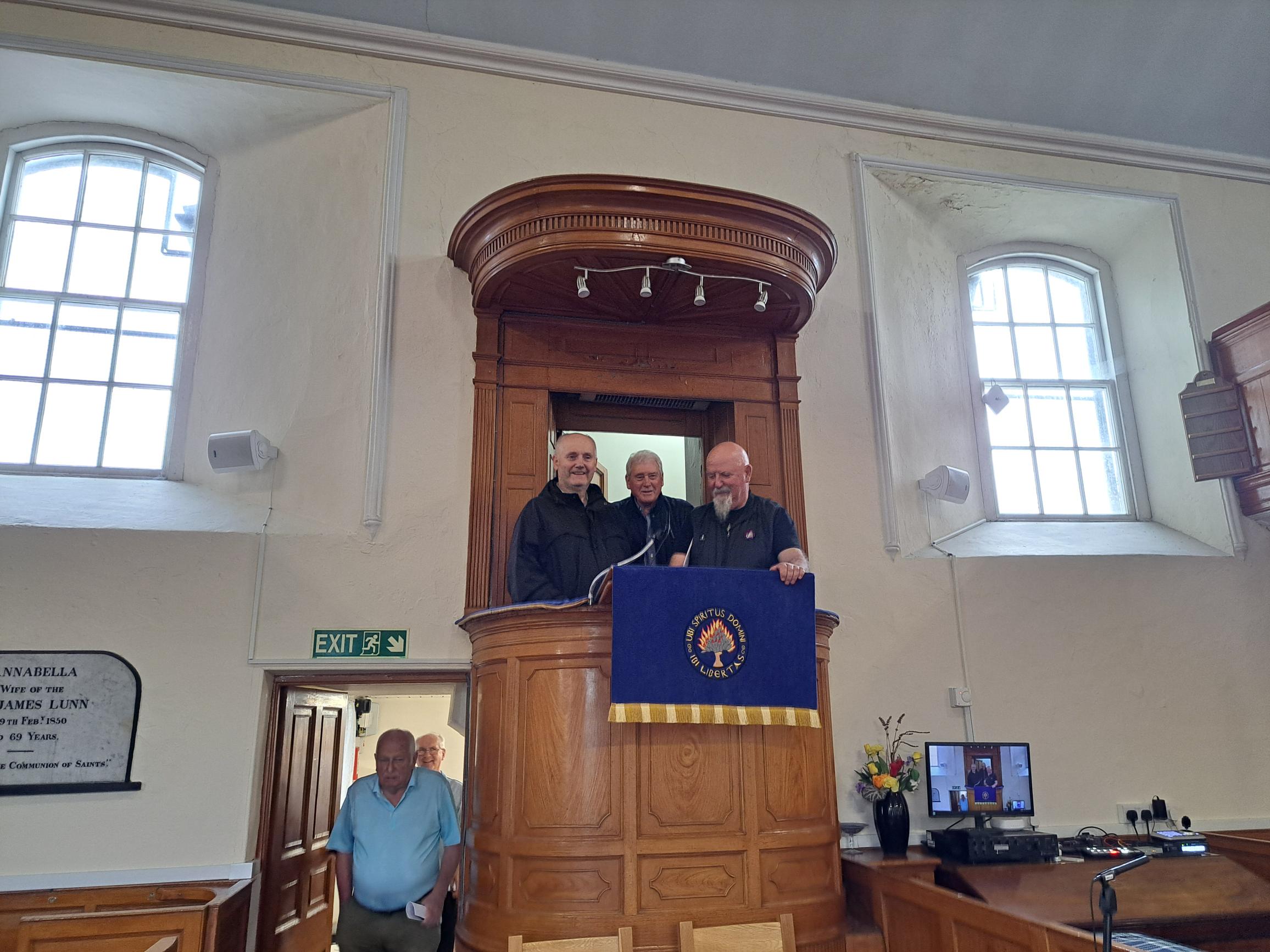
In the pulpit
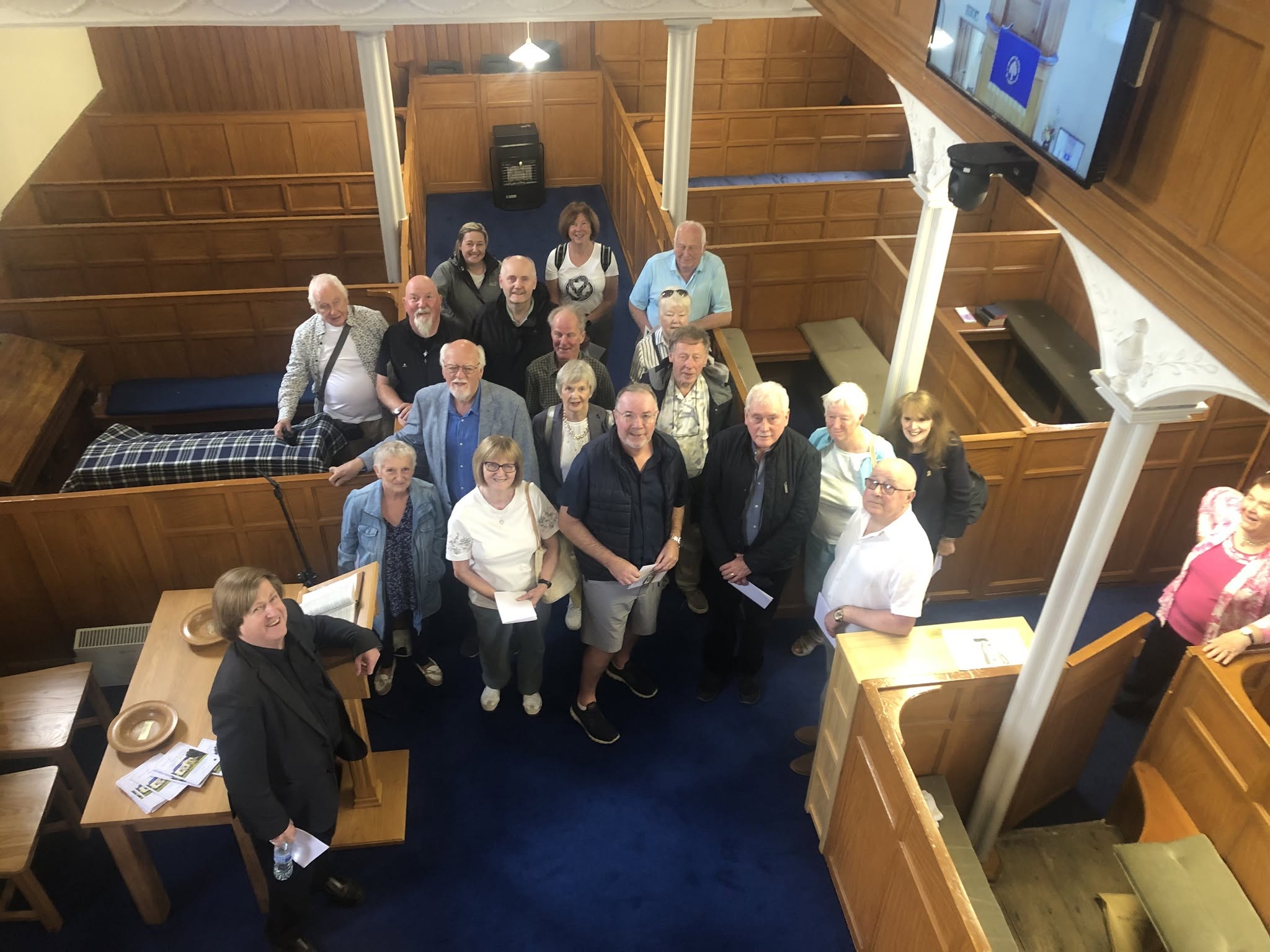
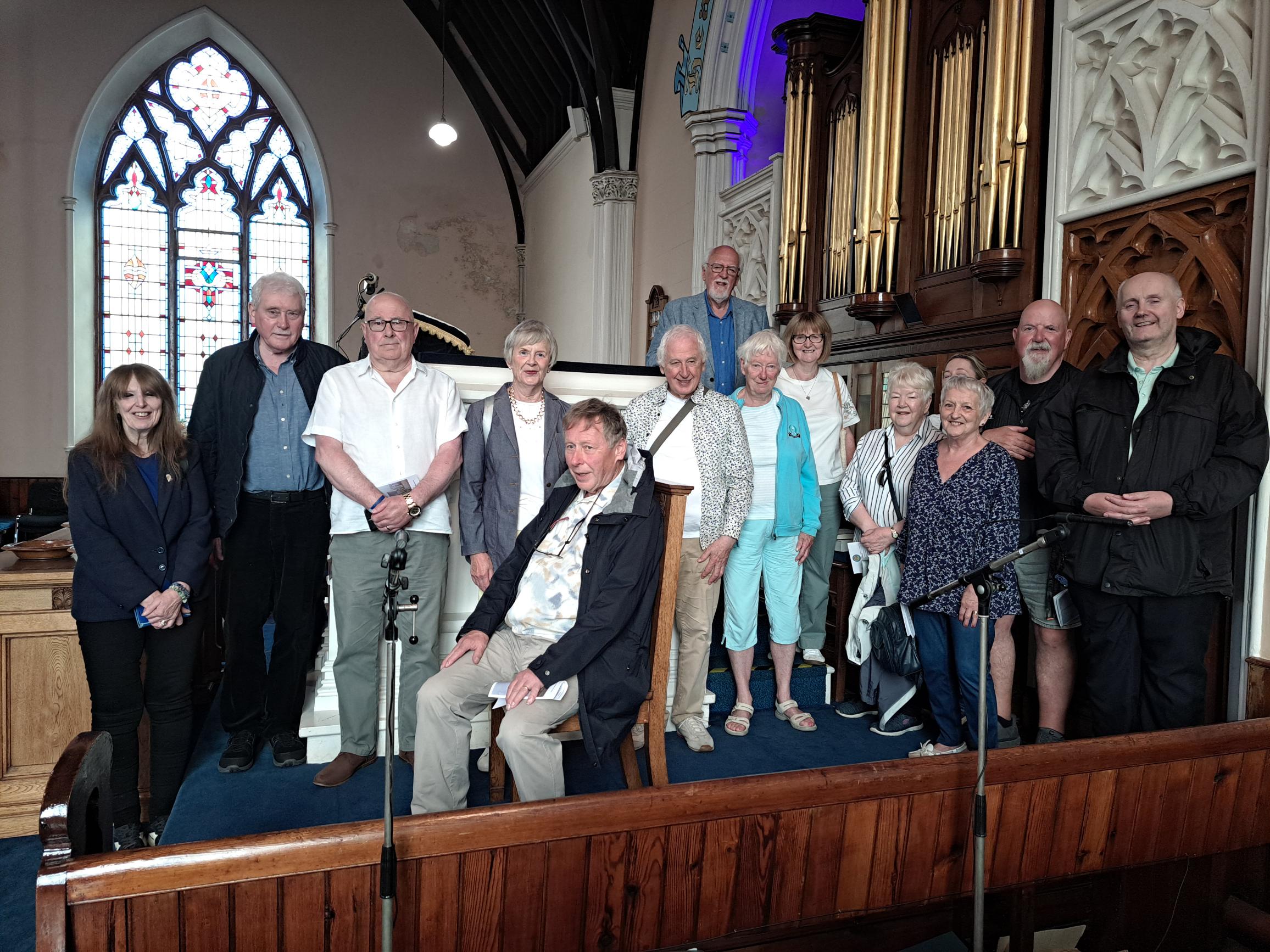
From Warrenpoint we moved on to Newry, generally said to be the first non-conformist church in Ireland to be built in the Gothic style. Designed by W.J. Barre, it is an impressive building with a spire and as well as a big, white pulpit also houses the first organ installed in a Presbyterian church in Ireland. The organ was built for Belfast’s Second Congregation and despite rumours that it had once been in St George’s Chapel, Windsor perhaps built by Snetzler and indeed played (and haunted) by Handel we do know now that it was built by an organ builder named White who operated out of Orr’s Entry in Belfast. When the Second Congregation moved to All Souls’ the organ came with them but in the 1920s it was sold to Newry where it continues in regular use, the same organ that was once played by Edward Bunting.
Some of our group in front of the organ of 1806
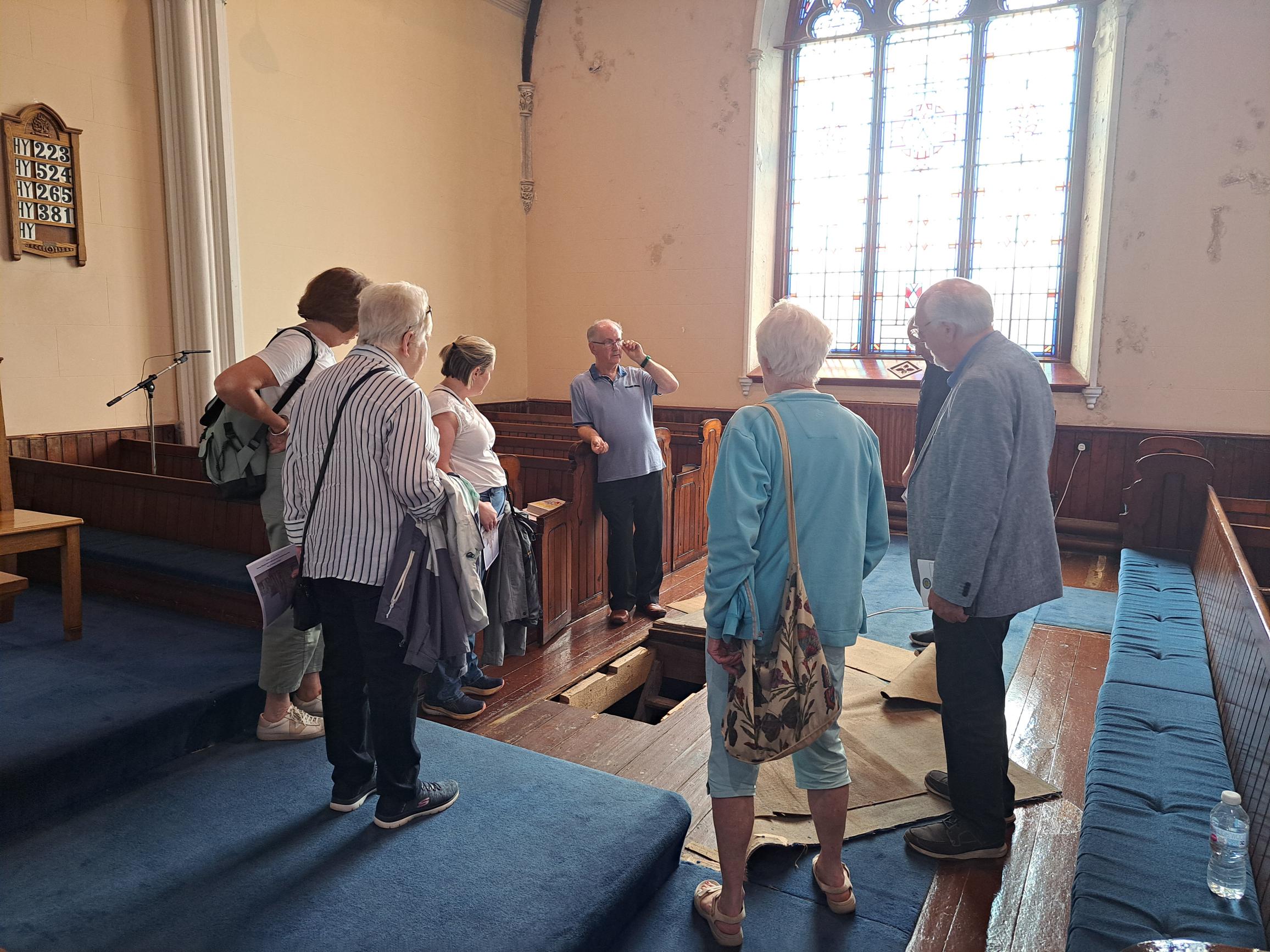
While we were at Newry Anthony opened up the trapdoor to the underground passages that are hidden away under the building. Only one of our number was brave enough to venture into this hidden realm and modesty prevents me from naming that intrepid explorer but the passages seem to be there to house a large stove that once heated the church. Made by Musgrave & Co. Ltd, a firm based in Belfast in the middle of the nineteenth century, there must have been a flue somewhere, but it hasn’t been used for a long time.
Anthony opens the trap door
Click on the video for Anthony Holmes’s video of the underground passageway
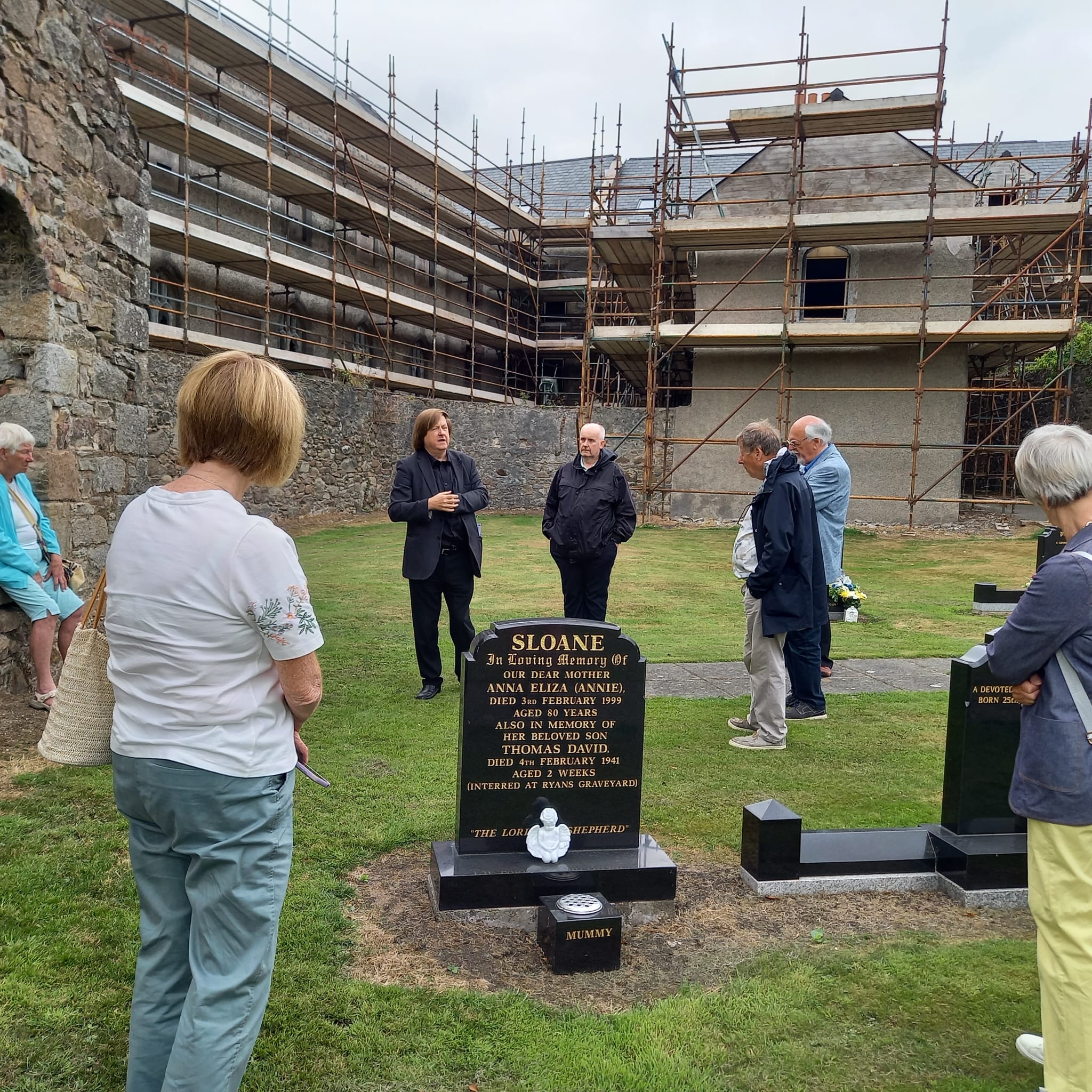
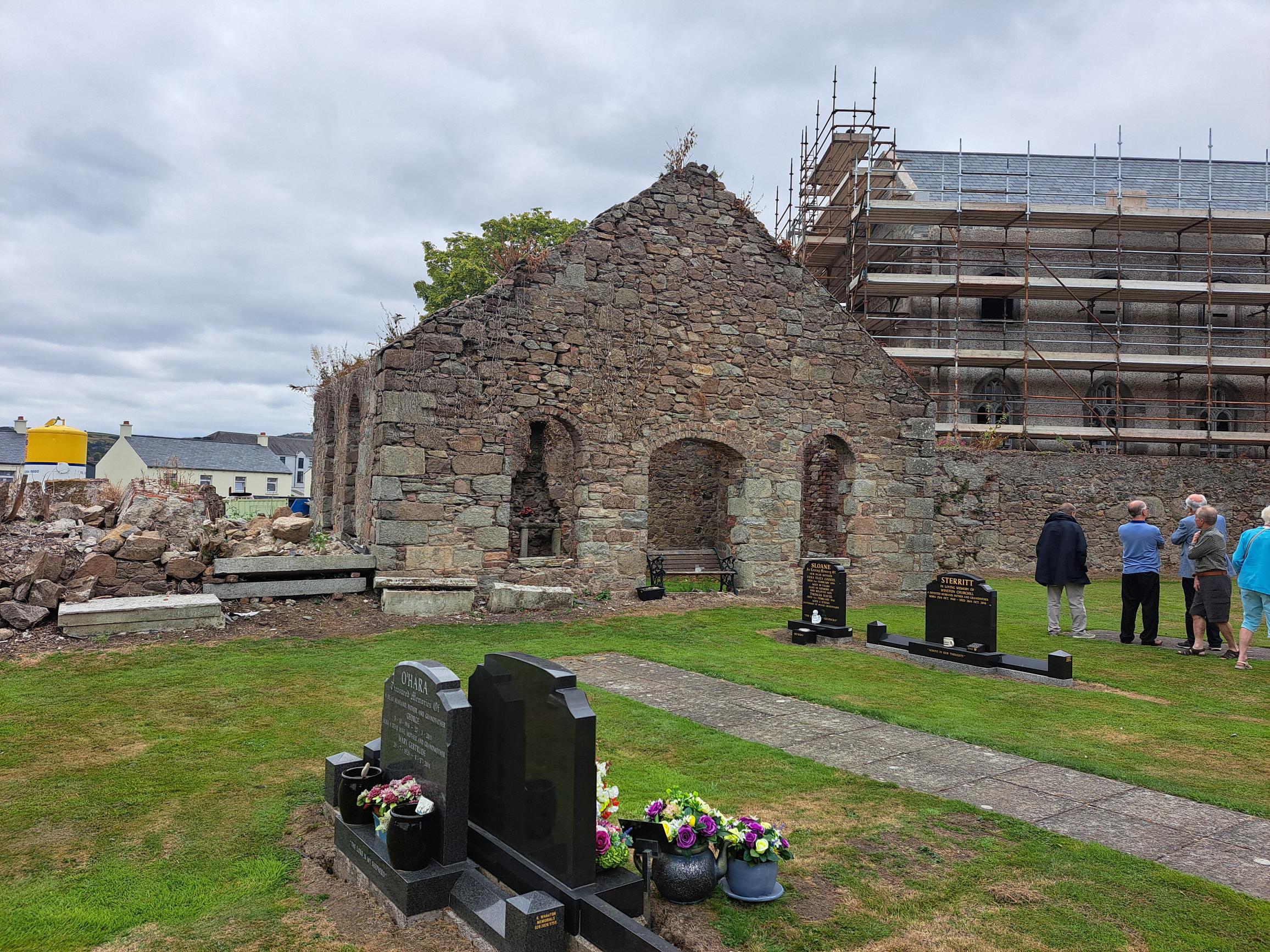
From the Newry church we went on to the Old Meeting House Green on High Street. Despite extensive redevelopment on all sides this spot remains a beautifully maintained peaceful oasis which contains not only ancient and modern graves but the ruins of the previous meeting house.
Inside the old graveyard (Photo: Sue Steers)
All that remains of the old meeting house (Photo: Sue Steers)
The old meeting house was built in 1724 but abandoned when the new church was built in 1853. It was here that John Wesley preached when he came to Newry and until fairly recently the remains of the pulpit could be seen. The graveyard is particularly notable for containing the last resting place of John Mitchel, Young Irelander, Nationalist leader and a son of the manse, as well as the grave of Rev A.G. Malcolm an innovative minister who edited the first major Non-Subscribing hymnbook and who began his ministry at Dunmurry before moving to Newry.
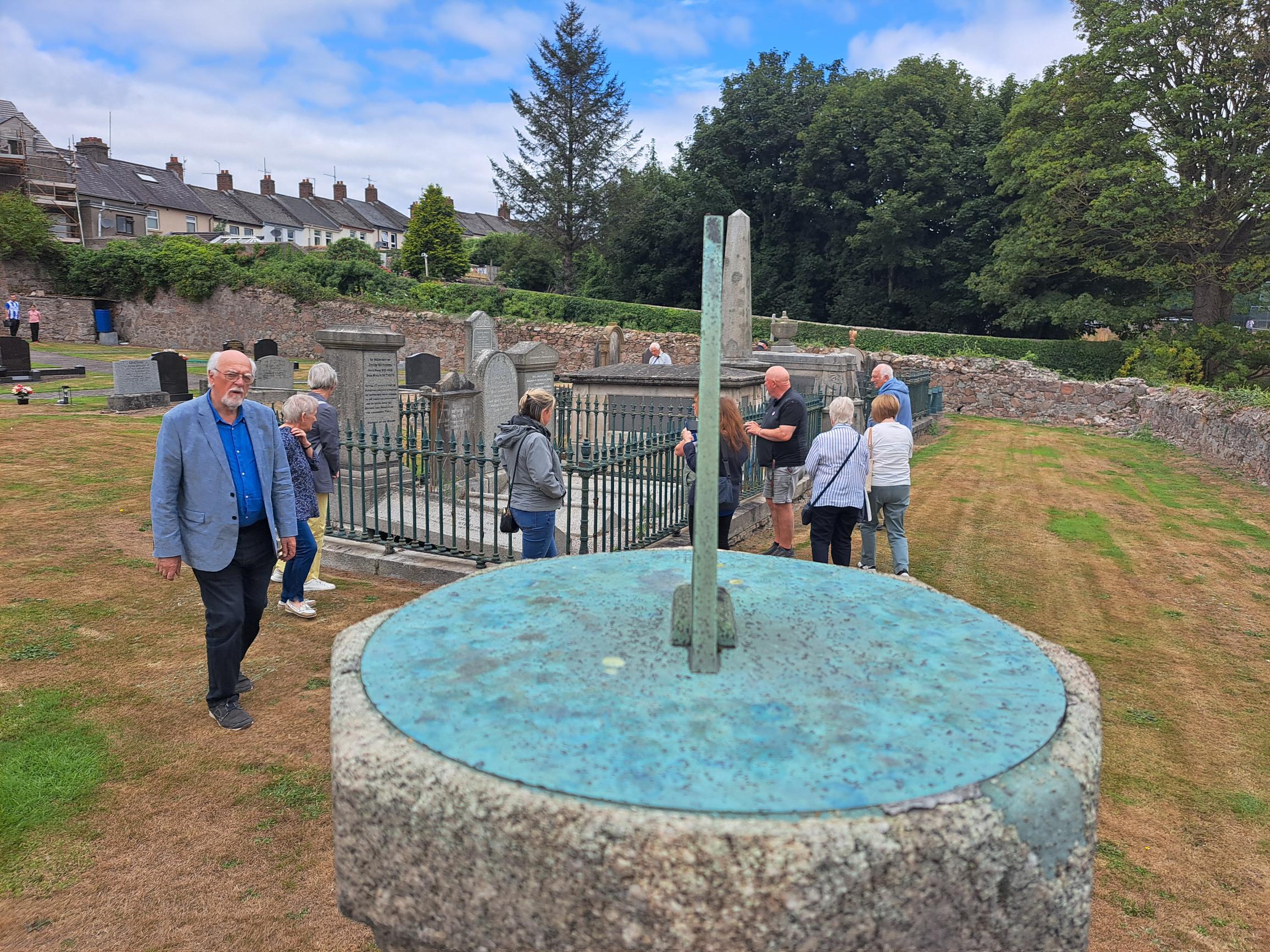
A view of the graveyard from the sundial, said to date from 1757
On leaving Newry we travelled to Banbridge for lunch before going off to the Masonic Hall which was built as the Second Non-Subscribing congregation in Banbridge. This congregation built a grand church opened in 1849 after a large portion of the original congregation left that church following the appointment of the Rev John Montgomery, a nephew of Henry Montgomery. There were deep divisions amongst Non-Subscribers at that time and this was one of the places where this manifested itself in congregational division.
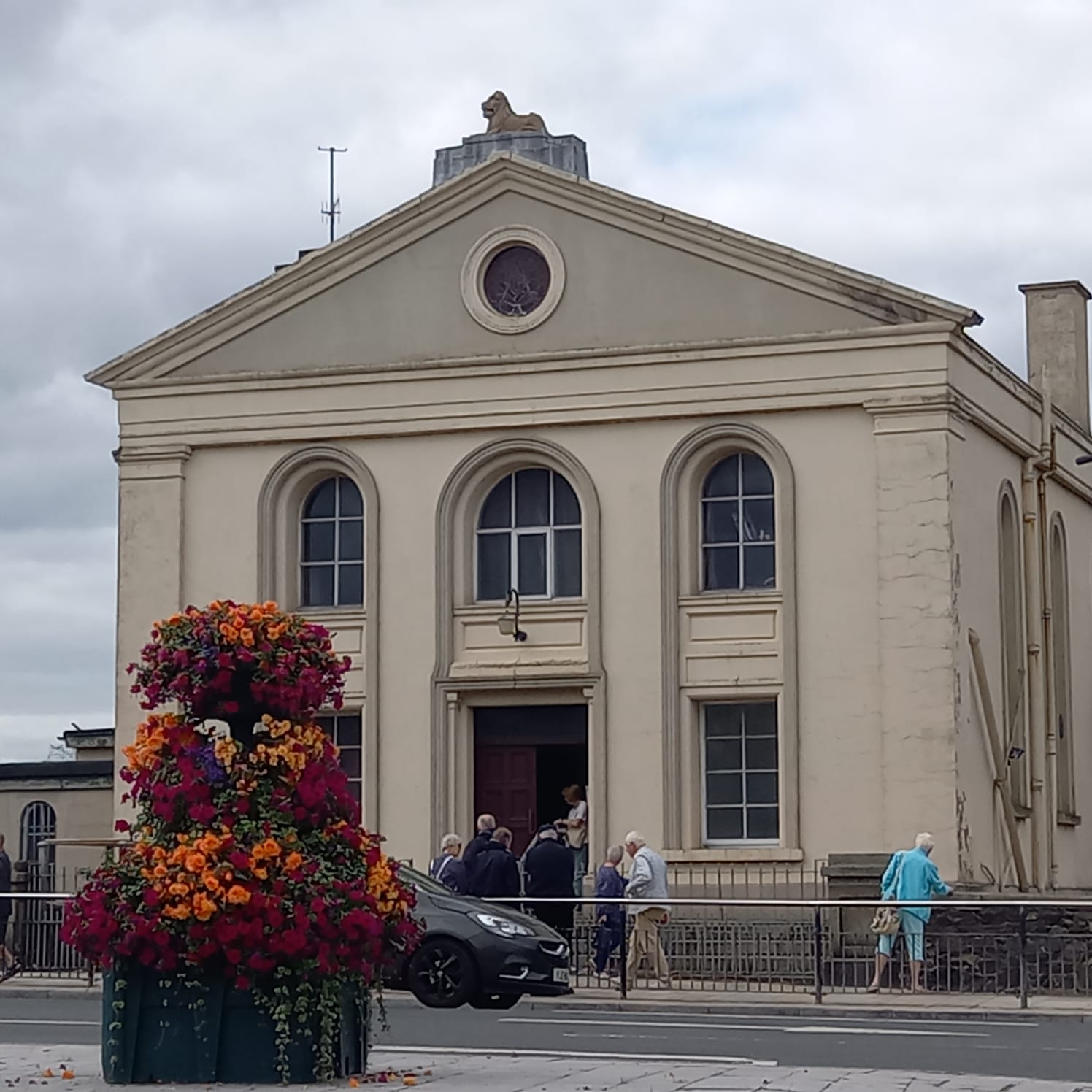
Second Banbridge (Photo: Sue Steers). Note the lion on top of the pediment
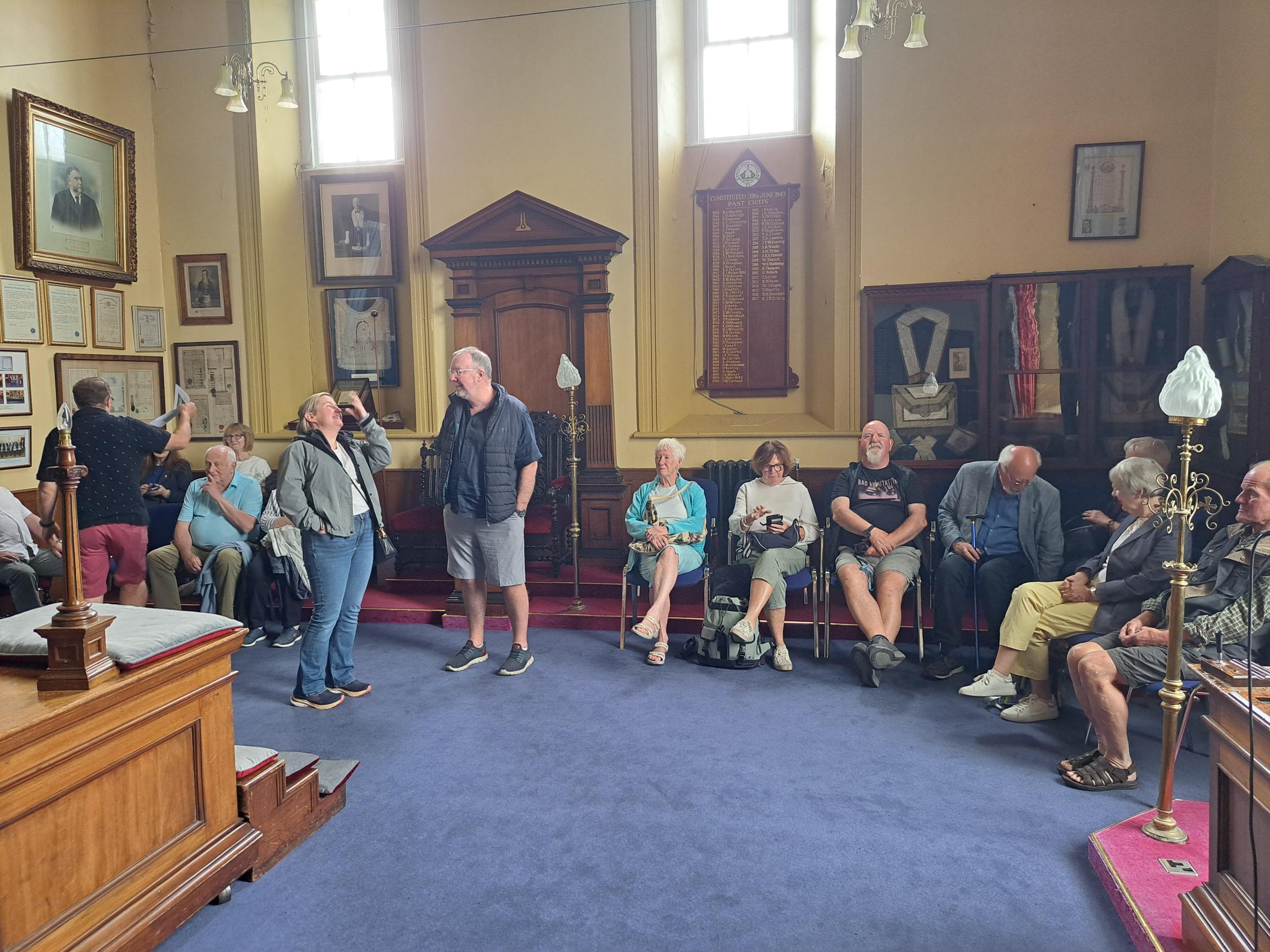
I am sure most people that pass the Masonic Hall don’t realise it began life as one of our churches and we were given the rare privilege of visiting the building, being shown round by Willy McCoy, one of the officers. The interior was extensively remodelled, probably in the 1890s and most of the rooms give nothing away of its ecclesiastical origins. Nearly all the windows are covered in, and new floors have been added, but the original church must have filled both the length and height of the building, probably with galleries. It must have been a magnificent space built to compete with the church building they had left.
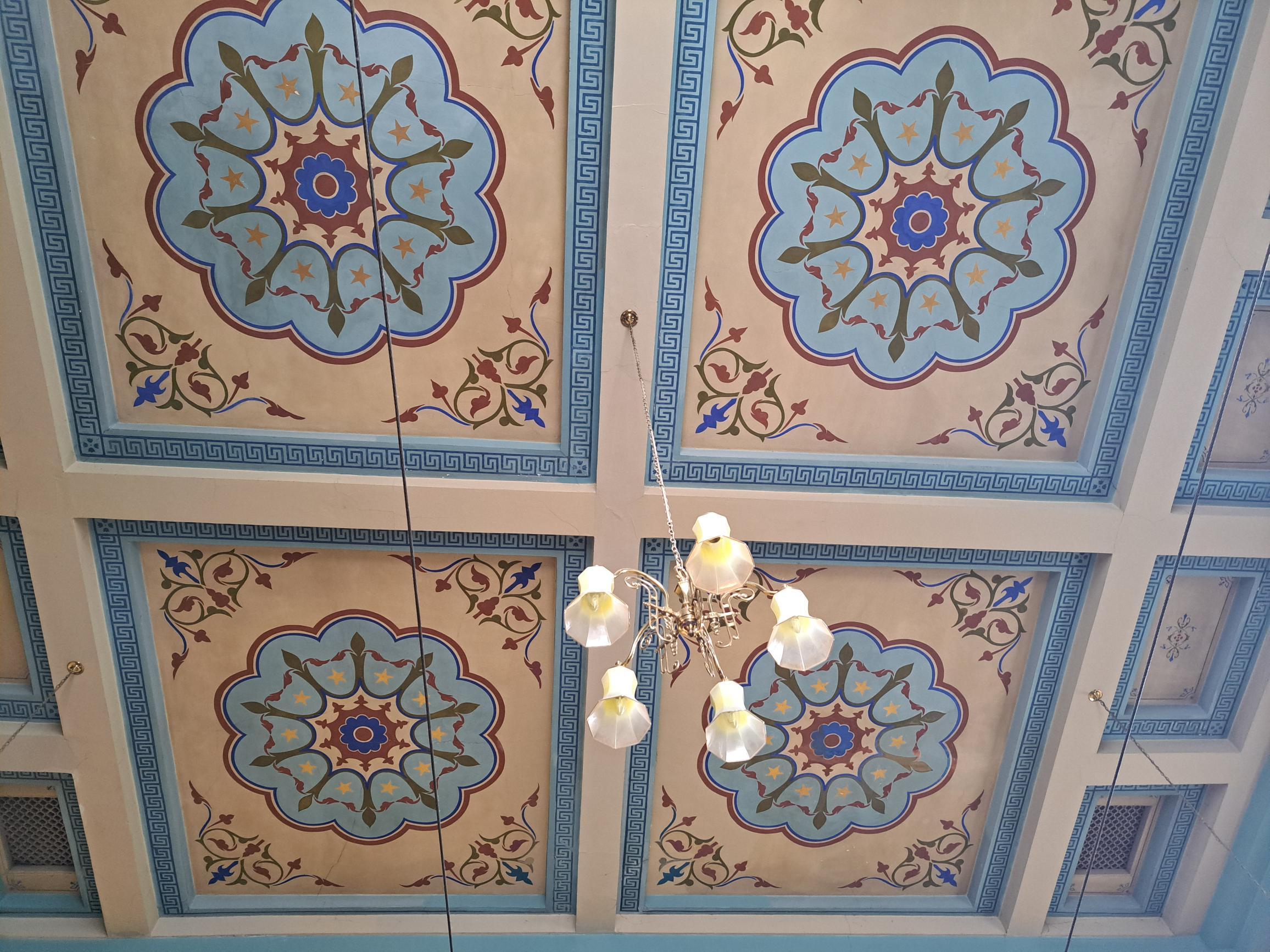
It doesn’t quite match the splendid building that is the first congregation but it can’t have been far off. But the one detail that does survive and which is quite exceptional is the ceiling that remains in the Lodge Room.
The Lodge Room
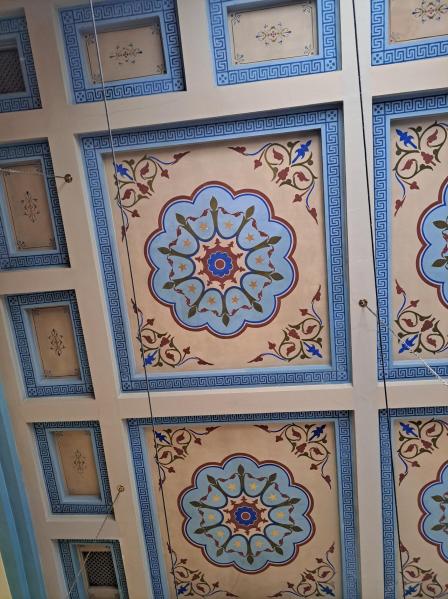
The ceiling dates from 1849 when the building was opened and is a stunning piece of work that has not been dimmed by age at all.
The impressive ceiling in Second Banbridge
The one thing we could not discover was the origin of the stone lion that sits atop the structure. This does not seem to have been placed there by the Masonic Lodge, but would it be put there by the congregation? It is nevertheless an attractive and distinctive feature. You can read more about this congregation here.
From there it was a short walk to First Banbridge. Founded in 1716 this church was built in 1844 towards the end of the ministry of the Rev James Davis, Non-Subscriber and Remonstrant. We were greeted by Carol McAlister and Karen Bushby who again were excellent hosts. We know that the Second Congregation’s building was designed by Edward Gardner (who may have had a connection with our Downpatrick congregation), but we don’t know who designed First Banbridge.
Outside Banbridge (Photo: Karen Bushby)
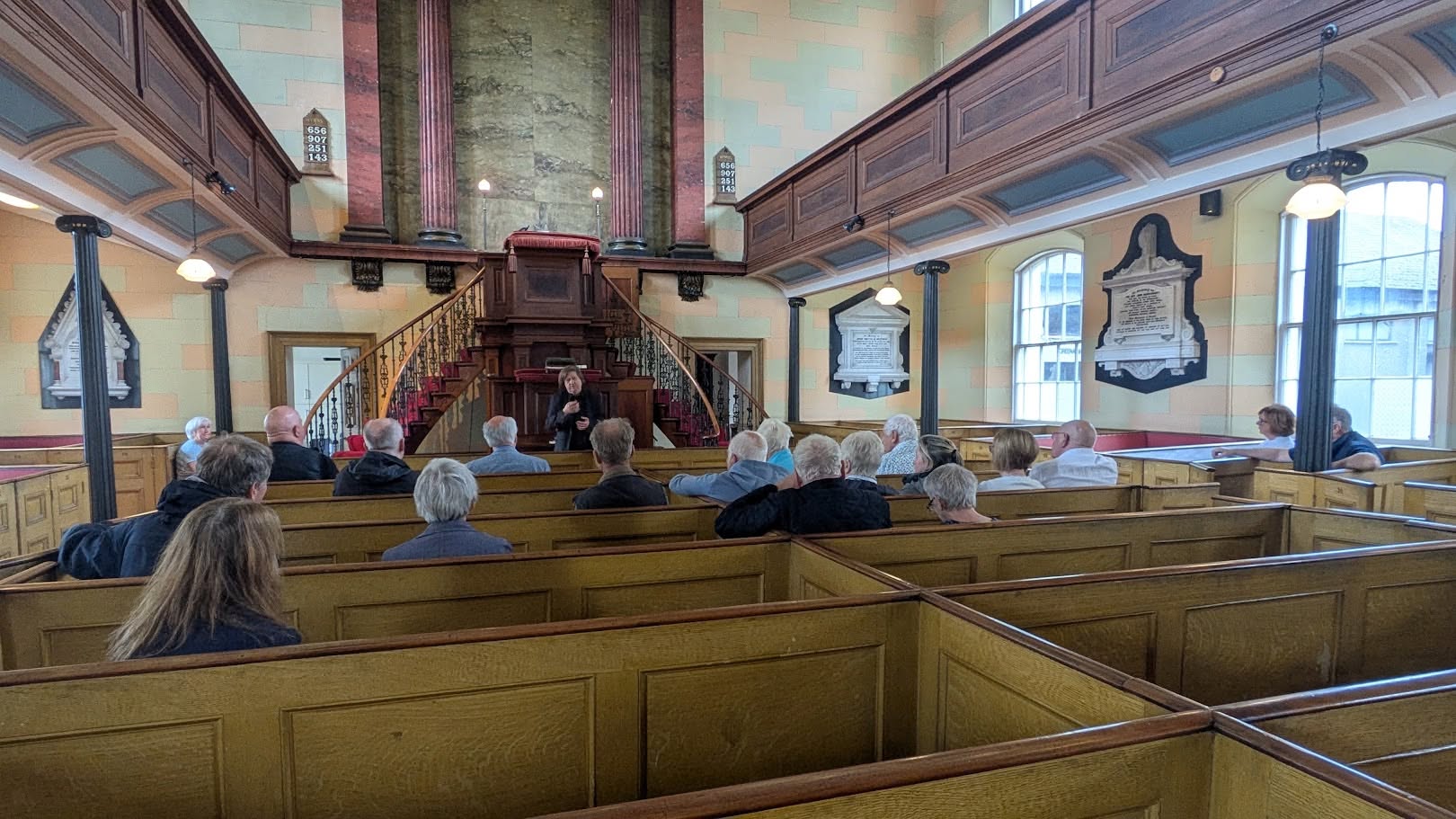
If Newry is an example of the beginnings of the use of Gothic architecture then Banbridge is a stunning example of the adoption of the fullest Neo-Classical design. It is a complete and splendid example of Classical architecture with Ionic columns at the entrance, a large vestibule with a curved staircase on either side leading to a U-shaped gallery and a magnificent two-decker pulpit.
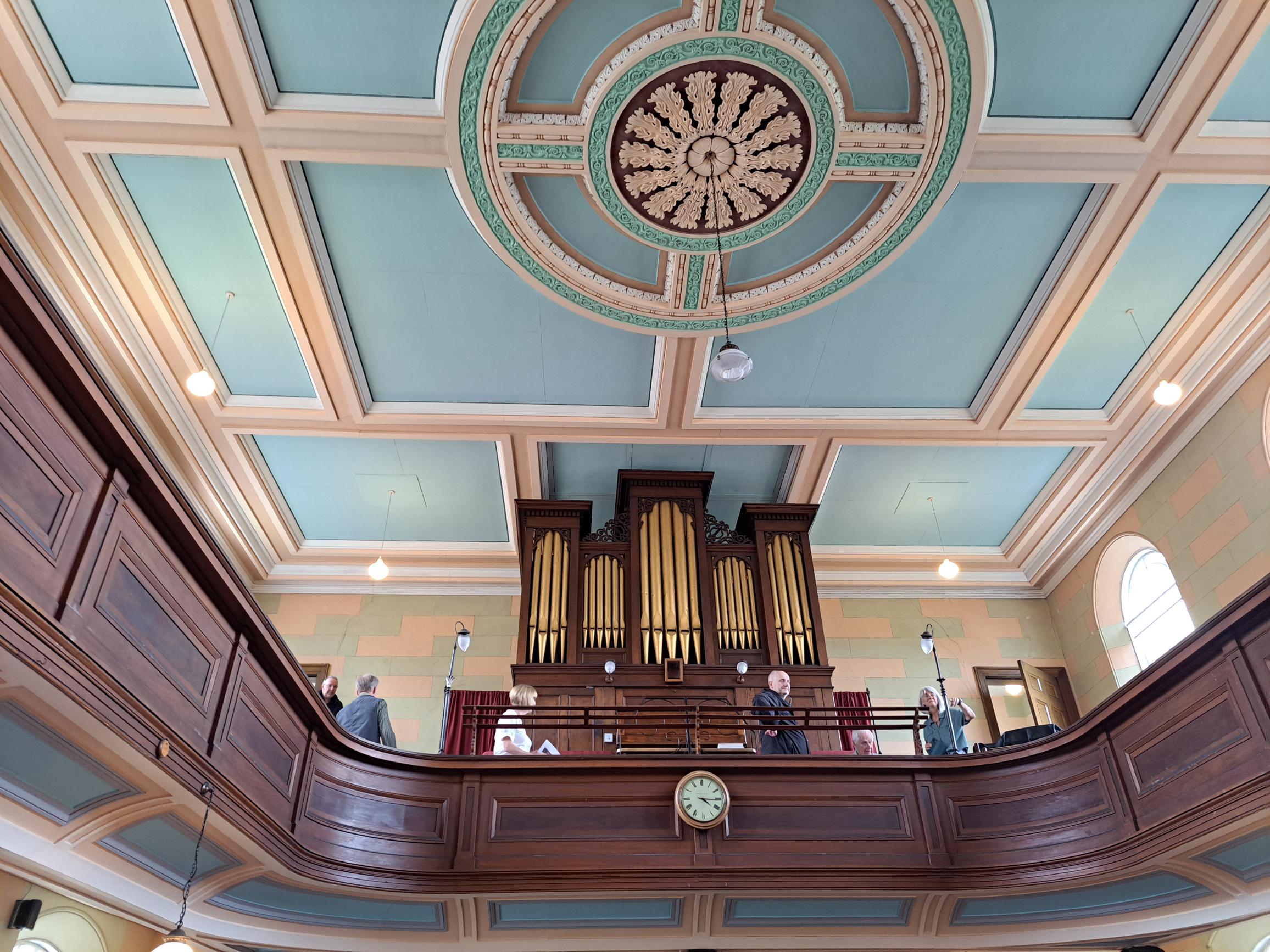
Ceiling and Organ, First Banbridge (Photo: Sue Steers)
The Classical features extend all the way around the building both inside and outside, which is not always the case, but here it makes for a very impressive church.
Looking towards the pulpit (Photo: Karen Bushby)
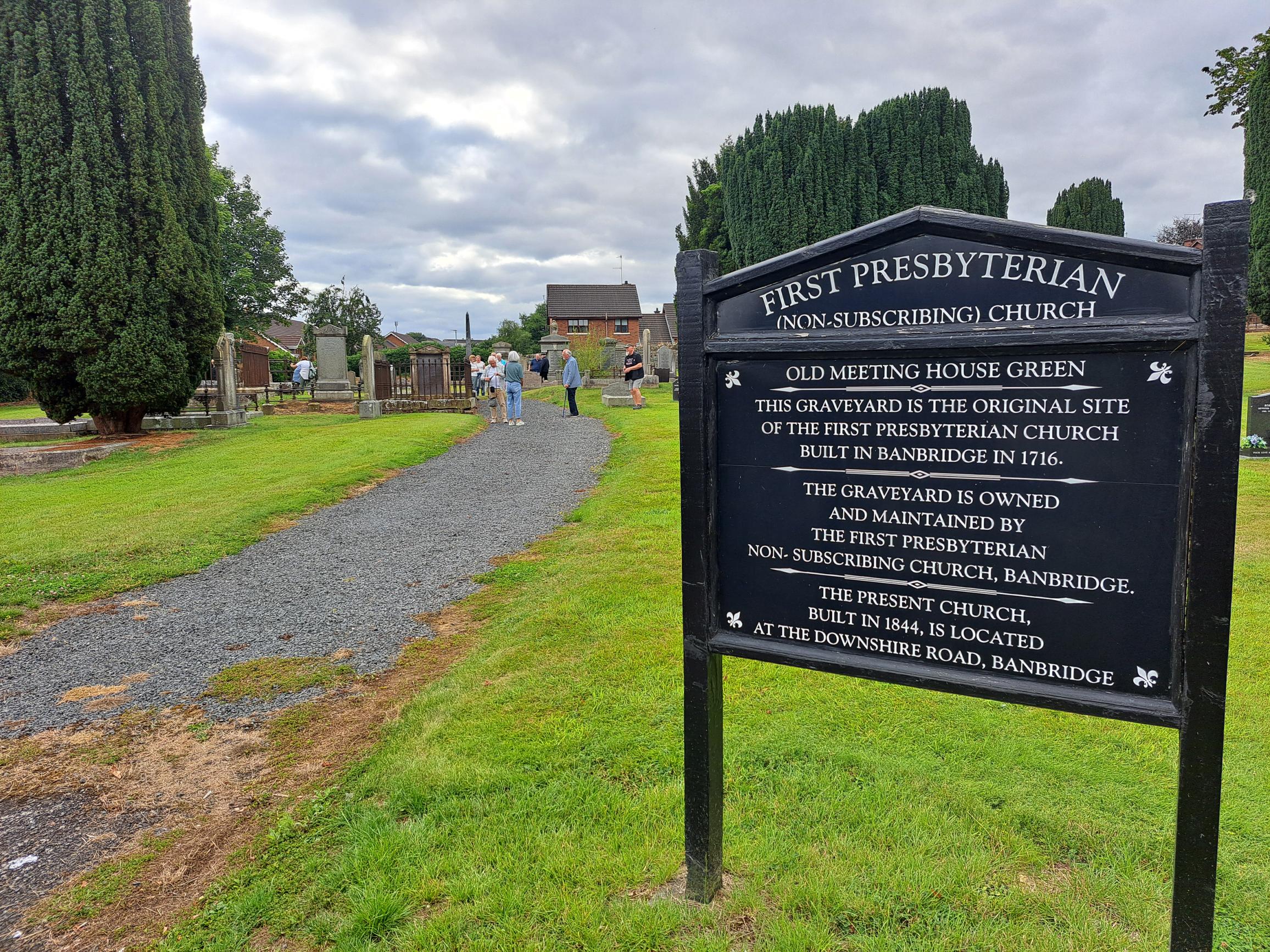
After leaving the church we stopped off at the Banbridge Meeting House Green. This was also once the site of the first meeting-house and is the burial place of many members and ministers such as James Davis and John Montgomery as well as Rev Percival Godding who served in the First World War, you can read a little bit about him here.
Entrance to Banbridge Old Meeting House Green
Inside the graveyard (Photo: Karen Bushby)
It was an excellent day, thank you to everyone who came along or helped organise the day, especially to Kathy. We are already preparing for next year when a trip to Carlingford is planned.
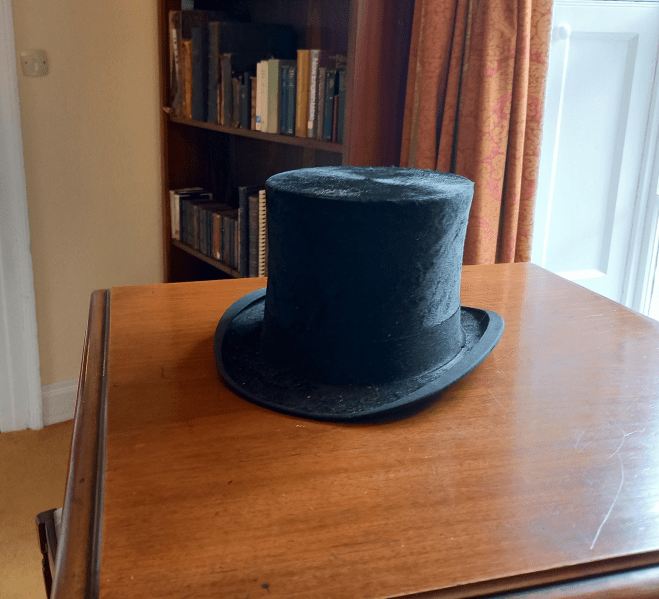
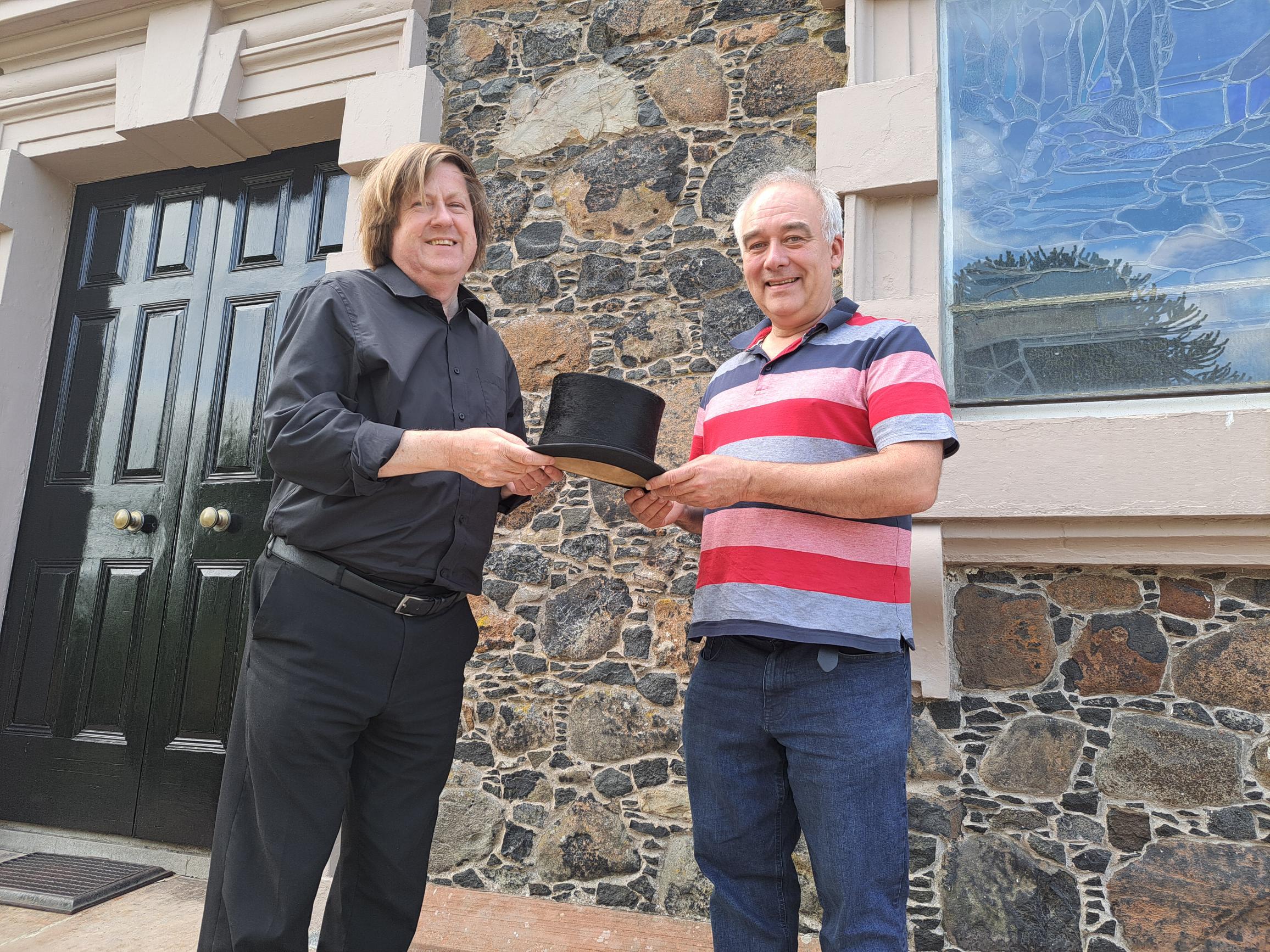
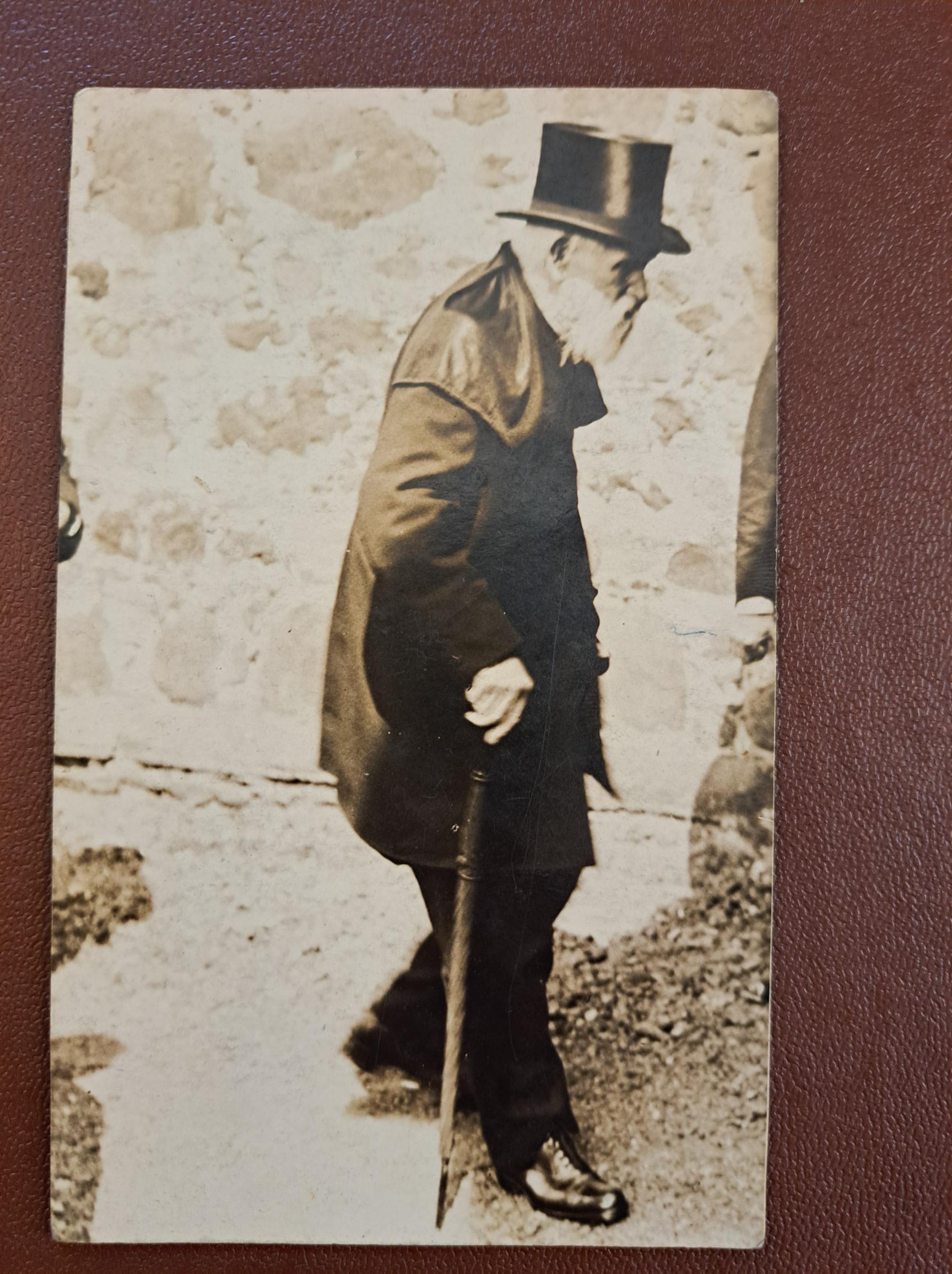
It was a great delight for us to welcome to Dunmurry last week Patrick Robertson, a direct descendant of the Rev Alexander Gordon, his great great grandson no less. He brought with him a mass of wonderful material relating to AG and his family which will provide the basis for much important research in times to come. But the most poignant item he brought along was Alexander Gordon’s silk top hat.
On the steps of Dunmurry Church with Alexander Gordon silk hat
The last time this hat was in Dunmurry was on 18th January 1931 when AG preached in Dunmurry for the last time shortly before his death in February of that year. This visit was preserved in a photograph taken as he entered the Church which can be seen in this post. Alexander Gordon was a member of Dunmurry from the time he moved to Manchester in 1890 to take over as Principal of the Unitarian Home Missionary College. He seems to have valued this link above all else and returned regularly to Dunmurry to attend communion, to serve on the committee and to participate in other aspects of congregational life.
Patrick has another printed postcard image of AG’s visit to Dunmurry in 1931. This view is actually the same shot as the original picture used on this blog before but it is cropped differently. This is it:
The venerable figure of Alexander Gordon coming to preach at Dunmurry at the age of 89 in 1931. Wearing his silk hat
Alexander Gordon was known for his hats. He was said to wear an ancient silk hat inscribed ‘Not Yours!’ But this one wasn’t it. It is actually in excellent condition and though it must be nearly 100 years old it is probably not much older than that.
But his hat was noticed in a newspaper article which is preserved in the Very Rev William McMillan Library in Dunmurry. Probably from the Belfast Newsletter and dating from early in 1931 the writer gives an account of Gordon’s visit to the Linen Hall Library to hear Shannon Millin’s lecture on Belfast historian George Benn. For the writer Gordon was the ‘Silk-hatted veteran’:
Patrick has a lot of fascinating material relating to Alexander Gordon including his certificate from Manchester New College, London dated June 1862 and signed by James Martineau, J.J. Tayler, William Gaskell and many other prominent Unitarians. In later years AG corresponded regularly with his granddaughter Nellie and these lively and engaging letters shed a lot of light on his activities and interests in the 1920s and will be the subject of a future article. The family history is fully covered by a range of letters from across the generations which show the Gordon family’s removal from the north east of Scotland to Dudley in the English west midlands where Alexander Gordon’s grandfather and namesake established himself as a highly successful spirit and wine merchant.
Alexander Gordon senior announces his entry into business
His grandfather was not only a very successful business man (helped no doubt by his wife Maria Loxton whose aide memoire for calculating measures survives to this day) but was Mayor of Dudley, and was also a leading Methodist in the west midlands. Converted by Wesley he kept an illustrated document detailing his spiritual state. This was before Methodists began to be advocates for temperance or teetotalism, which was quite a late development, most people won’t realise that as late as 1841 the Methodist Conference ruled against Methodist Chapels being used to host teetotal meetings and against using unfermented wine at communion.
Other documents that will provide more insight into Alexander Gordon’s life and activity include his ‘Essay on the Results of the Late [Crimean] War’, probably his oldest surviving written work, dating from 1856 at the age of 15; congregational addresses from Norwich and Hope Street, Liverpool, presented on his removal; a testimonial given to his father on removing from Coventry in 1854; photographs and more.
All this helps us expand our knowledge of Alexander Gordon and the world he belonged to, someone whose significance as a scholar has not diminished and whose personal religious bonds, it is becoming increasingly clear, were strongest with the Remonstrant congregation of Dunmurry.
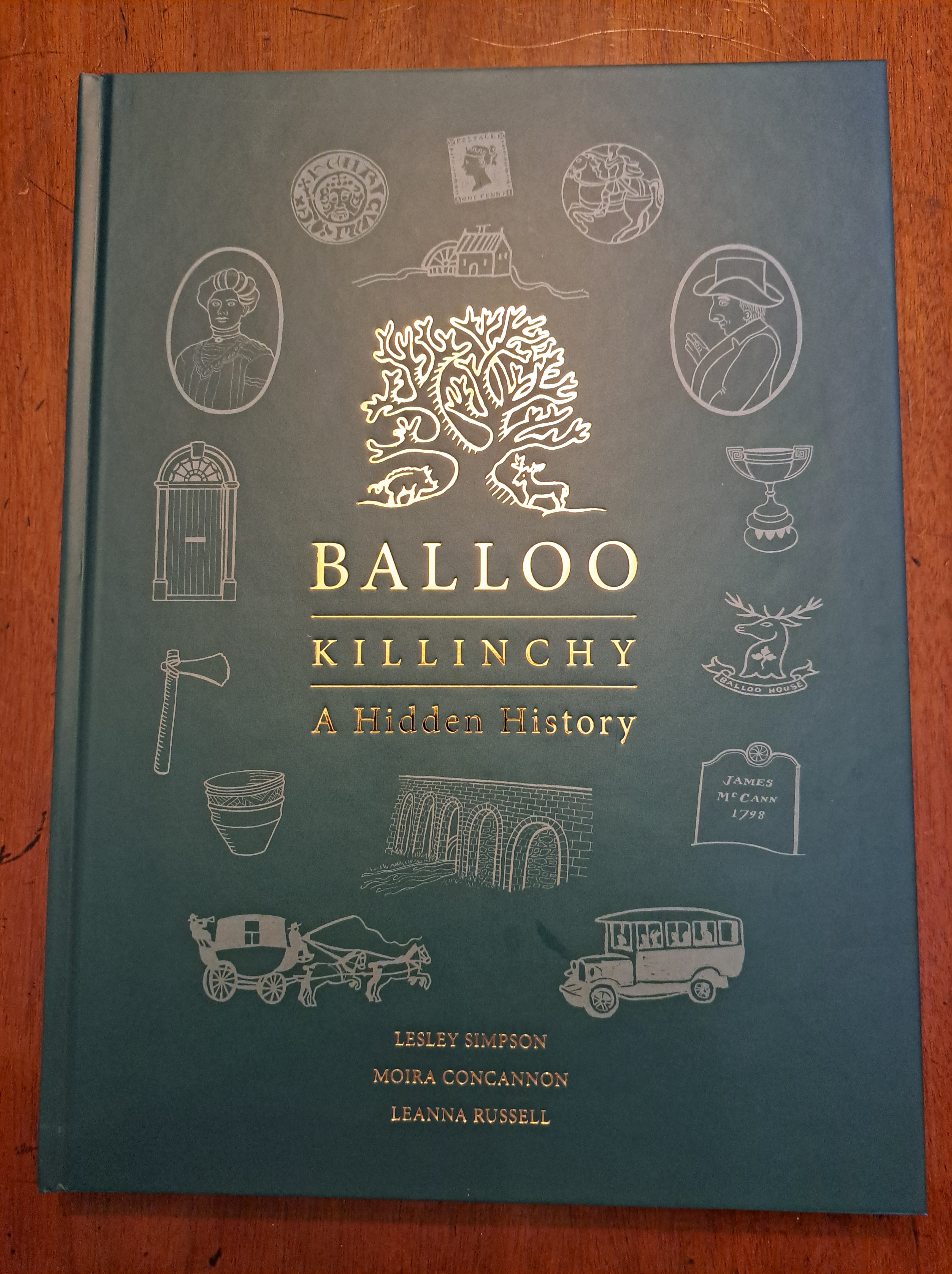
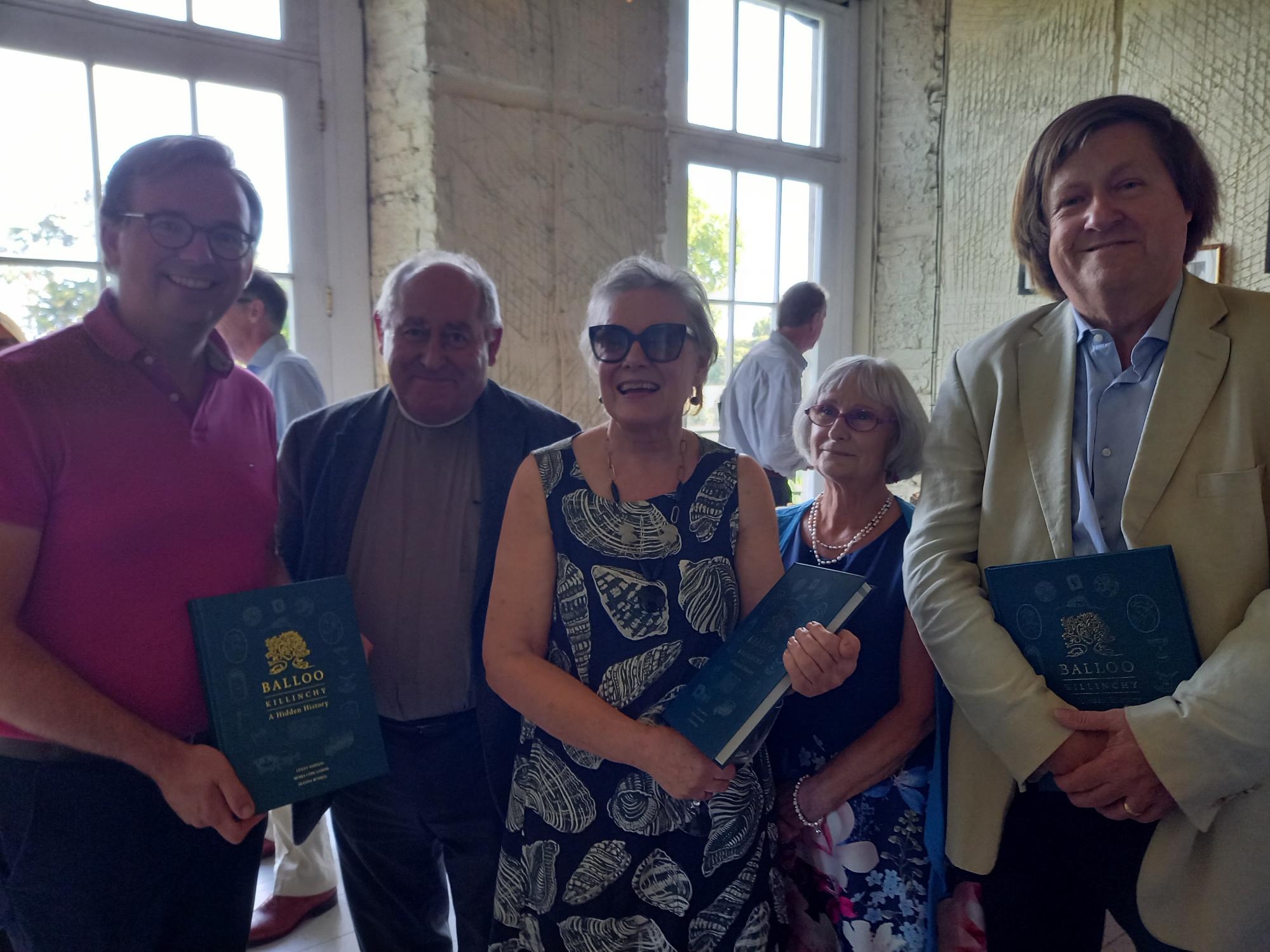
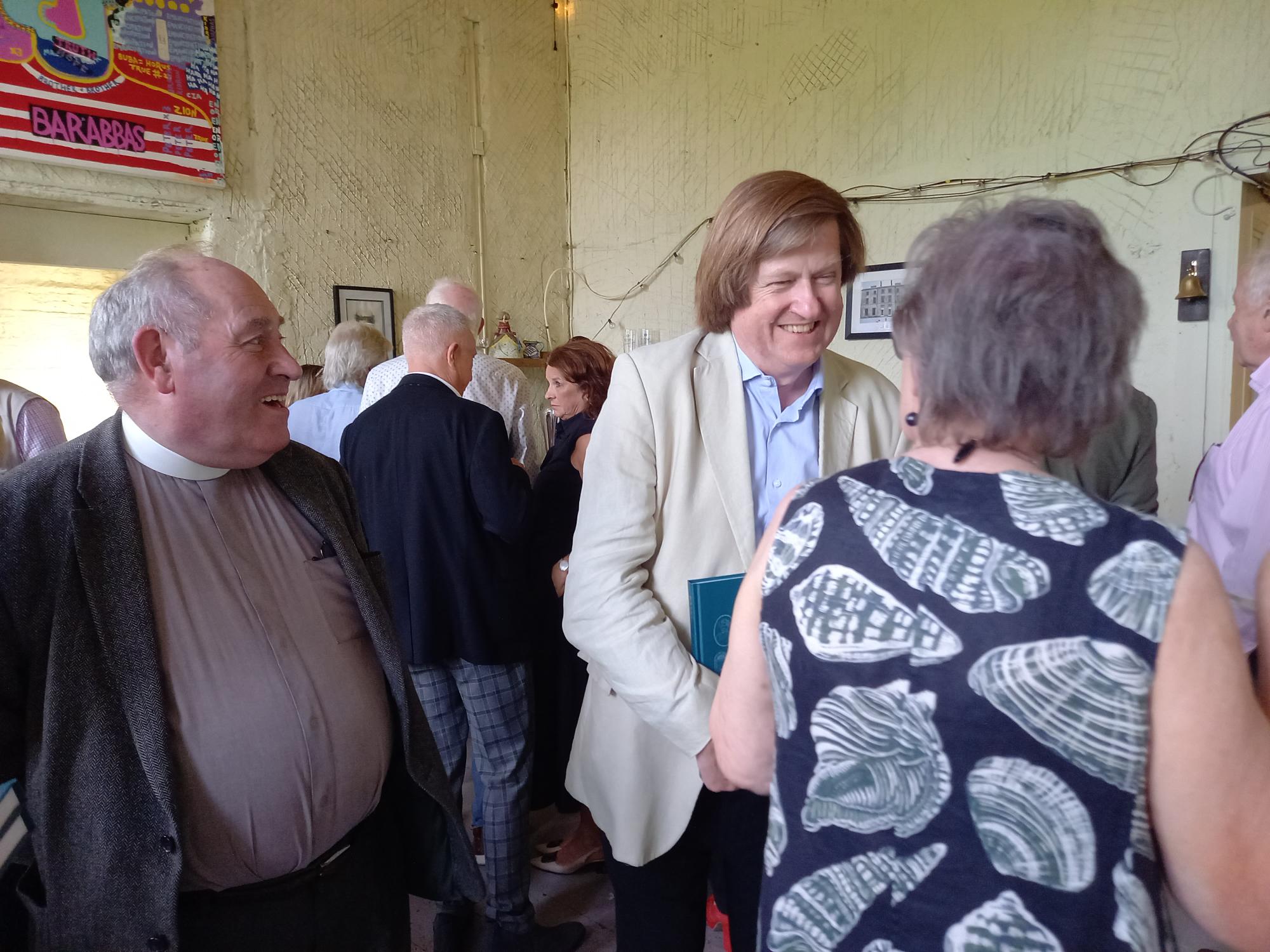
I was delighted to attend the launch of Balloo, Killinchy, A Hidden History by Lesley Simpson, Moira Concannon and Leanna Russell on Saturday, 15th August at Florida Manor, Killinchy. It was a wonderful occasion and a great start for a fascinating and beautifully produced book.
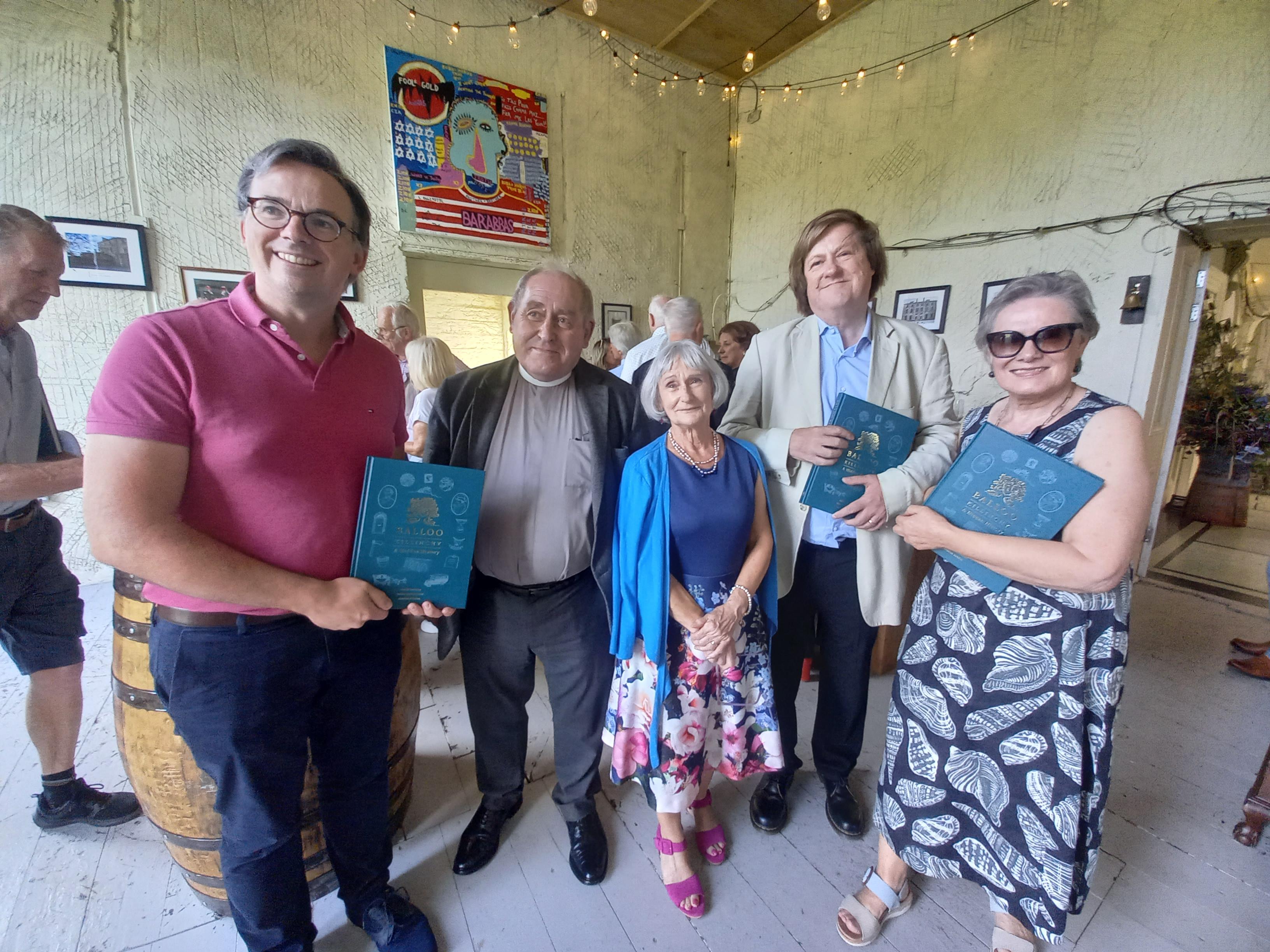
With Rev Dr Stanley Gamble, Rev Dr John Nelson, Lesley Simpson and Moira Concannon
The authors tell the story of the locality through maps, family history, newspaper reports, churches, mills and stores and, most of all, the local houses. Of particular interest to me is the house known as Templebrook Valley which was the home of the Rev Samuel Watson minister in Killinchy from 1797 up to his death in 1856. He was at the centre of one of the major disputes between the Synod of Ulster and the Non-Subscribers in the 1830s and the new Remonstrant meeting house was built for him in Killinchy in 1846.
When the Non-Subscribers were ejected from their original meeting-house, for three years they held services in the grounds of his house. The book tells the story of the Rev Samuel Watson and his ‘long and interesting life from his suspected involvement with the United Irishmen to his move towards Unitarianism’. One of 13 children, three of them becoming Non-Subscribing Presbyterian ministers, Samuel Watson was also a significant farmer in the locality. Sadly his house was left to fall into dereliction in the twentieth century although a new house has now been restored on the site.
There is a great deal in the book about Samuel Watson. At the stone-laying ceremony for his new meeting-house it was reported that:
…seventy clergymen and strangers joined the congregation for a celebration which culminated in a substantial dinner, in a commodious wooden house that had been erected for the occasion with the Rev. Samuel Watson presiding.
I was particularly amused by one quotation taken from James Gourley in 1874, a perhaps not entirely unbiased commentator, who asked an old man who had sat under Samuel Watson’s feet:
What sort of doctrines did he preach? ‘Ohm’ said he ‘at that time there was no word about doctrine.’ ‘And what then did he preach about?’ ’Mainly about far away countries and wild beasts’.
Samuel Watson’s obituary in the Northern Whig described him as ‘…one of the oldest and ablest Ministers of the Church.’
The book is full of detail and uncovers such fascinating stories as the 1893 excavation of Templebrook Valley by the Belfast Natural History and Philosophical Society with the co-operation of Samuel Watson’s two youngest daughters – Anna and Sarah who were photographed at the excavation which uncovered Bronze Age vessels now in the Ulster Museum.
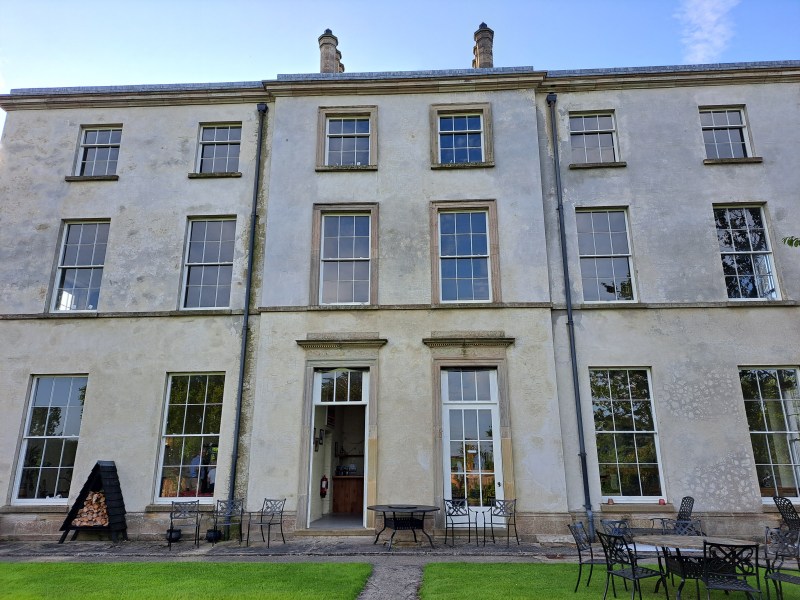
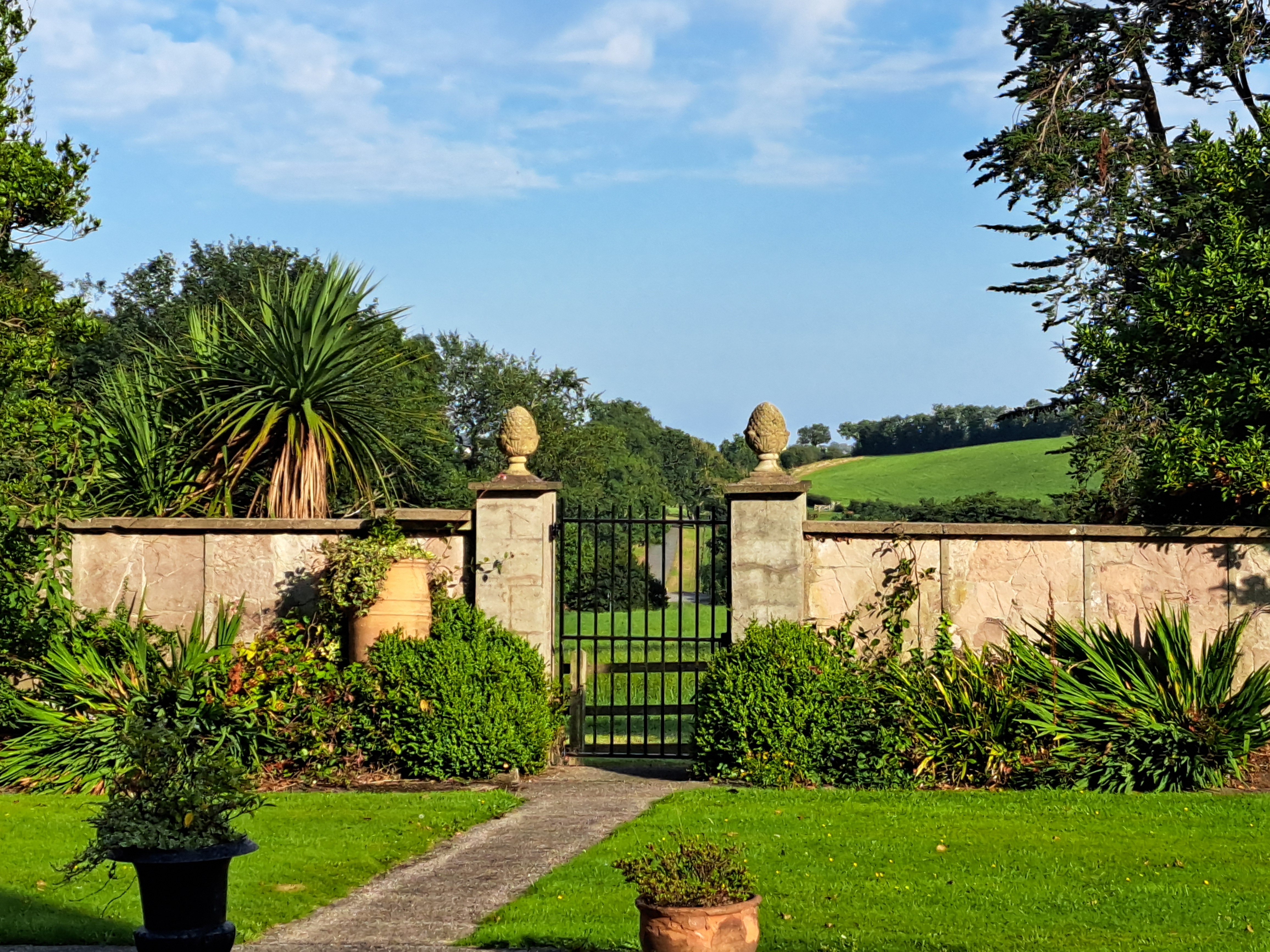
The view from the back of Florida Manor
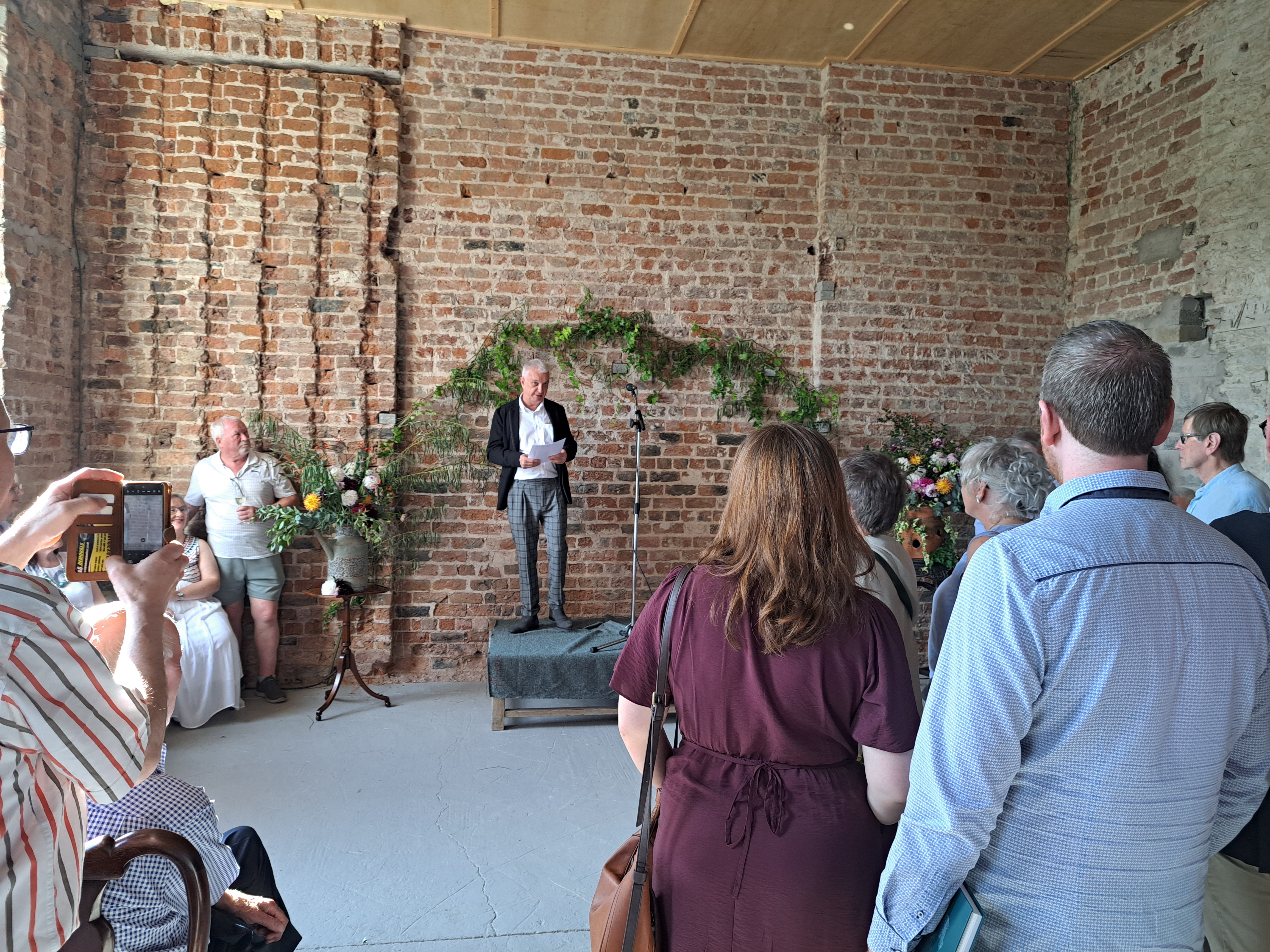
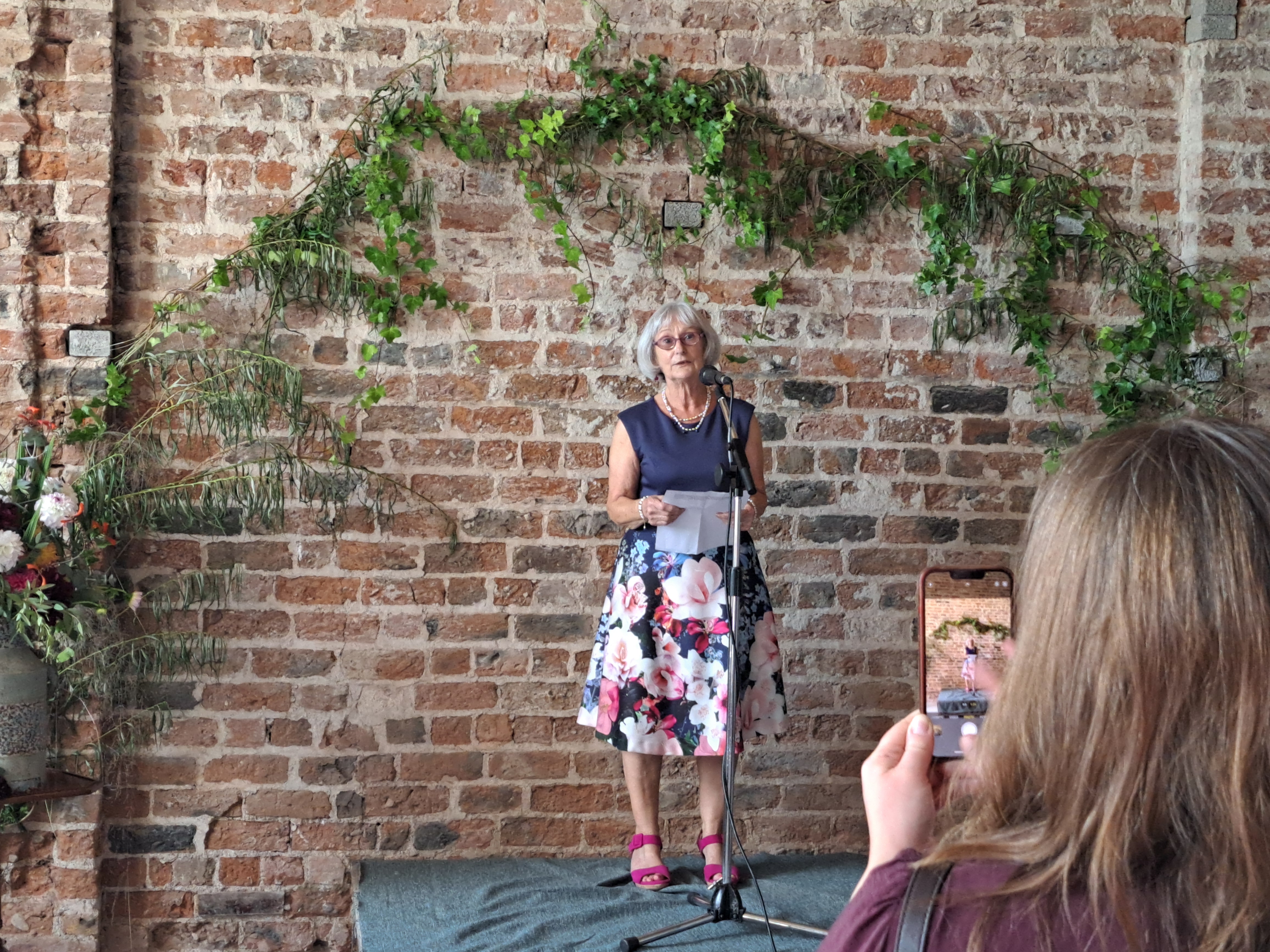
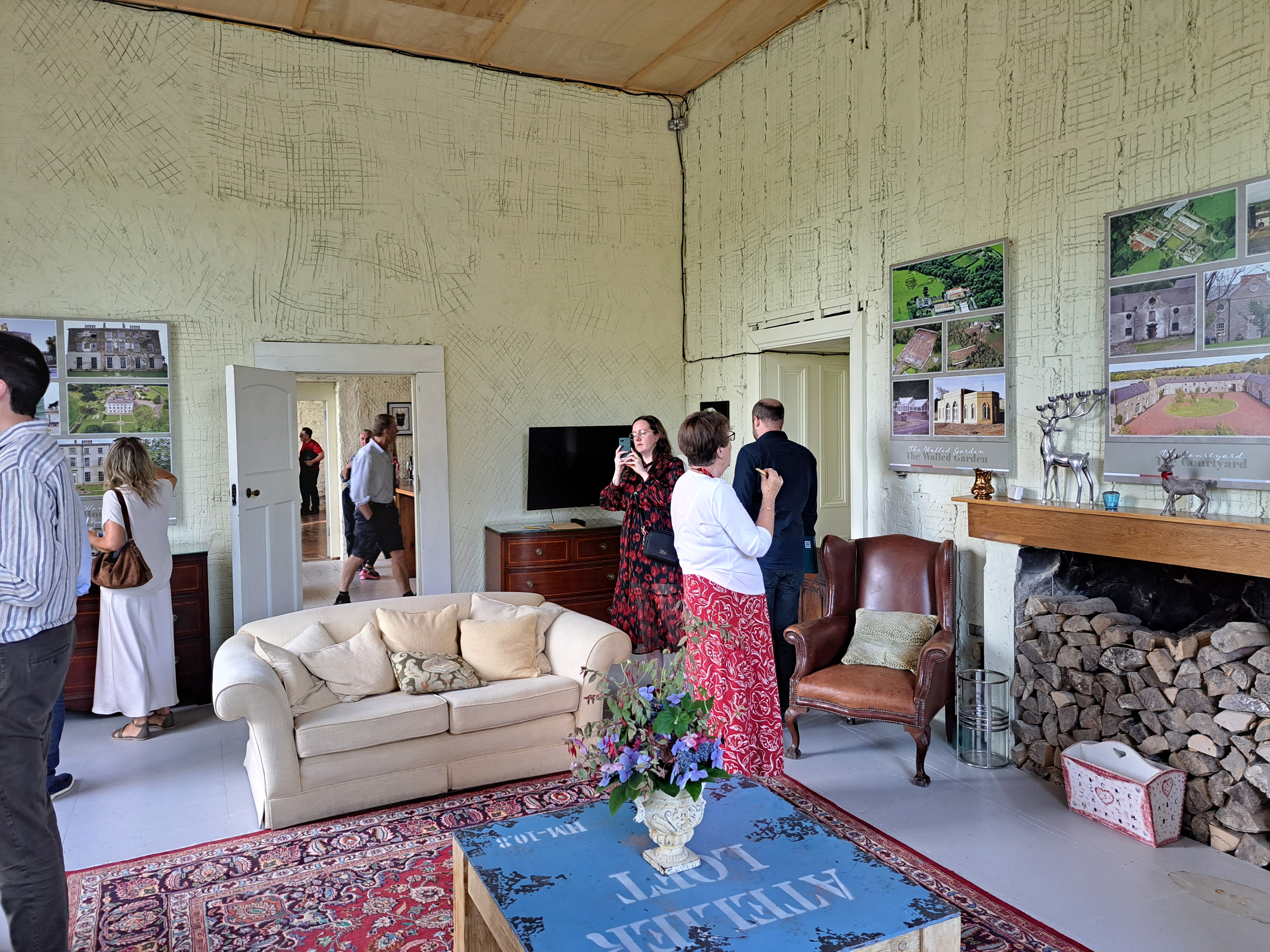
The book is richly illustrated throughout and is full of fascinating information. It is a credit to its authors and will be enjoyed by all with an interest in local history, the history of county Down and Irish Presbyterian history. The launch was a splendid occasion at Florida Manor, as the following photographs show.
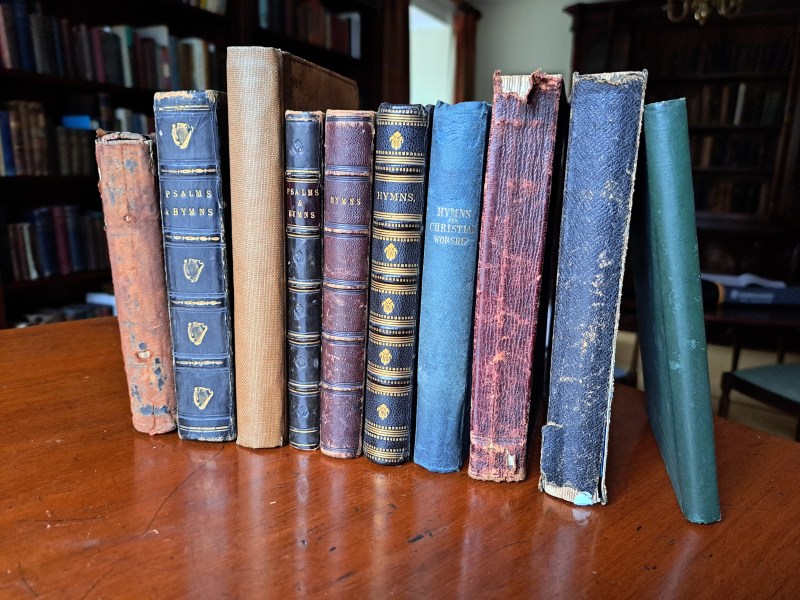
The title of this post comes from the Preface to A Collection of Psalms, Hymns and Spiritual Songs written by the Rev A.G. Malcolm for his hymnbook published in Newry in 1811.
Click on the video to explore Irish Non-Subscribing Presbyterian hymnbooks
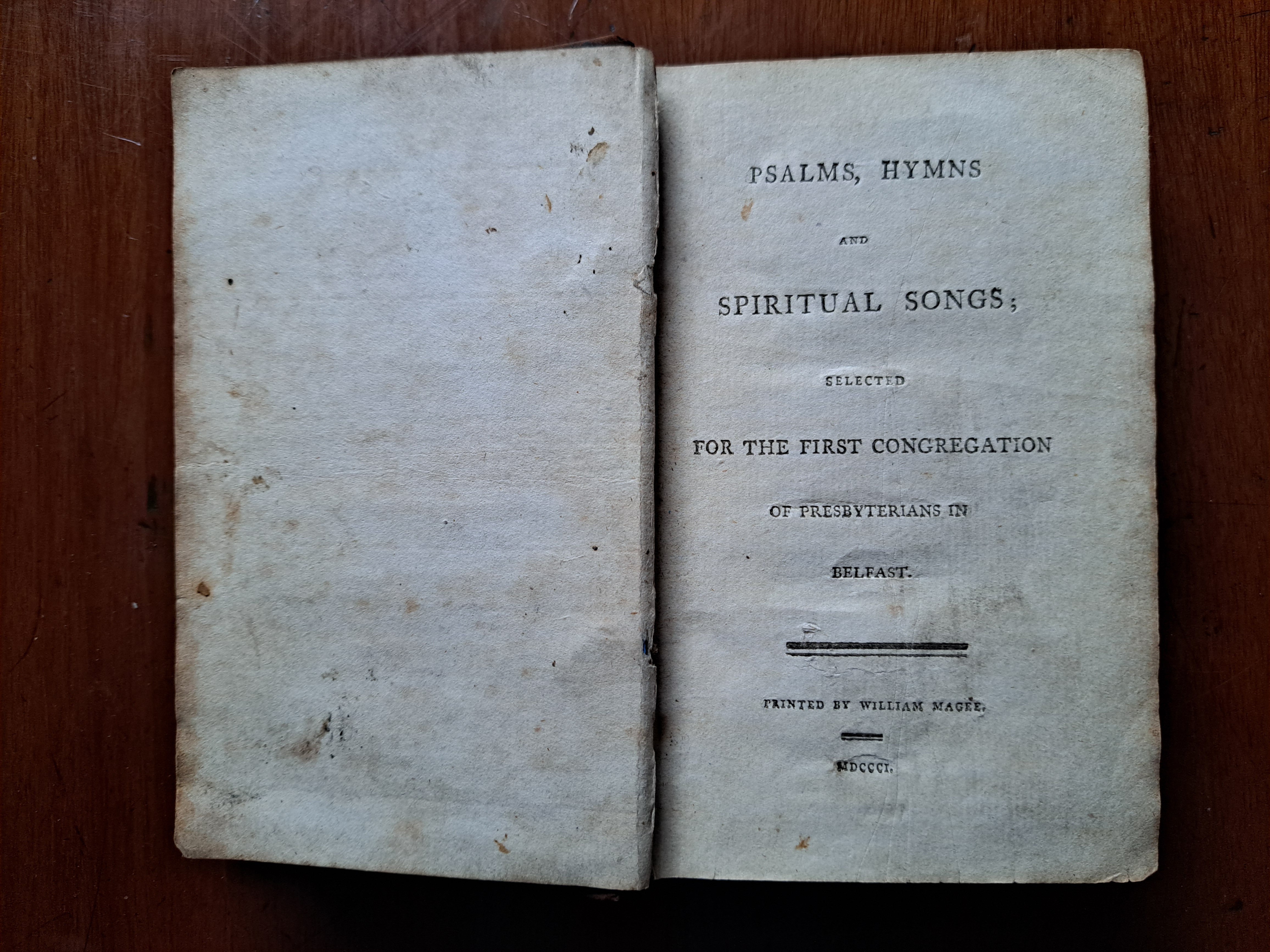
Prior to about 1800 Non-Subscribing or New Light Presbyterian churches, in common with other Presbyterians, would have worshipped with a Psalter or Psalm book. The first distinctly Non-Subscribing hymnbook appeared in First Church in 1801. What is surprising about this publication is that in the same year Edward Bunting offered to supply an organ to the church. This offer wasn’t taken up although in just a few years the Second Congregation were to become the first church with an organ, First Church not acquiring one until 1853. The Rev William Bruce edited this collection and 1,200 copies were published. A choir seems to have led the singing which initially contained boys but was later expanded to include adults.
First Church’s Collection of 1801
William Bruce’s book contained 246 hymns, with an index of first lines and a brief one page table of subjects. The next hymnbook, the Newry edition of A.G. Malcolm, contained 405 hymns with a more substantial table of subjects running over eight pages. Plus it had an index of first lines with the names of authors (for example Barbauld, Watts, Doddridge, Kippis, Merrick, Wesley, Addison, Enfield) which showed the eclectic sources the book drew on from within Dissenting circles and beyond.
An interesting preface also explained their intentions:
…care has been taken, to select psalms and hymns, which treat of of the leading points both of faith and practice; and it is hoped, that the compilation will be found to contain a sufficient variety of the best compositions, in sacred poetry, adapted to all the principal subjects of Christian devotion.
A.G. Malcolm went on:
Correctness, both in sentiment and style, has also been made an object of considerable attention. Hence, many verses have been altered; and such psalms and hymns as seemed, in any degree, unsuitable to the simplicity and solemnity of divine worship have been omitted.
As the work is intended for general use, and must be expected to fall into the hands of persons, who unavaoidably differ from one another, in their opinions, on religious subjects, all expressions, which appeared likely to give offence to any sincere Christian, have been studiously avoided.
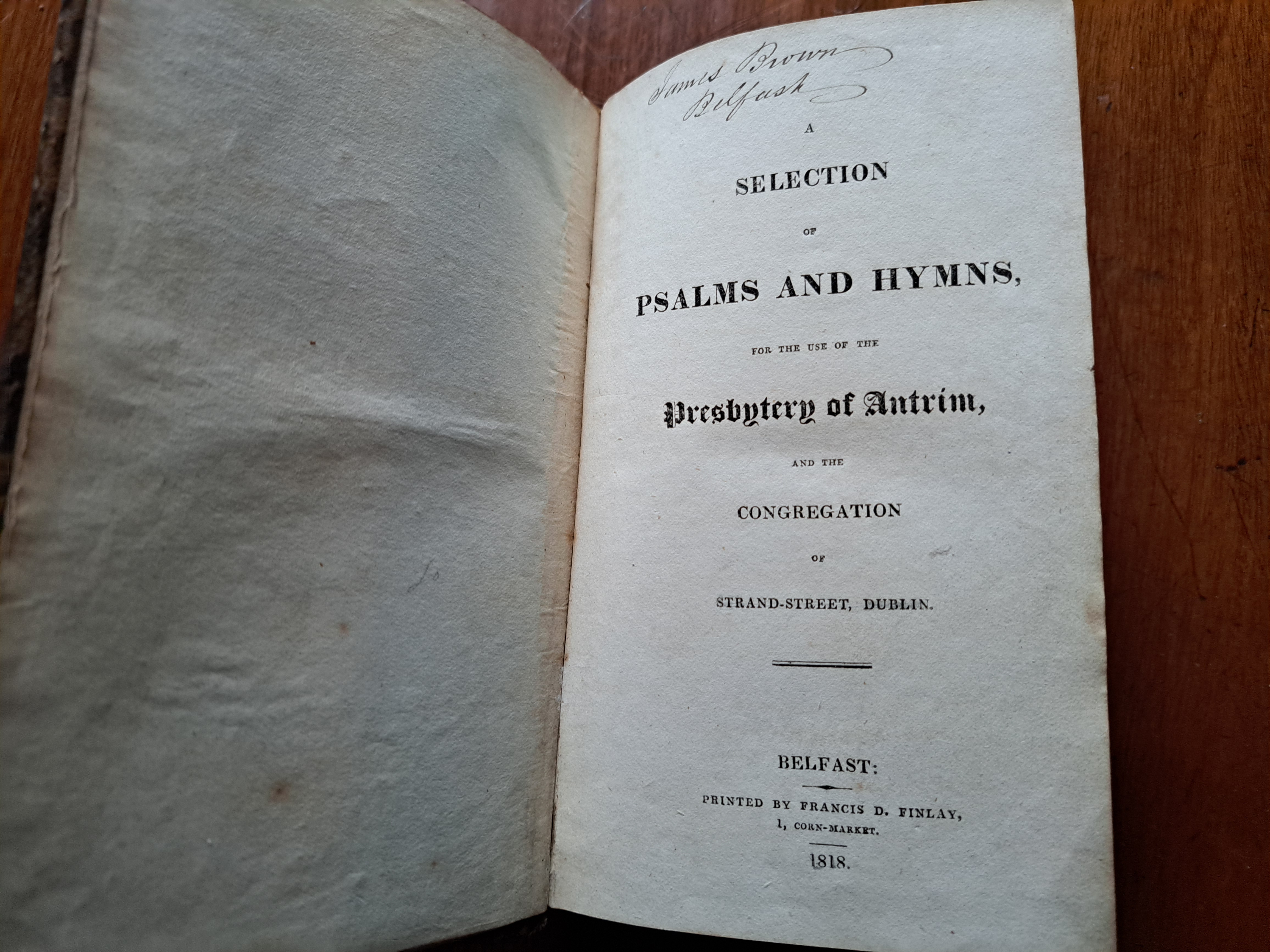
Interestingly the next hymnbook, dated Belfast, July 1818 and edited by Rev W.D.H. McEwen, made a similar point in a slightly more forceful way in its Preface:
Some doctrines are so offensive to the societies, for whose use this compilation is principally intended, that they are carefully avoided. As to others, the same scrupulosity is not observed; for, with respect to them, there may exist a diversity of sentiment. This selection may, therefore, be thought defective, but it will not disgust by a pertinacious obtrusion of doctrine.
So certain doctrines weren’t allowed to get in the way! Some were left out all together – the Trinity, the theory of the atonement based on penal substitution – and on some doctrines Non-Subscribers were able to agree to differ.
W.D.H. McEwen,s hymnbook
The book was published for the Presbytery of Antrim and the congregation of Strand Street, Dublin but it came from the minister of the Second Congregation. Curiously they had installed an organ in 1806 and had Edward Bunting as their organist from then until 1817. So they don’t appear to have had a hymnbook of their own for the first dozen years after installing the organ.
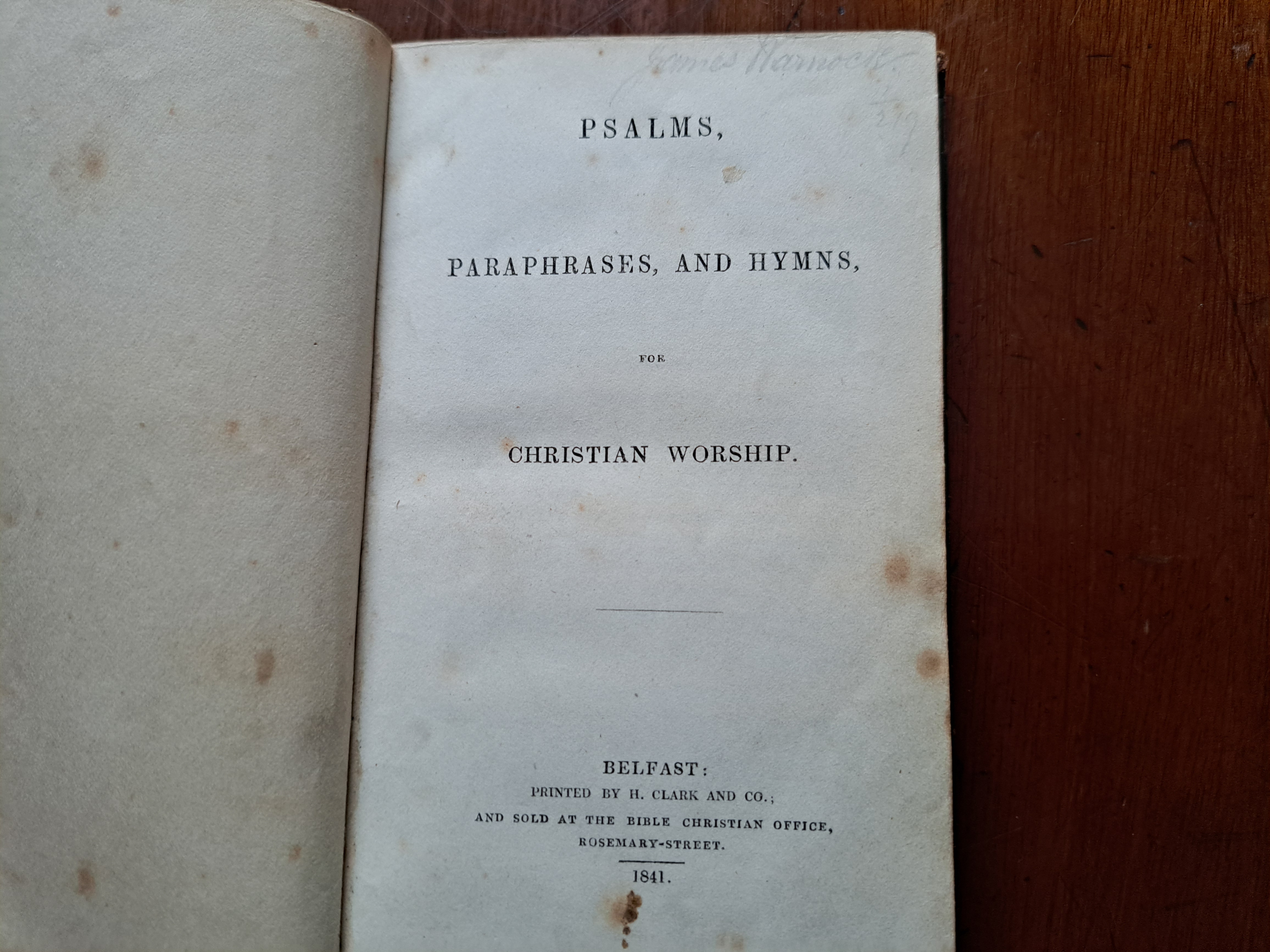
Following the establishment of the Remonstrant Synod of Ulster in 1830 Non-Subscribers moved towards the development of a hymnbook for all churches. This is Psalms, Paraphrases, and Hymns, for Christian Worship published in Belfast in 1841:
Psalms, Paraphrases, and Hymns, for Christian Worship 1841
This is the first edition of what became Hymns for Christian Worship, a book which went into at least four further editions before the end of the century and was followed by a supplement in 1899. Throughout this time this was the main series of hymnbooks in use in the churches in Ireland. More detail can be seen in the video above.
A recent post looked at the two wonderful Rowel Friers cartoons which hang on the wall of the Library in Dunmurry, as well as the video which explains the story about them. As the post explains these pictures were commissioned by the Rev William McMillan for his impressive Exhibition illustrating the history of the Presbytery of Antrim held in January 1976.
It must have been an attractive display in the McCleery Hall, the Rev Mac sourced portraits, books, communion plate, swords and pikes from the ’98 Rebellion, sculptures by Rosamond Praegar, commmunion tokens, copper collecting pans and all sorts of material from all over Northern Ireland. There was even a mould for making eighteenth-century communion tokens from Ballycarry and – something I had not previously heard of – an eighteenth-century family token box, described as ‘a wooden box holding a small leadbox in which the token was taken to the meeting house.’
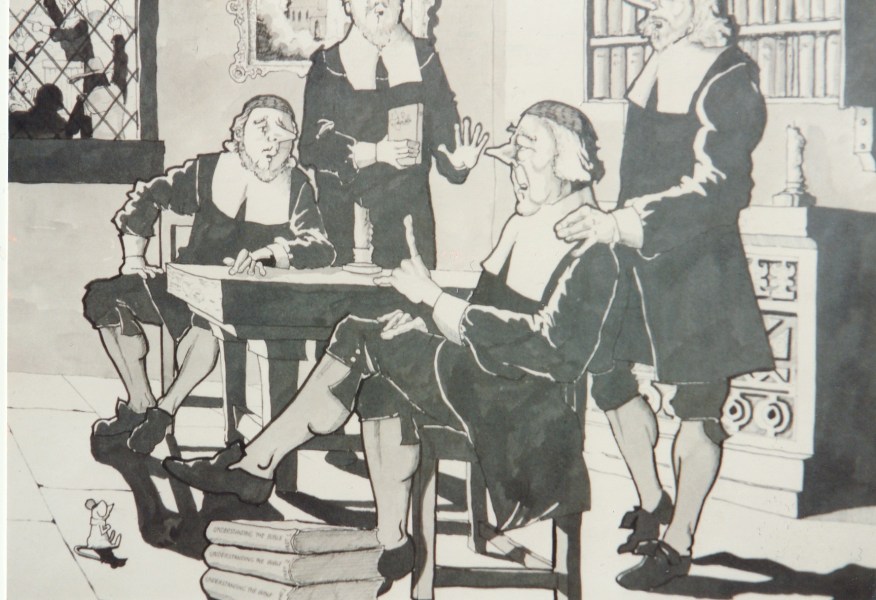
One feature of the Exhibition for the 250th anniversary of the Presbytery of Antrim is that there were in fact three, not two, Rowel Friers cartoons included. Unfortunately one of these has been missing for fifty years. However, we have now discovered a photograph of the lost picture and this features in our latest video:
Click on the video to see the video about the 1626 Antrim Meeting
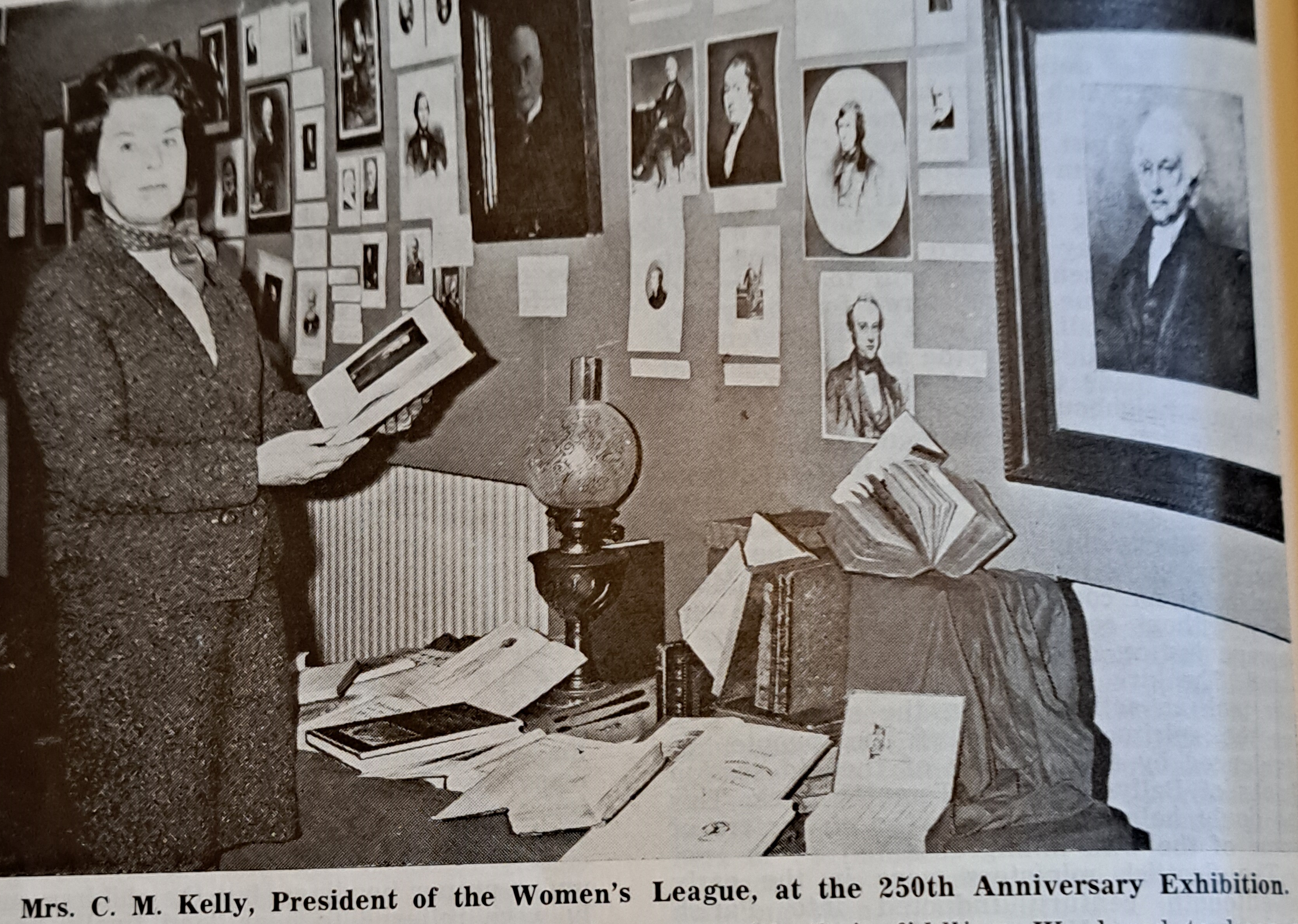
The Exhibition was held in January 1976 and covered both the creation of the Presbytery of Antrim in 1725 and its separation from the Synod of Ulster. It was also intended to cover the anniversary of the creation in 1626 of the original Antrim Meeting. The Exhibition must have been fascinating but unfortunately in that pre-digital age there were very few photographs taken. There is only one that shows the Exhibition in the Non-Subscribing Presbyterian magazine at the time:
Betty Kelly at the Exhibition in the McCleery Hall in 1976
There were a large number of dignitaries invited to the dinner that followed the Exhibition, representatives of all denominations, figures in public life, historians and international figures. Many of the speeches are recorded in the Non-Subscribing Presbyterian magazine and the Rev John Radcliffe, clerk of the Synod, made reference to the third Rowel Friers cartoon:
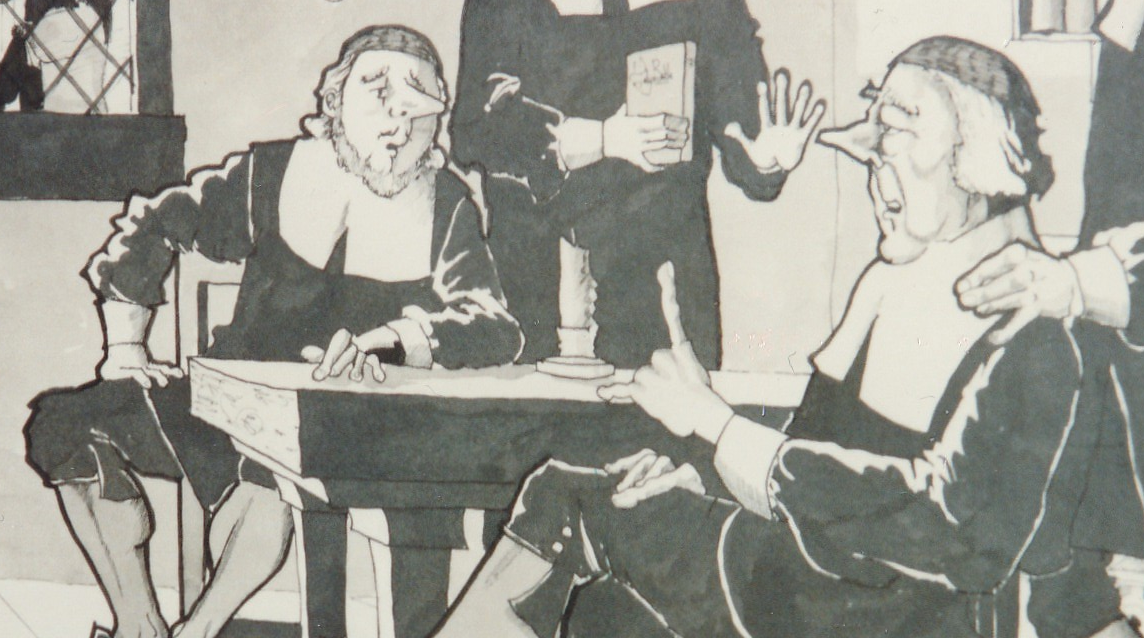
‘There are two extreme forms of the expression of religious sentiment. There is one that is very well expressed in the person here described: “His mind and voice had precisely the fluid quality of some clear, subtle liquid: one felt it could flow around anything and overcome nothing.” That is the extreme of presenting the Christian faith in such delightfully attractive style, with such a fluency of language, with such a vividness of imagery, that it will flow around anything and overcome nothing. At the other extreme there is another sort of Christianity, corybantic Christianity. There is a cartoon on the wall there, a drawing of four rather austere clerics, and the date is 1626. Outside you see somebody rousing a rabble – not unheard of in these days. The four rather serious looking clerics are trying to bring a bit of reason into it all; and the man outside is an exponent of corybantic Christianity, the Christianity that is the direct oppposite of that I have been describing tonight – and appeals all the time to the emotions in which people get carried away, and leads in the end to a very dangerous, in fact terrible, fanaticism – the very negation of the Christian spirit.’
Detail from the photograph
It is a fascinating footnote to our previous post and video about our Rowel Friers cartoons, another part of the story that takes us back even further in time, in this case to 1626.
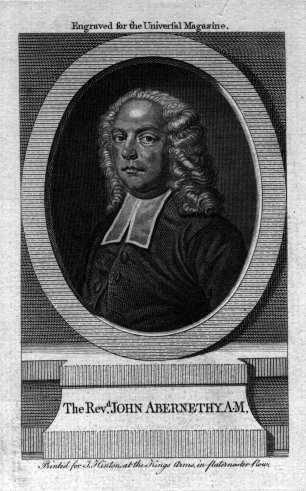
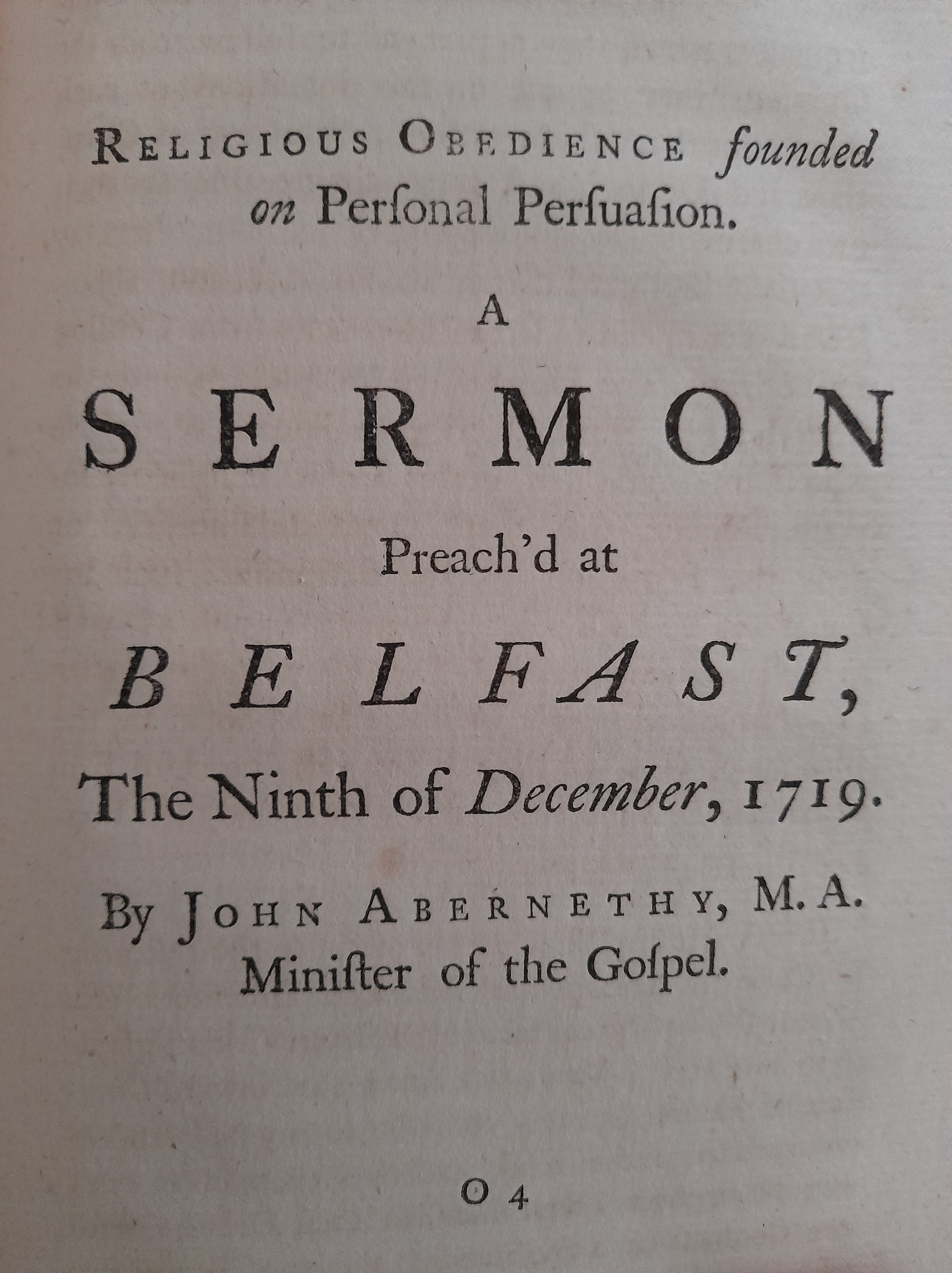
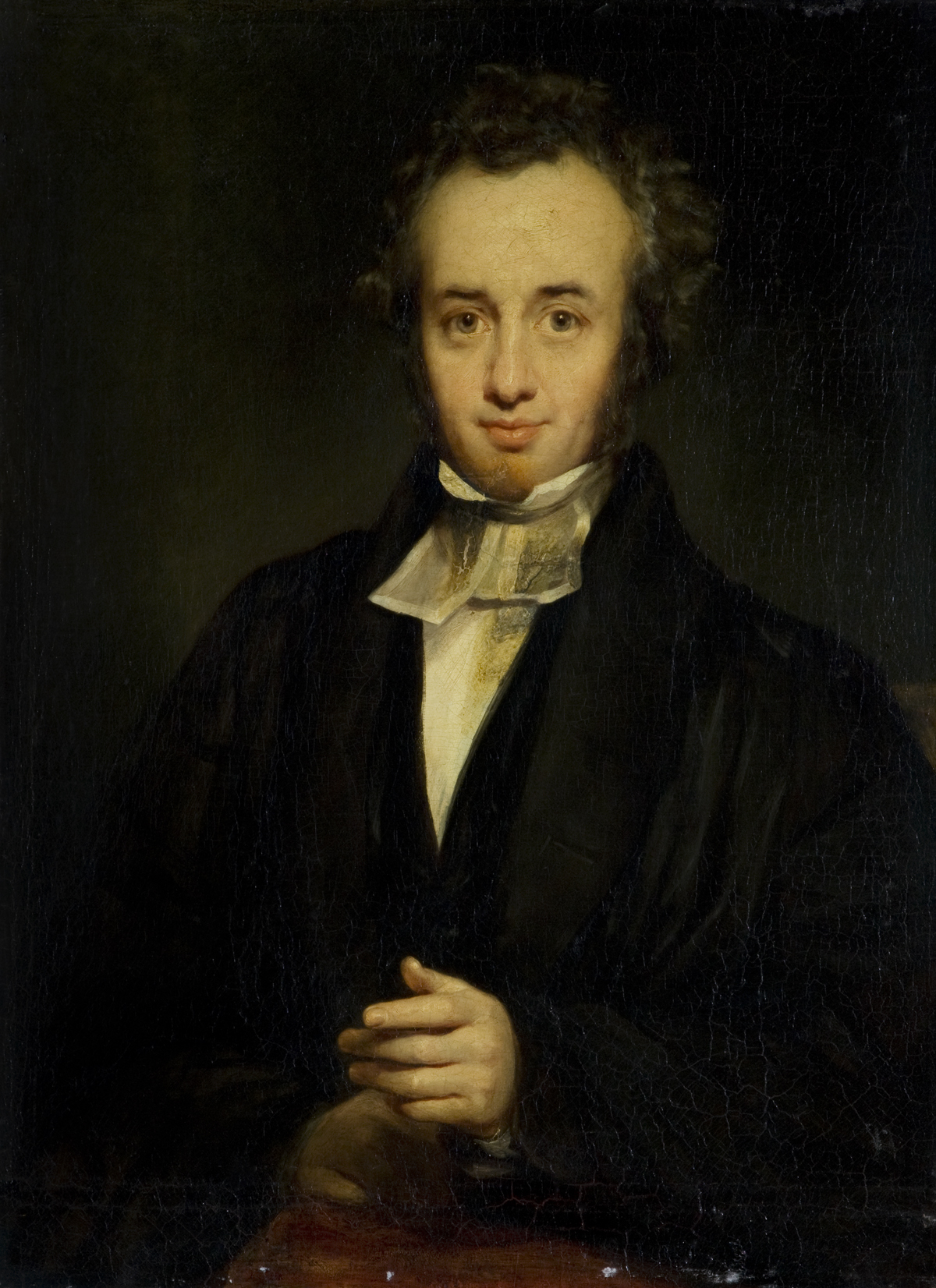
Episode 6 of our explorations of the Very Rev William McMillan Library at Dunmurry looks at the writings of the Rev John Abernethy (1680-1740). Without doubt the most prominent Presbyterian minister in Ireland in the early eighteenth century and the foremost exponent of Non-Subscription, he was minister at Antrim (see picture above) and later Wood Street, Dublin.
Click on the video to see John Abernethy’s books
Some of his books were the best sellers of their day and some of his publications were seen as either controversial theological statements or the key to opening up a new way to understand faith, depending on your point of view. Ironically at the time of the first subscription controversy the minister of Dunmurry, the Rev John Malcome, was a vocal opponent of the Non-Subscribers and was the first to use the term ‘New-Light’ about them. But Dunmurry Library has a good selection of his published works, most of them published after Abernethy’s death.
The founder of the Belfast Society in 1705, an outspoken advocate of the rights of the dissenting minority in Ireland and an established philosopher of some importance, John Abernethy’s books had considerable influence and this video looks at his publications held by our Library in Dunmurry.
In the latest of our videos exploring the Very Rev William McMillan Library at Dunmurry we take a (brief) look at the eight volumes of the Journal of John Wesley. In particular we look at his visits to Belfast and his relationship with the Non-Subscribing Presbyterian churches in Belfast.
Exploring the Library at Dunmurry, episode 4. Click on the video above
John Wesley visited Belfast 11 times in the course of his career, always preaching in the town, sometimes in the market-house, sometimes in the open air. Often it seems he visited at times of cold, windy or wet weather. Only once did he preach in a church and the only church to ever be open to him was First Presbyterian Church, Rosemary Street. But this visit was mired in controversy and was not repeated. I am grateful to Des McKeown of First Church who recently gave me a copy of a letter to The Northern Whig dated 3 December 1873 written by the minister of First Church, the Rev John Scott Porter. This features in the video and it is interesting to see his opinion of Wesley’s visit almost one hundred years previously.
A youthful John Scott Porter
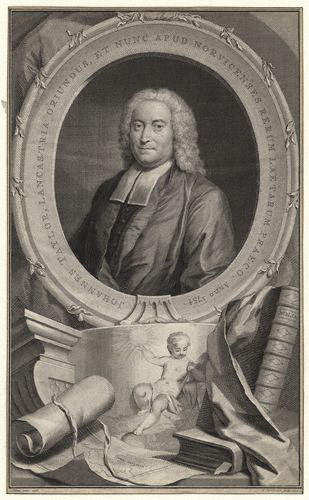
But another feature of Wesley’s Journal is his identification of followers of Dr John Taylor in the crowds that came to hear him in Belfast. John Taylor was minister of the Octagon Chapel in Norwich and the author of the The Scripture Doctrine of Original Sin. What are the implications of this in Belfast in the 1760s? We try to unpack the meaning of this for John Wesley’s reception in Belfast in the video.
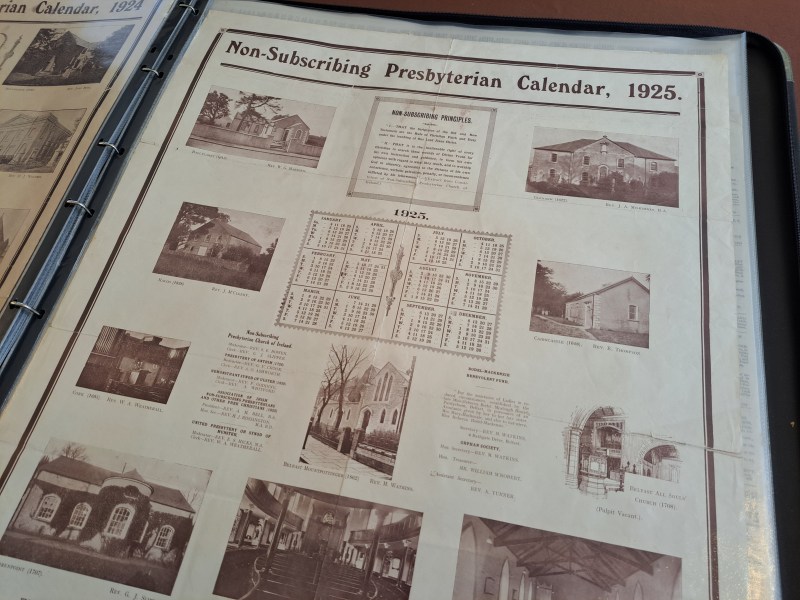
Ephemera is the term given for items that weren’t usually expected to last. Usually printed items, they had only a limited shelf-life and were generally expected to be thrown away when they had been used. Inevitably such things tend to become interesting to collectors because they often illuminate some aspect of social history that might otherwise be lost. Our new Very Rev William McMillan Library is rich in ephemera and this latest video explores two items held by the Library:
Click above to see Episode 3 of the explorations of Dunmurry NSP Library
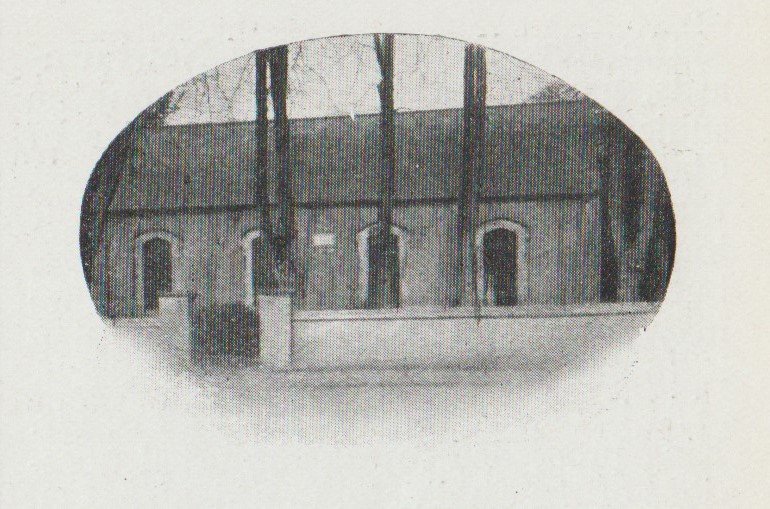
In 1924 and 1925 the congregation of York Street Church, Belfast, under the leadership of Rev Dr A.L. Agnew, produced a calendar to sell to the denomination. Over the two years they included a picture of all the churches in the denomination in Ireland and they make for interesting documents. Many of the pictures date from a bit before the mid-1920s but it makes for an interesting collection of early twentieth-century photographs. Some images are quite well-known and have often been published. Some are quite rare like this picture of Ballymoney:
There’s also a reminder of an attempt at outreach in Bangor which lasted for a few years, and seemed to be successful for these years at least:
But altogether they are interesting documents. They must have captured a lot of interest at the time but at the end of the year what do you do with an old calendar but throw it away? Which is why so few have survived. You can find out all about it by watching the video.
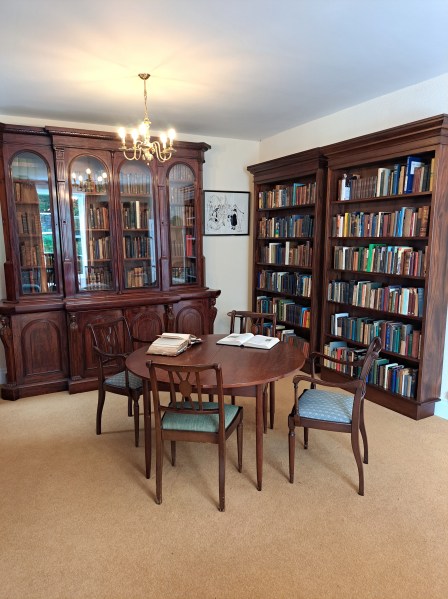
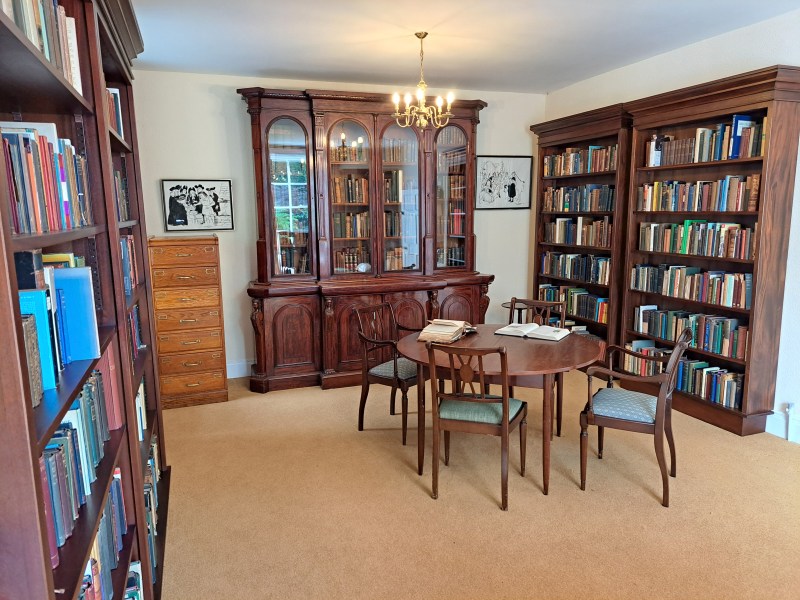
At Dunmurry we are particularly looking forward to the formal opening and dedication of the Very Rev William McMillan Library on Sunday, 22nd September at 3.00 pm. The Rev Mac bequethed his Library to the Church and over the last four years we have been working on creating a catalogue and getting everything ready to house the Library. We have had furniture made for the Library, we have also repurposed other furniture for use in the Library and restored some items to house the books.
It is an exciting project and a very fitting memorial for the Rev Mac who was an historian of some ability and renown. He assembled this collection as he worked on the history of Non-Subscription and the Library contains over 2,500 books, as many pamphlets and journals again, and many more manuscripts and other items. After the dedication the Library will be open for visitors (although we will not be able to lend items) but we want the Library to be known and appreciated by as wide a group as possible.
To help in this process I will be uploading short videos talking about the Collection, in which I will highlight different books which have an interesting story to tell. The first of these is this video;
Dunmurry NSP Library Episode 1. Click on the video to view.
This video looks at the Library’s copy of W.D. Killen’s History of Congregations of the Presbyterian Church in Ireland and Biographical Notices of Eminent Presbyterian Ministers and Laymen published in 1886 which was rebound and interleaved by Alexander Gordon in 1892. It’s a fascinating tale, the first in a series of short films about the unusual, interesting and informative books on the shelves.