Della Robbia Pottery

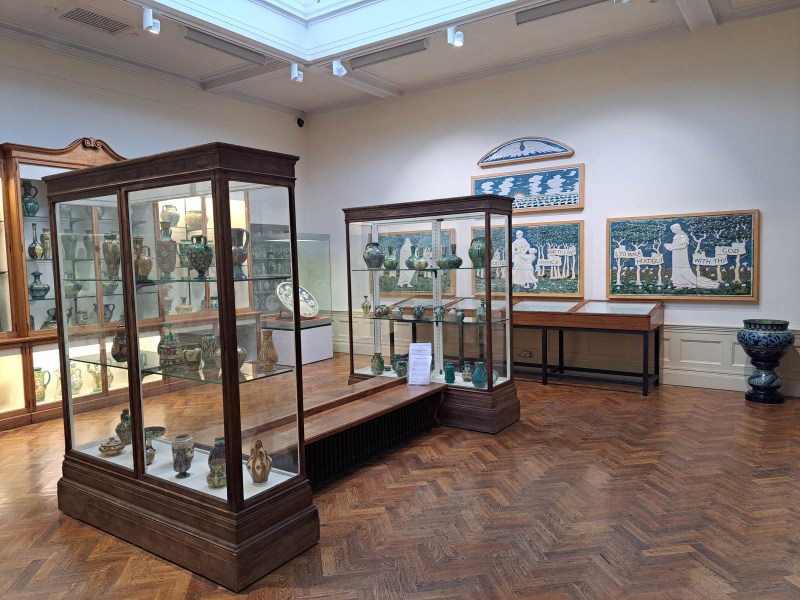
I can’t remember the last time I visited the Williamson Art Gallery in Birkenhead but a re-visit was long overdue and I was so pleased to see the exhibitions and collections there. There’s a lot to see, including a fine collection of ship’s models, but the stand out part for me was the collection of Della Robbia.

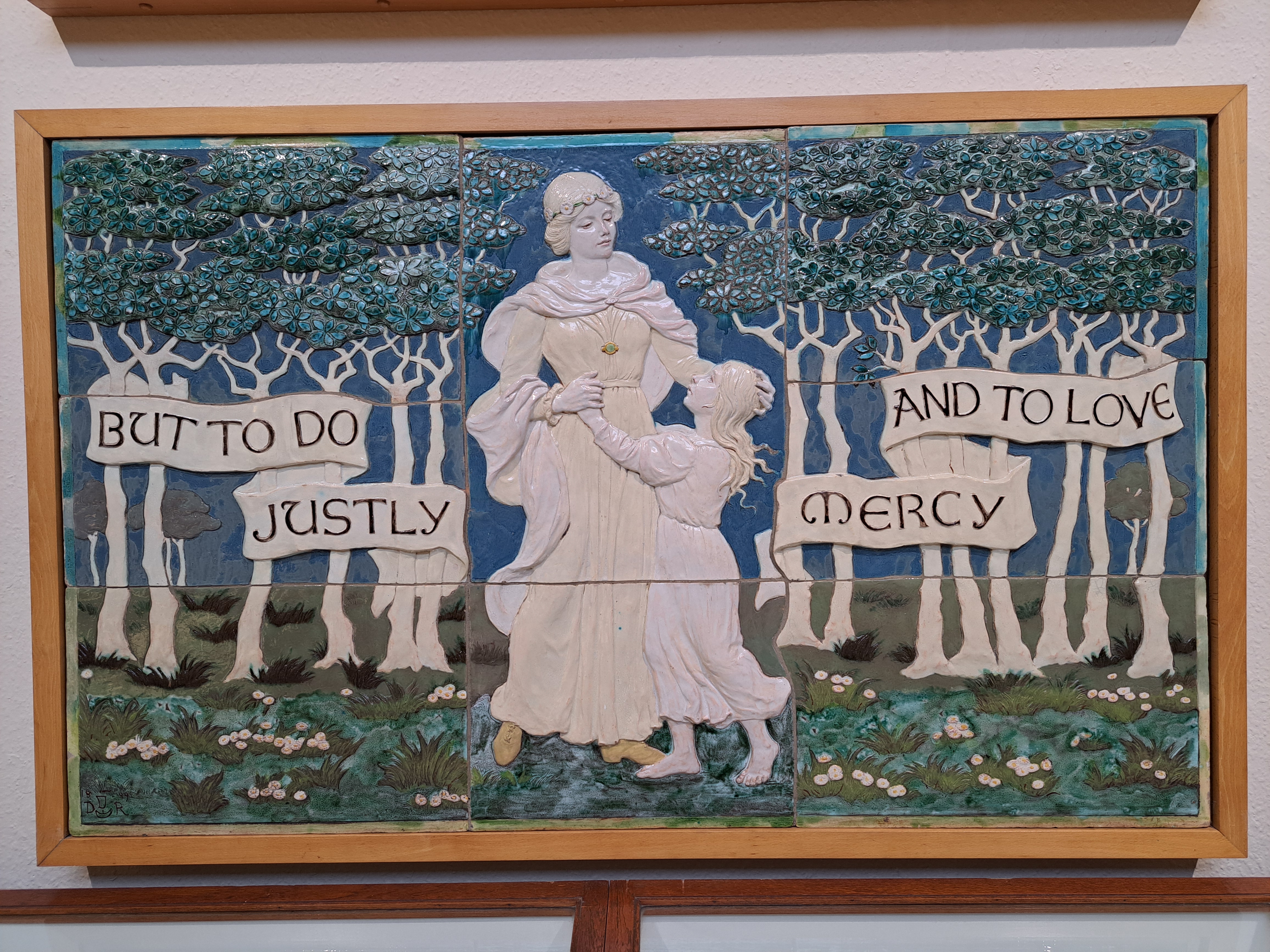
Only produced in Birkenhead from 1894 to 1906 the Della Robbia collection remains so striking that just entering the room it’s housed in lifts one’s spirits. It is replete, of course, with Unitarian connections not least through Harold Rathbone, the founder of the pottery and a member of the well-known Unitarian merchant family of that name. Harold Rathbone became an artist, studied at the Slade and in Paris, and set up the pottery in Birkenhead in 1894, a conscious revival of the work of Luca Della Robbia the 15th-century Florentine sculptor. His portrait was painted by William Holman Hunt and he looks every inch the sensitive Victorian artist influenced by William Morris and Edward Burne-Jones and the whole panoply of Arts and Crafts and Pre-Raphaelite artists amongst whose circle he moved.

Unusually for a modern gallery there is not a single label on any exhibit. In a way it is nice not to have the distraction but there is such a wealth of material it would be helpful to be given some background information. Nevertheless a lot of the production was geared towards a religious purpose and some of it was prominently Unitarian and this I recognized right away.

Panels from the Liverpool Domestic Mission

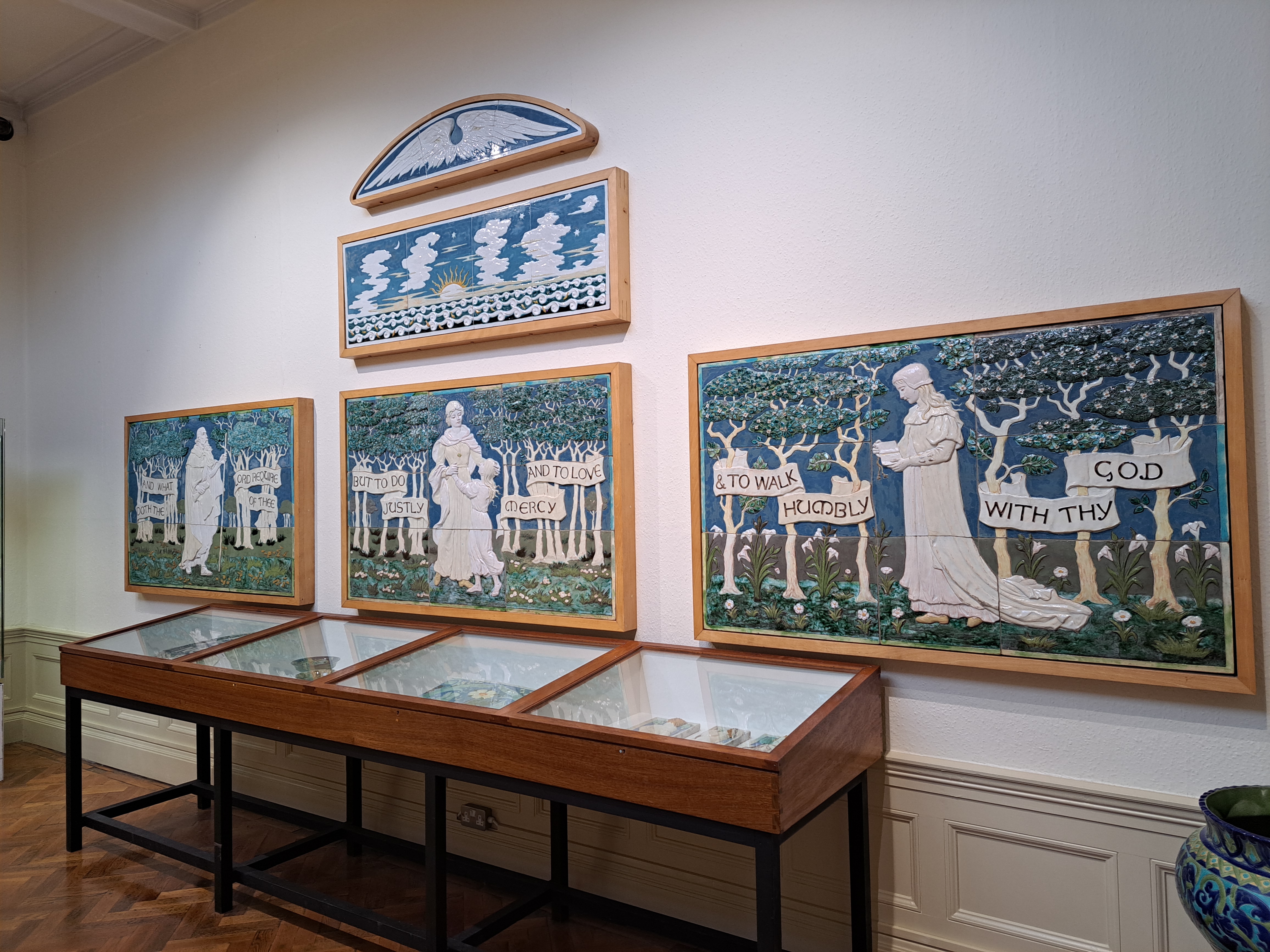
It is good that some of the decoration from the Liverpool Domestic Mission is there and quite prominently displayed. The Mission building closed in the early 1970s and it must have migrated to the Art Gallery then.

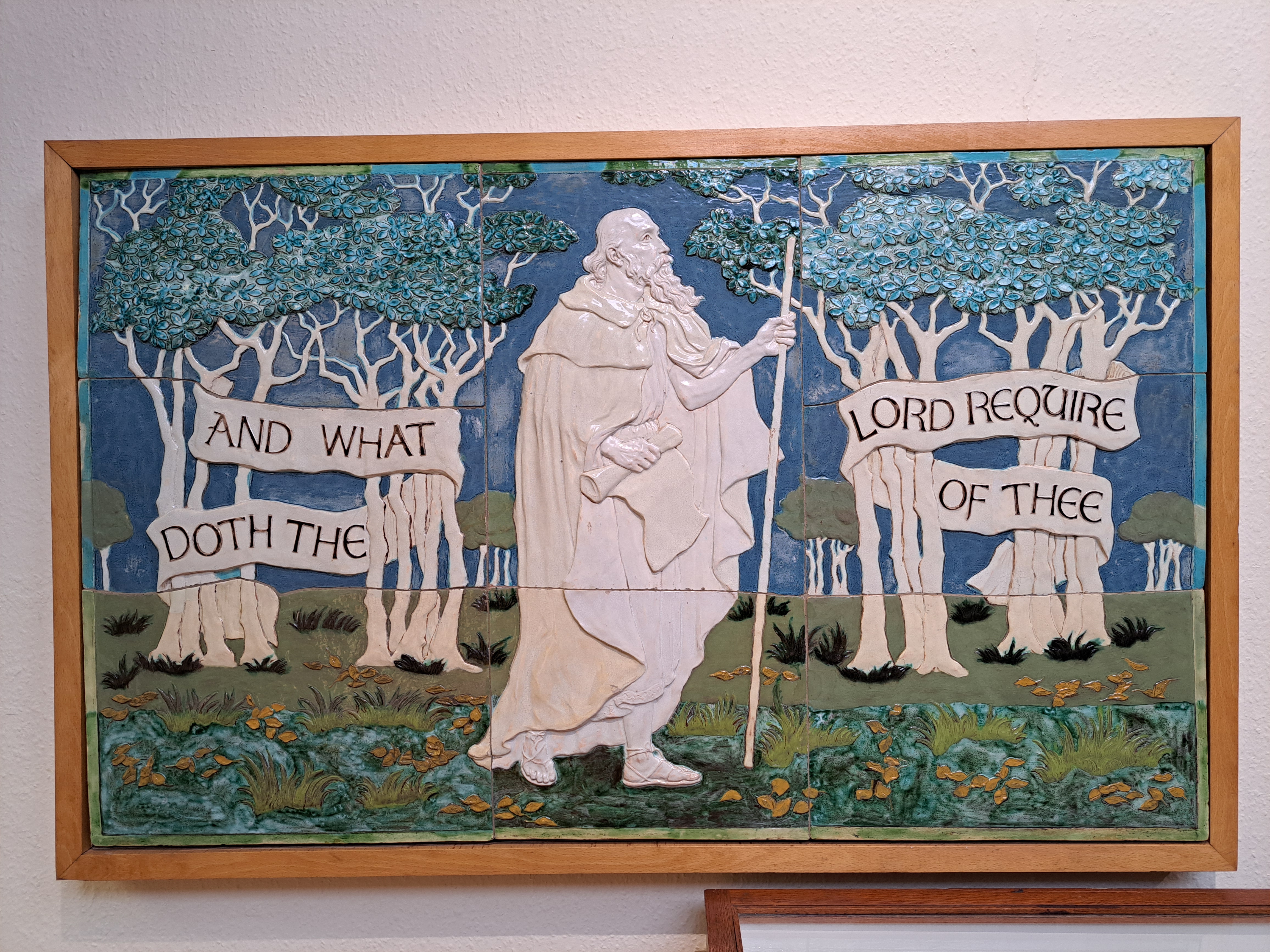
The display on the wall in the Art Gallery is laid out exactly as it was in the Domestic Mission building. It is also the same as the decoration in the Memorial Church, Manor Road, Wallasey which is still in situ. The text illustrated by the panels – And what doth the Lord require of thee / But to do justly and to love mercy / & to walk humbly with thy God – is a good one for Unitarians.

There are other panels that almost certainly have a Unitarian connection and two plaques after Edward Burne-Jones’ ‘Six Days of Creation’ may also have been part of the decoration at the Domestic Mission.

In the first catalogue for his pottery Harold Rathbone described his Della Robbia as ‘particularly applicable for church decoration on account of its silhouetted distinctiveness and architectural effect…it is a matter of congratulation, if of some wonder, that the honour of introducing this tender and attractive method of adornment has, in churches of the British Isles, we believe, been left entirely so far to ourselves.’

The exhibition in the Williamson Art Gallery is an impressive collection of this creative work that remains so vibrant and also so redolent of the art of that time and the religious impulses that were most closely connected to it. 

Alfred the Great by Harold S. Rathbone

Rev John Johns (1801-1847)

John Johns, the first Minister to the Poor in Liverpool – the first minister of the Liverpool Domestic Mission – died more than half a century before Ullet Road Church was built. Yet his memorial can be found there. In fact it is one of many memorials. When Ullet Road Church was built in 1899, purpose-built cloisters were added to house the many memorials which had covered the walls of their former Chapel on Renshaw Street.

Renshaw Street Chapel, Liverpool

But John John’s memorial wasn’t added with those from Renshaw Street. His memorial originally was placed in the Domestic Mission, and it was only after it was demolished in the 1970s that it was it removed to Ullet Road and kept in store for some years before being fixed in one of the entrances to the church.

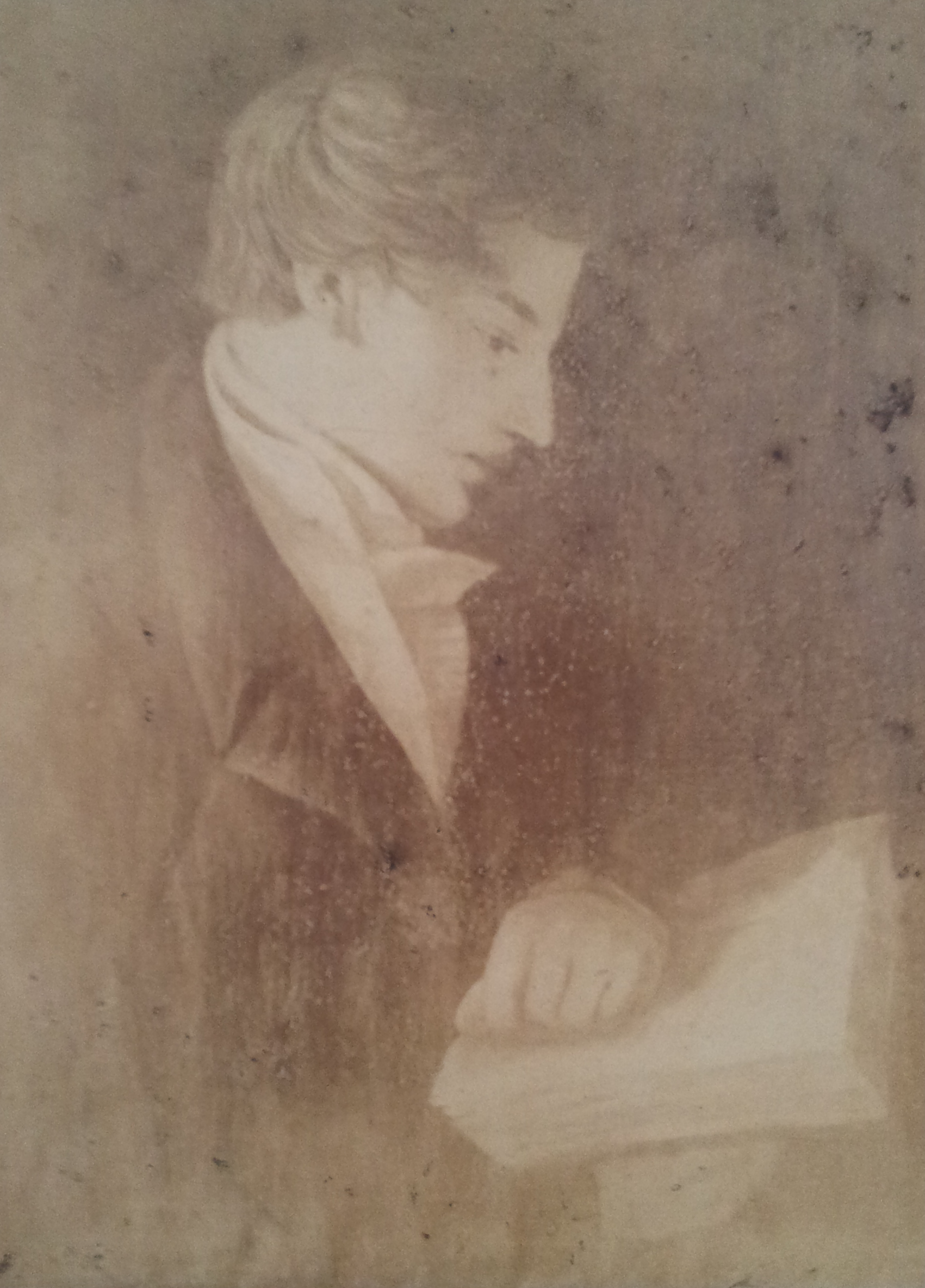
Portrait of John Johns aged 18, held in Ullet Road Church and taken from ‘Liverpool Unitarians’

Using some of the memorials, including that of the Rev John Hamilton Thom, one of the founders of the Domestic Mission, this video tells the story of John Johns and his work as the first ‘minister to the poor’: ‘a medium of kind and Christian connection’, as Joseph Tuckerman put it. In this case a connection between the wealthy congregation of Renshaw Street/Ullet Road and the growing numbers of poor living in the same city.

Click on the video below to see the story of Rev John Johns, first minister to the poor in Liverpool:

Rev John Johns (1801-1847). First minister to the poor in Liverpool

Liverpool Unitarians: Faith and Action

This book (first published, I now realise, back in 2014!) has just been reprinted and, the original print run having sold out, is once again available. The publishers and printers have done an excellent job, it’s an attractive book, this time published in memory of Bernard Cliffe, Len Mooney and Rev Daphne Roberts, three contributors who have died since the original publication.

The full list of contributors and subjects is as follows:

Introduction, David Steers; Memorials of the Ancient Chapel of Toxteth Park, Bernard Cliffe; Jeremiah Horrocks 1618 – 1641, Bernard Cliffe; William Roscoe 1753 – 1831, David Steers; A Short History of the Rathbone Family, Annette Butler; The Unitarian Family of George Holt, Bernard Cliffe; Noah Jones 1801 – 1861, Philip Waldron; James Martineau 1805 – 1900, Len W. Mooney; Joseph Blanco White 1775 – 1841, David Steers; Kitty Wilkinson 1786 – 1860, Daphne Roberts; John Johns 1801 – 1847, David Steers; William Henry Channing 1810 – 1884, Richard Merritt; Charles Pierre Melly 1829 – 1888, John Keggen; Sir Henry Tate 1819 – 1899, Richard Merritt; Sir John Brunner 1842 – 1919, Len W. Mooney; Lawrence Redfern 1888 – 1967, Elizabeth Alley; Sir Adrian Boult 1889 – 1983, Richard Merritt; The Visitors’ Book of the Ancient Chapel, Bernard Cliffe.

Published by the Merseyside District Missionary Association the cover design is by Alison Steers and the book contains over 50 illustrations, many published here for the first time.

To accompany the republication we have produced a short video which incorporates a trip around Ullet Road Church which can be seen here:

Click on the video for a tour of Ullet Road Church and details of the book
The cover of the book

Liverpool Unitarians: Faith and Action Essays exploring the lives and contributions to society of notable figures in Liverpool Unitarian history

Edited by Daphne Roberts and David Steers

Published by Merseyside and District Missionary Association

ISBN: 978-0-9929031-0-7

Brand new edition for 2024

Price £10 (plus £2 post and packing). Available from Rev Phil Waldron, Ullet Road Church, 57 Ullet Road, Sefton Park, Liverpool. L17 2AA.

In the Introduction I say:

This book is not intended to be hagiography but it does try to outline how one group of people – members of a particular faith community with deep historical roots but with an aversion to fixed creeds – were inspired to serve their fellows in different ways. Their legacy can be seen all over the city – in its parks, in its monuments, in the university, in hospitals, in education, in art galleries and museums – and it exists in the long and continuing struggle to create a society that gives equality and opportunity to all its citizens. It is not meant to be an exhaustive account of all the eminent members of the churches and chapels in the region. Readers will notice that the names mentioned are part of wider connections of family and business which includes many others who could be included. There are other figures who could be the subject of such biographical accounts. But this is a selection of some of those who have followed the call of faith to be of service to wider society.

Canning Street Presbyterian Church, Liverpool: Then and Now

The solid and imposing structure of Canning Street Presbyterian Church was a feature of that corner of Canning Street and Bedford Street for about 120 years.

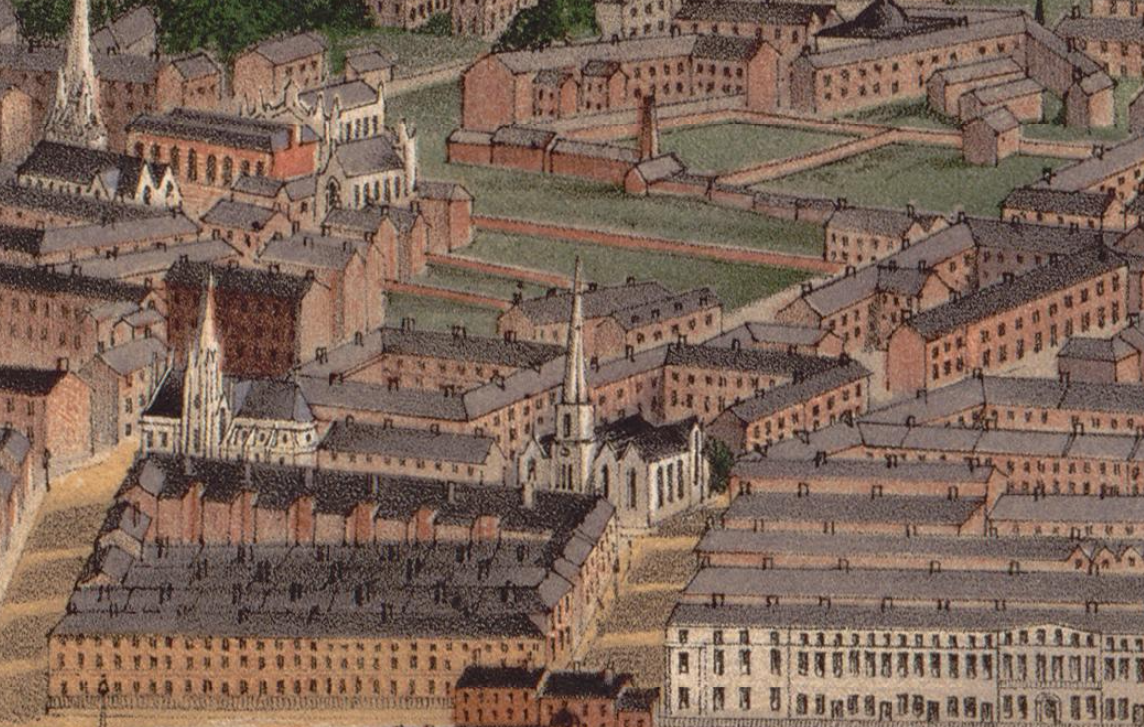
I’ve mentioned this church before and used its image as it appears in an aerial view of Liverpool painted from a hot air balloon by John R. Isaac in 1859 and published in New York. (This can be viewed on the Library of Congress site. You can also read the original post by clicking on this link – Seven Churches in Liverpool in 1859 viewed from the air). Below Canning Street Presbyterian Church can be seen in the centre of this section of the picture:

Detail from Liverpool, 1859, part of Birkenhead, the docks, and Cheshire coast Library of Congress

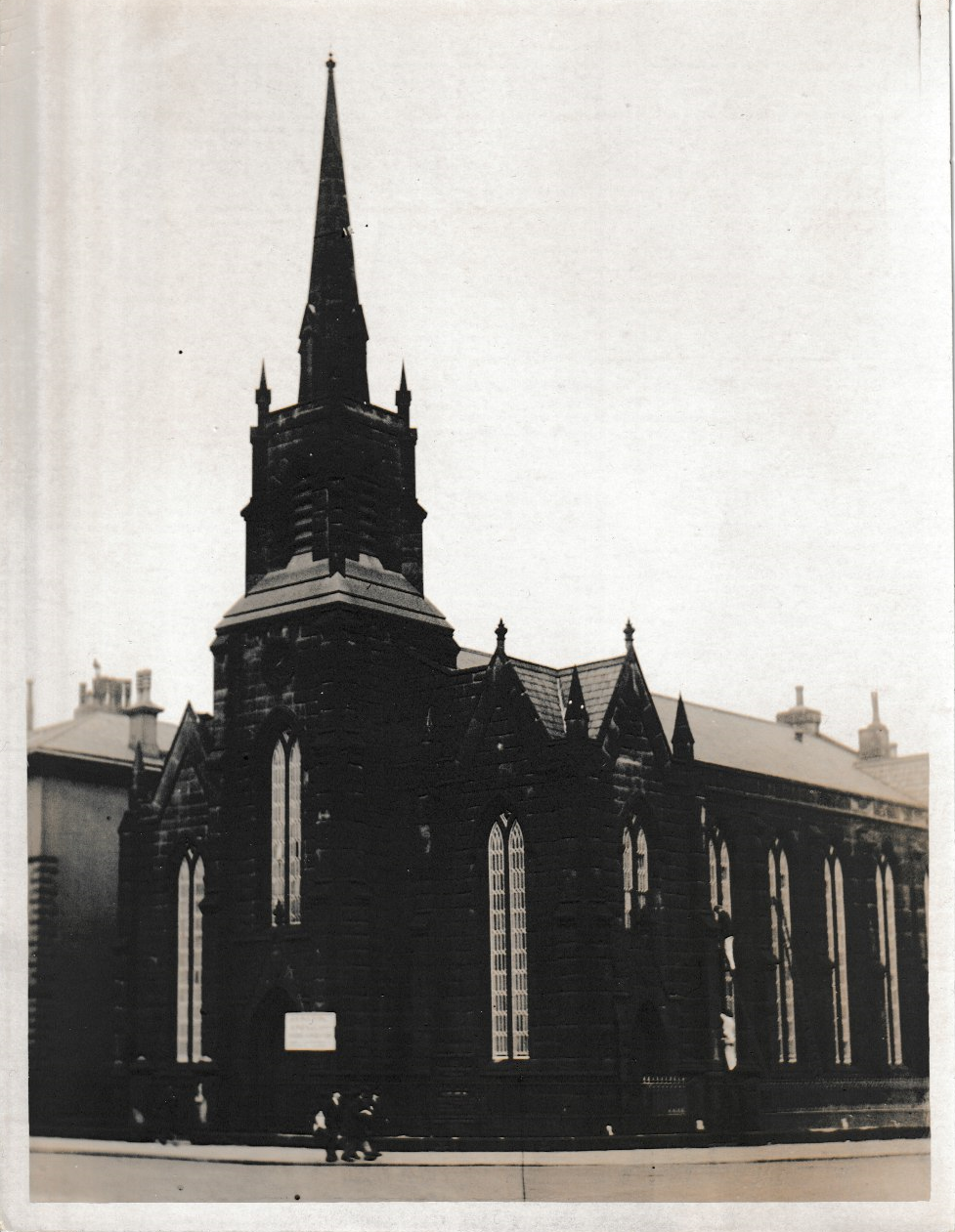
In fact of the seven churches mentioned in that post I have blogged about most of them at one time or another (Hope Street Unitarian Church, the Catholic Apostolic Church and Myrtle Street Baptist Church can all also be seen in this image) but recently I acquired a press photograph of Canning Street Presbyterian Church taken in 1931:

The picture is a bit dark but it shows the edifice built in 1846 and finally demolished in the 1960s. It was built by a denomination of exiled Scots, members of the Free Church of Scotland, which became the Presbyterian Church in England. Later this body united with the United Presbyterian Church (at a ceremony in Liverpool in 1876) to form the Presbyterian Church of England. In 1896 the minister, the Rev Simeon Ross Macphail observed that fifty years previously increasing numbers of Scottish emigrants to Liverpool were not inclined to join the local churches which called themselves Presbyterian but were by then Unitarian in theology. This would be true by the 1840s, although it was not the case a couple of generations before when Scots newly arrived in the city, perhaps influenced by the theological moderatism of the Church of Scotland, were often happy to make common cause with the dissenters.

Canning Street, in its prime location in the wealthiest part of the city flourished for decades until it followed the trend to move out of the by then less fashionable Georgian area of the city to the suburbs. In 1931 they sold up and built a new church in Allerton (now Allerton United Reformed Church). It was at this point that this photo was taken as it was sold to the German Church in Liverpool who moved their location from the very centre of town to Canning Street.

A German-speaking Lutheran congregation had existed in Liverpool since at least 1846. Meeting in various places over the years they had sufficient capital in 1871 to purchase what had been known as Newington Chapel. This had been founded originally as a break away from the Ancient Chapel of Toxteth. Unhappy with the appointment of an Arian (or Unitarian) minister in 1775, a group of Congregationalists built their own chapel on Renshaw Street. From 1811, with the appointment of Rev Thomas Spencer, this congregation grew rapidly and built Great George Street Chapel as a suitable base for his oratorical powers. Unfortunately, Thomas Spencer never took up his place in Great George Street Chapel, when he drowned in a swimming accident in the Mersey, but the congregation moved nevertheless and continued to flourish under the leadership of Rev Dr Thomas Raffles. In the best tradition of non-conformist awkwardness a small minority of the congregation refused to move and stayed in Newington Chapel, stayed, in fact, until 1871 when the German Evangelical/Lutheran Church was able to buy the meeting-house from them.

This congregation remained here until 1931 when the Cheshire Lines Railway Company purchased the site from them for £14,000. That was a good price and more than enough to buy Canning Street Church for just £4,000 in that year, the building being formally opened for Lutheran worship on 25th October 1931.

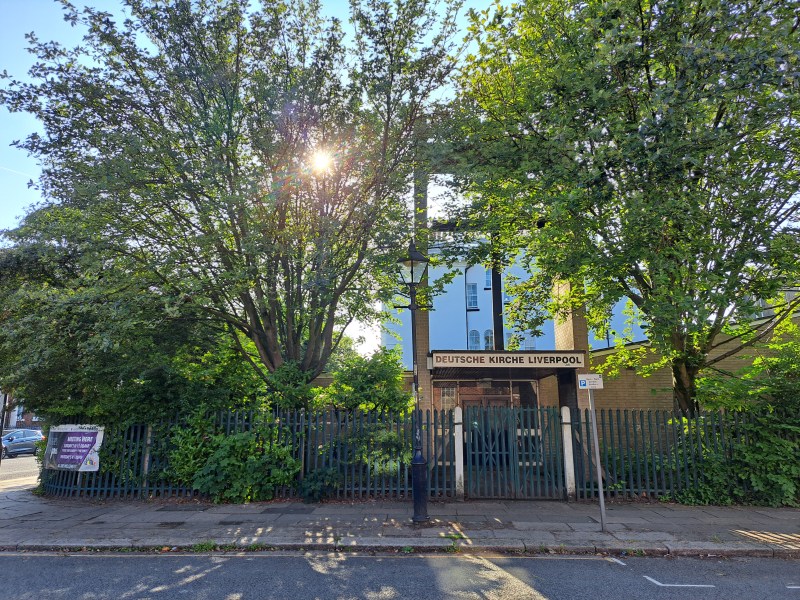
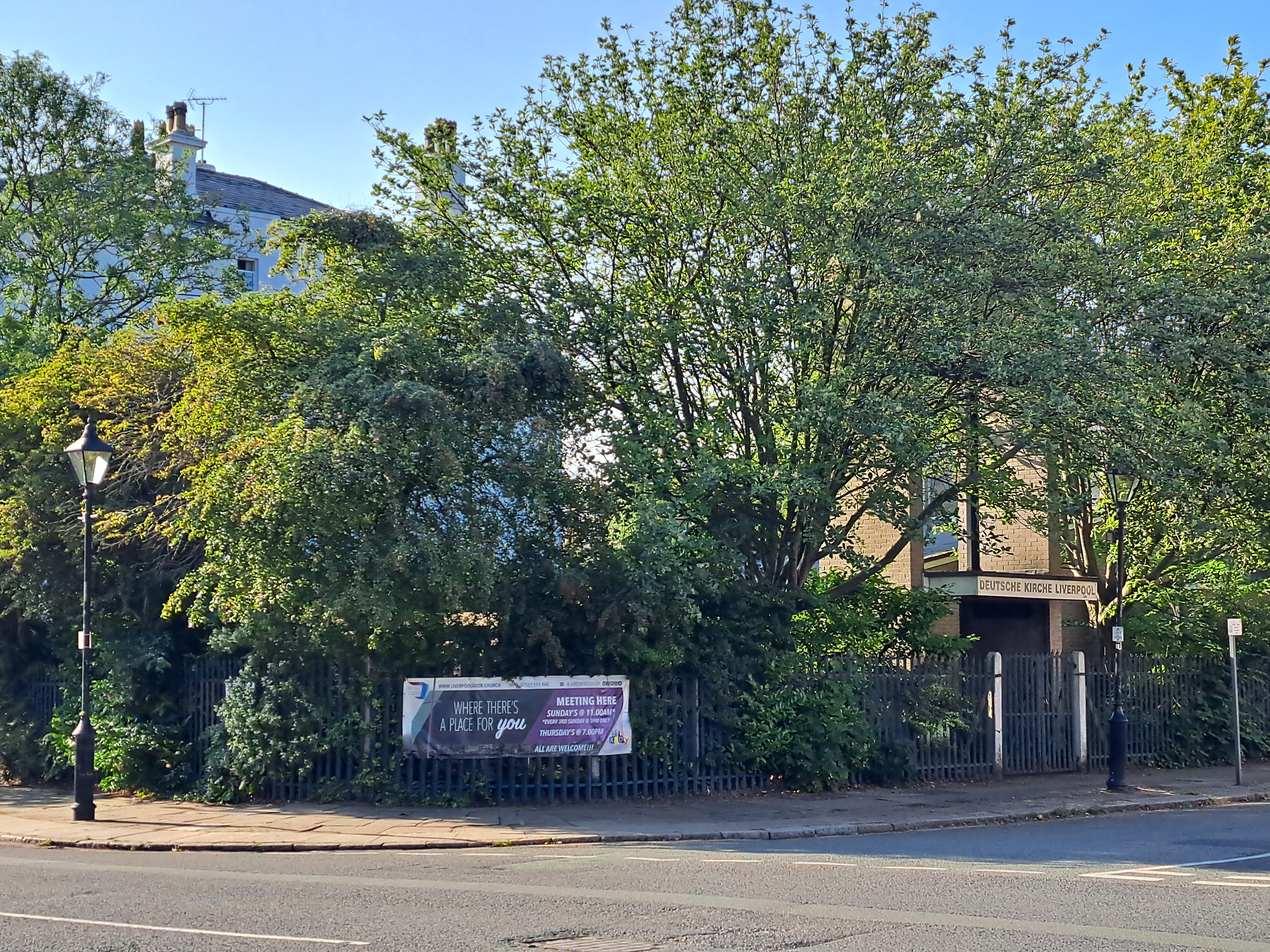
The site of the church today

Canning Street Church – Deutsche Kirche Liverpool

The German congregation has worshipped on that site ever since but in the 1960s they demolished the old church and replaced it with a rather plain building which doesn’t really catch the eye.

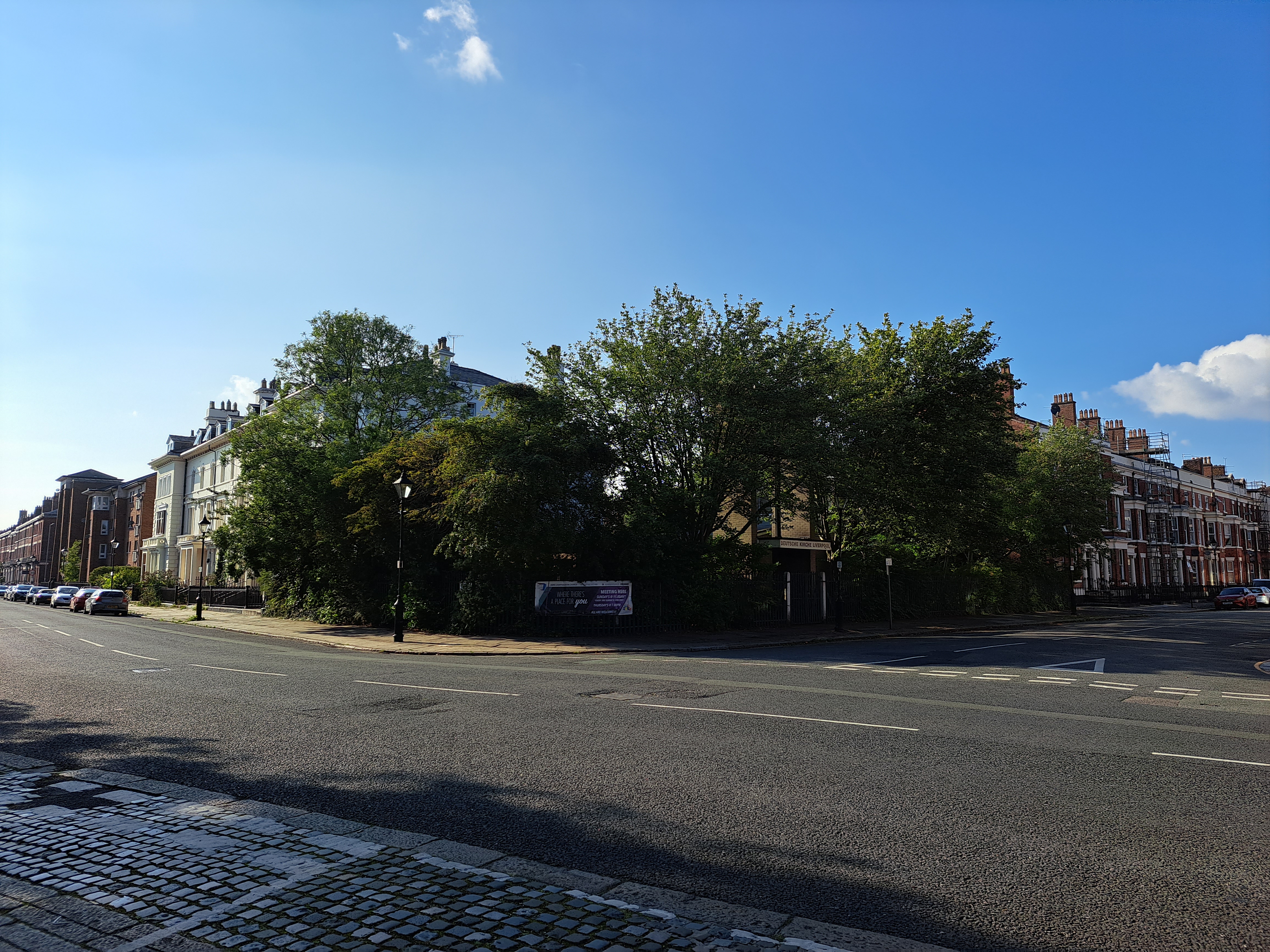
A view of the corner of Canning Street and Bedford Street today. The German Church is opposite the viewer, the site of the one-time Catholic Apostolic Church can be seen on the far left.

No pictures or text may be reproduced from this site without the express permission of the author.

Faith and Freedom – Autumn and Winter 2022

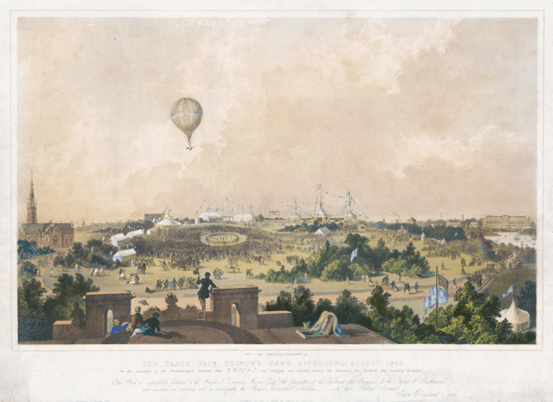
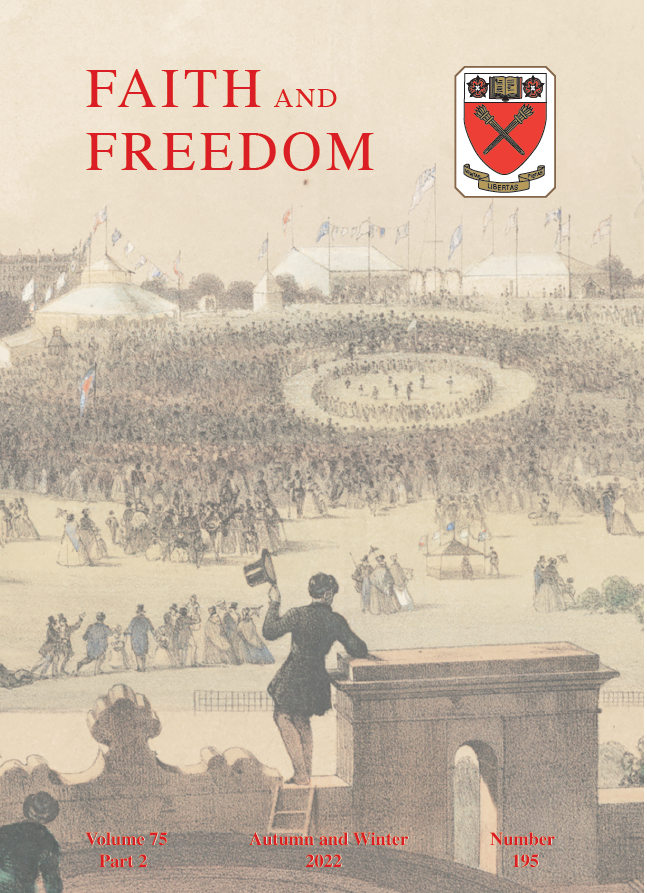
The new issue of Faith and Freedom is available now. Our cover picture shows James Martineau on top of his house in Prince’s Park, Liverpool (from a lithograph by John R. Isaac and now held by the Library of Congress).

The cover of our latest issue

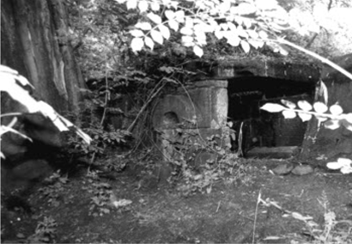
Historian Jim Kenny (well known for his blog The Priory and the Cast Iron Shore, which he publishes under the name Glen Huntley) gives the first full account of the house Martineau built in Liverpool overlooking the Park. Planned in detail by Martineau himself, including a curious network of subterranean passages, it was described by a visitor as A pie-crust sort of house, with all the “curiosities and niceties that a Unitarian Minister could wish.” In the lithograph, based on an original watercolour by W.G. Herdman, James Martineau looks down on the ‘Fancy Fair’ in aid of local hospitals. The building is long gone now although the site became the centre of a struggle between developers and conservationists in recent times and the underground passages were still discoverable then, and may yet have survived to the present day.

Passage entrance on the site of Martineau’s house, c.2001. Courtesy of Friends of Williamson’s Tunnels

These and more illustrations accompany the article which tell this fascinating story of a unique house, the brainchild of the most significant Unitarian theologian of the nineteenth century, and built in the most prosperous suburb of Liverpool.

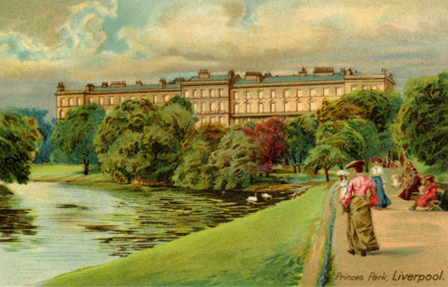
An Edwardian postcard showing nearby Prince’s Park and the Prince’s Park Mansions, neighbours of James Martineau.

Ian Rocksborough-Smith, assistant professor of US history at the University of Fraser Valley in S’ólh Téméxw/British Columbia, Canada, writes about ‘The Ambiguities of White Catholic Liberalism’ in the context of a ‘A Case Study in the Aftermath of the 1951 Race Riot in Cicero, Illinois’. He writes:

‘What did religiously-inclined white racial liberalism look like through the mid-twentieth century at a local level? This article looks at the intersections of race, religion, and civil rights in the wake of the 1951 race riot in Cicero, Illinois. Specifically, it considers the efforts of white Catholic liberals who advocated for racial reform measures well ahead of the mainstream orthodoxies of the Catholic Church – the latter of which did not pivot substantively towards civil and human rights until after Vatican II in the early-mid 1960s.’

We also have two fine examples of thoughtful and challenging sermons, the first on ‘Catching the Spirit’ given by London District Minister Jim Corrigall at New Unity congregation, North London, and the second ‘On Agreeing – But Not Quite – with Adam Gopnik’s Liberal Credo’ by Frank Walker given in the chapel of Harris Manchester College, Oxford.

Reviews include two books (in English and Welsh) reviewed by Graham Murphy, former Principal of Unitarian College, Manchester, and a Welsh-speaker, which explore the identity of Y Smotyn Du, ‘the Black Spot’, the heartland of Welsh-speaking Unitarianism, as well as two reviews on peacebuilding in the Middle East and Christian pluralism in Britain today. These are by Marcus Braybrooke, Anglican minister and a leading figure in inter-faith relations both nationally and internationally. In addition Lena Cockroft, current moderator of the Non-Subscribing Presbyterian Church of Ireland, reviews a book on mindfulness and golf.

Books Reviewed

Eric Jones, Best Foot Forward, South East Wales Unitarian Society, 2020, pp 112, £6.95 pbk.

Goronwy Evans, Procio’r Cof, Y Lolfa, 2021, pp 208, ISBN 978-1-80099-042-5, £9.99 pbk.

Ron Kronish, Profiles in Peace: Voices of Peacebuilders in the Midst of the Israeli-Palestinian Conflict, Publisher Ron Kronish in Israel, 2022. Available on Amazon Kindle and as a paperback 978-1734470093, $ 22.97.

Alan Race, My Journey as a Religious Pluralist: A Christian Theology of Religions Reclaimed. An Imprint of Wipf and Stock Publishers, pp.202. ISBN 978-1-7252-9823-1, pbk £20.00. Hbk 978-1-7252-9822-4, e-bk 978-1-7252-9824-8

Martin Wells, No One Playing. The essence of mindfulness in golf and in life. John Hunt Publishing, 2022, pp 108. ISBN: 978-1-78904-781-3, pbk £ 8.99. ISBN: 978-1-78904-782-0, e-book £ 4.99.

Subscription Details

An annual subscription for each volume (two issues) costs £16.00 (postage included) in the United Kingdom. Single copies can be ordered at a cost of £8.00 each (postage included). Cheques should be made out to Faith and Freedom and sent to the business manager:

Nigel Clarke,
Business Manager, Faith and Freedom,
16 Fairfields,
Kirton in Lindsey,
Gainsborough,
Lincolnshire.
DN21 4GA.

It is also possible to pay online. For more details see our website: https://www.faithandfreedom.org.uk/subs.htm

Roscoe Gardens – cause for concern

The congregational memorial in 2019

In July 2019 I published a post about Roscoe Gardens, Mount Pleasant in Liverpool, a little-known green space near Liverpool city centre. It is the site of the burial ground of Renshaw Street Chapel and the home of a memorial to the chapel and its members including such notable figures as William Roscoe and Joseph Blanco White. You can see the original post here. In the last year this has become one of the two most frequently visited posts on this blog, the other being Croft Unitarian Chapel to which I hope to return in the near future.

Memorial to William Roscoe

The reason for the frequency of views of the Roscoe Gardens post has been a developing abuse of the site that has seen scant disregard for for its importance to the city and its status as a burial ground and memorial.

Inscription on the memorial

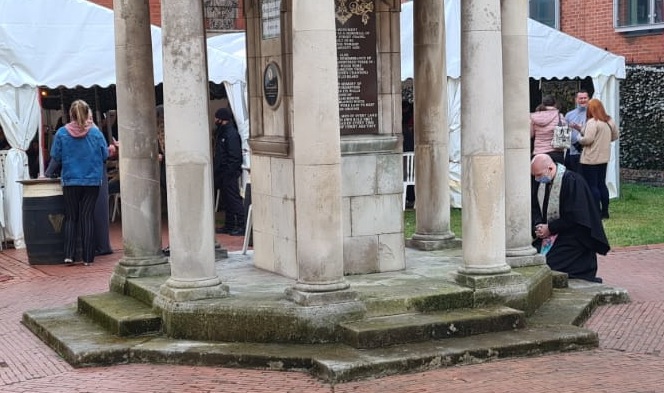
On the evening of Friday, 30th April the Rev Phil Waldron went to Roscoe Gardens in his clerical robes to kneel in prayer at the congregational memorial to highlight this ongoing problem. In solidarity with his stand I am pleased to publish his press release below which explains all the issues. Let us all pray that this leads to some action by Liverpool City Council:

Rev Phil Waldron kneels in prayer in Roscoe Gardens, Friday, 30th April 2021

Statement from Rev Phil Waldron and the Unitarian community in Liverpool:

Since July 2020 Liverpool City Council has been complicit in the desecration of the graves of many of our city’s citizens and the gifting of an entire public park to a private business. Since July 2020 Roscoe Gardens has been locked off, and public access removed and denied, consistently by the business operating in the space.

Roscoe Gardens is not just a public park, but a Unitarian burial ground and needs to be treated with the basic levels of decency, dignity and respect that is not only presumed human moral basics but also obligations under the law of the local authority.

The council have allowed a marquee structure of such vast size, it should be subject to planning requirements, to be erected over and pegged into the graves of those interred on the site.

The Listed memorial of William Roscoe, one of the first abolitionists is currently in a state of disrepair, as is the green space of the park itself. Members of the Unitarian congregation are being denied their right to pay their respects to those interred at the site. Members of the local community, including the elderly and those less able of body, have been deprived of their nearest greenspace during a pandemic and lockdown.

The structure erected by the business is directly adjacent to, and outside of peoples homes. Families of children have had nothing short of months of misery, endured by the obscene and lurid content matter of the ‘entertainment’ blasted directly into their homes, let alone the anti-social behaviour of customers.

This is nothing short of an affront to those buried in the ground beneath them, including founders of the Temperance movement.

As B G Orchard once wrote, “… no group of men has so manifested far-sighted appreciation of great questions affecting social wellbeing of the town or worked with more dogged ardour to promote national education, public parks, free libraries and museums… at present Renshaw Street Chapel is probably the greatest political force in our midst.” –

we are shocked Liverpool City Council sees fit to allow the graves of these people who built the socialist foundations of our city, to be desecrated and ran into disrepair, in such a way.

Liverpool City Councillors and Officers, and even our local MP, have been made aware of ongoing complaints since August 2020 and failed to act. In fact, to this date, Liverpool City Council have ignored every reference to desecration to the graves made, and to this date, not one single Councillor or Officer has had the foresight to contact the Unitarian Church, not only to apologise, but to seek the permission they are obliged to, for use of the space, as set out under the Burial Act.

The business operator has shown no willingness to listen to the community and currently only allows access to the space if a petition is signed in support of their continued occupation of consecrated ground. The business has also consistently breached the terms of the Land Use Agreement they had with the council, and evidence has been provided, again consistently, to the responsible officers and no action has been taken.

Liverpool City Council has failed in its duty to protect this sacred, public space and abandoned its commitment and obligations to respecting culture, faith and our city’s history.

We have asked several times for answers to the simple questions overleaf, and still await a response from the council. We are now demanding the immediate restoration of the dignity of those interred at the site and unfettered public access to the public park resumed.

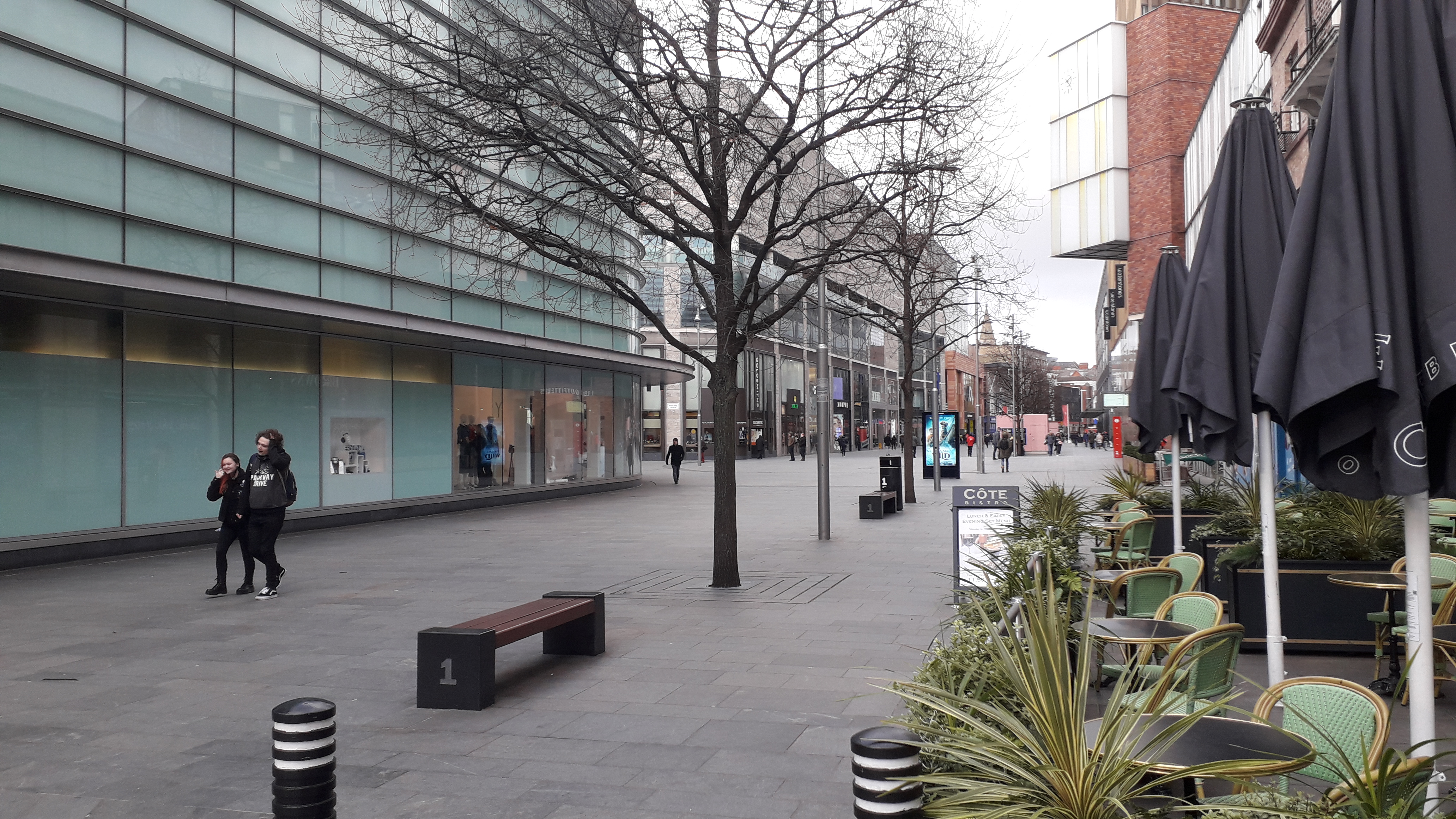
Paradise Street, Liverpool

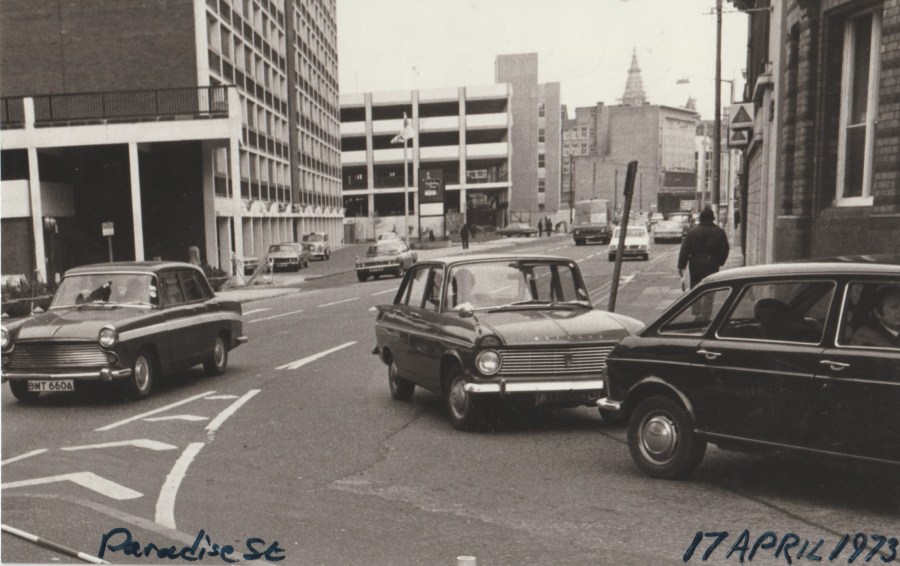
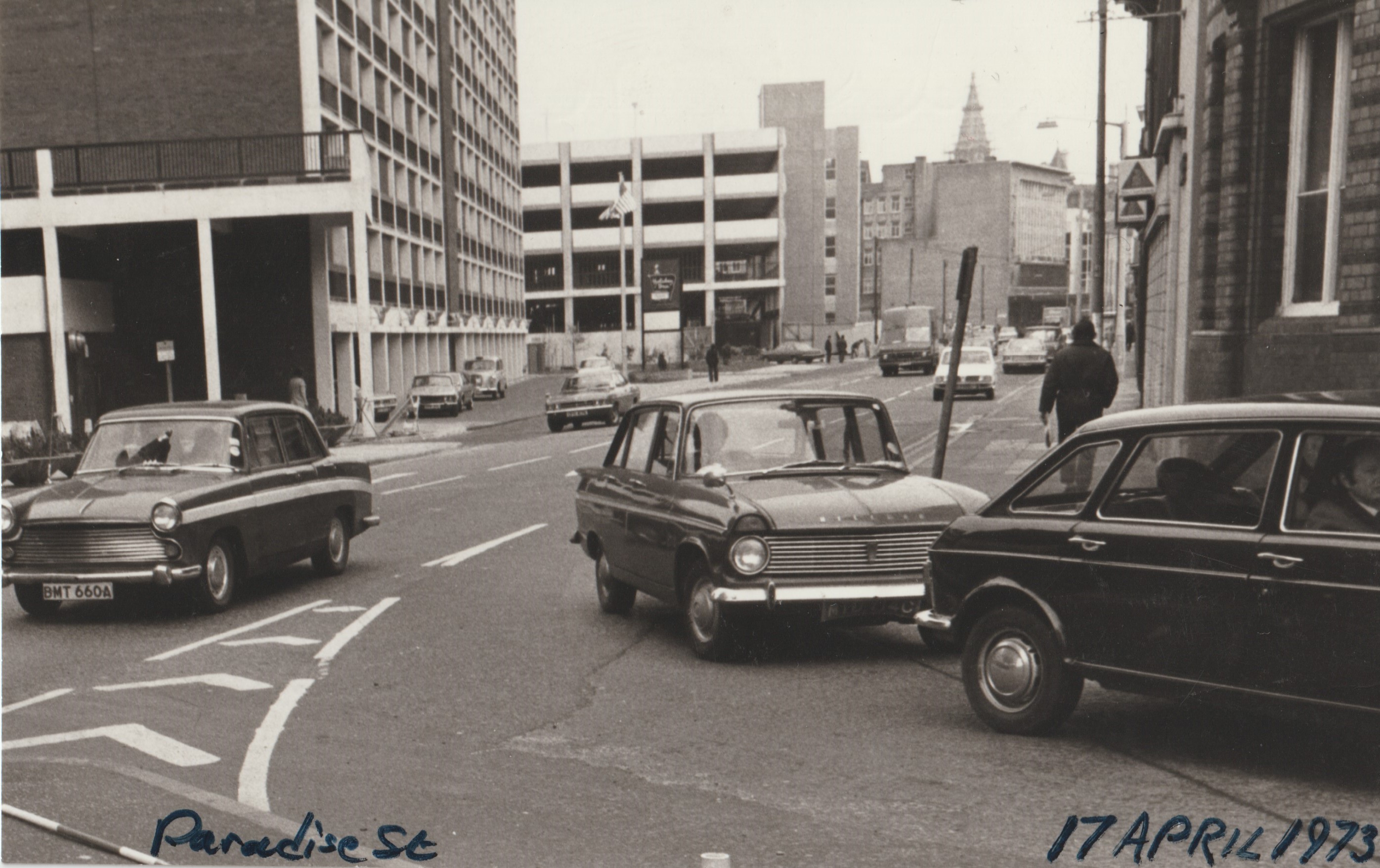
I bought this black and white print of a view of Paradise Street dated 17 April 1973 for a small amount on eBay recently. I was interested in seeing it because Paradise Street as it was before the building of the Liverpool 1 shopping development has been so completely obliterated. It is today forgotten and it takes some effort to recall it to mind. Not that Paradise Street in the 1970s deserves to loom large in anyone’s memory, even at the time it had the feeling of something like a backlot to the city centre, a place where there was nothing much to see, a place that existed as an adjunct to the streets and places that mattered.

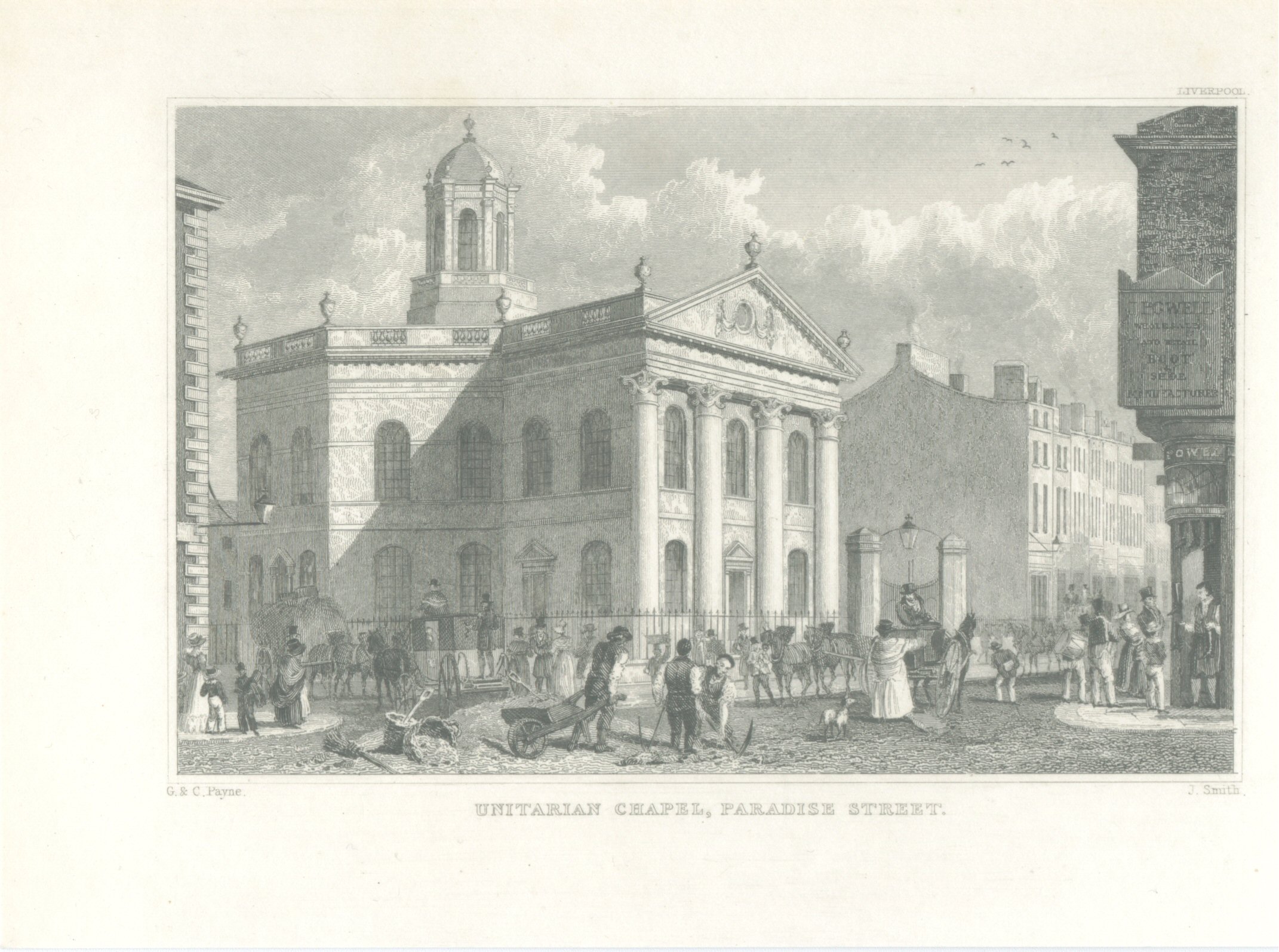
A lot of it was car parks and this picture clearly shows the new multi-story car park which was then just being completed in 1973. A brutal and functional building, it wasn’t very pleasant although it was handy enough. Its contemporary neighbour the Holiday Inn, seen on the left of the photograph, was little better to look at. But the multi-story wasn’t the only car park on Paradise Street. On the opposite side of the road, not visible in the picture, was a street-level car park complete with parking meters. I can’t be the only person straining to remember this entirely forgettable piece of streetscape because another photograph of Paradise Street featuring the corner of the street-level car park sold just after this one on eBay for about £5. But that car park must have been somewhere near the site of the Paradise Street chapel of 1791.

G2 - Paradise Street

Paradise Street, Chapel

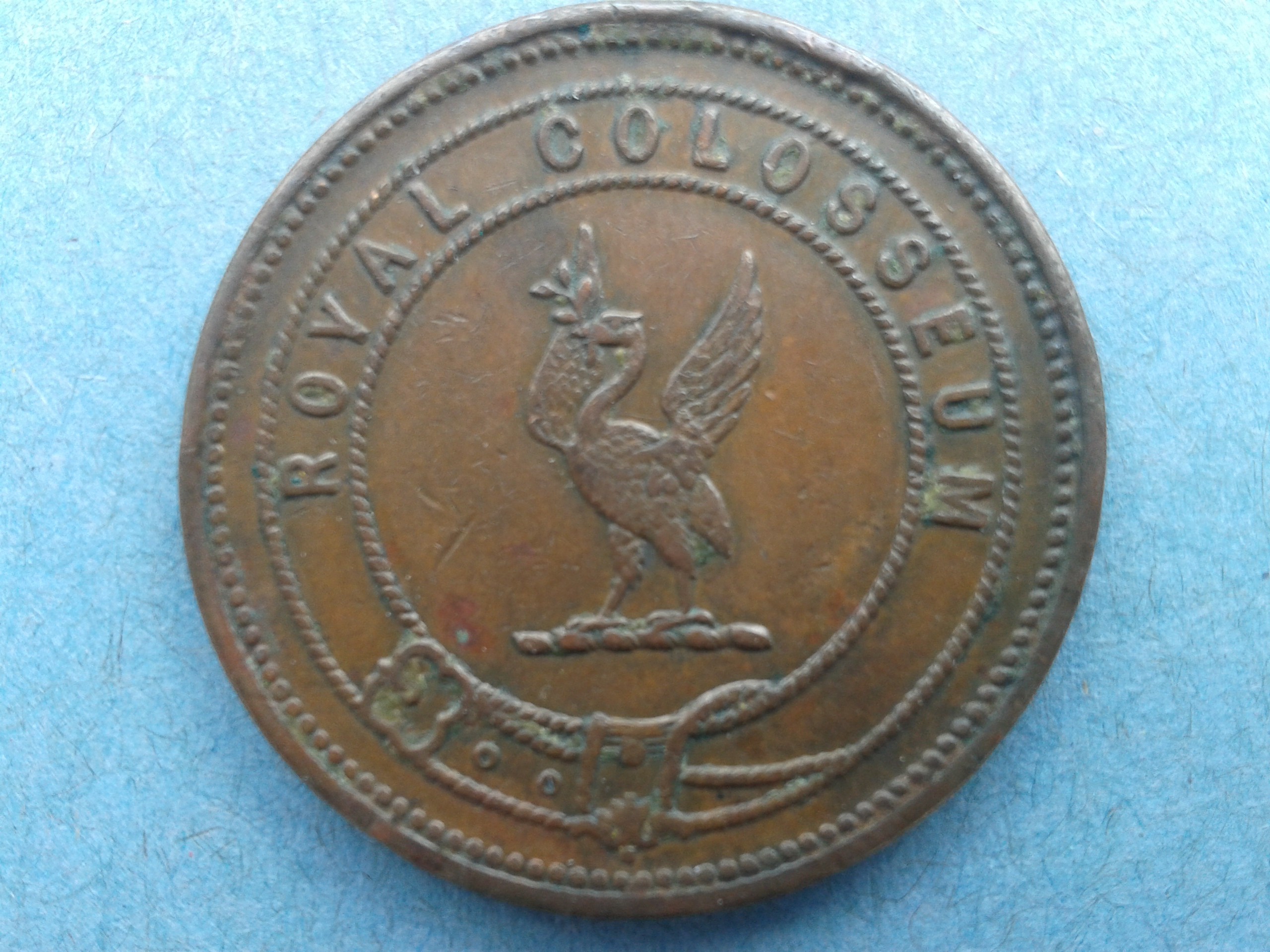
I have written before about this chapel which had an unusual history and ended up as a music hall. To some extent it enshrined the fortunes of this city centre street – from a well to do residential neighbourhood with its fashionable chapel and the home of the first US consul, to a seedy street with a licentious and dangerous reputation. Later still it became a commercial area (and the old chapel a warehouse) and later still Nazi bombs in 1941 finished off what was left and prepared the ground for the 1970s car parks and cheap hotels.

Coinobverse02

Click on the above image to read about the history of Paradise Street Chapel/Royal Colosseum

So let’s compare then and now views of Paradise Street.

Paradise Street

Paradise Street April 1973

Paradise Street 2020

Paradise Street February 2020

The only buildings which remain are at opposite ends of the road. On the right in the 1973 picture is a red-brick building and the Eagle pub. The red-brick building is still there and is today a tapas bar, but you can’t take a picture from the same spot because there is so much furniture outside. Just visible next door is what was the Eagle pub, originally the US Consul’s house and which still carries an American eagle above the front door. Everything else has been redeveloped except for the post-war building at the far end of the street behind which the tower of the Municipal Buildings on Dale Street can still be seen. This was for many years Horne Brothers, the gentleman’s outfitters. In my youth I had to be a customer there because they had a monopoly on the provision of uniforms for my school. An at least annual visit there was inevitable. But I had another connection with Horne Brothers in that I was sent to the barbers shop in the basement to get my hair cut. This was done by Mr Cannon, one of the team of barbers who worked in the gloom of the basement. You had to make an appointment and my appointment was always with him. Unknown to me then it was Mr Cannon who first cut the hair of the Beatles. In volume one of Mark Lewisohn’s excellent book All These Years he tells how when Brian Epstein took over their management he sent them to Mr Cannon to get their first Beatles hair cut. Had I known anything of this back in the 1970s I would have asked him about it, but such things were of little general interest in the 70s. But although the building is still there Horne Bros has long gone, it was turned into a McDonalds years ago.

No pictures or text may be reproduced from this site without the express permission of the author.

Great George Street Chapel, Liverpool

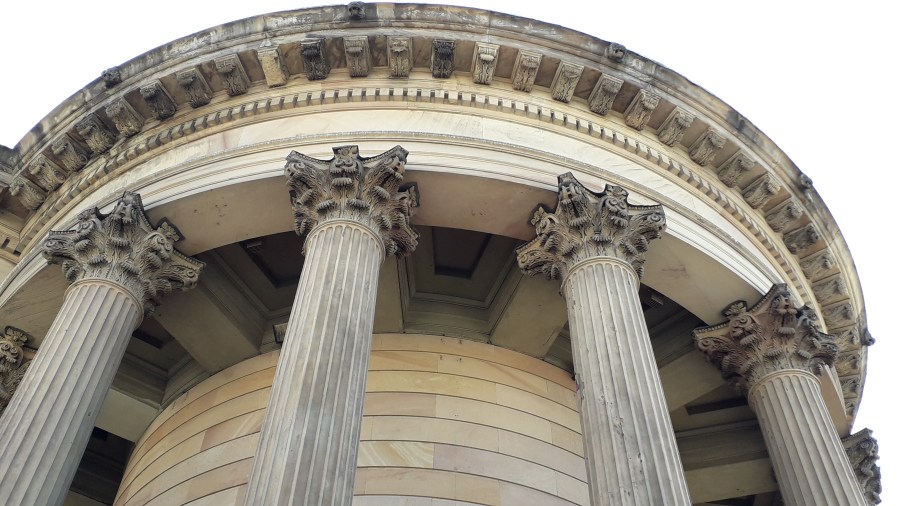
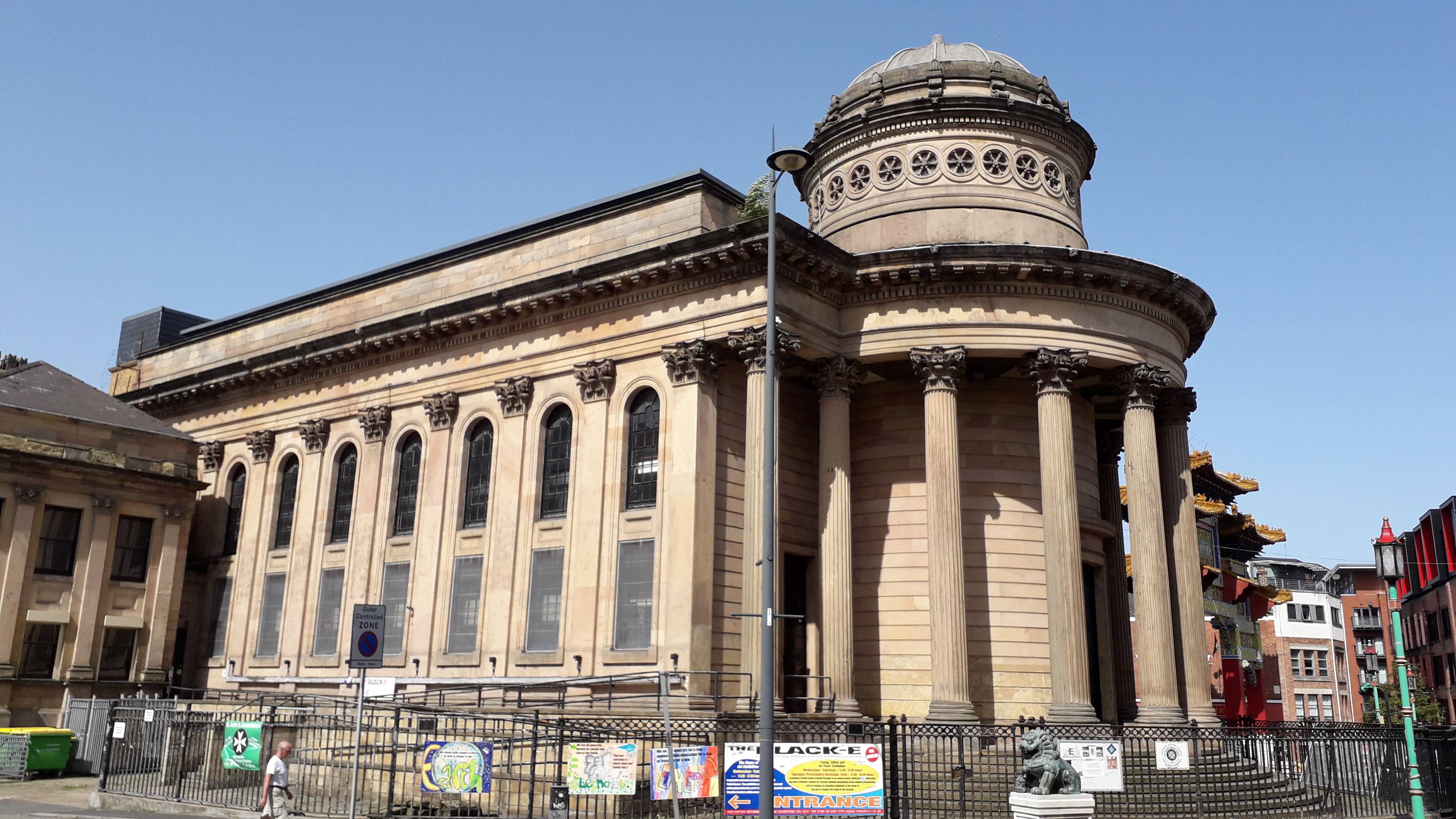
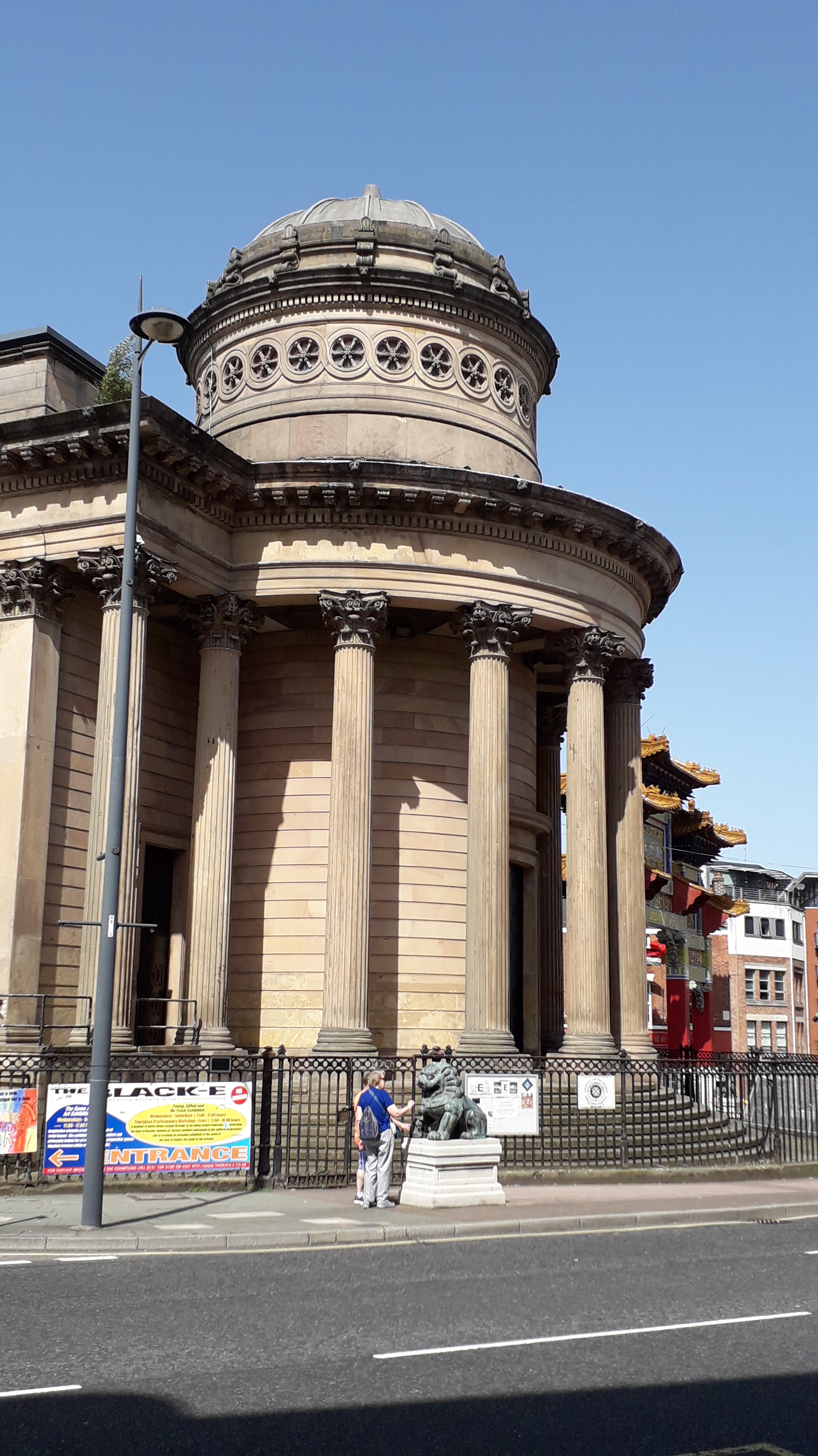
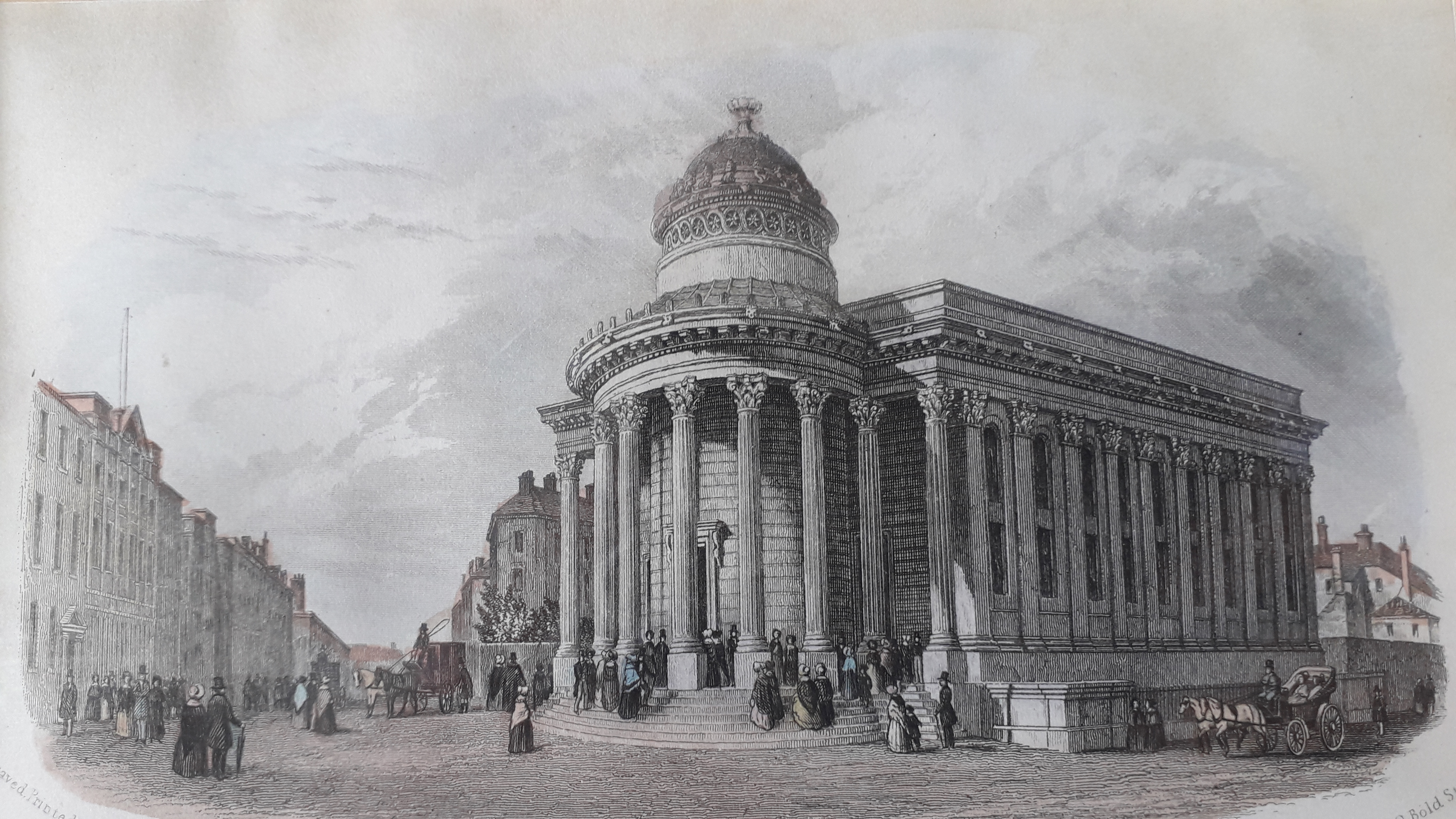
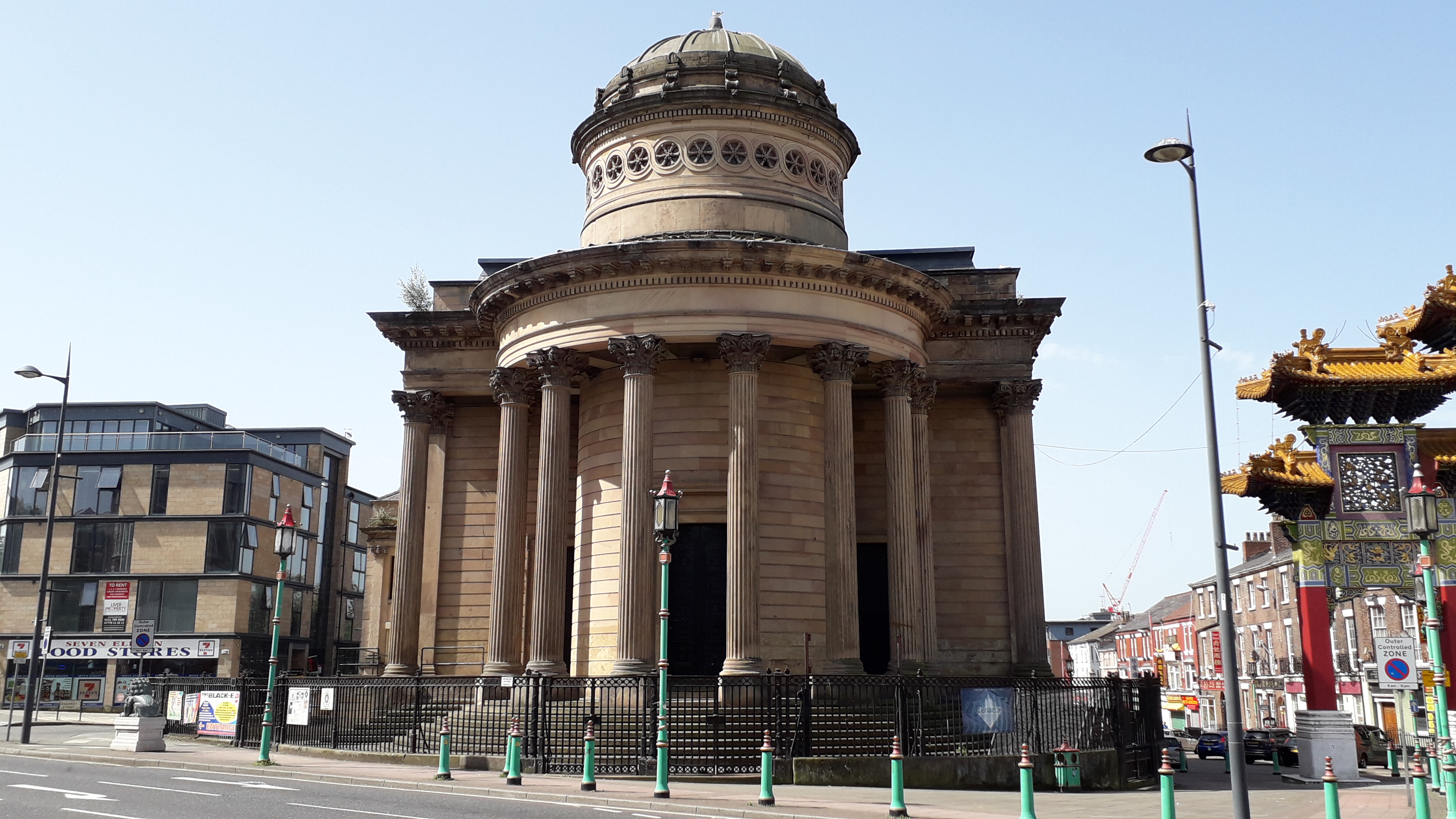
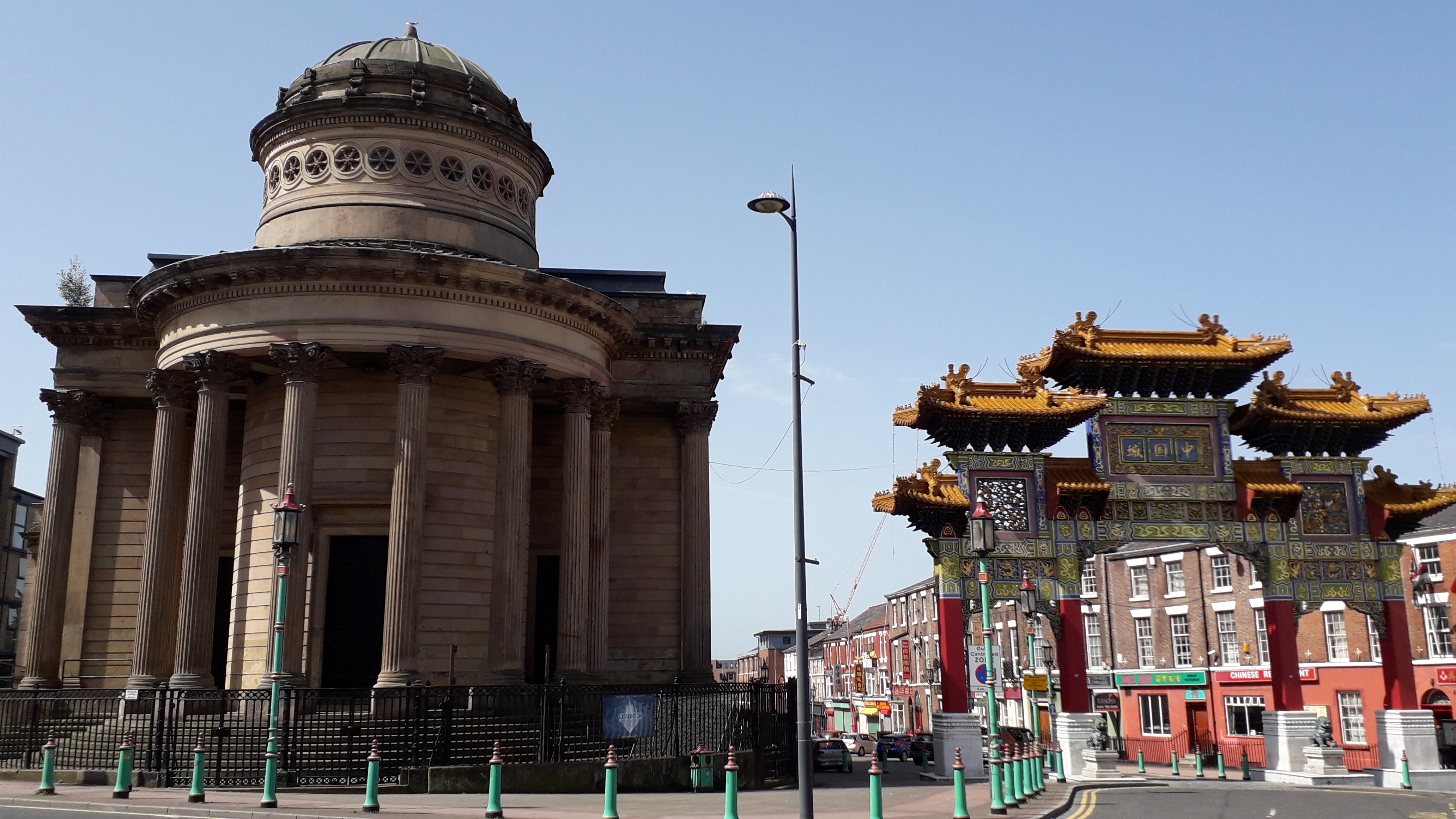
Great George Street Chapel is one of the most impressive buildings in Liverpool although it may not be as appreciated as it ought to be. Of course, it is not called ‘Great George Street Chapel’ today and has not been so designated for more than half a century. After closure as a chapel it became an arts centre known originally as the Blackie (the building was then stained black by decades of industrial and domestic pollution) subsequently renamed in more recent times the Black-E. This has proved to be a long-lasting and effective institution which has ensured the survival of this building. It’s much altered on the inside but the exterior is much as it always has been.

GGC front side view wide

It’s remarkably imposing and is now set off against the architectural additions that have been made to Liverpool’s Chinatown including the arch and the lions that line the street.

GGC front view with Chinese Arch

GGC front side view portrait

The congregation that built the chapel liked to claim descent from the Ancient Chapel of Toxteth. In the 1770s a new Independent Chapel was founded nearer the town centre, on Newington, including members who had left the Ancient Chapel because of the direction of the theology of its minister and leading members. Without being spectacular this church appears to have flourished for some decades until they called the Rev Thomas Spencer in February 1811. Then aged just 20 years old he had a resounding impact gathering a massive congregation of up to 2,000 hearers. His successor Thomas Raffles described his impact as in this way:

“The chapel soon became thronged to excess, and not alone the thoughtless and the gay, whom the charms of a persuasive eloquence and an engaging manner might attract, but pious and experienced Christians sat at his feet with deep attention and delight. There seemed to be, indeed, a shaking amongst the dry bones. A divine unction evidently attended his ministry, and such were the effects produced that every beholder with astonishment and admiration cried What hath God wrought?

They needed a bigger church and so built anew on Great George Street in 1811.

GGC engraving 01

A contemporary engraving of the church of 1840

But just four months after laying the foundation stone tragedy struck when Thomas Spencer drowned while swimming in the Mersey near the Herculaneum Potteries. But this did not deter the new church which soon called the formidable figure of Rev Thomas Raffles. In the best traditions of non-conformity not all the members of Newington left for the new church, a congregation stayed behind for decades to come but Thomas Raffles ministered at Great George Street for 49 years and when the new building burnt down in 1840 they built the striking edifice that remains to this day.

GGC corner detail

GGC dome detail

GGC door

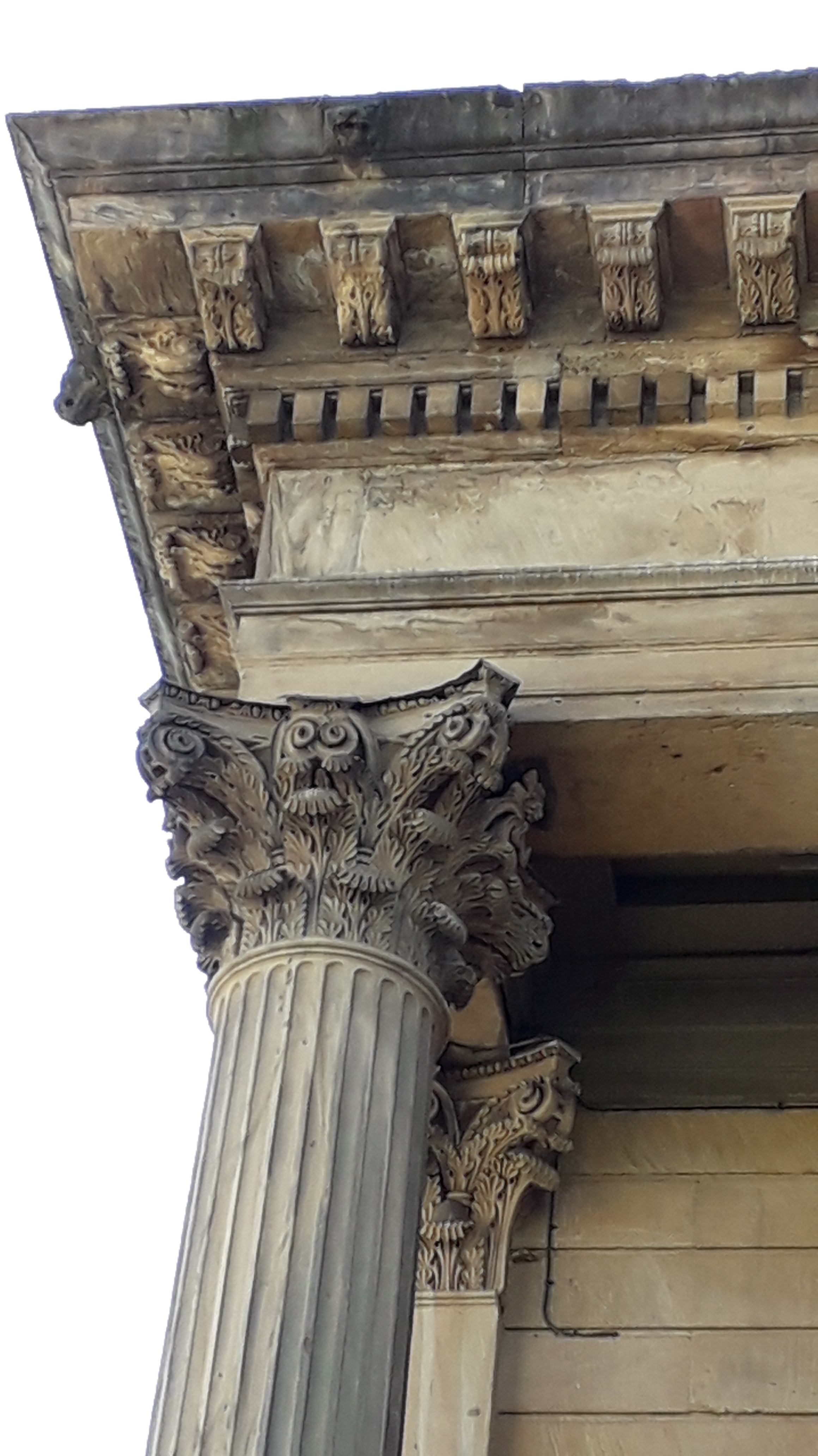
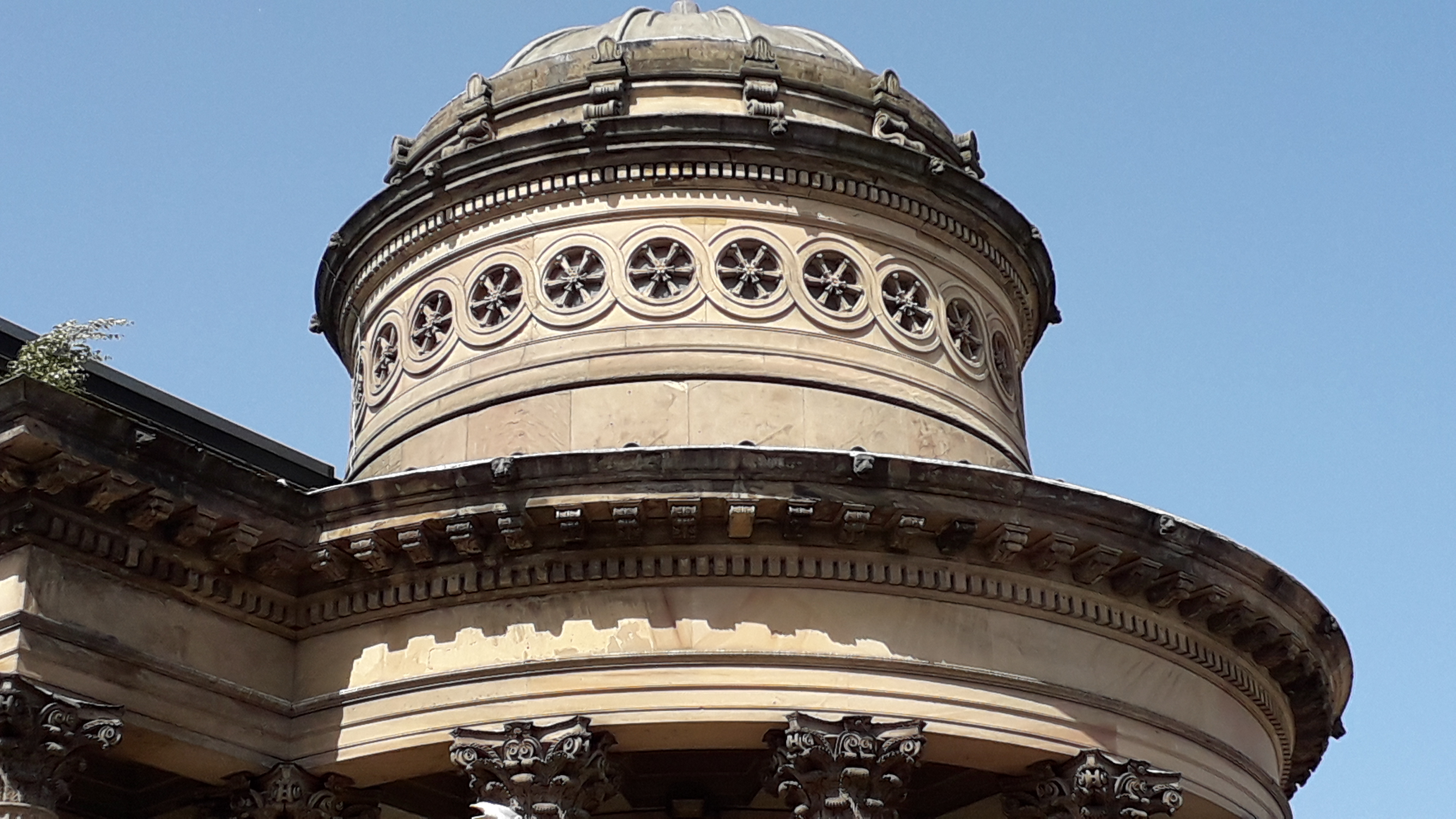
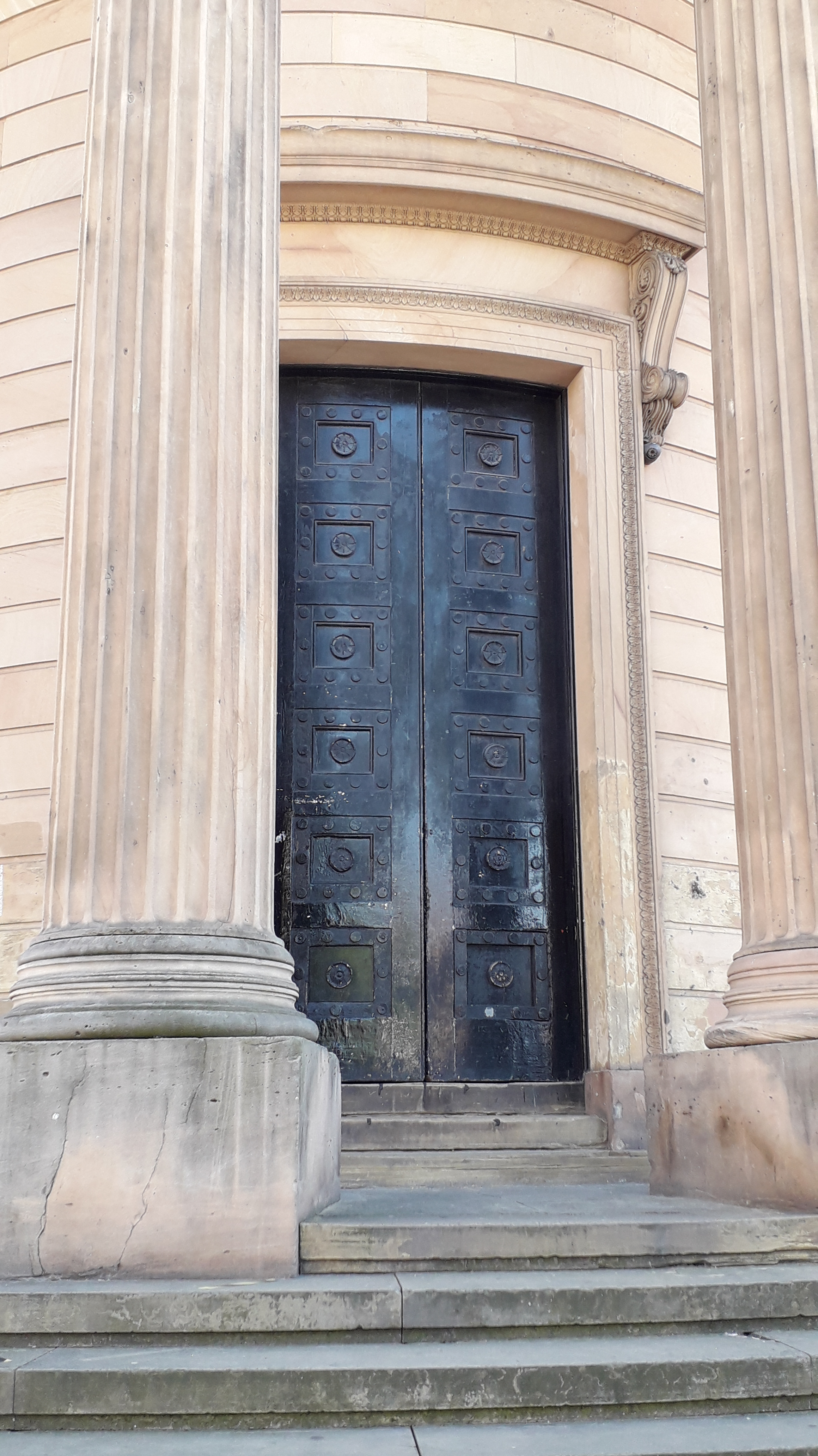
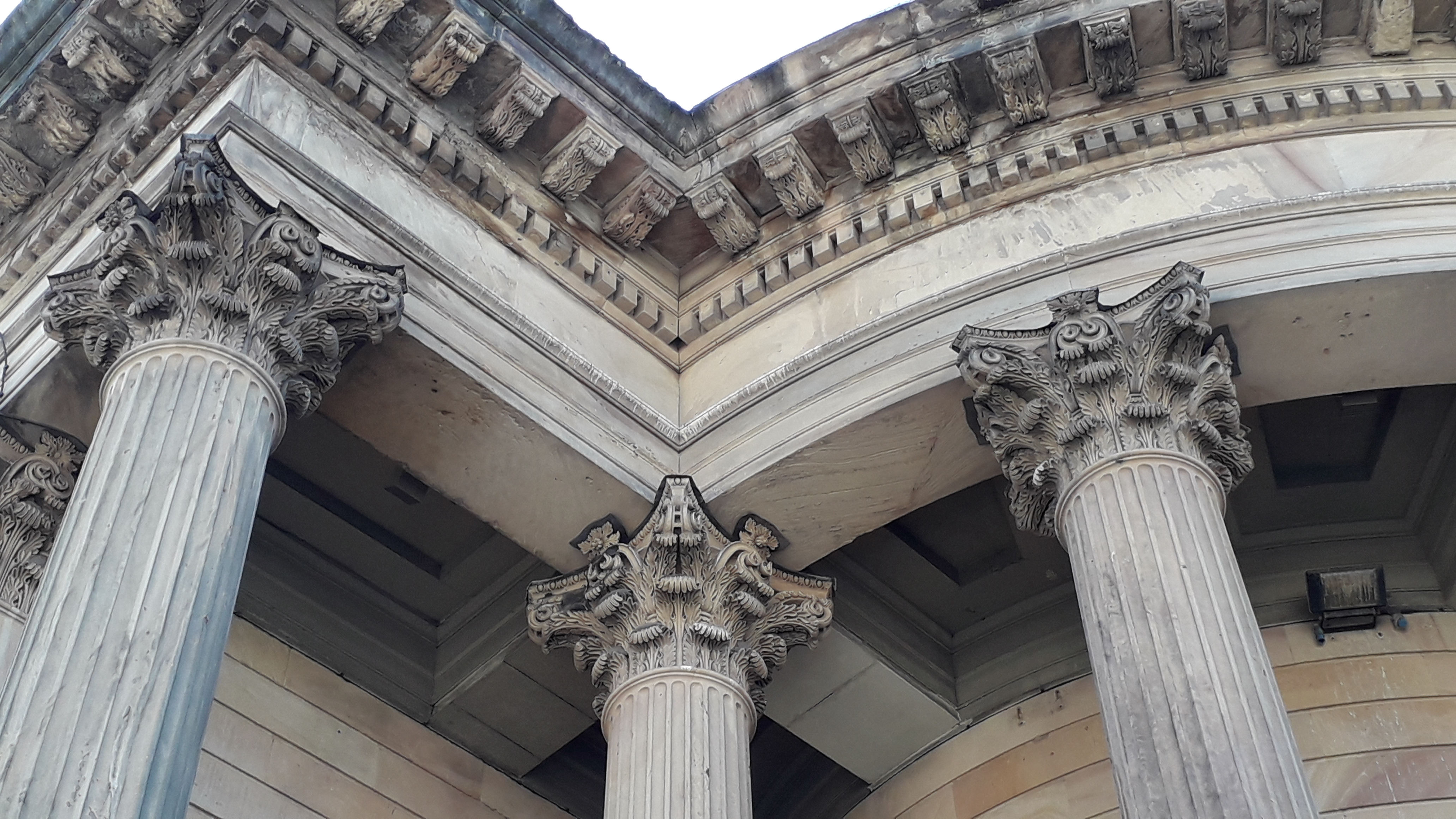
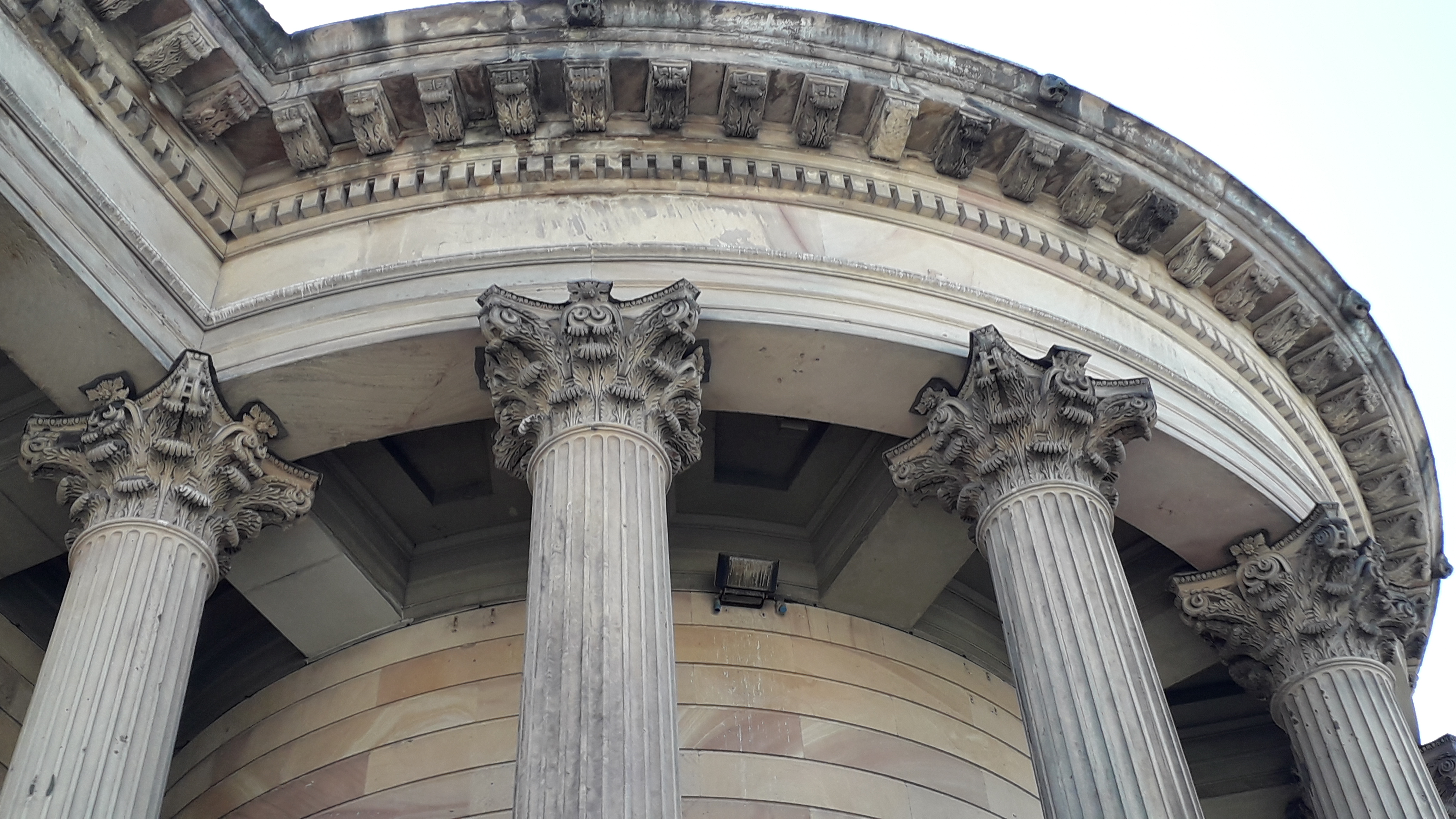
It cost £13,922 in 1840 and could seat 1,800 hearers. The architect was Joseph Franklin, the Corporation Surveyor, and the massive columns around the circular entrance are said to have come from a quarry in Park Road, Toxteth. Remembered also as a pioneering architect of railway buildings Joseph Franklin succeeded John Foster junior, the architect of Rodney Street Church of Scotland, as the Corporation Surveyor. As with that building this is a significant and impressive structure.

GGC front view

GGC pillar heads

GGC pillar heads circular


Roscoe Gardens, Mount Pleasant, Liverpool

RSC 08

Memorial, Roscoe Gardens

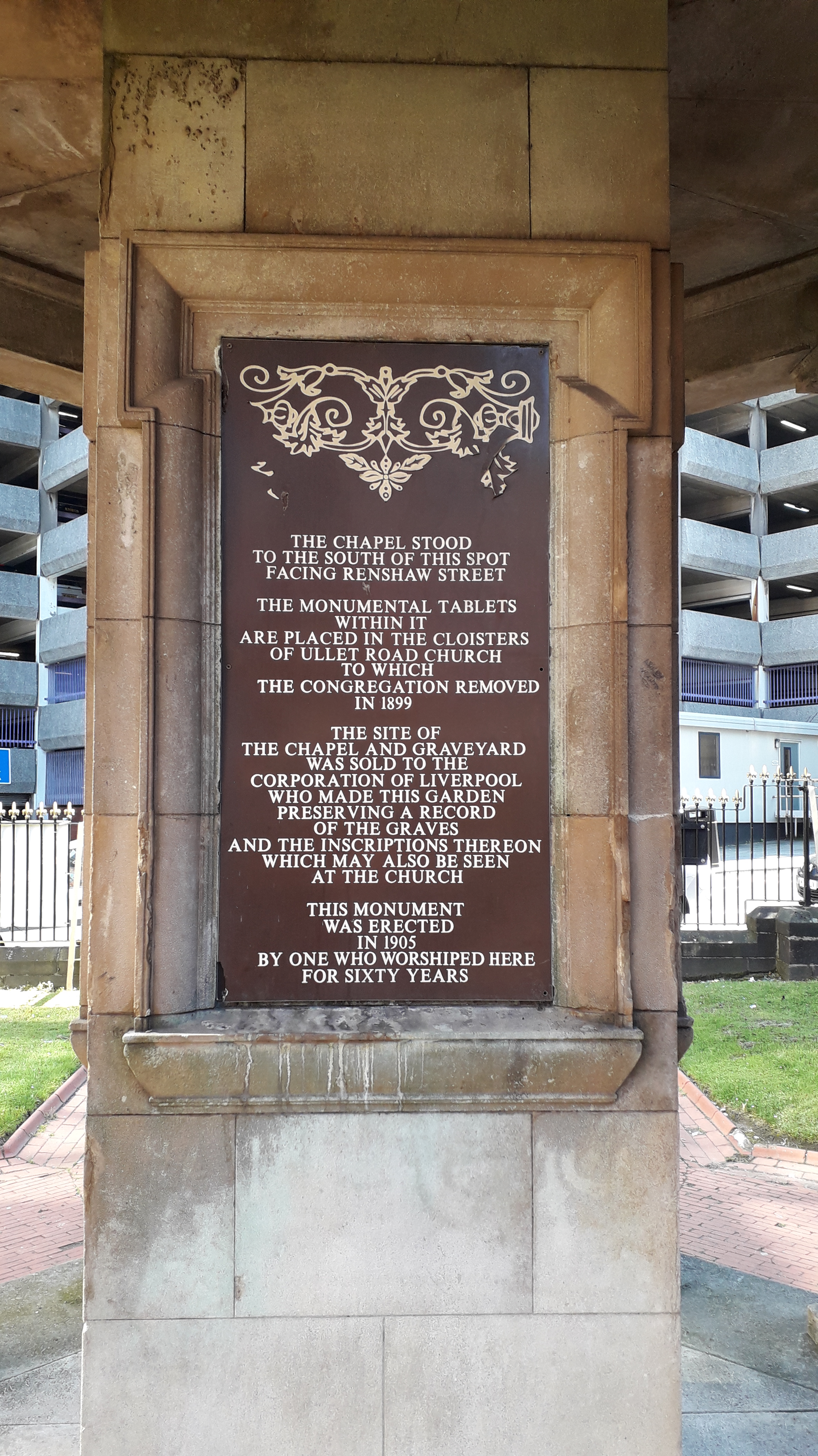
Roscoe Gardens, as it is now named by the Council, situated at the foot of Mount Pleasant is an easily overlooked green space in Liverpool city centre. It often has a slightly forlorn look which is not surprising as it is surrounded by some very high buildings and is probably difficult to maintain. But this was the site of the graveyard of Renshaw Street Chapel, a chapel which stood on the other side of the space facing into Renshaw Street where Grand Central now stands, a massive red-brick structure that was originally built as the Methodist Central Hall.

It is only right that someone as important in the history of Liverpool should have the space named after him. The author, campaigner against the slave trade, MP (who voted for the end of the trade despite the opposition of so many people in Liverpool), botanist, art collector and much more was hailed as Liverpool’s greatest citizen and was ultimately buried in this graveyard.

Renshaw Street130

Renshaw Street Chapel, 1811-1899

William Roscoe was born not far away, at the top of Mount Pleasant, in the Bowling Green Inn where his father was the publican. Not long after his birth his family moved a short distance to a newly built tavern which had attached to it an extensive market garden.

W Roscoe House Nov 2013

William Roscoe’s childhood home

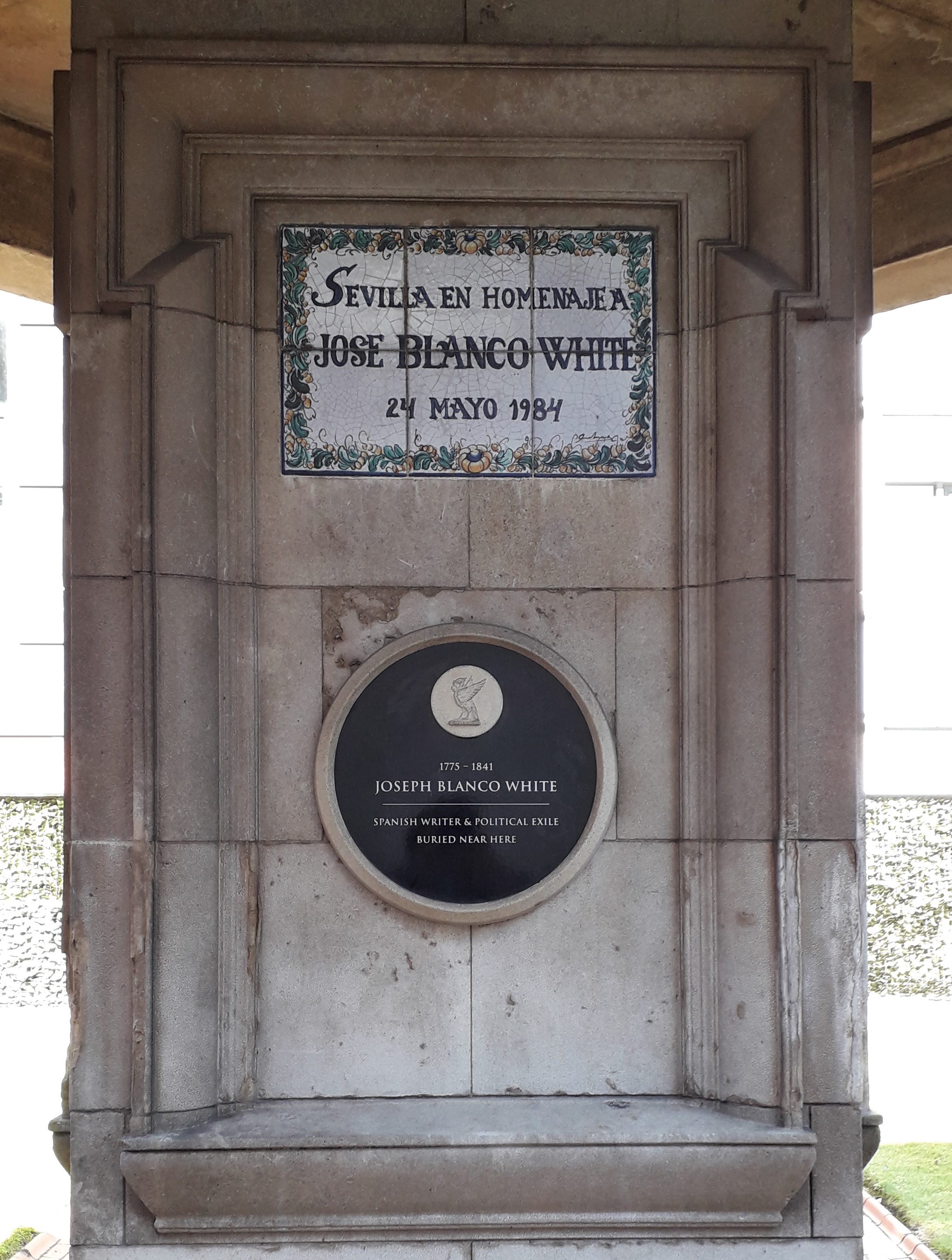
The history of the chapel that stood nearby is commemorated on the memorial built there after the chapel was sold and the congregation relocated on Ullet Road. Two of the chapel members buried there are commemorated: Joseph Blanco White and William Roscoe.

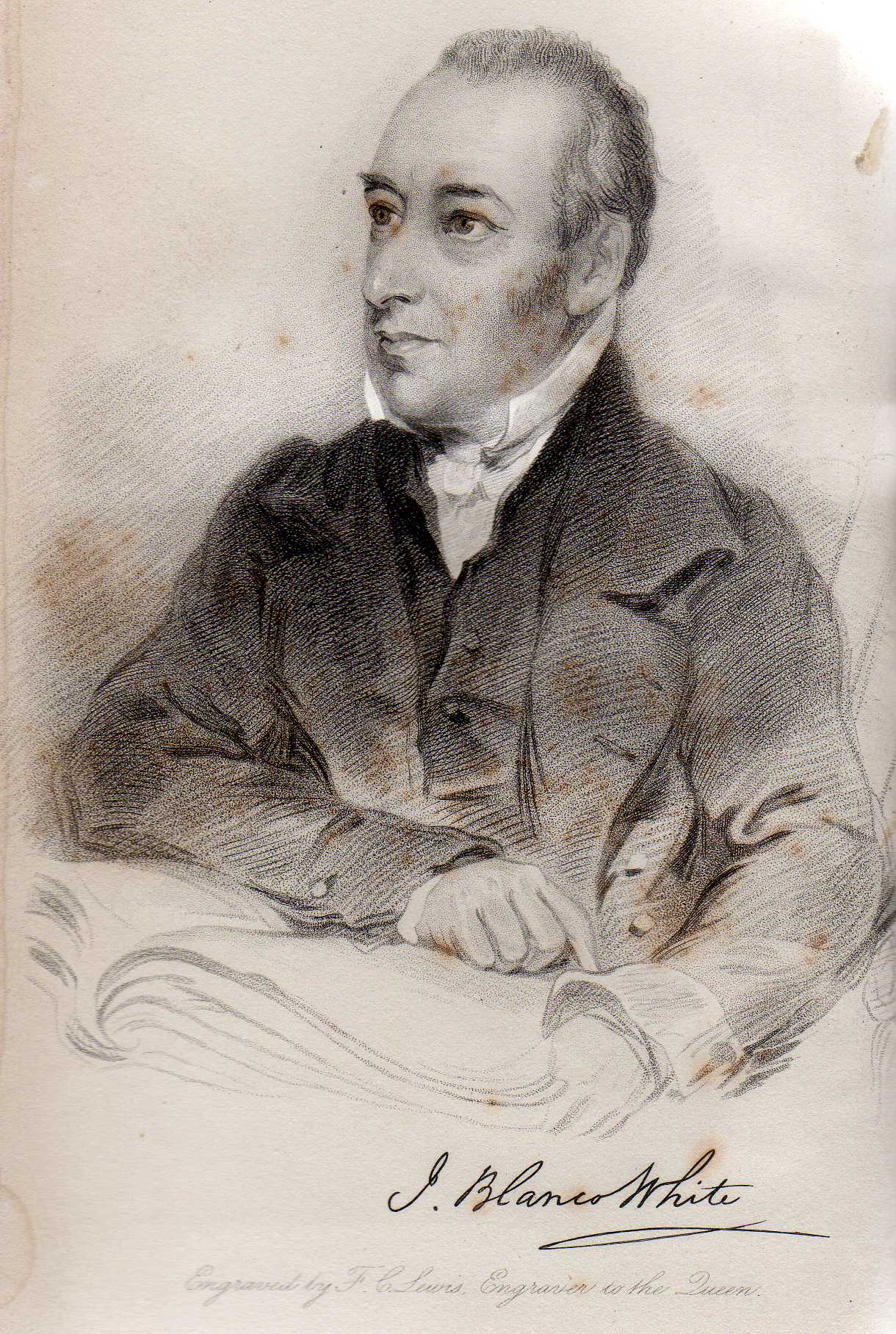
Blanco White128

Joseph Blanco White

Joseph Blanco White was another hugely significant figure who is increasingly remembered in both Liverpool and his home country of Spain.

RSC plaque 02

Plaques for Joseph Blanco White on the memorial in Roscoe Gardens


Blanco White Sue 57
Joseph Blanco White (Ullet Road Church)

William Roscoe was a member of this congregation all his life but although he lived near to the site of this graveyard he would have attended the previous chapel on Benn’s Gardens. Indeed he was baptised there on 28th March 1753 and was a regular attender throughout his life until the new chapel was built on Renshaw Street. No doubt Roscoe was present at the official opening in 1811 when the Rev Robert Lewin preached (making no reference to the new building in his address!). But his membership of this congregation was one of the constant threads that ran throughout his life and in Renshaw Street a large memorial was built to him, later moved to Ullet Road.

William Roscoe 01

Memorial to William Roscoe originally in Renshaw Street, now in Ullet Road

Two of the panels on the Roscoe Gardens memorial commemorate the congregation that once met nearby and one names three of the ministers:

RSC 01

RSC 03

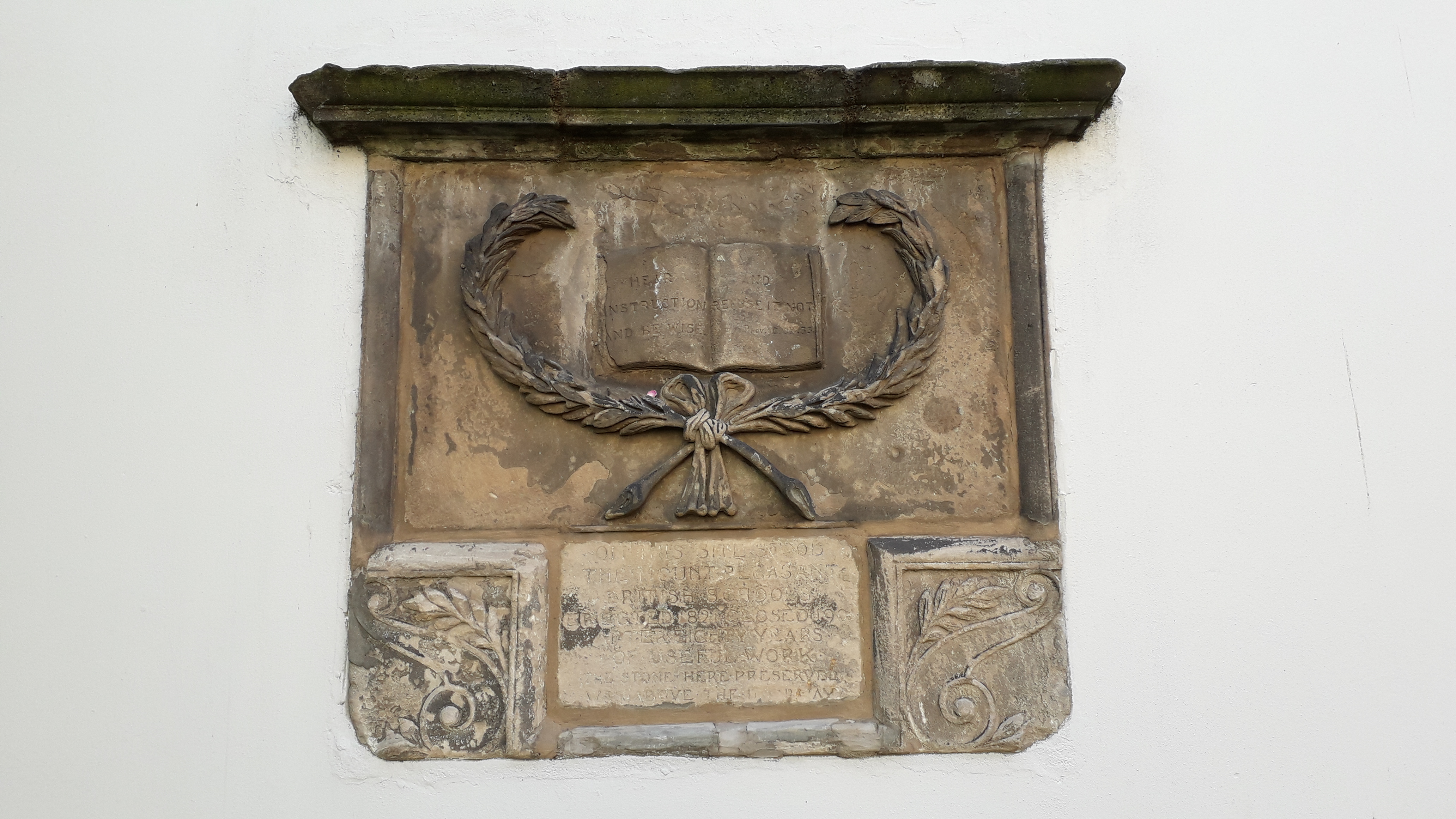
The only contemporary memorial in Roscoe Gardens is one to the Mount Pleasant school which was run by the congregation and stood on an adjacent site:

RSC 05

The memorial is fixed to a neighbouring wall. The inscription reads:

On this site stood the Mount Pleasant British Schools erected 1821 closed 1901 after eighty years of useful work. The stone here preserved was above the doorway. 

Above that, on the original stone, is written Hear instruction and be wise and refuse it not from Proverbs 8:33.

Catholic Apostolic Church, Liverpool

The Catholic Apostolic Church was a remarkable church which combined revivalist enthusiasm with liturgical worship and married a millenarian theology with prophetic ministry. Because of their belief in the imminent second coming they set up a system that ultimately proved to guarantee their own obsolescence. Believing that the second coming of Christ was very near they tried to re-establish the offices of the primitive church starting with Apostles in 1832 which had reached the full number by 1835. Since only they could ordain the prophets, evangelists, pastors, ‘angels’ (bishops), deacons and other orders down to doorkeepers, the death of the last apostle in 1901, before the return of the Lord, meant that there was no longer any possibility of continuing in the long term.

I am not sure how many Catholic Apostolic churches there ever were but their churches were very grand and required sophisticated architectural designs. Because they tended to include in their number many wealthy people they were often able to design and build some quite magnificent buildings. The church in Gordon Square in London, now leased to various Anglican groups, would be the best surviving example of their architecture, but the Roman Catholic Church in Bristol was originally Catholic Apostolic and is another impressive building, in this case having a classical design. I did see the less grand Catholic Apostolic church in Belfast before it was suddenly demolished but wasn’t able to take a photograph of it. Indeed an online search does not produce any images of this building, although it would be nice to think some images are preserved somewhere. It seems to have given up its licence to conduct marriages in 1954.

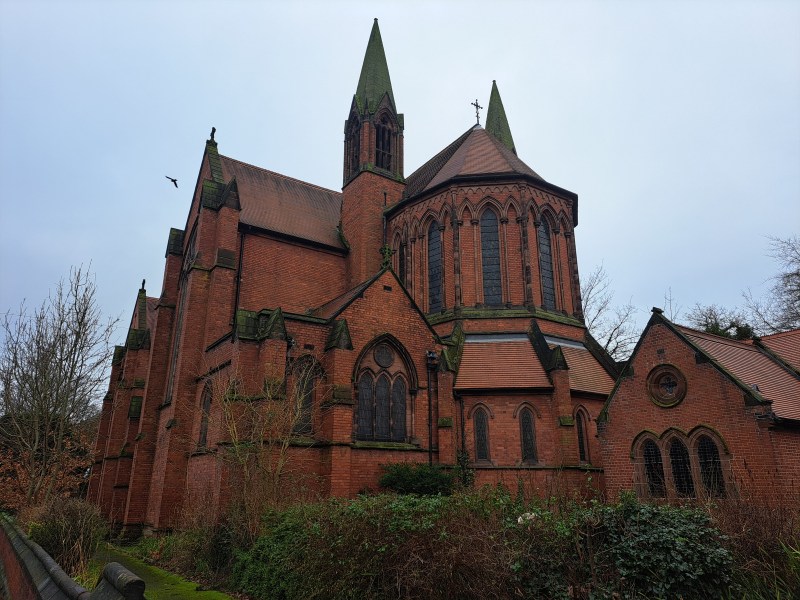
This excursion into the world of the now vanished Catholic Apostolic Church was prompted by the discovery of an old USB on which I had transferred at some point a couple of slides featuring the Catholic Apostolic Church on Catharine Street, Liverpool. It closed at some point in the 1970s and later was used by the New Testament Church of God. Later still it passed into secular use, then became badly dilapidated before being burnt down in the mid-1980s.
20131023150738-06

The church in the mid-1980s

I found these images on the USB, originally taken as 35 mm slides the first of which I must have taken in about 1985 and the second in 1986. The first shows the church when it was unused and beginning to show signs of neglect. The second shows the view from the side towards the high altar after it was destroyed by fire. A great shame that such an unusual building was lost. Pevsner recorded that the plan of the building had been revealed to the first minister in a dream. He also said there were Flemish roundels incorporated in the stained glass windows. Whatever was there the little that survived was subsequently demolished and a block of flats built on the site.

20131023150738-04

The ruined interior after the fire

The image at the top of the page is a detail from an aerial view of Liverpool by John R. Isaac in 1859 and published in New York. This is a view from a hot air balloon and can be viewed on the Library of Congress site here.

Amongst the churches found in that image is the Catholic Apostolic Church on the corner of Catharine Street and Canning Street, it can be seen slightly to the right of centre still with its spire which was removed in the early 1970s. An account of all the churches in that picture can be read in an earlier post: Seven Churches in Liverpool in 1859 viewed from the air.

No pictures or text may be reproduced from this site without the express permission of the author.