From Rational Piety to Music Hall

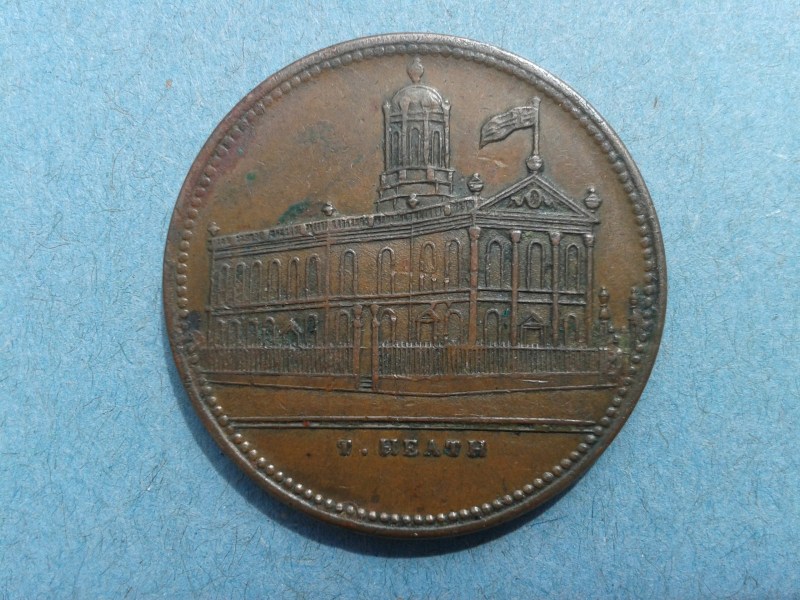
I wonder how many Unitarian churches have their images engraved on the reverse of a coin? I only know of one example, it is not a particularly beautiful example of the medallist’s art but it is very interesting and tells an unusual tale.

The reverse of the token

The church in question is Paradise Street Chapel in Liverpool, now long demolished, indeed the whole street has disappeared under the shopping development known today as Liverpool One. But Paradise Street was built in 1791 and was a dissenting church of some importance in Liverpool at the time. In the nineteenth century no less a person than James Martineau became the minister – a fitting appointment to a congregation that was cultured, wealthy and influential. They had built their meeting house on the grand scale, with a central cupola it was octagonal with a classical frontage and adorned with elegant stone urns along the balustrade. Martineau arrived in 1832 and established a name for himself as a preacher, teacher and philosopher linking up with other prominent figures in Liverpool and the north west including John Hamilton Thom, Charles Wicksteed, and John James Tayler.

Coinreverse01 detail
Close up of the Chapel

But partly through the changing environment around the old chapel, which had become more commercially orientated and less like an area the well-to-do might want to visit, and partly also because of the more devotional worship that Martineau introduced, the congregation felt a need to abandon their old church and build something new. Accordingly a grand gothic church was built on Hope Street and Martineau and his congregation departed to their new home, selling the old place off. (For Hope Street Church see my earlier post – the Church on Hope Street).
James Martineau and his congregation, perhaps out of financial necessity from building anew on an extravagant scale, showed little sentimentality in disposing of their old place of worship. Yet one can’t help suspecting that a man of such high-brow intellectual tastes as Martineau can hardly have approved of the new use to which the old chapel was now put. It was purchased by a man called Joseph Heath who intended to turn it into a music hall.
After the Unitarians left it in 1849 the spacious chapel, with its well-constructed gallery all built of the finest materials and to the highest standards, was converted into the Royal Colosseum Theatre and Music Hall. The pews were re-used for seating and one can see how a large chapel could easily be adapted for use as a theatre. However, Joseph Heath must have been an ingenious individual because he managed to turn Paradise Street into the first multiplex: there were twin auditoria for both a theatre and a music hall. According to The Liverpool Stage by Harold Ackroyd the theatre “presented what were described as full blooded dramatic plays for a patronage of mariners”, while the front part of the old chapel was converted into a music hall where variety performances were put on “well suited to the taste of those for whom Mr. Heath catered.”
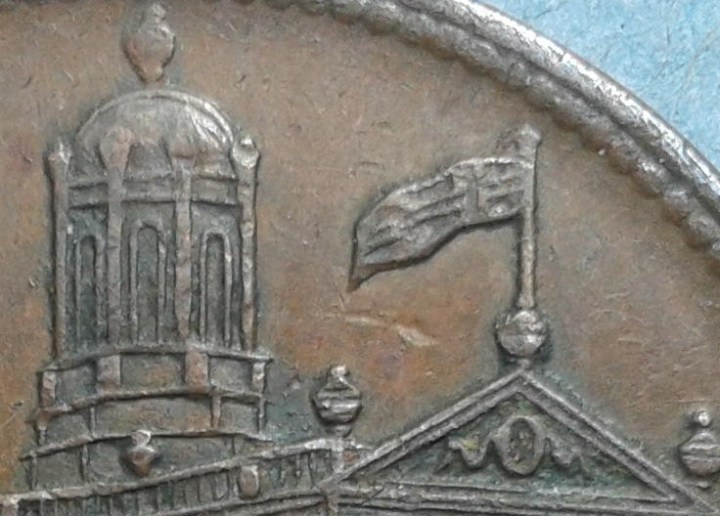
Coinreverse01 detail tower
Detail of the tower

One can’t imagine Martineau really approving of such an undignified end to his old church but there was greater indignity to come. The Colly, as it became known, was reputedly haunted, an association encouraged by the continuing presence of the chapel’s graveyard around the building. This also presented a practical advantage to the thespians. According to Harold Ackroyd again:
…there was never any shortage of a skull during a performance of Hamlet. These were easily obtained, the artists’ dressing room, below the stage, formerly having been a grave vault, the artist had only to put his hand through an opening in the thin dividing wall, to seize hold of the grisly relic, as did Hamlet.
So it was the music hall owners who had the coin engraved with the unmistakable likeness of the Paradise Street Chapel. The Heath family owned the former chapel until about 1895 although it went through a number of refurbishments and changes of name in that time. But it remained known as the Royal Colosseum Theatre until 1875 at which time it was being run by Thomas Theodore Heath, Joseph’s son. Presumably this is the ‘T. Heath’ whose name is inscribed on the coin as the owner of the theatre. This would date the coin to the early 1870s when it functioned as an admission token for those eager for Victorian melodrama or the bawdy delights of an evening at the music hall. On the other side of the coin is a Liver bird, a belt and the name of the theatre. Some examples of the coins have a large letter ‘H’ stamped on them. I don’t know precisely what this indicated, at first I thought it was a reference to a seat or a row or an entrance but ‘H’ seems to be the only letter used in this way and it rather spoils the look of the engraving. Whatever meaning it had to the person at the theatre door this is now long forgotten.

An example of the coin with the letter 'H' stamped on it
An example of the coin with the letter ‘H’ stamped on it

By the late 1870s the theatre was said to be able hold 3,000 people, and must have been returned to a single auditorium, but at this stage in its history it was struck by a terrible tragedy. On the night of 11th October 1878, during a performance before a full house, a portion of the ceiling fell onto the pit and caused panic amongst the audience. Thirty-seven people were killed in the crush to escape and many more injured. Pictures in the Illustrated London News at the time show a building that was already extensively remodelled from the one that appears on the back of the token but it had fallen victim to the sort of tragedy that was not unknown in Victorian Britain. Following this the theatre was rebuilt, frequently renamed and continued in use up to the First World War. By then known as Kelly’s Theatre, it finally closed its doors in October 1916 and was sold to Cooper’s Ltd who used it as a warehouse for their greengrocery and restaurant business.

Coinobverse02

The whole story of Paradise Street Chapel and the Royal Colosseum Theatre was brought to a close by a German bomb during the blitz of 1941. Precisely how much of the building of 1791 had survived within the much enlarged edifice is hard to know but by then the building’s origins as a place of worship were hardly remembered. The link is maintained though by these little tokens which record a small element of theatre history and, almost by accident, help to preserve the image of a building that had a quite different history and purpose.

(This is an amended version of an article that first appeared in the ‘Inquirer’ 4 July 2015)
The Church on Hope Street

I have sometimes been tempted to write a blog or a column entitled ‘The things I buy on eBay’. I have picked up lots of pieces of ephemera at very low cost on eBay which while certainly bearing very little intrinsic value and generally falling into the category of junk nevertheless have some historical interest.

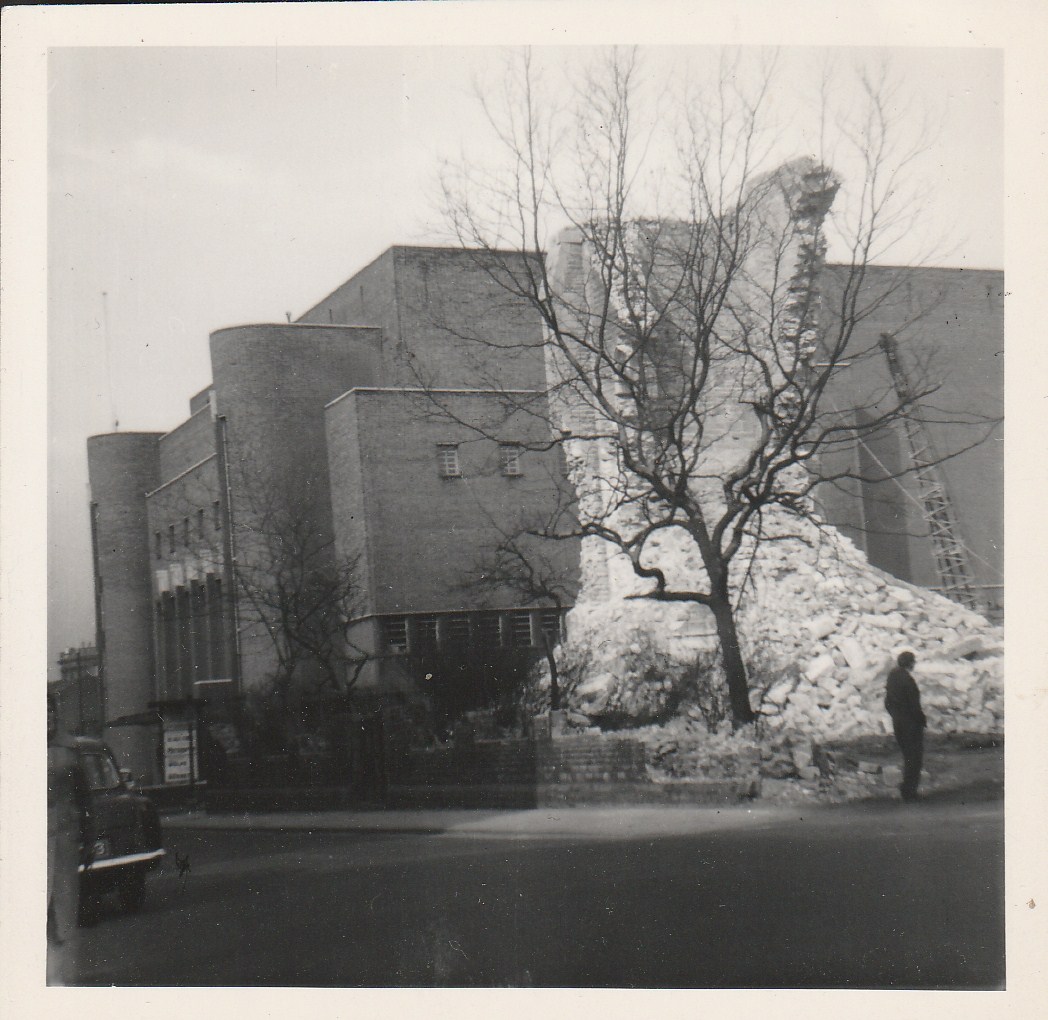
Hope Street Church, demolition 1962


The photograph above is a good example of this. It cost just 99p (which I suppose is actually quite a lot for a single, slightly blurry print) but it shows the very end of Hope Street Unitarian Church in Liverpool. Taken in 1962, probably by someone who habitually recorded views of buildings which he thought might one day be interesting, it catches the tower in the final stage of demolition. Somewhere under the rubble was a brass plate and a “hermetically sealed vase” containing a list of members, ground plans of the old and new chapels, a report of the congregation’s school, a plan of Liverpool, a print of the Dissenters’ Chapels Act, an engraved portrait of the minister and all the local papers from the week before the laying of the foundation stone on 9th May 1848. It was a sad end to a building that was opened for worship in 1849 and which occupied a prominent place in the city. Indeed it seems a shame that such a site, midway between the two cathedrals, could not have been saved for future use. It would be a great site today with enormous potential. But it is easy to be wise after the event, the world must have looked quite different to what was presumably a small and discouraged congregation by the early 1960s.


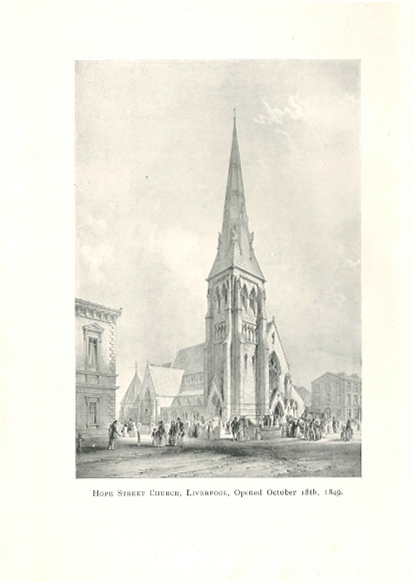
Hope Street had certainly known rather more glorious days. Built by James Martineau’s congregation to provide a place of worship that suited his style and popularity it was a thorough-going gothic construction that reflected his devotional approach. The classic image of it is this one:

Hope Street Church
Hope Street Church


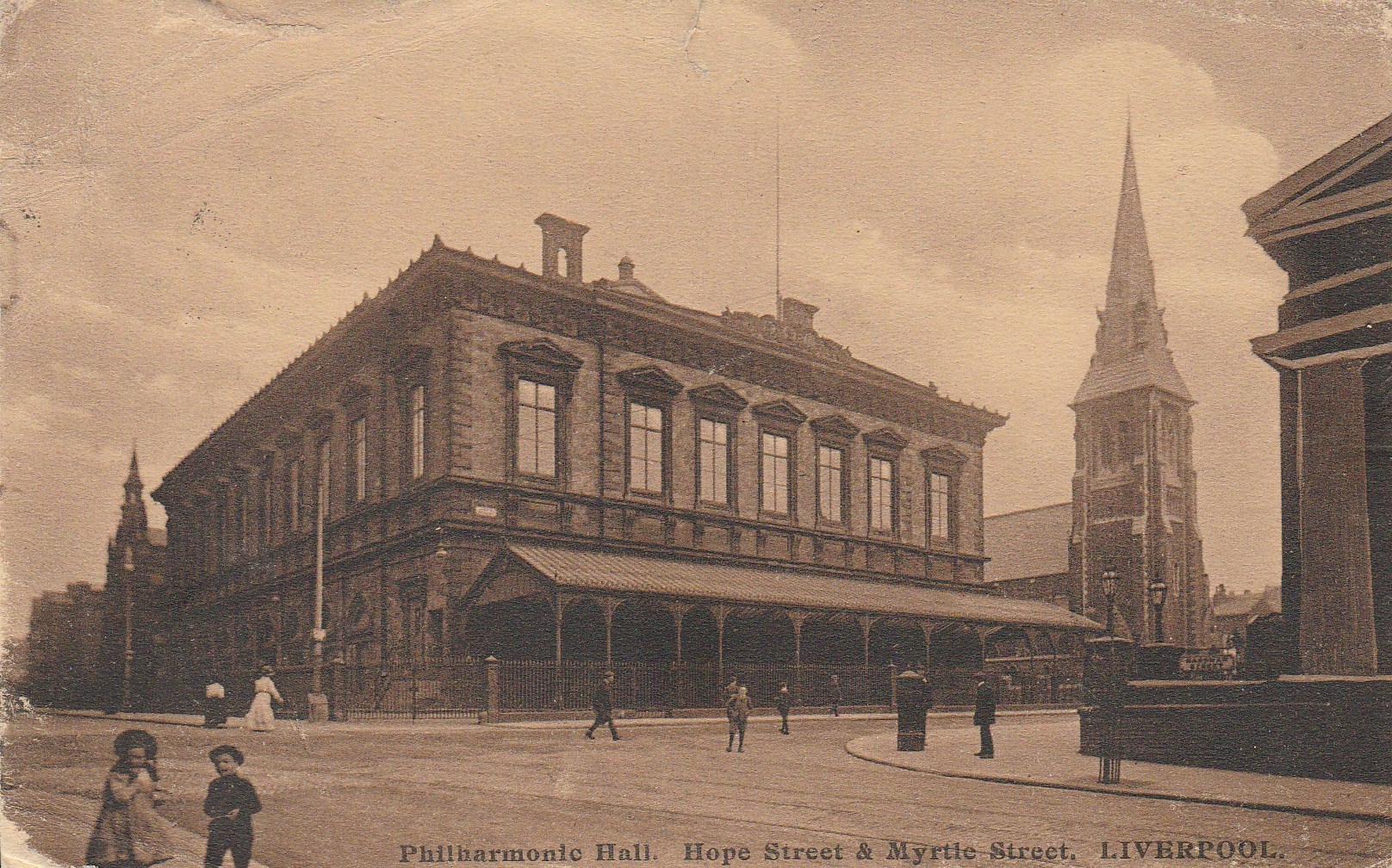
Its relationship to the next-door Philharmonic Hall can be seen from this Edwardian postcard. The original Philharmonic burnt down in the 1930s and was replaced by the present building in 1939. In the picture the classical church opposite, the corner of which can just be seen on the right of the postcard, was the Church for the Blind, attached to the Liverpool School for the Blind which was situated on Hardman Street.

Next door to the Philharmonic


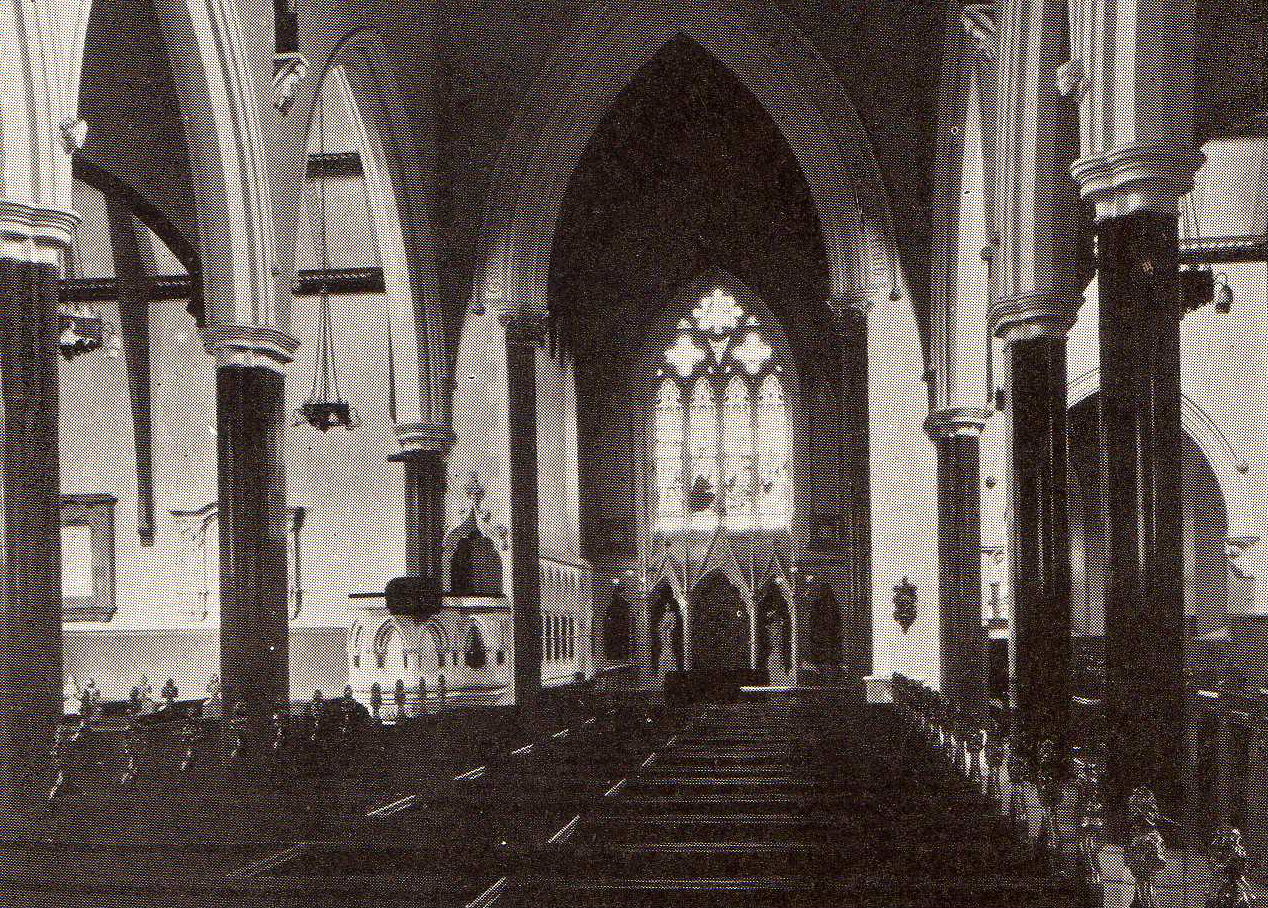
Nothing really remains of Hope Street Church today. Photographs of the interior are intriguing. This scan isn’t great but it shows the view looking towards the pulpit, the chancel and the font.

Church interior
Church interior


After James Martineau and before the First World War the congregation had some high profile ministers including Charles Wicksteed, Alexander Gordon and Richard Acland Armstrong. The 1920s saw a revival of fortunes under the radical ministry of Stanley A. Mellor who mixed an advanced theology with Socialist ideas. But the crowds that came out to hear him did not last and by the time of the eccentric ministry of the highly scholarly Sidney Spencer the numbers were starting to reduce.


In the Winter 2008/9 of the Merseyside District Unitarian Newsletter The Honourable Dr Frank Paterson, a former member of Hope Street and a very distinguished circuit judge who died in 2014, wrote his reminiscences of the Church. They are a fascinating and rare account of the congregation in the twentieth century. I place them here with due acknowledgment to the MDMA Newsletter:


I reflect with pleasure on my childhood and early manhood, when I frequently accompanied my father to the morning and evening services. He had a wide interest in almost every religious creed. In latter years he reminded me of a character in Shaw’s Major Barbara who declared that he had studied several religions and found that he would be perfectly at home in any one of them. Having been born into a Scots Presbyterian household, he was attracted by the preaching of Dr Charles Aked, the charismatic minister of the then Pembroke Baptist Chapel in Liverpool, where he met my mother, whom he married in 1911. After the departure of Dr Aked for the United States (to what was known as ‘The Millionaires’ Church’ on 5th Avenue), my parents transferred their allegiance to Hope Street Unitarian Church to enjoy the benefits of the preaching of the Reverend Stanley Mellor. Following his death, they continued to attend Hope Street church throughout the ministry of the Reverend Sidney Spencer, I do not think my mother took any interest in the details of religious faiths, but was content to fulfil what she regarded as a spiritual duty by attendance at a church on a Sunday. It is perhaps not surprising that the idea of a free religious faith always appealed to me. It gave me great pleasure to follow in my father’s footsteps as chairman of the Hope Street Committee, which awakened in me the desire to enter a calling where I could participate in the cut and thrust of debate, and to promote harmony where there has been discord.


It has therefore been a source of satisfaction to me to find that Hope Street had its origins on the site of what is now The Queen Elizabeth II Law Courts, where I have spent the greater part of my professional life. When the buildings were opened by Queen Elizabeth II, I happened to be one of the longest standing circuit judges of the court and had the honour of being presented to Her Majesty. Whilst waiting for the ceremony I was placed in a line of those about to be presented immediately between the Anglican Bishop of Liverpool on one side and the Catholic Archbishop of Liverpool on the other. I regret I didn’t have the courage or the time to remind these prelates that I felt like the wonderful white church that once stood half way between the Anglican and Catholic cathedrals in Hope Street.


When I was a child services at Hope Street were almost as well attended as the Hope Hall Cinema (now the Everyman Theatre) down the road, and in order to secure two seats together my father was obliged to apply to the Church Secretary, Mr William Letcher. There was an interval of several weeks before a reply was received notifying my father that two places had been reserved for himself and my mother, and on the following Sunday they were met in the vestibule by Mr Letcher to be escorted past the queue waiting to be seated and down the aisle to a pew four rows from the front, on the back of which was a card bearing their names. This remained what we regarded as our family pew until the church was demolished several decades later. William Letcher remains in my memory as a formidable figure, well-suited to the task of controlling the crowds at Hope Street. He was, I believe, employed by one of Liverpool’s principle banks, in charge of the Stationary Department. As a small boy he appeared to me as a person of enormous power and influence. Whatever it meant for the Trinity to be present in one person, it seemed to me that person might as well be Mr William Letcher. He was highly thought of, and in due course enjoyed the distinction of becoming the subject of a light-hearted song, composed by my father and another member of the congregation, which recommended a variety of facetious changes to forms of worship, each one punctuated by the refrain: “But Will `e Letch `ya?” The authors sang it at a Christmas party.


Another innovation of my father’s as Chairman was the collection of “bun pennies`”. These were coins dating from the early days of the reign of Queen Victoria on which the monarch’s head appeared with hair drawn back in a bun, still current in the inter-war years but invariably worn very smooth. My father encouraged members of the congregation to deposit any they found in their possession in a wooden casket he had placed on the window-ledge of the church vestibule, similar to those designed for holding ashes with an incision made in the top and inscribed with the words: “The Hope Street Church Ancient Victorian Secret Society”. To what objects the fund accumulated therein was applied remains uncertain to this day.


The only photograph of the church I recall seeing was taken by a photographer from the Liverpool Daily Post and showed the spire wrapped in smoke. It dated from an evening on which my father had had to move a Committee Meeting from the Library to the Church Hall, and eventually – very reluctantly – to adjourn with business unfinished, because the premises had become unbearably hot. The neighbouring Philharmonic Hall was on fire. My father had a print framed and hung in the church to illustrate the perils to which the members of the Committee were prepared to subject themselves in pursuance of their duties.


Hope Street Church also survived the blitz a few years later. It may be that the enemy found the white spire of that Unitarian stronghold a useful pointer to the Liverpool docks and to the Cammell Laird shipyards and it took care to spare it. Be that as it may, incendiary bombs were such a menace that the government required all males over a certain age to register for fire-watching duties. The minister of Hope Street, the Reverend Sidney Spencer, an ardent pacifist, had no hesitation in fire-watching at his own church or anywhere else, but objected to doing so under compulsion of the State. He refused to register. The magistrates fined him £10 which he steadfastly refused to pay. In due course, he was sent to prison for a term of 14 days. The minister (an admirer of Mahatma Gandhi) was adamant that he did not wish the fine to be paid, but after a few days the Committee felt that he had made his point, and that somehow the fine should be paid anonymously. It was decided that, as a law student with access via the Magistrates’ Entrance to the courts on Dale Street, the Chairman’s son was best able to make the payment without drawing attention to himself. This I did. The first clerk I approached hesitated: “But Mr Spencer has said he doesn’t want this fine paid. I don’t think I can take it.” “If anyone offers us money – we take it!” declared his senior. A few hours later, the Reverend Sidney Spencer was a free man.


My father reimbursed me, from what source I do not know. Possibly he unlocked the coffer of the Hope Street Church Ancient Victorian Secret Society!

Liverpool Unitarians: Faith and Action. Essays exploring the lives and contributions to society of notable figures in Liverpool Unitarian history. Edited by Daphne Roberts and David Steers

In September of 2014 we launched – in fine style, it must be said, in the impressive surroundings of the Liverpool Athenaeum, thanks to Philip Waldron – the book Liverpool Unitarians: Faith and Action. Essays exploring the lives and contributions to society of notable figures in Liverpool Unitarian history. Published by the Merseyside District Missionary Association it should also be added that the District took to the role of publisher with great aplomb – not necessarily the most usual role for any church administrative body.  The book is available in many book shops and museums in Liverpool as well as online from the District and via Amazon.

Liverpool Unitarians was a long time in preparation but I think is a better book for the extra time spent on its production. All the contributors have some connection with Merseyside Unitarianism and all write about different aspects of the contribution made by members of this household of faith to wider society over the centuries.

The full list of contributors and subjects is as follows:

Introduction, David Steers; Memorials of the Ancient Chapel of Toxteth Park, Bernard Cliffe; Jeremiah Horrocks 1618 – 1641, Bernard Cliffe; William Roscoe 1753 – 1831, David Steers; A Short History of the Rathbone Family, Annette Butler; The Unitarian Family of George Holt, Bernard Cliffe; Noah Jones 1801 – 1861, Philip Waldron; James Martineau 1805 – 1900, Len W. Mooney; Joseph Blanco White 1775 – 1841, David Steers; Kitty Wilkinson 1786 – 1860, Daphne Roberts; John Johns 1801 – 1847, David Steers; William Henry Channing 1810 – 1884, Richard Merritt; Charles Pierre Melly 1829 – 1888, John Keggen; Sir Henry Tate 1819 – 1899, Richard Merritt; Sir John Brunner 1842 – 1919, Len W. Mooney; Lawrence Redfern 1888 – 1967, Elizabeth Alley; Sir Adrian Boult 1889 – 1983, Richard Merritt; The Visitors’ Book of the Ancient Chapel, Bernard Cliffe

It was particularly pleasing to see Len Mooney’s contributions published in the book in light of Len’s sad death just a few months later. Someone who had been a devoted member of Ullet Road Church for many decades Len was a thoughtful and wise person whose gifts shine through in his chapters published here.

The cover of the book

The book has a full colour cover designed by Alison Steers which incorporates ‘The Triumph of Truth’, the central detail from the library ceiling of Ullet Road Church, painted by Gerald Moira; the Good Samaritan Window at Gateacre Chapel, which was erected in memory of Sir Henry Tate; a bronze representation of the James, (the ship on which Richard Mather and the local puritans sailed to Massachusetts in 1635) made in 1934 for the hall door at the Ancient Chapel of Toxteth; the front elevation of Ullet Road Church built in 1899; and detail of the Liverpool Town Plan of 1725 by J. Chadwick.


The book also contains more than fifty illustrations, many of them never before published, and all of them helping to tell the story of Liverpool Unitarianism. Some of the stories told in the book are well known, others are not so familiar to the general reader, yet others break entirely new ground – Bernard Cliffe’s analysis of the memorials and graves in the Ancient Chapel is a first, as is his examination of the chapel’s visitors’ book.

In the Introduction I say:

This book is not intended to be hagiography but it does try to outline how one group of people – members of a particular faith community with deep historical roots but with an aversion to fixed creeds – were inspired to serve their fellows in different ways. Their legacy can be seen all over the city – in its parks, in its monuments, in the university, in hospitals, in education, in art galleries and museums – and it exists in the long and continuing struggle to create a society that gives equality and opportunity to all its citizens. It is not meant to be an exhaustive account of all the eminent members of the churches and chapels in the region. Readers will notice that the names mentioned are part of wider connections of family and business which includes many others who could be included. There are other figures who could be the subject of such biographical accounts. But this is a selection of some of those who have followed the call of faith to be of service to wider society.


It is pleasing also to report positive reviews in various publications.

In Faith and Freedom Peter Godfrey says: a splendid book… chapters that are full of interest and fill the reader with admiration and often wonder at the scope of the achievements of these Liverpool Unitarians

and in The Inquirer Alan Ruston says:

readers of this book will come to the conclusion that Unitarianism has not been just a faith of the mind but one of action as well.

The title and full publication and order details are as follows:

Liverpool Unitarians Faith and Action Essays exploring the lives and contributions to society of notable figures in Liverpool Unitarian history

Edited by Daphne Roberts and David Steers

Published by the Merseyside and District Missionary Association 2014 ISBN 978-0-9929031-0-7 Price £12.99 plus £2.50 post and packing 128 pages, 52 illustrations, full colour cover

Available from: Philip Waldron, Ullet Road Church, 57 Ullet Road, Sefton Park, Liverpool L17 2AA or liverpoolunitarians@gmail.com also available for purchase on Amazon

Joseph Blanco White (Ullet Road Church)