Postcards by A.D. Coon

In this post we are looking at some more examples of the work of Allen Daniel Coon. The total output of postcards he produced between 1902 and his death in 1938 must have been enormous and they covered a very wide geographical area. I hadn’t noticed that one card I picked up a few years ago was by him:

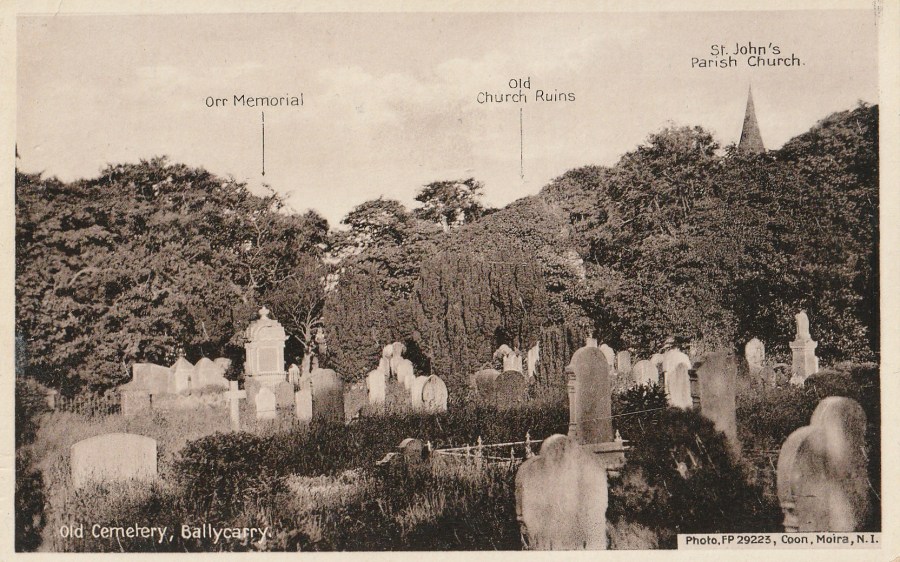
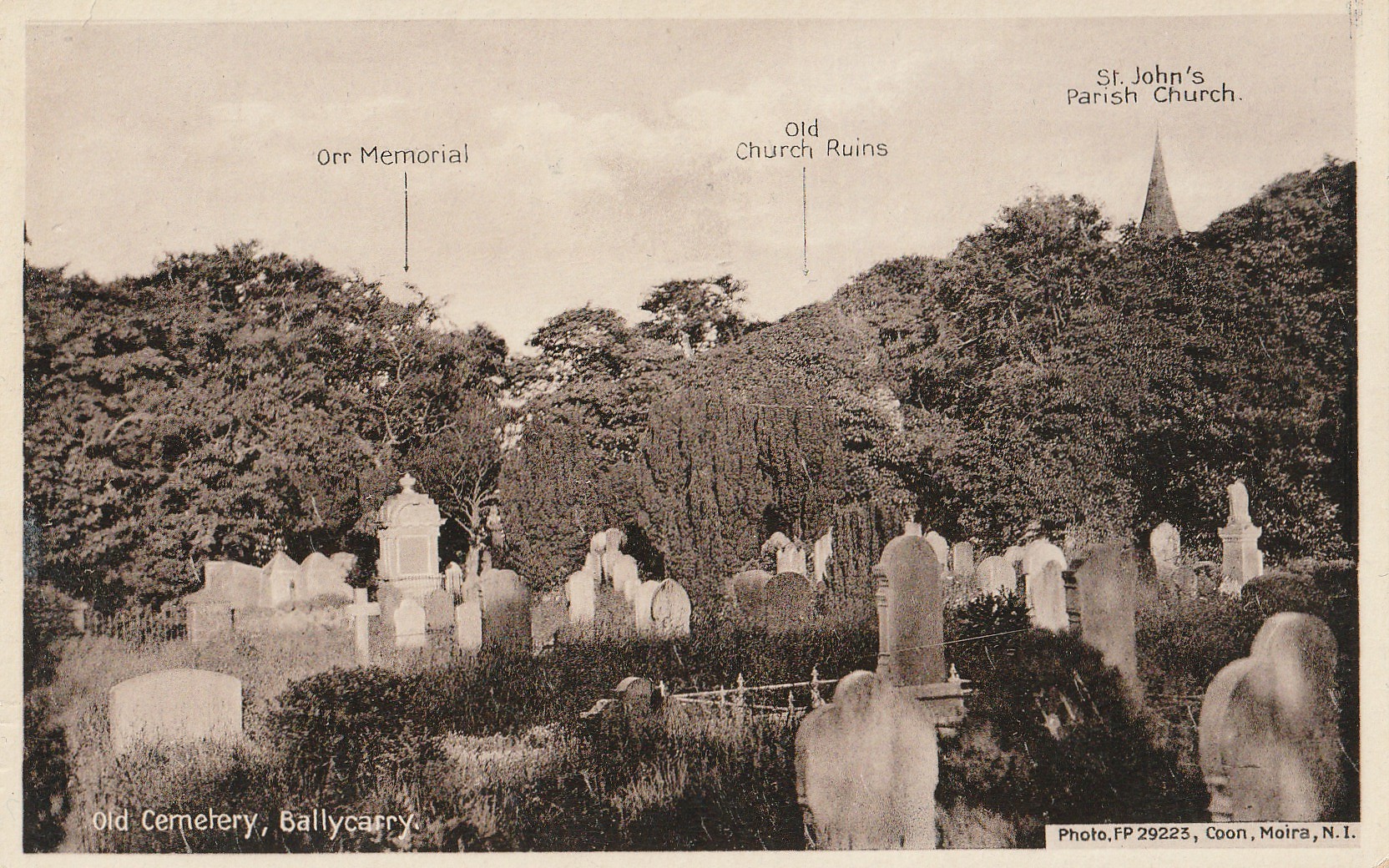
Old Cemetery, Ballycarry, 1929

This was produced for John McKee News Agent and Confectioner, Ballycarry, and is interesting because he has labelled different features of the graveyard, although you can only see the tip of the spire of St John’s Parish Church and can’t see the ruins of the old church at all as they are obscured by trees.

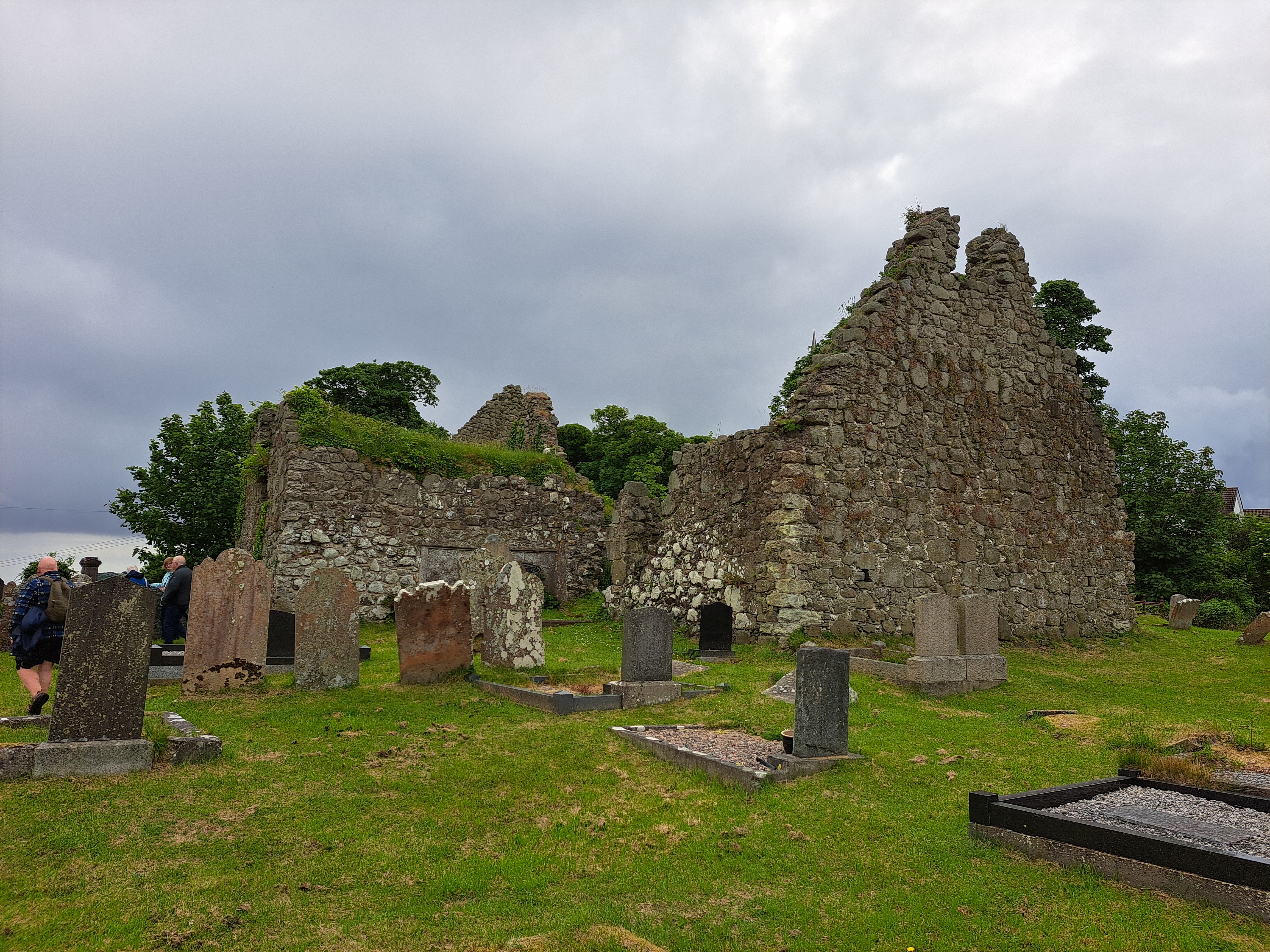
This is what the ruins look like today:

Ruins of Templecorran Church, Ballycarry

You can read about our recent visit to this graveyard here.

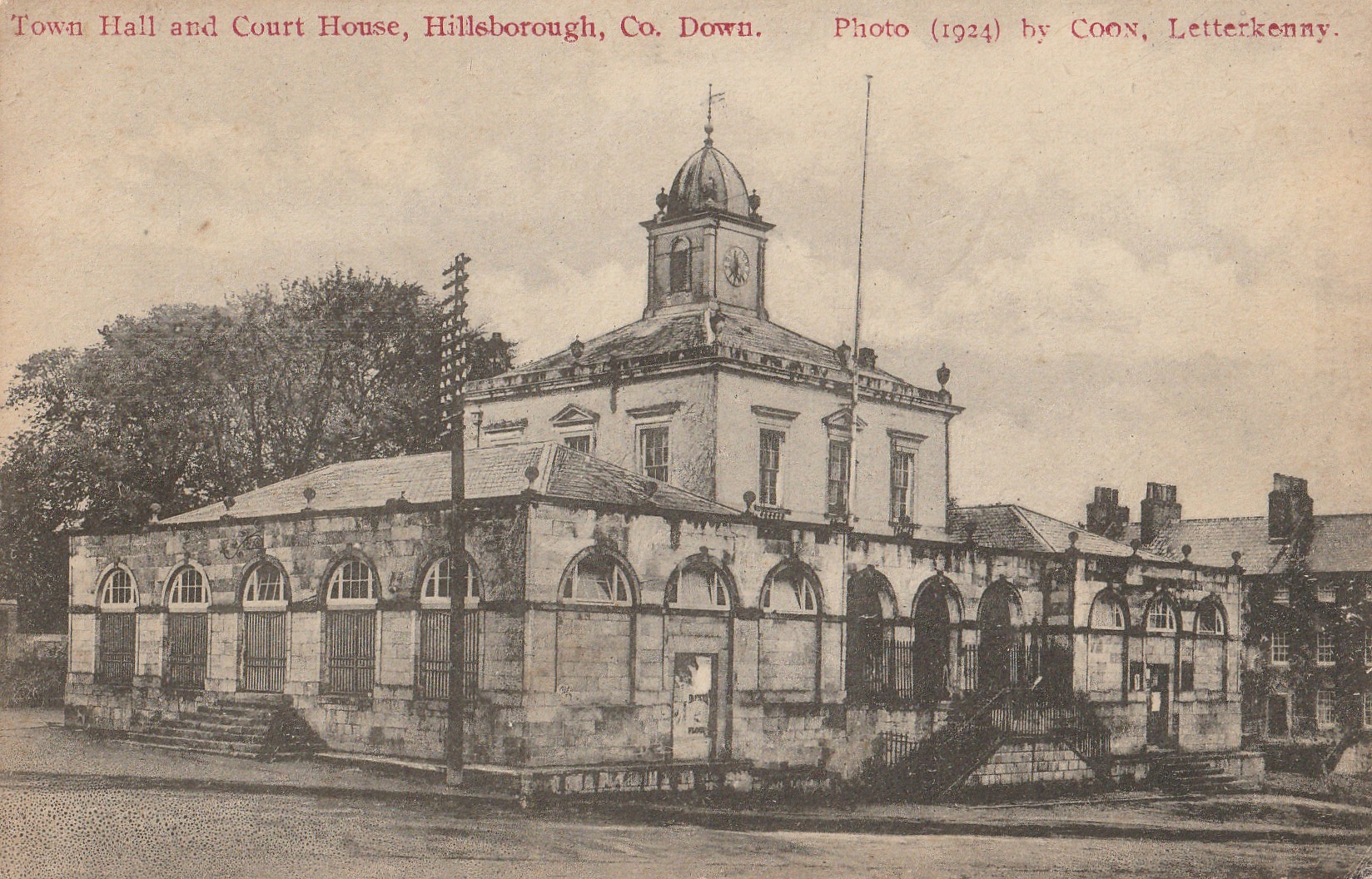
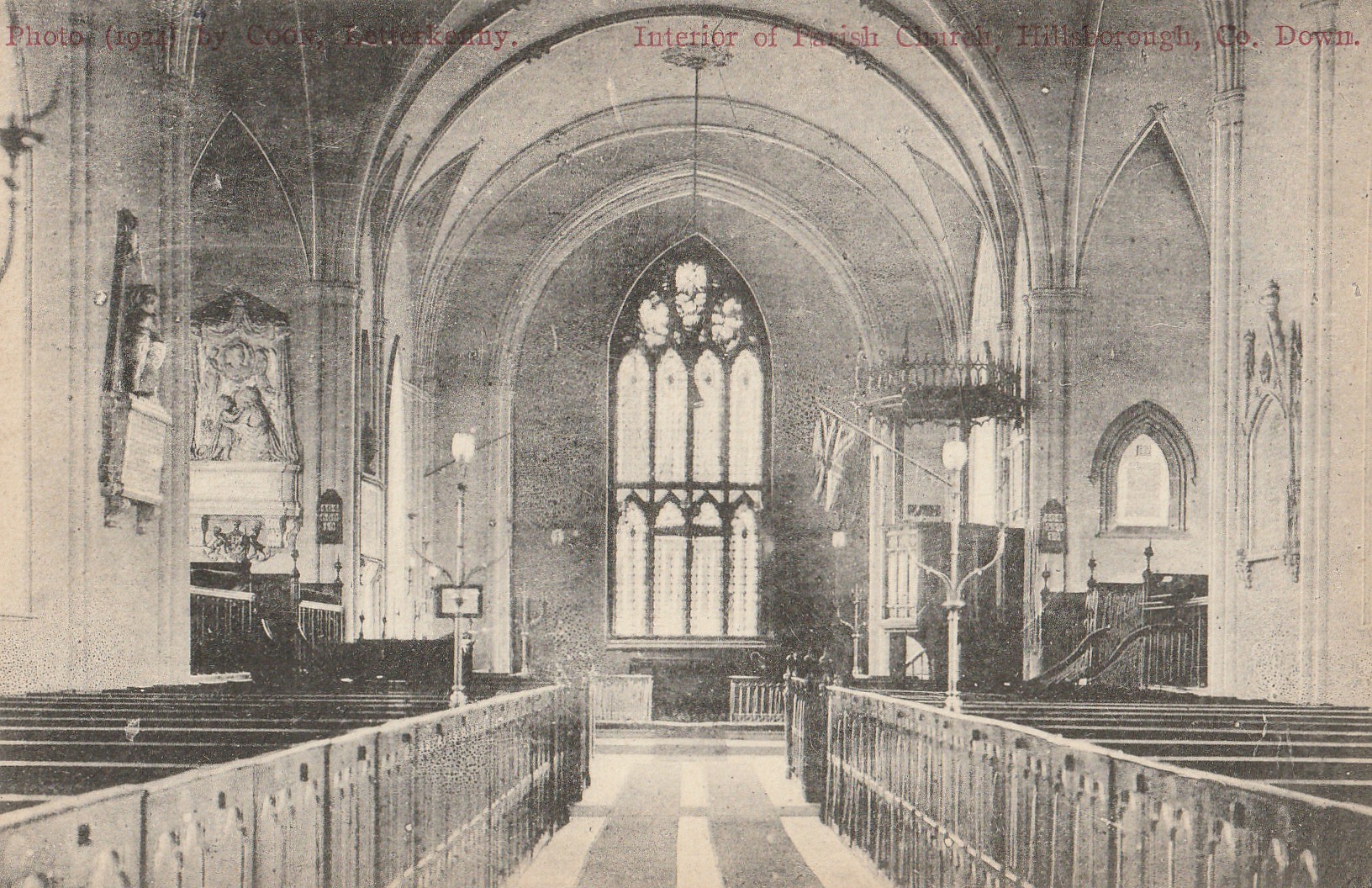
Allen Coon produced a lot of postcards for this part of County Antrim in the later 1920s, in this case giving his location as Moira, NI. Five years earlier his postcards produced for Mrs Johnston, Draper & Boot Merchant, Hillsborough still give his location as Letterkenny:

Town Hall and Court House, Hillsborough, 1924

Interior of Parish Church, Hillsborough, 1924

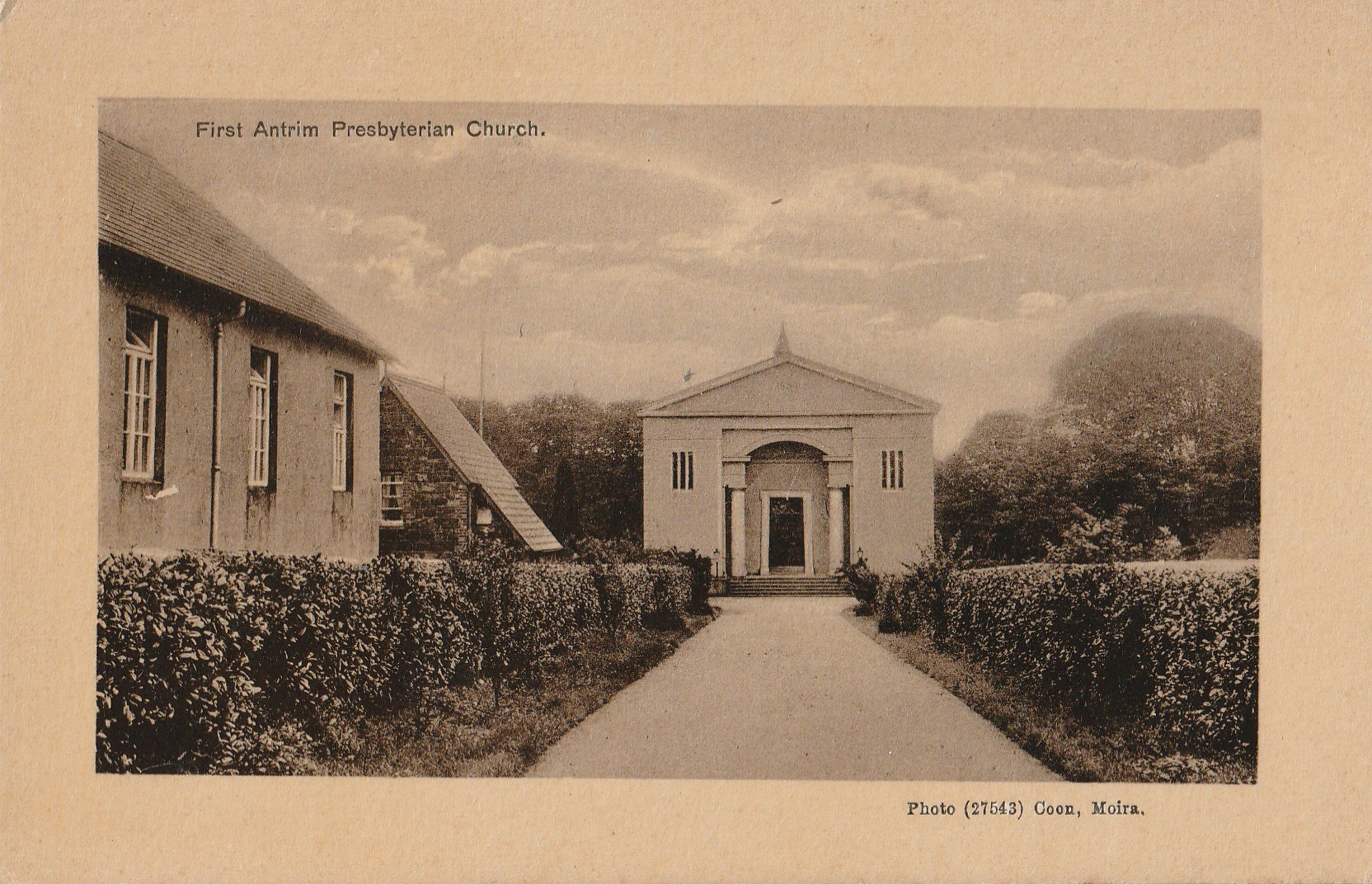
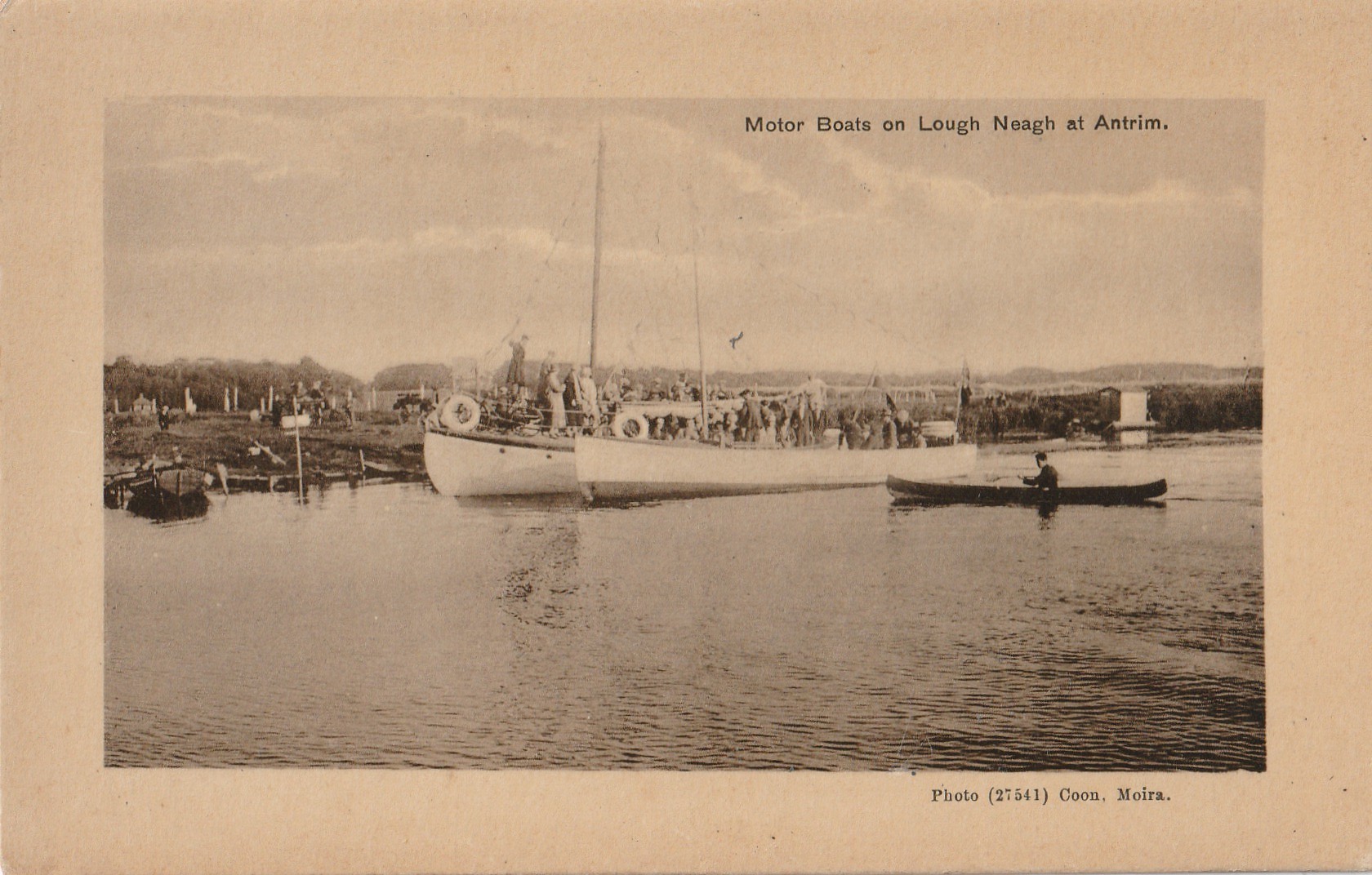
The cards produced in Antrim in 1927 stand out from the others having a large border and a glossy finish. This time they are published for Mrs Simpson, Newsagent and Stationer, Antrim, who must have wanted something different in terms of design. By this time he is well settled in Moira:

First Antrim Presbyterian Church, 1927

Motor Boats on Lough Neagh at Antrim, 1927

Presumably the motor boats were used as pleasure craft taking people on tours of the Lough.

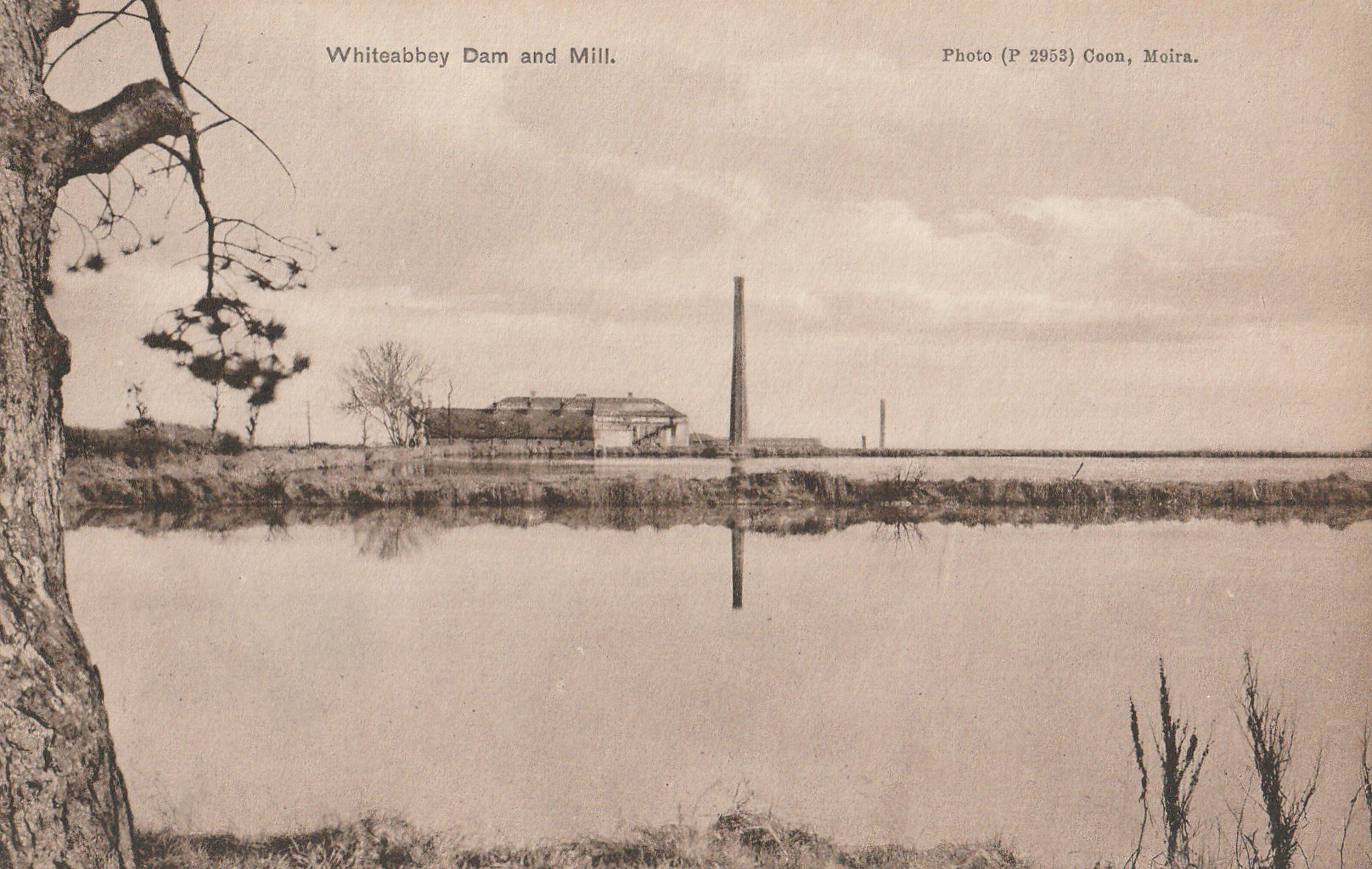
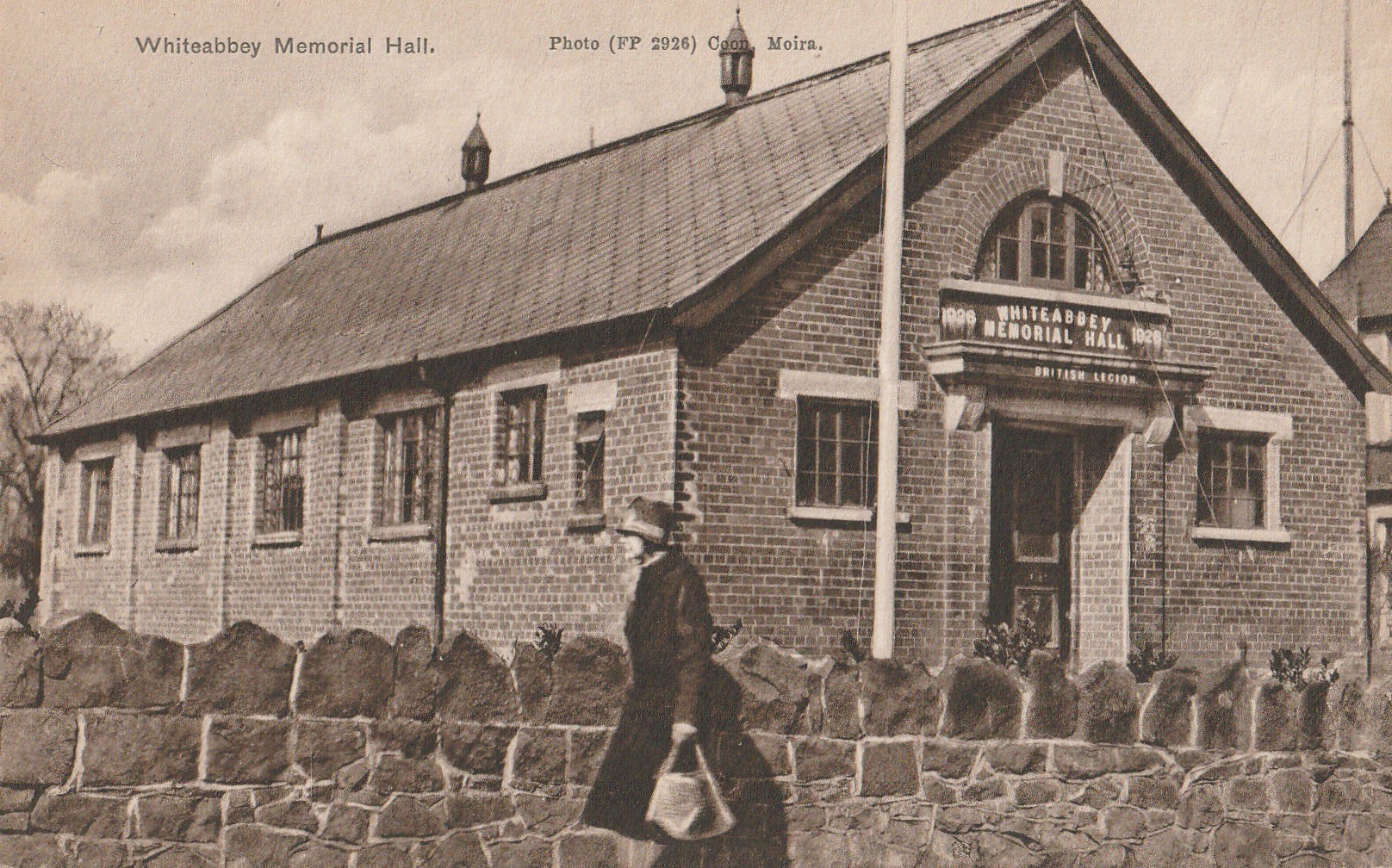
In Whiteabbey in 1929 he produced about 18 postcards for H. Quiery, Newsagent & Tobacconist. He must have exhausted all the possible views of the surroundings.

Whiteabbey Dam and Mill, 1929
Whiteabbey Memorial Hall, 1929

A lot of Allen Coon’s pictures are straightforward architectural treatments of churches or halls. But this one is slightly different in that a passer-by boldly walks into shot in front of the Whiteabbey Memorial Hall (opened just two years earlier in 1927). Was this pre-arranged to add a bit of extra detail? Or did the lady accidently cross into the frame while he was standing there with his camera? If this was an unforeseen intrusion into his picture he must have liked the look of the finished article since he could easily have taken another one. But there she remains for posterity, out on her messages, captured on film.

Allen Daniel Coon (1867 – 1938), Pioneering Photographer and Cinematographer

In this video we take a look at the career of Allen Daniel Coon, one of the pioneers of photography and cinematography in Ulster. The video tells something of his story, with many examples of his postcards, and tracks down his last resting place.

Video: Allen Daniel Coon (1867 -1938) Photographer and Cinematographer

The previous post on this blog is all about Allen Coon’s postcards produced for W.J. Ross of Finaghy Stores in 1927, but these are just a small sample of his vast output produced between his arrival in Ireland in 1902 and his death in 1938.

Allen Daniel Coon was born in Buffalo, New York in 1867. The son of a Baptist pastor and, tradition has it, a native American mother, his career followed a fairly conventional path in its early years. He read law at university and then established himself as an attorney in Buffalo. But at some point he tired of this life and took the road to prospect for gold first in California and then in Alaska. One assumes this was not entirely successful because at some point he took up photography. He was a friend of George Eastman, the founder of Kodak, and may have been related to him. Either way he travelled to England with him in 1900 moving to Ireland a couple of years later to set up his own photography business.

This was right at the beginning of the boom in the sale of postcards. In 1902 you could send a picture postcard for a halfpenny and expect it to be at a local destination at lunchtime. For skilled photographers the opportunities were obvious and operating initially from Londonderry, later from Letterkenny and ultimately from Moira (each place was printed as his location on the front of his postcards) he produced hundreds of postcards of impressive views, street scenes, local landmarks, prominent buildings and sometimes interesting people.

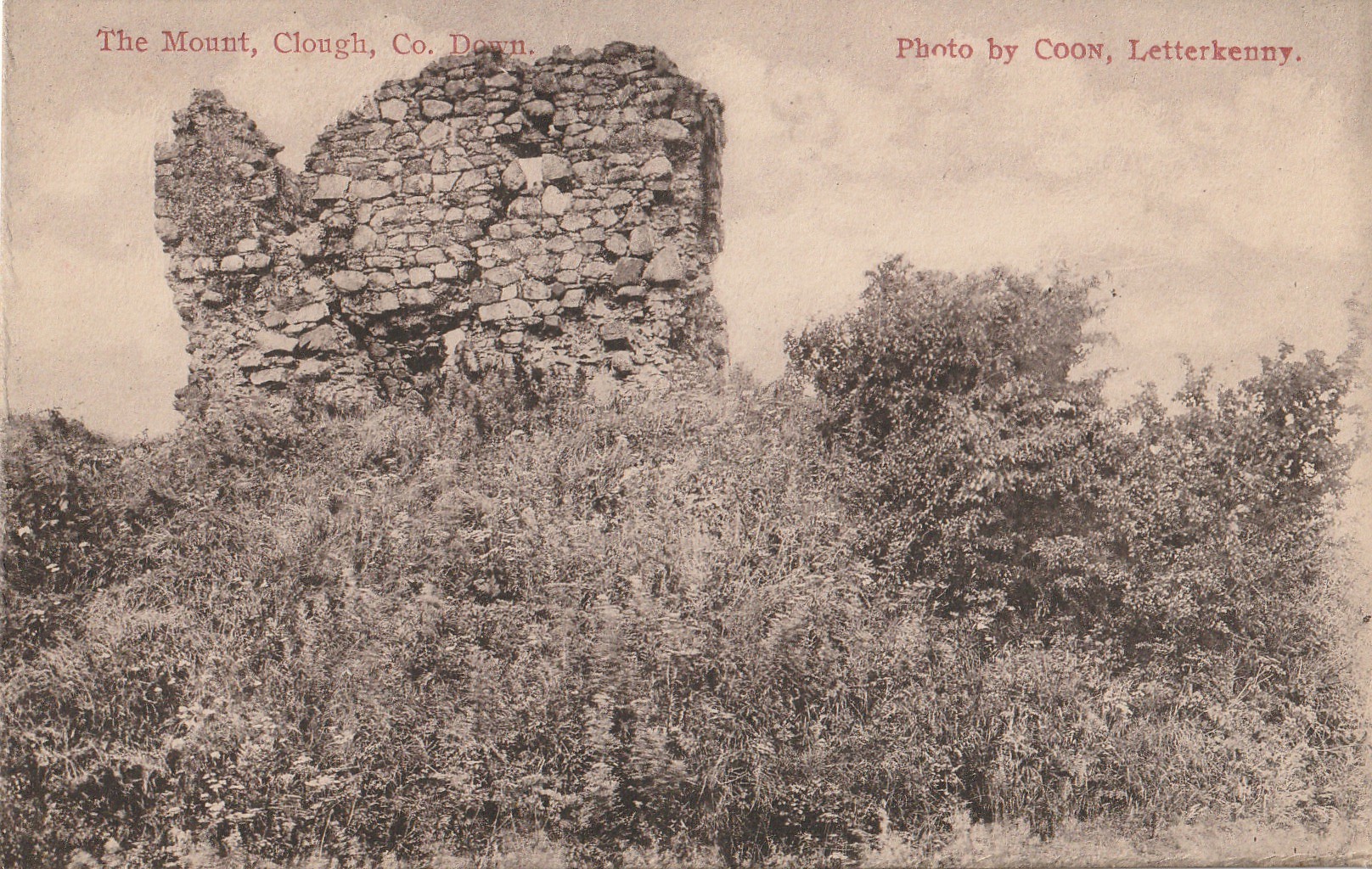
Clough Castle (no publisher listed on the back)

It is recorded that he charged local traders less than £5 for 2,000 postcards, which also included their name on the back of the card. From about 1924 he started numbering the cards starting with the last two digits of the year they were produced which is very helpful in dating the cards.

In the Census of 1911 he was recorded as living with his wife of three years, Clara, at Church Wall, Londonderry where he recorded his profession as Photographer and Theatrical Showman. Also recorded were their two eldest children (Gladys and Gaynor) and the fact that while his wife was a Presbyterian he declared himself to be an agnostic.

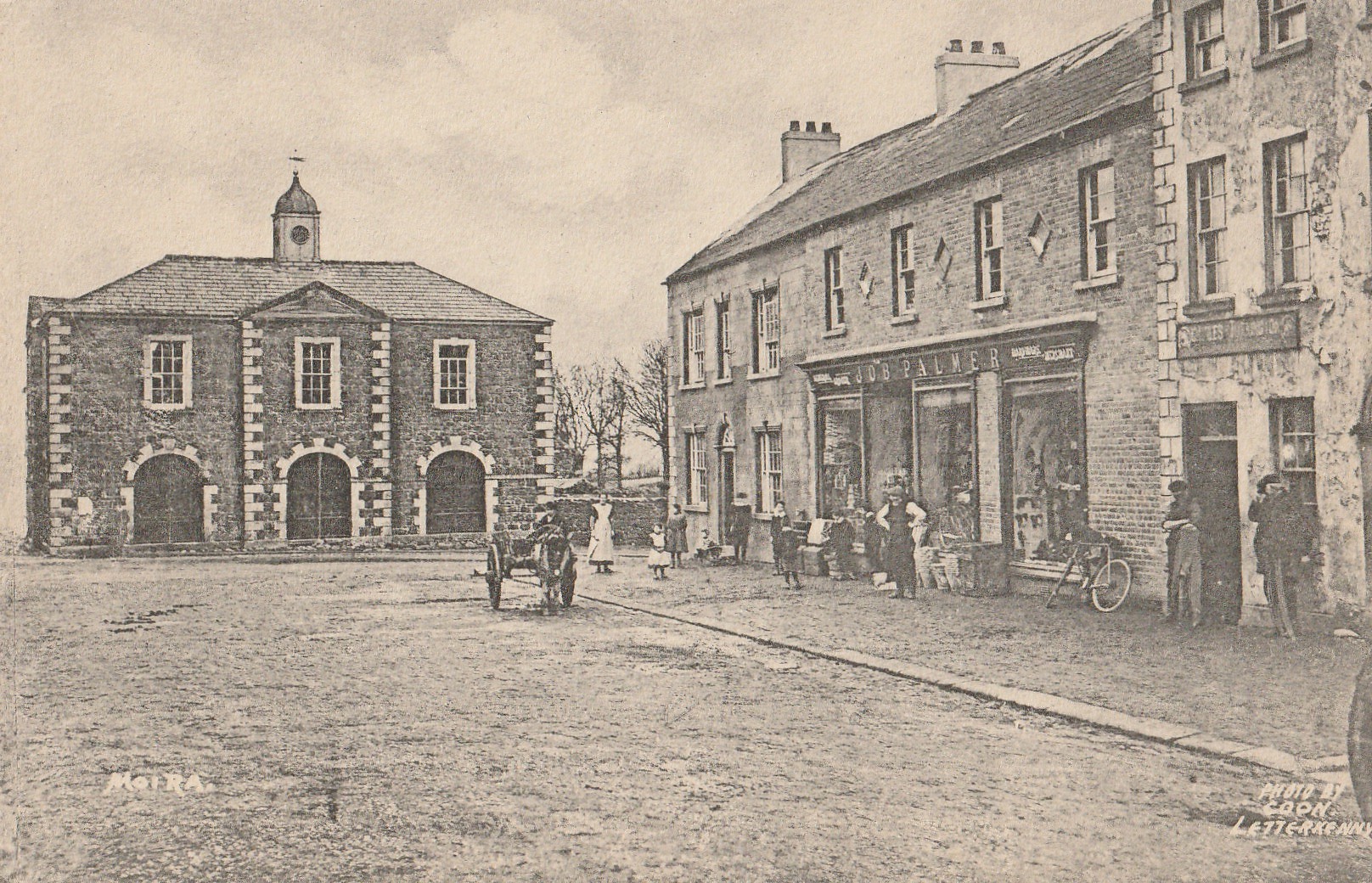
Moira Market House, published by Job Palmer, General Trader, whose shop can be seen on the right

The Theatrical Showman side of his profession was not an idle boast. Although his income from postcard sales must have been steady he was also perpetually ‘on tour’ travelling all over the north of Ireland with his camera and darkroom, setting up in towns as he went to film moving pictures and then show them to a fascinated populace along with films of Charlie Chaplin and other entertainers. In fact he also seems to have had an interest in some of the earliest cinemas established in county Donegal and in Belfast but his commitment to travelling from town to town with his films never waned right up to his death.

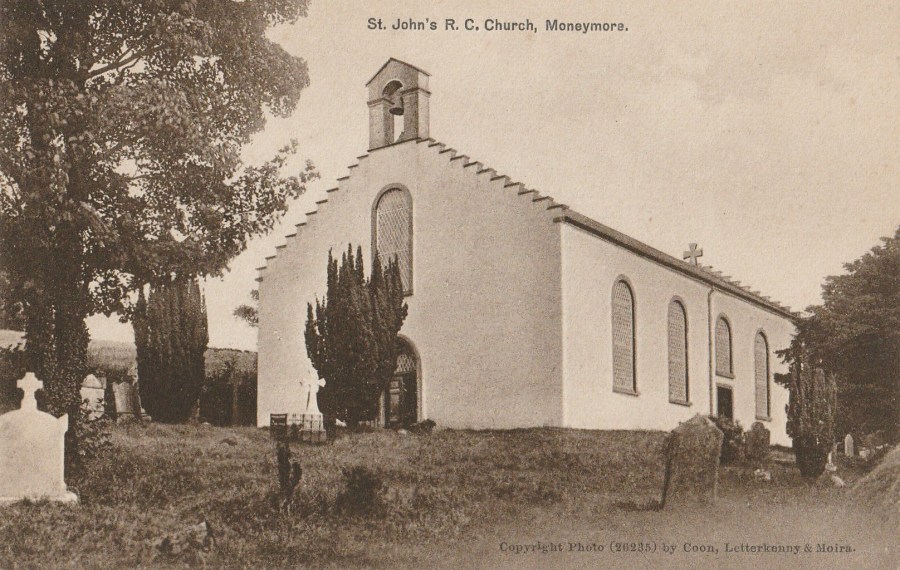
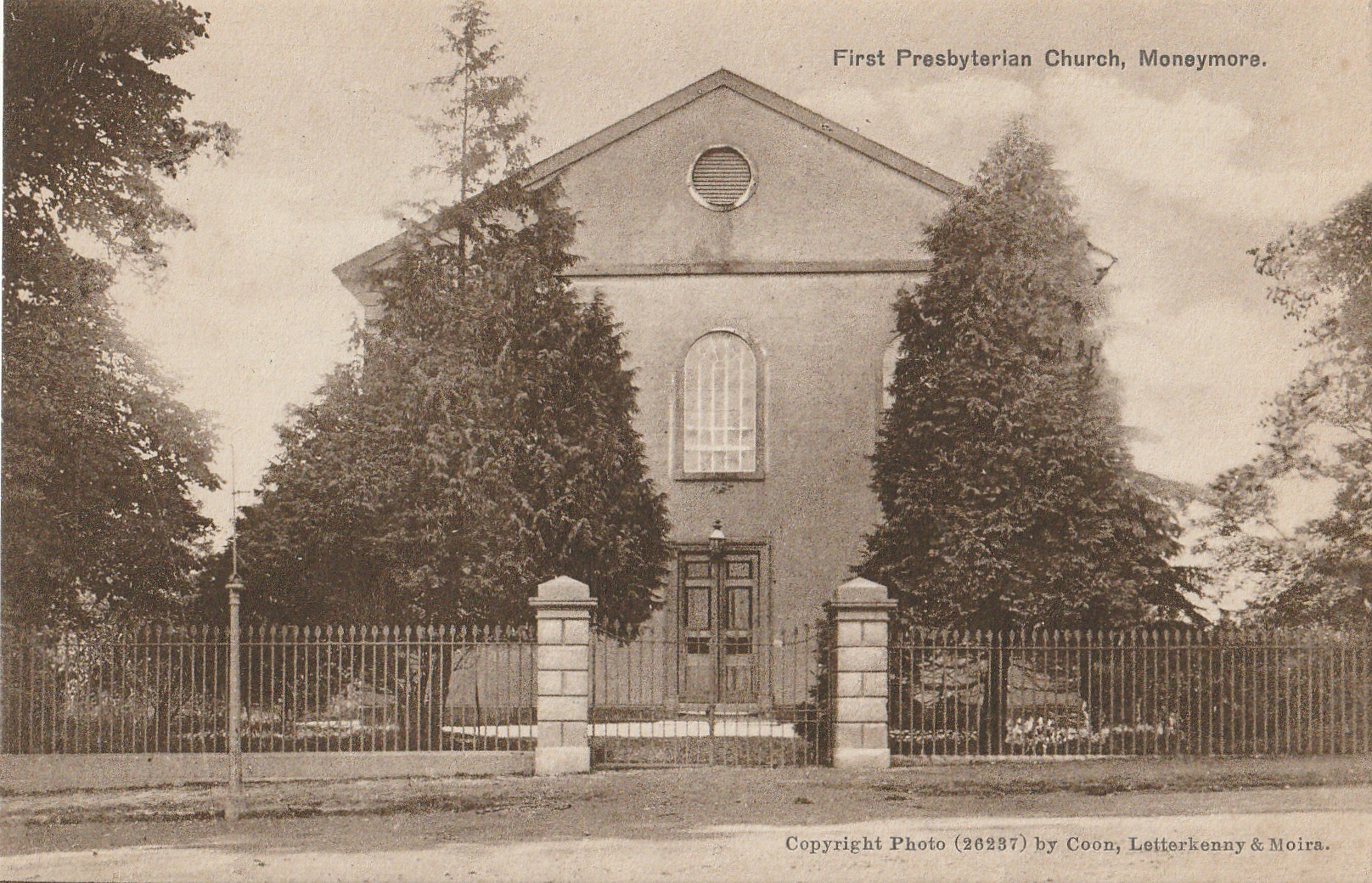
Moneymore, First Presbyterian Church (‘Published by Coon for Devlin, General Merchant, Moneymore’)

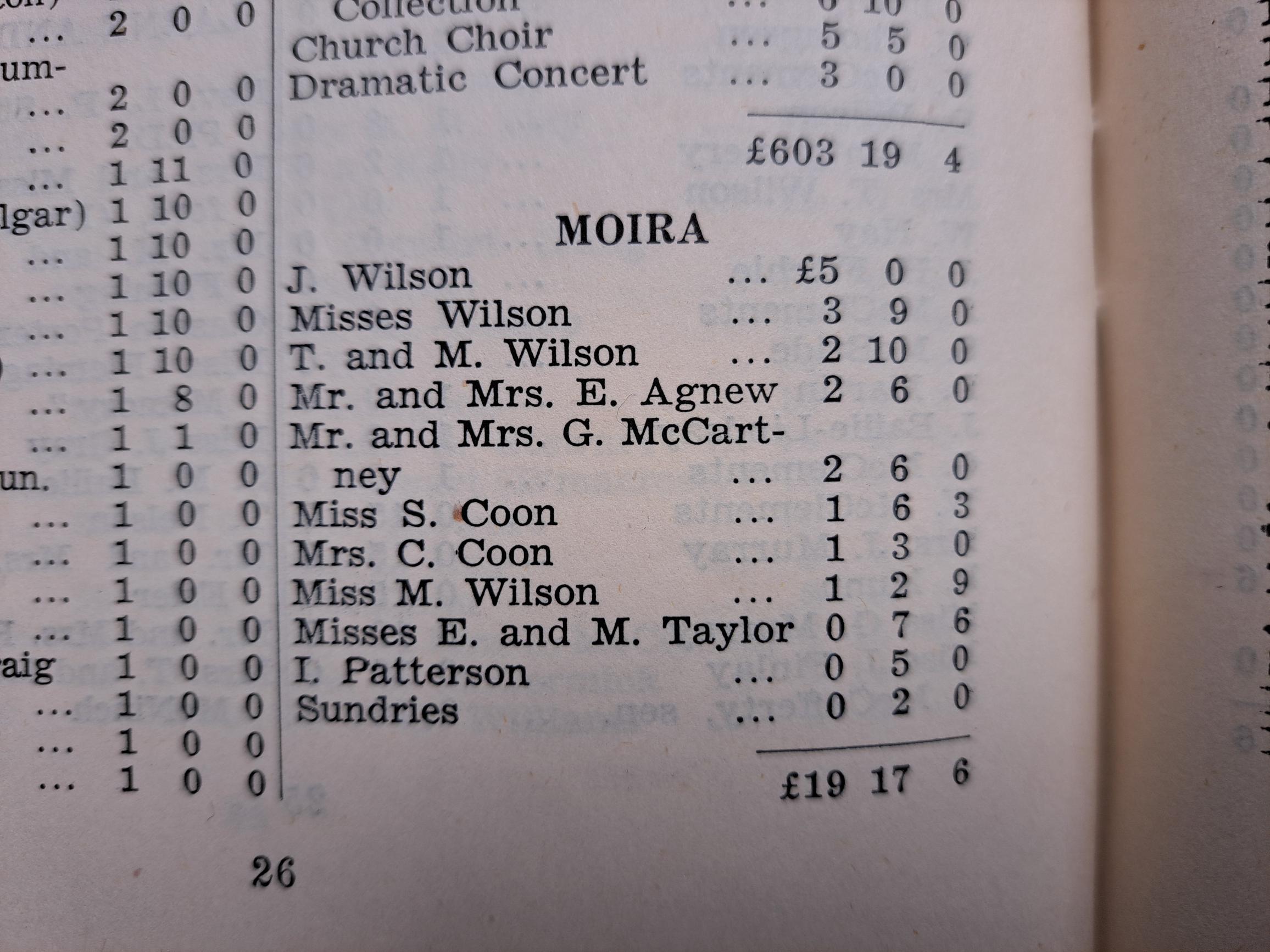
After partition he moved from Letterkenny to Moira and was ultimately buried there in the Non-Subscribing Presbyterian Church graveyard after his sudden death while on tour in Sligo. It is clear that his family had a close association with the Church, other family members are buried in the churchyard, but in the 1940s when the Non-Subscribing Presbyterian denomination launched a tercentenary appeal for the Sustentation Fund (1642 – 1942), Allen Coon’s wife Clara and his daughter Sylvia were amongst the members of the little congregation at Moira who gave their support. Indeed Miss Sylvia Coon was also one of the two local appeal officials for Moira.

Donations from Moira to the NSPCI Tercentenary Sustentation Fund Appeal, including Clara and Sylvia

Postcards from Finaghy – and the Moore family of Finaghy and Dunmurry

Following our postcard views of Dunmurry in the 1930s I thought I would post some postcards from a place a short distance away; pictures of Finaghy, which probably date from a few years before, and which we know were taken by Allen Daniel Coon of Letterkenny and Moira.

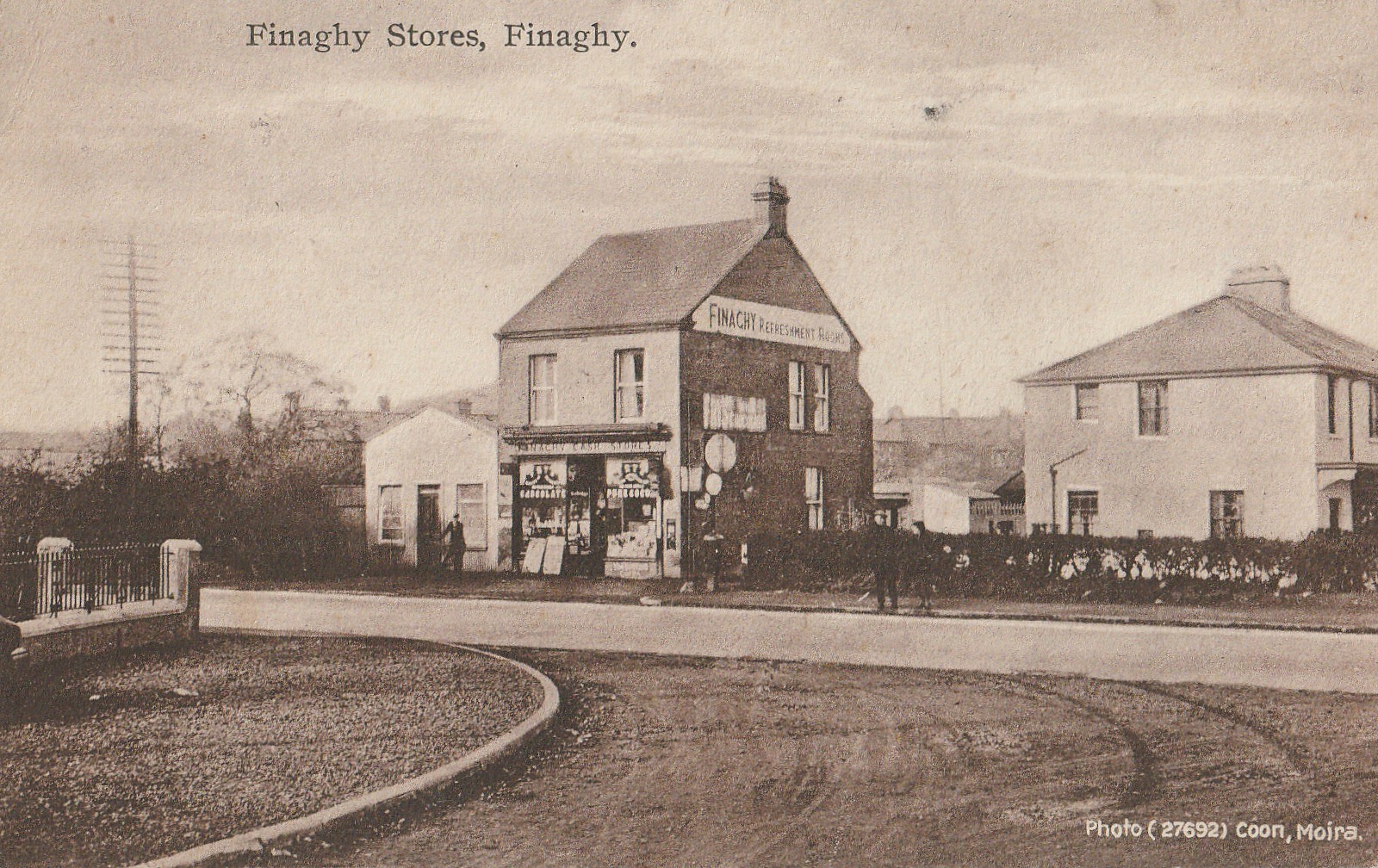
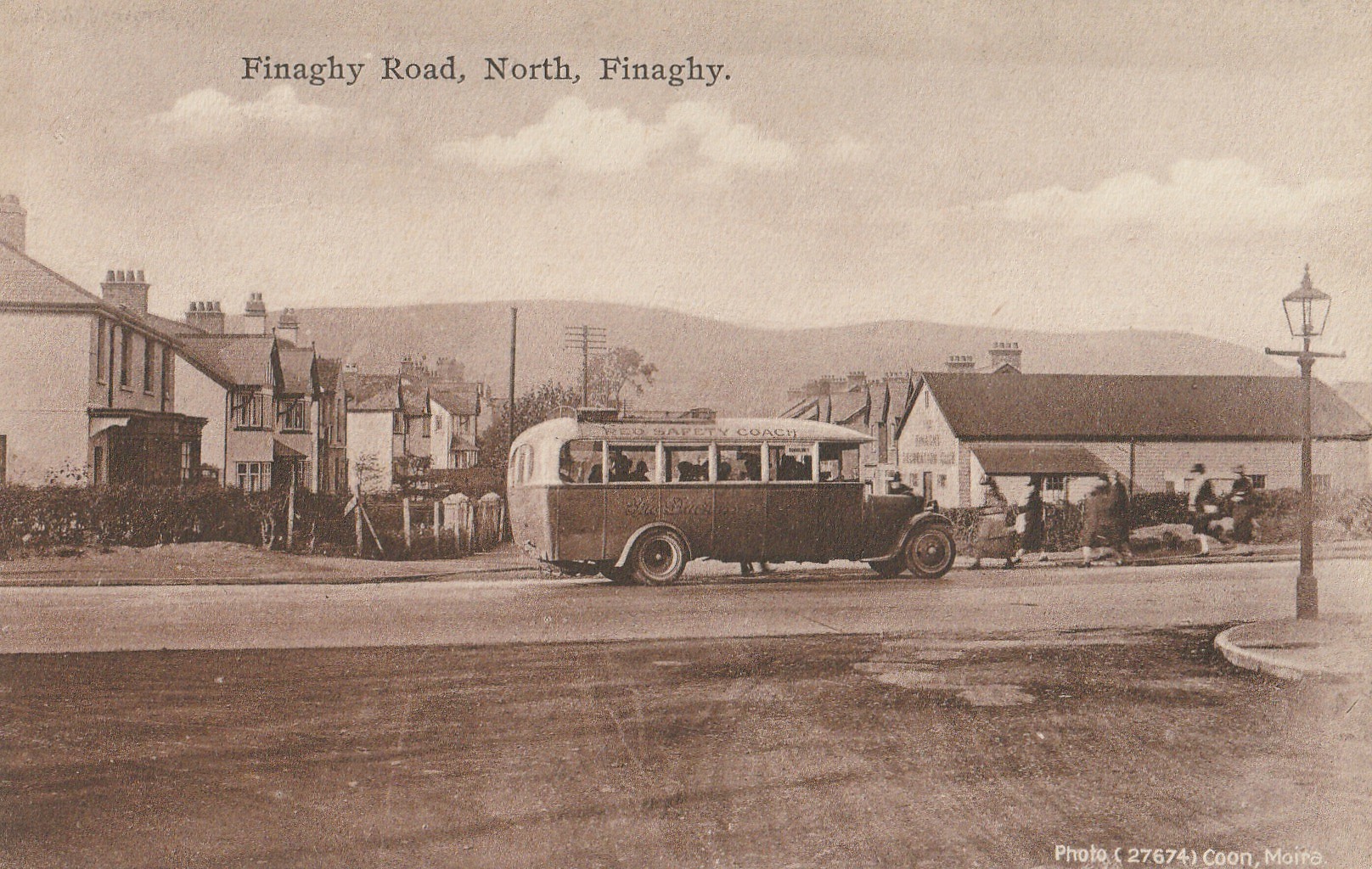
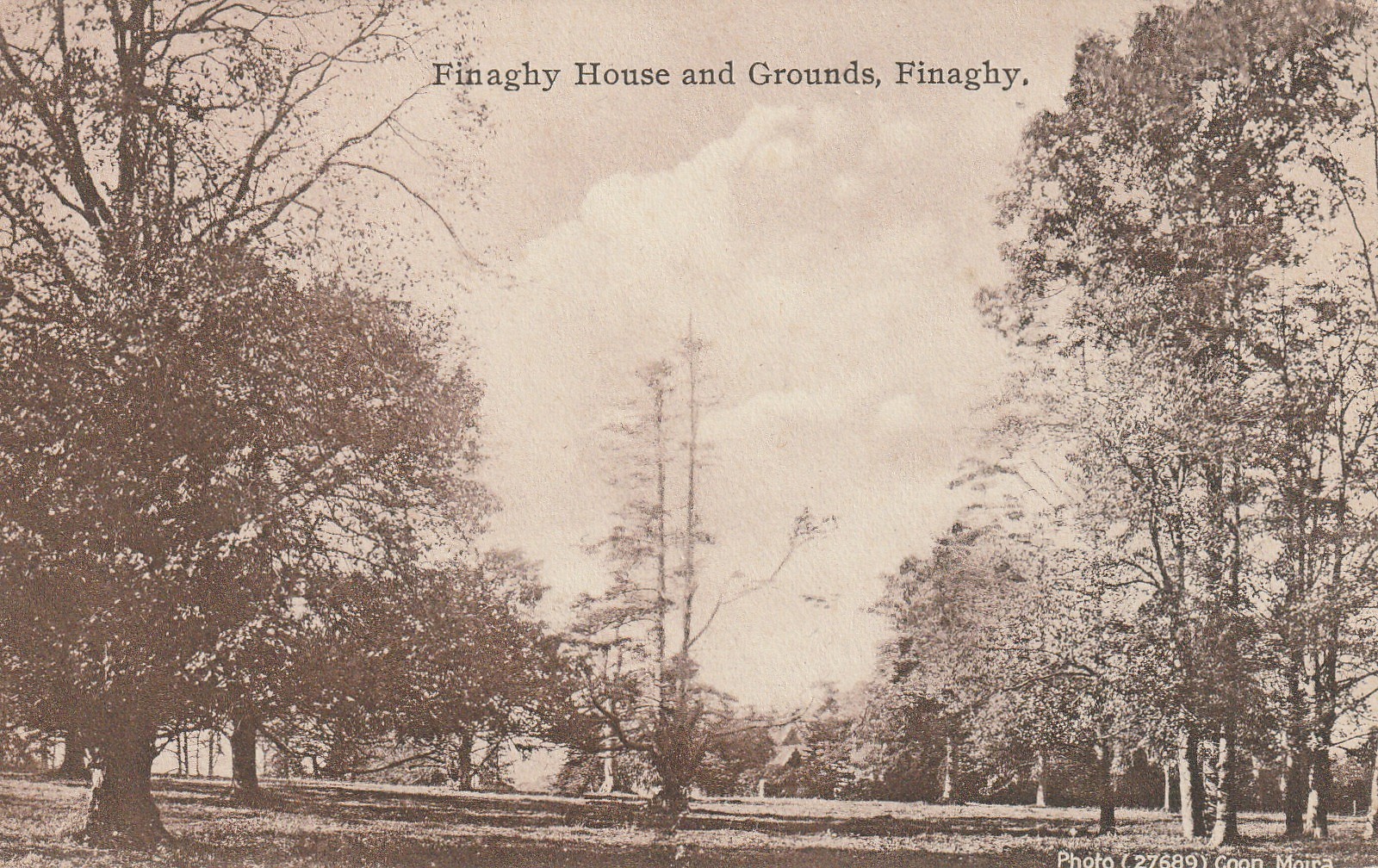
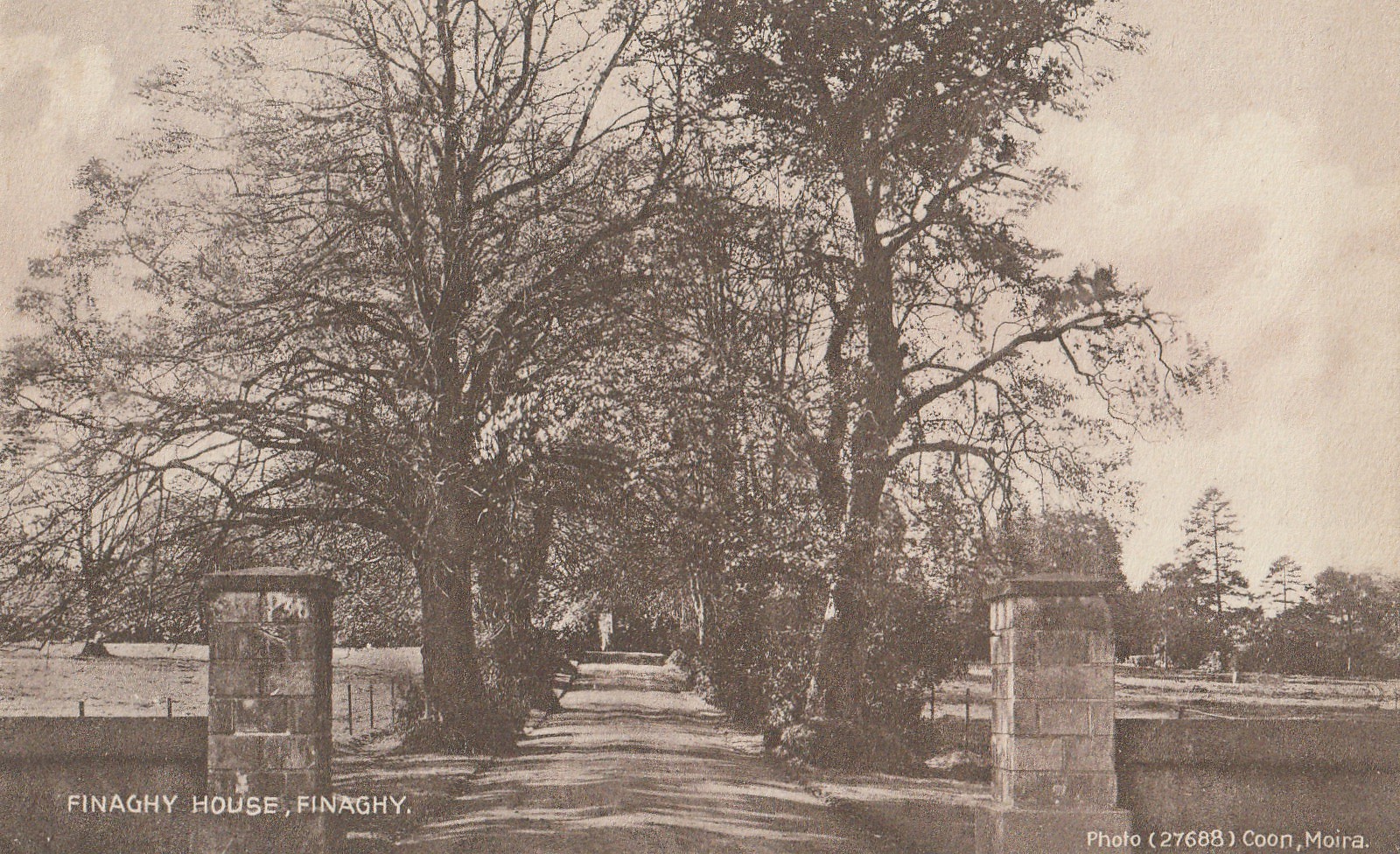
The numbering system on the four cards is believed to point to a date in 1927 for their production. According to the excellent catalogue of Allen Coon’s cards produced by Brian Hamilton in 2016 there were five cards published in this series for W.J. Ross of Finaghy Stores but I only have four of them. These four images are quite common but I have to admit that I have never seen an example of the fifth card which is named as ‘Finaghy Road South looking North’.

Finaghy Stores, Finaghy

The ‘Finaghy Stores’ postcard shows a solitary shop, that of W.J. Ross’s Cash Stores and Refreshment Rooms. It stands out very prominently in those days, but later had another shop joined to it and was surrounded by a number of other shops, including a couple of banks. The shop was well known to me in more recent times when it belonged to John Frazer, an active member of All Souls’ Church when I was minister there.

Finaghy Road, North, Finaghy

The postcard ‘Finaghy Road, North, Finaghy’ looks across the crossroads to Finaghy Road North and dates from a time when there was so little traffic that a bus could stop in the middle of the road to pick up passengers to be taken into town. This view has essentially not changed except for the addition of shops on one side and what was a bank on the other side of the road.

The other two postcards are a little more curious. Named as ‘Finaghy House’ and ‘Finaghy House and Grounds’, they could more accurately be titled ‘Finaghy House gateposts’ and ‘Finaghy House Grounds’ since neither card features any more than the merest suggestion of Finaghy House.

Finaghy House and Grounds

This is a pity really because Finaghy House will have been a major landmark at the time. Lord Belmont in Northern Ireland tells us all about Finaghy House in his excellent blog which you can read here. He tells us that the original house was built by Richard Woods at the end of the seventeenth century but was sold to the Charley family, a prominent linen family in 1727. Lord Belmont quotes the 1830 Ordnance Survey Memoirs as saying ‘the walls are nearly four feet thick and run together by grouted lime, similar to other ancient buildings.’ A descendant of the family said it was ‘an imposing mansion in a large park, with extensive outhouses and stables … a remarkable feature [of the interior] being a revolving fireplace between the drawing-room and the dining-room.’ The Charley family sold the house to a family named Brewis who, it is said, bred corgis, one of which had the distinction of being the first corgi owned by Queen Elizabeth, The Queen Mother.

In about 1890 Finaghy House was sold to James Moore and this is where a connection can be found with the Non-Subscribing Presbyterian Church of Ireland. James Moore was a direct descendant of Rev Henry Montgomery and the family were all members of our church at Dunmurry. In the 1901 Census he is listed as a Manufacturing Stationer living with his wife, Maria Lydia, who had been born in New Orleans. They and their three children (Harold Montgomery, Kenneth Montgomery and Sybil) all give their religion as Unitarian. As well as the five family members there are three servants listed as resident in the house. Harold and Kenneth are respectively stationer’s assistant and stationer’s apprentice to their father in 1901, Sybil is still at school. By the 1911 Census the three children are no longer living at home although there are still three (different) servants; a parlour maid, a cook and a housemaid.
Finaghy House by A.D. Coon

By 1911 James Moore was a JP in County Antrim. In the First World War Kenneth Montgomery Moore was commissioned into the 11th Battalion Royal Irish Rifles and was awarded the Military Cross. He returned home safely at the end of the war and his name is listed in the First World War Roll of Honour of the Non-Subscribing Presbyterian Church of Ireland  (published 2018).

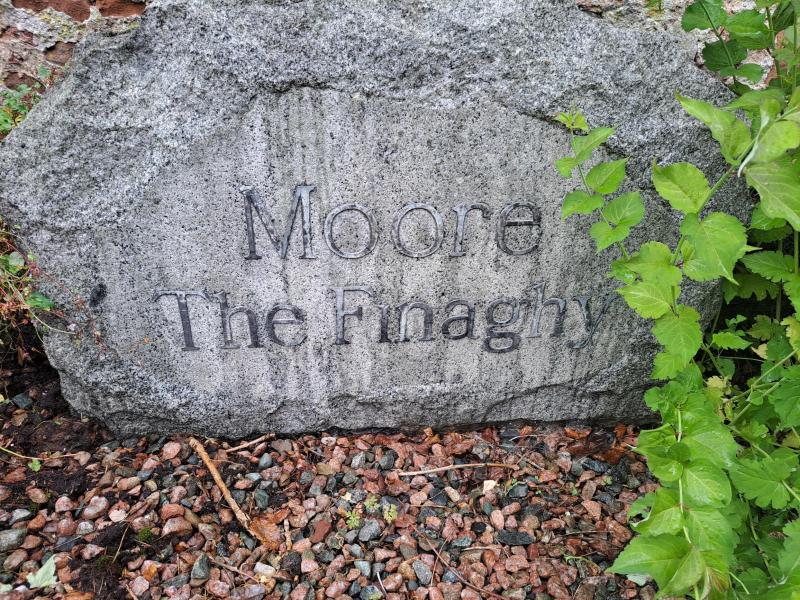
The Moore family burial ground can be found in their church, the First Presbyterian (NS) Church, Dunmurry. Marked simply as ‘Moore, The Finaghy’ it can be seen at the top of this page.

Dunmurry Postcards

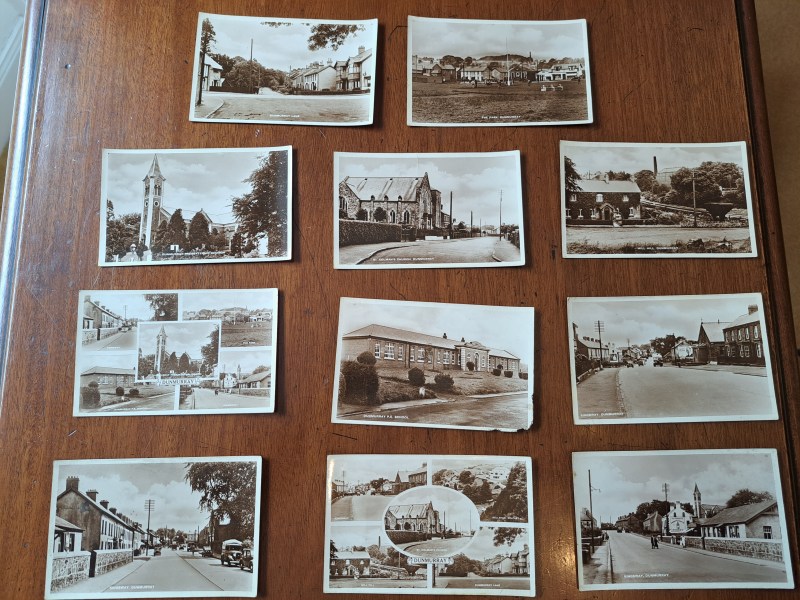
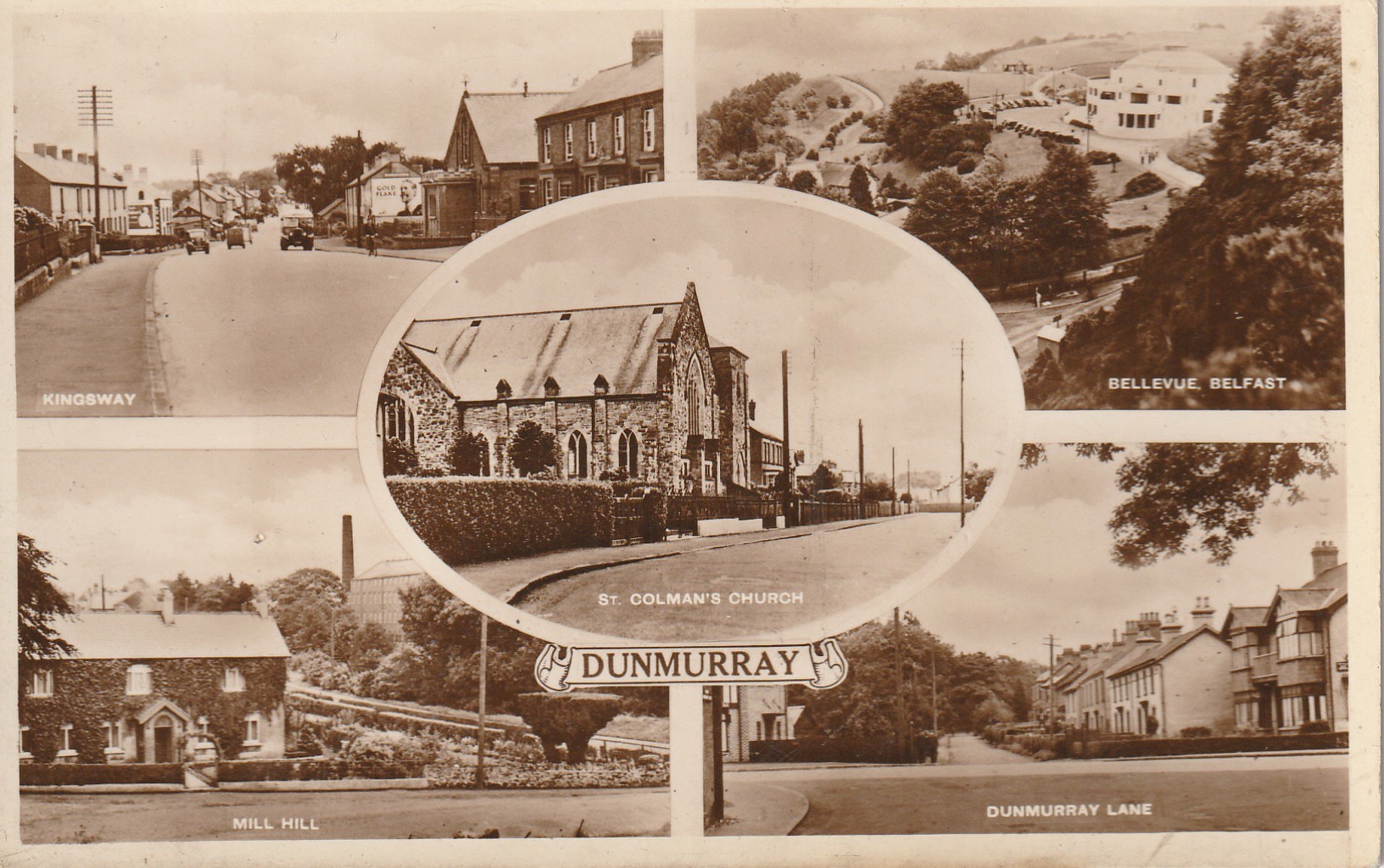
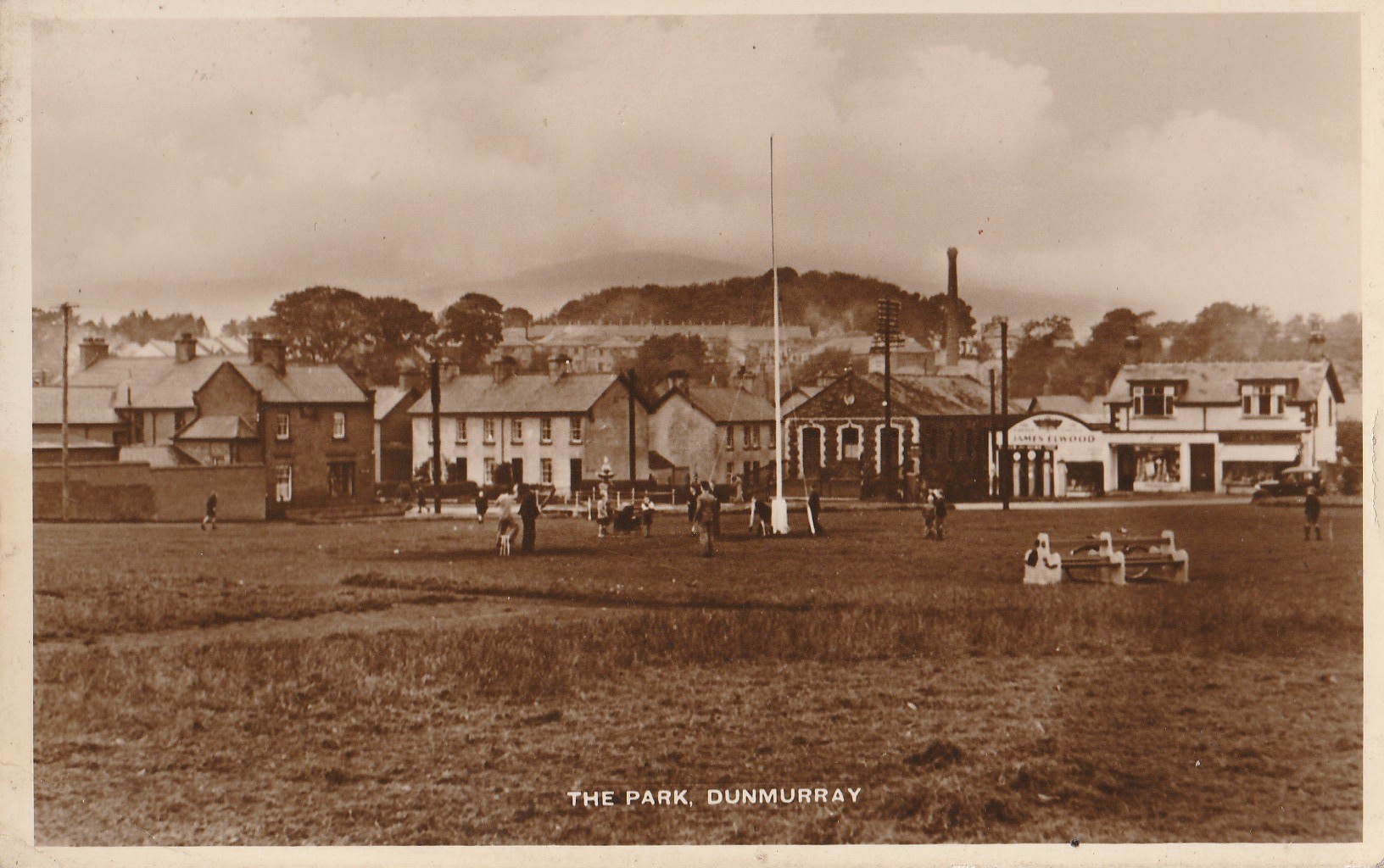
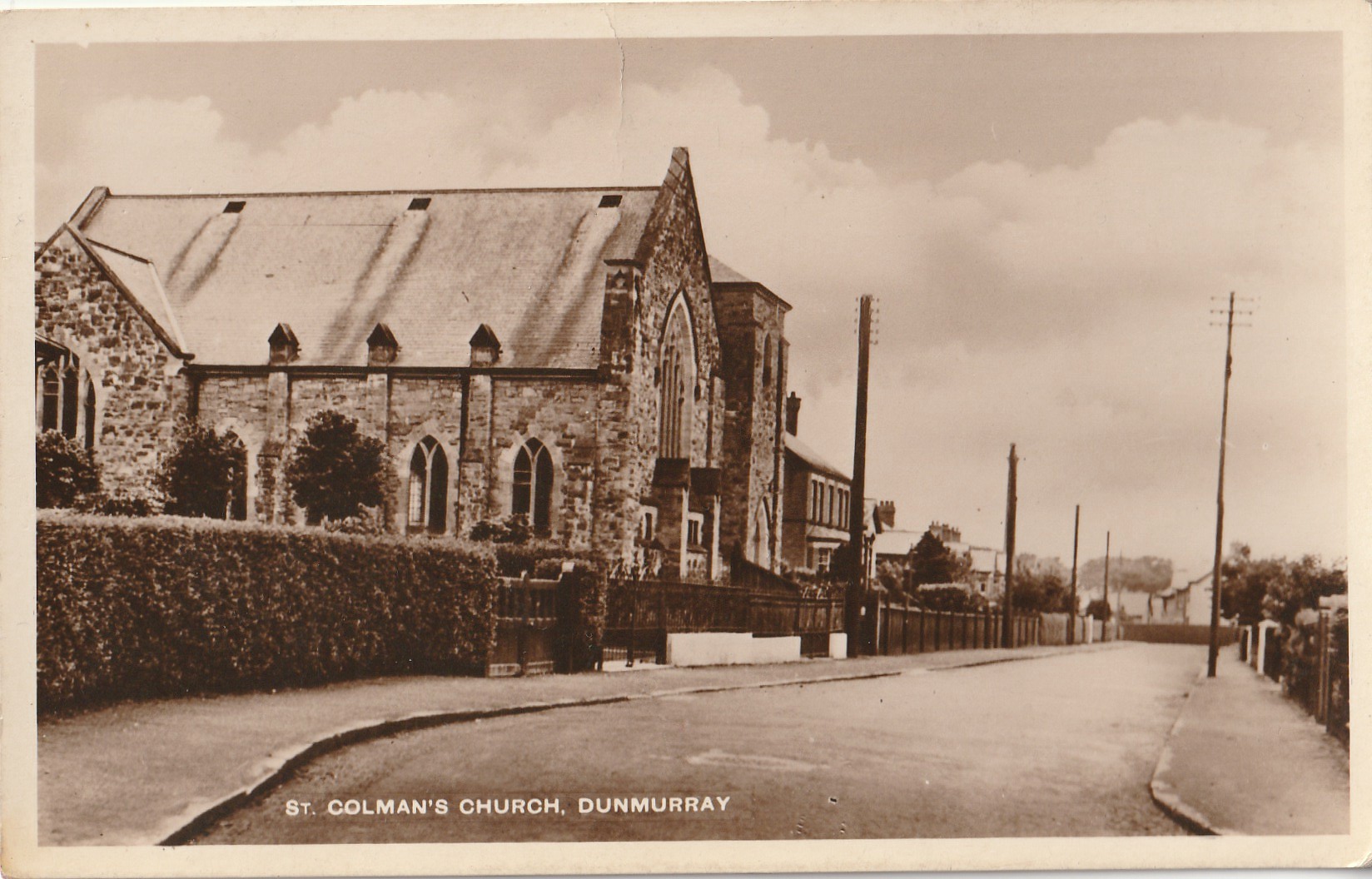
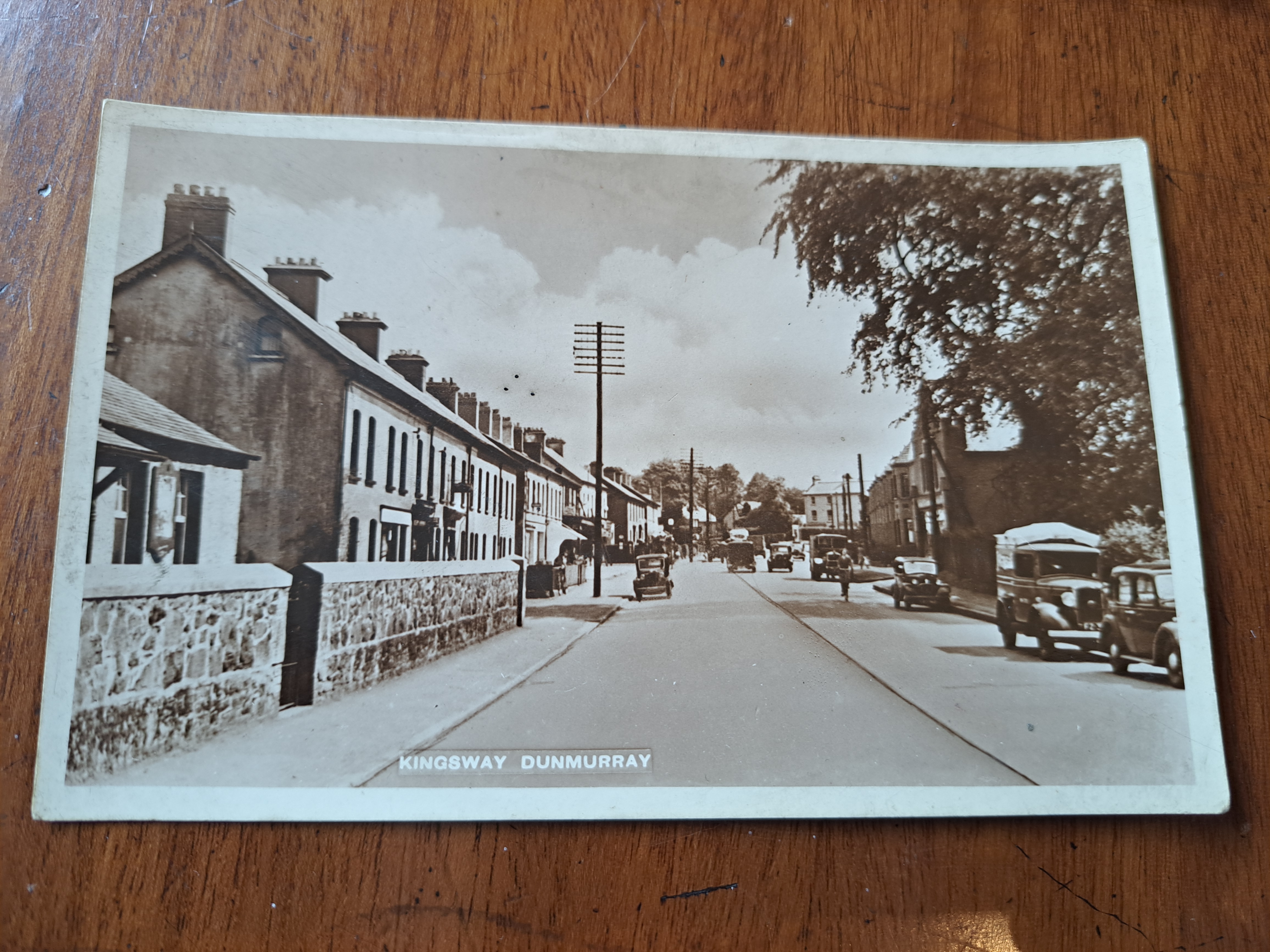
We have a good collection of postcards of Dunmurry in our Library at First Dunmurry (Non-Subscribing) Presbyterian Church. The following video tells their story:

Here are the postcards:

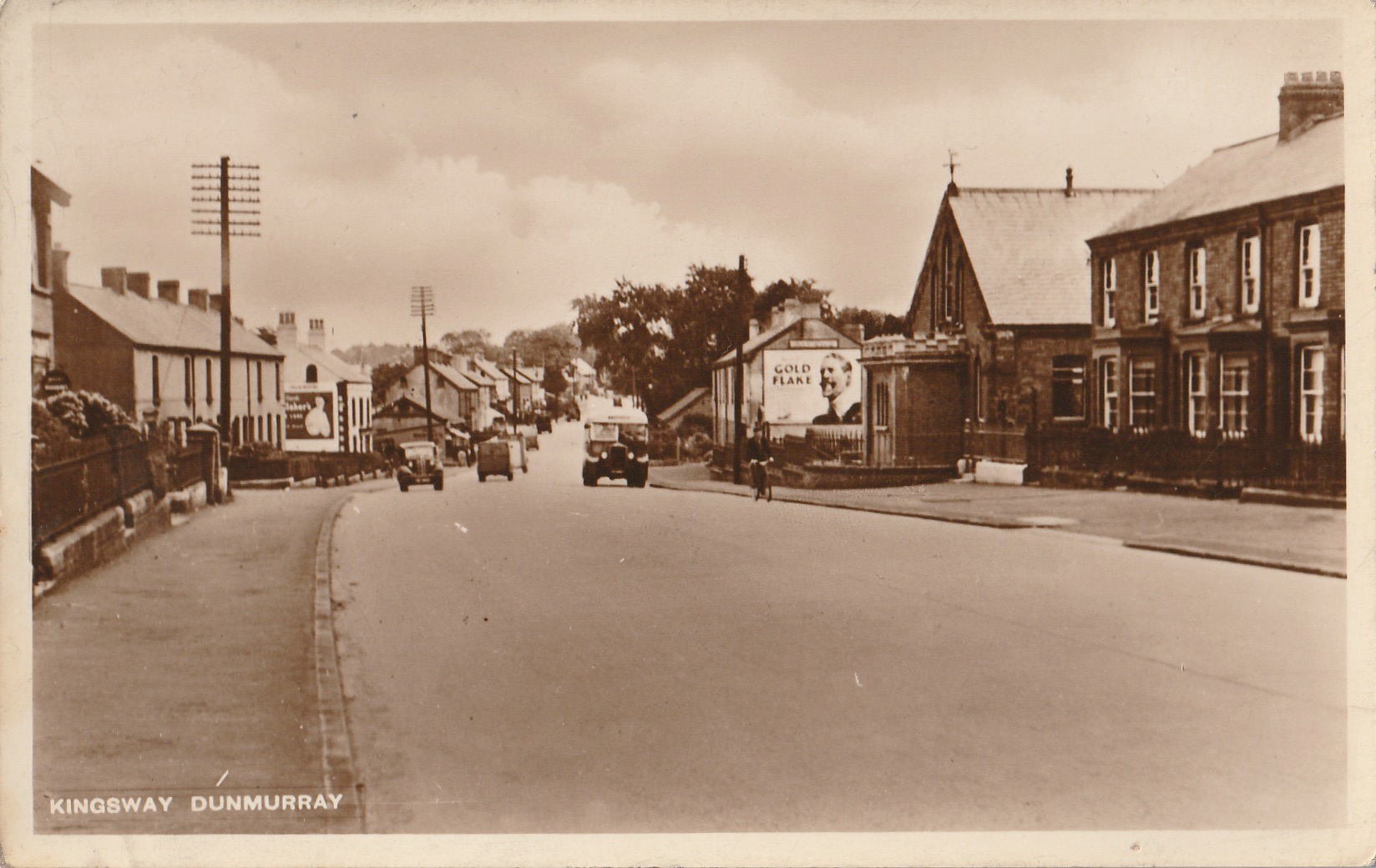
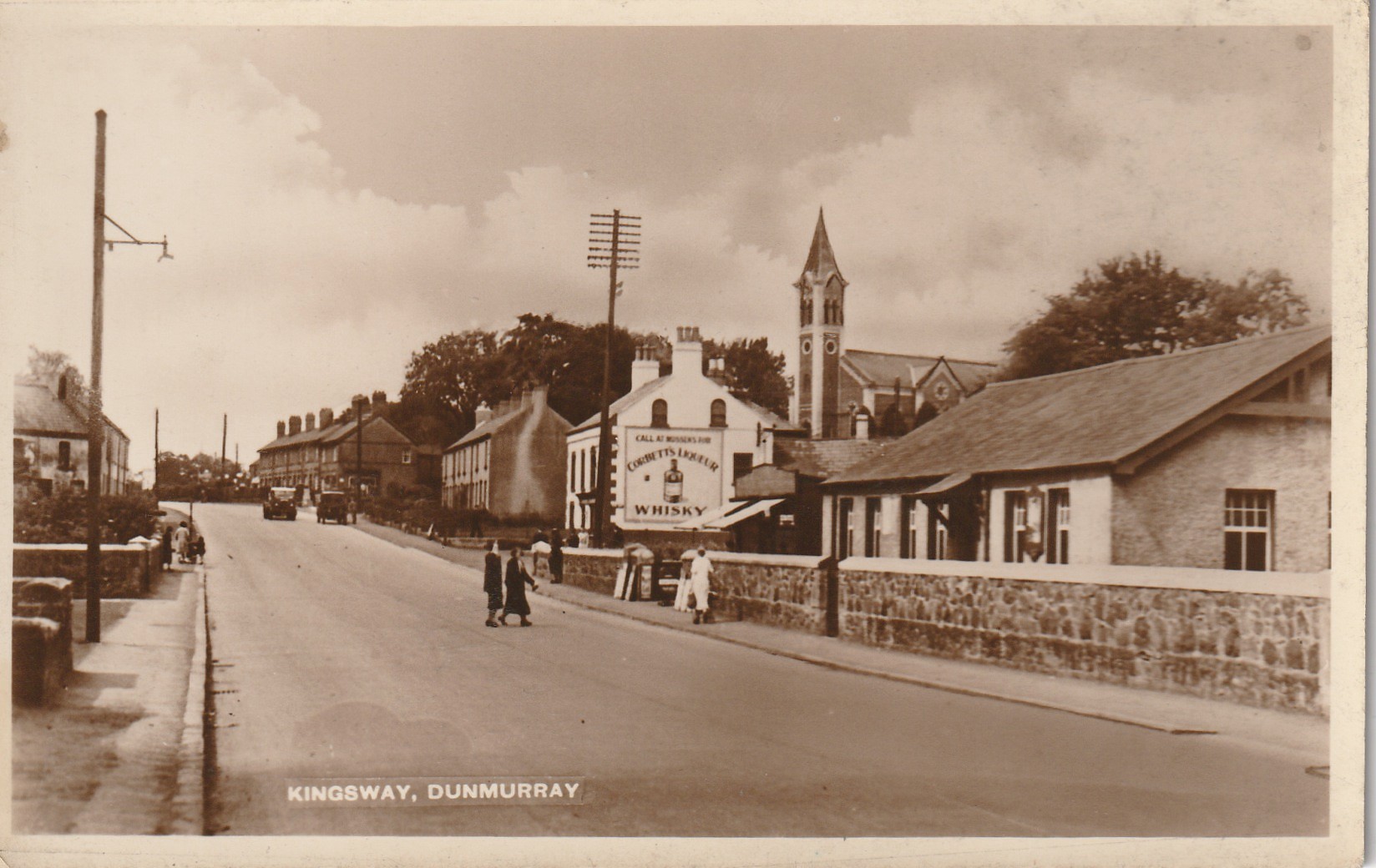
Kingsway 1
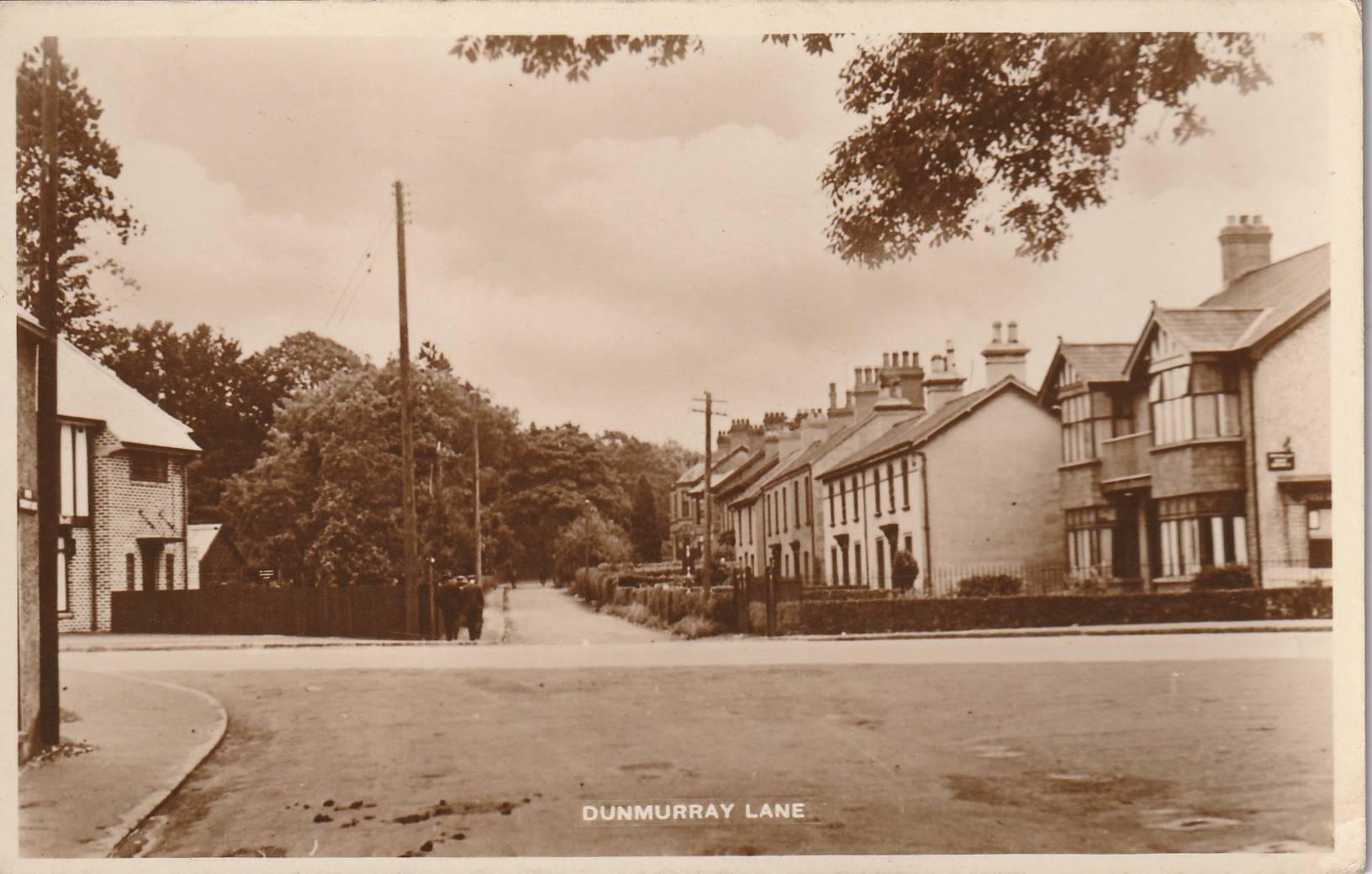
Dunmurry Lane
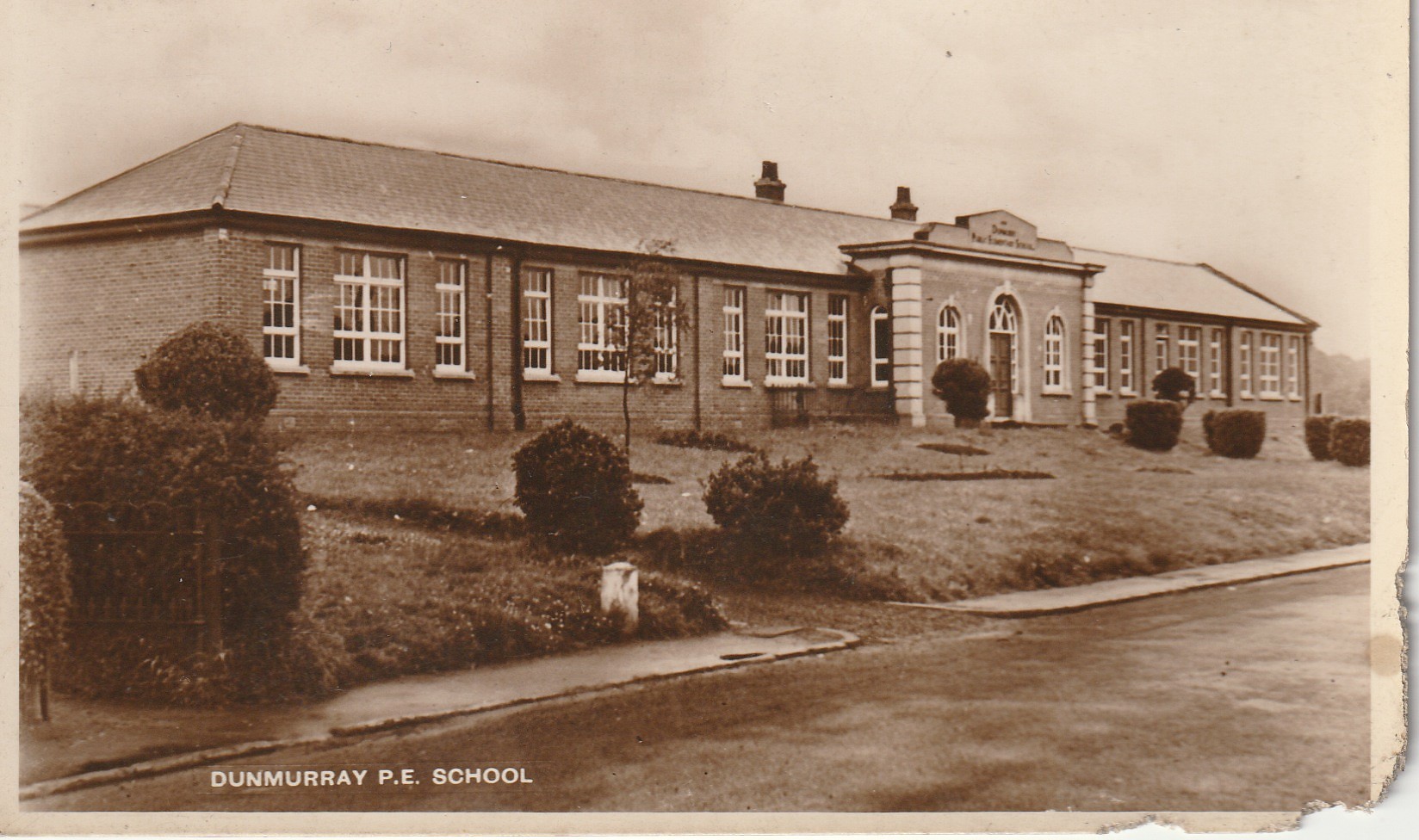
Dunmurry Primary School
Kingsway 2
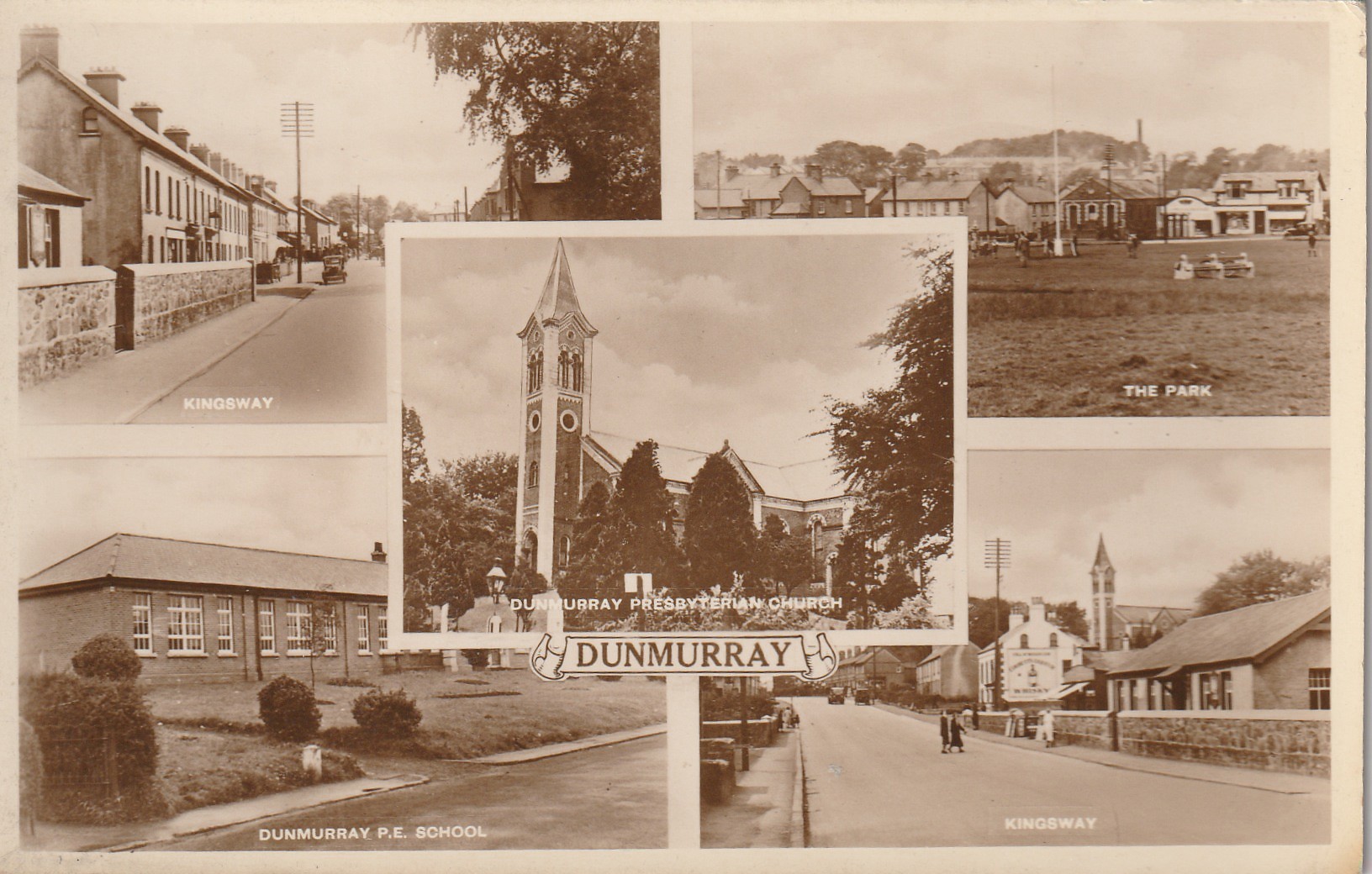
Multi-view 1
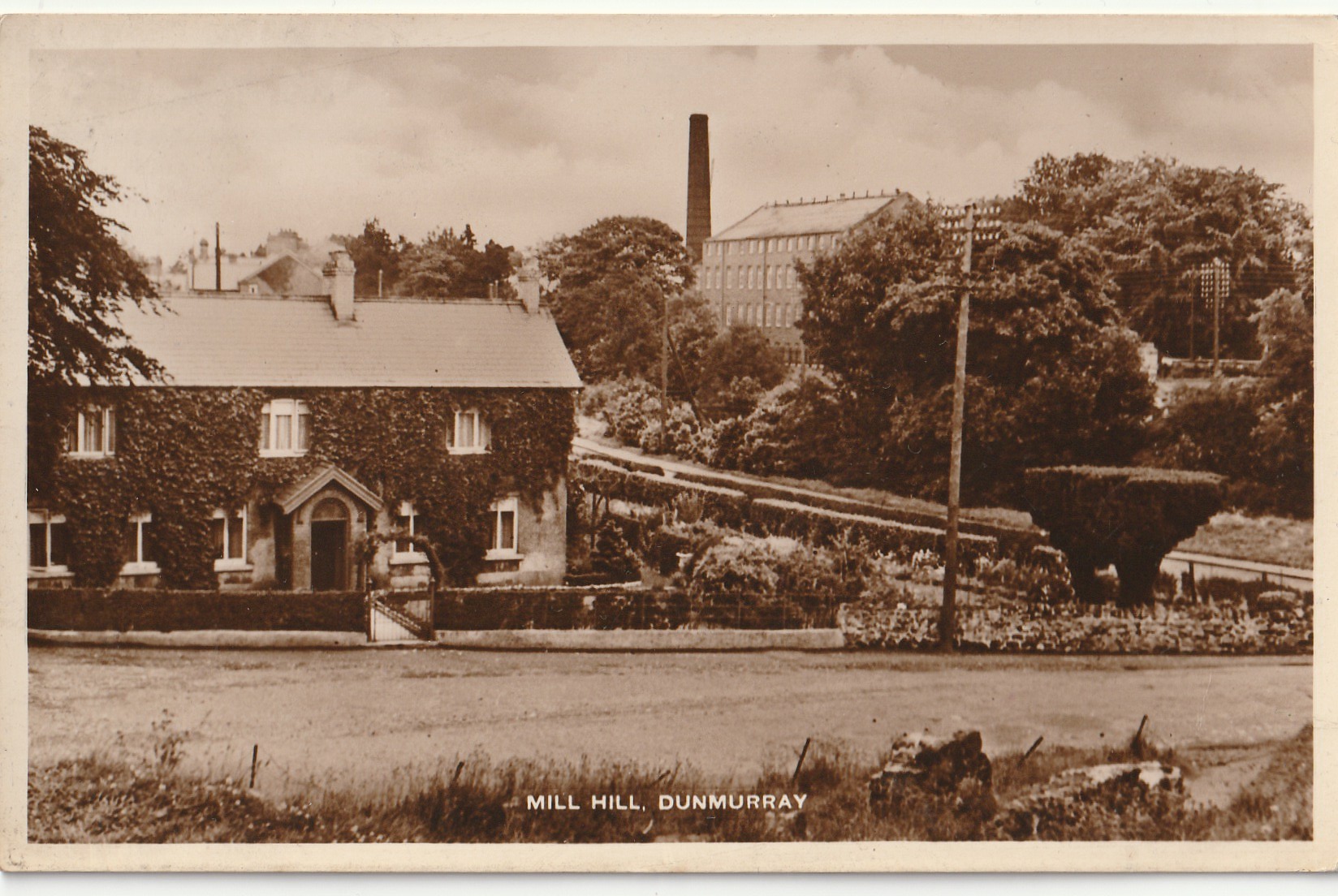
Mill Hill
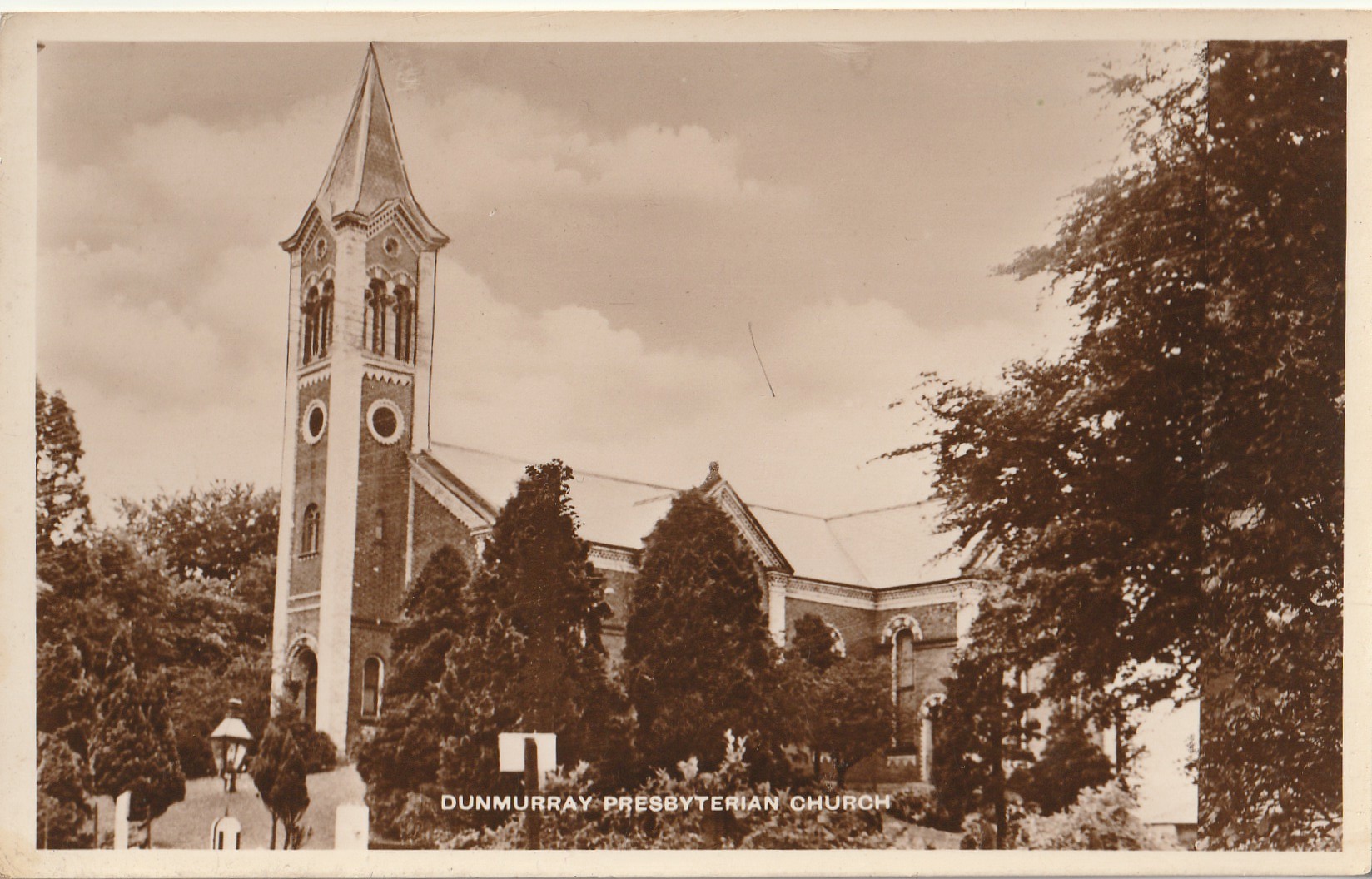
Presbyterian Church
Multi-view 2
The Park
St Colman’s
Kingsway 3

All published by W. McCartney, Stationer, Newsagent & Tobacconist, Dunmurry. All with the unusual spelling of ‘Dunmurray’ on the front and back of each card!

Postcard from Dunmurry: Then and Now (a different view)

Back in January 2023 I posted a piece about a postcard of Dunmurry which showed the classic view of the church built in 1779. It was published in Lisburn by F.W. Harding and posted in November 1906. This is the picture:

and you can read about it by clicking here.

As I mention in that post, postcards of Non-Subscribing Presbyterian churches are not that common. I have seen the 1906 view before and there is also a much later one but I was pleased to discover another postcard featuring the church, this one new to me:

This dates from a little later and although it is taken from a less popular vantage point in many ways it gives a much clearer view of the building. This card was published locally by ‘W. McCartney, Stationer and Tobacconist, Dunmurry’ in the ‘Signal Series’. It has at the bottom left hand corner the title ‘Unitarian Church, Dunmurry’ and was never posted. On the back, however, it is dated May 19th 1919 and has a message to an unnamed recipient which reads ‘With best wishes for your welfare from the People of Dunmurry and district from W. Laursen’. The name is actually a bit hard to make out but that is my best guess.

In a way it is a clearer picture than the 1906 view, being a Real Photograph, if a little damaged. But the view is not obscured by trees and you can clearly see the large amount of ivy that was then being allowed to grow over the left hand door. This is actually also present on the 1906 view although it is hard to make out behind the tree.

A modern image from more or less the same angle, taken a couple of weeks ago, shows the same view:

The view of the church hasn’t changed between 1919 and 2024. There are now houses along the side which weren’t there but the splendid building of 1779 is reassuringly the same.

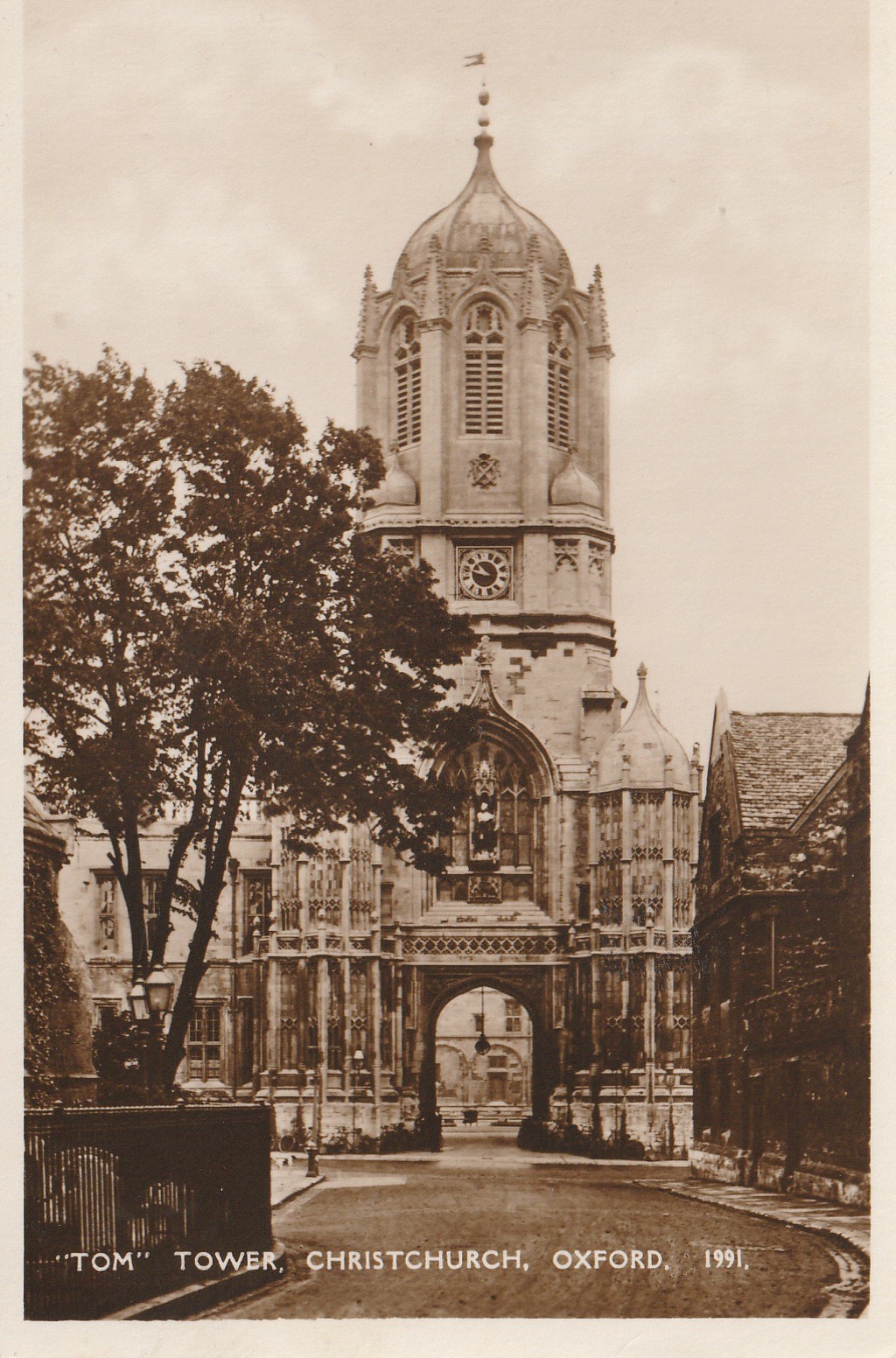
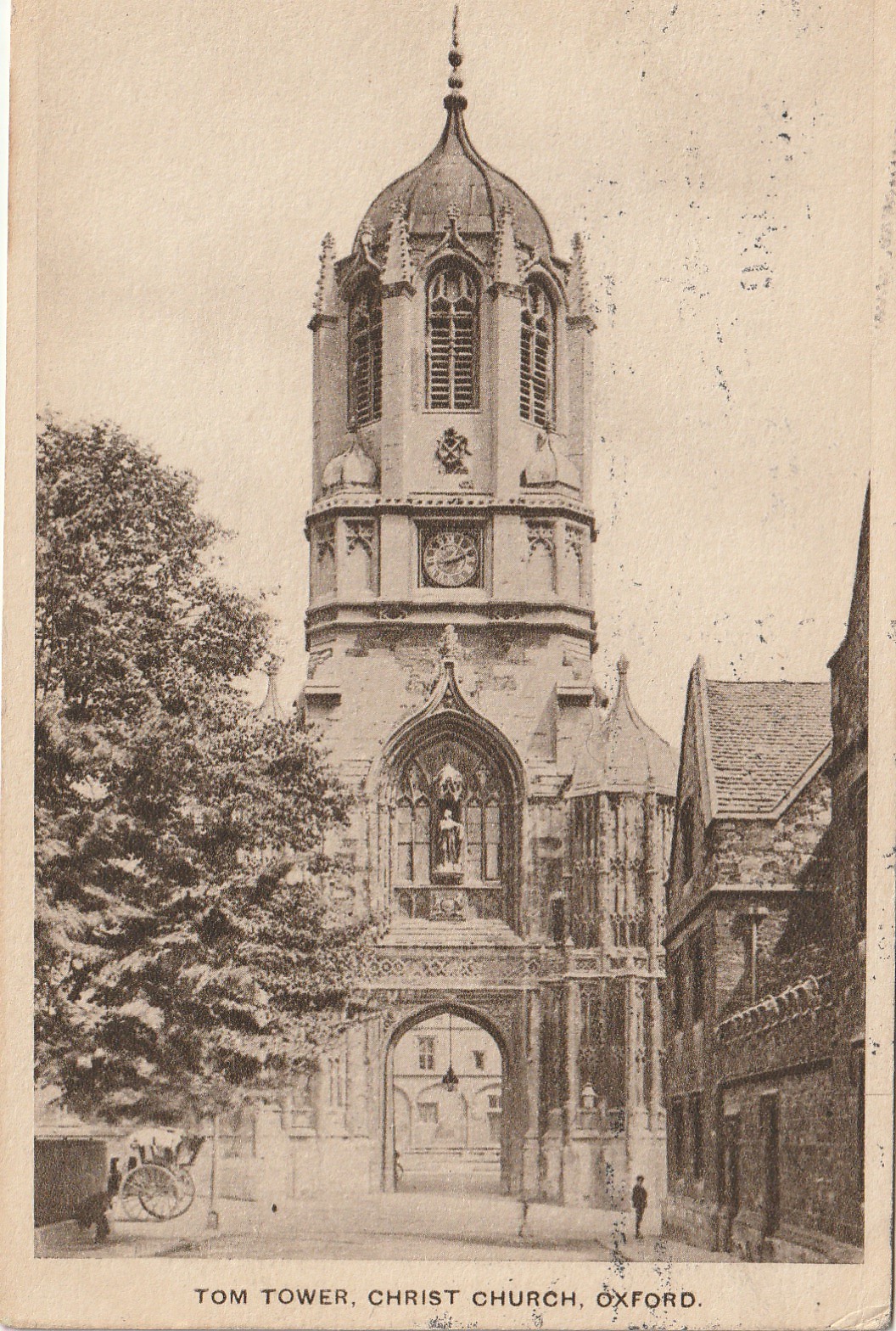
Tom Tower, Christ Church, Oxford

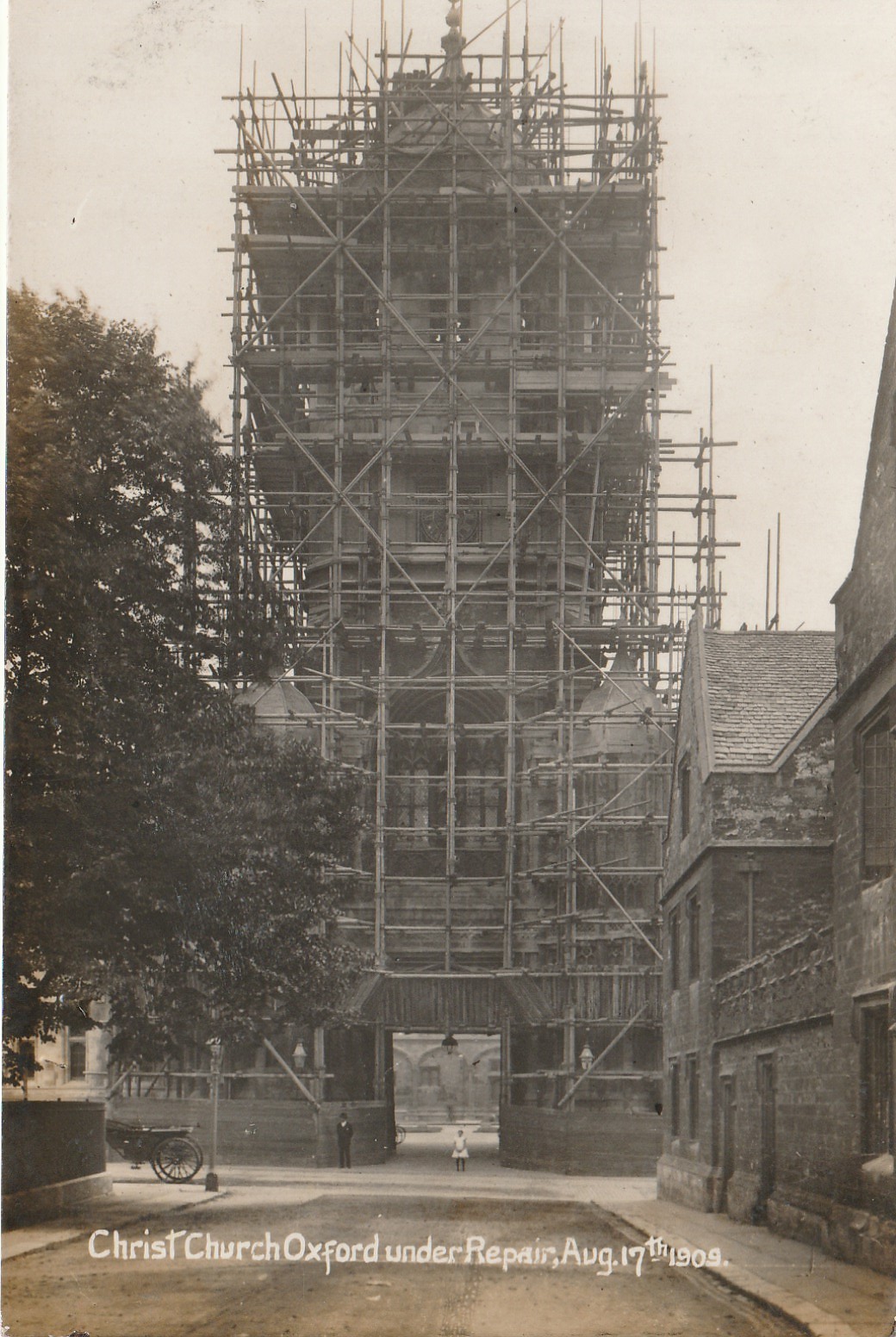
Recently, when in Oxford, I visited the Christ Church Picture Gallery where one of the exhibitions, entitled ‘WISH YOU WERE HERE!‘ (1 July – 30 October 2023) The attraction of Christ Church in early photographic postcards, caught my eye. It is always interesting (and rare) to see a serious art exhibition that contains items that you could afford to buy yourself. There are around 70 postcards in the Christ Church exhibition but seeing them encouraged me to start my own small collection. Prices can vary but generally cards like this should be quite cheap, they were produced and sold in vast quantities by a variety of printers and are hardly rare. So I decided to create my own small collection and focused on cheap examples of pictures of the West Front/St Aldate’s view of Tom Tower. I picked this view because although every postcard from 1900 to 1950 (or indeed to the present day) looks superficially the same you realise when you investigate closely that this is not the case. Since Tom Tower is situated on a main thoroughfare there are plenty of social changes that can be observed and a multitude of minor small details that are worth exploring in the foreground. I will work out the best way to display these images of the West Front.

But I allowed myself a small diversion into a handful of pictures of Tom Tower itself. Mainly this was because I managed to get one picture that I had seen in the exhibition which must be quite rare and was accordingly slightly more expensive than the others. This is it:

‘Christ Church Oxford under Repair, Aug. 17th 1909’. No publisher named.

I think this is a wonderful postcard. All the pictures of Tom Tower alone, largely taken from over the road, somewhere near the entrance to Pembroke College, are basically the same. There might be a vehicle of some sort somewhere in view, or a bowler hatted figure standing under the entrance to the college, but not much more.

This picture, however, is very different. The publishers give us the exact date and show us Tom Tower, not as you would expect, but covered in scaffolding. If you had turned up in Oxford to do the touristy thing and saw the tower covered in scaffolding I imagine you would be disappointed. I don’t think you would want to buy a postcard that also obscured the view. If you turned up after the work was completed and the scaffolding had been taken away I don’t think you would want to buy a picture of how it looked during restoration, unless you were very interested in scaffolding. It can’t have had a long shelf-life and it can’t have been many people’s favourite view. And yet it is a compelling image, intriguing and lively. I am glad the unnamed publisher took this view and glad to get a copy for my collection.

This card, dated 14th January 1910, was sent by Emily to ‘Mr Hammond, “The Lilacs”, Skipton Cliffe, Andoversford, Glos.’ Mr Hammond appears to have been Emily’s uncle since she also included ‘love to Aunt’ at the end of the message. And it doubled as a birthday card – ‘With every Good Wish for Many Happy Returns of the Day’, she begins. Emily might have been a student in Oxford, she was certainly resident there because she also says ‘I sent you the paper for you to read Mr Whale’s speeches our Liberal Candidate for Oxford’. ‘Mr Whale’ was George Whale who stood in Oxford in the 1906 election and lost by just 100 votes. He stood again in January 1910 but a swing of 6.4% saw him lose by over 1,200 votes to Arthur Annesley his Conservative opponent. George Whale was a freethinker and the chairman of the Rationalist Press Association. A former Mayor of Woolwich he was never successful in getting elected to Parliament.

But this was the card that Emily chose to send to her uncle for his birthday along with news of the freethinking candidate on the eve of the election in Oxford. It was, I think, an inspired choice.

‘Tom Tower Christ Church, Oxford’. Published by Vincent of Oxford. Posted 4th September 1915. Sent to Mrs Ewan Jones of Cricklewood by ‘All’, they were planning to drive to Oxford ‘with little Julian’ in the afternoon.

The other postcards of Tom Tower are all difficult to date precisely, especially when they were unposted, but they were mostly taken before the First World War, although similar examples could remain in print right up to the 1940s.

‘”Tom” Tower Christchurch, Oxford’ by J. Salmon Ltd., Sevenoaks. Unposted.
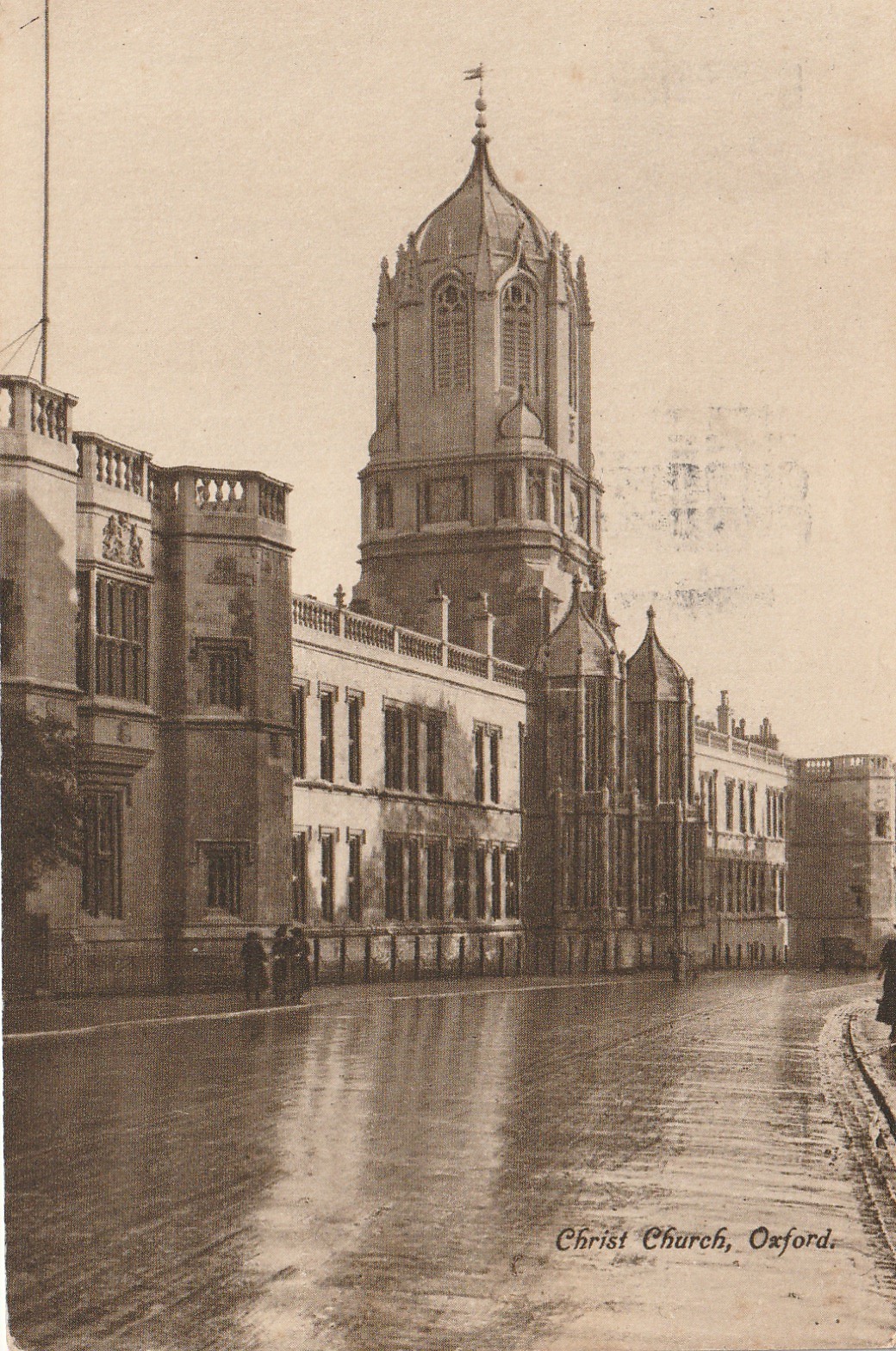
‘Christ Church, Oxford’. Published by Penrose and Palmer. Posted by Dorothy to Mrs England in Acocks Green, Birmingham on 12th November 1926.

This last photograph, published by the local firm of Penrose and Palmer, is another favourite of mine. The road is wet after a downpour and the photographer has caught a reflection of the building in the road. It’s a fine photograph. It falls somewhere between the direct images of Tom Tower on its own and the wider (landscape) views of the whole West Front but it is actually a more characterful and interesting picture than most of them.

No pictures or text may be reproduced from this site without the express permission of the author.

William Sunderland Smith and Antrim

The 2023 issue of the Transactions of the Unitarian Historical Society includes Ian Wood’s article on his great great grandfather William Sunderland Smith, minister at Antrim from 1872 to 1912 and a figure of some note in the town at the time because of his writings on history, including the 1798 Rebellion, natural history, geology and theology.

W.S. Smith’s son William Ivan Smith was an enthusiastic amateur photographer and he took a number of pictures in Antrim in 1902 which are a main feature of this video which introduces the 2023 Transactions:

Click on the video above to find out about the Transactions and W.S. Smith

Prior to coming to Antrim in 1872 and after leaving the Unitarian Home Missionary Board in 1859 W.S.Smith had ministered successively at Aberdeen, Rawtenstall, Doncaster, Tavistock and Crediton. So he had a series of short ministries all over the country before crossing the Irish Sea and finding, one assumes, a deep sense of fulfilment in his last charge at Antrim. W.I. Smith’s visit to Antrim in 1902 produced a number of photographs which give us a splendid picture of his ministry and I am grateful to Ian Wood and his family for digitising them and for making them available.

So here is W.I. Smith’s portrait of his father:

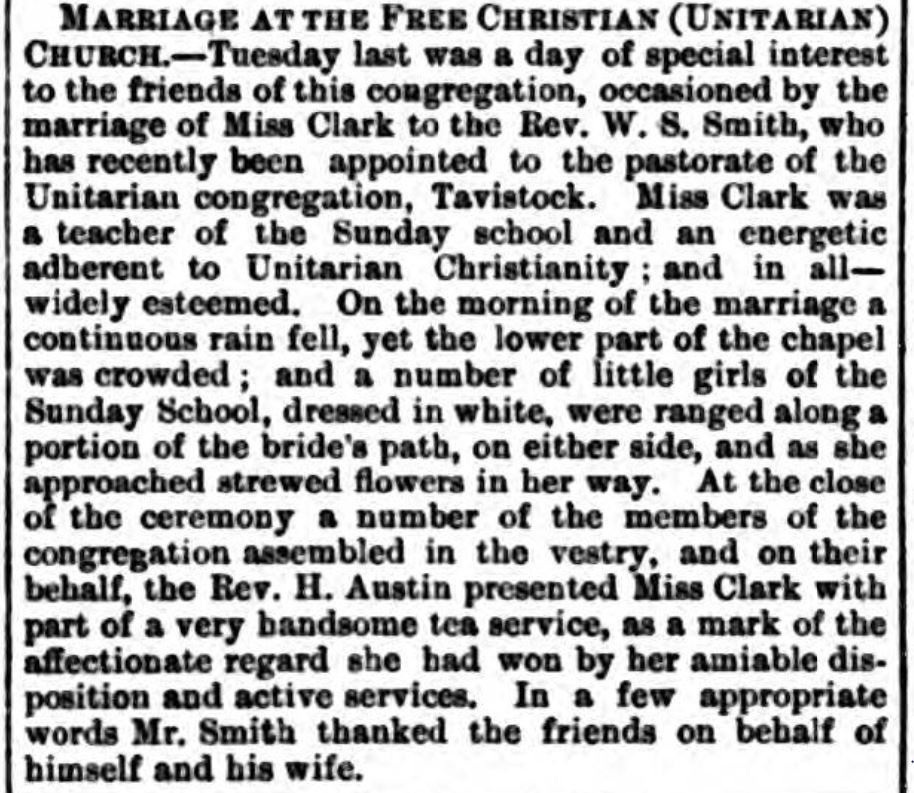
W.S. Smith’s first wife died in 1868 but the following year, having moved from Doncaster to Tavistock , he met and married Clara Ann Clark. Ian Wood has found this cutting from the Wilts and Gloucestershire Standard which gives an engaging account of the wedding between the Cirencester Sunday School teacher and the Tavistock Unitarian minister on 9th November 1869:

In 1902 when William Ivan Smith visited Antrim he took this picture of his step-mother:

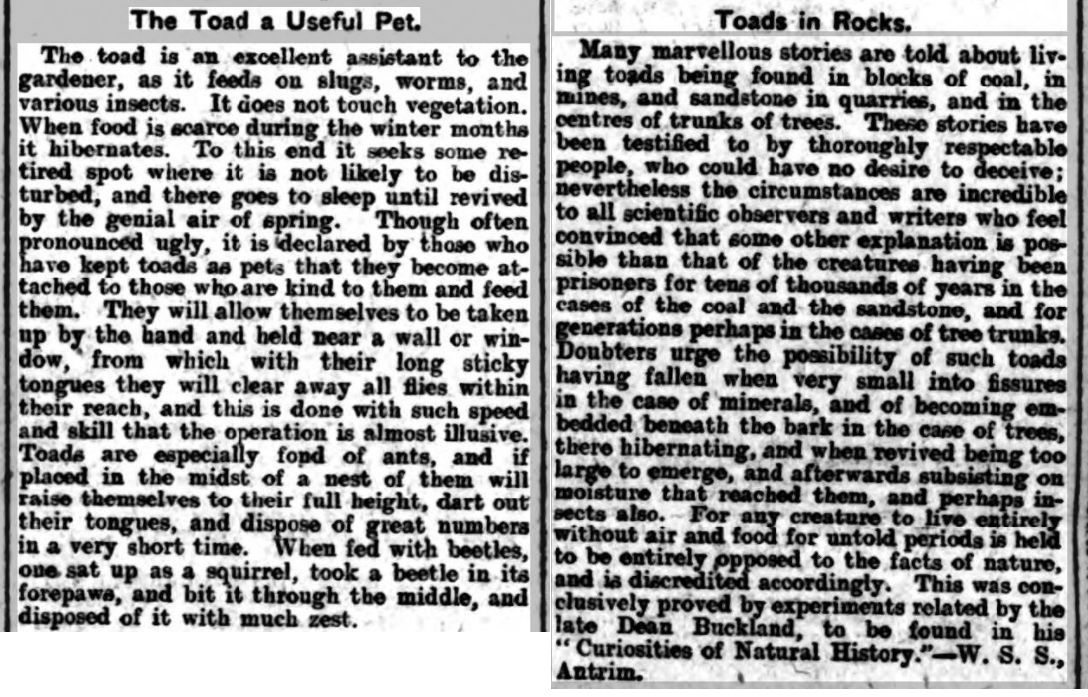
William Sunderland Smith arrived in Antrim, after a short ministry in Crediton, Devon, in 1872. He must have established a prominent name for himself in the town with publications such as Historical Gleanings in Antrim and Neighbourhood and Memories of ’98 as well as regular contributions to the Ulster Journal of Archaeology and the provision of ‘Nature Notes’ to the Northern Whig, including this account of toads in 1906:

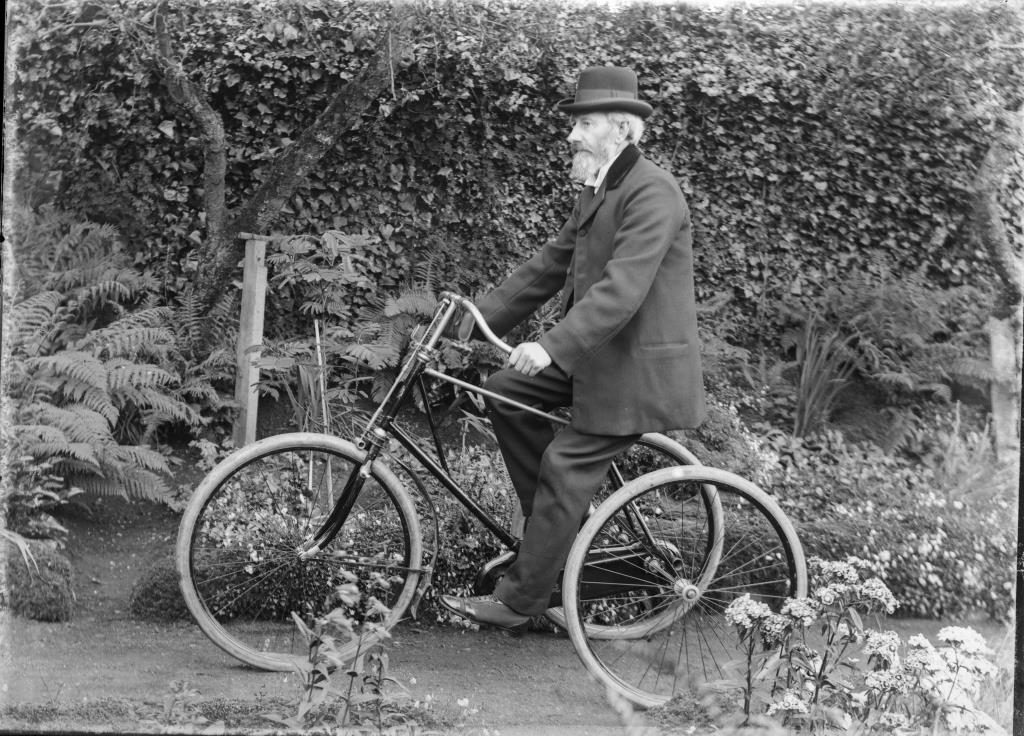
W.I. Smith’s photograph of his father astride his preferred method of transport in Antrim suggests that he must have been a very familiar figure on the local roads at the time:

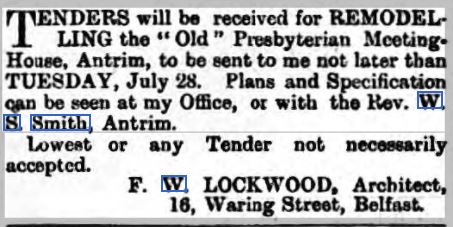
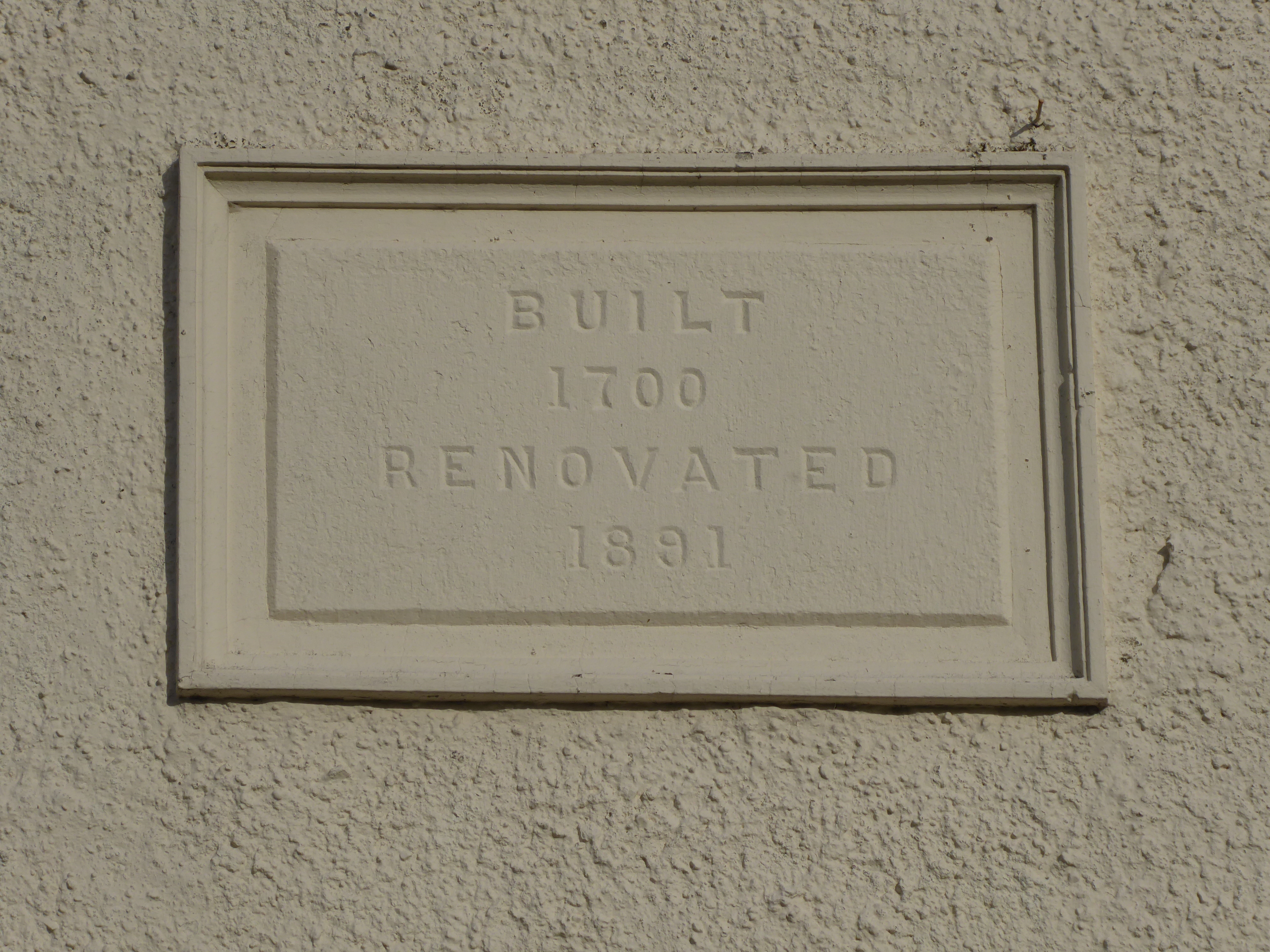
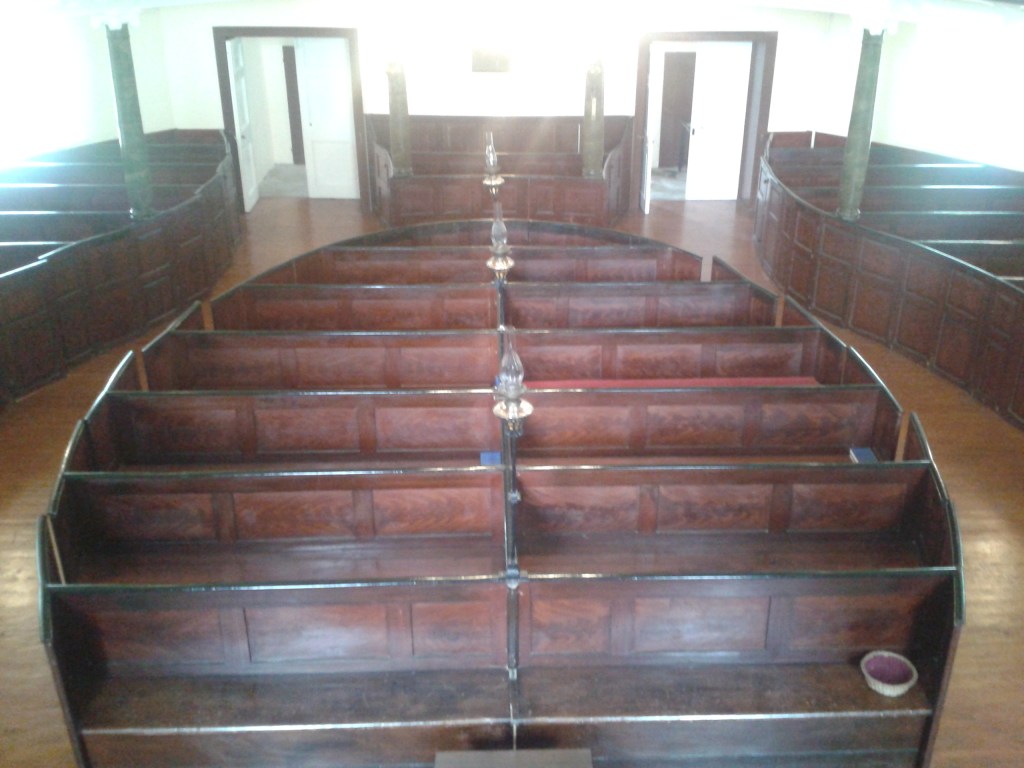
The Antrim meeting-house had been built in 1700 but under his ministry the interior was completetly refurbished in 1891. Ian Wood has found the following cutting from the Northern Whig seeking tenders to undertake this work:

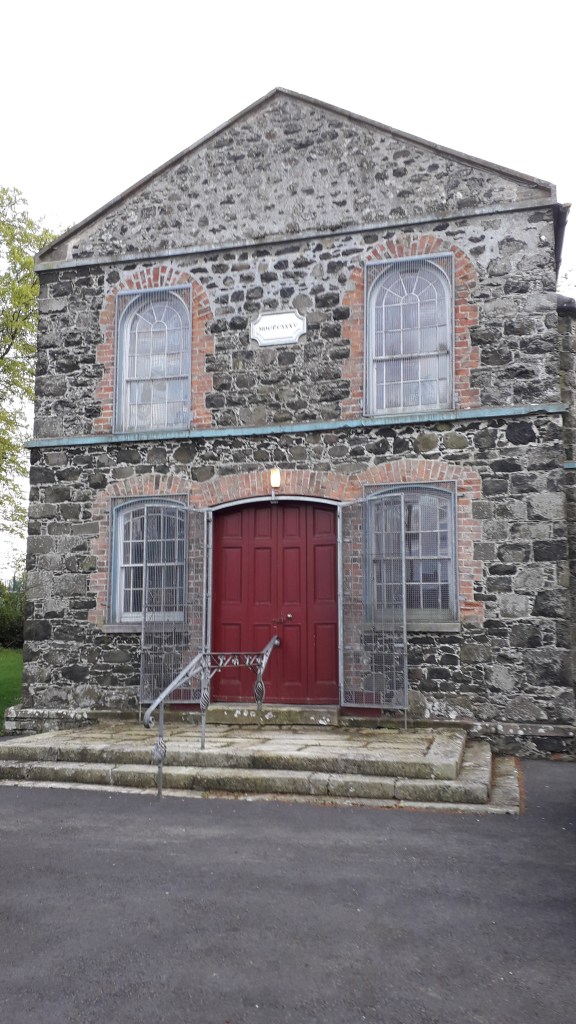
This was a major undertaking which seems to have been successfully completed but images of the interior, either in its original form or in the remodelled layout created by W.S. Smith, are hard to come by. If you would like to see the interior as it looks today – denuded of its ecclesiastical furniture – click here. One postcard which I have acquired features the interior of the Antrim meeting-house as it originally looked. It is a strange picture that has been very amateurishly doctored with Rev John Abernethy’s portrait cut out from somewhere and stuck over the pulpit:

But when he came to Antrim in 1902 William Ivan Smith also took a picture of the interior of the church as it looked by this time. This is it:

Now, at first glance, this may not look like such an interesting image, but as the only surviving picture of the inside of Antrim complete with its pews it is not without importance. However, on top of that W.I. Smith was quite a skilled photographer and there is more detail in this high resolution image of a 1902 print than you might initially notice. If you click on the video above you can discover some more of what this picture contains.

Thank you to Ian Wood for researching his ancestor and for discovering these fascinating pictures and making them available.

You can find out more about the Unitarian Historical Society and the Transactions by visiting its website here.

You can see a bit more about the manse in Antrim on this website via this link.

No pictures or text may be reproduced from this site without the express permission of the author.

Postcard from Dunmurry: Then and Now

I am not sure how many Non-Subscribing Presbyterian Churches had postcards produced featuring the meeting-house in Edwardian days. Not all of them I would guess but I have a good few examples and have blogged about a few of them including Downpatrick, Newry, Banbridge, All Souls’ Belfast (including one that quite clearly is not All Souls’), and Crumlin. There are others such as Clough and Dromore which I have seen but not acquired, but recently I was pleased to pick up a picture of Dunmurry.

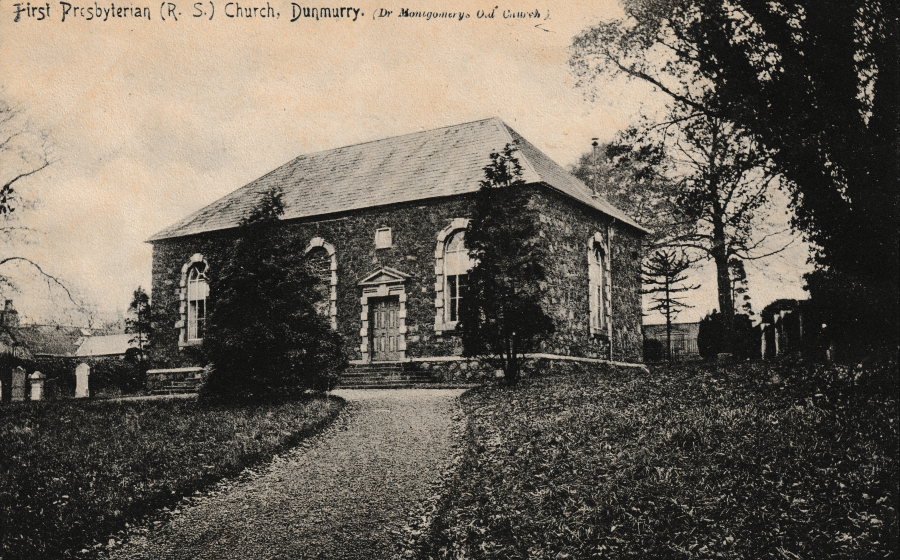
Dunmurry postcard

Labelled First Presbyterian (R[emonstrant] S[ynod]) Church, Dunmurry, (Dr Montgomery’s Old Church) I have seen this card offered for sale before but I am pleased to at last track one down. Published by F.W. Harding of Lisburn this card was posted on 12th November 1906 to Miss Browne in Aghalee, ‘M.B.’ writes to ‘Maggie’ telling they her they are still waiting for a letter from her but hope to see her soon.

We can compare it with a modern view, taken from more or less the same position last week and see that, of course, although some of the graves, the trees and planting around the church have changed the view is essentially unchanged.

Dunmurry January 2023

In January we filmed some short reflections in the church featuring Allen Yarr on the piano. The video can be seen here:

January Reflections

Reflections for the month of January with the Rev Dr David Steers, minister, and Allen Yarr, church organist. Music: ‘When I survey’, ‘Music for the Royal Fireworks’

Postcard from Crumlin

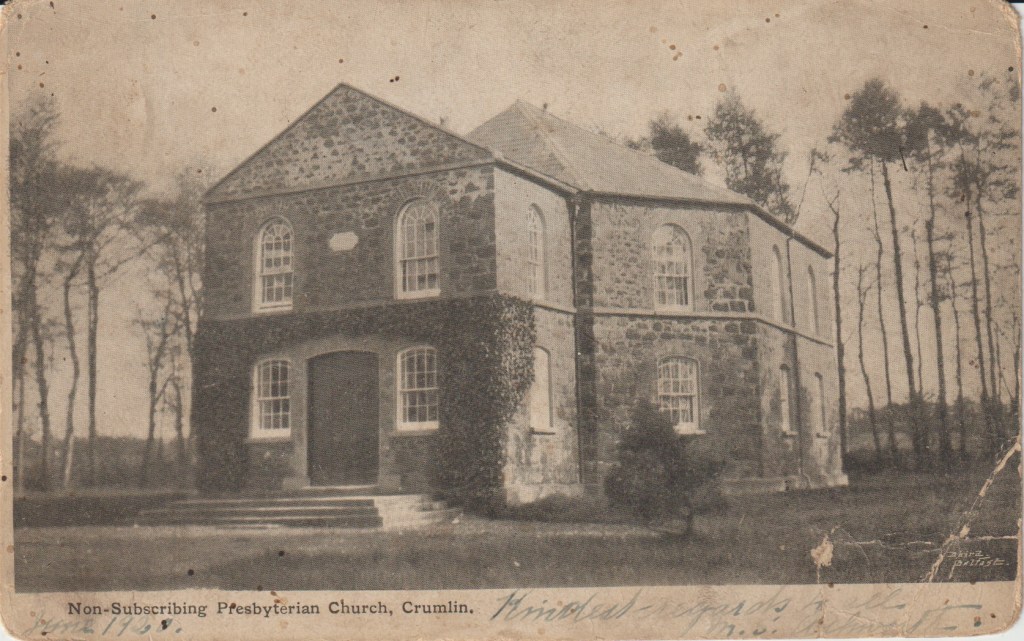
Postcard from Crumlin, June 1908
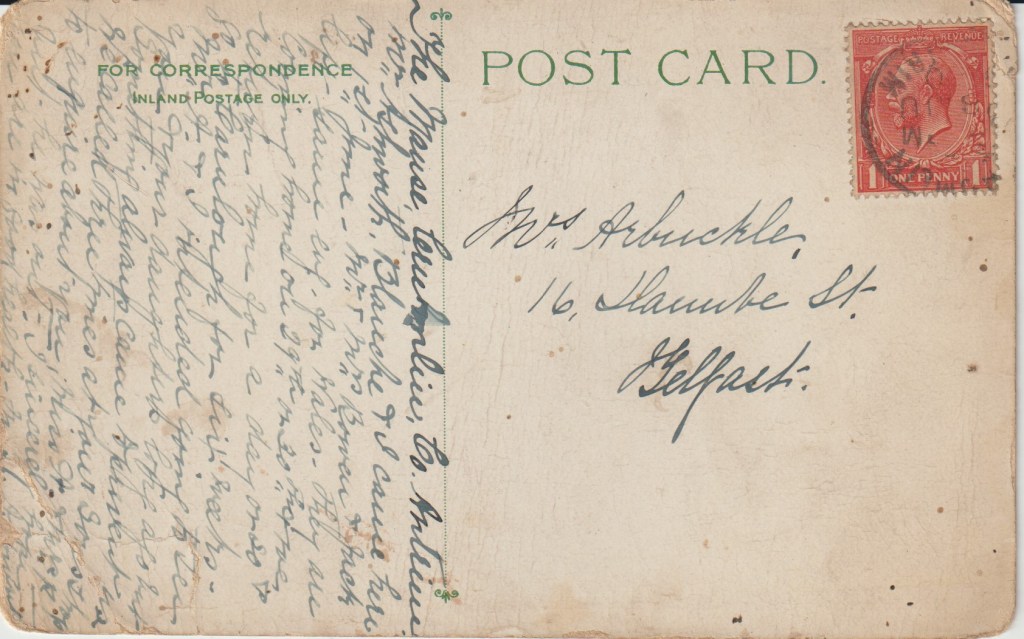
Message on postcard

I purchased this postcard on eBay recently. It is not in great condition but it is a fairly rare example of a Baird of Belfast postcard of the Non-Subscribing Presbyterian Church at Crumlin. It came with added interest because it was sent by Mrs Ashworth to her friend Mrs Arbuckle of 16 Danube Street, Belfast in June 1908. The message gives us a little glimpse into Non-Subscribing Presbyterian church life in 1908.

Mrs Ashworth, the author, writes in friendly, yet also fairly formal tones to Mrs Arbuckle. Mrs Ashworth (as she describes herself) was the wife of the Rev Alexander Osborne Ashworth minister of York Street Non-Subscribing Presbyterian Church at the time. She refers to her husband only as Mr Ashworth in her short note although also mentions a person called Blanche who appears to be their daughter. They are also staying in the manse at Crumlin. ‘Mr Ashworth, Blanche and I’ came to the manse on 1st June, ‘Mr & Mrs Bowen & Jack’ left the same evening for Wales where they would remain for most of the month before returning for a six week stay at Carnlough. Prior to sending the card the Ashworths had made some unsuccessful attempts to meet up with Mrs Arbuckle and her family.

It’s not possible to identify the Mrs Arbuckle, but there is a good chance that she was a member of York Street Church, indeed there was a Mary Arbuckle living on York Street itself in the 1901 census and Danube Street is certainly within the catchment area of York Street Church.

Most of the contents reveal mundane domestic arrangements involving three Belfast families over 110 years ago. But knowing that two of those families were the families of NSP ministers and the fact that it was all written on a postcard depicting Crumlin Church enables us to put some flesh on the bones of this brief correspondence.

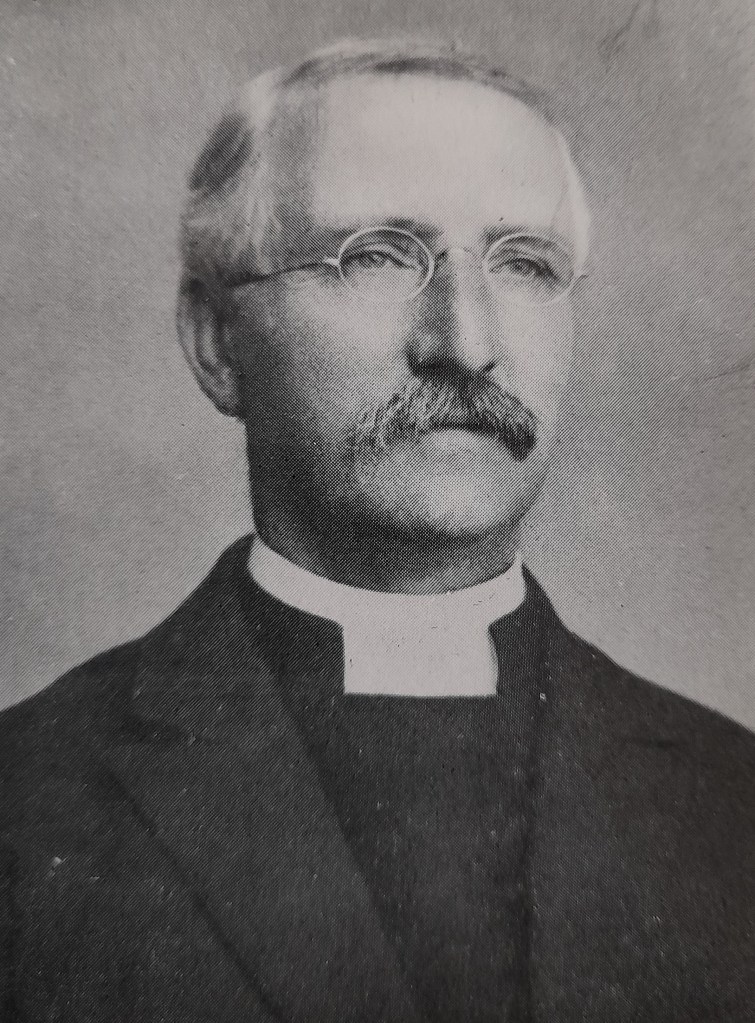
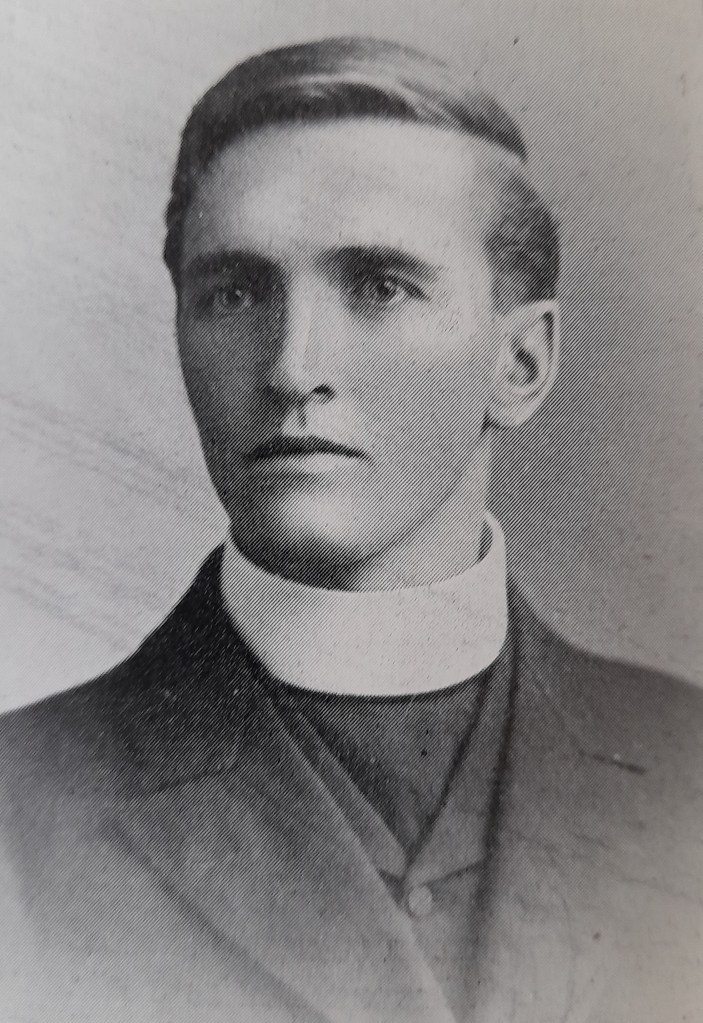
Mr and Mrs Bowen were the Rev Samuel Evans Bowen and his wife. S. E. Bowen was called to be minister of Crumlin in 1908, he was ordained later in the year on 3rd September by the Presbytery of Templepatrick. It may be that Alexander Ashworth and his wife were preparing the manse for their arrival, although he was clerk of the Presbytery of Antrim at that time and was still minister of York Street until 1909 when he retired, although he continued as a very active senior minister until 1913 and remained active in his denomination for many years afterwards until his death in 1935. Ashworth was born in the Rossendale valley in Lancashire in 1846 and trained at the Unitarian Home Missionary College. He came to York Street in 1893 after previous ministries in Chatham, Stalybridge, Doncaster and South Shields. For many years he was also the Sunday School Convenor for the Non-Subscribers. This job was no sinecure, in 1909, for instance, he organised the Annual Sunday School Conference at Downpatrick, an event which attracted 450 participants.

Rev A. O. Ashworth in 1909

The Rev Alexander Ashworth is probably hardly remembered today, for one thing the church where he had his longest and most significant ministry was destroyed in the blitz of 1941, but he gave devoted service in many different ways for decades.

Rev S. E. Bowen in 1908

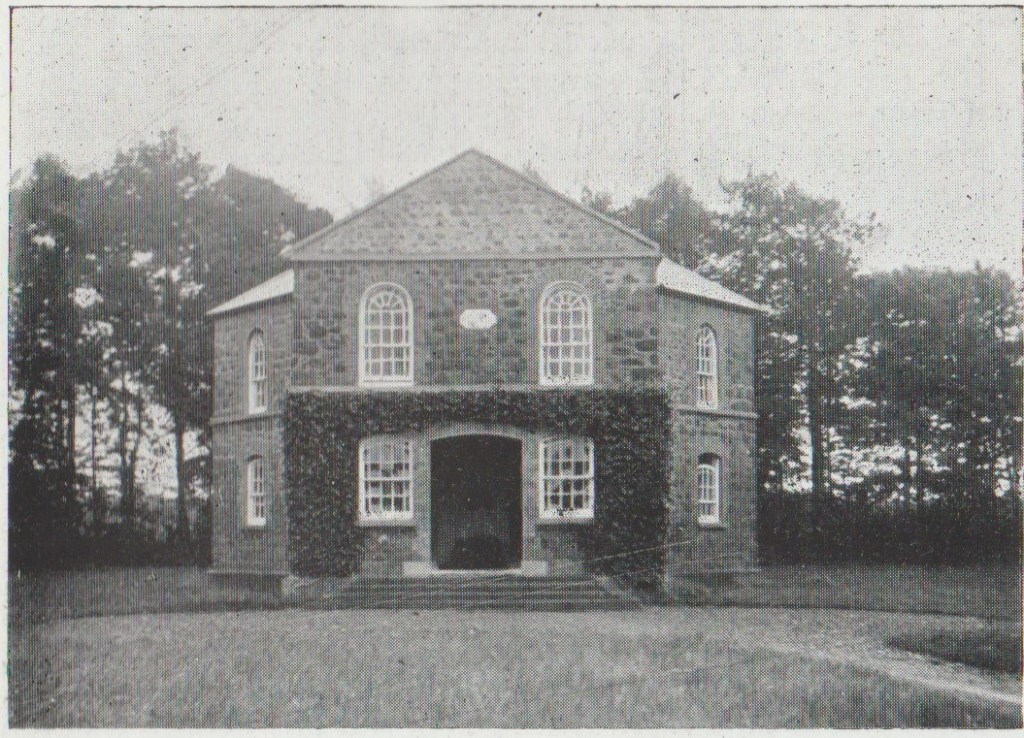
The same was true of S.E. Bowen. Another former student of the Unitarian College in Manchester he was minister in Crumlin for over twenty years (to 1929) before returning to his native Wales to minister at Allt-y-placa, Capel-y-bryn and Cwm Sychbant for 27 years. But with this postcard we get a view of the Crumlin meeting-house. Judging by the trees it is of a similar, although not identical, vintage to the photograph that appeared in the Non-Subscribing Presbyterian magazine in October 1908 to accompany the account of his ordination. In both pictures the ivy seems to be contained in identical positions but the postcard shows a small tree or bush to the right of the church which is not there in the magazine image. The postcard could be quite a few years older than the other photograph.

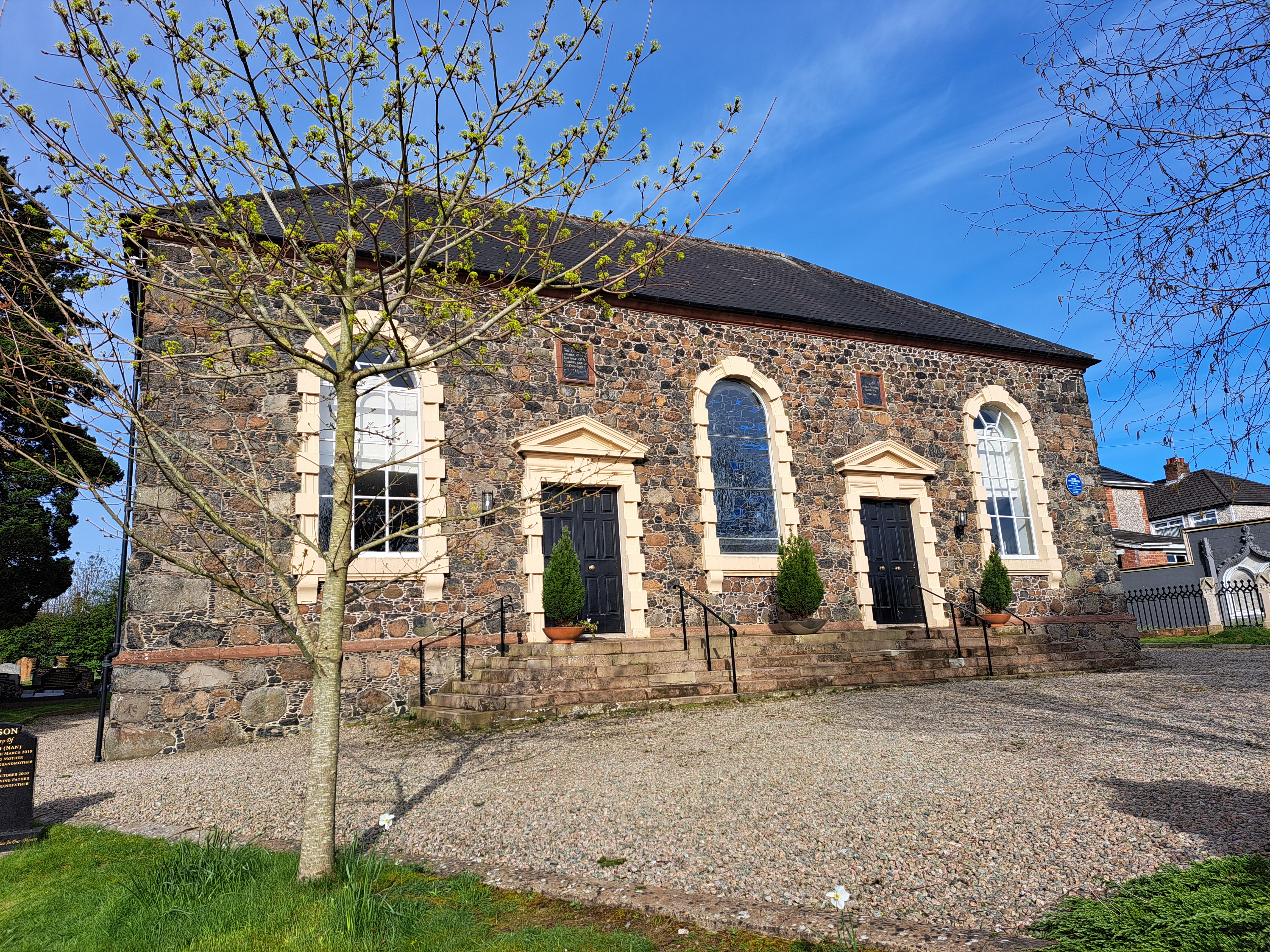
The Crumlin meeting-house is fairly secluded and can’t be seen from the main road. Built in 1835 it replaced an earlier church of 1715. It is a miniature replica of Belfast’s First Presbyterian Church designed by Roger Mulholland. It is interesting that the congregation of Crumlin took that building as a template for their new church over 60 years later.

Crumlin in 1908 (NSP Magazine)
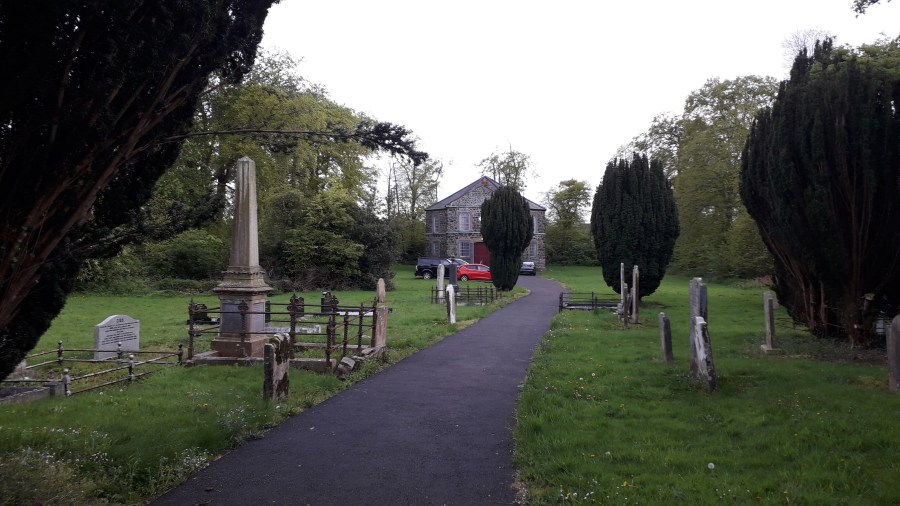
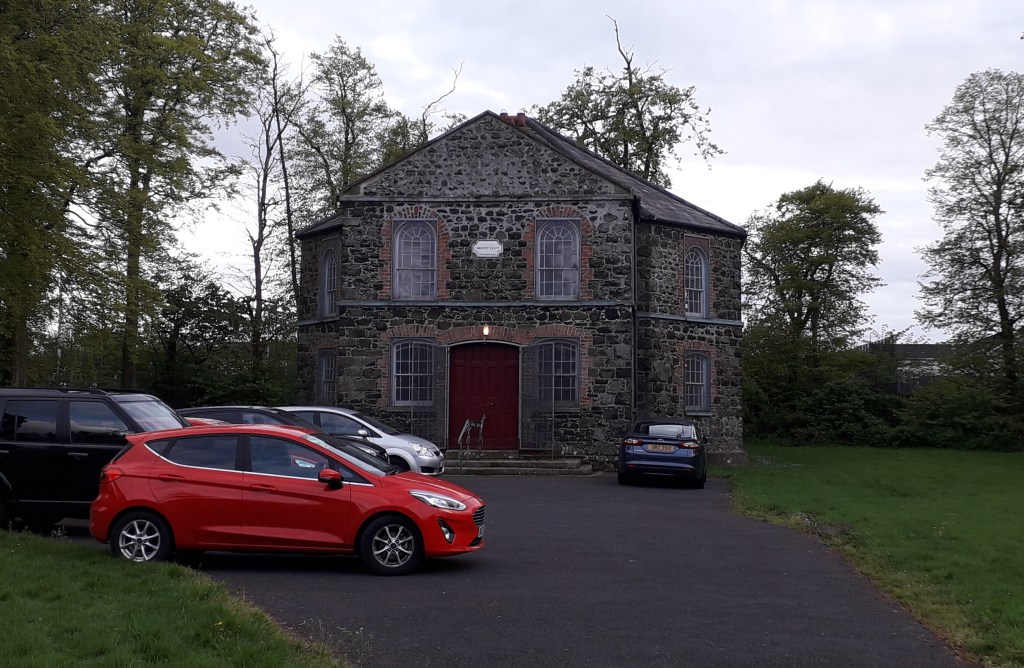
Crumlin in 2019

Whenever I try to take an architectural photograph I always aim to get a shot of the building without the distractions of either people or vehicles. I wasn’t able to do this with this picture of Crumlin taken in the autumn of 2019. The foreground is crowded with cars. But in the long term a photograph of something like a church which includes other details that date it actually makes it more interesting to the viewer. But if I was going to compose the cars for a photograph I wouldn’t park them like that!

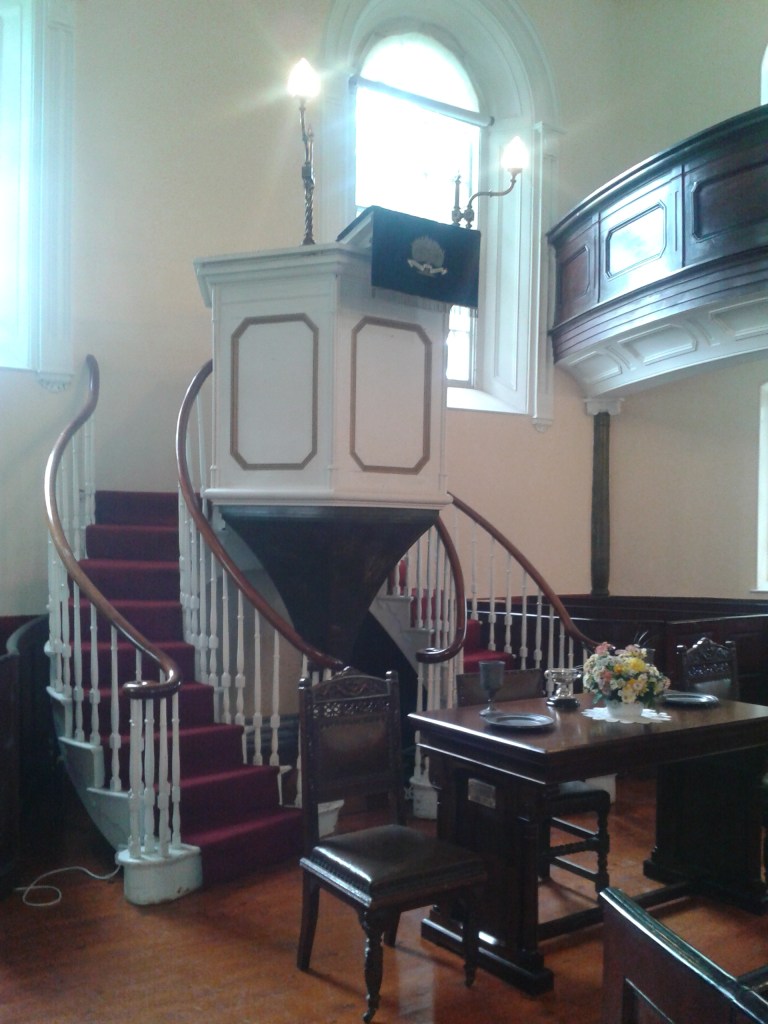
The interior of Crumlin has an elegant charm.

Pulpit
Pews

The account of S.E. Bowen’s ordination published in the Non-Subscribing Presbyterian magazine is quite full and interesting. In the service the Rev S.E. Bowen said that ‘Unitarians were a people who believed not so much in attempting a definition of religion as in working for truth and liberty, being bound together by a profound belief in the Fatherhood of God and the brotherhood of man.’ Later, over the welcome dinner there were a number of speeches given. Representing the Presbytery of Antrim the Rev W.S. Smith told the whole congregation to pick a day in October and arrive at the manse with a spade ready for three hours of work, leading the author of the report to note that the manse garden must ‘to say the least, be inferior in condition to the Garden of Eden when it was given to the father of all living to dress it and keep it’. The Rev Alexander Gordon was also there speaking highly of S.E. Bowen as a former student of his. He also related how he had recently been in the south of France and attended worship in a Protestant congregation there where the service was conducted by a young man in a congregation that only numbered sixteen, ‘yet he had been favourably impressed with the manifest consciousness of the congregation that they had come to worship, and with the energy and the earnestness of the preacher.’ It made me wonder what else Alexander Gordon did in the south of France in the summer of 1908, I can’t imagine that he just went there to sunbathe.

Front entrance

Images of Gertrude von Petzold

In this issue [of Faith and Freedom: Volume 73, Part 1, Number 190] we are pleased to include Mária Pap’s review of the Lindsey Press’s new book Unitarian Women. A Legacy of Dissent. One of the subjects rightly featured in the book, and also included within the book’s cover illustration, is Gertrude von Petzold. Although her career as a Unitarian minister was relatively short it was also quite effective and was remarkable because it was such a trailblazing achievement, the first woman minister of any organised denomination in Britain. Her achievement is perhaps all the more impressive because she was not born in Britain, English was not her first language, and she achieved all that she did in the teeth not only of prejudice because of her sex but also because of her nationality. In every sense she was an outsider in her chosen field and yet she established herself in her profession as a leader of considerable authority who inspired tremendous affection and loyalty from her congregations.

Gertrude von Petzold A 01

Postcard of Gertrude von Petzold, taken by Burton & Sons published by Rotary

She was also an undoubted celebrity in her own right. The image of her reproduced in the book and on the cover of this issue travelled far and wide and has retained a place in the public imagination, at least for those interested in this aspect of Unitarian or women’s history. In the last couple of years an enlargement of this same image has been framed and hung on the walls of Harris Manchester College, a fitting tribute from her old college, but a compliment too to the photographer.

When the picture was first taken in 1904 it was ubiquitous. It must have sold, as a postcard, in the thousands. Not only that, three weeks after being inducted as pastor of Narborough Road Free Church in Leicester the same image graced the cover of the Tatler magazine.

The picture was taken by Burton & Sons, a long-established photographer local to Leicester but with studios across the Midlands. They also had the task of creating something new – no one had ever photographed a woman minister before. How should such a subject be depicted? With what clothes, posture, style? How do you present someone doing an entirely new thing, the first of her kind? There is no precedent for this kind of illustration. So where do they go for inspiration? The answer is simple, it is a celebrity photograph. The model used by the photographer, and by market leader Rotary who subsequently produced and sold her image as a postcard, is that of the top celebrities and postcard favourites of their day – the stars of the stage. Although she is wearing her academic hood and holds a book as indicators of her academic status, Gertrude von Petzold is dressed very elegantly, she gazes off into the middle distance her head resting on her left hand. This is a classic pose of an actress or musical hall star in 1904, she was being packaged as a celebrity in the terms of her era.

MIss Phillida Terson

Postcard of Miss Phillida Terson/Miss Phyllis Terry published by J. Beagles & Co. 1912. As can be seen the pose is almost identical to that in Rotary photograph of Gertude von Petzold. (Described as ‘an actress of distinction’ in the ODNB she combined stage appearances with film roles in later life).

You have to acknowledge too that she also must have projected something of a star quality herself. You can find other examples of pictures of women graduates from this era and they lack that extra element that undoubtedly helped to make this postcard sell.
Unnamed Graduate Wickens Studios Bangor N.W.
Unnamed Pre-1914 female graduate. Wickens Studios, Bangor, North Wales

To many of us this [image of Gertrude von Petzold] is a familiar picture. But it was not an inevitable depiction of the first woman minister. How else might an Edwardian photographer think that a woman minister might be shown? Well the answer comes with the postcard that is reproduced alongside this article. This is a far rarer postcard than the one produced by Rotary and, it has to be said, is not as well produced although it was published by J. Beagles a long-established London photographic publisher. Like Rotary they specialised in royalty, musical hall artistes and actors and actresses but unlike them they had a different model in mind for the picture of the first female minister. What inspired them was the image of a woman as a nurse.

Gertrude von Petzold B 01

Postcard of Gertrude von Petzold by J. Beagles & Co. London 1904.

This was already a well established outlet for women’s work – a caring profession characterised by service, so it was not a surprising model to be chosen by the photographer. Although again there are academic accoutrements, this picture, with plainer clothes, a high collar, long sleeves and even the hands pushed into the pockets of the skirt or pinafore, is exactly reminiscent of contemporary photographs of nurses. With a fuller face, if not exactly gazing directly at the camera, this is one of the ways that members of the nursing profession were presented on postcards in the Edwardian era and right through the First World War. J. Beagles were not alone in this; Elliot and Fry, another firm of London photographers, also produced similar images of Gertrude von Petzold.

Edwardian Nurse Postcard

Postcard of an Edwardian nurse (‘With very best wishes for the future from Eunice to Molly’, no photographer or  publisher named). She doesn’t have her hands in her pockets as many similar photographs did but the similarities of pose and dress can be seen with J. Beagles’ photograph of Gertude.

But here we have two ideas of this pioneering woman minister. Was she a star, a glamorous personality, an elegant figure fit to grace the cover of magazines? Or was she a nurse, someone inspired by practical purpose, a worker, a servant? I wonder how she preferred to be seen herself? In the end, though, there is no doubt which card was the most popular. The ‘nurse’ picture is very rare indeed. The postcard image of this minister as a celebrity and star is very common and is frequently offered for sale on eBay right up to the present day.

This article appears in the SPRING AND SUMMER 2020 Volume 73, Part 1 Number 190 of Faith and Freedom. All the illustrations are from my own collection and may not be reproduced without my express permission.

An annual subscription to Faith and Freedom costs £15 (postage included). Contact the business manager:

Nigel Clarke,
Business Manager, Faith and Freedom,
16 Fairfields, Kirton in Lindsey,
Gainsborough, Lincolnshire.  DN21 4GA.

It’s also possible to pay via PayPal via clicking here.

Email: faithandfreedom@btinternet.com

The current situation with Covid-19 has delayed production and distribution of this issue but another article in the current issue can also be read online. To read Jim Corrigall’s review of Stephen Lingwood, SEEKING PARADISE: A UNITARIAN MISSION FOR OUR TIMES, Lindsey Press, London 2020, pp 142, ISBN 978-085319-094-3. £10.00 pbk. click here.