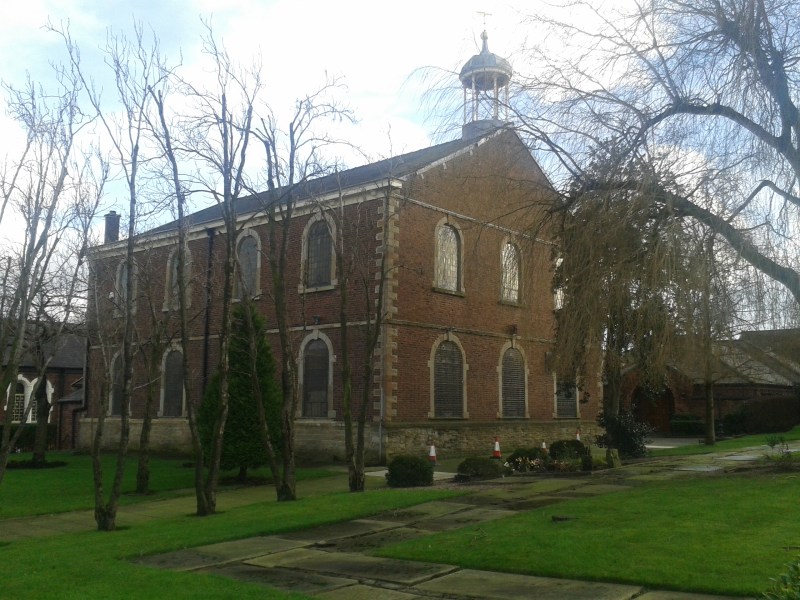
The building of Chowbent Chapel in 1722 speaks volumes for the determination of Lancastrian dissent in the early eighteenth century. Having retained possession of the chapel of ease after the ejections of 1662 it wasn’t until the 1720s that the local landlord managed to expel dissenters from the essentially Anglican chapel, allegedly because of the part played by the minister ‘General’ James Wood and his congregation in suppressing the Jacobite rebellion of 1715.
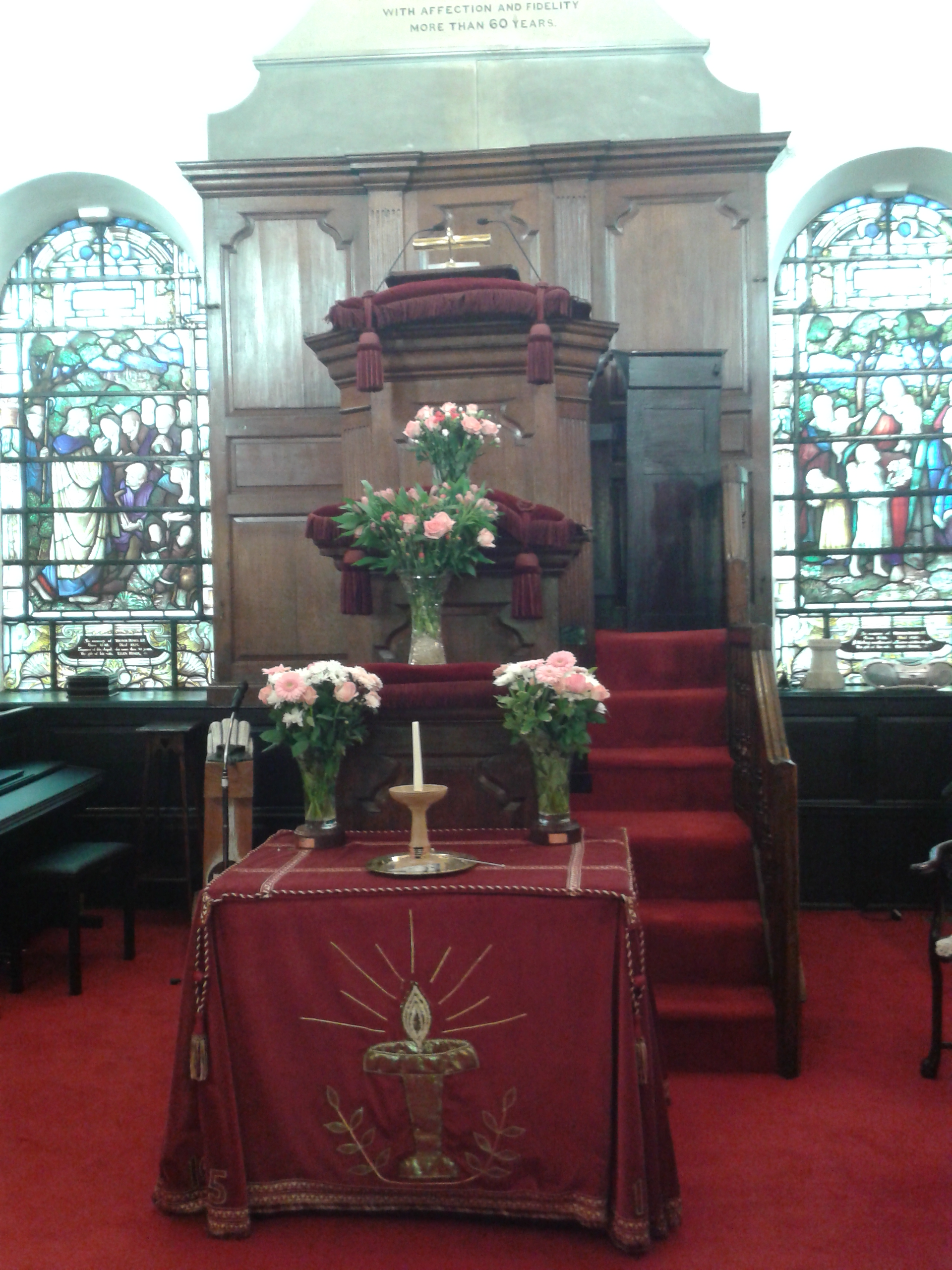
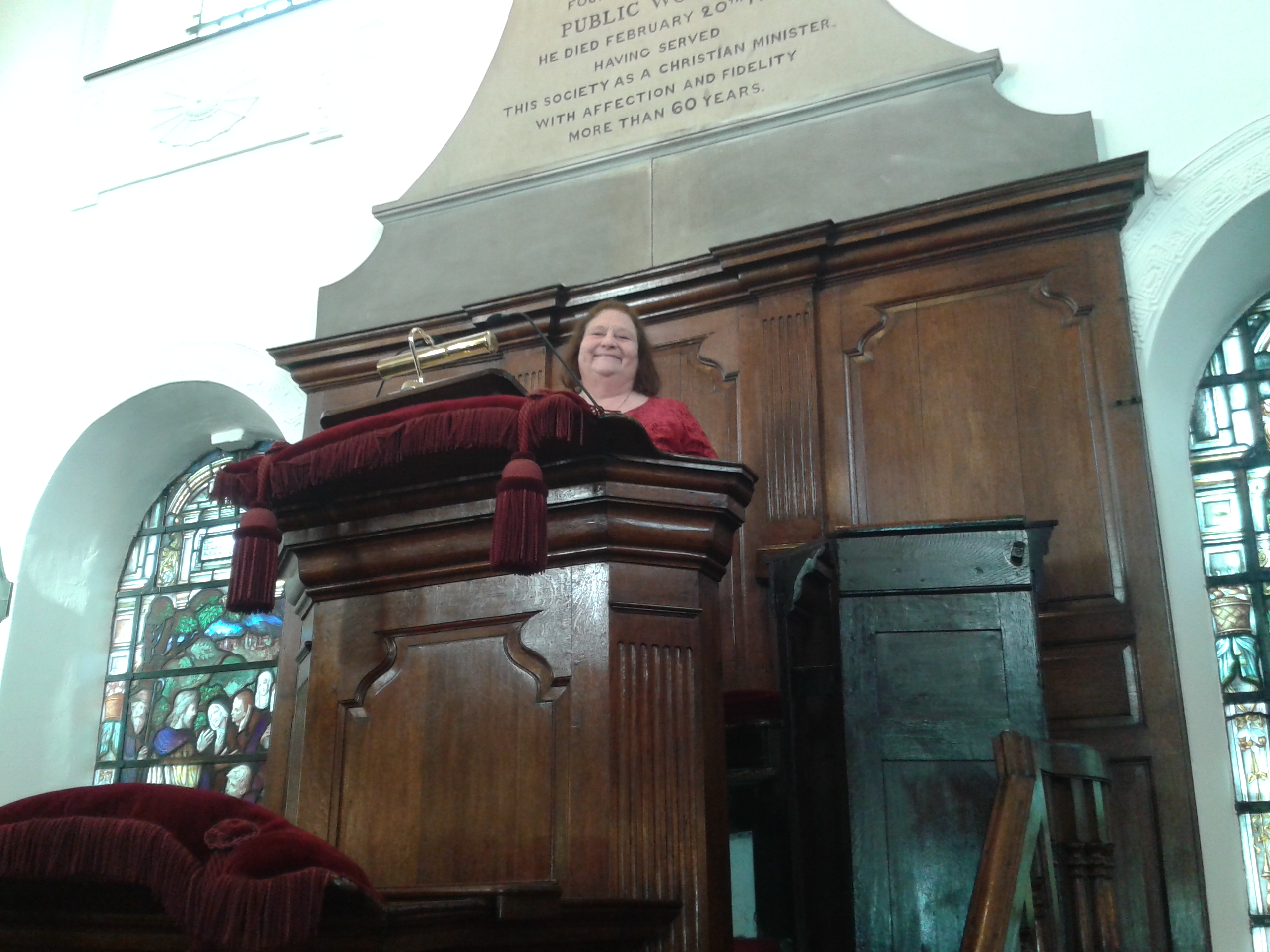
The eighteenth-century three decker pulpit
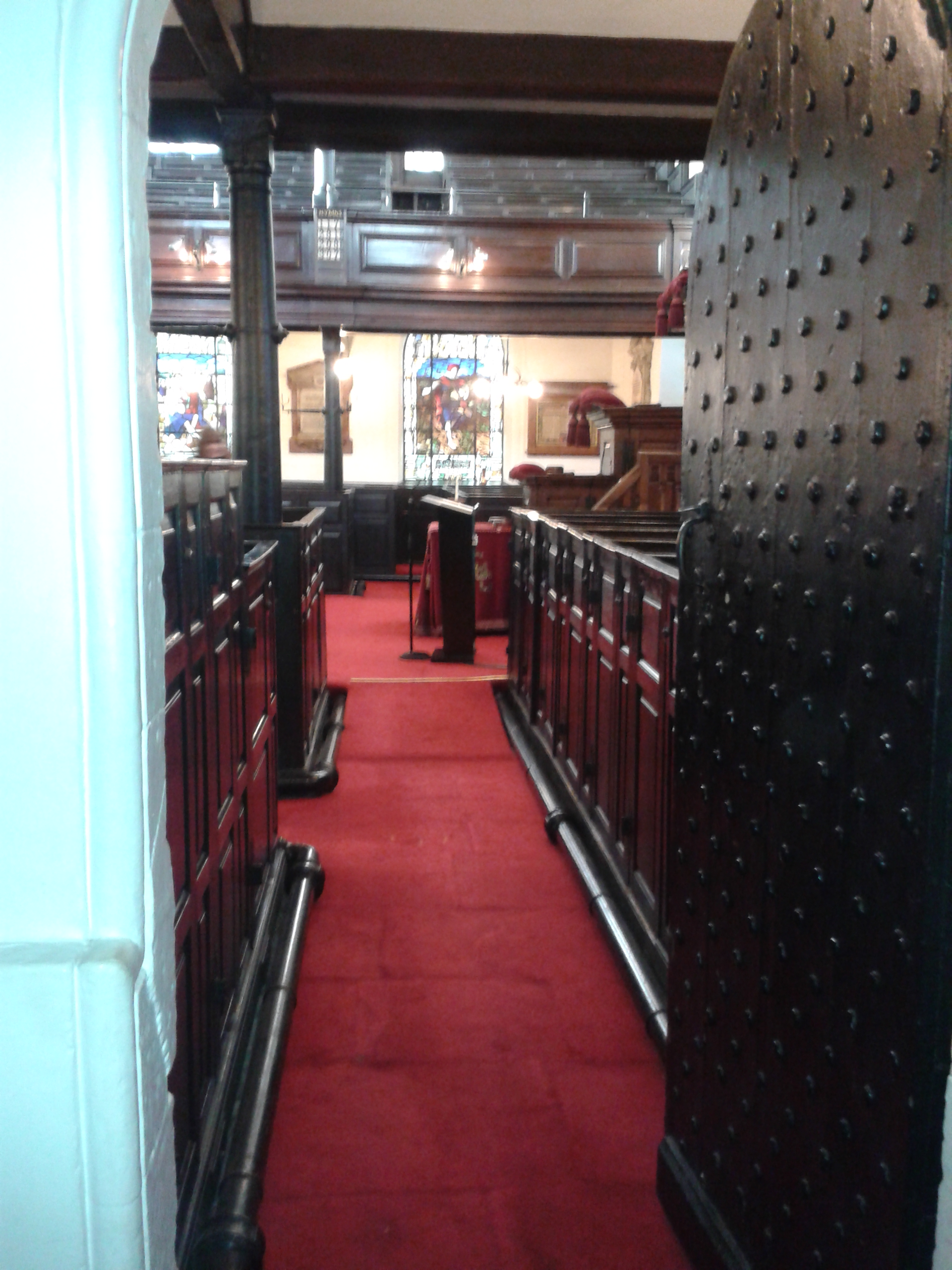
The new chapel was built on land owned by the Mort family who appear to have been generous supporters and benefactors and who had a great importance in Lancashire non-conformity in general. But the chapel, to me at least, always has something of the sense of a fortress about it – the solid, square walls, the ancient oak pillars, the studded door into the church, the large memorial to ‘General’ Wood above the pulpit.
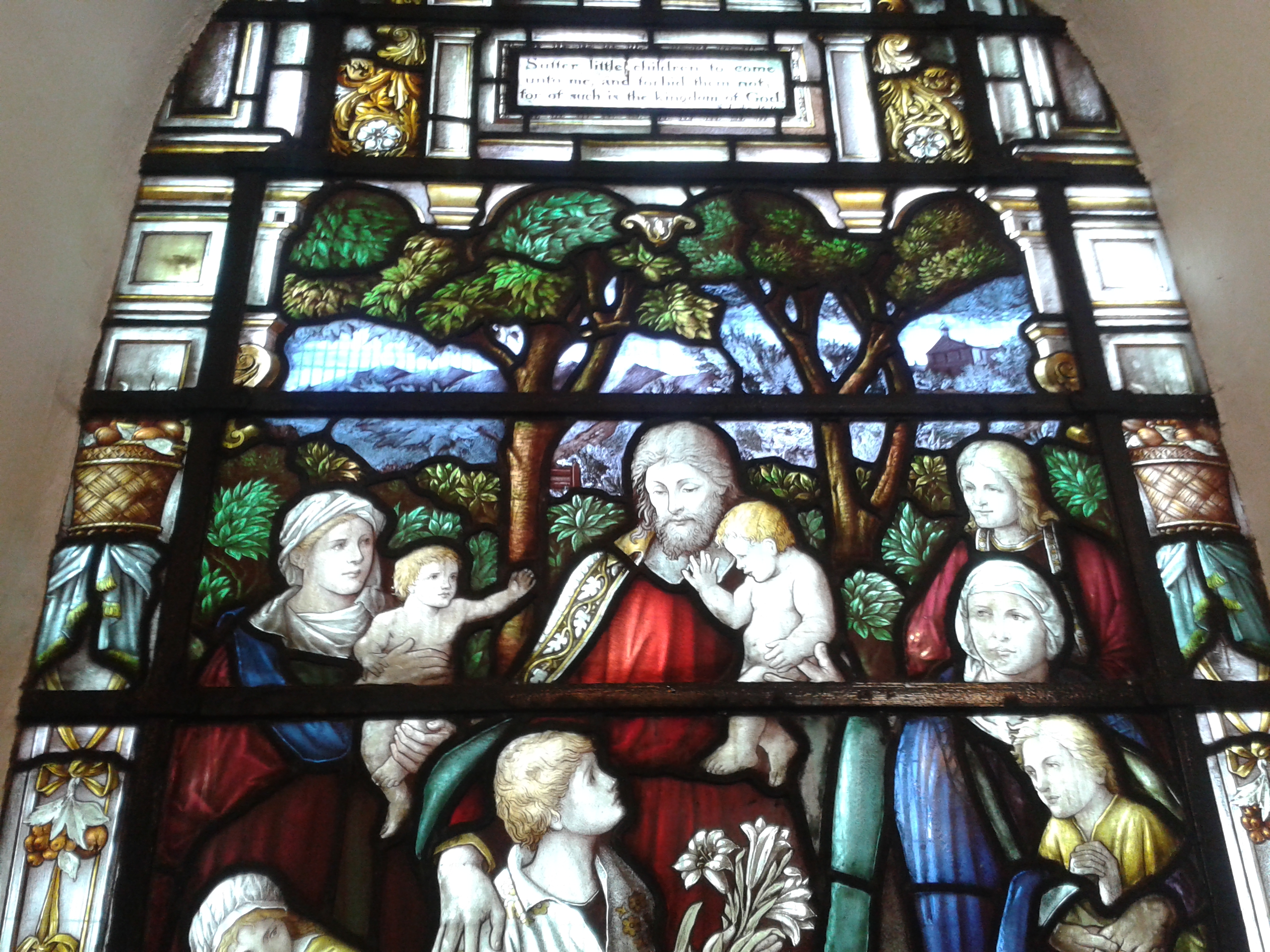
But it is also full of interesting details that would be easy to miss. There is a large amount of stained glass but I had forgotten about the appearance of an image of the chapel itself in the window depicting Jesus and the children. The three decker pulpit is incredibly impressive and with the traditional pulpit cushions very much looks the part still. You can’t miss the pulpits and reading desk but you might miss the small section of panel cut out from behind the top pulpit. Here it was said they had to make space for the door to open wider in order to admit the well-fed frame of the Rev Thomas Belsham when he visited in the nineteenth century!
The Victorian stained glass window featuring the picture of the chapel
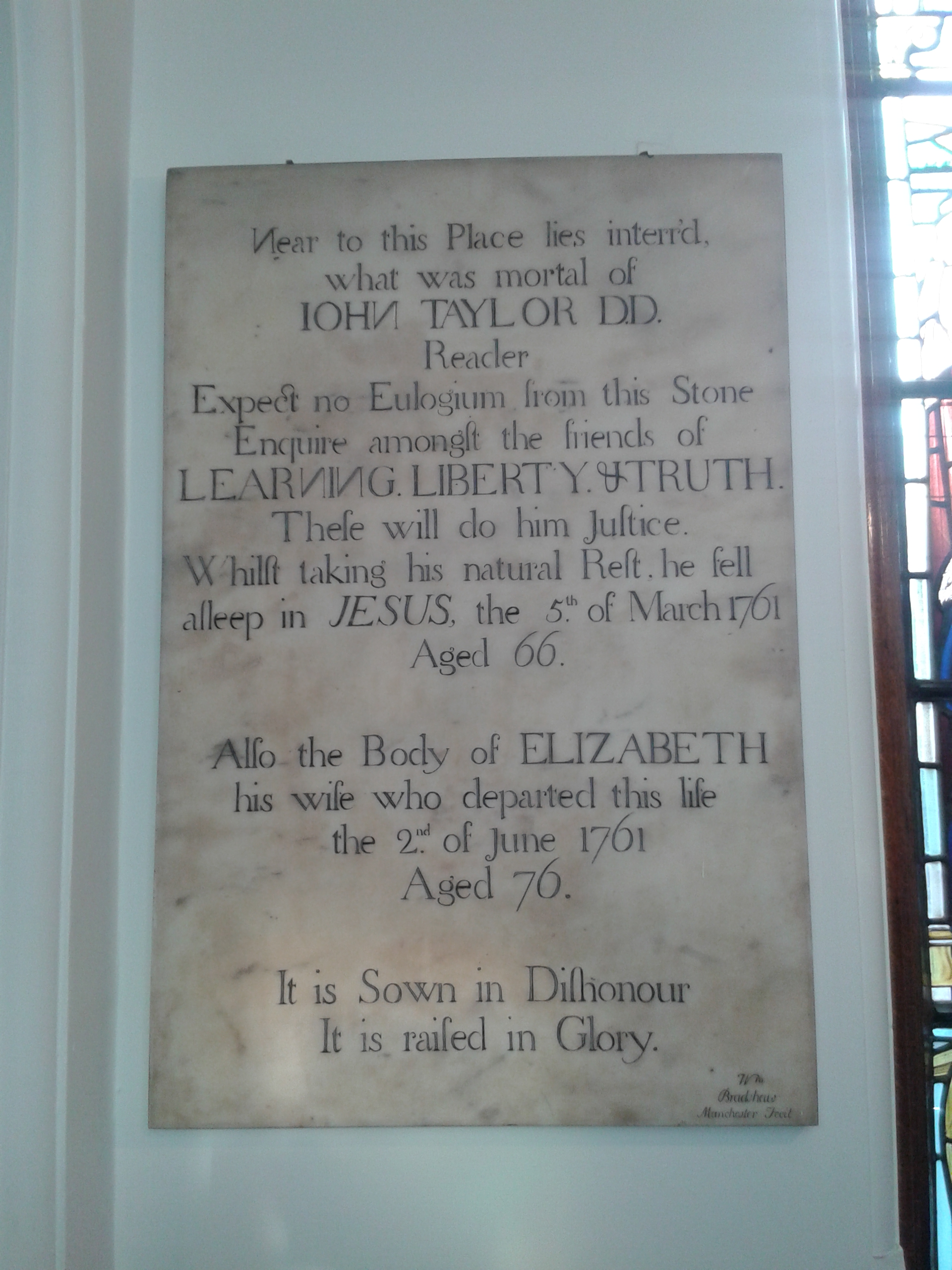
It has been some years since I was last at the chapel and I had a recollection of seeing the grave of the Rev John Taylor laid flat in the grounds of the chapel. John Taylor being the first Tutor in Divinity at the Warrington Academy. But this is not the case – John Taylor is certainly buried there but his gravestone was removed when the front of the church was extended to make way for the organ and vestibule in 1901. There is however, a touching memorial to him and his wife.
Memorial to John and Elizabeth Taylor
The reason for my visit in January was to be part of the congregation to celebrate 25 years of ministry by the Rev Brenda Catherall and I was delighted to play a small part in that special service. Brenda has been minister there since 2007 following ministries in Bank Street, Bolton and Monton and has given 25 years of devoted service to the Unitarian ministry and touched the lives of a great many people through her outstanding work. There is something so appropriate about her ministry in the congregation in which she grew up and which has always had a special place in her affections.
Rev Brenda Catherall in the pulpit
The chapel encapsulates the proud tradition of dissent and non-conformity in the town and it is so encouraging to see the congregation in such good heart and in such good hands.
The Faith and Freedom Great War project continues to expand and now contains around 75 separate items. One recent addition is the video made in 2014 by John Featherstone with input from Peter and Kath Faulkner, the then minister, the Rev Patrick Timperley, and members of the Old Meeting, Mansfield as a tribute to the memory of the war dead of their congregation in the First World War.
Some twenty-two chapel members are listed on the war memorial as having given their lives in the First World War. As other churches have done in this time of the centenary of the Great War the current congregation have researched the lives and circumstances of the men who were killed and tracked down the last resting place of each one of them. The Mansfield folk have also gone one step further and visited the grave of each soldier wherever that was possible. In 2014 a group of Mansfield members travelled to each grave or memorial of a chapel member and placed a poppy there while speaking the words:
We place this cross in thanks and in memory of….a brave son of Mansfield, whose name lives on, and is recorded on the wall of the chapel he attended.
The whole project was also recorded and can be seen on a beautifully put together video. As is so often the case with such research it is deeply poignant. Many of the soldiers were very young, their ages are given on the video along with their address and pre-war occupation – miners, colliery men, a pork butcher’s assistant, a hosiery hand, a farm labourer, and so on. Where there was no known grave the group from Mansfield visited the memorial – such as those at Thiepval and the Menin Gate – which bears the name of those killed in those battles and they placed their poppy there. They visited all the soldiers’ graves and memorials in France and Belgium. One soldier was killed in Iraq and his grave lies in the Baghdad North Gate War Cemetery, he was remembered by a poppy being placed on the Iraq Roll of Honour in the head office of the Commonwealth War Graves Commission in Maidenhead.
In carrying out this act of remembrance they followed in the footsteps of others from the chapel who had gone before. One mother whose young son was killed at Ypres visited the battle site with a party of bereaved mothers in 1920. She returned with a stone from the ruins of Ypres which was incorporated into the wall of the chapel as a memorial.
The circumstances of all the soldiers who were killed were traced, with the exception of one who proved elusive yet is still remembered, as the video says. The grave that is closest to home is in Nottingham Road Cemetery, Mansfield. Here was buried Ernest Davenport a private in the Notts and Derby regiment. Aged just 20 when he died, before the war he had worked in an iron foundry. He had been wounded in the Easter Rising in Dublin and had died of his wounds on 28th May 1916. It was at his grave, near the anniversary of the outbreak of the war one hundred years before, that the chapel members as a whole gathered for an act of remembrance of all those killed.
The video can be viewed here:
The Faith and Freedom Great War Project can be visited here:
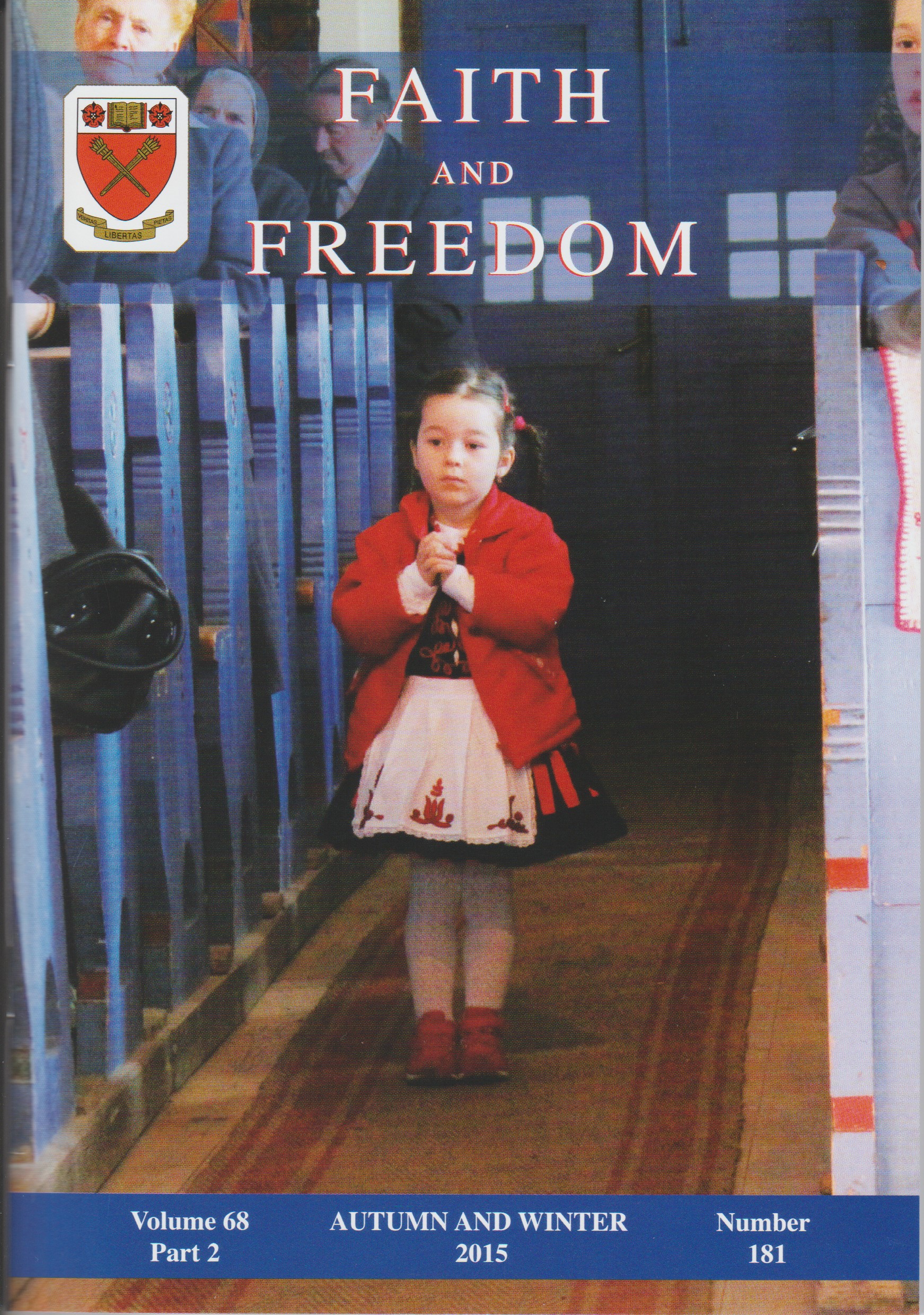
This latest issue of Faith and Freedom has a special cover. Taken from the above photograph by Márkó László it shows a scene from a Thanksgiving celebration at the Unitarian congregation in Oklánd, Hargita county, in Transylvania. This is a first for Faith and Freedom and ties in with a number of reviews in the Autumn and Winter 2015 issue which deal with the faith and practice of the Hungarian-speaking Unitarian churches in Romania. Márkó László’s photographs very effectively capture something of the cultural identity of the Unitarian folk there as well as their deeply held faith. There are more of his pictures in the 2016 Calendar.
The cover of the Autumn and Winter 2015 issue of ‘Faith and Freedom’, Vol. 68 Part 2, Number 181
Once again Faith and Freedom itself contains illustrations this time with a portrait of founding editor Eric Shirvell Price found inside and a photograph of the Rev Percival Godding, whose account of his time as a prisoner of war during the First World War also features.
An annual subscription costs £15 per annum (US $30 in the United States and Canada) and you can pay by post or online via PayPal. All details can be found on our website at:
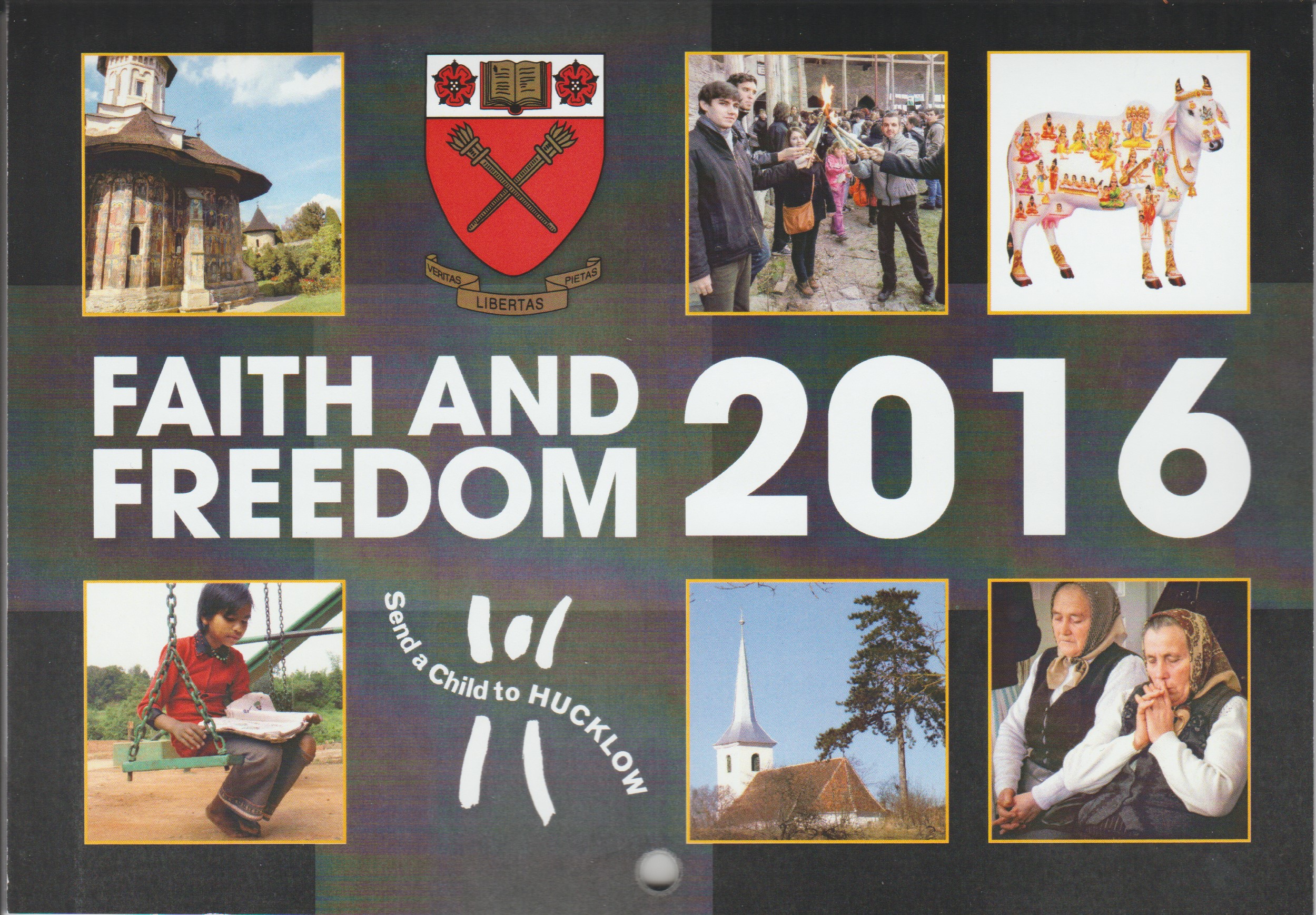
The cover of the 2016 ‘Faith and Freedom’ Calendar – ‘Faith in the World’
If you are an individual subscriber you will also receive a copy of our 2016 Calendar. These are also being sold in aid of the Send a Child to Hucklow Fund. A £5 donation will have one wing its way to you. Again information about the Calendar (and a preview) can be found on our website.
Service of Thanksgiving, Oklánd church, Transylvania (Photo: Márkó László)
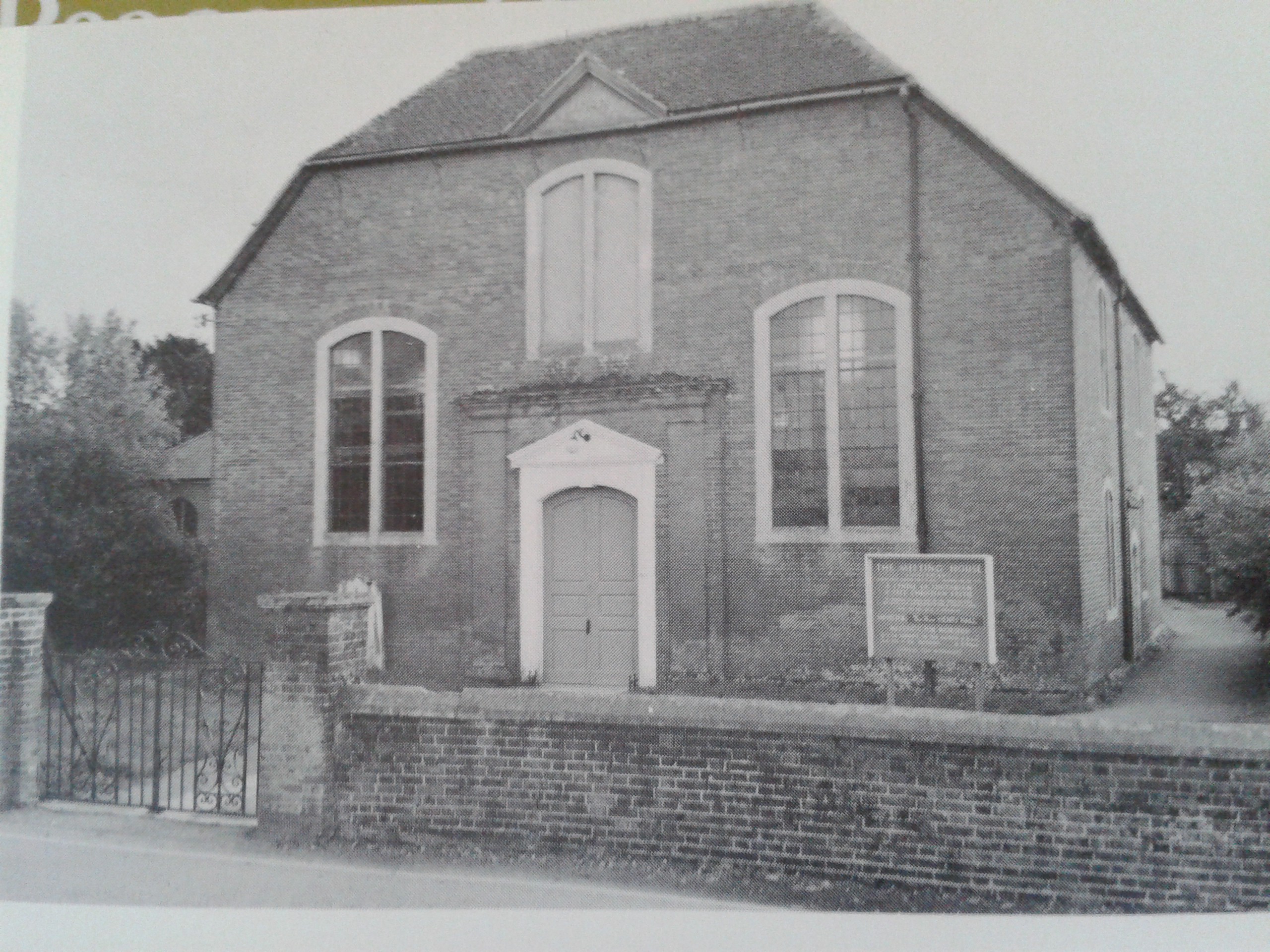
In my previous post about Rev Porter Orr I mentioned St Thomas’ Unitarian Chapel in Ringwood, Hampshire. This particular meeting house (which closed in the mid-1970s) had the rare designation for a Unitarian chapel of being dedicated to (or at least named after) a saint. This is not unique – by far the most famous Unitarian church named after a saint is St Mark’s in Edinburgh – but it is worth giving some consideration to.
St Thomas’ Unitarian Chapel Ringwood (from ‘The Unitarian Heritage’)
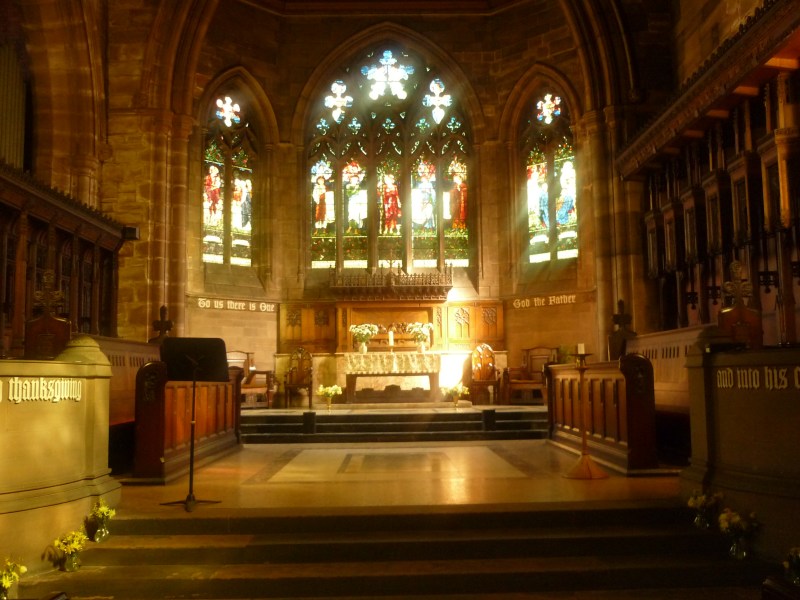
Victorian Unitarian church builders could often be quite keen on saints, of course. In the era of gothic rebuilding in the nineteenth century decorative windows featuring Burne Jones saints were often inserted, as the above view of the chancel of Ullet Road Church shows.
Most Unitarian churches get very dull names, they usually get called after the street they are situated on or the district they are in although sometimes more interesting terminology can be applied such as ‘Great Meeting’ or ‘New Meeting’ (or indeed ‘Old Chapel’). What they tend not to be is named after saints.
That is not to say that Unitarians couldn’t be creative – and also very orthodox – in their church names when they wanted to be. A quick trawl through the invaluable Vestiges of Protestant Dissent published by George Eyre Evans in 1897 (which contains a list of all the Unitarian congregations at that time) reveals no less than eight congregations called ‘Christ Church’ ( I think Bridgwater may be the only survivor of this group). Not mentioned in Vestiges are most of the three churches that I can think of called ‘All Souls’’. This designation probably comes from a slightly later period (All Souls’, Belfast had just been built in 1896) and although to outsiders this probably comes across as a very high Anglican name it is really a more typically Unitarian name in the twentieth century than Christ Church, although the use of this name in England, at least, has ceased I think.
Other popular nineteenth-century Unitarian names (none of them still in use so far as I know) were ‘Church of the Saviour’, which was used by three congregations, and the ‘Church of the Messiah’ and the ‘Church of our Father’ which each had a single use. More overtly Unitarian names were ‘Unity’, which had five takers in 1897 some of them still continuing today, and one ‘Church of the Divine Unity’.
What Unitarians have tended not to do is name churches after individuals –saints in the sense of the people of God – but there are three examples of this that I can think of – Matthew Henry, John Pounds and Edmund Kell, who all have their congregational memorials.
Methodist Unitarians were very keen on Biblical names for their churches – ‘Bethlehem’ and ‘Nazareth’ being the best-known examples of this. In Vestiges there is also one obscure ‘Salem’ founded as a break away from Calvinistic Baptists in King’s Lynn in 1811.
But naming a Unitarian church after a saint is something that does raise questions. How and why did the congregation select that saint? Which saint of that name did they actually mean? Was there ever any suggestion of the congregation being directly inspired by that saint?
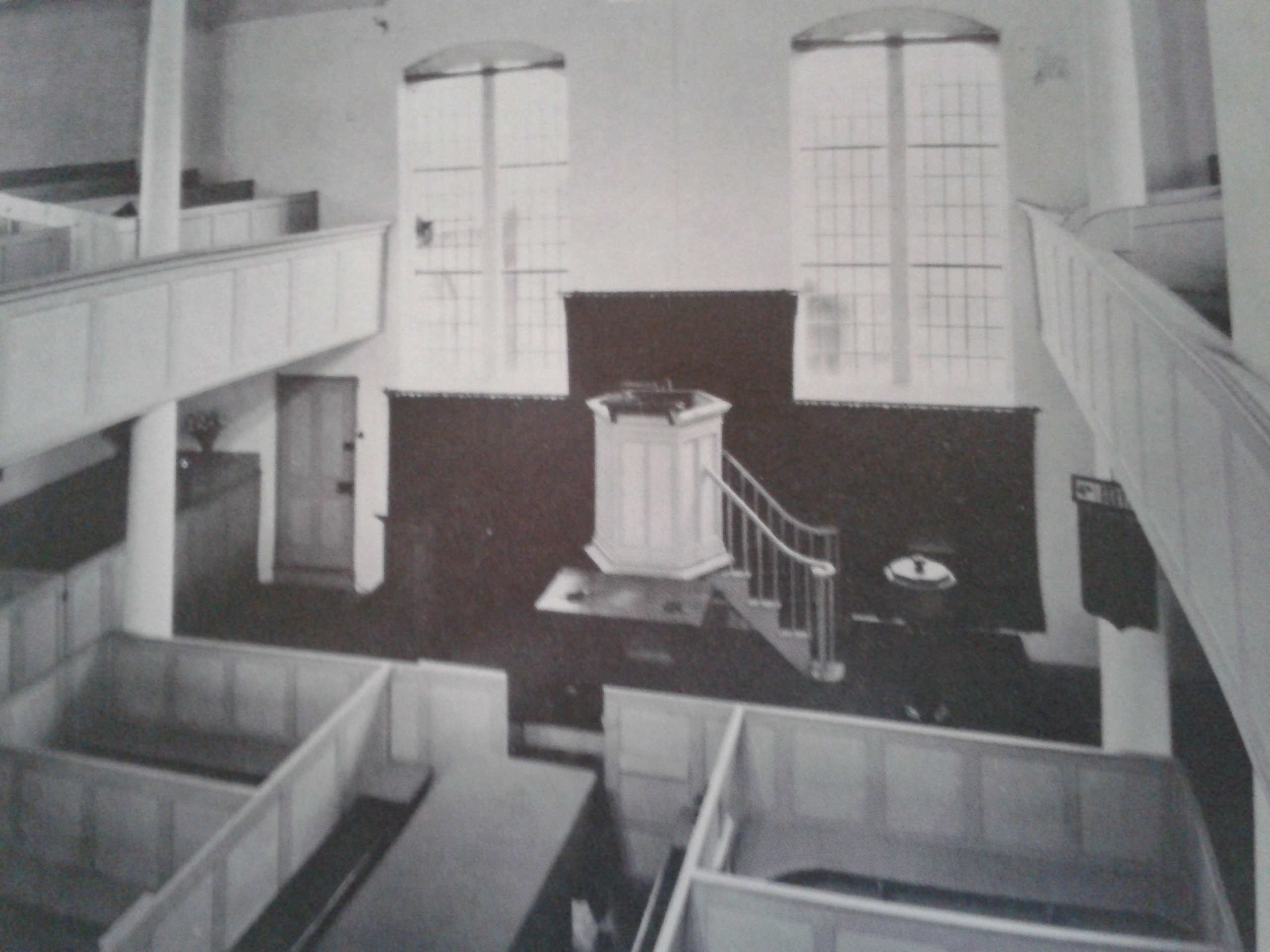
It is often thought that St Mark’s Church is a unique example of the naming of a Unitarian church after a saint but clearly that is not so. What is curious about Ringwood is that the chapel (which is now an interpretative centre for local history) was built in 1727 but only started using the name of St Thomas some time in the first half of the nineteenth century. Why this was so is anybody’s guess. The name was certainly used for a long time, the Rev John Midgely has found instances of it being used in advertisements in the Inquirer in the 1930s, although it seems to have been dropped before it closed in 1975. What is different about St Mark’s in Edinburgh is that this was the name chosen at the time of its building in 1835 and in use ever since. The Rev Andrew Hill has suggested that no one knows why the name was chosen, but presumably the gospel writer was regarded with favour by the Edinburgh people.
The interior of St Thomas’ Chapel (from ‘The Unitarian Heritage’)
But, according to the Vestiges, there was another chapel that took the name of a saint. This was St Michael’s Chapel in Selby. This congregation dated from 1672 and built a new chapel in 1699 which G.E. Evans suggests was called St Michael’s from the start. This seems unlikely in 1699 but the name was definitely in use for a long time and was transferred to the modest new building that was finally opened in 1903 (following some years in a temporary building from 1886). The congregation closed in 1968 according to The Unitarian Heritage and the building passed into other uses, although it still seems to stand.
So there we have the three Unitarian churches named after saints. There were quite a number of churches built on streets with saints’ names – St Nicholas’ Street etc – and there are a few examples of Unitarian chapels later being consecrated by the Church of England and being given a saint’s name. But these are the only three that are definitely named after saints. Can anyone shed any further light on them? It would be interesting to hear any accounts of either St Thomas’ or St Michael’s or indeed of any other saintly churches. In the meantime we have a Unitarian trinity – St Mark, St Thomas and St Michael.
Addendum:
With regard to St Michael’s Chapel, Selby the Rev Andrew Hill has sent the following interesting information:
“The congregation at Selby traces its origin to the visit of a puritan preacher, Noah Ward, from York, in the year 1660. As an itinerant minister he continued to make frequent visits to Selby down to the time of his death, which occurred in 1699. It is said that in honour of the memory of this preacher St. Michael’s Chapel was built in that same year by a gentleman of the name of Barstow. It seems to have owed its name to the fact that one of the Christian names of the said gentleman was Michael, whose good deed it was thought would be perpetuated by calling the place after Michael the archangel. After the death of Mr. Barstow the Chapel was given in trust by his widow, Alice Barstow. contemporary with the Barstow family there were two other families of similar social standing who were associated with the Chapel; these were the Bacons and the Morritts. Beatrix Bacon, wife of Christopher Bacon, bequeathed the land near the town, from which a portion of the minister’s stipend is still paid. A silver Communion Cup is still preserved, on which is engraved: “The Gift of Beatrix Bacon to the Selby Chapel.” The first minister was John Troviss; who was followed by a John Hodgson, and on the removal of the latter to Lincoln, a Mr. Foljamb took his place. From this date until nearly the end of 1886, when worship in the old Chapel ceased on account of its dilapidated state, there were eight ministers of whom Thomas Smith was the first and J. M. Pilkington the last. The new chapel, which is of red brick and on the old site, has been erected to an approximate cost of £400, including the interior fittings, and has accommodation for 125 It was opened on September 24th, 1903, the Rev. Ceredig Jones, M.A., of Bradford, preaching on the occasion. the present minister is the Rev. John Dale.” From: The Unitarian Chapels of Yorkshire.
Does anyone remember the chapel built in 1903? Dare one ask is the silver communion cup still preserved today?
In two recent articles [in the April 2015 issue of the Transactions of the Unitarian Historical Society and the June 2015 issue of the Non-Subscribing Presbyterian magazine] I have written about the Rev John Orr (1829-1896) a scholarly and successful minister in nineteenth-century Ireland whose career took a strange and unexpected turn when he emigrated to the United States in 1879. Whatever the intention of his move to New England his career didn’t flourish on the other side of the Atlantic and by the time of his death he was little remembered in his homeland. This is a pity because he was an important figure in his own day whose two major published works won plaudits and whose ministry at Comber, co. Down helped to establish and grow a fairly new congregation. It wouldn’t be an exaggeration to say that he had been almost forgotten since leaving Comber for Cambridge, Massachusetts in June 1879, although the first step towards raising his profile probably came with the publication of the Thoemmes Dictionary of Irish Philosophers in 2004 in which I co-wrote the entry on him with Professor M.A. Stewart.
But following my article on John Orr in the 2015 Transactions the second article in the Non-Subscribing Presbyterian is as much about his family background – as both the son and the brother of Non-Subscribing Presbyterian ministers he was part of a notable dynasty – and this also deserves to be noticed.
His father, Alexander, was born in about the year 1798 and grew up in the Moneyreagh congregation. Alexander’s friend the Rev S.C. Nelson of Downpatrick reported of his background that:
there he was brought up under the guidance and auspices of that foremost champion of Unitarian Christianity, that true and consistent representative of the earnest loving spirit of the pure and living faith of the Gospel – the buoyant, persevering, and self-sacrificing Fletcher Blakely.
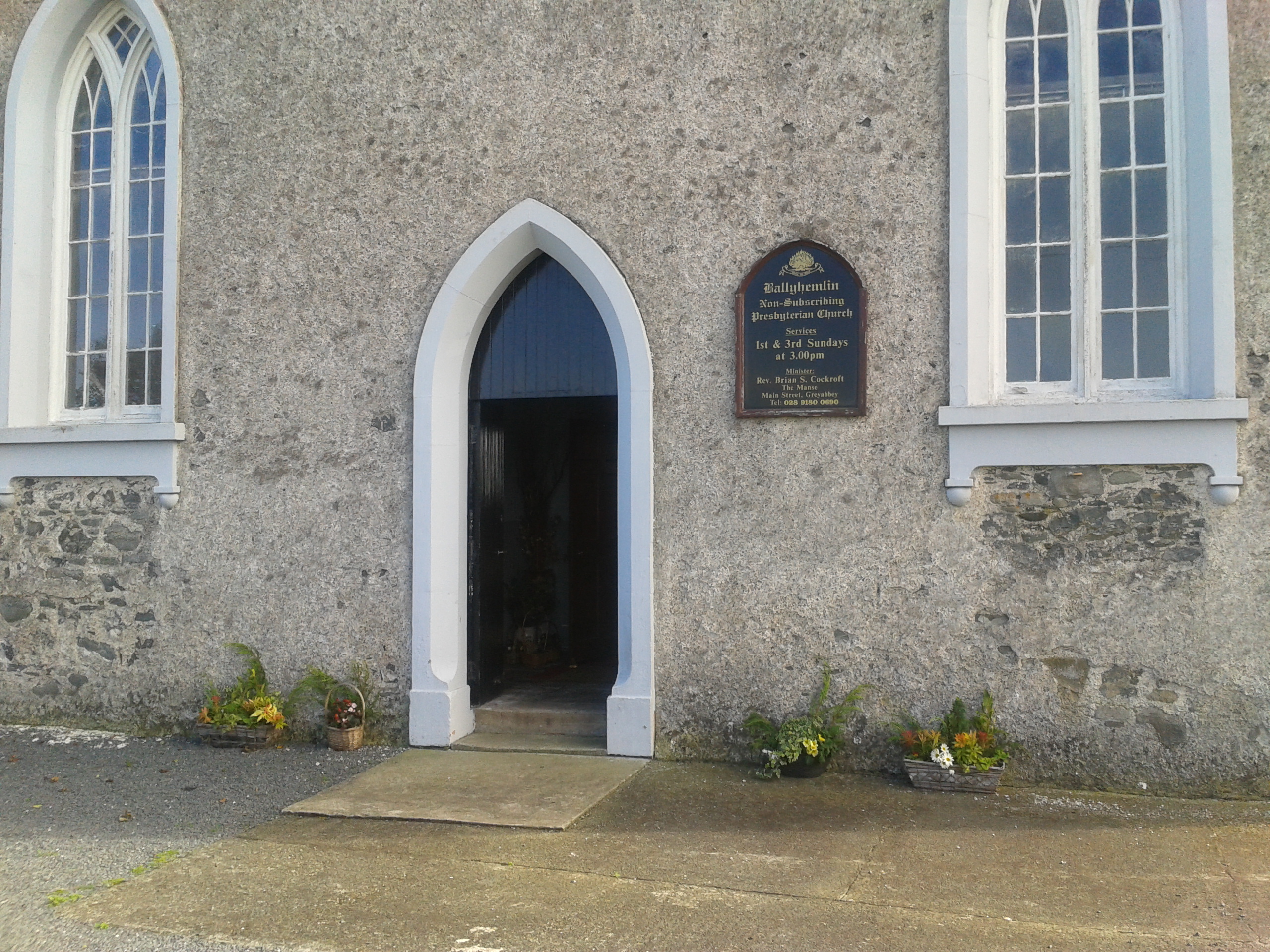
This input, together, no doubt, with his education at Moses Neilson’s Rademon Academy, (supplemented by time at Glasgow University and the Belfast Academical Institution) led him to incline towards the non-subscribers by the time of the second subscription controversy. Alexander Orr was already minister of Second Anaghlone by this time but although his sympathies were with Henry Montgomery and his followers he and his congregation did not join the Remonstrant Synod in 1829 and he waited until 1838 before joining them when he became minister of Ballyhemlin. Here he kept a classical school and remained as minister until his death in 1869.
The entrance to the Ballyhemlin church
This provides the background for the ministry of his son, the Rev John Orr who was both minister at Comber and, from 1866, Professor of Church History, Pastoral Theology and Moral Philosophy for his denomination. If you want to read about him, his publications, his ideas, his importance, and his mysterious emigration to the USA at the age of 50 then the full story can be found in my article ‘Rev John Orr of Comber, county Down and Cambridge, Massachusetts’ in the April 2015 issue of the Transactions of the Unitarian Historical Society, but I will attempt now to place him in the context of his family.
Alexander married Nancy Porter and all three of their children (at least those that we know about) were born while he was minister at Anaghlone. Unfortunately no baptismal register survives for that congregation so we can’t check for additional siblings and we don’t have accurate dates of birth for two of the three brothers. The eldest son, however, was named Porter Orr and must have been born in about 1826 and he was the first to follow his father into the ministry.
Like his father, and his brother John, Porter Orr trained for the ministry at the Belfast Academical Institution. College records at the time are not complete, however, and although we know that his time as a student overlapped with John Orr we don’t know so much about his time there. At the end of his time as a Remonstrant student he became part of the export of ministers produced by the non-subscribers. Training ministers to a high standard there was a surplus of potential ministers over vacancies and a number of students took up pulpits at churches in England. After being licensed by the Presbytery of Bangor Porter Orr accepted a call to the Unitarian church at Ringwood in Hampshire in 1845. With its origins in the seventeenth century the meeting house, then known as St Thomas’ Chapel, was built in 1728. Porter Orr stayed here for five years before accepting a call to Strabane and returned to Ireland in 1850.
As a new congregation Strabane was part of the fruit of the quite committed and successful missionary effort of the Remonstrant Synod and one of the few congregations to be founded west of the Bann. Porter Orr was the third minister of the congregation and had succeeded his brother John who had been minister there from March 1848 to May 1850.
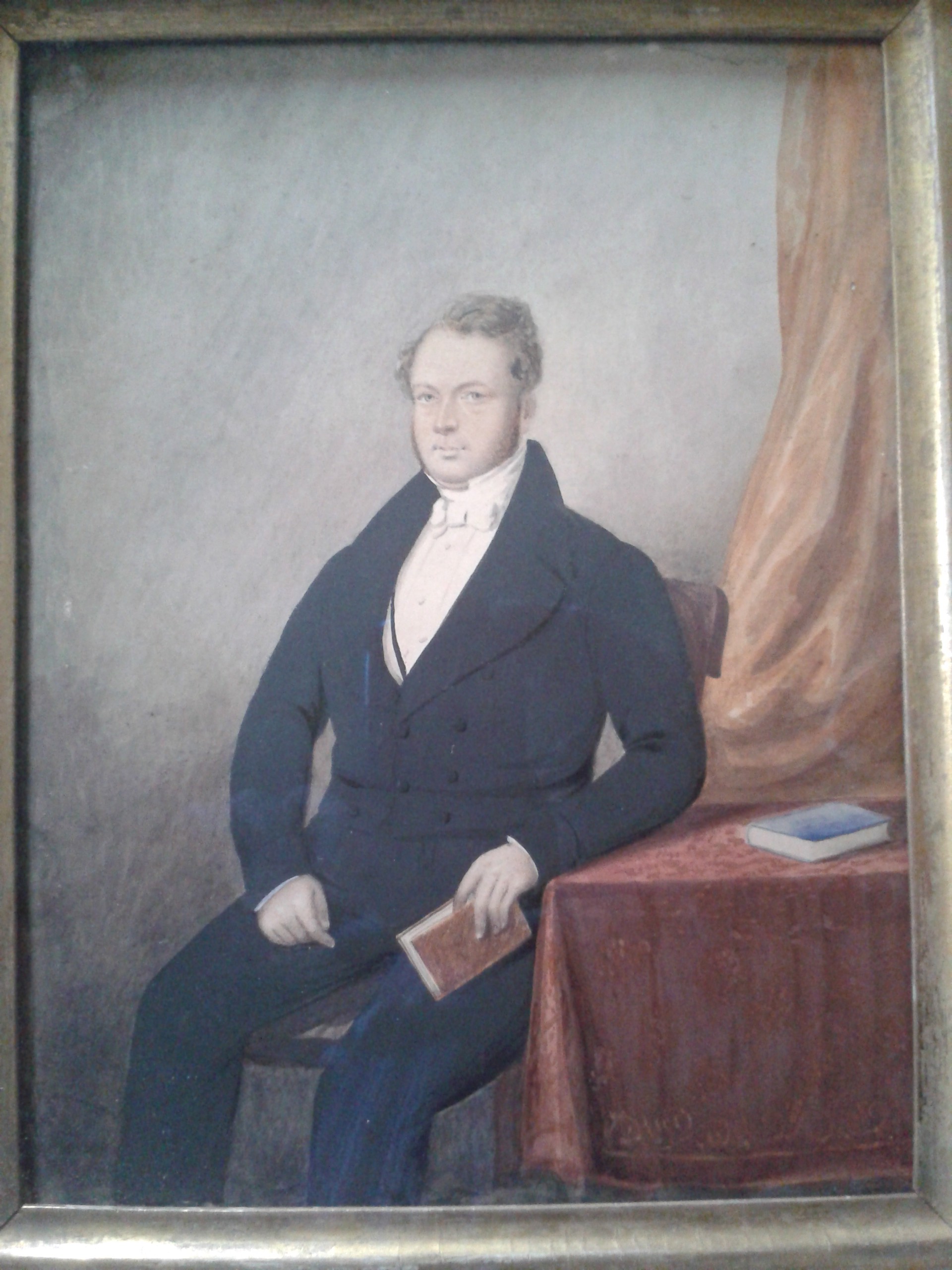
Recently a portrait has come to light of a minister painted in about 1850. Generously donated to the Comber Church by a direct descendant of John Orr this shows a youngish man in the clerical attire of the mid-nineteenth century. It is undated and has been reframed in modern times, when someone has written on the back the name Thomas Porter Orr. I think we can fairly confidently assume that this is a portrait of the Rev Porter Orr. It is only small in size, the books in the portrait cannot be identified, but its provenance in the Orr family and the fact that it is certainly a clergyman would suggest – to me at least – that Thomas Porter Orr and the Rev Porter Orr were one and the same person. The portrait could have been made in Ringwood or Strabane, we can’t know for sure, but it is a charming and touching memento of a life that was cut short. Porter Orr resigned his charge on 30th January 1855, he died less than two weeks later on 12th February.
Portrait believed to be the Rev Porter Orr (Comber NSP Church)
The congregation of Strabane did not last much longer, Porter Orr was the last minister and the congregation effectively ceased in 1857. But it was important to the Orrs and the denomination. John Orr was there long enough to meet his wife – Sarah Jane Porter – the daughter of James Porter, one of the founders of the Strabane congregation, and they married in October 1851. Sarah Jane’s sister, Catherine, married the Rev David Maginnis, another prominent minister in the last half of the century, in 1845.
Of his brother John Orr we can say that he was one of the outstanding intellects of his generation of ministers within the Non-Subscribing Presbyterian churches, but despite his highly successful ministerial and academic careers, along with David Maginnis, his brother in law, he often found himself at the centre of the increasingly strident infighting that bedevilled the non-subscribers at the time, although he was held in high regard by his colleagues, especially those who shared his radical theological views.
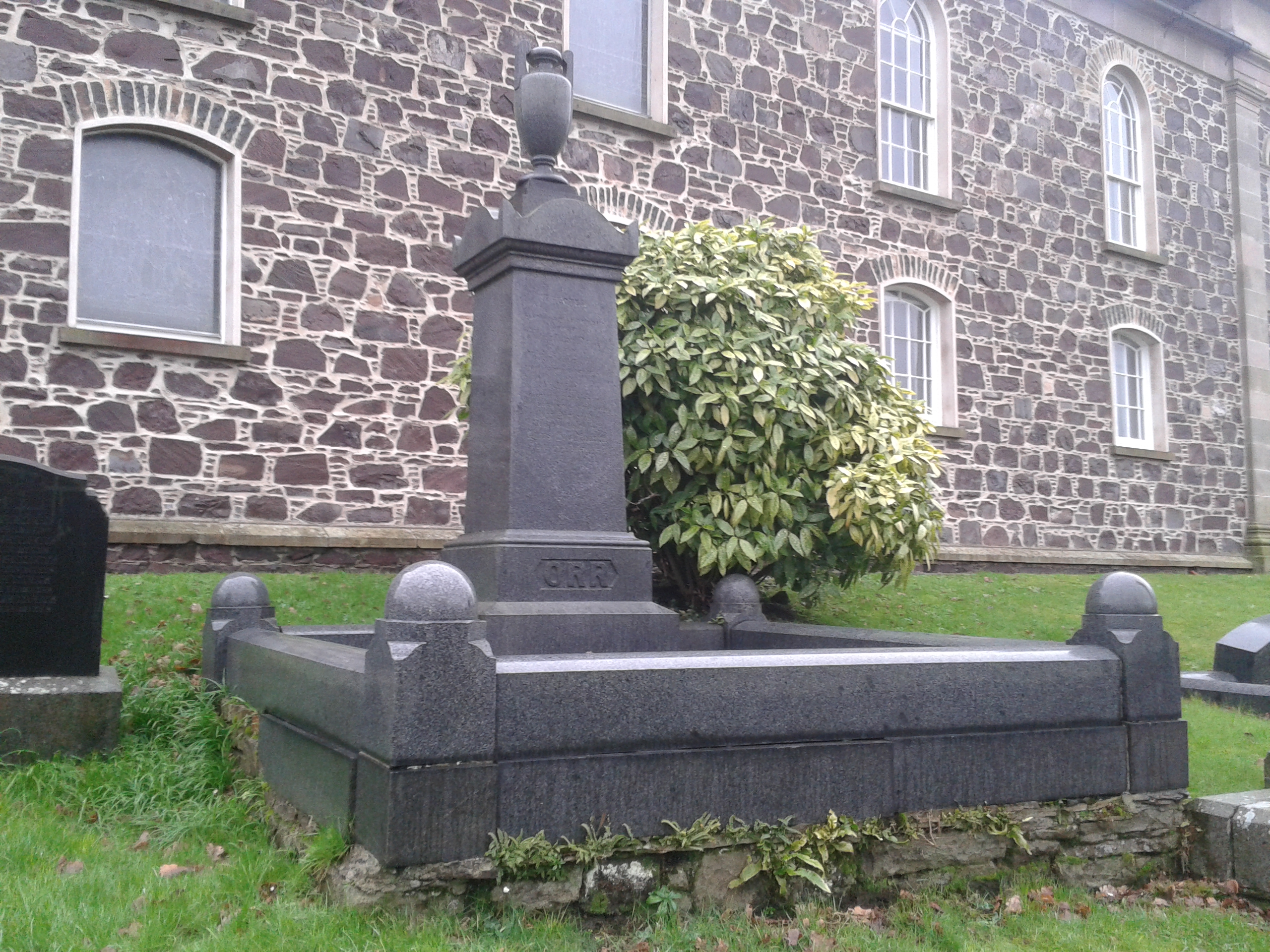
What impelled Orr to leave for America? Was it a sense of bereavement following the death of his first wife at the age of 42 in 1865? Or was it some sense of unfulfilled ambition? Or a sense of dissatisfaction with his denomination? Or had some issue arisen in Comber that meant he should depart? Again we will never know exactly. But we know quite a lot about what he did in America, the introductions he had and the aims he carried with him across the Atlantic. We know also that he died on 19th August 1896 and was buried in Mount Auburn cemetery, Cambridge, Massachusetts. His second son Alexander, who was a journalist, joined him in the Boston area but predeceased him in 1891 aged 35 and was buried in the same cemetery. His youngest daughter lived in Boston until 1960 when she died and was buried in the same plot as her father. What became of his second wife Agnes is not known. Most of the rest of the family are commemorated on the imposing memorial in the graveyard in Comber.
The Faith and Freedom Great War project continues to expand and we hope to see added to the site in the near future a number of new articles, including Alan Ruston’s piece for the Transactions of the Unitarian Historical Society (1993), ‘Killed Fighting in the First World War’; and a moving sermon by Andrew Hill who recounts his father’s experiences during the First World War as a ministerial student who was assigned to “Non Combatant service only on conscientious grounds”.
We have also received a good number of images of war memorials from many different places. Brendan Burke has sent a whole sequence of pictures of the memorial in the South Mall in Cork. Of course it is not related directly to the Unitarian (or any church) in Cork but unveiled in 1925 it is a rare example of such a public memorial in the Irish Republic. It shows a soldier of the Royal Munster Fusiliers with the names of the war dead (which almost certainly includes some members of the Princes Street congregation) on a plinth underneath.
Cork Peace Park (Photo: Brendan Burke)
We’ve a good number of images of war memorials too from churches in Northern Ireland, many of them designed by Rosamund Praeger, the famous sculptor who was also a member of the Holywood NSP congregation.
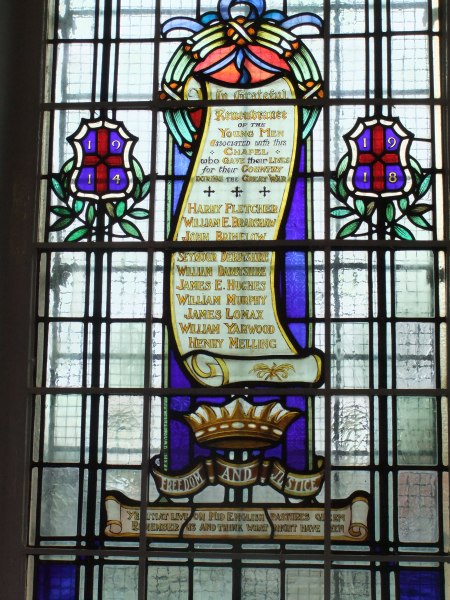
Lynne Readett has sent some fascinating material from Park Lane Chapel, Ashton in Makerfield. Here the memorial takes two forms – the first a stained glass window listing the names of those who were killed in the war. This was beautifully restored and rededicated at a service to mark the outbreak of the First World War in August 2014. The congregation also built an extension to their school house as a further memorial in 1925.
Memorial window Park Lane (Photo: Lynne Readett)
The window contains a list of the Chapel’s fallen as well as the legend ‘Freedom and Justice’ and the quotation ‘Ye that live on mid English pastures green, remember us and think what might have been’. This was a commonly used verse on memorials all over England at the time but I don’t know the source, does anyone know where it comes from?
Lynne has supplied the site with photographs and accounts of special services held both there and at Cairo Street, Warrington, together with details of those who were killed in the war who belonged to Cairo Street. Susan Naylor has also supplied details of the members of Park Lane who died in the First World War.
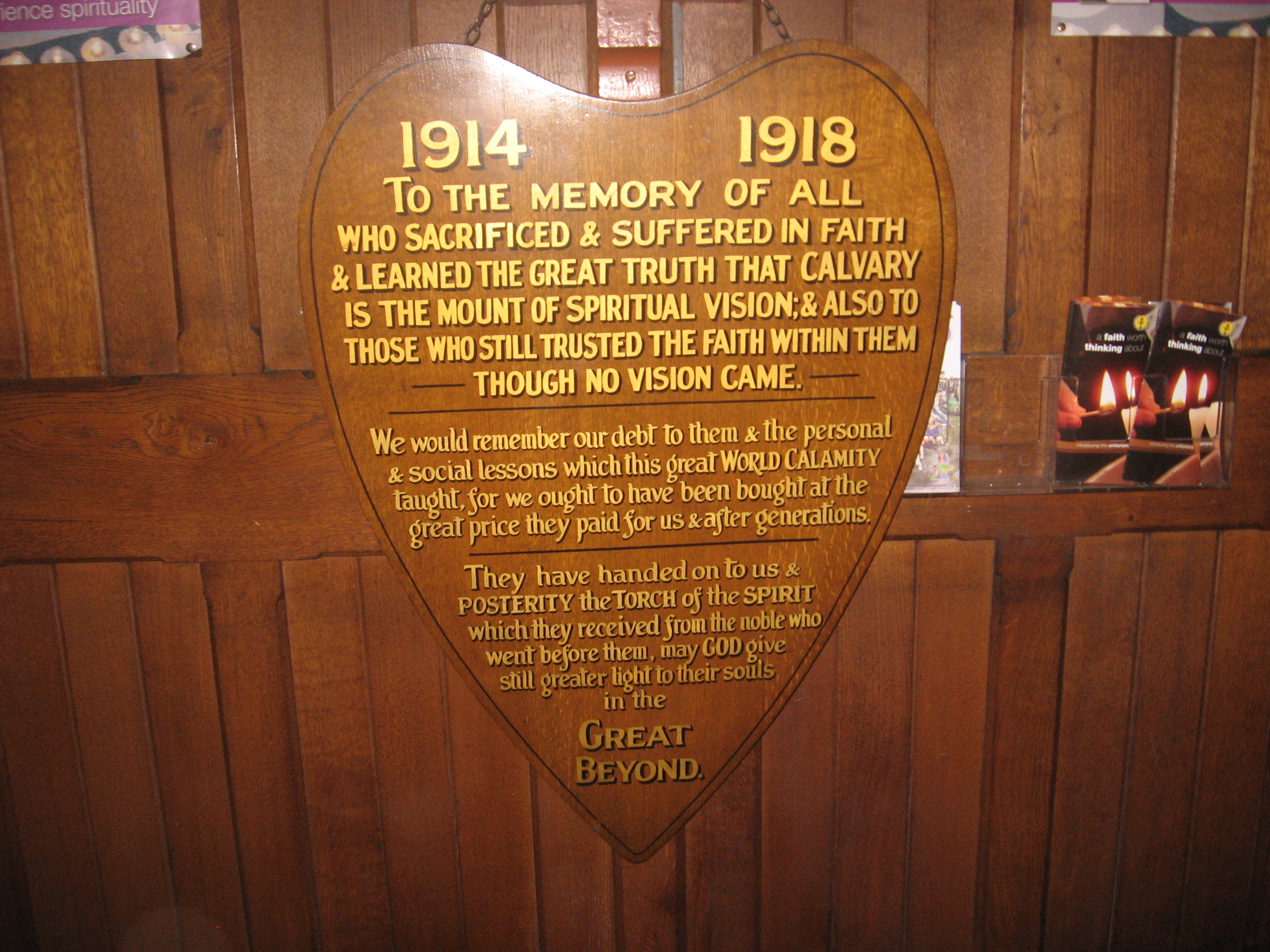
Jennifer Young has sent a picture of the war memorial at Lincoln Unitarian Chapel. I have only visited this Chapel once, some years ago when it was refurbished under the ministry of the Rev Paul Travis but I have to confess that I don’t remember seeing this memorial. It seems rather verbose, it carries the names of no individuals and is quite unlike any other memorial that I am aware of. It is interesting to compare it with the Park Lane memorial window. If like so many church war memorials it dates from the early 1920s then I would guess it is the work of the minister at the time the Rev J. Lionel Tayler.
Lincoln War Memorial (Photo: Jennifer Young)
But it is very pleasing to record that a wide variety of material is being sent in for the Project and more is very much welcomed, including anything that forms part of the church experience of the Great War.
In his excellent short article on Jeremiah Horrocks in the book Liverpool Unitarians Faith and Action Bernard Cliffe is very cautious about making too many definite assertions about his life. As Bernard puts it “an account of the life of the boy and the young man has to be a matter of conjecture, with the generous use of qualifying words.” The truth is we have very few hard facts about the life of this pioneer astronomer who died at the young age of 22. Inevitably though this hasn’t stopped others from drawing all sorts of conclusions about his life.
One of the things we do know for sure was the extent of his achievement as a youthful astronomer – indeed there are some parallels here with the life of Clyde Tombaugh who first identified Pluto in his 20s. Clyde Tombaugh now has a feature on Pluto’s surface named after him while Jeremiah Horrocks himself has been memorialized in a number of places since his initial observation of the transit of Venus across the Sun.
Horrocks’s discoveries were only published posthumously and, gradually, in the centuries after that, places – and churches – were keen to claim him as one of their own. But his scientific importance is pretty well established. Allan Chapman (in ‘Jeremiah Horrocks, the transit of Venus and the ‘New Astronomy’ in early seventeenth-century England’, Journal of the Royal Astronomical Society, 1990, 31) says that despite a scientific hagiography that has also built up around him “the plain fact [is] that his documented contributions to astronomy were formidable by any standard…he was one of the first men in England to grasp the significance of what was going on in contemporary European astronomy. Not only did he repeat many of the techniques of Kepler and Galileo, but he went on to develop the New Astronomy to produce conclusions which substantially advanced those of its continental founders” (pp.33-334).
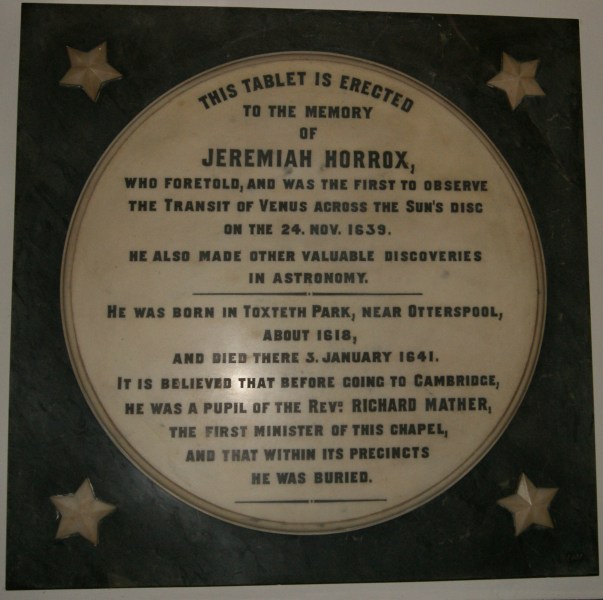
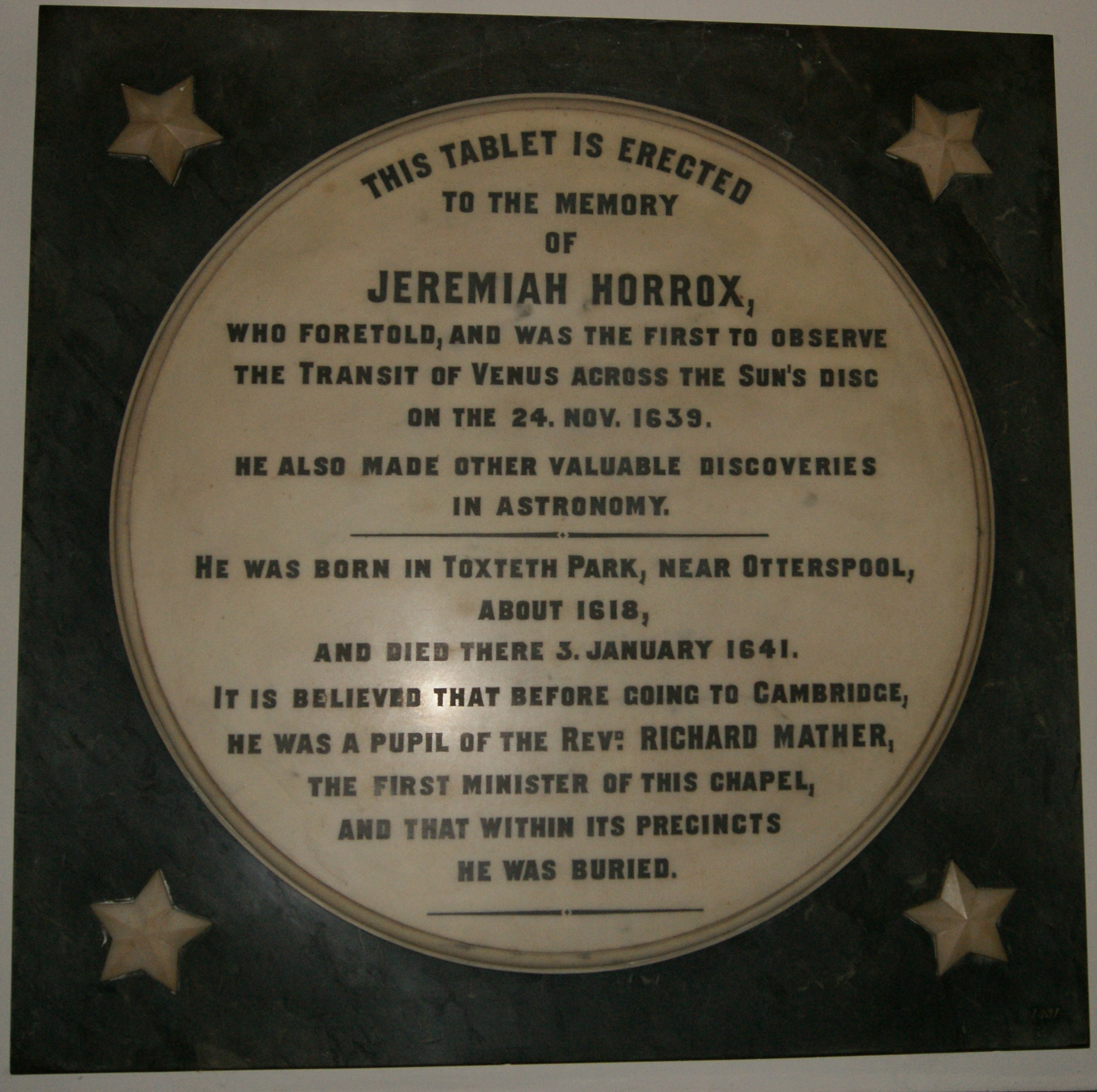
A plaque in the Ancient Chapel of Toxteth records that Jeremiah Horrocks (or Horrox) “foretold, and was the first to observe the transit of Venus across the Sun’s disc on the 24. Nov. 1639”. But the plaque, which was put up in 1891, is, in fact, only one of four church memorials to him around the country.
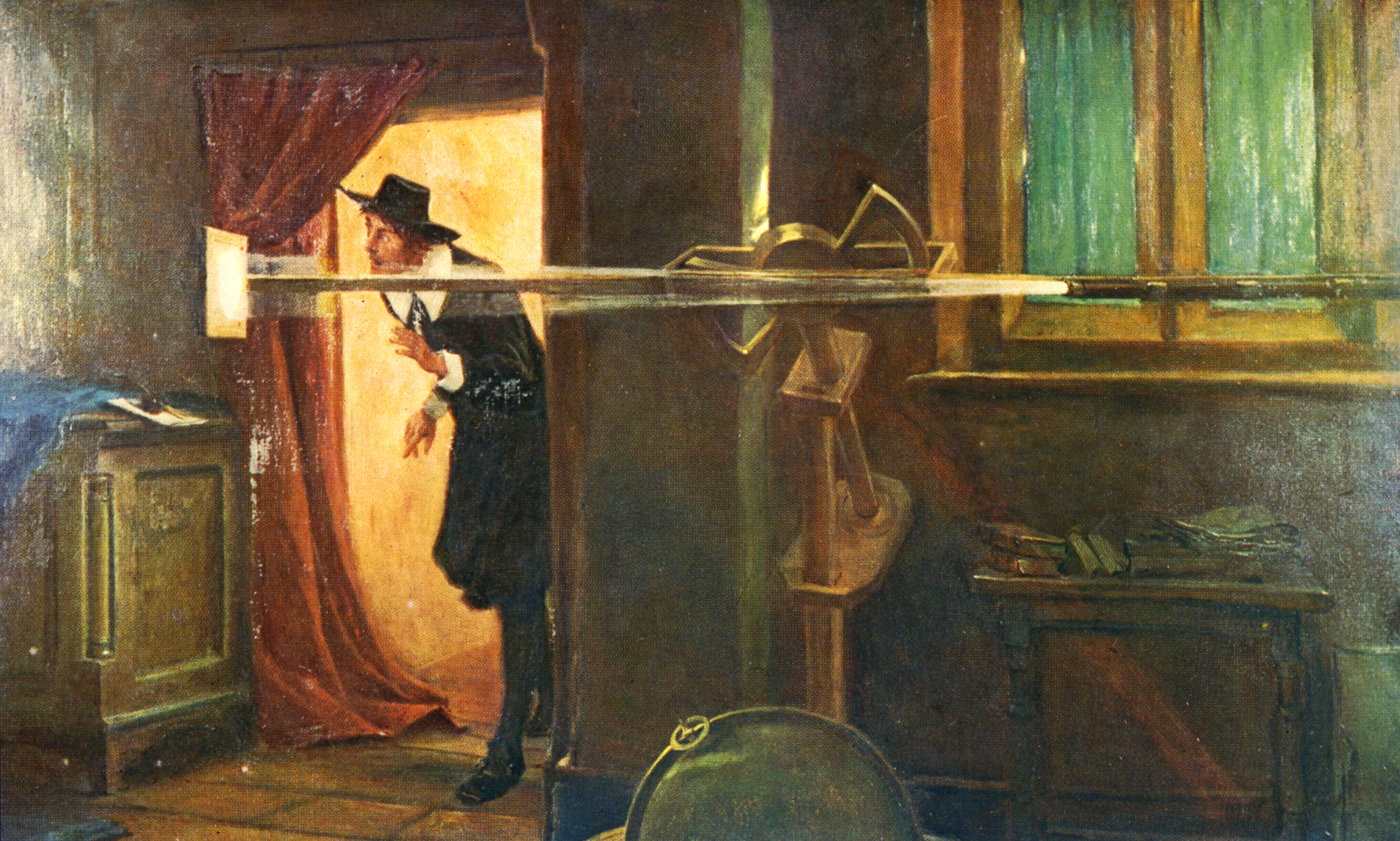
A Victorian depiction of Jeremiah Horrocks observing the transit of Venus
Without doubt the best known of these is in Westminster Abbey erected opposite that of Isaac Newton (who had praised his work) in 1874 following a petition from the Council of the Royal Astronomical Society (actually inscribed on part of the marble monument to John Conduitt, who was married to the niece of Isaac Newton). Certainly the Abbey is a fitting place for a memorial to such a person. On it his scientific achievements are listed but it also states that he was “Curate of Hoole”. Now there is no doubt that Hoole is where Jeremiah Horrocks lived for a while and where he observed the transit of Venus. But there is no evidence that he was ever curate of Hoole, or indeed an ordained clergyman of any sort.
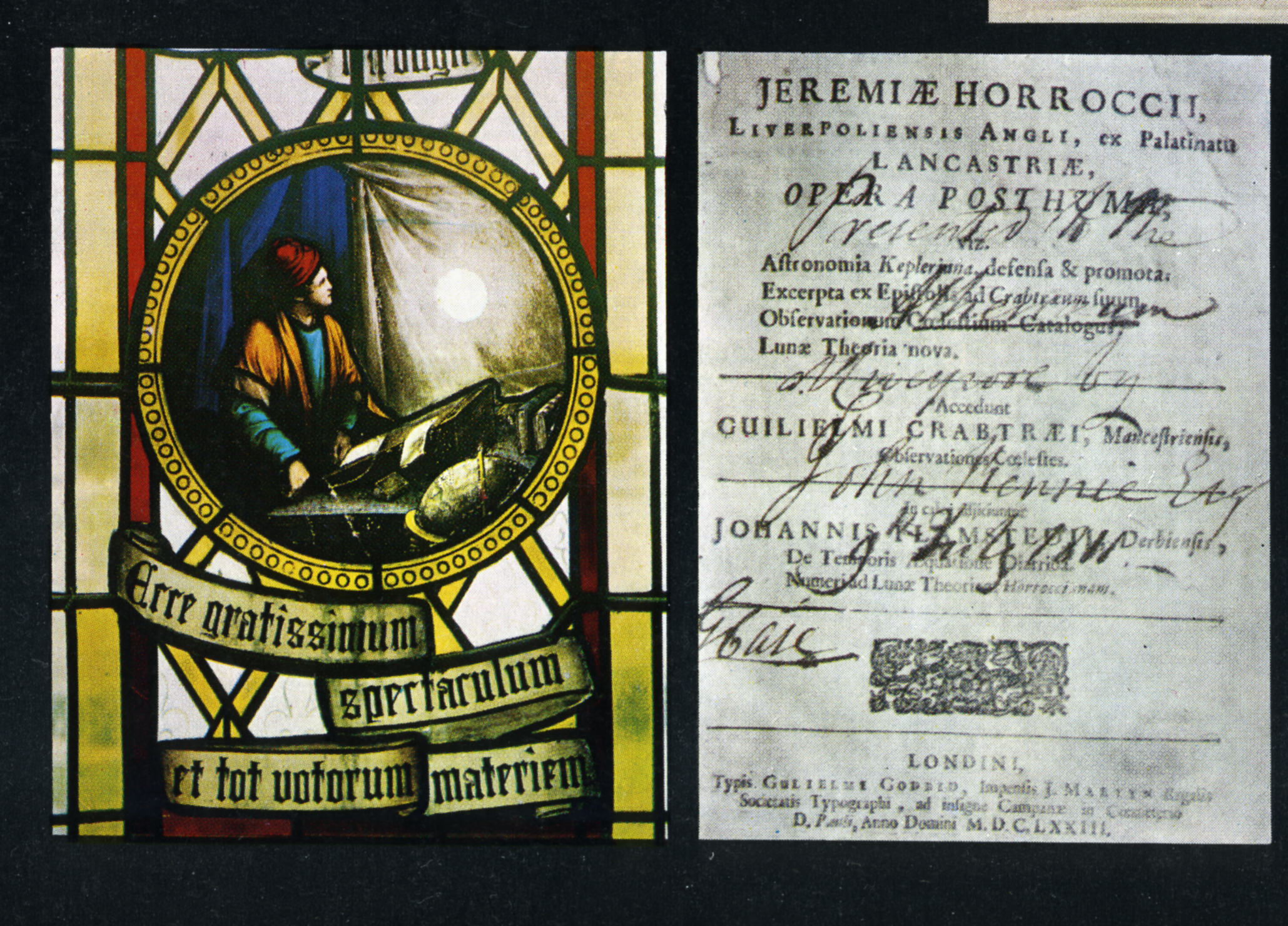
The Victorians were not slow to extend or embellish their assessment of his religious affiliations. The church at Hoole has its own memorials too including a Horrocks Chapel, memorial windows, a weather vane and a plaque, although the website of St Michael’s Church, Hoole now describes the text of this plaque as “largely fictional”.
Jeremiah Horrocks seems to have spent about a year in Hoole. Rather than being a curate or holding any position in the church he was probably a tutor to the children of a local family, in whose home he observed the transit of Venus. But there can be little doubt that he will have attended the church at Hoole while he was resident there. At the time there will have been little difference in the theological outlook of Hoole and the Ancient Chapel of Toxteth. Both were centres of Puritanism – comprising earnest, godly, and devout parishioners, in both places members being technically part of the Church of England (there was little leeway to be anything else at the time) but possessing a no-nonsense approach to faith and a fair degree of suspicion of ecclesiastical hierarchies. During his time there the church was still a just a chapel of ease and the curate (later rector) was eventually ejected for non-conformity.
The stained glass window at Hoole Church and the title page of Horrocks’ posthumous work
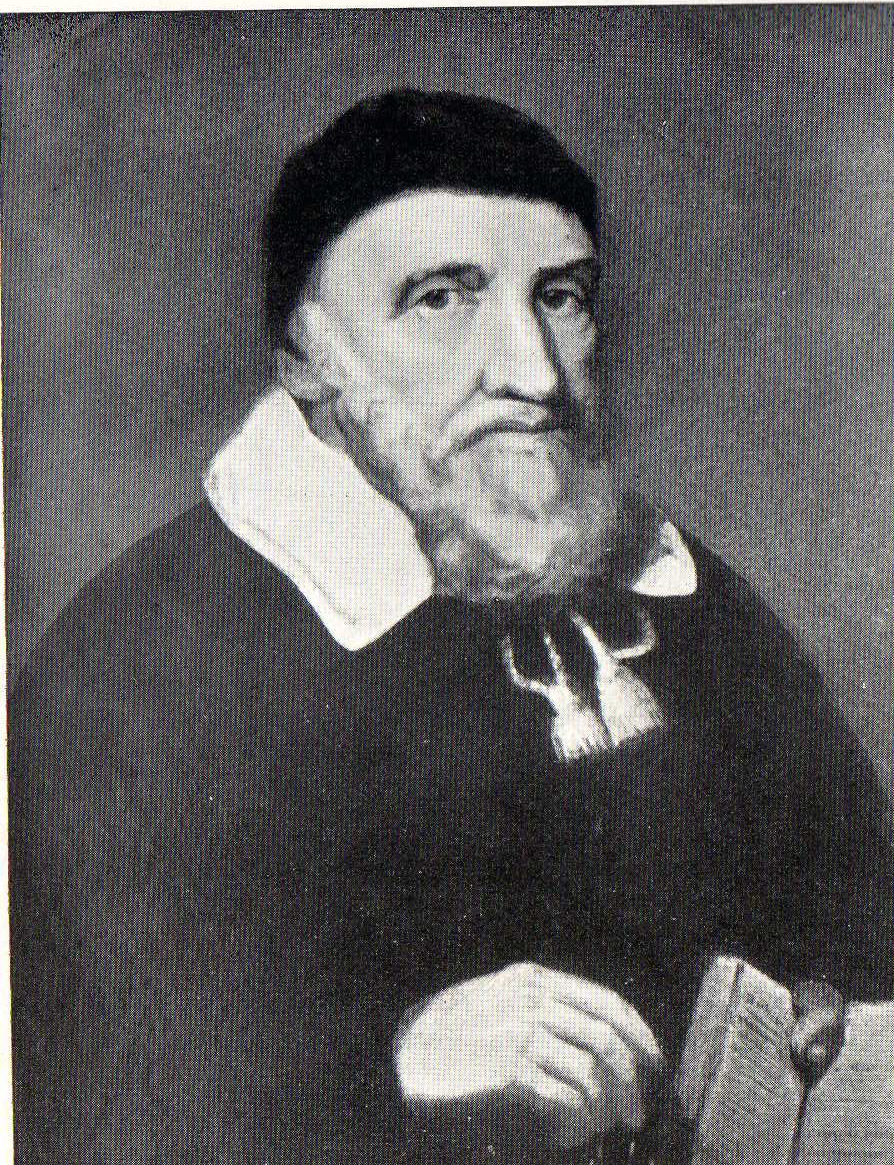
Although no records of Horrocks’ baptism or burial survive he seems both to have been born and died in Toxteth where his family names illustrate the Puritanism of his background. The names of Horrocks and Aspinwall (his mother’s maiden name) were amongst those puritan settlers who arrived in Toxteth in the late sixteenth century and began clearing the hunting park and built the chapel. They were part of the group who called Richard Mather to be first their schoolmaster and then their minister. The same Richard Mather was reluctant to accept Episcopal ordination. He eventually did so but was alarmed after being ordained (so the story goes) when the bishop approached him and asked to speak to him in confidence. Fearing that some admonishment was imminent he was surprised instead to hear the bishop say “I have an earnest request unto you, and you must not deny me; it is that you will pray for me; for I know that the prayers of men that fear God will avail much, and such an one I believe you to be.” Despite this unusual alleged exchange with the bishop he was eventually suspended for nonconformity and subsequently left with many of his followers for New England.
Richard Mather
It was probably here that Horrocks was educated and his religious opinions formed. From Toxteth he went to Emmanuel College, Cambridge as a sizar, basically the lowest form of student life, working as a college servant alongside his studies. He left without taking a degree but developed a passion for astronomy while there and was soon manufacturing his own astronomical instruments. Members of the Horrocks family, quite probably including his father, were watchmakers which must have been an assistance in developing precision instruments.
But following his death on 3rd January 1641 two hundred and fifty years were to pass before the Ancient Chapel erected its own memorial in his memory.
But this is not the only church memorial to Jeremiah Horrocks in Liverpool. In 1826 Moses Holden, described by the Oxford Dictionary of National Biography as a “popular astronomer,” used the proceeds of one of his lectures to pay for the erection of a memorial tablet in St Michael’s in the Hamlet church in Aigburth, not far from the Ancient Chapel. It may well have been awareness of this tablet that encouraged the Unitarians to put up their own. Holden seems himself to have been a Methodist lay preacher but was on good terms with the established church. Nevertheless Jeremiah Horrocks can never have had any connection with St Michael’s in the Hamlet, since it was not founded until 1815.
Horrocks is commemorated in other ways too – additional memorials in Hoole and Liverpool; an observatory; an institute of the University of Central Lancaster – but it is curious how a variety of religious traditions have all sought to harness him for their own adornment. All of them have some claim on him but – in my view at least – it is the memorial that is the least known and acknowledged, the one in the Unitarian Ancient Chapel of Toxteth, that is most appropriate. Not because he was a Unitarian – because he wasn’t, such an idea would have been absurd to him. Not because he was a dissenter, because he wasn’t that either. As I have suggested his own views were almost certainly very strongly puritan and he held them within the context (technically at least) of the Church of England. But the little chapel in Toxteth Park was the place where he grew up and was educated. He was therefore part of a particular religious community founded in the last years of the sixteenth century and continuing ever since. The memorial to Jeremiah Horrocks was unveiled on Sunday, 11th October 1891, the minister, the Rev Valentine D. Davis preaching a sermon based on Genesis ch.1 v.1,3:
In the beginning God created the heavens and the earth. And God said, “Let there be light”; and there was light.
The Memorial to Jeremiah Horrocks in the Ancient Chapel of Toxteth, Liverpool
I probably first came across the Unitarian Van Mission in the late Professor R.K. Webb’s masterful survey of ‘The Unitarian Background’ in the 1986 volume Truth Liberty Religion. Essays celebrating Two Hundred Years of Manchester College (edited by Barbara Smith). However, the end of his chapter takes on a very negative tone where he describes “precipitous decline” being caused by the “attenuation and fragmentation of Unitarian doctrine”. In this context he mentions “the touching Van Mission that wended its slow way through the country in the years after 1906”.
This really is a slightly patronising view of the Van Mission and, of course, is not really fair. From the perspective of the late twentieth century anything that relied on horse drawn power could be regarded as touching and slow. But in 1906 people would not regard such a mission in any such way.
It is clear from the response to my previous post that there is a great deal of latent interest in the Unitarian Van Mission. It is also the case that there is the material for a serious research project on it. John Roberts’ useful investigation into the Van Mission in the 1978 Transactions of the Unitarian Historical Society is just about the only thing that has been written on it since the First World War. I don’t have much else to hand that can shed light on the Van Mission but the one thing I do have is the special centenary edition of the Christian Life from 1913 – a single issue of that magazine that never fails to provide something of interest.
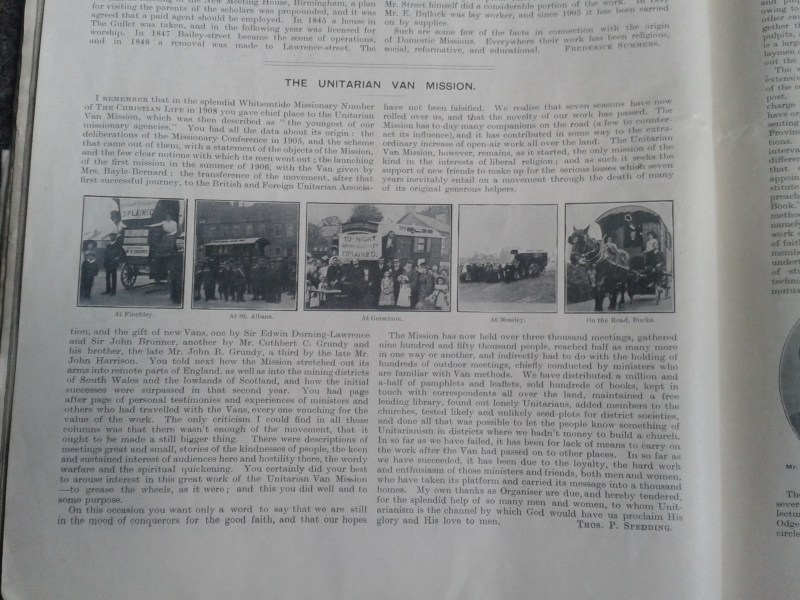
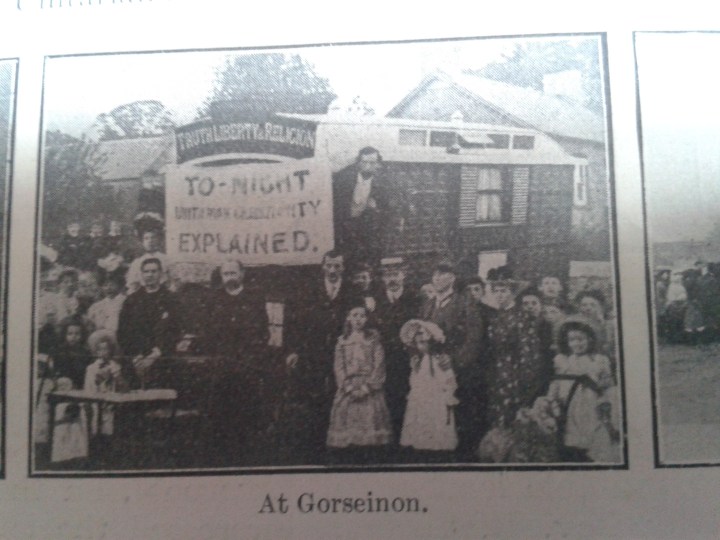
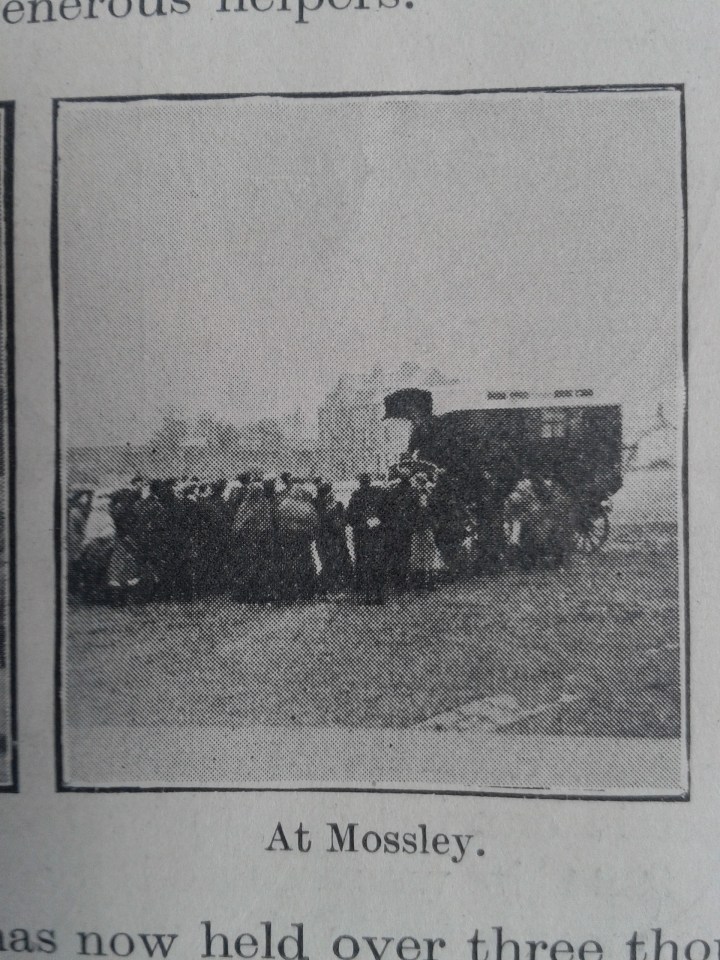
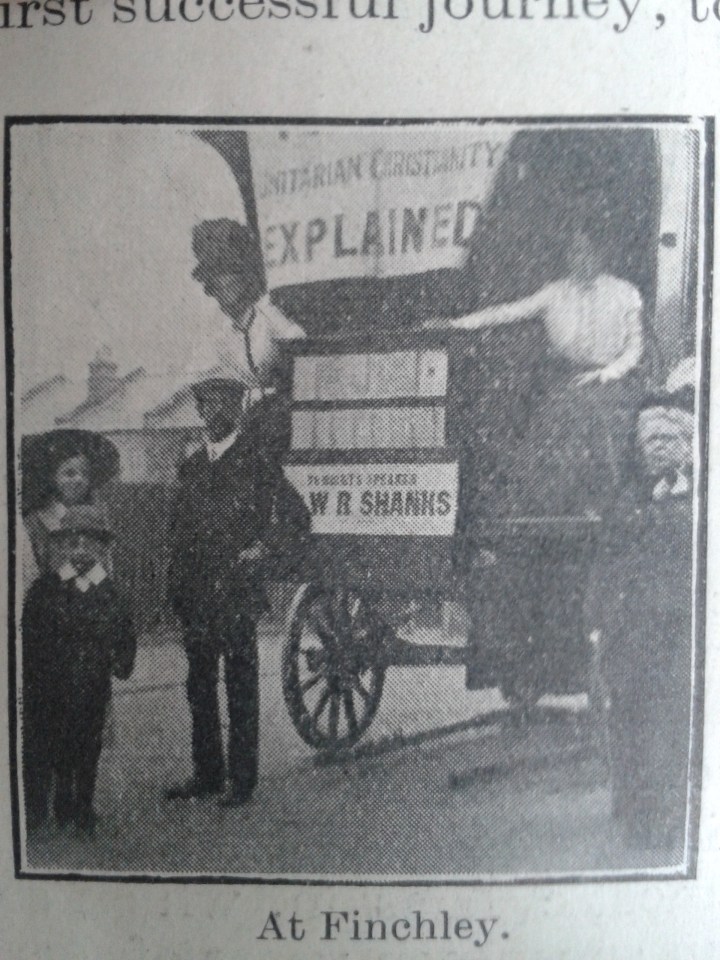
It was published to mark the centenary of the Trinity Act and includes a vast amount of material. One of the shorter sections – only about half a page – is that on the Unitarian Van Mission written by the Rev T.P. Spedding and accompanied by five fascinating, if frustratingly small, images. The article is, like almost everything in that issue, quite relentlessly positive and upbeat. In part this reflects the celebratory nature of that publication but it also reflects the underlying truth – they were positive, things were going well, they didn’t know the world stood on the brink of a brutal world war, and they had every reason to feel that in religious terms their ideas, if not all-conquering, were at least gaining a positive reception and winning ground.
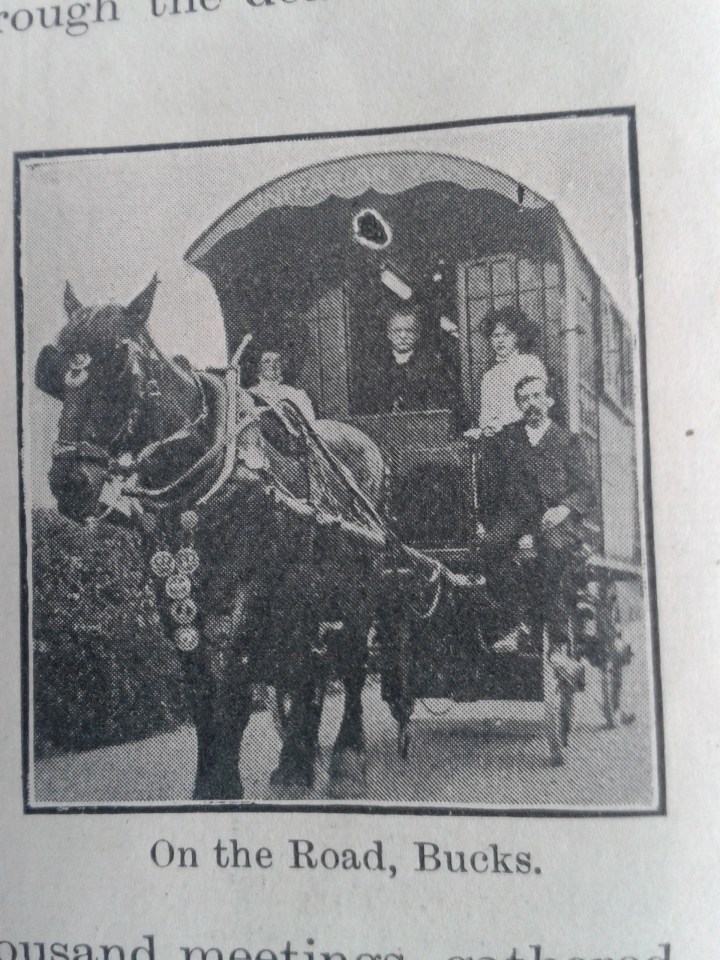
The Van on the move, the horse with its brasses and the Rev T.P. Spedding with three assistants on board
T.P. Spedding writes how the number of vans had increased to four thanks to donations by Sir Edwin Durning-Lawrence, Cuthbert C. and John R. Grundy, and John Harrison. (John Roberts suggests that in the end there were six vans on the road.) But if T.P. Spedding’s statistics are accurate it had been an extraordinarily active movement:
The mission has now held over three thousand meetings, gathered nine hundred and fifty thousand people, reached half as many more in one way or another, and indirectly had to do with the holding of hundreds of outdoor meetings, chiefly conducted by ministers who are familiar with Van methods. We have distributed a million and a-half of pamphlets and leaflets, sold hundreds of books, kept in touch with correspondents all over the land, maintained a free lending library, found out lonely Unitarians, added members to the churches, tested likely and unlikely seed-plots for district societies…
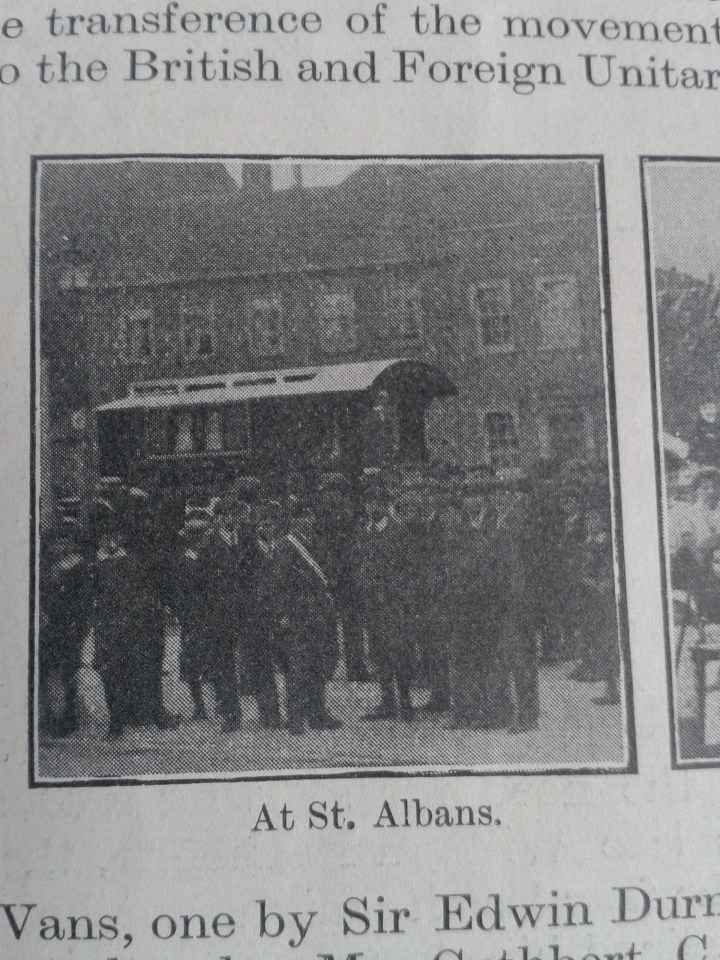
A meeting at St Albans
Three thousand outdoor meetings in about seven years! Even with modern media gathering 950,00 people online would be something that any church publicity movement would be very proud of.
Gorseinon near Swansea
Its clear that the Mission didn’t just go into uncharted territory but also went to places where it supplemented an already established witness. It also faced competition from many other churches that were doing something similar and opposition from some who, T.P. Spedding seems to suggest, may have had this purpose in their design.
A busy meeting at Mossley where a church had existed since the 1840s
Nothing I have yet seen explains the logistics of operating the Mission – presumably horses were hired or loaned wherever they were needed by the local people. There must have been a lot of careful organisation behind its running. But there are records in various places that will repay careful examination and a fuller picture can be built up of the Mission’s operation.
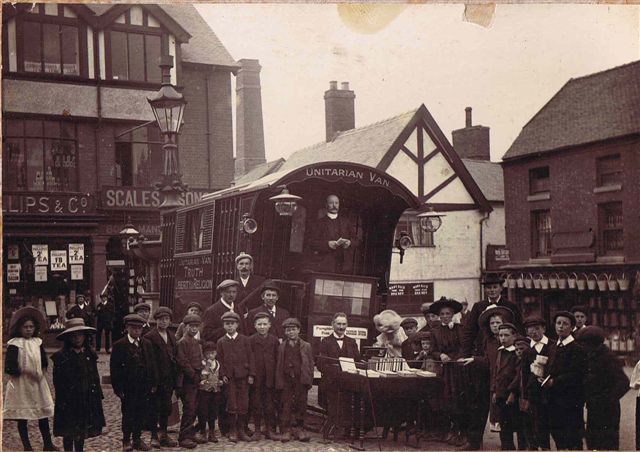
Finchley, “Unitarian Christianity Explained. Tonight’s Speaker [Rev] W R Shanks” – the Rev William Rose Shanks (1856-1928)The pictures in Christian Life are small and are not terribly well reproduced. The best picture of the Mission in operation is still the one I reproduced on this blog a few weeks ago. A lot of people have looked at it but we are still not able to identify the location. Both Len Smith and Rachel Eckersley are working hard on finding the spot, the presence of a number of named shops should be a help. It appears not to be Chesterfield, Northwich or Burslem which all had a branch of Scales and Sons. The town of Malton, which seemed a good possibility, can now be discounted, Len has discovered. Wrexham may be a possibility. But we still need to find the place where this interesting photograph was taken. If you have any suggestions please do send them in.
If you look up at the night sky on a clear night you will gradually see hundreds and hundreds of stars. In fact we know there are hundreds of thousands of millions of them, each one of them a star like our Sun. Around our Sun there orbit a number of planets and around all the other stars in the universe there must be planets of different shapes and sizes. Astronomers know of the existence of about 170 of these, light years away from us and discovered, so I read, by a process called microlensing.
If you were asked how many planets there were in our solar system you might say that there were eight or nine. Officially now there are eight although Pluto, the planet most recently discovered – as recently as 1930 – has now been demoted and is officially regarded only as a dwarf planet. It is also a very long way away – so far away that it takes 248 years for it to orbit around the Sun compared to the 365 days it takes our Earth. But because it is quite small and exists in an area where there are lots of other things floating around – the Kuiper Belt – it has been denied its planetary status by astronomers in the last ten years. However, this is still controversial and not everyone agrees with it.
But Pluto is in the news again this week as the US spaceship, New Horizons, which was launched nine years ago in 2006, will become the first space craft to visit Pluto.
Having journeyed through space for more than three billion miles, New Horizons will come within 7,800 miles of Pluto at 12.49pm Tuesday, 14th July UK time. As it hurtles past it will take photographs and make measurements of the distant planet which will tell us something about its composition and atmosphere.
But the story of Pluto’s discovery is not without interest. It was discovered in 1930 by Clyde Tombaugh. Although he was the first to discover it and he later helped to found the New Mexico State University’s astronomy department he didn’t start out as an astronomer. He grew up on a farm in Kansas and became interested in the stars and the planets as a boy. He built all his first telescopes out of farm machinery and the telescope he used to search for Pluto was made from things he found on the farm when he was 24. Other astronomers had predicted the existence of Pluto but Clyde Tombaugh, using a telescope made from a grain elevator, a cream separator and an old car axle together with lenses he had ground himself, was the first to see the planet. Clyde died in 1997 and, fittingly, when New Horizons was launched some of his ashes were sent into space onboard the ship.
I am always impressed by stories like this. It is a truly human trait to wonder at the stars and the majesty of creation, and to want to explore its vastness. This is something the Psalmist felt as he gazed at the night sky over Jerusalem maybe three thousand years ago:
When I look at thy heavens, the work of thy fingers, the moon and the stars which thou hast established; what is man that thou art mindful of him, and the son of man that thou dost care for him?
(Psalm 8 v.3-4)
Isaac Watts expressed something similar in one of his hymns in the eighteenth century:
Eternal Power, whose high abode Becomes the grandeur of a God: Infinite length beyond the bounds Where stars revolve their finite rounds.
But what particularly caught my eye with this story was that Clyde Tombaugh also helped to found a new church in Las Cruces, New Mexico. Not only that when he died they put in a very striking stained glass window in his memory in the Unitarian Universalist church there of which he was a member. It is a very large and attractive window, eight feet tall and eighteen feet wide and shows the figure of Clyde Tombaugh making one of his lenses and the solar system stretched out in the night sky including Pluto. Appropriately enough it also includes the church’s motto: “That all souls shall grow into harmony with creation”.
If you would like to see the window this link should take you there:
The Rev Eric Price, the founding editor of Faith and Freedom, was recalled and honoured at Harris Manchester College on Tuesday, 23rd June during the annual meeting of Friends and Governors.
Eric had significant ministries in Bolton and Liverpool, among other places, and was lay secretary of Manchester College for a great many years. In addition he founded and edited Faith and Freedom from its inception in 1947 to the year 1983.
Portarit of Rev Eric Price
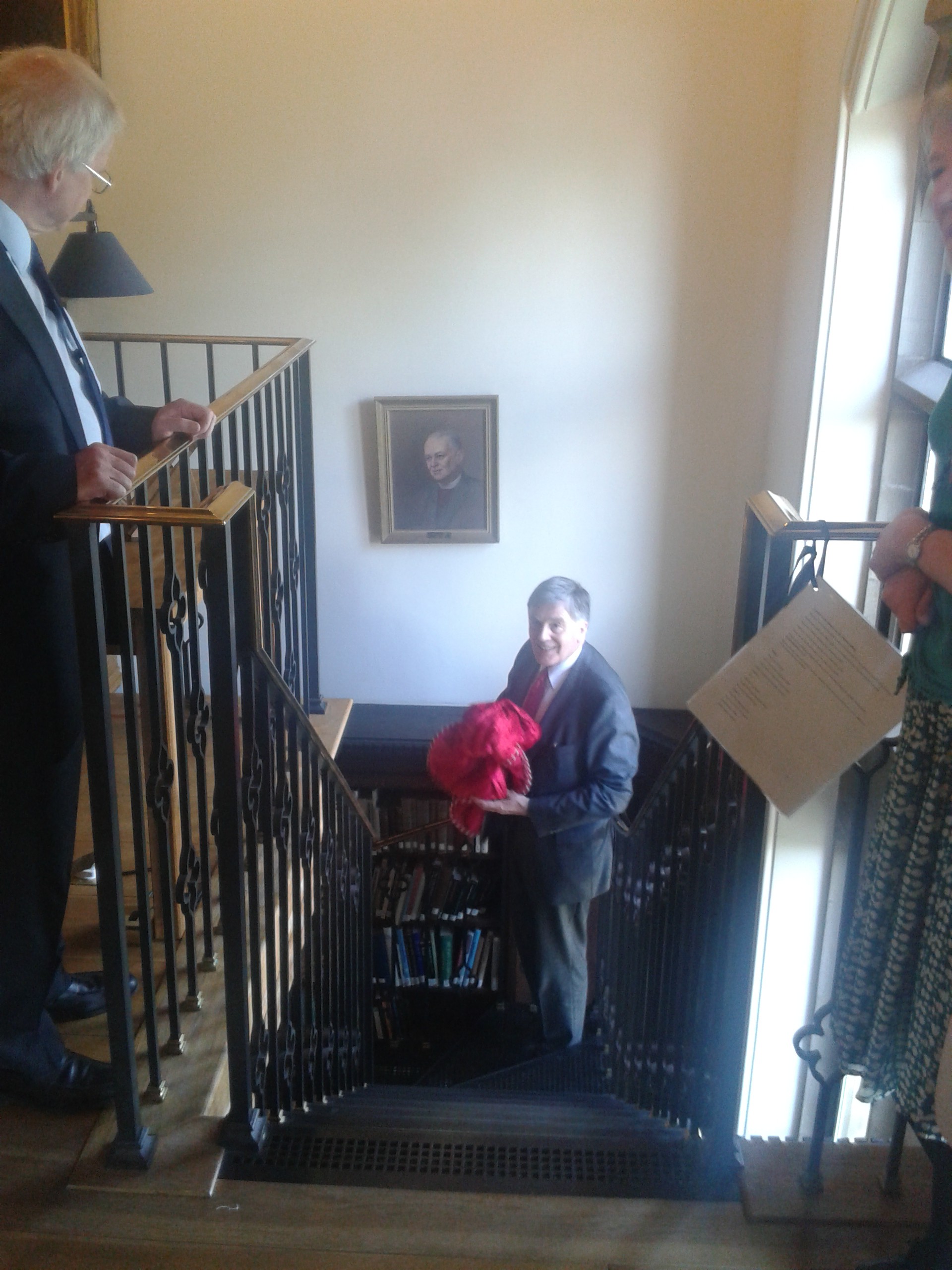
At the meeting Richard Price, Eric’s son presented a portrait to the College. This had originally been presented to his father by Bank Street Chapel, Bolton and was unveiled in its new location by the Principal, Rev Dr Ralph Waller.
The Principal unveils the portrait in its new location in the library
While making the presentation, in the course of an amusing speech, Richard Price recalled that he had been involved with Faith and Freedom from the very start, having been drafted in to stick erratum sheets in all 600 copies of the first issue printed! Later, he recalled his mother, when pregnant with his brother, threatening to give birth to twins and call them ‘Faith’ and ‘Freedom’, so all-consuming had the journal become for his father at the time!
Richard Price addresses those present in the library. Emeritus Editor Rev Peter and Sheila Godfrey can be seen in the corner of the shot
Happily both myself and Nigel Clarke were able to be there for the occasion and Nigel took the opportunity to present to Richard a bound copy of the very first issue which his father had signed.