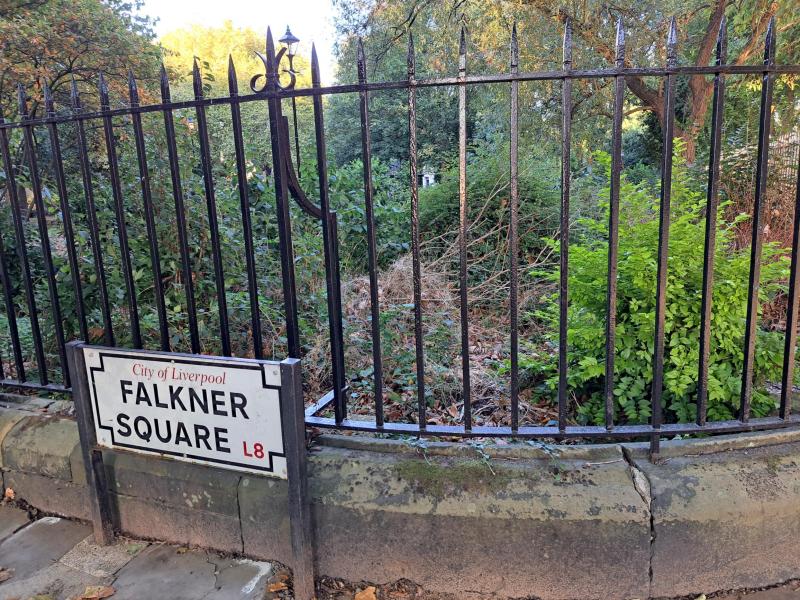
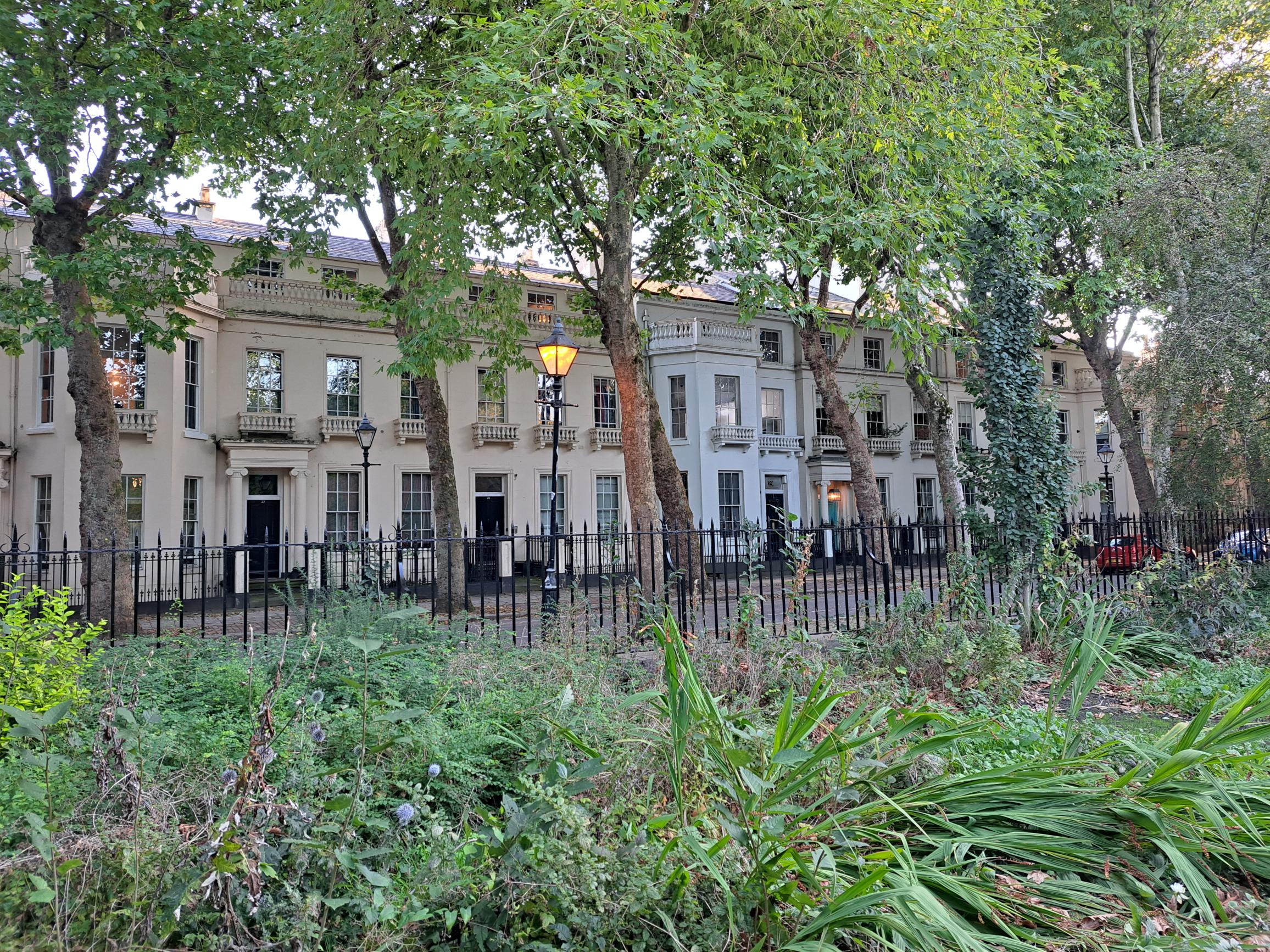
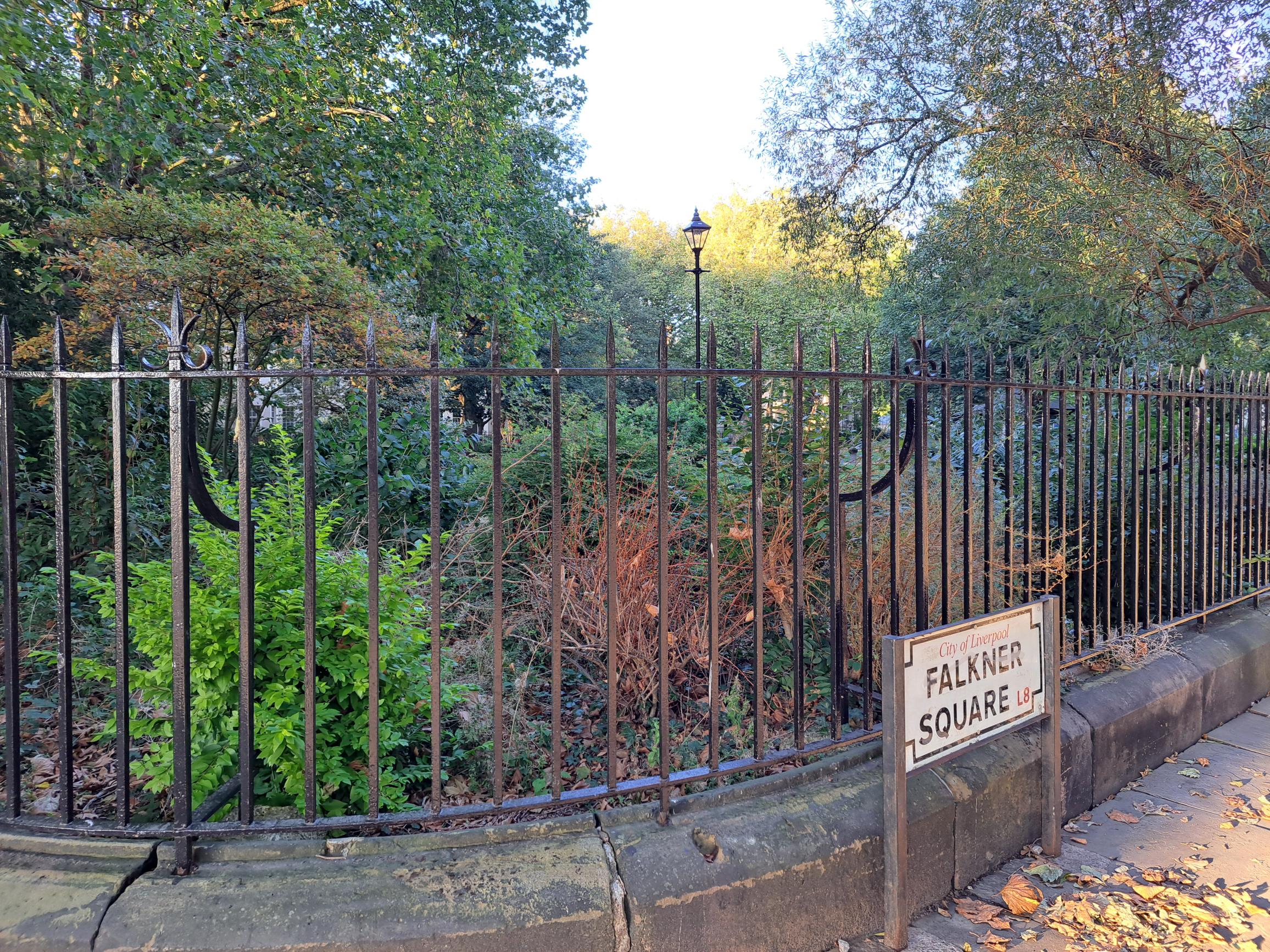
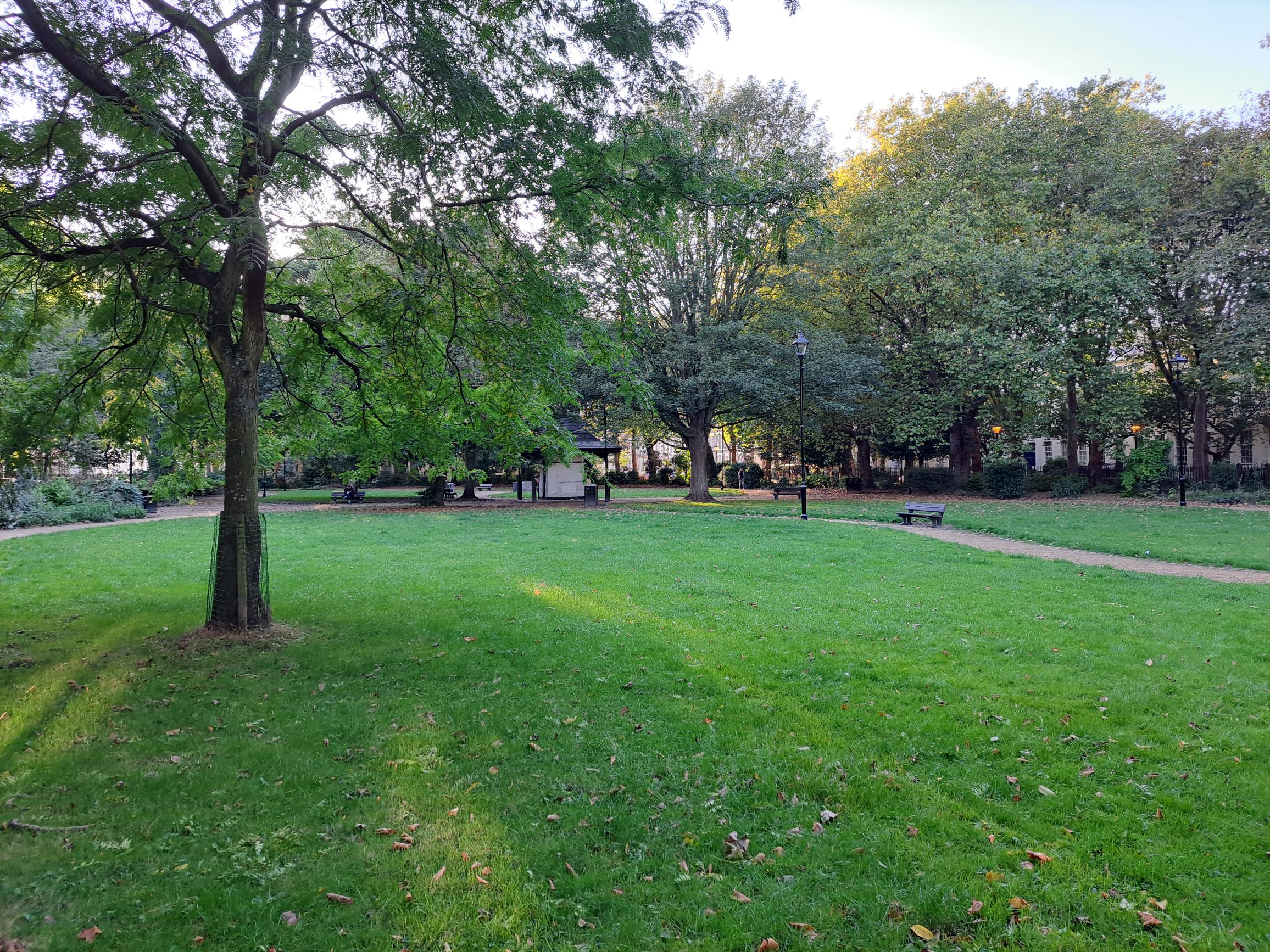
A walk around Falkner Square in Liverpool is always interesting. The buildings are quite impressive although not quite as grand as the houses in the nearby Georgian Quarter, now much utilised for film locations, although Falkner Square itself made a film appearance in the 1971 film Gumshoe with Albert Finney.
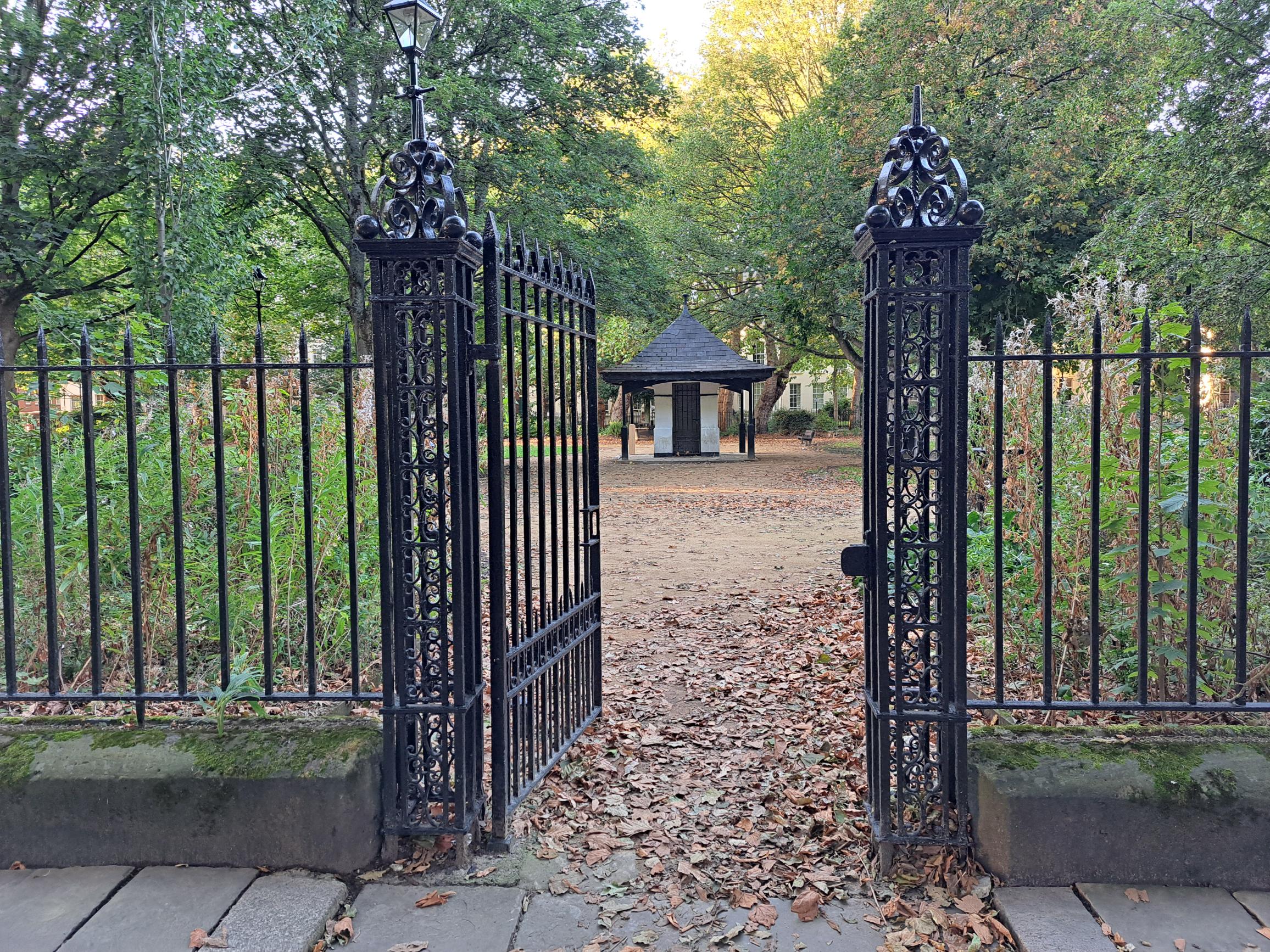
What’s attractive about it is that it has its own central park and resembles the sort of square you would find in Bloomsbury. I was always told, that in days gone by, only the people who lived in the Square had a key to the park, although the City Council now claims it as ‘one of the earliest public open spaces in the city’. I suspect it wasn’t open to the public in its earliest days.
Falkner Square is said to be named after Edward Falkner, an ex-soldier and former High Sheriff of Lancashire, who mustered a force of 1,000 men to defend Liverpool in 1797 when fears of a French invasion were at their highest. He was a successful merchant, involved inevitably in the slave trade, but who died in 1825, so he can’t have been directly involved in the development of the Square.
Joseph Sharples’ Pevsner Architectural Guides Liverpool says ‘The central garden is shown planted on a map of 1831, but the stuccoed houses did not begin to appear until the mid 1840s.’ The only architect he mentions is William Culshaw who designed number 29 in 1845 along with many Liverpool buildings.
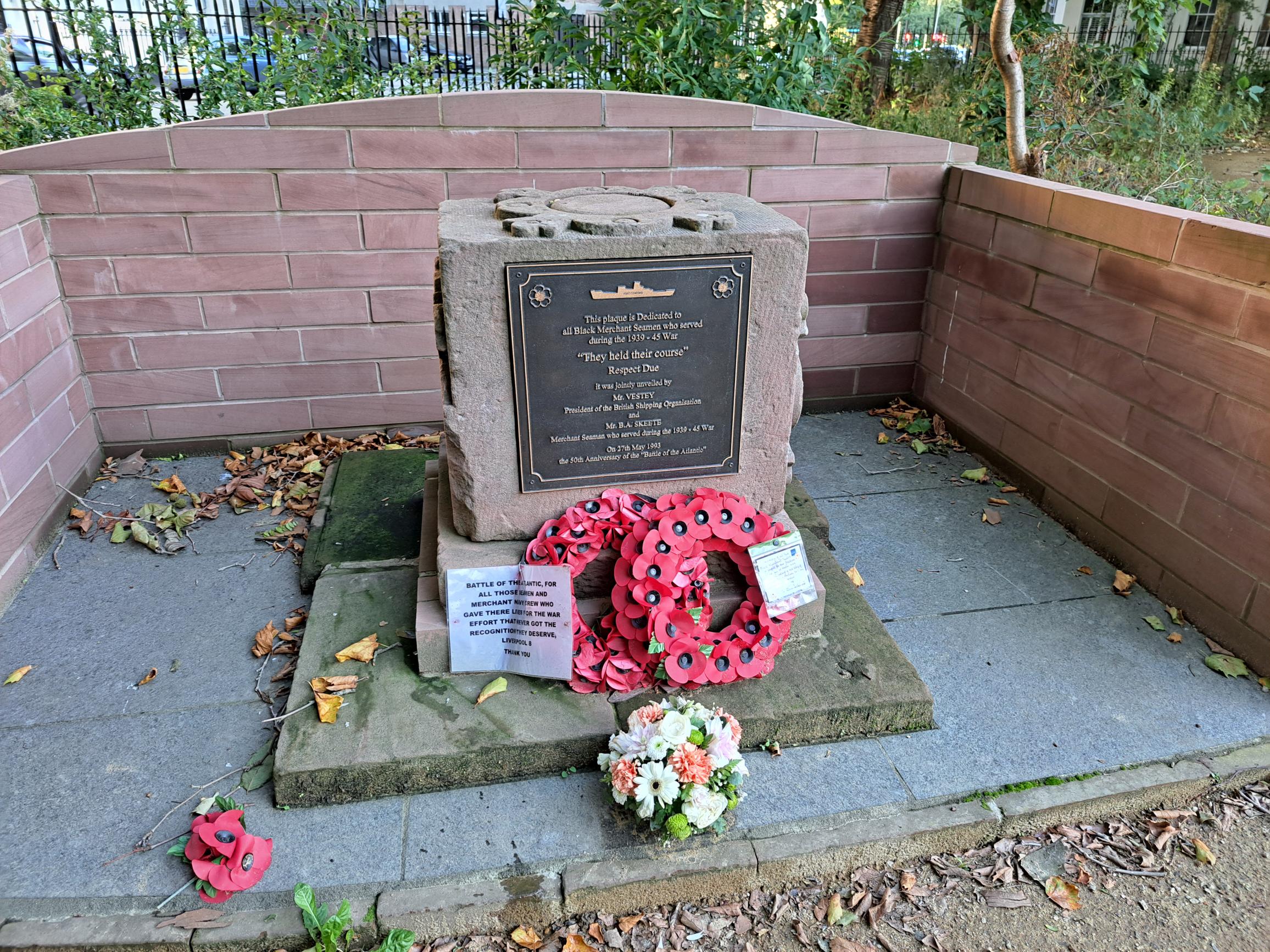
One relatively new feature is the Memorial to Black Merchant Seamen who served in the Second World War. This was unveiled in 1993 on the 50th anniversary of the Battle of the Atlantic and contains the words “They Held Their Course” RespectDue. The bronze plaque, which, shockingly, has endured some vandalism but is now restored, is attached to a large decorated piece of sandstone. This came from the old Liverpool Sailors’ Home, which was once a very prominent landmark in Canning Place near the city centre. Now only the ornate gates survive and can still be seen at the entrance to Liverpool 1.
Memorial to Black Merchant Seamen who served in the Second World War
The solid and imposing structure of Canning Street Presbyterian Church was a feature of that corner of Canning Street and Bedford Street for about 120 years.
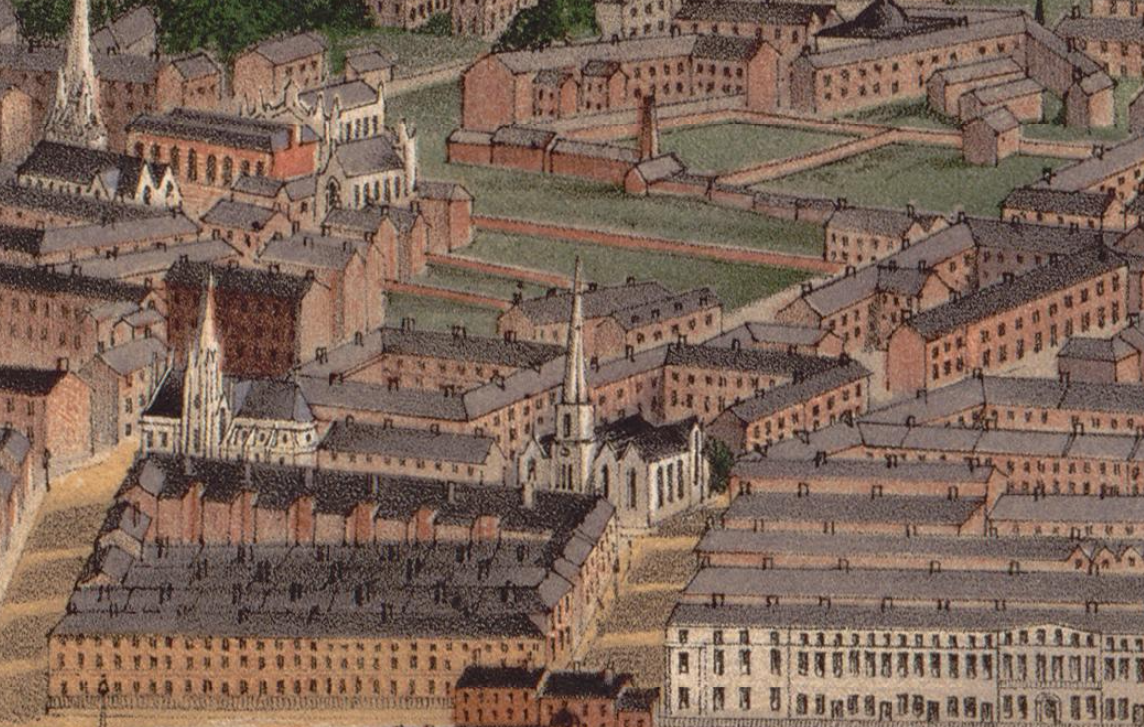
I’ve mentioned this church before and used its image as it appears in an aerial view of Liverpool painted from a hot air balloon by John R. Isaac in 1859 and published in New York. (This can be viewed on the Library of Congress site. You can also read the original post by clicking on this link – Seven Churches in Liverpool in 1859 viewed from the air). Below Canning Street Presbyterian Church can be seen in the centre of this section of the picture:
Detail from Liverpool, 1859, part of Birkenhead, the docks, and Cheshire coast Library of Congress
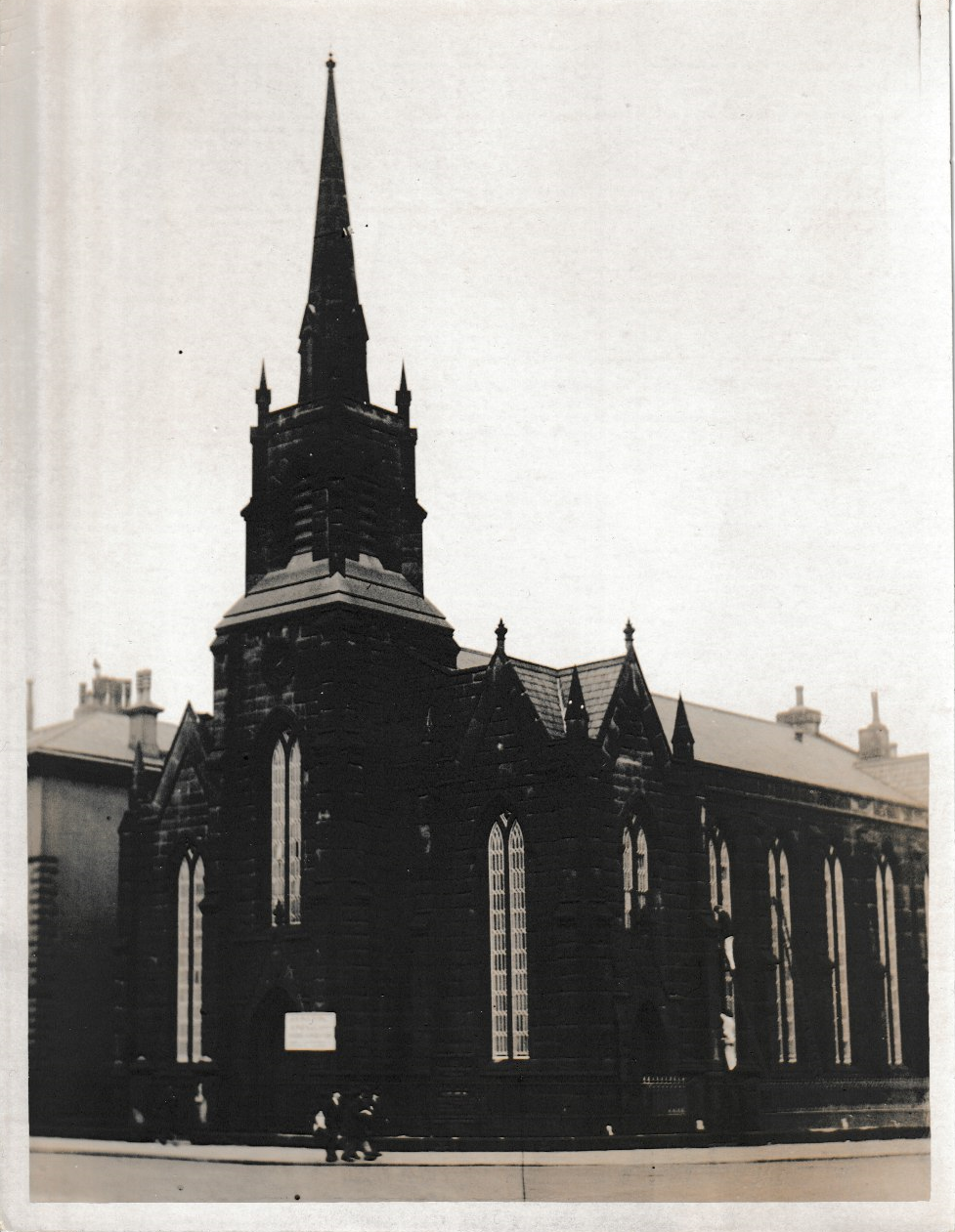
In fact of the seven churches mentioned in that post I have blogged about most of them at one time or another (Hope Street Unitarian Church, the Catholic Apostolic Church and Myrtle Street Baptist Church can all also be seen in this image) but recently I acquired a press photograph of Canning Street Presbyterian Church taken in 1931:
The picture is a bit dark but it shows the edifice built in 1846 and finally demolished in the 1960s. It was built by a denomination of exiled Scots, members of the Free Church of Scotland, which became the Presbyterian Church in England. Later this body united with the United Presbyterian Church (at a ceremony in Liverpool in 1876) to form the Presbyterian Church of England. In 1896 the minister, the Rev Simeon Ross Macphail observed that fifty years previously increasing numbers of Scottish emigrants to Liverpool were not inclined to join the local churches which called themselves Presbyterian but were by then Unitarian in theology. This would be true by the 1840s, although it was not the case a couple of generations before when Scots newly arrived in the city, perhaps influenced by the theological moderatism of the Church of Scotland, were often happy to make common cause with the dissenters.
Canning Street, in its prime location in the wealthiest part of the city flourished for decades until it followed the trend to move out of the by then less fashionable Georgian area of the city to the suburbs. In 1931 they sold up and built a new church in Allerton (now Allerton United Reformed Church). It was at this point that this photo was taken as it was sold to the German Church in Liverpool who moved their location from the very centre of town to Canning Street.
A German-speaking Lutheran congregation had existed in Liverpool since at least 1846. Meeting in various places over the years they had sufficient capital in 1871 to purchase what had been known as Newington Chapel. This had been founded originally as a break away from the Ancient Chapel of Toxteth. Unhappy with the appointment of an Arian (or Unitarian) minister in 1775, a group of Congregationalists built their own chapel on Renshaw Street. From 1811, with the appointment of Rev Thomas Spencer, this congregation grew rapidly and built Great George Street Chapel as a suitable base for his oratorical powers. Unfortunately, Thomas Spencer never took up his place in Great George Street Chapel, when he drowned in a swimming accident in the Mersey, but the congregation moved nevertheless and continued to flourish under the leadership of Rev Dr Thomas Raffles. In the best tradition of non-conformist awkwardness a small minority of the congregation refused to move and stayed in Newington Chapel, stayed, in fact, until 1871 when the German Evangelical/Lutheran Church was able to buy the meeting-house from them.
This congregation remained here until 1931 when the Cheshire Lines Railway Company purchased the site from them for £14,000. That was a good price and more than enough to buy Canning Street Church for just £4,000 in that year, the building being formally opened for Lutheran worship on 25th October 1931.
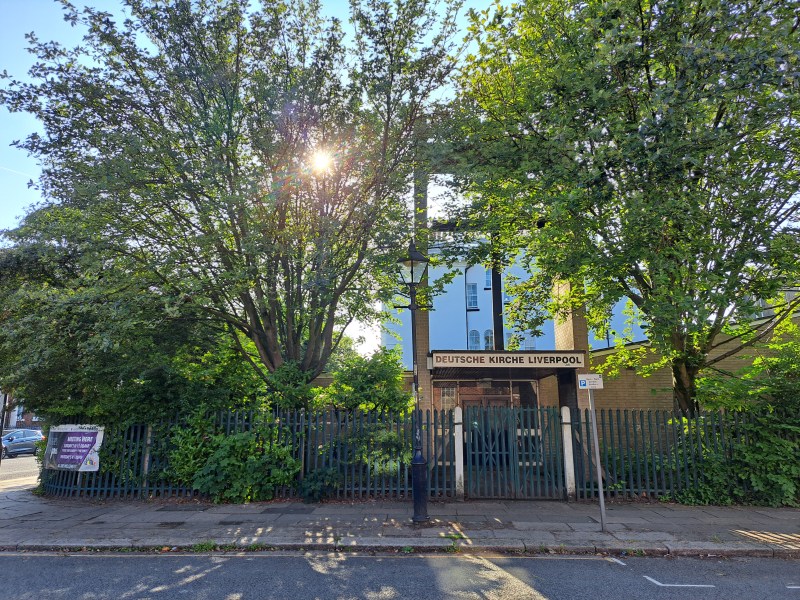
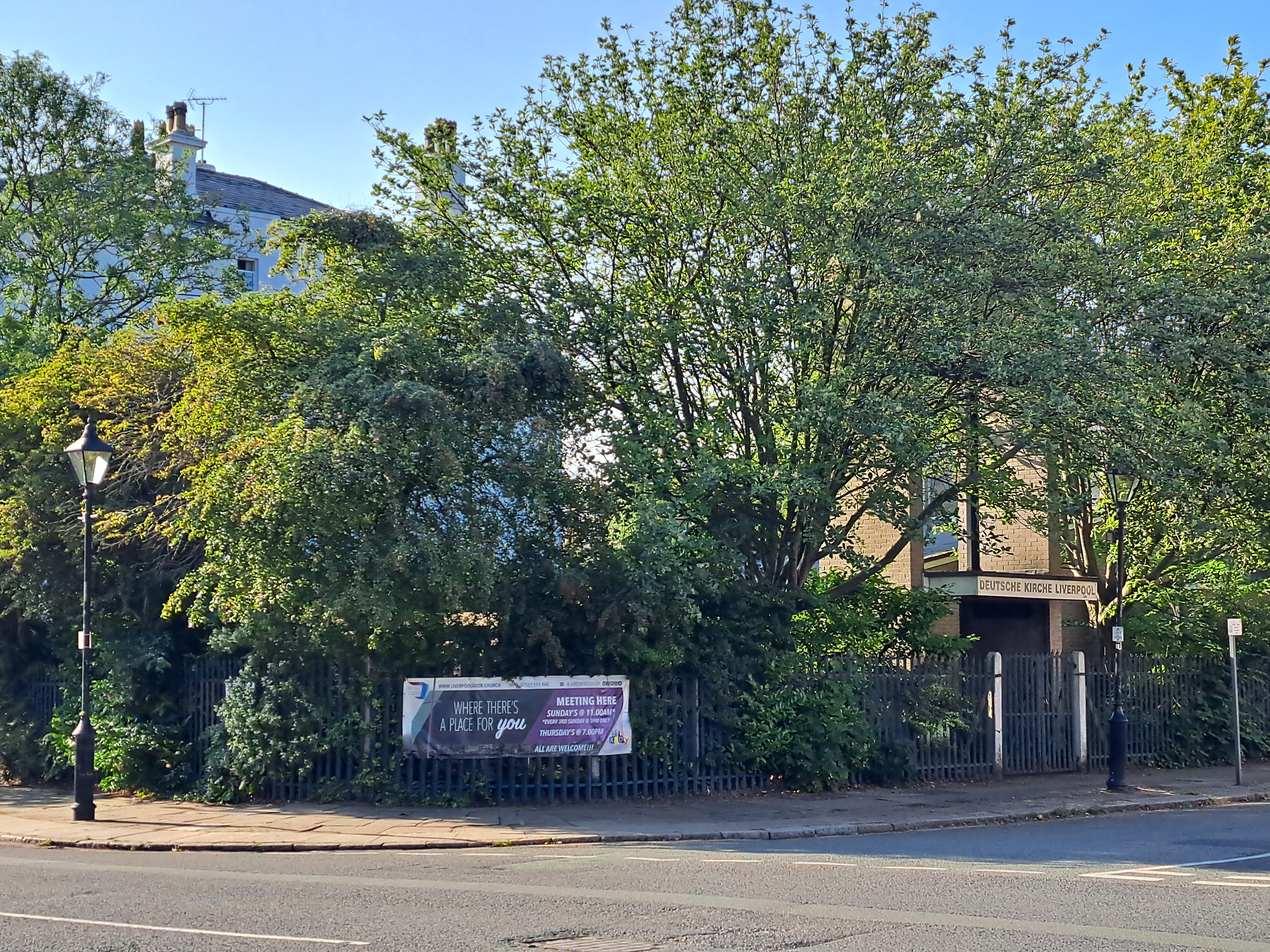
The site of the church today
Canning Street Church– Deutsche Kirche Liverpool
The German congregation has worshipped on that site ever since but in the 1960s they demolished the old church and replaced it with a rather plain building which doesn’t really catch the eye.
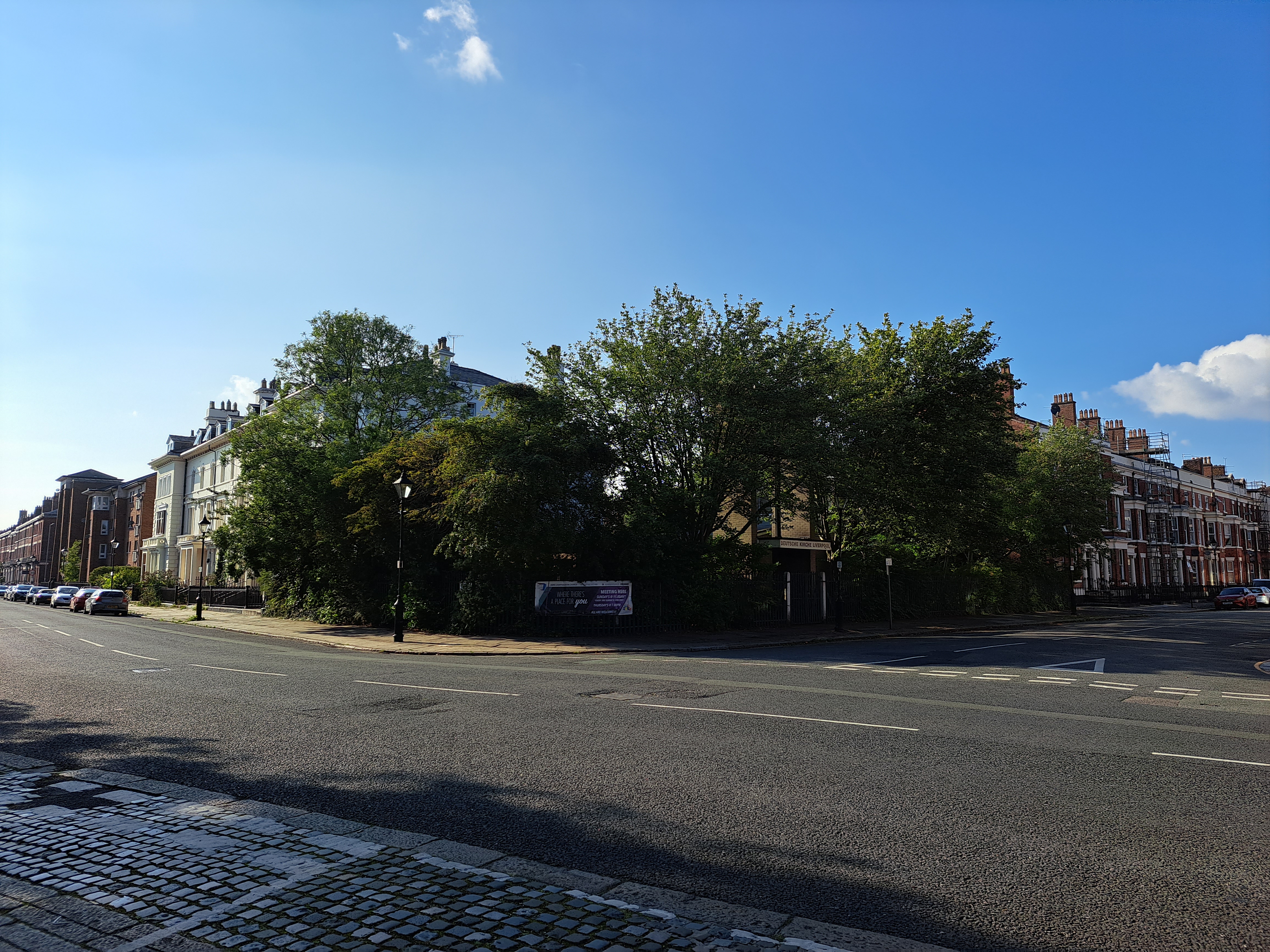
A view of the corner of Canning Street and Bedford Street today. The German Church is opposite the viewer, the site of the one-time Catholic Apostolic Church can be seen on the far left.
No pictures or text may be reproduced from this site without the express permission of the author.
 velvethummingbee