Non-Subscribers celebrate the Coronation

As we prepare to mark the Coronation of King Charles III on Saturday, 6th May 2023 I thought I would have a look at some of the ways Non-Subscribing Presbyterians have celebrated previous Coronations over the last 120 years.

Looking through the Non-Subscribing Presbyterian magazine for 1911 (the journal began publication in 1907) I could find little direct reference to congregational celebration. There was plenty going on in the churches in June 1911 but in terms of special services or special events there is not much record of specific events.

However, there certainly was a lot of interest and this video explains some of it:

Coronation celebrations by Non-Subscribers in 1902 and 1911

Filmed at First Dunmurry (NS) Church the video includes music played on the piano by Allen Yarr, the church organist, including Handel’s Water Music and Music for the Royal Fireworks.

In 1911 the magazine gives a hopeful editorial about the new reign as well as an account of the meaning of the Crown. It also describes the Royal visit to Ireland just a few weeks after the Coronation in July 1911. This was to be the last visit to Dublin by a reigning monarch until the visit of Queen Elizabeth II in 2011. While he was in Dublin a loyal address was presented to the King on behalf of the Non-Subscribing Presbyterian Church of Ireland.

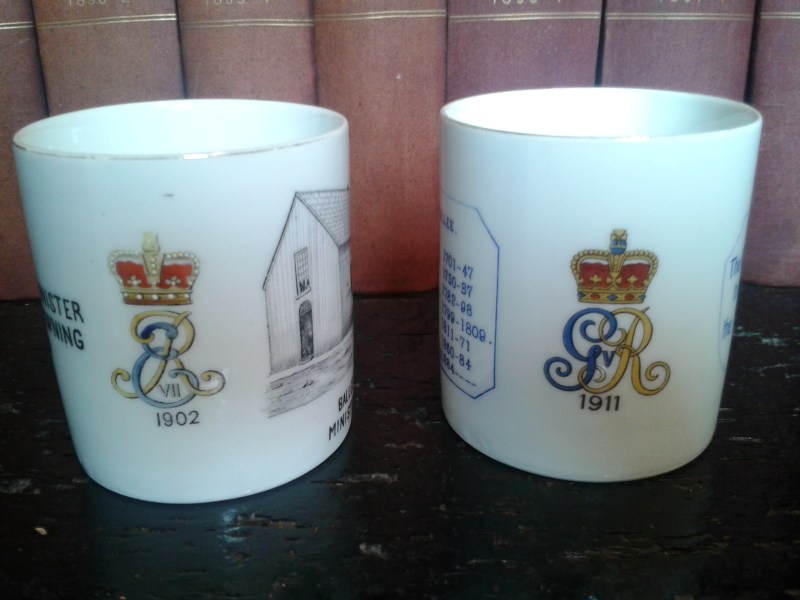
The main focus of the video though is the contribution of the Rev J.H. Bibby, minister at Ballee from 1884 to 1935. Originally from Warrington he was a member of a family connected to the ceramics business which no doubt helped in his gifting to the Sunday School and members of his church of commemorative mugs:

Ballee Commemorative Mugs

The Rev Joseph Henry Bibby was educated at the Unitarian Home Missionary College from 1880 to 1884 and spent the whole of his long ministry in Ballee, where he was closely involved in local life. He was a generous benefactor to the church and on his death left many of his books to the Unitarian College as well as his collection of ceramics and glass to Warrington Museum. Some of what he donated to the Museum can be seen in the video above.

Rev J.H. Bibby

What makes his gifts of the Coronation mugs stand out is that they are lithophanes, that is they contain an image impressed in the porcelain which can only be see when held to the light. Here’s the image of Edward VII as seen in the 1902 mug:

Edward VII as he appears on the Ballee mug

Many subsequent students at the Unitarian College, Manchester also had reason to thank J.H. Bibby because he bequeathed a sum of money to establish a prize for New Testament Greek. For those who could master the intricacies of Greek there was at least the reward of a small prize at the end of the course if you could prove your proficiency, and we have Joseph Henry Bibby to thank for that.

1902 and 1911 Ballee mugs

NSP Lives of the First World War: 03 William Crymble

When the Non-Subscribing Presbyterian magazine published its second collection of names of men and women who had joined up after the start of the First World War in March 1915 the entry for Ballee congregation contained one name:

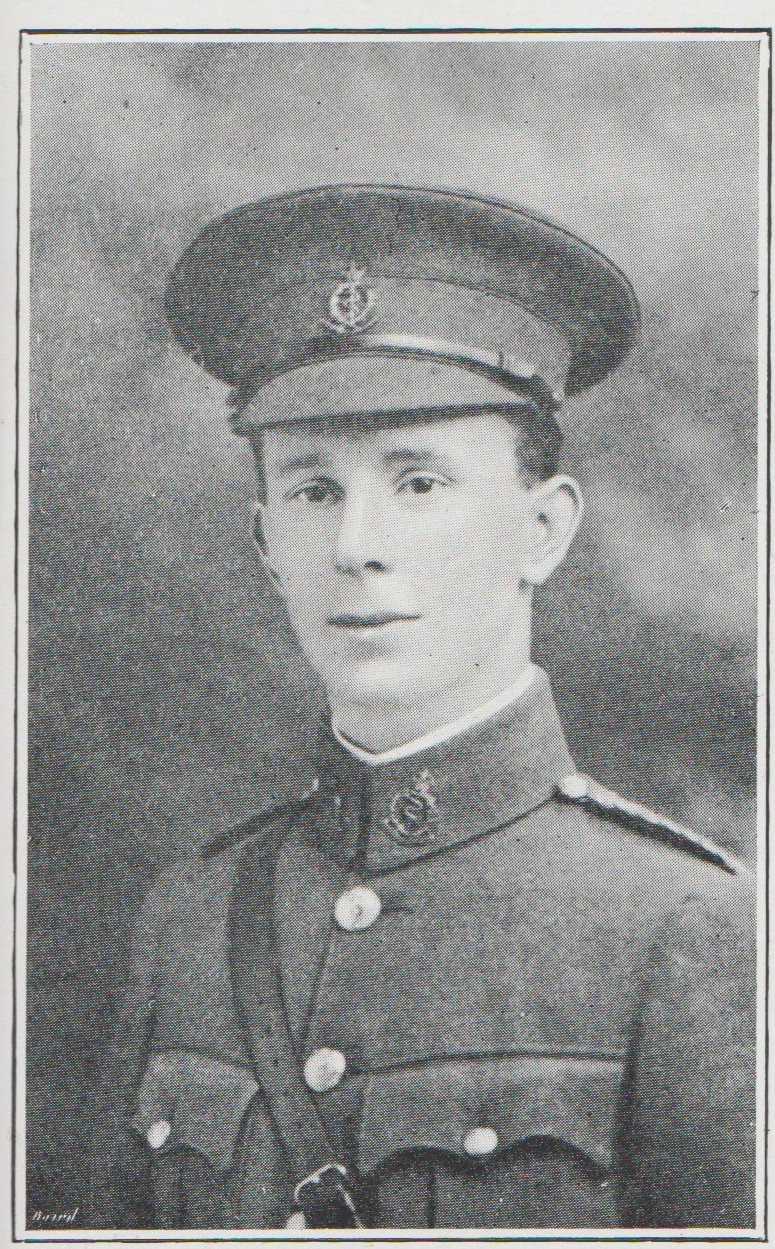
Captain Wm. Crymble, RAMC. Interned at Magdeburg since Mons.

William Crymble was a Captain in the Royal Army Medical Corps. His father was the principal of the school at Ballee and the whole family belonged to the congregation. He had trained to be a doctor in Belfast and Dublin, following his studies with positions at the Royal Victoria Hospital Belfast, Down District Asylum and Beckett Street Infirmary Leeds. Before the war he had joined the reserve of the RAMC and had been promoted to Captain on 13th July 1914. His skills were very necessary once war broke out and in August 1914 he went with the British Expeditionary Force to France.

Captain Crymble 04 NSP October 1915

Captain William Crymble RAMC

Attached to the 14th Field Ambulance he was amongst those taken prisoner at Le Cateau on 26th August 1914. The story of his initial capture makes for grim reading with accusations of brutality against the enemy. The medical officers were said to be prevented from attending to the wounds of the injured, they were transported in cattle trucks to the internment centre at Torgau in Germany, with little ventilation and frequently no water.

He was interned not just in Magdeburg but in a total of four camps. Magdeburg was the first and reportedly the worst with officers being thrown in prison for failing to salute a German officer, property being confiscated and the keeping of diaries forbidden. All this was reported in the Non-Subscribing Presbyterian and based on With French in France and Flanders by Rev O. S. Watkins, an army chaplain. Sanitation was poor, facilities for exercise limited and rigid discipline enforced. At one camp prisoners from different nations were split up and separated out of national groups in an effort to break down their resistance to camp discipline. Remarkably though, over the summer of 1915, William Crymble was able to return home in an exchange of prisoners. He was returned to Holywood Barracks where he declared he felt like a “fish out of water” until he could get back to the front.

He soon got his wish and was sent to Egypt to be part of the war effort with the Mediterranean Force. But here tragedy struck. On 12th October 1916 he died of enteric fever in Alexandria. One of his colleagues and a former fellow student at Queen’s said:

“On the day on which the sad news of his death was made known to the patients he had attended, the medical officer on duty was sharing the distress which was visible among the patients and could not always trust himself to speak. But the sorrow that could not find adequate personal expression was manifested on Sunday the 22nd.”

The Non-Subscribing Presbyterian reported that “Rev J.H. Bibby made touching reference to his death on the Sunday succeeding the receipt of the sad news in Ballee.”

He is buried at the Suez War Memorial Cemetery in Egypt.