With the forthcoming opening of the extension to Down Museum to house the Downpatrick High Cross in a new interpretative centre I thought it might be appropriate to say something about the old cross.
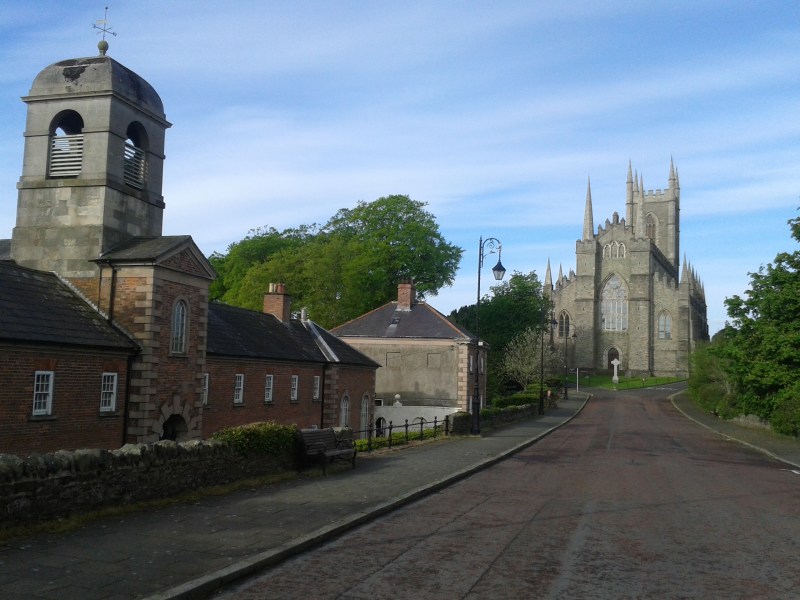
The view from behind the old cross looking along the Mall
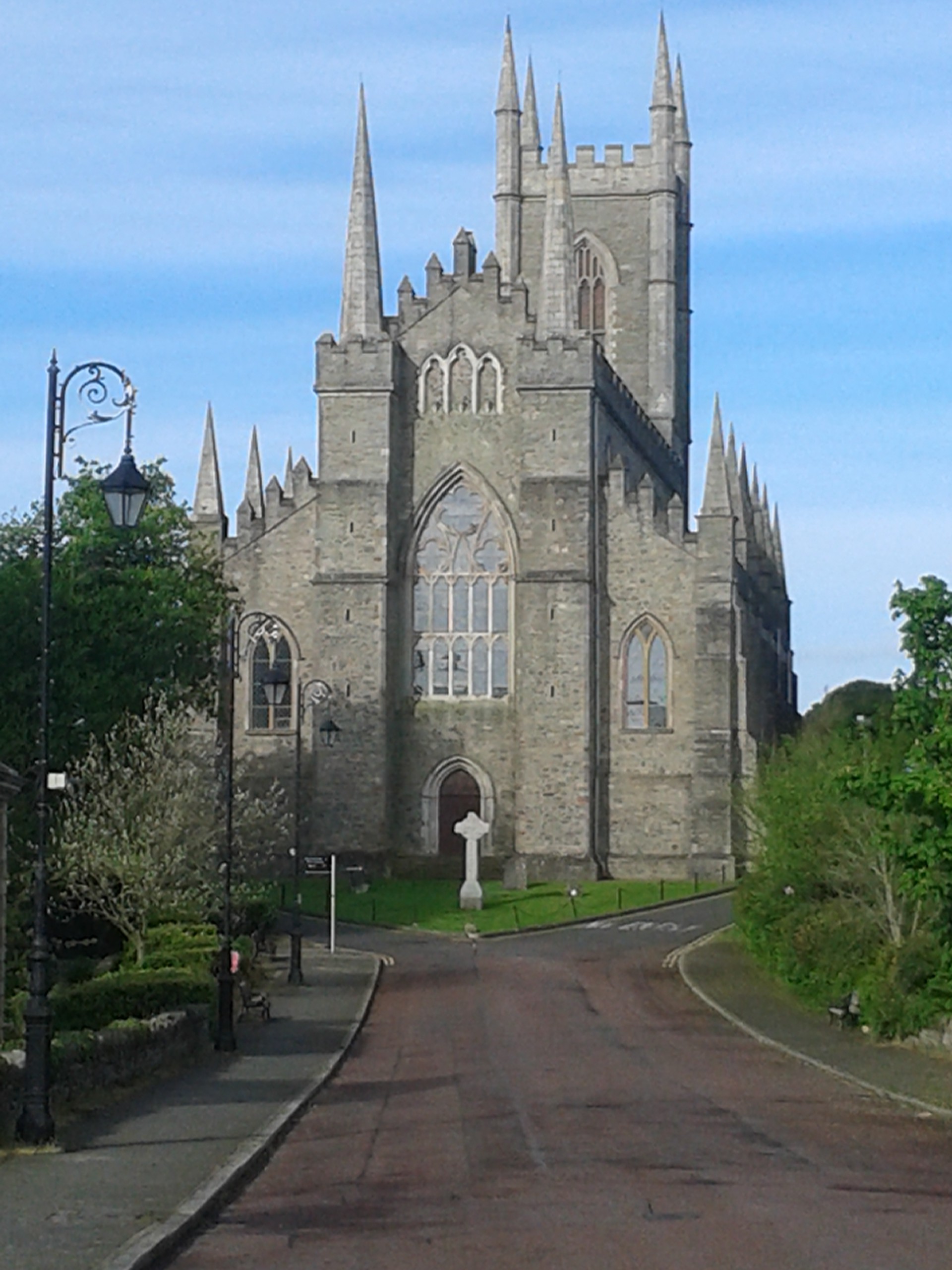
If you have been to Down Cathedral then you will have walked past the High Cross that sits just outside the Cathedral. This is very old – or to be exact it is a copy of something that is very old, because in December 2013 it was taken down and replaced with an exact copy. The original cross is about 1,100 years old and was put up in about 900 AD. This has now been taken down to be conserved and protected from the elements and has been replaced with a new one, an exact replica in Mourne granite weighing in at one tonne. Using modern technology the weathered design of the old cross was exactly replicated on the new cross.
The view of the new cross in front of the cathedral
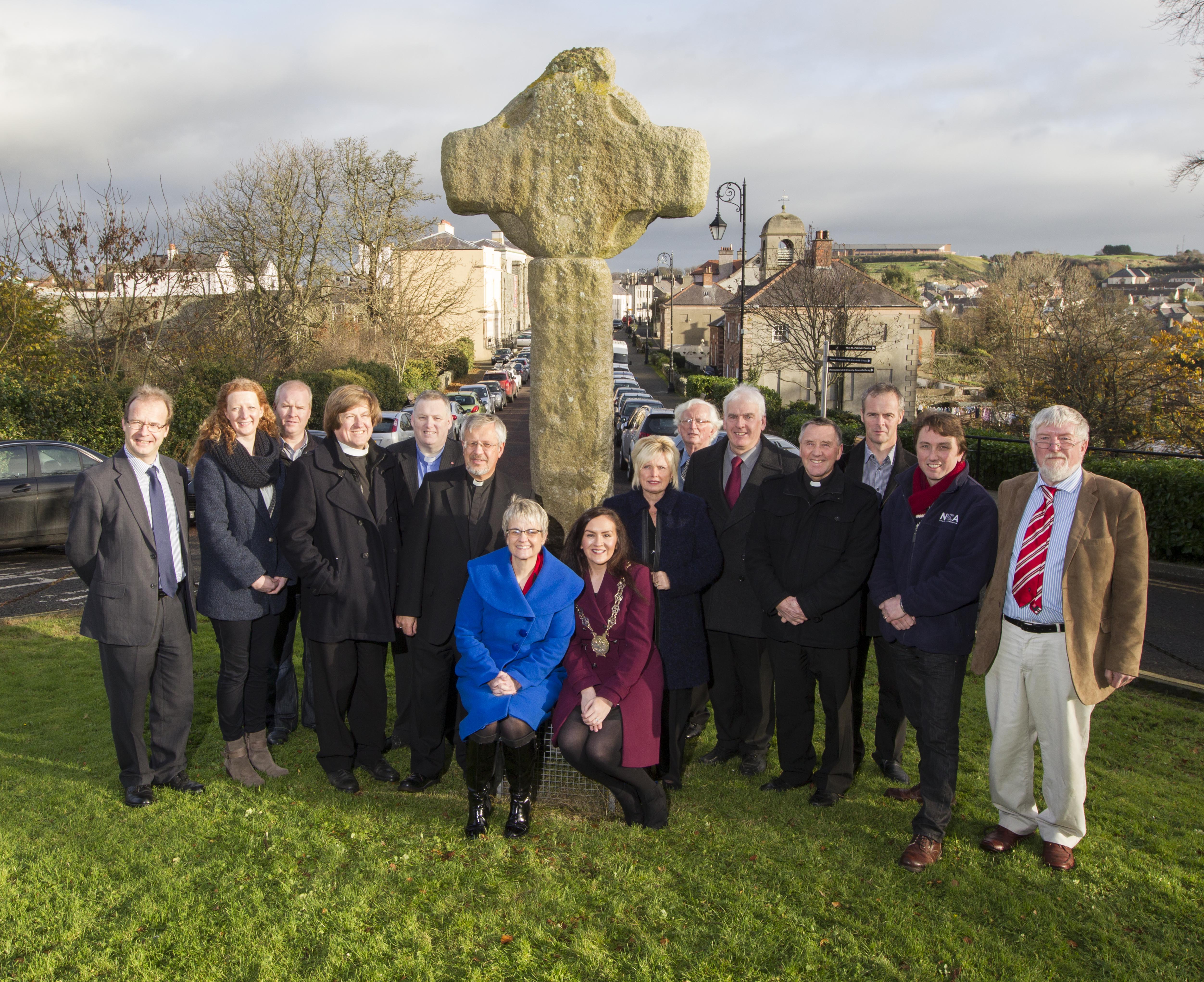
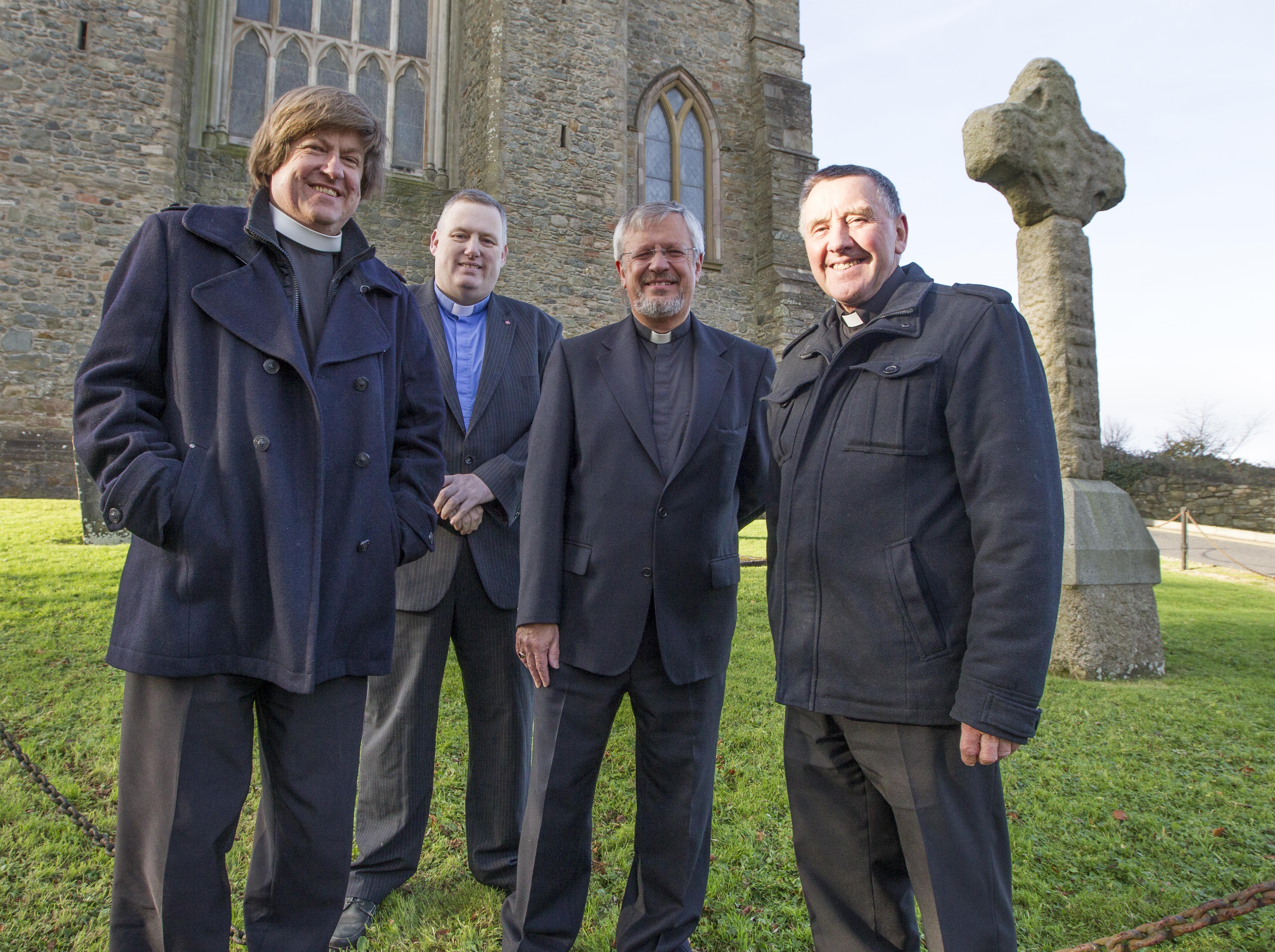
Through the kindness of the Dean of Down, the Very Rev Henry Hull, who is always so inclusive in all the special and civic events in the Cathedral, I was privileged, along with all the local clergy, both to be present at the removal of the old cross and to take part in the blessing of the new cross that was put in its place before Easter last year.
Politicans, museum staff and clergy, just prior to the removal of the old cross
The original cross stood outside the ancient monastery established in Downpatrick in the centuries following the death of St Patrick. It stayed there until the Reformation when it was taken down and used as the town’s Market Cross, located outside the Market House. Over time it was damaged and its pieces dispersed around the town until the 1890s when Francis Joseph Bigger, the famous antiquarian, reconstructed the cross and had it placed outside the Cathedral.
These ancient high crosses carried a lot of information. Although now difficult to make out in any detail they tell the Christian story. The Downpatrick Cross carries an image of the crucifixion as well as Jesus entering Jerusalem on donkey on Palm Sunday. The Cross is also believed to show the heads of Adam and Eve and Cain about to slay Abel. To me though the most interesting images on the cross are those of St Anthony and St Paul. It is very hard to make out but at the top of the shaft on one side of the cross there are two figures sat facing each other. Between them is a circle and above them something else that may be a bird. These two saints (who lived in the 3rd and 4th centuries) were important in the spread of monasticism and scholars suggest that the image represented is that of their meeting at the hermitage at Mount Colzim in Egypt, a meeting that reputedly took place in AD 347. According to the story a raven flew down and deposited a loaf of bread between them, paralleling the story of Elijah being fed by ravens in the Old Testament. The two holy men then disputed over who should have the responsibility of breaking the bread, each of them deferring to the other, until eventually they both picked up the loaf and pulled together, neatly representing the sharing of the Eucharist.
Local clergy in front of the old cross
All the detail is very worn now, and it is very hard to make out. But it is good to know that the same ancient cross that has been in the town since before the end of the first millennium is now being preserved.
In his excellent short article on Jeremiah Horrocks in the book Liverpool Unitarians Faith and Action Bernard Cliffe is very cautious about making too many definite assertions about his life. As Bernard puts it “an account of the life of the boy and the young man has to be a matter of conjecture, with the generous use of qualifying words.” The truth is we have very few hard facts about the life of this pioneer astronomer who died at the young age of 22. Inevitably though this hasn’t stopped others from drawing all sorts of conclusions about his life.
One of the things we do know for sure was the extent of his achievement as a youthful astronomer – indeed there are some parallels here with the life of Clyde Tombaugh who first identified Pluto in his 20s. Clyde Tombaugh now has a feature on Pluto’s surface named after him while Jeremiah Horrocks himself has been memorialized in a number of places since his initial observation of the transit of Venus across the Sun.
Horrocks’s discoveries were only published posthumously and, gradually, in the centuries after that, places – and churches – were keen to claim him as one of their own. But his scientific importance is pretty well established. Allan Chapman (in ‘Jeremiah Horrocks, the transit of Venus and the ‘New Astronomy’ in early seventeenth-century England’, Journal of the Royal Astronomical Society, 1990, 31) says that despite a scientific hagiography that has also built up around him “the plain fact [is] that his documented contributions to astronomy were formidable by any standard…he was one of the first men in England to grasp the significance of what was going on in contemporary European astronomy. Not only did he repeat many of the techniques of Kepler and Galileo, but he went on to develop the New Astronomy to produce conclusions which substantially advanced those of its continental founders” (pp.33-334).
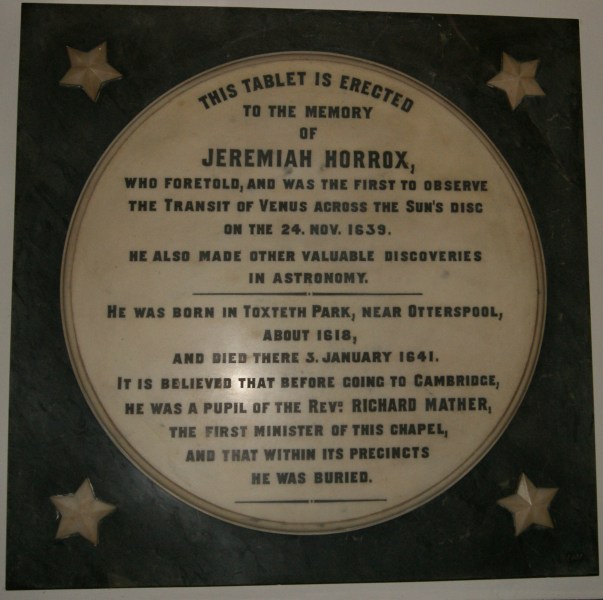
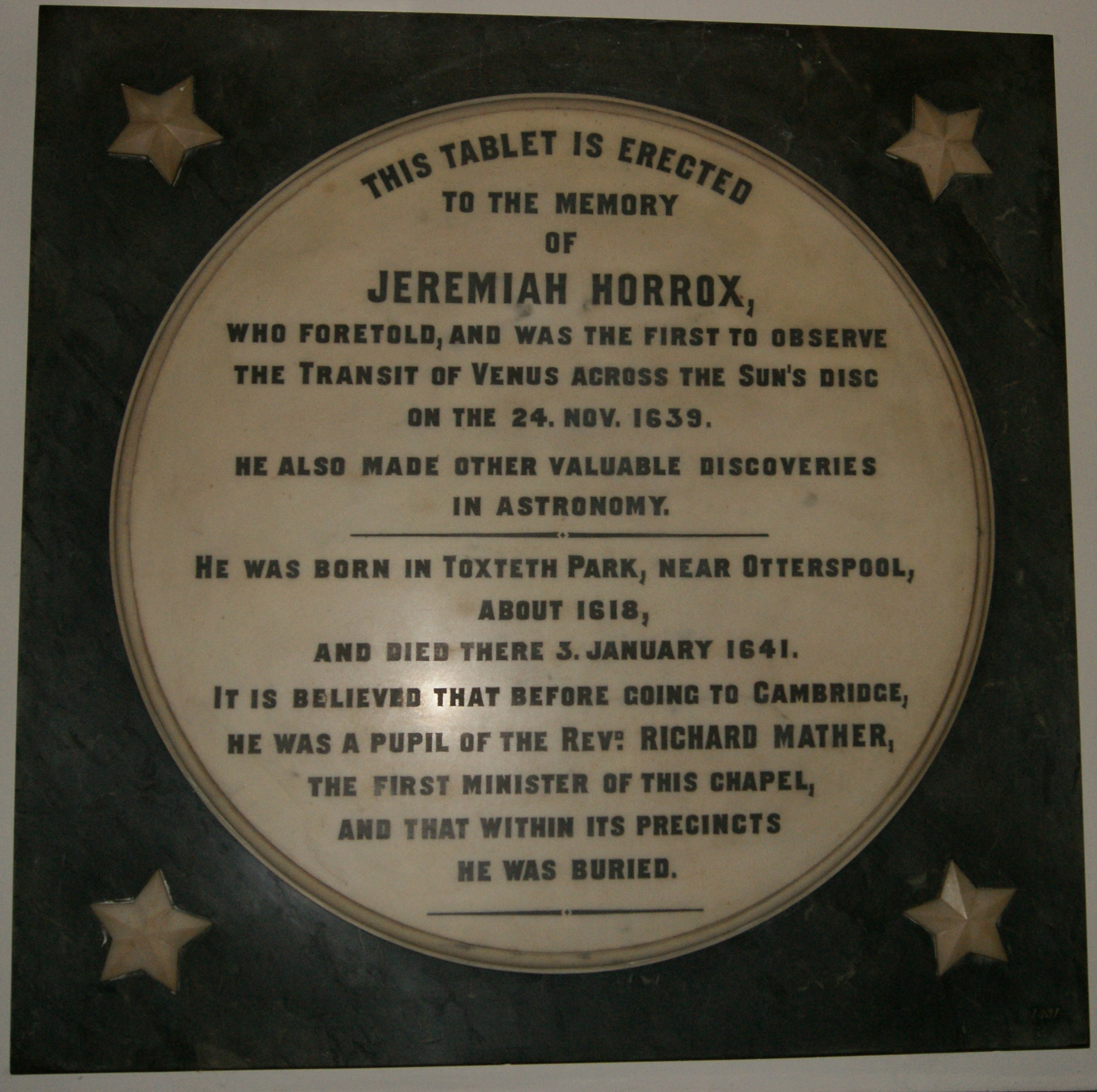
A plaque in the Ancient Chapel of Toxteth records that Jeremiah Horrocks (or Horrox) “foretold, and was the first to observe the transit of Venus across the Sun’s disc on the 24. Nov. 1639”. But the plaque, which was put up in 1891, is, in fact, only one of four church memorials to him around the country.
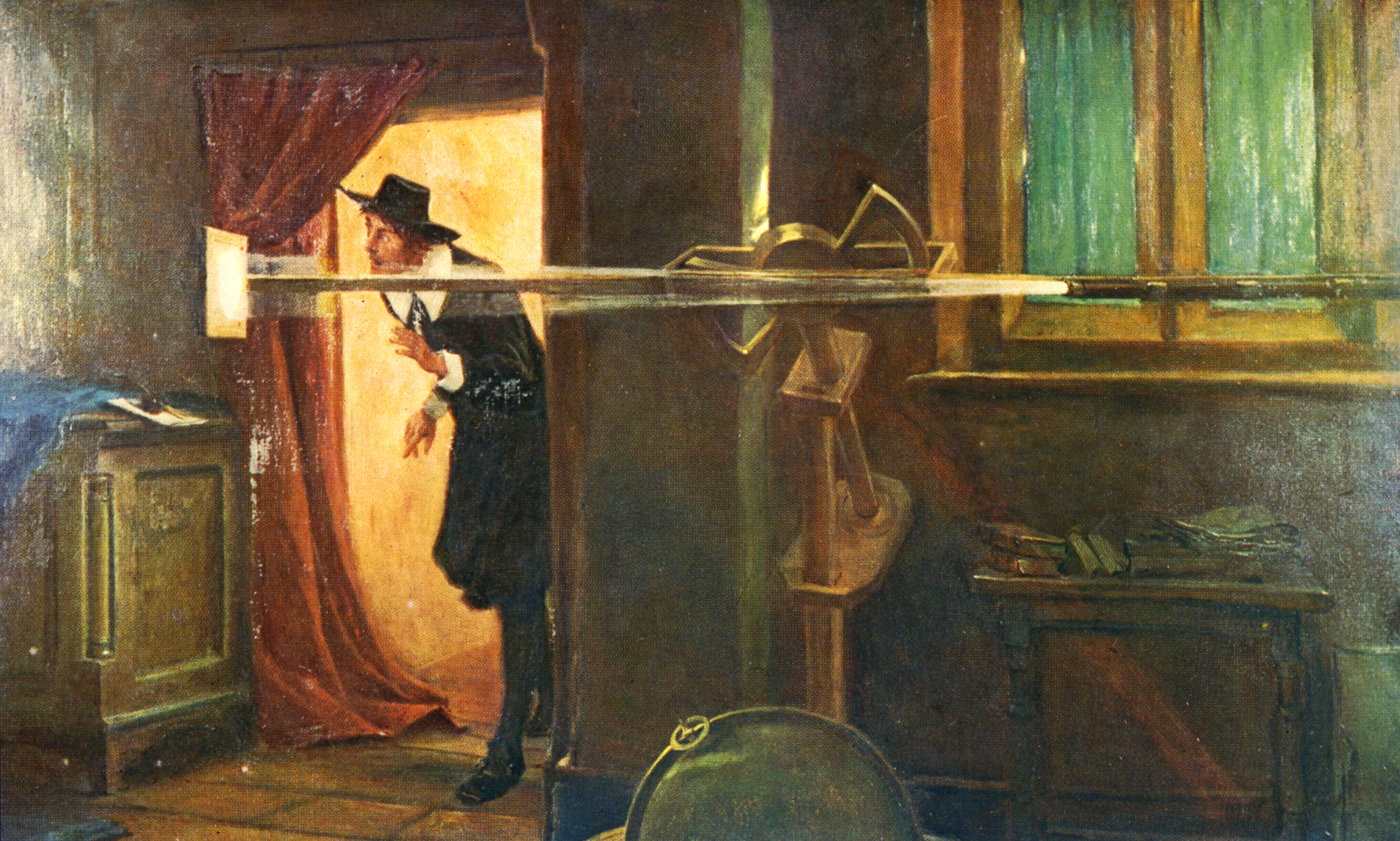
A Victorian depiction of Jeremiah Horrocks observing the transit of Venus
Without doubt the best known of these is in Westminster Abbey erected opposite that of Isaac Newton (who had praised his work) in 1874 following a petition from the Council of the Royal Astronomical Society (actually inscribed on part of the marble monument to John Conduitt, who was married to the niece of Isaac Newton). Certainly the Abbey is a fitting place for a memorial to such a person. On it his scientific achievements are listed but it also states that he was “Curate of Hoole”. Now there is no doubt that Hoole is where Jeremiah Horrocks lived for a while and where he observed the transit of Venus. But there is no evidence that he was ever curate of Hoole, or indeed an ordained clergyman of any sort.
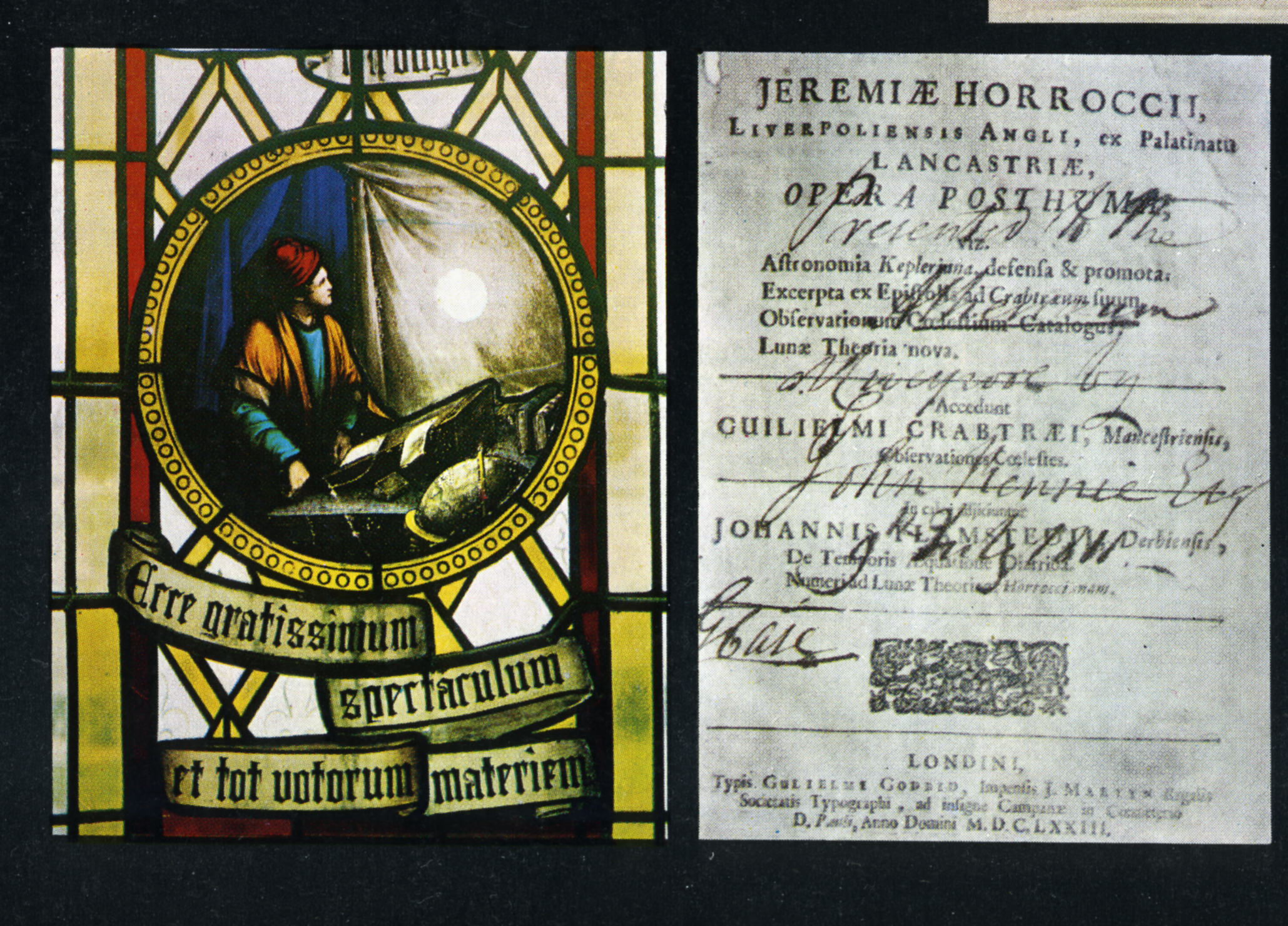
The Victorians were not slow to extend or embellish their assessment of his religious affiliations. The church at Hoole has its own memorials too including a Horrocks Chapel, memorial windows, a weather vane and a plaque, although the website of St Michael’s Church, Hoole now describes the text of this plaque as “largely fictional”.
Jeremiah Horrocks seems to have spent about a year in Hoole. Rather than being a curate or holding any position in the church he was probably a tutor to the children of a local family, in whose home he observed the transit of Venus. But there can be little doubt that he will have attended the church at Hoole while he was resident there. At the time there will have been little difference in the theological outlook of Hoole and the Ancient Chapel of Toxteth. Both were centres of Puritanism – comprising earnest, godly, and devout parishioners, in both places members being technically part of the Church of England (there was little leeway to be anything else at the time) but possessing a no-nonsense approach to faith and a fair degree of suspicion of ecclesiastical hierarchies. During his time there the church was still a just a chapel of ease and the curate (later rector) was eventually ejected for non-conformity.
The stained glass window at Hoole Church and the title page of Horrocks’ posthumous work
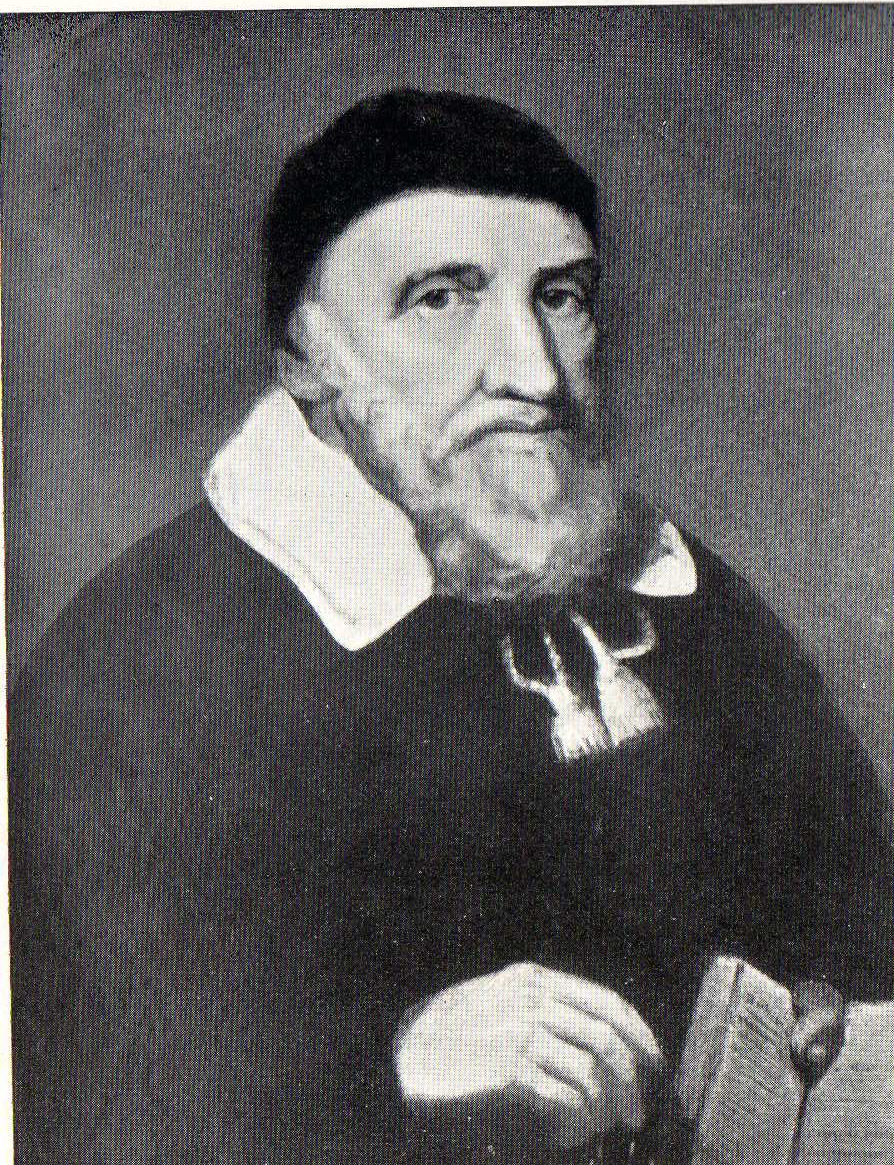
Although no records of Horrocks’ baptism or burial survive he seems both to have been born and died in Toxteth where his family names illustrate the Puritanism of his background. The names of Horrocks and Aspinwall (his mother’s maiden name) were amongst those puritan settlers who arrived in Toxteth in the late sixteenth century and began clearing the hunting park and built the chapel. They were part of the group who called Richard Mather to be first their schoolmaster and then their minister. The same Richard Mather was reluctant to accept Episcopal ordination. He eventually did so but was alarmed after being ordained (so the story goes) when the bishop approached him and asked to speak to him in confidence. Fearing that some admonishment was imminent he was surprised instead to hear the bishop say “I have an earnest request unto you, and you must not deny me; it is that you will pray for me; for I know that the prayers of men that fear God will avail much, and such an one I believe you to be.” Despite this unusual alleged exchange with the bishop he was eventually suspended for nonconformity and subsequently left with many of his followers for New England.
Richard Mather
It was probably here that Horrocks was educated and his religious opinions formed. From Toxteth he went to Emmanuel College, Cambridge as a sizar, basically the lowest form of student life, working as a college servant alongside his studies. He left without taking a degree but developed a passion for astronomy while there and was soon manufacturing his own astronomical instruments. Members of the Horrocks family, quite probably including his father, were watchmakers which must have been an assistance in developing precision instruments.
But following his death on 3rd January 1641 two hundred and fifty years were to pass before the Ancient Chapel erected its own memorial in his memory.
But this is not the only church memorial to Jeremiah Horrocks in Liverpool. In 1826 Moses Holden, described by the Oxford Dictionary of National Biography as a “popular astronomer,” used the proceeds of one of his lectures to pay for the erection of a memorial tablet in St Michael’s in the Hamlet church in Aigburth, not far from the Ancient Chapel. It may well have been awareness of this tablet that encouraged the Unitarians to put up their own. Holden seems himself to have been a Methodist lay preacher but was on good terms with the established church. Nevertheless Jeremiah Horrocks can never have had any connection with St Michael’s in the Hamlet, since it was not founded until 1815.
Horrocks is commemorated in other ways too – additional memorials in Hoole and Liverpool; an observatory; an institute of the University of Central Lancaster – but it is curious how a variety of religious traditions have all sought to harness him for their own adornment. All of them have some claim on him but – in my view at least – it is the memorial that is the least known and acknowledged, the one in the Unitarian Ancient Chapel of Toxteth, that is most appropriate. Not because he was a Unitarian – because he wasn’t, such an idea would have been absurd to him. Not because he was a dissenter, because he wasn’t that either. As I have suggested his own views were almost certainly very strongly puritan and he held them within the context (technically at least) of the Church of England. But the little chapel in Toxteth Park was the place where he grew up and was educated. He was therefore part of a particular religious community founded in the last years of the sixteenth century and continuing ever since. The memorial to Jeremiah Horrocks was unveiled on Sunday, 11th October 1891, the minister, the Rev Valentine D. Davis preaching a sermon based on Genesis ch.1 v.1,3:
In the beginning God created the heavens and the earth. And God said, “Let there be light”; and there was light.
The Memorial to Jeremiah Horrocks in the Ancient Chapel of Toxteth, Liverpool
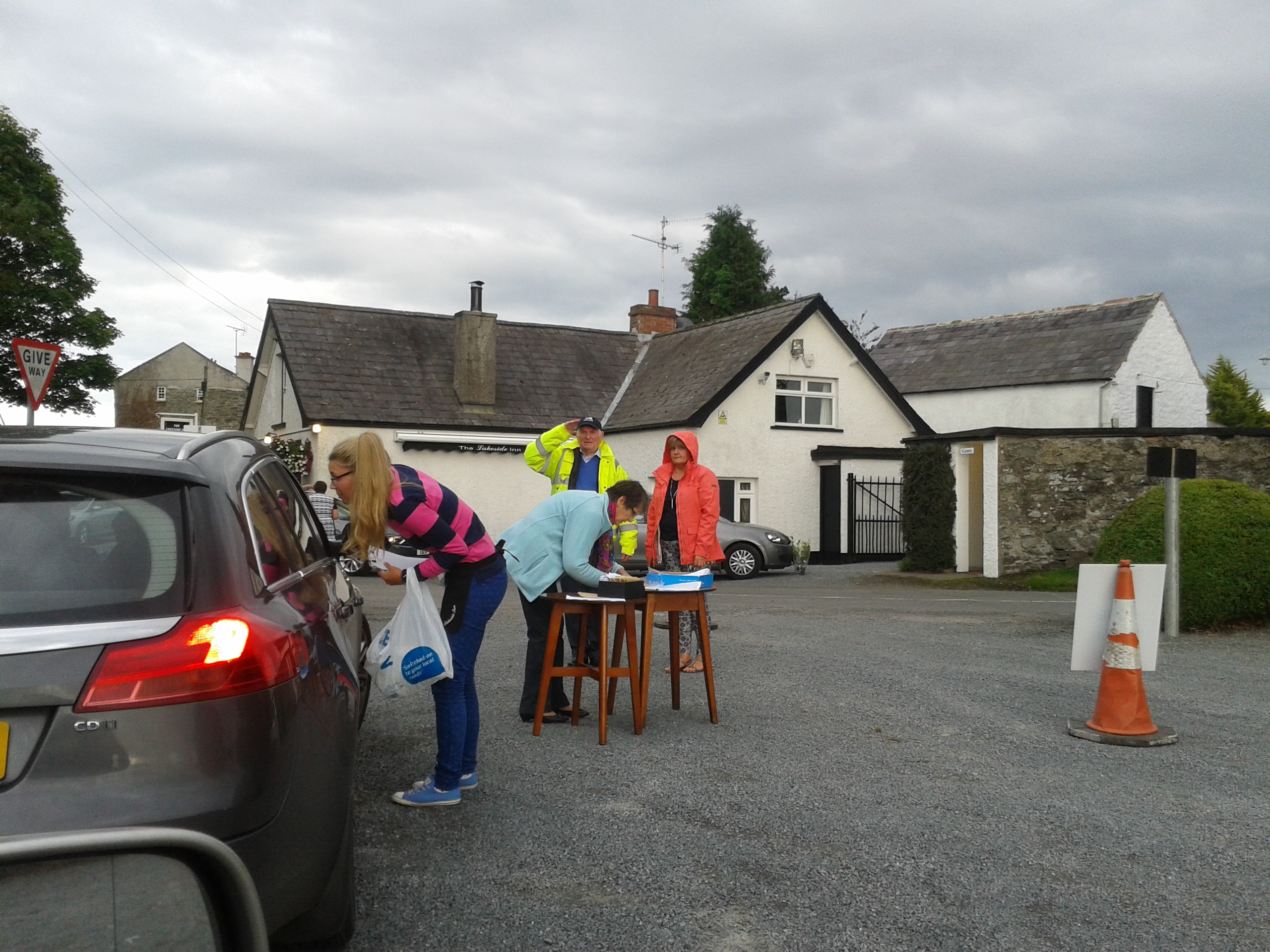
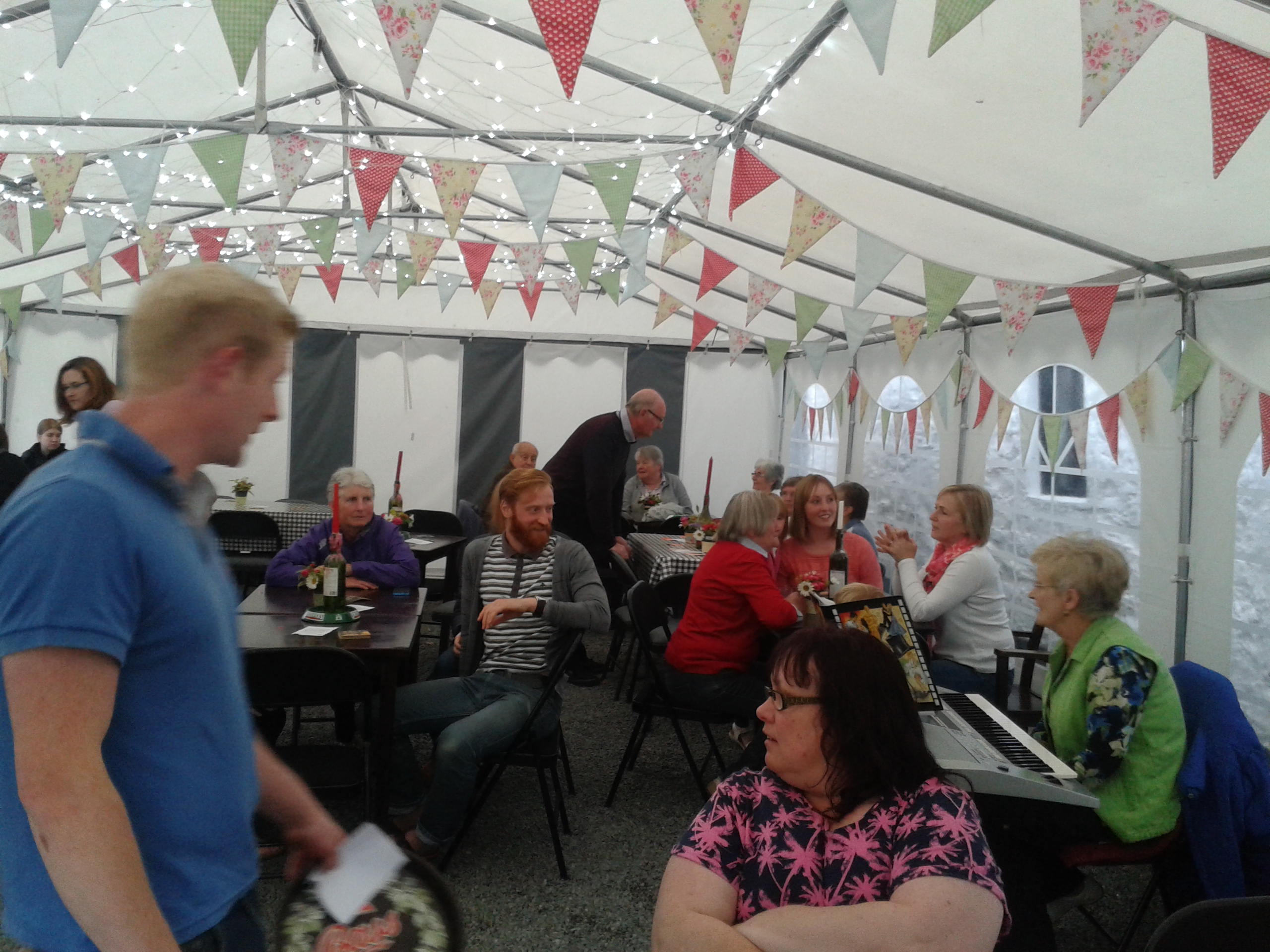
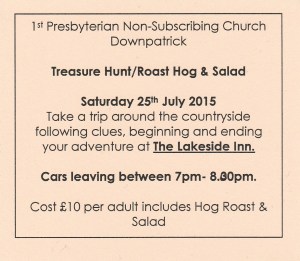
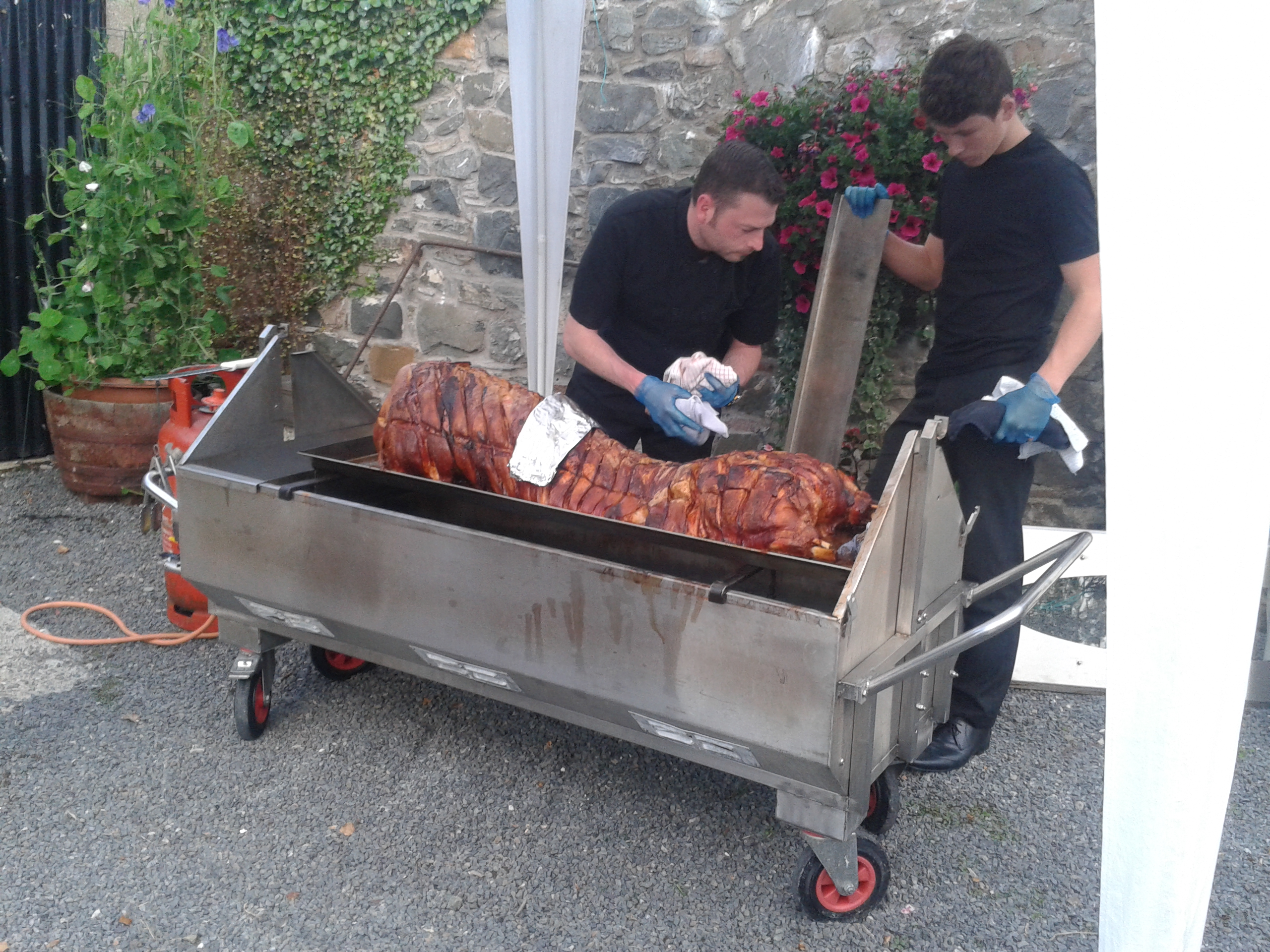
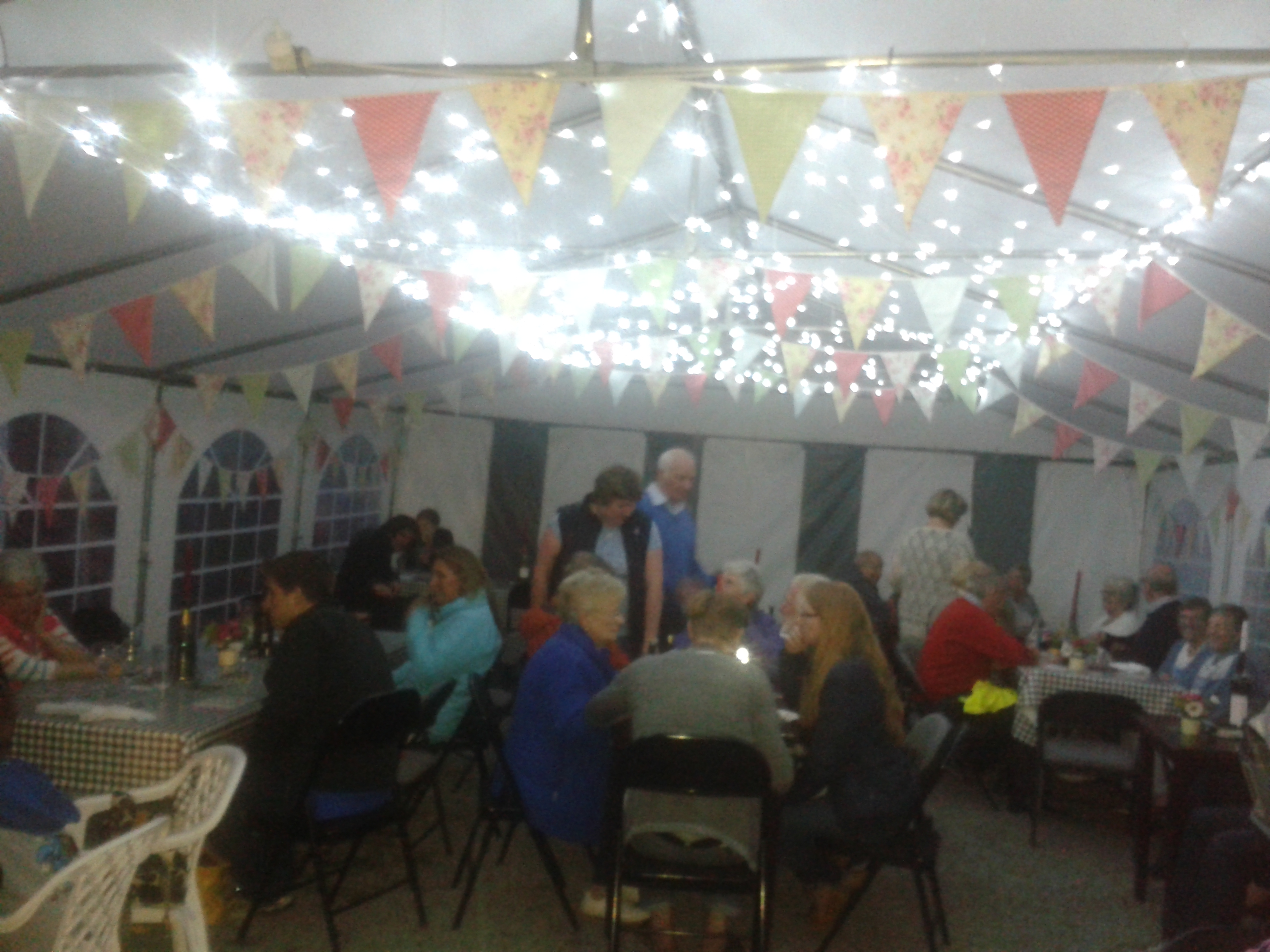
On Saturday, 25th July around 125 people took part in the Treasure Hunt organised by the First Presbyterian (Non-Subscribing) Church, Downpatrick. It was a fantastic night helped by good weather and the great venue that is the Lakeside Inn, Ballydugan, where church member and recent NI Bar Person of the Year Margaret Ferguson is the licensee. Those taking part went on a fifteen mile journey around the local countryside, answering clues along the way and coming back to a magnificent Hog Roast. As well as being a great night it also raised a very good sum for church funds.
Setting off for the journey from the car parkIn the marque early in the eveningTicket to the Treasure HuntPreparing the Hog RoastPart of the queue for the hog roastThe queue looking towards the roadMarquee with lights
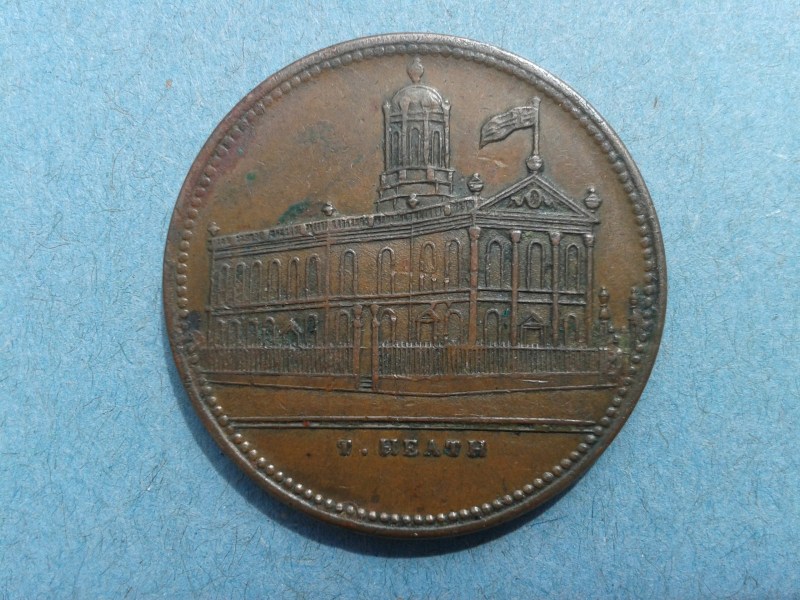
I wonder how many Unitarian churches have their images engraved on the reverse of a coin? I only know of one example, it is not a particularly beautiful example of the medallist’s art but it is very interesting and tells an unusual tale.
The reverse of the token
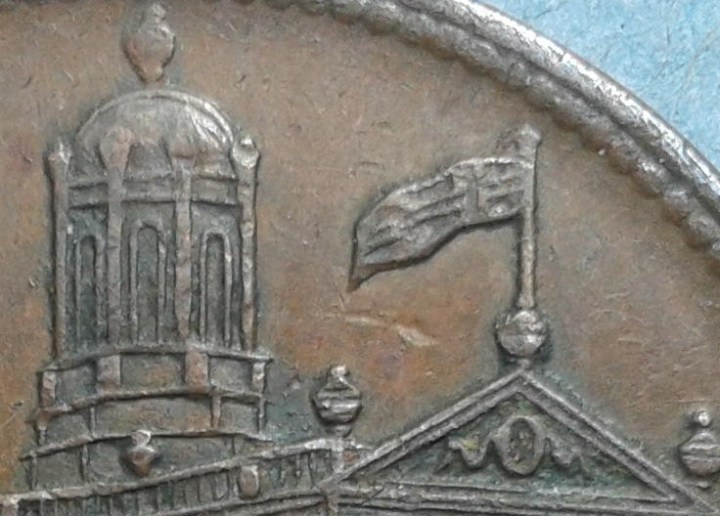
The church in question is Paradise Street Chapel in Liverpool, now long demolished, indeed the whole street has disappeared under the shopping development known today as Liverpool One. But Paradise Street was built in 1791 and was a dissenting church of some importance in Liverpool at the time. In the nineteenth century no less a person than James Martineau became the minister – a fitting appointment to a congregation that was cultured, wealthy and influential. They had built their meeting house on the grand scale, with a central cupola it was octagonal with a classical frontage and adorned with elegant stone urns along the balustrade. Martineau arrived in 1832 and established a name for himself as a preacher, teacher and philosopher linking up with other prominent figures in Liverpool and the north west including John Hamilton Thom, Charles Wicksteed, and John James Tayler.
Close up of the Chapel
But partly through the changing environment around the old chapel, which had become more commercially orientated and less like an area the well-to-do might want to visit, and partly also because of the more devotional worship that Martineau introduced, the congregation felt a need to abandon their old church and build something new. Accordingly a grand gothic church was built on Hope Street and Martineau and his congregation departed to their new home, selling the old place off. (For Hope Street Church see my earlier post – the Church on Hope Street).
James Martineau and his congregation, perhaps out of financial necessity from building anew on an extravagant scale, showed little sentimentality in disposing of their old place of worship. Yet one can’t help suspecting that a man of such high-brow intellectual tastes as Martineau can hardly have approved of the new use to which the old chapel was now put. It was purchased by a man called Joseph Heath who intended to turn it into a music hall.
After the Unitarians left it in 1849 the spacious chapel, with its well-constructed gallery all built of the finest materials and to the highest standards, was converted into the Royal Colosseum Theatre and Music Hall. The pews were re-used for seating and one can see how a large chapel could easily be adapted for use as a theatre. However, Joseph Heath must have been an ingenious individual because he managed to turn Paradise Street into the first multiplex: there were twin auditoria for both a theatre and a music hall. According to The Liverpool Stage by Harold Ackroyd the theatre “presented what were described as full blooded dramatic plays for a patronage of mariners”, while the front part of the old chapel was converted into a music hall where variety performances were put on “well suited to the taste of those for whom Mr. Heath catered.”
Detail of the tower
One can’t imagine Martineau really approving of such an undignified end to his old church but there was greater indignity to come. The Colly, as it became known, was reputedly haunted, an association encouraged by the continuing presence of the chapel’s graveyard around the building. This also presented a practical advantage to the thespians. According to Harold Ackroyd again: …there was never any shortage of a skull during a performance of Hamlet. These were easily obtained, the artists’ dressing room, below the stage, formerly having been a grave vault, the artist had only to put his hand through an opening in the thin dividing wall, to seize hold of the grisly relic, as did Hamlet.
So it was the music hall owners who had the coin engraved with the unmistakable likeness of the Paradise Street Chapel. The Heath family owned the former chapel until about 1895 although it went through a number of refurbishments and changes of name in that time. But it remained known as the Royal Colosseum Theatre until 1875 at which time it was being run by Thomas Theodore Heath, Joseph’s son. Presumably this is the ‘T. Heath’ whose name is inscribed on the coin as the owner of the theatre. This would date the coin to the early 1870s when it functioned as an admission token for those eager for Victorian melodrama or the bawdy delights of an evening at the music hall. On the other side of the coin is a Liver bird, a belt and the name of the theatre. Some examples of the coins have a large letter ‘H’ stamped on them. I don’t know precisely what this indicated, at first I thought it was a reference to a seat or a row or an entrance but ‘H’ seems to be the only letter used in this way and it rather spoils the look of the engraving. Whatever meaning it had to the person at the theatre door this is now long forgotten.
An example of the coin with the letter ‘H’ stamped on it
By the late 1870s the theatre was said to be able hold 3,000 people, and must have been returned to a single auditorium, but at this stage in its history it was struck by a terrible tragedy. On the night of 11th October 1878, during a performance before a full house, a portion of the ceiling fell onto the pit and caused panic amongst the audience. Thirty-seven people were killed in the crush to escape and many more injured. Pictures in the Illustrated London News at the time show a building that was already extensively remodelled from the one that appears on the back of the token but it had fallen victim to the sort of tragedy that was not unknown in Victorian Britain. Following this the theatre was rebuilt, frequently renamed and continued in use up to the First World War. By then known as Kelly’s Theatre, it finally closed its doors in October 1916 and was sold to Cooper’s Ltd who used it as a warehouse for their greengrocery and restaurant business.
The whole story of Paradise Street Chapel and the Royal Colosseum Theatre was brought to a close by a German bomb during the blitz of 1941. Precisely how much of the building of 1791 had survived within the much enlarged edifice is hard to know but by then the building’s origins as a place of worship were hardly remembered. The link is maintained though by these little tokens which record a small element of theatre history and, almost by accident, help to preserve the image of a building that had a quite different history and purpose.
(This is an amended version of an article that first appeared in the ‘Inquirer’ 4 July 2015)
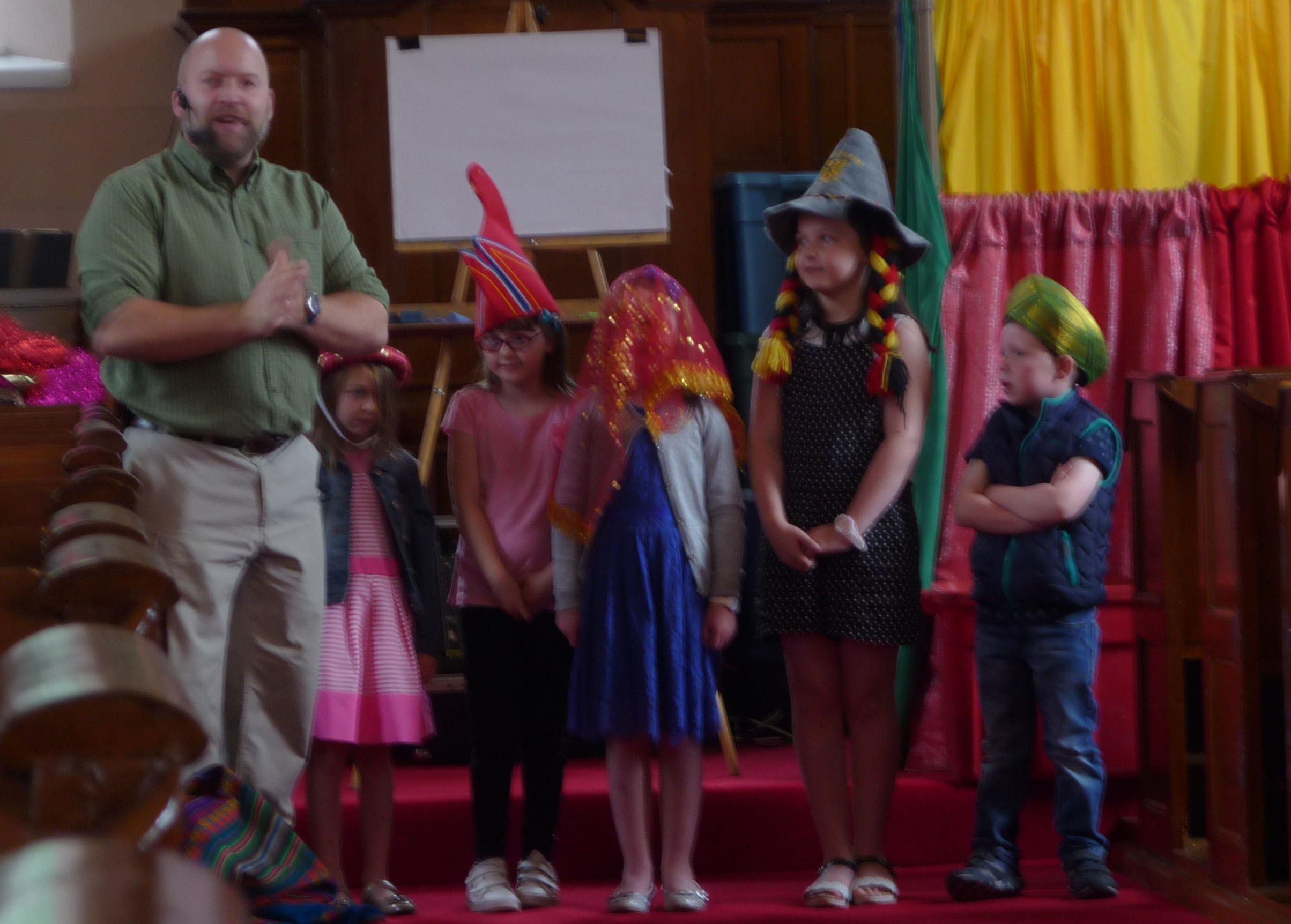
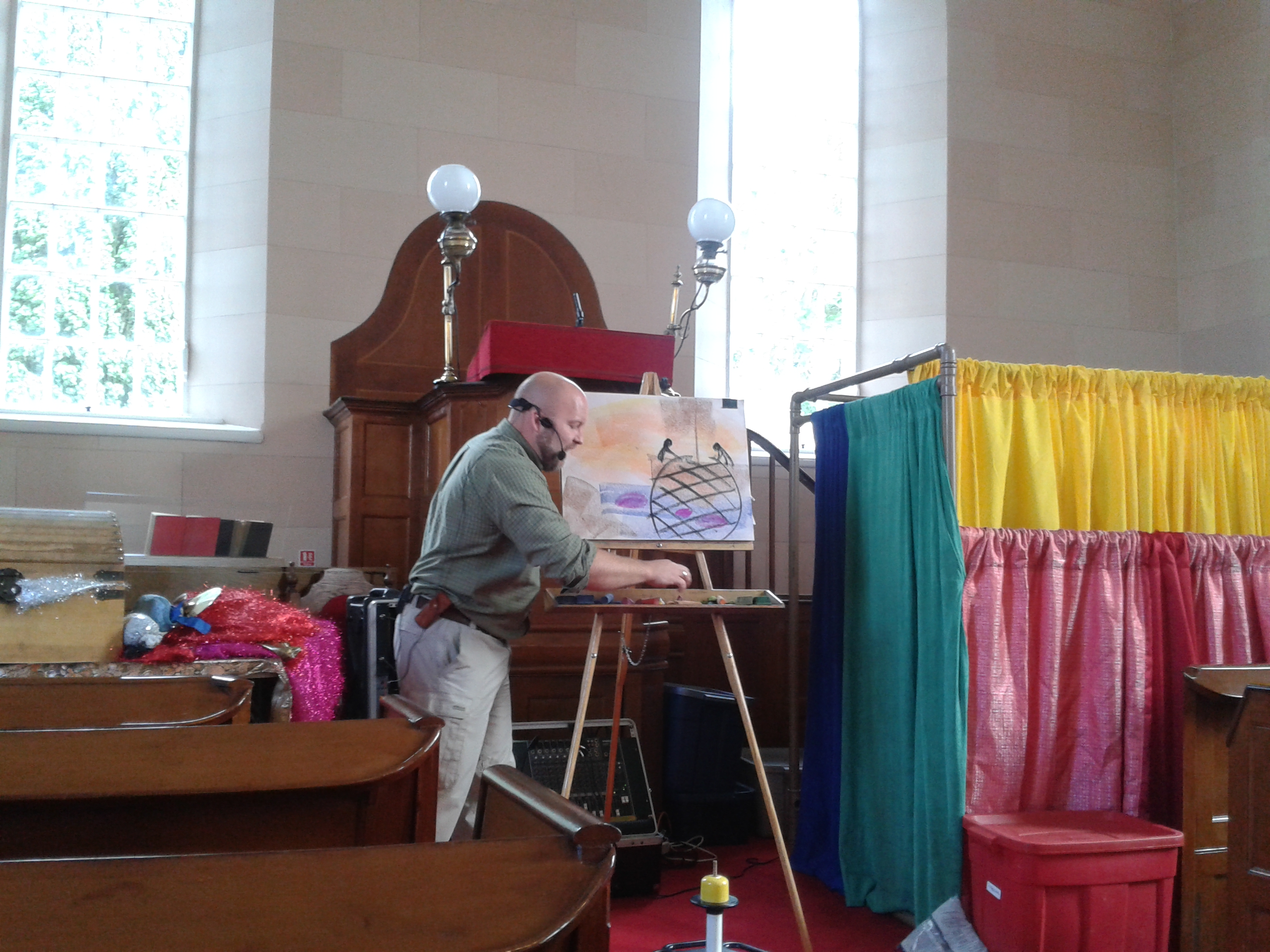
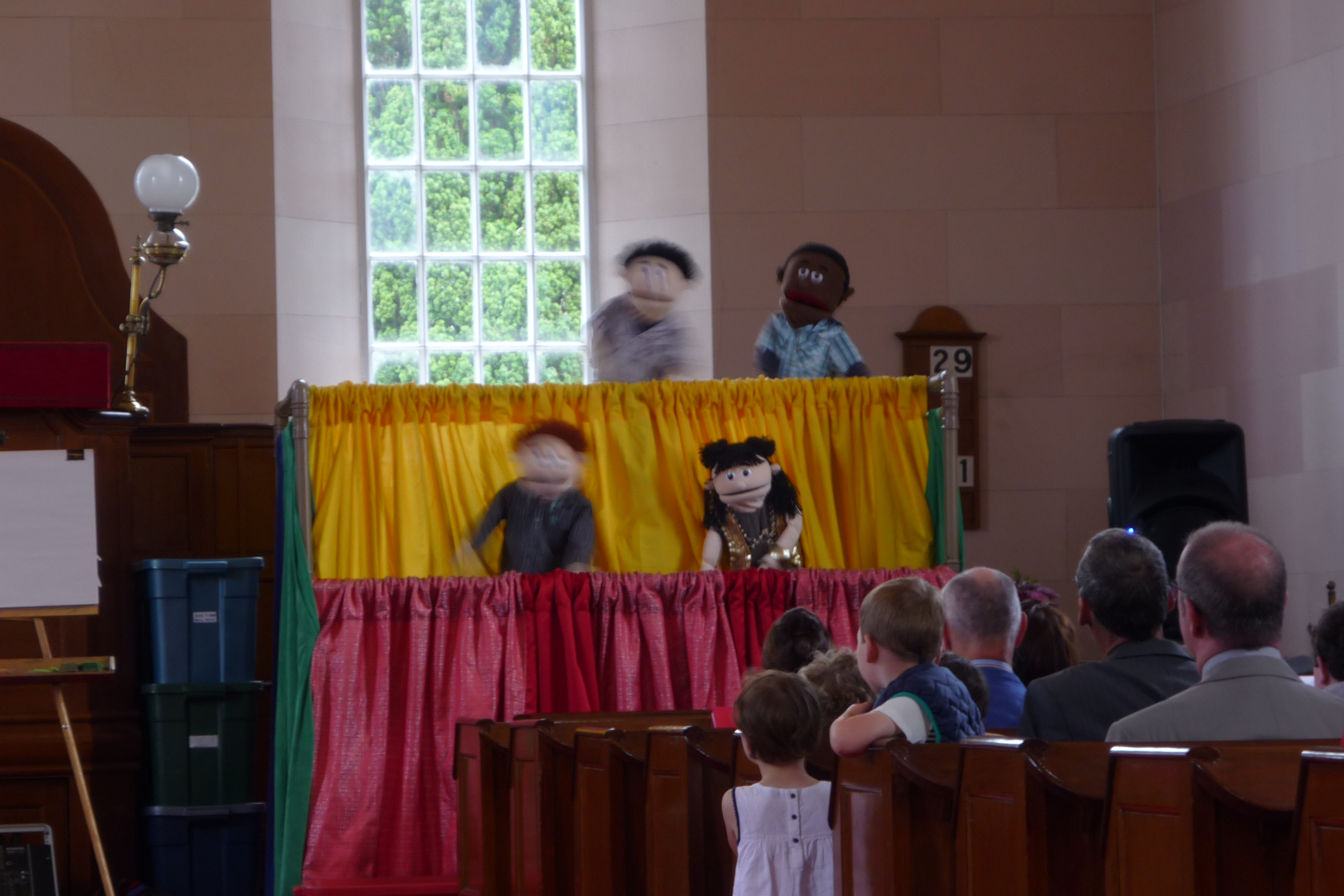
On Sunday, 19th July worship at Clough was led by Sam Shaw and Godshandiwork Puppets. There was a large congregation of members, both young and old, and from Ballee and Downpatrick as well as Clough and everyone was enthralled by the wonderful, varied presentation given by Sam and his team which included puppets, music, drawing and lots of fun.
Wearing hats from all around the worldPuppet quartetTelling the story through artPuppets in songWatching the puppetsBrown bear and polar bear
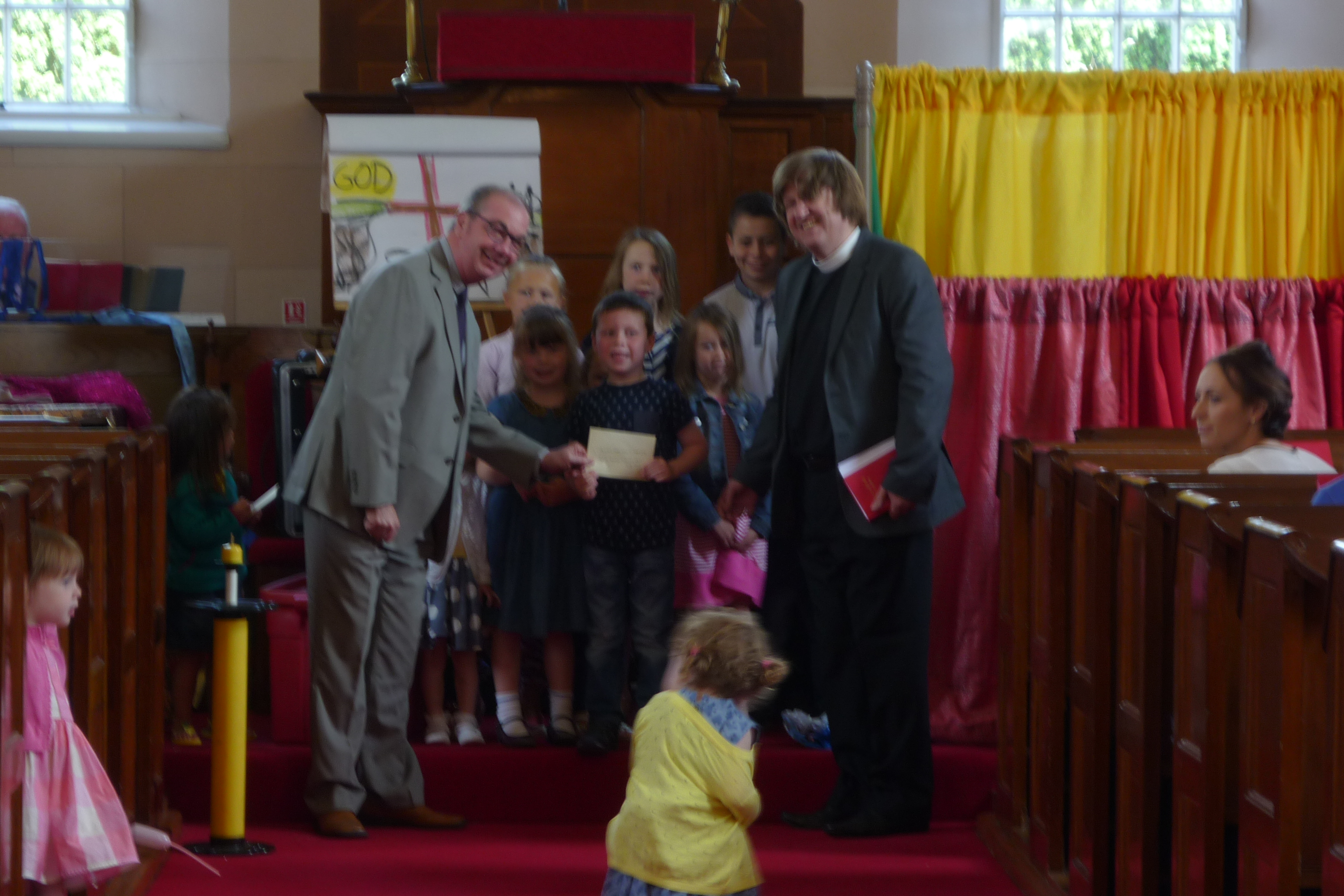
Over the last year Clough Sunday School have also been raising money for the Downpatrick and District Autism NI Parents Support Group and at the end of the service Sunday School member Thomas Rooney presented a cheque for £230 to Ashley McKinley on behalf of the Parents Support Group.
Thomas Rooney makes the presentation to Ashley McKinleySome of the congregation
I probably first came across the Unitarian Van Mission in the late Professor R.K. Webb’s masterful survey of ‘The Unitarian Background’ in the 1986 volume Truth Liberty Religion. Essays celebrating Two Hundred Years of Manchester College (edited by Barbara Smith). However, the end of his chapter takes on a very negative tone where he describes “precipitous decline” being caused by the “attenuation and fragmentation of Unitarian doctrine”. In this context he mentions “the touching Van Mission that wended its slow way through the country in the years after 1906”.
This really is a slightly patronising view of the Van Mission and, of course, is not really fair. From the perspective of the late twentieth century anything that relied on horse drawn power could be regarded as touching and slow. But in 1906 people would not regard such a mission in any such way.
It is clear from the response to my previous post that there is a great deal of latent interest in the Unitarian Van Mission. It is also the case that there is the material for a serious research project on it. John Roberts’ useful investigation into the Van Mission in the 1978 Transactions of the Unitarian Historical Society is just about the only thing that has been written on it since the First World War. I don’t have much else to hand that can shed light on the Van Mission but the one thing I do have is the special centenary edition of the Christian Life from 1913 – a single issue of that magazine that never fails to provide something of interest.
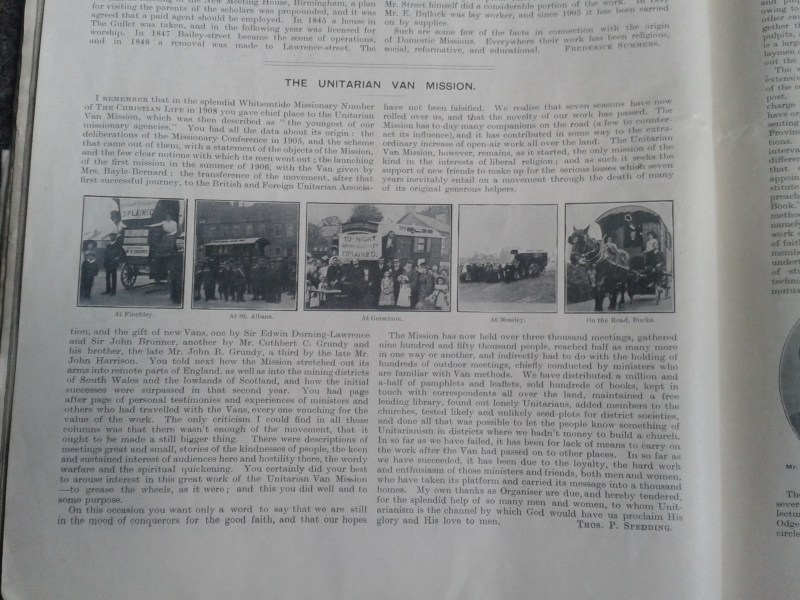
It was published to mark the centenary of the Trinity Act and includes a vast amount of material. One of the shorter sections – only about half a page – is that on the Unitarian Van Mission written by the Rev T.P. Spedding and accompanied by five fascinating, if frustratingly small, images. The article is, like almost everything in that issue, quite relentlessly positive and upbeat. In part this reflects the celebratory nature of that publication but it also reflects the underlying truth – they were positive, things were going well, they didn’t know the world stood on the brink of a brutal world war, and they had every reason to feel that in religious terms their ideas, if not all-conquering, were at least gaining a positive reception and winning ground.
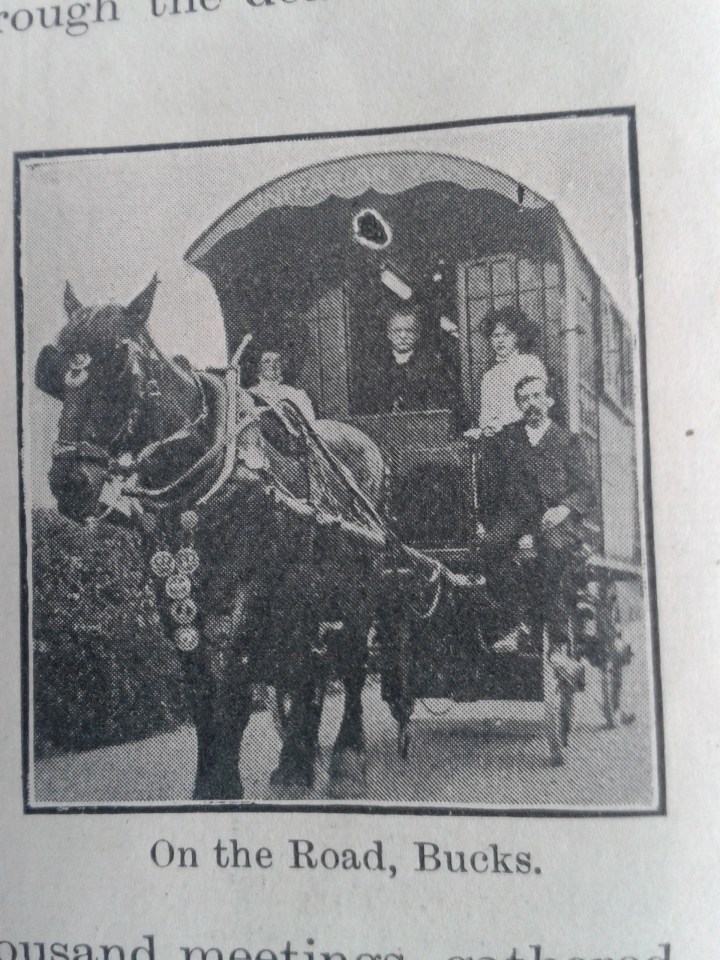
The Van on the move, the horse with its brasses and the Rev T.P. Spedding with three assistants on board
T.P. Spedding writes how the number of vans had increased to four thanks to donations by Sir Edwin Durning-Lawrence, Cuthbert C. and John R. Grundy, and John Harrison. (John Roberts suggests that in the end there were six vans on the road.) But if T.P. Spedding’s statistics are accurate it had been an extraordinarily active movement:
The mission has now held over three thousand meetings, gathered nine hundred and fifty thousand people, reached half as many more in one way or another, and indirectly had to do with the holding of hundreds of outdoor meetings, chiefly conducted by ministers who are familiar with Van methods. We have distributed a million and a-half of pamphlets and leaflets, sold hundreds of books, kept in touch with correspondents all over the land, maintained a free lending library, found out lonely Unitarians, added members to the churches, tested likely and unlikely seed-plots for district societies…
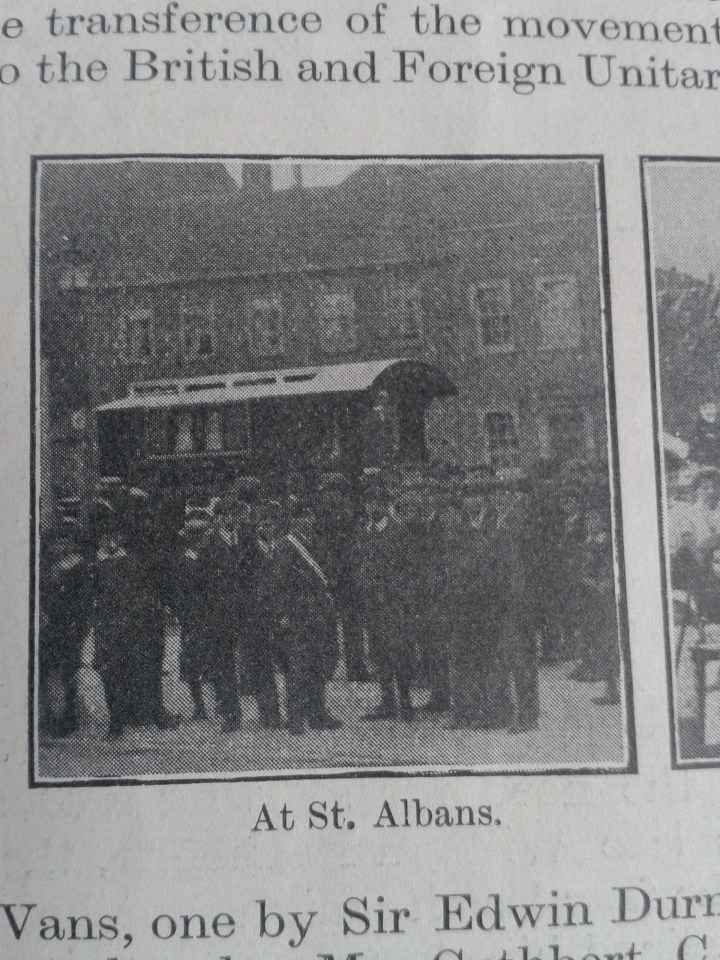
A meeting at St Albans
Three thousand outdoor meetings in about seven years! Even with modern media gathering 950,00 people online would be something that any church publicity movement would be very proud of.
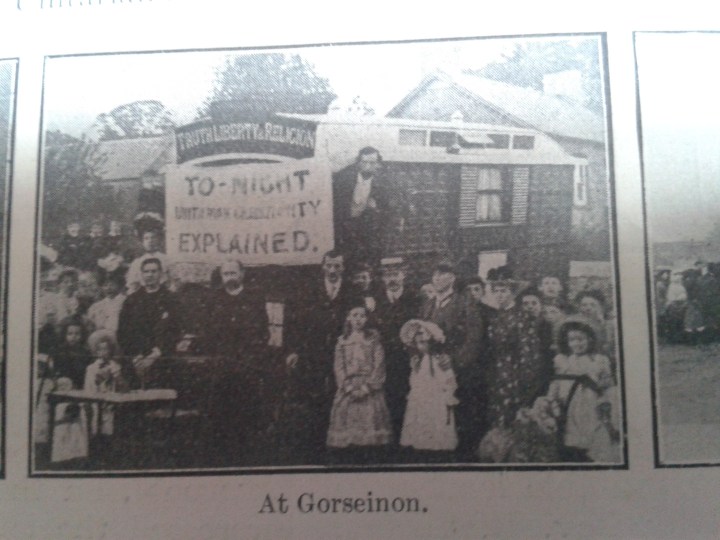
Gorseinon near Swansea
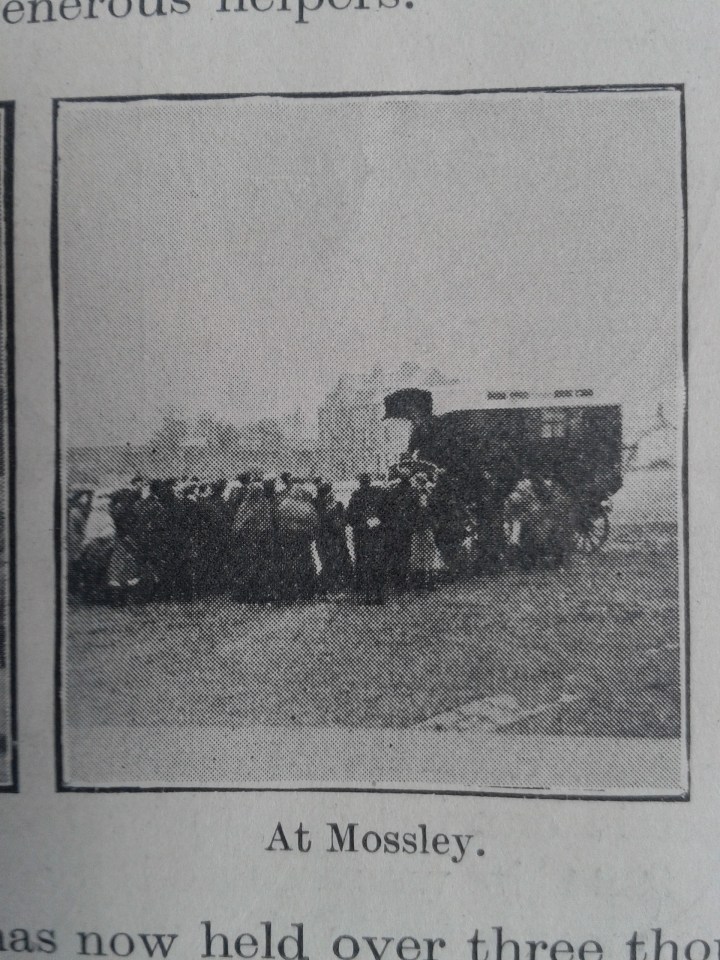
Its clear that the Mission didn’t just go into uncharted territory but also went to places where it supplemented an already established witness. It also faced competition from many other churches that were doing something similar and opposition from some who, T.P. Spedding seems to suggest, may have had this purpose in their design.
A busy meeting at Mossley where a church had existed since the 1840s
Nothing I have yet seen explains the logistics of operating the Mission – presumably horses were hired or loaned wherever they were needed by the local people. There must have been a lot of careful organisation behind its running. But there are records in various places that will repay careful examination and a fuller picture can be built up of the Mission’s operation.
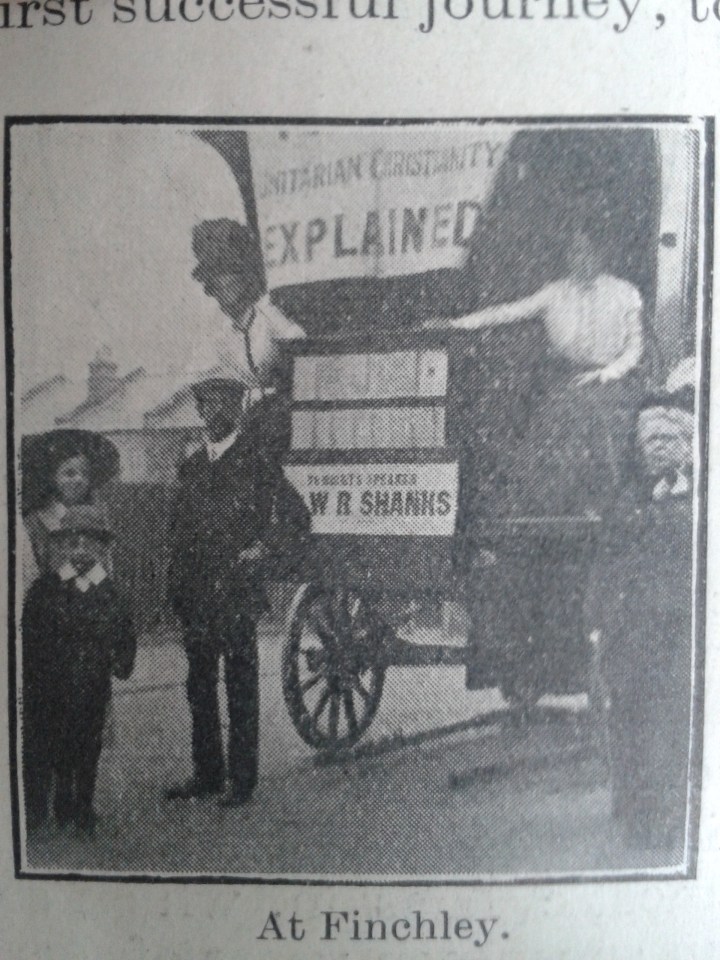
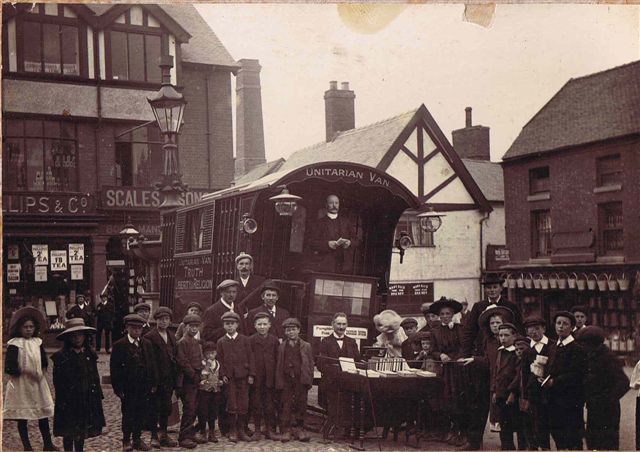
Finchley, “Unitarian Christianity Explained. Tonight’s Speaker [Rev] W R Shanks” – the Rev William Rose Shanks (1856-1928)The pictures in Christian Life are small and are not terribly well reproduced. The best picture of the Mission in operation is still the one I reproduced on this blog a few weeks ago. A lot of people have looked at it but we are still not able to identify the location. Both Len Smith and Rachel Eckersley are working hard on finding the spot, the presence of a number of named shops should be a help. It appears not to be Chesterfield, Northwich or Burslem which all had a branch of Scales and Sons. The town of Malton, which seemed a good possibility, can now be discounted, Len has discovered. Wrexham may be a possibility. But we still need to find the place where this interesting photograph was taken. If you have any suggestions please do send them in.
If you look up at the night sky on a clear night you will gradually see hundreds and hundreds of stars. In fact we know there are hundreds of thousands of millions of them, each one of them a star like our Sun. Around our Sun there orbit a number of planets and around all the other stars in the universe there must be planets of different shapes and sizes. Astronomers know of the existence of about 170 of these, light years away from us and discovered, so I read, by a process called microlensing.
If you were asked how many planets there were in our solar system you might say that there were eight or nine. Officially now there are eight although Pluto, the planet most recently discovered – as recently as 1930 – has now been demoted and is officially regarded only as a dwarf planet. It is also a very long way away – so far away that it takes 248 years for it to orbit around the Sun compared to the 365 days it takes our Earth. But because it is quite small and exists in an area where there are lots of other things floating around – the Kuiper Belt – it has been denied its planetary status by astronomers in the last ten years. However, this is still controversial and not everyone agrees with it.
But Pluto is in the news again this week as the US spaceship, New Horizons, which was launched nine years ago in 2006, will become the first space craft to visit Pluto.
Having journeyed through space for more than three billion miles, New Horizons will come within 7,800 miles of Pluto at 12.49pm Tuesday, 14th July UK time. As it hurtles past it will take photographs and make measurements of the distant planet which will tell us something about its composition and atmosphere.
But the story of Pluto’s discovery is not without interest. It was discovered in 1930 by Clyde Tombaugh. Although he was the first to discover it and he later helped to found the New Mexico State University’s astronomy department he didn’t start out as an astronomer. He grew up on a farm in Kansas and became interested in the stars and the planets as a boy. He built all his first telescopes out of farm machinery and the telescope he used to search for Pluto was made from things he found on the farm when he was 24. Other astronomers had predicted the existence of Pluto but Clyde Tombaugh, using a telescope made from a grain elevator, a cream separator and an old car axle together with lenses he had ground himself, was the first to see the planet. Clyde died in 1997 and, fittingly, when New Horizons was launched some of his ashes were sent into space onboard the ship.
I am always impressed by stories like this. It is a truly human trait to wonder at the stars and the majesty of creation, and to want to explore its vastness. This is something the Psalmist felt as he gazed at the night sky over Jerusalem maybe three thousand years ago:
When I look at thy heavens, the work of thy fingers, the moon and the stars which thou hast established; what is man that thou art mindful of him, and the son of man that thou dost care for him?
(Psalm 8 v.3-4)
Isaac Watts expressed something similar in one of his hymns in the eighteenth century:
Eternal Power, whose high abode Becomes the grandeur of a God: Infinite length beyond the bounds Where stars revolve their finite rounds.
But what particularly caught my eye with this story was that Clyde Tombaugh also helped to found a new church in Las Cruces, New Mexico. Not only that when he died they put in a very striking stained glass window in his memory in the Unitarian Universalist church there of which he was a member. It is a very large and attractive window, eight feet tall and eighteen feet wide and shows the figure of Clyde Tombaugh making one of his lenses and the solar system stretched out in the night sky including Pluto. Appropriately enough it also includes the church’s motto: “That all souls shall grow into harmony with creation”.
If you would like to see the window this link should take you there:
In the latest issue of Faith and Freedom Clair Linzey contributes ‘Animal theology: a view from the periphery’. Clair is the Deputy Director of the Oxford Centre for Animal Ethics and the article is based on a sermon she delivered in the Chapel of Harris Manchester College. In it she takes her lead from Jesus’s concern for the poor and Brazilian theologian Leonardo Boff’s theology of liberation which extends concern for the poor and marginalised to the planet itself and its non-human inhabitants. She makes a case for concern for animal welfare to be moved from the margins of our thought and discourse to a more central place in our consideration for the sake of our own spiritual and personal well-being. It is well worth reading.
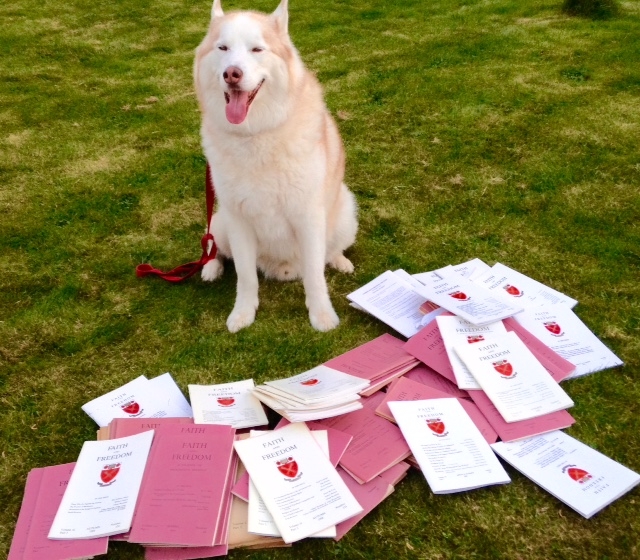
Those who attended the Old Students Association at Harris Manchester College in June will also have seen Nigel Clarke’s excellent presentation on the journal over the past twelve months. This included our own modest foray into animal matters with the appointment last year of Billy as the custodian of the Faith and Freedom archive.
Billy and the journals
Billy had initially done an excellent job in minding the archive and expressed evident delight at being appointed to such an illustrious role.
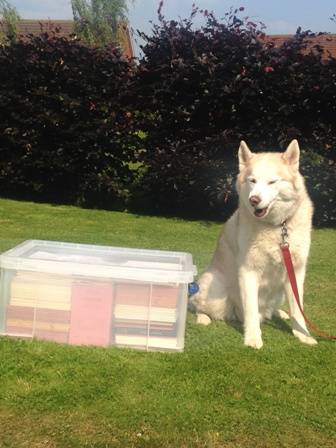
All safely gathered in
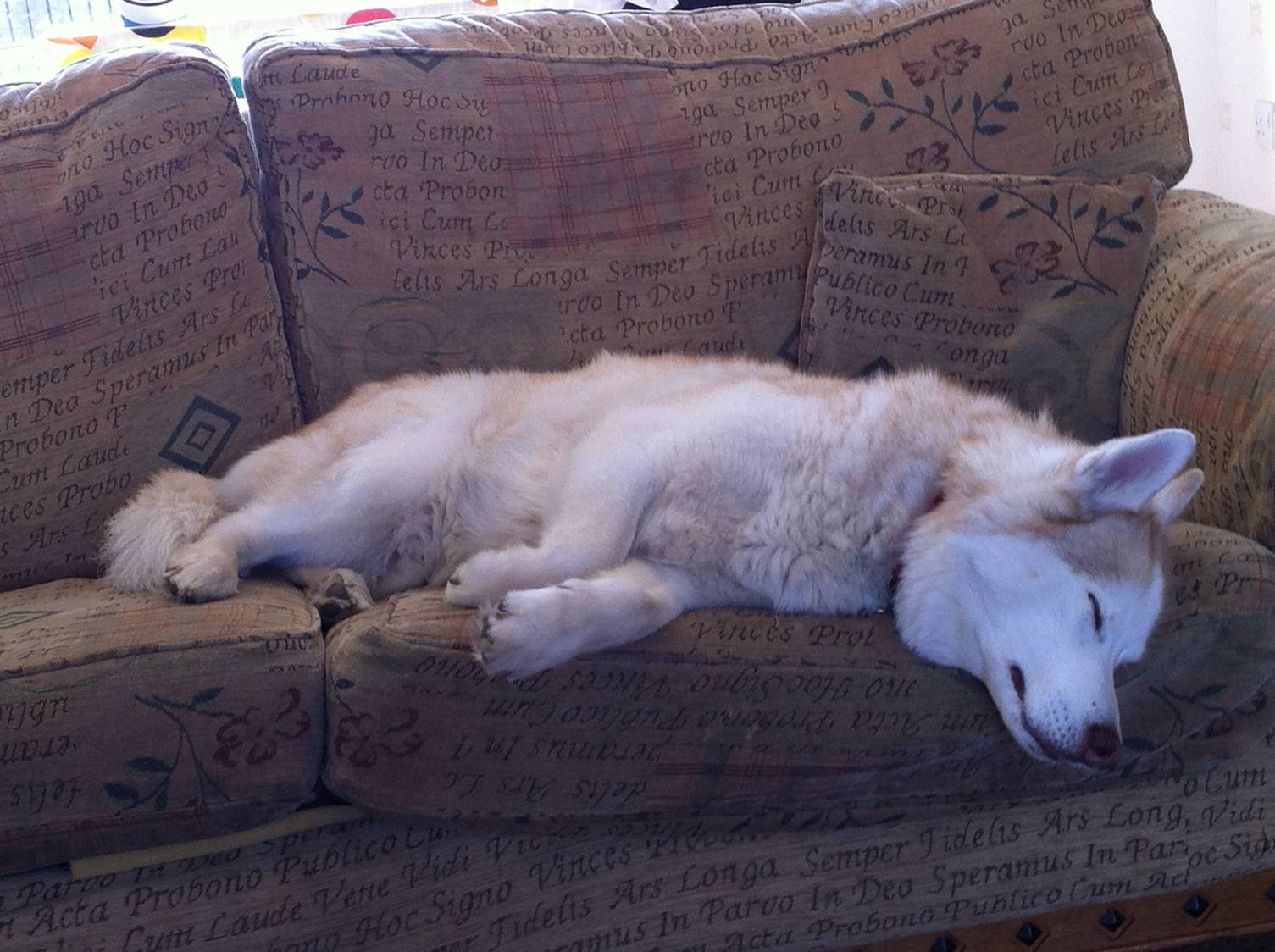
However, in more recent times he seems to have grown bored with this position and hints of dissatisfaction, indolence even, have crept into his demeanour as this candid picture illustrates:
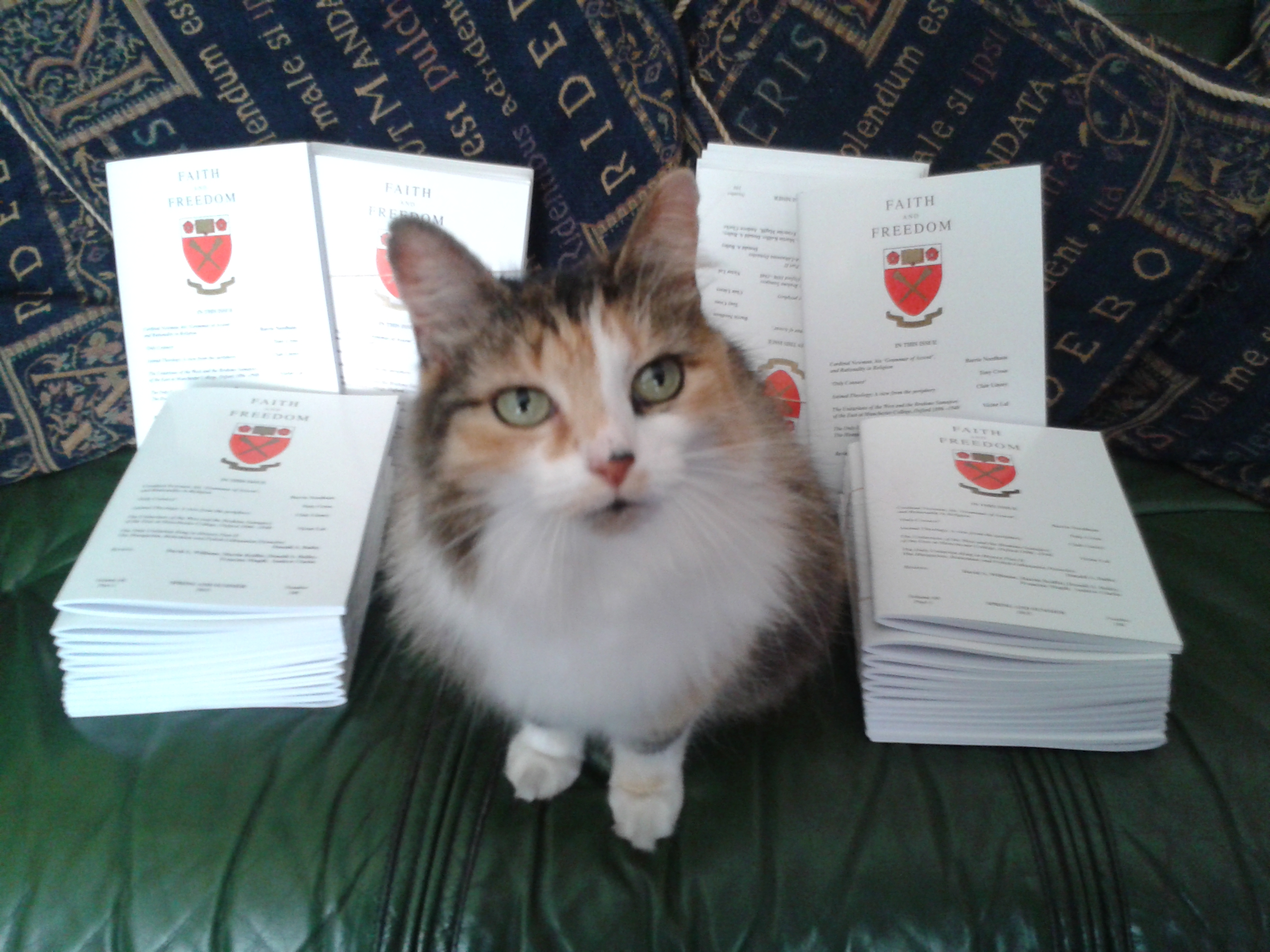
This has led to calls for the position to be offered to Caspian, the cat. Caspian, however, indicated that he had other things to consider and was not at all minded to be tied down to such a position. His friend Rosie, however, has given it consideration and seems at home in a bookish world.
Time will tell if Rosie will prove suitable for this job. Caspian, however, declined to be photographed for this report and appears only in silhouette.
The Rev Eric Price, the founding editor of Faith and Freedom, was recalled and honoured at Harris Manchester College on Tuesday, 23rd June during the annual meeting of Friends and Governors.
Eric had significant ministries in Bolton and Liverpool, among other places, and was lay secretary of Manchester College for a great many years. In addition he founded and edited Faith and Freedom from its inception in 1947 to the year 1983.
Portarit of Rev Eric Price
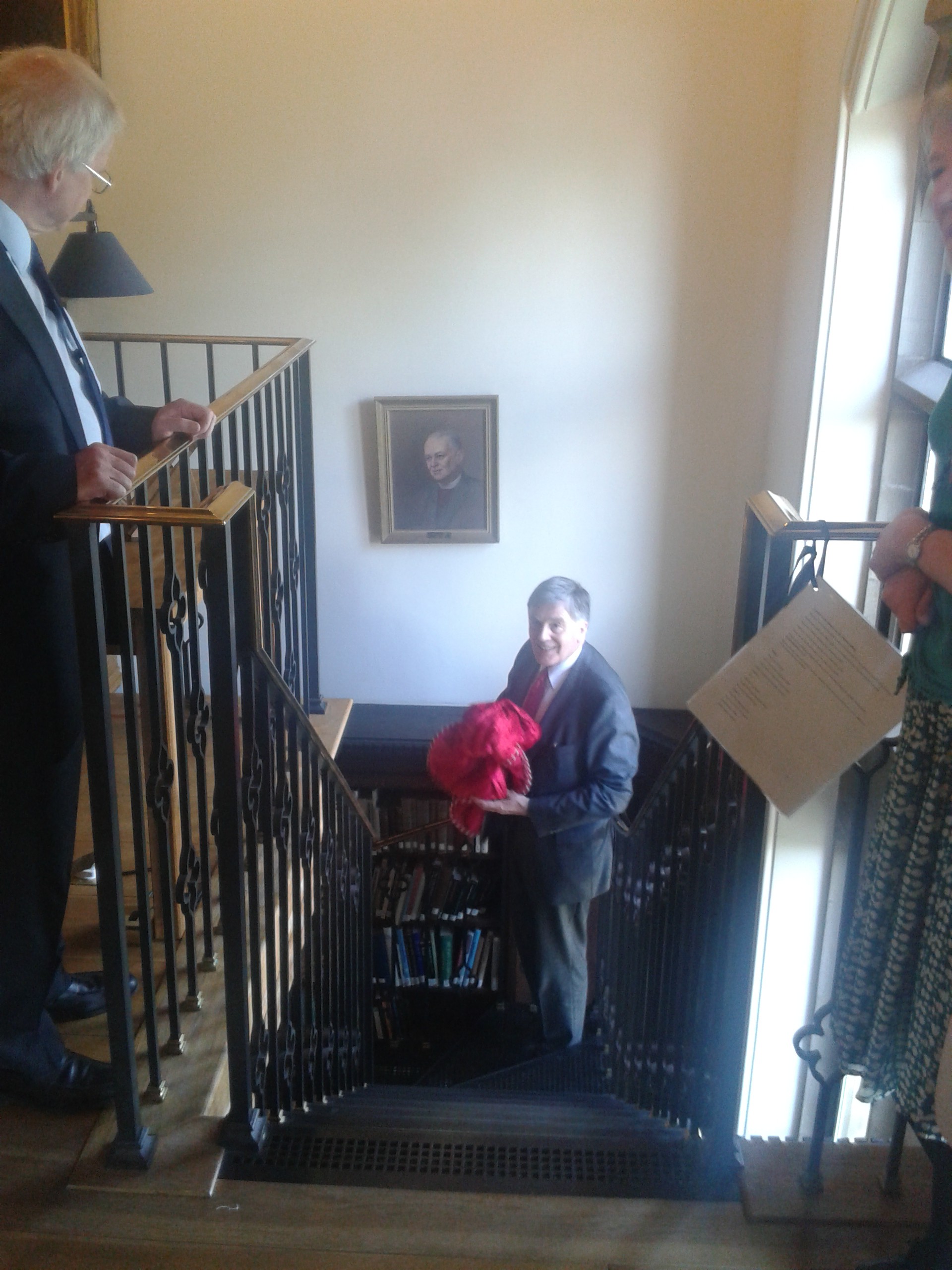
At the meeting Richard Price, Eric’s son presented a portrait to the College. This had originally been presented to his father by Bank Street Chapel, Bolton and was unveiled in its new location by the Principal, Rev Dr Ralph Waller.
The Principal unveils the portrait in its new location in the library
While making the presentation, in the course of an amusing speech, Richard Price recalled that he had been involved with Faith and Freedom from the very start, having been drafted in to stick erratum sheets in all 600 copies of the first issue printed! Later, he recalled his mother, when pregnant with his brother, threatening to give birth to twins and call them ‘Faith’ and ‘Freedom’, so all-consuming had the journal become for his father at the time!
Richard Price addresses those present in the library. Emeritus Editor Rev Peter and Sheila Godfrey can be seen in the corner of the shot
Happily both myself and Nigel Clarke were able to be there for the occasion and Nigel took the opportunity to present to Richard a bound copy of the very first issue which his father had signed.
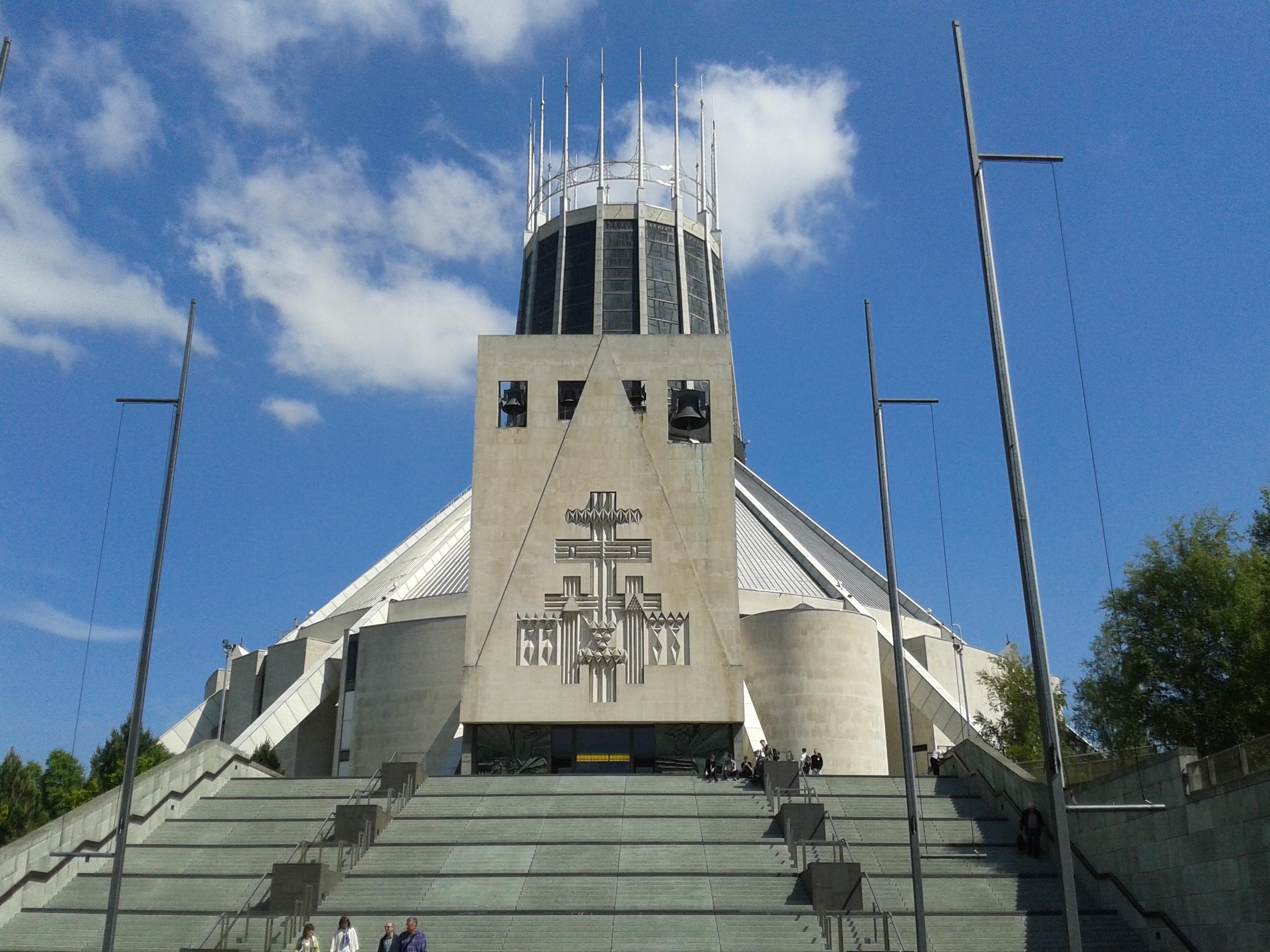
On a recent visit to Liverpool’s Metropolitan Cathedral I was struck by the beauty of the place – not quite for the first time – but on a profounder level than I had experienced before. It is a building of the 1960s in every way, with a lot of the problems that would be associated with such a building, especially one that was, in the end, built quickly and on a limited budget.
Cathedral exterior
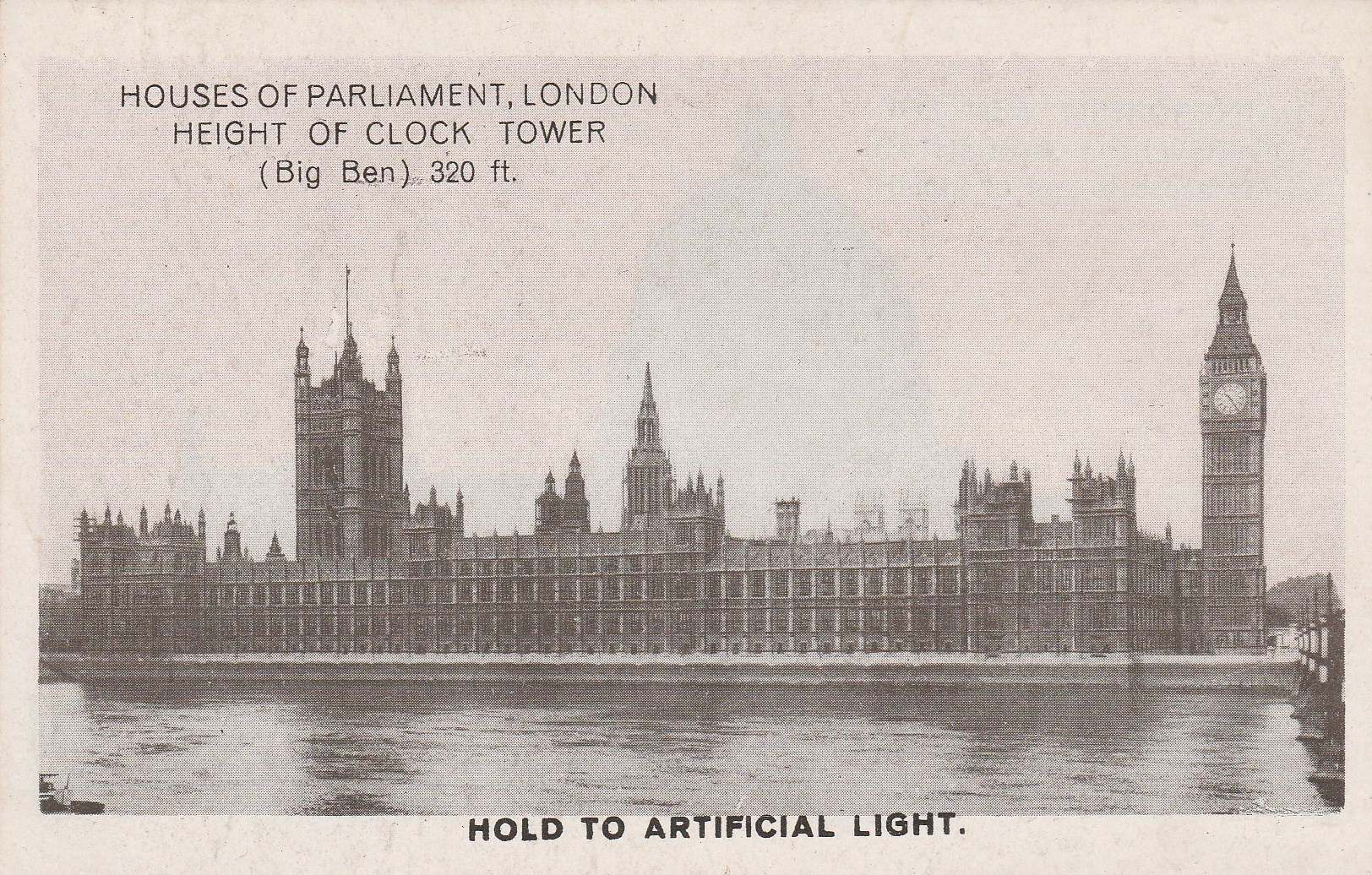
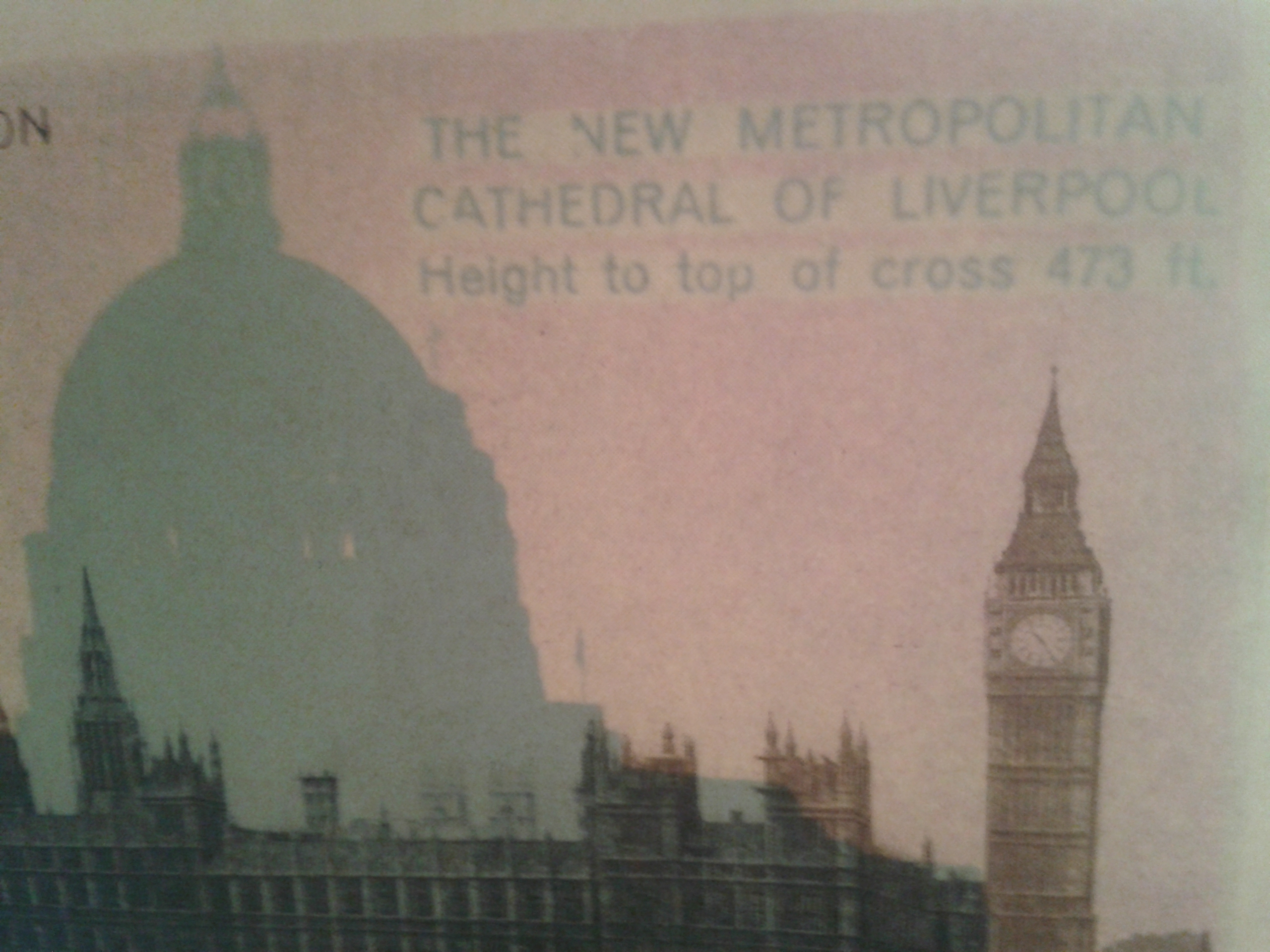
The original plan had been very extravagant indeed, a massive structure that would have dwarfed the large Anglican Cathedral nearby. Sir Edwin Lutyens was brought in to provide a plan for the second biggest cathedral in the world, the model for which can still be seen in the Museum of Liverpool. I have a promotional postcard from the 1930s that shows just how big they expected it to be:
Height of Big Ben 320 ft
Hold it up to electric light and all is revealed:
Height to top of cross 473 ft
But although the crypt was completed and remains part of the continuing cathedral the great romanesque building of Lutyens’ design could never be constructed after the war. Somewhere in the crypt there is a brick with my great grandmother’s name on, one of the thousands of faithful who made a contribution to build the northern cathedral in the 1920s and 1930s. But although I wasn’t an Anglican, in my youth it was the Church of England cathedral that played a bigger role in my life. We went there for school Founders’ Day, often a bit of a trial, especially when I was dragooned into the junior choir. I was also there for the Boys’ Brigade Liverpool battalion church parades. These I found much more enjoyable especially when I was a member of the colour party and got to process through the cathedral and sit in the choir stalls, learning along the way quite a bit about liturgy and the conduct of worship. But no visitor to the Anglican cathedral can fail to be impressed by its sheer grandeur, it is a breathtaking building.
So I didn’t go to the Metropolitan Cathedral often and when I did it was reminiscent to me of the ‘space race’, of something very modern and a bit utilitarian. The bare concrete walls didn’t help in this regard. Coming straight after Vatican II its central altar and circular design is another typically sixties design which is fine if you like that sort of thing but I have never felt that worship in the round was necessarily the best way for any group of faithful people to gather.
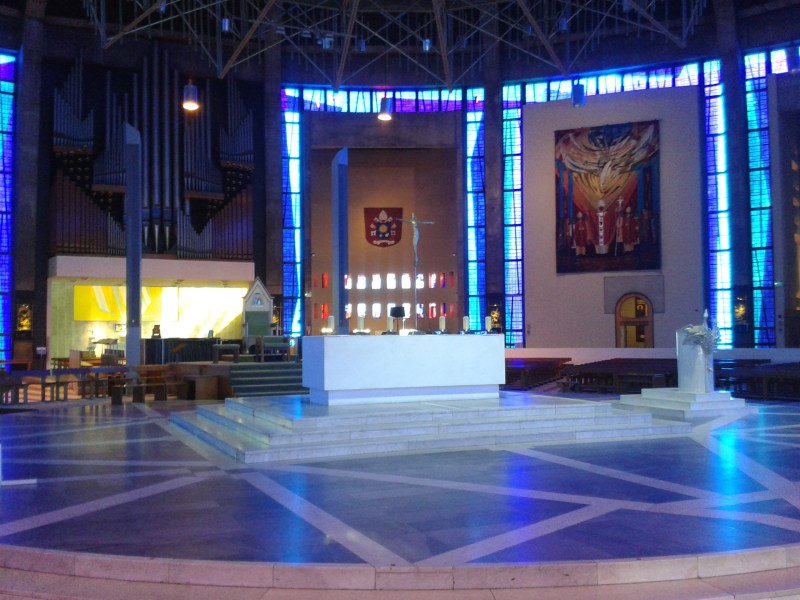
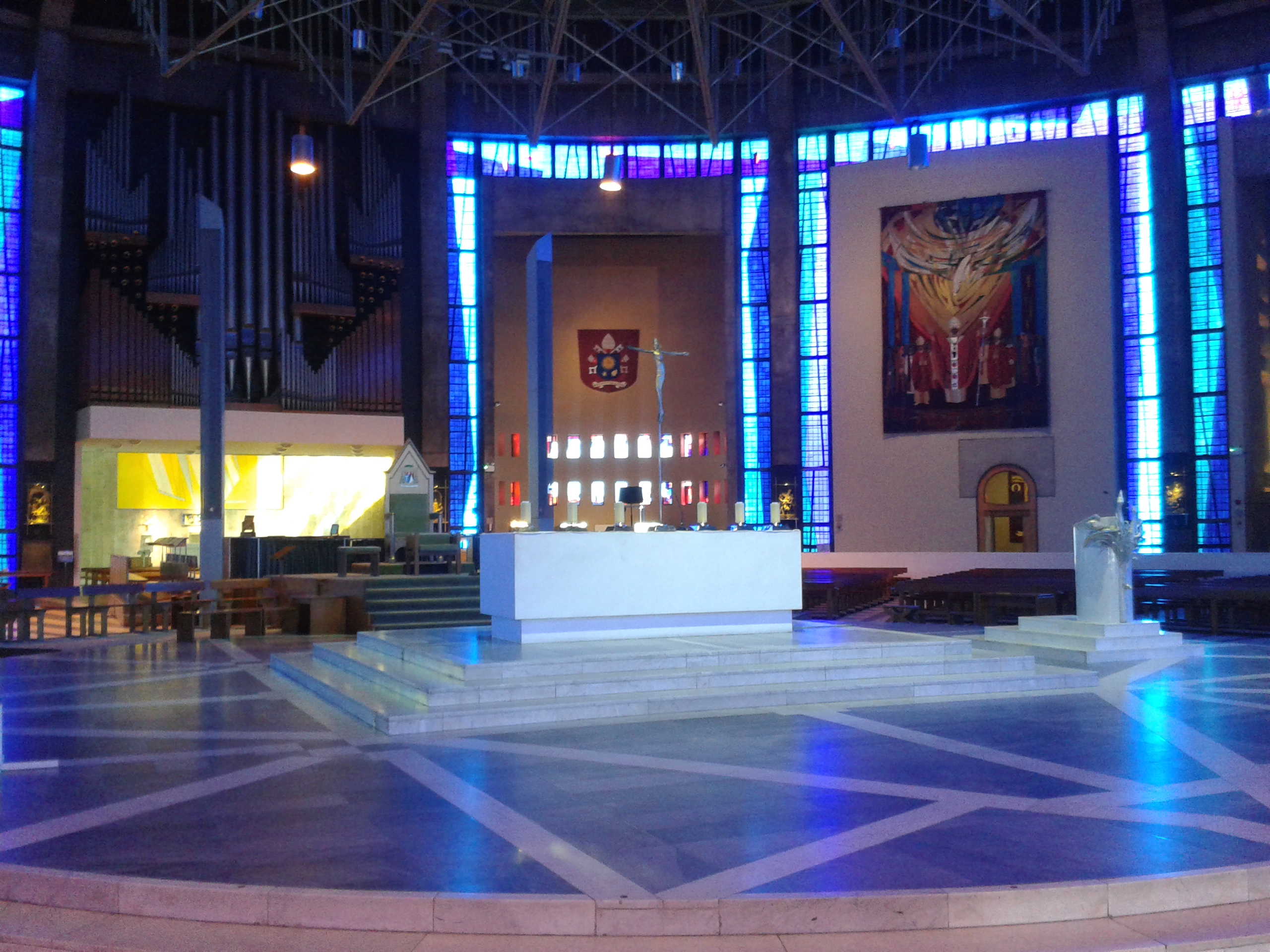
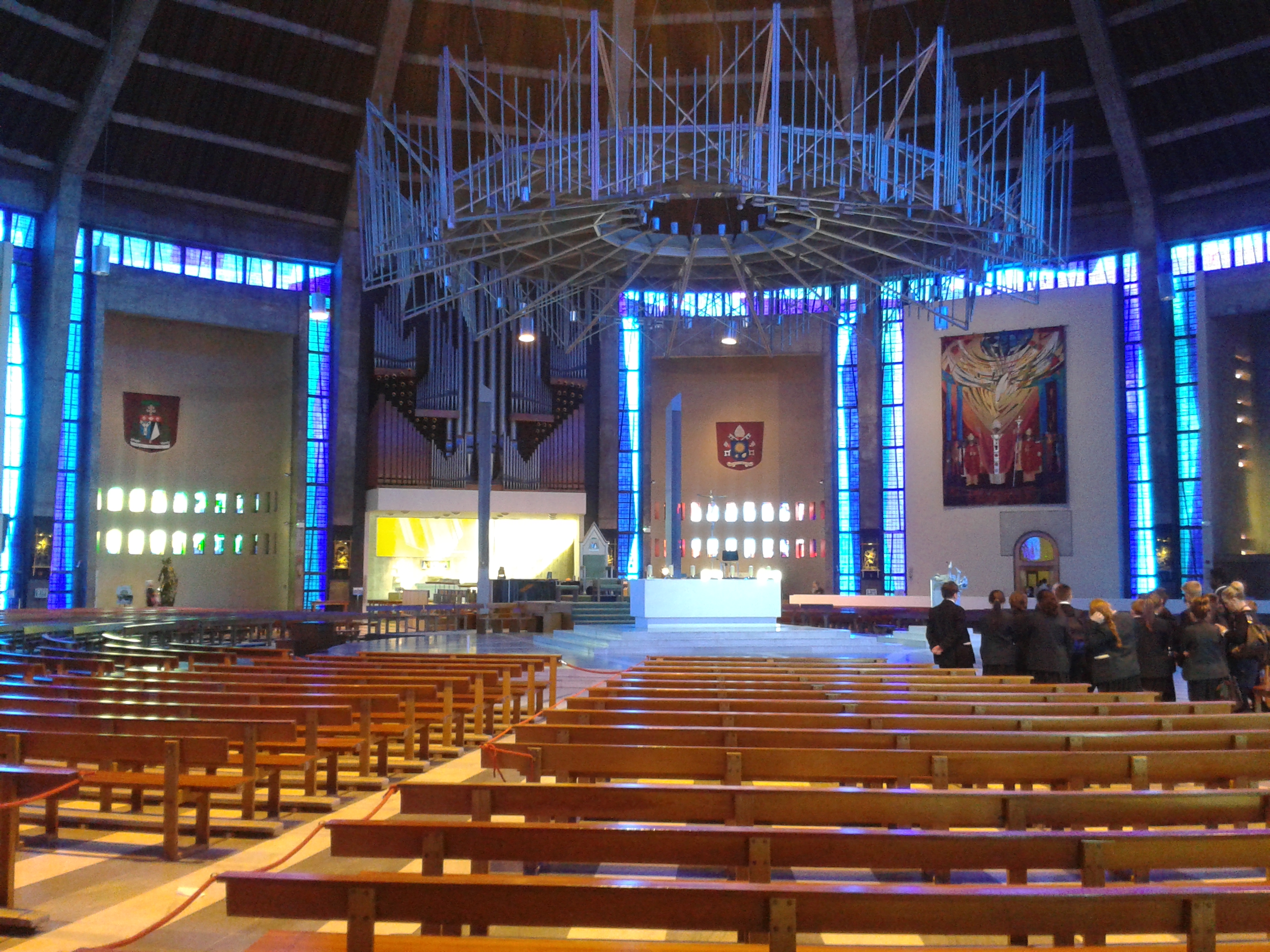
Cathedral interior, a peaceful reflective space
But if you go in the cathedral today, as I did recently, you are struck by a quiet, luminous beauty. The blue of the stained glass windows seems to fill the space with a peaceful, reflective sense. The bare walls are frequently covered by tapestries and different hangings which create interest and warmth and although, when I visited, there were a number of school parties being shown round, the atmosphere of peace and worship was never interrupted. This I think is testimony to the skill of the guides and the attentiveness of the school pupils. The circular space has one great advantage in that if you walk around you discover a truly meditative experience. Indeed I felt so enthralled that I walked round twice and would happily have continued in my perambulations if other matters had not called upon my attention.
The view toward the altar
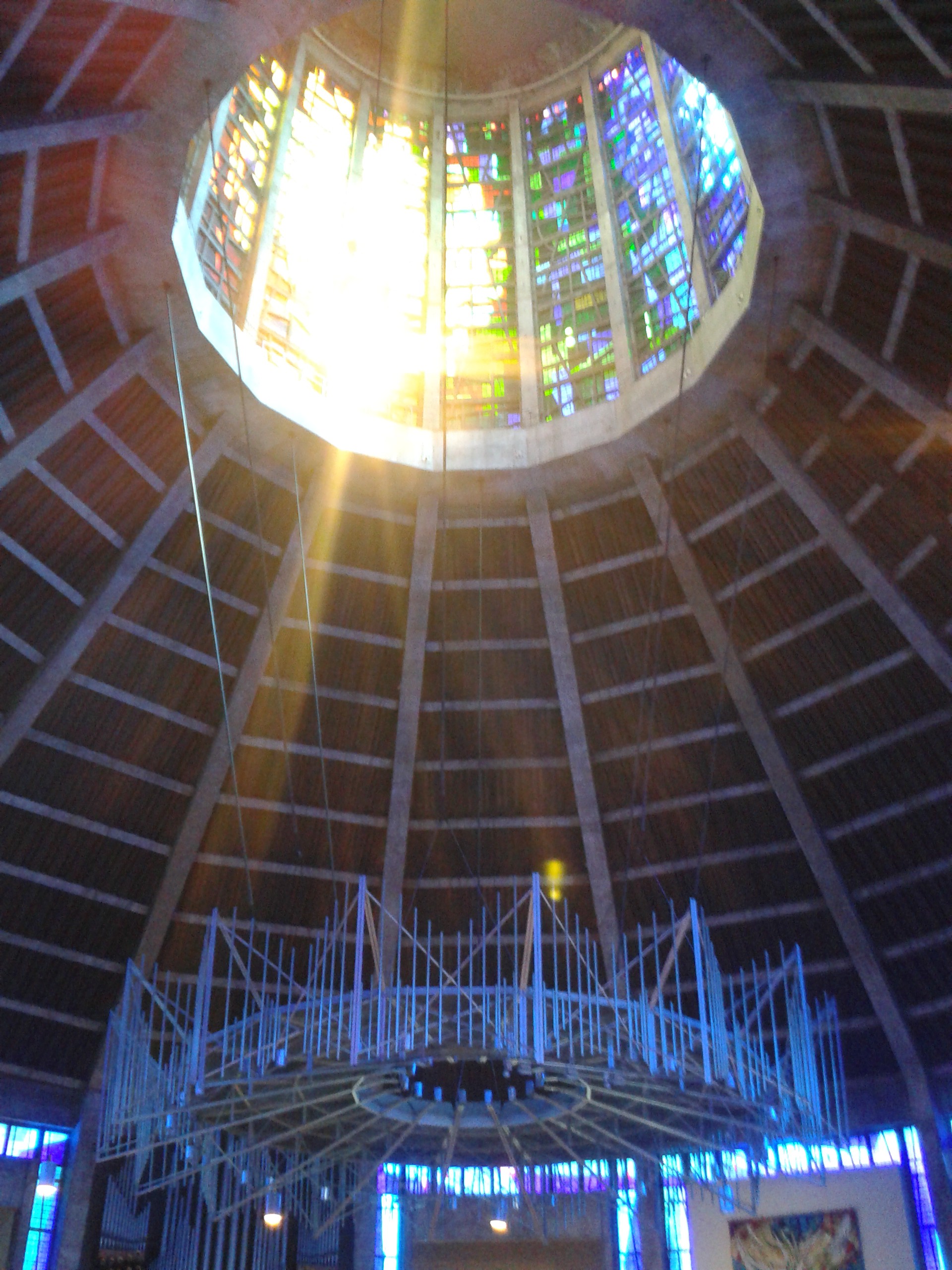
The light seemed to flood in from the lantern on this particular sunny day and infused the building with a sense of the numinous. It made me glad that I had gone in. There is a great deal of art to view. Again much of it very redolent of the 1960s but there’s nothing wrong with that. Not all of it can appeal to everyone but some of it struck me on that day as impressive, Robert Brumby’s terracotta statue of the Virgin and Child seems to fill the corner of the Lady Chapel very appropriately, for instance.
View of the lantern
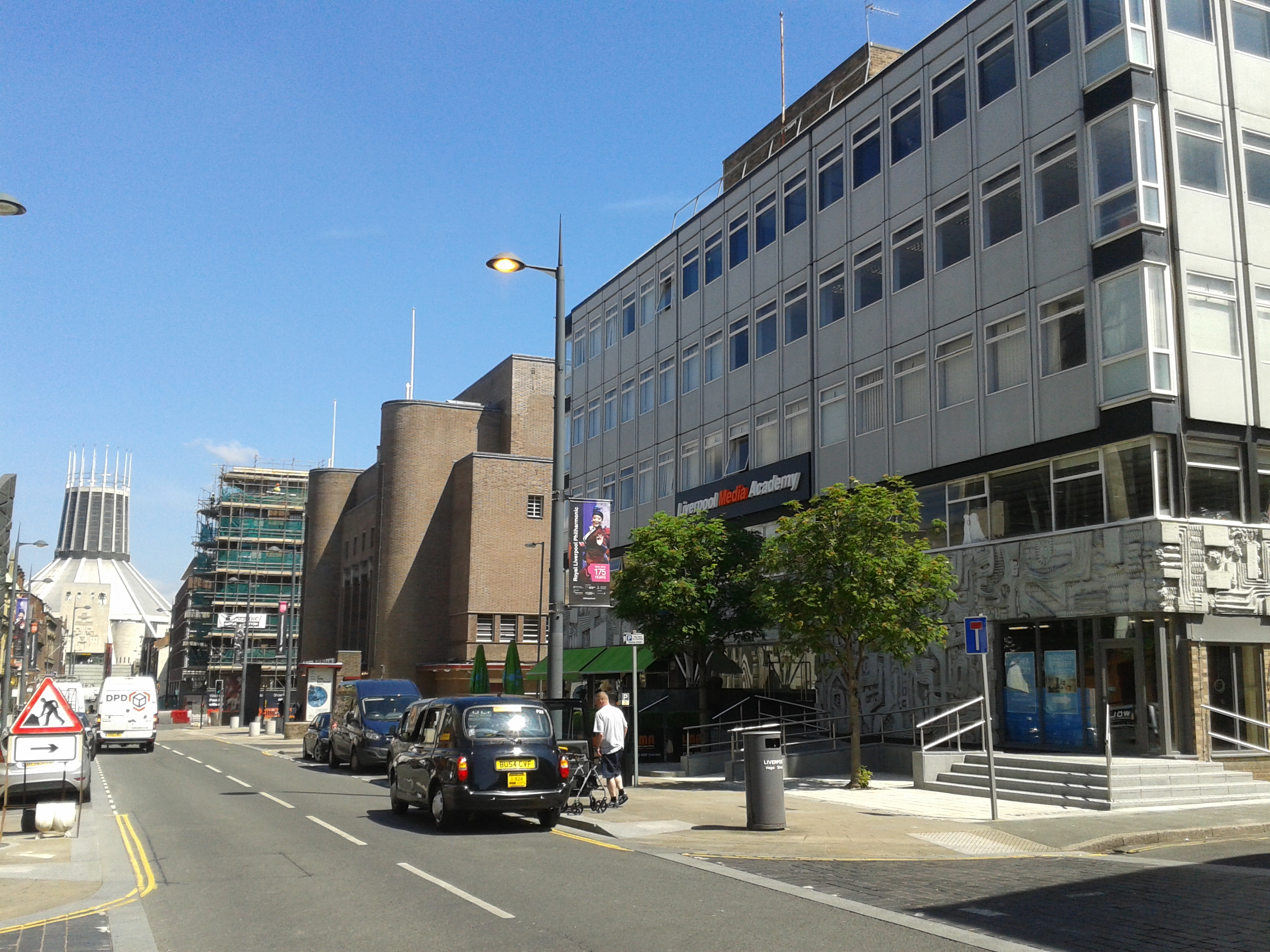
But leaving the cathedral on this sunny day I had to go and look again at the site of Hope Street Church. This building is now long gone, just one of a number of sometimes quite grand churches that once featured on these surrounding streets, it has to be said. You can read about Hope Street Church in a previous post. But the building on the right of the picture now called the Liverpool Media Academy, right next to the Philharmonic Hall, was once the site of James Martineau’s Church. The view from outside now looks along Hope Street to the modern cathedral opened in 1967.


















 velvethummingbee