Faith and Freedom Number 196 (2023)

The latest issue of Faith and Freedom (Spring and Summer 2023, Number 196) is now available and will be with subscribers. New subscribers are very welcome, details of how to subscribe can be found below.

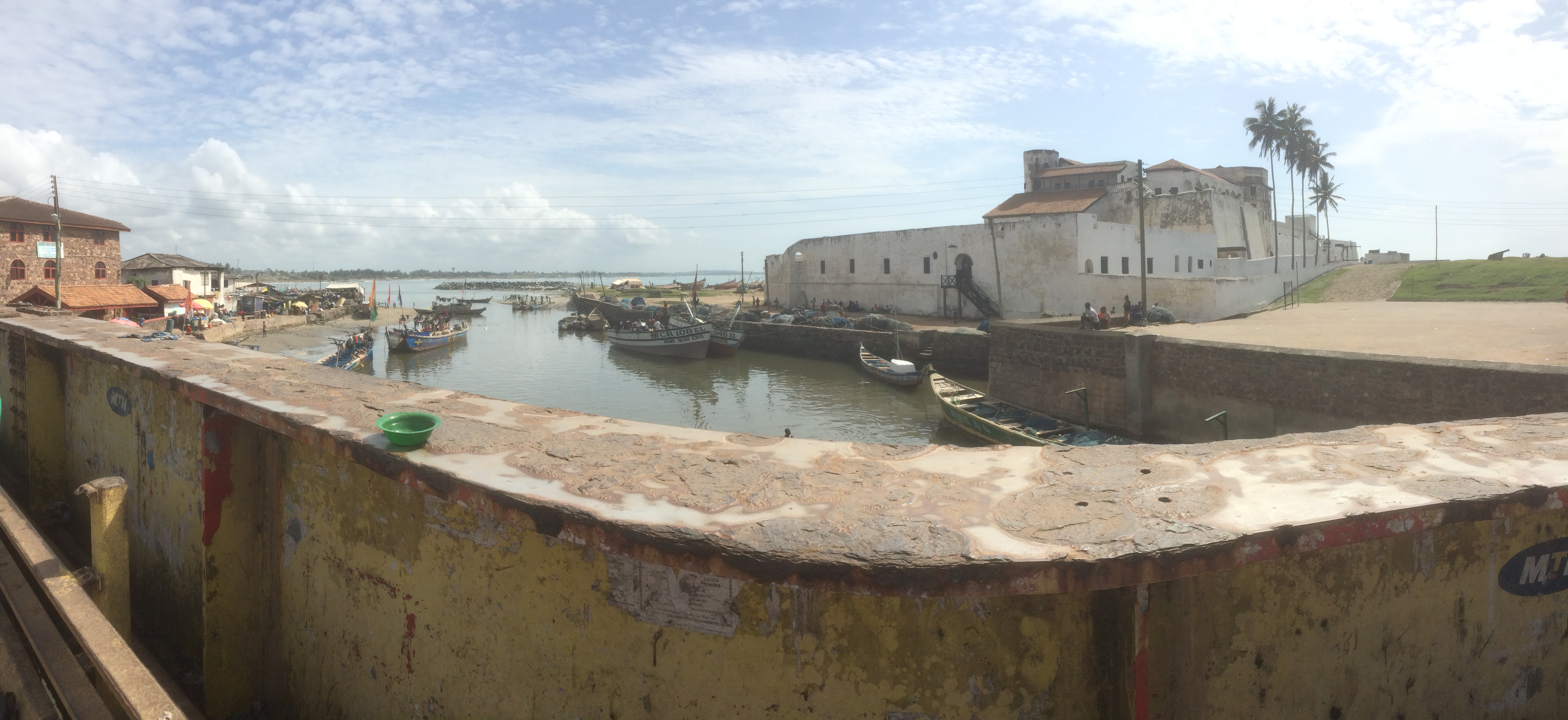
Elmina Castle, Ghana (Photo: Aidan McQuade)

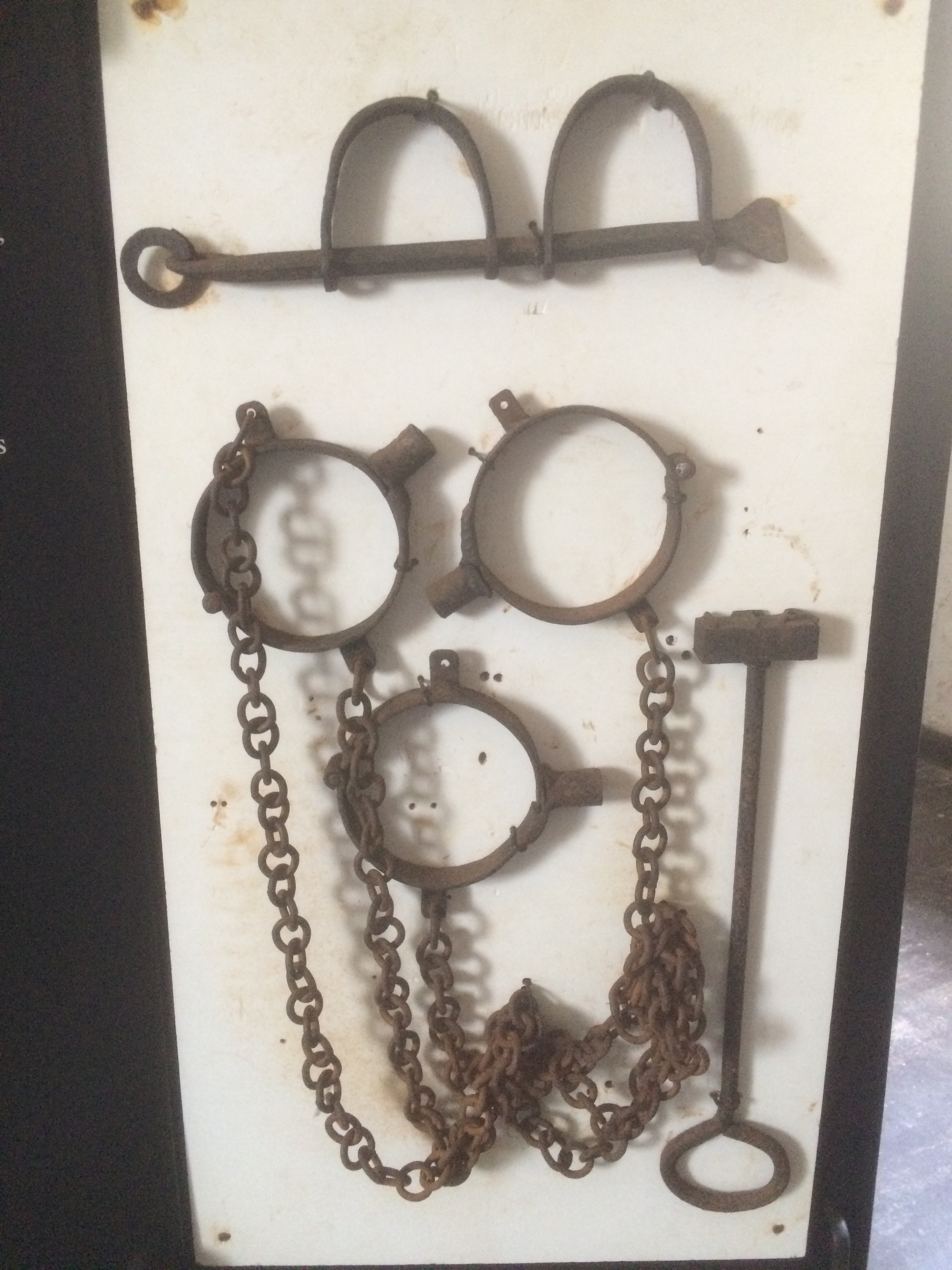
The cover picture features a collection of shackles used on slaves in Elmina Castle, Ghana, a photograph taken by Aidan McQuade who contributes our first article – Ireland – slavery and anti-slavery.

Cover picture – Photo Aidan McQuade

Aidan McQuade is a former director of Anti-Slavery International and has worked extensively in development and humanitarian operations, including leading Oxfam GB’s emergency responses to the civil war in Angola from 1996 to 2001. He writes of the horrors of the slave trade looking through the lens of Irish involvement and noting also those individuals who contributed to anti-slavery activism in the eighteenth century.

He writes:

“Over hundreds of years slavery devastated the African interior as wars and raids, encouraged by the European powers, kidnapped millions of people, many of them children, to feed the demand from the Americas for human beings who could and would be worked to death to produce cash crops, mostly for European markets.

As with today, it is easy to ignore the exploitation that occurs within the political economy – the systems that govern business, trade and employment – when the are concealed far away from us.

So, when it was first brought to public attention by Thomas Clarkson, the image of the Brookes ship shocked the world. It presented in stark detail a visceral reality of the slave trade: how slaves would be packed like sardines into the holds of the slave ships. Clarkson’s friend and comrade in the anti-slavery struggle Olaudah Equiano had direct personal experience of being treated as this sort of cargo and he described it in his auto-biography”:
 …we were all put under deck …The stench of the hold while we were on the coast was so intolerably loathsome, … but now that the whole ship’s cargo were confined together, it became absolutely pestilential. The closeness of the place, and the heat of the climate, … almost suffocated us. … many died, …. This wretched situation was again aggravated by the galling of the chains, now become insupportable; and the filth of the [latrine buckets], into which the children often fell, and were almost suffocated. The shrieks of the women, and the groans of the dying, rendered the whole a scene of horror almost inconceivable… Every circumstance I met with served only to render my state more painful, and heighten my apprehensions, and my opinion of the cruelty of the whites.

The door of no return, through which slaves would leave Elmina Castle for the slave ships. (Photo: Aidan McQuade)

John Maxwell Kerr, is a founder member of the Society of Ordained Scientists. His paper, originally given at Harris Manchester College, examines The Search for Meaning in Nature. It is a wide-ranging and deep study using the author’s knowledge of science and religion, incorporating all the riches of literature and poetry, and reaching a surprising conclusion.

Rev John Maxwell Kerr

Barrie Needham’s article on ‘De-churching’ or To the church no more looks at patterns of belief and church attendance in the twenty-first century. What can churches do to overcome these tendencies, what do they need to offer?

Rev Frank Walker

We have an inspiring sermon by Frank Walker, Outlooks on life that still challenge and encourage us, and Graham Murphy provides a review article and essay on Matthew Teller’s valuable book Nine Quarters of Jerusalem, A new Biography of the Old City, which gives such insight to this troubled city, Graham writes:

“In his book about the Old City he describes a place we can visualise, though we may never have been there. We see in our minds eye a golden Dome set within castellated walls as if true to the plans in history books and illustrated bibles. How we imagine Jerusalem is freighted with biblical notions which Teller’s book tends to undermine with doses of reality. He draws our attention to lesser-known aspects of the city’s past and finds himself fascinated by the religious rituals. He interviews the people who live and work beside the pilgrim routes and sacred sites. He shows us how they regard their city, how they cope with its recurrent crises and the lack of rights for the majority who live there.”

And as ever we are blessed by some wonderful reviews. In this issue we feature:

Facing up to Climate Change

Mike Berners-Lee, There Is No Planet B – A Handbook for the Make or Break Years. Cambridge University Press, 2021 (updated edition) pp 316. ISBN 9781108821575, £9.99 pbk. Gaia Vince, Nomad Century – How to Survive the Climate Upheaval. Allen Lane, 2022, pp 260. ISBN 9780241522318, £20.00 hbk. Greta Thunberg, The Climate Book. Allen Lane, 2022, pp 446. ISBN 9780241547472, £25.00 hbk. Reviewed by Professor David A. Williams

A ‘warts and all’ attention to church history

John W. Nelson, A Short History of the Non-Subscribing Church of Ireland including sketches of individual congregations and a Fasti of ministers who served in them, published by The Rev Dr J.W. Nelson, 2022, pp 420, ISBN 9781739978501, £15 hbk. Reviewed by Philip Blair

Praying to an ‘unknowable God’

Bert Hoedemaker, Never-Ending Prayer – A Case for the Christian Tradition. The Lutterworth Press, 2022, pp 136. ISBN: 978 07188 96027, pbk £20. Reviewed by Jim Corrigall

Rev Jim Corrigall

and

Eavesdropping on fascinating conversations

Philip Allott, The Music of Time: Twenty-Four Fables for Today, Matador, 2022, pp 408. ISBN 9781803132228, £7.99 pbk. Reviewed by Frank Walker

Subscription Details

An annual subscription for each volume (two issues) costs £16.00 (postage included) in the United Kingdom. Single copies can be ordered at a cost of £8.00 each (postage included). Cheques should be made out to Faith and Freedom and sent to the business manager:

Nigel Clarke,
Business Manager, Faith and Freedom,
16 Fairfields,
Kirton in Lindsey,
Gainsborough,
Lincolnshire.
DN21 4GA.

It is also possible to pay online. For more details see our website: https://www.faithandfreedom.org.uk/subs.htm

Rev Dr Peter Godfrey, Editor Emeritus

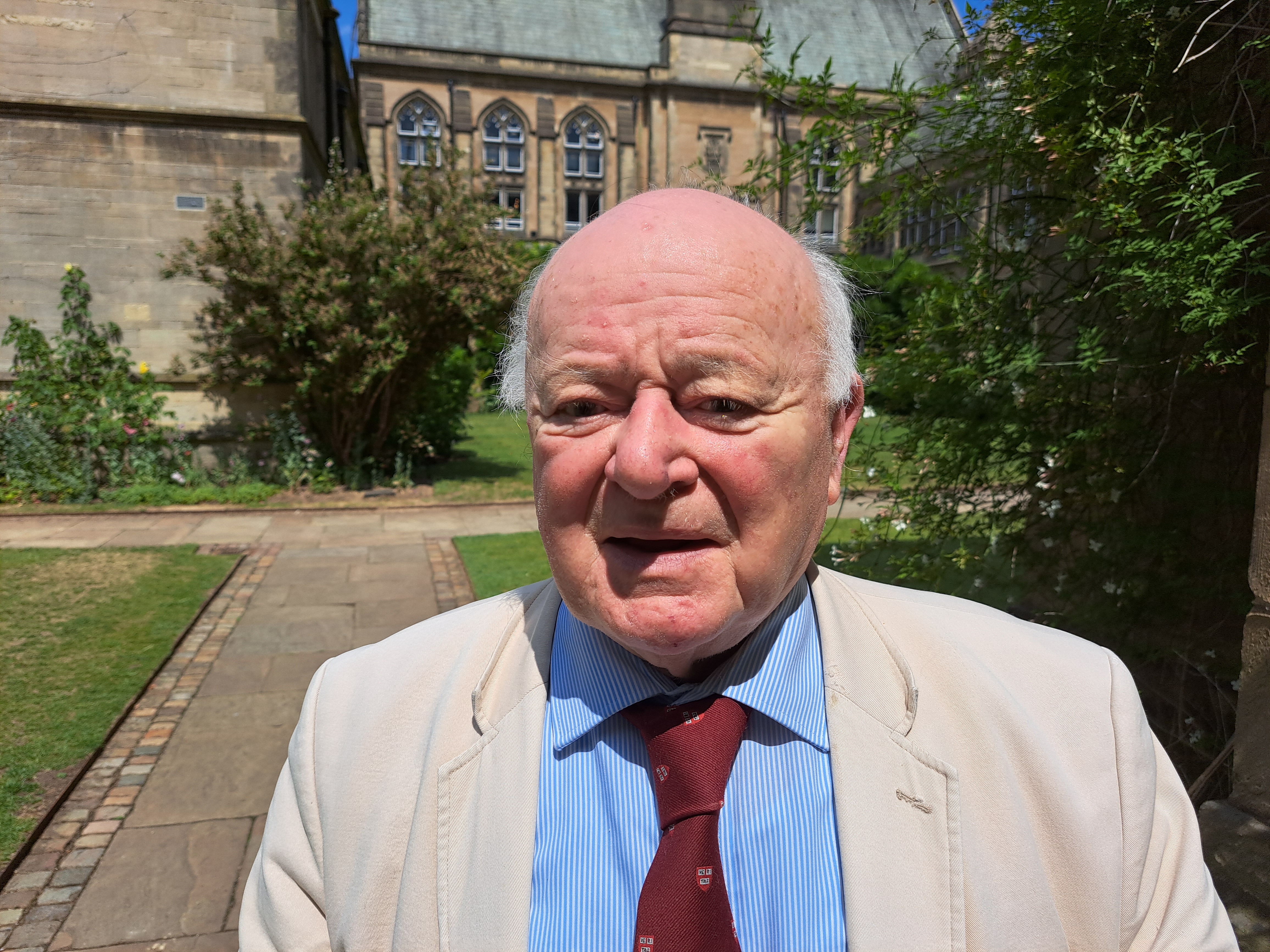
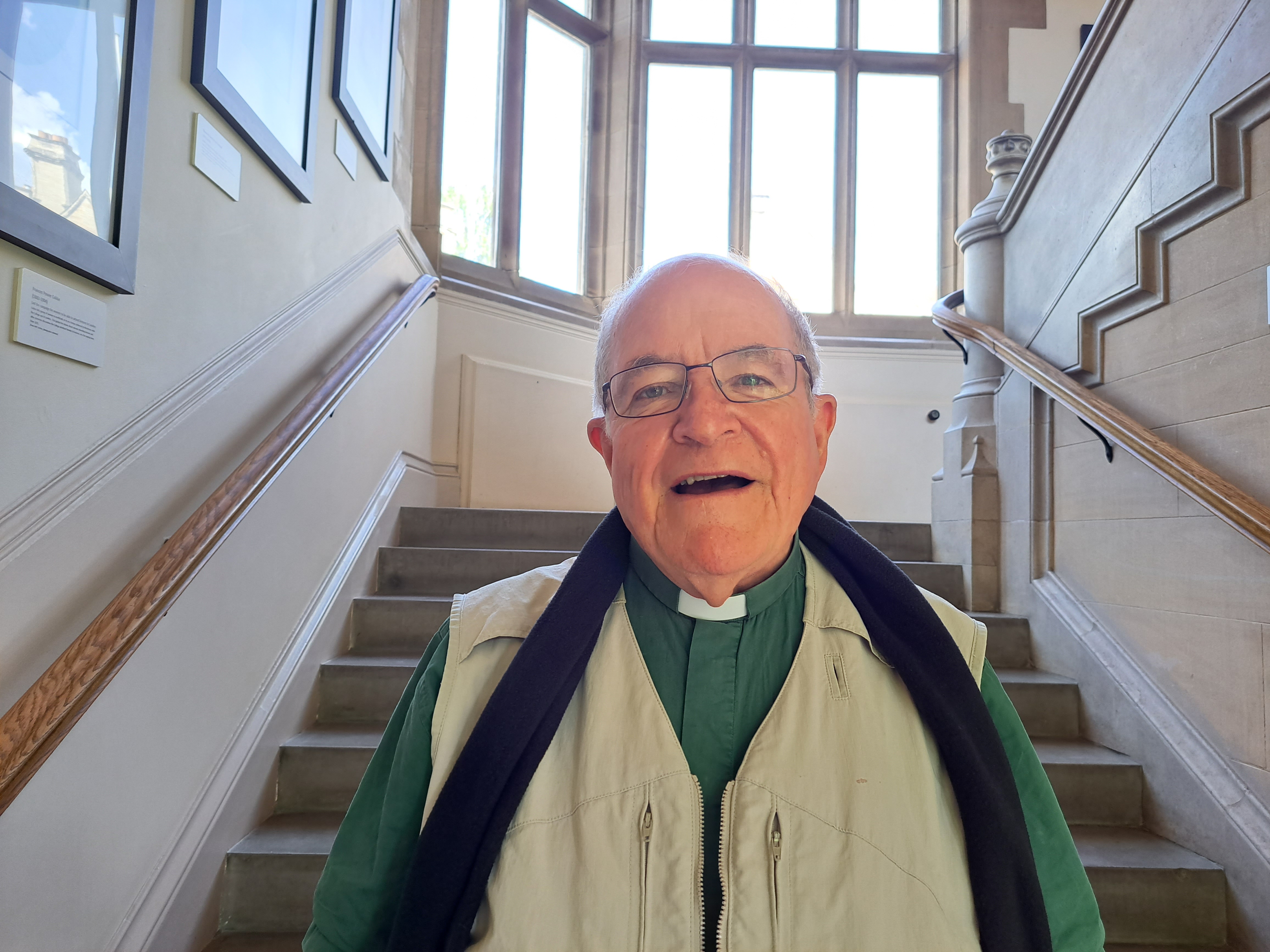
It was good to be at the Old Students Association meeting at Harris Manchester College, where some of the images of contributors seen above were taken. And good to see Rev Dr Peter Godfrey, Editor Emeritus of Faith and Freedom.

Clifton House and Clifton Street Cemetery

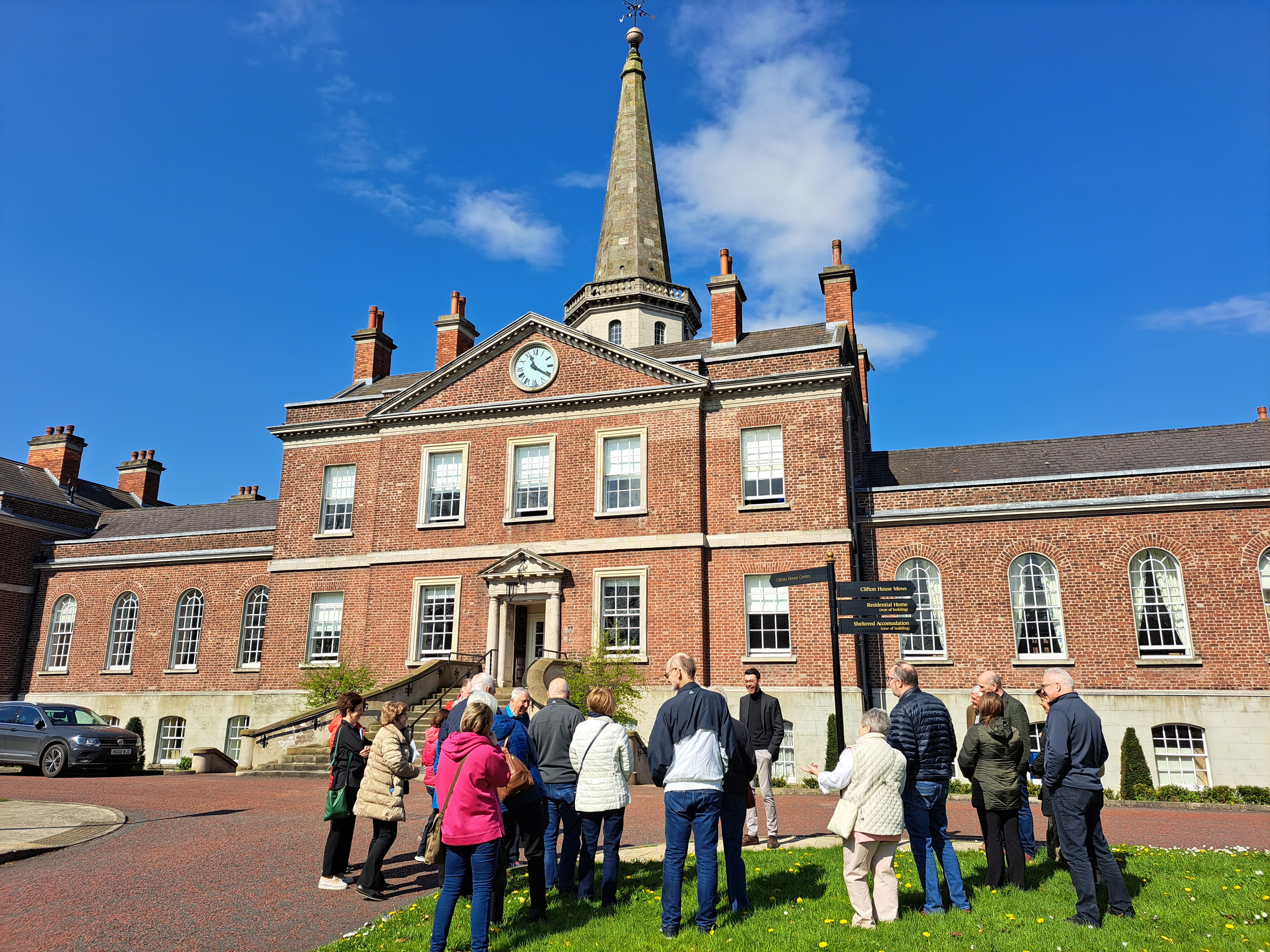
Assembling outside Clifton House at the start of the tour

On Friday, 21st April we had a wonderful congregational visit to Clifton House. Reputedly one of the oldest buildings in Belfast, having been built in 1774, it is actually only five years older than our own church in Dunmurry. But it is a very impressive building featuring its unusual spire which must have towered over Belfast when it was first built and certainly angered the Earl of Donegall who gave the land not expecting a building that would dominate the skyline and overshadow St Anne’s parish church.

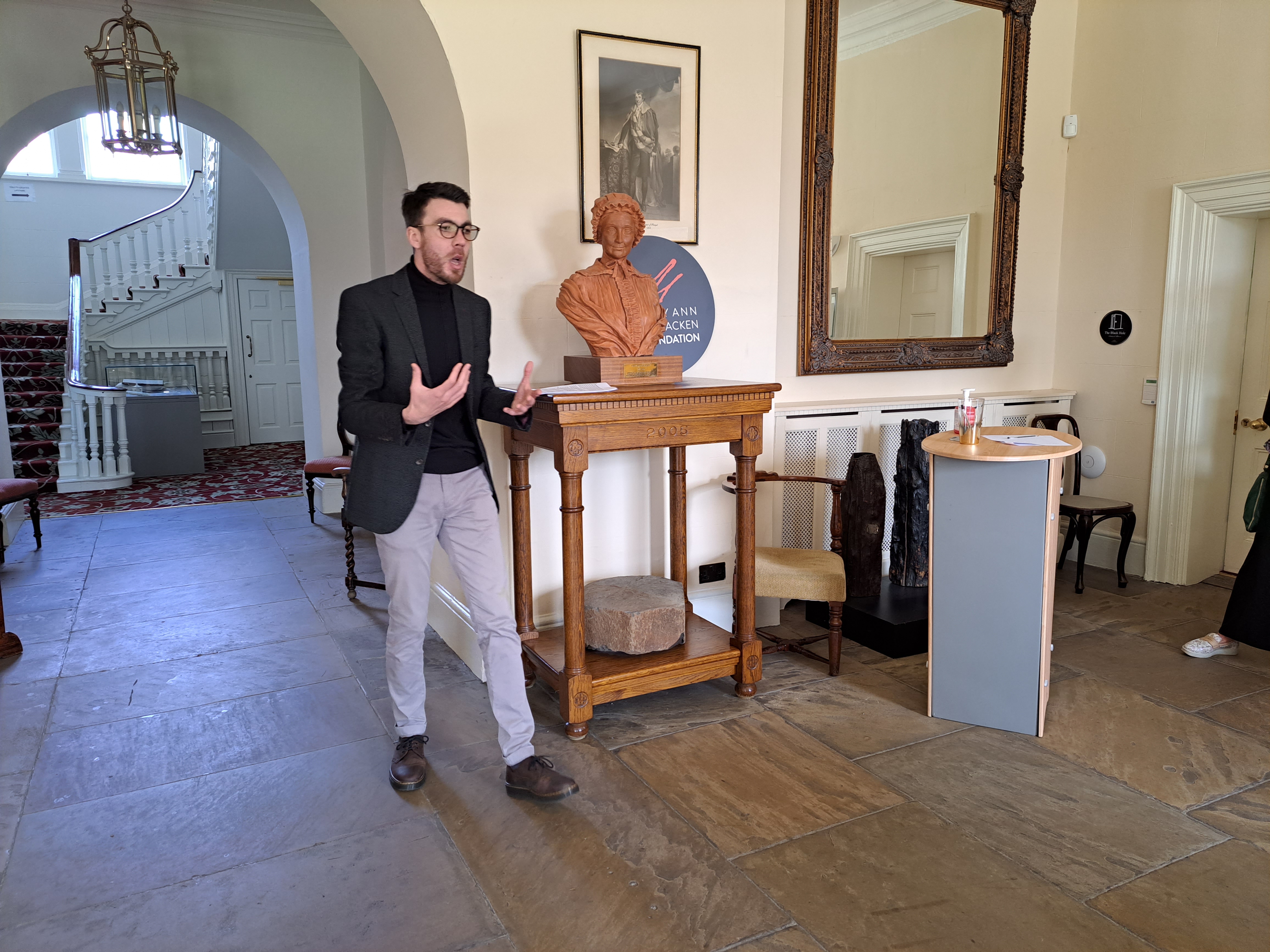
Jason Burke, one of our guides, in front of a bust of Mary Ann McCracken

Right from the start it was a much more enlightened institution than its usual name of ‘Poor House’ would indicate. Even the ‘punishment room’ was equipped with a bed, something ordinary inmates of institutions such as the workhouse might not expect in the nineteenth century. Curiously the mostly Presbyterian founders had no hesitation in employing a lottery to set up Clifton House but through that scheme were able to build a Poor House and an infirmary.

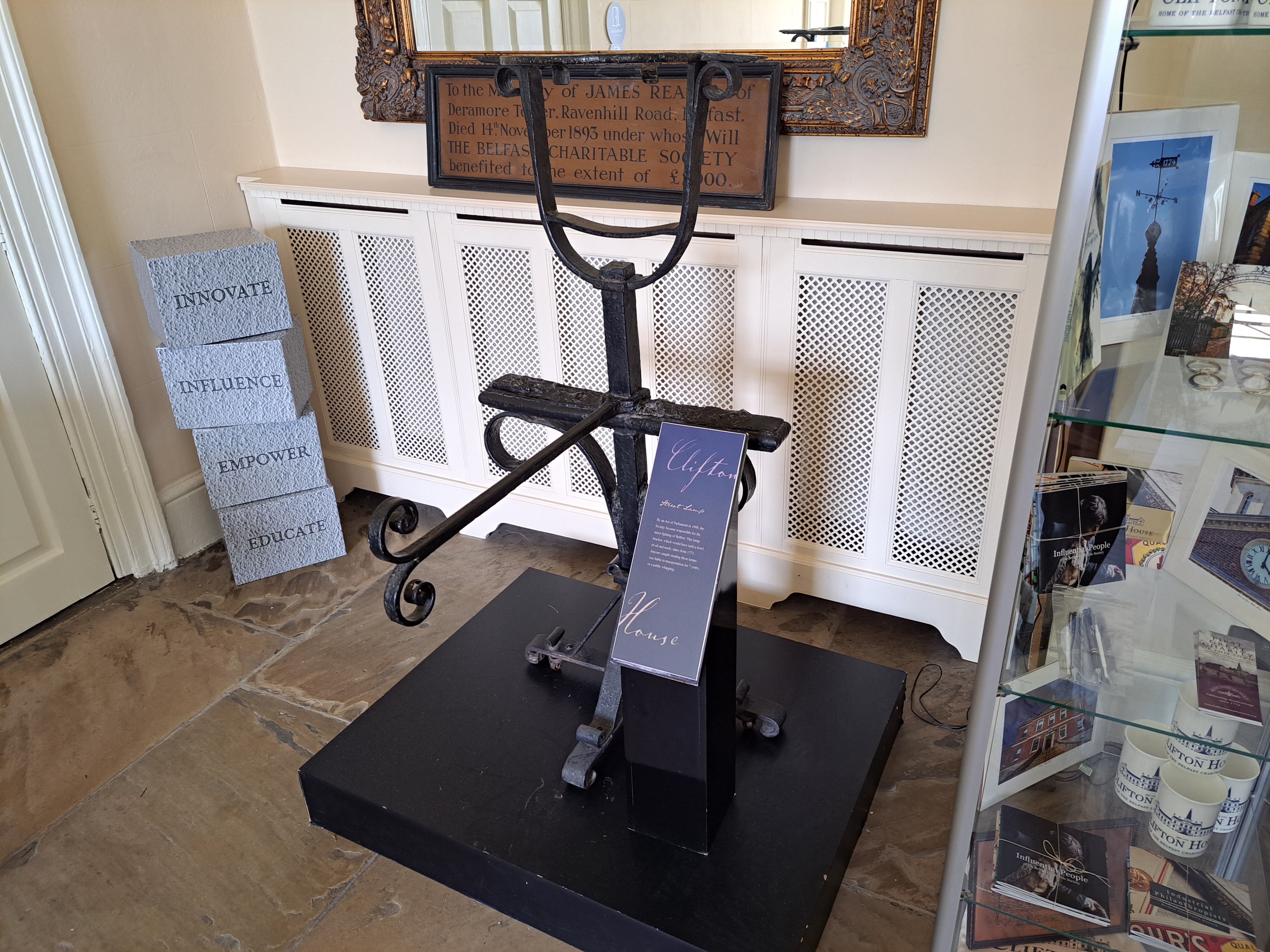
I hadn’t realised either that the Belfast Charitable Society (to give it its full name) was set up by Act of Parliament and also had responsibility for the provision of water in Belfast as well as street lighting.

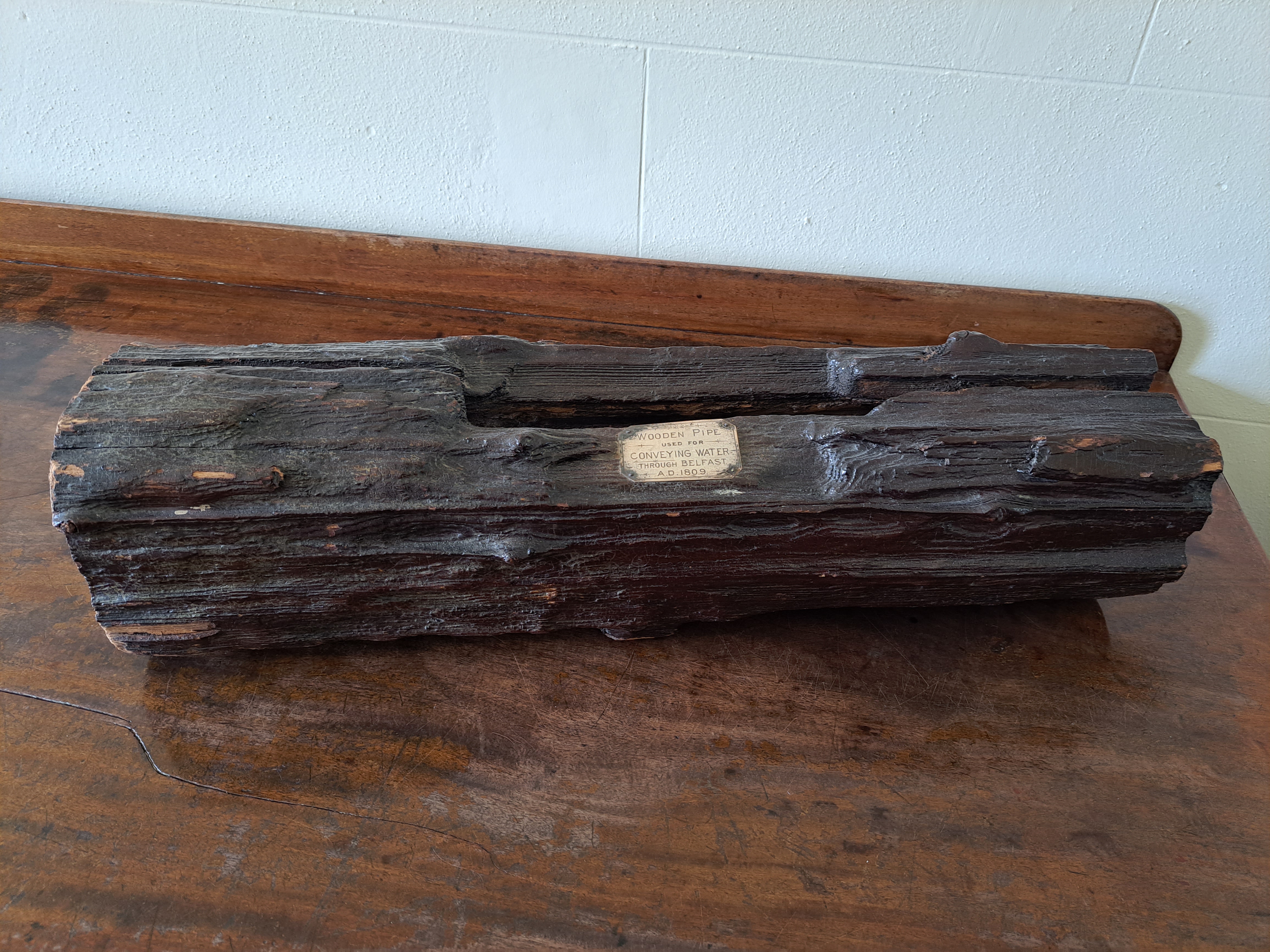
Water pipe made from elm dating from 1809
Early lamp bracket in use in Belfast in the 1770s

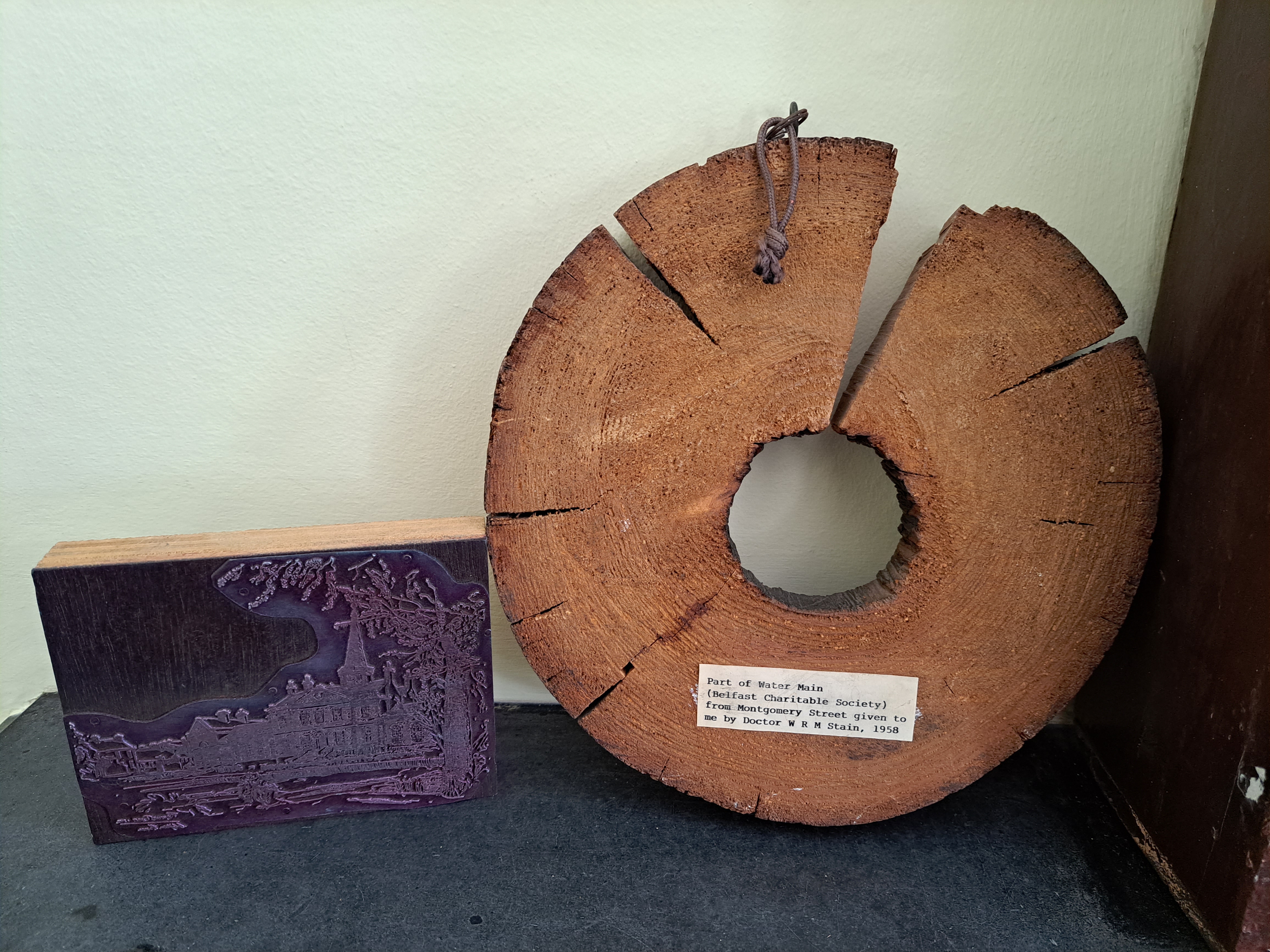
Examples of the English Elm which were used as water pipes were on show and such was the importance of this function the Water Commissioners had to make an annual payment of £800 in perpetuity to the Belfast Charitable Society. This still continues to this day with NI Water having taken the place of the Water Commissioners and still being obliged to pay £800 per annum to the Charitable Society.

Cross-section of water pipe

The Society played its part in the development of cotton spinning and weaving in Belfast when machinery was established in the basement of the building for children to work on.

It is an impressive and dignified building, beautifully restored in recent decades and still fulfilling its original function of caring for those in need.

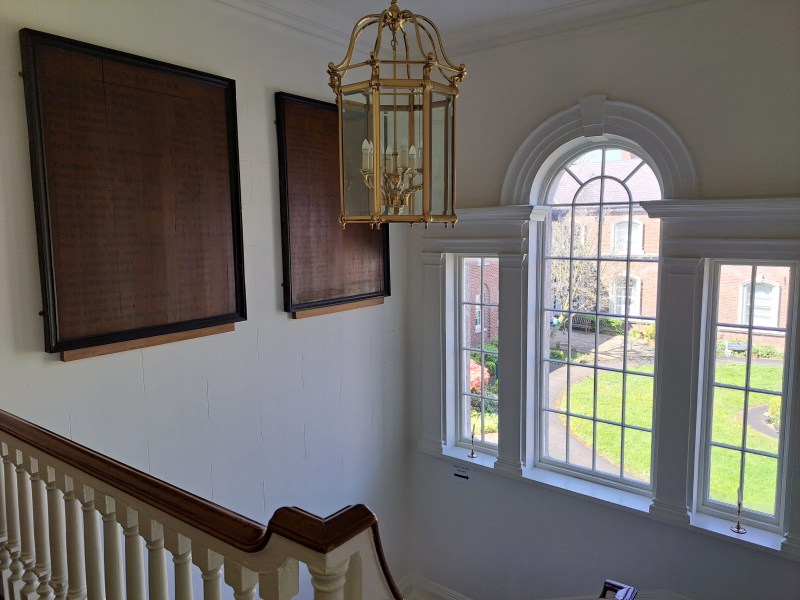
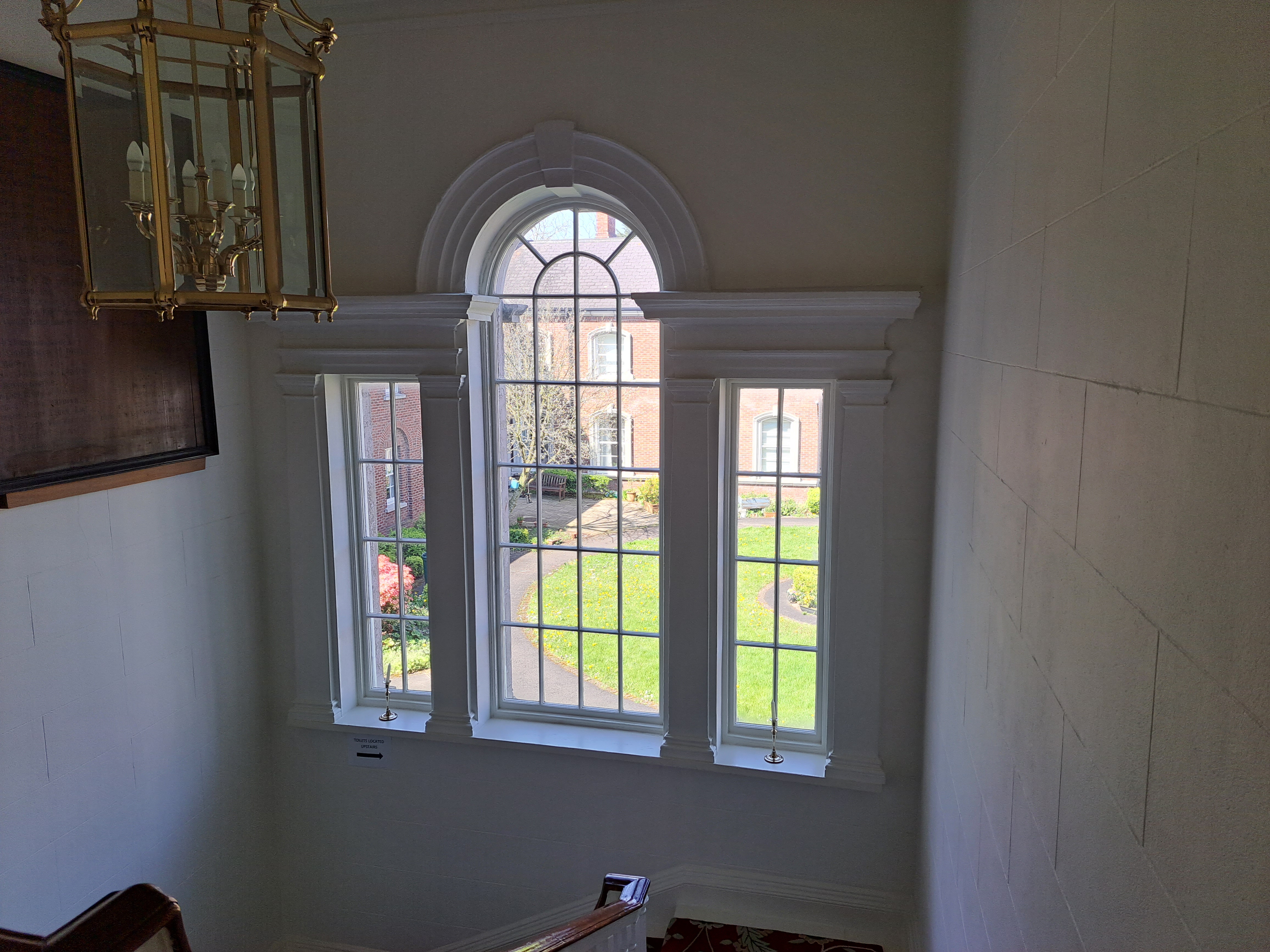
View from the staircase

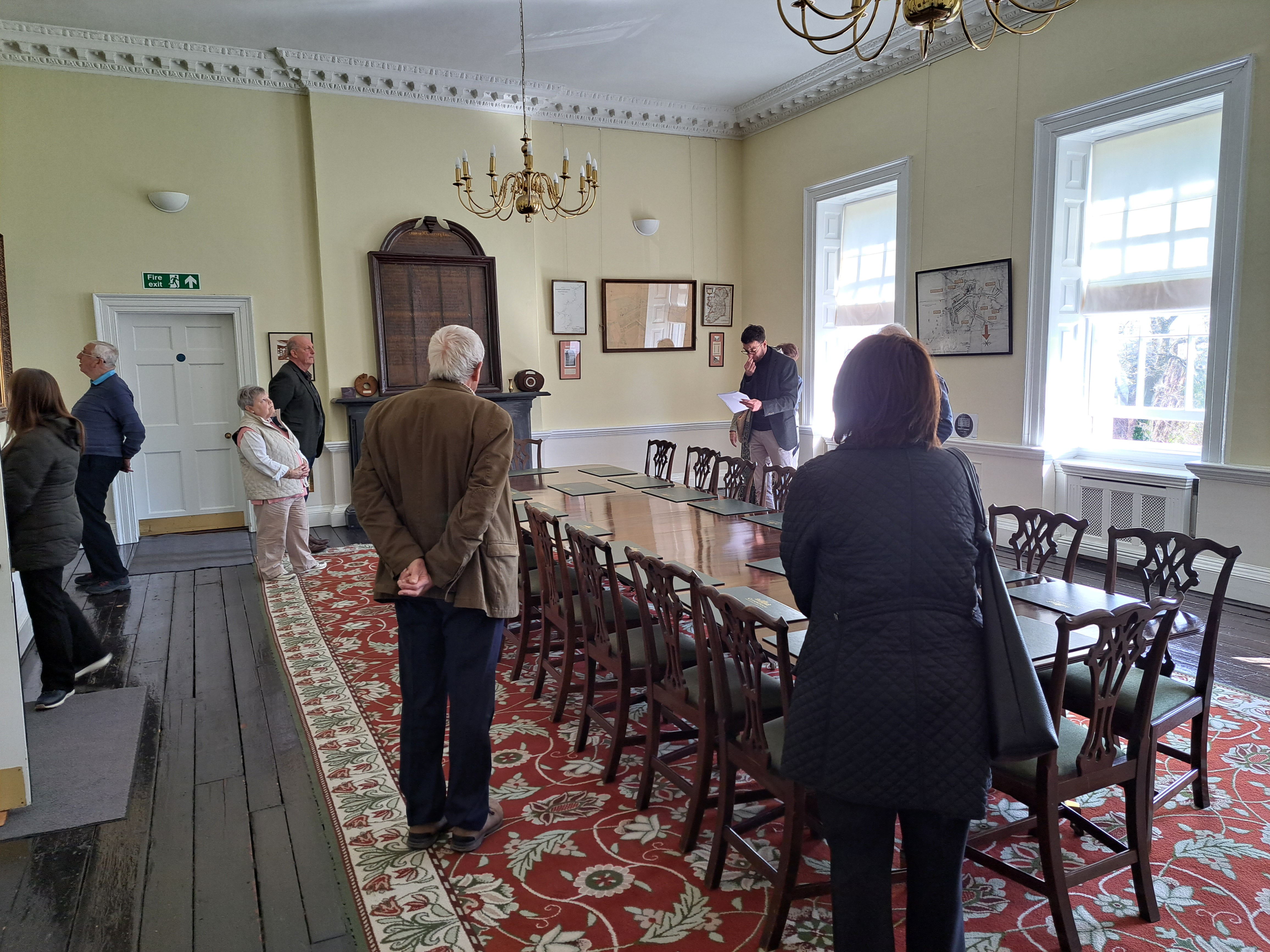
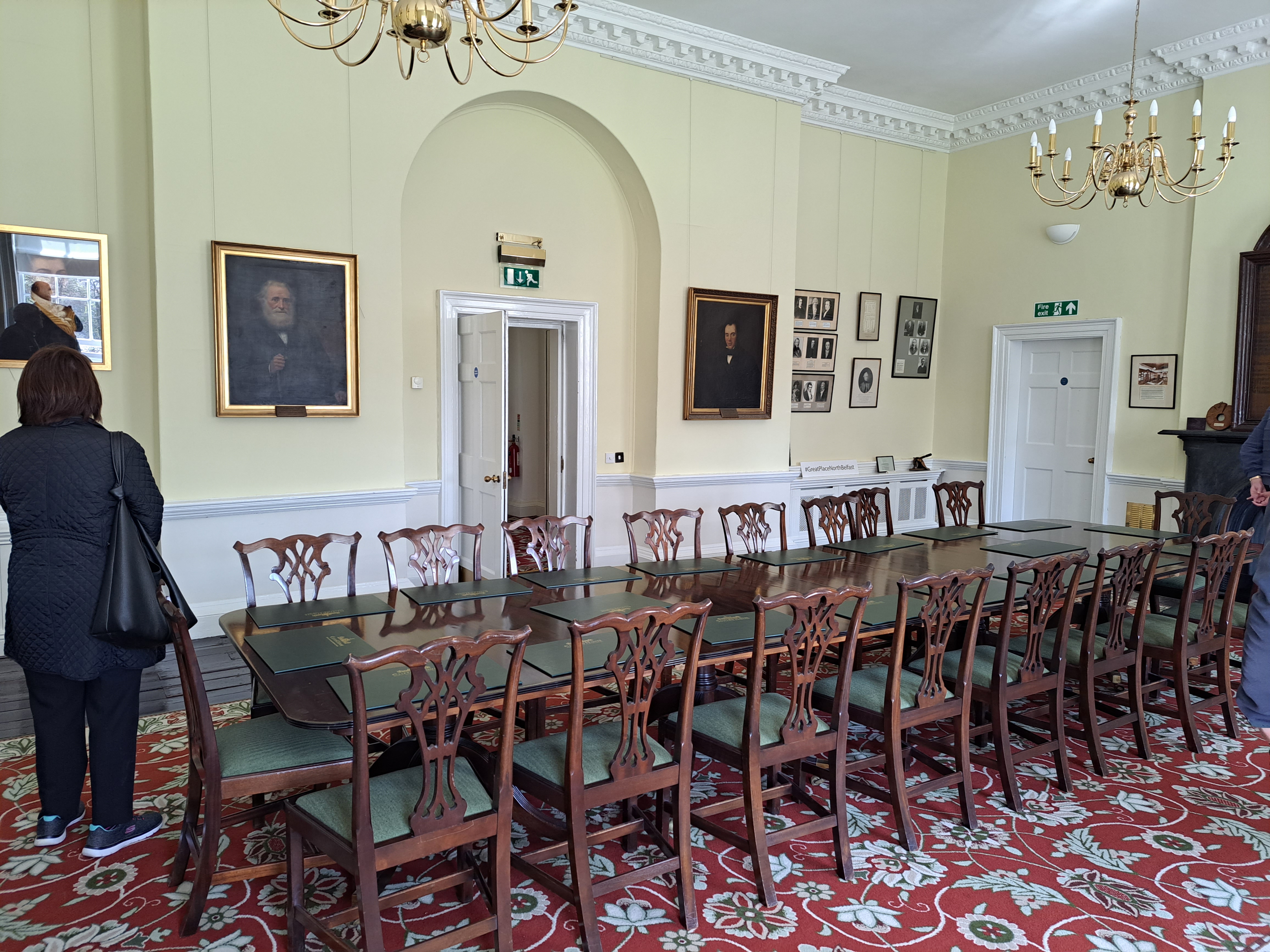
At the heart of the building is the boardroom, a room which also has a key place in so many aspects of the history of Belfast:

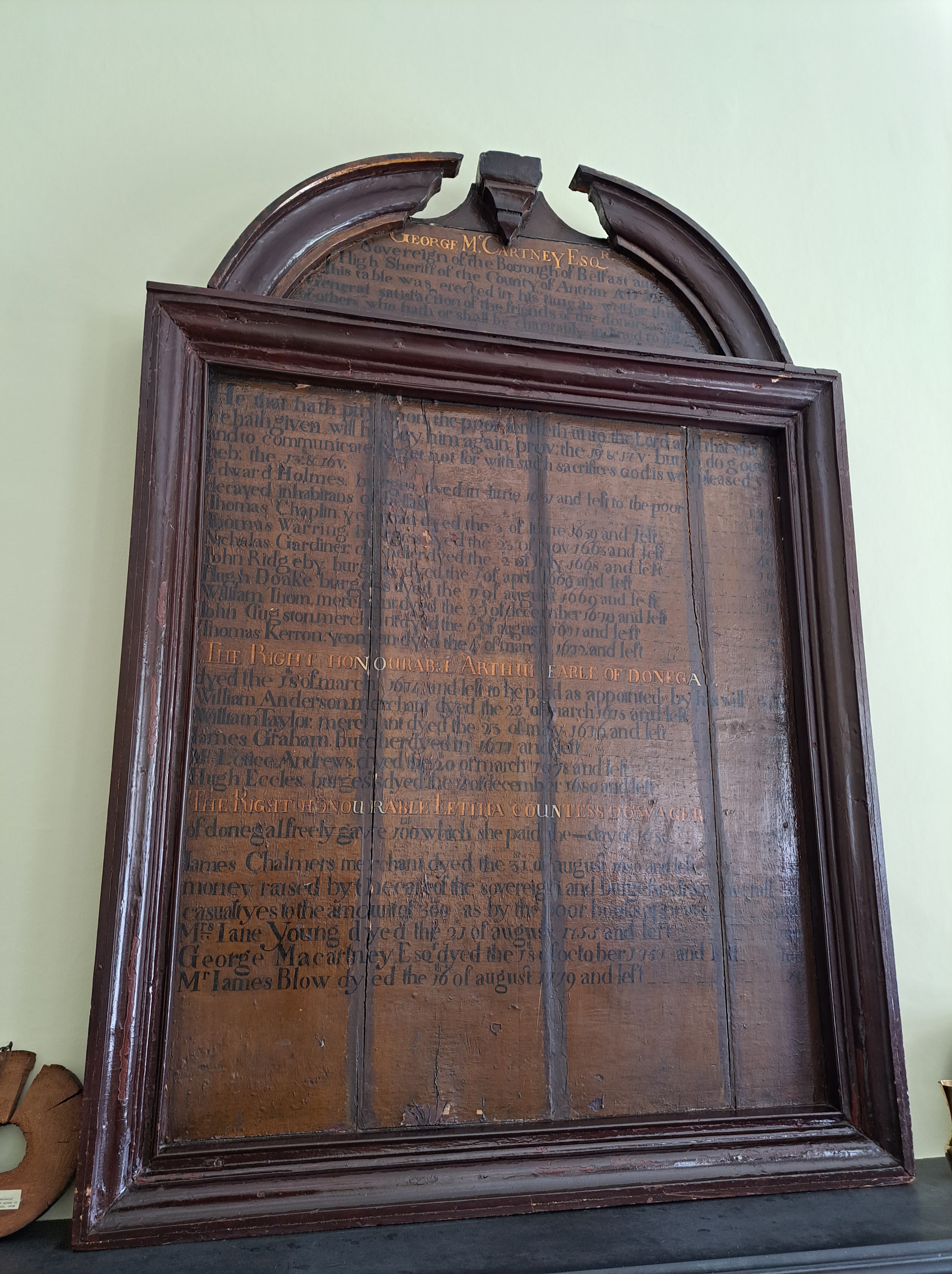
Charity board in the Boardroom

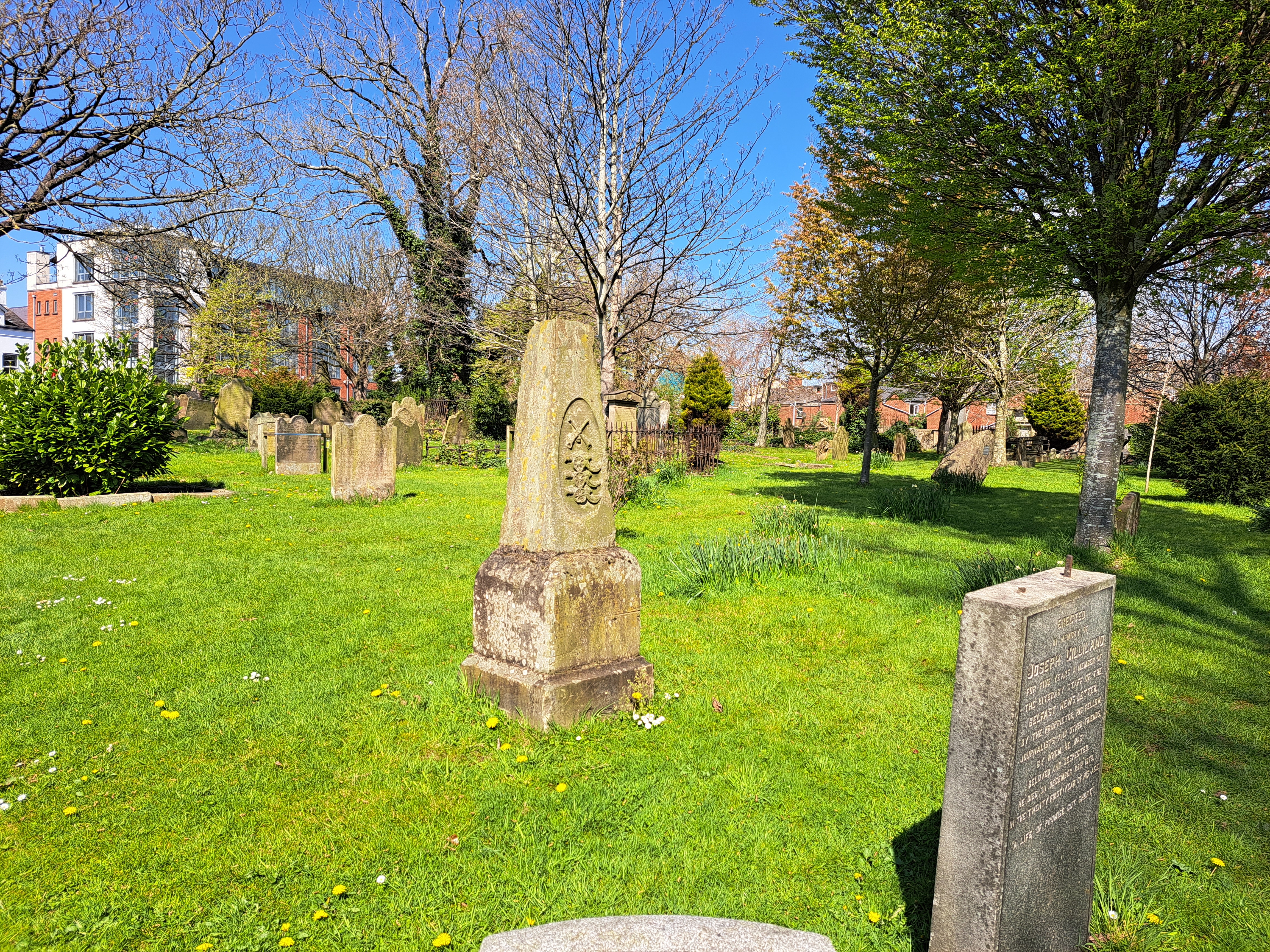
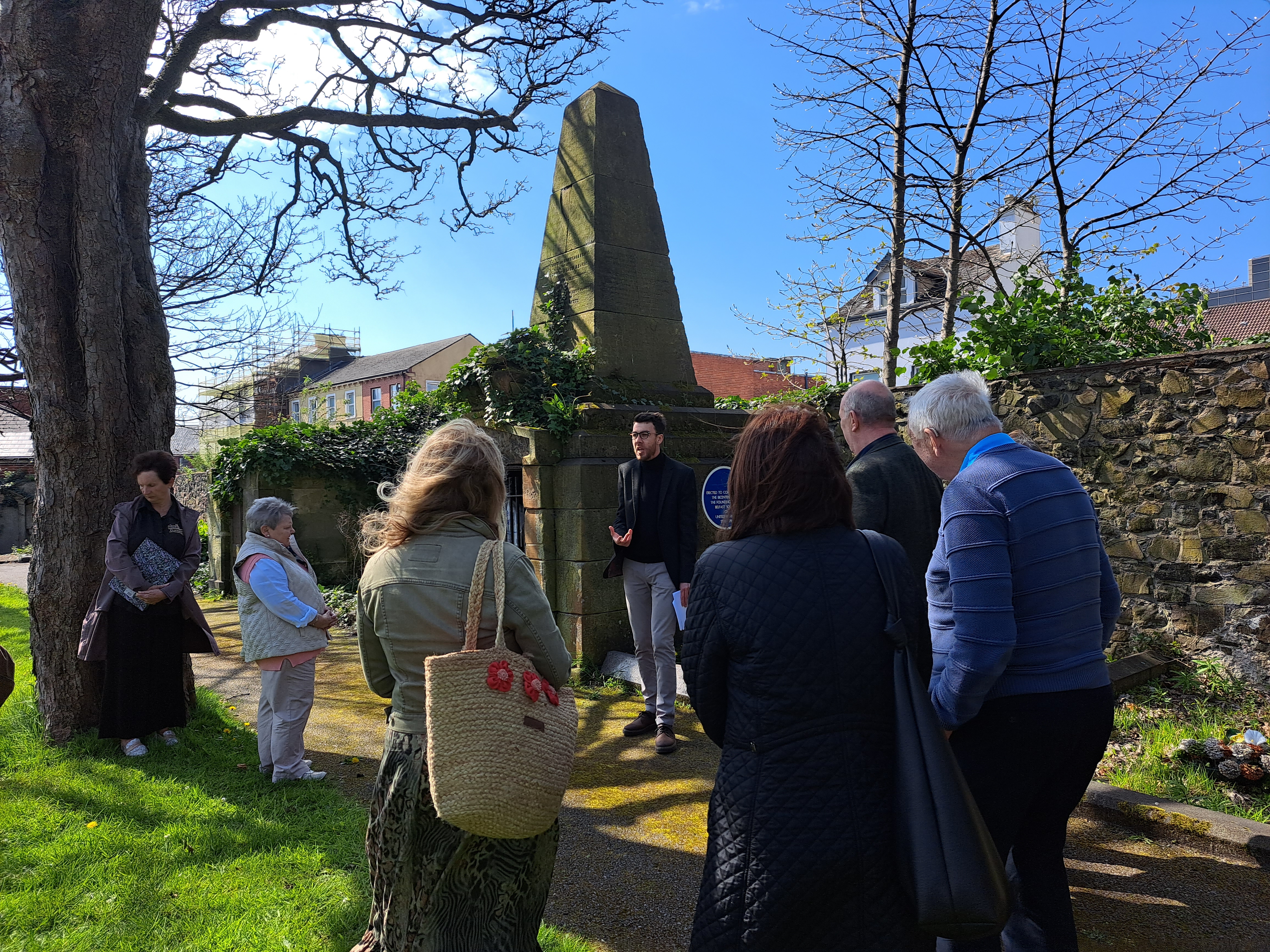
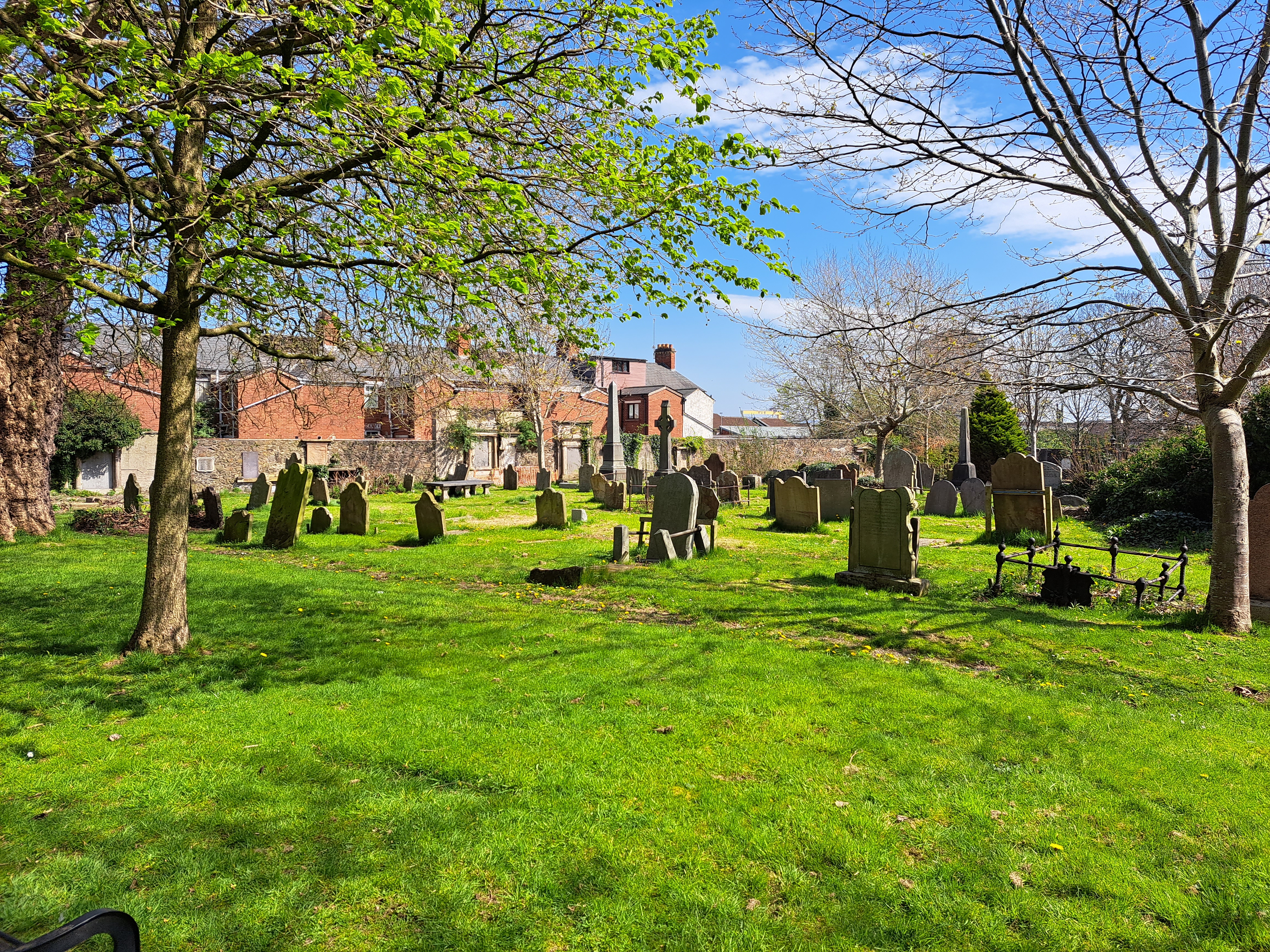
The extensive tour also took us round the Clifton Street graveyard. Another repository of Belfast history.

Sadly the graveyard suffered greatly from vandalism at the start of the Troubles, although its existence was threatened fairly dramatically in its early days when it was frequently targeted by grave robbers and we were told many tales of their nefarious activities over the years.

Vandalised grave of Robert Haliday

But there is still a great deal there that connects us with Belfast’s past, many of the people buried there being Non-Subscribers. Indeed throughout the tour many of the names we heard who had been associated with Clifton House were members of our denomination.

Grave of Mary Ann McCracken and possible resting place of Henry Joy McCracken

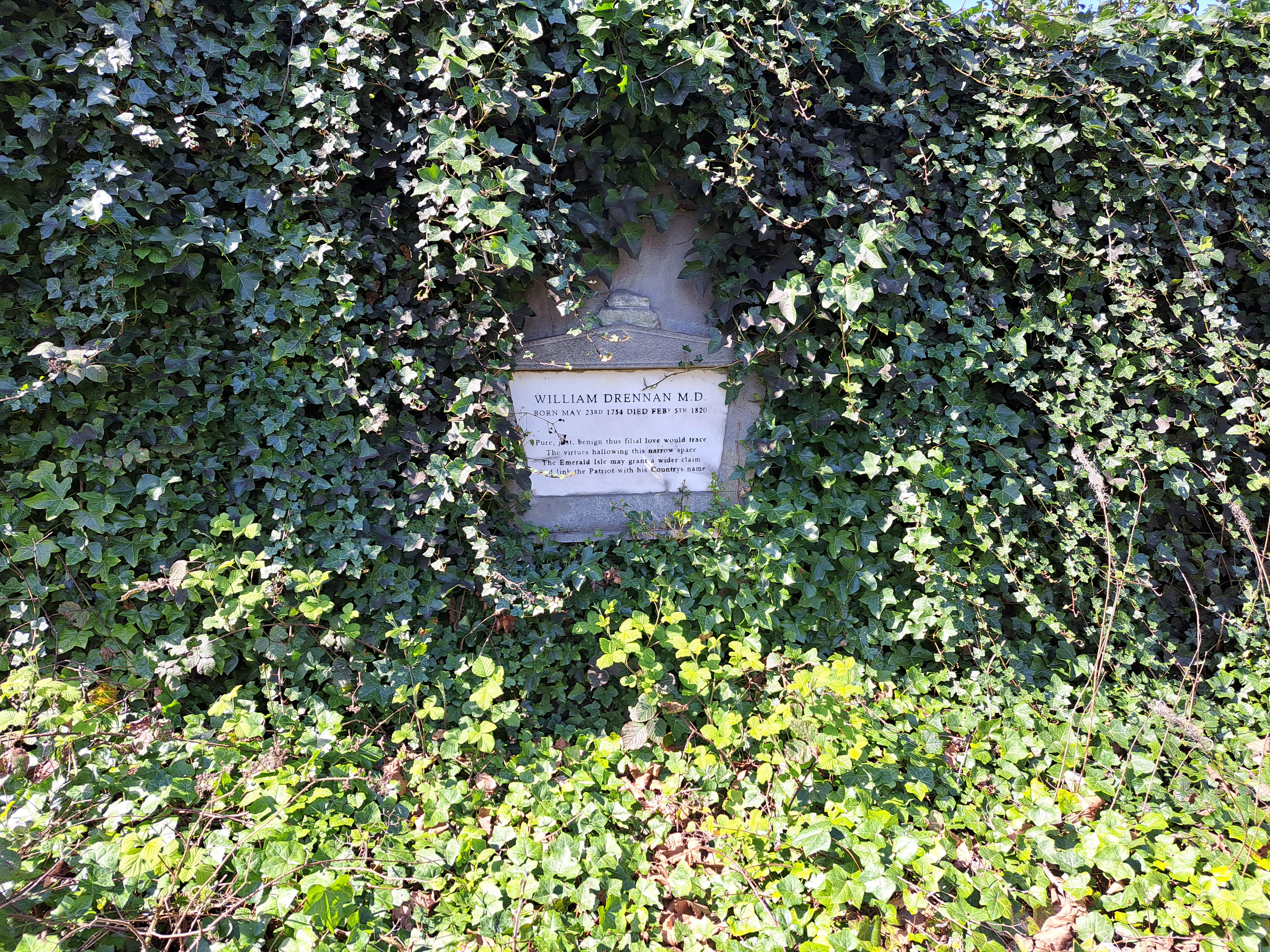
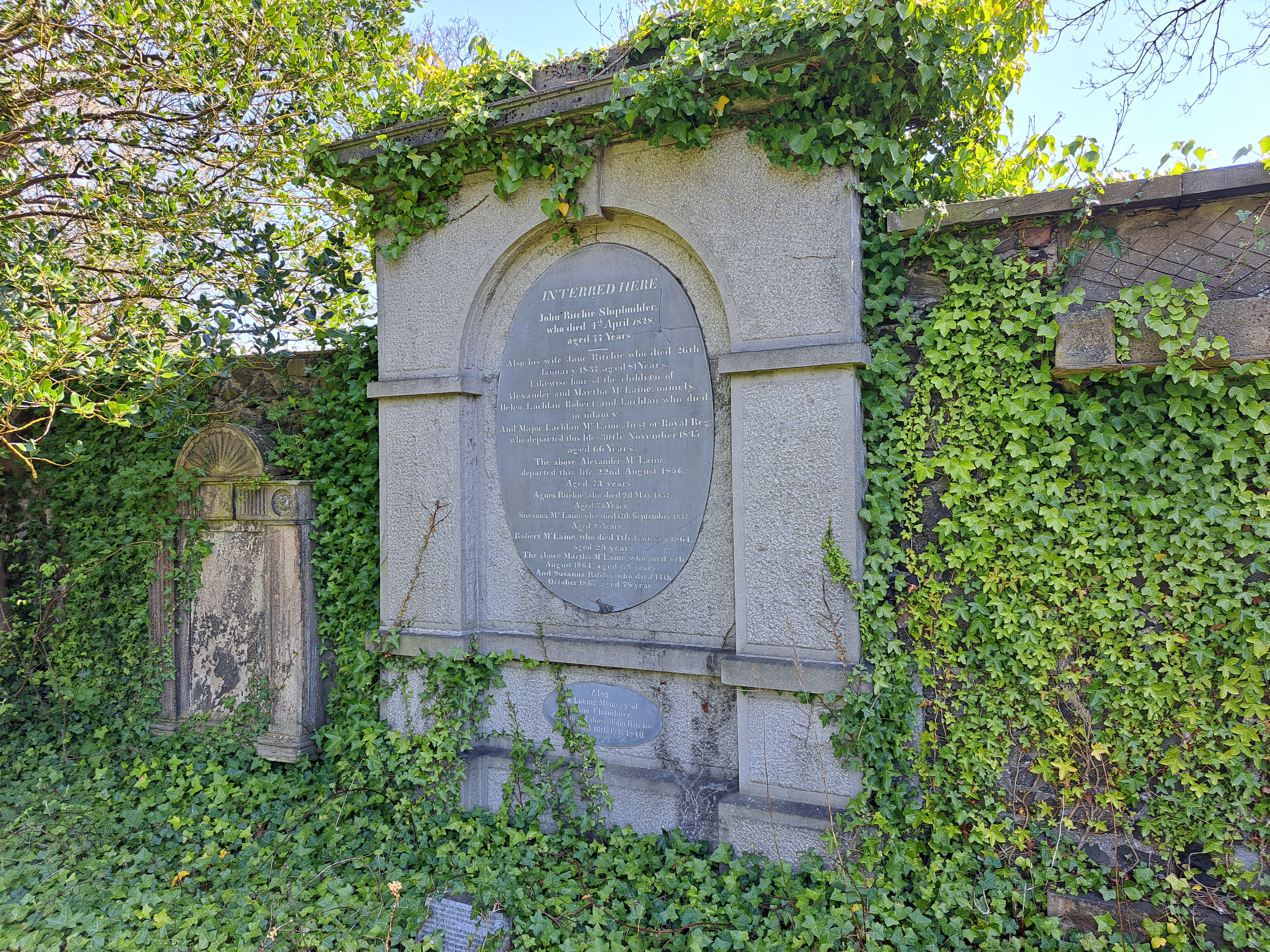
But in the graveyard we saw the graves of such notables as Dr William Drennan (poet, doctor, educationalist, United Irishman), John Ritchie (who established ship building in Belfast), and Thomas McCabe (who successfully opposed the establishment of a Belfast slave ship company) who were all Non-Subscribers, as indeed was Waddell Cunningham who it was who proposed establishing a slave ship company in Belfast (but who isn’t buried in Clifton Street).

Grave of William Drennan
Grave of John Ritchie
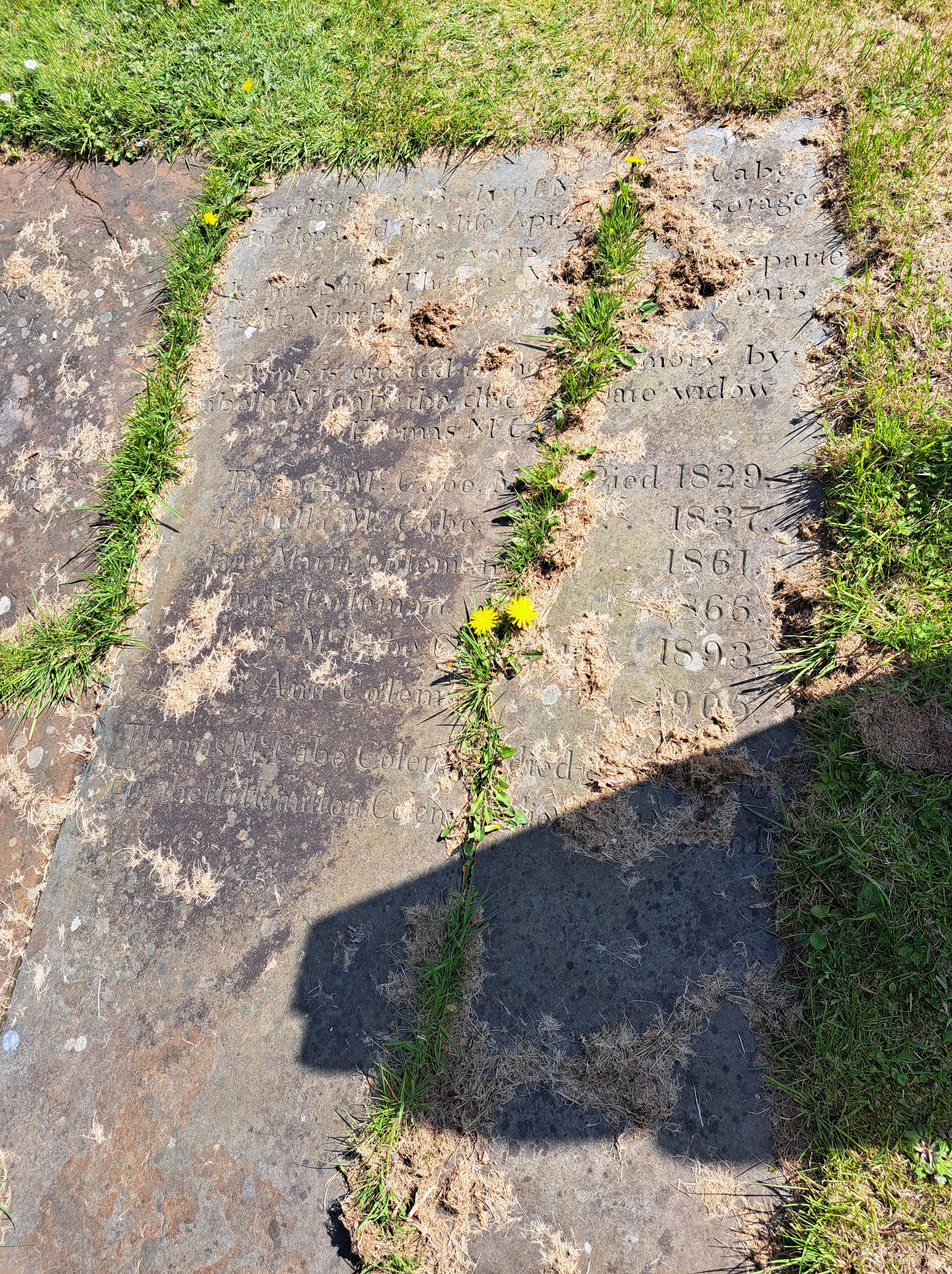
Grave of Thomas McCabe

It was a fascinating tour and we are grateful to our guides for such an interesting and illuminating morning.

Killyleagh and the Hincks family

Click on the video to follow the story

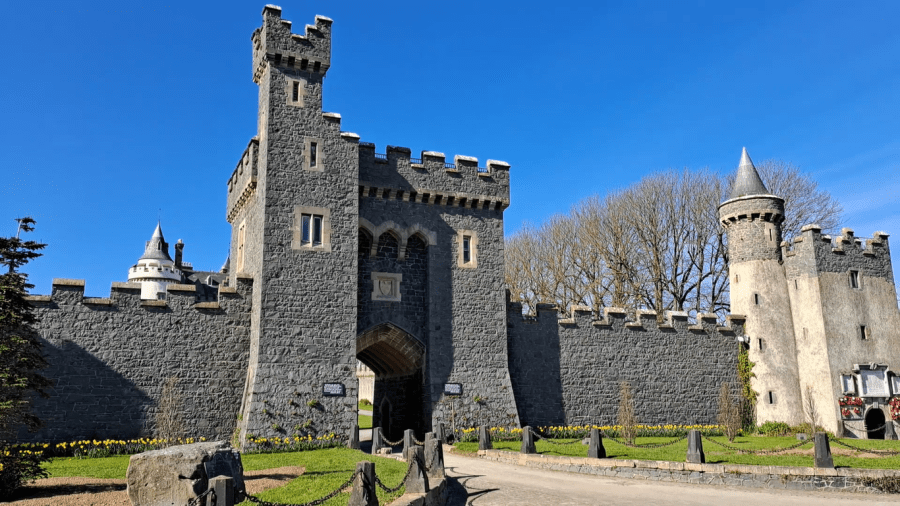
Killyleagh, county Down is a town remarkable for its history, much of this related to the Non-Subscribing tradition in Irish Presbyterianism. In this video we look at some of this history, including Sir Hans Sloane and local rector Rev Edward Hincks, Egyptologist and son of Rev Thomas Dix Hincks who is buried in the parsh graveyard.

Thomas Dix Hincks was born in Dublin and educated at Trinity College, Dublin and the dissenting academy of Hackney New College, London. He became minister of the Old Presbyterian Church, Princes Street, Cork in 1790 and the following year married Anne Boult. In Cork he kept a school and helped to establish the Royal Cork Institution. He later moved to Fermoy where he ran the Fermoy Academy before coming to Belfast as Professor of Oriental Languages at the Royal Belfast Academical Institution which was then also a training college for ministers as well as a school. A pioneering educationalist and teacher he published widely over the years, he was awarded the degree of LLD in 1834 by Glasgow University and was a Member of the Royal Irish Academy.

He and his wife are buried in Killyleagh alongside their eldest son but together they established a significant Unitarian/Non-Subscribing dynasty which was influential in England, Ireland and Canada.

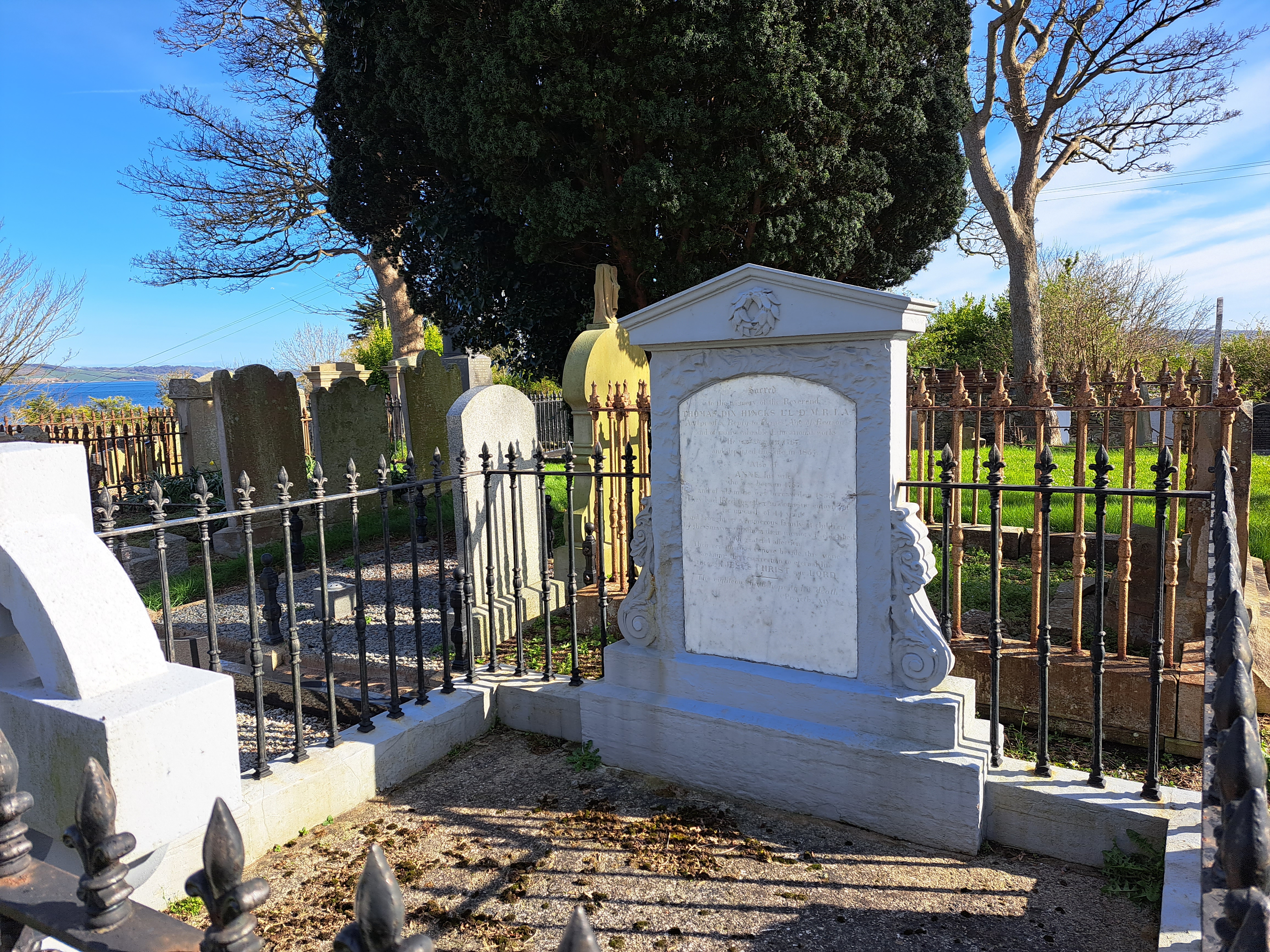
The grave of Thomas Dix Hincks and Anne Hincks in Killyleagh

They had seven children, two girls and five boys:

Hannah Hincks (d.c1873)

Anne Hincks (d.1877)

Rev Edward Hincks (1792-1866)

Rev William Hincks c.1793-1871

Rev Thomas Hincks (1796-1882)

Rev John Hincks (1804-1831)

Sir Francis Hincks (1807-1885)

Two of the brothers became ministers of Renshaw Street Chapel in Liverpool, amongst other things.

To hear the full story and hear more about Killyleagh click on the video at the top of the page.

Memorial window to Thomas Dix Hincks, Anne Hincks and Hannah Hincks in the First Presbyterian Church, Rosemary Street, Belfast.

A previous video explores something of the life of Rev Thoms Hincks (1818-1899) the son of Rev William Hincks (c.1793-1871). It can be seen here:

William Sunderland Smith and Antrim

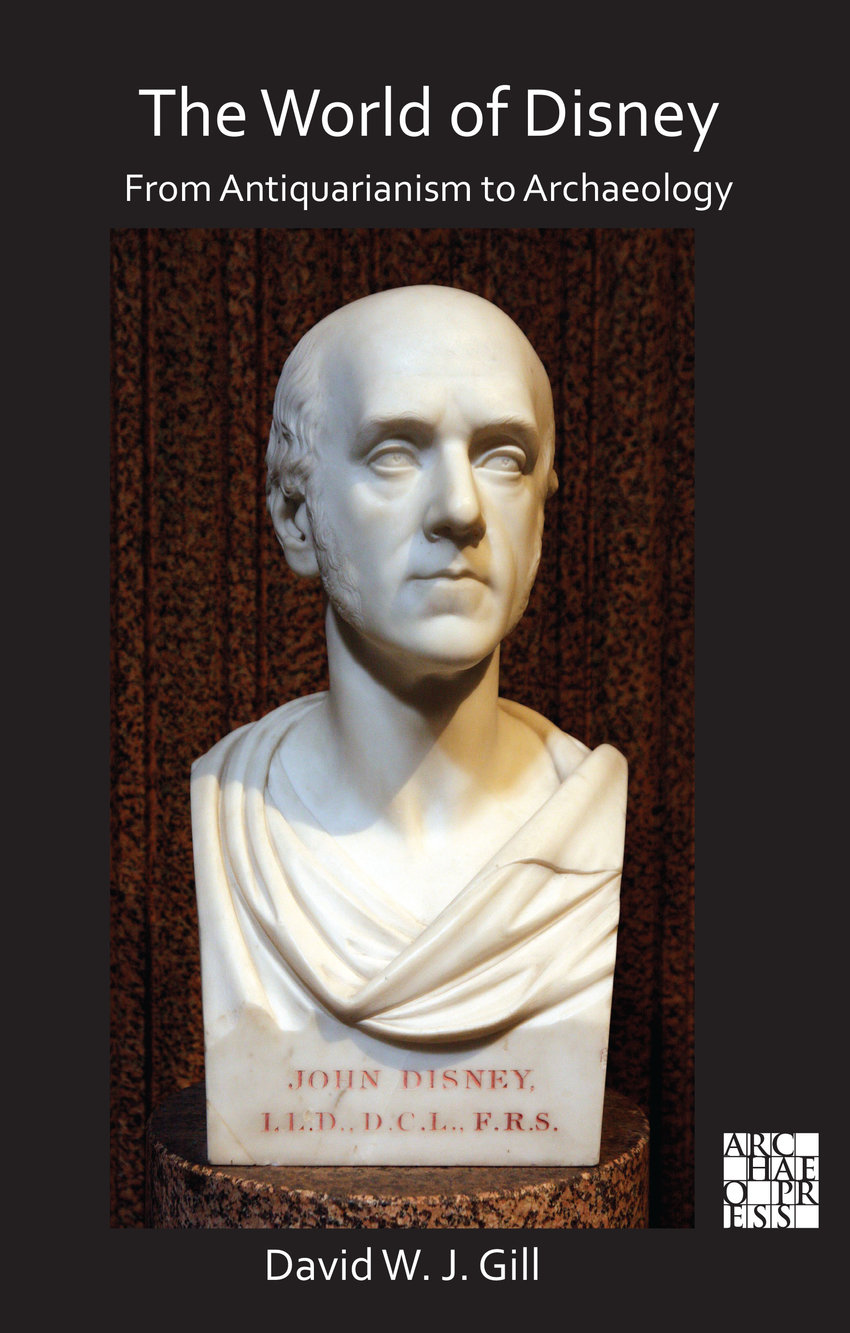
The 2023 issue of the Transactions of the Unitarian Historical Society includes Ian Wood’s article on his great great grandfather William Sunderland Smith, minister at Antrim from 1872 to 1912 and a figure of some note in the town at the time because of his writings on history, including the 1798 Rebellion, natural history, geology and theology.

W.S. Smith’s son William Ivan Smith was an enthusiastic amateur photographer and he took a number of pictures in Antrim in 1902 which are a main feature of this video which introduces the 2023 Transactions:

Click on the video above to find out about the Transactions and W.S. Smith

Prior to coming to Antrim in 1872 and after leaving the Unitarian Home Missionary Board in 1859 W.S.Smith had ministered successively at Aberdeen, Rawtenstall, Doncaster, Tavistock and Crediton. So he had a series of short ministries all over the country before crossing the Irish Sea and finding, one assumes, a deep sense of fulfilment in his last charge at Antrim. W.I. Smith’s visit to Antrim in 1902 produced a number of photographs which give us a splendid picture of his ministry and I am grateful to Ian Wood and his family for digitising them and for making them available.

So here is W.I. Smith’s portrait of his father:

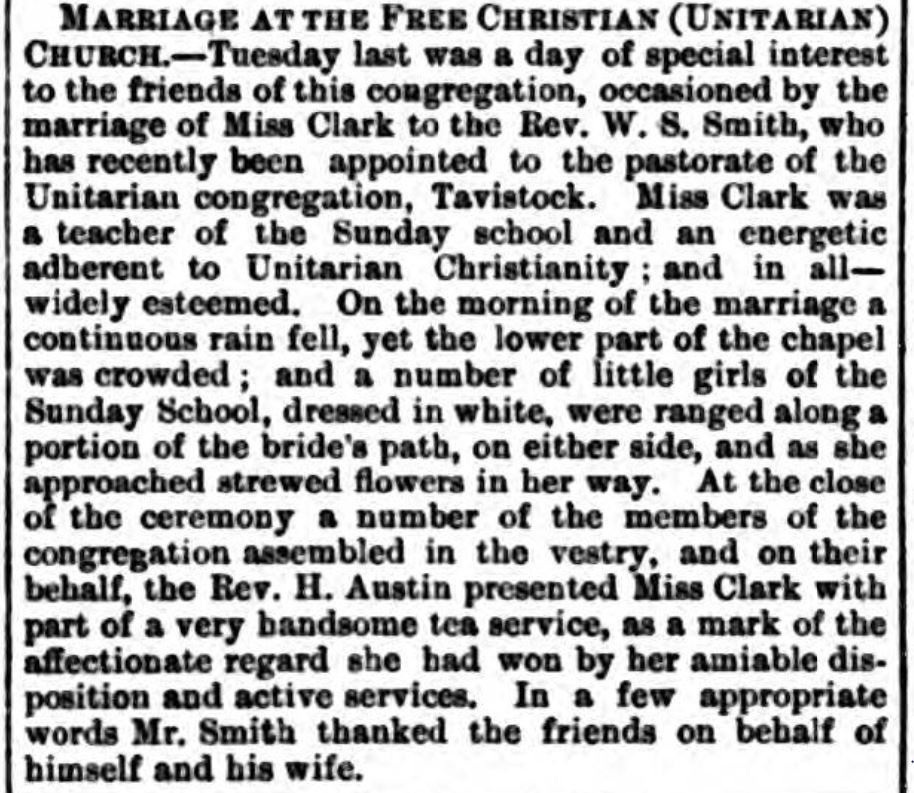
W.S. Smith’s first wife died in 1868 but the following year, having moved from Doncaster to Tavistock , he met and married Clara Ann Clark. Ian Wood has found this cutting from the Wilts and Gloucestershire Standard which gives an engaging account of the wedding between the Cirencester Sunday School teacher and the Tavistock Unitarian minister on 9th November 1869:

In 1902 when William Ivan Smith visited Antrim he took this picture of his step-mother:

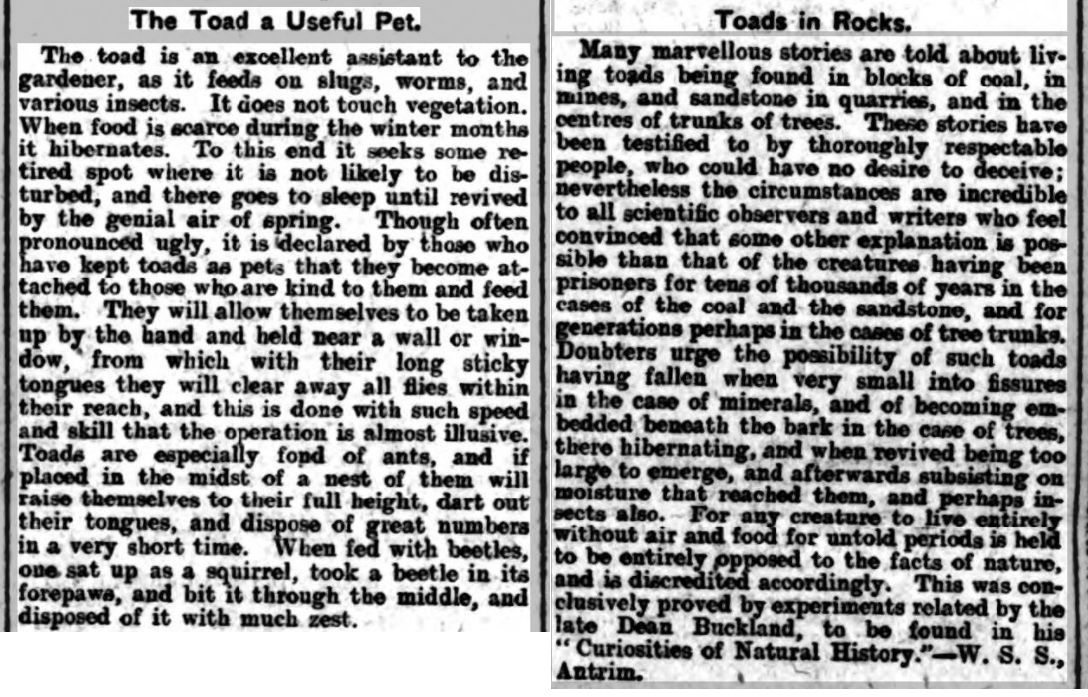
William Sunderland Smith arrived in Antrim, after a short ministry in Crediton, Devon, in 1872. He must have established a prominent name for himself in the town with publications such as Historical Gleanings in Antrim and Neighbourhood and Memories of ’98 as well as regular contributions to the Ulster Journal of Archaeology and the provision of ‘Nature Notes’ to the Northern Whig, including this account of toads in 1906:

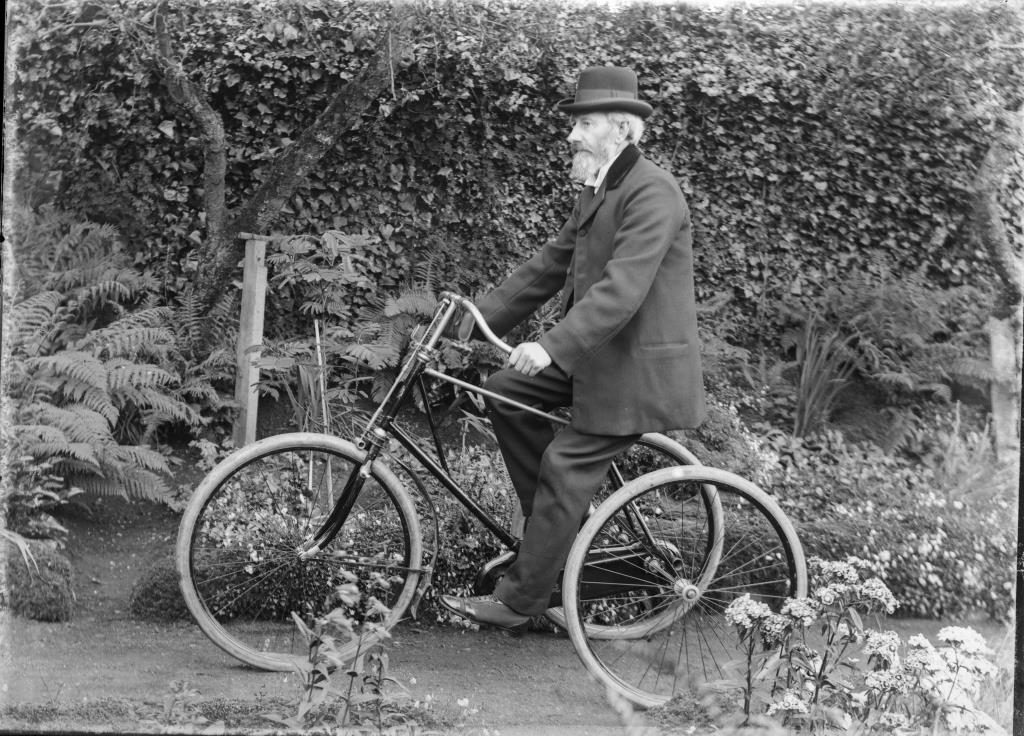
W.I. Smith’s photograph of his father astride his preferred method of transport in Antrim suggests that he must have been a very familiar figure on the local roads at the time:

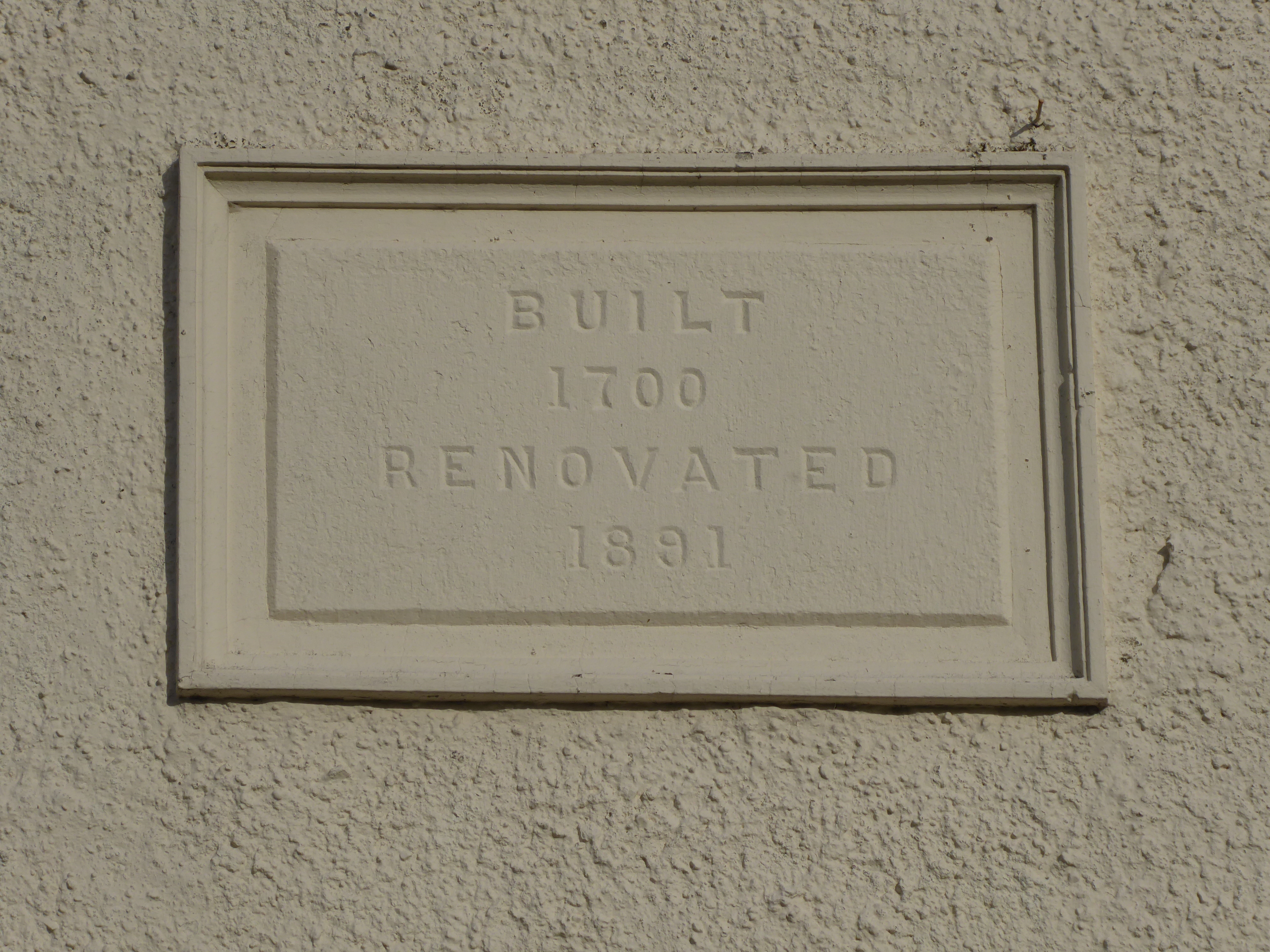
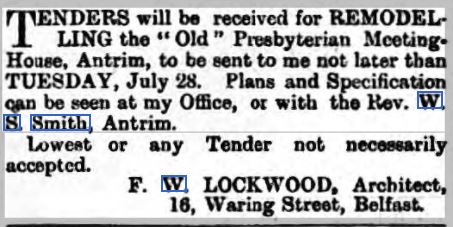
The Antrim meeting-house had been built in 1700 but under his ministry the interior was completetly refurbished in 1891. Ian Wood has found the following cutting from the Northern Whig seeking tenders to undertake this work:

This was a major undertaking which seems to have been successfully completed but images of the interior, either in its original form or in the remodelled layout created by W.S. Smith, are hard to come by. If you would like to see the interior as it looks today – denuded of its ecclesiastical furniture – click here. One postcard which I have acquired features the interior of the Antrim meeting-house as it originally looked. It is a strange picture that has been very amateurishly doctored with Rev John Abernethy’s portrait cut out from somewhere and stuck over the pulpit:

But when he came to Antrim in 1902 William Ivan Smith also took a picture of the interior of the church as it looked by this time. This is it:

Now, at first glance, this may not look like such an interesting image, but as the only surviving picture of the inside of Antrim complete with its pews it is not without importance. However, on top of that W.I. Smith was quite a skilled photographer and there is more detail in this high resolution image of a 1902 print than you might initially notice. If you click on the video above you can discover some more of what this picture contains.

Thank you to Ian Wood for researching his ancestor and for discovering these fascinating pictures and making them available.

You can find out more about the Unitarian Historical Society and the Transactions by visiting its website here.

You can see a bit more about the manse in Antrim on this website via this link.

No pictures or text may be reproduced from this site without the express permission of the author.

Transactions of the Unitarian Historical Society April 2023

Volume 28 Number 2 (April 2023) of the Transactions of the Unitarian Historical Society is now ready and, as ever, it is full of interest. It contains:

To give ‘occasional contributions’ and ‘annual subscriptions’ to
promote ‘those great principles of religious truth’:
Unitarian Fellowship Funds in the early nineteenth century

by David L. Wykes

Dr David Wykes

Our first article is by Society Vice-President David Wykes who has researched in great detail the story of the Unitarian Fellowship Funds. Although these were not long-lasting they deserve attention as an early national initiative which expressed a Unitarian identity and which found outlets all over the country. The Funds have long been neglected by historians but they are a very important indication of lay involvement in Unitarianism. They embraced both the poorer strata of society for a denomination that was often seen as appealing only to the rich, as well as gave an opportunity for women to be more actively involved in church life. The article includes a check list of Fellowship Funds and richly illustrates a movement that was one of the earliest expressions of a Unitarian denominational identity.

Emily Ronalds (1795–1889) and her social reform work
by Beverley F. Ronalds

Emily Ronalds. Photograph by Edmund Wheeler, Brighton, 1880. Courtesy: Auckland Library, New Zealand, Sir George Grey Special Collections, NZMS 1235

Beverley Ronalds, a Fellow of the Australian Academy of Technology and Engineering, uncovers the life and contribution of Emily Ronalds, a much-neglected Unitarian figure who played an important part in the extension of infant schooling. In her youth she was, by nature, a retiring figure, she was later described by the American social activist Frances Wright as ‘clever’ with ‘energy of character’, while Henry Crabb Robinson spoke of her ‘vivacity & good spirits’. She had close links with many of the most advanced thinkers of her day and contributed to experiments in socialist co-operative communities, the abolition of slavery and the development of feminism.

William Sunderland Smith (1833 – 1912) and his family
by Ian Wood

William Sunderland Smith photographed by his son William Ivan Smith in 1902. Courtesy: the family of W.I. Smith

William Sunderland Smith was the twelfth student to enrol in the Unitarian Home Missionary Board (later College) and went on to have a succession of ministries in England, Scotland and Ireland. Ministering, in turn, at Aberdeen, Rawtenstall, Doncaster, Tavistock and Crediton, his final and longest ministry was at Antrim. Ian Wood, his great great grandson, traces his life and that of his family, along with his theological and political ideas. A writer and journalist he developed extensive scientific interests, contributing ‘Nature Notes’ to the Northern Whig newspaper, and made numerous contributions on natural history and Irish history to the Ulster Journal of Archaeology.

Review Article.
The Oxford History of Protestant Dissenting Traditions
by Alan Ruston

Alan Ruston contributes a Review Article on The Oxford History of Protestant Dissenting Traditions, a five volume investigation of the place of Protestant Dissent not only in England and Ireland but also the Empire and Commonwealth, the USA and ultimately all over the world. Alan reviews all five volumes but pays especial attention to volumes two and three which contain a great deal concerning Unitarianism.

In addition we have our review section.

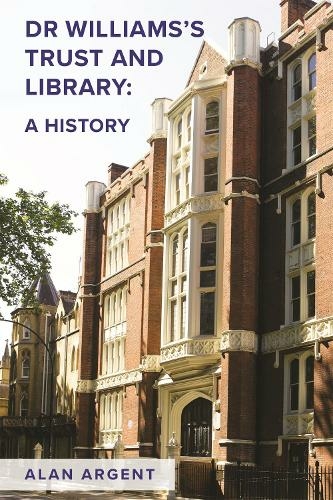
Dr Williams’s Trust and Library: A History
by Alan Argent

A Short History of the
Non-Subscribing Presbyterian Church of Ireland.
Including Sketches of Individual Congregations
and a Fasti of Ministers who served in them

by J.W. Nelson

These Eighty Years. A Recollection
by Alan Ruston

All reviewed by David Steers,
Editor of the Transactions

plus

OBITUARY
Professor Sir Tony Wrigley, FBA (1931-2022):
a Unitarian appreciation
by David L. Wykes

An annual subscription costs £10

Visit the new Unitarian Historical Society website to join: https://unitarianhistory.org.uk/

Faith and Freedom – Autumn and Winter 2022

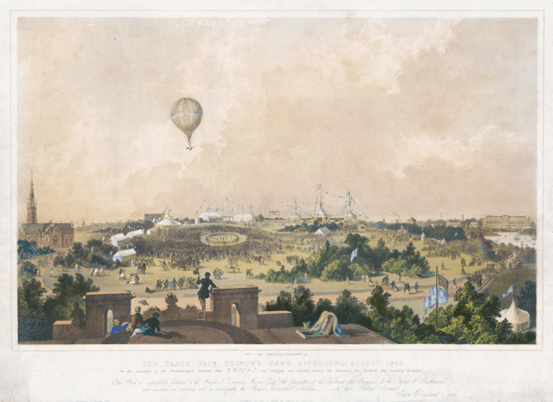
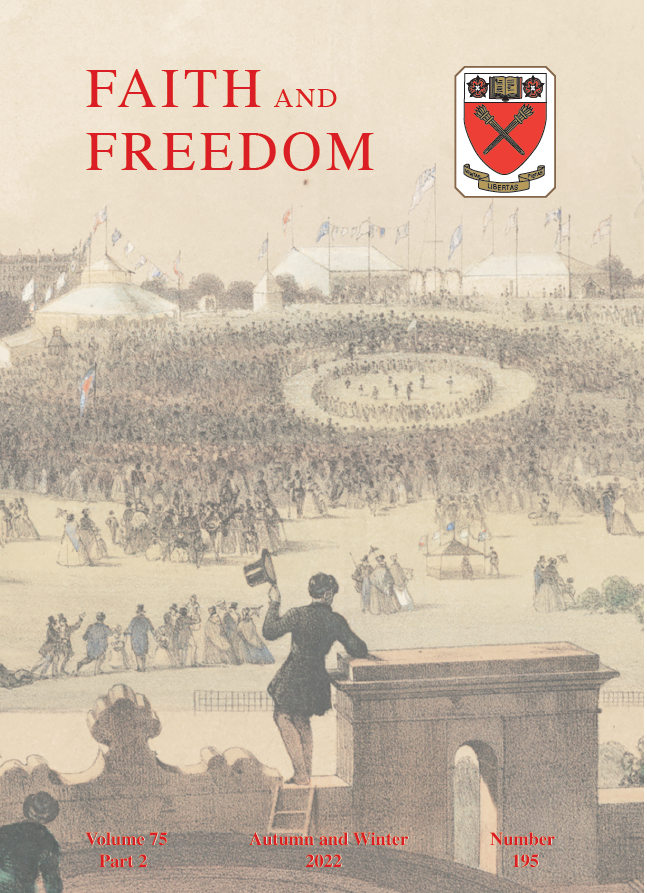
The new issue of Faith and Freedom is available now. Our cover picture shows James Martineau on top of his house in Prince’s Park, Liverpool (from a lithograph by John R. Isaac and now held by the Library of Congress).

The cover of our latest issue

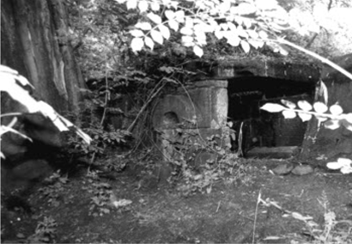
Historian Jim Kenny (well known for his blog The Priory and the Cast Iron Shore, which he publishes under the name Glen Huntley) gives the first full account of the house Martineau built in Liverpool overlooking the Park. Planned in detail by Martineau himself, including a curious network of subterranean passages, it was described by a visitor as A pie-crust sort of house, with all the “curiosities and niceties that a Unitarian Minister could wish.” In the lithograph, based on an original watercolour by W.G. Herdman, James Martineau looks down on the ‘Fancy Fair’ in aid of local hospitals. The building is long gone now although the site became the centre of a struggle between developers and conservationists in recent times and the underground passages were still discoverable then, and may yet have survived to the present day.

Passage entrance on the site of Martineau’s house, c.2001. Courtesy of Friends of Williamson’s Tunnels

These and more illustrations accompany the article which tell this fascinating story of a unique house, the brainchild of the most significant Unitarian theologian of the nineteenth century, and built in the most prosperous suburb of Liverpool.

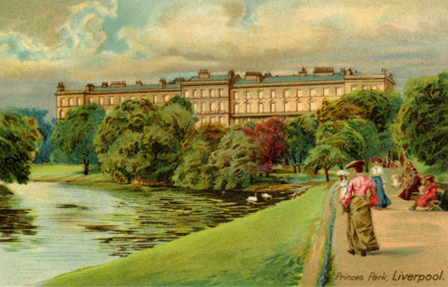
An Edwardian postcard showing nearby Prince’s Park and the Prince’s Park Mansions, neighbours of James Martineau.

Ian Rocksborough-Smith, assistant professor of US history at the University of Fraser Valley in S’ólh Téméxw/British Columbia, Canada, writes about ‘The Ambiguities of White Catholic Liberalism’ in the context of a ‘A Case Study in the Aftermath of the 1951 Race Riot in Cicero, Illinois’. He writes:

‘What did religiously-inclined white racial liberalism look like through the mid-twentieth century at a local level? This article looks at the intersections of race, religion, and civil rights in the wake of the 1951 race riot in Cicero, Illinois. Specifically, it considers the efforts of white Catholic liberals who advocated for racial reform measures well ahead of the mainstream orthodoxies of the Catholic Church – the latter of which did not pivot substantively towards civil and human rights until after Vatican II in the early-mid 1960s.’

We also have two fine examples of thoughtful and challenging sermons, the first on ‘Catching the Spirit’ given by London District Minister Jim Corrigall at New Unity congregation, North London, and the second ‘On Agreeing – But Not Quite – with Adam Gopnik’s Liberal Credo’ by Frank Walker given in the chapel of Harris Manchester College, Oxford.

Reviews include two books (in English and Welsh) reviewed by Graham Murphy, former Principal of Unitarian College, Manchester, and a Welsh-speaker, which explore the identity of Y Smotyn Du, ‘the Black Spot’, the heartland of Welsh-speaking Unitarianism, as well as two reviews on peacebuilding in the Middle East and Christian pluralism in Britain today. These are by Marcus Braybrooke, Anglican minister and a leading figure in inter-faith relations both nationally and internationally. In addition Lena Cockroft, current moderator of the Non-Subscribing Presbyterian Church of Ireland, reviews a book on mindfulness and golf.

Books Reviewed

Eric Jones, Best Foot Forward, South East Wales Unitarian Society, 2020, pp 112, £6.95 pbk.

Goronwy Evans, Procio’r Cof, Y Lolfa, 2021, pp 208, ISBN 978-1-80099-042-5, £9.99 pbk.

Ron Kronish, Profiles in Peace: Voices of Peacebuilders in the Midst of the Israeli-Palestinian Conflict, Publisher Ron Kronish in Israel, 2022. Available on Amazon Kindle and as a paperback 978-1734470093, $ 22.97.

Alan Race, My Journey as a Religious Pluralist: A Christian Theology of Religions Reclaimed. An Imprint of Wipf and Stock Publishers, pp.202. ISBN 978-1-7252-9823-1, pbk £20.00. Hbk 978-1-7252-9822-4, e-bk 978-1-7252-9824-8

Martin Wells, No One Playing. The essence of mindfulness in golf and in life. John Hunt Publishing, 2022, pp 108. ISBN: 978-1-78904-781-3, pbk £ 8.99. ISBN: 978-1-78904-782-0, e-book £ 4.99.

Subscription Details

An annual subscription for each volume (two issues) costs £16.00 (postage included) in the United Kingdom. Single copies can be ordered at a cost of £8.00 each (postage included). Cheques should be made out to Faith and Freedom and sent to the business manager:

Nigel Clarke,
Business Manager, Faith and Freedom,
16 Fairfields,
Kirton in Lindsey,
Gainsborough,
Lincolnshire.
DN21 4GA.

It is also possible to pay online. For more details see our website: https://www.faithandfreedom.org.uk/subs.htm

The lying in state of Her Majesty Queen Elizabeth II

Service of prayer from First Dunmurry NSP Church, Friday, 9th September

At the time of writing the coffin of Her Majesty the Queen is lying in state in Westminster Hall and many thousands of people are queuing in order to be able to pay their last respects. Special services have been held all over the country in the last week and at First Dunmurry (NS) Presbyterian Church we held a short service of prayer and reflection on Friday, 9th December. An edited audio recording of the service can be heard by clicking on the video above. Allen Yarr is the organist.

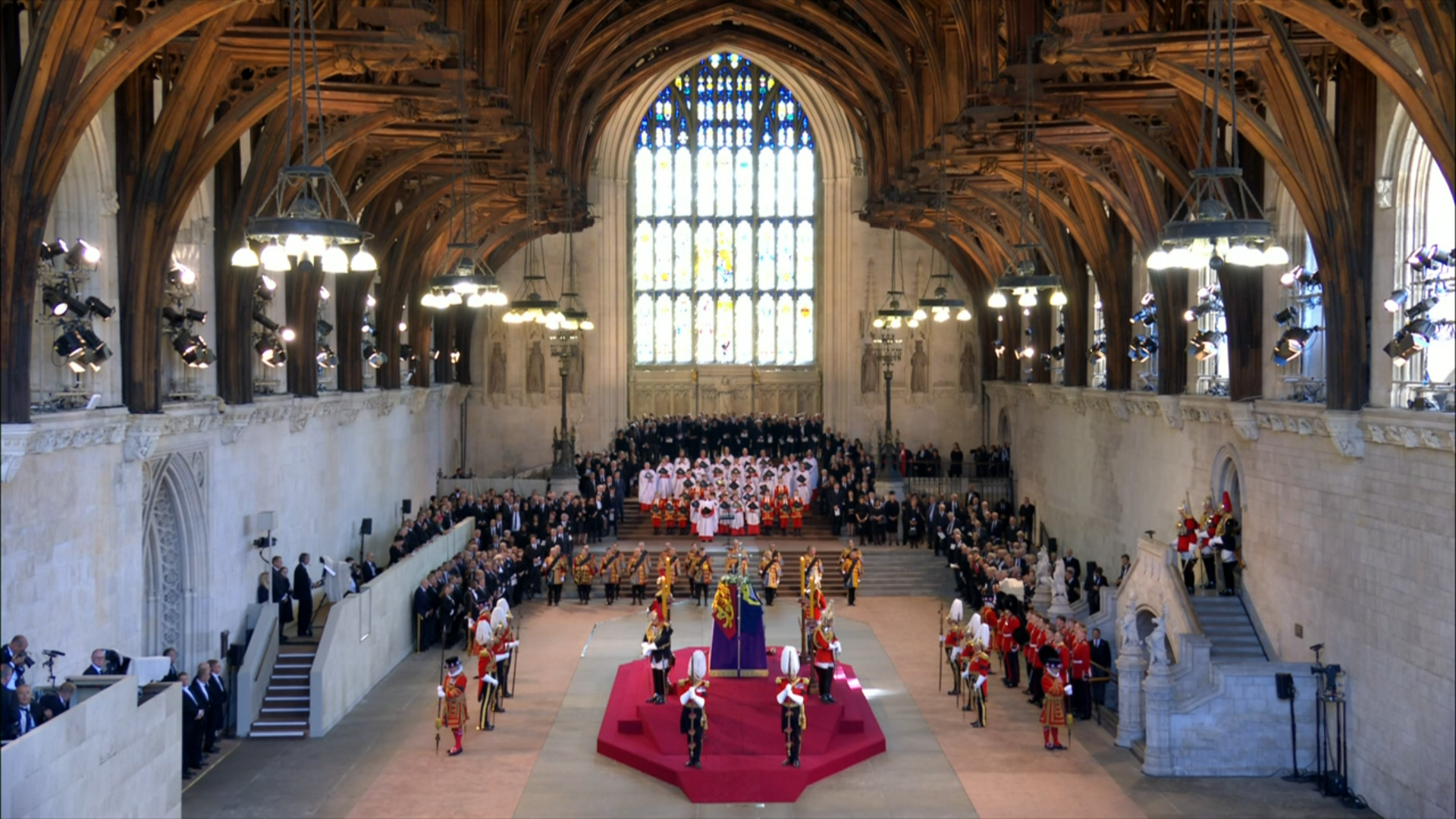
Below are some images from the lying in state in Westminster Hall.

Pallbearers carry the Queen’s coffin into Westminster Hall
A short service was held on the arrival of the Queen’s coffin
With the Imperial State Crown atop the coffin the Queen is guarded by members of the Life Guards and the Blues and Royals

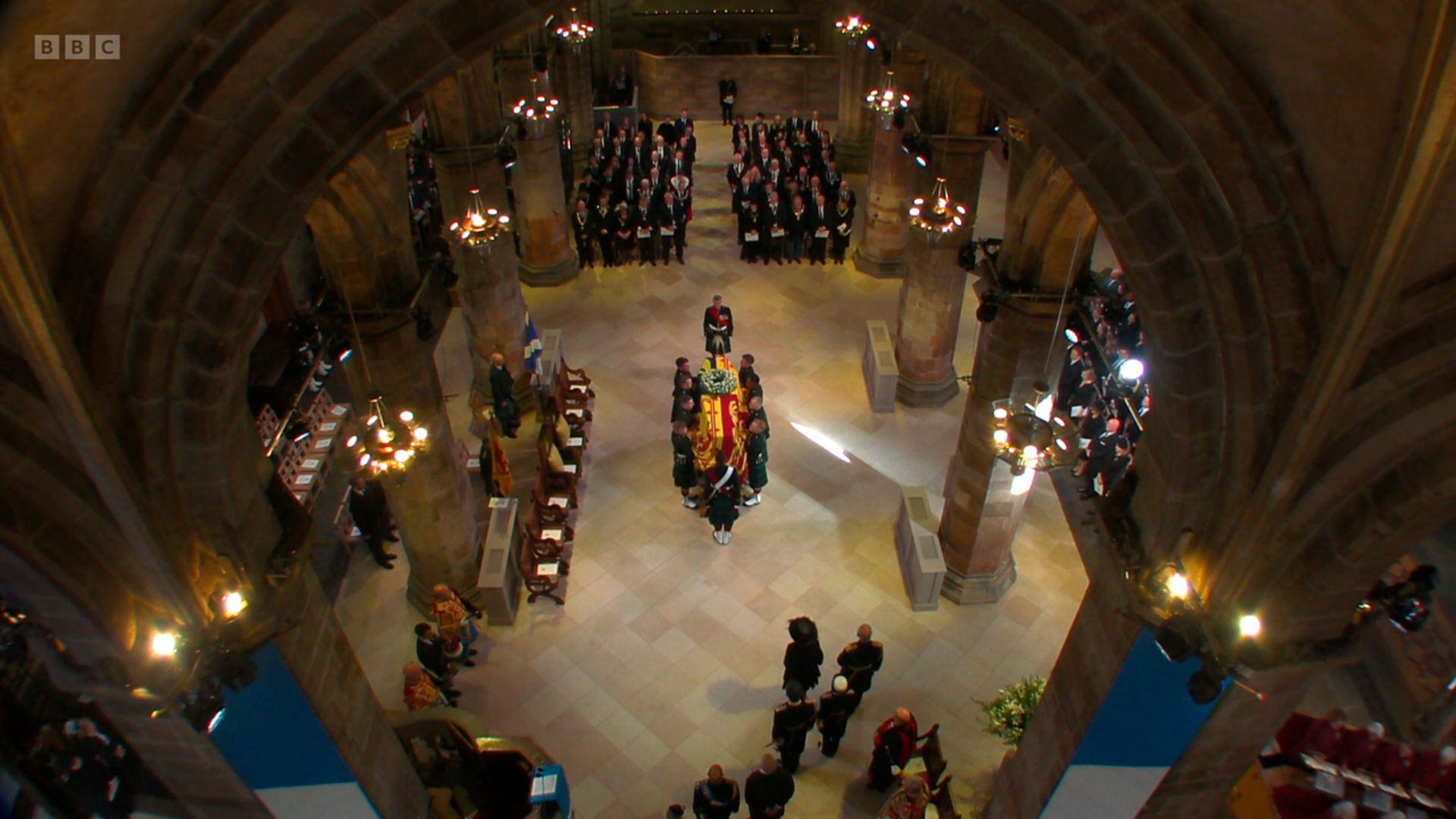
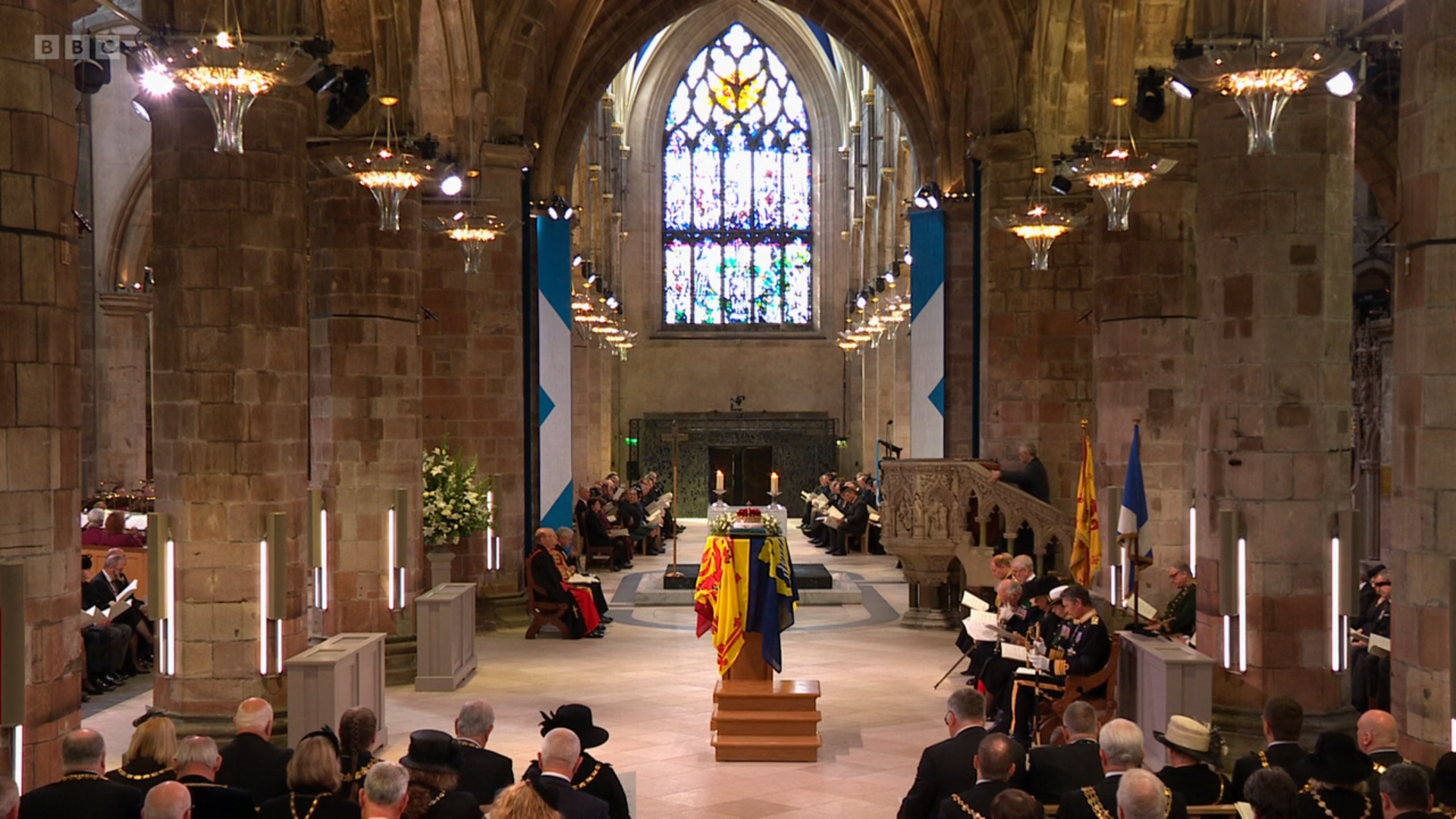
Earlier in the week, on Monday, 12th September a very moving service of thanksgiving for the life of the Queen was held in St Giles Cathedral, Edinburgh. Below are some images from that occasion.

The coffin is brought in to the Cathedral
The sermon was delivered by the Moderator of the Church of Scotland
The ancient Crown of Scotland, part of the Honours of Scotland, is placed on the Royal Standard of Scotland

Services of thanksgiving for the life of the Queen were also held in Belfast and Cardiff.

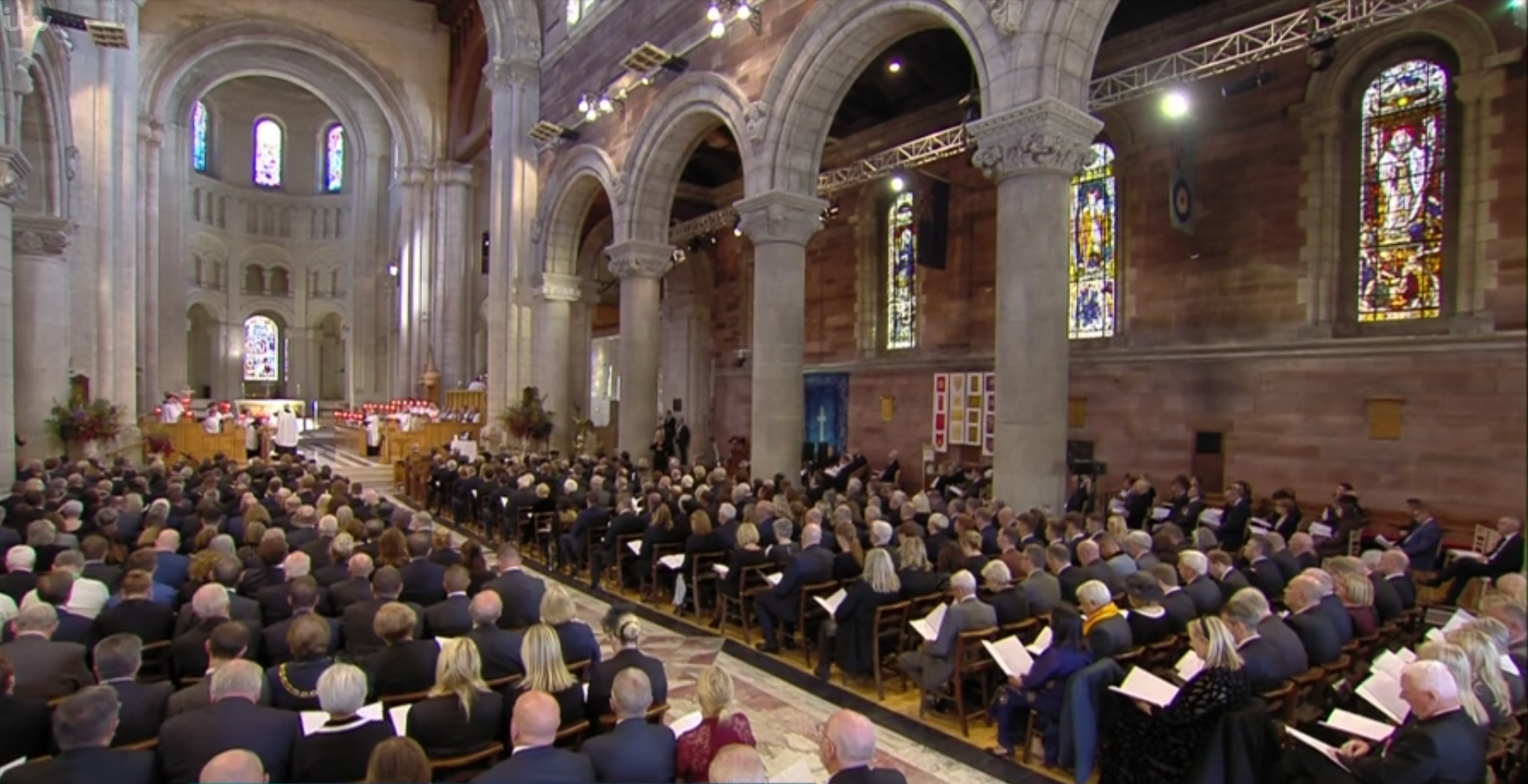
The service at St Anne’s Cathedral, Belfast

I shall not die, but live, and shall
the works of God discover.
The Lord hath me chastised sore,
but not to death giv’n over.
O set ye open unto me
the gates of righteousness;
Then will I enter into them,
and I the Lord will bless.
This is the gate of God, by it
the just shall enter in.
Thee will I praise, for thou me heard’st
and hast my safety been.

Translation of Psalm 118 v.17-21 which was sung in Scots Gaelic by Karen Matheson at the service in St Giles Cathedral, Edinburgh.

Transactions of the Unitarian Historical Society April 2022

The issue for 2022 (vol 28 No.1) will be with subscribers shortly and once again this is a very full and very special issue because members will receive two journals for their subscription. Part One contains three important articles plus reviews and more, Part Two is produced in collaboration with the Reckoning International Unitarian and Unitarian Universalist Histories Project.

Part One

The cloisters, Ullet Road Church Liverpool

In Part One our main articles look at Unitarianism, slavery and philanthropy. A number of Unitarians were actively involved in the abolition of slavery. One very prominent example of this was William Roscoe whose memorial is located in the cloisters in Ullet Road Church, a set of buildings constructed at the end of the nineteenth and start of the twentieth centuries which perfectly illustrate the enormous philanthropic contributions of wealthy Unitarians at this time.

‘Jewel Case’ – The Man and his Money Derek McAuley

Very Rev George Case, MA, DD (used with permission of Clifton Diocesan Archives)

Derek McAuley traces the story of the Very Rev George Case whose journey from the Anglican to Catholic priesthood was followed by a very generous bequest to the Unitarian movement. His father was a contemporary of William Roscoe in Liverpool but unlike Roscoe he was deeply implicated in the slave trade. Using modern tools and databases Derek examines the source of Dr Case’s wealth.

Reflections on a Window Rory Delany

The Wilson Memorial Window, Dublin Unitarian Church (Photo: Rory Delany)

The most prominent and striking window within Dublin Unitarian Church, St Stephen’s Green is the Wilson Memorial Window which memorializes Thomas Wilson, long standing member of the congregation and generous benefactor. In this article Rory Delany looks at the source of Thomas Wilson’s wealth, again using the databases and records which have become available and which highlight those families involved in the slave trade. He contrasts Thomas Wilson’s attitudes and business interests with his contemporary and fellow church member James Haughton who was a noted anti-slavery campaigner.

Unitarians and Philanthropy 1860-1914 Alan Ruston

Looking towards the library at Harris Manchester College

Alan Ruston gives a substantial survey of Unitarian philanthropy between 1860 and 1914. Many wealthy Unitarians gave vast sums to build churches, establish charities and develop educational institutions such as Manchester College (see above) which was founded in 1786 in Manchester but moved to Oxford in 1893 following a number of very generous donations.

Books Reviewed

Reviewed by David Wykes, Alan Ruston and David Steers

Part Two

The ethnographic composition of Hungary in 1910 (Map: Lehel Molnár)

Part Two of this issue develops the successful initial event of the Reckoning International U/UU Histories Project which was entitled ‘Transylvanian Unitarians Resisting and Surviving in Authoritarian Times’ and which took place on Thursday, 4 November 2021. This can be viewed online at the Starr King School for the Ministry YouTube channel (https://youtu.be/ozH1fnDkSHk).

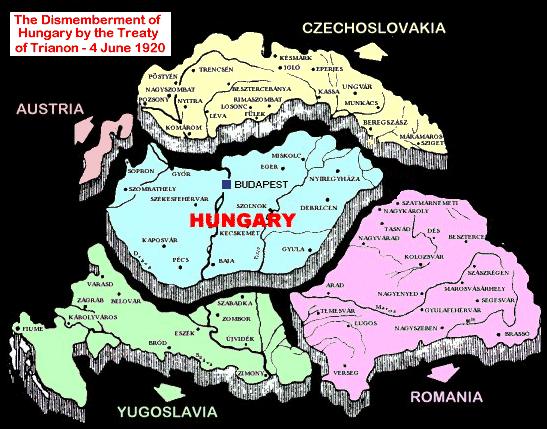
The dismemberment of Hungary by the Treaty of Trianon (Map: Lehel Molnár)

We are very pleased to be able to carry in this issue an introduction and summary of the whole Reckoning project compiled by its co-ordinators Claudia Elferdink and Lehel Molnár This is followed by two articles which are not transcripts of the original webinar but which give additional insight and information on the experience of Hungarian Unitarians over the last one hundred years, particularly following the Communist takeover in Romania after the Second World War. The first of these is ‘The Hungarian Unitarian Church in the Twentieth Century’ by Sándor Kovács and Lehel Molnár, an explanation of the struggles of the church from the Treaty of Trianon – when Hungary lost two thirds of its historic territory – to the present century. This is followed by ‘Resistance or/and Compromise. The Struggles and Service of Unitarian Bishop Elek Kiss (1888–1971) in Communist Romania’ by Sándor Kovács which gives a very detailed view of the problems and stresses experienced by the church in the Communist era.

The ethnographic compostion of Hungary in 1880

New subscribers are very welcome, annual membership costs only £10. If you haven’t yet taken out a subscription or would like to renew your subscription that can be done through the Society’s treasurer who can be contacted via the Unitarian Historical Society website here.

Silent yet eloquent memorials

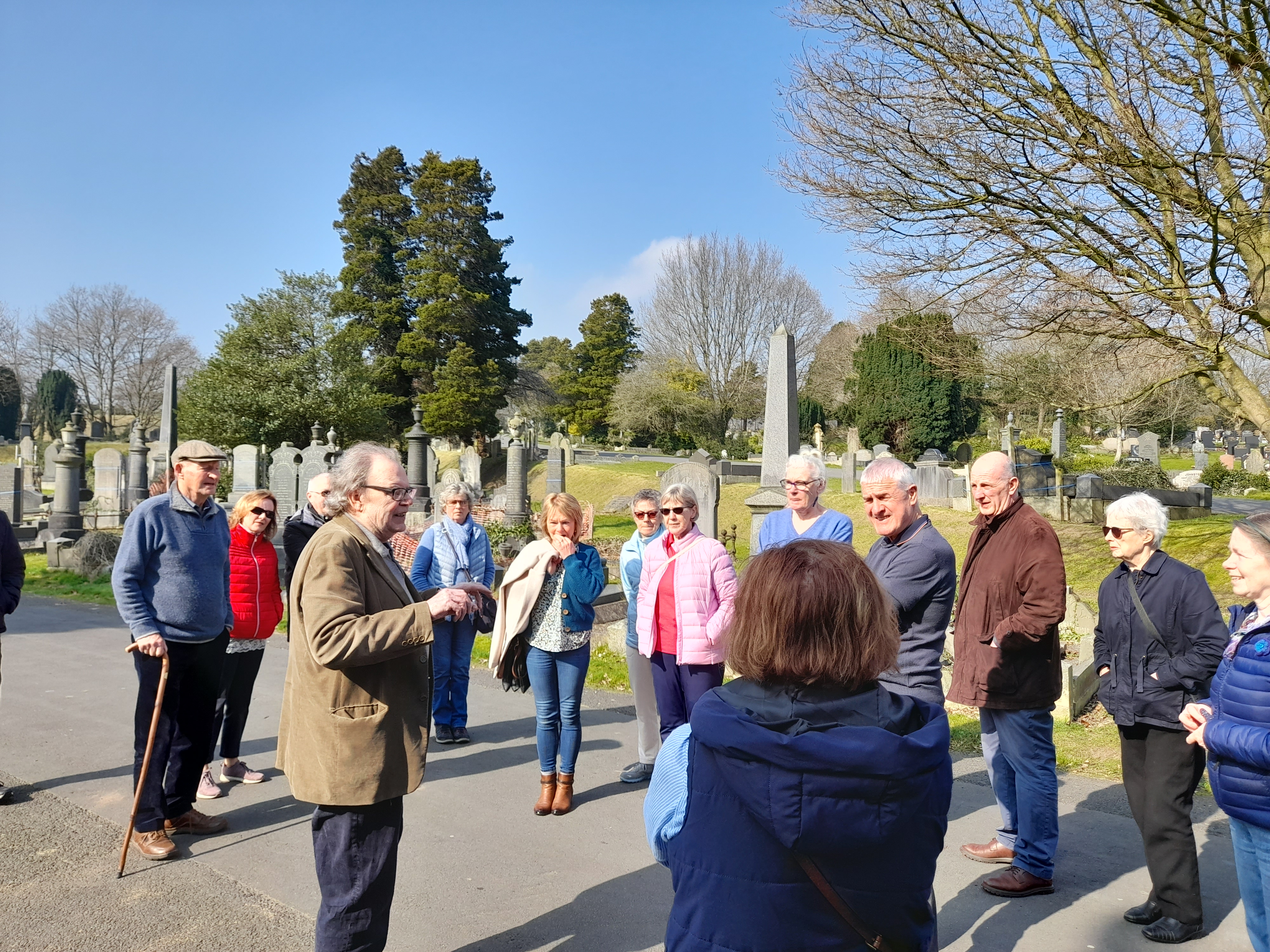
Starting off on the tour

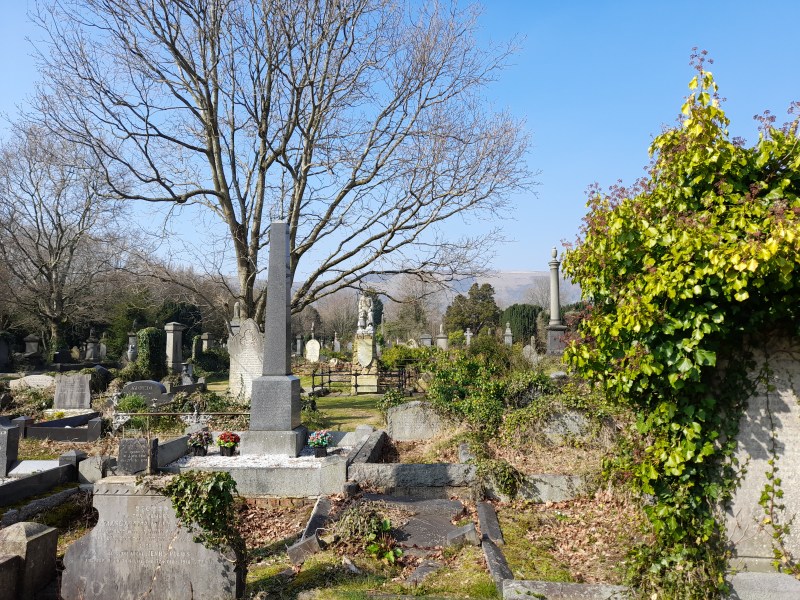
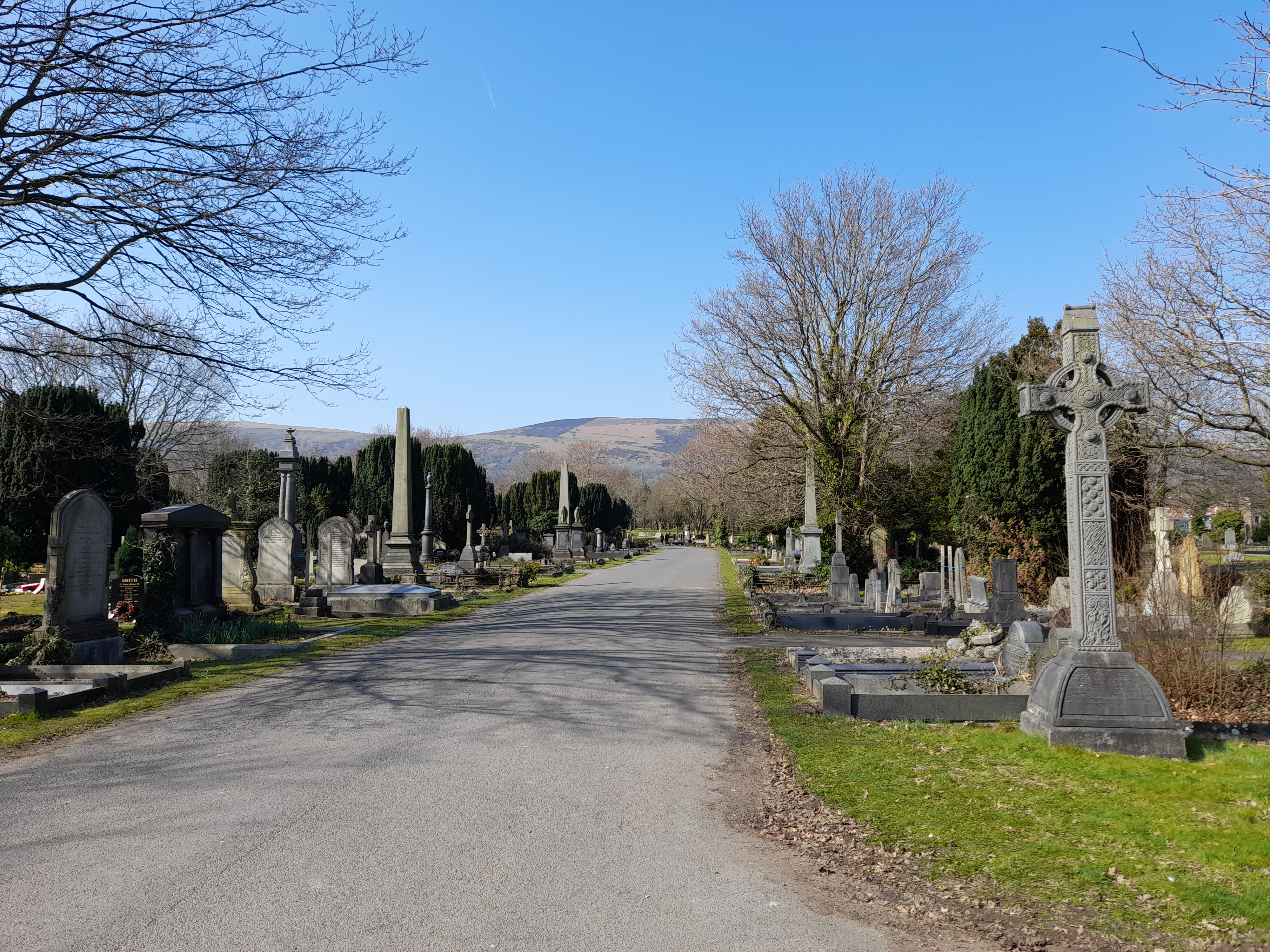
On Wednesday, 23rd March a group from the four Belfast Non-Subscribing Presbyterian Churches enjoyed an excellent visit to the Belfast City Cemetery. We were blessed by good weather, almost like a summer’s day, which showed off the whole site to its fullest advantage. Designed in the shape of a bell and opened in 1869 it has been the burial place of approximately 225,153 people ranging from the some of the poorest members of society, buried in paupers’ graves, to some of the wealthiest merchants, industrialists and businessmen of Victorian Belfast. Years of neglect and vandalism obscured the importance of the cemetery in the city’s history for a long time, but the remarkable work done by Tom Hartley on the graves and history of the cemetery, not least reflected in his book Belfast City Cemetery, has opened up the cemetery to a wider and appreciative public. It is good too to see the construction of a visitors’ centre and the restoration of some of the larger memorials. Tom Hartley has an encyclopaedic knowledge of the history and significance of the site and was our informative guide as he showed us round a large proportion of the original Victorian graveyard, so attractively laid out with the Belfast hills providing a dramatic backdrop. Tom made special reference to some of the Presbyterian and Non-Subscribing Presbyterian graves in the cemetery and we encountered the last resting places of some familiar figures from our tradition. Among others we saw the grave of Margaret Byers, the founder of Victoria College, and Elisha Scott, legendary Liverpool goalkeeper. Cemeteries are such important repositories of history: funeral monuments, grave inscriptions, memorial artwork all tell us a great deal and in this case Belfast City Cemetery provides a fascinating window into the growth, development and history of Belfast as a city. After the tour we had lunch at Cultúrlann McAdam Ó Fiaich. Below are some images of what we saw:

The grave of Rev John Scott Porter (Biblical scholar, theologian and Belfast Non-Subscribing minister) and his brother William Porter, attorney general at the Cape Colony who introduced a franchise into the colony that extended the vote, at the time, to all people irrespective of race.
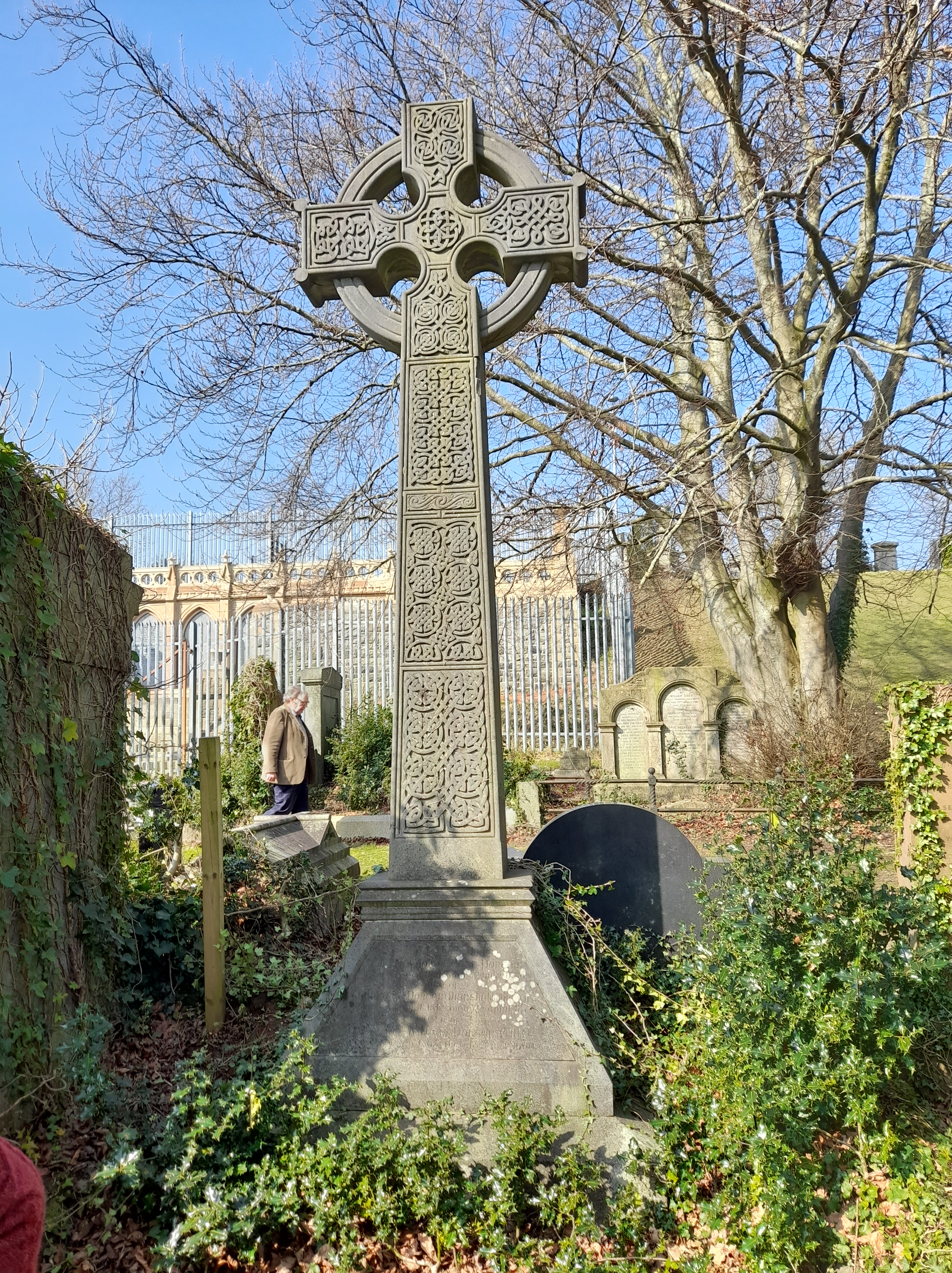
View across the cemetery showing the memorial to John Kirker (1891) on the right in the form of an ornamental Celtic Cross carved from a single piece of limestone.
.
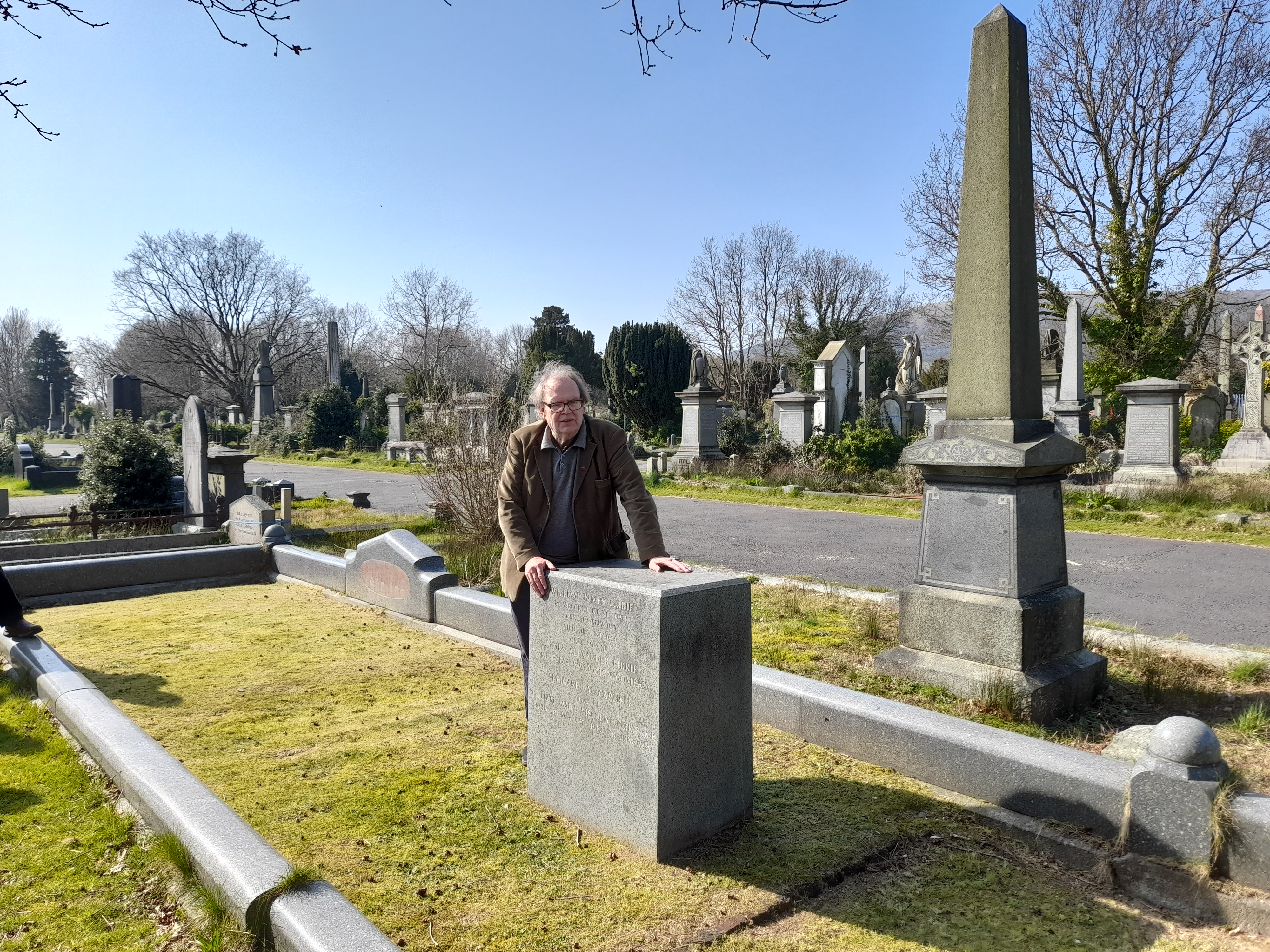
Tom Hartley at the grave of Lord and Lady Pirrie. William Pirrie was a leading Belfast politician and shipbuilder, chairman of Harland and Wolff and responsible for the building of the ‘Titanic’. His wife Margaret Montgomery Pirrie was a significant figure in her own right, closely involved in the establishment of the Royal Victoria Hospital and a granddaughter of the Rev Henry Montgomery of Dunmurry.
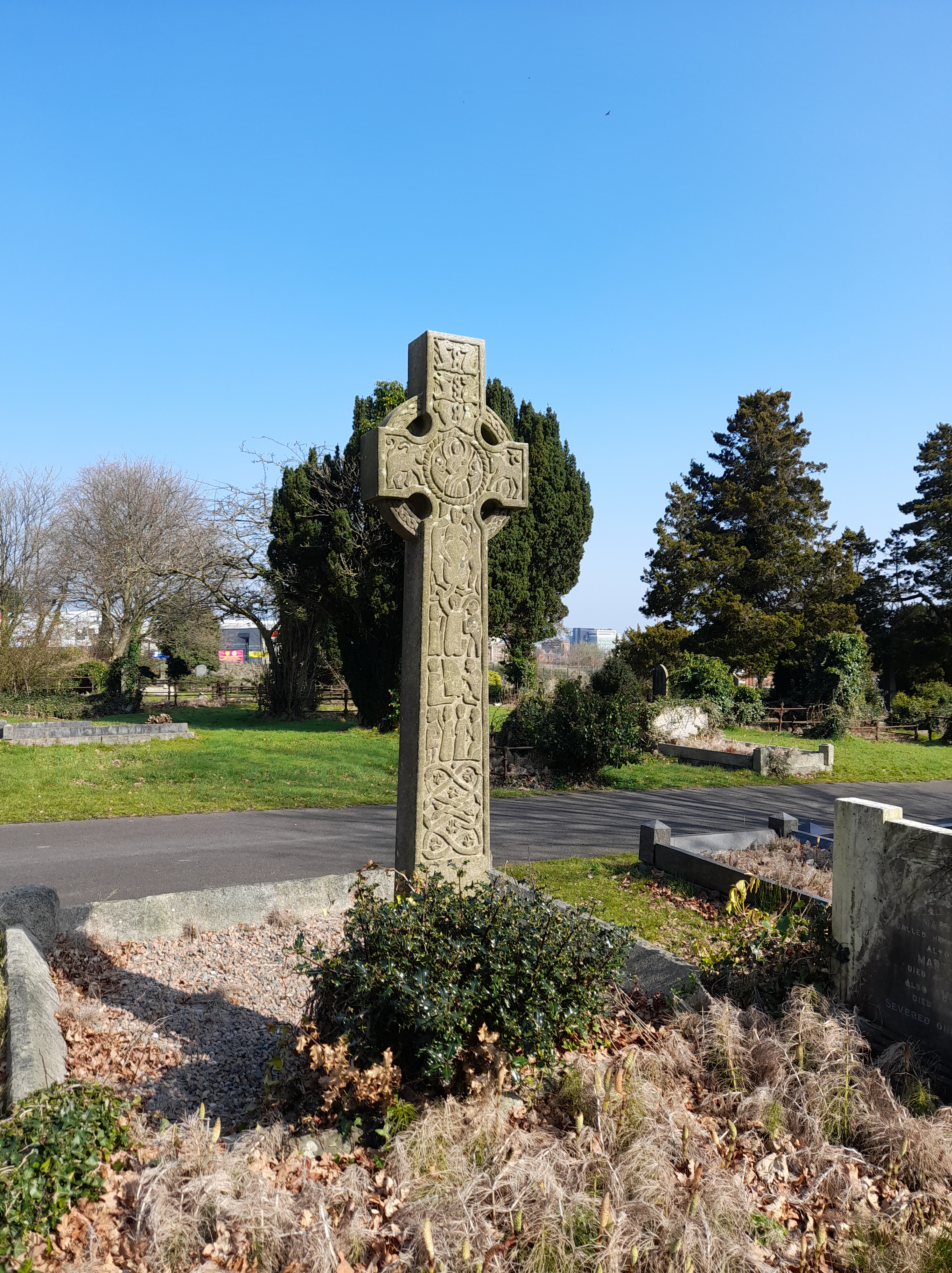
Another nineteenth-century Celtic Cross containing ancient religious imagery including, in this case, the Ouroboros (at the bottom of the Cross), the snake consuming its own tail.
The infamous location in the cemetery where an underground wall, six feet tall, divided what were planned to be the Catholic and Protestant plots.
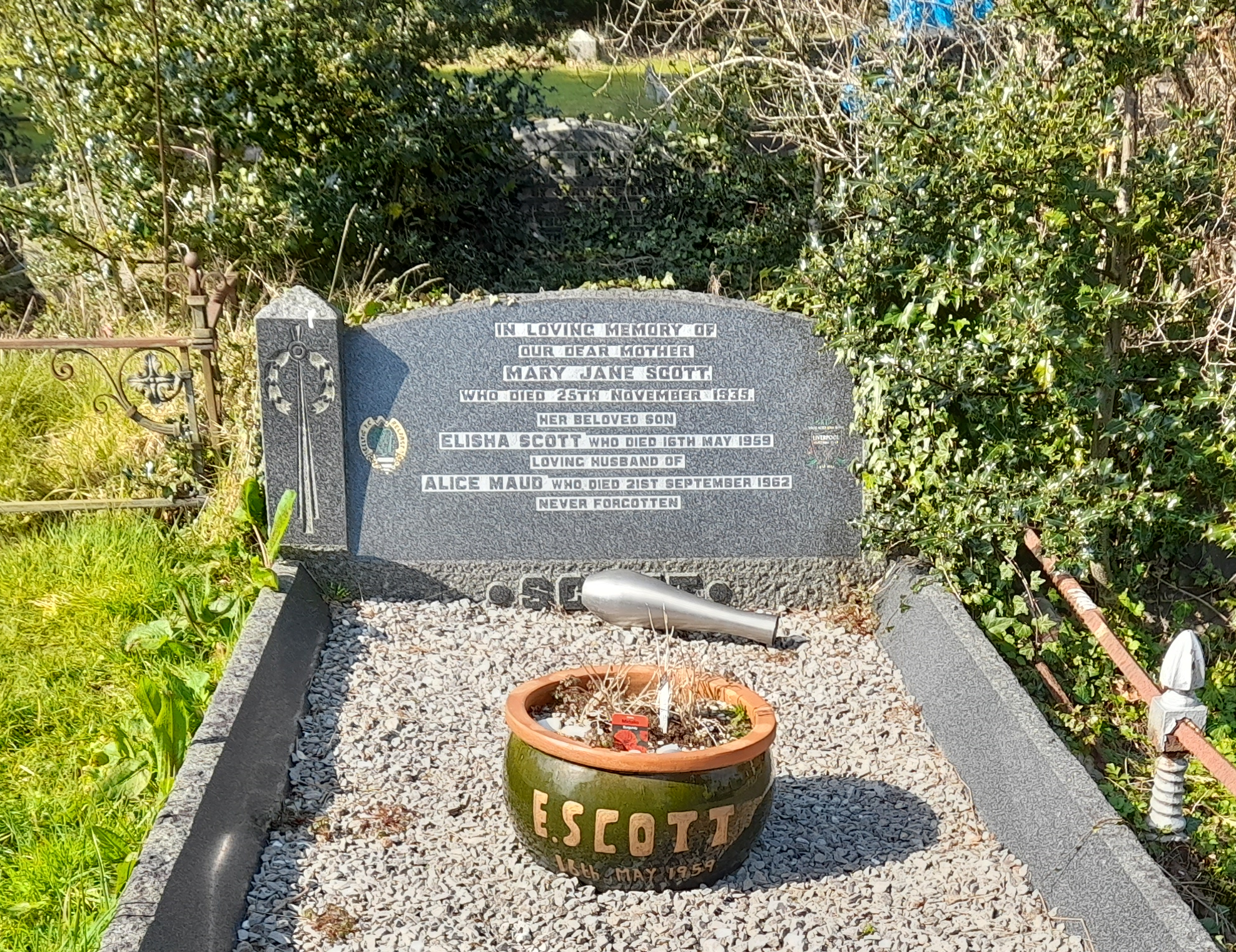
The grave of Elisha Scott, Belfast born Liverpool goalkeeper who played for the club for 22 years and made 468 appearances for Liverpool (which undoubtedly would have been more but for the First World War). He finished his career as a highly successful player-manager of Belfast Celtic until sectarian violence brought about the closure of that club.

The A to Z of Non-Subscribing Presbyterianism – 26 videos telling the story of Irish Non-Subscription

The whole alphabet of Non-Subscription is now available to view on our YouTube channel. This tells the story of Non-Subscribing Presbyterianism in twenty-six chapters looking at a different aspect of the history, ethos, identity, theology or practice of this denomination. Filming began in June and ended in December 2021 with a service going live every week. Filmed at Downpatrick, Ballee, Clough and Dunmurry Non-Subscribing Presbyterian Churches, music has been provided by John Strain, Laura Patterson, Allen Yarr, Alfie McClelland, and Laura Neill. In addition a team of readers have taken part in these services each week including Elsie Nelson, Annabel Cleland, Noelle Wilson, Mary Stewart, Bobby Graham, Robert Neill, Emma McCrudden, and Gilbert Cameron.

The full list of topics covered is as follows:

Abernethy, John

Bible

Collecting Ladles

Doors

Education

Faith

Gifts of the Spirit

Hymns and Hymnbooks

Inquiring

Jesus

Kedron

Lord’s Supper

Montgomery, Henry

New Light

Organ

Pews

Quires and Places where they sing

Remonstrant

Stained Glass

Tokens

Ubi Spiritus Domini ibi Libertas

Verse

Women

eXile

Yahweh

Zechariah

They can all be accessed from this link:

The A to Z of Non-Subscribing Presbyterianism