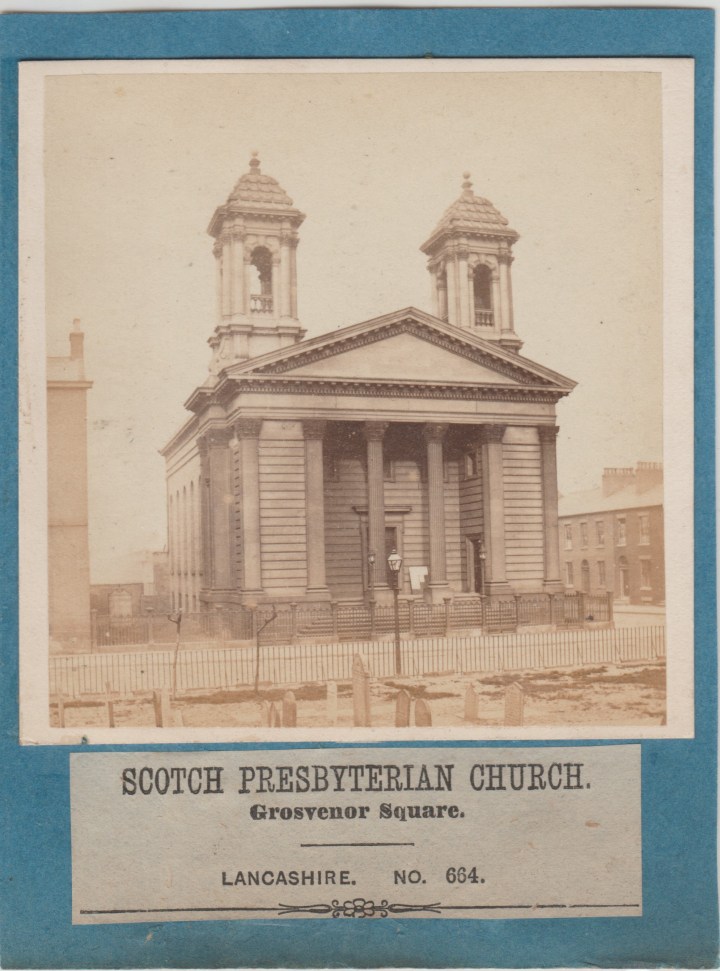
Like the photograph of Platt Chapel in the previous post this picture did not come cheap but it is a very rare, relatively early picture of a long vanished church. I can’t find any other picture of this church as good as this online.
The Scotch Presbyterian Church was situated on Grosvenor Square, near the top of Oxford Road in Manchester, an area that has long been colonised by academic buildings although the square still exists as a small green space. In the centre of the square stood All Saints’ Church and the Presbyterian Church was on the far side of the square, on Lower Ormond Street, the road parallel with Oxford Road. Both churches are long gone the Presbyterian Church ending its days in the 1950s as a wallpaper shop and later as a paint shop before demolition in the early 1970s. All Saints’ was damaged in the blitz.
In the foreground of the picture the graves seen there form part of the church yard of All Saints’ Church. It is an untidy looking area in the picture – there are two lifeless looking trees, denuded of leaves and branches, and the gravestones stand in the middle of a scruffy no-man’s land which is covered in either sand or bare earth amidst clumps of grass. Was it taken in the middle of some building work or renovation or did it always look a mess? Either way it is nothing to do with the Presbyterian Church other than it crops up in the foreground of the picture.
There is a very full set of records for the congregation deposited in Manchester Libraries, Information and Archives. Amongst these the Communicants’ roll books begin in 1832 which suggests a foundation of that date. The pew rents/seat lettings books begin in 1850 when the church was opened for worship, the foundation stone of the new building having been laid on 17th September 1849.
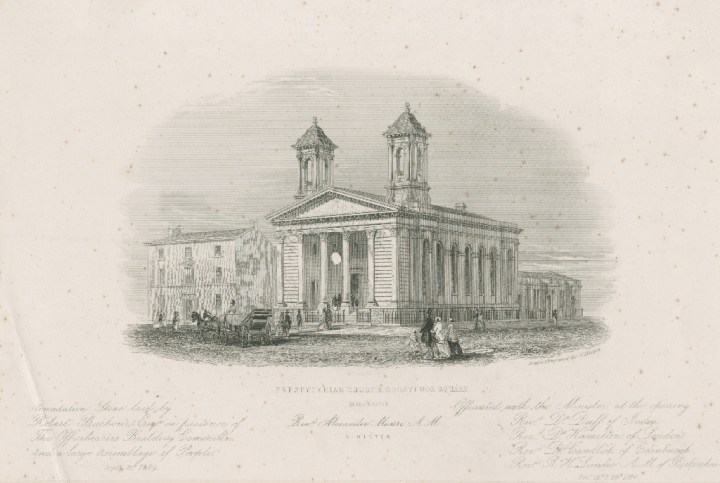
An architectural drawing of the church at the time of its opening (Manchester Libraries, Information and Archives)
The church closed in 1940 and merged with Withington Presbyterian Church to form Withington Grosvenor Presbyterian Church further out of Manchester. This congregation closed in 1971 to form Grosvenor St Aidan’s Presbyterian (later URC) Church in Didsbury (now called simply Didsbury United Reformed Church).
The photograph is quite small, it only measures about 8 cm by 6 cm, but it is very sharp and very old. The sister photograph that shows Platt Chapel dates from before 1874 so there is no reason to date this one to any other period. But here it is, the oldest photograph of the Scotch Presbyterian Church, Grosvenor Square, Chorlton-on-Medlock. Long vanished but preserved in this little study, a very precise architectural photograph taken on a sunny day sometime in the middle of the reign of Queen Victoria.
The original photograph attached to its card
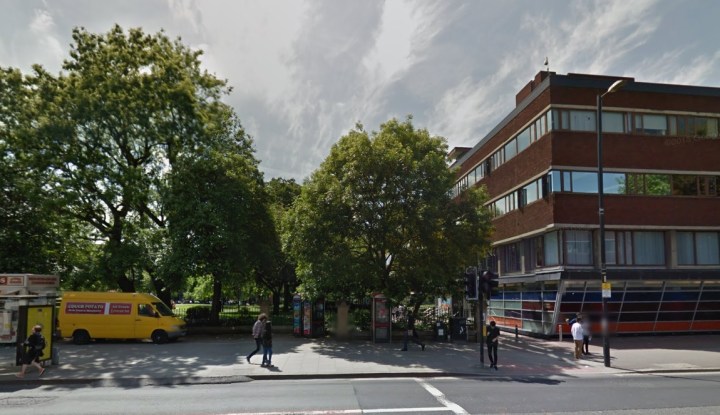
Google Street View, from a position along Oxford Road just past Manchester Metropolitan University, shows this view looking towards where the church once stood. It would have been visible beyond the trees on the other side of the square (now called ‘All Saints Park’).
Google Street View – Oxford Road
No pictures or text may be reproduced from this site without the express permission of the author.
Back in August I wrote about the short but significant life of Jeremiah Horrocks (1618-1641) and his connection with the Ancient Chapel of Toxteth. You can read the post here:
Jeremiah Horrocks is interesting for a variety of reasons but it is a curious fact that as a scientist he has collected memorials in at least four churches around the country, including the Ancient Chapel of Toxteth in Liverpool and Westminster Abbey.
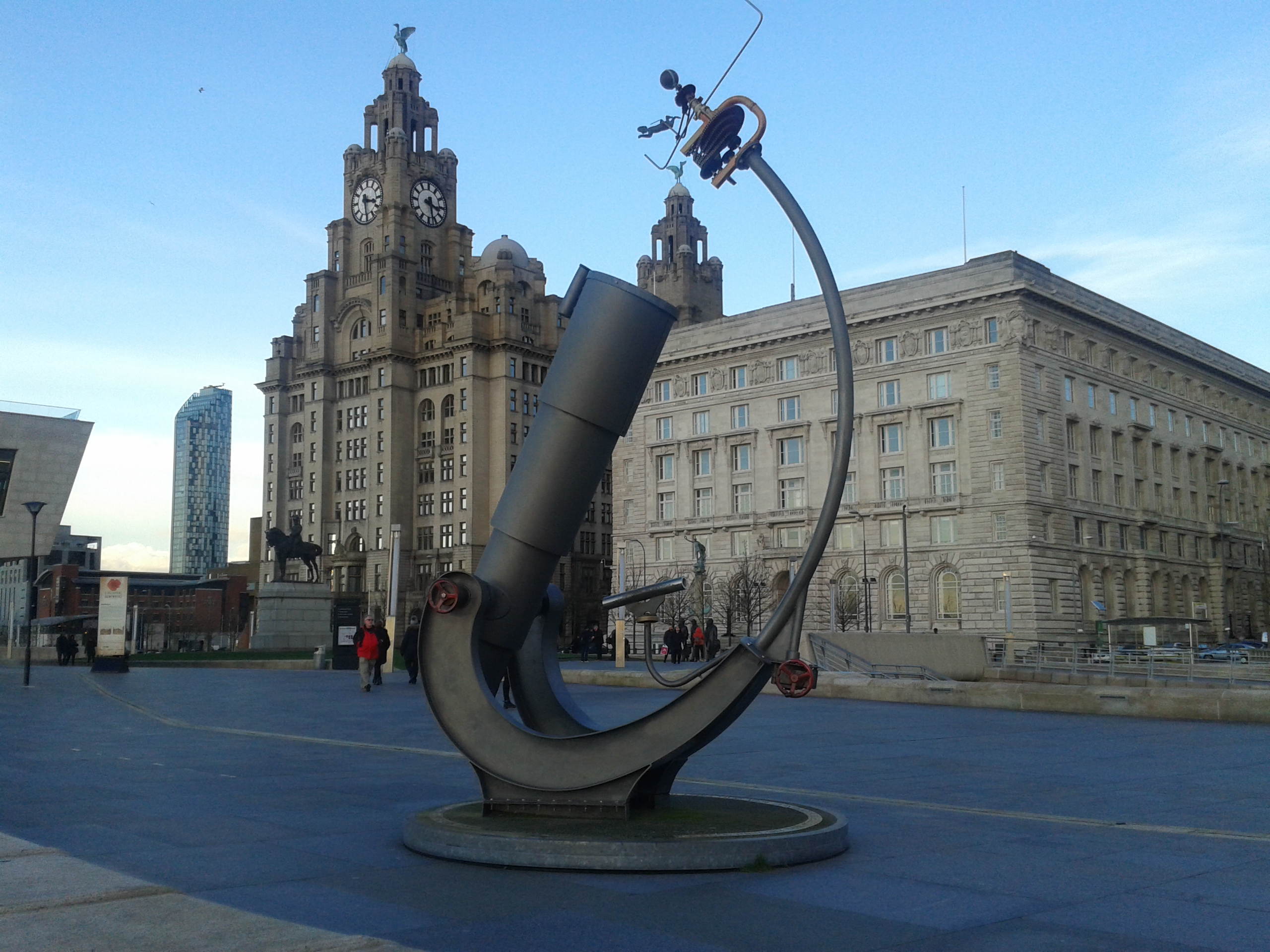
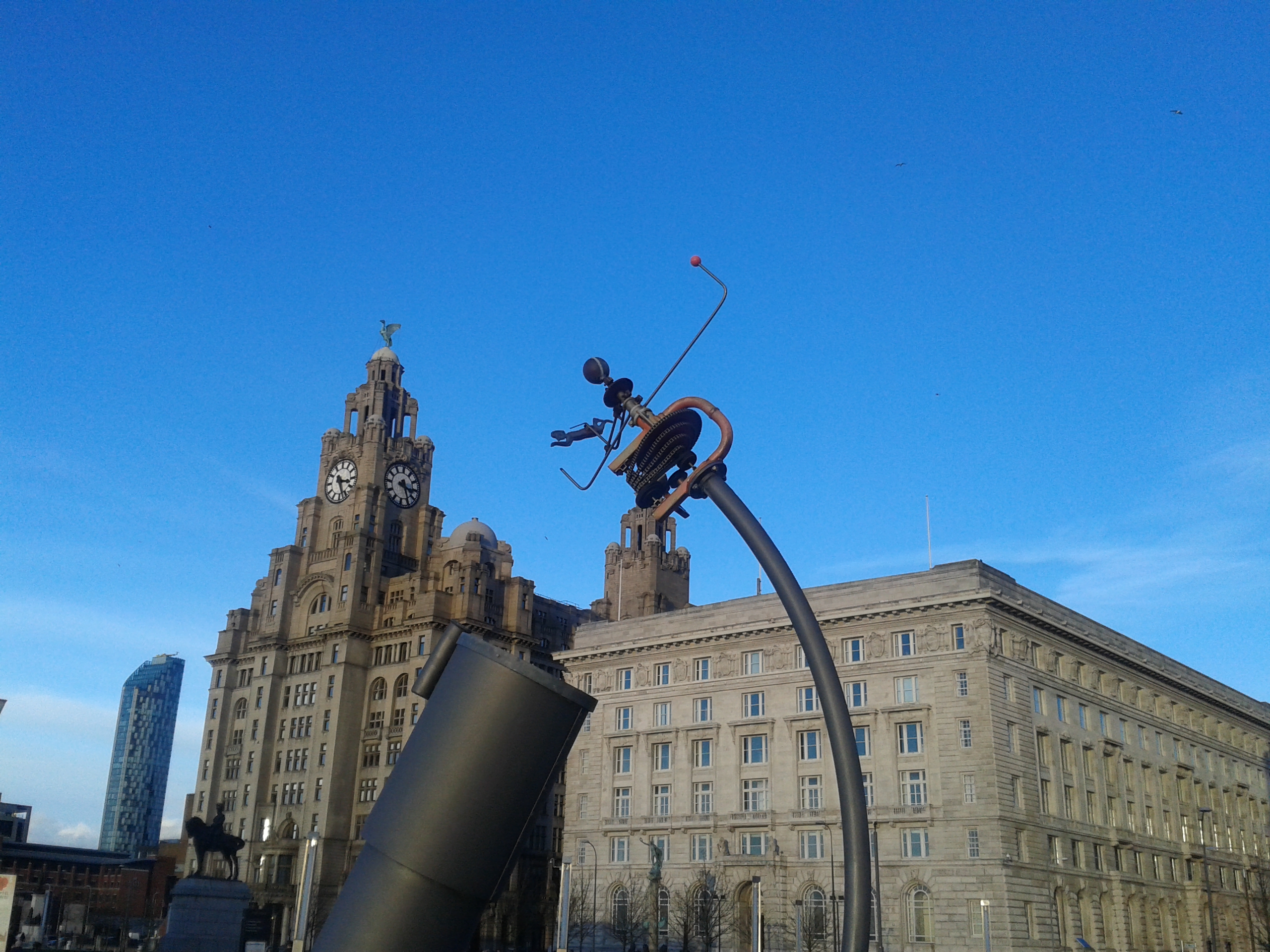
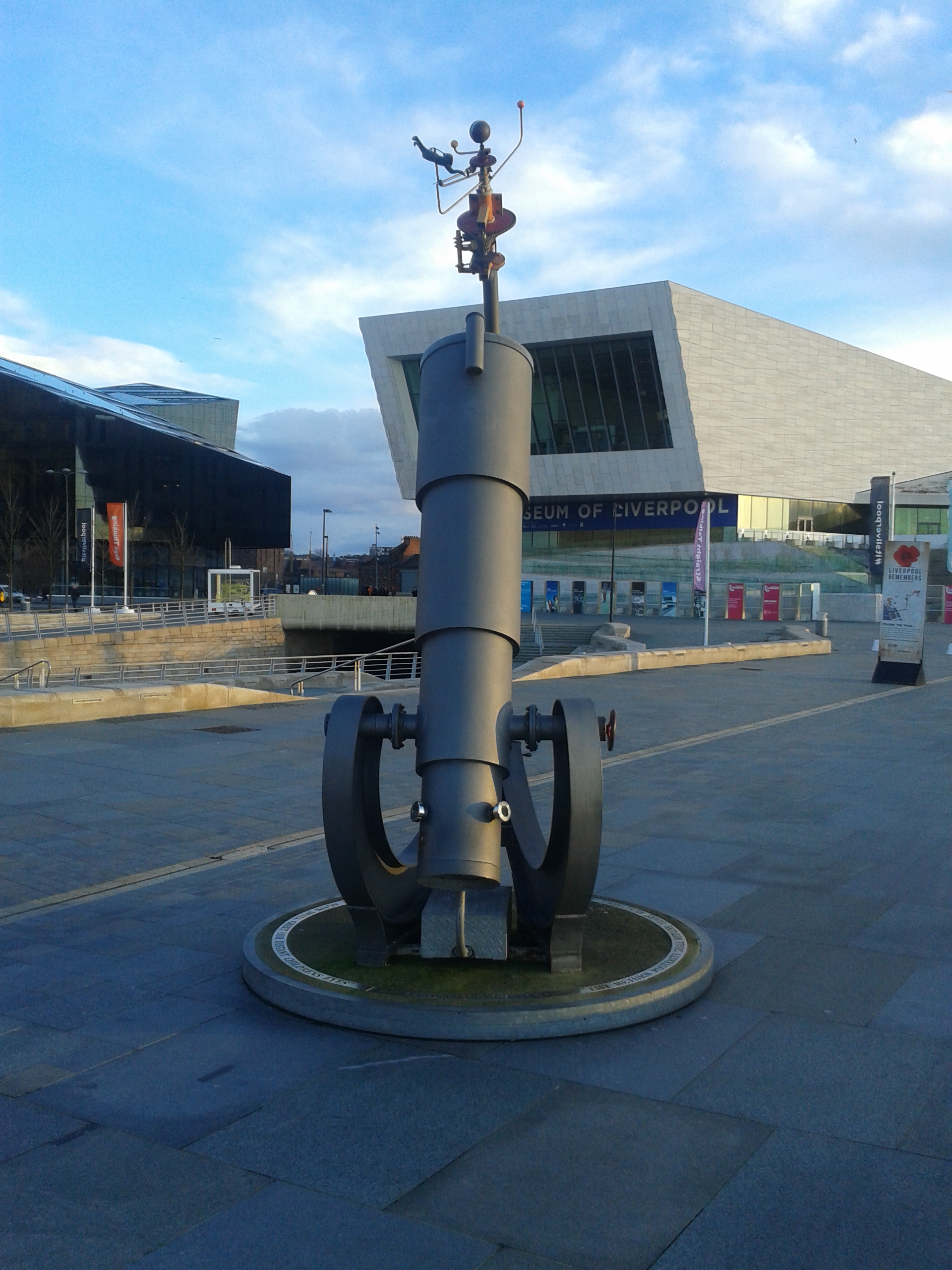
As I also mentioned in my last posting on this topic there are a number of other memorials and commemorations of him in different places, all of them dating from long after he lived. One of the most recent and impressive is near the Pier Head in Liverpool. This is an exciting installation, well-sited in front of the Liver Buildings amongst the ever-growing collection of statuary and memorials that is accumulating there.
Entitled Heaven and Earth and created by Andy Plant the work was installed in 2011. The base is inscribed with the words:
Thy return posterity shall witness, years must roll away, but then at length the splendid sight again shall greet our distant children’s eyes
a quotation from Jeremiah Horrocks’ posthumously published book on the transit of Venus.
The sculpture has a working hand powered mechanical orrery, the position of Venus has been replaced by a copper angel version of Jeremiah and as his wings flap he orbits the other planets. Inside the large telescope there is a video animation of the life of Jeremiah by Tim Hunkin.
Unfortunately when I visited the sculpture on a crisp January afternoon this year none of these features were working. They may not have been intended to function beyond the time of the original exhibition of which the sculpture formed a part, I don’t know. But Tim Hunkin is something of a genius and it is great to think that some of his work is part of the installation. In fact you can read about how Tim Hunkin created A Short Life of Jeremiah Horrocks and see the animation on his own website here:
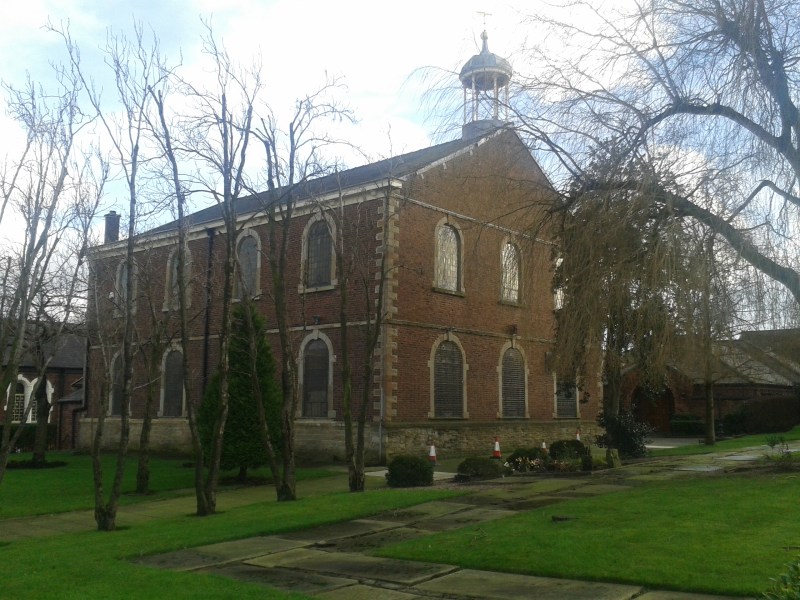
The building of Chowbent Chapel in 1722 speaks volumes for the determination of Lancastrian dissent in the early eighteenth century. Having retained possession of the chapel of ease after the ejections of 1662 it wasn’t until the 1720s that the local landlord managed to expel dissenters from the essentially Anglican chapel, allegedly because of the part played by the minister ‘General’ James Wood and his congregation in suppressing the Jacobite rebellion of 1715.
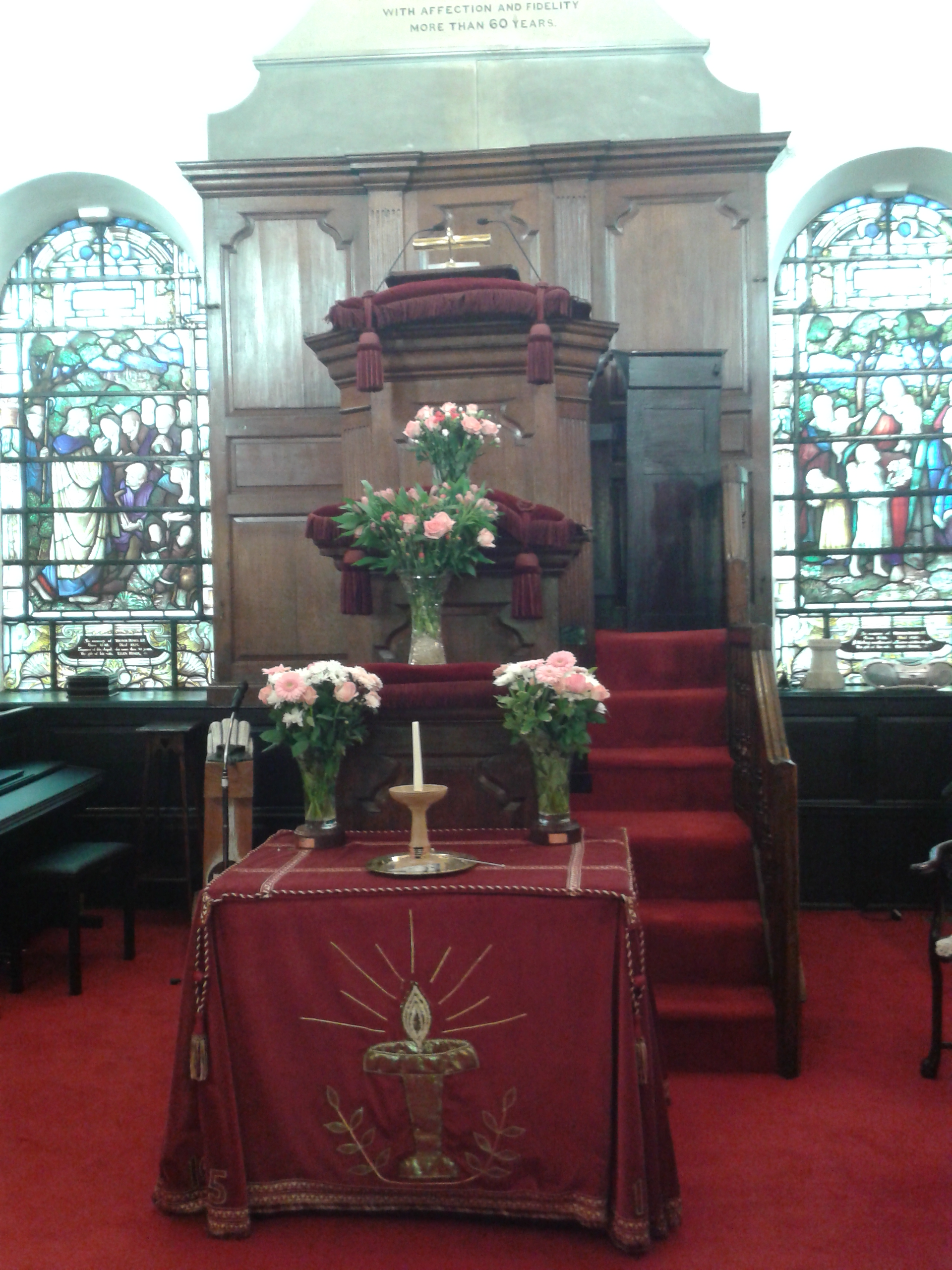
The eighteenth-century three decker pulpit
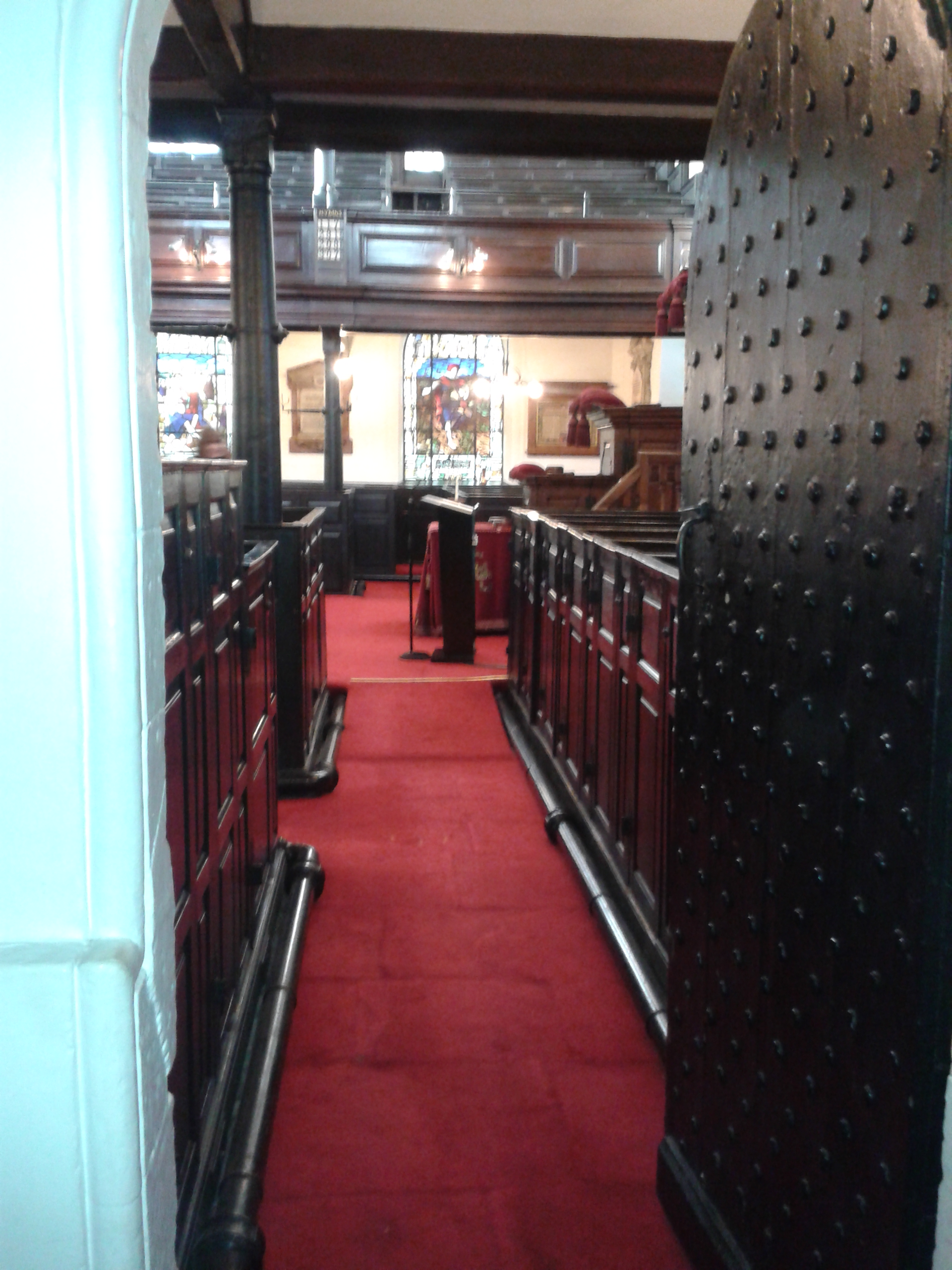
The new chapel was built on land owned by the Mort family who appear to have been generous supporters and benefactors and who had a great importance in Lancashire non-conformity in general. But the chapel, to me at least, always has something of the sense of a fortress about it – the solid, square walls, the ancient oak pillars, the studded door into the church, the large memorial to ‘General’ Wood above the pulpit.
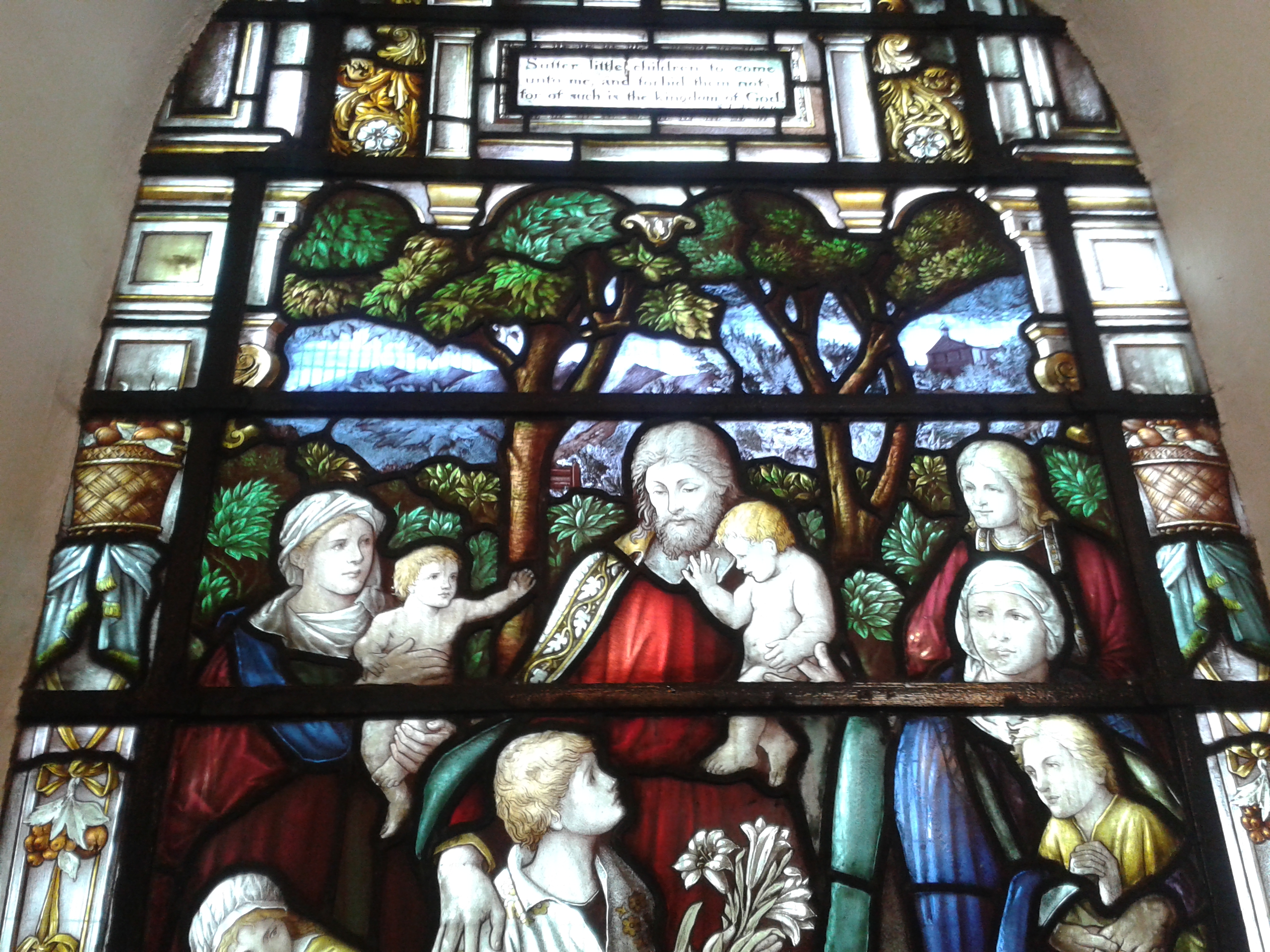
But it is also full of interesting details that would be easy to miss. There is a large amount of stained glass but I had forgotten about the appearance of an image of the chapel itself in the window depicting Jesus and the children. The three decker pulpit is incredibly impressive and with the traditional pulpit cushions very much looks the part still. You can’t miss the pulpits and reading desk but you might miss the small section of panel cut out from behind the top pulpit. Here it was said they had to make space for the door to open wider in order to admit the well-fed frame of the Rev Thomas Belsham when he visited in the nineteenth century!
The Victorian stained glass window featuring the picture of the chapel
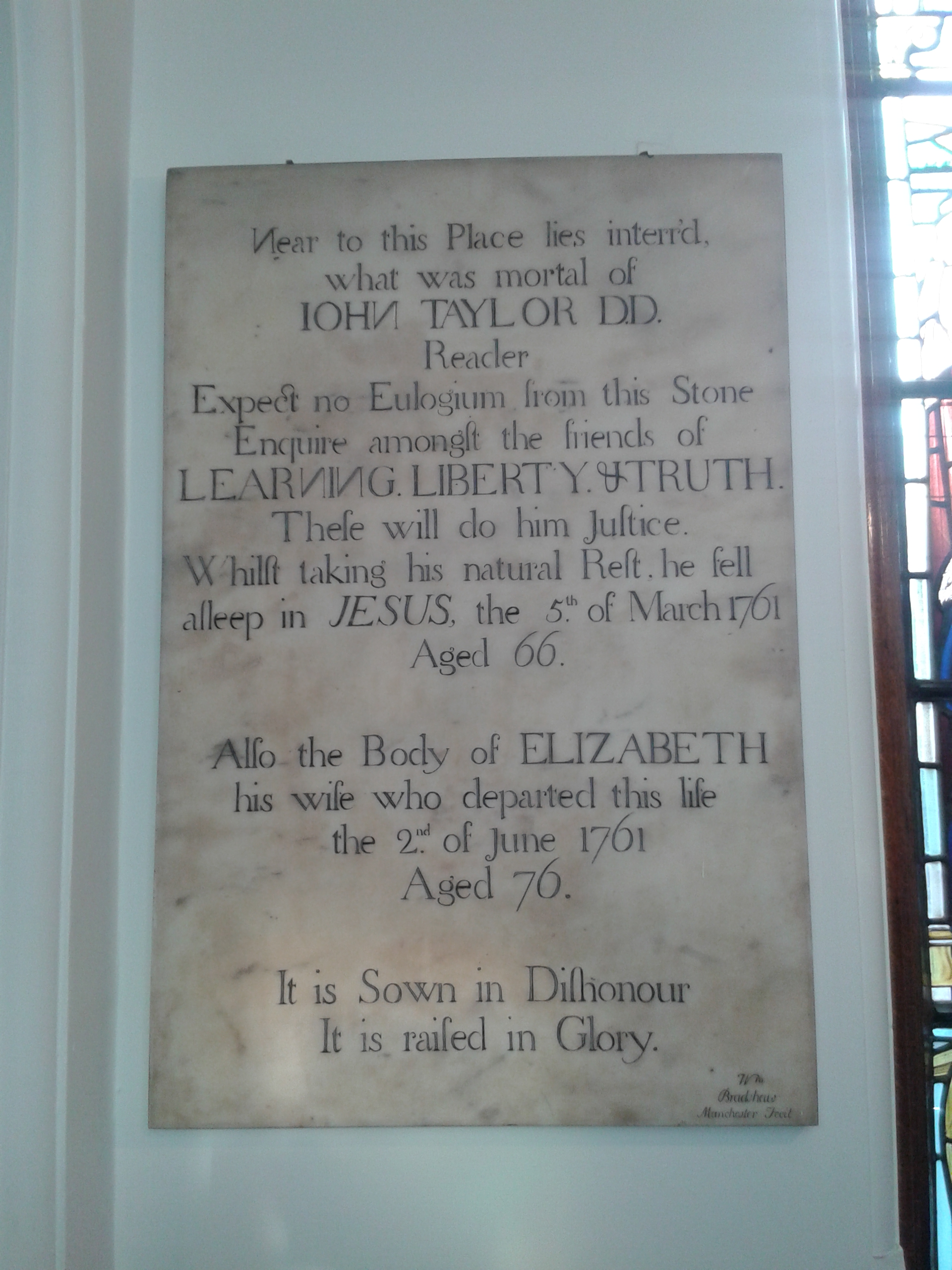
It has been some years since I was last at the chapel and I had a recollection of seeing the grave of the Rev John Taylor laid flat in the grounds of the chapel. John Taylor being the first Tutor in Divinity at the Warrington Academy. But this is not the case – John Taylor is certainly buried there but his gravestone was removed when the front of the church was extended to make way for the organ and vestibule in 1901. There is however, a touching memorial to him and his wife.
Memorial to John and Elizabeth Taylor
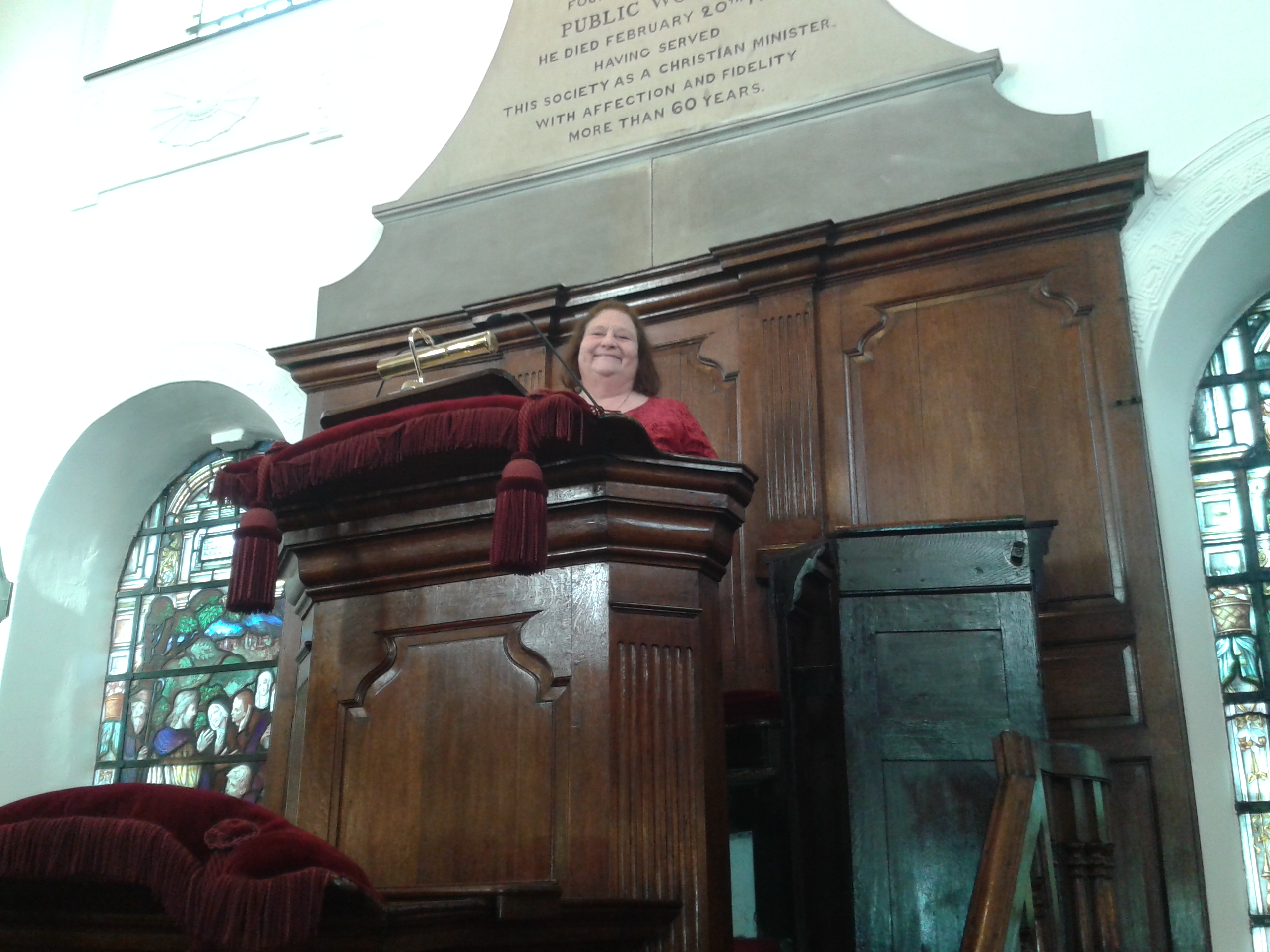
The reason for my visit in January was to be part of the congregation to celebrate 25 years of ministry by the Rev Brenda Catherall and I was delighted to play a small part in that special service. Brenda has been minister there since 2007 following ministries in Bank Street, Bolton and Monton and has given 25 years of devoted service to the Unitarian ministry and touched the lives of a great many people through her outstanding work. There is something so appropriate about her ministry in the congregation in which she grew up and which has always had a special place in her affections.
Rev Brenda Catherall in the pulpit
The chapel encapsulates the proud tradition of dissent and non-conformity in the town and it is so encouraging to see the congregation in such good heart and in such good hands.
It was a tremendous privilege and pleasure to take part in the induction and ordination of the Rev Philip Waldron as minister of Ullet Road Church, Southport and Wirral Unitarians as part of the Merseyside Partnership at Ullet Road on Saturday, 9th January.
Rev Phil Waldron in the chancel
It was an impressive service that drew on the traditions and ethos of Unitarianism on Merseyside and which resonated effectively with the august building that is Ullet Road Church. It is testimony to the high regard in which Phil is held by his colleagues that so many ministers took part and that so many people were present. The music supplied by the organ and the singing by the choir Liverpool Voices were also of a very high standard and added greatly to the service.
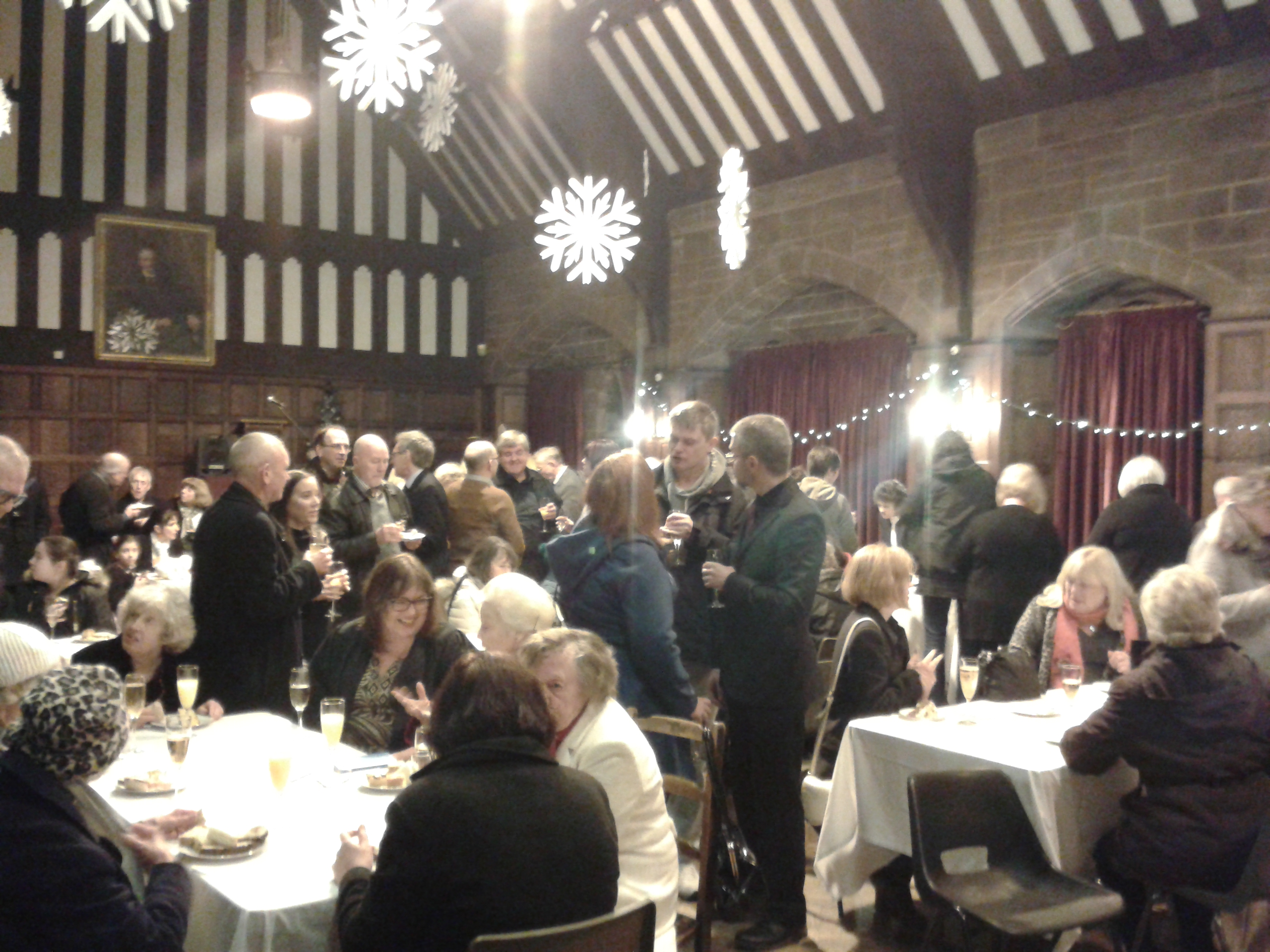
Refreshments after the service in the hall
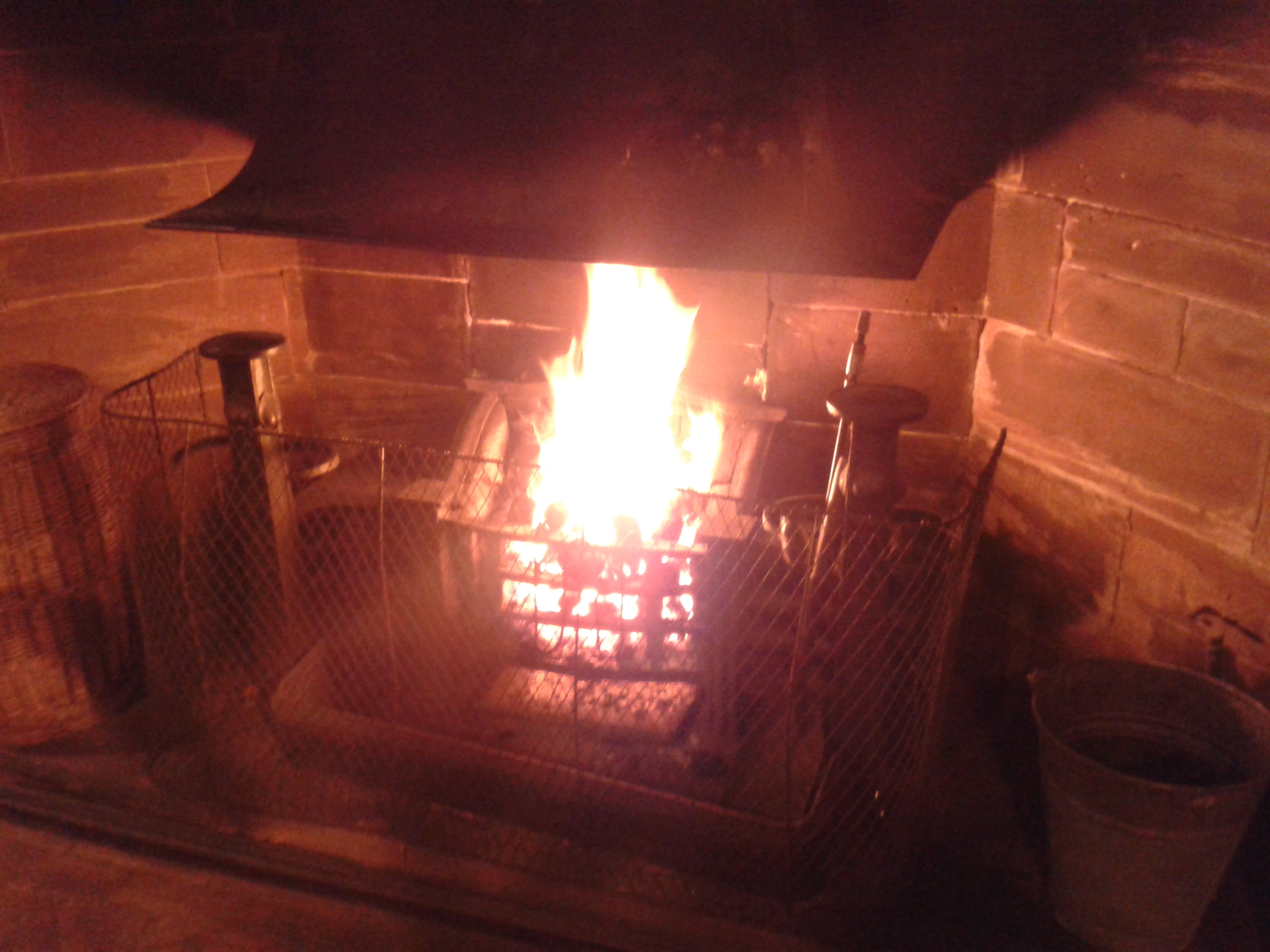
Ullet Road is certainly one of the most remarkable sets of buildings within the Unitarian tradition in England and ranks highly amongst all branches of dissent. The hall, designed by Percy Worthington and built slightly later than the Church at the start of the twentieth century, is a delight in itself. On occasions such as this (with appropriate winter decorations left over from a wedding) it really comes into its own with the feel of something like a medieval hall, not least because of the open fire that provides such a focus.
The fireplace in the hall which stands beneath the Arms of Sir John Brunner and Sir Henry Tate
In the course of his own statement Phil quoted the Rev Stanley Mellor, the highly successful minister of Hope Street Church in the first half of the twentieth century, which encapsulates some of his own aspirations for ministry:
“[the purpose] of the Christian religion, is the awakening of the soul to the discovery of its own eternal character, the conversation of the heart to knowledge of its other-worldly destiny and duty.”
The congregation are much blessed to possess such a building that reflects this quest so effectively and Merseyside District can look with satisfaction upon such an auspicious start to a new ministry.
In his excellent short article on Jeremiah Horrocks in the book Liverpool Unitarians Faith and Action Bernard Cliffe is very cautious about making too many definite assertions about his life. As Bernard puts it “an account of the life of the boy and the young man has to be a matter of conjecture, with the generous use of qualifying words.” The truth is we have very few hard facts about the life of this pioneer astronomer who died at the young age of 22. Inevitably though this hasn’t stopped others from drawing all sorts of conclusions about his life.
One of the things we do know for sure was the extent of his achievement as a youthful astronomer – indeed there are some parallels here with the life of Clyde Tombaugh who first identified Pluto in his 20s. Clyde Tombaugh now has a feature on Pluto’s surface named after him while Jeremiah Horrocks himself has been memorialized in a number of places since his initial observation of the transit of Venus across the Sun.
Horrocks’s discoveries were only published posthumously and, gradually, in the centuries after that, places – and churches – were keen to claim him as one of their own. But his scientific importance is pretty well established. Allan Chapman (in ‘Jeremiah Horrocks, the transit of Venus and the ‘New Astronomy’ in early seventeenth-century England’, Journal of the Royal Astronomical Society, 1990, 31) says that despite a scientific hagiography that has also built up around him “the plain fact [is] that his documented contributions to astronomy were formidable by any standard…he was one of the first men in England to grasp the significance of what was going on in contemporary European astronomy. Not only did he repeat many of the techniques of Kepler and Galileo, but he went on to develop the New Astronomy to produce conclusions which substantially advanced those of its continental founders” (pp.33-334).
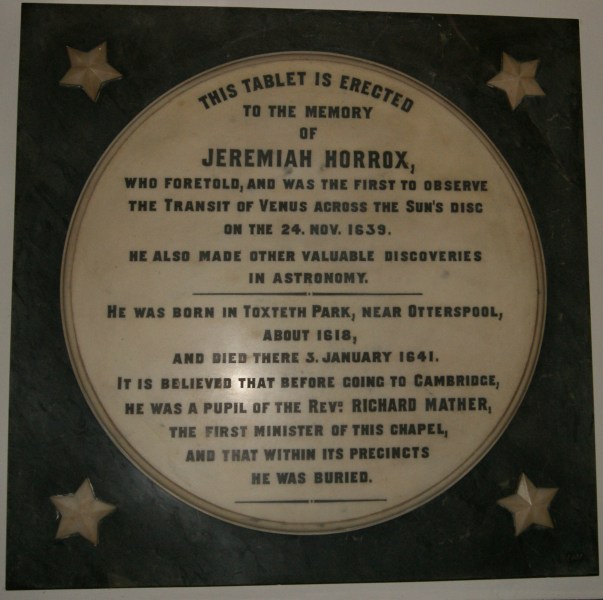
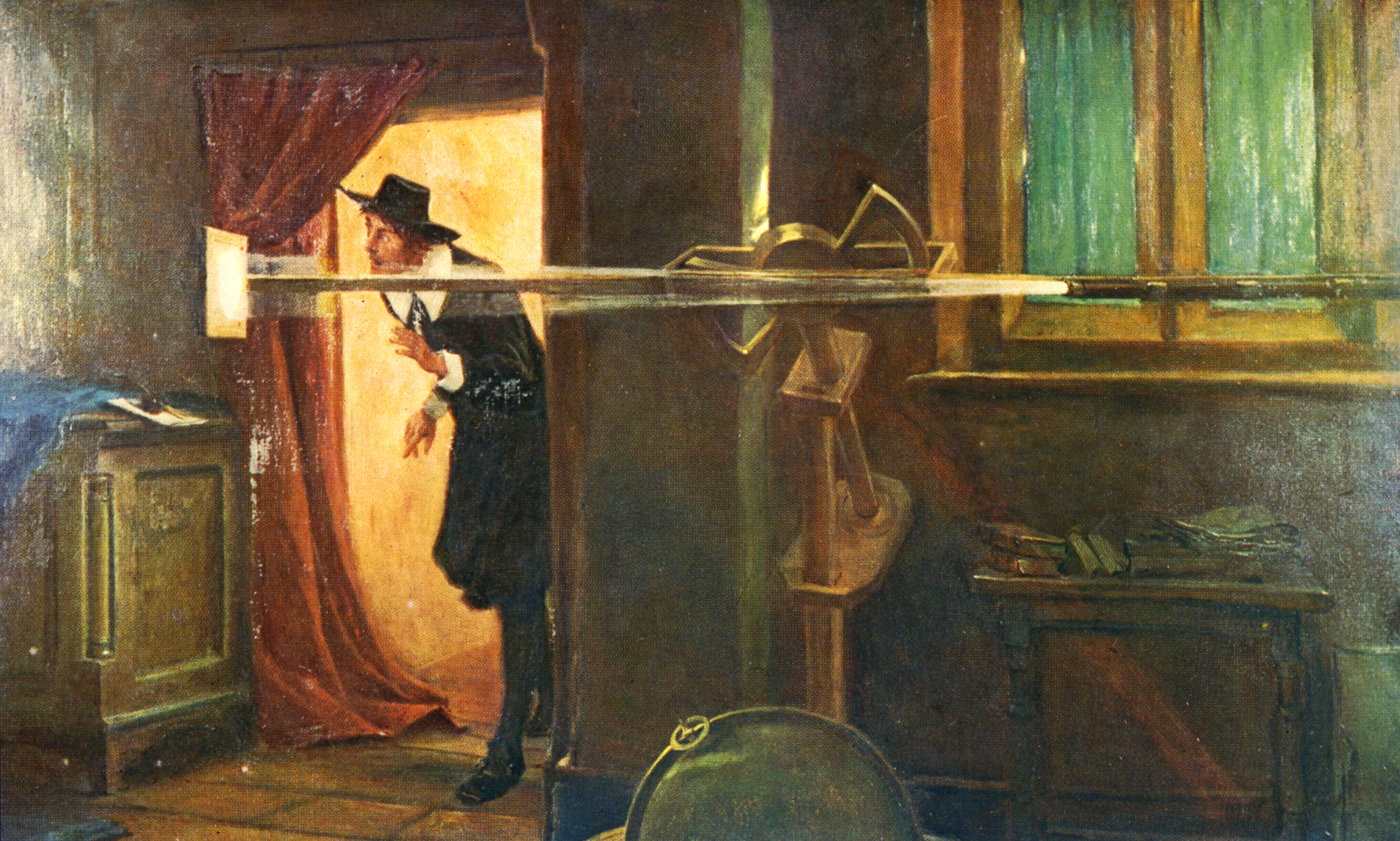
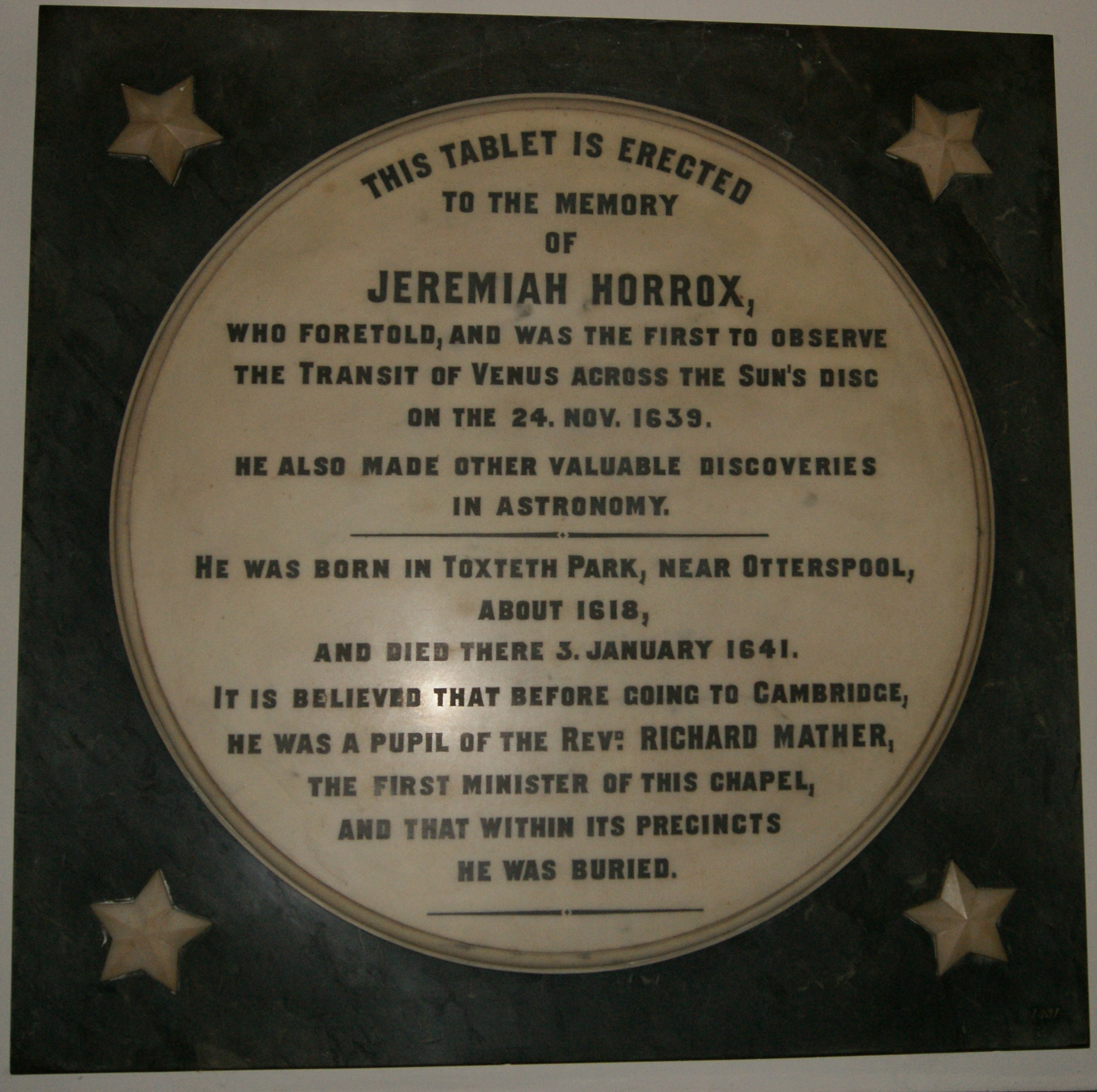
A plaque in the Ancient Chapel of Toxteth records that Jeremiah Horrocks (or Horrox) “foretold, and was the first to observe the transit of Venus across the Sun’s disc on the 24. Nov. 1639”. But the plaque, which was put up in 1891, is, in fact, only one of four church memorials to him around the country.
A Victorian depiction of Jeremiah Horrocks observing the transit of Venus
Without doubt the best known of these is in Westminster Abbey erected opposite that of Isaac Newton (who had praised his work) in 1874 following a petition from the Council of the Royal Astronomical Society (actually inscribed on part of the marble monument to John Conduitt, who was married to the niece of Isaac Newton). Certainly the Abbey is a fitting place for a memorial to such a person. On it his scientific achievements are listed but it also states that he was “Curate of Hoole”. Now there is no doubt that Hoole is where Jeremiah Horrocks lived for a while and where he observed the transit of Venus. But there is no evidence that he was ever curate of Hoole, or indeed an ordained clergyman of any sort.
The Victorians were not slow to extend or embellish their assessment of his religious affiliations. The church at Hoole has its own memorials too including a Horrocks Chapel, memorial windows, a weather vane and a plaque, although the website of St Michael’s Church, Hoole now describes the text of this plaque as “largely fictional”.
Jeremiah Horrocks seems to have spent about a year in Hoole. Rather than being a curate or holding any position in the church he was probably a tutor to the children of a local family, in whose home he observed the transit of Venus. But there can be little doubt that he will have attended the church at Hoole while he was resident there. At the time there will have been little difference in the theological outlook of Hoole and the Ancient Chapel of Toxteth. Both were centres of Puritanism – comprising earnest, godly, and devout parishioners, in both places members being technically part of the Church of England (there was little leeway to be anything else at the time) but possessing a no-nonsense approach to faith and a fair degree of suspicion of ecclesiastical hierarchies. During his time there the church was still a just a chapel of ease and the curate (later rector) was eventually ejected for non-conformity.
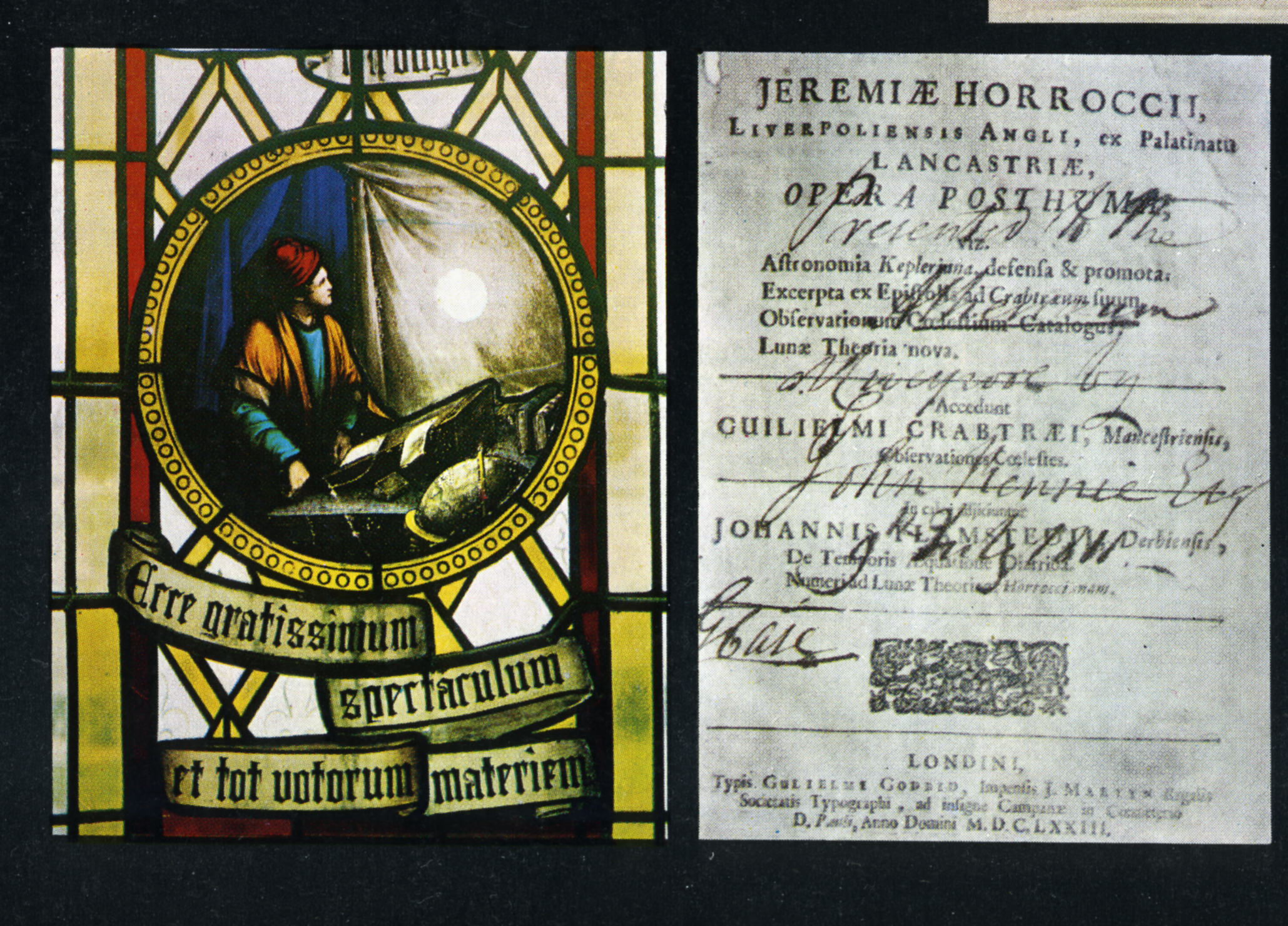
The stained glass window at Hoole Church and the title page of Horrocks’ posthumous work
Although no records of Horrocks’ baptism or burial survive he seems both to have been born and died in Toxteth where his family names illustrate the Puritanism of his background. The names of Horrocks and Aspinwall (his mother’s maiden name) were amongst those puritan settlers who arrived in Toxteth in the late sixteenth century and began clearing the hunting park and built the chapel. They were part of the group who called Richard Mather to be first their schoolmaster and then their minister. The same Richard Mather was reluctant to accept Episcopal ordination. He eventually did so but was alarmed after being ordained (so the story goes) when the bishop approached him and asked to speak to him in confidence. Fearing that some admonishment was imminent he was surprised instead to hear the bishop say “I have an earnest request unto you, and you must not deny me; it is that you will pray for me; for I know that the prayers of men that fear God will avail much, and such an one I believe you to be.” Despite this unusual alleged exchange with the bishop he was eventually suspended for nonconformity and subsequently left with many of his followers for New England.
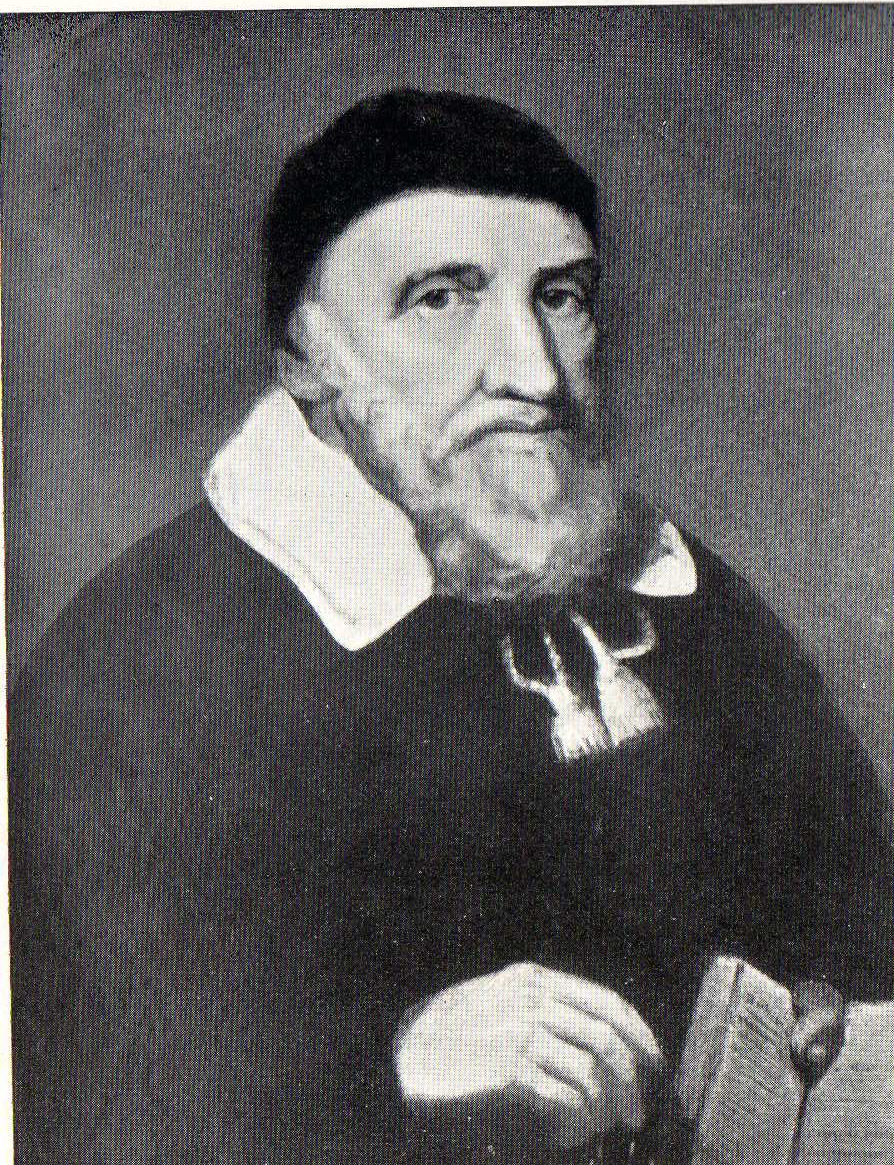
Richard Mather
It was probably here that Horrocks was educated and his religious opinions formed. From Toxteth he went to Emmanuel College, Cambridge as a sizar, basically the lowest form of student life, working as a college servant alongside his studies. He left without taking a degree but developed a passion for astronomy while there and was soon manufacturing his own astronomical instruments. Members of the Horrocks family, quite probably including his father, were watchmakers which must have been an assistance in developing precision instruments.
But following his death on 3rd January 1641 two hundred and fifty years were to pass before the Ancient Chapel erected its own memorial in his memory.
But this is not the only church memorial to Jeremiah Horrocks in Liverpool. In 1826 Moses Holden, described by the Oxford Dictionary of National Biography as a “popular astronomer,” used the proceeds of one of his lectures to pay for the erection of a memorial tablet in St Michael’s in the Hamlet church in Aigburth, not far from the Ancient Chapel. It may well have been awareness of this tablet that encouraged the Unitarians to put up their own. Holden seems himself to have been a Methodist lay preacher but was on good terms with the established church. Nevertheless Jeremiah Horrocks can never have had any connection with St Michael’s in the Hamlet, since it was not founded until 1815.
Horrocks is commemorated in other ways too – additional memorials in Hoole and Liverpool; an observatory; an institute of the University of Central Lancaster – but it is curious how a variety of religious traditions have all sought to harness him for their own adornment. All of them have some claim on him but – in my view at least – it is the memorial that is the least known and acknowledged, the one in the Unitarian Ancient Chapel of Toxteth, that is most appropriate. Not because he was a Unitarian – because he wasn’t, such an idea would have been absurd to him. Not because he was a dissenter, because he wasn’t that either. As I have suggested his own views were almost certainly very strongly puritan and he held them within the context (technically at least) of the Church of England. But the little chapel in Toxteth Park was the place where he grew up and was educated. He was therefore part of a particular religious community founded in the last years of the sixteenth century and continuing ever since. The memorial to Jeremiah Horrocks was unveiled on Sunday, 11th October 1891, the minister, the Rev Valentine D. Davis preaching a sermon based on Genesis ch.1 v.1,3:
In the beginning God created the heavens and the earth. And God said, “Let there be light”; and there was light.
The Memorial to Jeremiah Horrocks in the Ancient Chapel of Toxteth, Liverpool
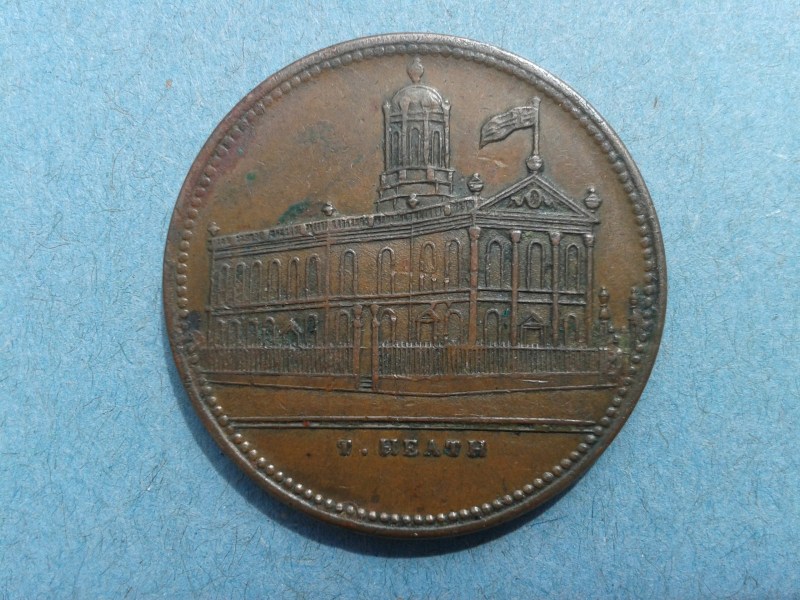
I wonder how many Unitarian churches have their images engraved on the reverse of a coin? I only know of one example, it is not a particularly beautiful example of the medallist’s art but it is very interesting and tells an unusual tale.
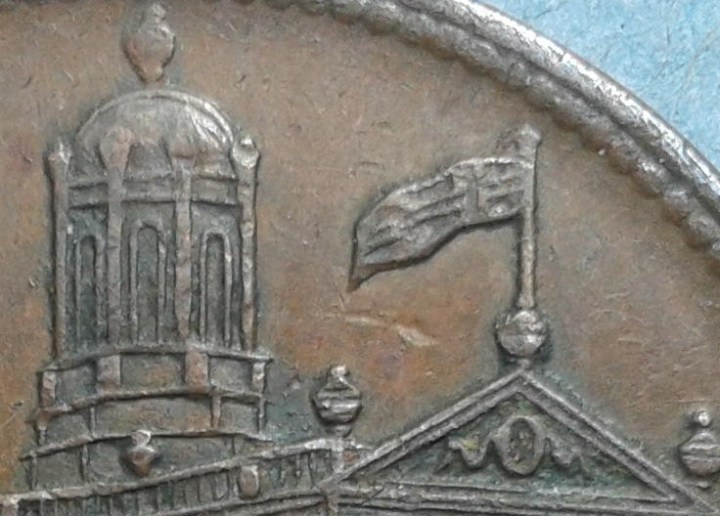
The reverse of the token
The church in question is Paradise Street Chapel in Liverpool, now long demolished, indeed the whole street has disappeared under the shopping development known today as Liverpool One. But Paradise Street was built in 1791 and was a dissenting church of some importance in Liverpool at the time. In the nineteenth century no less a person than James Martineau became the minister – a fitting appointment to a congregation that was cultured, wealthy and influential. They had built their meeting house on the grand scale, with a central cupola it was octagonal with a classical frontage and adorned with elegant stone urns along the balustrade. Martineau arrived in 1832 and established a name for himself as a preacher, teacher and philosopher linking up with other prominent figures in Liverpool and the north west including John Hamilton Thom, Charles Wicksteed, and John James Tayler.
Close up of the Chapel
But partly through the changing environment around the old chapel, which had become more commercially orientated and less like an area the well-to-do might want to visit, and partly also because of the more devotional worship that Martineau introduced, the congregation felt a need to abandon their old church and build something new. Accordingly a grand gothic church was built on Hope Street and Martineau and his congregation departed to their new home, selling the old place off. (For Hope Street Church see my earlier post – the Church on Hope Street).
James Martineau and his congregation, perhaps out of financial necessity from building anew on an extravagant scale, showed little sentimentality in disposing of their old place of worship. Yet one can’t help suspecting that a man of such high-brow intellectual tastes as Martineau can hardly have approved of the new use to which the old chapel was now put. It was purchased by a man called Joseph Heath who intended to turn it into a music hall.
After the Unitarians left it in 1849 the spacious chapel, with its well-constructed gallery all built of the finest materials and to the highest standards, was converted into the Royal Colosseum Theatre and Music Hall. The pews were re-used for seating and one can see how a large chapel could easily be adapted for use as a theatre. However, Joseph Heath must have been an ingenious individual because he managed to turn Paradise Street into the first multiplex: there were twin auditoria for both a theatre and a music hall. According to The Liverpool Stage by Harold Ackroyd the theatre “presented what were described as full blooded dramatic plays for a patronage of mariners”, while the front part of the old chapel was converted into a music hall where variety performances were put on “well suited to the taste of those for whom Mr. Heath catered.”
Detail of the tower
One can’t imagine Martineau really approving of such an undignified end to his old church but there was greater indignity to come. The Colly, as it became known, was reputedly haunted, an association encouraged by the continuing presence of the chapel’s graveyard around the building. This also presented a practical advantage to the thespians. According to Harold Ackroyd again: …there was never any shortage of a skull during a performance of Hamlet. These were easily obtained, the artists’ dressing room, below the stage, formerly having been a grave vault, the artist had only to put his hand through an opening in the thin dividing wall, to seize hold of the grisly relic, as did Hamlet.
So it was the music hall owners who had the coin engraved with the unmistakable likeness of the Paradise Street Chapel. The Heath family owned the former chapel until about 1895 although it went through a number of refurbishments and changes of name in that time. But it remained known as the Royal Colosseum Theatre until 1875 at which time it was being run by Thomas Theodore Heath, Joseph’s son. Presumably this is the ‘T. Heath’ whose name is inscribed on the coin as the owner of the theatre. This would date the coin to the early 1870s when it functioned as an admission token for those eager for Victorian melodrama or the bawdy delights of an evening at the music hall. On the other side of the coin is a Liver bird, a belt and the name of the theatre. Some examples of the coins have a large letter ‘H’ stamped on them. I don’t know precisely what this indicated, at first I thought it was a reference to a seat or a row or an entrance but ‘H’ seems to be the only letter used in this way and it rather spoils the look of the engraving. Whatever meaning it had to the person at the theatre door this is now long forgotten.
An example of the coin with the letter ‘H’ stamped on it
By the late 1870s the theatre was said to be able hold 3,000 people, and must have been returned to a single auditorium, but at this stage in its history it was struck by a terrible tragedy. On the night of 11th October 1878, during a performance before a full house, a portion of the ceiling fell onto the pit and caused panic amongst the audience. Thirty-seven people were killed in the crush to escape and many more injured. Pictures in the Illustrated London News at the time show a building that was already extensively remodelled from the one that appears on the back of the token but it had fallen victim to the sort of tragedy that was not unknown in Victorian Britain. Following this the theatre was rebuilt, frequently renamed and continued in use up to the First World War. By then known as Kelly’s Theatre, it finally closed its doors in October 1916 and was sold to Cooper’s Ltd who used it as a warehouse for their greengrocery and restaurant business.
The whole story of Paradise Street Chapel and the Royal Colosseum Theatre was brought to a close by a German bomb during the blitz of 1941. Precisely how much of the building of 1791 had survived within the much enlarged edifice is hard to know but by then the building’s origins as a place of worship were hardly remembered. The link is maintained though by these little tokens which record a small element of theatre history and, almost by accident, help to preserve the image of a building that had a quite different history and purpose.
(This is an amended version of an article that first appeared in the ‘Inquirer’ 4 July 2015)
I probably first came across the Unitarian Van Mission in the late Professor R.K. Webb’s masterful survey of ‘The Unitarian Background’ in the 1986 volume Truth Liberty Religion. Essays celebrating Two Hundred Years of Manchester College (edited by Barbara Smith). However, the end of his chapter takes on a very negative tone where he describes “precipitous decline” being caused by the “attenuation and fragmentation of Unitarian doctrine”. In this context he mentions “the touching Van Mission that wended its slow way through the country in the years after 1906”.
This really is a slightly patronising view of the Van Mission and, of course, is not really fair. From the perspective of the late twentieth century anything that relied on horse drawn power could be regarded as touching and slow. But in 1906 people would not regard such a mission in any such way.
It is clear from the response to my previous post that there is a great deal of latent interest in the Unitarian Van Mission. It is also the case that there is the material for a serious research project on it. John Roberts’ useful investigation into the Van Mission in the 1978 Transactions of the Unitarian Historical Society is just about the only thing that has been written on it since the First World War. I don’t have much else to hand that can shed light on the Van Mission but the one thing I do have is the special centenary edition of the Christian Life from 1913 – a single issue of that magazine that never fails to provide something of interest.
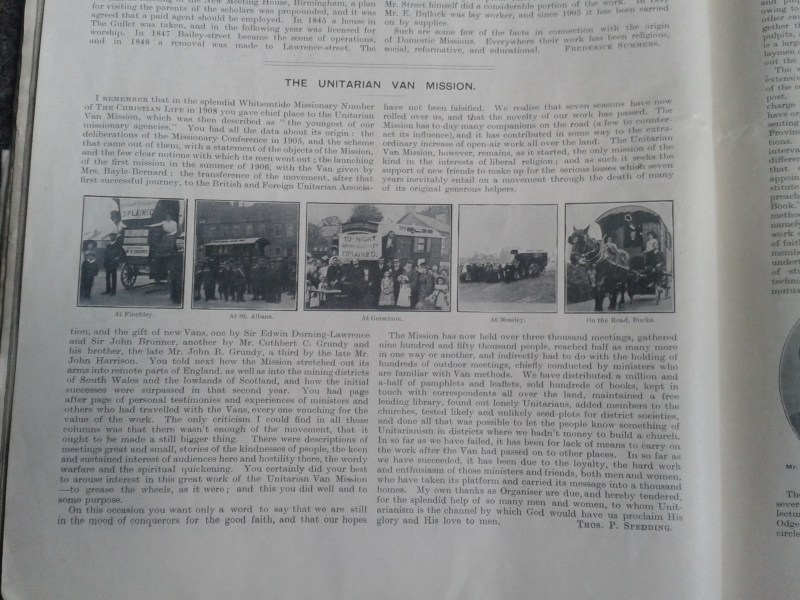
It was published to mark the centenary of the Trinity Act and includes a vast amount of material. One of the shorter sections – only about half a page – is that on the Unitarian Van Mission written by the Rev T.P. Spedding and accompanied by five fascinating, if frustratingly small, images. The article is, like almost everything in that issue, quite relentlessly positive and upbeat. In part this reflects the celebratory nature of that publication but it also reflects the underlying truth – they were positive, things were going well, they didn’t know the world stood on the brink of a brutal world war, and they had every reason to feel that in religious terms their ideas, if not all-conquering, were at least gaining a positive reception and winning ground.
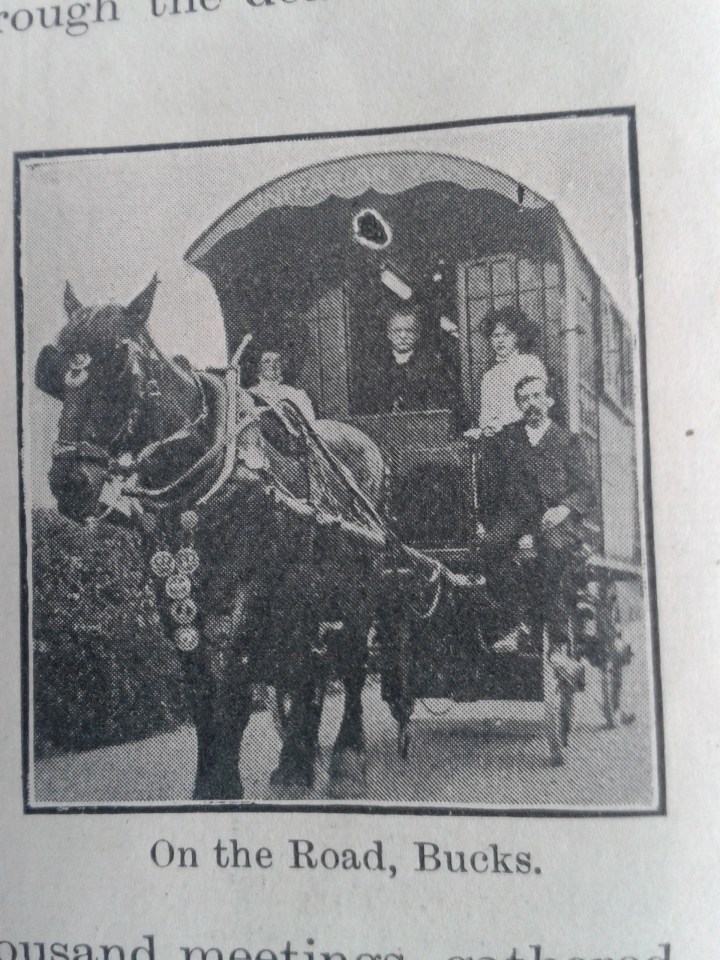
The Van on the move, the horse with its brasses and the Rev T.P. Spedding with three assistants on board
T.P. Spedding writes how the number of vans had increased to four thanks to donations by Sir Edwin Durning-Lawrence, Cuthbert C. and John R. Grundy, and John Harrison. (John Roberts suggests that in the end there were six vans on the road.) But if T.P. Spedding’s statistics are accurate it had been an extraordinarily active movement:
The mission has now held over three thousand meetings, gathered nine hundred and fifty thousand people, reached half as many more in one way or another, and indirectly had to do with the holding of hundreds of outdoor meetings, chiefly conducted by ministers who are familiar with Van methods. We have distributed a million and a-half of pamphlets and leaflets, sold hundreds of books, kept in touch with correspondents all over the land, maintained a free lending library, found out lonely Unitarians, added members to the churches, tested likely and unlikely seed-plots for district societies…
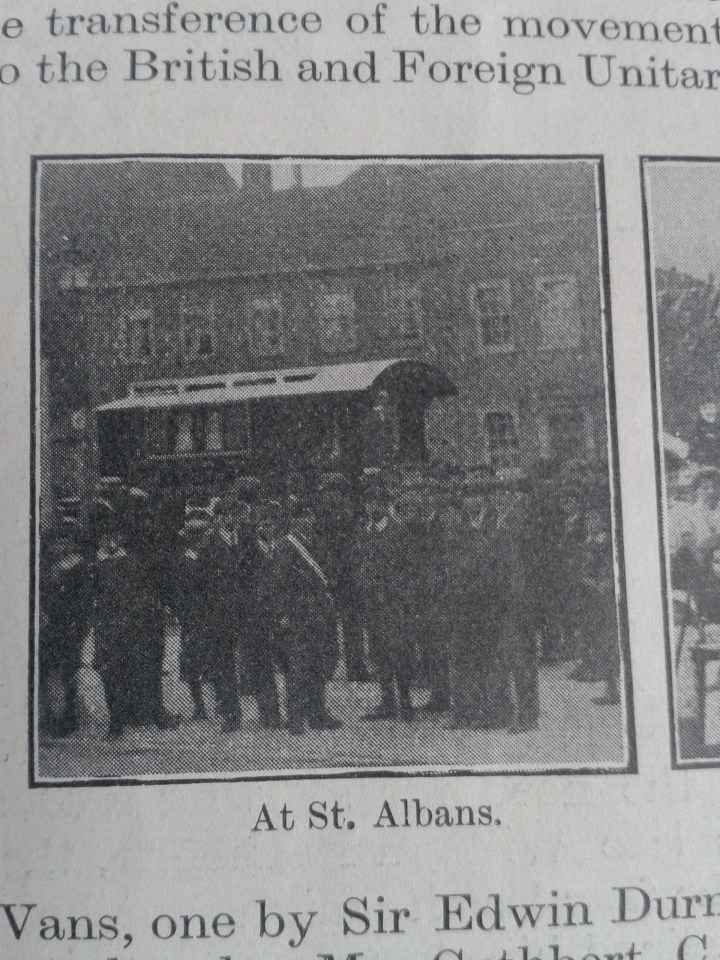
A meeting at St Albans
Three thousand outdoor meetings in about seven years! Even with modern media gathering 950,00 people online would be something that any church publicity movement would be very proud of.
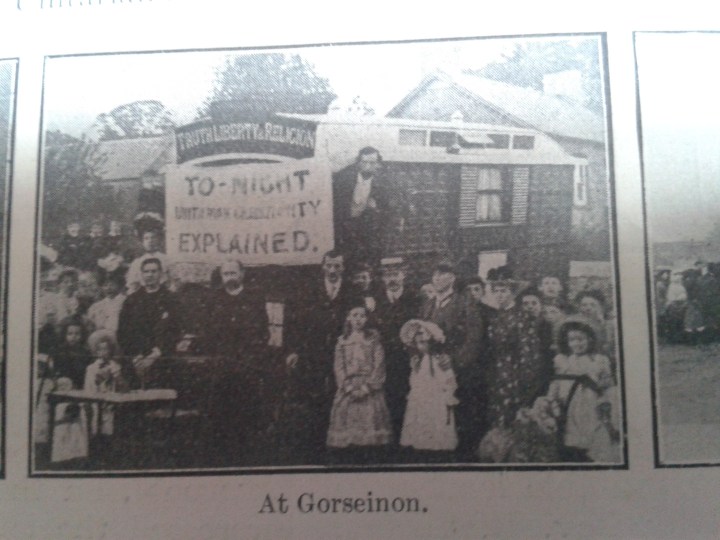
Gorseinon near Swansea
Its clear that the Mission didn’t just go into uncharted territory but also went to places where it supplemented an already established witness. It also faced competition from many other churches that were doing something similar and opposition from some who, T.P. Spedding seems to suggest, may have had this purpose in their design.
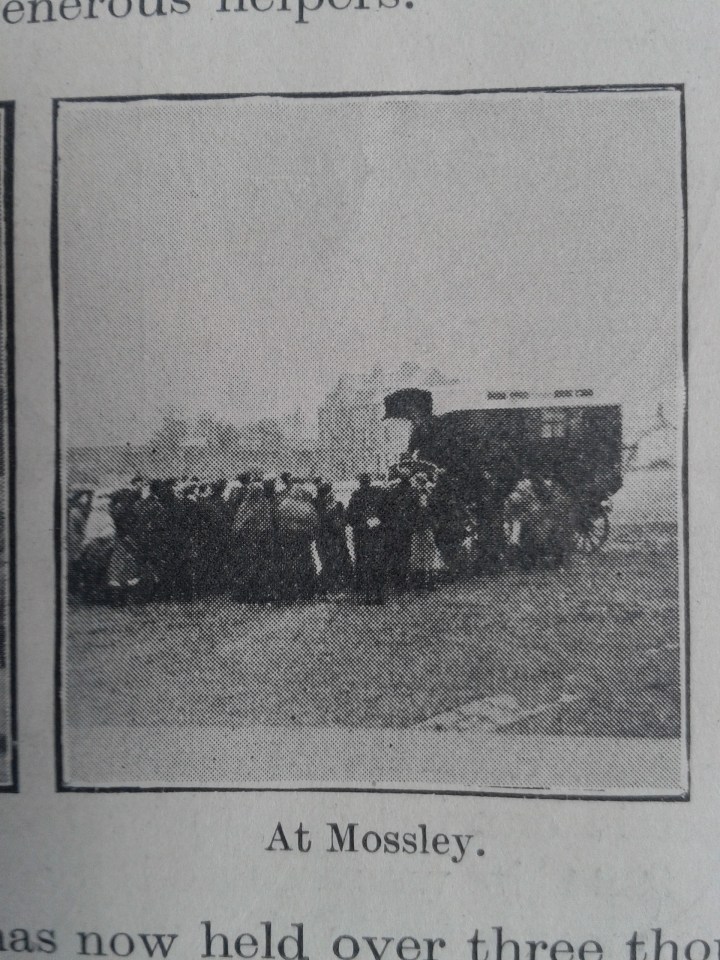
A busy meeting at Mossley where a church had existed since the 1840s
Nothing I have yet seen explains the logistics of operating the Mission – presumably horses were hired or loaned wherever they were needed by the local people. There must have been a lot of careful organisation behind its running. But there are records in various places that will repay careful examination and a fuller picture can be built up of the Mission’s operation.
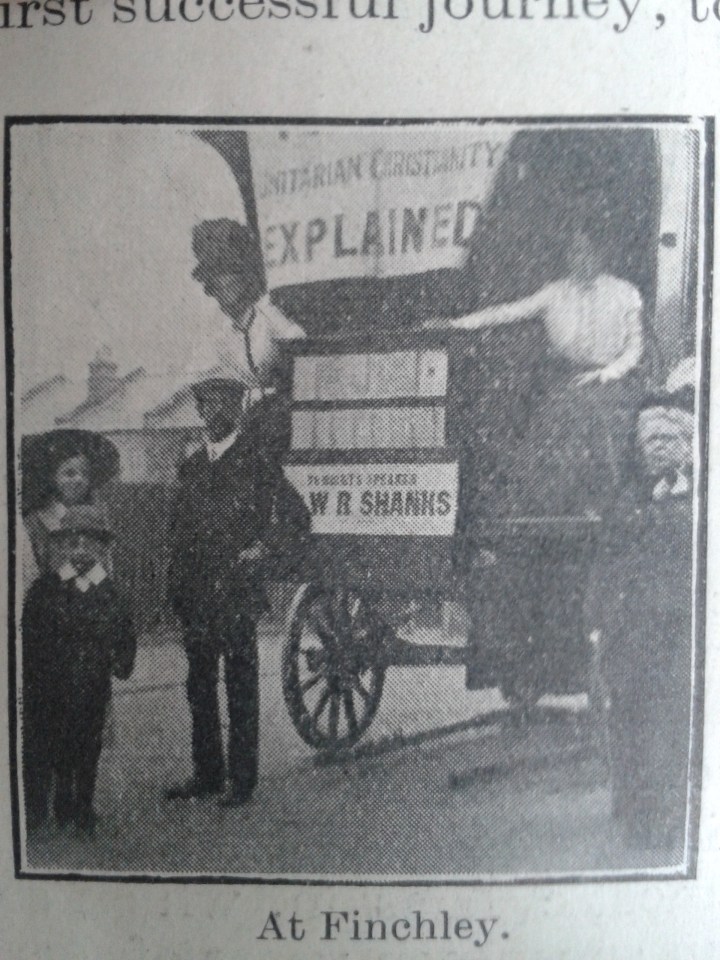
Finchley, “Unitarian Christianity Explained. Tonight’s Speaker [Rev] W R Shanks” – the Rev William Rose Shanks (1856-1928)The pictures in Christian Life are small and are not terribly well reproduced. The best picture of the Mission in operation is still the one I reproduced on this blog a few weeks ago. A lot of people have looked at it but we are still not able to identify the location. Both Len Smith and Rachel Eckersley are working hard on finding the spot, the presence of a number of named shops should be a help. It appears not to be Chesterfield, Northwich or Burslem which all had a branch of Scales and Sons. The town of Malton, which seemed a good possibility, can now be discounted, Len has discovered. Wrexham may be a possibility. But we still need to find the place where this interesting photograph was taken. If you have any suggestions please do send them in.
I have sometimes been tempted to write a blog or a column entitled ‘The things I buy on eBay’. I have picked up lots of pieces of ephemera at very low cost on eBay which while certainly bearing very little intrinsic value and generally falling into the category of junk nevertheless have some historical interest.
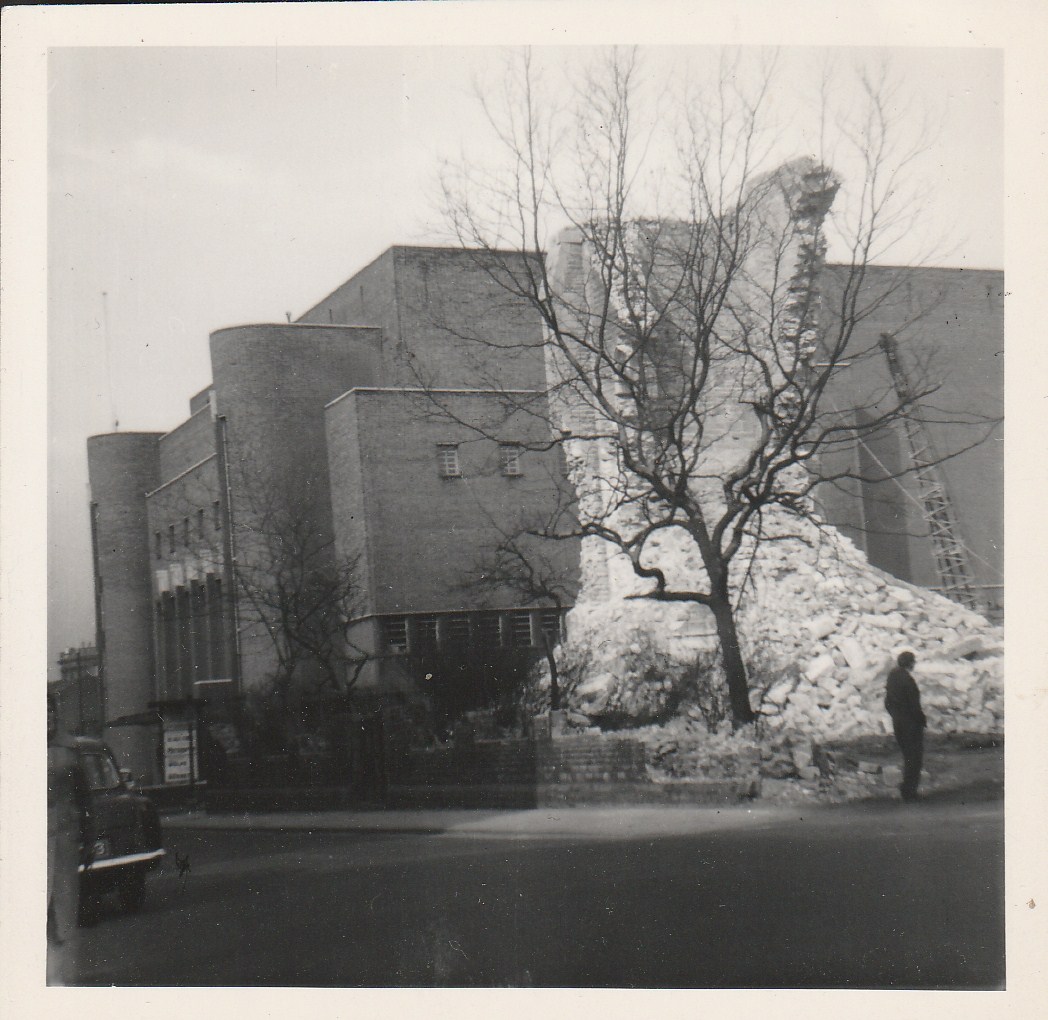
Hope Street Church, demolition 1962
The photograph above is a good example of this. It cost just 99p (which I suppose is actually quite a lot for a single, slightly blurry print) but it shows the very end of Hope Street Unitarian Church in Liverpool. Taken in 1962, probably by someone who habitually recorded views of buildings which he thought might one day be interesting, it catches the tower in the final stage of demolition. Somewhere under the rubble was a brass plate and a “hermetically sealed vase” containing a list of members, ground plans of the old and new chapels, a report of the congregation’s school, a plan of Liverpool, a print of the Dissenters’ Chapels Act, an engraved portrait of the minister and all the local papers from the week before the laying of the foundation stone on 9th May 1848. It was a sad end to a building that was opened for worship in 1849 and which occupied a prominent place in the city. Indeed it seems a shame that such a site, midway between the two cathedrals, could not have been saved for future use. It would be a great site today with enormous potential. But it is easy to be wise after the event, the world must have looked quite different to what was presumably a small and discouraged congregation by the early 1960s.
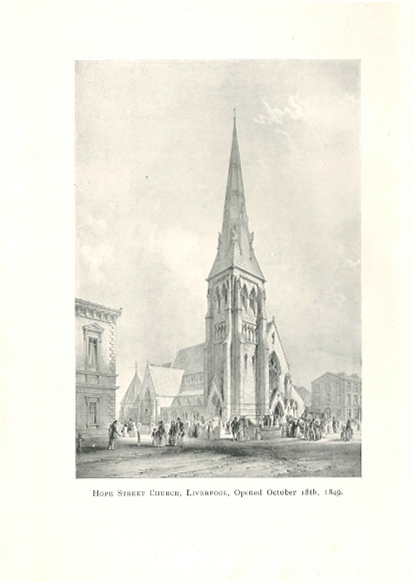
Hope Street had certainly known rather more glorious days. Built by James Martineau’s congregation to provide a place of worship that suited his style and popularity it was a thorough-going gothic construction that reflected his devotional approach. The classic image of it is this one:
Hope Street Church
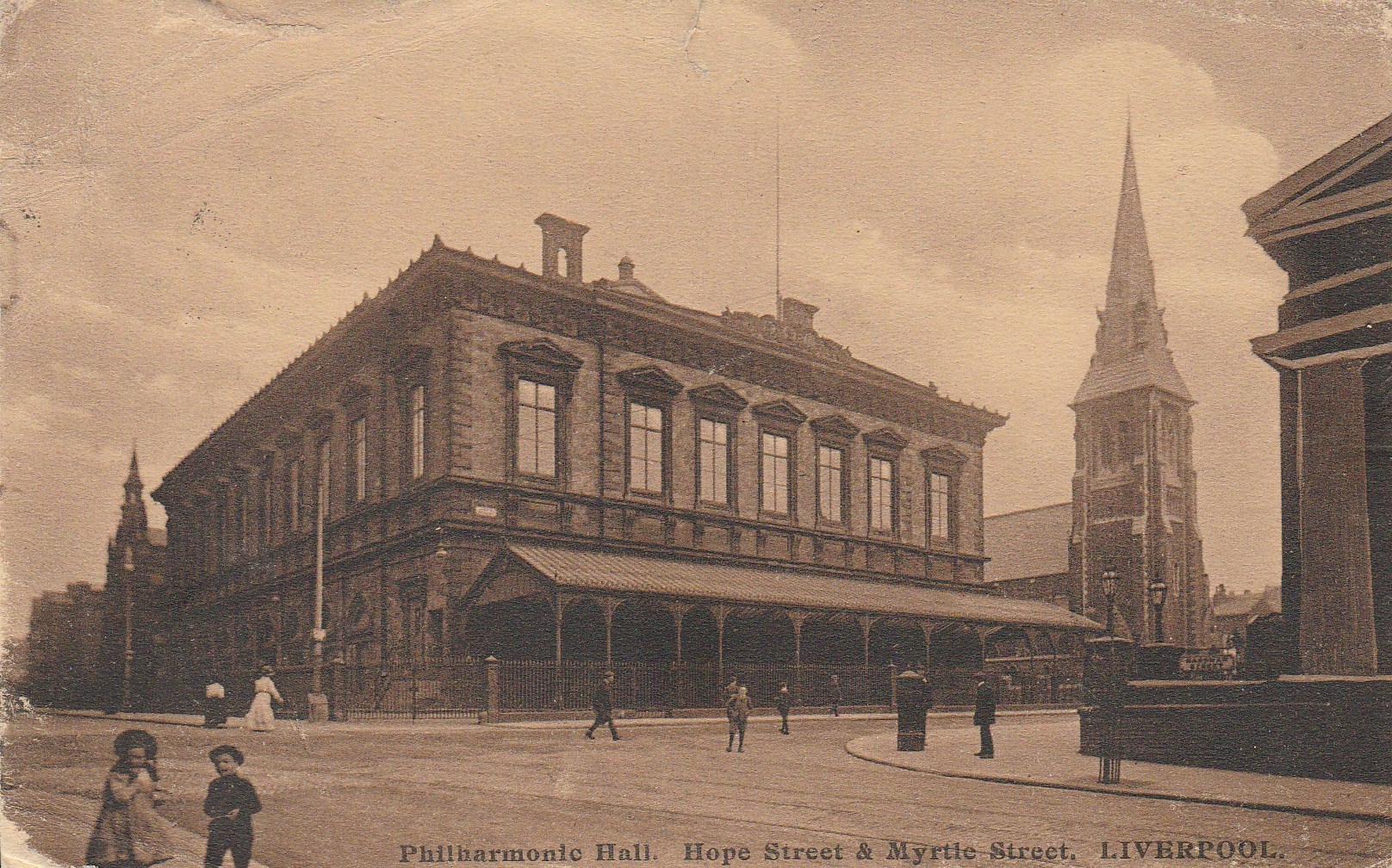
Its relationship to the next-door Philharmonic Hall can be seen from this Edwardian postcard. The original Philharmonic burnt down in the 1930s and was replaced by the present building in 1939. In the picture the classical church opposite, the corner of which can just be seen on the right of the postcard, was the Church for the Blind, attached to the Liverpool School for the Blind which was situated on Hardman Street.
Next door to the Philharmonic
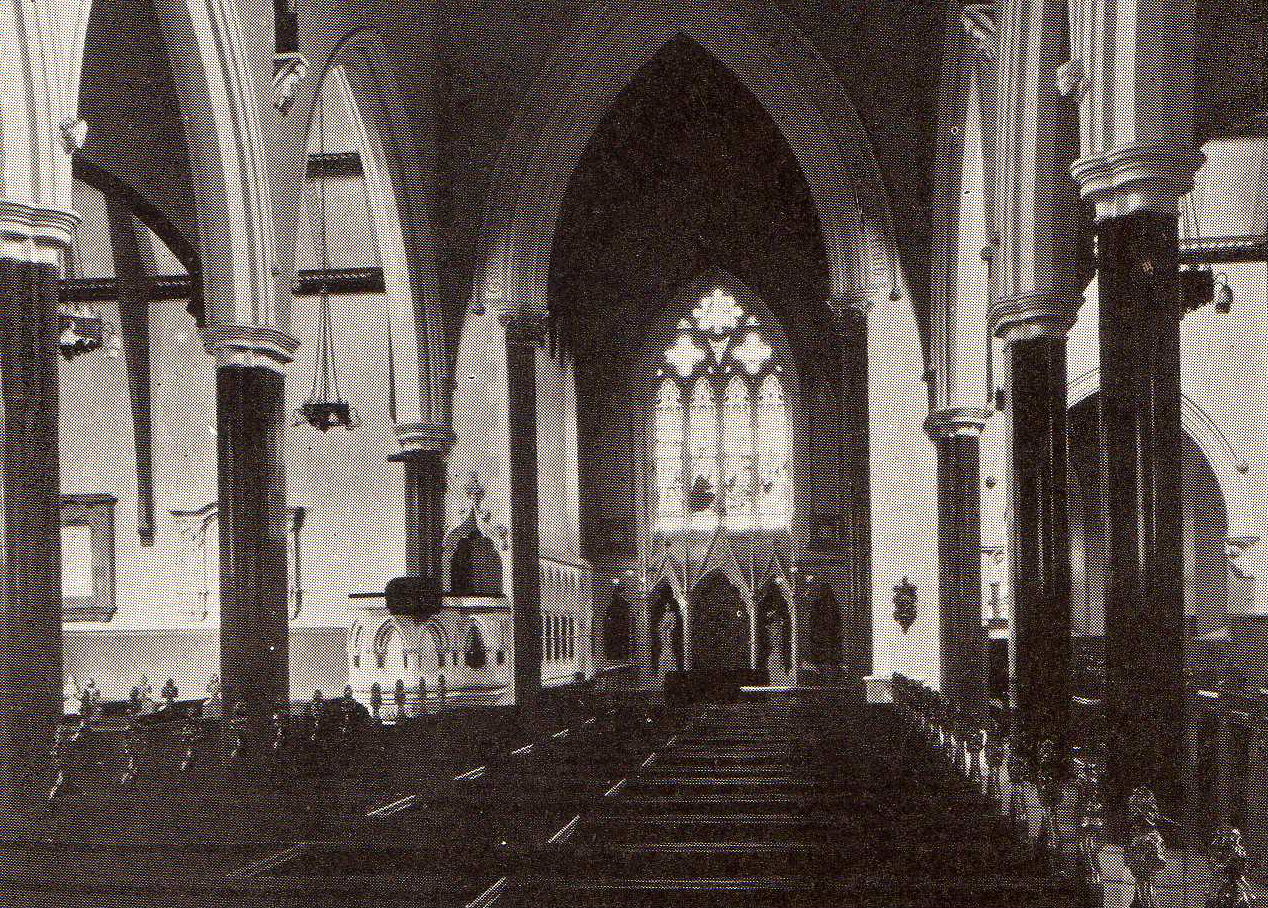
Nothing really remains of Hope Street Church today. Photographs of the interior are intriguing. This scan isn’t great but it shows the view looking towards the pulpit, the chancel and the font.
Church interior
After James Martineau and before the First World War the congregation had some high profile ministers including Charles Wicksteed, Alexander Gordon and Richard Acland Armstrong. The 1920s saw a revival of fortunes under the radical ministry of Stanley A. Mellor who mixed an advanced theology with Socialist ideas. But the crowds that came out to hear him did not last and by the time of the eccentric ministry of the highly scholarly Sidney Spencer the numbers were starting to reduce.
In the Winter 2008/9 of the Merseyside District Unitarian Newsletter The Honourable Dr Frank Paterson, a former member of Hope Street and a very distinguished circuit judge who died in 2014, wrote his reminiscences of the Church. They are a fascinating and rare account of the congregation in the twentieth century. I place them here with due acknowledgment to the MDMA Newsletter:
I reflect with pleasure on my childhood and early manhood, when I frequently accompanied my father to the morning and evening services. He had a wide interest in almost every religious creed. In latter years he reminded me of a character in Shaw’s Major Barbara who declared that he had studied several religions and found that he would be perfectly at home in any one of them. Having been born into a Scots Presbyterian household, he was attracted by the preaching of Dr Charles Aked, the charismatic minister of the then Pembroke Baptist Chapel in Liverpool, where he met my mother, whom he married in 1911. After the departure of Dr Aked for the United States (to what was known as ‘The Millionaires’ Church’ on 5th Avenue), my parents transferred their allegiance to Hope Street Unitarian Church to enjoy the benefits of the preaching of the Reverend Stanley Mellor. Following his death, they continued to attend Hope Street church throughout the ministry of the Reverend Sidney Spencer, I do not think my mother took any interest in the details of religious faiths, but was content to fulfil what she regarded as a spiritual duty by attendance at a church on a Sunday. It is perhaps not surprising that the idea of a free religious faith always appealed to me. It gave me great pleasure to follow in my father’s footsteps as chairman of the Hope Street Committee, which awakened in me the desire to enter a calling where I could participate in the cut and thrust of debate, and to promote harmony where there has been discord.
It has therefore been a source of satisfaction to me to find that Hope Street had its origins on the site of what is now The Queen Elizabeth II Law Courts, where I have spent the greater part of my professional life. When the buildings were opened by Queen Elizabeth II, I happened to be one of the longest standing circuit judges of the court and had the honour of being presented to Her Majesty. Whilst waiting for the ceremony I was placed in a line of those about to be presented immediately between the Anglican Bishop of Liverpool on one side and the Catholic Archbishop of Liverpool on the other. I regret I didn’t have the courage or the time to remind these prelates that I felt like the wonderful white church that once stood half way between the Anglican and Catholic cathedrals in Hope Street.
When I was a child services at Hope Street were almost as well attended as the Hope Hall Cinema (now the Everyman Theatre) down the road, and in order to secure two seats together my father was obliged to apply to the Church Secretary, Mr William Letcher. There was an interval of several weeks before a reply was received notifying my father that two places had been reserved for himself and my mother, and on the following Sunday they were met in the vestibule by Mr Letcher to be escorted past the queue waiting to be seated and down the aisle to a pew four rows from the front, on the back of which was a card bearing their names. This remained what we regarded as our family pew until the church was demolished several decades later. William Letcher remains in my memory as a formidable figure, well-suited to the task of controlling the crowds at Hope Street. He was, I believe, employed by one of Liverpool’s principle banks, in charge of the Stationary Department. As a small boy he appeared to me as a person of enormous power and influence. Whatever it meant for the Trinity to be present in one person, it seemed to me that person might as well be Mr William Letcher. He was highly thought of, and in due course enjoyed the distinction of becoming the subject of a light-hearted song, composed by my father and another member of the congregation, which recommended a variety of facetious changes to forms of worship, each one punctuated by the refrain: “But Will `e Letch `ya?” The authors sang it at a Christmas party.
Another innovation of my father’s as Chairman was the collection of “bun pennies`”. These were coins dating from the early days of the reign of Queen Victoria on which the monarch’s head appeared with hair drawn back in a bun, still current in the inter-war years but invariably worn very smooth. My father encouraged members of the congregation to deposit any they found in their possession in a wooden casket he had placed on the window-ledge of the church vestibule, similar to those designed for holding ashes with an incision made in the top and inscribed with the words: “The Hope Street Church Ancient Victorian Secret Society”. To what objects the fund accumulated therein was applied remains uncertain to this day.
The only photograph of the church I recall seeing was taken by a photographer from the Liverpool Daily Post and showed the spire wrapped in smoke. It dated from an evening on which my father had had to move a Committee Meeting from the Library to the Church Hall, and eventually – very reluctantly – to adjourn with business unfinished, because the premises had become unbearably hot. The neighbouring Philharmonic Hall was on fire. My father had a print framed and hung in the church to illustrate the perils to which the members of the Committee were prepared to subject themselves in pursuance of their duties.
Hope Street Church also survived the blitz a few years later. It may be that the enemy found the white spire of that Unitarian stronghold a useful pointer to the Liverpool docks and to the Cammell Laird shipyards and it took care to spare it. Be that as it may, incendiary bombs were such a menace that the government required all males over a certain age to register for fire-watching duties. The minister of Hope Street, the Reverend Sidney Spencer, an ardent pacifist, had no hesitation in fire-watching at his own church or anywhere else, but objected to doing so under compulsion of the State. He refused to register. The magistrates fined him £10 which he steadfastly refused to pay. In due course, he was sent to prison for a term of 14 days. The minister (an admirer of Mahatma Gandhi) was adamant that he did not wish the fine to be paid, but after a few days the Committee felt that he had made his point, and that somehow the fine should be paid anonymously. It was decided that, as a law student with access via the Magistrates’ Entrance to the courts on Dale Street, the Chairman’s son was best able to make the payment without drawing attention to himself. This I did. The first clerk I approached hesitated: “But Mr Spencer has said he doesn’t want this fine paid. I don’t think I can take it.” “If anyone offers us money – we take it!” declared his senior. A few hours later, the Reverend Sidney Spencer was a free man.
My father reimbursed me, from what source I do not know. Possibly he unlocked the coffer of the Hope Street Church Ancient Victorian Secret Society!
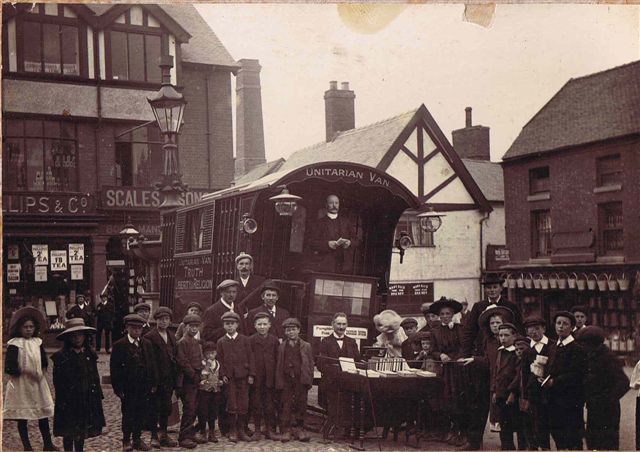
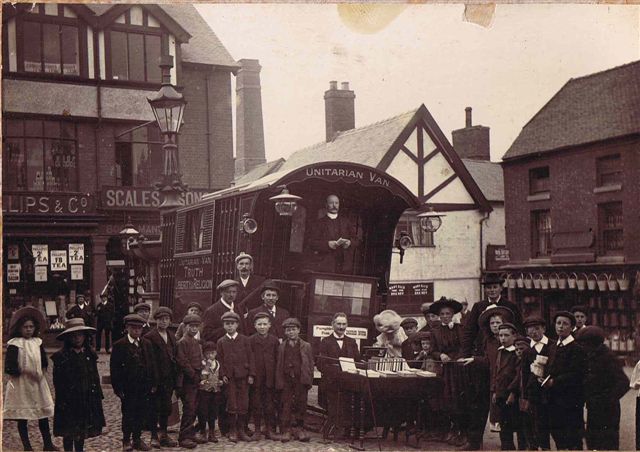
This photograph has been featured on the Unitarian Historical Society website for a number of years with the caption “Unitarian Van Mission in an unidentified town” and the suggestion that if anyone could identify it they should write in. Nobody ever has responded to the invitation so I thought I might post the picture here in the hope that someone might be able to suggest a likely location for where it was taken.
Click on the photograph to enlarge
It shows the Unitarian Van Mission fully operational at some point early in the twentieth century – somewhere between 1906 and 1914. It is a fascinating picture: a minister (probably the Rev T.P. Spedding) stands in the van, a helper sits stiffly behind the literature table and a few other variously attired men appear amongst a large contingent of children, all of them quite well dressed and well shod. Had the children been brought out from some local chapel to see the van or did they just gather when they saw a photograph being taken?
But where was the photograph taken? It looks like a town square which should be identifiable to anyone who has sufficient local knowledge. Chances are the cobbled square no longer exists in anything like this form, even it didn’t get destroyed during the war the planners of the 1960s will have had some effect on the scene. I wonder – without any real evidence – if it was taken somewhere in the Midlands? Perhaps the chimney in the background just left of centre is suggestive of the Potteries? Behind the van can be seen a few shops – a tea merchant looks like it belongs to a Phillips & Co but it is not clear what Scales & Sons are selling immediately behind the ornate lamppost. On the right an unnamed shop sells buckets and similar items.
Can anyone identify the location of this photograph? It would be nice to know where it was taken.
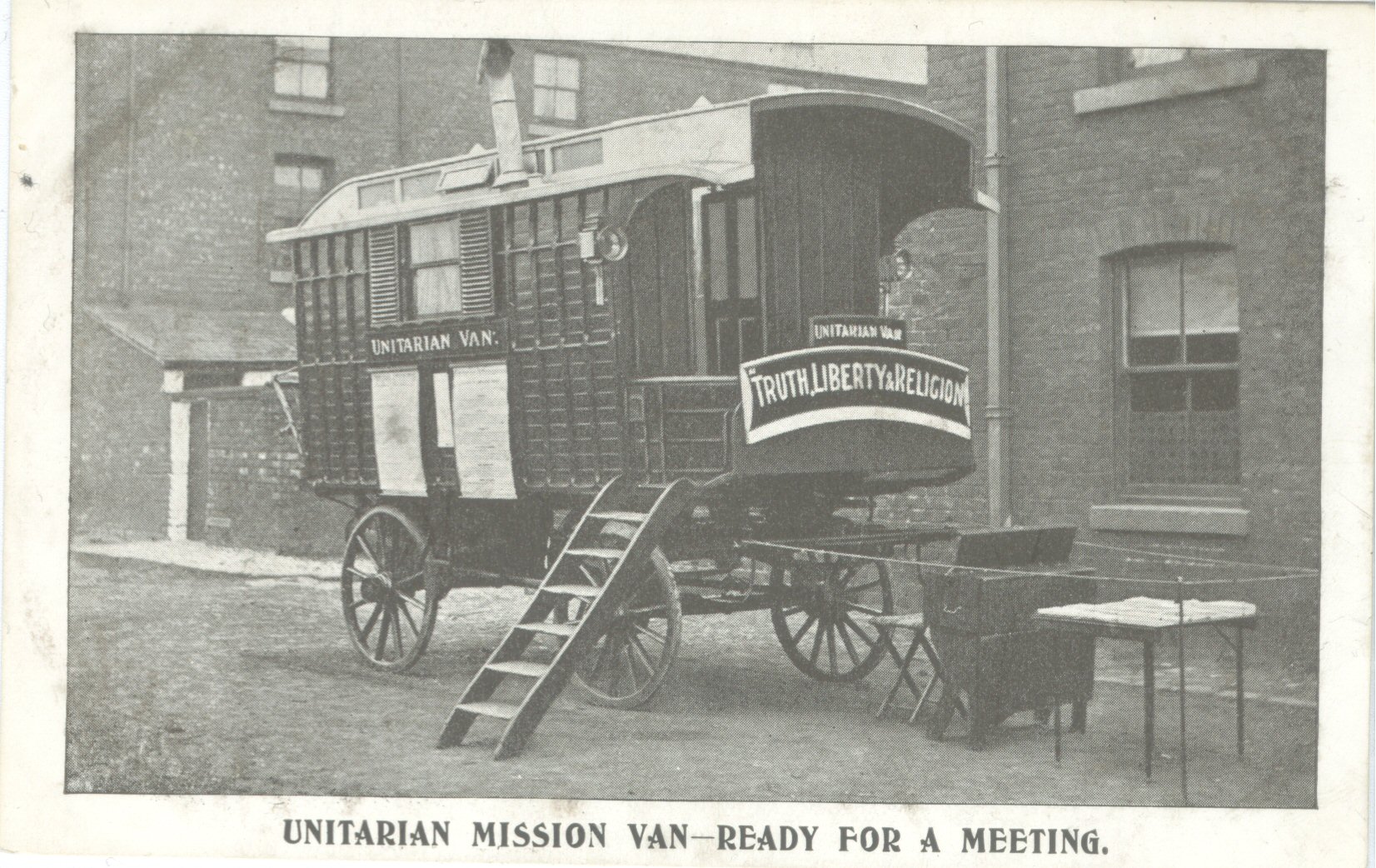
It is an interesting photograph because it shows the van in action, with its stall set out, attracting a crowd. Postcards of the van itself are not difficult to find. Here’s a good example of one:
This seems to show that there was even some sort of stove on board to keep the occupants warm and perhaps to make a cup of tea. The Van Mission began its first tour in 1906 and within a few years there were a total of six vans all paid for by generous donations and travelling around many parts of England, Wales and Scotland.
Unitarians often claim to have never had any interest in mission work, especially overseas, which is true up to a point. At home, however, they did experience a number of missionary impulses from the 1820s onwards and without the activities of some individuals and the contributions of a number of institutions would not have experienced any growth or development in the nineteenth century.
The Van Mission itself was a late flowering of Unitarian missionary endeavour in the years just before the First World War, something of a golden age for non-conformity and for more liberally minded religious groups. In a book, Open Air Theology and Sketches of the Unitarian Van Mission, the Rev H. Bodell Smith outlined the way the mission operated:
…this is not an ordinary mission movement. There is, of course, an utter absence of the appeals usually made at street ‘religious’ meetings. They are not invited to become ‘washed in the blood’; they are not told, ‘only believe and you will be saved’; there is not the slightest attempt to dictate to them what they must believe, with the alternative that otherwise they will perish ever-lastingly. The appeal is to their own reason and every-day experience. Hearers are asked to judge for themselves as to the truth of what is said to them. They are told frankly: “We do not say that you must believe as we do. You cannot believe to order. You can only believe according to the evidence that comes before your minds, that is, according to your light. We are here to give you such light as we have. We ask you to listen to what we have to say, and then leave it to you for what it is worth.”
I have never seen Open Air Theology and Sketches of the Unitarian Van Mission, this quotation comes from Rev John Roberts’ short but interesting article in the ‘Transactions of the Unitarian Historical Society’ for 1978. In it he names T. P. Spedding as becoming the first missioner after resigning from his pulpit in Rochdale. He was joined by Bertram Taylor as the lay missioner, who possibly is the figure seated behind the desk. He volunteered to accompany the whole of the first tour of 1906 when the Van visited a succession of towns, generally staying for three days in each one, while visiting ministers conducted afternoon and evening meetings. A journey of 163 days apparently attracted a total of 24,516 hearers. Not a bad total at all.
As with so much else the First World War brought this particular enterprise to an end but it would be nice to know just where they were located when this picture was taken.
UPDATE
Rachel Eckersley has suggested that Scales is possibly a Yorkshire name and has found three boot manufacturers (which appears to be the trade the firm is engaged in according to the sign) which might fit the bill – in Leeds; Armthorpe, Doncaster; and Malton. She suggests Malton might be the most likely contender although it is hard to identify this as the definite location. Rachel has also found a Scales shop in Chesterfield although photographic evidence shows its location close to the crooked spire.
In September of 2014 we launched – in fine style, it must be said, in the impressive surroundings of the Liverpool Athenaeum, thanks to Philip Waldron – the book Liverpool Unitarians: Faith and Action. Essays exploring the lives and contributions to society of notable figures in Liverpool Unitarian history. Published by the Merseyside District Missionary Association it should also be added that the District took to the role of publisher with great aplomb – not necessarily the most usual role for any church administrative body. The book is available in many book shops and museums in Liverpool as well as online from the District and via Amazon.
Liverpool Unitarians was a long time in preparation but I think is a better book for the extra time spent on its production. All the contributors have some connection with Merseyside Unitarianism and all write about different aspects of the contribution made by members of this household of faith to wider society over the centuries.
The full list of contributors and subjects is as follows:
Introduction, David Steers; Memorials of the Ancient Chapel of Toxteth Park, Bernard Cliffe; Jeremiah Horrocks 1618 – 1641, Bernard Cliffe; William Roscoe 1753 – 1831, David Steers; A Short History of the Rathbone Family, Annette Butler; The Unitarian Family of George Holt, Bernard Cliffe; Noah Jones 1801 – 1861, Philip Waldron; James Martineau 1805 – 1900, Len W. Mooney; Joseph Blanco White 1775 – 1841, David Steers; Kitty Wilkinson 1786 – 1860, Daphne Roberts; John Johns 1801 – 1847, David Steers; William Henry Channing 1810 – 1884, Richard Merritt; Charles Pierre Melly 1829 – 1888, John Keggen; Sir Henry Tate 1819 – 1899, Richard Merritt; Sir John Brunner 1842 – 1919, Len W. Mooney; Lawrence Redfern 1888 – 1967, Elizabeth Alley; Sir Adrian Boult 1889 – 1983, Richard Merritt; The Visitors’ Book of the Ancient Chapel, Bernard Cliffe
It was particularly pleasing to see Len Mooney’s contributions published in the book in light of Len’s sad death just a few months later. Someone who had been a devoted member of Ullet Road Church for many decades Len was a thoughtful and wise person whose gifts shine through in his chapters published here.
The cover of the book
The book has a full colour cover designed by Alison Steers which incorporates ‘The Triumph of Truth’, the central detail from the library ceiling of Ullet Road Church, painted by Gerald Moira; the Good Samaritan Window at Gateacre Chapel, which was erected in memory of Sir Henry Tate; a bronze representation of the James, (the ship on which Richard Mather and the local puritans sailed to Massachusetts in 1635) made in 1934 for the hall door at the Ancient Chapel of Toxteth; the front elevation of Ullet Road Church built in 1899; and detail of the Liverpool Town Plan of 1725 by J. Chadwick.
The book also contains more than fifty illustrations, many of them never before published, and all of them helping to tell the story of Liverpool Unitarianism. Some of the stories told in the book are well known, others are not so familiar to the general reader, yet others break entirely new ground – Bernard Cliffe’s analysis of the memorials and graves in the Ancient Chapel is a first, as is his examination of the chapel’s visitors’ book.
In the Introduction I say:
This book is not intended to be hagiography but it does try to outline how one group of people – members of a particular faith community with deep historical roots but with an aversion to fixed creeds – were inspired to serve their fellows in different ways. Their legacy can be seen all over the city – in its parks, in its monuments, in the university, in hospitals, in education, in art galleries and museums – and it exists in the long and continuing struggle to create a society that gives equality and opportunity to all its citizens. It is not meant to be an exhaustive account of all the eminent members of the churches and chapels in the region. Readers will notice that the names mentioned are part of wider connections of family and business which includes many others who could be included. There are other figures who could be the subject of such biographical accounts. But this is a selection of some of those who have followed the call of faith to be of service to wider society.
It is pleasing also to report positive reviews in various publications.
In Faith and Freedom Peter Godfrey says: a splendid book… chapters that are full of interest and fill the reader with admiration and often wonder at the scope of the achievements of these Liverpool Unitarians
and in The Inquirer Alan Ruston says:
readers of this book will come to the conclusion that Unitarianism has not been just a faith of the mind but one of action as well.
The title and full publication and order details are as follows:
Liverpool Unitarians Faith and ActionEssays exploring the lives and contributions to society of notable figures in Liverpool Unitarian history
Edited by Daphne Roberts and David Steers
Published by the Merseyside and District Missionary Association 2014 ISBN 978-0-9929031-0-7 Price £12.99 plus £2.50 post and packing 128 pages, 52 illustrations, full colour cover
Available from: Philip Waldron, Ullet Road Church, 57 Ullet Road, Sefton Park, Liverpool L17 2AA or liverpoolunitarians@gmail.com also available for purchase on Amazon











 velvethummingbee