If you can’t get to church on Sunday amidst all the current restrictions or, indeed, if you have been to church but would like to join in another Christmas service, you can click on our video and join in our Service of Carols and Readings.
Filmed partly in Downpatrick it features music played on the organs at Ballee and Downpatrick plus music on the trumpet and bagpipes as well as readers from different churches who re-tell the Christmas story.
Click on the video to see the service:
Service of Christmas Carols and Readings, Downpatrick
Non-Subscribing Presbyterian Church
First Presbyterian (NS) Church, Downpatrick
Christmas Carol Service
Sunday, 20th December 2020
O Come, O come, Emmanuel (played by Jack on the trumpet)
Opening Words Rev Dr David Steers
1st Reading Isaiah ch.9 v.2, 6-7 Nigel
1st Carol O Come, all ye faithful (played by Laura on the bagpipes)
1st Carol O Come, all ye faithful (played by John on the organ at Ballee)
2nd Reading Isaiah ch.11 v.1-9 Margaret
2nd Carol O little town of Bethlehem (John)
3rd Reading Isaiah ch.40 v.1-5 Rosemary
3rd Carol Once in Royal David’s City (John)
4th Reading Luke ch.1 v.26-35 Adele
4th Carol The first Nowell (played by Laura on the organ at Downpatrick))
5th Reading Matthew ch.1 v.18-25 Emma
5th Carol Mary’s Boy Child (Laura)
6th Reading Luke ch.2 v.1-7 Emma
6th Carol Silent night! (John)
7th Reading Luke ch.2 v.8-20 Noelle
7th Carol See amid the winter snow (Laura)
8th Reading Matthew ch.2 v.1-12 Mary
8th Carol Hark! The Herald Angels sing (John)
9th Reading John ch.1 v.1-14 Robert
Prayer
9th Carol Joy to the world (Laura)
Benediction
A Great and Mighty Wonder (John)
O thou eternal Wisdom, whom we partly know and partly do not know;
O thou eternal Justice, whom we partly acknowledge, but never wholly obey;
O thou eternal Love, whom we love a little, but fear to love too much:
Yet, O Lord, thou art our Father; we are the clay, and thou art our potter; we are all the work of thy hand.
Isaiah ch.64 v.8
Our service for the Second Sunday in Advent comes from First Presbyterian (Non-Subscribing) Church, Downpatrick and has as its reading Isaiah ch.64 v.1-9. In that passage God is likened to a potter and through interaction with our Creator we can be remade. This image of the potter at work at the wheel is a very powerful one in the Bible, it is suggestive of the ongoing process of creation of which we are a part.
The video can be seen here:
The organist is John Strain, playing the organ at Ballee Non-Subscribing Presbyterian Church, who plays Lo! He comes with clouds descending (Mission Praise 424) and Hark the glad sound! The saviour comes (Hymns of Faith and Freedom 107).
The quotation at the top of this page comes from Martin Luther King. It is in fact itself a distillation of a quotation from Theodore Parker, the nineteenth-century Unitarian theologian and abolitionist:
I do not pretend to understand the moral universe; the arc is a long one, my eye reaches but little ways; I cannot calculate the curve and complete the figure by the experience of sight; I can divine it by conscience. And from what I see I am sure it bends towards justice.
It is interesting to compare the two sayings; one a very powerful soundbite, the other, the older one – the first to make the case for this imagery – far less snappy but explaining the idea in a very clear way.
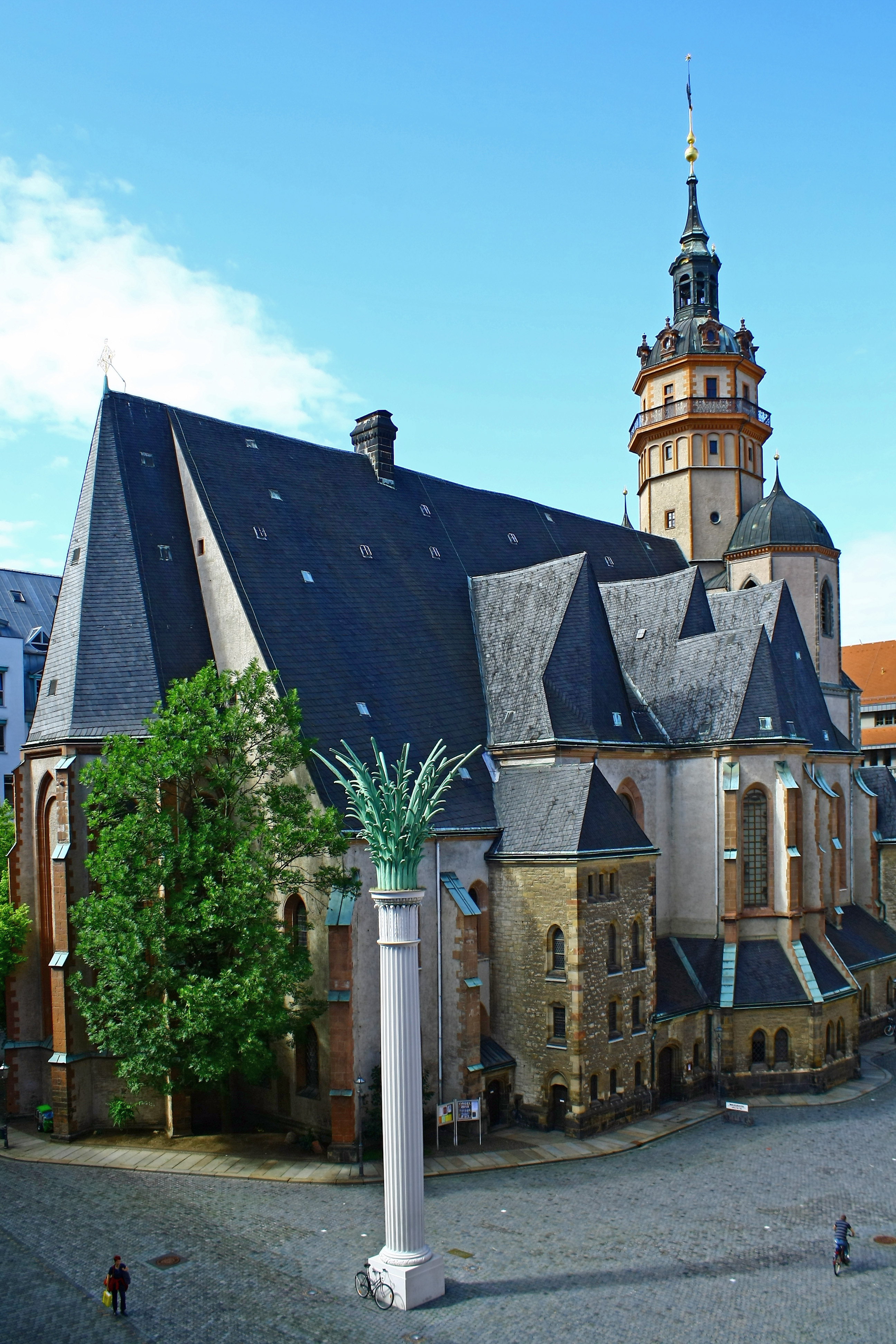
I use this saying in this week’s online service which looks back to the fall of the Berlin Wall in 1989. The impetus for this momentous event came from the churches, most notably in Leipzig where St Nicholas Church became the centre of resistance to a corrupt state in a society poisoned by secret police and corrupted by layers of informers and spies.
St Nicholas Church, Leipzig (Wikimedia Commons)
The minister of the main church in Leipzig, the Rev Christian Führer, led the people in mass prayer vigils which helped to bring the system to an end. His position was similar to that of László Tőkés in Romania, who I was privileged to meet a couple of years ago in Transylvania, and who distilled his experience in his book With God, for the People. But both men showed the necessity of observing the phrase in our reading today ‘choose this day whom you will serve’.
You can see the service in this week’s video:
Available from 9.45 am on Sunday, 15th November
This week’s service is filmed in Dunmurry. The reading is from Joshua ch.24 v.14-18 and is given for us by Emma McCrudden. Church organist Allen Yarr plays the hymns When I survey the Wondrous Cross and Praise to the Lord, the Almighty, the King of Creation.
Time for a Story: War Horse
With Armistice Day in mind this week’s Time for a Story, given by Sue Steers, tells the story of the work of horses in the First World War, an aspect of the story of that conflict which was long overlooked until the publication of Michael Morpurgo’s book War Horse. The video can be seen here:
In so many places tomorrow Remembrance Services have either been curtailed or cancelled because of the pandemic. This is one of the many inevitable consequences of the situation around the coronavirus. Nevertheless, many churches will hold a service of Remembrance on Sunday morning, at least they will in Northern Ireland although obviously not in other places such as England where a lockdown has again closed the churches. I will be leading two Remembrance services tomorrow and we also have an online Remembrance Service which can be viewed here:
Non-Subscribing Presbyterian Remembrance Service, Sunday, 8th November 2020
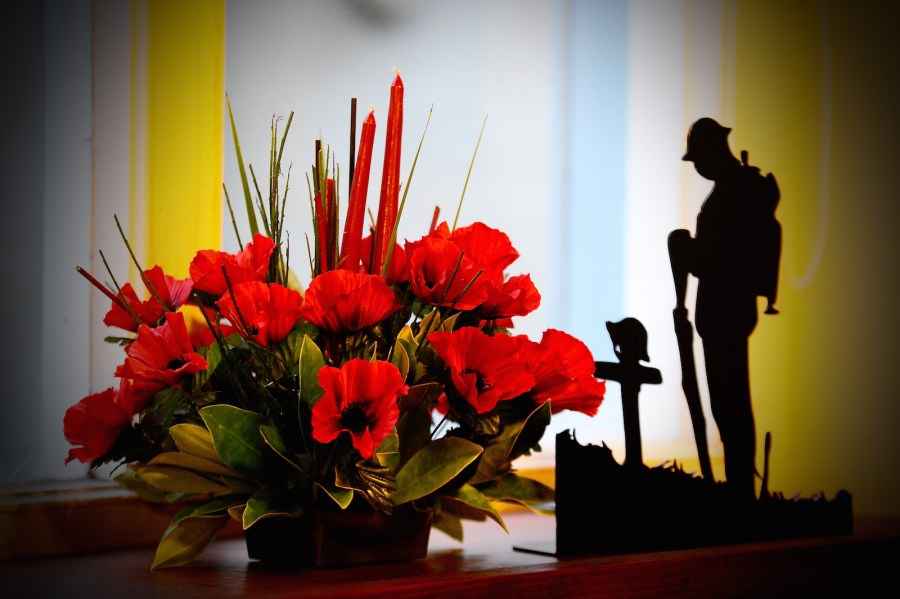
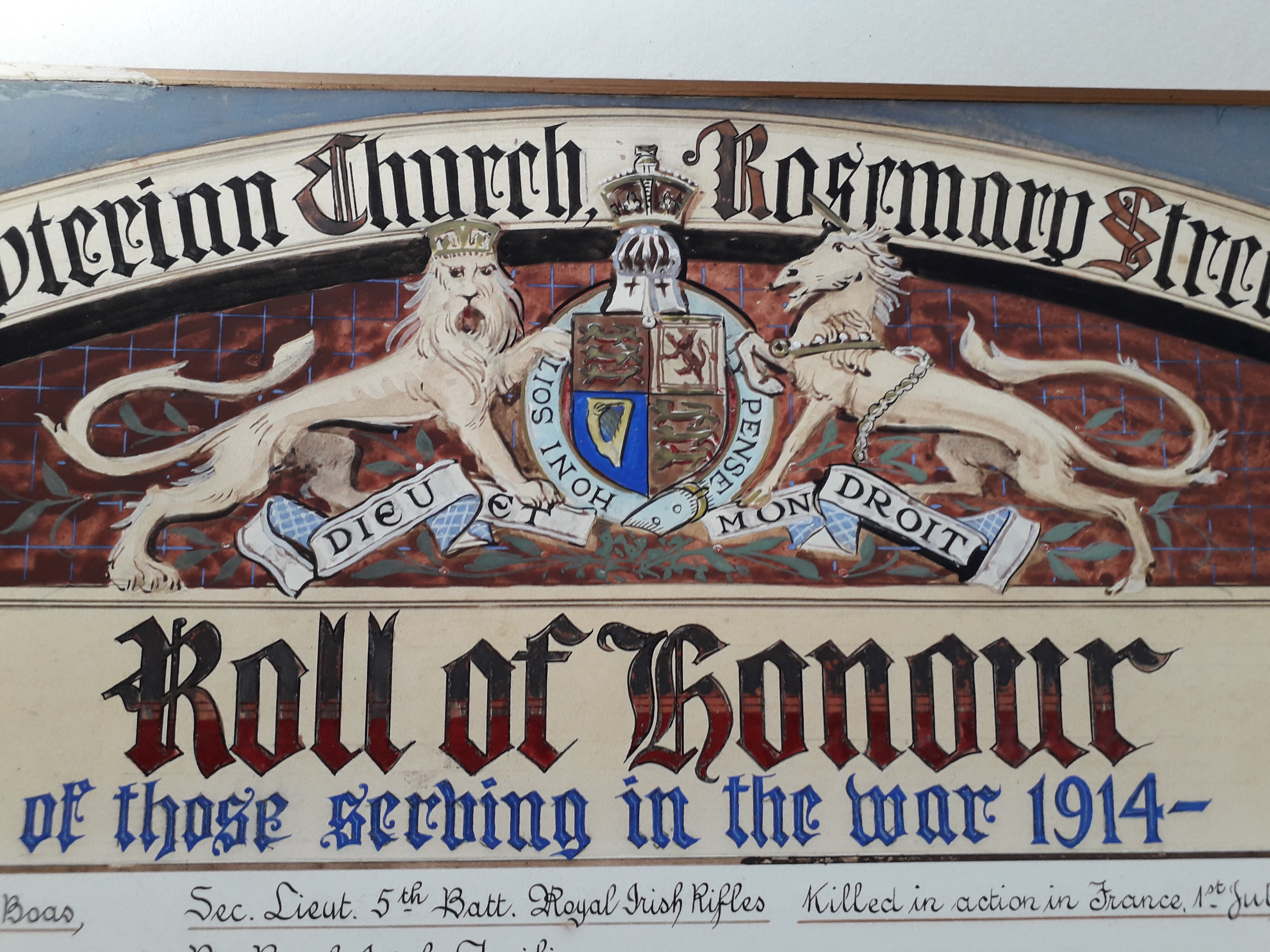
Our service comes from Downpatrick and features the two memorials which we have in the church. One is the First World War memorial which includes the names of all the members of the congregation who served in the war as well as three who are listed as having died in the war. When I researched the details for the Roll of Honour of the Non-Subscribing Presbyterian Church of Ireland in 2018I discovered that many church war memorials, although often cast in bronze or carved in marble, sometimes didn’t quite match the records as we know them today. So in the case of the Downpatrick memorial one of the members who is listed as having served actually died in 1920 from wounds he received at Ypres and his grave is recorded by the Commonwealth War Graves Commission. So four members of the congregation were killed through fighting in the First World War.
We also have a second memorial which includes a poppy from the Blood Swept Lands and Seas of Red installation which was on show in the Tower of London in 2014 and which was given in memory of Rifleman John Hayes. Click on the following link to read about this:
In today’s video I have also included an image of every Non-Subscribing Presbyterian twentieth-century war memorial of which I am aware.
Detail from the illuminated Roll of Honour of the First Presbyterian Church, Rosemary Street, Belfast
Time for a Story
On 4th November 1922 Howard Carter finally discovered the entrance to the tomb of Tutankhamun. In this week’s Time for a Story Sue Steers tells this fascinating tale. The video can be seen here:
Many of the most vivid phrases that have passed into everyday use in the English language originate in either the Authorized (King James) Version of the Bible or in Shakespeare. That is the starting point for our service today. The Bible requires translation for it to be intelligible and it requires interpretation to achieve any relevance for its hearers. For the best part of three centuries one version – the Authorized Version of 1611 – held sway in the English-speaking world. From the end of the nineteenth century onwards this has changed as a plethora of translations have emerged reflecting changes in language and Biblical understanding.
“Do you understand what you are reading?” Philip asks the Ethiopian in Acts ch.8 v.27-40. “How can I, unless some one guides me?” he replies (RSV), or “How can I, unless someone explains it to me?” as the NIV says.
Click on the video above to see today’s service
Today’s service comes from Clough Non-Subscribing Presbyterian Church. The reading (2 Timothy ch.3 v.14-ch.4 v.8) is given by Robert Neill (Downpatrick) and Alfie McClelland plays the hymns Through all the changing scenes of life and Jesus the very thought of Thee.
This Sunday’s worship again reflects on the importance of the harvest in our lives, both spiritually and temporally. Our reading is given for us by Dillon Howell and the hymns and harvest music is played by John Strain on the organ at Ballee Non-Subscribing Presbyterian Church.
The video both begins and ends with images from harvest services in our churches over recent years. They are always such uplifting occasions and a great deal of thought goes into making the churches look so attractive. It is nice to be reminded of some of the imaginative and creative displays that we always see in our churches. Click on the above video to see the service.
Last week we were considering the legacy of Rev Henry Montgomery and using the story in Mark’s gospel of Jesus and the disciples walking through the grainfields and plucking the ears of corn to eat on the Sabbath. In its own way this was a template for being prepared to radically reform religious practice whenever it is deemed essential.
No one sews a piece of unshrunk cloth on an old garment; if he does, the patch tears away from it, the new from the old, and a worse tear is made. And no one puts new wine into old wineskins; if he does, the wine will burst the skins, and the wine is lost, and so are the skins; but new wine is for fresh skins.
Mark ch.2 v.21-22.
Today’s service continues with this theme. Filmed in the First Presbyterian (NS) Church, Downpatrick the reading is from 2 Corinthians ch.3 v.1-6 and is given by church secretary Mary Stewart. Laura Patterson plays the hymns How deep the Father’s love for us and Great is thy faithfulness. Click on the following link to join in the service:
If you look closely at the film outside the Church in Downpatrick at the start and during the hymns you will catch glimpses of the Swifts flying about the church yard.
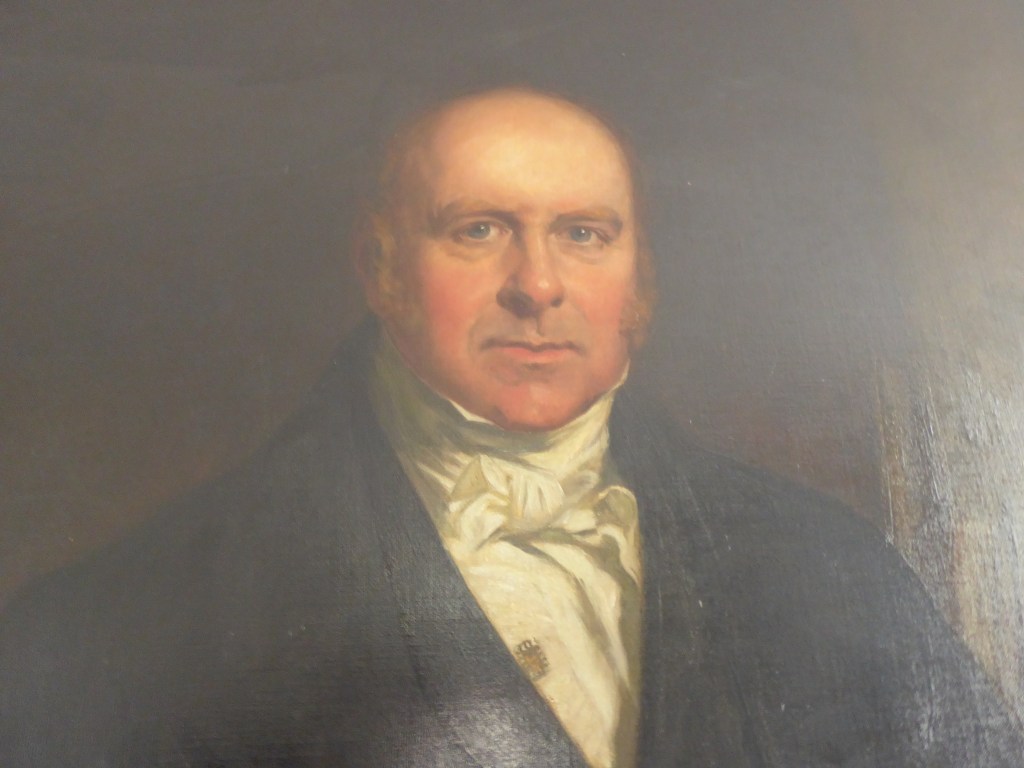
Our worship today comes from Dunmurry and considers the theological legacy of the Rev Henry Montgomery, nineteenth-century minister of the church and leader amongst the Non-Subscribing Presbyterians.
Henry Montgomery, portrait in Dunmurry Church
That the imposition of human tests and confessions of faith, and the vain efforts of men to produce an unattainable uniformity of belief, have not only tended to encourage hypocrisy, but also to restrict the sacred right of private judgment – to lessen the authority of the Scriptures – to create unrighteous divisions amongst Christians – to sanction the most barbarous persecutions – to trench on the natural and civil rights of men – to place undue power in the hands of the few – to throw a shield over the time-serving – to expose the honest to injuries and persecutions – to perpetuate errors in almost all churches – and to prevent that free inquiry and discussion which are essential to the extension of religious knowledge.
(From the principles expounded by Henry Montgomery in 1830)
Morning Worship, Sunday, 20th September 2020
Service from the First Presbyterian (NS) Church, Dunmurry. Conducted by the Rev Dr David Steers. Today’s reading is given by Noelle Wilson from Mark ch.2 v.18-28 and Allen Yarr plays the hymns Just as I am, Thine own to be (‘Church Hymnary’, 497) and Thy Kingdom come, O God (‘Church Hymnary’, 152) on the church organ. Click on the above link to see the service.
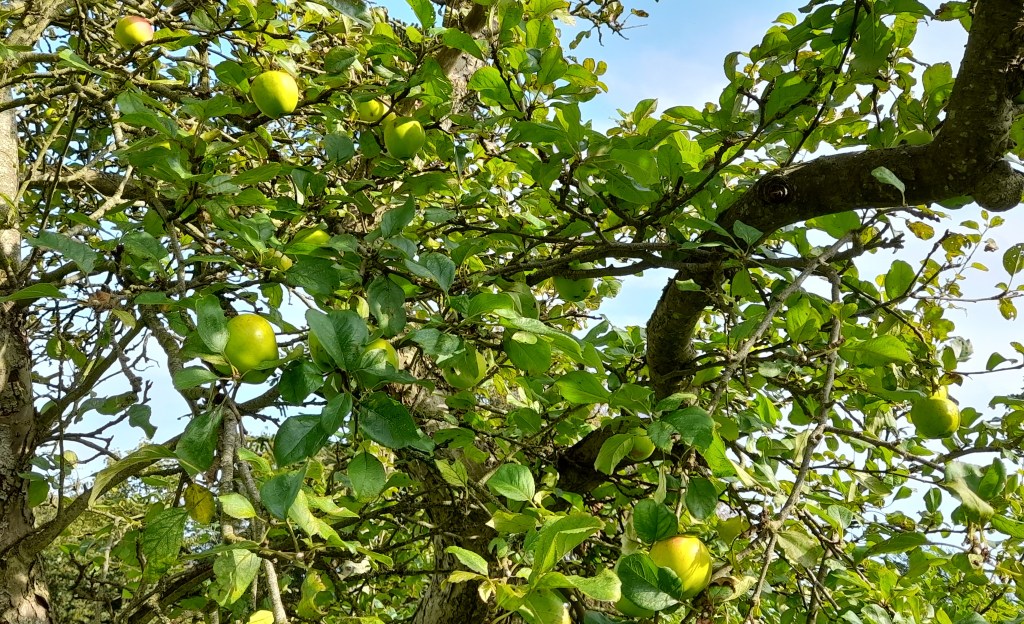
Apple Tree, Ballee
And God saw every thing that he had made, and, behold, it was very good.
After the flood, while the earth remains, seedtime and harvest, and cold and heat, and summer and winter, and day and night shall not cease.
Genesis (ch1 v.31 & ch.8 v.22)
All our churches are now returning to Sunday worship although not on every Sunday just yet during the current crisis. For the time being we will also be continuing with our online acts of worship every Sunday on our YouTube Channel: Downpatrick, Ballee & Clough NSP Churches.
The first service back at Dunmurry after lockdown was also live streamed on Facebook on Sunday, 13th September at 11.30 am. The full service can be seen in the following video:
….And I have felt A presence that disturbs me with the joy Of elevated thoughts; a sense sublime Of something far more deeply interfused, Whose dwelling is the light of setting suns, And the round ocean and the living air…
The service for today considers our experience of the holy, especially in relation to the natural world. The Biblical reading comes from Job ch.12 v.7-10 and is given by Doreen Chambers. Alfie McClelland plays the organ at Clough – the hymns ‘When morning gilds the skies’ (Hymns of Faith and Freedom 26) and ‘City of God, how broad and far’ (Hymns of Faith and Freedom 202). The service is conducted by Rev Dr David Steers. Click on the following video (after 9.45 am on Sunday, 13th September) to join in the act of worship.
But ask the beasts, and they will teach you; the birds of the air, and they will tell you; or the plants of the earth, and they will teach you; and the fish of the sea will declare to you
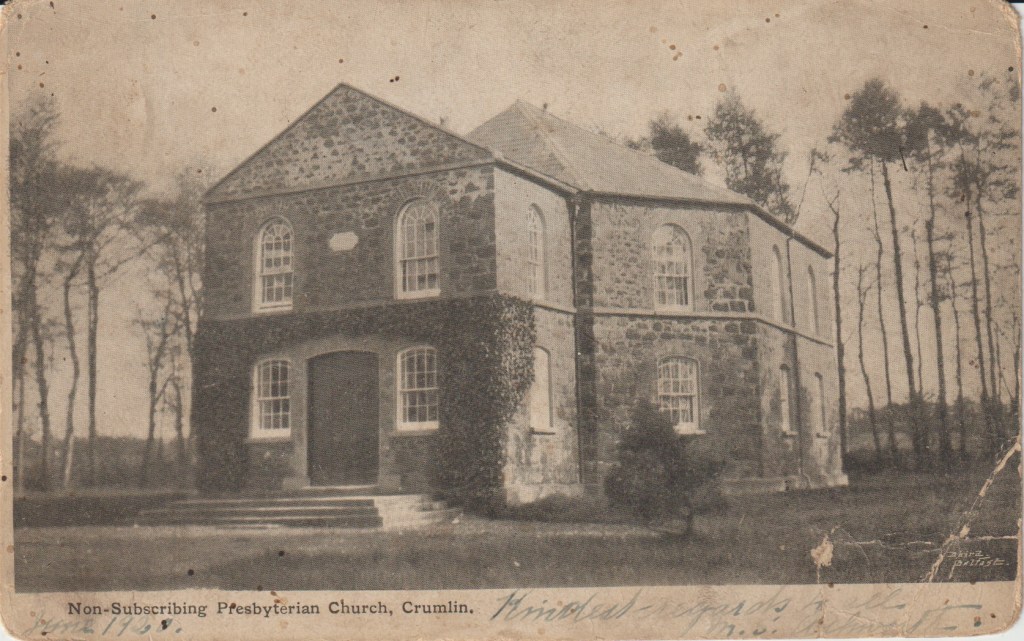
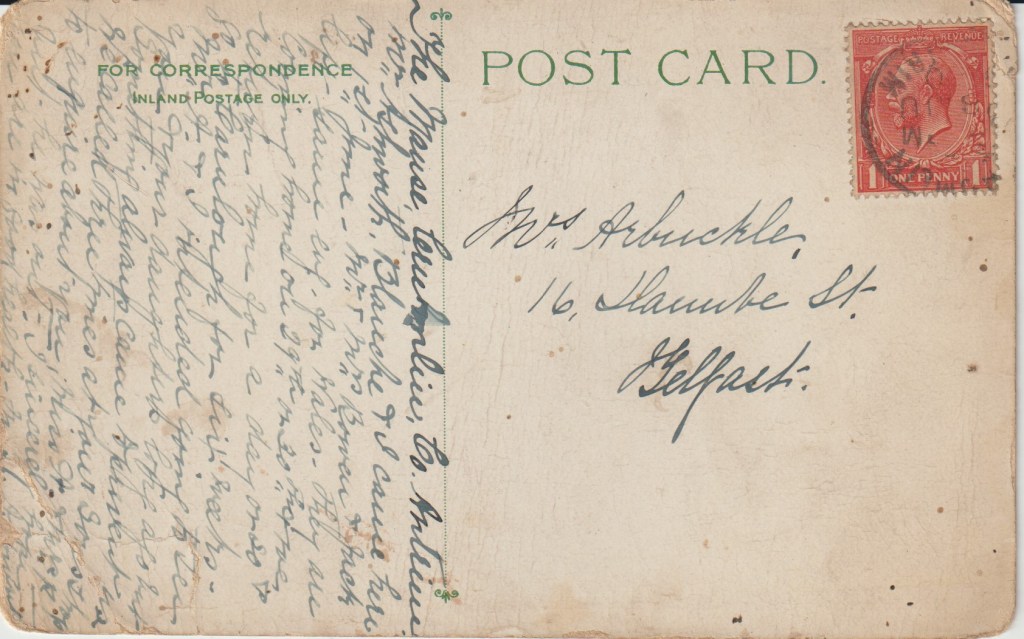
I purchased this postcard on eBay recently. It is not in great condition but it is a fairly rare example of a Baird of Belfast postcard of the Non-Subscribing Presbyterian Church at Crumlin. It came with added interest because it was sent by Mrs Ashworth to her friend Mrs Arbuckle of 16 Danube Street, Belfast in June 1908. The message gives us a little glimpse into Non-Subscribing Presbyterian church life in 1908.
Mrs Ashworth, the author, writes in friendly, yet also fairly formal tones to Mrs Arbuckle. Mrs Ashworth (as she describes herself) was the wife of the Rev Alexander Osborne Ashworth minister of York Street Non-Subscribing Presbyterian Church at the time. She refers to her husband only as Mr Ashworth in her short note although also mentions a person called Blanche who appears to be their daughter. They are also staying in the manse at Crumlin. ‘Mr Ashworth, Blanche and I’ came to the manse on 1st June, ‘Mr & Mrs Bowen & Jack’ left the same evening for Wales where they would remain for most of the month before returning for a six week stay at Carnlough. Prior to sending the card the Ashworths had made some unsuccessful attempts to meet up with Mrs Arbuckle and her family.
It’s not possible to identify the Mrs Arbuckle, but there is a good chance that she was a member of York Street Church, indeed there was a Mary Arbuckle living on York Street itself in the 1901 census and Danube Street is certainly within the catchment area of York Street Church.
Most of the contents reveal mundane domestic arrangements involving three Belfast families over 110 years ago. But knowing that two of those families were the families of NSP ministers and the fact that it was all written on a postcard depicting Crumlin Church enables us to put some flesh on the bones of this brief correspondence.
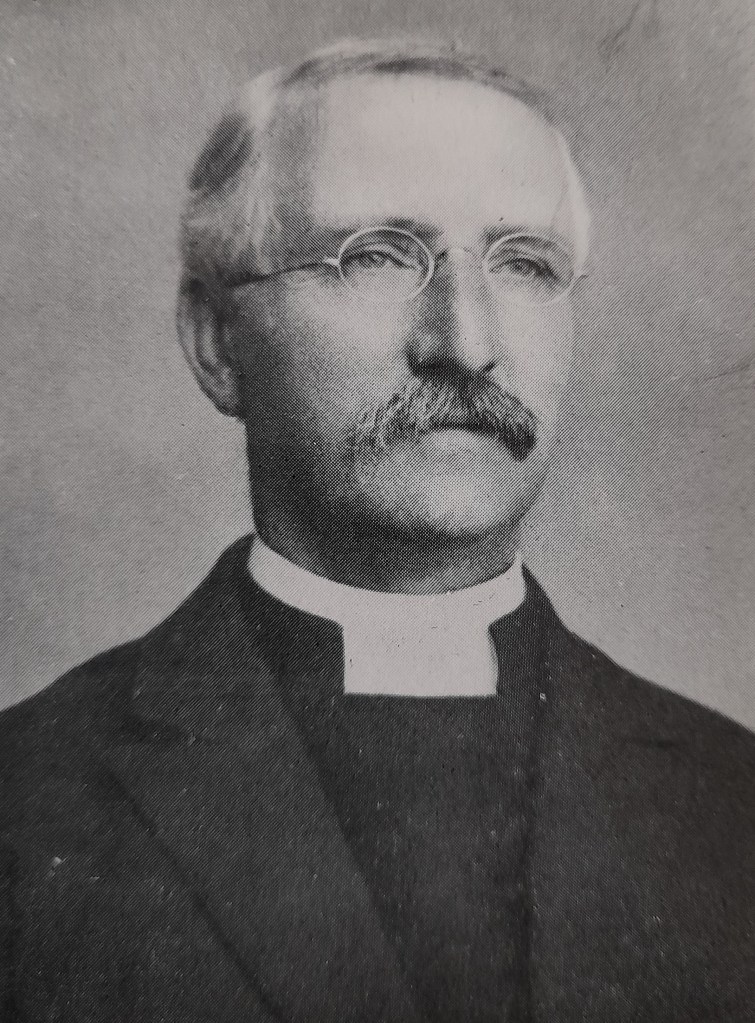
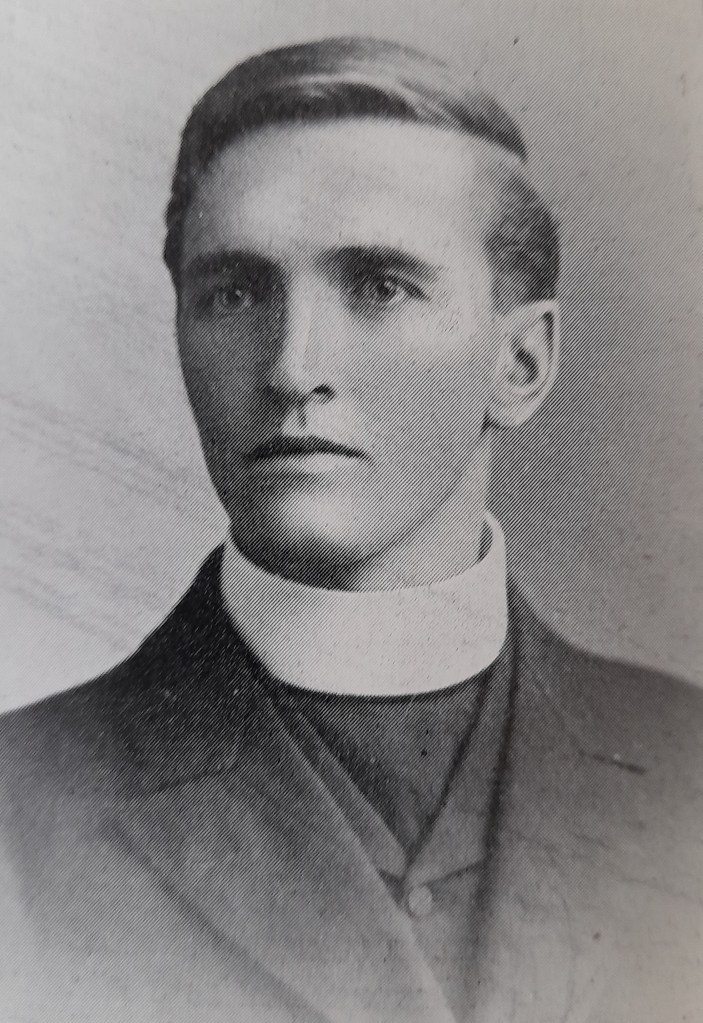
Mr and Mrs Bowen were the Rev Samuel Evans Bowen and his wife. S. E. Bowen was called to be minister of Crumlin in 1908, he was ordained later in the year on 3rd September by the Presbytery of Templepatrick. It may be that Alexander Ashworth and his wife were preparing the manse for their arrival, although he was clerk of the Presbytery of Antrim at that time and was still minister of York Street until 1909 when he retired, although he continued as a very active senior minister until 1913 and remained active in his denomination for many years afterwards until his death in 1935. Ashworth was born in the Rossendale valley in Lancashire in 1846 and trained at the Unitarian Home Missionary College. He came to York Street in 1893 after previous ministries in Chatham, Stalybridge, Doncaster and South Shields. For many years he was also the Sunday School Convenor for the Non-Subscribers. This job was no sinecure, in 1909, for instance, he organised the Annual Sunday School Conference at Downpatrick, an event which attracted 450 participants.
Rev A. O. Ashworth in 1909
The Rev Alexander Ashworth is probably hardly remembered today, for one thing the church where he had his longest and most significant ministry was destroyed in the blitz of 1941, but he gave devoted service in many different ways for decades.
Rev S. E. Bowen in 1908
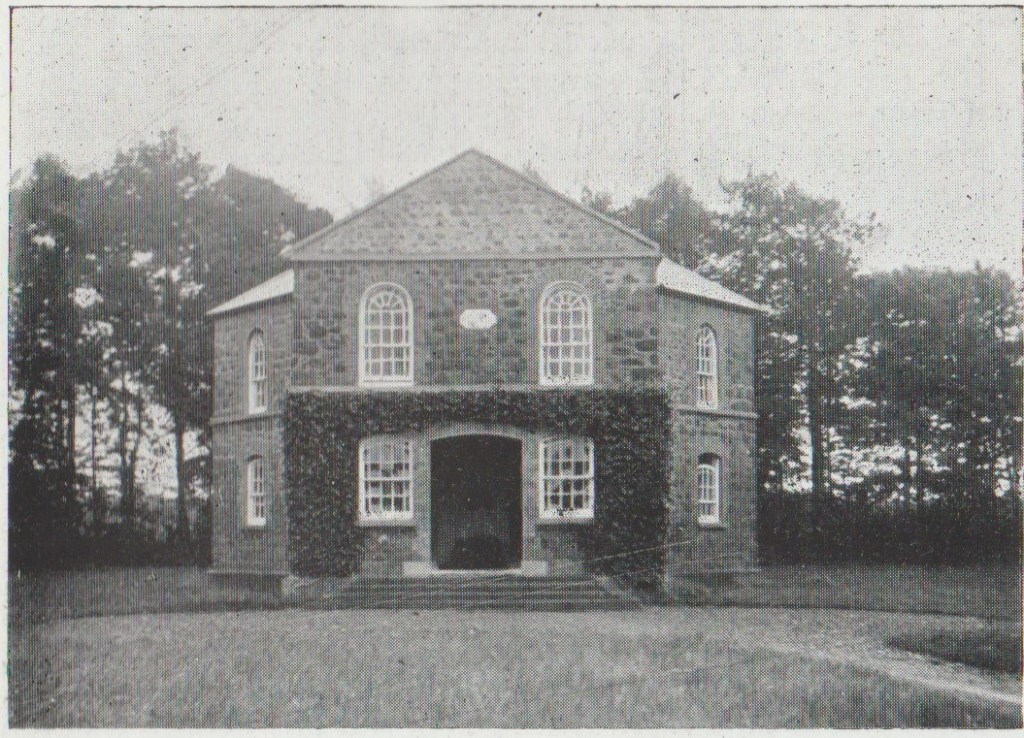
The same was true of S.E. Bowen. Another former student of the Unitarian College in Manchester he was minister in Crumlin for over twenty years (to 1929) before returning to his native Wales to minister at Allt-y-placa, Capel-y-bryn and Cwm Sychbant for 27 years. But with this postcard we get a view of the Crumlin meeting-house. Judging by the trees it is of a similar, although not identical, vintage to the photograph that appeared in the Non-Subscribing Presbyterian magazine in October 1908 to accompany the account of his ordination. In both pictures the ivy seems to be contained in identical positions but the postcard shows a small tree or bush to the right of the church which is not there in the magazine image. The postcard could be quite a few years older than the other photograph.
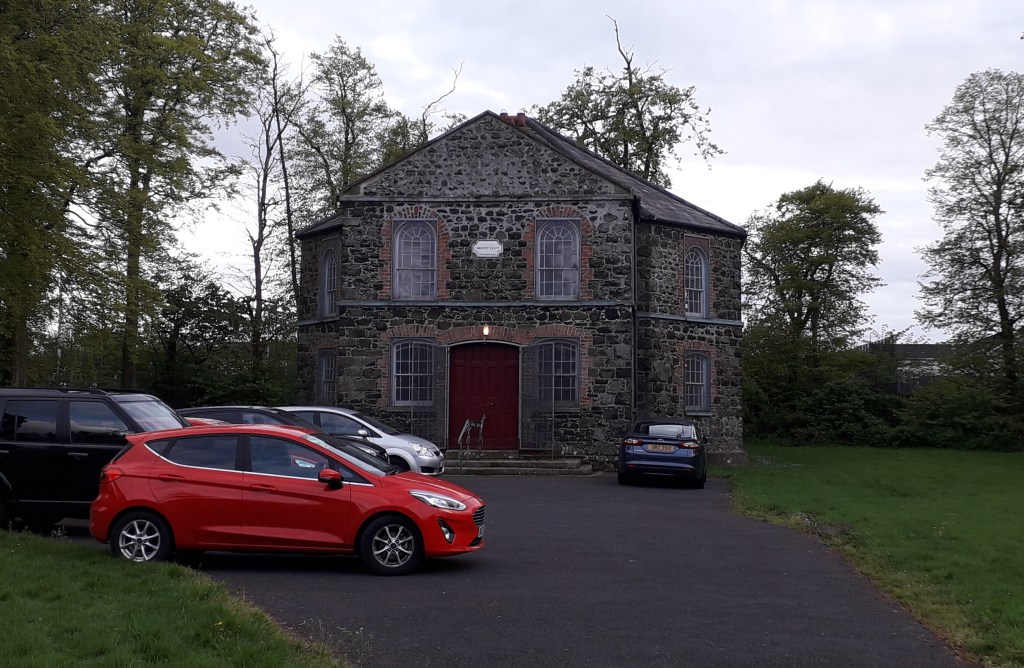
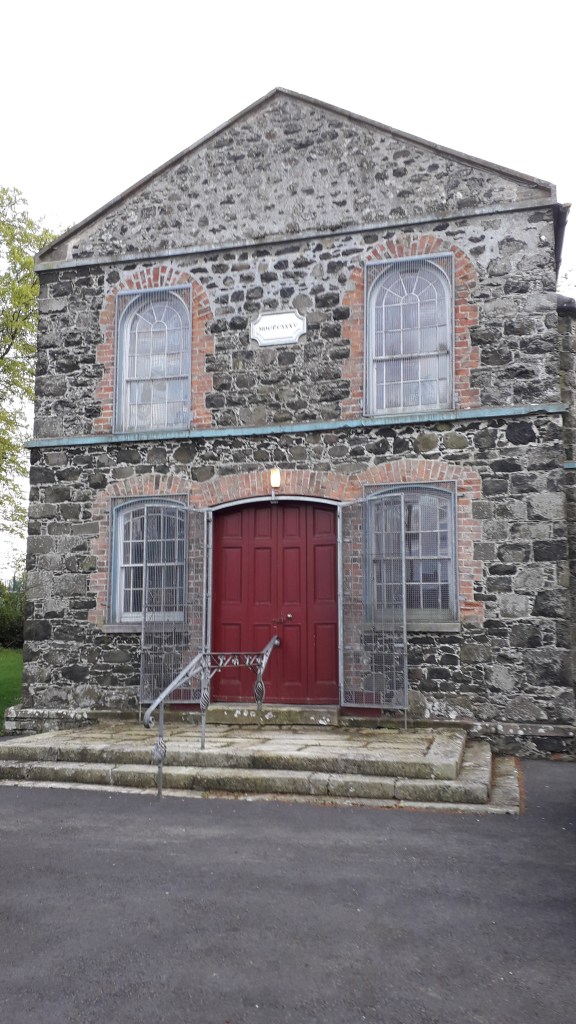
The Crumlin meeting-house is fairly secluded and can’t be seen from the main road. Built in 1835 it replaced an earlier church of 1715. It is a miniature replica of Belfast’s First Presbyterian Church designed by Roger Mulholland. It is interesting that the congregation of Crumlin took that building as a template for their new church over 60 years later.
Crumlin in 1908 (NSP Magazine)
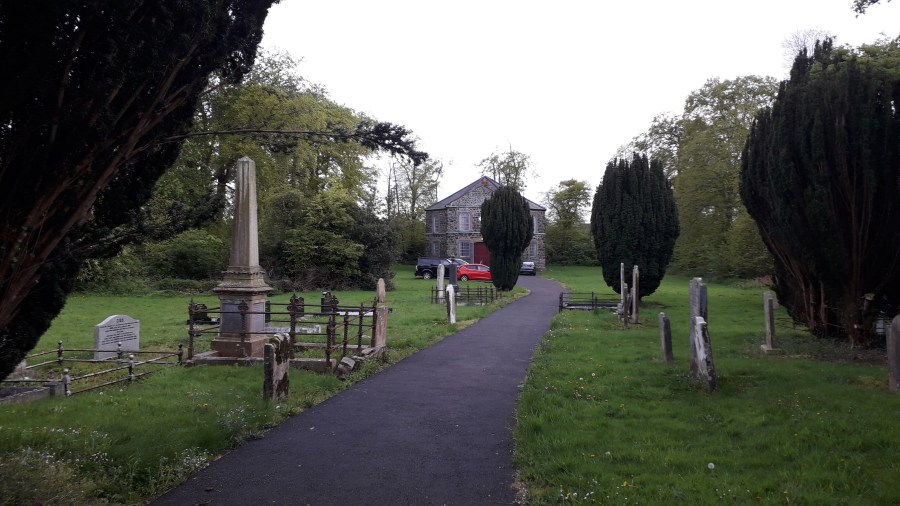
Crumlin in 2019
Whenever I try to take an architectural photograph I always aim to get a shot of the building without the distractions of either people or vehicles. I wasn’t able to do this with this picture of Crumlin taken in the autumn of 2019. The foreground is crowded with cars. But in the long term a photograph of something like a church which includes other details that date it actually makes it more interesting to the viewer. But if I was going to compose the cars for a photograph I wouldn’t park them like that!
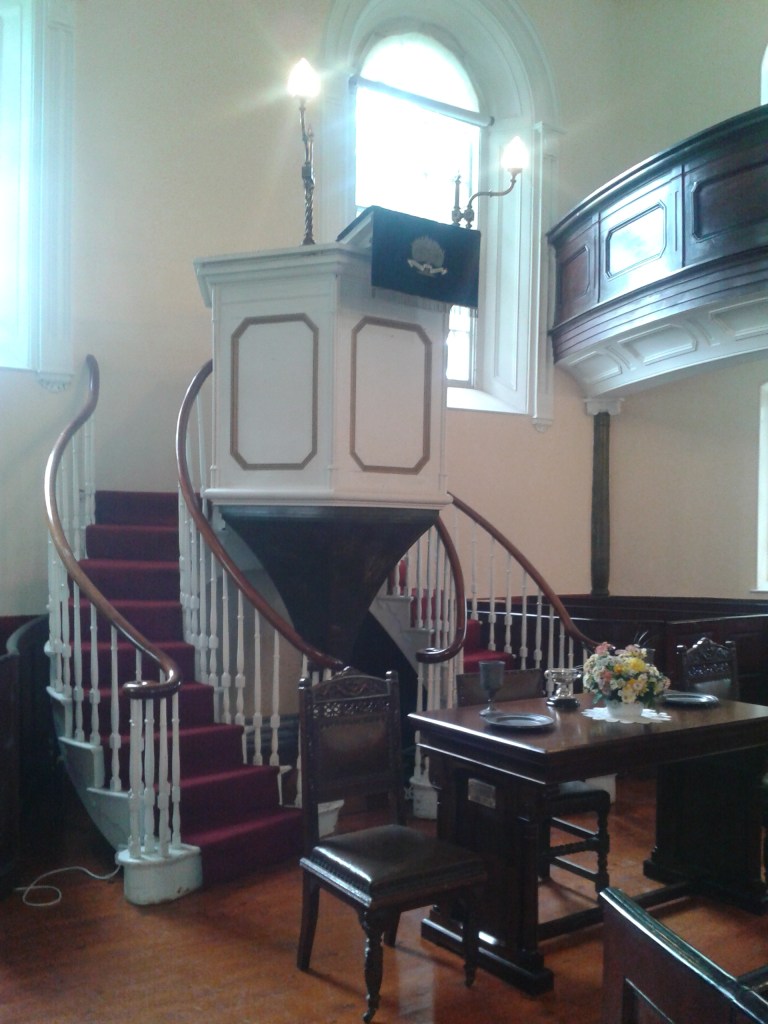
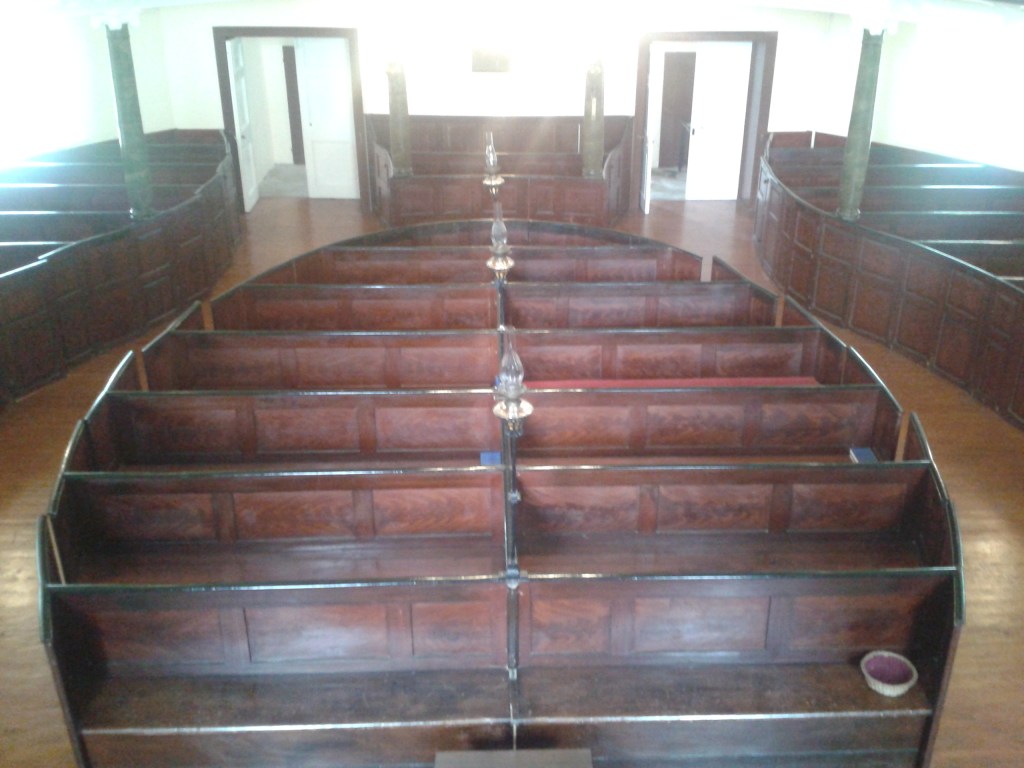
The interior of Crumlin has an elegant charm.
Pulpit
Pews
The account of S.E. Bowen’s ordination published in the Non-Subscribing Presbyterian magazine is quite full and interesting. In the service the Rev S.E. Bowen said that ‘Unitarians were a people who believed not so much in attempting a definition of religion as in working for truth and liberty, being bound together by a profound belief in the Fatherhood of God and the brotherhood of man.’ Later, over the welcome dinner there were a number of speeches given. Representing the Presbytery of Antrim the Rev W.S. Smith told the whole congregation to pick a day in October and arrive at the manse with a spade ready for three hours of work, leading the author of the report to note that the manse garden must ‘to say the least, be inferior in condition to the Garden of Eden when it was given to the father of all living to dress it and keep it’. The Rev Alexander Gordon was also there speaking highly of S.E. Bowen as a former student of his. He also related how he had recently been in the south of France and attended worship in a Protestant congregation there where the service was conducted by a young man in a congregation that only numbered sixteen, ‘yet he had been favourably impressed with the manifest consciousness of the congregation that they had come to worship, and with the energy and the earnestness of the preacher.’ It made me wonder what else Alexander Gordon did in the south of France in the summer of 1908, I can’t imagine that he just went there to sunbathe.




 velvethummingbee