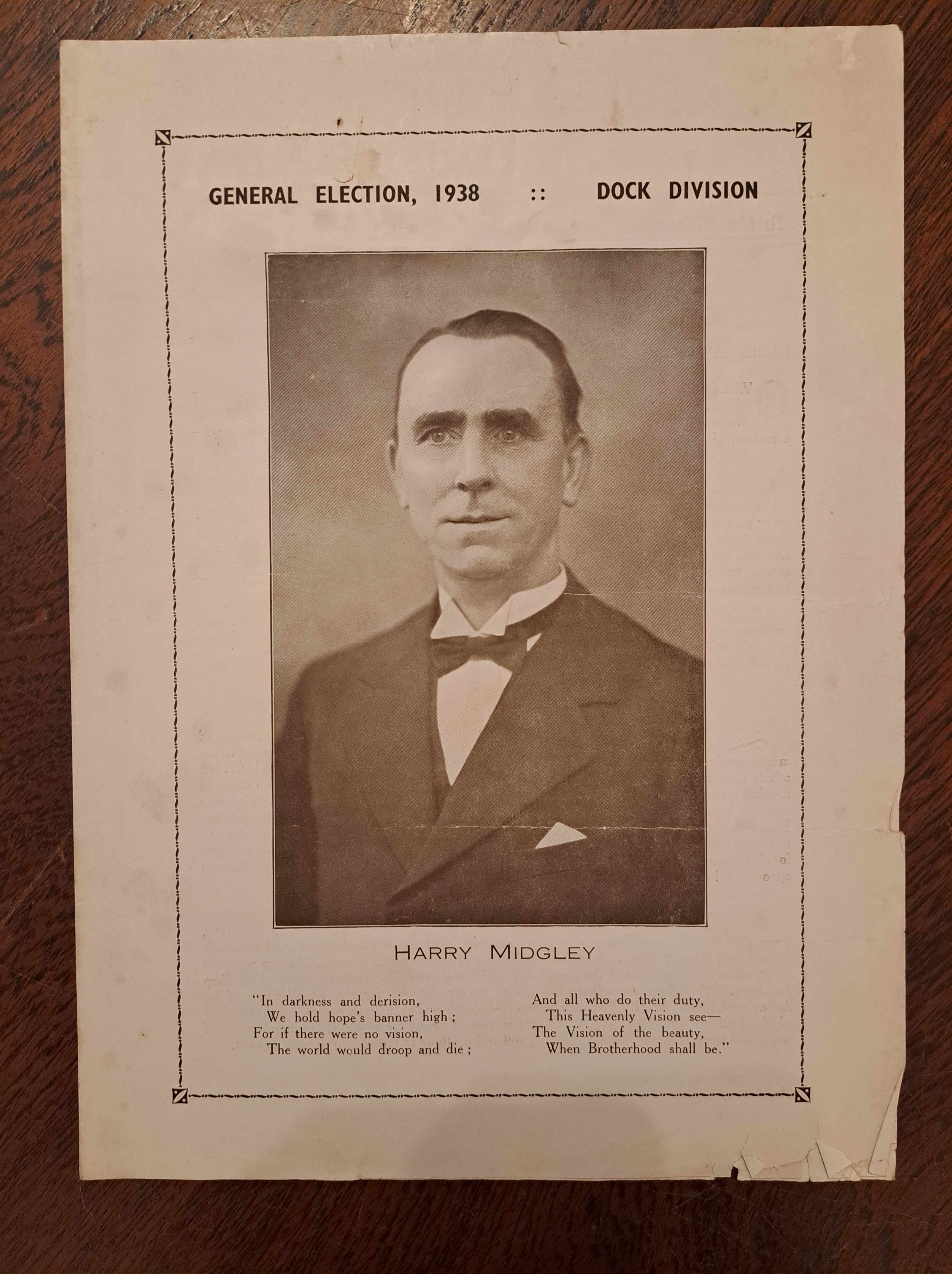
One of the recently discovered items in the Very Rev William McMillan Library is the election address produced by Harry Midgley for the Dock Constituency in the 1938 Stormont Election. This is a fascinating piece of history, a very rare survival, that tells us about the career of a controversial figure in Belfast political history:
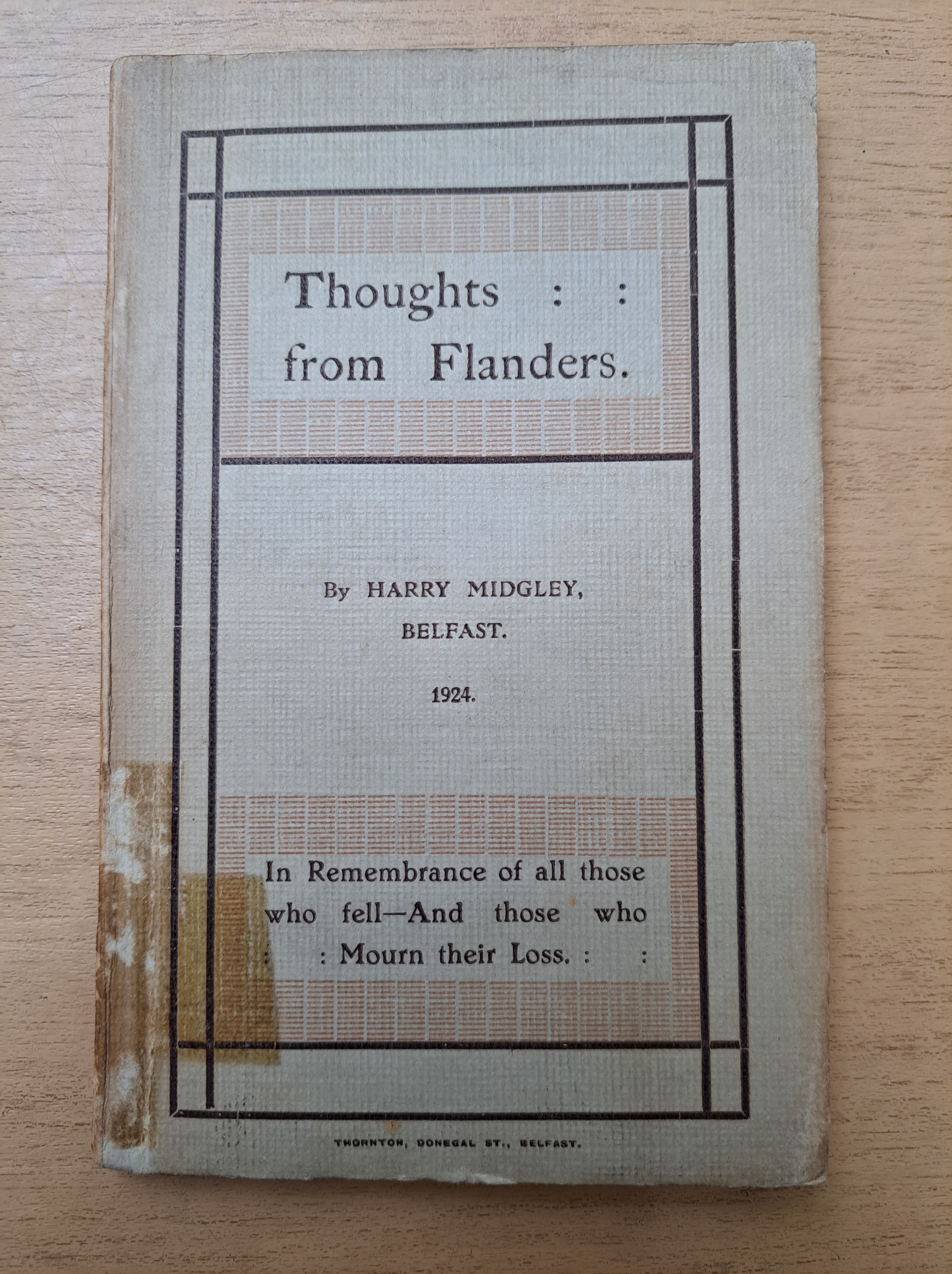
Harry Midgley was born in North Belfast, in Tiger’s Bay, and from his youth was involved in the nascent Labour movement in Northern Ireland. According to the ‘Dictionary of Irish Biography’ as a boy he attended a Sunday School connected with the Independent Labour Party in Belfast and he certainly met Keir Hardy in Befast as a youth and began speaking on behalf of the ILP on the Custom House steps while still a teenager. In his early days, right up to the early 1920s, Harry Midgley supported the all-Ireland Socialist ideals of James Connolly, nevertheless on the outbreak of war in 1914, along with his brothers, he joined up, enlisting in the Royal Inniskilling Fusiliers and served throughout the First World War. Later, in 1924, he published his reflections on his war-time experiences in poetic form. Much influenced by Kipling his verses also show the mixture of Christian values coupled with utopian socialist ideals which underpinned his politics throughout his career.
On his return from the war he immersed himself in politics, firstly getting a job as a shipyard joiner with Harland and Wolff, and soon after being appointed as organising secretary of the Irish Linenlappers’ and Warehouse Workers’ Union. This was his entry into the Labour movement and he became active in different organisations particularly the Belfast Labour Party.
He also became a member of York Street Non-Subscribing Presbyterian Church (see picture at the top of this page) at a time when it was perceived as very left-orientated under the ministry of the Rev A.L. Agnew. Indeed when he fought the West Belfast Westminster constituency in 1924 (gaining over 21,000 votes, although not proving victorious) A.L. Agnew and the Rev E.I. Fripp, minister of All Souls’ NSP Church, were amongst his most prominent supporters. York Street Church was also characterised by very open political debate in the early 1920s, and welcomed speakers of all political backgrounds to its ‘mock parliaments’.
The Belfast Labour Party had proved very successful at its inception. In 1920 it won 10 out of the 60 seats in the municipal elections in Belfast. The Party gradually transformed to the Northern Ireland Labour Party and Harry Midgley became the first secretary.
In 1925 he was a elected to the council as a representative of the Dock Ward and a few years later, in 1933, he was successful in winning the Dock Constituency in the Stormont Parliament. However, in 1938 he lost this seat, partly due to the fall out from the Spanish Civil War. It is this from this election that the printed address in the Dunmurry Library comes. To see it and find out more about it click on the video above.
Gradually the Northern Ireland Labour Party adopted a pragmatic view of partition and Harry Midgley went along with this view. But for a party that tried to stand outside the sectarian divide the issue of the border was one that would not go away. The Northern Ireland Labour Party itself became divided over the position to take on the question of the border and eventually Harry Midgley was expelled, partly because of the strongly pro-Union position he ultimately adopted. He then formed his own Commonwealth Labour Party which enjoyed some success and as a Member of Parliament in Stormont he served in the war-time government, the first non-Unionist representative to be in government in Northern Ireland. Later he joined the Ulster Unionist Party, reconciled by the party’s willingness to follow the post-war social policies of the Westminster government. Having been elected as the MP for the Belfast Willowfield constituency at a by election in 1941 he continued to represent the same constituency up to the time of his death in 1957, first for the Northern Ireland Labour Party, then the Commonwealth Labour Party and ultimately for the Ulster Unionist Party, the only member of the Stormont Parliament to represent the same constituency for three different parties.
In later life he joined the Orange Order and the Royal Black Preceptory. A life-long supporter of Linfield FC he became a director of the club and ultimately the Chairman. At the time of his death he was Minister of Education.
 velvethummingbee
Hello David,
Both Celia and I have enjoyed the Harry Midgley document. Many thanks for making it available. Incidentally, to the best of my knowledge, he is/was no relation.
I’ve learned a lot. Among other things I was surprised to learn that Arthur Agnew’s leanings were politically left-wing. And we were interested to see the presence of Edgar Innes Fripp. He was minister for a few years at Dunham Road Unitarian Chapel, Altrincham, where I and then Celia had a ministry. Fripp’s ministry there was not well received. He seems to have gone through a sort of right-wing, almost high church phase. Attendances shrank and it seems there were few tears shed when he departed.
Keep up the good work with the library.
All the best,
John.
LikeLiked by 1 person
Great to hear from you John, I am glad you liked the post. I was wondering if there was possibly a family relationship there. I discovered that his grandfather came from Yorkshire, he came over to Belfast at the start of the industrial expansion of the city bringing his skills from working in the mills of Yorkshire..
Yes, Dr Agnew had a strongly left-wing ministry in his early years. He visited the Soviet Union under Stalin and came back and gave lectures on ‘A Thousand Miles Through Soviet Russia’. What was new to me was that E.I. Fripp was also a Socialist. I didn’t know that but he did speak publically on behalf of Harry Midgley. All Souls’ was his most productive ministry, he built the church, and he was very much wedded to a strongly liturgical form of worship. But, of course, that approach did not necessarily go against also holding left-wing political views. A lot of High Anglicans in his time were also inclined towards Socialism. But this is the first time I have seen his political views associated with these ideas.
Best wishes to you and Celia,
David
LikeLike