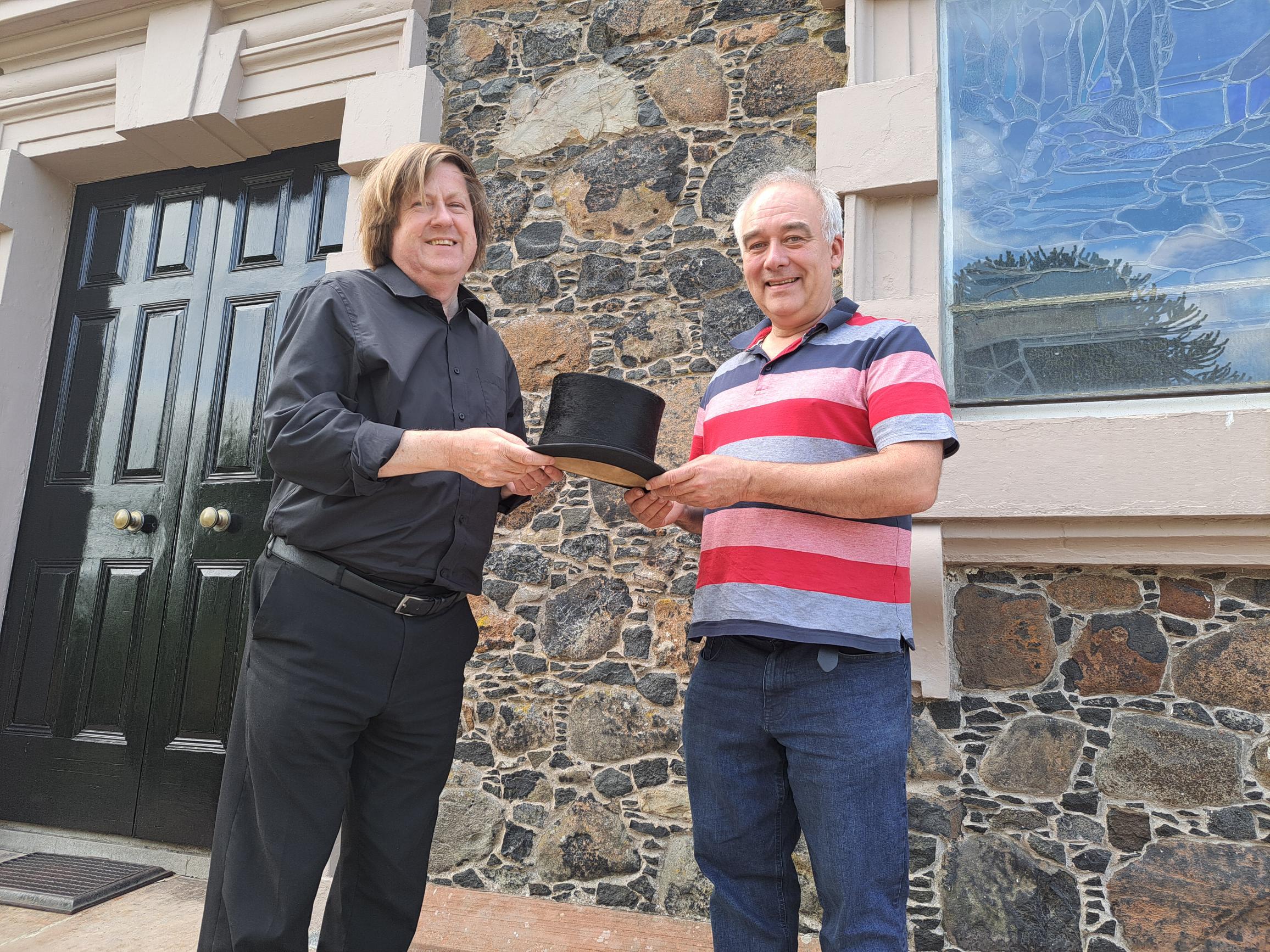
It was a great delight for us to welcome to Dunmurry last week Patrick Robertson, a direct descendant of the Rev Alexander Gordon, his great great grandson no less. He brought with him a mass of wonderful material relating to AG and his family which will provide the basis for much important research in times to come. But the most poignant item he brought along was Alexander Gordon’s silk top hat.
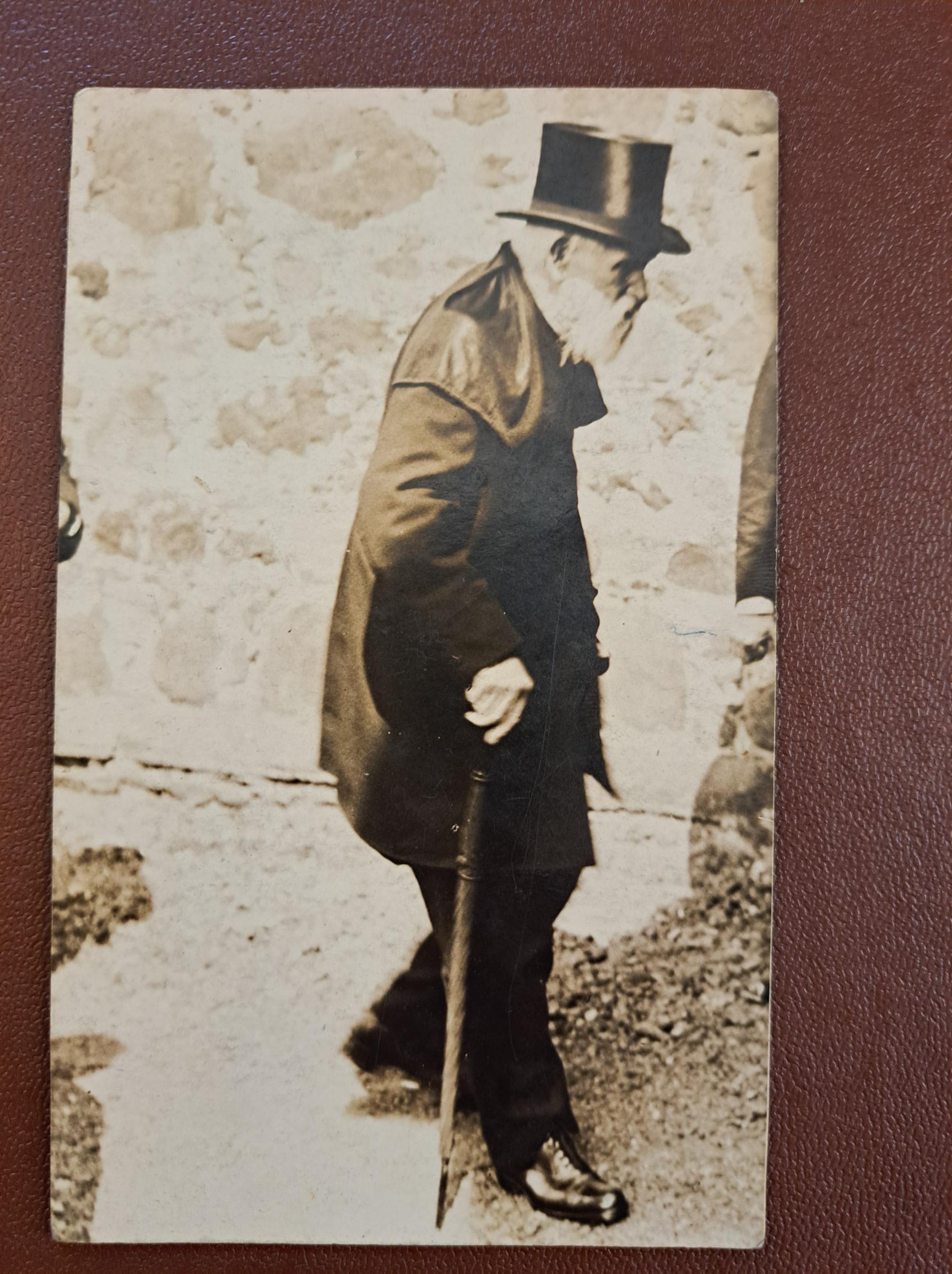
The last time this hat was in Dunmurry was on 18th January 1931 when AG preached in Dunmurry for the last time shortly before his death in February of that year. This visit was preserved in a photograph taken as he entered the Church which can be seen in this post. Alexander Gordon was a member of Dunmurry from the time he moved to Manchester in 1890 to take over as Principal of the Unitarian Home Missionary College. He seems to have valued this link above all else and returned regularly to Dunmurry to attend communion, to serve on the committee and to participate in other aspects of congregational life.
Patrick has another printed postcard image of AG’s visit to Dunmurry in 1931. This view is actually the same shot as the original picture used on this blog before but it is cropped differently. This is it:
Alexander Gordon was known for his hats. He was said to wear an ancient silk hat inscribed ‘Not Yours!’ But this one wasn’t it. It is actually in excellent condition and though it must be nearly 100 years old it is probably not much older than that.

But his hat was noticed in a newspaper article which is preserved in the Very Rev William McMillan Library in Dunmurry. Probably from the Belfast Newsletter and dating from early in 1931 the writer gives an account of Gordon’s visit to the Linen Hall Library to hear Shannon Millin’s lecture on Belfast historian George Benn. For the writer Gordon was the ‘Silk-hatted veteran’:


Patrick has a lot of fascinating material relating to Alexander Gordon including his certificate from Manchester New College, London dated June 1862 and signed by James Martineau, J.J. Tayler, William Gaskell and many other prominent Unitarians. In later years AG corresponded regularly with his granddaughter Nellie and these lively and engaging letters shed a lot of light on his activities and interests in the 1920s and will be the subject of a future article. The family history is fully covered by a range of letters from across the generations which show the Gordon family’s removal from the north east of Scotland to Dudley in the English west midlands where Alexander Gordon’s grandfather and namesake established himself as a highly successful spirit and wine merchant.

His grandfather was not only a very successful business man (helped no doubt by his wife Maria Loxton whose aide memoire for calculating measures survives to this day) but was Mayor of Dudley, and was also a leading Methodist in the west midlands. Converted by Wesley he kept an illustrated document detailing his spiritual state. This was before Methodists began to be advocates for temperance or teetotalism, which was quite a late development, most people won’t realise that as late as 1841 the Methodist Conference ruled against Methodist Chapels being used to host teetotal meetings and against using unfermented wine at communion.
Other documents that will provide more insight into Alexander Gordon’s life and activity include his ‘Essay on the Results of the Late [Crimean] War’, probably his oldest surviving written work, dating from 1856 at the age of 15; congregational addresses from Norwich and Hope Street, Liverpool, presented on his removal; a testimonial given to his father on removing from Coventry in 1854; photographs and more.
All this helps us expand our knowledge of Alexander Gordon and the world he belonged to, someone whose significance as a scholar has not diminished and whose personal religious bonds, it is becoming increasingly clear, were strongest with the Remonstrant congregation of Dunmurry.


Ah, they don’t make ’em like that any more; and I don’t mean the hat!
John. ________________________________
LikeLiked by 1 person