Balloo, Killinchy, A Hidden History

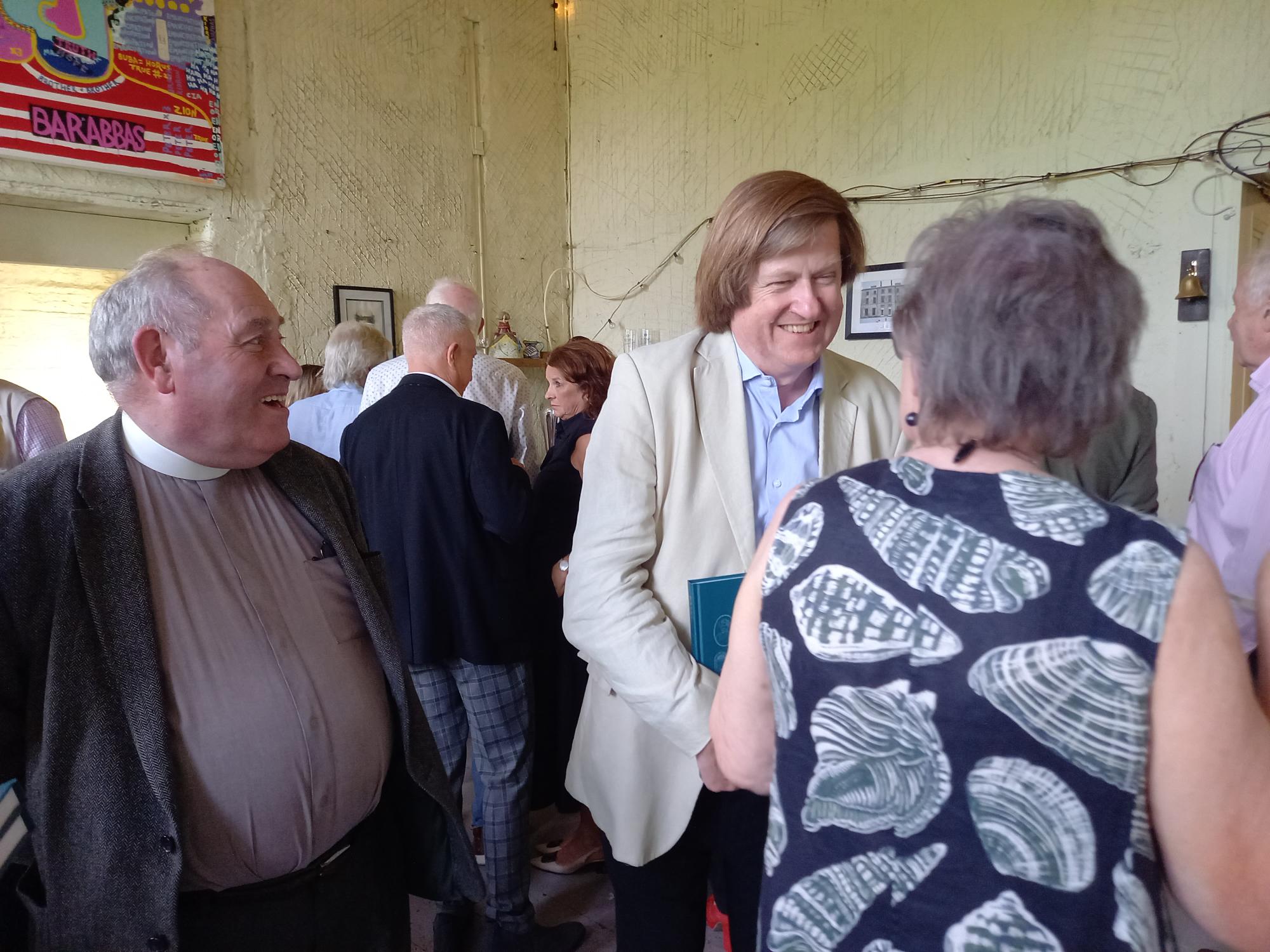
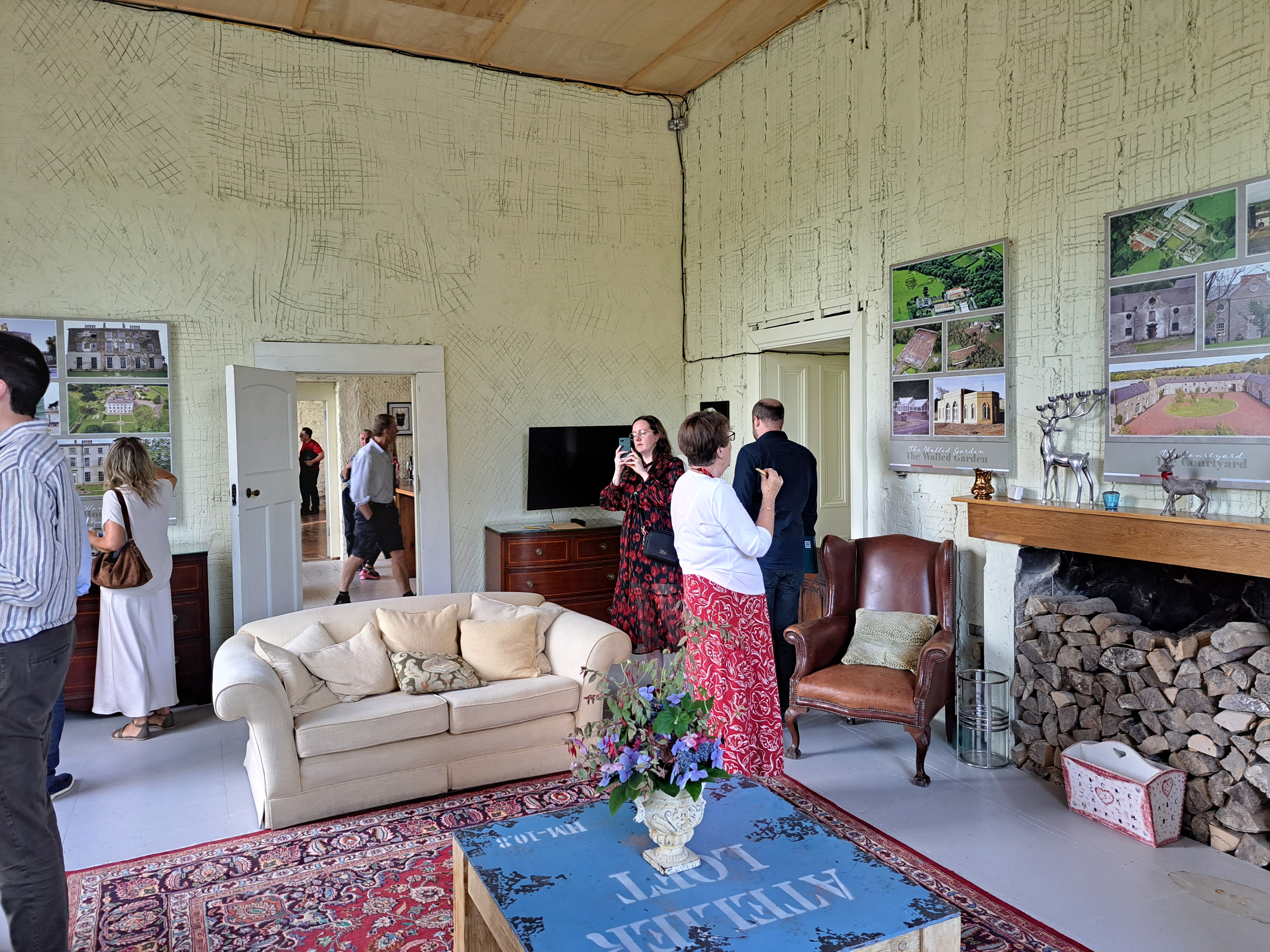
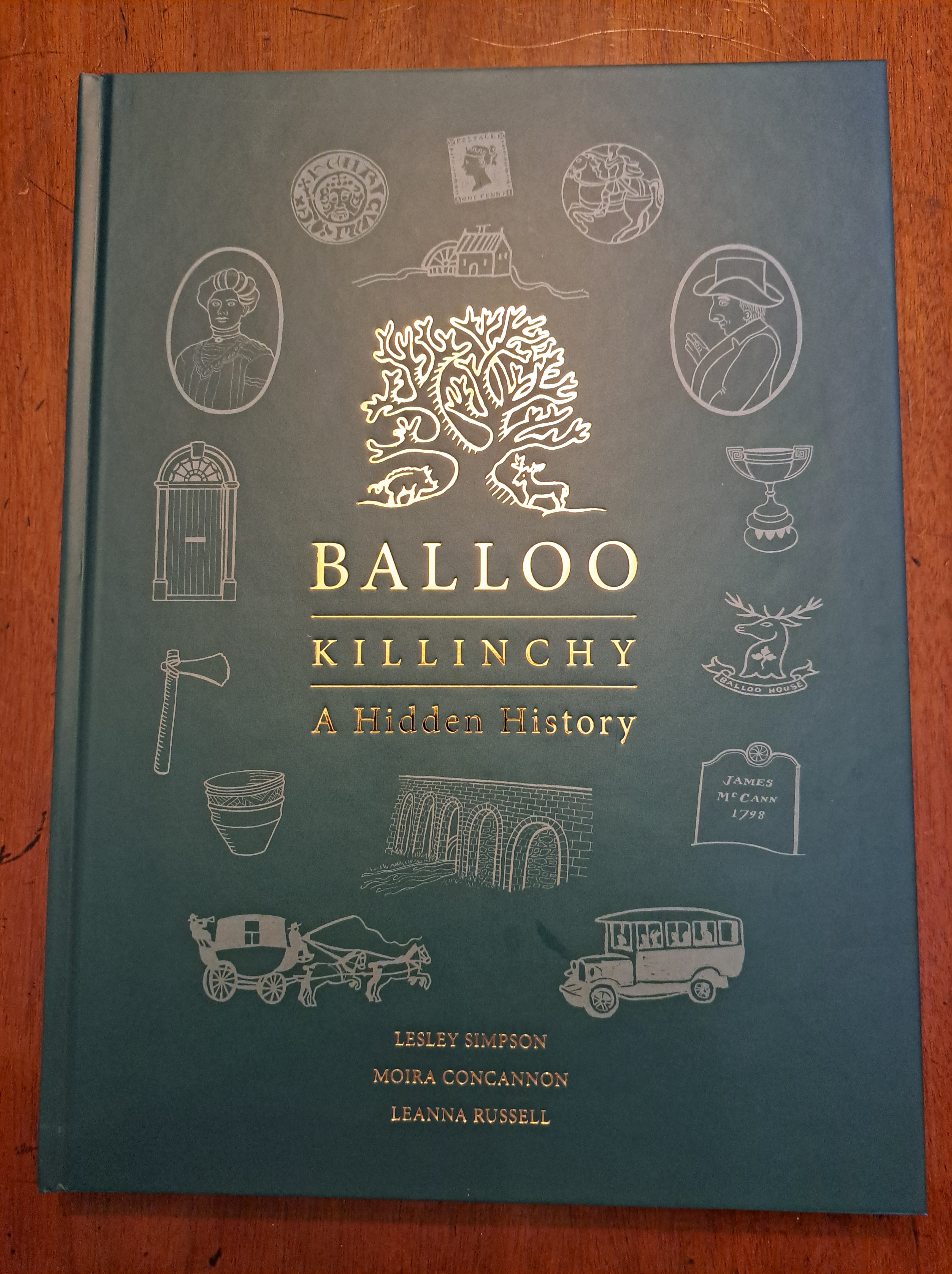
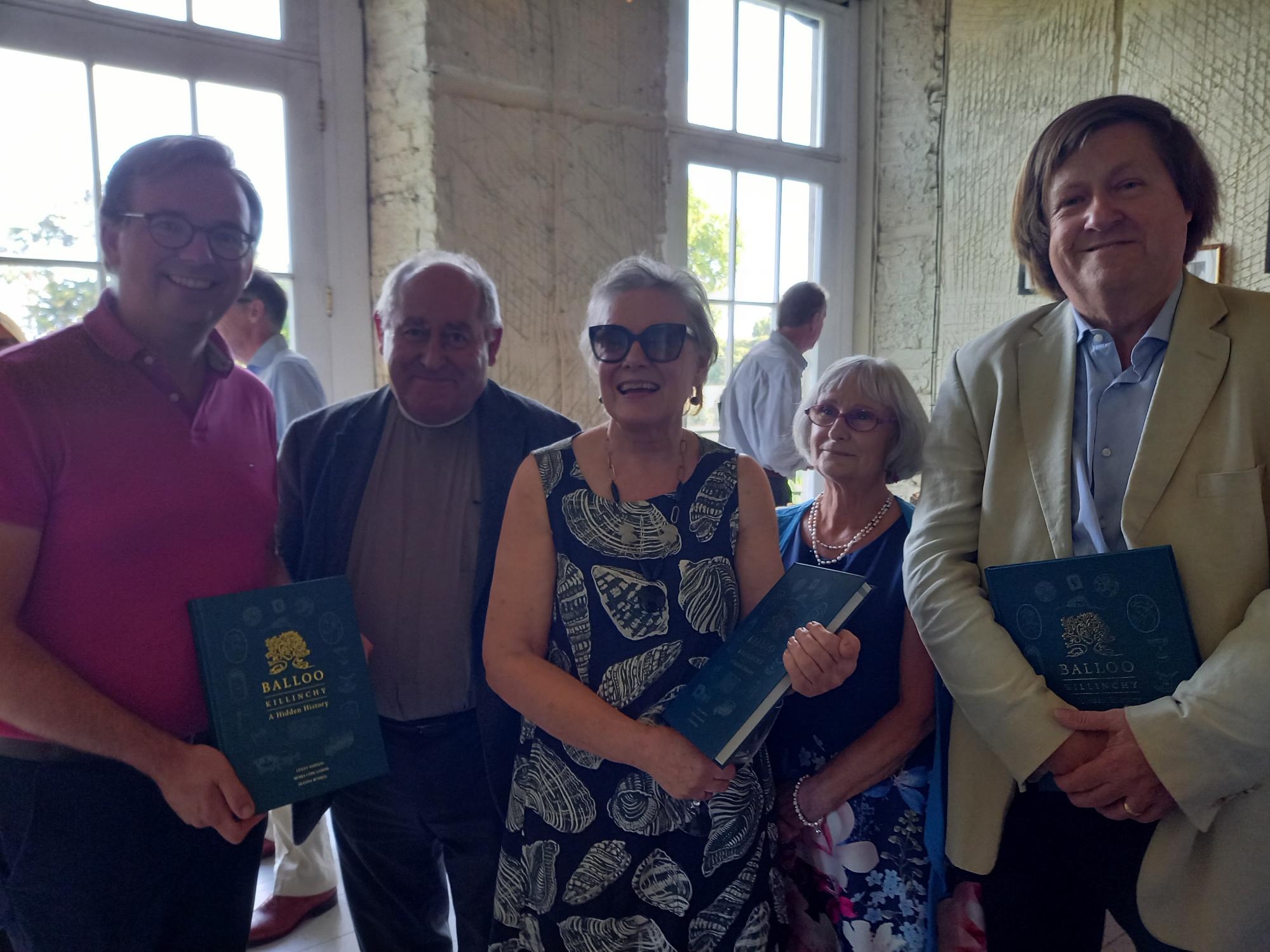
I was delighted to attend the launch of Balloo, Killinchy, A Hidden History by Lesley Simpson, Moira Concannon and Leanna Russell on Saturday, 15th August at Florida Manor, Killinchy. It was a wonderful occasion and a great start for a fascinating and beautifully produced book.
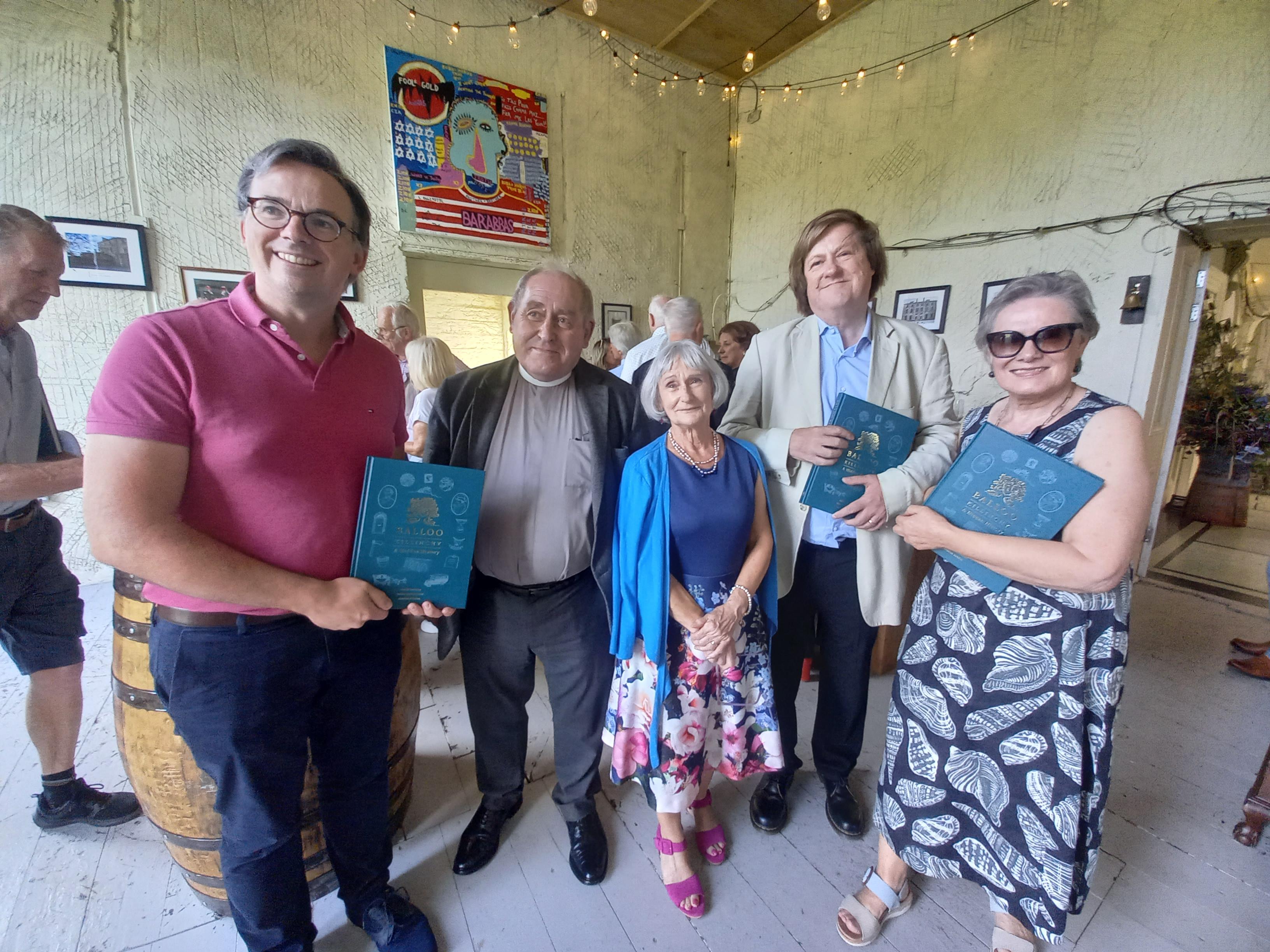
With Rev Dr Stanley Gamble, Rev Dr John Nelson, Lesley Simpson and Moira Concannon

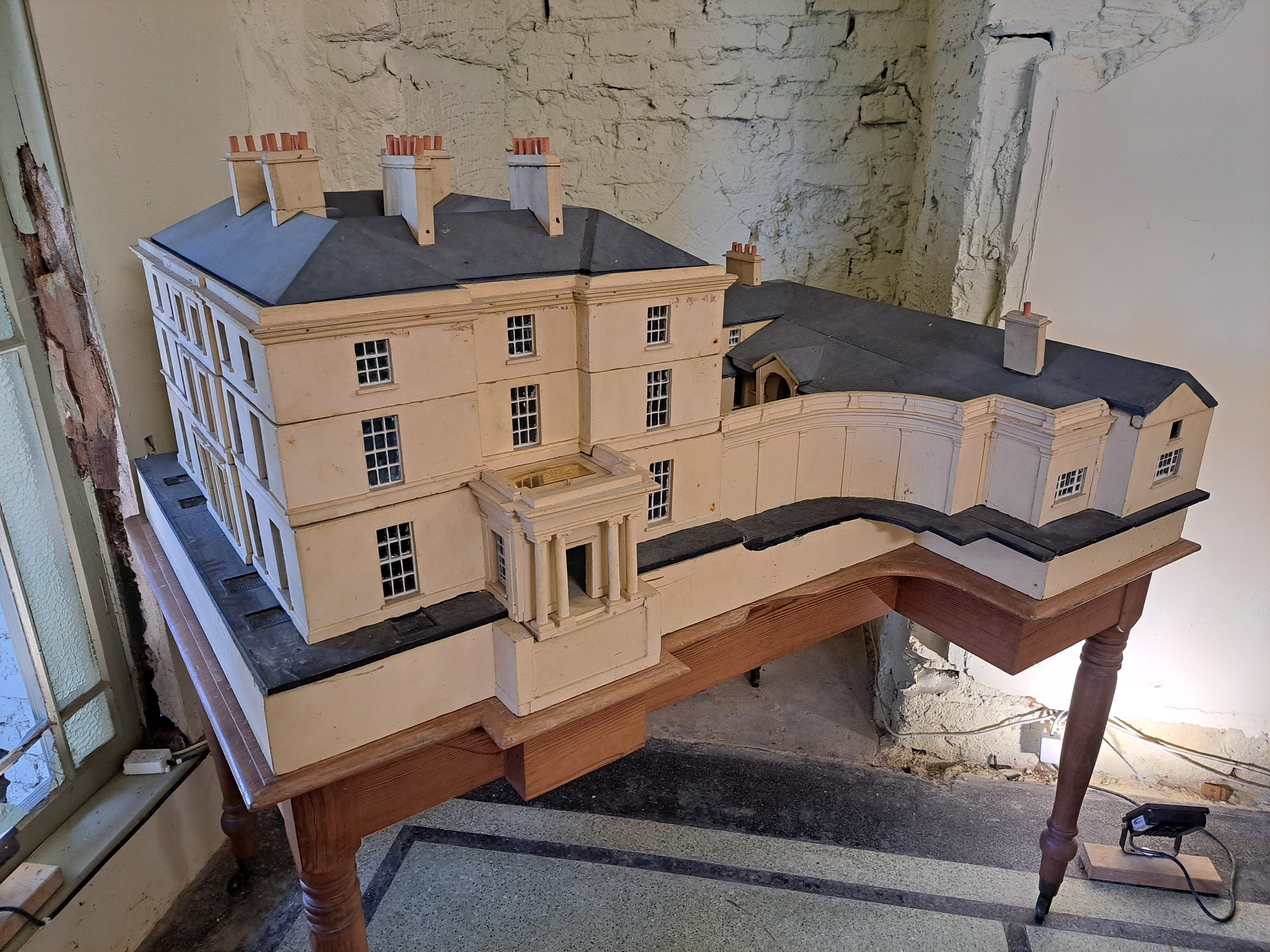
The authors tell the story of the locality through maps, family history, newspaper reports, churches, mills and stores and, most of all, the local houses. Of particular interest to me is the house known as Templebrook Valley which was the home of the Rev Samuel Watson minister in Killinchy from 1797 up to his death in 1856. He was at the centre of one of the major disputes between the Synod of Ulster and the Non-Subscribers in the 1830s and the new Remonstrant meeting house was built for him in Killinchy in 1846.
When the Non-Subscribers were ejected from their original meeting-house, for three years they held services in the grounds of his house. The book tells the story of the Rev Samuel Watson and his ‘long and interesting life from his suspected involvement with the United Irishmen to his move towards Unitarianism’. One of 13 children, three of them becoming Non-Subscribing Presbyterian ministers, Samuel Watson was also a significant farmer in the locality. Sadly his house was left to fall into dereliction in the twentieth century although a new house has now been restored on the site.
There is a great deal in the book about Samuel Watson. At the stone-laying ceremony for his new meeting-house it was reported that:

…seventy clergymen and strangers joined the congregation for a celebration which culminated in a substantial dinner, in a commodious wooden house that had been erected for the occasion with the Rev. Samuel Watson presiding.

I was particularly amused by one quotation taken from James Gourley in 1874, a perhaps not entirely unbiased commentator, who asked an old man who had sat under Samuel Watson’s feet:

What sort of doctrines did he preach? ‘Ohm’ said he ‘at that time there was no word about doctrine.’ ‘And what then did he preach about?’ ’Mainly about far away countries and wild beasts’.

Samuel Watson’s obituary in the Northern Whig described him as ‘…one of the oldest and ablest Ministers of the Church.’

The book is full of detail and uncovers such fascinating stories as the 1893 excavation of Templebrook Valley by the Belfast Natural History and Philosophical Society with the co-operation of Samuel Watson’s two youngest daughters – Anna and Sarah who were photographed at the excavation which uncovered Bronze Age vessels now in the Ulster Museum.
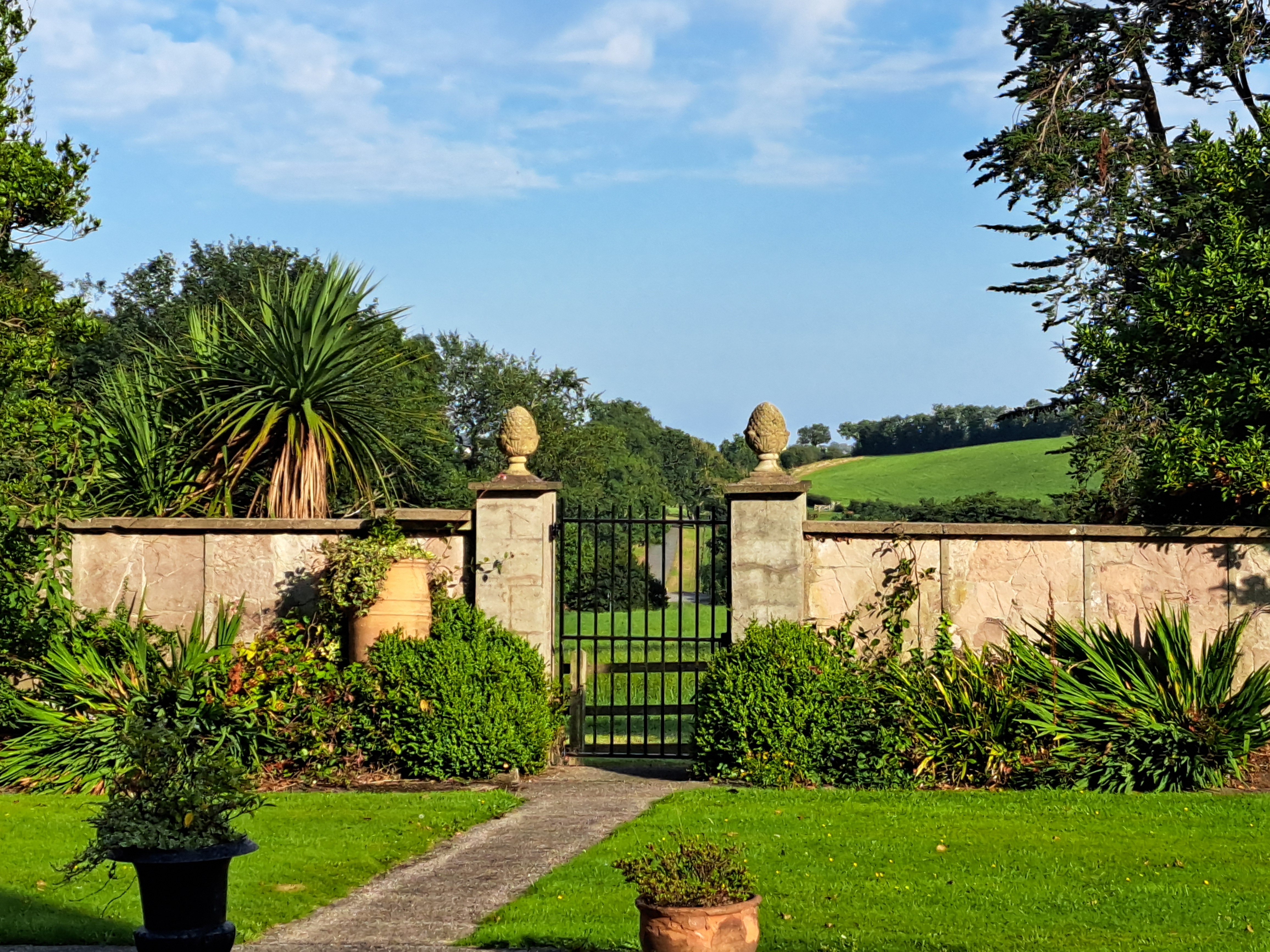
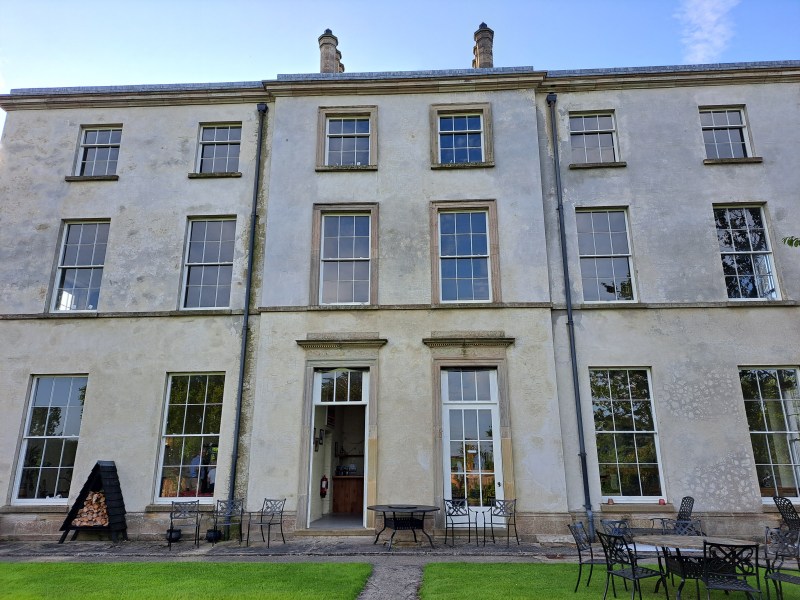
The view from the back of Florida Manor

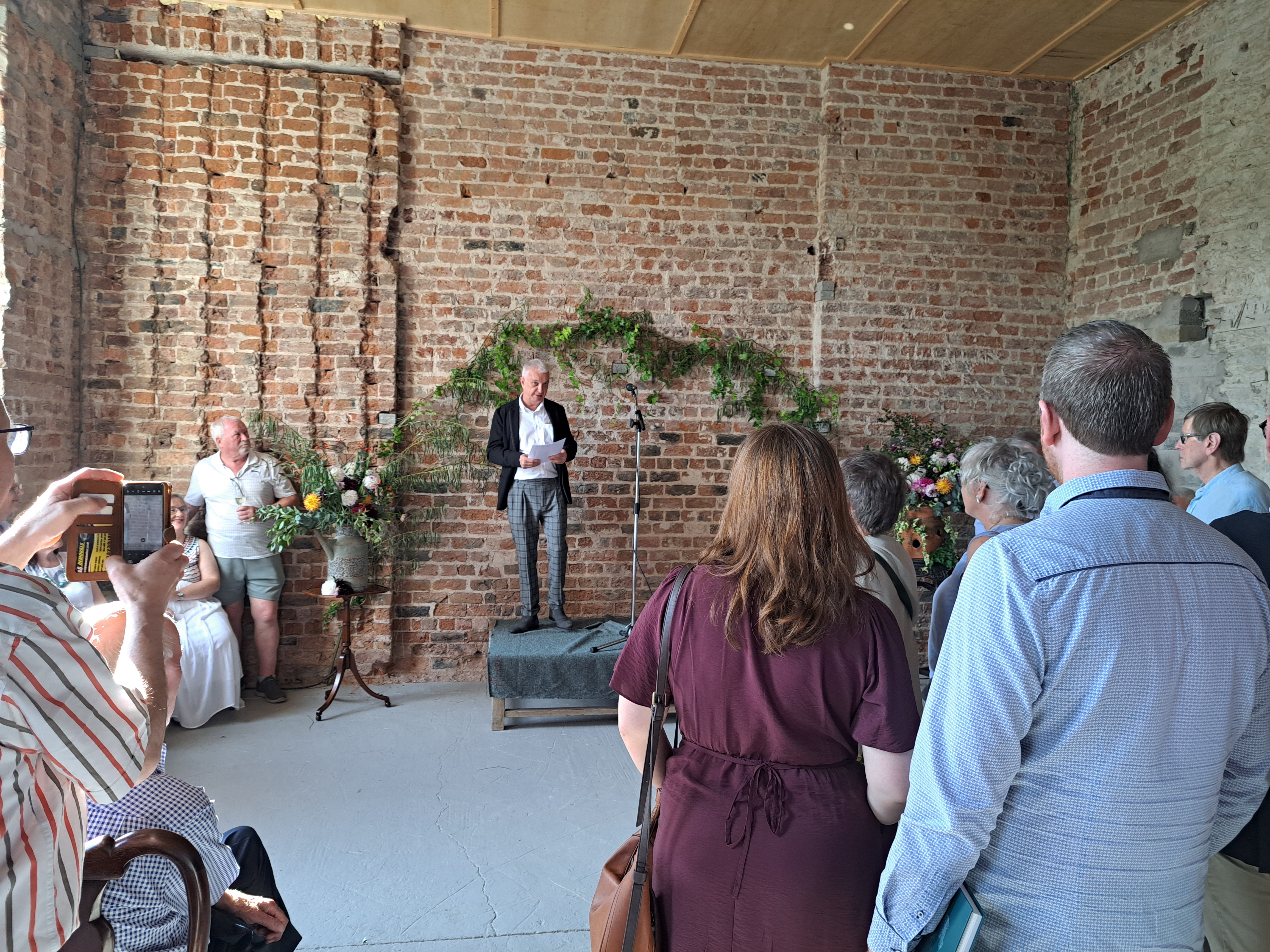
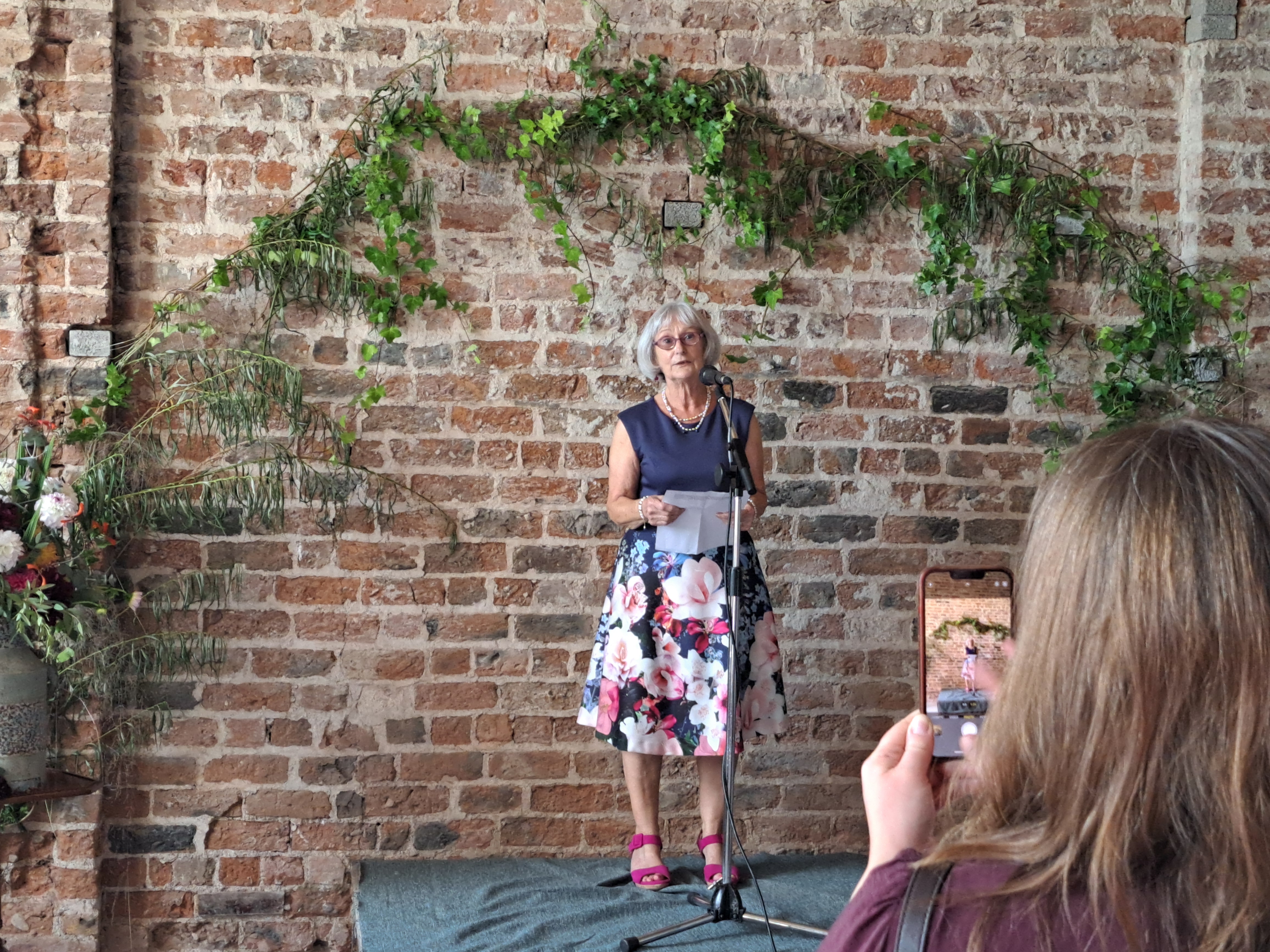
The book is richly illustrated throughout and is full of fascinating information. It is a credit to its authors and will be enjoyed by all with an interest in local history, the history of county Down and Irish Presbyterian history. The launch was a splendid occasion at Florida Manor, as the following photographs show.
Allen Daniel Coon (1867 – 1938), Pioneering Photographer and Cinematographer

In this video we take a look at the career of Allen Daniel Coon, one of the pioneers of photography and cinematography in Ulster. The video tells something of his story, with many examples of his postcards, and tracks down his last resting place.
Video: Allen Daniel Coon (1867 -1938) Photographer and Cinematographer

The previous post on this blog is all about Allen Coon’s postcards produced for W.J. Ross of Finaghy Stores in 1927, but these are just a small sample of his vast output produced between his arrival in Ireland in 1902 and his death in 1938.

Allen Daniel Coon was born in Buffalo, New York in 1867. The son of a Baptist pastor and, tradition has it, a native American mother, his career followed a fairly conventional path in its early years. He read law at university and then established himself as an attorney in Buffalo. But at some point he tired of this life and took the road to prospect for gold first in California and then in Alaska. One assumes this was not entirely successful because at some point he took up photography. He was a friend of George Eastman, the founder of Kodak, and may have been related to him. Either way he travelled to England with him in 1900 moving to Ireland a couple of years later to set up his own photography business.

This was right at the beginning of the boom in the sale of postcards. In 1902 you could send a picture postcard for a halfpenny and expect it to be at a local destination at lunchtime. For skilled photographers the opportunities were obvious and operating initially from Londonderry, later from Letterkenny and ultimately from Moira (each place was printed as his location on the front of his postcards) he produced hundreds of postcards of impressive views, street scenes, local landmarks, prominent buildings and sometimes interesting people.

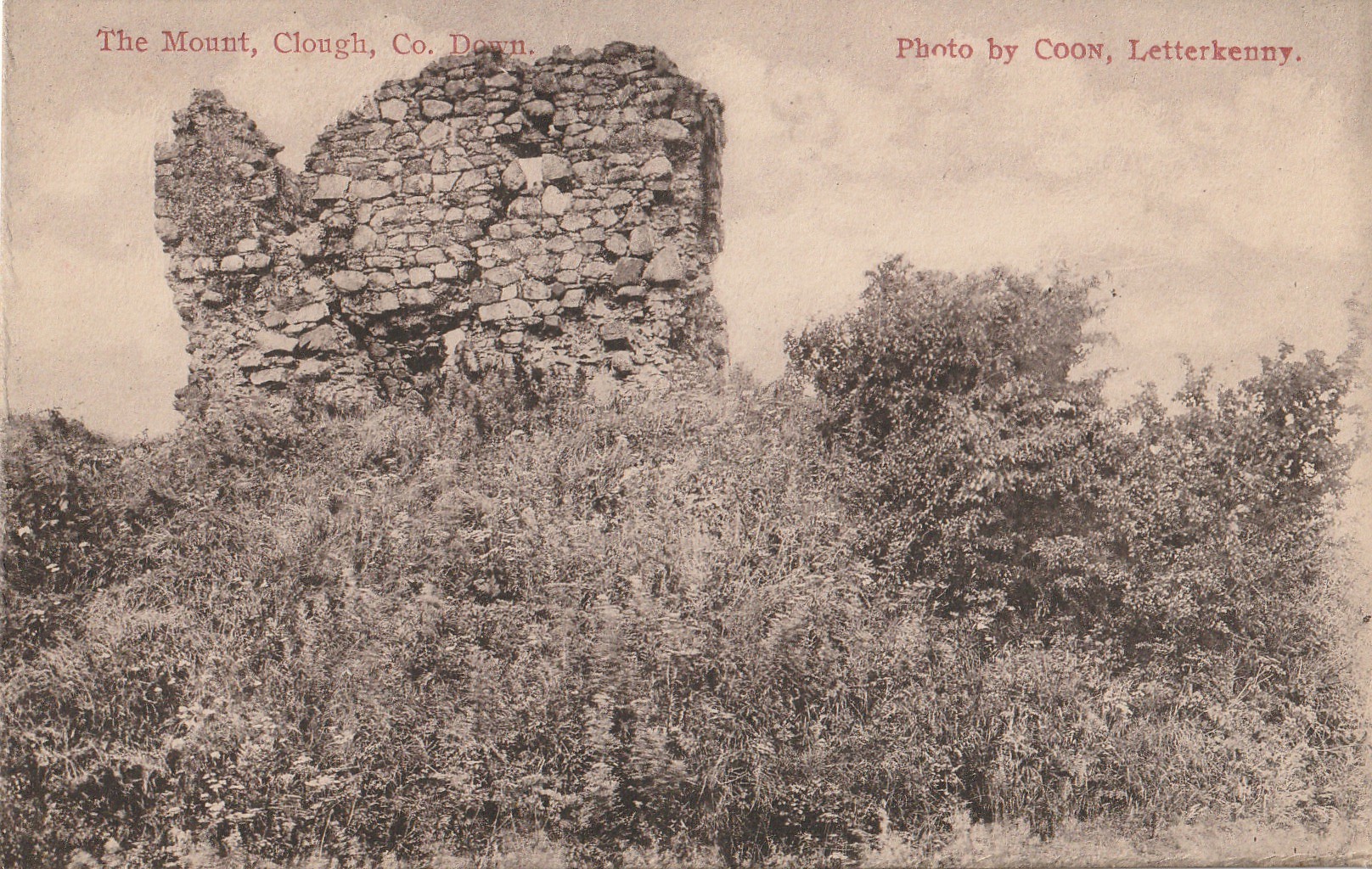
Clough Castle (no publisher listed on the back)

It is recorded that he charged local traders less than £5 for 2,000 postcards, which also included their name on the back of the card. From about 1924 he started numbering the cards starting with the last two digits of the year they were produced which is very helpful in dating the cards.

In the Census of 1911 he was recorded as living with his wife of three years, Clara, at Church Wall, Londonderry where he recorded his profession as Photographer and Theatrical Showman. Also recorded were their two eldest children (Gladys and Gaynor) and the fact that while his wife was a Presbyterian he declared himself to be an agnostic.

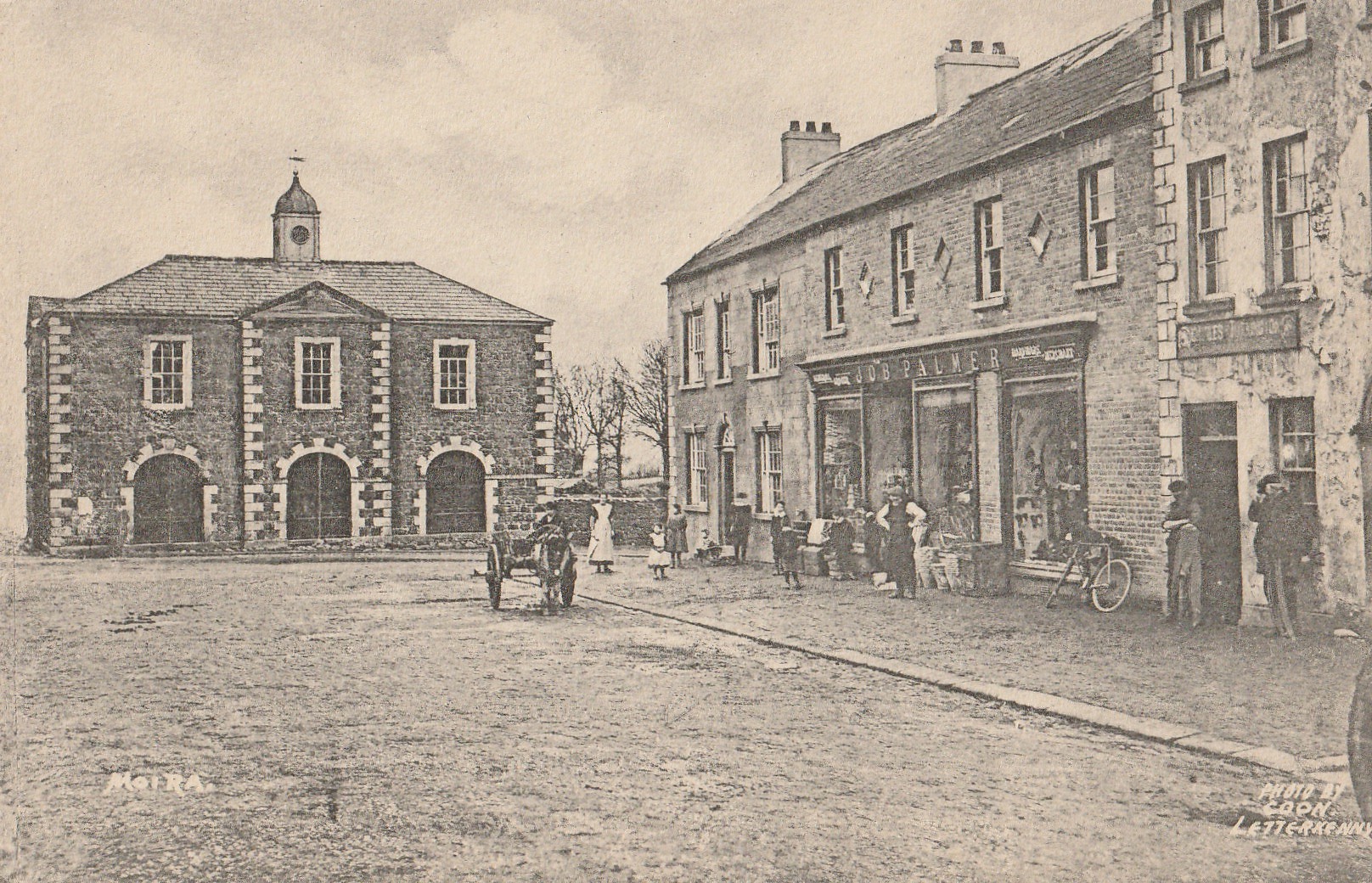
Moira Market House, published by Job Palmer, General Trader, whose shop can be seen on the right

The Theatrical Showman side of his profession was not an idle boast. Although his income from postcard sales must have been steady he was also perpetually ‘on tour’ travelling all over the north of Ireland with his camera and darkroom, setting up in towns as he went to film moving pictures and then show them to a fascinated populace along with films of Charlie Chaplin and other entertainers. In fact he also seems to have had an interest in some of the earliest cinemas established in county Donegal and in Belfast but his commitment to travelling from town to town with his films never waned right up to his death.

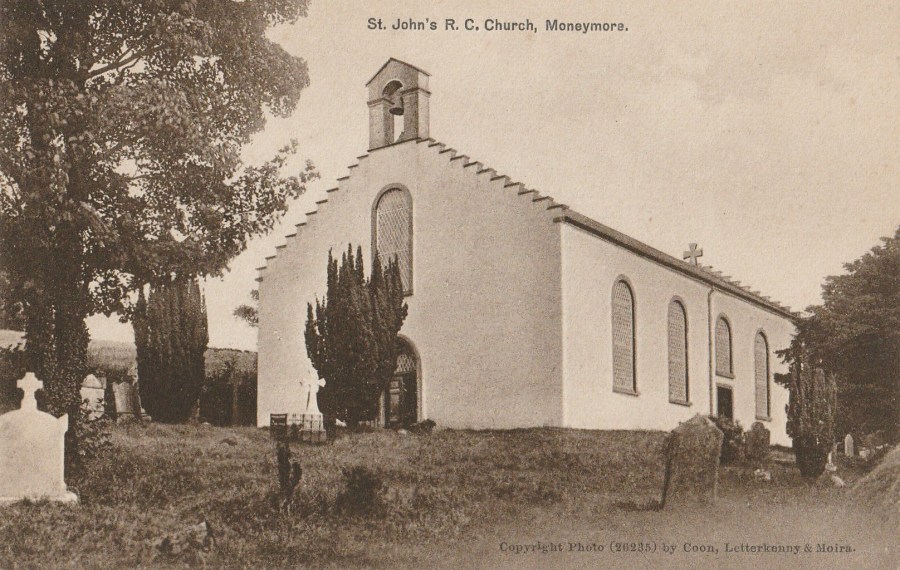
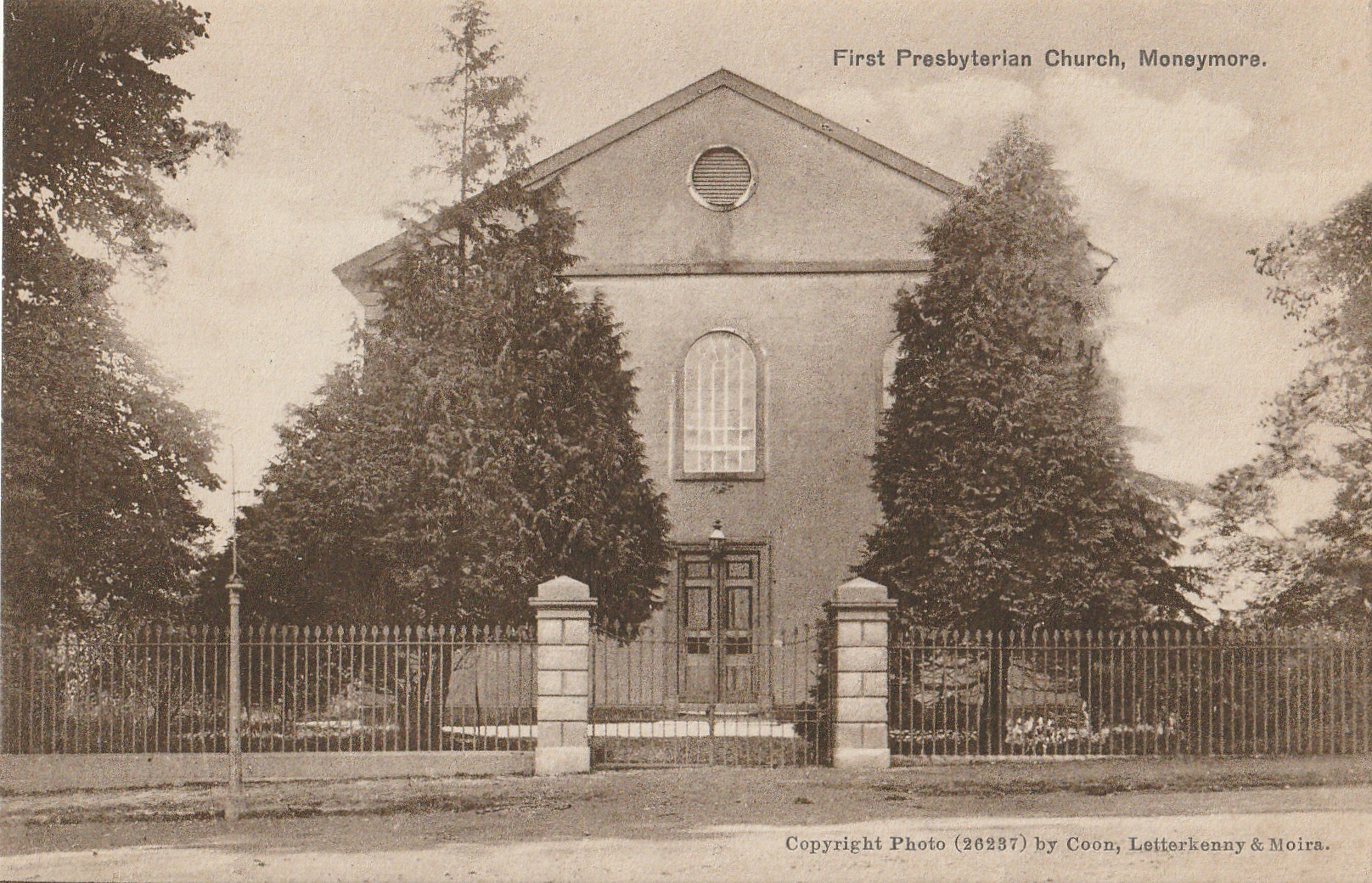
Moneymore, First Presbyterian Church (‘Published by Coon for Devlin, General Merchant, Moneymore’)

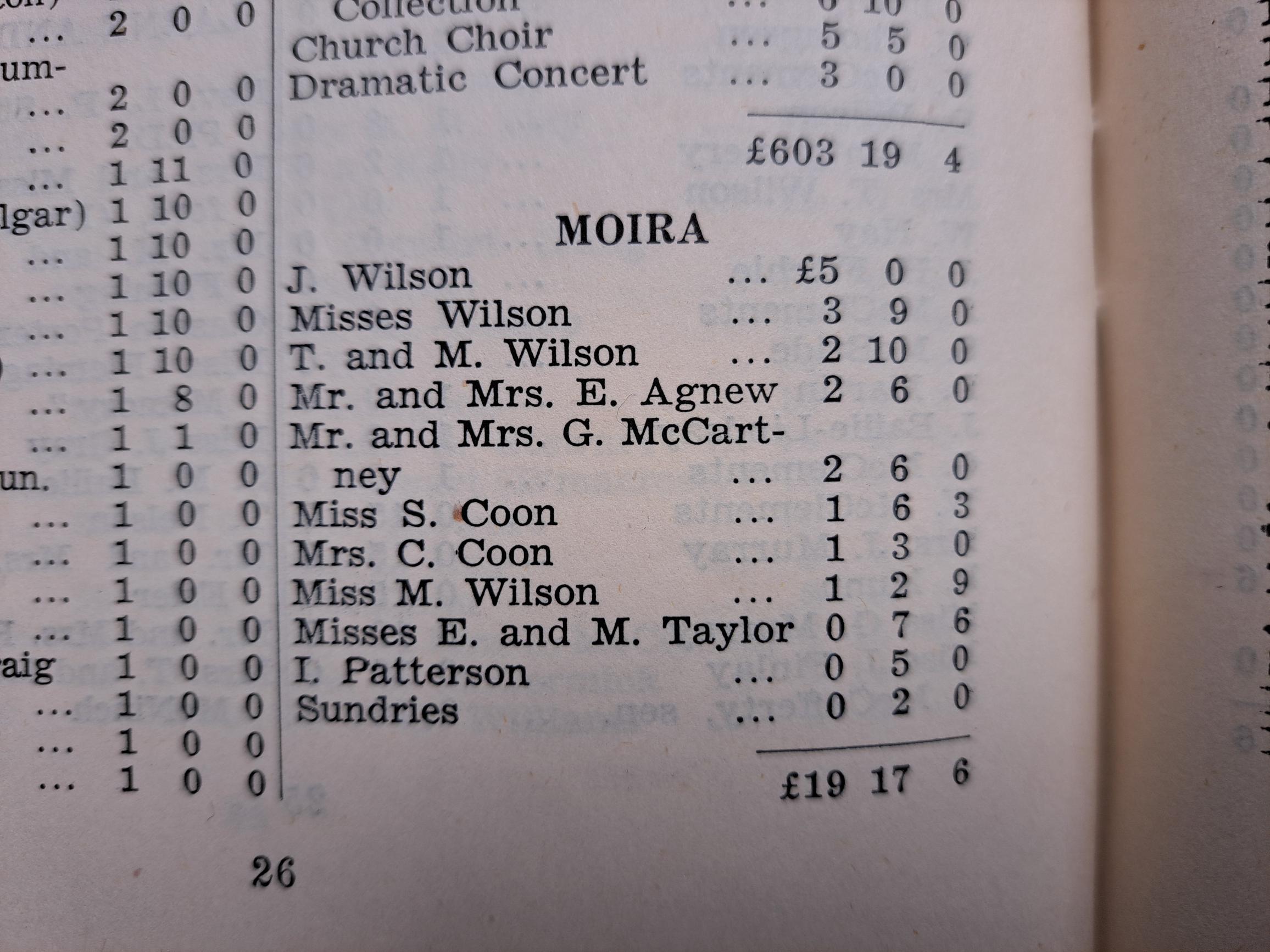
After partition he moved from Letterkenny to Moira and was ultimately buried there in the Non-Subscribing Presbyterian Church graveyard after his sudden death while on tour in Sligo. It is clear that his family had a close association with the Church, other family members are buried in the churchyard, but in the 1940s when the Non-Subscribing Presbyterian denomination launched a tercentenary appeal for the Sustentation Fund (1642 – 1942), Allen Coon’s wife Clara and his daughter Sylvia were amongst the members of the little congregation at Moira who gave their support. Indeed Miss Sylvia Coon was also one of the two local appeal officials for Moira.

Donations from Moira to the NSPCI Tercentenary Sustentation Fund Appeal, including Clara and Sylvia

Postcards from Finaghy – and the Moore family of Finaghy and Dunmurry

Following our postcard views of Dunmurry in the 1930s I thought I would post some postcards from a place a short distance away; pictures of Finaghy, which probably date from a few years before, and which we know were taken by Allen Daniel Coon of Letterkenny and Moira.

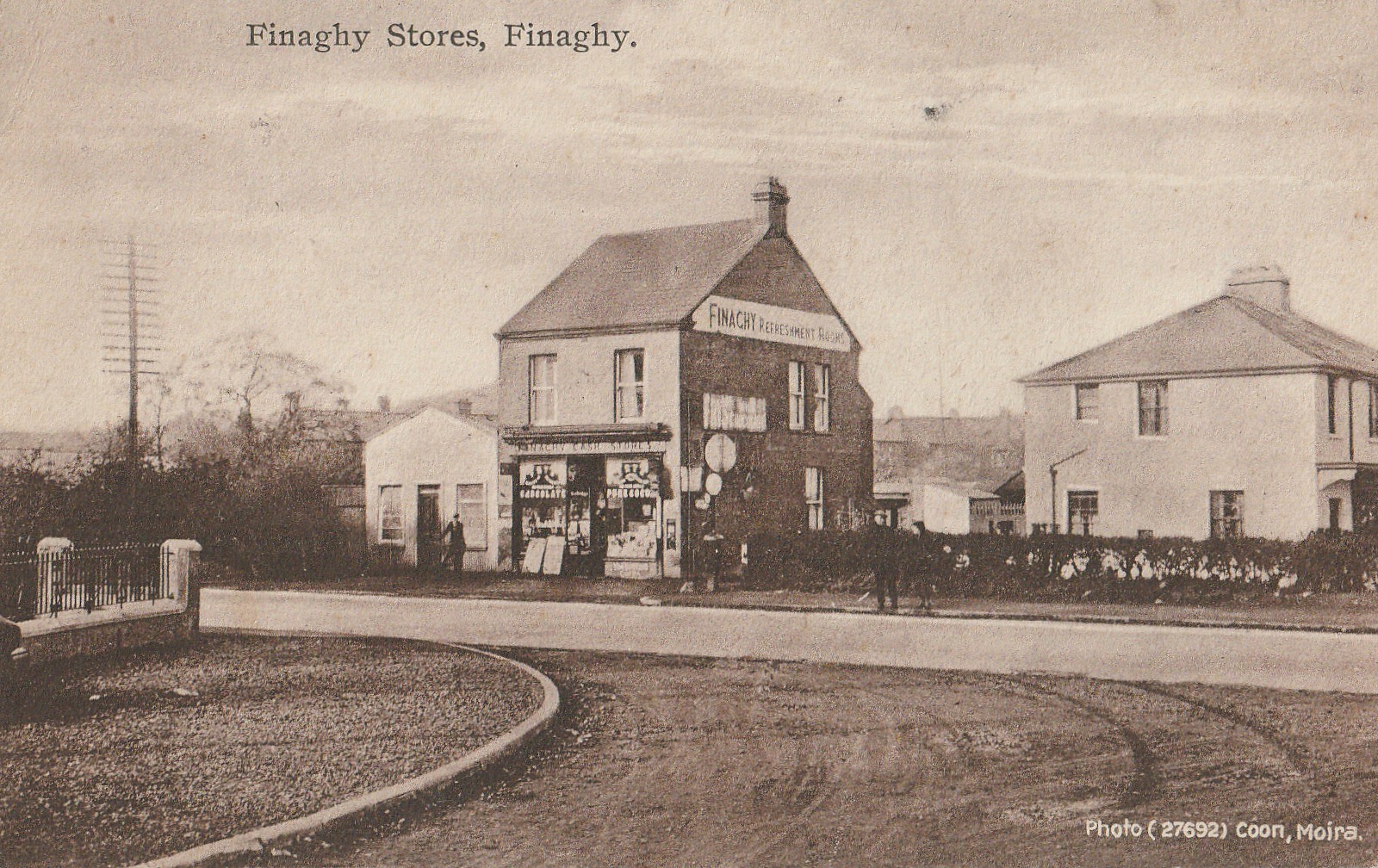
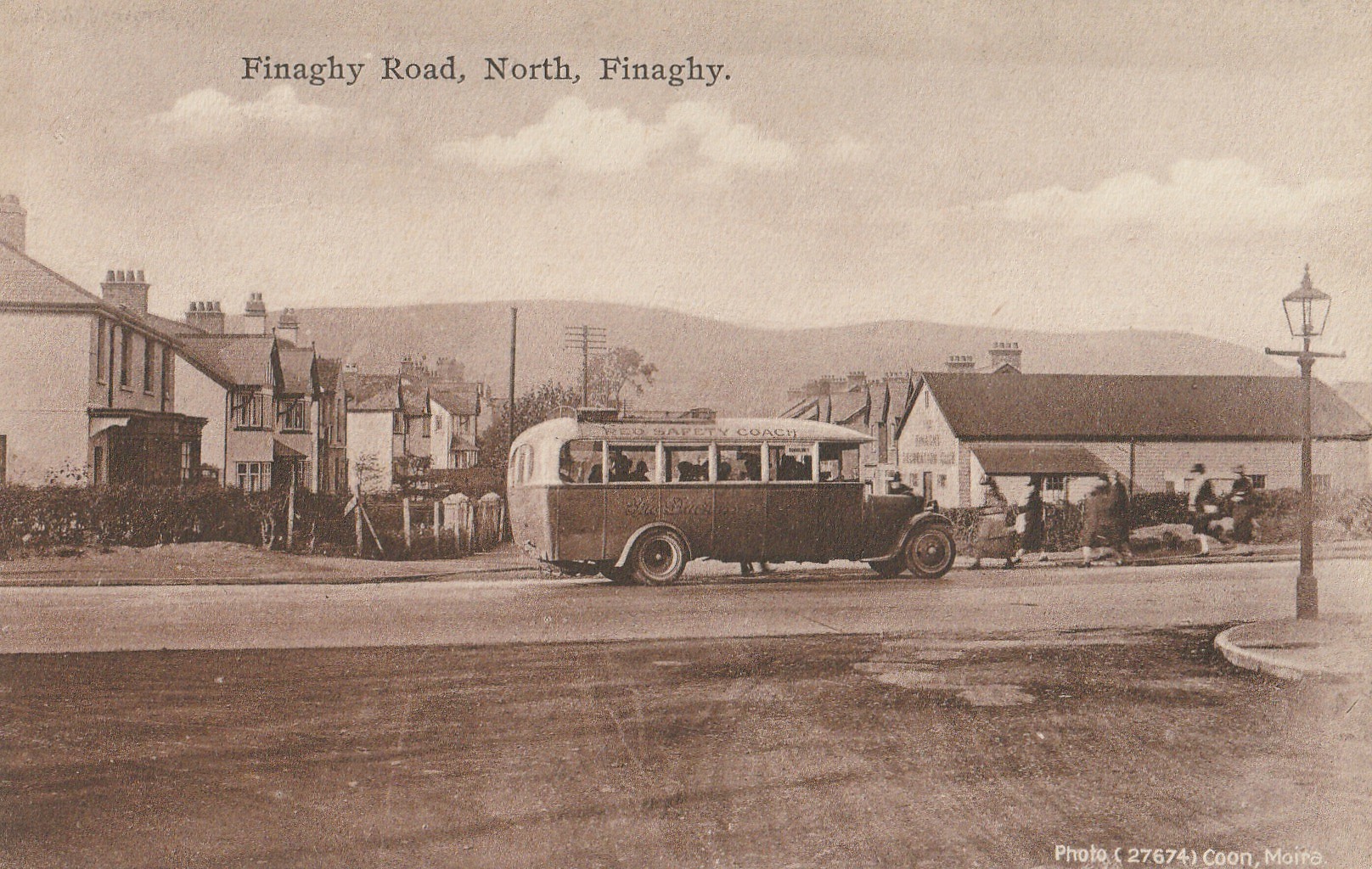
The numbering system on the four cards is believed to point to a date in 1927 for their production. According to the excellent catalogue of Allen Coon’s cards produced by Brian Hamilton in 2016 there were five cards published in this series for W.J. Ross of Finaghy Stores but I only have four of them. These four images are quite common but I have to admit that I have never seen an example of the fifth card which is named as ‘Finaghy Road South looking North’.

Finaghy Stores, Finaghy

The ‘Finaghy Stores’ postcard shows a solitary shop, that of W.J. Ross’s Cash Stores and Refreshment Rooms. It stands out very prominently in those days, but later had another shop joined to it and was surrounded by a number of other shops, including a couple of banks. The shop was well known to me in more recent times when it belonged to John Frazer, an active member of All Souls’ Church when I was minister there.

Finaghy Road, North, Finaghy

The postcard ‘Finaghy Road, North, Finaghy’ looks across the crossroads to Finaghy Road North and dates from a time when there was so little traffic that a bus could stop in the middle of the road to pick up passengers to be taken into town. This view has essentially not changed except for the addition of shops on one side and what was a bank on the other side of the road.

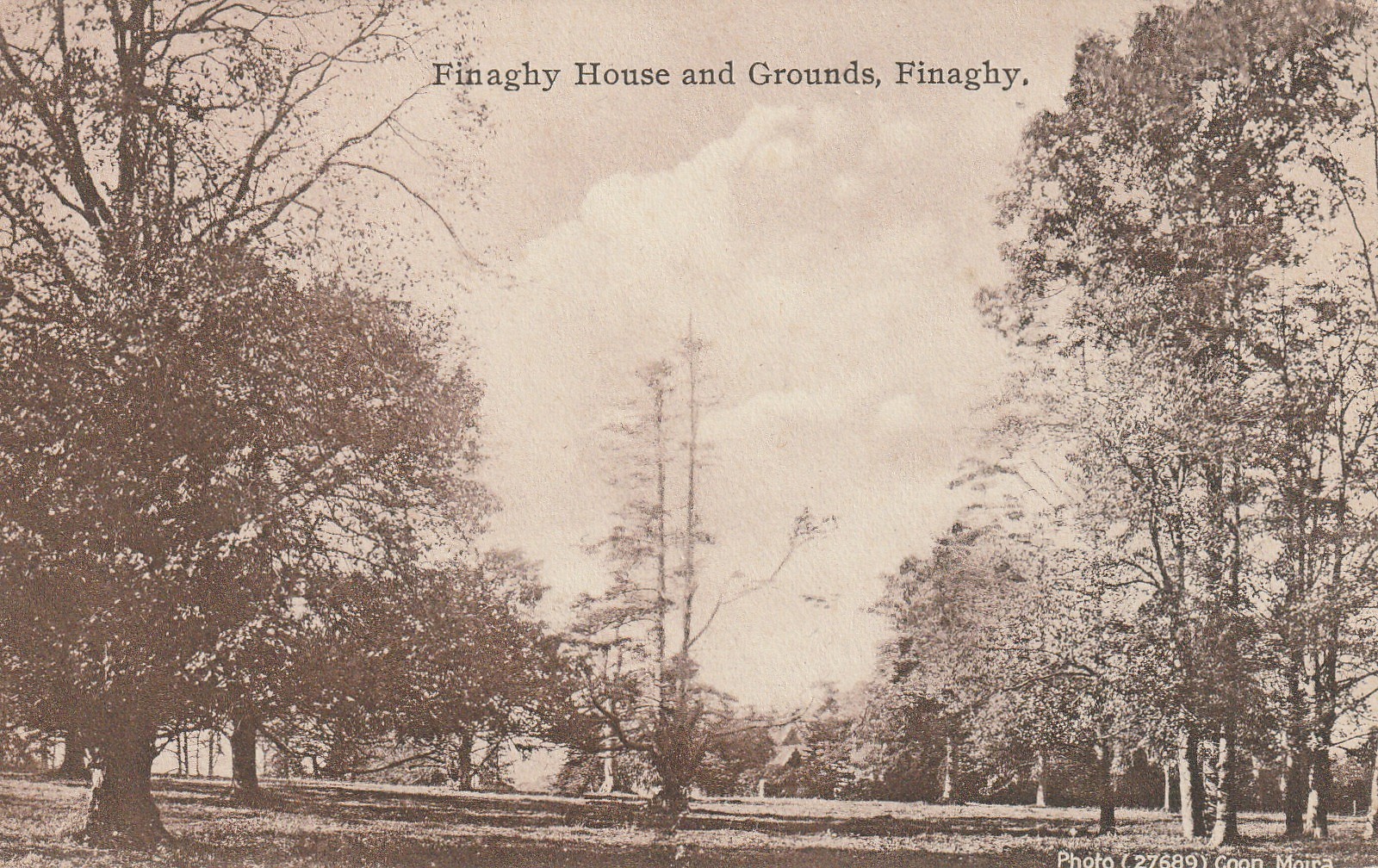
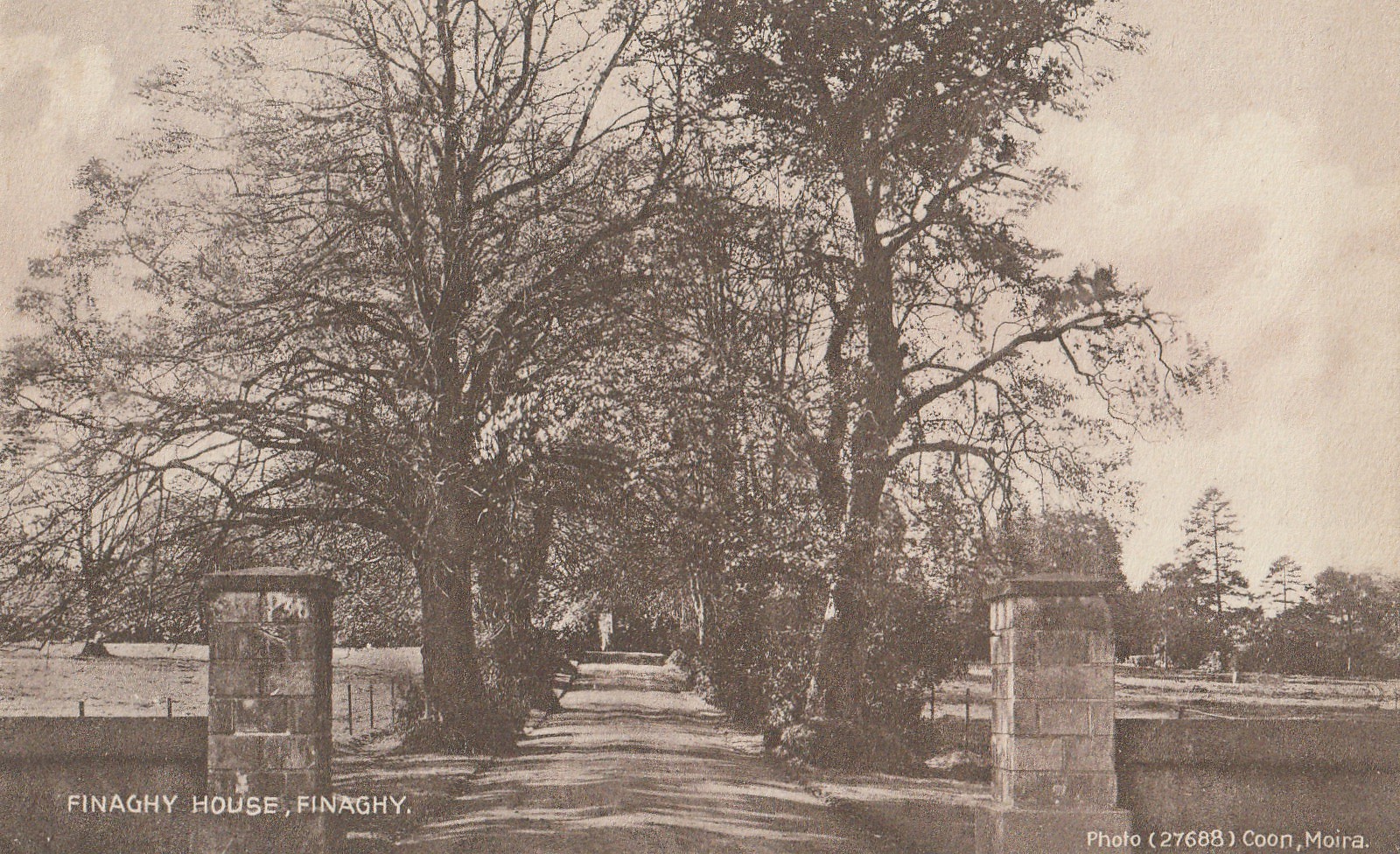
The other two postcards are a little more curious. Named as ‘Finaghy House’ and ‘Finaghy House and Grounds’, they could more accurately be titled ‘Finaghy House gateposts’ and ‘Finaghy House Grounds’ since neither card features any more than the merest suggestion of Finaghy House.

Finaghy House and Grounds

This is a pity really because Finaghy House will have been a major landmark at the time. Lord Belmont in Northern Ireland tells us all about Finaghy House in his excellent blog which you can read here. He tells us that the original house was built by Richard Woods at the end of the seventeenth century but was sold to the Charley family, a prominent linen family in 1727. Lord Belmont quotes the 1830 Ordnance Survey Memoirs as saying ‘the walls are nearly four feet thick and run together by grouted lime, similar to other ancient buildings.’ A descendant of the family said it was ‘an imposing mansion in a large park, with extensive outhouses and stables … a remarkable feature [of the interior] being a revolving fireplace between the drawing-room and the dining-room.’ The Charley family sold the house to a family named Brewis who, it is said, bred corgis, one of which had the distinction of being the first corgi owned by Queen Elizabeth, The Queen Mother.

In about 1890 Finaghy House was sold to James Moore and this is where a connection can be found with the Non-Subscribing Presbyterian Church of Ireland. James Moore was a direct descendant of Rev Henry Montgomery and the family were all members of our church at Dunmurry. In the 1901 Census he is listed as a Manufacturing Stationer living with his wife, Maria Lydia, who had been born in New Orleans. They and their three children (Harold Montgomery, Kenneth Montgomery and Sybil) all give their religion as Unitarian. As well as the five family members there are three servants listed as resident in the house. Harold and Kenneth are respectively stationer’s assistant and stationer’s apprentice to their father in 1901, Sybil is still at school. By the 1911 Census the three children are no longer living at home although there are still three (different) servants; a parlour maid, a cook and a housemaid.

Finaghy House by A.D. Coon

By 1911 James Moore was a JP in County Antrim. In the First World War Kenneth Montgomery Moore was commissioned into the 11th Battalion Royal Irish Rifles and was awarded the Military Cross. He returned home safely at the end of the war and his name is listed in the First World War Roll of Honour of the Non-Subscribing Presbyterian Church of Ireland  (published 2018).

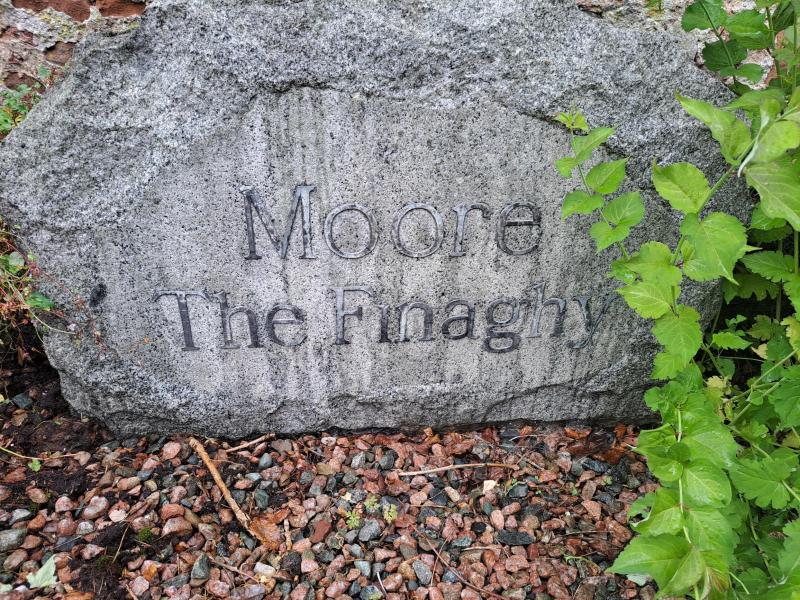
The Moore family burial ground can be found in their church, the First Presbyterian (NS) Church, Dunmurry. Marked simply as ‘Moore, The Finaghy’ it can be seen at the top of this page.

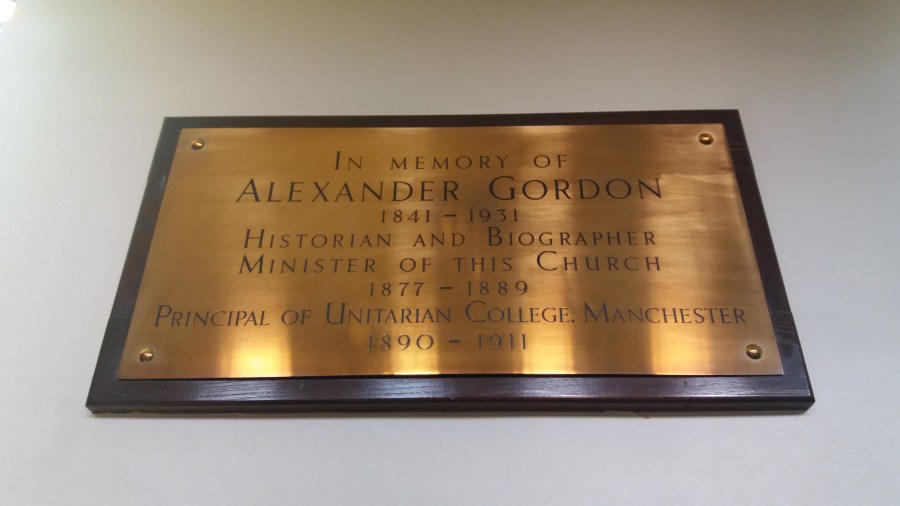
Alexander Gordon (1841 – 1931)

Historian, Biographer, Minister of First Church, Belfast. ‘An Englishman by birth, a Scotsman by education and an Irishman by inclination’.

On Thursday, 22nd May, 2025, we had an illustrated talk in First Dunmurry (NS) Presbyterian Church about the great historian Alexander Gordon.

Talk at Dunmurry by Rev Dr David Steers

A distinguished minister in England and Ireland, he served at Aberdeen; Hope Street, Liverpool; Norwich and at First Church, Belfast, before becoming Principal of the Unitarian Home Missionary College, Manchester and a lecturer in Ecclesiastical History in the first Free Faculty of Theology in the British Isles.

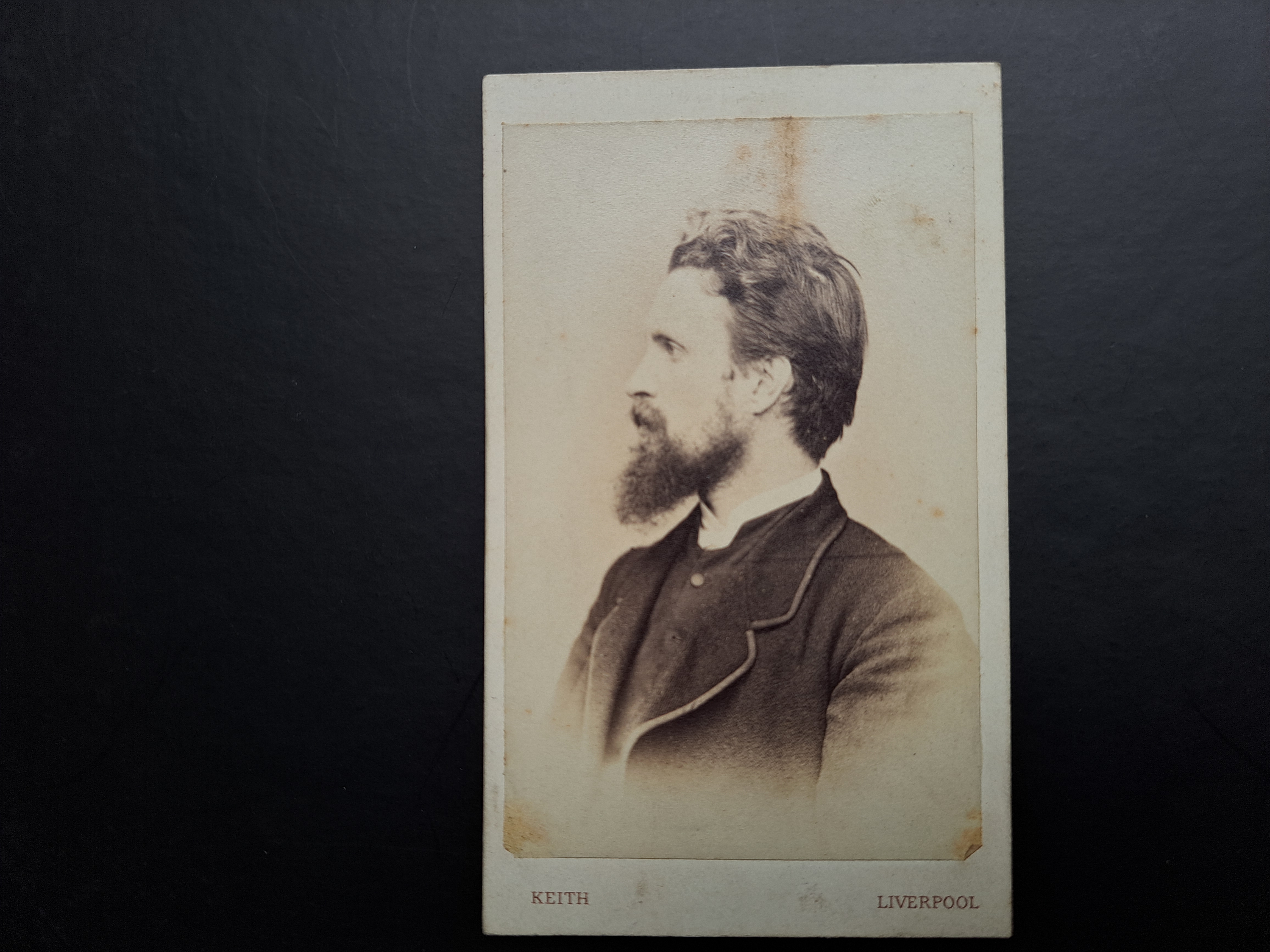
The earliest known photograph of Alexander Gordon, taken in Liverpool c.1872 at the time of his marriage to Clara Maria Boult

His scholarship was widely acknowledged all over the world, contributing 778 entries to the Dictionary of National Biography, 39 articles to the eleventh edition of the Encyclopaedia Britannica and much more. A superb linguist and experienced traveller his researches took him all over Europe. Among other things he was closely involved in the creation of the Non-Subscribing Presbyterian Church of Ireland in 1910.

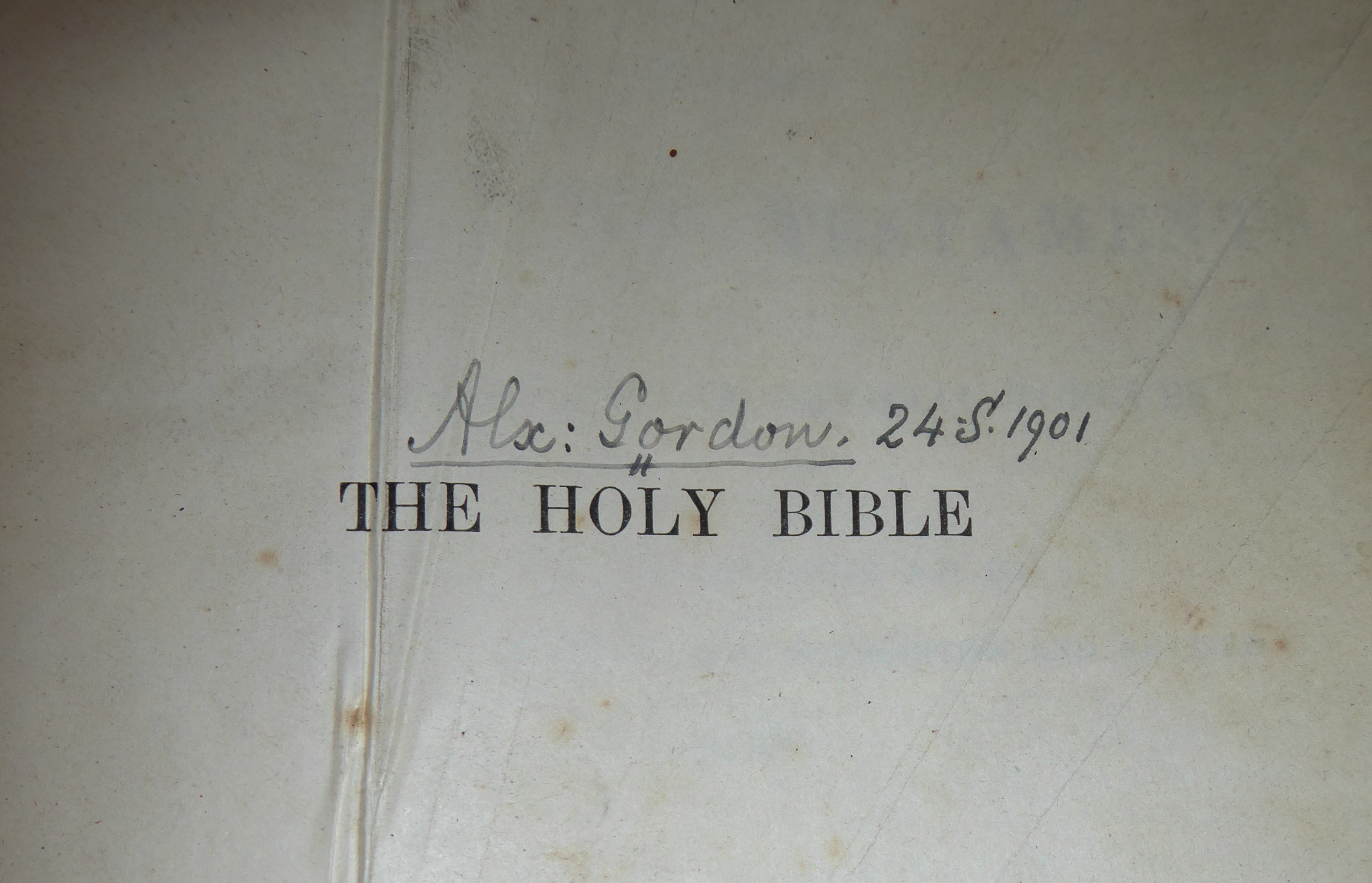
Gordon’s distinctive signature in a personal copy of his Bible (Revised Version)

The talk looks at his education, his work as a biographer and historian, and his commitment to the churches in Ireland which he served as secretary to the Association of Irish Non-Subscribing Presbyterians and later being closely involved in the setting up of the Non-Subscribing Presbyterian Church of Ireland itself.

He was a distinguished minister at First Church but even after leaving for Manchester kept a very close connection with the Irish churches, particularly through Dunmurry where he was regarded as the unpaid curate of his friend the Rev J.A. Kelly, despite the incredible heavy work load of his high profile work. From 1895 until the year of his death in 1931 he only missed one communion service at Dunmurry – and that was because of an unexpected train timetable change that left him stranded in Dublin one weekend during the First World War. For a very experienced traveller, particularly rail traveller, this must have been especially galling for Gordon. The lecture also looks at Alexander Gordon as a travel writer.

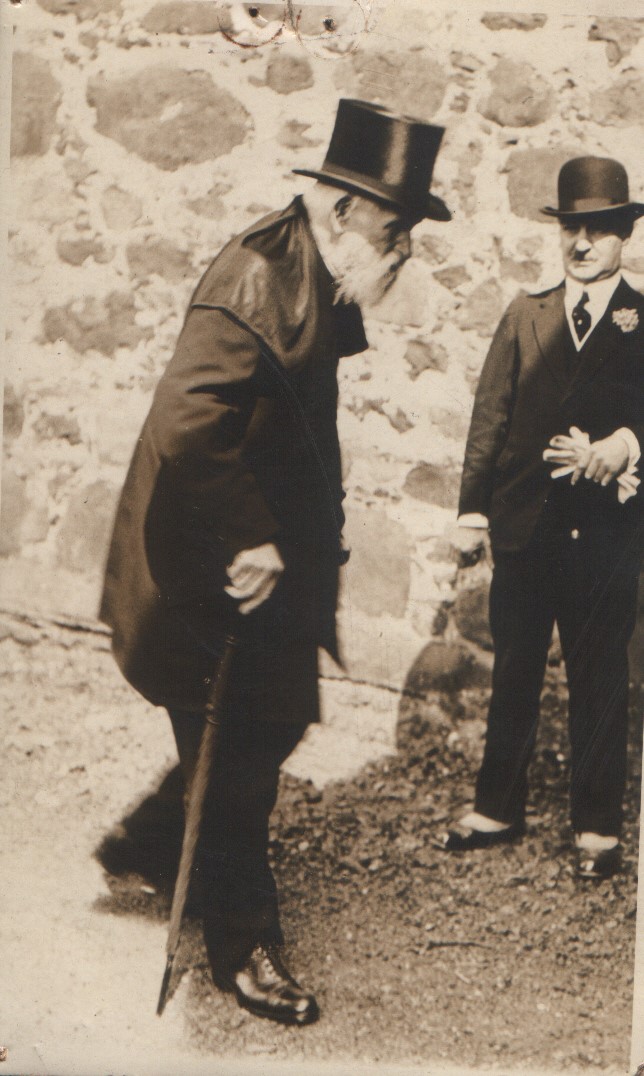
The last photograph of Alexander Gordon taken at Dunmurry on 18th January 1931

It examines too his family background, which was frequently touched by tragedy. But he inspired great loyalty and affection in the generations of students he trained for the ministry.

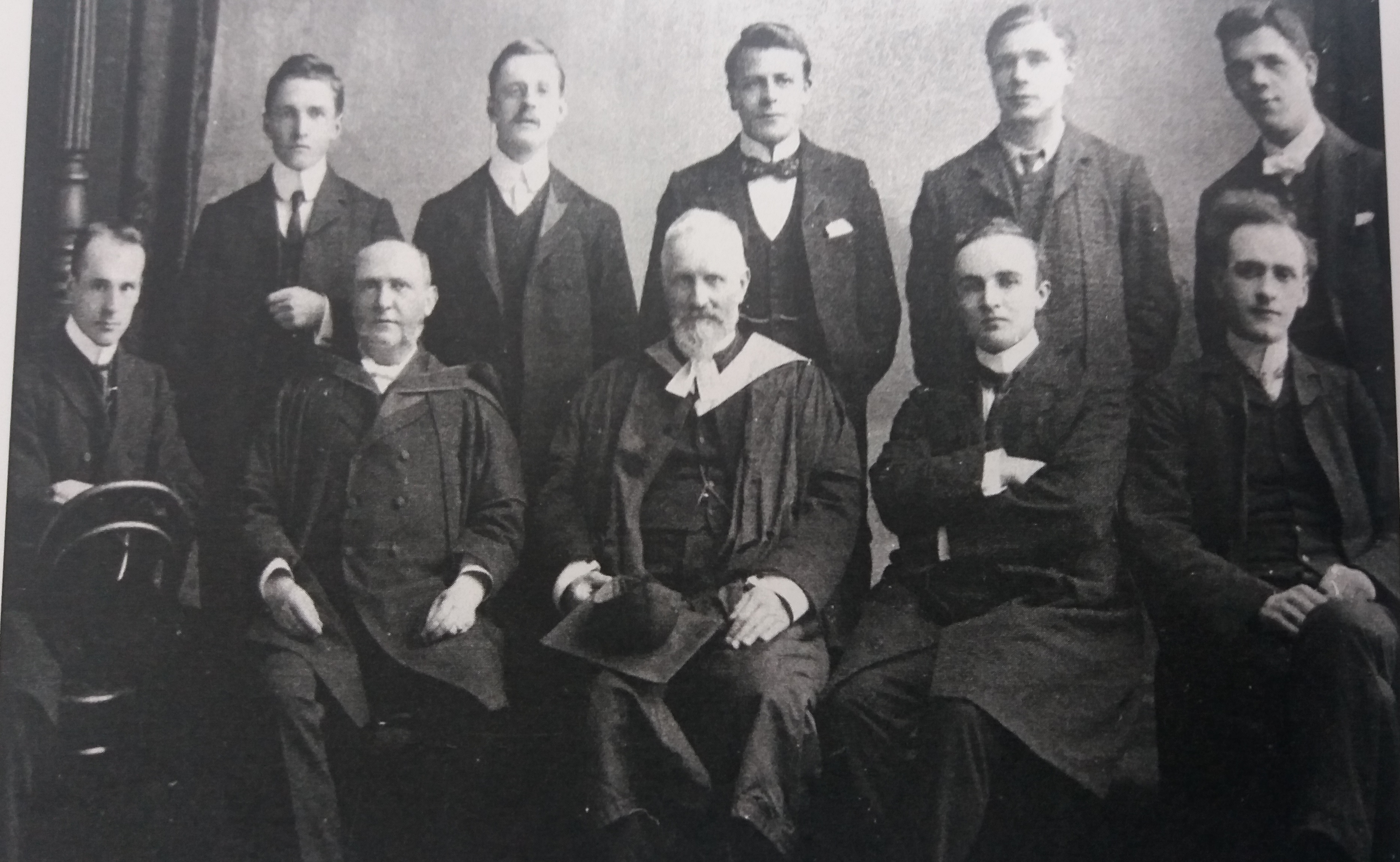
Principal of the Unitarian Home Missionary College, Manchester

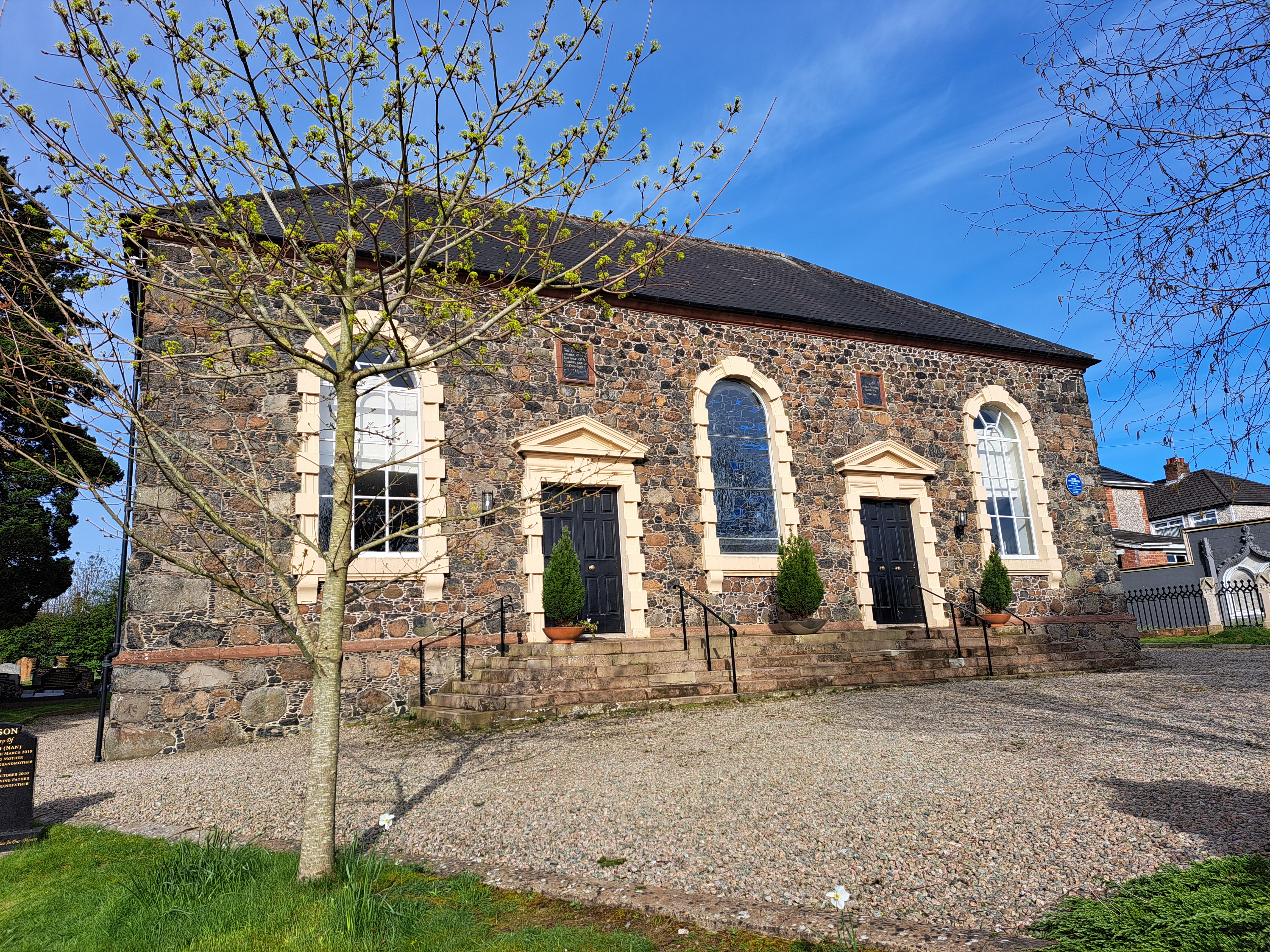
He was buried in Dunmurry, just a short time after he conducted his final service there on 18th January 1931.

Postcard from Dunmurry: Then and Now (a different view)

Back in January 2023 I posted a piece about a postcard of Dunmurry which showed the classic view of the church built in 1779. It was published in Lisburn by F.W. Harding and posted in November 1906. This is the picture:

and you can read about it by clicking here.

As I mention in that post, postcards of Non-Subscribing Presbyterian churches are not that common. I have seen the 1906 view before and there is also a much later one but I was pleased to discover another postcard featuring the church, this one new to me:

This dates from a little later and although it is taken from a less popular vantage point in many ways it gives a much clearer view of the building. This card was published locally by ‘W. McCartney, Stationer and Tobacconist, Dunmurry’ in the ‘Signal Series’. It has at the bottom left hand corner the title ‘Unitarian Church, Dunmurry’ and was never posted. On the back, however, it is dated May 19th 1919 and has a message to an unnamed recipient which reads ‘With best wishes for your welfare from the People of Dunmurry and district from W. Laursen’. The name is actually a bit hard to make out but that is my best guess.

In a way it is a clearer picture than the 1906 view, being a Real Photograph, if a little damaged. But the view is not obscured by trees and you can clearly see the large amount of ivy that was then being allowed to grow over the left hand door. This is actually also present on the 1906 view although it is hard to make out behind the tree.

A modern image from more or less the same angle, taken a couple of weeks ago, shows the same view:

The view of the church hasn’t changed between 1919 and 2024. There are now houses along the side which weren’t there but the splendid building of 1779 is reassuringly the same.

Canning Street Presbyterian Church, Liverpool: Then and Now

The solid and imposing structure of Canning Street Presbyterian Church was a feature of that corner of Canning Street and Bedford Street for about 120 years.

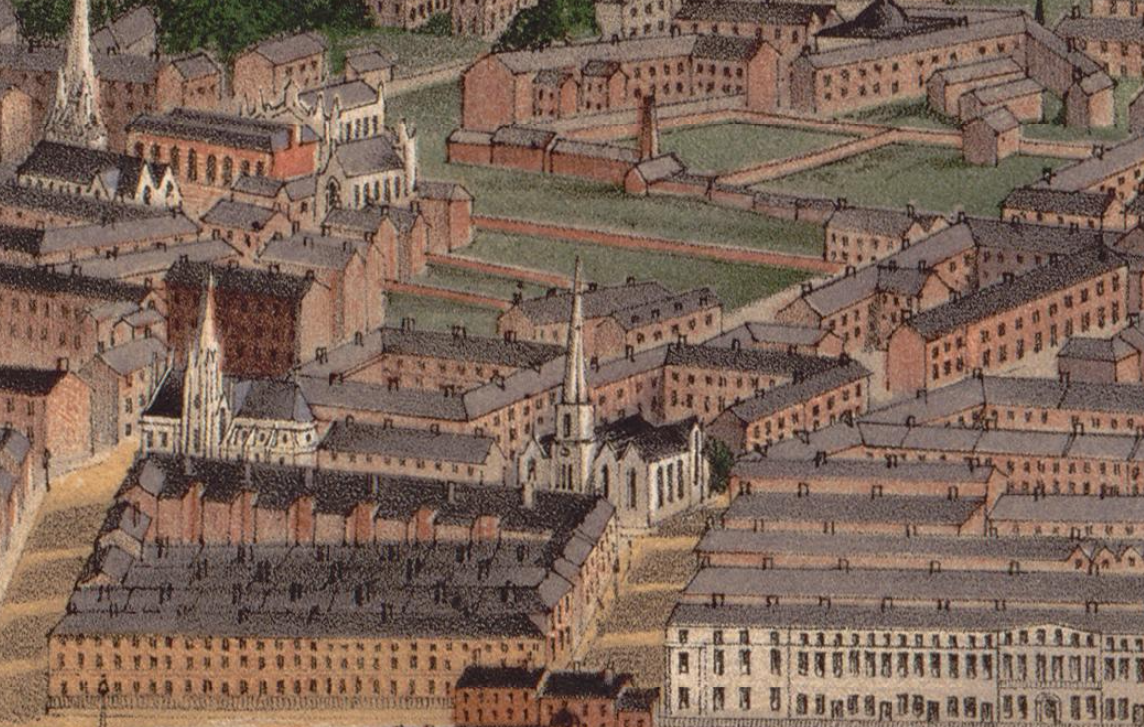
I’ve mentioned this church before and used its image as it appears in an aerial view of Liverpool painted from a hot air balloon by John R. Isaac in 1859 and published in New York. (This can be viewed on the Library of Congress site. You can also read the original post by clicking on this link – Seven Churches in Liverpool in 1859 viewed from the air). Below Canning Street Presbyterian Church can be seen in the centre of this section of the picture:

Detail from Liverpool, 1859, part of Birkenhead, the docks, and Cheshire coast Library of Congress

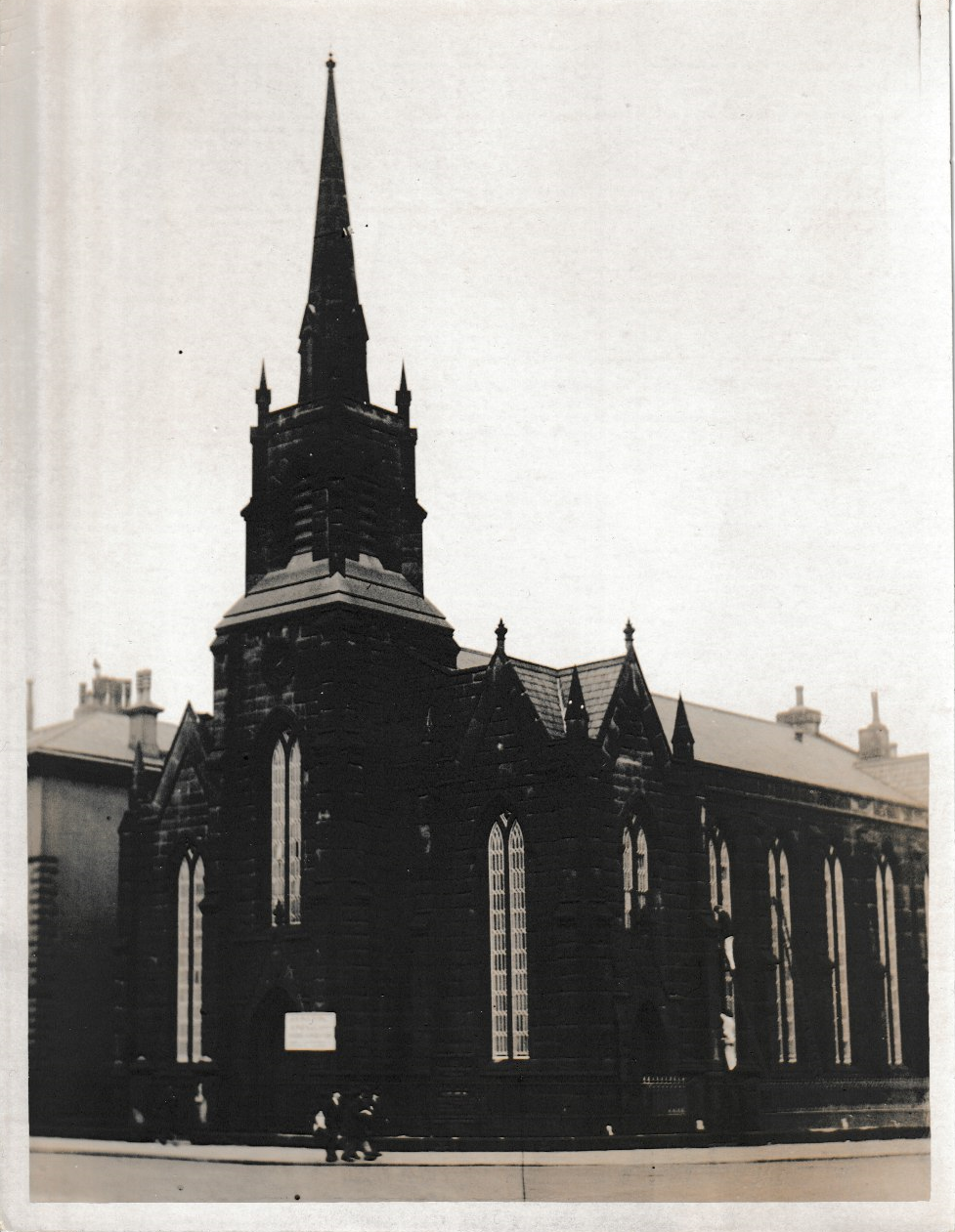
In fact of the seven churches mentioned in that post I have blogged about most of them at one time or another (Hope Street Unitarian Church, the Catholic Apostolic Church and Myrtle Street Baptist Church can all also be seen in this image) but recently I acquired a press photograph of Canning Street Presbyterian Church taken in 1931:

The picture is a bit dark but it shows the edifice built in 1846 and finally demolished in the 1960s. It was built by a denomination of exiled Scots, members of the Free Church of Scotland, which became the Presbyterian Church in England. Later this body united with the United Presbyterian Church (at a ceremony in Liverpool in 1876) to form the Presbyterian Church of England. In 1896 the minister, the Rev Simeon Ross Macphail observed that fifty years previously increasing numbers of Scottish emigrants to Liverpool were not inclined to join the local churches which called themselves Presbyterian but were by then Unitarian in theology. This would be true by the 1840s, although it was not the case a couple of generations before when Scots newly arrived in the city, perhaps influenced by the theological moderatism of the Church of Scotland, were often happy to make common cause with the dissenters.

Canning Street, in its prime location in the wealthiest part of the city flourished for decades until it followed the trend to move out of the by then less fashionable Georgian area of the city to the suburbs. In 1931 they sold up and built a new church in Allerton (now Allerton United Reformed Church). It was at this point that this photo was taken as it was sold to the German Church in Liverpool who moved their location from the very centre of town to Canning Street.

A German-speaking Lutheran congregation had existed in Liverpool since at least 1846. Meeting in various places over the years they had sufficient capital in 1871 to purchase what had been known as Newington Chapel. This had been founded originally as a break away from the Ancient Chapel of Toxteth. Unhappy with the appointment of an Arian (or Unitarian) minister in 1775, a group of Congregationalists built their own chapel on Renshaw Street. From 1811, with the appointment of Rev Thomas Spencer, this congregation grew rapidly and built Great George Street Chapel as a suitable base for his oratorical powers. Unfortunately, Thomas Spencer never took up his place in Great George Street Chapel, when he drowned in a swimming accident in the Mersey, but the congregation moved nevertheless and continued to flourish under the leadership of Rev Dr Thomas Raffles. In the best tradition of non-conformist awkwardness a small minority of the congregation refused to move and stayed in Newington Chapel, stayed, in fact, until 1871 when the German Evangelical/Lutheran Church was able to buy the meeting-house from them.

This congregation remained here until 1931 when the Cheshire Lines Railway Company purchased the site from them for £14,000. That was a good price and more than enough to buy Canning Street Church for just £4,000 in that year, the building being formally opened for Lutheran worship on 25th October 1931.

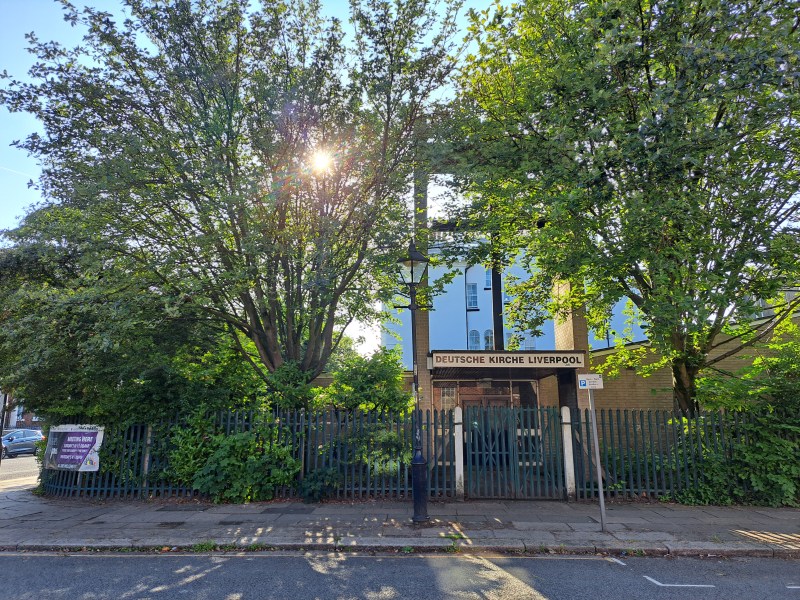
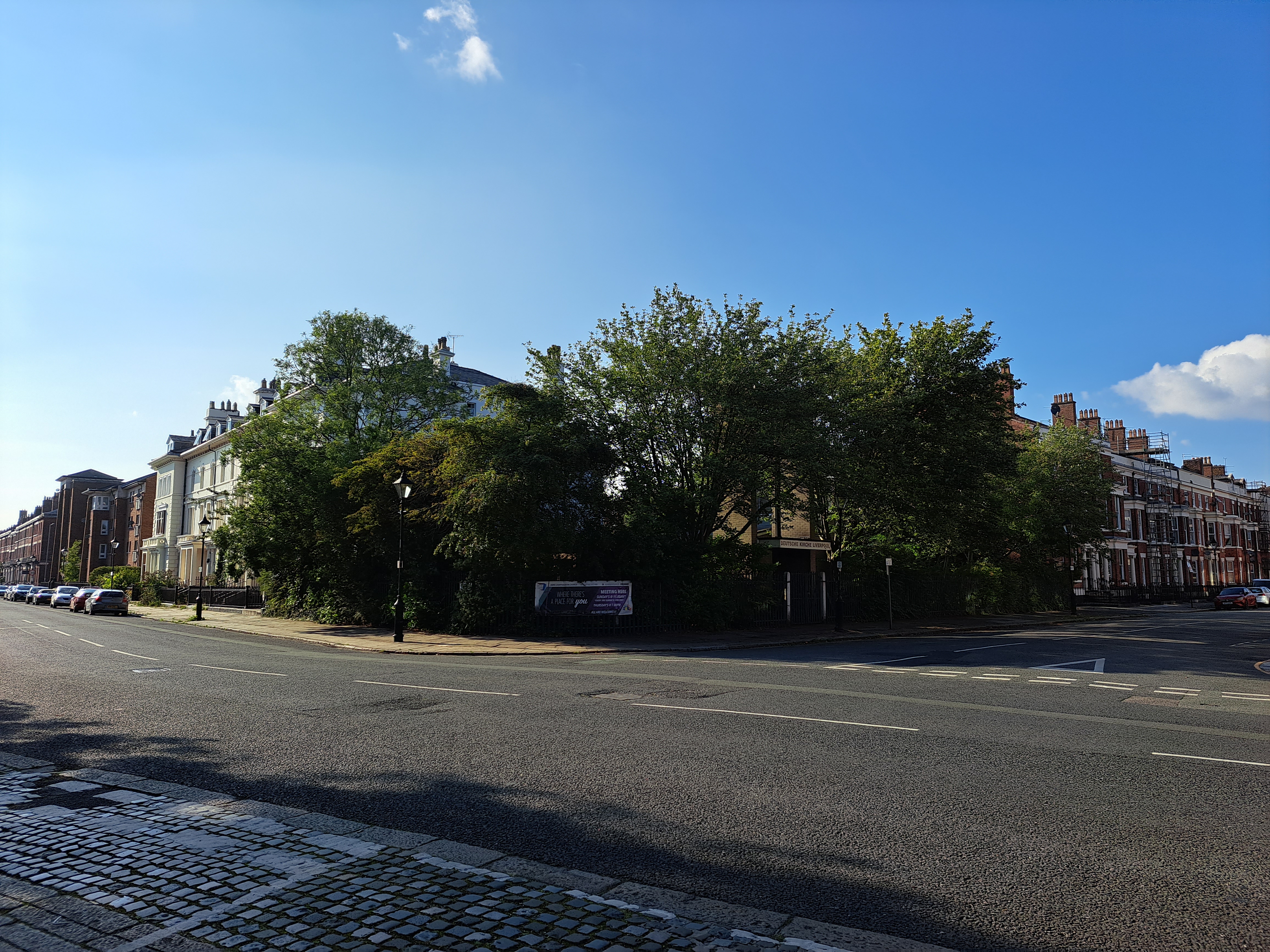
The site of the church today

Canning Street Church – Deutsche Kirche Liverpool

The German congregation has worshipped on that site ever since but in the 1960s they demolished the old church and replaced it with a rather plain building which doesn’t really catch the eye.

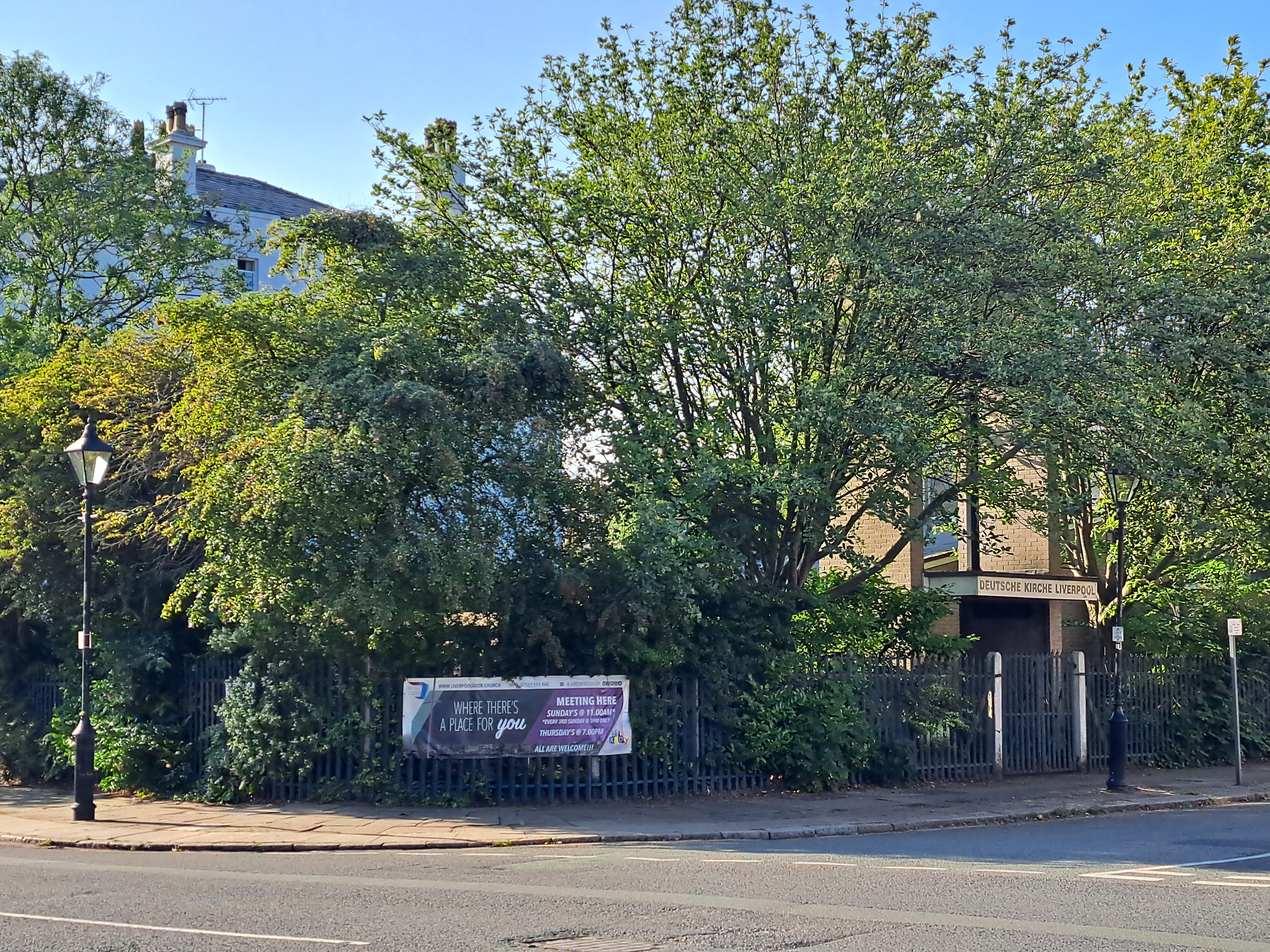
A view of the corner of Canning Street and Bedford Street today. The German Church is opposite the viewer, the site of the one-time Catholic Apostolic Church can be seen on the far left.

No pictures or text may be reproduced from this site without the express permission of the author.

Faith and Freedom Calendar 2019 available to download

The Faith and Freedom Calendar is available and has been sent out to all individual subscribers to the journal. You can order additional hard copies from Nigel Clarke, the business manager (faithandfreedom@btinternet.com), in return for a donation which will go to the Send a Child to Hucklow Fund.

The whole Calendar is also available to view and to download via the following link:

faith and freedom calendar 2019 web


This year’s Calendar features:

Winter in the Vale of Edale, Peak District National Park. Photo:  Andrew Clarke

Church House, Abbey Street, Armagh.Photo: Paul Eliasberg

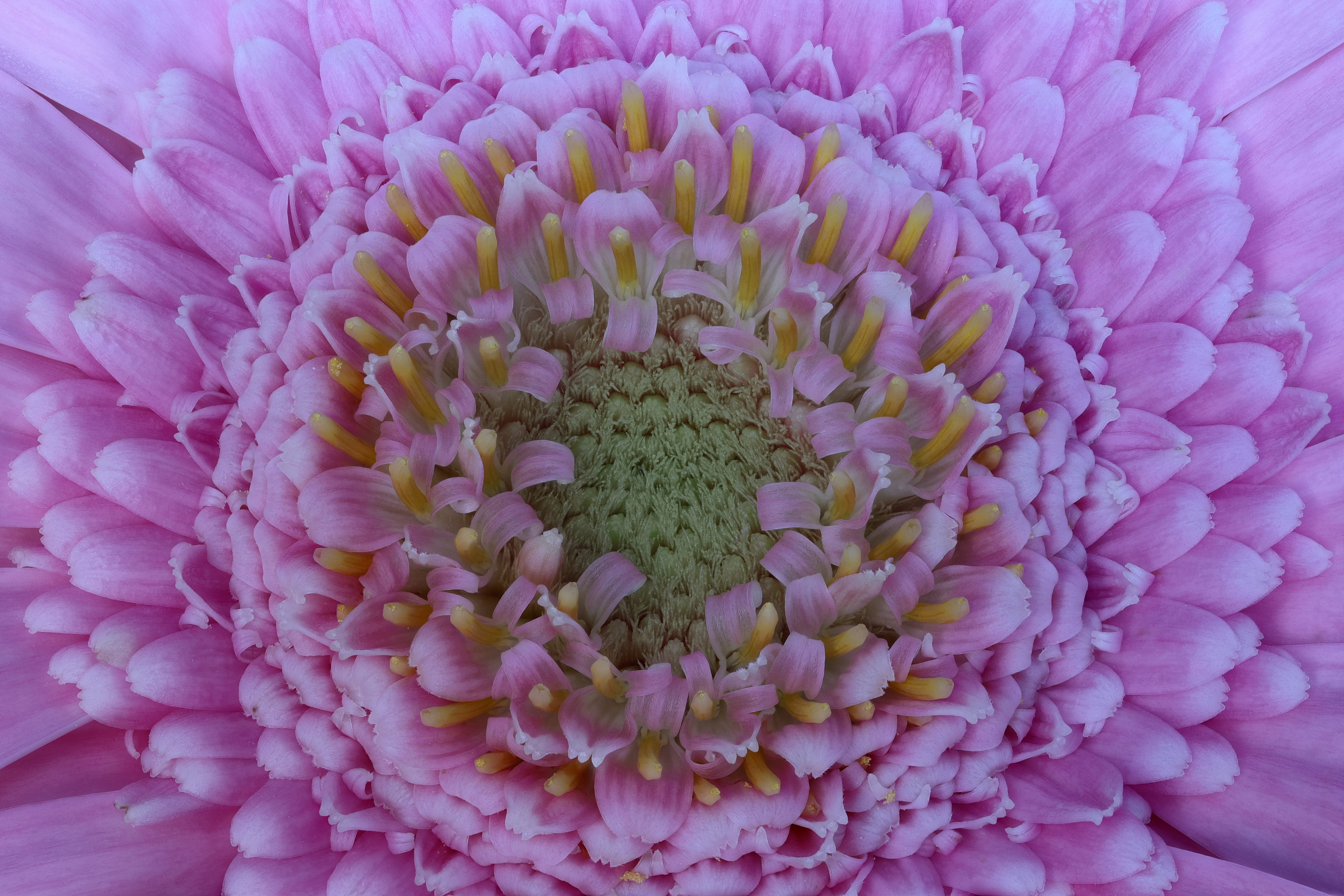
Gerbera (African Daisy). Photo: Graham Bonham

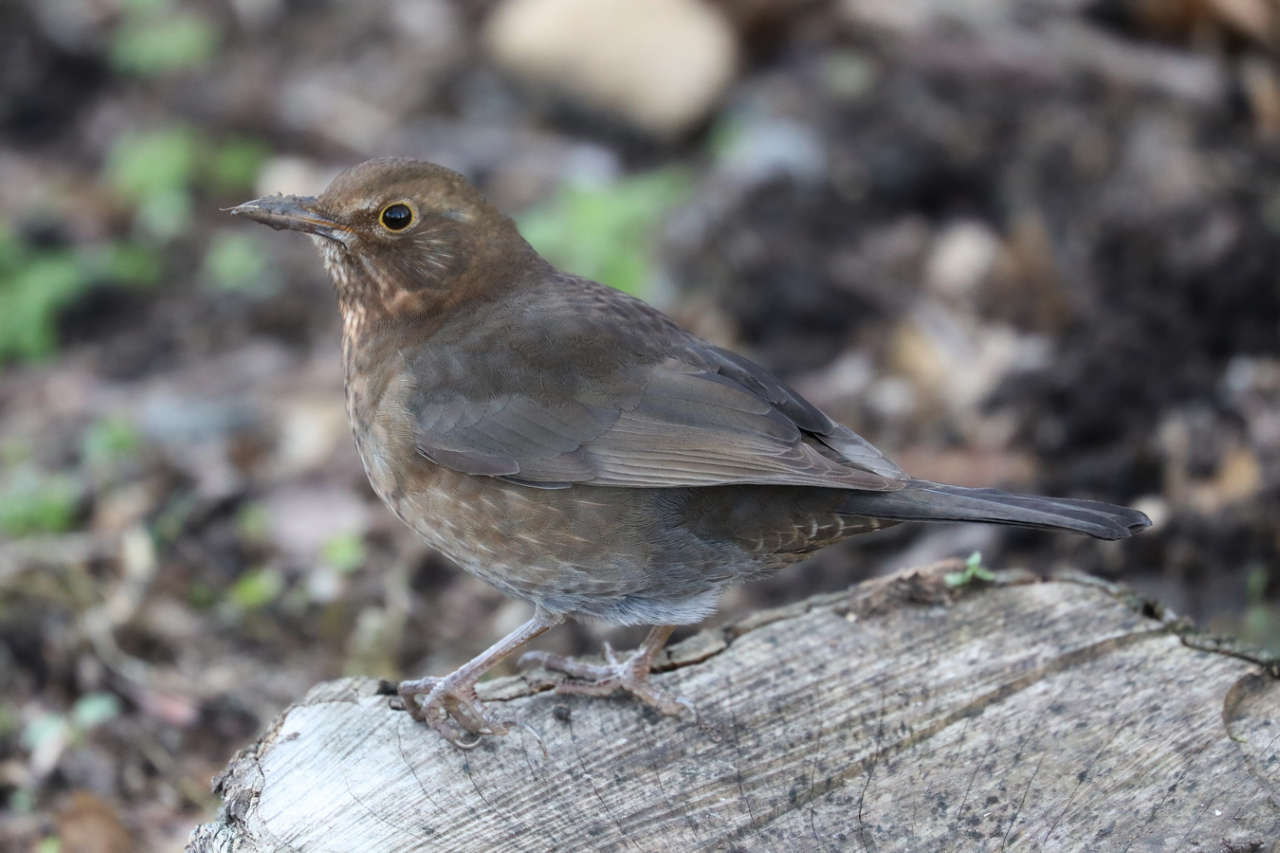
Juvenile blackbird. Photo: Graham Bonham

A celebration of famous Unitarians on Dunas Day, Torockó, Romania. Photo: Sára Bíró

St John’s Co-Cathedral, Valletta, Malta. Photo: Anne Wild

Lake Ohrid viewed from the church of the Archangel Michael, Radožda, Macedonia. Photo: Tony Lemon

Unitarian service at Bölön, Transylvania, Romania. Photo: Sára Bíró

Dandelion seed head. Photo: Graham Bonham

Methodist chapel, Barber Booth, Edale, Derbyshire. Photo: Andrew Clarke

Commemorating the centenary of the end of WW1, Downpatrick. Photo: David Steers

Cygnets on Ballydugan Lake, county Down. Photo: David Steers

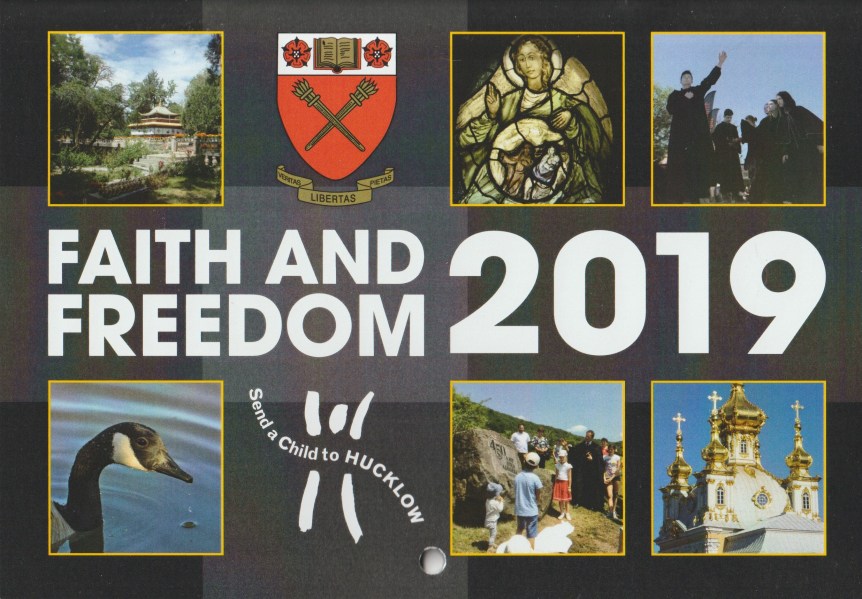
Cover scan back 2019

Faith and Freedom 2019 Calendar

The Faith and Freedom Calendar for 2019 is now winging its way to all individual subscribers around the world. Additional copies can be had for a suggested donation of £5 (all of which goes to the Send a Child to Hucklow Fund). Email Nigel Clarke at faithandfreedom@btinternet.com if you would like to order one.

The Calendar is full of fantastic images celebrating the world of faith and the natural world, each month carrying a large illustration from around the world including Derbyshire Peak District, Northern Ireland (Armagh and Down), Malta (St John’s Co-Cathedral Valletta), Transylvania (Torockó and Bölön), and Macedonia (Lake Ohrid) as well as Graham Bonham’s brilliantly detailed pictures of plants and birds.

There is a scan of the cover at the top of this page, and of the back cover at the bottom and here are some of Graham’s images:

Flower Graham Bonham

March
Gerbera is a member of the daisy family and was named after Dr Trugott Gerber, an eighteenth-century German botanist and friend of Carl Linnaeus. The plant is native to the tropics and is commonly known as the African daisy. A perennial, it is attractive to insects and birds but resistant to deer. The picture was constructed by combining multiple images focused at different points into a single composite image.


blackbird

April
The common blackbird is a species of true thrush. RS Thomas’ poem ‘A Blackbird Singing’ cites “a suggestion of dark Places about it.” However it is not normally seen as a symbol of bad luck. In medieval times the trick of placing live birds under a pie crust just before serving may have been the origin of the nursery rhyme. A blackbird also featured on the UK 4d stamp in 1966.


Seeds Graham Bonham

September
The image of the dandelion seed head can be interpreted in many ways, explains Graham Bonham who created the focus-stacked composite image. “It could symbolize transience – the temporariness of existence: there one moment and blown away the next. Alternatively, it could represent fecundity – one bloom produces hundreds of potential new lives – or be about underappreciated beauty: even pesky ‘weeds’, which many people use ‘chemical weapons’ against (to the detriment of the environment), have beautiful aspects.”


Cover scan back 2019

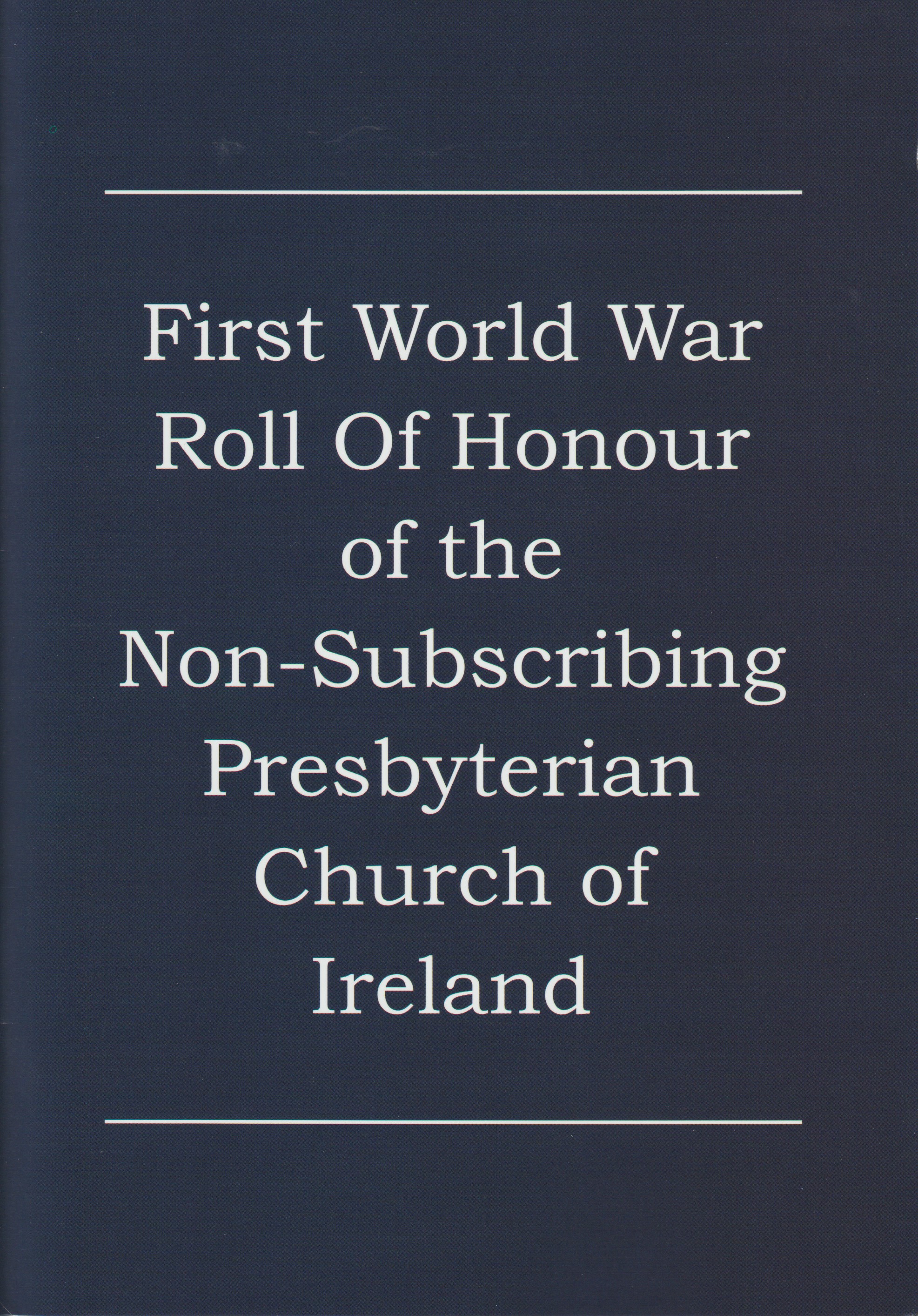
Roll of Honour of the Non-Subscribing Presbyterian Church of Ireland

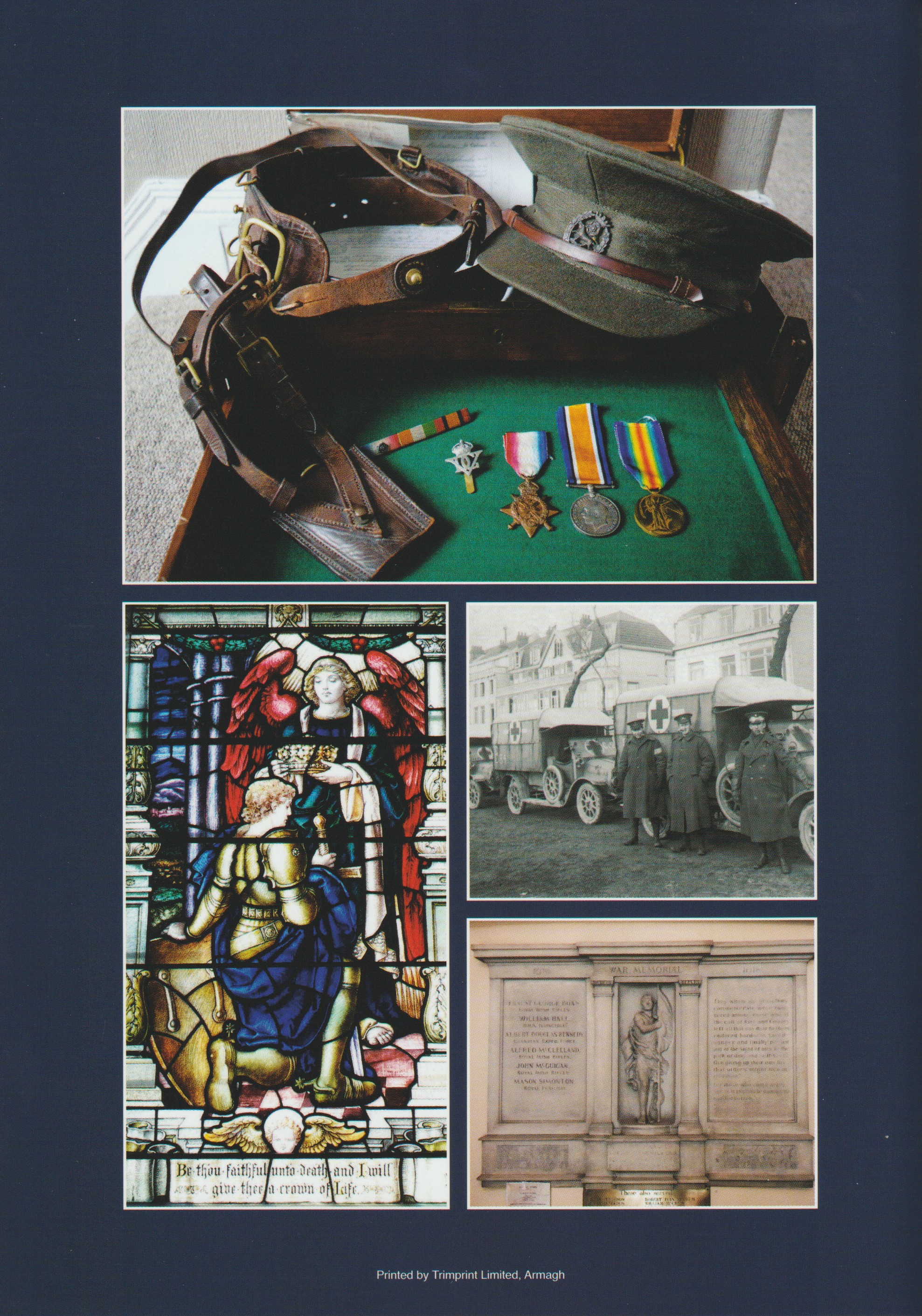
The Roll of Honour for the First World War of the Non-Subscribing Presbyterian Church of Ireland is now ready and will be dedicated at the service at Downpatrick on Sunday, 18th November at 3.00 pm.

Everyone is welcome at the service which will also commemorate the centenary of the end of the First World War.

The Roll contains an introduction and two sections. The first is a list, by congregation, of all the men and women, with their service details where known, who are known to have served in the First World War. The second part is an alphabetical list of all those who gave their lives in the Great War. The book runs to 50 pages and everyone who attends the service at Downpatrick will receive a complimentary copy. Thereafter the book will be available for purchase at a cost of £5 (postage not included). All profits from sales of the book will go to the Poppy Appeal and Help for Heroes.

Front Cover 02

Front Cover

Back Cover 02

Back Cover

Service to Commemorate the Centenary

of the end of the First World War and

Dedication of the Roll of Honour

in memory of all the men and women of the

Non-Subscribing Presbyterian Church of Ireland

who served or gave their lives in the Great War

Sunday, 18th November 3.00 pm

at the

First Presbyterian (Non-Subscribing) Church, Stream Street, Downpatrick


Old Meeting House Antrim

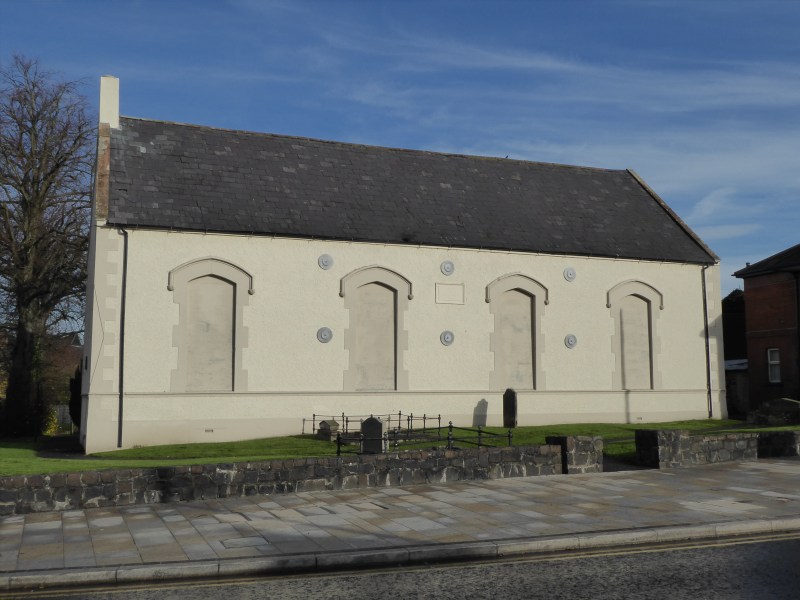
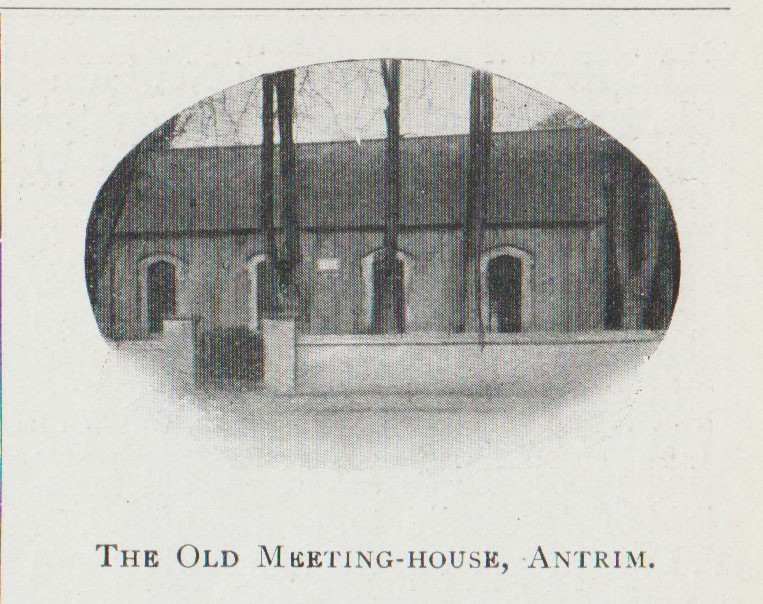
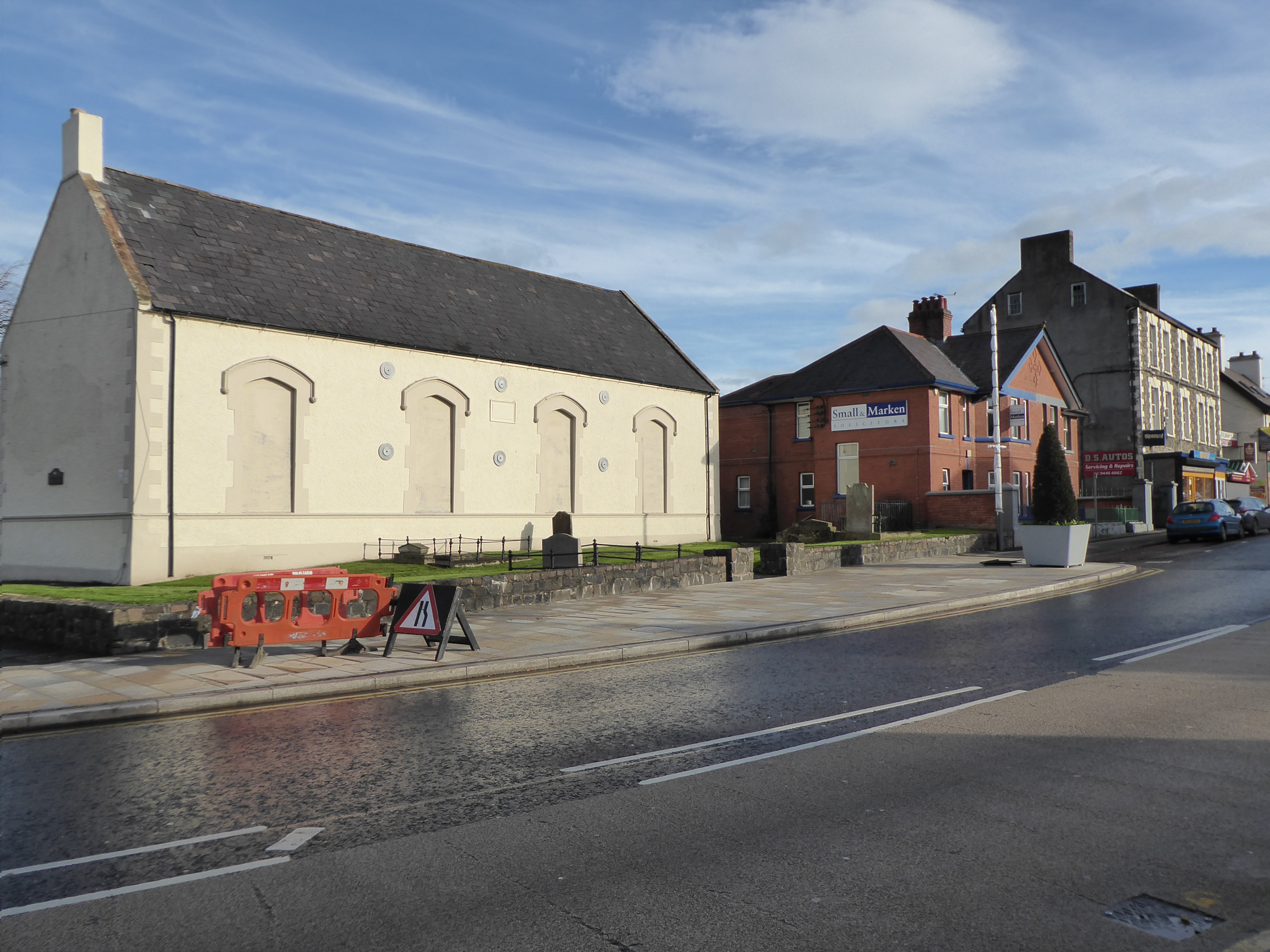
Earlier this week I was pleased to get a look inside the Old Meeting-House at Antrim in the company of Rev Dr John Nelson and architect Dara O’Malley. This is the original Presbyterian meeting-house in the town which became Non-Subscribing under the leadership of Rev John Abernethy, the ‘father of Non-Subscription’ in Ireland.

Antrim June 1913

The meeting-house in 1913

Not a very large building but the home of an active and important congregation for a long time. In the 1970s the congregation was faced with a struggle to maintain the building and it was transferred to the local Council which was then Antrim Borough Council. From 1980 it was let out as a boxing club which closed some years ago and this year the meeting-house was returned to the church. As the photos show the building has faced some years of neglect but this point marks the beginning of the restoration of the meeting-house and the renewal of the congregation’s witness in the town.

This slideshow requires JavaScript.

The interior in 2018

It is quite a prominent building as you come into the town and nearby a large three-storey building is the original manse. I wrote about the story of the manse a couple of years ago, the post can be read here:

https://velvethummingbee.wordpress.com/2015/05/07/a-vestige-of-protestant-dissent-in-antrim-town/

Antrim Exterior front including manse

View of the meeting-house, the old manse is on the extreme right of the picture

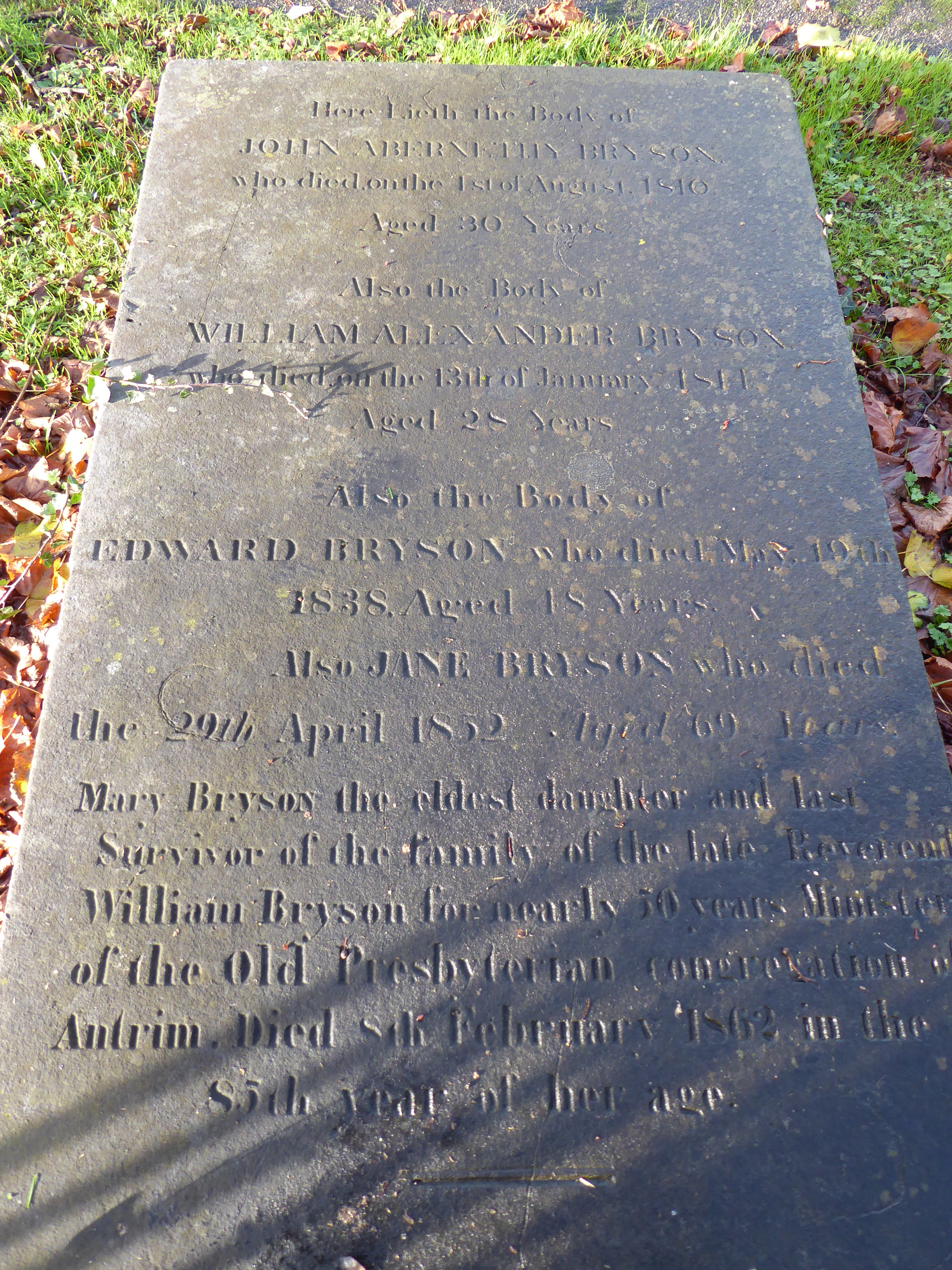
Most of the graveyard is now managed by the Council and this includes some interesting grave stones including the tombstone of the family of Rev William Bryson, minister at Antrim from 1764 to 1810. He was married to a granddaughter of John Abernethy and whilst holding a very radical theology was less radical in the political upheavals of the 1790s.

Antrim Bryson family tombstone

Bryson family tombstone

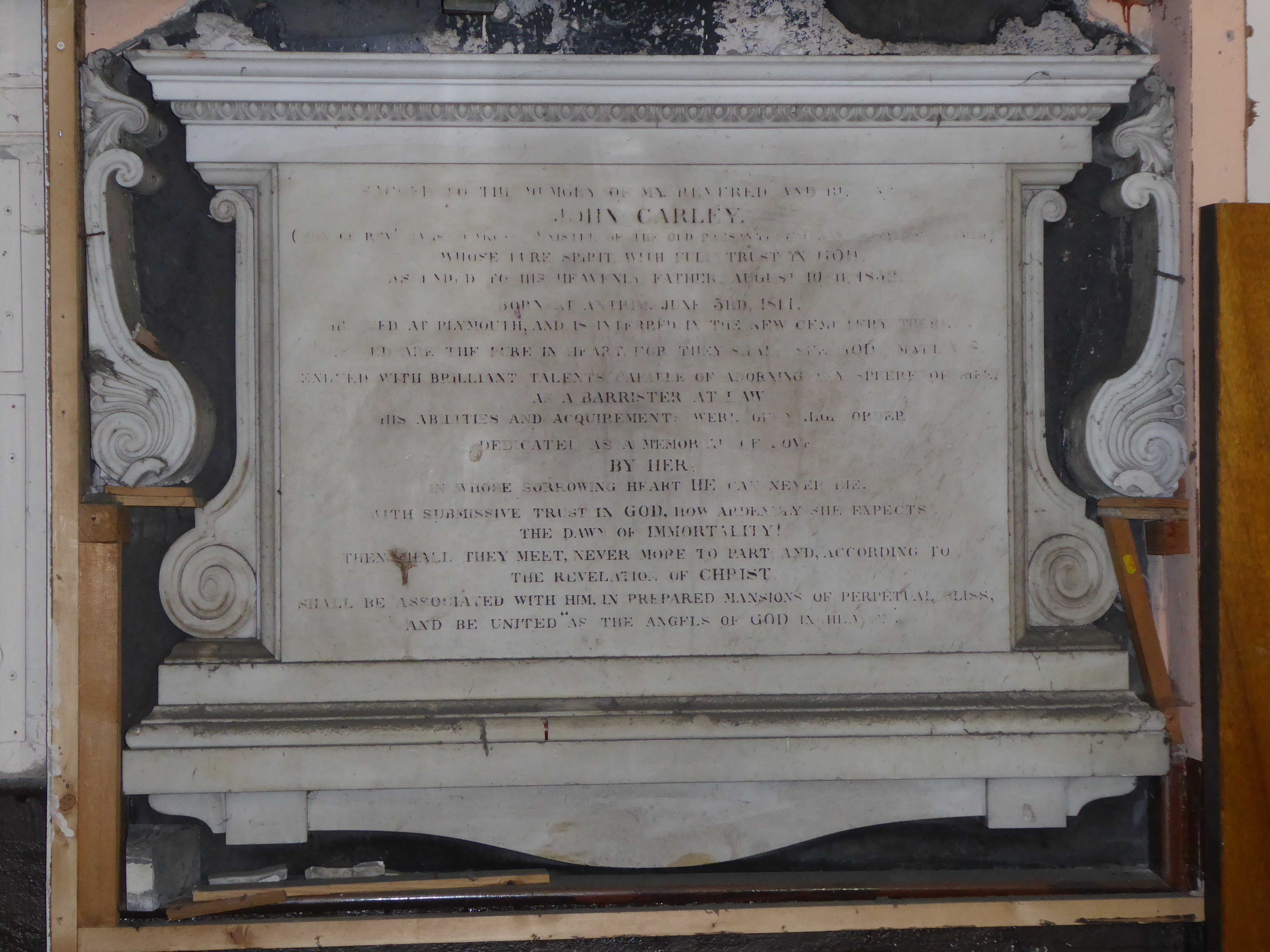
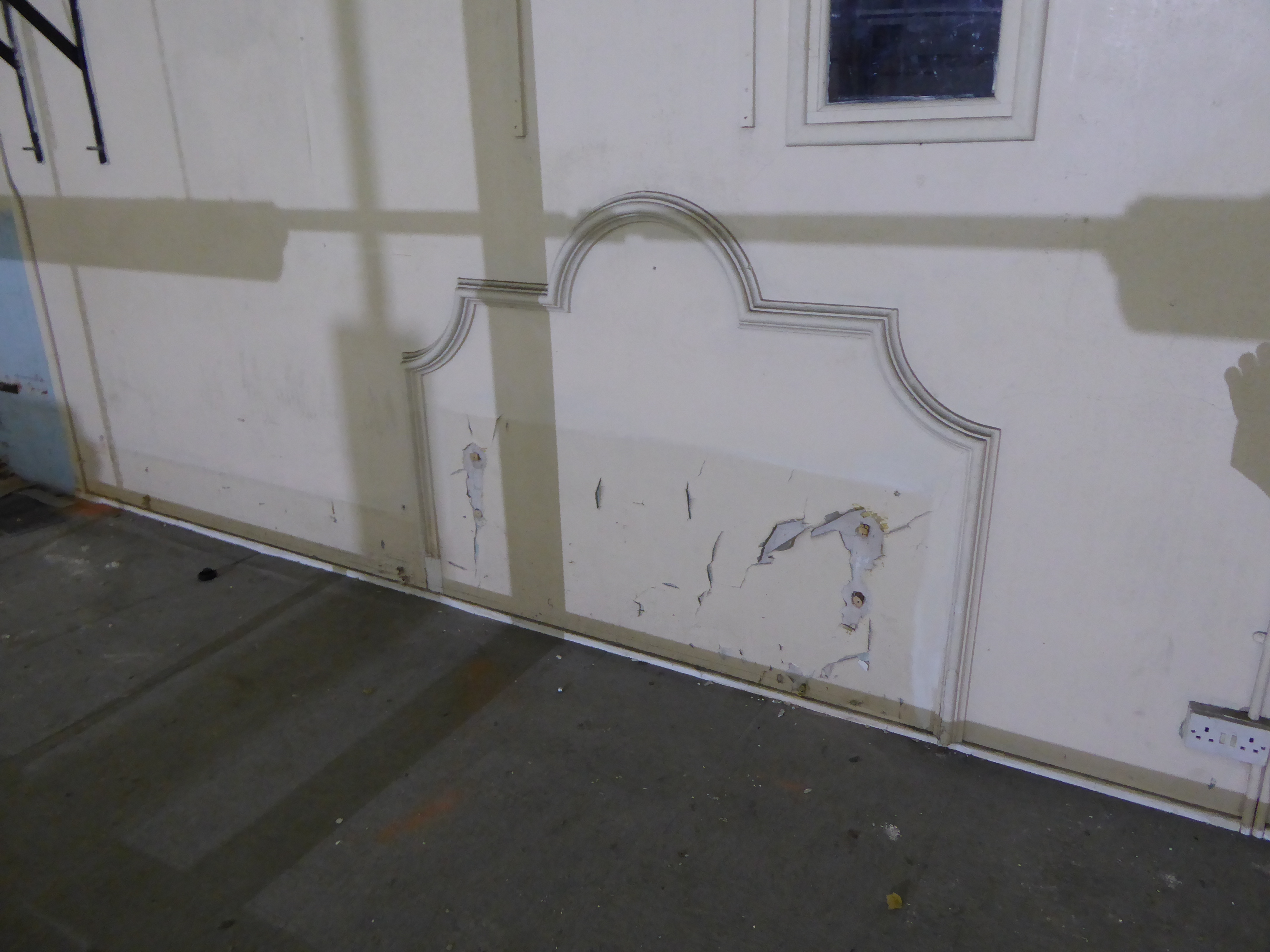
Inside there is little obvious reminder of the building’s life as a church although a memorial to John Carley, a barrister at law and the son of the Rev John Carley (minister 1811-1861) , can be found, as well as the outline of the decorative moulding around the long vanished pulpit and the place where the sounding board was once attached.

Antrim John Carley memorial

Memorial to John Carley

Antrim pulpit moulding

Moulding above the site of the pulpit of 1891

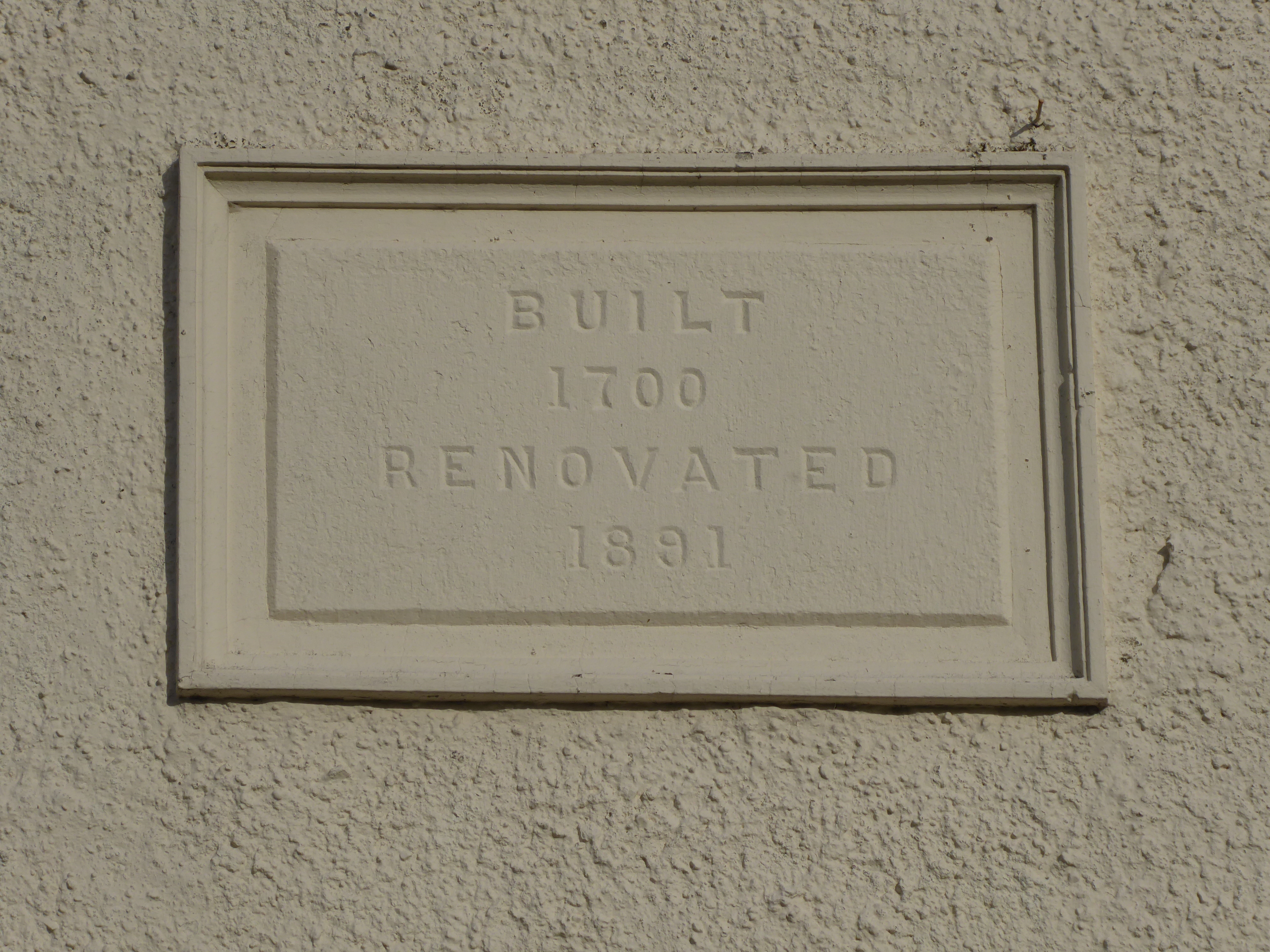
The interior was ‘turned’ in 1891, that is the location of the pulpit was moved from the centre of the long wall to the short wall at one end and the pews re-arranged accordingly. All those fittings are long gone but there is now tremendous potential for this survival from 1700.

Antrim Datestone

Datestone

No pictures or text may be reproduced from this site without the express permission of the author.