The title of this post comes from the Preface to A Collection of Psalms, Hymns and Spiritual Songs written by the Rev A.G. Malcolm for his hymnbook published in Newry in 1811.
Prior to about 1800 Non-Subscribing or New Light Presbyterian churches, in common with other Presbyterians, would have worshipped with a Psalter or Psalm book. The first distinctly Non-Subscribing hymnbook appeared in First Church in 1801. What is surprising about this publication is that in the same year Edward Bunting offered to supply an organ to the church. This offer wasn’t taken up although in just a few years the Second Congregation were to become the first church with an organ, First Church not acquiring one until 1853. The Rev William Bruce edited this collection and 1,200 copies were published. A choir seems to have led the singing which initially contained boys but was later expanded to include adults.
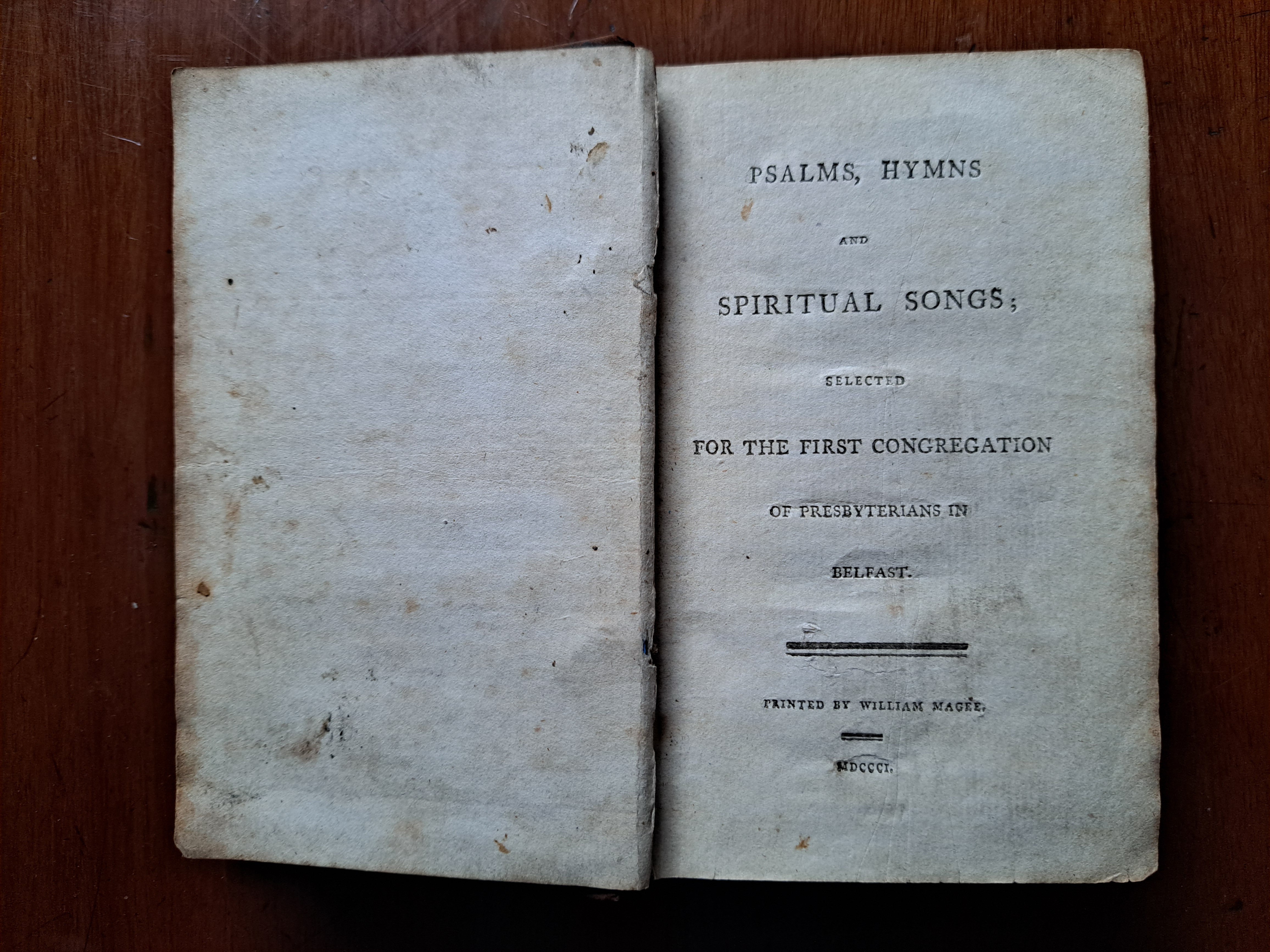
William Bruce’s book contained 246 hymns, with an index of first lines and a brief one page table of subjects. The next hymnbook, the Newry edition of A.G. Malcolm, contained 405 hymns with a more substantial table of subjects running over eight pages. Plus it had an index of first lines with the names of authors (for example Barbauld, Watts, Doddridge, Kippis, Merrick, Wesley, Addison, Enfield) which showed the eclectic sources the book drew on from within Dissenting circles and beyond.
An interesting preface also explained their intentions:
…care has been taken, to select psalms and hymns, which treat of of the leading points both of faith and practice; and it is hoped, that the compilation will be found to contain a sufficient variety of the best compositions, in sacred poetry, adapted to all the principal subjects of Christian devotion.
A.G. Malcolm went on:
Correctness, both in sentiment and style, has also been made an object of considerable attention. Hence, many verses have been altered; and such psalms and hymns as seemed, in any degree, unsuitable to the simplicity and solemnity of divine worship have been omitted.
As the work is intended for general use, and must be expected to fall into the hands of persons, who unavaoidably differ from one another, in their opinions, on religious subjects, all expressions, which appeared likely to give offence to any sincere Christian, have been studiously avoided.
Interestingly the next hymnbook, dated Belfast, July 1818 and edited by Rev W.D.H. McEwen, made a similar point in a slightly more forceful way in its Preface:
Some doctrines are so offensive to the societies, for whose use this compilation is principally intended, that they are carefully avoided. As to others, the same scrupulosity is not observed; for, with respect to them, there may exist a diversity of sentiment. This selection may, therefore, be thought defective, but it will not disgust by a pertinacious obtrusion of doctrine.
So certain doctrines weren’t allowed to get in the way! Some were left out all together – the Trinity, the theory of the atonement based on penal substitution – and on some doctrines Non-Subscribers were able to agree to differ.
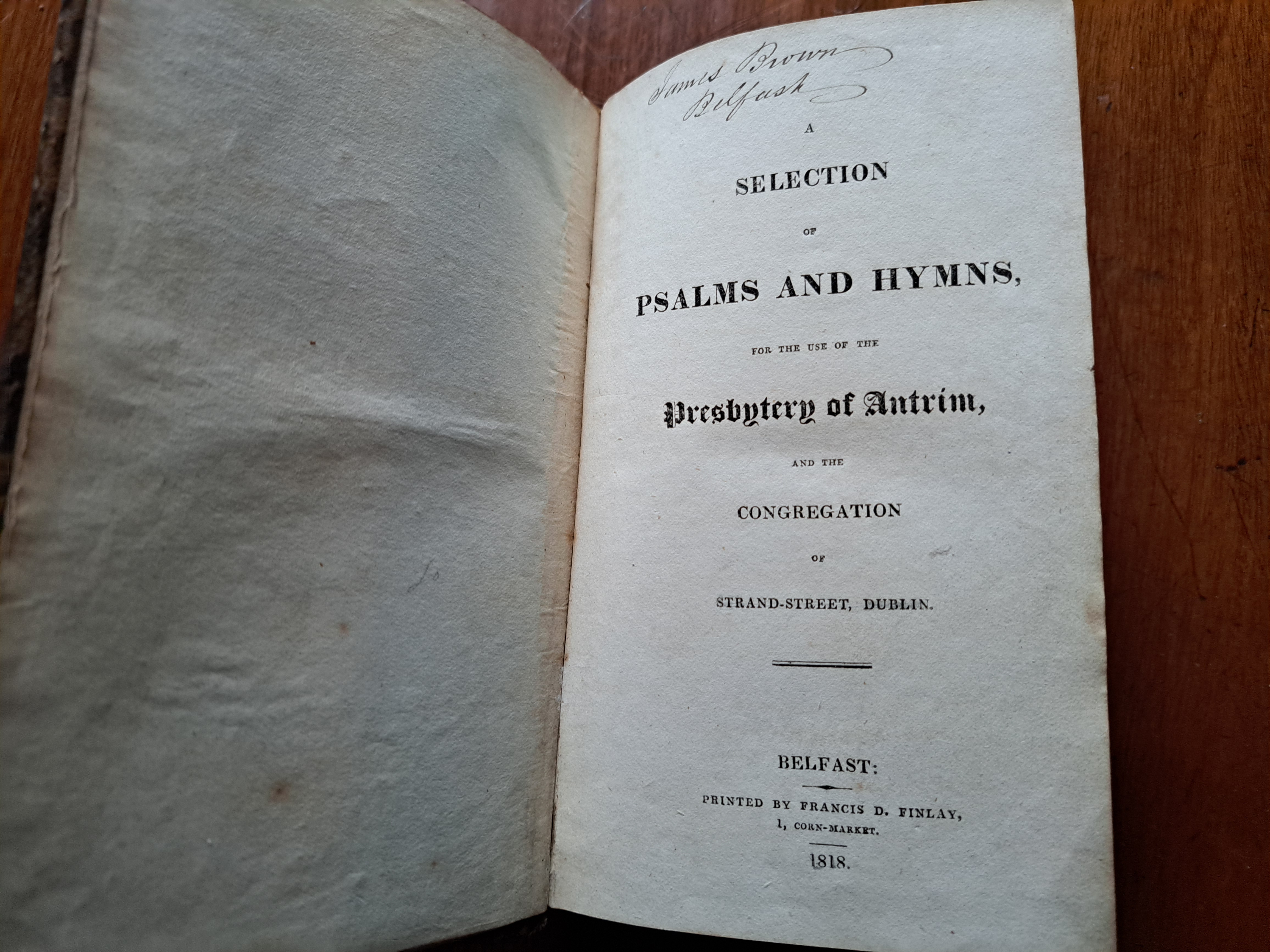
The book was published for the Presbytery of Antrim and the congregation of Strand Street, Dublin but it came from the minister of the Second Congregation. Curiously they had installed an organ in 1806 and had Edward Bunting as their organist from then until 1817. So they don’t appear to have had a hymnbook of their own for the first dozen years after installing the organ.
Following the establishment of the Remonstrant Synod of Ulster in 1830 Non-Subscribers moved towards the development of a hymnbook for all churches. This is Psalms, Paraphrases, and Hymns, for Christian Worship published in Belfast in 1841:
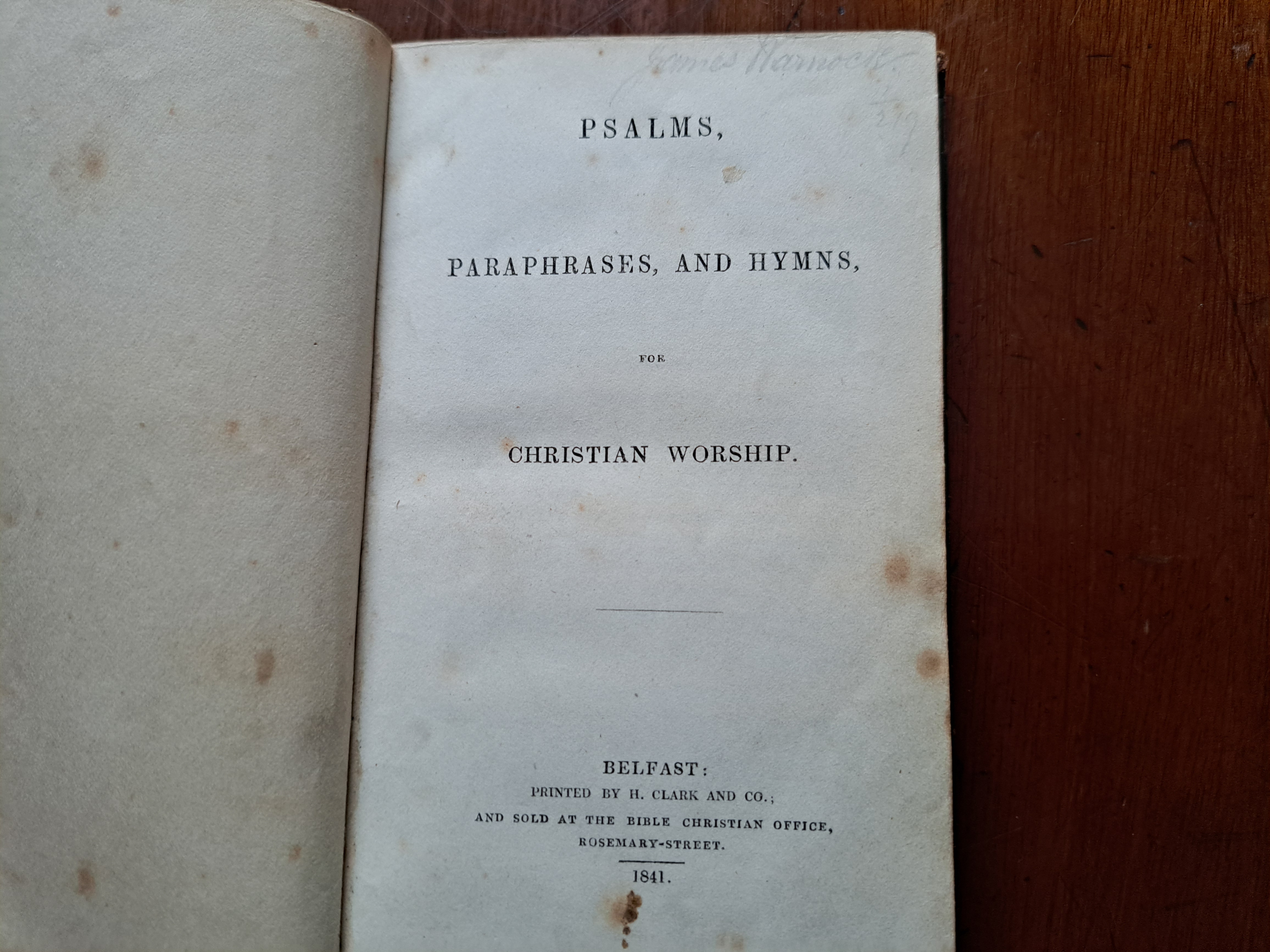
This is the first edition of what became Hymns for Christian Worship, a book which went into at least four further editions before the end of the century and was followed by a supplement in 1899. Throughout this time this was the main series of hymnbooks in use in the churches in Ireland. More detail can be seen in the video above.
 velvethummingbee